Amidst all the excitement of the Low Res, I received my annual rejection letter from the RA.
Immersed in all the distraction, I wasn’t bothered, which is why I have left it until now to reflect on this rejection. I’m still not bothered. Why? I’m not sure, in the end I invested quite a lot of time into the process of producing A Die, A Log, With You. However, I didn’t invest very much in an emotional sense – yes, it made me titter but it’s not as if I put my heart and soul into it. Why? because it was an arbitrary task I had set myself which was, frankly, getting in the way of more interesting things. Also, entering the Summer Exhibition is no longer my only artistic outlet into the big wide world. This blog has changed that.
Based on our discussion in yesterday’s session on the subject of success as an artist, I would say that I failed. The piece didn’t connect with others, and, perhaps more importantly, it didn’t connect with me. I used to think that my work was like a Harry Potter Horcrux with each piece containing a little bit of my emotional being. This piece has none of me, so was always destined to be a failure as a piece of work. However, as an exercise in ‘that will do’ as opposed to the normal quest for perfection it was a total success. So. I’m still left in a quandary as to why I didn’t feel connected – was it that in accepting something less than perfection I detached myself from it, or was I just not that into it to start with?
On the basis that I’ve ditched the individual topics areas, for the time being, I’ve not done too badly although I still haven’t made anything. That’s not such a problem because it’s been a hectic and emotional couple of weeks from both ends of the spectrum. I tend to chunk my life as a way to avoid feeling overwhelmed. If I have events coming up whether it be organising a birthday party, entertaining friends, jobs which I’ve been putting off, I can’t generally look beyond them. The future is looking relatively event free for the moment so I feel like I have some space to progress. I’m feeling optimistic. I started back at my oil painting class last week – I missed the last half-term because of the low res week.
I’ve been to Brasil! Brasil! at the RA – I managed to fit that in on the first Thursday of the Low Res, and I’ll cover it in a separate post.
I managed, finally, to attend Chris Koning’s online workshop on the perception of edges.
I’ve also been giving further thought to the research paper; I’m still thinking that I will do something associated with the fallibility of memory. I became interested in memory when my daughter was studying for her psychology A Level a few years ago, and I bought Julia Shaw’s The Memory Illusion, started reading it and never finished it. I’ve started reading it again.
I’ve found an artist, Al Hopwood, who explores themes of memory, identity and perception at the intersection of art, psychology and story-telling…to reflect on the construction of personal and collective narratives. Also, Perplexity has thrown up some other artists who explore the ways in which we remember, but I haven’t been able to research them any further for the moment.
Going forward…
I’m hoping to squeeze in Linder at the Hayward, Donald Rodney and Arthur Neal this weekend.
I’ve also been thinking about how else I can progress my work. I’ve been mulling over the unfillablehole issue and I keep coming back to the Alex Schady workshop and possibly making a video, or maybe painting a self-portrait and just slathering it with junk food, or just making a water feature for the garden! Who knows, but I’m sure there’s something there, I just need to think about it some more. The discussion on tacit agency with Paul Haywood also planted a seed as to how I might explore some of my childhood memories.
At the beginning we were told that our dog, Monty, has metastatic melanoma. Without treatment he will rapidly decline in a matter of weeks. With treatment he has a chance of possibly living to his natural life expectancy. With no significant side effects to the treatment, we are giving it a go, and he had the first dose of chemo and immunotherapy on Friday. If it becomes obvious that it isn’t working, we will stop.
We are devastated. I know he’s only a dog but he’s been a part of our family for the last 12 years; he’s been a part of my daughter’s childhood for more time than he hasn’t. I also can’t help thinking that some of the desperately crippling sadness I’m feeling is unresolved grief from my mother’s death, because I’ve been teleported straight back there.
For me, emotion and food are intrinsically linked. The need to eat in order to survive is a primal instinct. I have a need to feed. When I became a mother, my need to nurture and provide nourishment, in all its forms, for my family became paramount. And, of course, many people express their love by making food for others.
The refusal of food is one of the first steps in withdrawing from the world. I remember the lengths I would go to in order to try and encourage my mother to eat. I would spend so much time making her dishes which she said she fancied only for her to take one taste and decide that she didn’t want it anymore. The most difficult moment was when I had to accept that all I could do was to offer it, and not to try and browbeat her into eating it.
Monty’s not as keen on his food as he was. I have dishes full of different vegetables and meats that I’ve cooked, in an attempt to encourage him, in the fridge. Unfortunately, the only food he seems keen on at the moment is steak. When he eats it I feel like everything will be ok, but in the back of my mind is the nagging thought that all I’m succeeding in doing is nourishing the very thing which is killing him.
On a happier note, we had a party to celebrate my daughter’s 21st birthday this weekend. Family and friends came from all over to join us to sit down and have dinner together. There was much drinking and dancing, and everyone had a good time, welcoming the chance to reconnect with old friends or form new connections over food. Some of them I hadn’t seen for a few years – they looked older, as I’m sure I did to them. Even more reason to make the time to meet up with people as much as possible – to walk the walk, and not just talk the talk.
Apparently, Guns N’ Roses didn’t know how to end their most successful song, Sweet Child O Mine. Whilst in the recording studio, Axl Rose reputedly started singing, ‘Where do we go? Where do we go now?’ And the rest is history and, in my humble opinion, probably the best bit of the song.
So a moment of inspired creativity can come from a total lack of direction and confusion. Here’s hoping…
I’m resolved to wallowing in the myre of confusion. There’s not much point in fighting it; I can’t understand everything. The latest book we read in my book club was Michael Ondaatje’s ComingThrough Slaughter. I’ve never read a book like it. It deals with the mental decline and eventual death of the New Orleans cornet player, Buddy Bolden, who is considered to be the father of jazz. I didn’t understand what was going on half of the time, who was talking, and to whom. It jumped around all over the place. There aren’t any chapters as such, just three parts, no speech marks and paragraphs end at odd points on the page and continue on the next – visually it is striking. It is a book to be read, not to be listened to; its format echoes the improvisation and syncopation of jazz music. Once I had decided that perhaps I wasn’t supposed to understand it and just went along with it, reading each phrase and word in its own right, looking at the patterns, and the sounds of the words, a bit like reading a poem (after all, Ondaatje is a poet), I got a lot more out of it.
So this is how I intend to move forward. And it’s just as well, because try as I might to keep up with the constant flow of information being offered up by Paul in the Low Res etching workshop, I just couldn’t. I started taking notes, but just gave up in the end and surrendered myself up to not understanding anything and just enjoying being along for the ride.
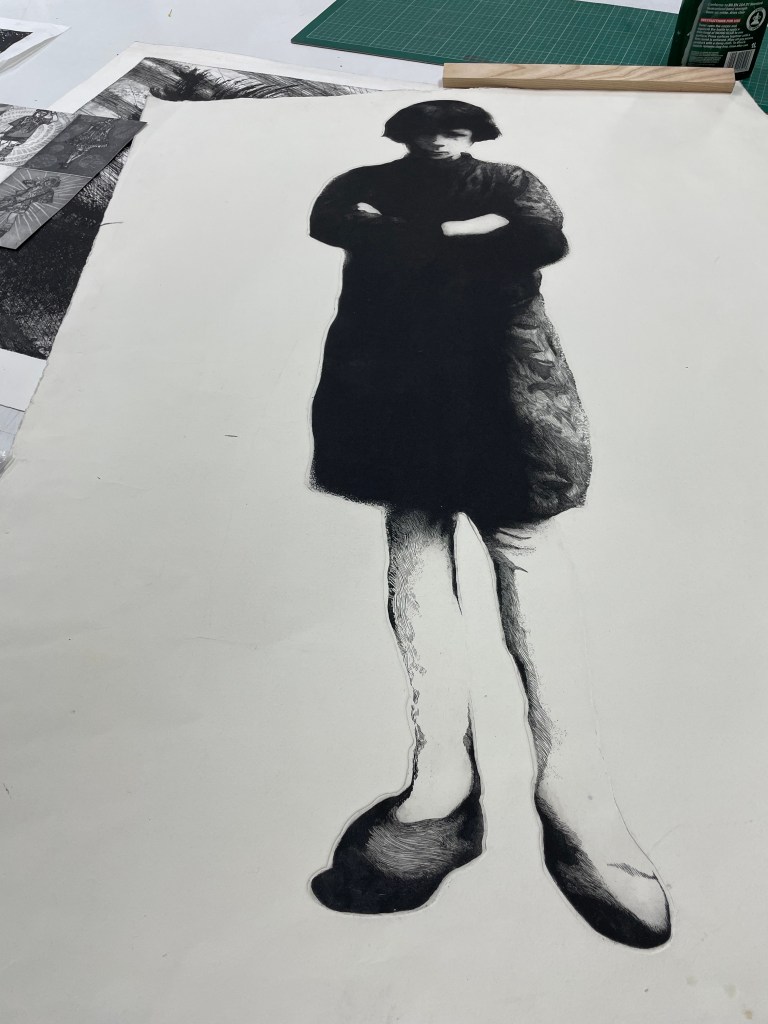
It kicked off with Paul showing us what we could have gone home with, had we the requisite skills. There were some impressive prints which demonstrated the versatility of printmaking which I hadn’t really fully appreciated until now.
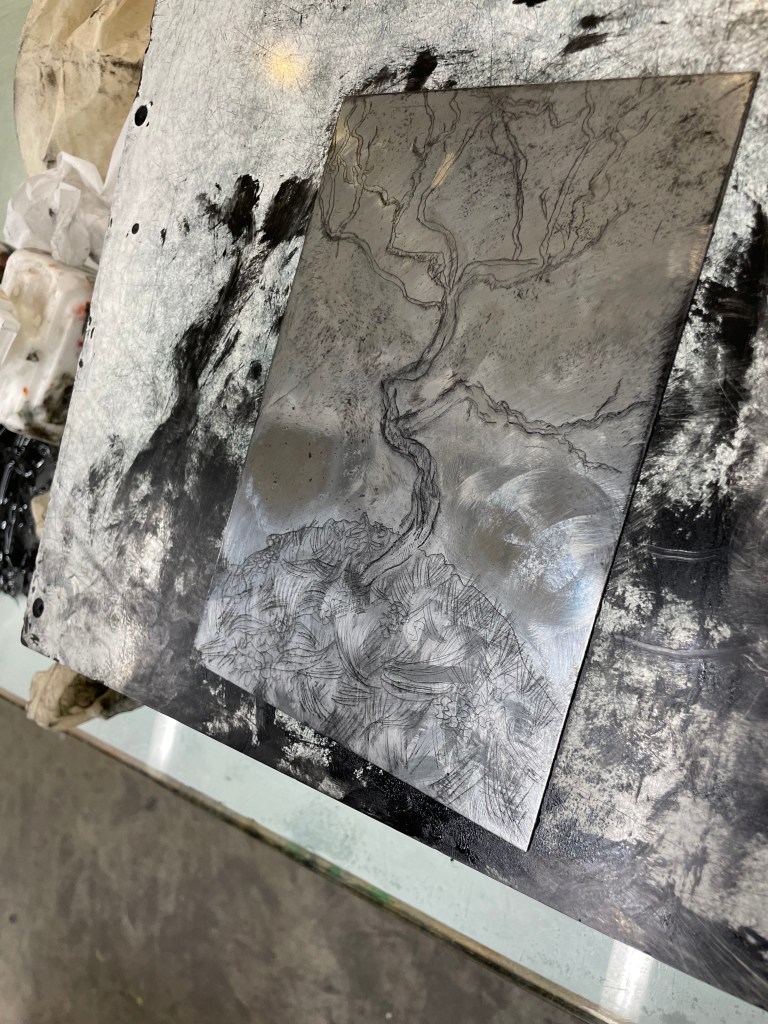
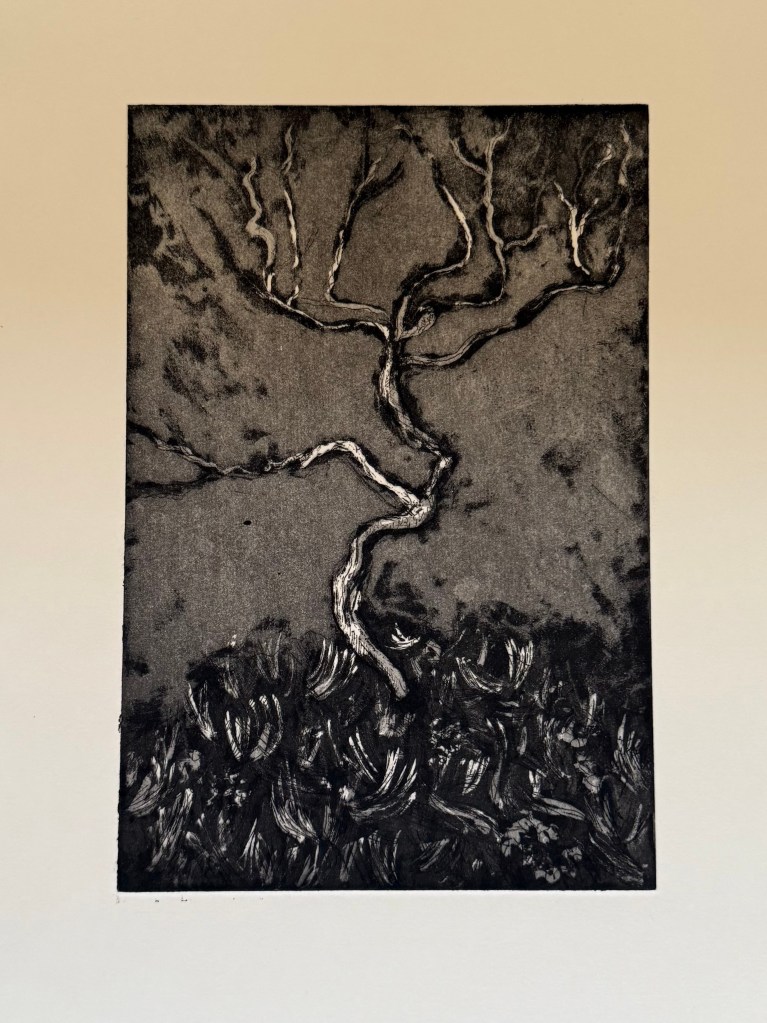
We started off by putting down a hard ground on a zinc plate and then we had about 20 minutes to create the image using a selection of Paul’s tools. What to do? I had a quick look on my phone and chose Schiele’s Small Tree in Late Autumn.
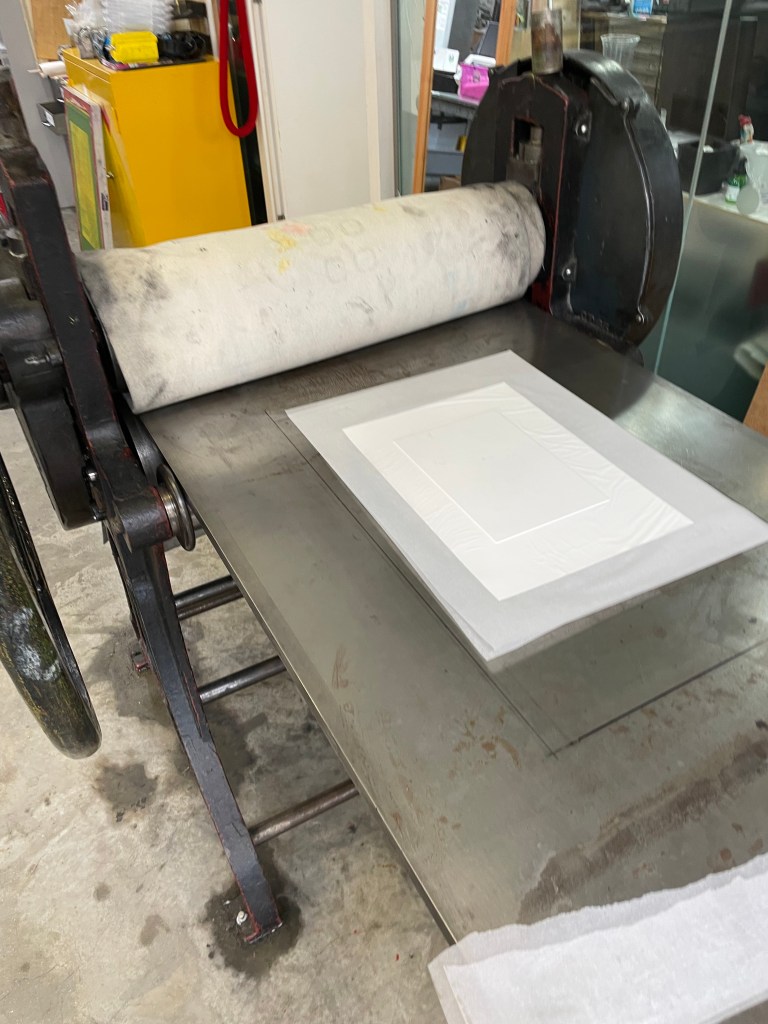
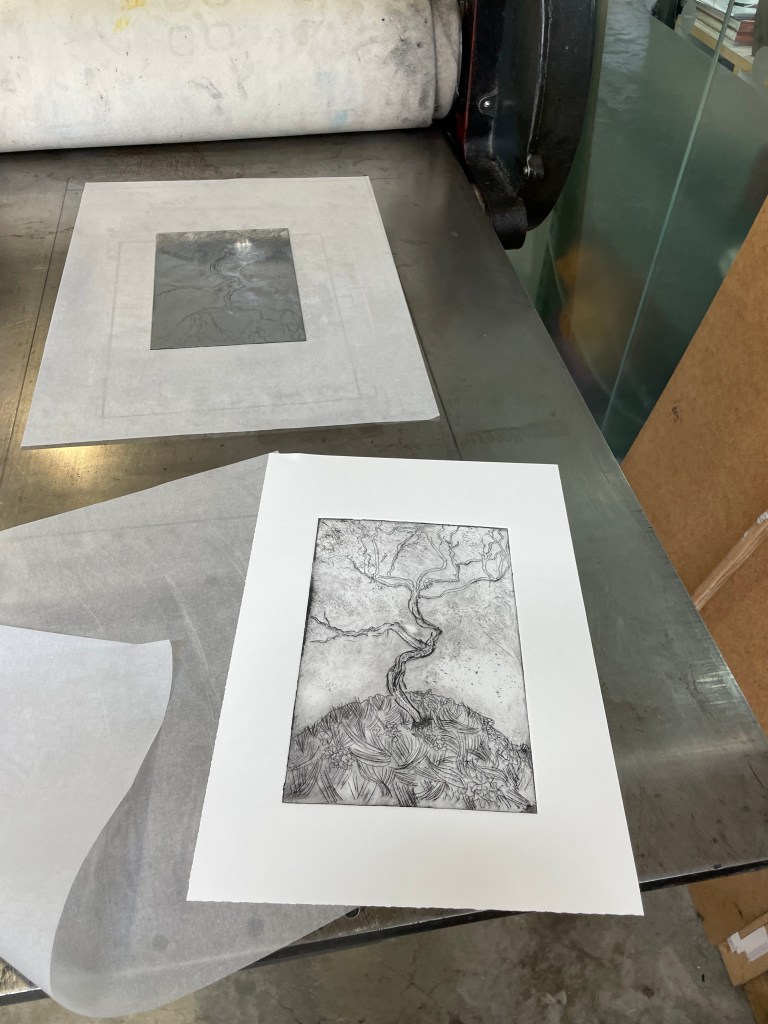
This is the plate once the hard ground had been removed and it had been cleaned followed by the printed images, using aquatint on the last one.
How do I feel about them? Pretty good bearing in mind I only had 20 minutes to create the plate and I had very little idea what I was supposed to be doing most of the time. Will I do it again? I don’t know – it’s very process driven, and whilst I love the excitement and anticipation of the big reveal, I’m more of an instant gratification kind of person. That’s not to say that I’ve ruled out etching altogether, it’s just that I would need a greater understanding of the different and quite complicated steps involved to do it any justice, and that’s just not compatible with the ‘new me’ at the moment.
In this week’s session, as preparation to discussing the impending research paper, we discussed the value of writing for artists. For me, it is a way of organising my thoughts and recording my decision-making so that I can look back and remember why I did what I did, also allowing me to identify any patterns in my way of working or thinking. It also allows a breathing space to step back, to reflect and evaluate. The process of writing often triggers the development of existing thoughts as well as generating new ones. It is also another means of expression; sometimes writing about something provides inspiration as to how I might convey an idea; I often find inspiration from other people’s writing (Parental Loss IMotherhood I); and sometimes writing is the only way to express something, Three Conversations With My Mother. It is an invaluable process.
Jonathan then asked us to spend some time thinking about what is intriguing us.
I have been thinking a lot lately about a conversation I had with Lyberis on the last day of the Low Res. We were in the bar discussing the talk with Jeremy Deller we had just been to, and also the Whitechapel Library audio walk by Janet Cardiff we had experienced in the morning. We had both been blown away by it. I’m trying to understand why it excited me so much; possibly because there was an element of immersiveness, but at the same time I was aware of what was going on around me both visually and audibly; being both removed from and in my surroundings simultaneously was a really interesting experience, particularly when what I was hearing synced with what was actually going on in the real world, like the sound of a moped, just as one went past. The section at St Botolph-without-Bishopsgate was fascinating as she describes two men, one in blue, sitting on a bench, and there actually were two men sitting on a bench chatting. If I had been them, I would have felt unnerved by 20 odd people all sitting down in silence and then getting up and leaving at the same time. It was difficult to work out what was going on. It seemed to be part detective drama, that we were with her looking for someone, as well as a collection of memories, and then, when we reached Liverpool Street Station, she theoretically abandoned us to find our own way back to Whitechapel to return the discman to the library, presumably relying on our memory. It’s just as well they were downloadable files!
But this got Lyberis and me on to talking about memory; how we are made up of our memories; but what if the memories are incorrect or false? I started thinking about how what I am doing is based solely on my memory. My memory is fallible, even photographs are open to interpretation, as we discovered in one of our previous weekly sessions. What if I am my own unreliable narrator? Even if my memories are factually incorrect, if I have a strong emotional response associated with something, surely that can’t be wrong? Is emotion the only true memory? Even if my memories aren’t correct, does that make them any less true to me? And then I was listening to the news on Radio 4 the other day and they mentioned that the writer, Mario Vargas Llosa, had died – he believed that novels should present lies as truths. This gives rise to the possibility that I could even invent my own history.
After taking us through the ins and outs of the research paper, Jonathan raised the issue of AI. He said he uses it to have a dialogue, to challenge his thinking. I’ve used it to critique a piece of work. I came across this article in the Guardian yesterday morning about the artist, David Salle, who has turned to AI to breathe new life into old paintings which hadn’t been rapturously received ‘I sent AI to Art School’.
Attended the Interim Show and the Low Residency Week
Posted on the blog a few times
I’ve mentioned in previous posts that I haven’t really done very much over the last 3 weeks since the Low Res. My inactivity has caused me some stress. But I have been thinking, and feeling a bit overwhelmed: processing everything I experienced and learnt from the week, cogitating as to how it could inform my work, thinking about where it all leaves me and where I go from here, trying to find a sense of direction, but to be honest I’ve been feeling more than a little lost. I think that was why I felt the way I did when I looked at the second year blogs; they all seemed to have such a clear sense of direction.
When I curated my blog for the Unit 1 Assessment and looked back at my Study Statement I had a sudden realisation that I might never get to the end, that I had bitten off more than I could chew, that I would only be able to cover all of the individual elements I had identified in a cursory, superficial manner which would not do the subject, or me, any justice. For this reason, my request for specific feedback was:
“I am concerned that the subject matter of my programme of study is too broad and, that by its very nature, is a process which will continue beyond the end of this course, something that I have already acknowledged in my Study Statement. I would like some feedback as to the consequences, if any, of there being no ‘conclusion’ as such, and whether I should consider narrowing my line of enquiry.”
I had hoped that maybe I would be gifted a steer, or a hint. But, the response was:
”You asked about whether you ought to be narrowing your approach but arguably you have to explore a double diamond shape for practice…
start at a narrow point
then expand wide
then narrow again
then open out again
— this good and a helpful place to be and probably clarity will emerge organically. You are certainly doing all the right things to create the environment where focus emerges.”
I felt like I was being told to step up to the edge and jump, and trust that there is probably a safety net waiting to catch me. A blind faith that the process will lead me through the confusion and show me the way.
But having thought about it some more over the last couple of weeks, I now realise that to progress forward I need to concentrate on those aspects which interest me the most, which I believe have affected me the most. In doing so, I will naturally leave to one side matters about which I don’t really have a lot to say. Already, in my mind, the possible avenues to explore have been significantly reduced to those which have been the strongest emotional experiences. In exploring these events, I still want to keep open a range of possible media, although I already sense that some appeal to me more than others, but I want to finish exploring the possibilities before concentrating on just a few: I tend to choose the medium which I think would best express what I’m trying to convey. Whilst I don’t like too much choice, I do like to have a few options. I don’t think that I could only ever work in one medium – I would find that too restrictive, particularly as I think that I have quite different needs to be met – a need for detail and control at the same time as a need for loose expression and experimentation.
I have also resolved to scrap my work plan in so far as I have sought to set myself on a prescriptive path; I will work on whatever interests me when I wake up in the morning. In my work plan I have also attempted to impose a way of working which really isn’t who I am. I’m trying to force myself into a pigeon-hole which isn’t my shape; to have some self-discipline, which frankly I don’t have. I work to deadlines, although just recently I haven’t left things to the last minute, which has been a huge change in me. I completed my Study Statement and Unit 1 Assessment leaving myself plenty of time to review and reflect. I also recognise that I don’t have a constant rhythm of working; I have periods of intense activity and then I reward myself with a period of doing nothing, although I am – I’m thinking and processing and doing other activities such as reading and looking at art, which are equally as valuable.
So, I’m not going to beat myself up that I haven’t produced anything over the last few weeks. Instead, I’m going into this week having recognised some truths about myself and intending to do whatever takes my fancy, if anything, although I do need to finish my posts on the Low Res. Maybe if I do make something I will feel differently about it because I have chosen to do it rather than feeling that I ought to have done it. I came across a reel of Steven Bartlett’s podcast with Chris van Tulleken, who was explaining a time when, at the end of a family dinner, he had decided to to clear the table and put the dishes in the dishwasher, but before he could do so, his wife turned to him and asked him to clear the dishes away. He commented that he had gone from having agency and contributing to family life willingly, to doing someone else’s bidding.
I’ve always thought it a good idea to try to see the world through someone else’s eyes, but perhaps misappropriating Alex Schady’s glasses during our collaborative making workshop wasn’t the best way to go about it, although I’d love to see the world the way he does! I imagine that it would be a lot like the experience I had in the Apple Store the other day when I accompanied my daughter who was buying a new laptop. Whilst she was doing her thing, I wandered over to the table with the futuristic looking Vision Pro headsets. Did I have time for a demo? Hell, yeah!
Apparently someone very technically minded in a back room somewhere was building my device for me based on my head size and glasses prescription, and then out it came ceremoniously offered up on a velvet cushion for my delight. Well, an hour later, having held a butterfly on my hand, walked with a tightrope walker across a ravine, ducked to avoid the flick of a dinosaur tail and had VIP access to a Metallica concert, I rather reluctantly removed ‘my precious’ and handed it back. My cheeks hurt through the stupid grin which must have been plastered all over my face. According to my daughter, I had turned into a child and had been making quite a lot of noise which had attracted quite a lot of attention. All the way home I was considering what I might sell to raise enough money to buy one. But then reality set in; I’d never go out of the house again, and would be destined always to watch films by myself (hang on, is that such a bad thing?). But it turns out that it’s had some mixed reviews, and so I resolved that I could spend the money I had saved by going on a nice holiday, and try to get my hands on one of Alex Schady’s spare pairs of glasses instead – he has quite a few apparently because he keeps on losing them. I wonder if he ever walks past someone and thinks, those glasses look familiar.
Until then I’ll have to make do with his fascination with holes. All sorts of holes; sink holes, caves, the holes the Road Runner used to fall down, black holes, white holes. He explained that the thing about holes is that they are defined by what is around them rather than the hole itself. Thinking about it, generally speaking, a hole is the void where something used to be. I have a hole somewhere inside me. I don’t know what used to be there, but I find myself trying to fill it with food, rubbish food, even when I’m not hungry and particularly when I’m bored. The thing is, I know that it’s a hole incapable of being filled, and that I’m not doing myself any favours in terms of my health whilst I engage in such a fruitless activity, but, nevertheless, still I try. I once told a counsellor, who was helping my daughter with her needle phobia, that I thought that my brain was trying to kill me. I could see the pound signs light up in his eyes.
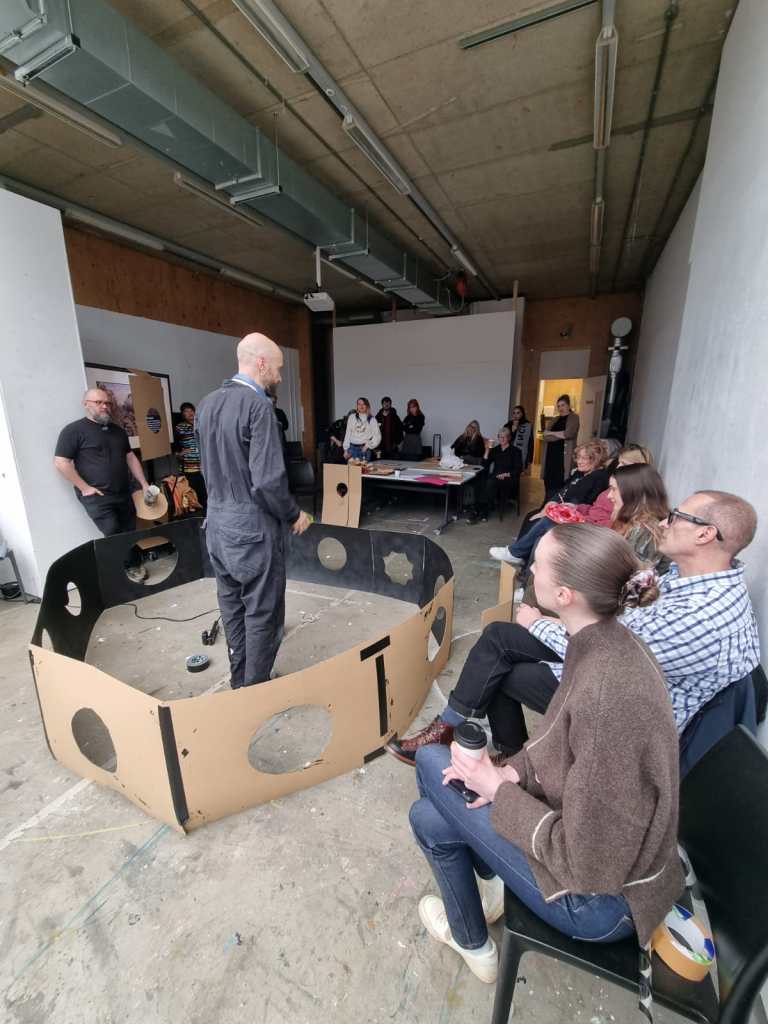
So, Alex got us to cut holes in some card and took us off into the outside world where we stopped still, on his bell, and focussed on what we could see through our differently shaped holes; a lot of perplexed passersby and the fruit and vegetable section of Waitrose. It became something close to a performance, and I half expected some members of the public to whip out their cardboard holes and join us. It’s interesting how masking the extraneous can make you notice more details which perhaps you wouldn’t notice in the round. I found myself slightly adjusting my hole so what I could see through it became more compositionally pleasing.
Then it was back indoors where our holes were repurposed by being joined together to form a circle and painted black. We then had to make something which would move inside the holes as Alex filmed them from the inside using a small turntable.
I forgot to photograph my piece which was a circular piece of card with tissue paper and a length of finger-knitting glued onto it in a spiral to represent my oesophagus, which I was going to spin around on a pencil. A strange choice, I agree, but I had just been talking to Zoë (to whom I owe thanks for allowing the use of her photos from the day) about recently having had an endoscopy. I’d been experiencing a sensation of having a lump in my throat for a while, and Dr Google had diagnosed it as being globus, which is a common side effect of reflux, but the GP didn’t necessarily agree and decided, in light of my family history of oesophageal cancer, that it was better to be safe than sorry. I told them to give me all the drugs they had, and all went fine (turns out I have a hiatus hernia) although I do remember seeing inside myself at one point which was ever so slightly weird. Zoë and I agreed that I should get hold of the images by making a data access request to see if I can use them in my work.
The last activity of the day was to make a cardboard structure which was to have a phone at one end and, at the other end, an image with a hole cut out of it. The trick was to get the distance between the two just right so that neither the image nor what could be seen through it would be out of focus, which proved to be quite difficult. We then went out onto the roof and did some filming for one minute. I filmed using one continuous take – it didn’t really cross my mind to pause and change focus. Thinking about it now, this meant that the decisions I made as to where to go next were determined solely by what I could see through the camera and not by extraneous influences. Rather than moving from left to right, I think, in retrospect, it would have been more effective moving in the opposite direction which would have created a relationship with the image itself, as if the figure is being thrown off balance by the movement.
Developing this idea further, it would be possible to see, quite literally, through someone else’s eyes. In this respect, Sophie chose an image in which a model was wearing sunglasses, which she cut out, which was ingenious.
All in all, a super-charged day which has provided lots of food for thought.
In the film Six Degrees of Separation (based on the play of the same name written by John Guare) one of the main characters, Ouisa Kittredge played by Stockard Channing, says:
”I read somewhere that everybody on this planet is separated by only six people. Six degrees of separation between us and everyone else on this planet. The President of the United States, a gondolier in Venice, just fill in the names. I find it extremely comforting that we’re so close. But I also find it like … water torture that we’re so close because you have to find the right six people to make the connection. I am bound, you are bound, to everyone on this planet by a trail of six people. It’s a profound thought… How everyone is a new door opening into other worlds.”
I don’t think I agree with her that it’s comforting to be that close to the President of the United States, or to many other people who live in this world of ours, for that matter.
The film was made in 1993, more than 10 years before the advent of social media, and so application of the theory would be dependent on your level of knowledge of the networks of friends and acquaintances. It was a fun game to play when we didn’t have anything better to do. I once got to Nelson Mandela in 4, Edward VII in 3 and perhaps most impressive of all, Ant & Dec in 2. In the age of social media it’s definitely a lot easier, and research carried out a while ago by Meta suggests that, certainly in terms of social networking, the number of degrees is probably closer to 3.5.
But, yes, connections are important and they enhance our lives and can be discovered in the most unlikely of circumstances. Unexpected connections can provide comfort that the choices we have made are the right ones. Who would have thought that even if I wasn’t on this course I would still be able to connect to Jonathan in 2? I just wouldn’t know it.
There are connections which become long-lasting and develop into relationships, and those that stay transitory. On my first night in London for the Low Res, I was having dinner in a restaurant near to my hotel, trying to make some headway into Stephen Fry’s Mythos but getting terribly distracted people-watching. A couple came in and sat at the table next to me. The woman saw my book and asked me whether it was his latest. One and a half hours’ of non-stop talking later, with the restaurant staff clearly eager to close up and head off home, we said our goodbyes never to see each other again. He was a lawyer with a keen interest in Roman civilisation and Greek mythology, and he would read books to his wife in bed (each to their own). I told him my story and encouraged him to embrace his passion and seize the day. He won’t, but that doesn’t matter because we talked about anything and everything connecting on so many different levels, but sometimes that’s all it’s destined to be, a connection in a moment in time.
I have been able to make even stronger connections with the majority of my course mates having now met them in person and spent hours in their company. We did a lot of travelling and walking over the course of the week which was a great opportunity to chat with everyone including the second year students who imparted some really helpful advice. It was a strange experience meeting people who I have seen on Zoom every week – would greeting them with a hug be appropriate?
It was an amazing time spent with like-minded people. I spent hours chatting about life and work with Rebecca who is such good company. She was explaining how each piece of her work is influenced by one of her stories (one of my favourites being Maureen and the Pope) whilst we were on our way back to CSM on the tube one day, when I noticed a young girl sitting opposite us holding a camera in her lap absolutely transfixed by Rebecca. After a couple of stops she got up from her seat and moved to stand next to Rebecca (who later confessed to being slightly worried that she was going to ask her to give up her seat because she wasn’t feeling well). She then rather apologetically explained that she couldn’t help but listen to what Rebecca had been saying, and that she found it really interesting as she is doing an Art A level and has had difficulty in finding focus in her work. The conversation continued for several more stops, up the escalators and through the tunnel until we parted ways. Another connection for just a moment in time, but hopefully one which was inspirational.
I’ve decided that I’m probably learning far more about myself by simply being in this process than I am by looking back on my life.
I need to retrain my brain. My legal training has made me focus on detail, anticipate every possible eventuality, dot every ‘i’ and cross every ‘t’ all within a rigid framework of rules and regulations. That way of thinking served its purpose then, but it now stultifies creativity.
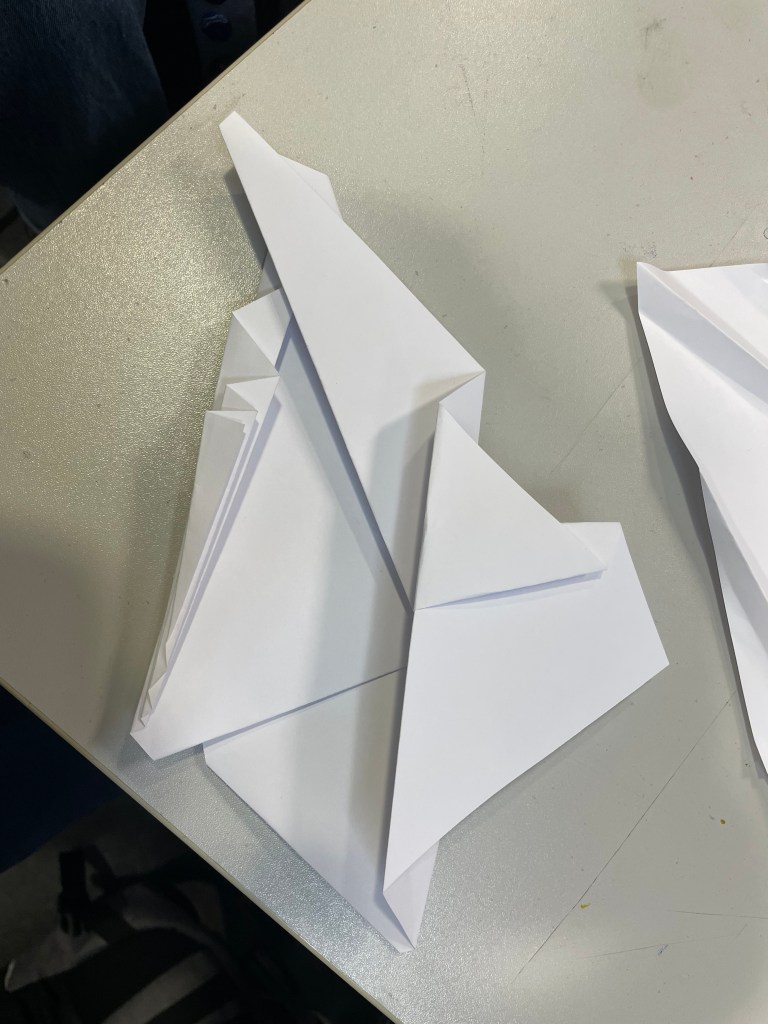
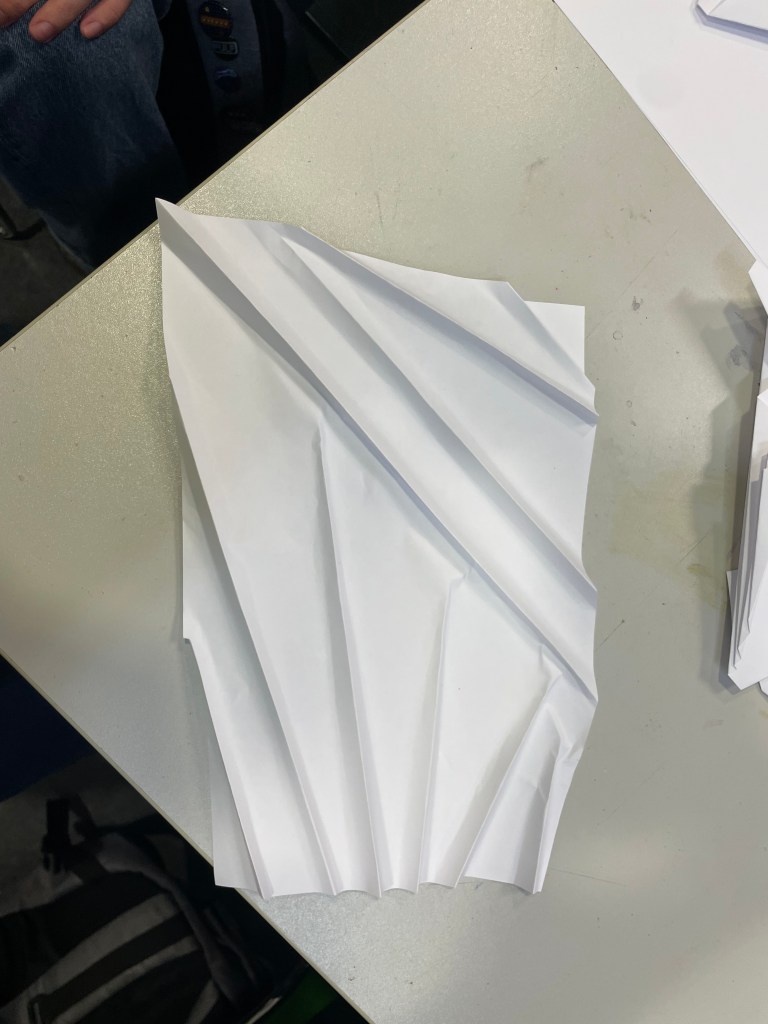
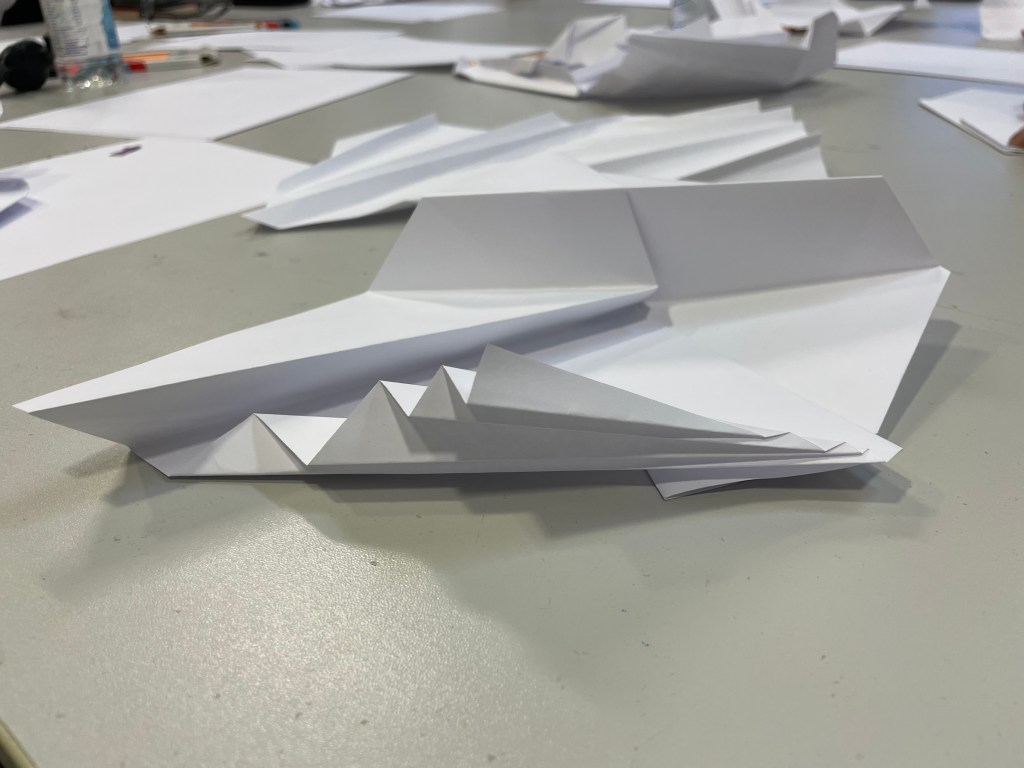
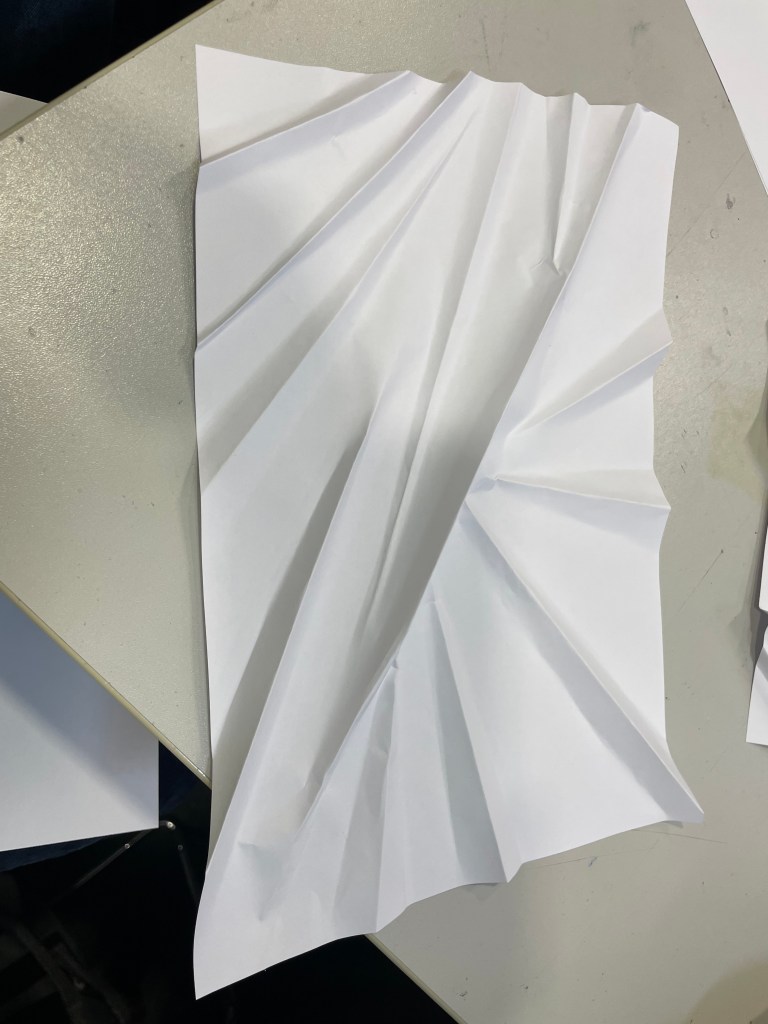
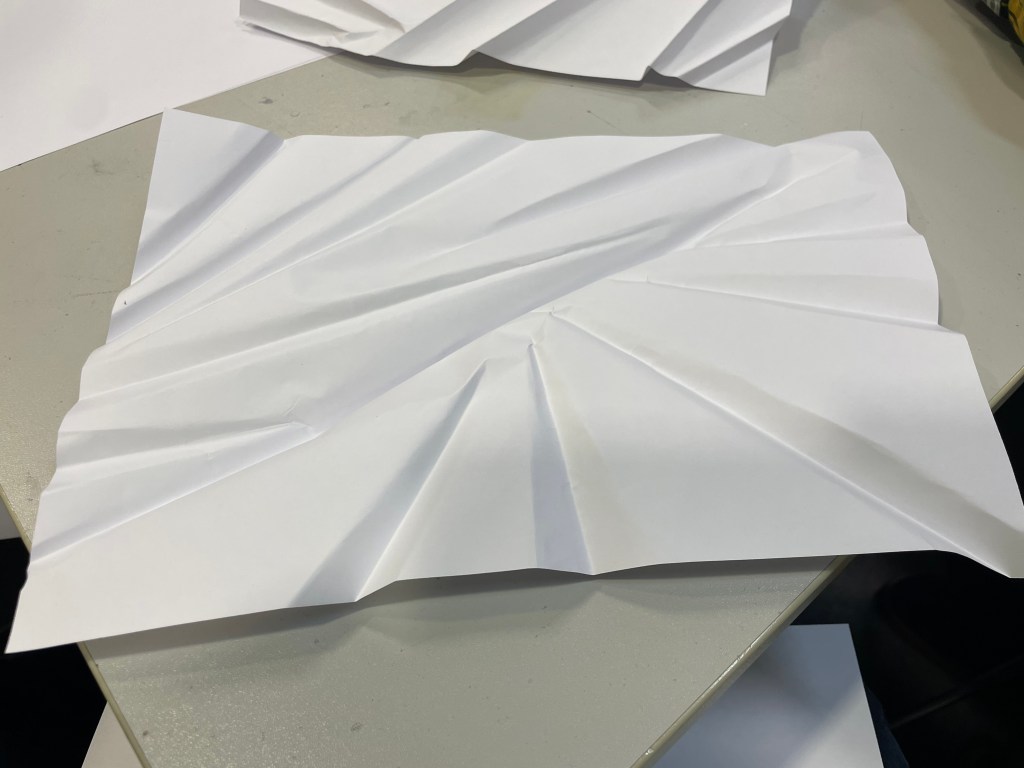
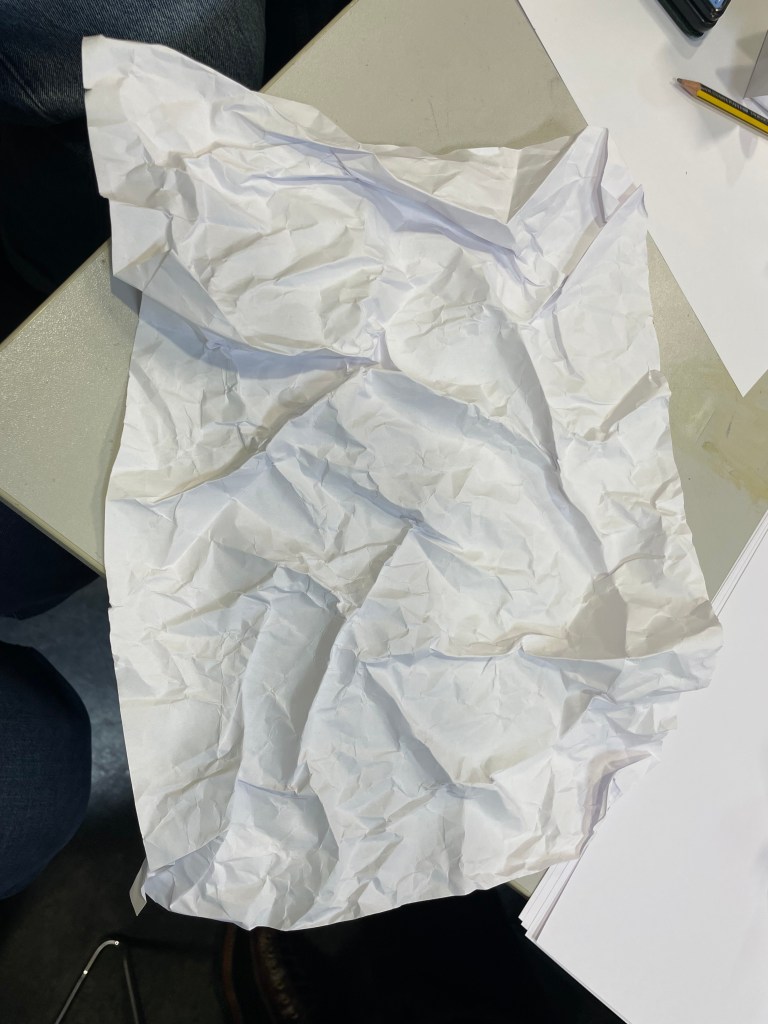
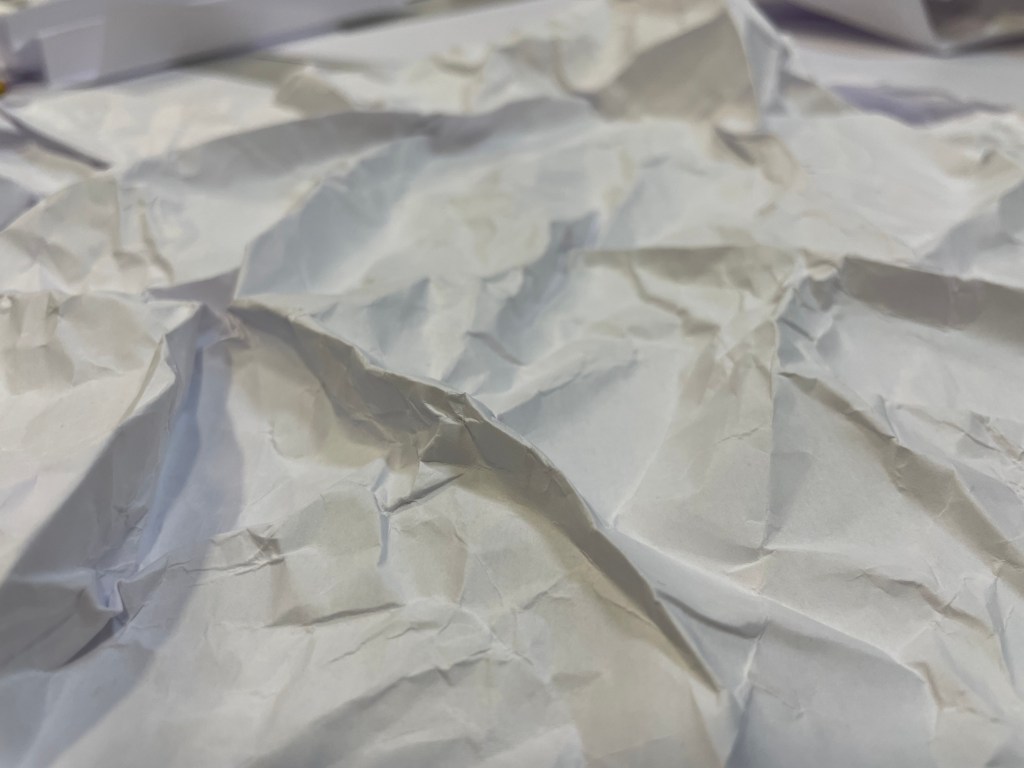
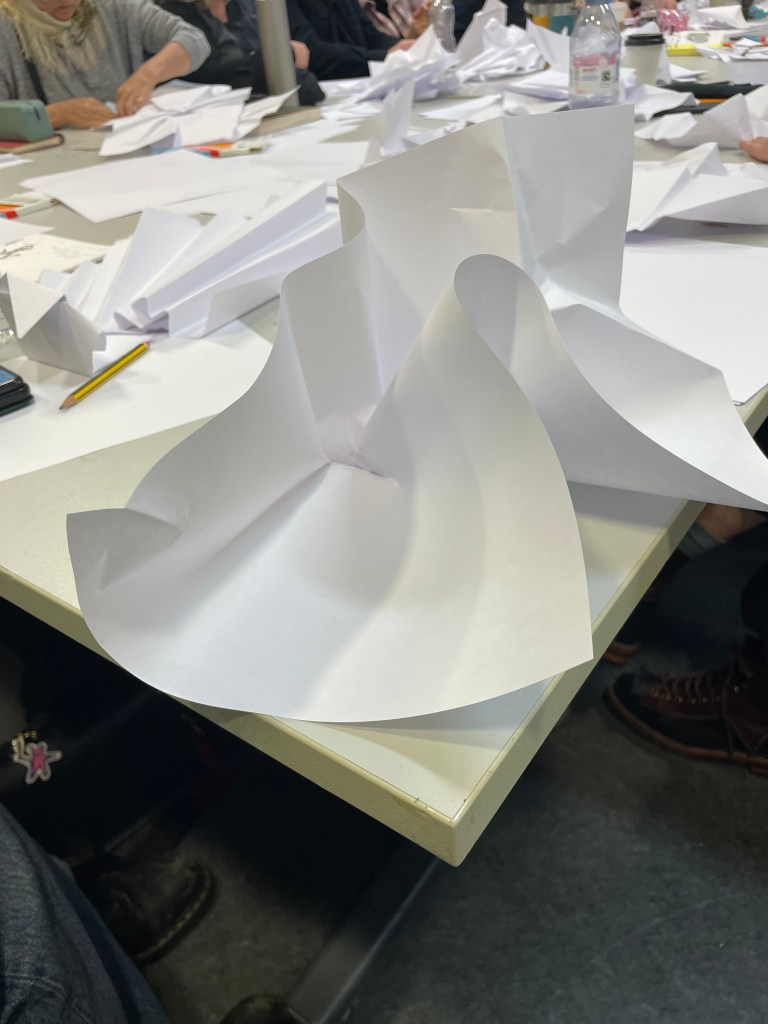
When I’m in a scenario which is unfamiliar, I like to know the parameters within which I’m expected to navigate; quite often I feel discombobulated when things don’t go the way I am expecting, the paper workshop with Christian Azolan being a case in point. We were instructed to fold the paper. To my pedantic mind, folding involves a deliberate act of bending something over on itself to create a clearly defined edge. It doesn’t include scrunching. But once I had overcome my initial confusion and accepted this unexpected variation of the parameters, I enjoyed myself.
I definitely preferred using the blank paper – I don’t know what brand it was, but it felt really good. It led me to confess my fetish for pristine white paper to some of my fellow students. I think it stems from being at primary school when the teacher would write my name on the front of a new exercise book with a marker pen and I would go back to my desk and give it a good sniff. I now appear to associate blank paper with a solvent high. I don’t think that my school ever had a pupil who was so keen to man the stationery cupboard at break time. In fact, I used to get palpitations and a bit of a sweat on just walking into WH Smith (R.I.P).
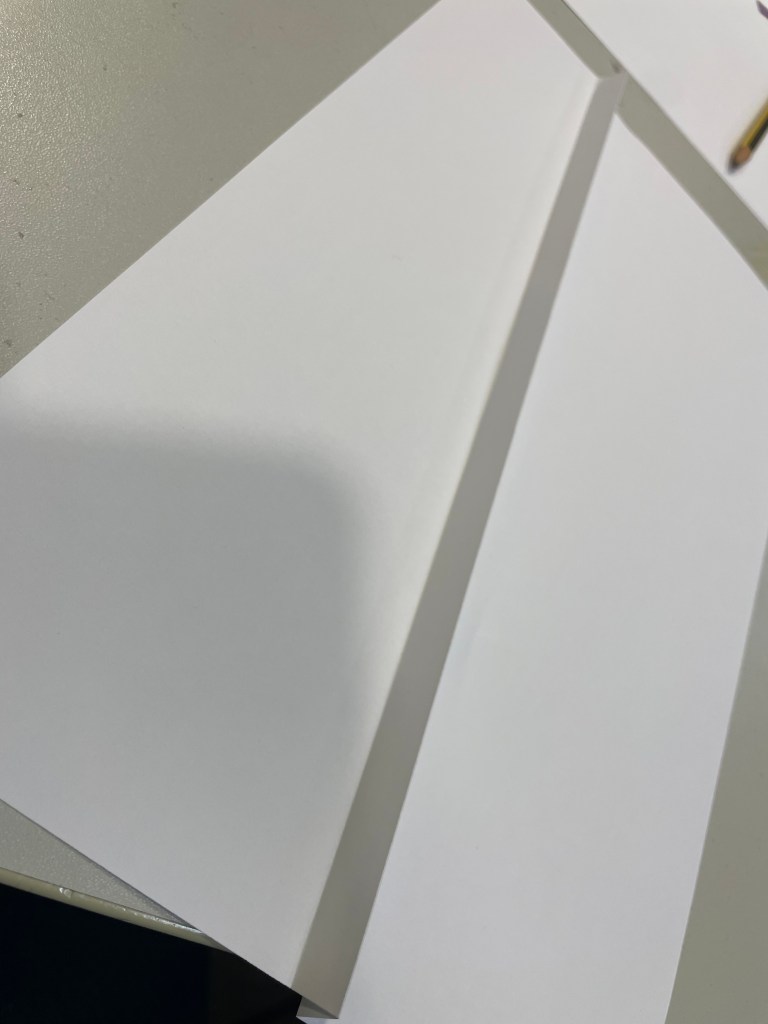
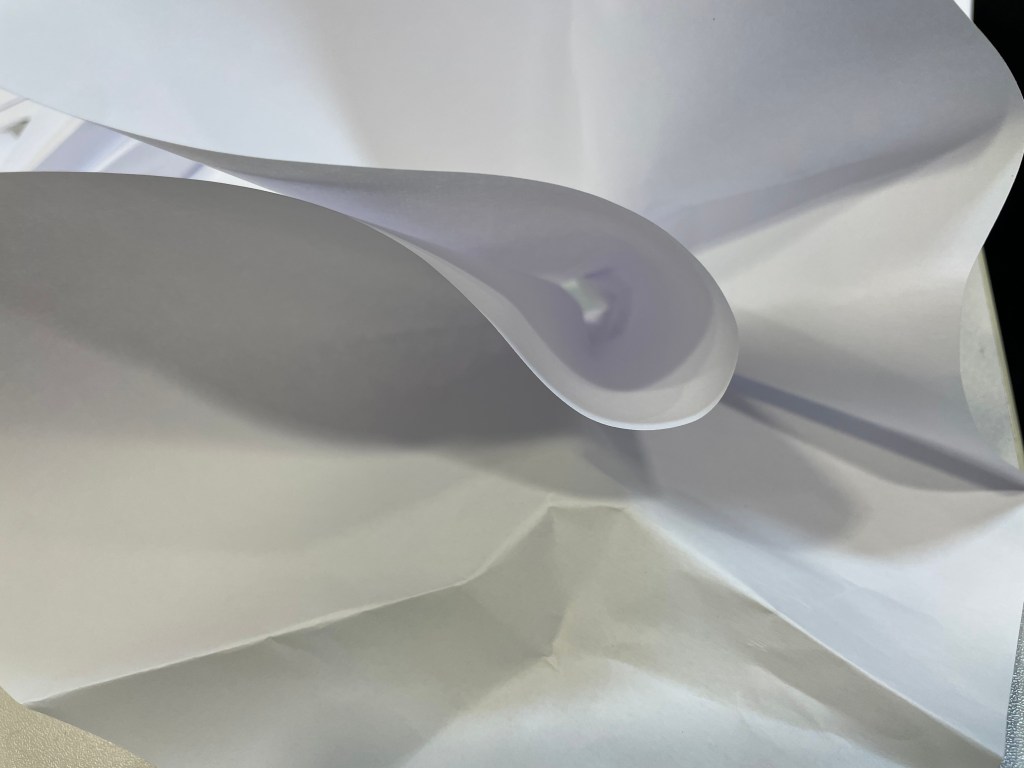
Working with the blank paper seemed to allow more freedom and I liked that the results took on a sculptural quality. The effect of the folding on the reverse of the paper was equally, if not more, interesting at times than the right side; areas which were peaks on one side became troughs on the other and vice versa.
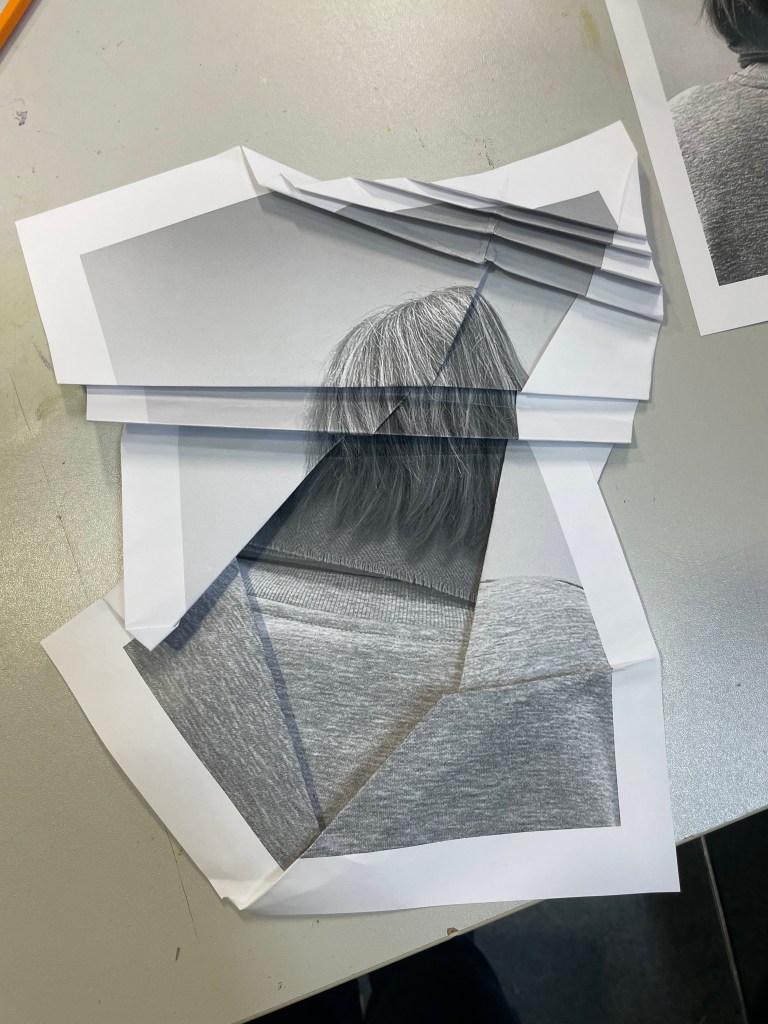
I felt inhibited using the print of the back of my head; I became too concerned with the resultant image which seemed to impose restrictions on how I folded, so maybe I like clear parameters, but not too many of them? Also, the effect is less sculptural than when using the blank paper; the areas of shadow are less apparent and the focus shifts to the distortion and concealment of parts of the image rather than the creation of form.
We then went on to do some linocutting – it seemed a bit incongruous with the folding activity, but nevertheless we all launched into it with equal enthusiasm.
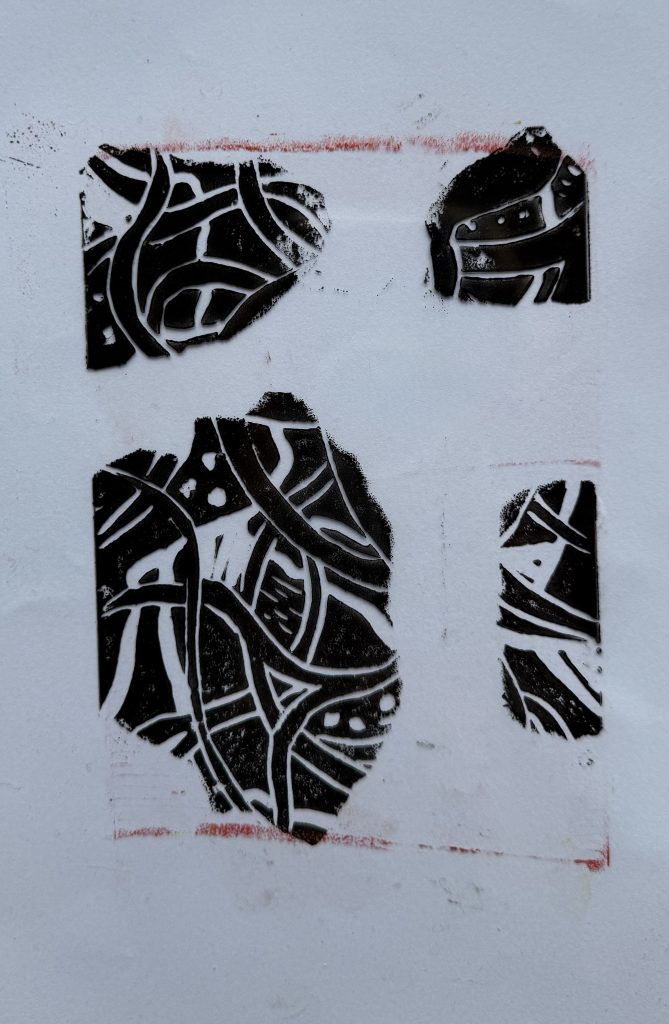
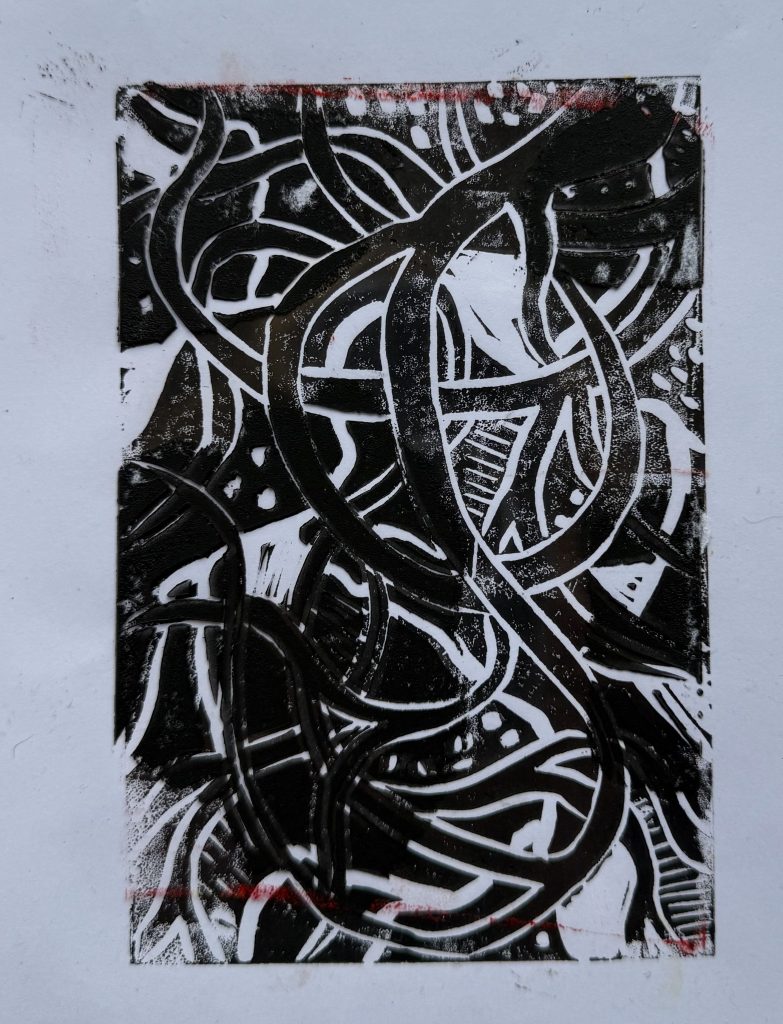
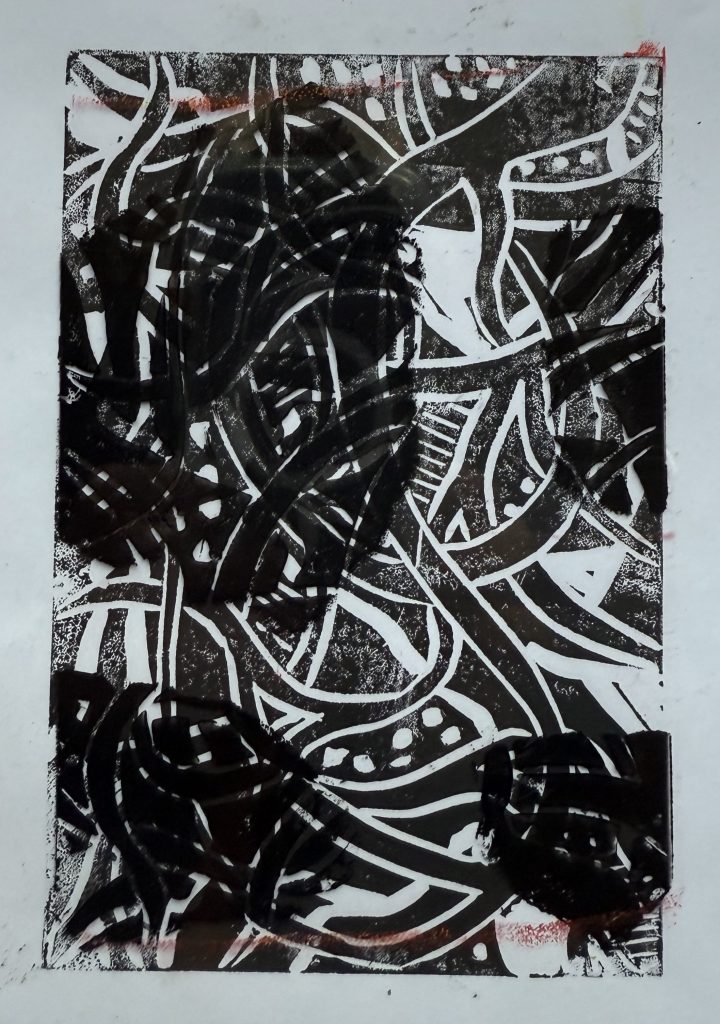
I prepared two linocuts; one inspired by tree roots and the other a reduction linocut of an abstract shape – I printed it using yellow ink first, then cut away more lino and printed using red ink.
I also printed the tree roots image on a transparency, having torn up bits of paper to create a random mask. It is interesting to see the effect of overlaying it with the two prints; how it creates a sense of discord on the prints where it’s not in sync with the image below, and how it creates areas of intensity on the print over which it lines up.
As I was taking my lino into the next door room to print it, Christian heard me reminding myself as to what I was planning to do. Sorry, are you talking to me? No, just myself. Doesn’t everyone do that? Yes, of course. When I went back in to print my second lino, I asked him how long we had left. Sorry, are you talking to me?…














 Kate McCalmont-Woods