My Best

‘…the sane human being is satisfied that the best he/she can do at any given moment is the best he/she can do at any given moment…’ Art & Fear.

A question I’ve been asking myself recently is whether I have done my best over the last two years. Yes, I think I have. Yes, I could have spent more time making, but even if I had, I don’t think that I would be in any different position than I am now. What I have done has been enough to enable me to see that I have discovered my way of thinking, seeing and making. There are things that I had hoped to explore within the structure of the course, such as my childhood in my grandmother’s village, but circumstances have not allowed me the time to do so. No matter – it is a project for the future, something to look forward to.

I never used to have this attitude. I always had to do my absolute best, I had to fix everything and in my head I was the only person who could do it. I decided to become a parent. I would be the best mother that I could be. Fortunately, (or maybe not), I was able to give up work and stay at home, devote all my time and energy to my new job. I tried all sorts of things from pureeing superfoods to baby Beethoven dvds and playing educationally stimulating cds in the car which used to drive me round the bend. I kept up to date with all the new advice being dished out by ‘professionals’ as to how to be a good parent.

I wish I’d seen this:

You’re Not the Architect of your Children

And I put my hands up to being a helicoptering mother who carried out her own 360 appraisals as to how well she was doing as a mother by looking at the success of her daughter – how well is she doing at school, how many friends does she have etc.? I’m not entirely sure how it all came about as I wasn’t the most ambitious person, but I suppose I was brought up to always put my best foot forward.

With hindsight I can now see it for what it was – a coping mechanism – a practical way to try and deal with a situation which was emotionally overwhelming. And that’s what I do when I feel that way – I try to exert some control. If you were to ask me what the most momentous events in my life have been, my answer would probably be having a child and the death of my parents. In both instances I felt overwhelmed, by responsibility, fear, vulnerability and grief. That feeling of overwhelm has lain unresolved and has affected how I have related and responded to circumstances since.

This course has given me the time and space to realise and to begin to process. One might argue that all I needed was a break from everyday life or therapy, but there is something intrinsic within this course and the making process that has brought me the clarity I needed – the process within which I felt able to be out of control; to experiment and to accept where the process led me, that I should lean into the uncertainty.

April

April is a strange month. On the one hand lighter nights, Spring, and so many birthdays, including my daughter’s. On the other, my mother’s birthday and the third anniversary of her death. It’s not surprising that she’s been on my mind.

My thoughts have turned back to microchimerism. I’ve mentioned this before, mainly in the context of siblings in The Invasive Sibling. In that post I also refer to the mother’s cells travelling into the baby via the two-way street that is the umbilical chord, something that I didn’t really think about any further at the time. I was doomscrolling on Instagram earlier, and came across a post which was about this very thing. It took me aback in the moment, and its profundity made me suddenly feel really emotional.

In general terms, it’s a difficult one to get my head around – the mother is inside the child, which in turn is inside the mother.

Regrets

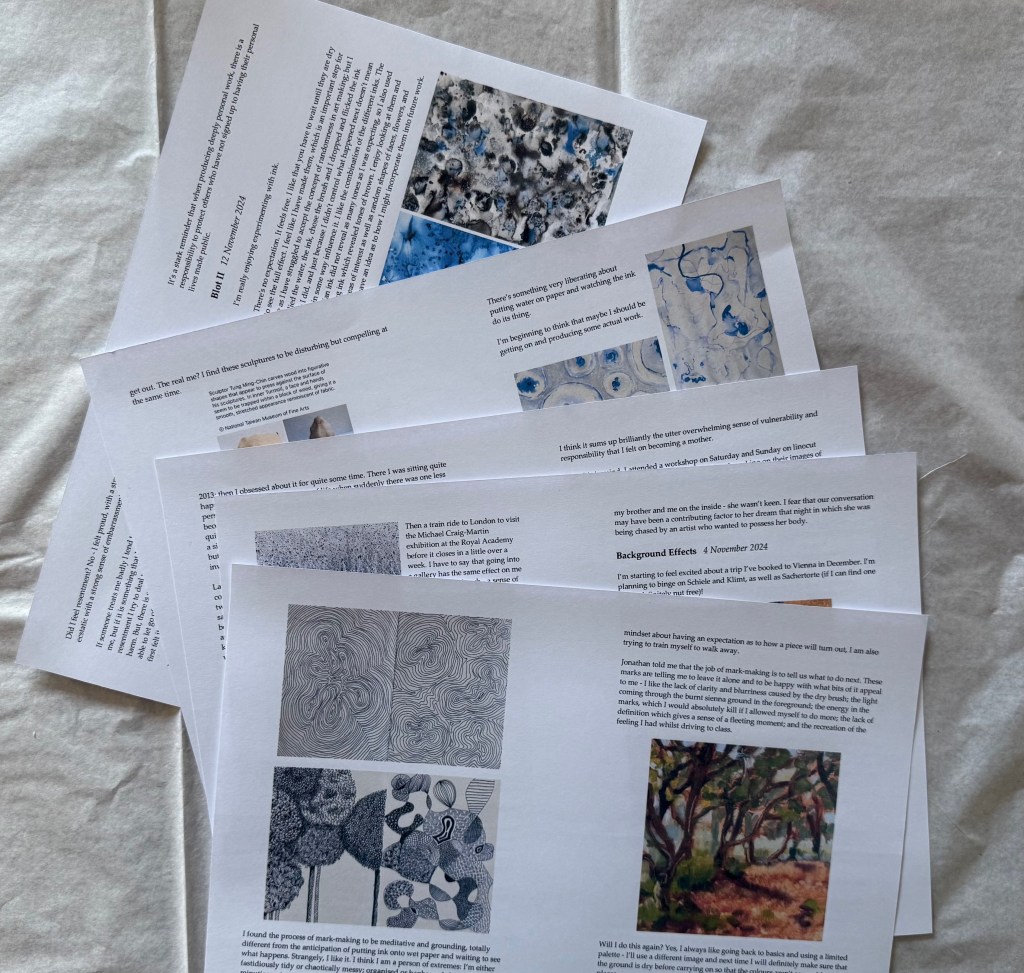
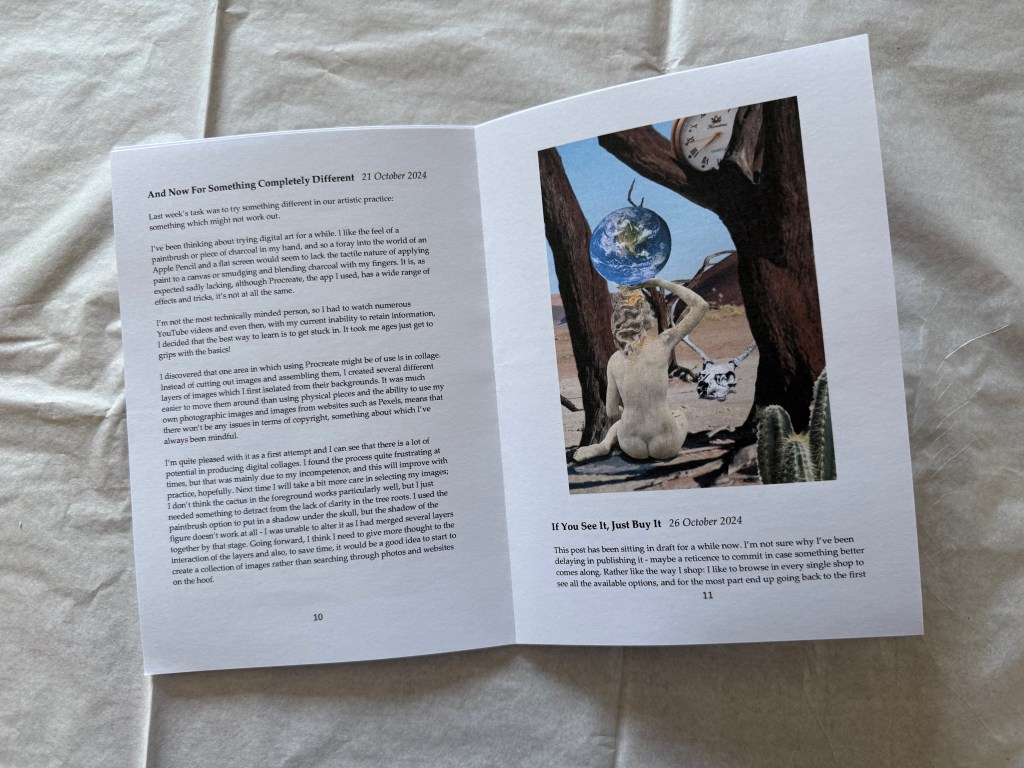
I’ve spent the last few days chained to my laptop copying and pasting most of my 195 blog posts (now plus one!) into a word document. Am I regretting my decision to make a book out of my blog? No, because it feels like it’s ticking a big box somewhere inside of me – it’s keeping my chimp happy – I’m making something that evidences the last two years. It will leave me free to experiment with something else.

That said, I have already reminded myself that I have never made a book before and so the process is very much an experiment, and that I should have no expectations as to the result.

I have formulated a plan though. The book is going to be in A5 format as that avoids the need to deal with things like columns. I’m going to print it in a series of booklets – signatures – of 5 sheets of A4 which equates to 20 pages. These will then be stitched together – I’m currently thinking no more than 10 in a single volume and then covered with a hardback cover. I am thinking that I may use some canvas that I have knocking around which I could paint, draw, print and stitch onto. Alternatively, I could try sheer fabric, cotton or linen. I’ll need to experiment. Even the end papers could be pieces in themselves.

I have already formatted and printed off a couple of signatures. It’s definitely going to run to more than a single volume, so I think that I’ll format and print off the first 10 signatures and make a single book just to see how it goes, rather than spending time formatting and printing out all of the blog.

Thus far the process has revealed a couple of things. Firstly, I need to be mindful that future posts will have to be included, so it may be an idea to limit posts going forward – but who am I kidding? Secondly, in carrying out the exercise I have relived the past two years and it has been helpful to note ideas that I have had along the way and which I could develop in the future, as well as discovering some draft posts which I didn’t publish, perhaps because I wasn’t quite ready. This is an example of part of one which was on the subject of perfectionism:

‘But old habits die hard and when my mother became ill I couldn’t process it on an emotional level and so I became the best carer that I could be, which now I regret because at times it meant that I wasn’t the best daughter that I could be. To this day I can’t understand why, when she said she fancied a gin and tonic, I told her that she couldn’t have it because she was taking morphine. She was dying, what did it matter? It is one of my biggest regrets. And when she didn’t eat one of the many offerings I had made for her, it was because I was a failure, because I wasn’t able to find that one thing that she would want to eat.

I had the same thought this evening as Monty, the dog, only had a few little bits of meat which he had been quite happily eating yesterday. What am I doing wrong? What is it that he wants that I’m not offering him?

And, of course, the answer is nothing. I can only do what I can do in the circumstances. If he was hungry he would eat. If my mother had been hungry she would have eaten what I had made for her. Even if they did eat, it’s not really enough to make any significant difference. I’m not responsible for them not eating. There is nothing that I can do on a practical level anymore to avoid having to deal with the inevitable outcome.

The Liminality of Memory

The idea of layering has always been in the background. It could be in the form of separate physical layers or the layering of media, or the remediation of images. I wanted to explore layering the moving image over the static image. I have to confess to adopting Lyberis’s approach of the monotone audio on his 3-minute video. To me, it’s the sound of silence, the sound that sometimes keeps me awake at night when I’m convinced someone’s running a car engine nearby or there’s an extractor fan which has been left on. It’s not quite right at the moment and it needs some more work, but I’m quite pleased with it so far.

https://youtu.be/7WoXFzFttHo?si=z348Mf6AF6fxwkku

Forget-me-nots

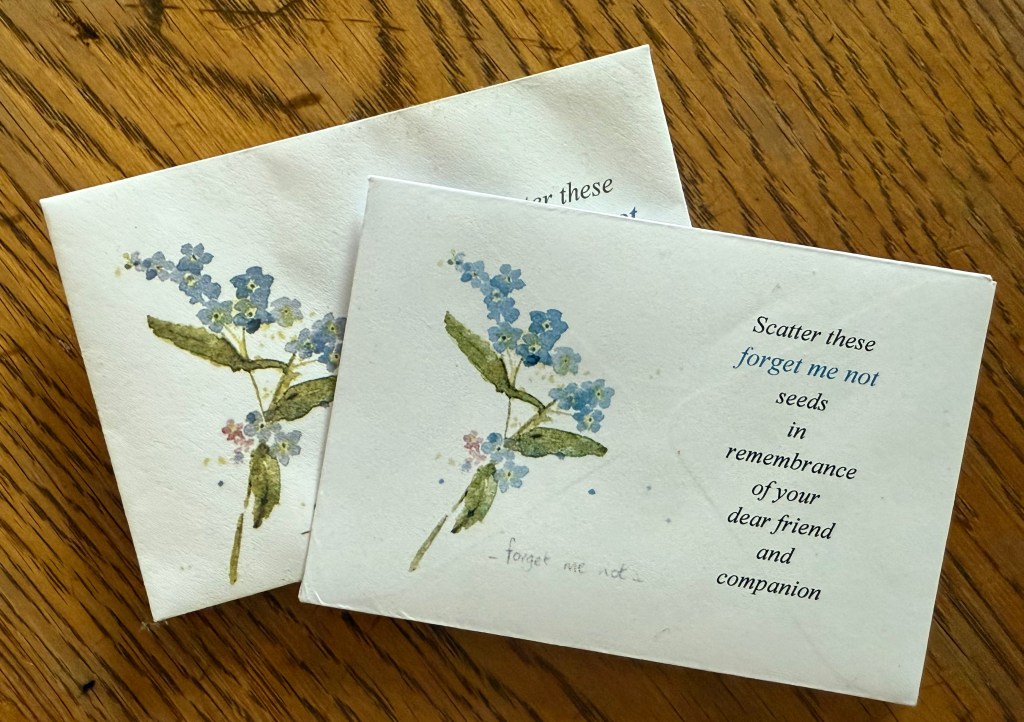
It’s a long time since I last had a pet, and this may not be anything new, but there’s a business out there, maybe more than one, which is supplying veterinary surgeries with packets of forget-me-not seeds to send to customers whose pets have died. Since Monty died we’ve received cards of condolence from our regular vets and the specialist practice, both enclosing identical packets of seeds.

I will sow the seeds and hopefully next year green shoots will emerge from the earth, but with my gardening skills, I don’t hold out much hope.

I appreciate the thought, if it was indeed a thought, and not just a gesture generated automatically by an impersonal process. The cards contained messages from staff I didn’t even know were involved in Monty’s care; general messages of sympathy for our loss, except for one, which stood out because it described him as having been such a character. No sooner had Monty’s heart stopped beating than the vet’s hand was on my shoulder, followed by “I’m sorry for your loss”. Similarly, from the veterinary nurse who had assisted, with an added hug, whose eyes failed to show any sign of recognition a couple of days later when I went into the surgery to speak to her about our other dog.

I’ve decided that I don’t like the phrase; it’s trite and it doesn’t make the pain any easier to bear. In fact, I don’t think that I’m a fan of euphemisms generally, particularly, the idea of passing or passing away. Where to? My father died, my mother died, my dog died. That’s it. They didn’t go anywhere, I didn’t lose them, and there’s no chance of finding them again, and reuniting.

That’s not to say that I don’t believe in something else. Maybe I believe in the law of the conservation of energy: it can neither be created nor destroyed.

Now, where are those forget-me-nots?

Maps

I was very lucky to have Cheng and Dalal in my group for this week’s group crit.

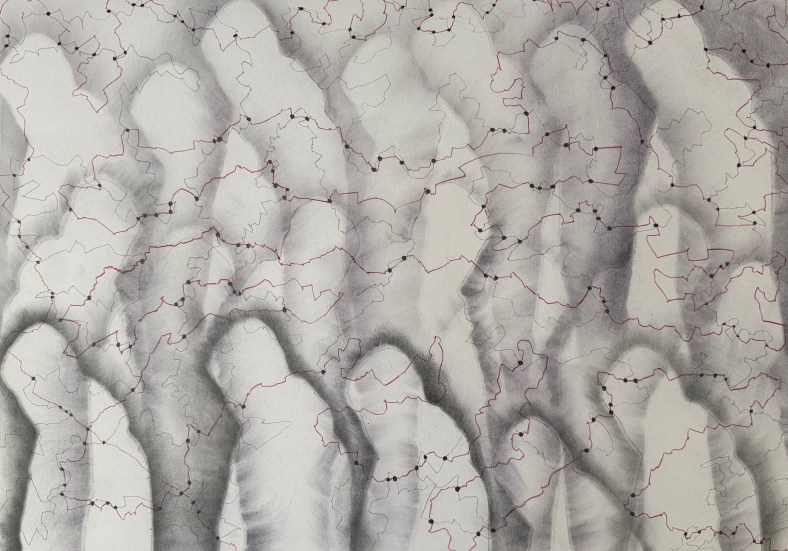
I showed my recent experiments with graphite and pencil.

I explained that I have become interested in the idea of inheritance recently and mentioned Donald Rodney’s work. We had a really interesting discussion about where we come from and our legacy, how it’s sometimes comforting to know that someone else before us was like us which frees us from feelings of fault and guilt, the idea of all that has gone before distilling down into us, much like our family tree before us, ends with us. How what we pass on feels like a responsibility or a burden.

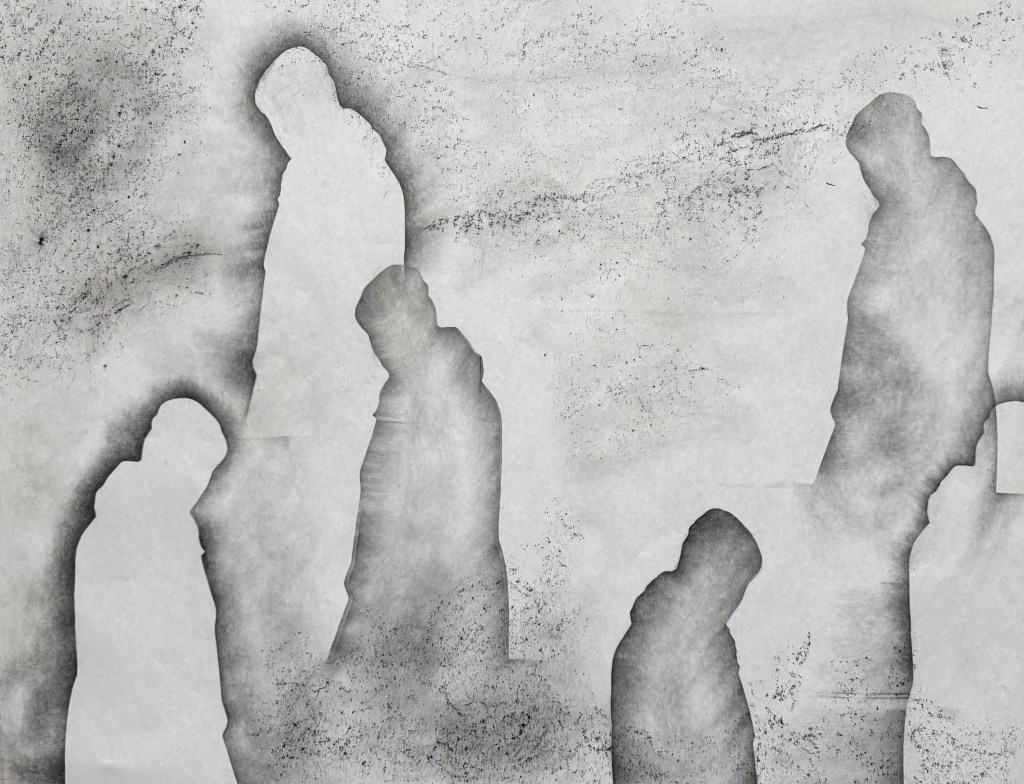
Cheng commented that the white shapes give the impression of something that is no longer there and the dark shapes are reminiscent of shadows. Thinking about it, the shadows are cast by something that is there but is not visible. A figure’s absence is felt yet we feel a figure’s presence somewhere – it just about sums up ancestry.

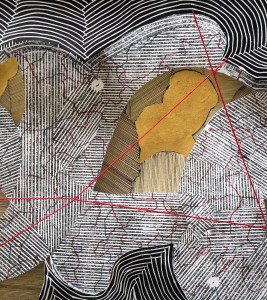
I explained the process of making the pieces and how they seemed to develop into a type of map. I mentioned that the subject of maps has come to the forefront of my thinking recently along with the idea of connection. In my Unit 1 feedback one of the comments was: “It feels as though you have been working through an abundance of techniques that are maybe a type of mapping – now is the time to compare and contrast all of those experiments in order to develop an intuitive and personal way of mapping your experiences…”.

For sometime I’ve been interested in Deborah Levy’s idea of her mother being her internal sat nav and I used Google maps to obtain the aerial image I used in Parental Loss. My art class recently gave me a scarf with a Grayson Perry map on it. I was thinking earlier in the year of mapping the course of a river. The coincidence that I chose to draw the lines in colours which reminded me of maps somehow has linked all of this together. That, and the fact that I have been complaining ad nauseum about not having a sense of direction.

During these two years, I am, to all intents and purposes, mapping my life.

There seems to be a strong unintentional link to maps in the images: Cheng said that the images in which I’ve marked the intersections remind her of constellations, and Dalal observed that the lines themselves could be interpreted as borders, which then feeds into borders marking the the point where countries connect. This led to me seeing that the outline of the shapes themselves resemble coastlines.

Cheng and Dalal both made some really helpful comments about potential development:

  • playing with scale: a large image on a wall giving the impression of a map but then coming in close on a small scale to create a more personal experience and stronger connections
  • Drawing on a vintage map or incorporating old family photos
  • Using a pin to attach separate images to the points of intersection – this has since led me to think about criminal investigation maps – maps with string coming off from them to images and additional information on the perimeter
  • Thinking about how I can use materials to create something that looks older, that comes from a past time – this brought to mind highly decorative old maps with sea monsters in the oceans
  • creating a large scale reimagined map

Shortly after our session ended, I had a thought about making a digital map of my life with events or periods of significance being marked by specific points, a bit like a Google map, which you could then drag the yellow man to and drop into a space where you have a street view – maybe of images relating to that particular event. And then I laughed, Alexa laughed, Siri laughed, my husband laughed.

Lots to think about, as ever.

Solitude

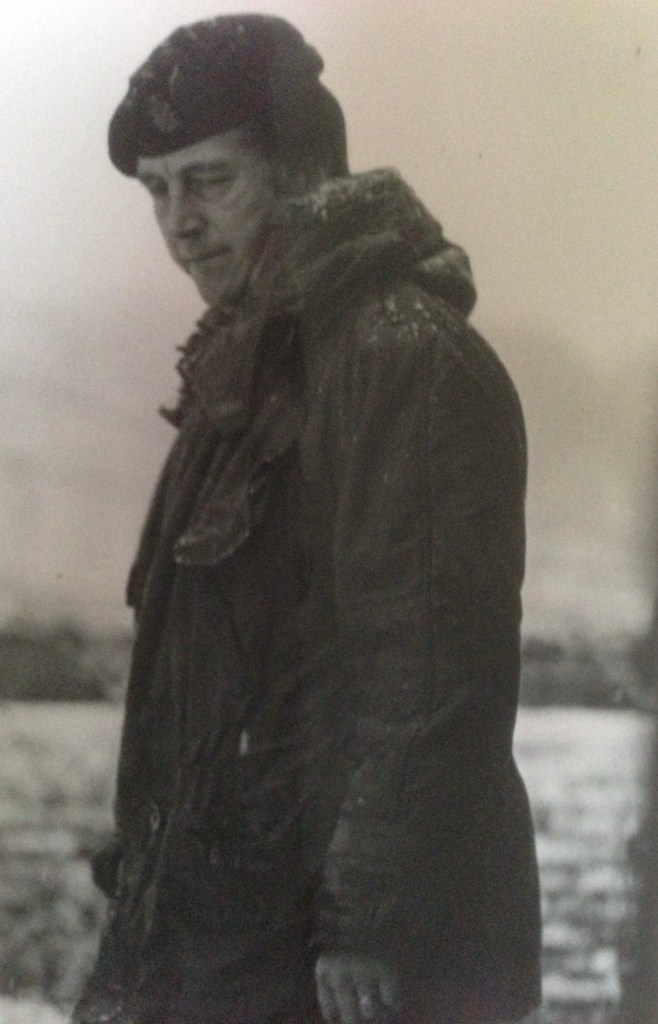
I feel particularly drawn to this photograph of my father. It’s solitary and contemplative, evoking a sense of vulnerability – a side which was never apparent whilst I was growing up. It makes me want to go and give him a hug. He was the world’s best hugger. Either that, or he’s watching someone doing something and he’s not that impressed – a more familiar experience.

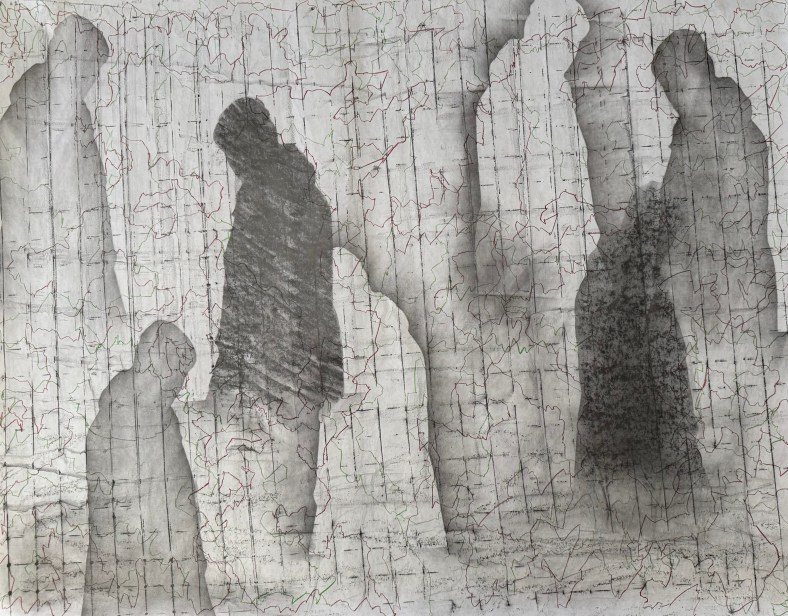
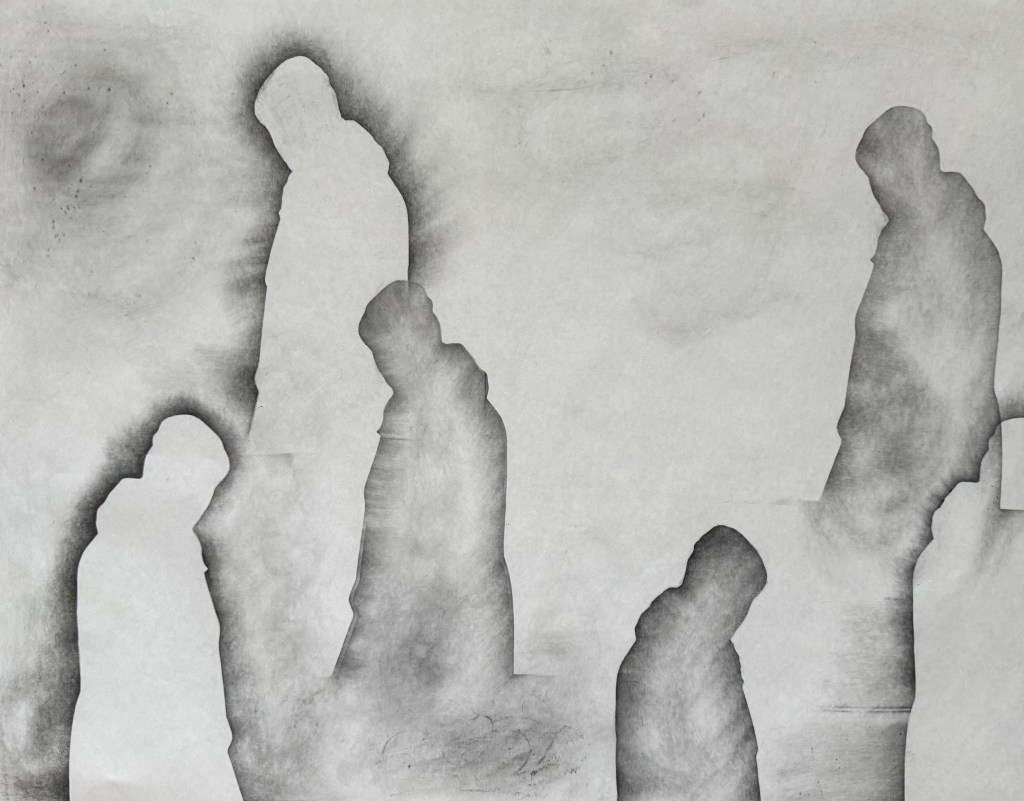
Having missed out on visiting a couple of exhibitions on Sunday, I decided to experiment. I took a piece of A1 flipchart paper, a graphite stick and a 5B pencil and got to work. First I created multiple silhouettes of the image using the graphite stick.

I was inspired by the Richter drawings (The Rich Are Getting Richter) and used the tiles on the kitchen floor to create texture with some frottaging.

Having really liked the effect of some of the lines and marks made in my automatic drawings, I used the 5B pencil to create a wandering line, holding it at the top and twisting it from side to side in the process and then holding it on its side to create a second softer line. I like the idea of tree roots and mycorrhizas connecting and creating a support network for trees, a concept we touched on in last week’s session. The lines are connecting each figure so it’s no longer alone. They are also reminiscent of a map or a mapping out. Not sure which, but I like the effect. I like the delicacy of the lines. They also remind me of the lines in skulls at the points where the plates have fused or cracks in a surface, fault lines. I wasn’t keen on the overlap on the two figures on the right which created a hard box-like edge, so I cropped it out on the last image.

I really enjoyed doing this, particularly the lack of control of the line making and the unpredictability of the frottaging, and despite that, it does bear a resemblance to the vague image I had in my head. It ties in with the idea of shadow selves (Sniper’s Alley) and the idea of inheritance and being made up of multitudes (Bus Replacement Service). It’s definitely an approach I will develop further, but I’ll use better quality paper next time.

Bus Replacement Service

I was planning on going into London yesterday to catch Donald Rodney: Visceral Canker at Whitechapel Gallery (as well as revisit the Cardiff audio walk), and Linder: Danger Came Smiling at the Hayward, before they close in the next day or two. But what I forgot was that it was a Sunday on a Bank Holiday weekend, a perfect time for railway engineering works. A bus replacement service would almost double my usual journey time, and so I decided to stay at home. Instead, I had a look on Whitechapel Gallery website, to see what I had missed. There is an interesting piece on Rodney by Caleb Azumah Nelson, particularly on their relationships with their fathers.

Rodney had, and ultimately died at the age of 37 from a complication of, sickle cell anemia. He was in the midst of a sickle cell crisis when his father died and he was unable to attend his Nine Night.

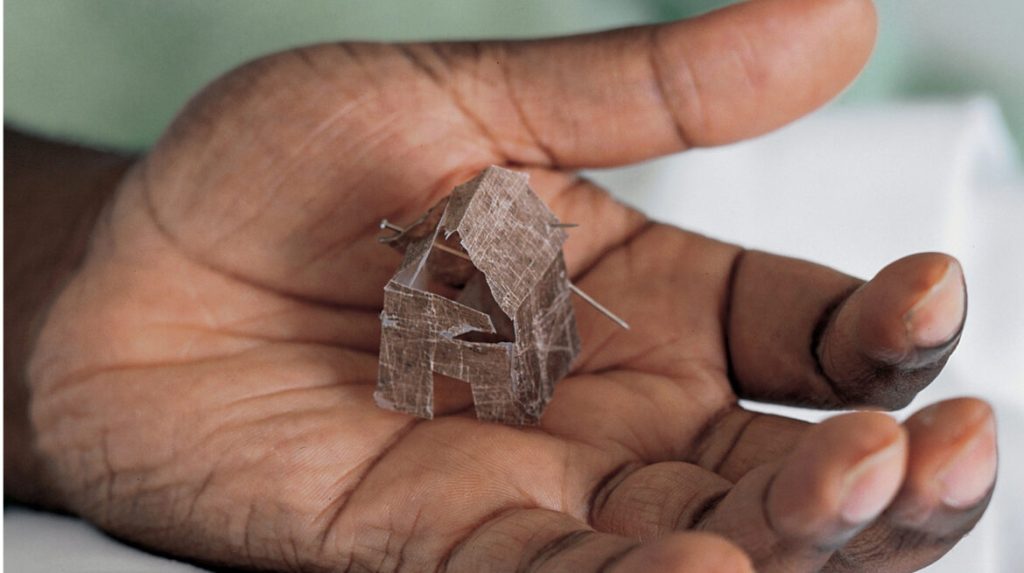
In the House of My Father 1977, photograph (Image Source: http://www.whitechapelgallery.org accessed 5/5/25)

Made from his own skin, the house is held together with small dressmaking pins.

This is the first piece of work by Rodney which Nelson encountered, purely by accident:

’The strength, not in the structure, but in the vulnerability of exposure, his open palm an invitation into his heart, his family. With this gesture, Rodney suggests, this is who I am, this is who I might be.

How does the self come to be? And how do we make space to be our whole selves? … a condition he would have inherited from his father, who would’ve inherited it from his father before that. Their selves, our selves, folding into one another: we contain multitudes. And what else do we inherit? And how do we carry around these inheritances, how do we make space for them in our lives?…’

At the time he was reflecting on his own relationship with his father:

’… wrangling with the things he cannot say to me, or doesn’t have the language for, the many rooms in the house to which I do not have the key…’

He finishes his piece with:

I believe Art gives us a space to be honest, to confront, to dismantle, to reassemble. To imagine. Visiting and revisiting Rodney’s work reminds me that other worlds are possible. It reminds me, that even in the face of continued crisis, it is necessary to dream. It reminds me that , even in the face of death, we must continue to inhabit many rooms, to hold space where we can be honest, where we can be our whole selves. Where we can feel alive.’

So many thoughts have come to mind:

  • The idea of inheritance and how we find a space for it in our everyday lives. To me this feels like a burden not just in the physical sense of belongings, and ‘stuff’, but to the extent that I might feel defined by it: I don’t want to be, I want to be my own person steering my own course independently of what has gone on before, but I can’t ignore the extent to which others have shaped me. Last weekend, I lost count of the number of times friends commented how my daughter is a mini-me or the spitting image. No, she’s not. She’s her own person, living her own life. But, inevitably, I will have had an input into who she is, even if it’s just a matter of genetics.
  • I have inherited my family history from my parents. I used to spend ages looking through the family photo albums talking to my mother about the contents. I feel an enormous responsibility to pass this knowledge on. It’s a burden. My daughter is not particularly interested. Maybe it’s an age thing – as we age we need a greater understanding of who we are? Or maybe it’s a digital thing, we don’t have a physical record of our lives lying around the house to prompt an inquiry and so the questions never get asked. Sometimes I think that I should write it all down in case she’s ever interested, and other times I think that I’ll take it all with me and free her from the burden.
  • I think that I’ve been dismantling myself over the last few months. I’m not entirely sure that I’ll be able to reassemble myself, but maybe a few left over bits here and there wouldn’t be such a bad thing. I could even write my own instruction manual.
  • The child/ parent relationship: I remember the moment when I realised that my parents didn’t know or have the answer to everything; that they were human. It really stopped me in my tracks.
  • The idea of the house with many rooms; our ancestors folding into one another; the self containing multitudes.

Food For Thought

Last week was a week of two halves.

At the beginning we were told that our dog, Monty, has metastatic melanoma. Without treatment he will rapidly decline in a matter of weeks. With treatment he has a chance of possibly living to his natural life expectancy. With no significant side effects to the treatment, we are giving it a go, and he had the first dose of chemo and immunotherapy on Friday. If it becomes obvious that it isn’t working, we will stop.

We are devastated. I know he’s only a dog but he’s been a part of our family for the last 12 years; he’s been a part of my daughter’s childhood for more time than he hasn’t. I also can’t help thinking that some of the desperately crippling sadness I’m feeling is unresolved grief from my mother’s death, because I’ve been teleported straight back there.

For me, emotion and food are intrinsically linked. The need to eat in order to survive is a primal instinct. I have a need to feed. When I became a mother, my need to nurture and provide nourishment, in all its forms, for my family became paramount. And, of course, many people express their love by making food for others.

The refusal of food is one of the first steps in withdrawing from the world. I remember the lengths I would go to in order to try and encourage my mother to eat. I would spend so much time making her dishes which she said she fancied only for her to take one taste and decide that she didn’t want it anymore. The most difficult moment was when I had to accept that all I could do was to offer it, and not to try and browbeat her into eating it.

Monty’s not as keen on his food as he was. I have dishes full of different vegetables and meats that I’ve cooked, in an attempt to encourage him, in the fridge. Unfortunately, the only food he seems keen on at the moment is steak. When he eats it I feel like everything will be ok, but in the back of my mind is the nagging thought that all I’m succeeding in doing is nourishing the very thing which is killing him.

On a happier note, we had a party to celebrate my daughter’s 21st birthday this weekend. Family and friends came from all over to join us to sit down and have dinner together. There was much drinking and dancing, and everyone had a good time, welcoming the chance to reconnect with old friends or form new connections over food. Some of them I hadn’t seen for a few years – they looked older, as I’m sure I did to them. Even more reason to make the time to meet up with people as much as possible – to walk the walk, and not just talk the talk.