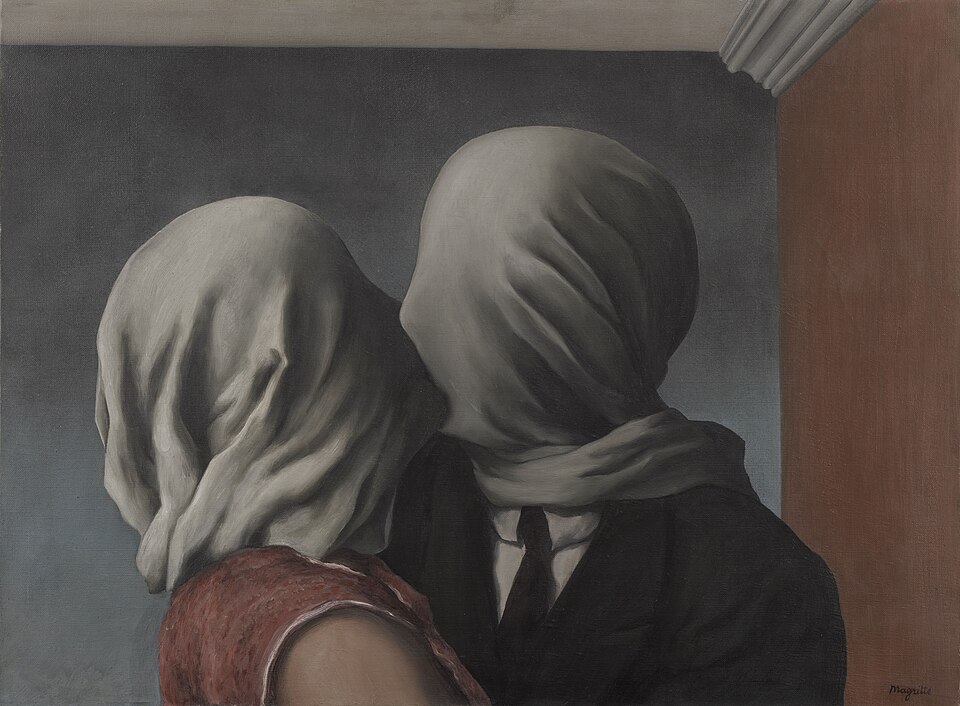
For some very light entertainment I’ve been watching ‘This Is Not a Murder Mystery’ a quirky fictionalisation of the gathering of Surrealists at Edward James’ West Sussex pile, West Dean. Whilst he was a champion and friend of the Surrealists and owned the largest collection of Surrealist art, this particular gathering at which several murders take place is a work of make believe, with Magritte waking up next to the first murder victim in a mise-en-scène exactly like his painting The Lovers which up until that point had not been seen by anyone.
Les Amants, 1928
I was trying to put togther the transcript for my 5-minute video earlier and I was thinking that I would like to make some work with me in it, me now, rather than videos from years ago. I managed to get over my reticence at using my voice and so I think it’s time that I bite the bullet. It seemed to me that being obscured in some way rather like in The Lovers might be the answer, a veil of sorts which could also represent am element of feeling disconnected. Because I’ve been looking at my work and my blog recently, the idea of time passing has been in the forefront of my mind, and I really dislike the sound of clocks, a constant reminder, particularly the one my husband has which belonged to his parents – it ticks so quickly it makes me feel anxious.
I’ve also been wanting to have a go at stop animation. I know that I could have just taken a video and used apps such as Capcut to create the effect, but I wouldn’t really be experiencing the process, so 153 photos later…
Whilst it was time consuming, the act of exporting, rotating and uploading the photos was repetitive and was strangely enjoyable for that reason. There are quite few things I would do differently if I did it again, the sheer fabric has creases in it which really I should have run an iron over before starting but I was so excited to get started. Having said that, I do quite like the diagonal that it creates. Also it was difficult to see the image on the phone screen because of the double layer of fabric and there are a few areas which could have done with being straightened out. Having said that I’m really pleased with the outcome, I enjoyed the process of making it and learnt a lot and even managed to tackle it in a logical way, dealing with just one photo at a time and not rushing it, which is unusual for me, although some of my impatience is obvious in the video, as already mentioned. In particular I really like the effect of double layering the sheer fabric which creates a contour-like effect.
I’m conscious that each time I post I’m creating more work for myself in terms of making my book. But there’s so much to think about, to process and to make at the moment.
We started this week’s session by reflecting on the response we had to the prompts last week. It’s quite interesting in that I didn’t, and still don’t, feel concerned about my identity. Maybe it’s because it can’t be defined, because it exists in and is created by my work. It doesn’t seem important to me – I live, I make.
We then looked at adjusting or disrupting our practice, considering whether there is anything we can do which might create new possibilities. We looked at placing ourselves on a line between two points and considering what would happen if we shifted our position between those points.
Material______________________________ Conceptual
Iterative Making ______________________________ Research-based
At first glance I placed myself clearly to either end: material, iterative making, intuitive, periodic and process. But thinking about it more carefully, and discussing the concepts with other members of my group, I began to see that it is not as simple as that.
I’m very much about materials, but then again I often have a concept in mind eg experimenting with combining specific processes
I make iteratively, but often there is a period of time in which I consider the work, research how other artists have approached it etc
I would say that I work intuitively but often that intuition is grounded in the structure of previous experience and knowledge
I have periods of activity in physical making, but then I’m thinking about things all the time
I think process v outcome is the only one in which I can say that I am possibly on the side of process although it could be said that outcomes are important in the sense that they feed back into the process of iterative making, and that outcome does not necessarily carry a sense of finality, in the same way as product does.
In a way, for me, they are more like recursive loops than linear continuums (or continua?). It was a helpful exercise as it highlighted to me that I’m neither one nor the other.
We then considered, what are the most important things to do that are not directly making art. In addition, to continuing to be part of a creative community, making space and time is important to me. In The End I talk about my concern that my time will be sucked up by everyday life. This last week has been busy and I’ve been making every day. The consequence is that tasks in everyday life have not been done and are now mounting up, and quite a few meals have been eaten separately. My art making has had a direct impact on home life and it’s not sustainable long term.
Having developed a way of working, I now need to put in place a time and place for working. By having a dedicated work space away from the house, I can try to develop a regular routine of making, physical or otherwise, in which the boundaries are clear and which minimises disruption to everyday life.
‘one paints when there is nothing else to do. After everything is done, has been taken care of, one can take up the brush. After all the human social needs, pressures are accounted for. Only then can we be free to work.’
This week’s session centred on the Unit 3 assessment and the end of year show.
It was interesting listening to others talking about their planned pieces and how they could be displayed within the space. I can’t deny that I had a small flicker of panic that I don’t have a singular large finale piece in mind. But on the whole I felt quite calm and relaxed about it. Fingers crossed, I will hopefully have my book which is A5 in size. I would also like to show a larger piece but I think that is yet to come. For the time being, I’m feeling confident that something will emerge from my ongoing experimentation over the coming weeks. I just need to be mindful of elements that might be time dependent such as drying etc.
Josh then said it out loud. He acknowledged the end of the course. We then had a moment reflecting on how we feel about it. Eleana commented that she had asked herself whether she would want to repeat the experience (yes) and Rebecca mentioned that she is dealing with it by having plans and making work which go beyond its end date. Personally, I wouldn’t want to repeat it. There was a time when I wondered whether I could apply again, but on reflection I wouldn’t want to go back to the beginning – I have made so much progress. What I would like is for it to continue because I like the structure and I like the people, but that’s not possible, although we can always stay in touch with each other and use the structure and the way of working which we have developed within the course to carry us forward.
I feel that I now have the tools to continue to develop as an artist beyond the end of the course. The problem is time. My fear is that once the structure has gone I will slip into old ways, of allowing the everyday things and the needs of others to suck up my time. At the moment, others accept that I spend periods of time making because there is a reason – the course. But when it is gone I need to find a way to ensure that I keep that time for myself and that others respect it. I think carrying on the blog will be fundamental to this. One can’t really post about the making of work without making it. I also need to think about my future goals and how I might achieve them.
Rebecca recommended a series of short videos on YouTube about elderly artists living in New York made by Joshua Charow.
In one of them, the artist, John Willenbecker, comments that he thinks that he could be a really great artist if he didn’t care about anything else except his work. He quotes Ad Reinhardt as saying that ‘one paints when there is nothing else to do. After everything is done, has been taken care of, one can take up the brush. After all the human social needs, pressures are accounted for. Only then can we be free to work.’
Try being a female artist with a family, I thought to myself.
I suppose that it’s only natural to pause and reflect on the fact that there are only 10 weeks left: 10 more Tuesday sessions with everyone, 1 more tutorial. Maybe it’s because I’m feeling as if time is slipping through my fingers like sand, that it seems like a blink of an eye since we started, temporally that is because I know that I have undergone enormous change in the interim. When I think back to the session in which we had to introduce ourselves and our work, I find it difficult to reconcile myself to the person I was back then. I now see, think and make differently.
I feel sad.
But all good things must come to an end. I’m trying to subdue that part of me that is panicking that I haven’t made the most out of the last 2 years. But I know that I have; what I’m feeling is the knowledge that there is so much more that I want to try and to experiment with, and that this is not the end, but the next step. So mingled with the melancholy is a flicker of excitement at what the future may bring.
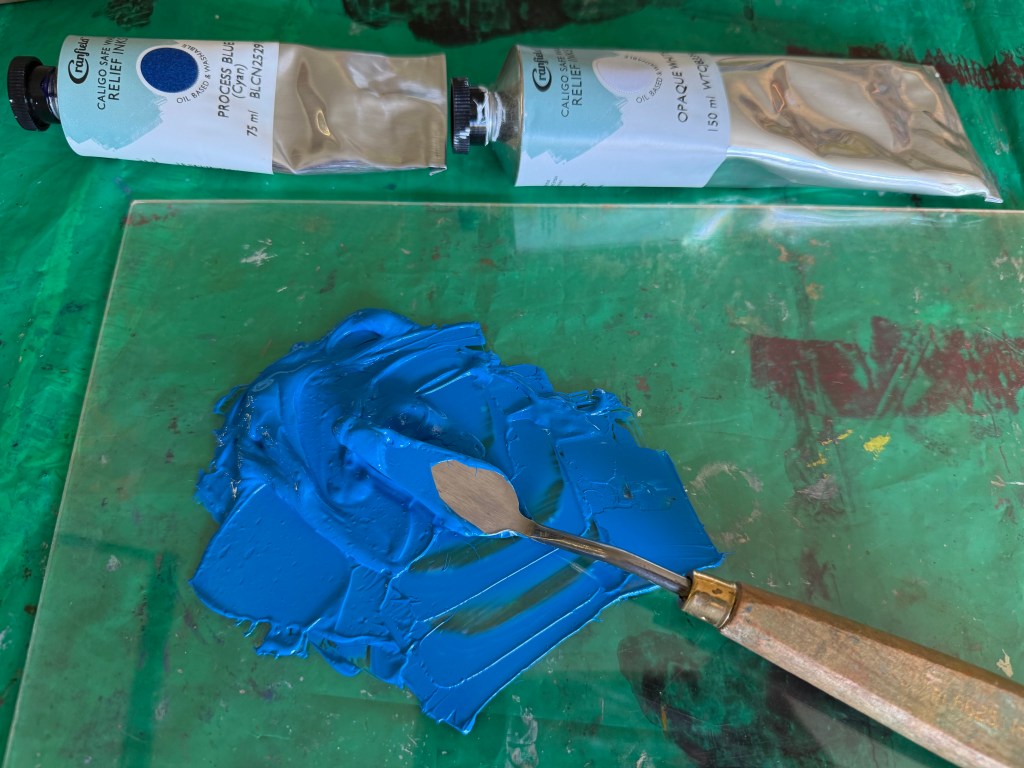
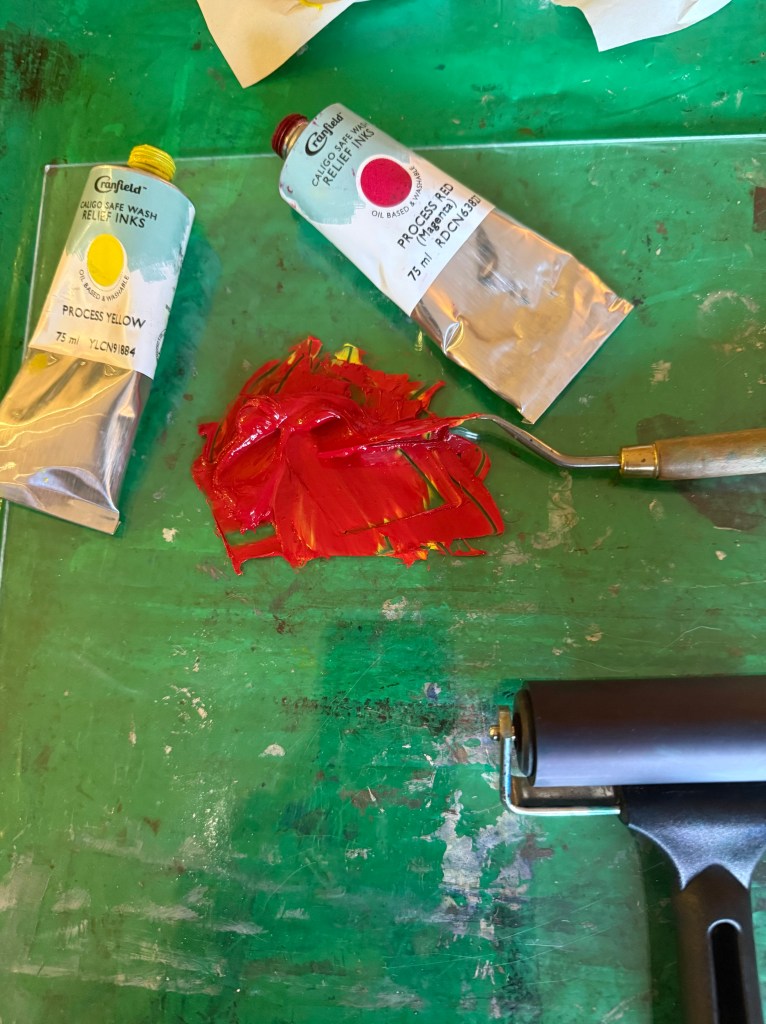
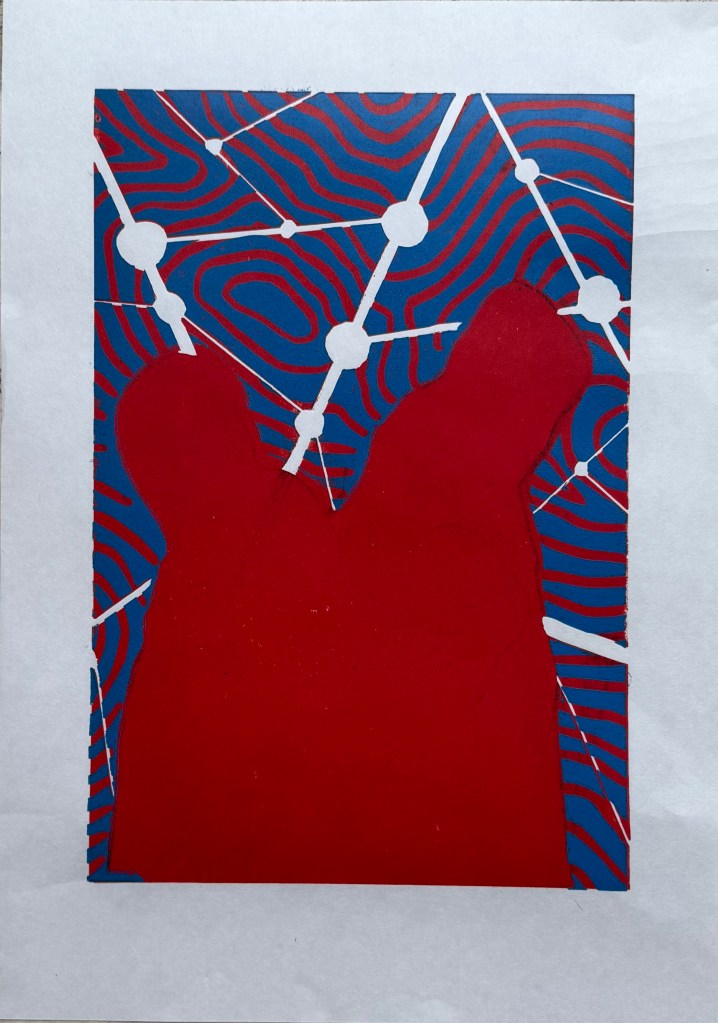
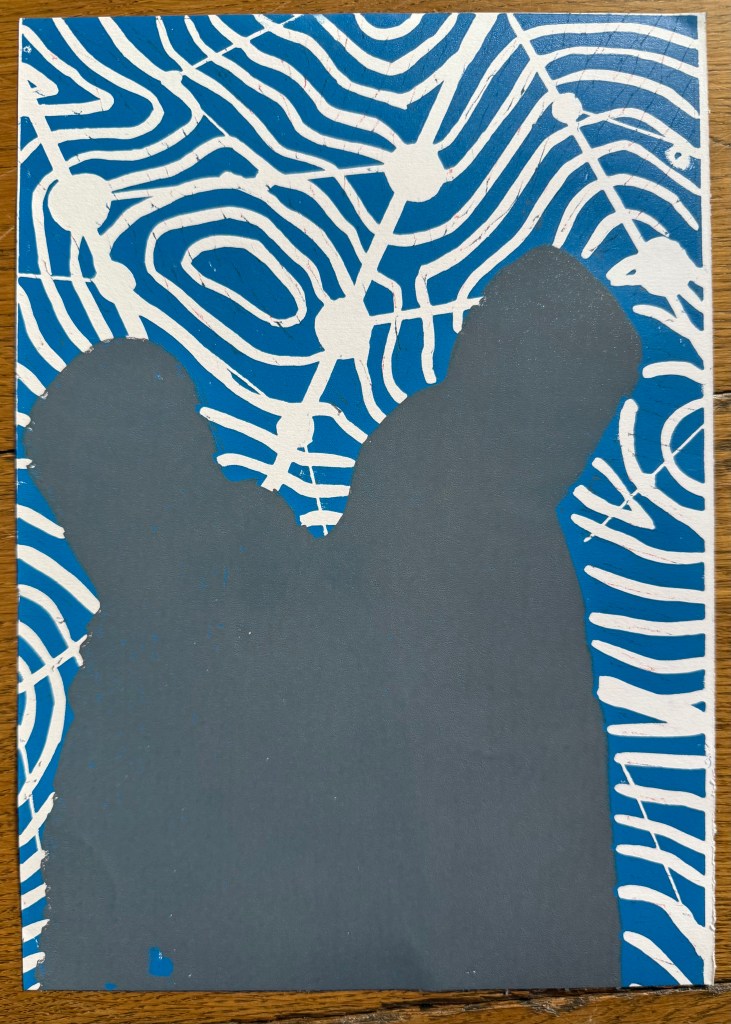
So, Plan A was dependent on me being able to overprint the red with blue. I did a quick test print. The process blue ink I was using must have some transparency as it turned into a very dark purple, so I made it more opaque by adding opaque white which resulted in a kind of cerulean blue which I liked against the red, although the photos don’t do it justice.
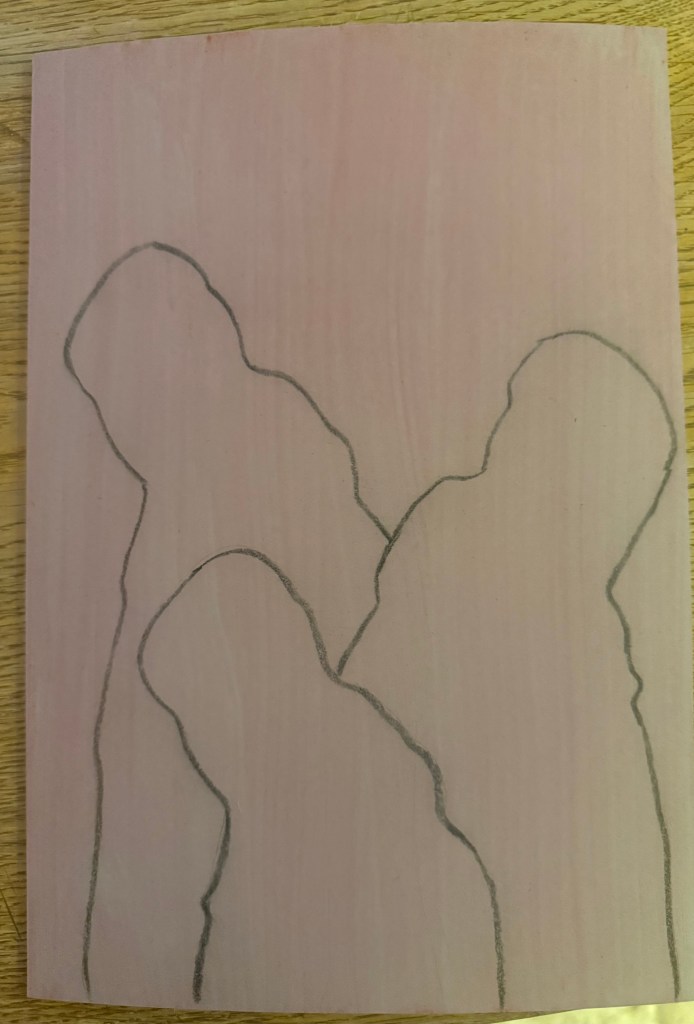
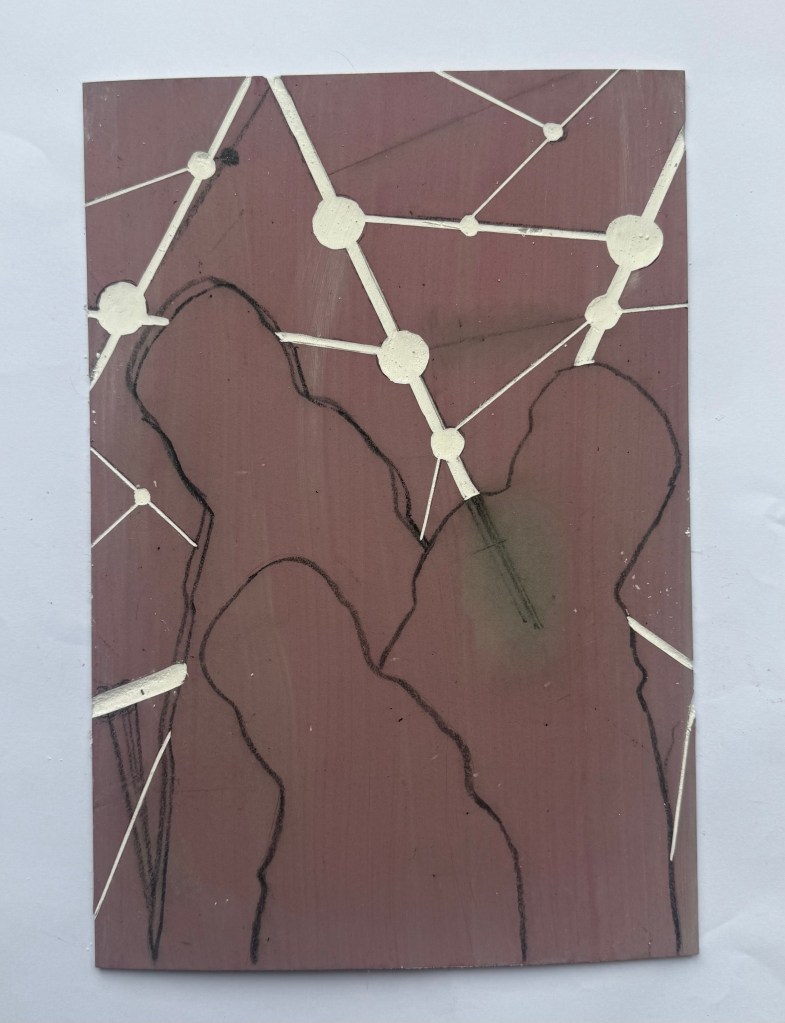
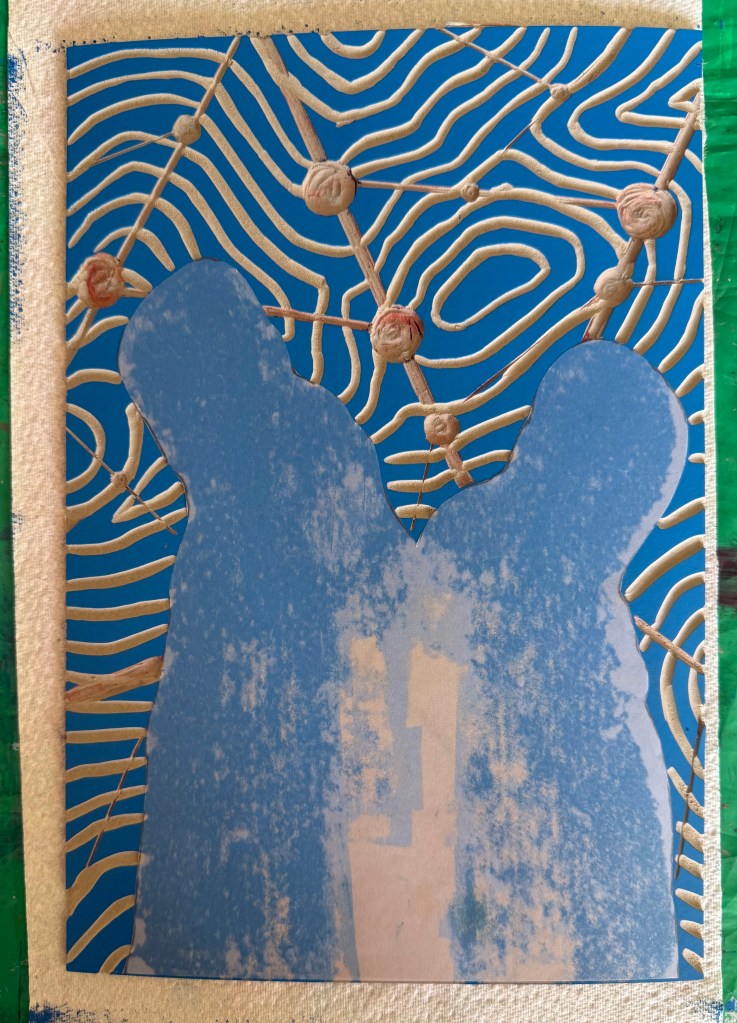
I then prepped a sheet of A4 lino by lightly sanding and wiping with white spirit before staining it with an acrylic ink and drawing on the figures and the white lines. I went over the pencil marks with a chinagraph pencil to make them stand out more. As usual I had launched in without giving it enough thought and ended up having to reposition some lines although I couldn’t erase the chinagraph marks, which becomes relevant later on in the test printing. I used a metal ruler to cut out the white areas and filled them with cornflour to see how they looked, neatening up where necessary – the circles are bit all over the place, so I resolved to use a template when making the actual prints.
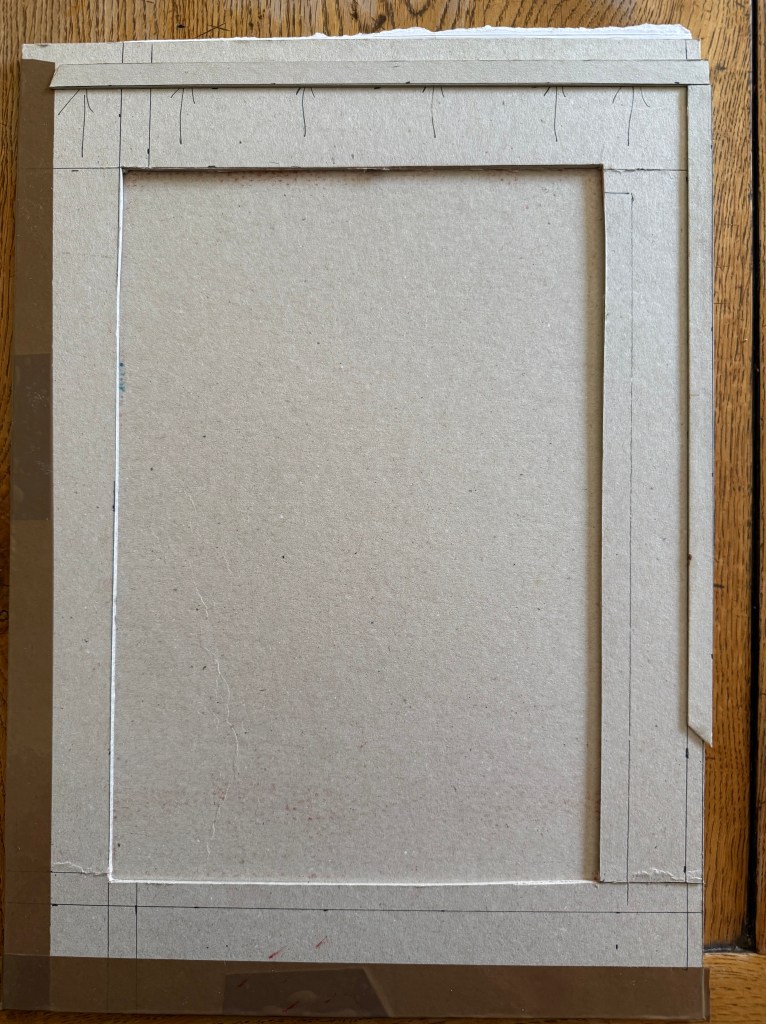
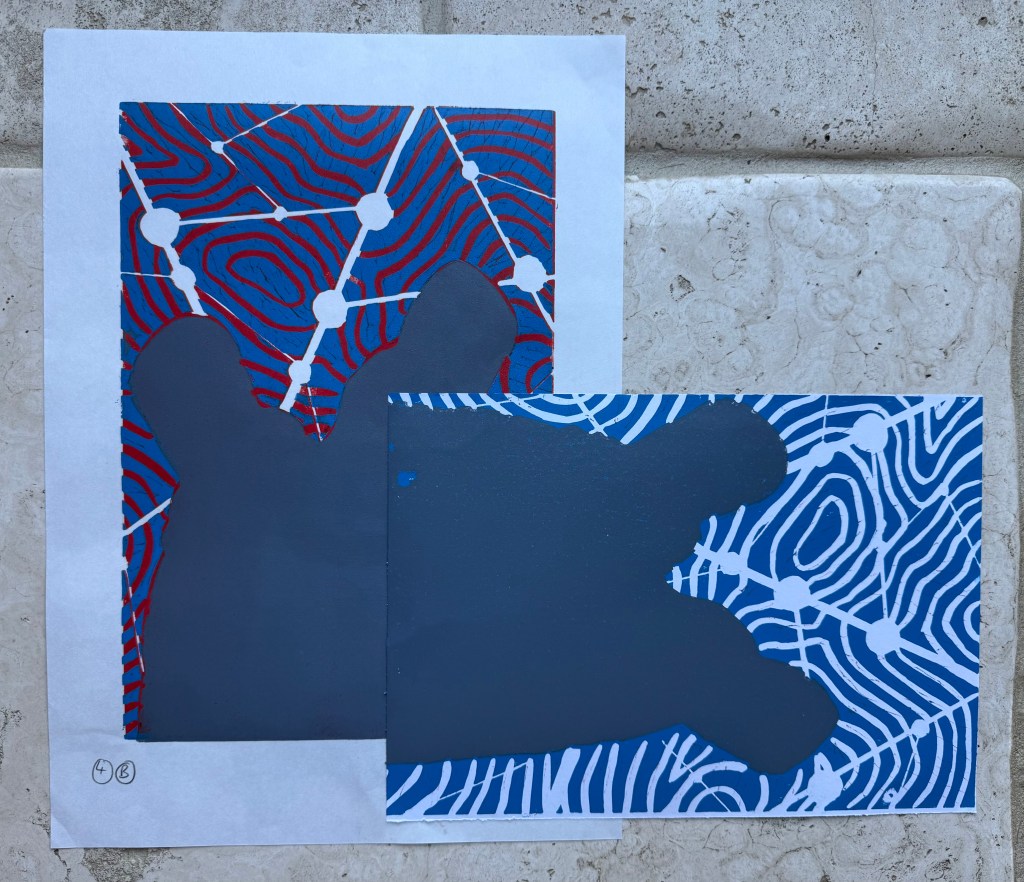
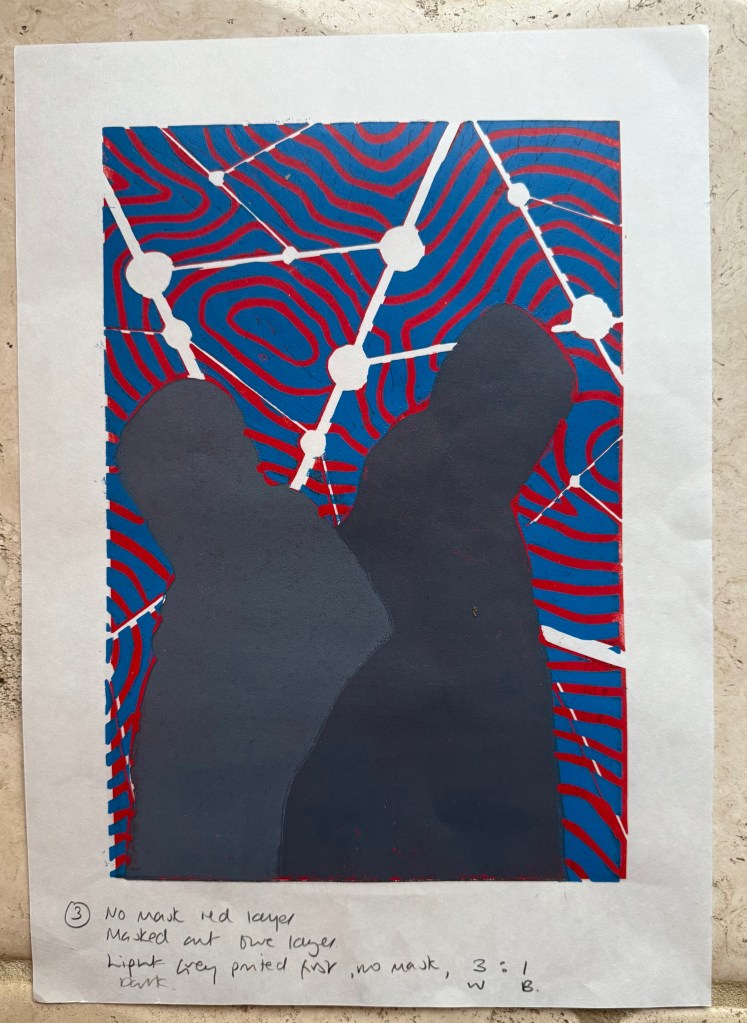
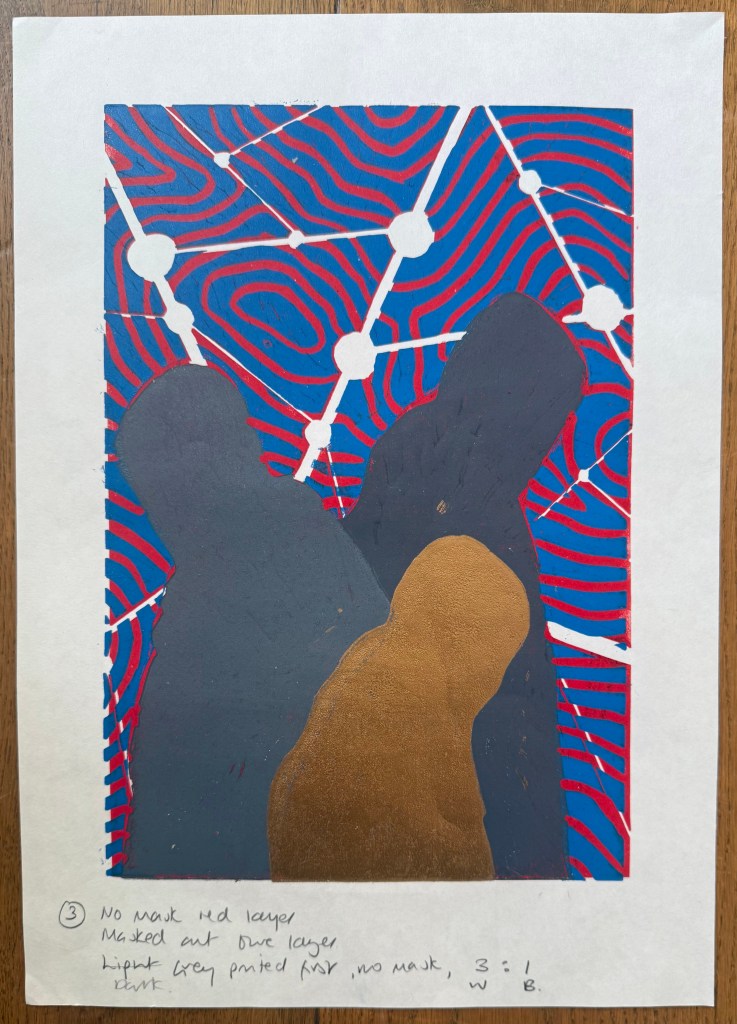
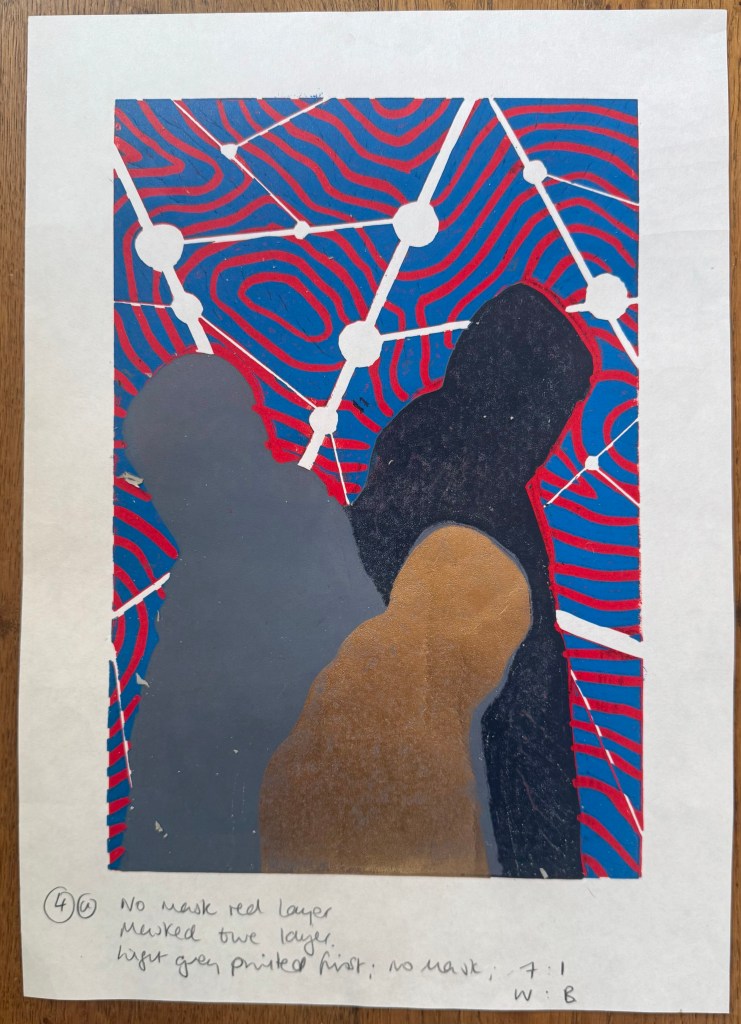
I created a registration board for the lino, drew lines where the paper was to go, and printed the first layer using equal parts process red and process yellow. Initially, I thought that I could mask out the figures using some tracing paper. Reduction linocuts work from light to dark ordinarily, but my image doesn’t really conform to that process. I knew one, if not two, of the figures would be a med/light grey and I wasn’t sure how that would sit on top of a bright red. I tried inking up whilst the mask was on the block and then removing it, but it was difficult to do because the mask kept on sticking to the brayer and the result wasn’t great. I decided to ink up the entire block for the rest of the prints. I also noticed that some of the chinagraph was coming off the block onto the prints.
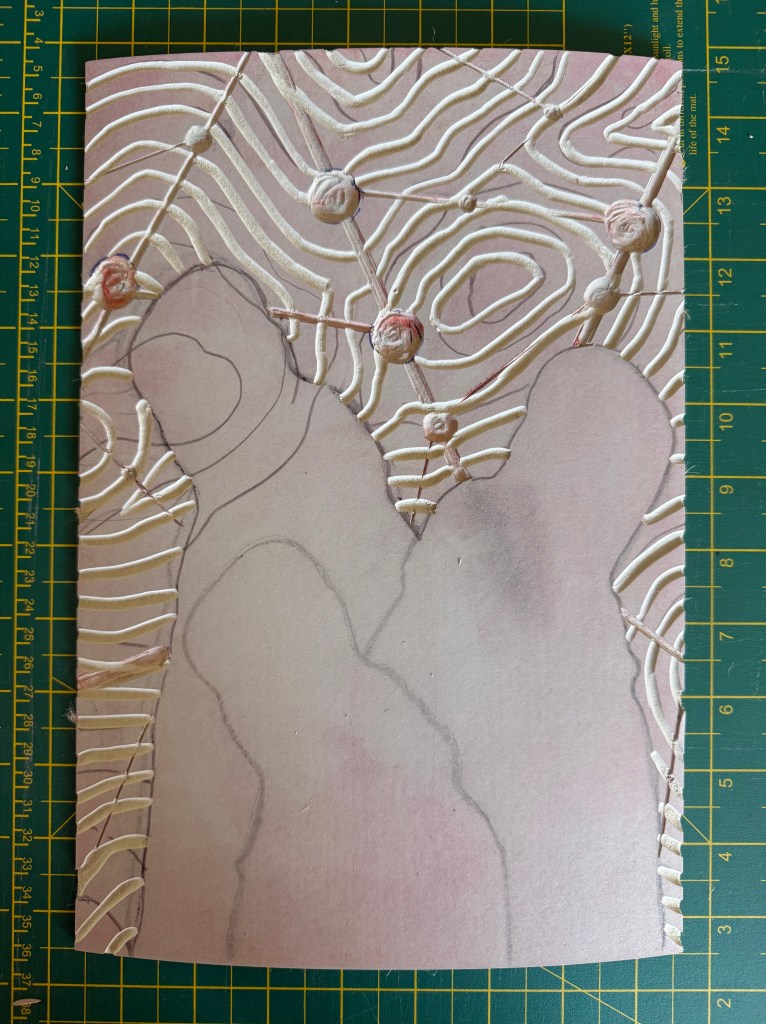
Next, I cut out the contour lines and printed with blue ink. By this stage I had realised my previous error and masked the figures after inking the block, but before printing – a much better result, and I can’t work out why I hadn’t realised this to start with. However, after the first print it was obvious that the registration was off. I had thought that I had lined up the paper the same each time when I was printing the red layer, but I clearly hadn’t. I created a raised edge against which to place the paper on subsequent prints, but I had to accept that the blue and red layers wouldn’t line up on all of the test prints, which would cause problems in relation to the white areas.
There was also misalignment around the edges of the figures which could have been caused by poor registration on the first layer, but could also have been caused by a lack of accuracy in creating the mask, or even applying too much ink.
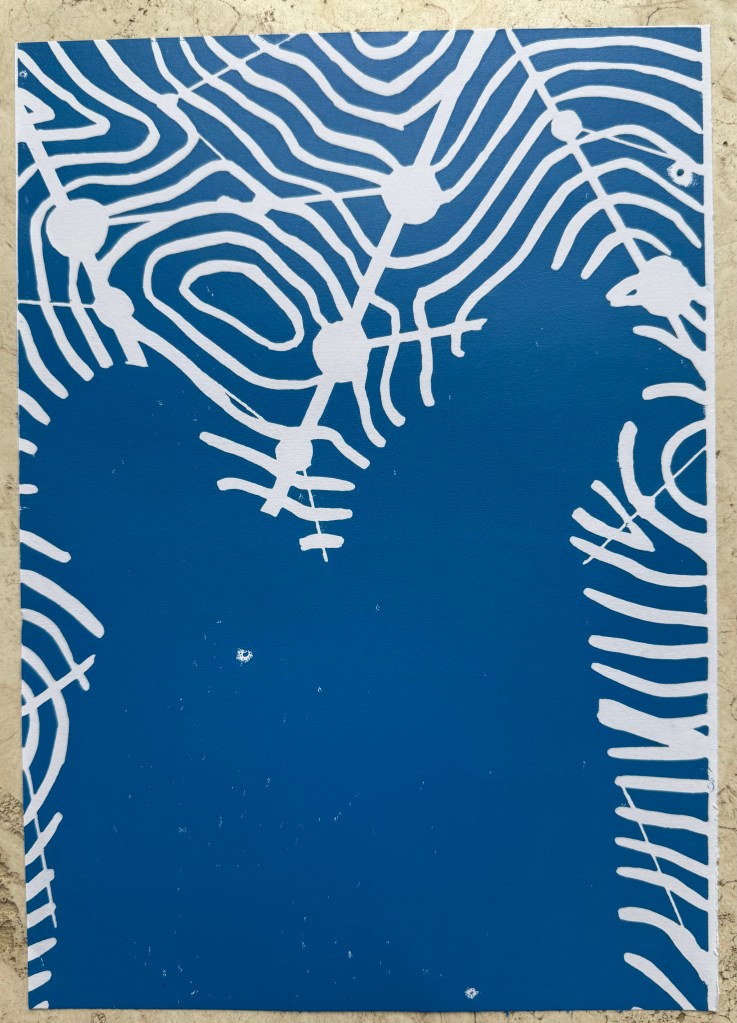
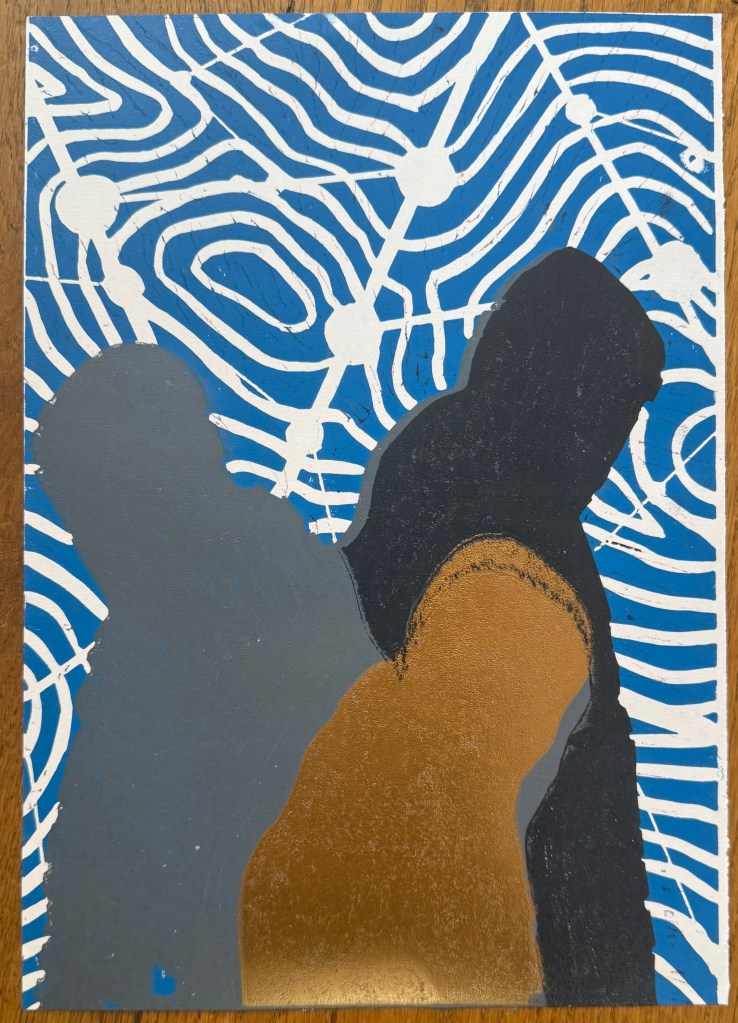
To complicate matters further, the paper I used was Japanese HoSho paper which being lightweight (90gsm) and strong makes it ideal for printing linocuts. However, it turns out that it is slightly smaller than A3. I already had some Snowdon 130gsm paper, so I thought that I would give that a go, to see if it would be a suitable alternative, even though it is heavier than the HoSho.
Other than a few areas where some bits had managed to get stuck onto the block, it seemed to print quite well.
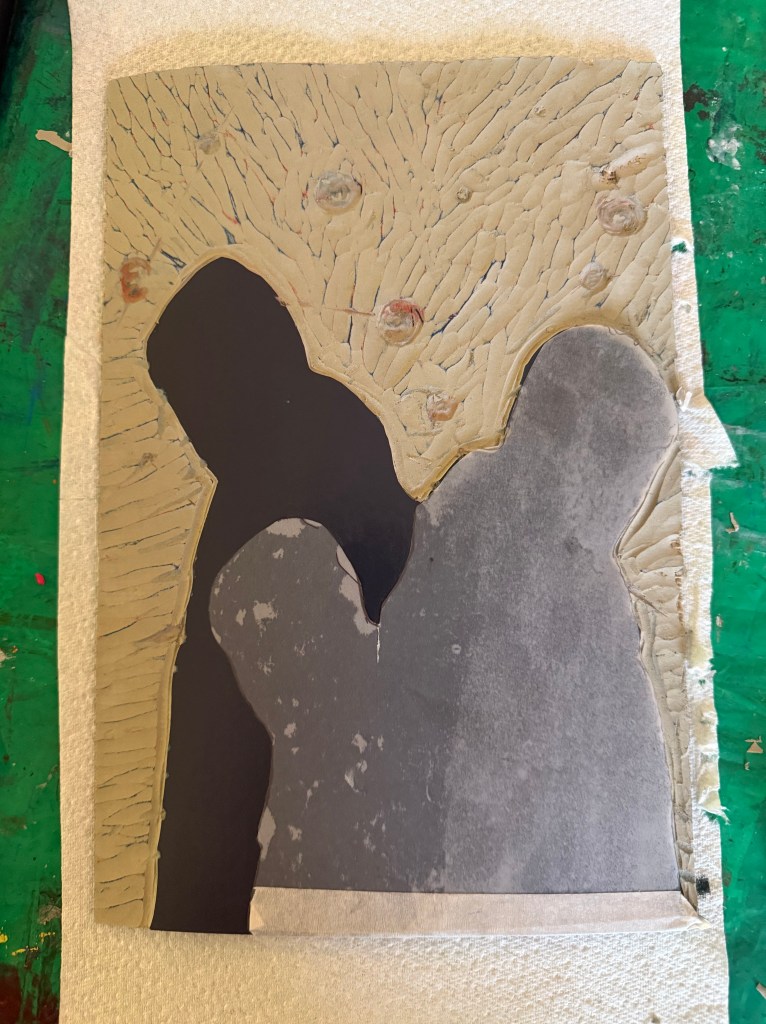
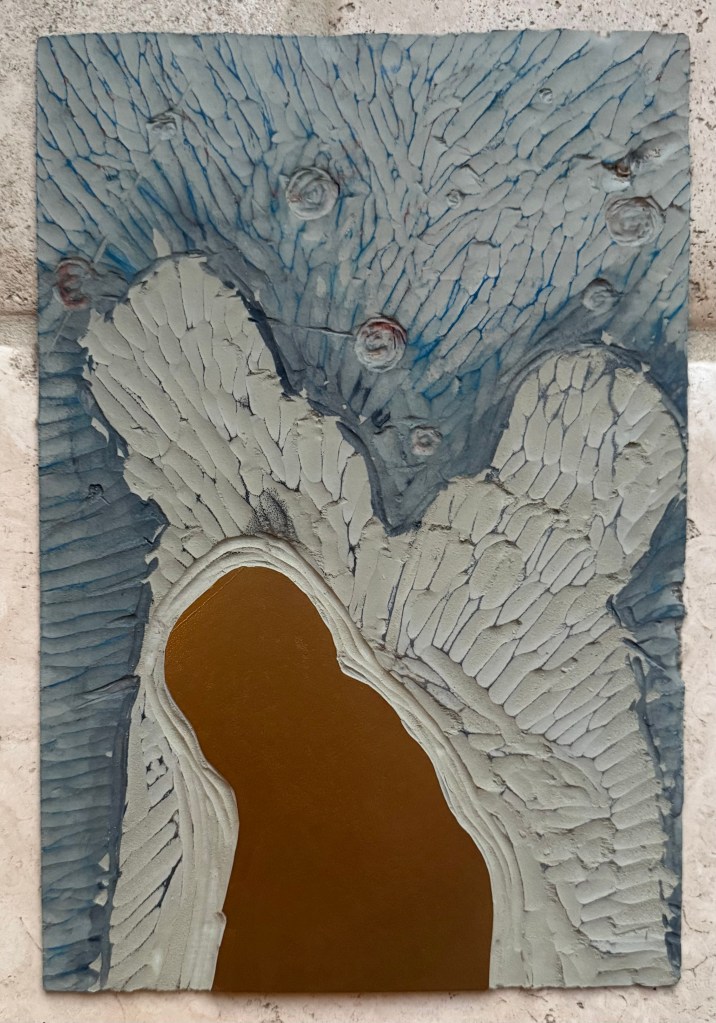
I then cut away the rest of the block leaving just the figures. I wanted to experiment with both masking areas and inking up the whole block to see how the subsequent layers printed so I could decide on a final approach ie whether to use a mask or to layer the ink. I would have preferred not to mask any areas as it seemed to increase the risk of mis-registration of the print. But before I decided I needed to find out how the final metallic gold layer would sit on top of all the other layers. I noticed that there were some indentations in the outlines of the figures from where I had cut out the contour lines.
I also wanted to see how the grey would print on top of the blue as well as the red, and it seemed to fare quite well, although it definitely has a cooler undertone to it than when printed over the red.
The blue and grey layers seemed to dry slower than the red and, as a result, the dark grey/black ink didn’t print well, and also the cut away areas picked up some of some of the blue and transferred it to the prints. I had the same issue with the gold ink, but by that stage I had become a bit frustrated and impatient, and just wanted to see what the colours looked like together. There are agents which can be added to the ink to speed up the drying process but you have to be careful as to the amount used, as they can alter the colours. I could have swapped from oil based to water based inks, which I didn’t have. So I decided to make the best of what I had.
I know that I make things more complicated for myself than they need to be. I could have watched videos on how to make reduction linocuts before starting, but there is a part of me that thinks that learning on the job is a more valuable, if not more frustrating, experience, and that the lessons learnt are more likely to be remembered (and possibly put me off linocuts for good).
So, what did I learn?
Preparation is key
Registration is everything – I watched a couple of videos after the event and invested in some Ternes Burton registration pins and tabs
It’s preferable not to mask areas if possible but to cut away the lino on each layer
Don’t use chinagraph or anything else which could transfer from the block to the paper
Accuracy is important
I should have had a resolved image before I started, rather than winging it in the process
When cutting out the first and second layers I needed to ensure a clean edge with the figures by using a craft knife
I needed to check that there isn’t any ink on the cut out areas of lino before printing
The ink needed to be dry before printing the next layer
But, the most important lesson is that because of the number of layers and the time needed for drying, it would not have been possible to complete the print before the end of the month. I needed to go back to the drawing board and have less colours so that it reduced the amount of drying time etc. So I amended the image to just white, red, grey and gold.
Yesterday’s session turned out to be quite timely for me.
We watched a video of William Kentridge’s Tide Table and part of an interview with him. He likes working with charcoal because it can be erased very easily, and speed of thinking is equal to the speed of drawing. This reminded me of paint being liquid thought (Elkins, J What Paint Is). Kentridge describes his work as being on a trajectory – a path followed, which finds structure and subject through being made.
Amongst other things, we considered what advantage exists in using material that changes easily, and what the advantages are of working in a fast or slow way? We discussed how working quickly can be more intuitive and stops the conscious mind from overthinking. In this respect, some expressed the opinion that work made in a short period of time does not have as much value as work which takes longer to make.
This is a concept that I have been grappling with for some time, in an attempt to shake it off (Dialogue I;Dialogue IV – I’m So Over It; We’re So Excited; Am I Bovvered?). It seems to me to be illogical, because I wouldn’t think that a book which took a year to write is of greater value than a book which only took a month. Maybe one author was in a flow state and it all came easily, whilst the other had to struggle, but theoretically they are of equal value.
What determines art’s worth? The time spent on it, the skill involved, the size, the materials used? Would a small piece using 24 carat gold leaf encrusted with diamonds which took me 5 minutes to make using quite complex skills be worth the same as something I took days to produce using a child’s wax crayon and a piece of scrap paper, but into which I poured all of my emotional being? I’m trying to bring myself over to the point of view that none of it matters; what matters is that I made it because I thought it worth making, and that it connects with me. But it’s very difficult to shift the mindset.
In my posts, which I refer to above, I was considering value in terms of rejection and how that might impact how I felt. I have the opposite scenario at the moment; I saw one of Rebecca’s blog posts about an exhibition she had been to, and I was intrigued by the technique used by the artist. I thought that I would quite like to try it out, and so I did. I made ‘Siblings’. It took me about 45 minutes or less to make. It didn’t take much skill to make – to be fair it could have been made by a primary school child with appropriate supervision while using the craft knife – but it represents and embodies something deeply emotional to me and it was very much about the process. As it turned out, I wasn’t disappointed with the end result and so I decided, on a whim, to enter it into the ING Discerning Eye Open Call, for which the deadline was the following day. It has been selected. You would think that I would be over the moon. I pretend to be to the outside world, but inside I still can’t help feeling that it’s unworthy because of the limited time it took to make.
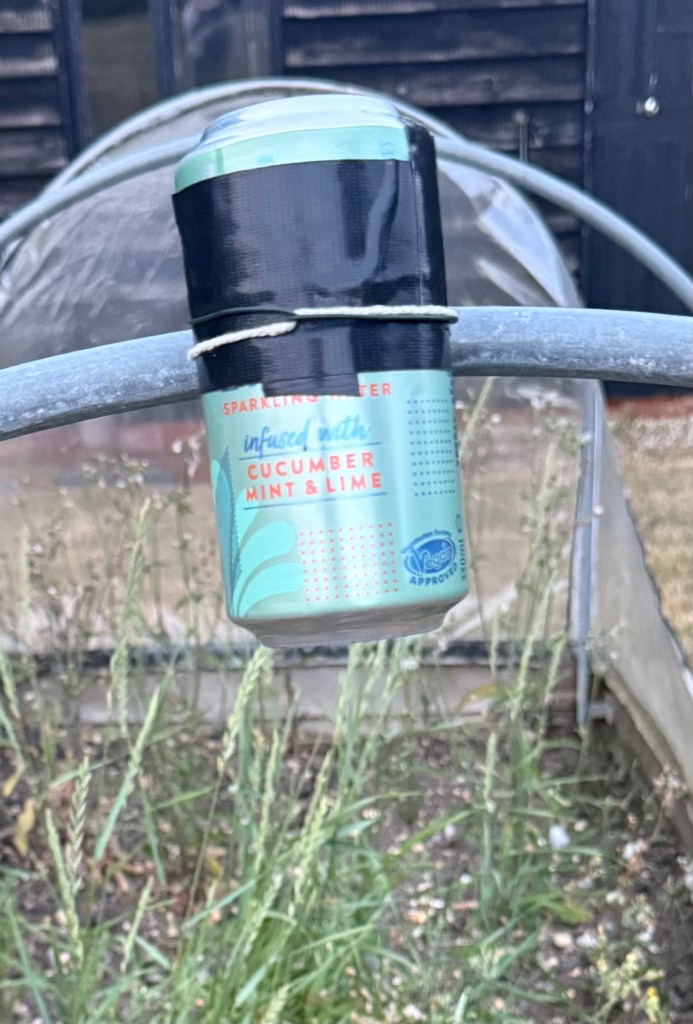
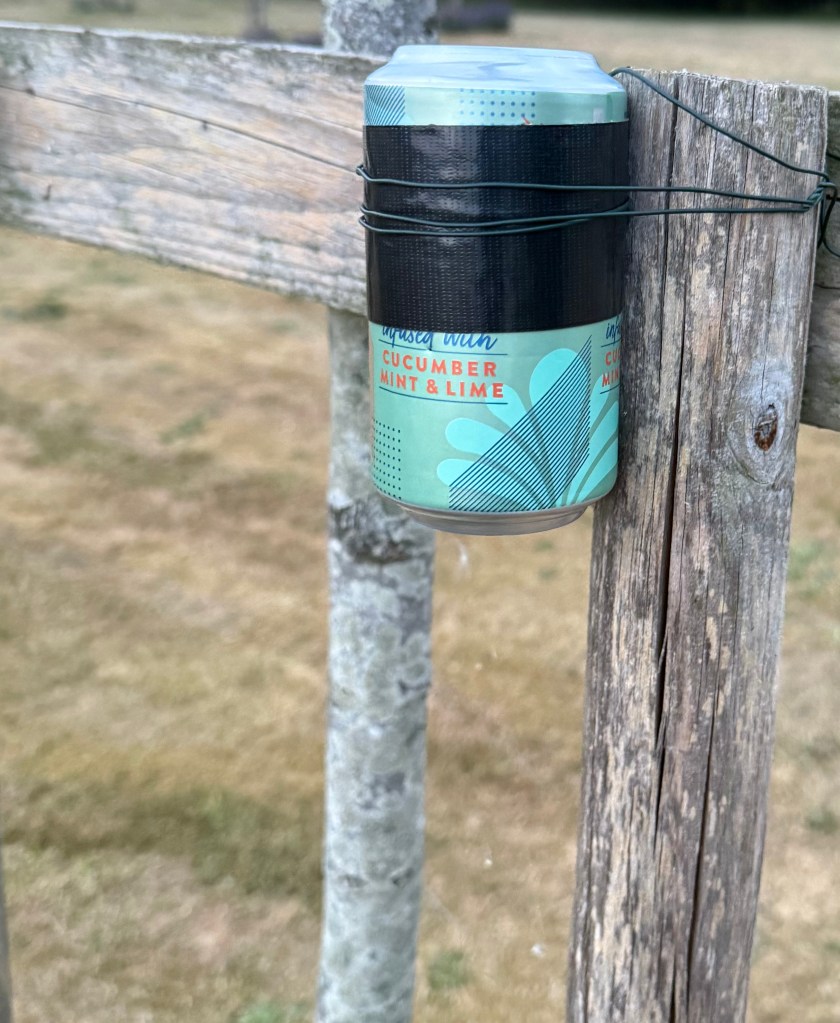
I’ve finally got around to doing something I’ve been wanting to try for ages – solargraphy.
I’ve been saving up used drinks cans in preparation, and today I managed to prepare some pinhole cameras and fix them in various parts of the garden. I took the top off the cans using a can opener, punctured a hole in the side using a pin and then inserted a piece of Ilford Multigrade satin photographic paper. I then sealed the unit using the bottom section of another securing it with gaffa tape
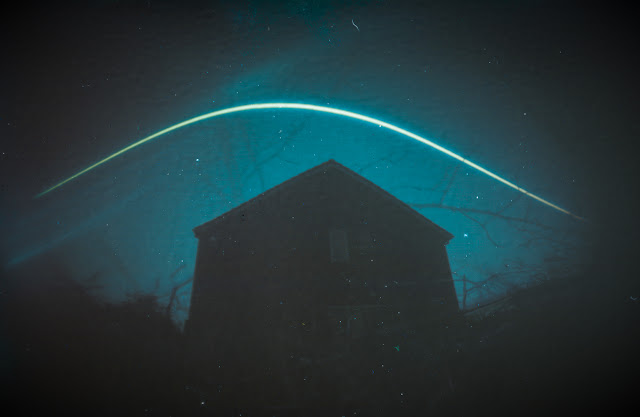
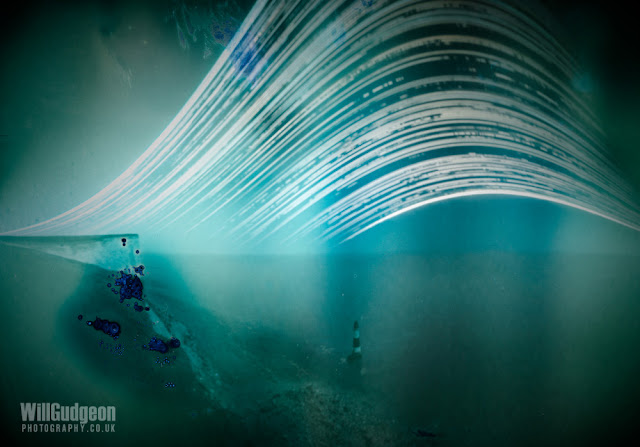
Hopefully I’ll get some images which show the movement of the sun across the sky, mapping its path – a perfect way to capture the passage of time within a single image. Maybe something like these:
I haven’t done anything since coming home from the Low Res.
There was an intense period building up to it, followed by a period of sitting back and taking stock. I’m still thinking about it all, but whilst doing so I’ve allowed myself to get sucked back into domestic life. My daughter’s now home from uni for a month, along with all her ‘stuff’. Whilst it’s lovely that she’s back, it’s upset the normal way of things. Glasses and crockery disappear into the blackhole that is her bedroom, and the bottom of the stairs has become a footwear hotspot. Could be worse, I suppose.
Also, one of our dogs, Monty, hasn’t been so good. He’s an old boy at 12. Enlarged prostrate, chemical castration, hormonal inbalance making him not himself, and removal of a malignant melanoma. Waiting to talk to the vet about prognosis. I suspect there may be trouble ahead and difficult decisions to make. He’s out of sorts. We’re all out of sorts. But tomorrow’s another day.
I haven’t made anything. I am conscious that I haven’t and it’s starting to stress me a bit. My last two posts could have been cheerier, but there’s no point in putting on a fake smile. My colours are definitely muted at the moment. I feel like I’m stuck and I can’t progress until I’ve managed to process and order all that I took away from the week in London, but up until now I haven’t been able to set aside the time to do it. Also, my logical side dictates that I should deal with it all in chronological order, but that’s impossible to do because it all seems to be intertwined.
Second year Catherine told me that she feels like a spider spinning a web. I told Jonathan that I felt like I had been collecting during the week; it’s as if I’m accumulating pieces of a jigsaw puzzle, but I don’t have the benefit of an image on a box to guide me. I just hope it makes something, because it’s making me feel out of sorts.
I’m looking forward to the start of a new term next week. I need some structure.
During our session at the brain gym this week, I explained to Dalal and Josh that I have been struggling to make finished work, as opposed to the products of experimentation. They both agreed with Jonathan, who, during my tutorial, had questioned whether I felt a pressure to make finished pieces; the experimentation stage is a place to stay for a while, and will, at the right point, turn into something more complete. I commented to Josh and Dalal that part of the problem may be that I’m ever conscious of time passing, and so I feel that I should be making the most of every minute – preparing the work plan had brought into perspective that there are a finite number of weeks left of the course, and that made me experience a moment of what I can only describe as loss.
I had hoped that a more productive phase would be imminent, but I suspect that at the moment this is being hampered by not having the headspace, or the physical space.
My husband is about (fingers crossed) to complete on the sale of his parents’ house in Liverpool – his childhood family home. He has been up and down, bringing things back. I find the process very difficult – I don’t have a problem with keeping things of use or of sentimental value, but another can opener? We have enough of our own stuff. We, or more specifically I, don’t need to add our parents’ stuff to the mix. I feel like I’m suffocating under the weight of belongings, many of which are occupying the physical space where I should be creating (more stuff?). Admittedly, I’ve been sorting this space out for I can’t remember how long, and made absolutely no progress. I’m conscious that my daughter will, one day, hopefully not in the foreseeable, have to undergo the same process – I don’t want her to be weighed down by all the stuff.
Along with the stuff, he also brought back what remains of one of his best friends from school, who died suddenly last year. His friend had left instructions as to all the places where he wanted to be scattered, including our garden, as he enjoyed coming to visit. Unbeknownst to me, my husband had brought him into the house and put him on the shelf, next to a glass bowl which had belonged to his parents, and which he had smuggled in as contraband whilst I wasn’t looking. My heart sank as I saw the bowl, and then the black bag next to it – what’s in here I thought as I opened the bag and took off the lid, another ornament?…