My daughter phoned me yesterday, after her final exam. That’s it, she’s done, she’s finished, university is over. Another chapter in her life is coming to an end as another is about to begin.
That’s not the only achievement. Whilst she was at home over the Easter holiday she drove a car for the first time since her head-on collision last May. She felt she was ready – she had been having dreams that she was driving and felt bereft when she woke up to discover that it wasn’t real. A far cry from the flashbacks she had been having. So, I went with her for a couple of drives, and then she asked me how I would feel if she went solo. I told her that I was ok with it if she felt comfortable, rather perplexed by the seriousness with which she had asked the question. Well, you were traumatised by the accident as well and I want to make sure that you feel comfortable with me going by myself.
I’ve been thinking about this conversation and wondering why I was surprised by it and why I’m not still carrying the fall out from the accident with me – what could have happened, and what did happen to my one and only. Maybe it’s because after it happened I was making – experimenting with drawing maps and hands – and writing about it on this blog. It makes me wonder how differently other things might have turned out had I been making art or had written about it at the time.
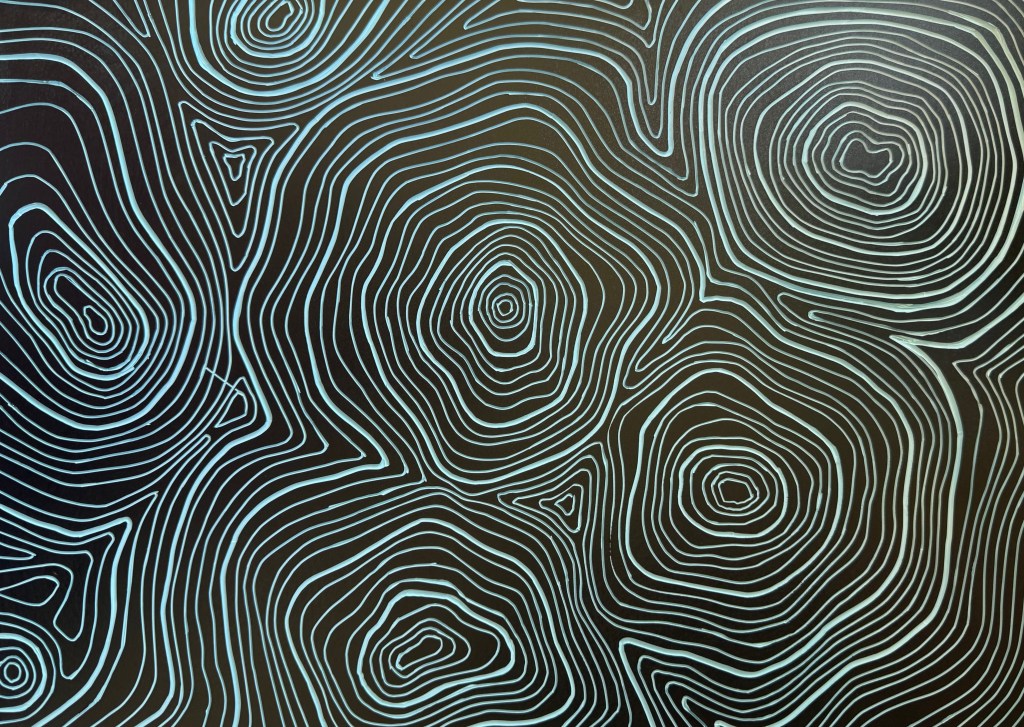
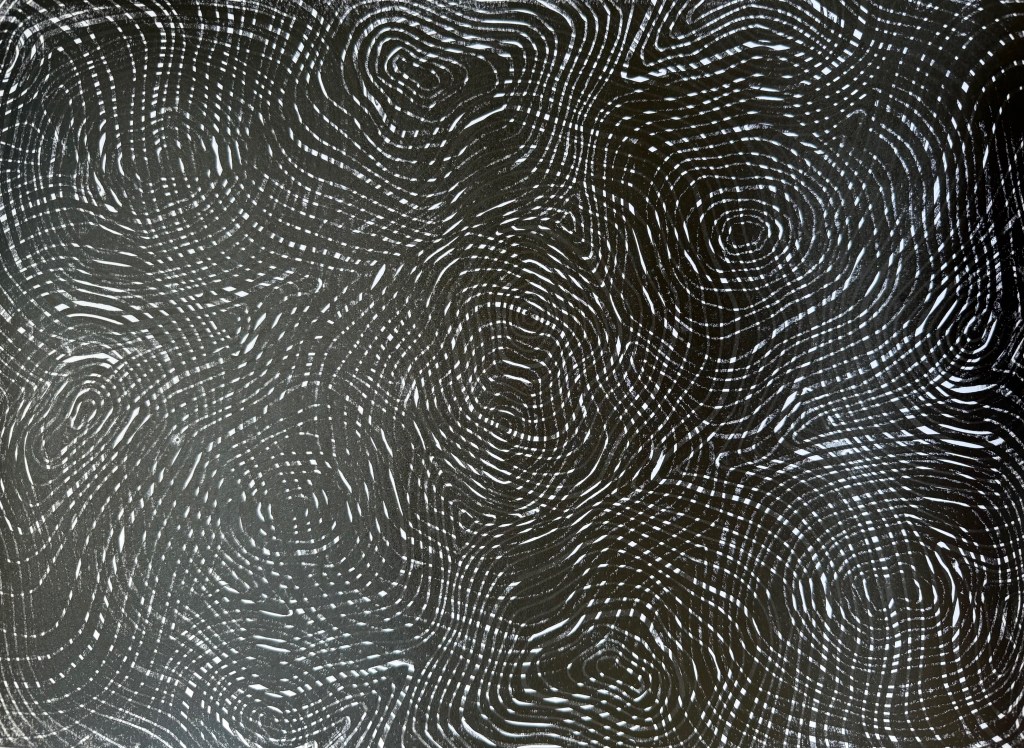
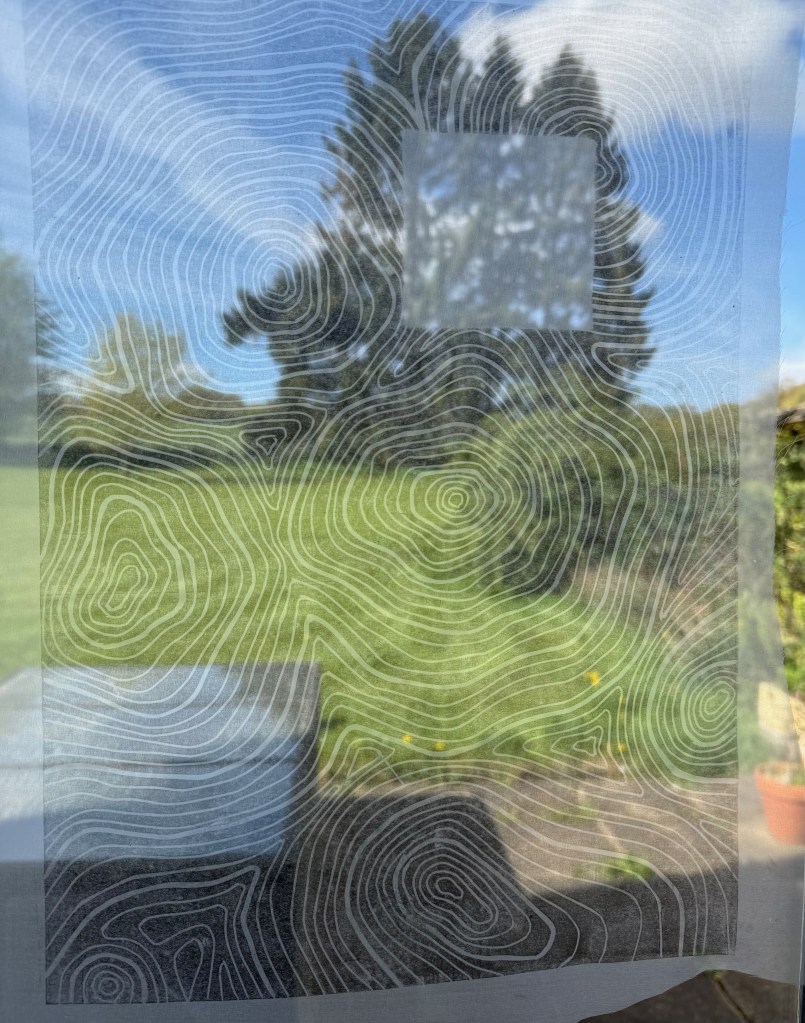
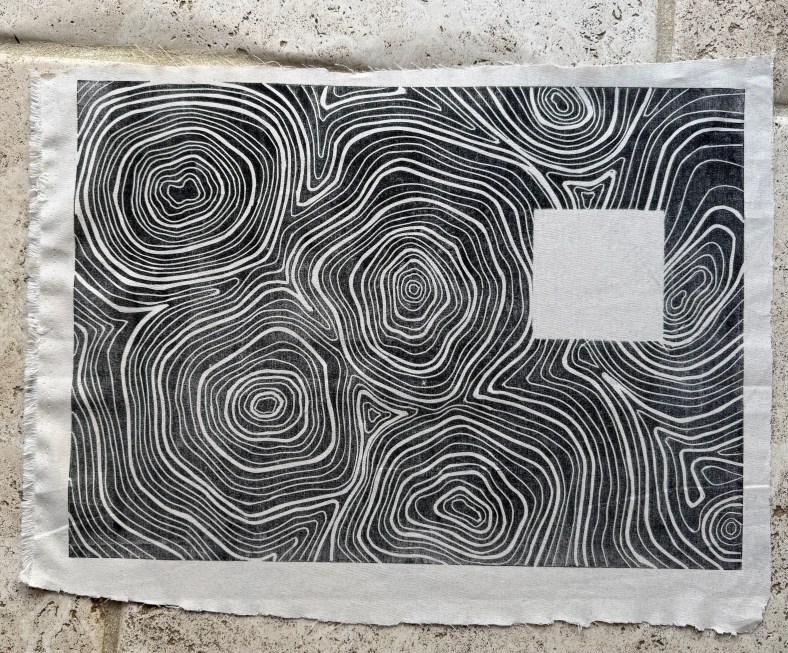
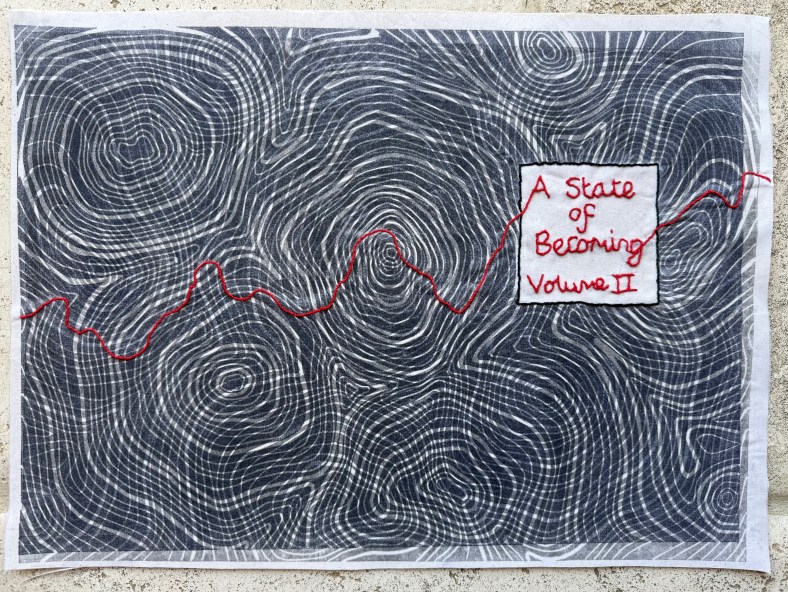
I’ve been making the book cloth for the second book. This time I lino printed onto a sheer fabric and a plain cotton.
I need to sharpen my cutting tools – there was slip on the left side. I’ll be able to cover it up with the mask for the title block.
Overprinting on paper
Print on sheer fabric
Print on cotton fabric
Fabrics bonded together and backed with mulberry paper and addition of title.
For the end papers I asked my husband and daughter to draw some more outlines for me to fill. I’d been experimenting with not using straight lines.
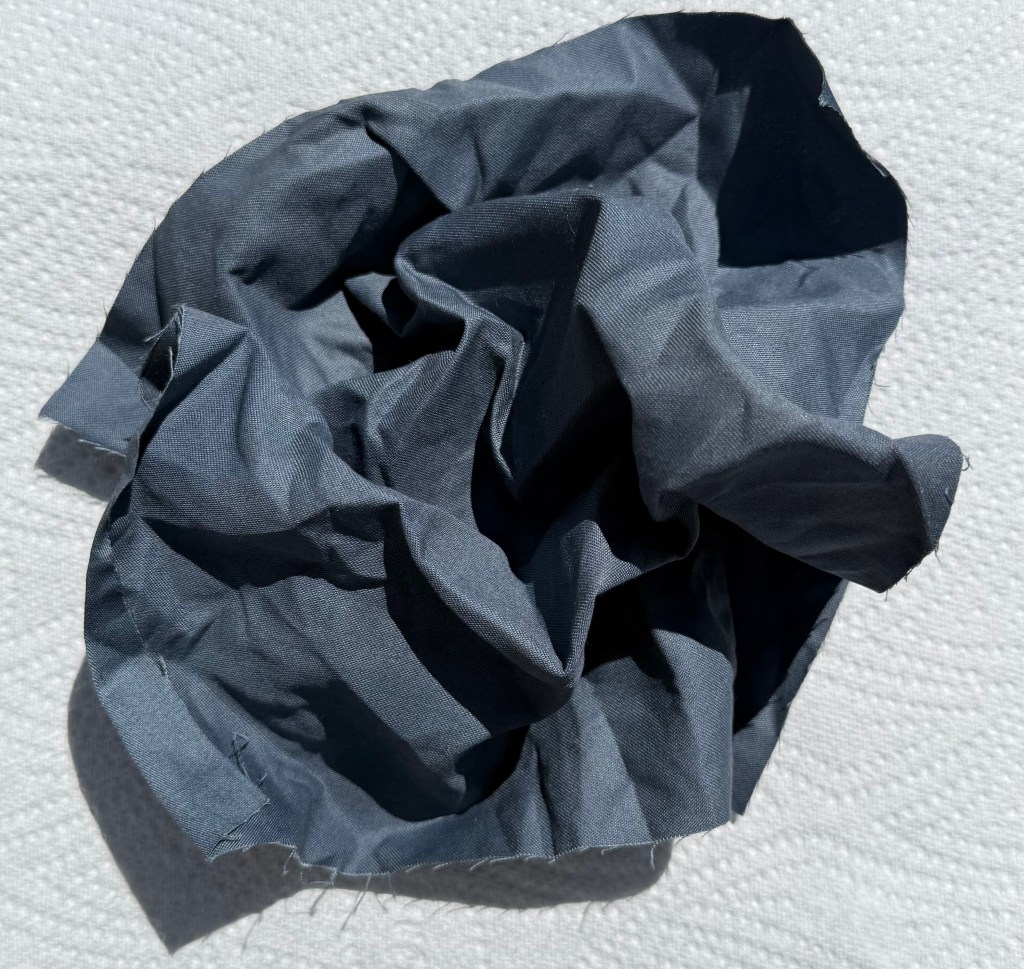
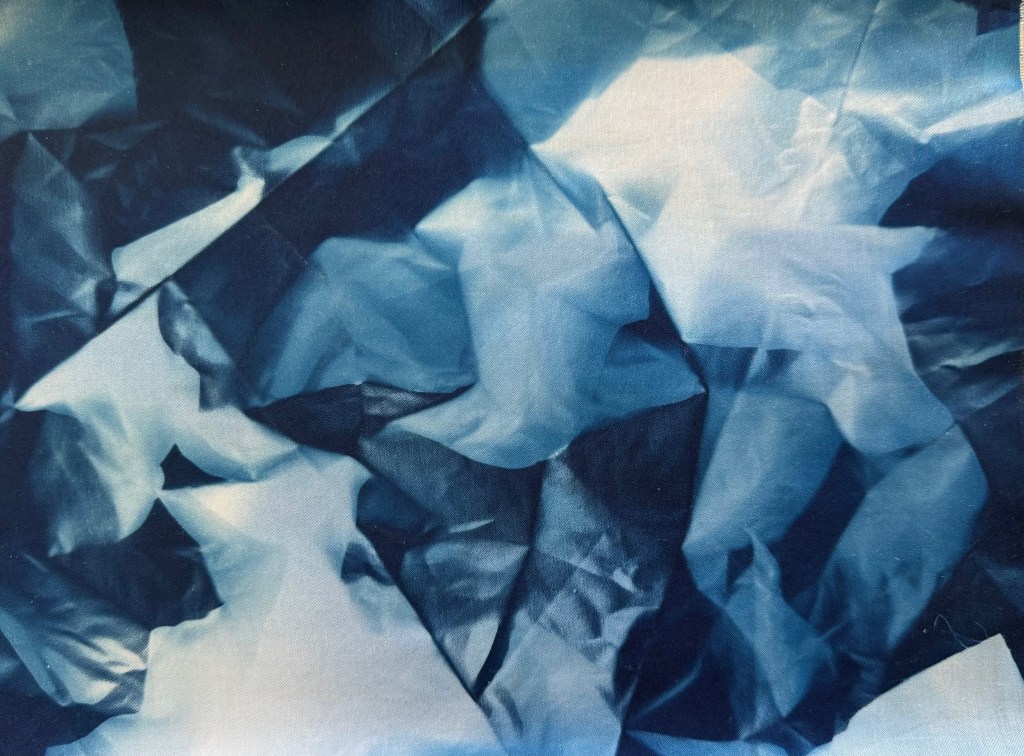
I then redid the cyantotype for the remake of Volume I. Whilst I was waiting for it to develop, I scrunched a piece of fabric up and left it outside. I was pleasantly surprised by the result.
April is a strange month. On the one hand lighter nights, Spring, and so many birthdays, including my daughter’s. On the other, my mother’s birthday and the third anniversary of her death. It’s not surprising that she’s been on my mind.
My thoughts have turned back to microchimerism. I’ve mentioned this before, mainly in the context of siblings in The Invasive Sibling. In that post I also refer to the mother’s cells travelling into the baby via the two-way street that is the umbilical chord, something that I didn’t really think about any further at the time. I was doomscrolling on Instagram earlier, and came across a post which was about this very thing. It took me aback in the moment, and its profundity made me suddenly feel really emotional.
In general terms, it’s a difficult one to get my head around – the mother is inside the child, which in turn is inside the mother.
I spoke with my daughter yesterday. After a short while it became apparent that something wasn’t quite right. She eventually told me that she felt really stressed. It’s difficult when all you want to do is give someone a hug but they’re miles away. It’s her final year: she has a dissertation due in a month and she starts her last set of exams shortly afterwards. She’s in a group of three and they are conducting an experiment, but circumstances have transpired that she has been the one who has had to spend day after day on campus conducting the testing of the participants, whilst one of her group has been abroad and the other has spent half of each week at home with his parents. She feels snowed under with work. She’s waking in the early hours, and not sleeping properly.
I asked her what is the worst that can happen? I don’t graduate, she replied. And what then? I have to redo the year. Is that such a bad thing? It upsets my plan. Well, that’s life, plans often have to change. So, if the very worst case scenario is not that bad, why make yourself ill worrying about it? We also discussed how she needs to be kinder to herself. I reminded her that it’s been non-stop since her car accident last May. She lost her summer holidays to pain relief, physiotherapy and trying to process the situation she found herself in, and no sooner was she emerging from it all than she was back at uni with the onslaught of the final year. I suggested that she discuss how she’s feeling with her supervisor – if you don’t tell people you’re struggling, they won’t know. I think she felt better – she said she did.
The conversation reminded me of the day in my early thirties when I walked out of the office to go to a meeting and realised that I just couldn’t do it and so I went home. I remember how I felt that day. I had an overwhelming feeling that I just had to get away – the best way to describe it would be as a survival instinct to run. There was absolutely no doubt in my mind that it was the right thing to do. I was signed off work for two weeks with ‘exhaustion’, the culmination of running an expedited trial which instead of taking a year to progress, was condensed into less than a couple of months; working incredibly long hours, every day. I coped because I was expected to cope, and like my daughter I just got on with it, reliably taking up the slack. The night before I ‘ran’, my mother had told me that she had been diagnosed with breast cancer – it was the nudge that had pushed me over the edge.
I learnt two important lessons from that experience: no-one is indispensable (they managed to get by without me) and how to say ‘no’. As a consequence work became more tolerable, but not enough for me to go back after maternity leave.
Whenever I hear that a friend’s child wants to be a lawyer, my heart sinks. I still feel uncomfortable when I go back into that environment. The visit to Clifford Chance’s offices during the Low Res to see Jo Boddy’s wonderful exhibition stirred up some old feelings. But worth it to see her amazing work. It was a privilege to hear her thinking behind her process, and how she went about its making.
I’m generally quite a logical person, but I’m not always methodological. Often I’ll have an idea that I want to try out, and instead of following the steps which logically come before it, I launch straight in. Maybe I’m just not that interested in the preceding steps, or maybe I’m just impatient.
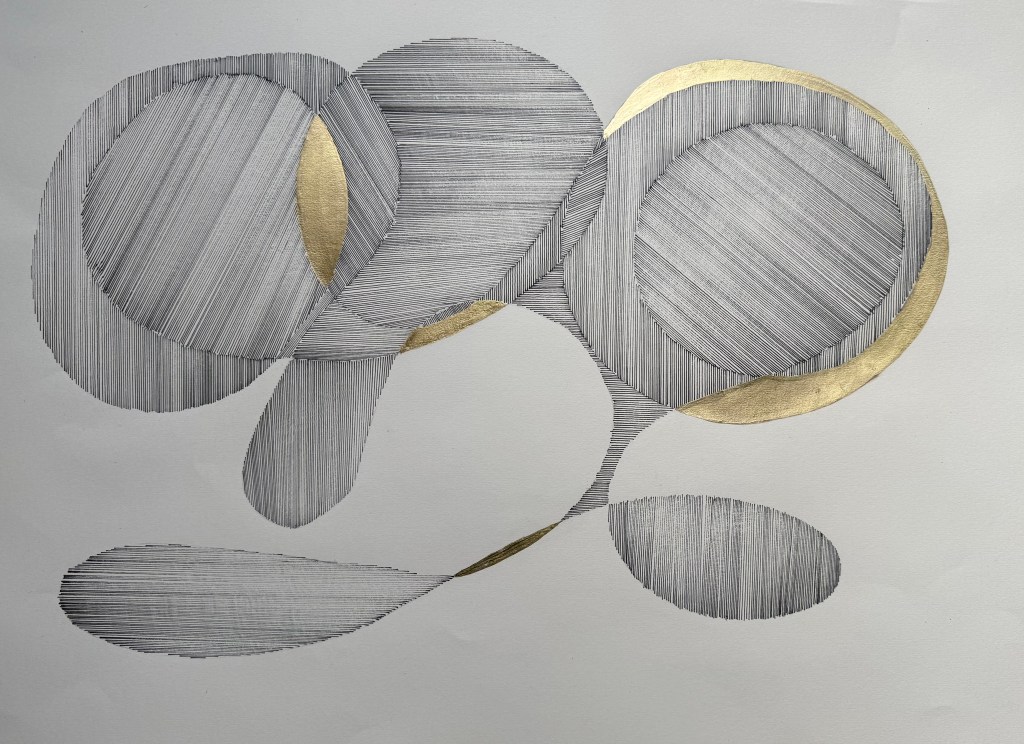
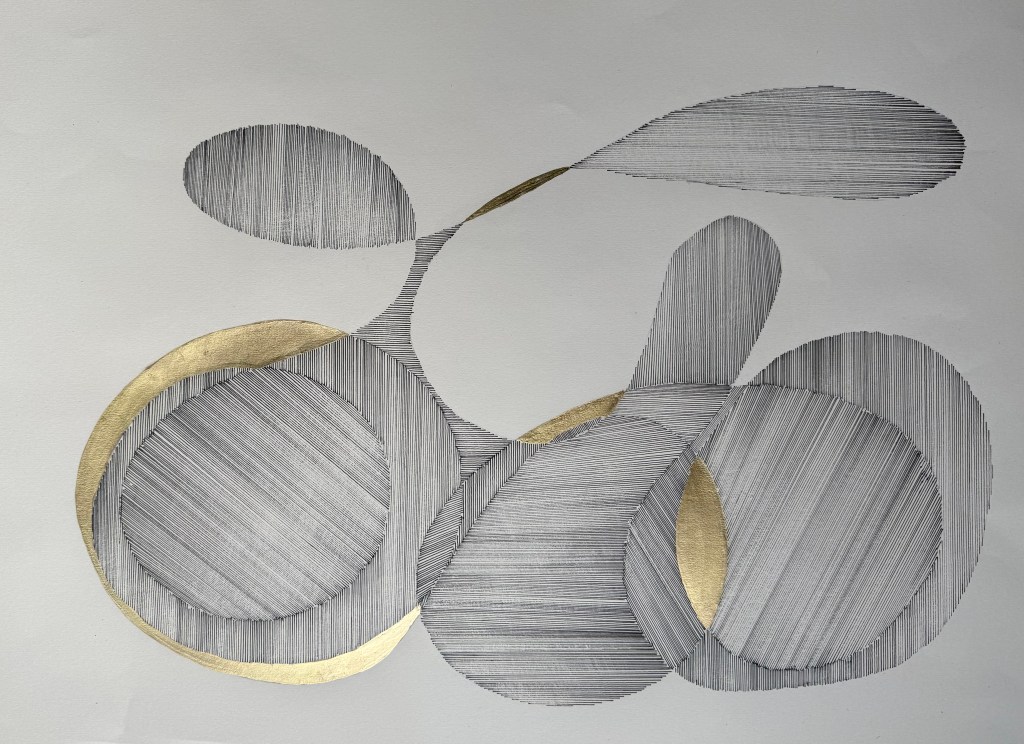
Anyway, armed with some Micron fine liners I decided that rather than start again where I left off last time, I would change a few things all at once. Sometimes in my art class we will do an exercise where we draw something and then pass our work onto the next person who then adds to or modifies it. I’m not keen on this exercise, in relinquishing control to someone else, of letting someone else be a part of my work.
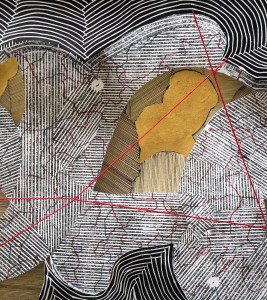
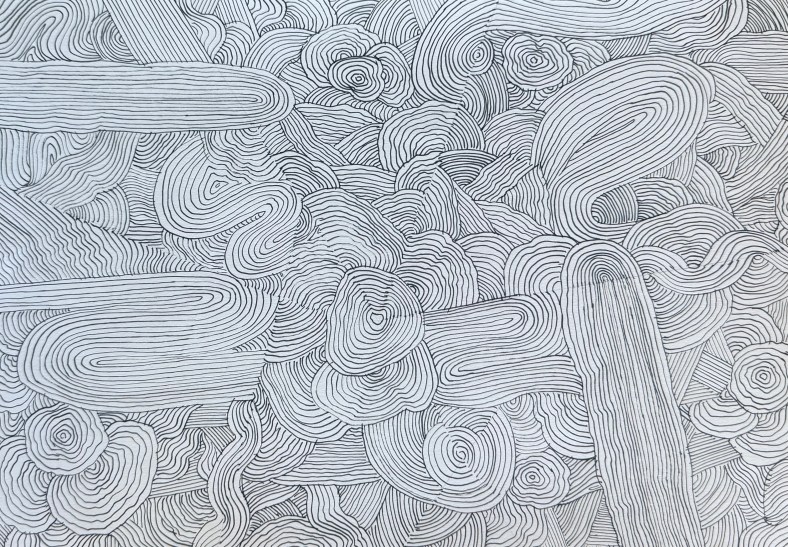
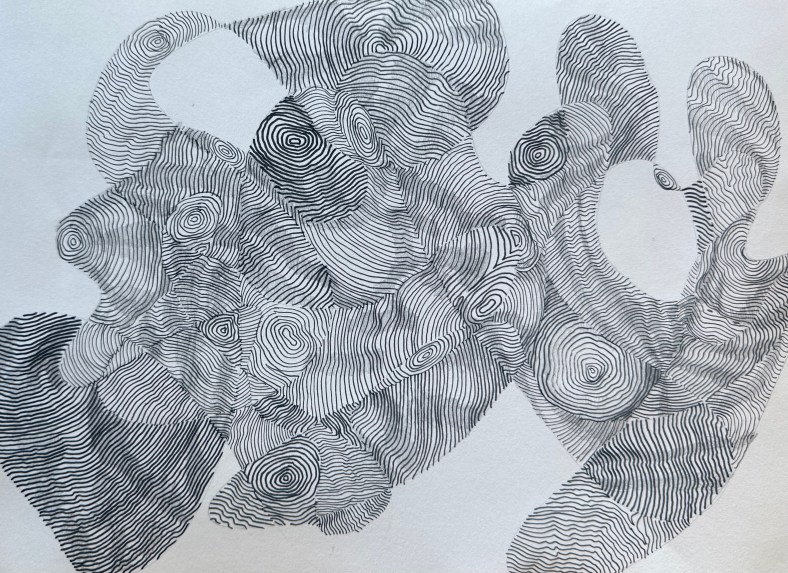
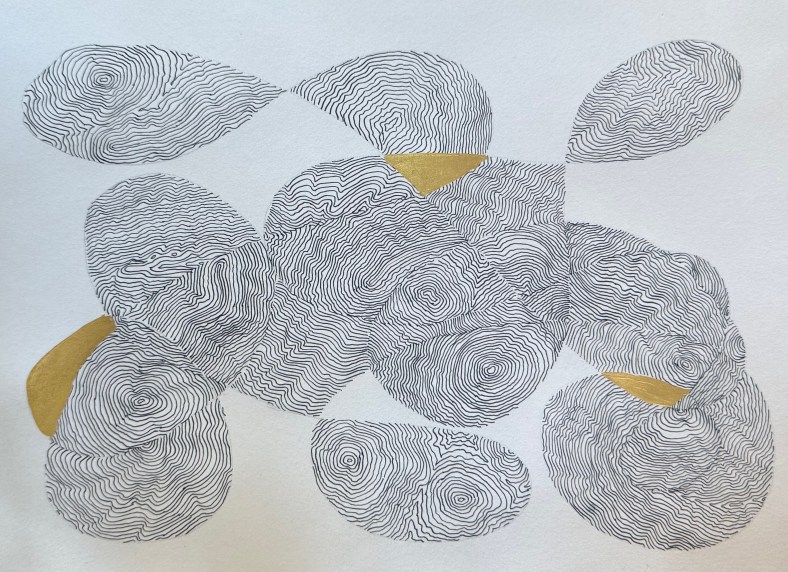
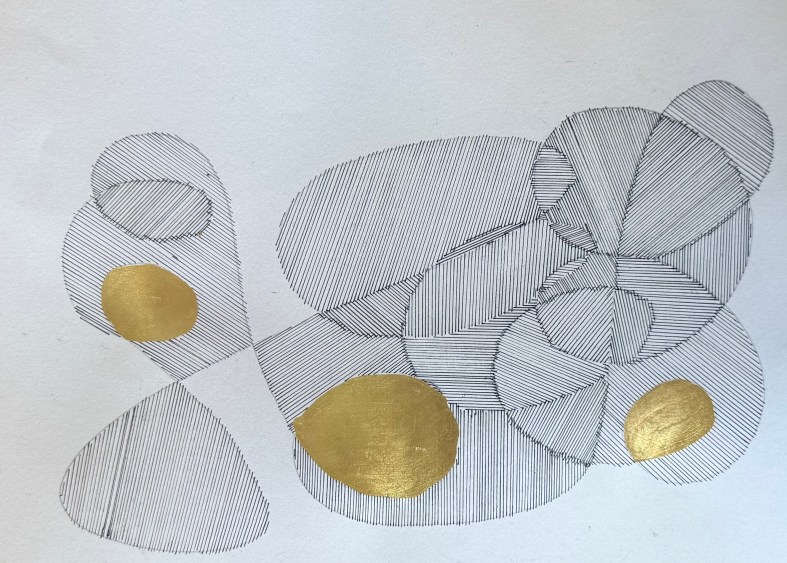
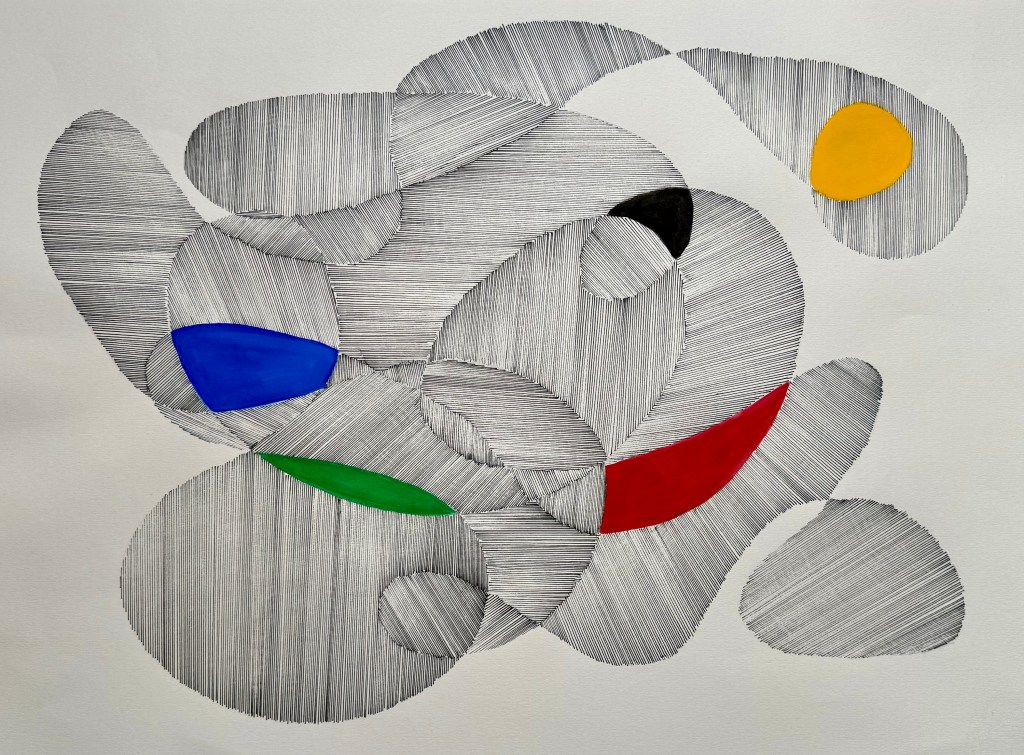
As drawing lines is a repetitive, controlled and focussed act, I decided that I wanted to shake it up a bit, to introduce an element of unpredictability. Whilst drawing a random outline is to all intents and purposes unpredictable, because I’ve done it so many times I suspected that I might have developed an unconscious pattern of movement, a comfortable way of doing it. So, I decided to ask my husband and daughter each to draw an outline to which I would then respond with a simple system of using the same width of pen and filling in each section with lines, ensuring the lines in adjacent sections are going in different directions. I also allowed myself the opportunity of leaving a few sections blank or treating them in a different way. I worked on A2 off white cartridge paper.
My husband’s:
This is the orientation it was drawn in and I prefer it this way as it gives it a feeling of instability, discord, of something melting. Anyway, the other way up it reads as a cyclist with a flat rear tyre.
My daughter’s:
The first thing that strikes me is the relevance of selfhood and the act of becoming. Becoming happens through entanglement with others and selfhood is shaped by those relationships, and the world around us. These images embody my relationship with the people who drew the outlines. I didn’t choose the outlines but I can choose how I respond to them, how I engage, how I attend to them. I transform the outlines with time and devotion much as I do in the relationships with my husband and daughter. They then respond to what I have done and all of us are changed by the process.
I really enjoyed making these images. The repetitive act of drawing the lines allowed me to switch off and to engage fully with the process rather than thinking about the result. I had no idea how they would turn out. The decision as to direction was made in the moment – it may not even have been a decision as such, just an intuitive adjustment of the angle of the ruler. I like that the mark-making is the subject of the images and consequently so is the process. The only active decision was which parts to leave out and how to deal with them. I love how the process is so evident – the times when the repetitive act and the sound of the pen on the paper made me lose focus and overshoot, how when I moved the ruler it left a spidery trail, how the areas where the lines cross form and edge which is at times irregular, creating a distortion, an interference, almost a vibration. Against the flat areas of colour the lines even appear to have a dynamism about them which I think is helped by the variation in tone – there are lighter areas where the pen is starting to dry up.
Whilst I was making them I felt content, as if two parts of myself were both being satisfied, balanced – the part which likes order and certainty and the other which likes the unpredictable and the unknown. There must be something about it which resonates with me because I subsequently went on to spend the following week experimenting with more images.
It would be interesting to see what the process is like involving people who aren’t experienced with making art to see how their outlines might differ in the sense that they might be less confident and their mark making more hesitant. Also, what about strangers? How might I feel responding to outlines which have not been made by people that I know?
I said no. Alcohol and morphine. Why? One of my biggest regrets. I used to dislike it, but now it’s my go-to drink. A constant reminder of when I should have been a daughter, not a carer?
A late night conversation which embodies the isolation and hopelessness of it all.
In yesterday’s session we looked at ‘thick description’ as opposed to ‘thin description’. Thick description gives extra information, creates a mental image, and prompts questions. Thick description is using language to expand understanding and allows us to recognise what we bring to it, emphasising that we are the makers of our work and we are bound into it. For me, this echoes material engagement theory: as humans we make things and are, in turn, made by the things we make.
We were given a few minutes to describe what was in front of us – the part that no-one ever gets to see on our Zoom sessions. I use my daughter’s bedroom whilst she’s at uni. I wrote down:
A sea blue wall displaying the boardwrapped with small, glowing lights – a showcase of scraps of paper arranged haphazardlywith multi-coloured pins, some images, some reminders of future tasks. Numerous containers with an assortment of writing materials; pens and pencils standing to attention, ready for action. The white desk with its marks of ink and nail varnish – traces of past actions of my daughter. It makes me feel connected. I sit where she sat. I feel her presence.
As I was writing it, I suddenly felt emotional – I don’t know where it came from – maybe because I was thinking in a sentimental way, and that became a release valve for the stress and tiredness that I’ve been feeling. Or maybe, despite my bravado, I just really miss her.
We went on to think about our own contact zones, and how we are influenced or changed by the contact, and how it impacts our work and the reason we make it. This discussion generated a whole host of different ideas. For me, it is about how they make me feel; I am influenced by contact zones that generate an interest, prod me and provoke a response from me, and I often put myself in zones which make me feel uncomfortable and challenge me, that take me out of my comfort contact zone. I am not sure that if my contact zones made me feel completely at peace and in equilibrium, with nothing to respond to or process, I would even feel the need to make art.
She went back to uni today. She was looking forward to getting back to some normality and having independence again. The house seems empty – don’t get me wrong, I’m not one to suffer from empty nest, but there is a presence missing, along with all her stuff that seemed to have found its way into every single room of the house. The creation station that she had set up in the sitting room is no longer there – watching tv whilst she painted by numbers to try and occupy herself and at the same time rehabilitate her hand. And then the quilt, which she didn’t manage to finish before she left; she was disappointed because she wanted to have something to show for what she saw as having been a wasted summer. Never mind – she’ll complete it over the next few weeks, and it will serve as a reminder of ‘that summer’, imbued with fear, frustration, pain, resilience and hope.
It never ceases to amaze me how, in the act of making, memories and emotions are stored within the object, like a creative time capsule.
Whenever I go to B&Q, I always want to come home and do some DIY; whenever I visit a beautiful garden, I always want to come home and sort out our garden; whenever I go to an exhibition, I always want to come home and make.
I’ve been feeling in need of a pick me up recently, and so yesterday I headed into London on a hot, Notting Hill Carnival, Bank Holiday Monday to catch Louise Bourgois’ ‘Maman’ on its last day at Tate Modern, the very space for which it was commissioned back in 2000. There’s no doubt that it’s impressive at 9m tall – again, I ask myself whether it’s all about the size, but I think any spider larger than real life would have an impact. I had an overwhelming urge to touch it, but resisted in light of the ‘Please Do Not Touch Sign’. I also found myself wondering how they got it into the building, memories of Johnny Vegas’ struggles coming to mind.
It was well worth the trip, a rare chance to see a piece in the flesh in the very place for which it had been made. Having said that, I’ve seen some images of it in a landscape, which I find particularly effective.
Tate Modern’s website on ‘Maman’:
Louise Bourgeois started making sculptures of spiders in the 1990s. This version is her biggest spider. Its title, Maman, is French for mummy. The artist said spiders reminded her of her mother: ‘Like a spider, my mother was a weaver. My family was in the business of tapestry restoration, and my mother was in charge of the workshop. Like spiders, my mother was very clever … spiders are helpful and protective, just like my mother.‘
I’m a bit behind with things at home, and we’re starting to amass some really impressive cobwebs. I watched as a flying insect became entangled in one of them; in a flash the spider came from nowhere and quickly got to work wrapping it up.
I’m not sure that spiders are clever as such, but they do have great skill. I don’t really think of them as being helpful and protective: they set traps that you can’t see, they ambush you and then swaddle you up until they consume you. Although, I don’t have a problem with them, as they catch flies etc, as long as they are not where they’re not supposed to be, such as on the bedroom ceiling above my head, or in the bed.
Lifelong arachnaphobe, Primo Levi, in his essay ‘The Fear of Spiders’:
“The spider is the enemy-mother who envelops and encompasses, who wants to make us re-enter the womb from which we have issued, bind us tightly and take us back to the impotency of infancy, subject us again to her power…”
I’ve tried not to be either of those spider mothers. I’ve tried not to be suffocating and I’ve tried to resist the urge to fix things. I’ve definitely failed; I often tell my daughter that I’m trying my best, and, when she’s older, not just to remember the times when I’ve not been at my best, like I seem to have done with my own mother. It’s that negative bias again, I suppose. I’m now actively remembering all the times when she was kind and caring, supportive, and all the laughs we had together, which by far outnumber the not so good.
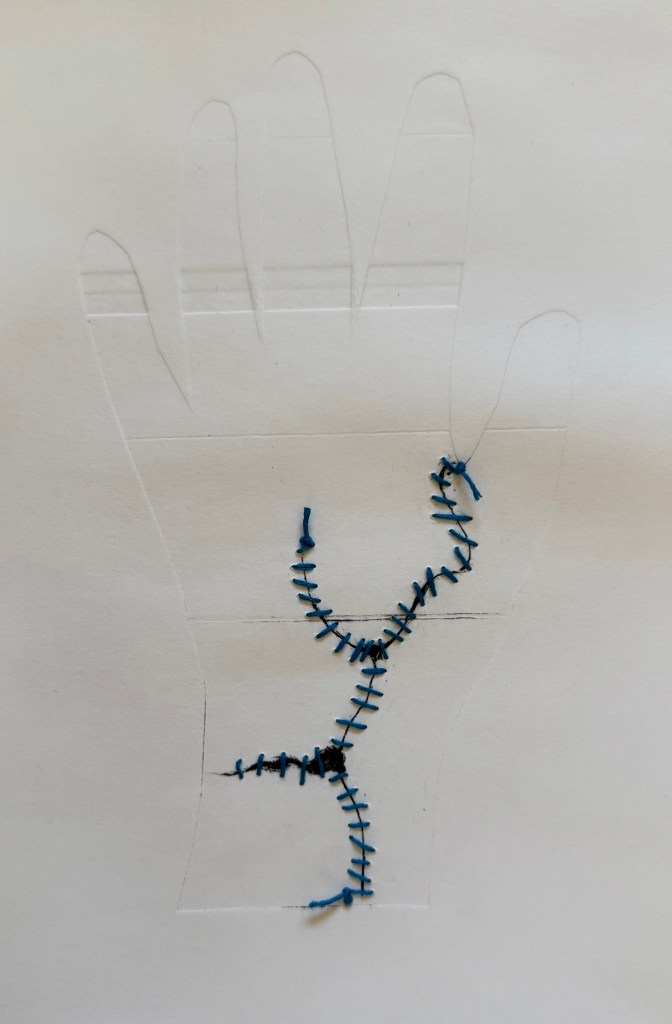
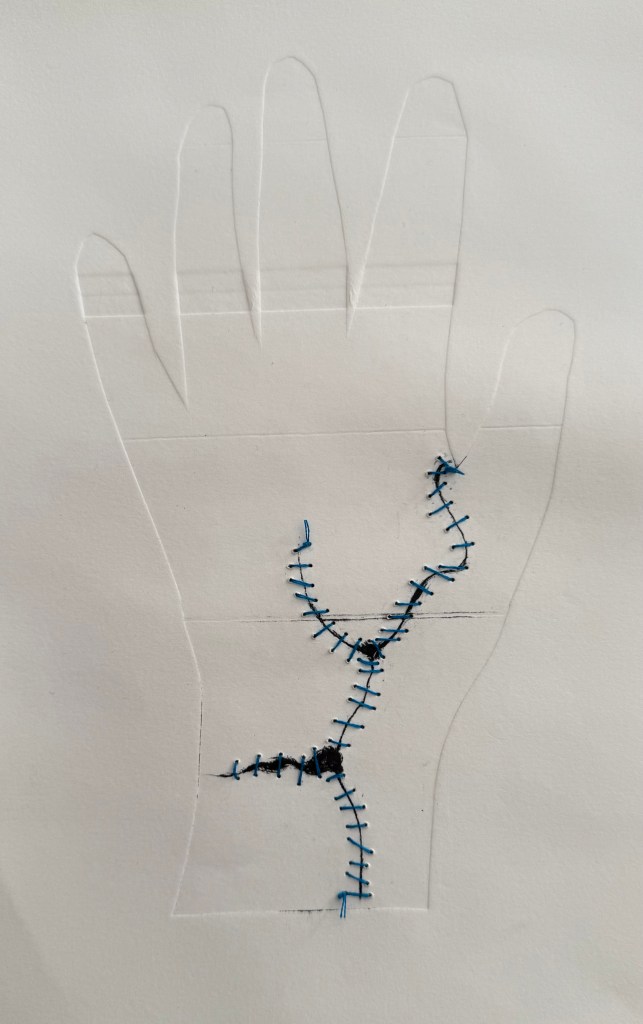
In the accident, a 2 inch piece of glass managed to find its way into my daughter’s thumb via the underside of her wrist (luckily missing her artery) severing the main nerve and two tendons in her dominant right hand. Fortunately, she was taken to Salisbury Hospital, the regional centre for plastics. We make the 2 hour round trip every week for dressing changes and physiotherapy. Every week I take a photograph of her wound, mapping its healing, but also so that she can look at it when we get back home – she can’t look at her hand in the moment. It’s important that she reconnects her brain to her hand otherwise the hand map in her brain will be lost, as will any chance of recovering as much sensation as possible. Whilst some of the physio has been physical exercises to rehabilitate movement in the tendons, the majority of it is brain training: visualisation and mirroring exercises, analysing touch and sensation, using the good hand to teach the injured hand how things feel, teaching the brain the new language with which the hand is trying to communicate.
So, we decided that we would make something. I’ve been meaning to try out some tetrapak printing for a while. The process of incising seemed appropriate. I feel some responsibility – if I hadn’t suggested that she leave earlier, perhaps it wouldn’t have happened. The act of sewing, holding things together, helping things to heal.
I like that the wound is the subject, that the hand is suggested by the embossing. I debated whether to add more detail, more variety of tone but for once went with the less is more option. I used ordinary cotton thread but we decided that the colour wasn’t right so we went for embroidery thread – a brighter blue. As I was sewing I knew that it was too thick, that I should have separated it, but I just kept going. I knew it was wrong; she said it was wrong because now she couldn’t see the wound – I had obliterated the very thing that we were supposed to be embracing. I tried a couple more times until we decided that it was right. By then the holes were quite large but that in itself doesn’t matter – it reinforces the idea that often we have to endure further harm or pain in order to heal.