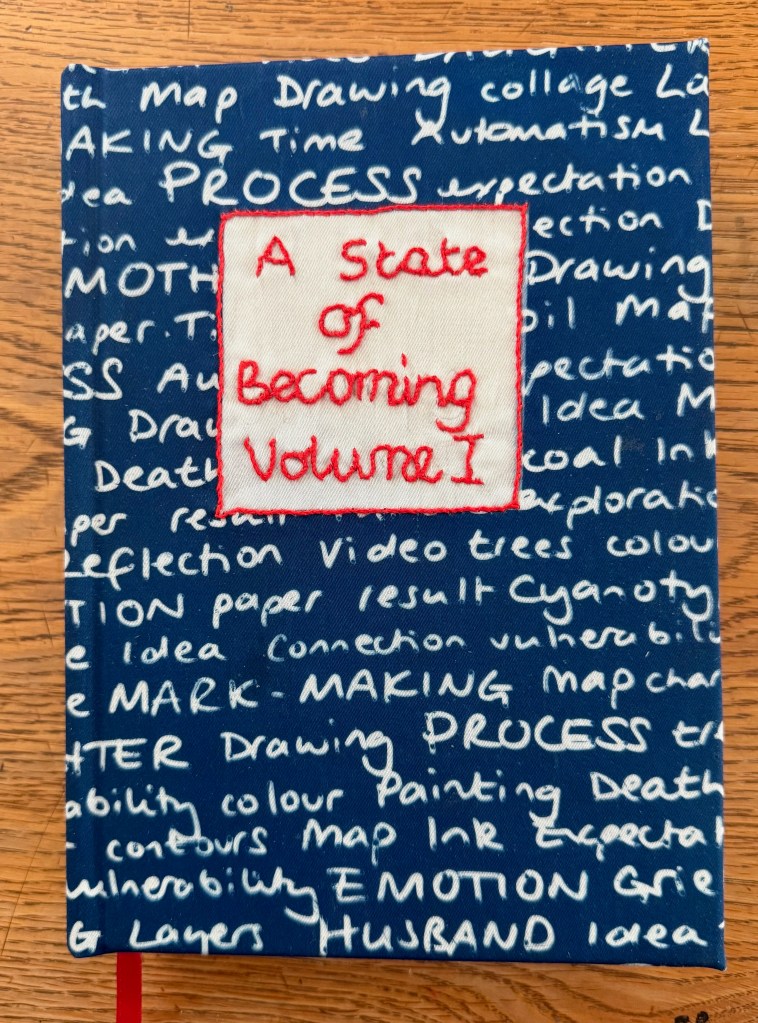
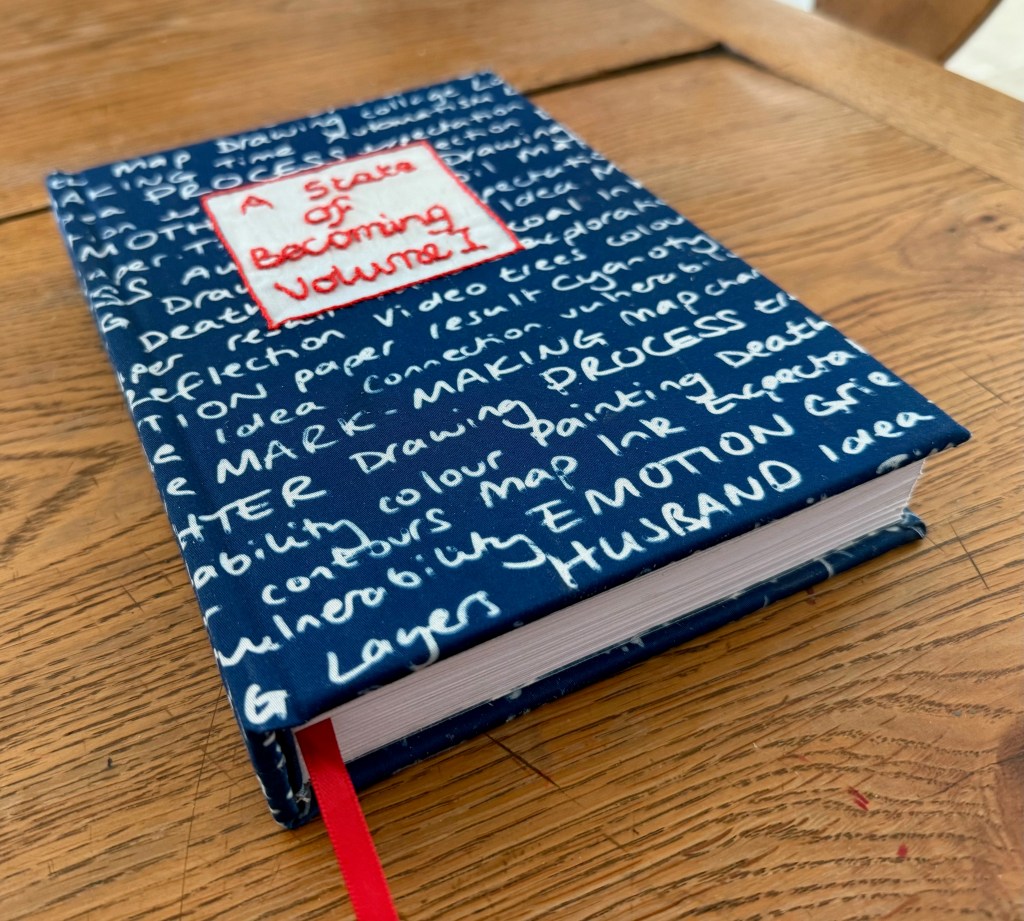
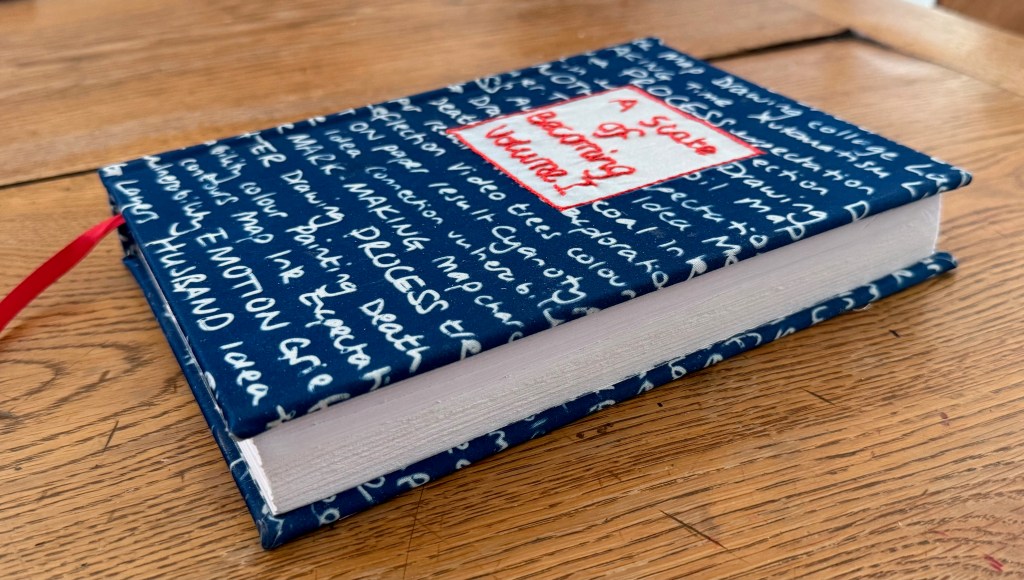
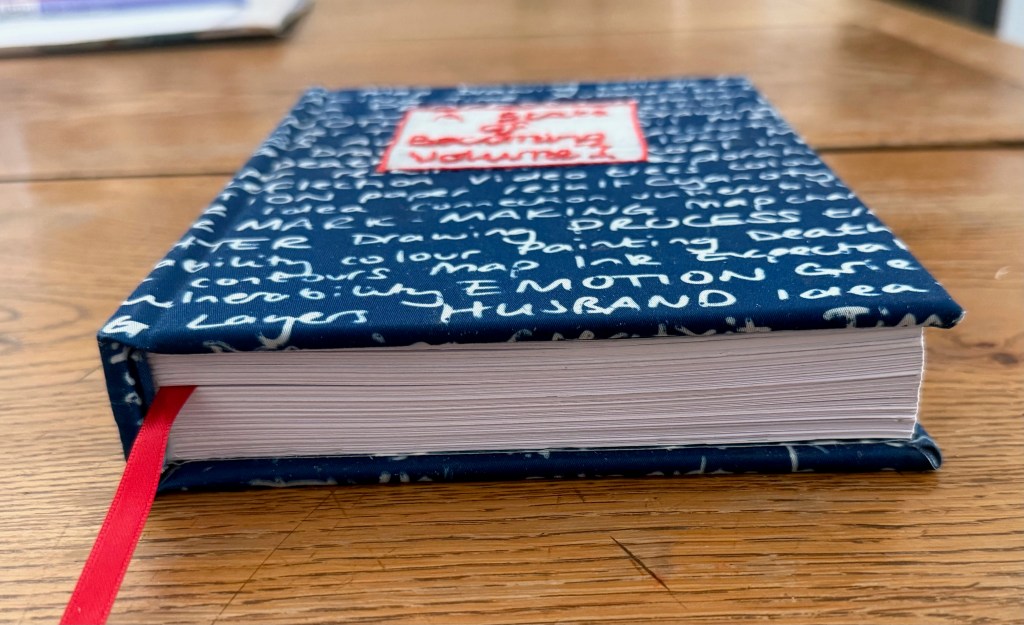
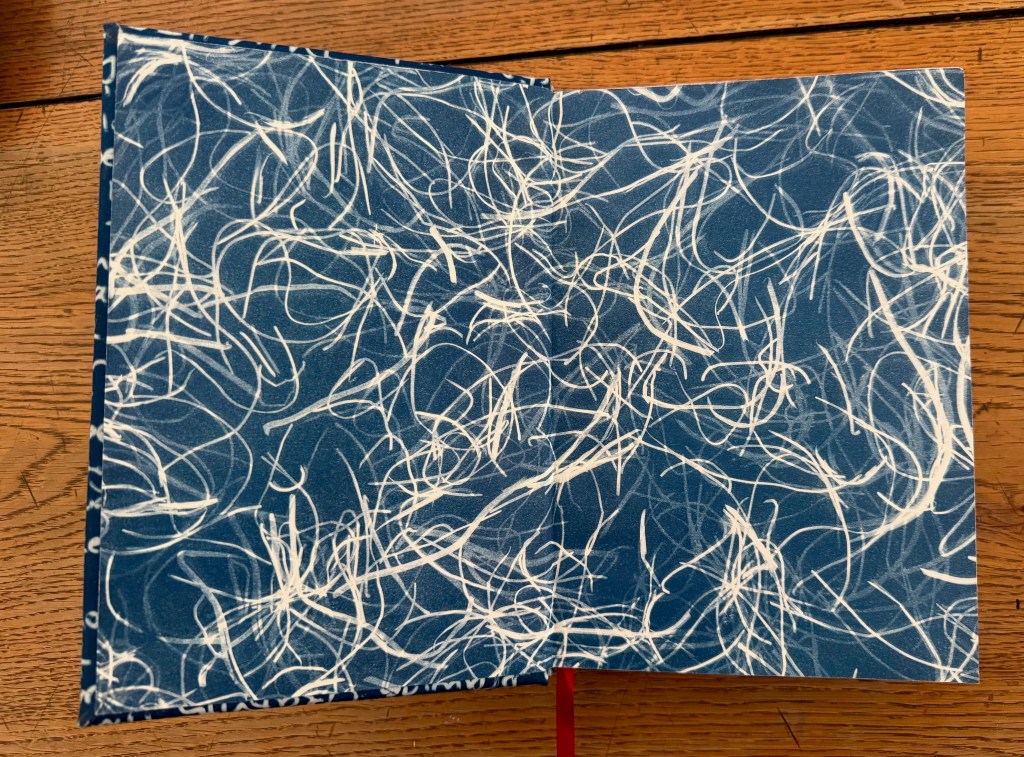
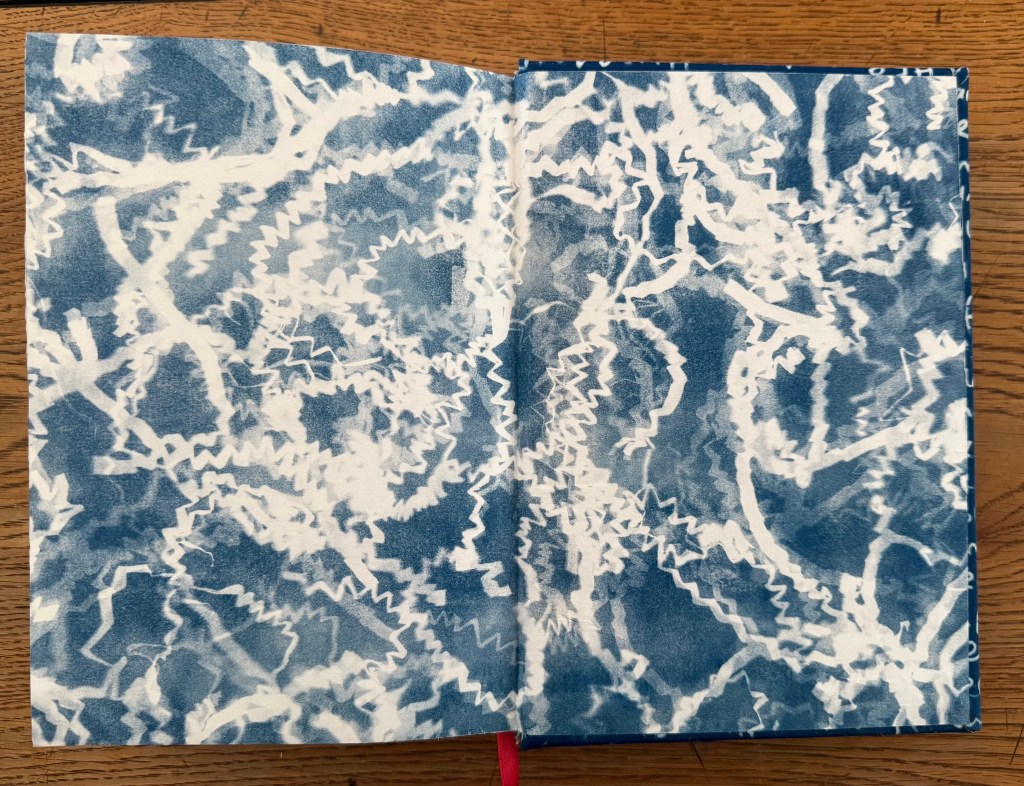
Well, I’ve finished Volume I and I’m really quite pleased with it, and relieved. A great improvement on my first attempt and no major catastrophes along the way.
It will need to go in the bookpress overnight and then I will trim and seal the ribbon.
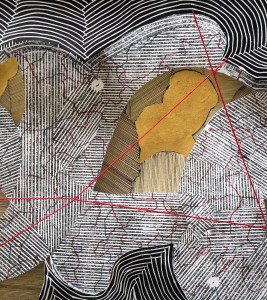
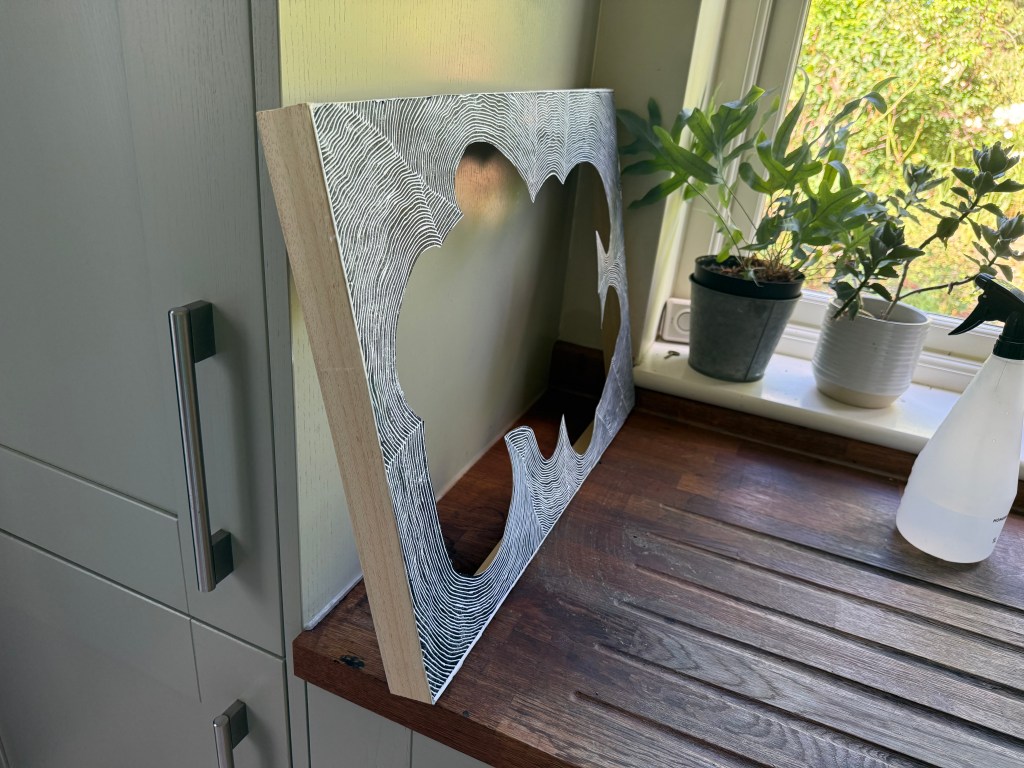
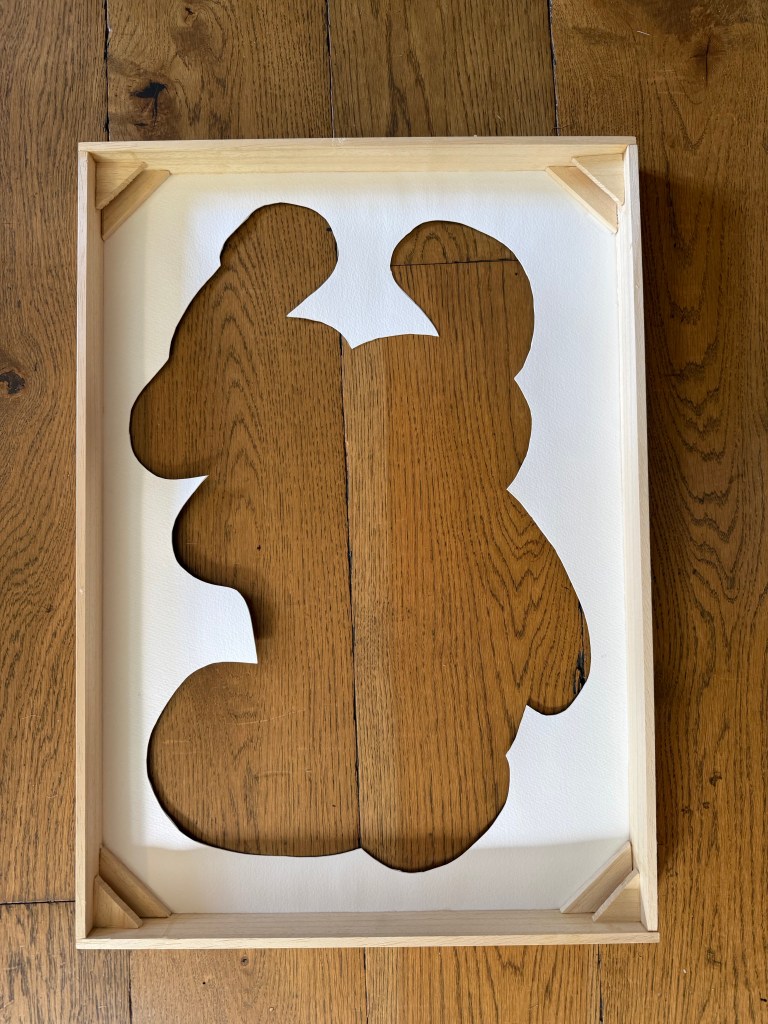
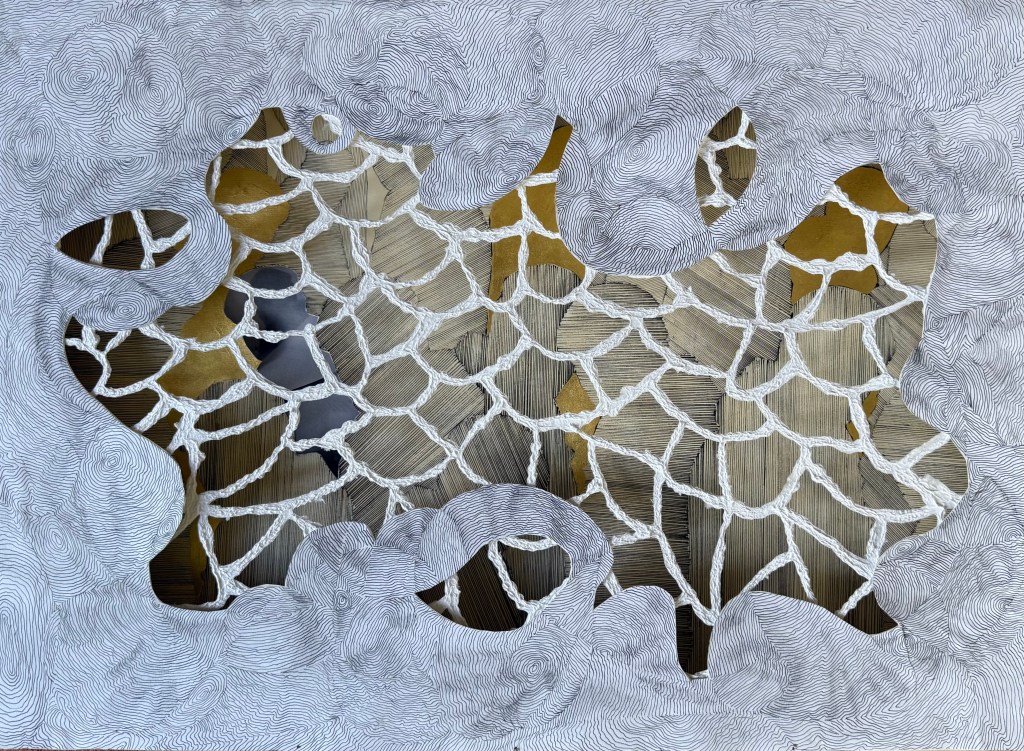
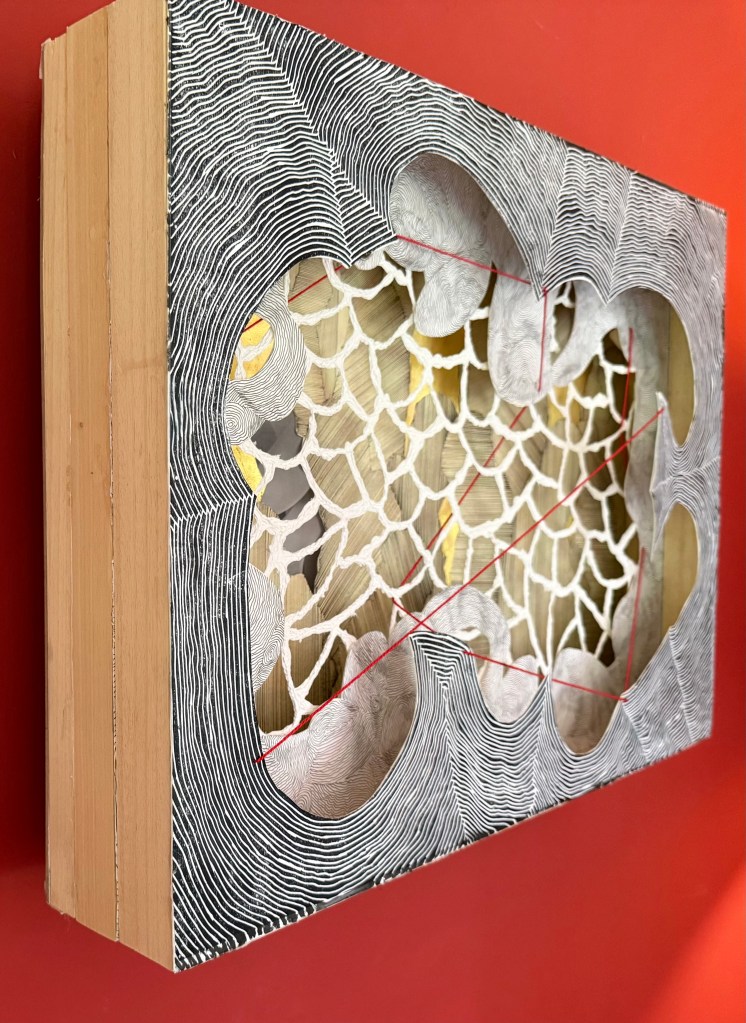
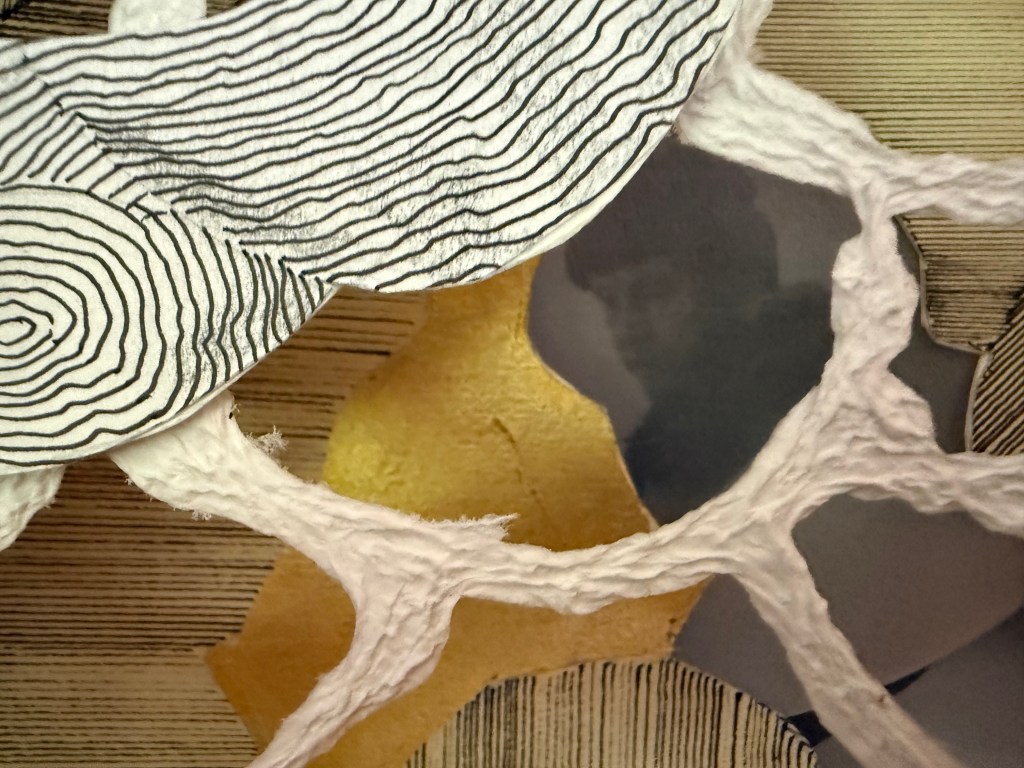
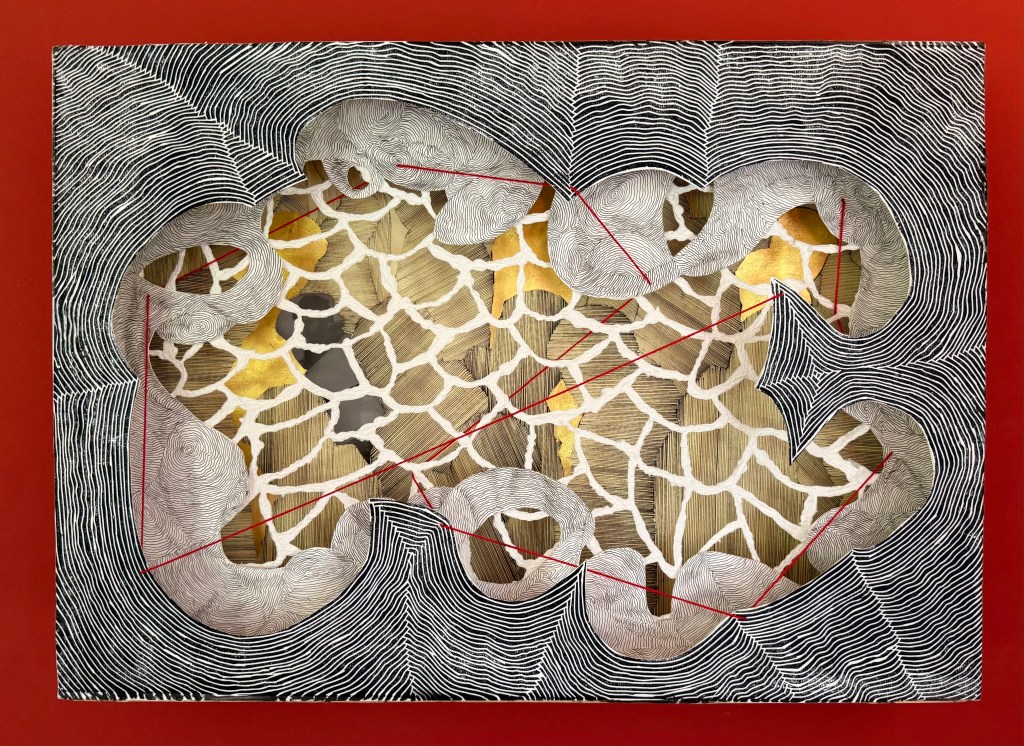
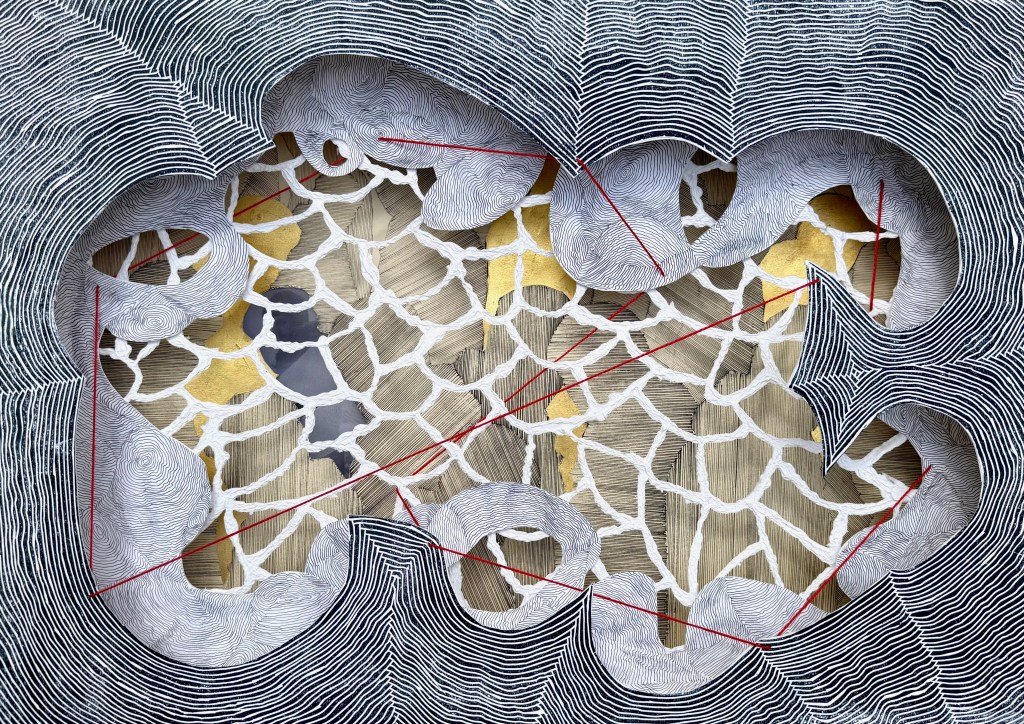
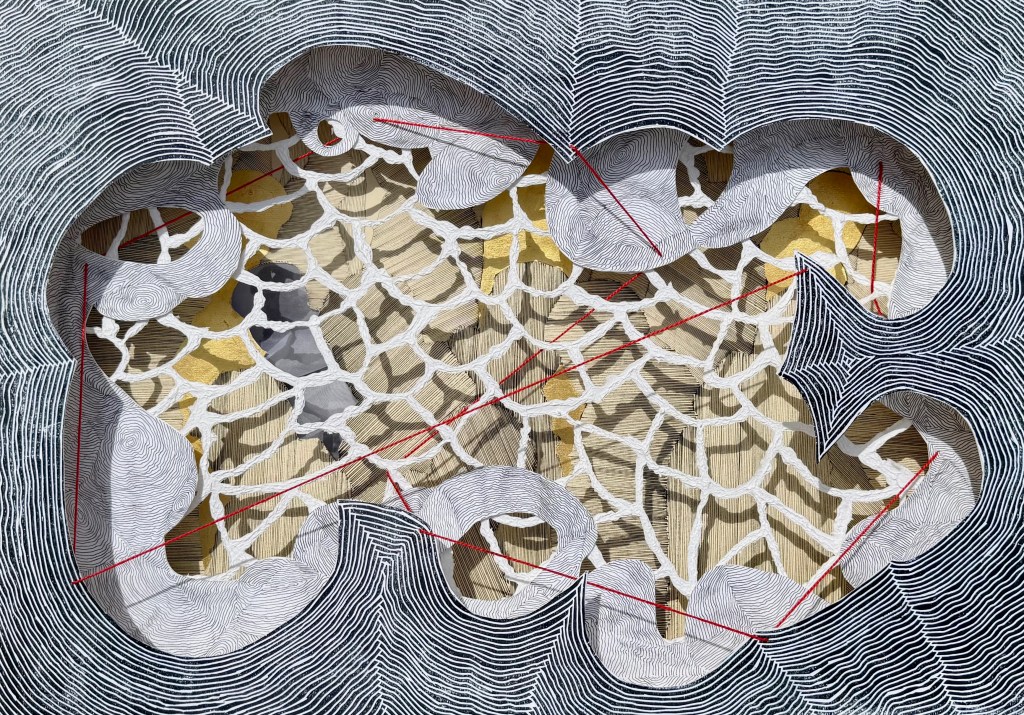
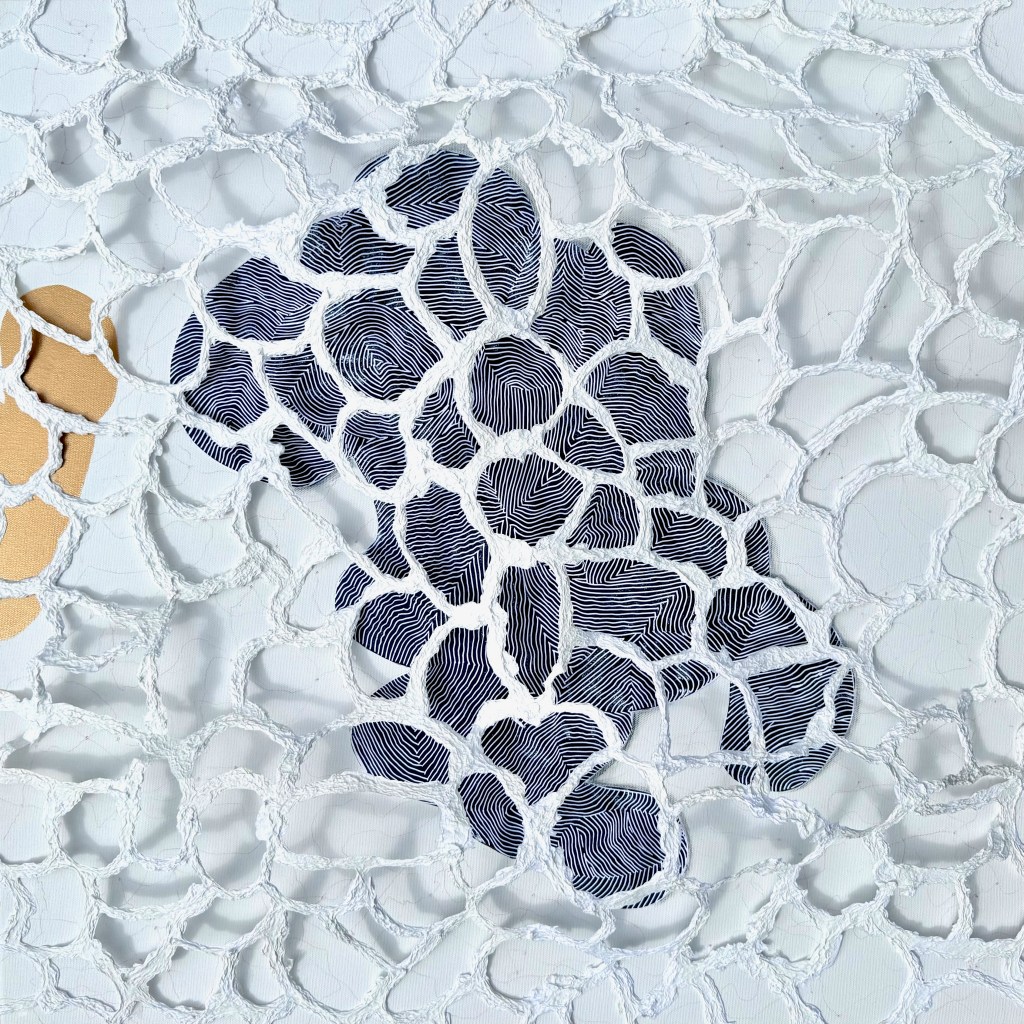
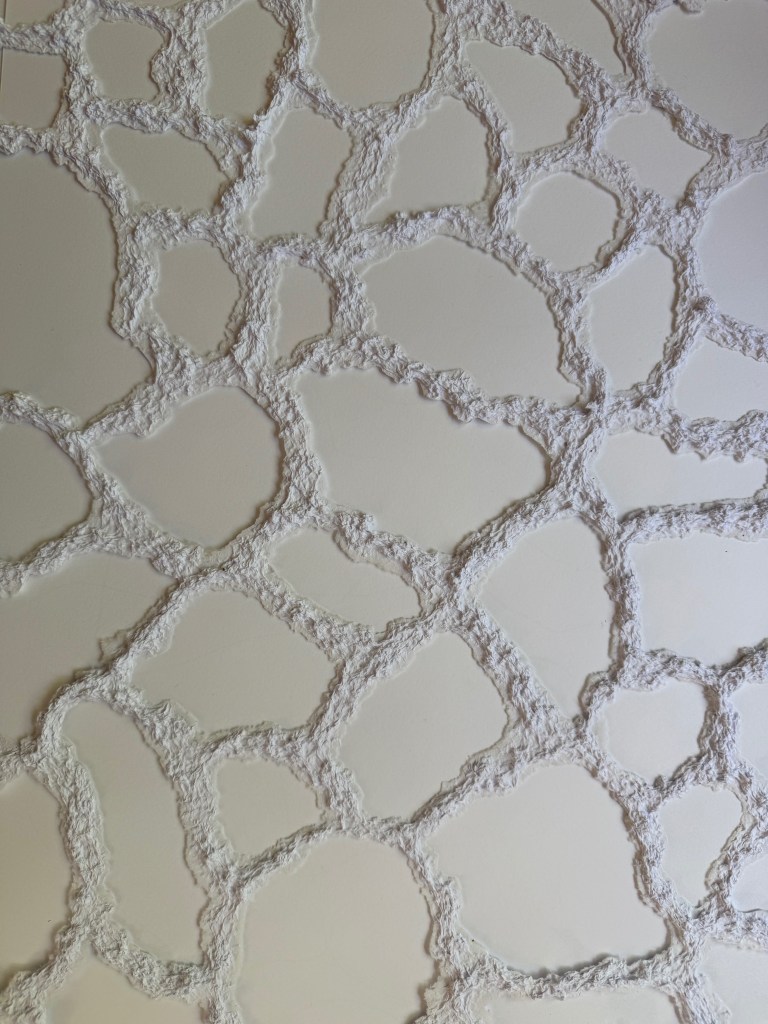
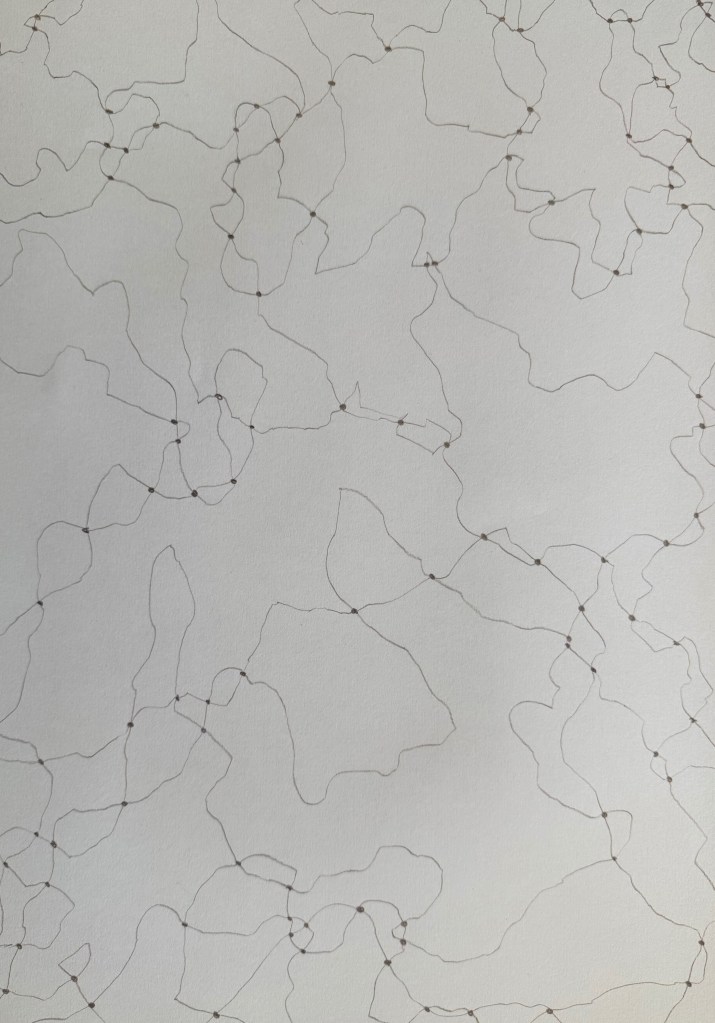
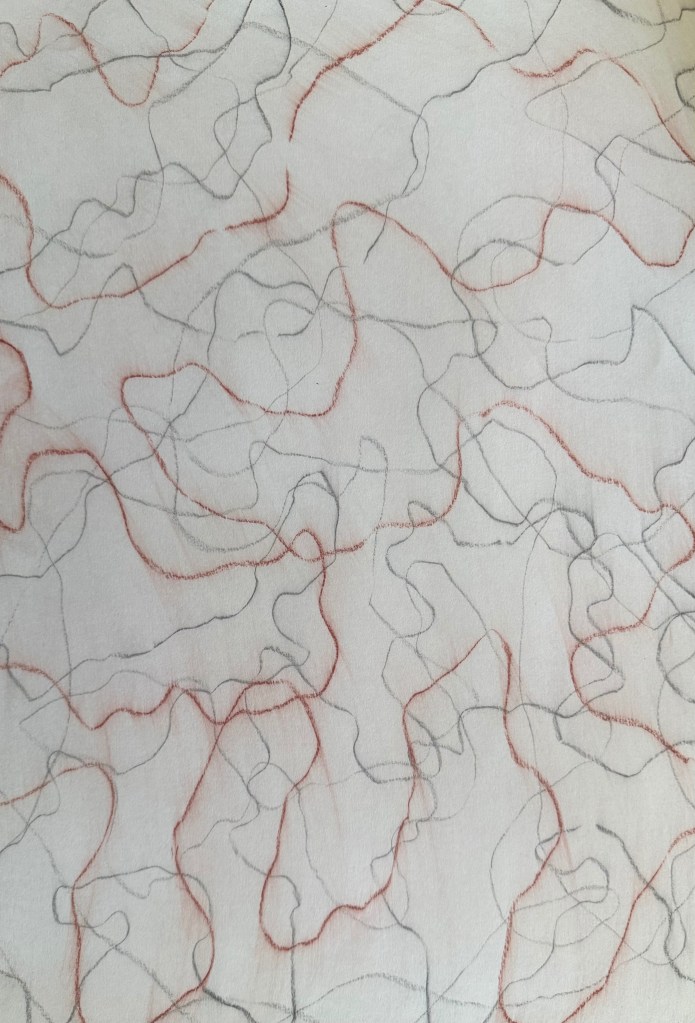
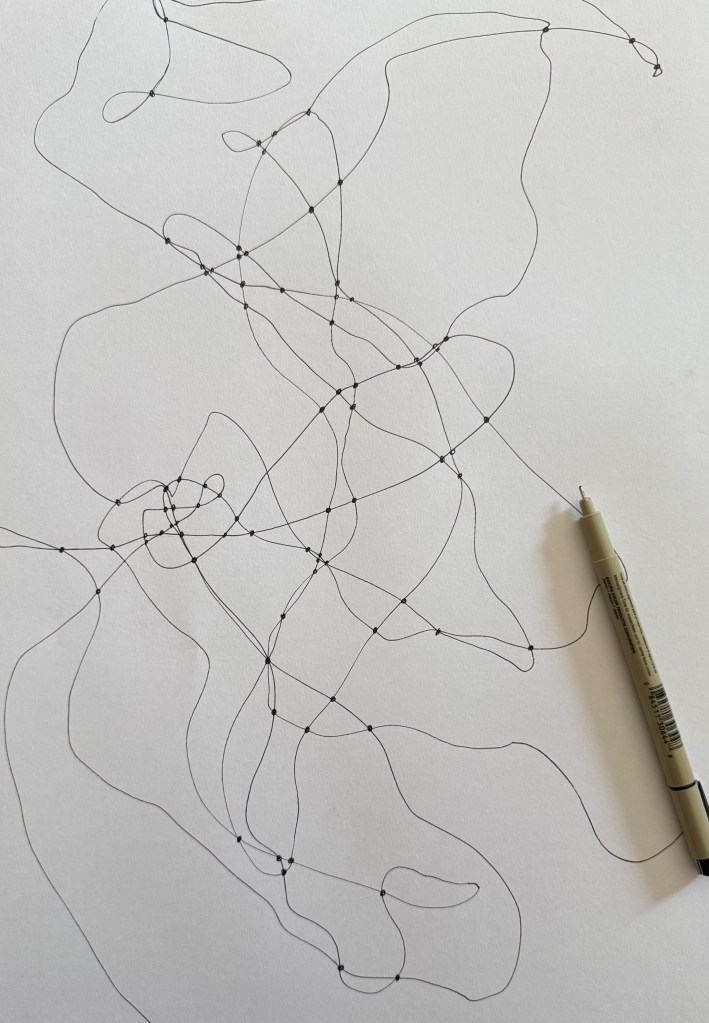
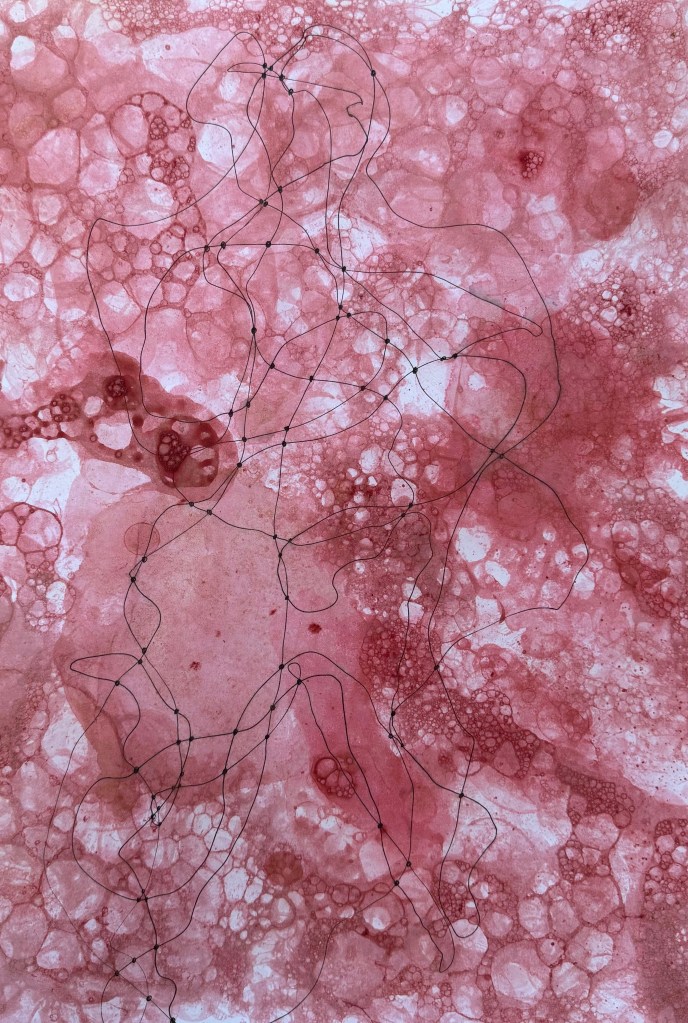
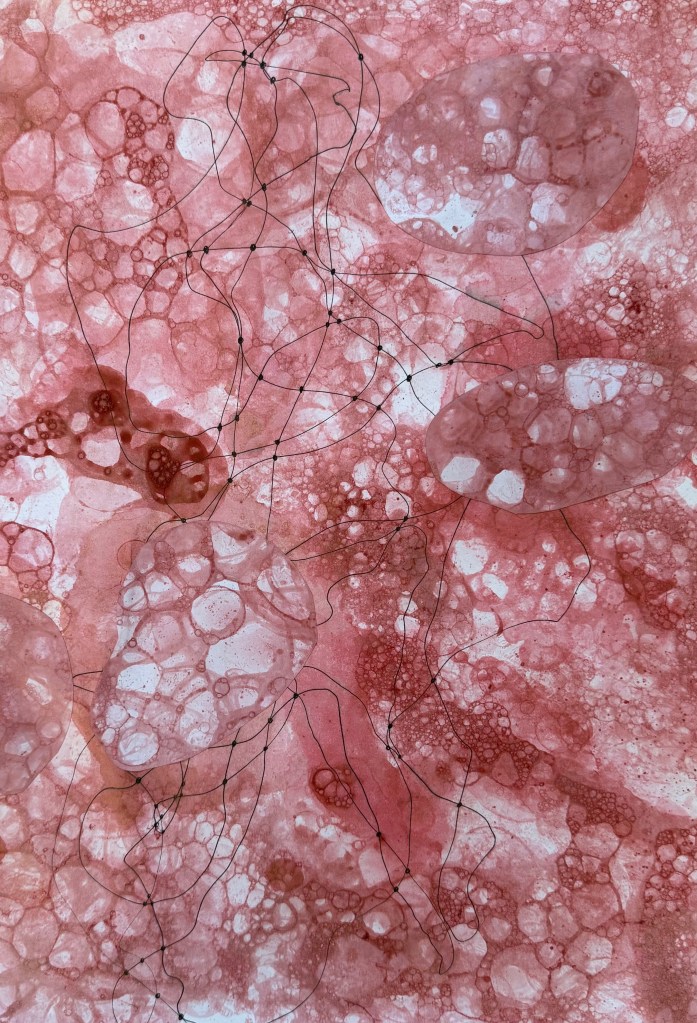
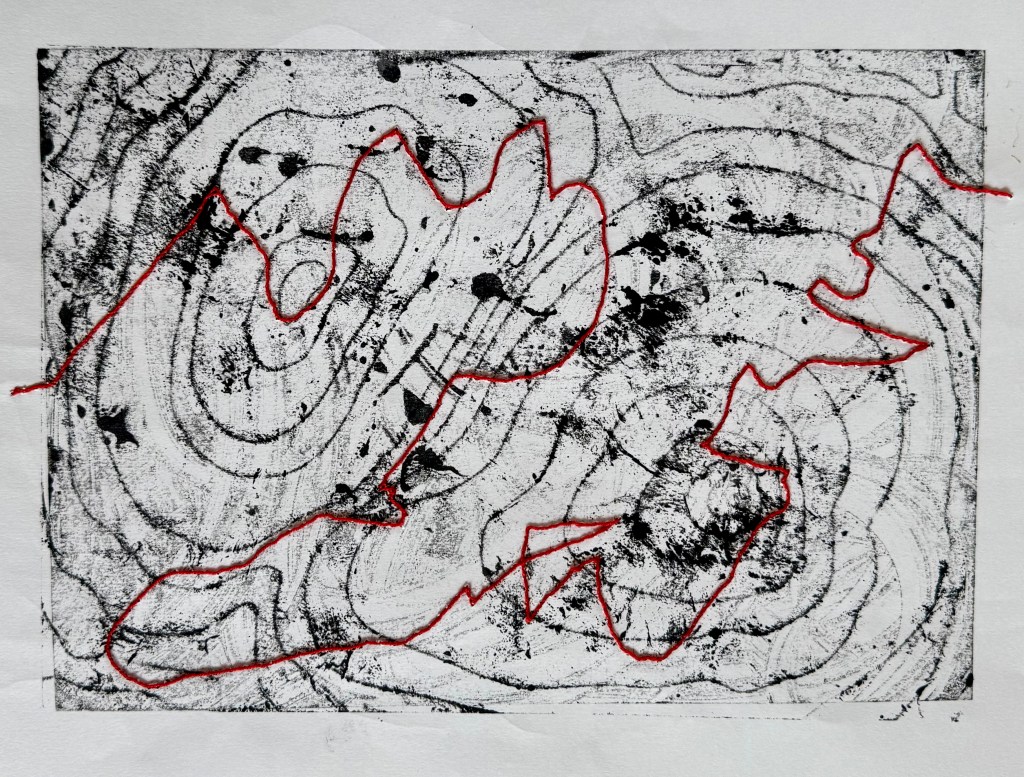
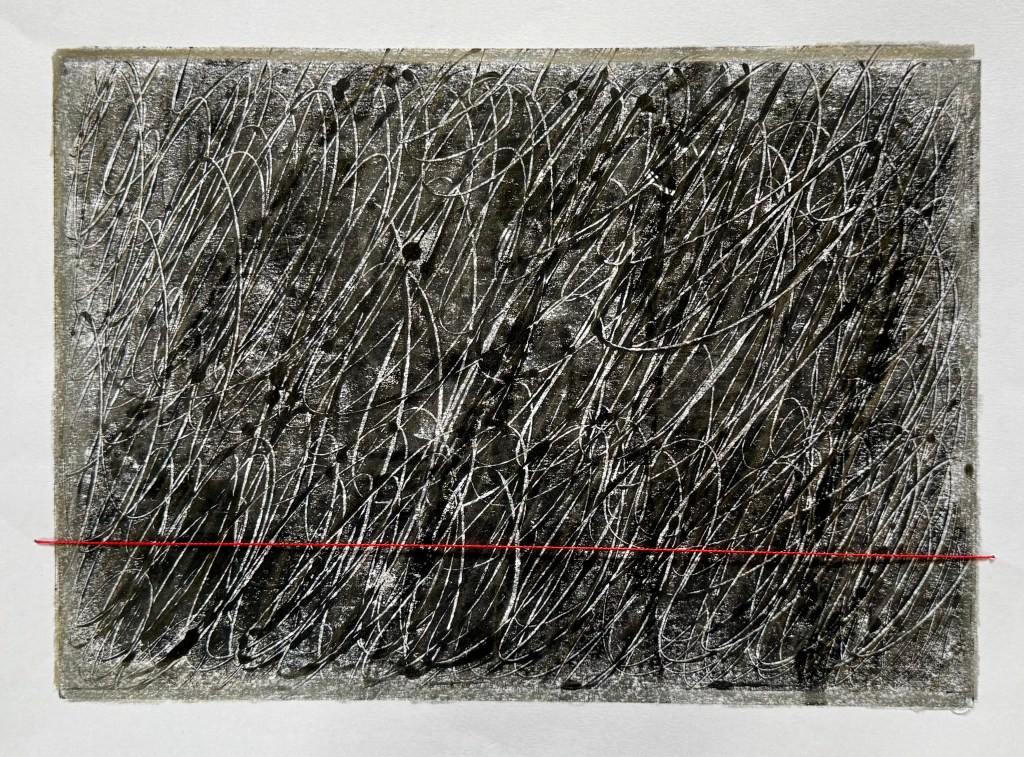
I’ve finished my layered piece. I ummed and ahhed for a while about whether I should paint the inside of the wood frames but decided against it – I like that you can see how I made it. The bottom layer is on MDF and each subsequent layer out of a wooden frame which I made onto which I then glued the image and secured with moulding pins. I then glued them all together using Gorilla wood glue. It’s not very heavy so it should hold, but just in case I have stapled the layers together on the top and bottom where the staples won’t be visible. I hesitated about the red thread – I wanted to use it emphasise the layers but in the last iteration I had the threads looping around each other. I decided to keep it simple this time. I like the end result.
I really like the cast shadows when it is photographed in the sun:
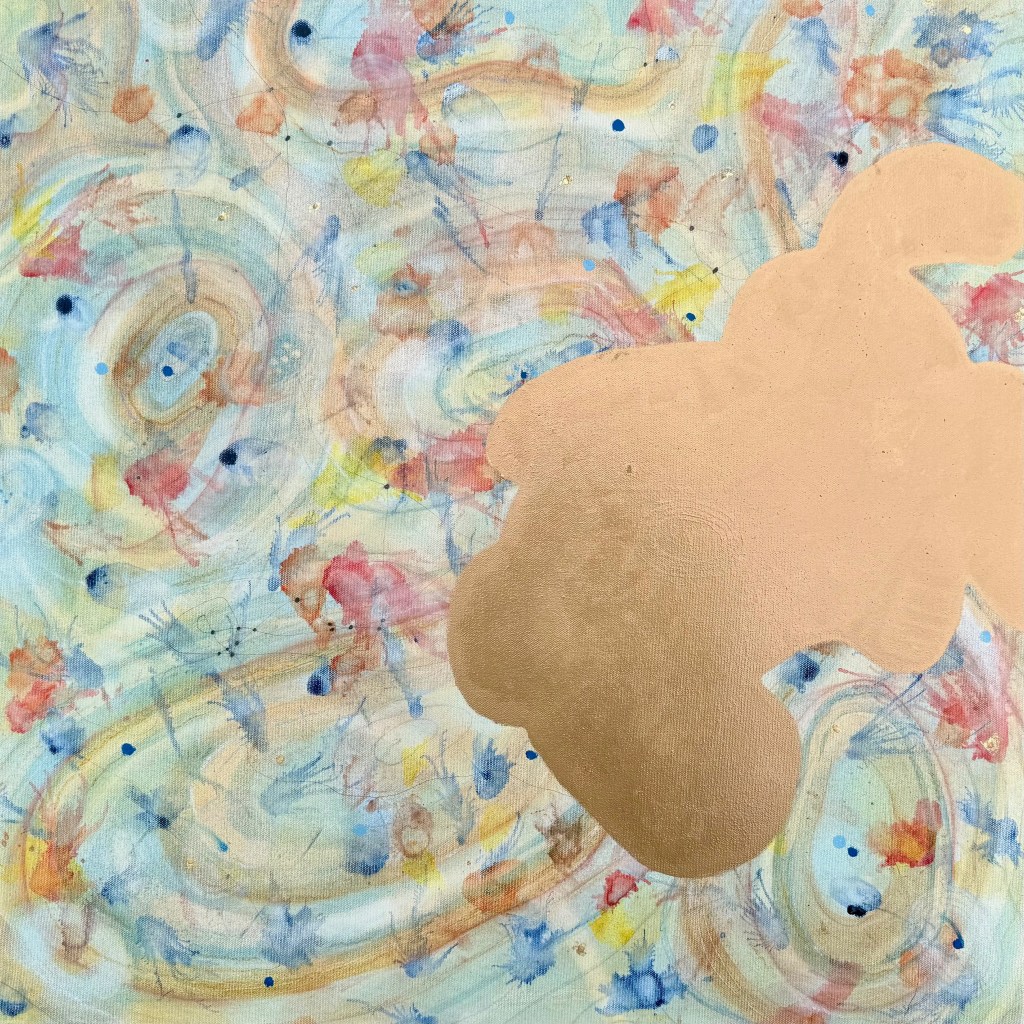
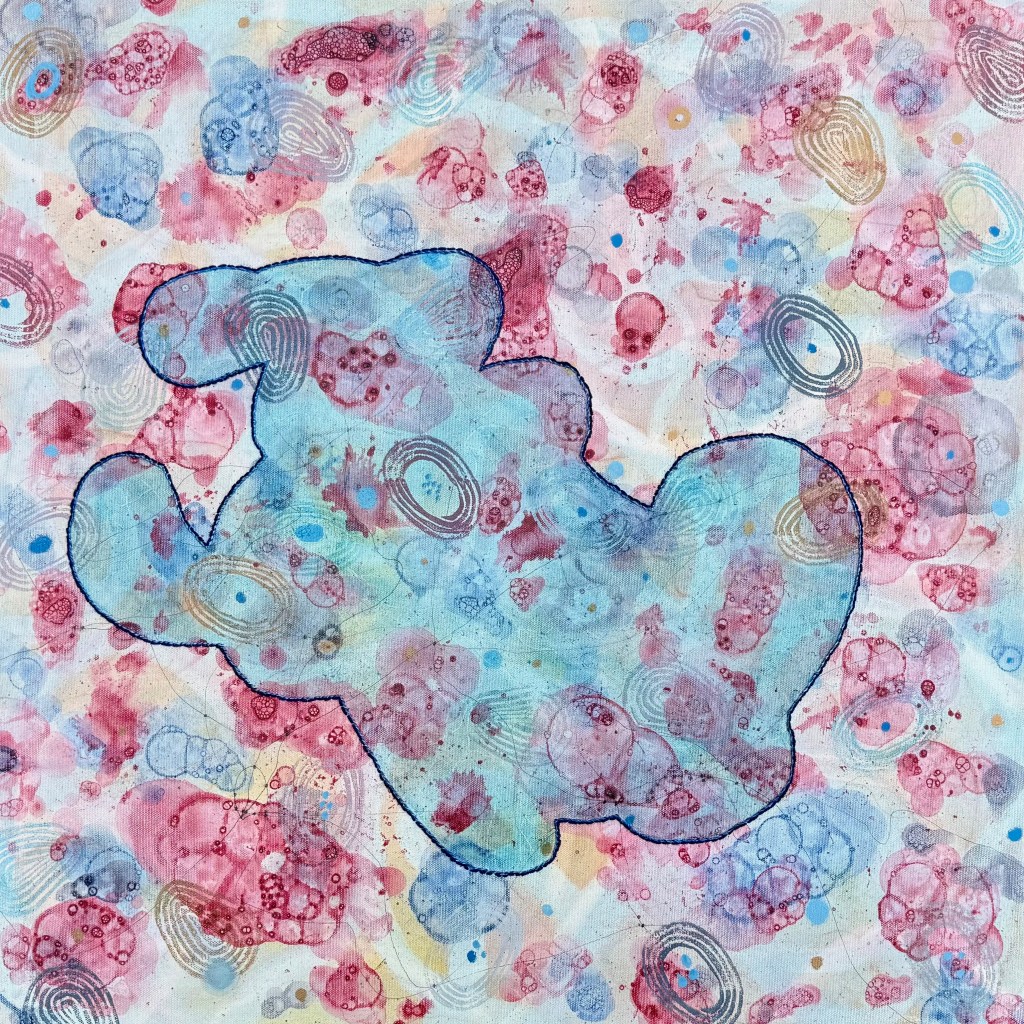
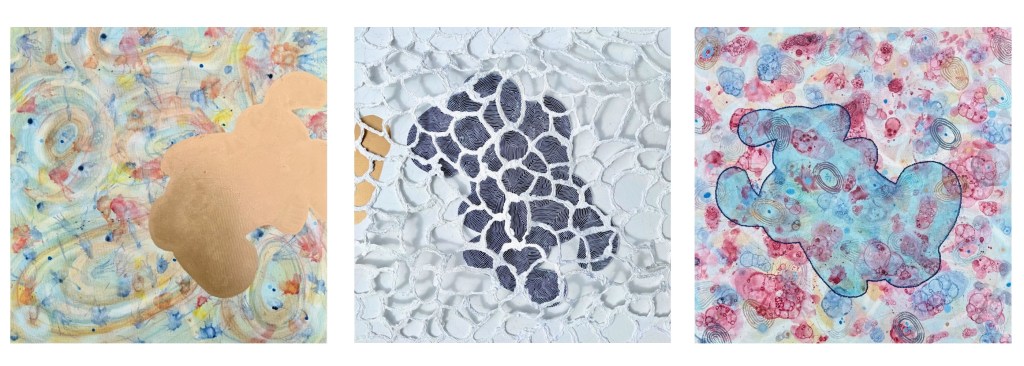
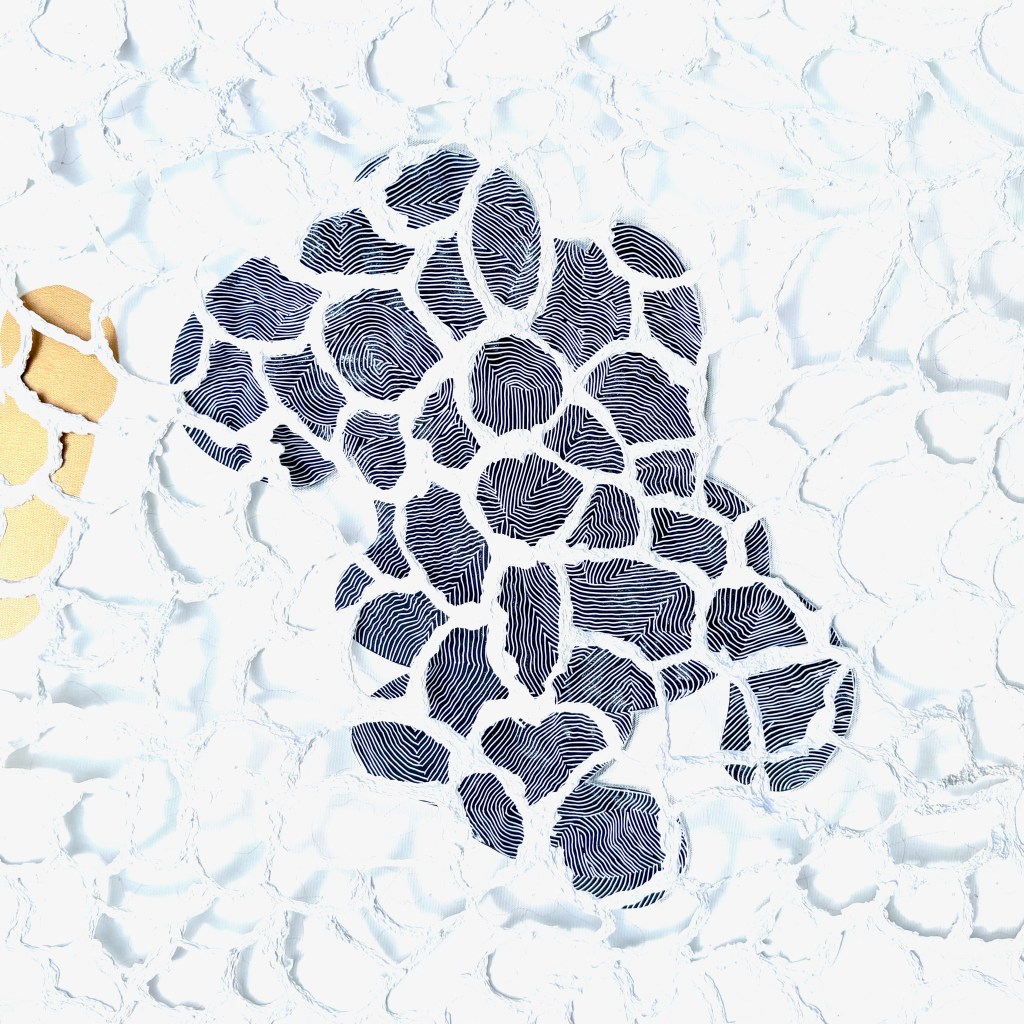
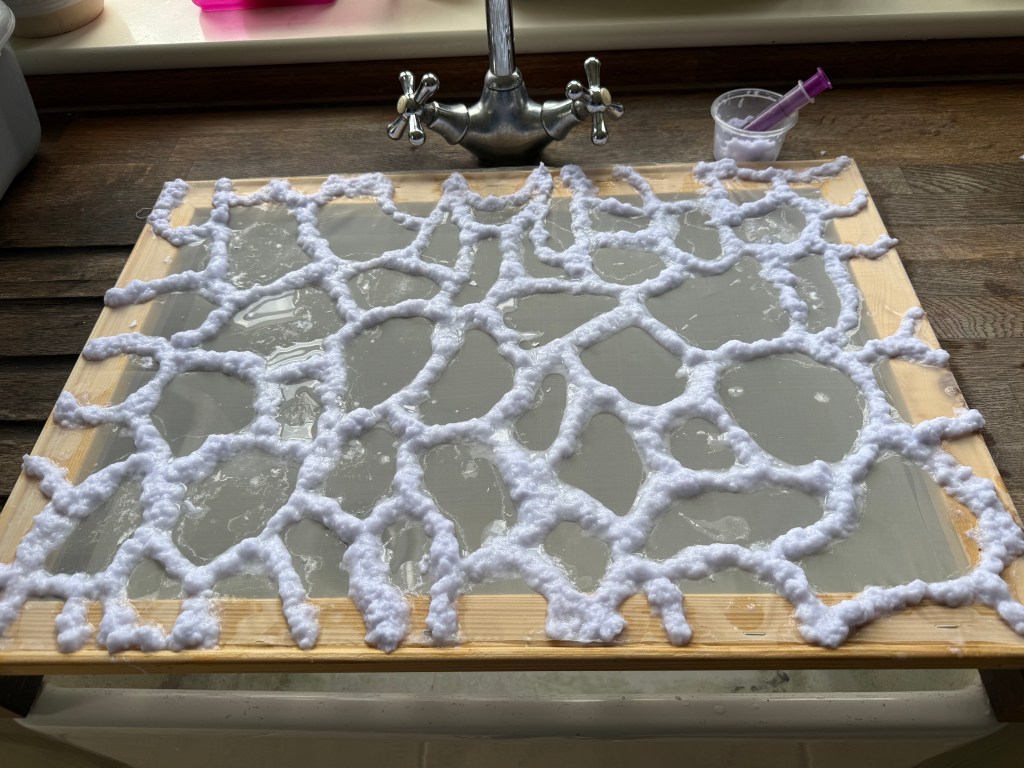
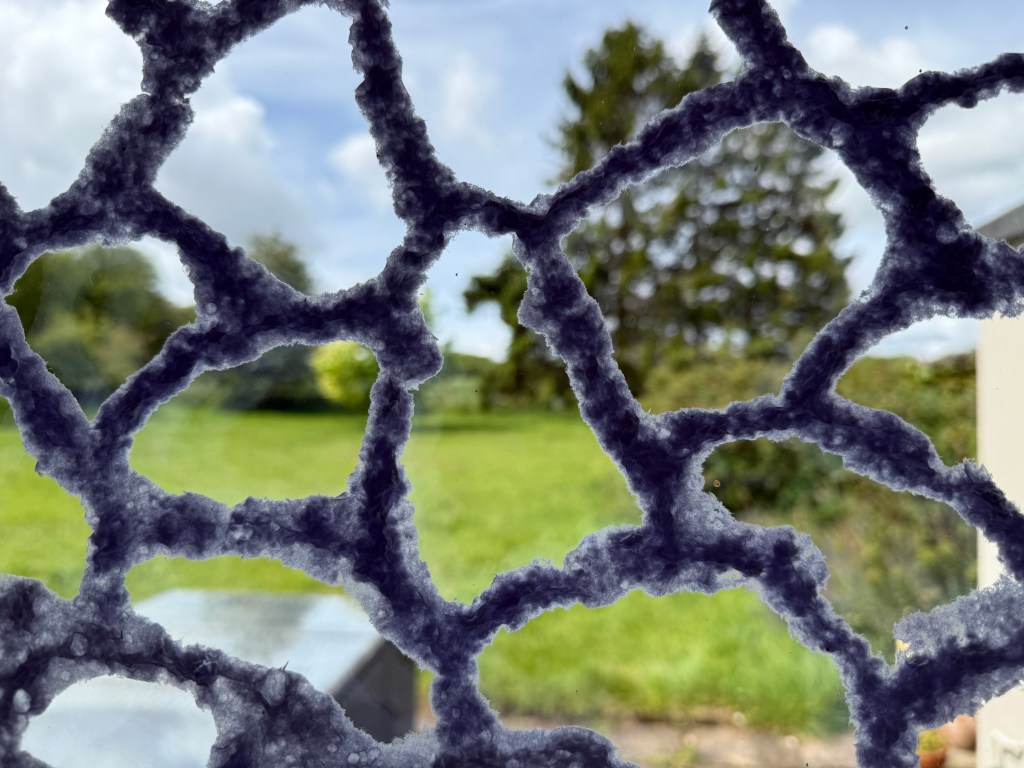
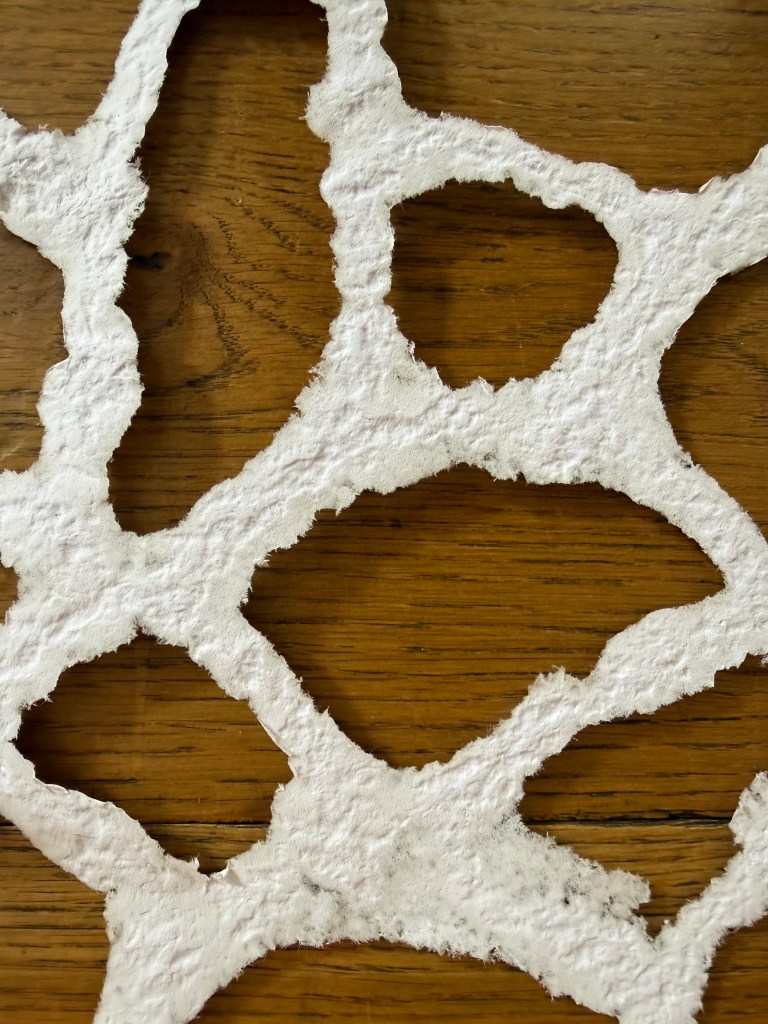
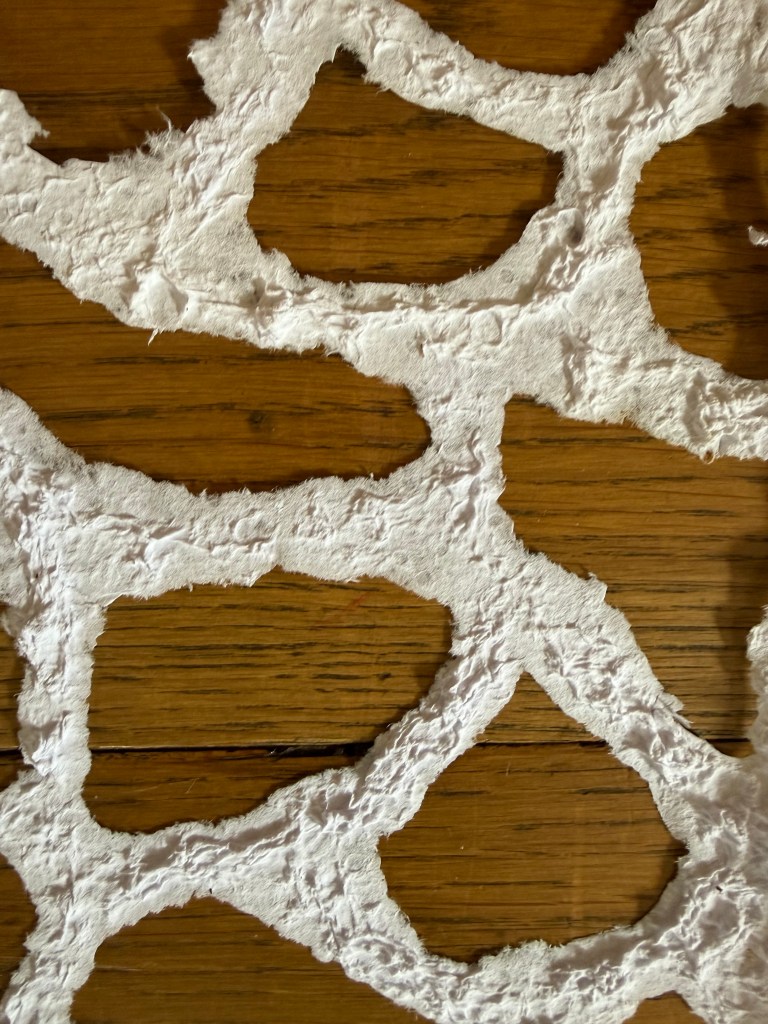
I decided that the shape on the blue canvas needed some oompf, and so I filled it with a blue glaze. I think it looks better. I managed to make a large sheet of paper lace – it took an age to dry with all the wet weather recently, but this weekend was a godsend. it dried less flexible than I was expecting but it’s workable. I decided to go with the simple shape in the end for the middle canvas to keep the sense of connection between the three of them. I overlayed the paper lace and am quite pleased with the result. My initial thought is that perhaps the central canvas now dominates a bit, but as I have taken to it representing me, I’m not that bothered, perhaps I’ve made it so subconsciously. I decided not to go with an umbilical cord – I’m liking the separation between the shapes – the drift – disconnection with the possibility of reconnection.
All together as a triptych:
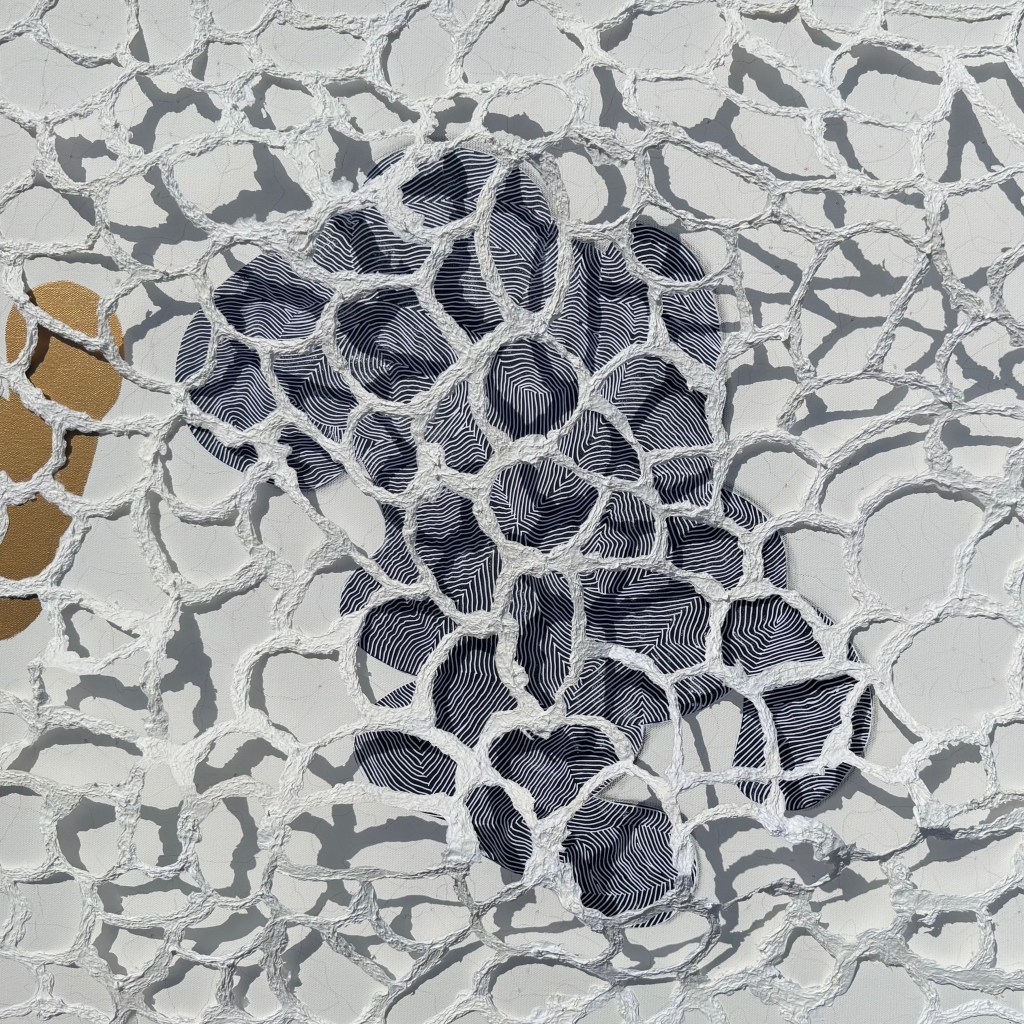
I photographed the middle canvas in the sun – I love the shadows which are created:
I also overexposed it – something to think about for the future – it’s reminding me of colllage:
I made a short video showing the stages of making:
Now just to make a few adjustments to the videos I plan to show and also to finish making the books. To this end I’m not going to post again until they’re done – I’ve got to give myself a chance! I’ve decided to format the whole blog and then see if it is possible to incorporate it into 2 volumes by increasing the number of signatures in each one – at the moment there are 10 making up to 200 pages. I’m thinking that I could stretch it to 12…
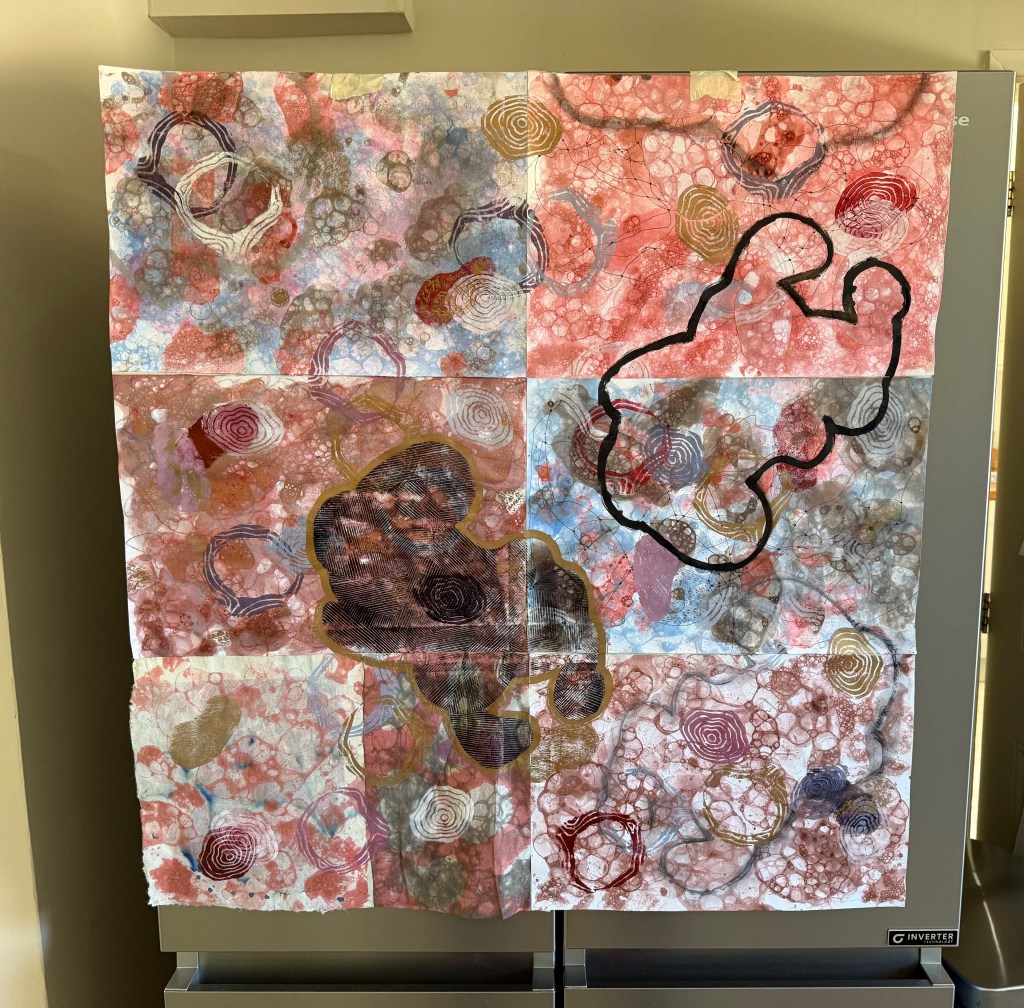
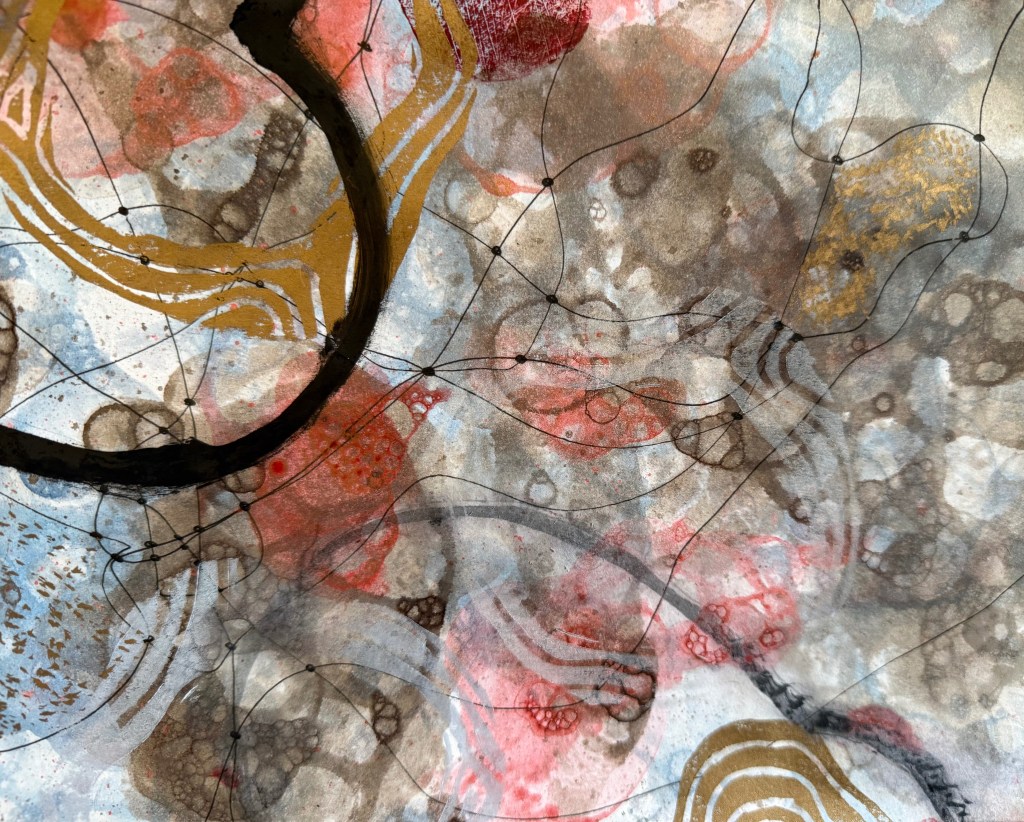
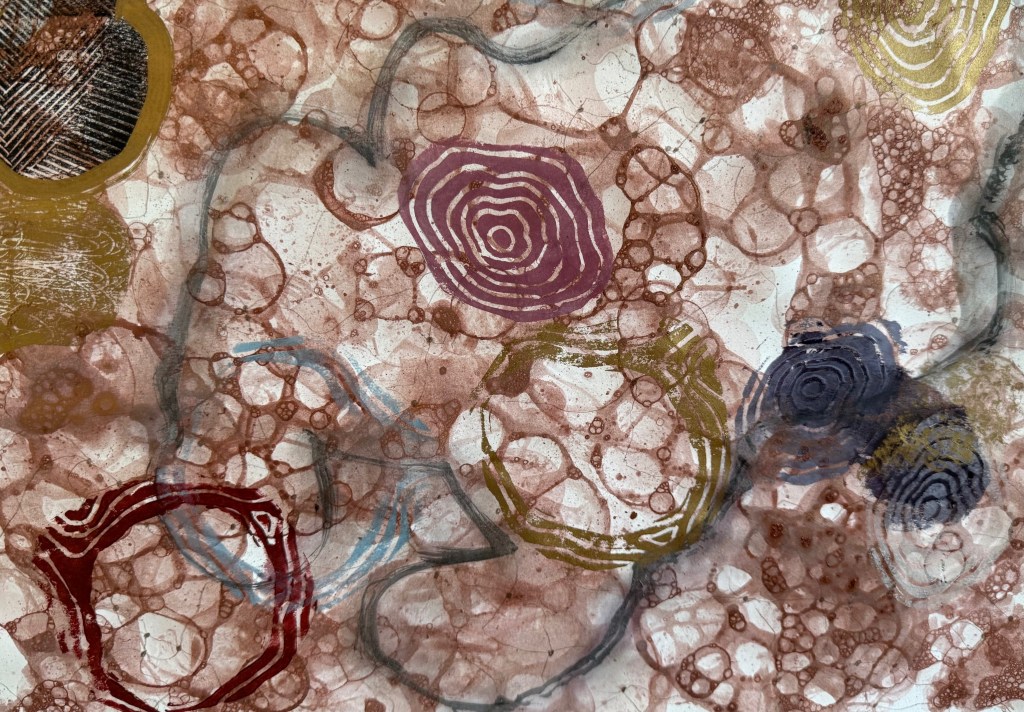
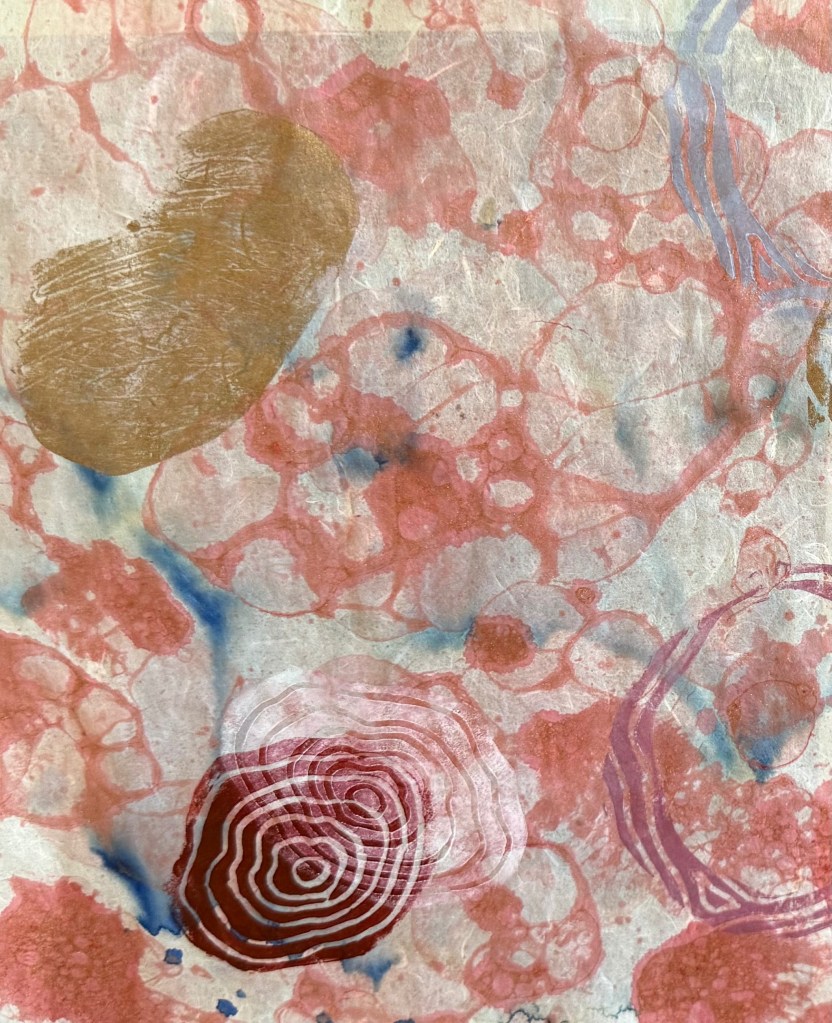
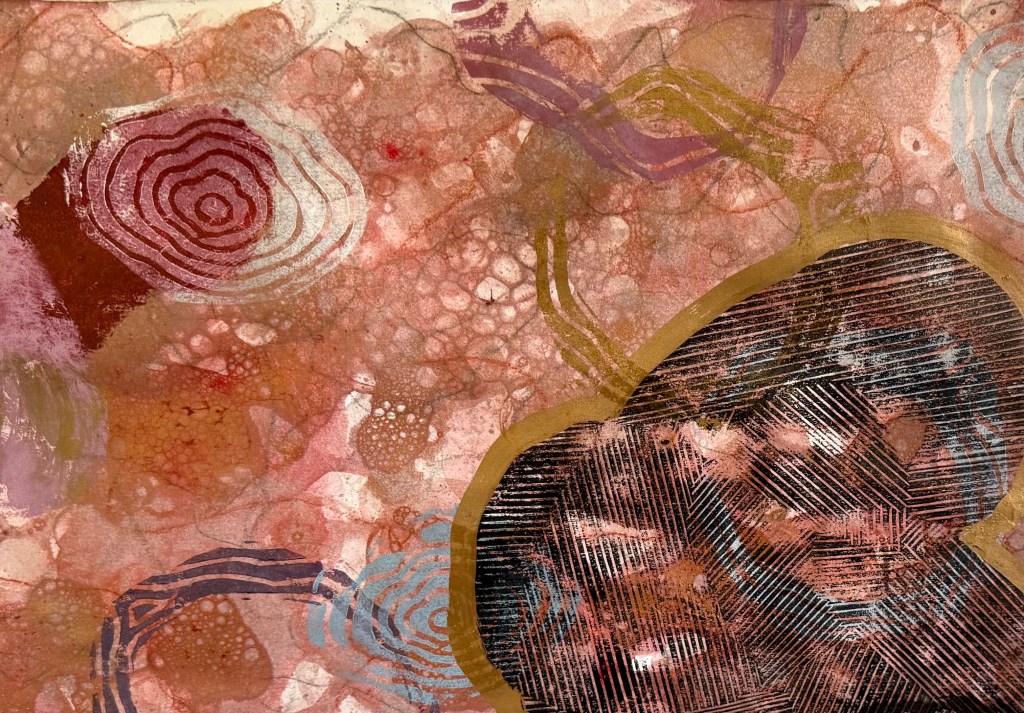
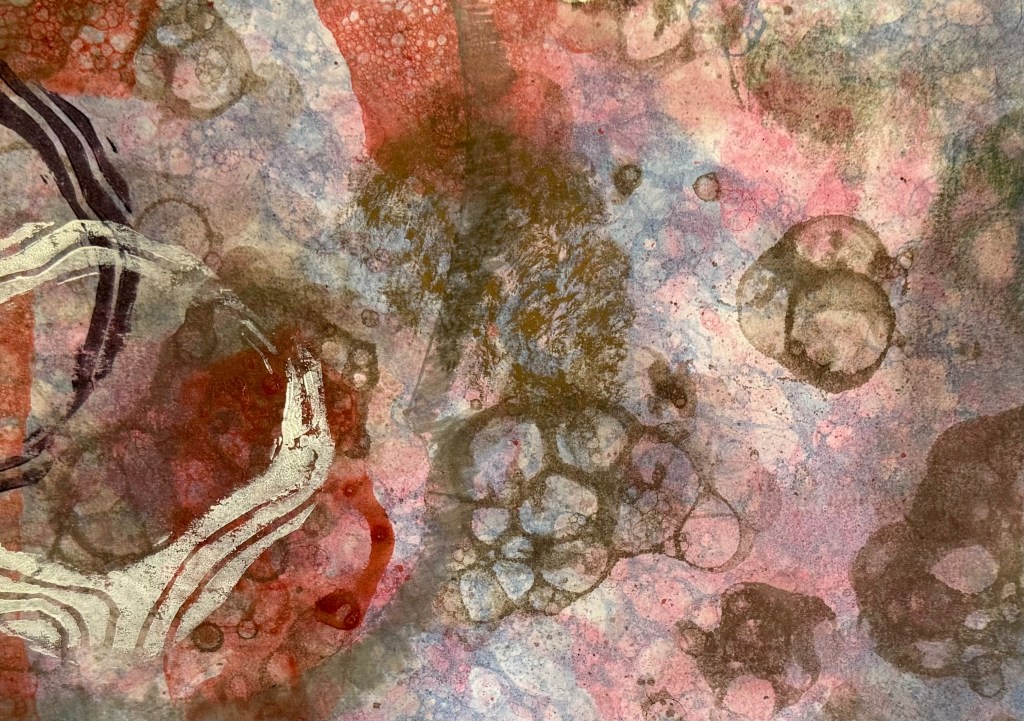
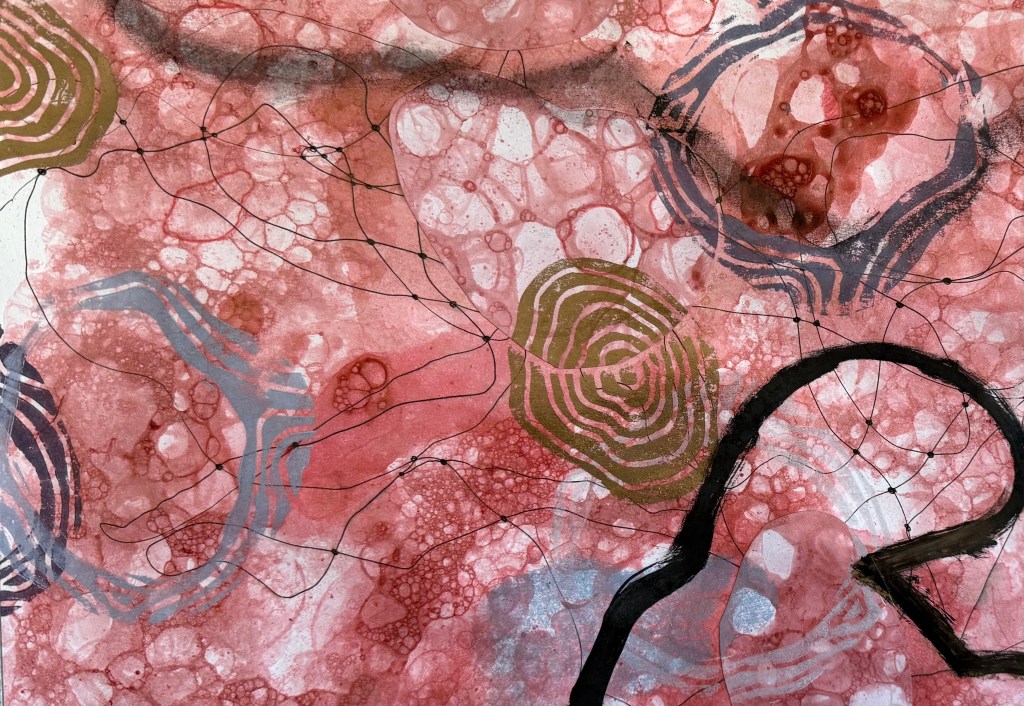
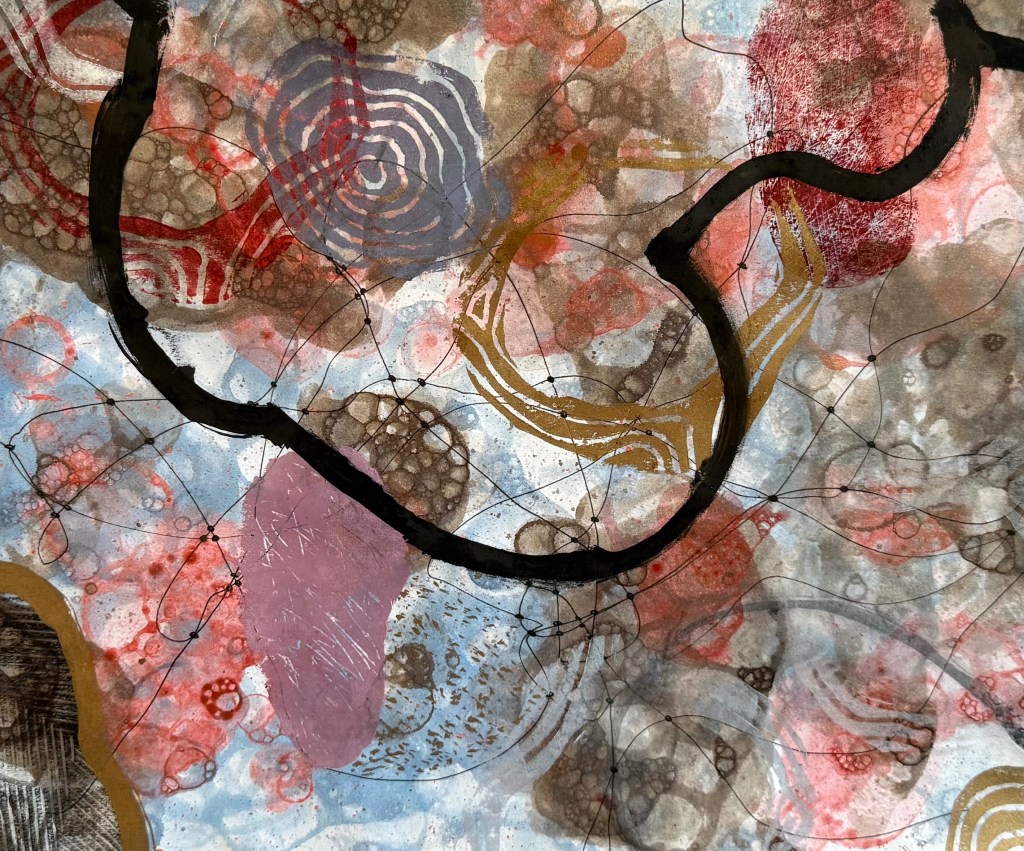
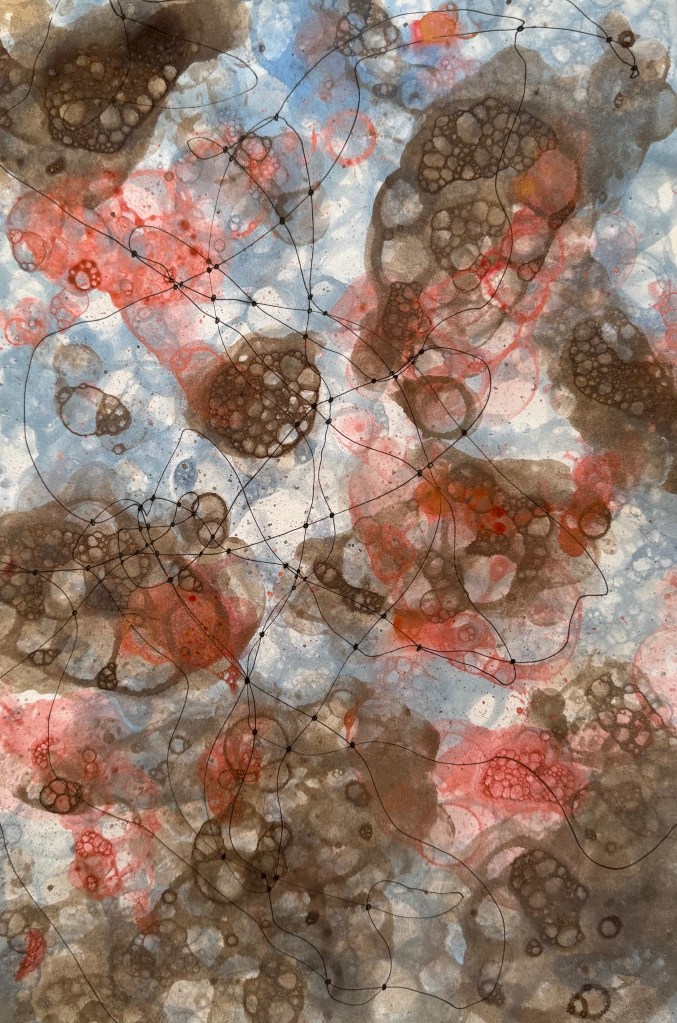
So, having taped all of the test sheets togther into what I called my ‘play sheet’, I let rip with the small pieces of linocut I had found. I also used the lino of the shape that I’m not intending to use, although I still really like the shape of it. The full print of it doesn’t fit with the background, although I do like the way the background disrupts it. I experimented with just using the outline which I think is effective, experimenting with the quality of the outline by using a bold line painted on with printing ink, some thinned down ink and some charcoal. I also added to some other areas with a brush as well as coloured pencils. I think that I need to sit with it for a while to identify those elements that work – it’s got everything but the kitchin sink in it. Hopefully, some clarity will emerge from the chaos.
I have some initial thoughts.
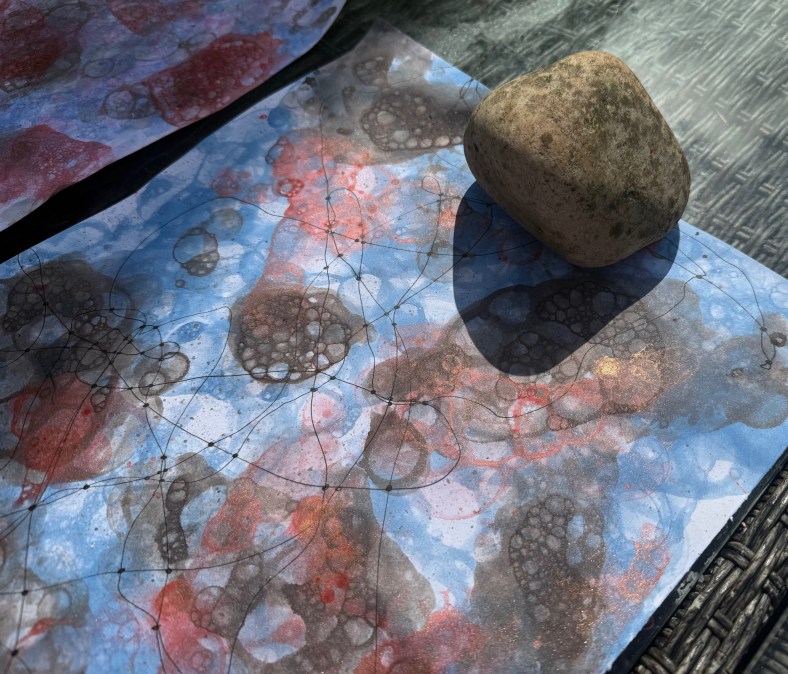
Printing the solid shapes of lino wasn’t very effective but I do like those bits where I scratched away some of ink from the surface before printing. I also like the muted contour lines in a light grey. The darker colours definitely need greater transparency (I was thinking about the shadow cast by the stone).
It’s a starting point and the next step is to work on a slightly larger piece of paper trying to get the transparency of ink right, adding in some masked areas, and to work out a colour palette. I’ll keep using the lino offcuts for now.
I was a bit disappointed about the lined shape – I really love the effect you get when they overlap and the lines distort. Maybe I need to try something separately but incorporating elements of today’s experimenting, perhaps even including elements of collage. Maybe I could try using mulberry paper, or try sticking with monochrome – it felt a bit strange using so much colour, but I think that I was feeling in a celebratory mood.
That said, there are some areas that I like.
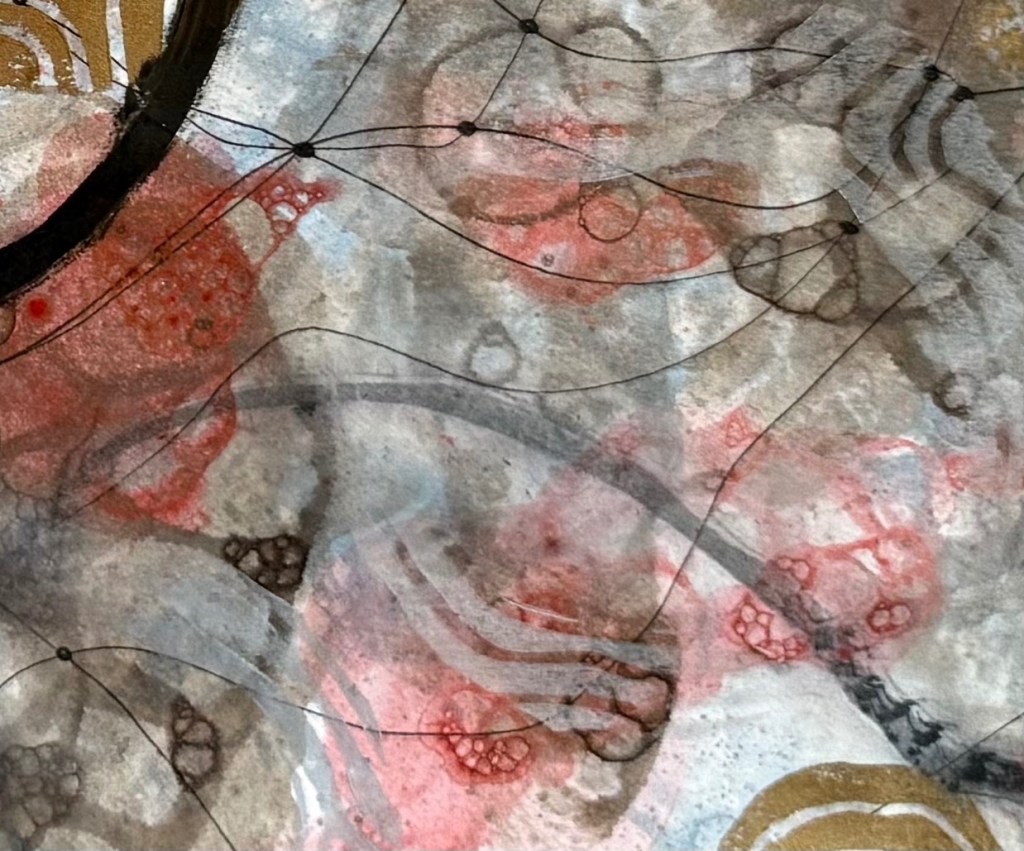
the visible lines the clarity of the bubble layerthe scratched gold shape and the bubbles on the mulberry paperthe effect of the background on the dark shapethe colours in the base layer and the gold shape added on with a brushthe disruption caused by the edge of the collaged piecehas a bit of everything in itthe pale grey contours
As I was experimenting I thought that what I really want is to achieve some thin veils of colour between the bubble layer and the print – like the effect you get when you glaze in oil painting. I’ve questioned recently whether I should try oil painting again. I haven’t done any for so long as I haven’t been going to my classes. It would be like meeting up with an old friend who I haven’t seen for a long time and during which time I have changed considerably. Would I get sucked into being my old self, or would they be happy to accept me as I am now?
The sun was out today so I thought that I would take advantage and engage in some more playful experimenting.
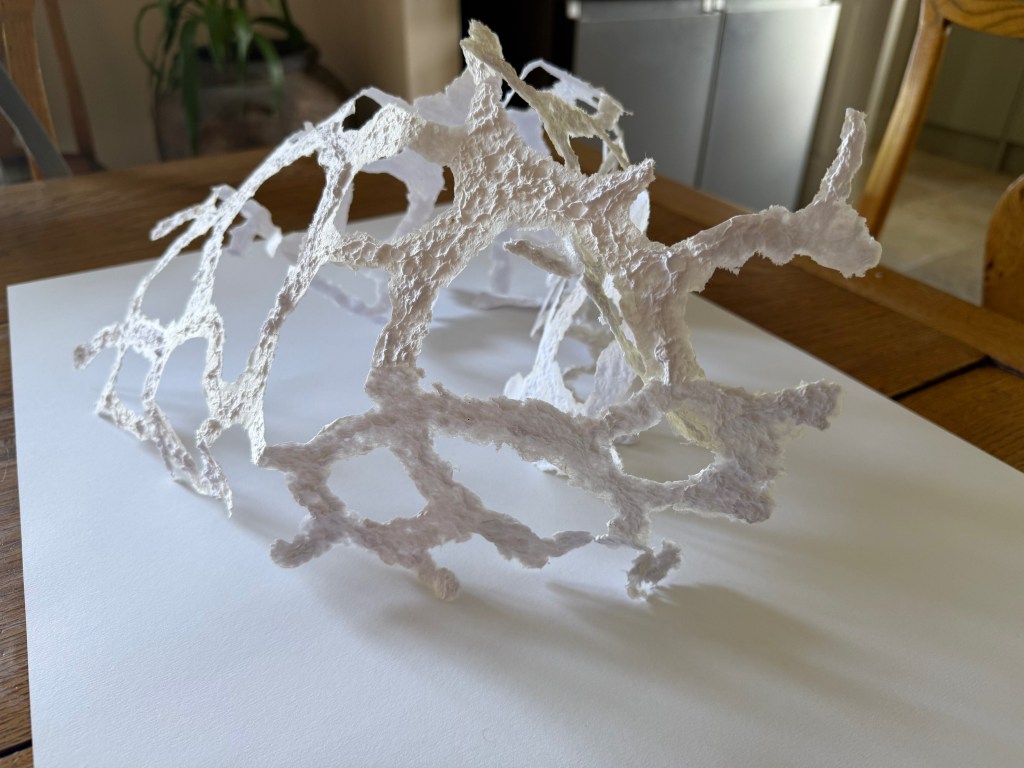
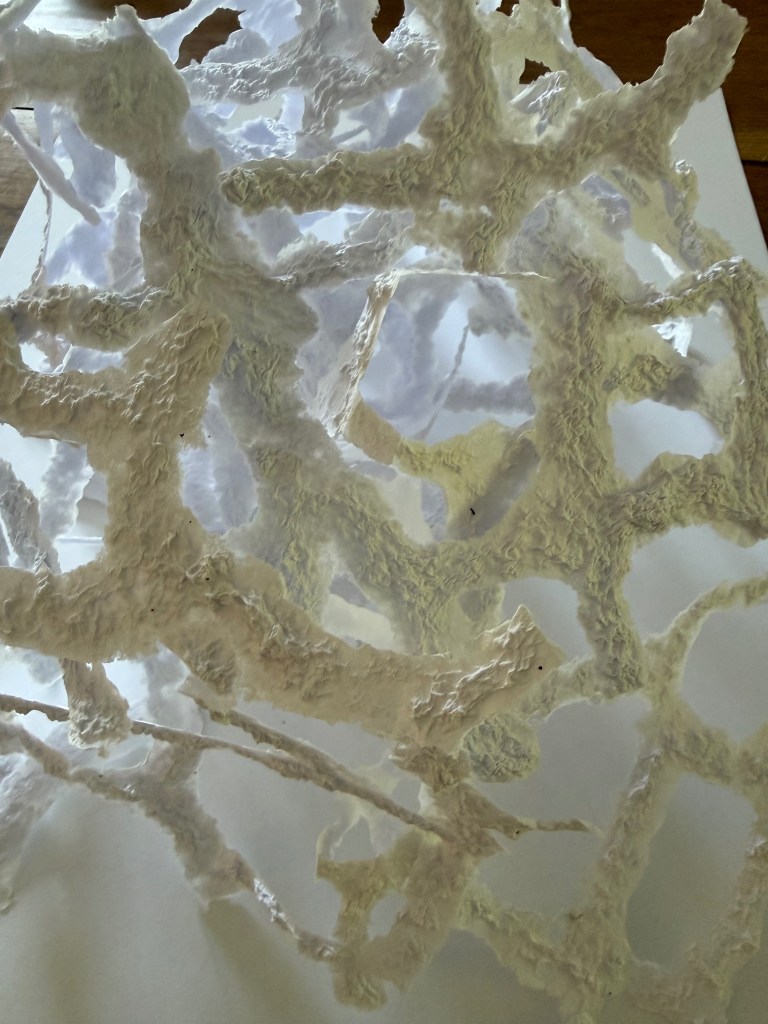
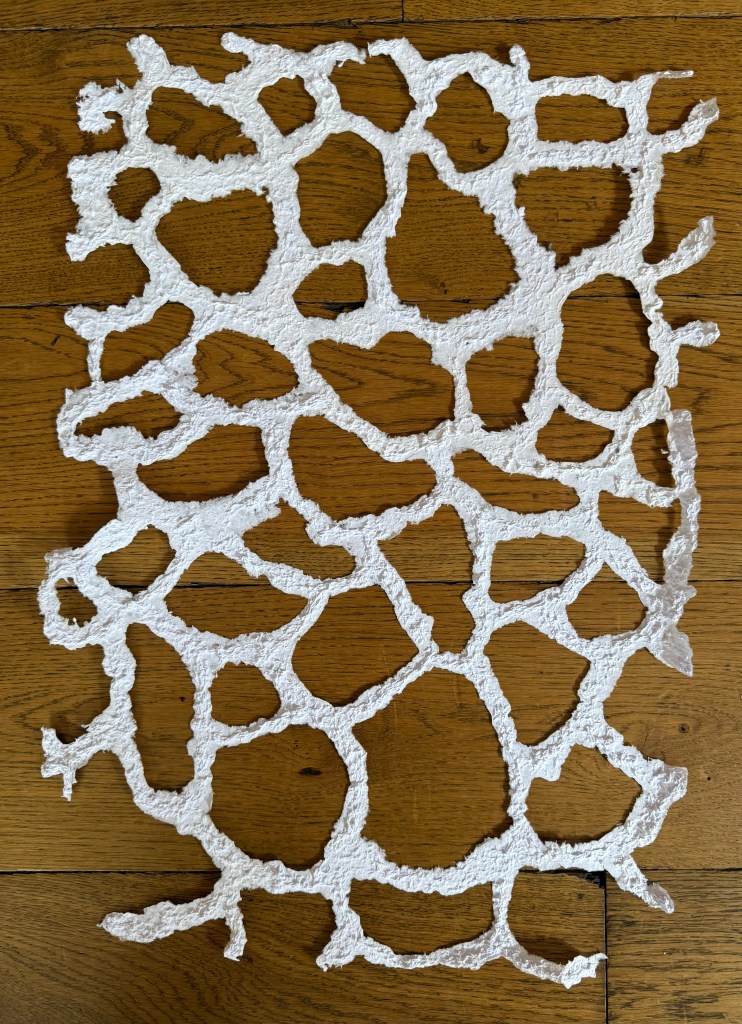
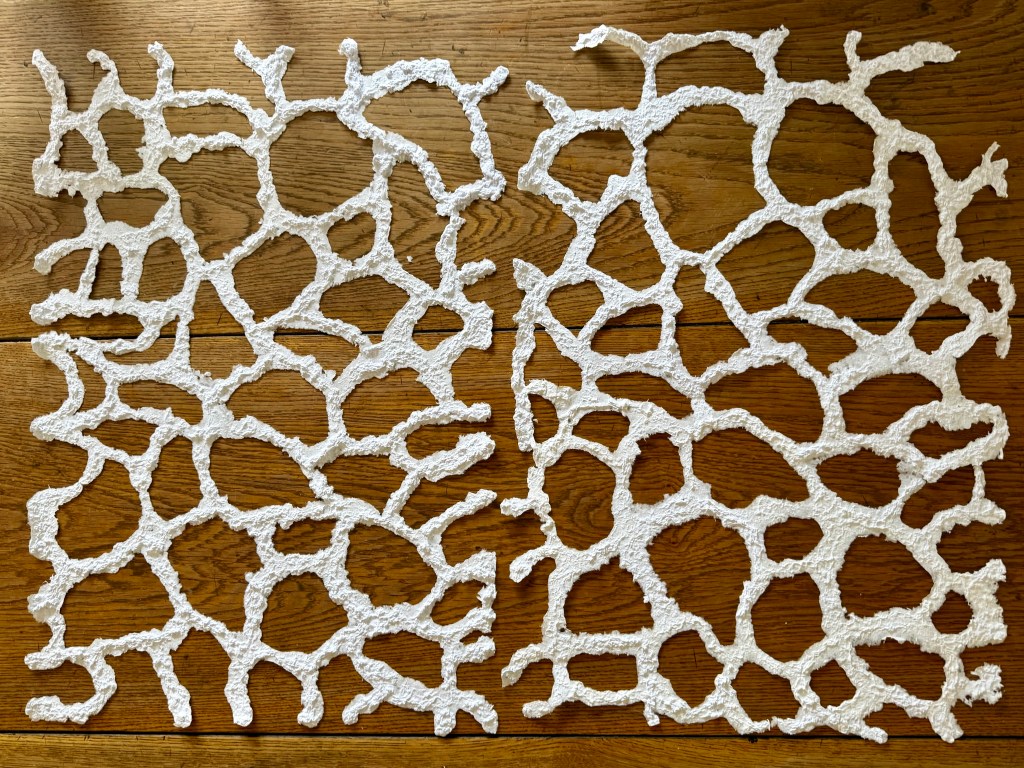
I’ve been lining up my paper pulp lacey membrane sheets by eye – that’s not working and so I’ve marked the edge of the frame so that each sheet is a repetition around the edges which will then line up. I gathered the ones that I’ve made already together in a pile intending to reprocess them in the blender. They took on a 3D form which caught my eye – maybe something for later. I also quite like how they look when laid on white paper.
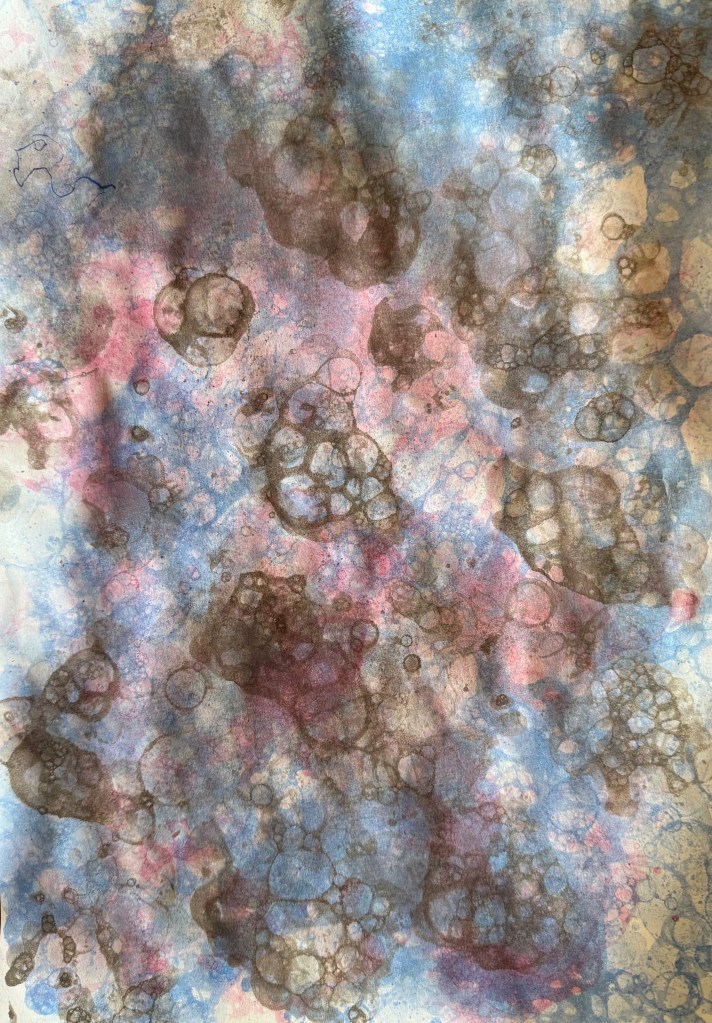
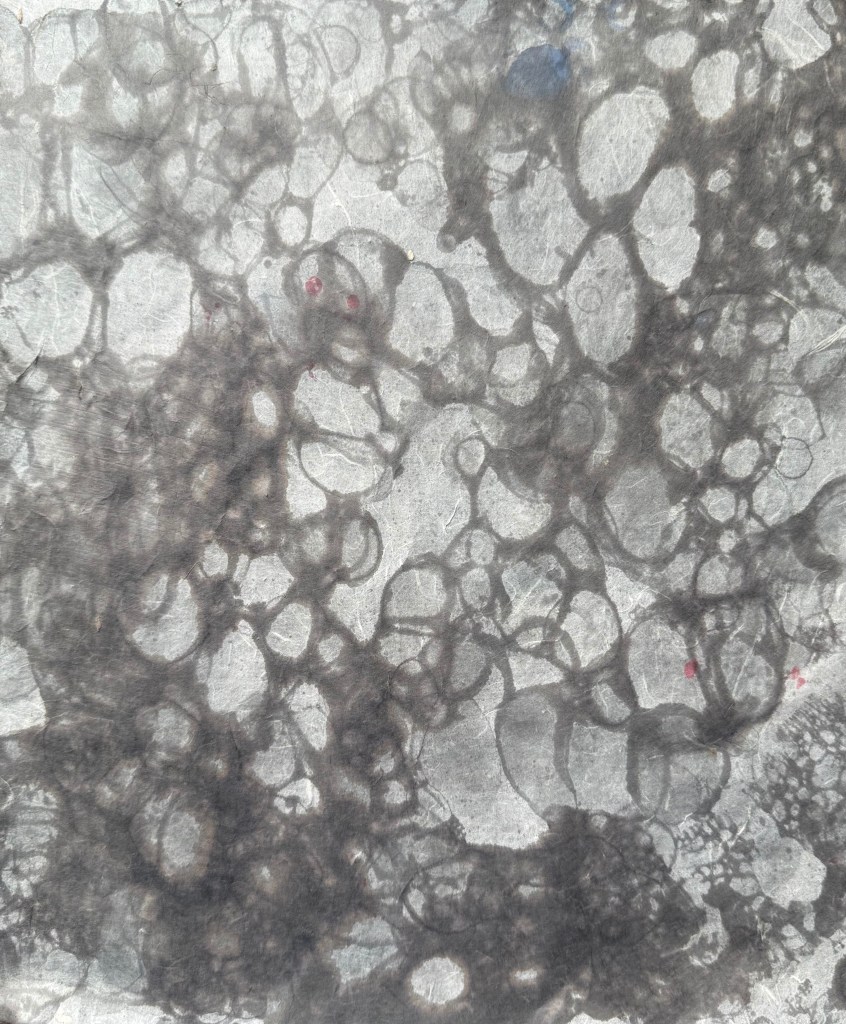
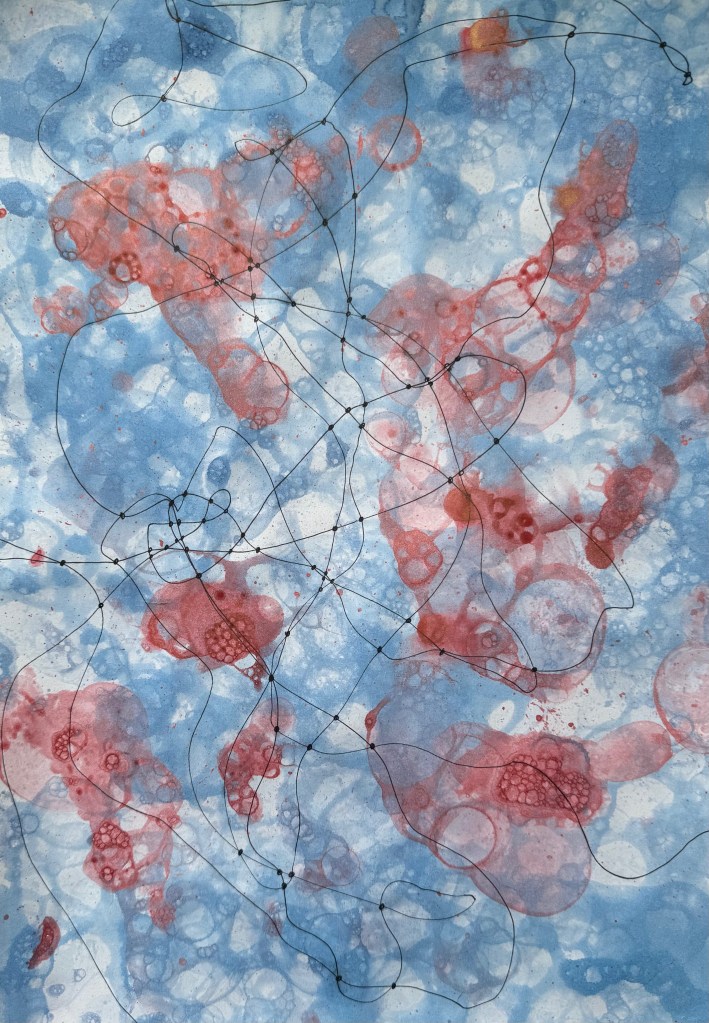
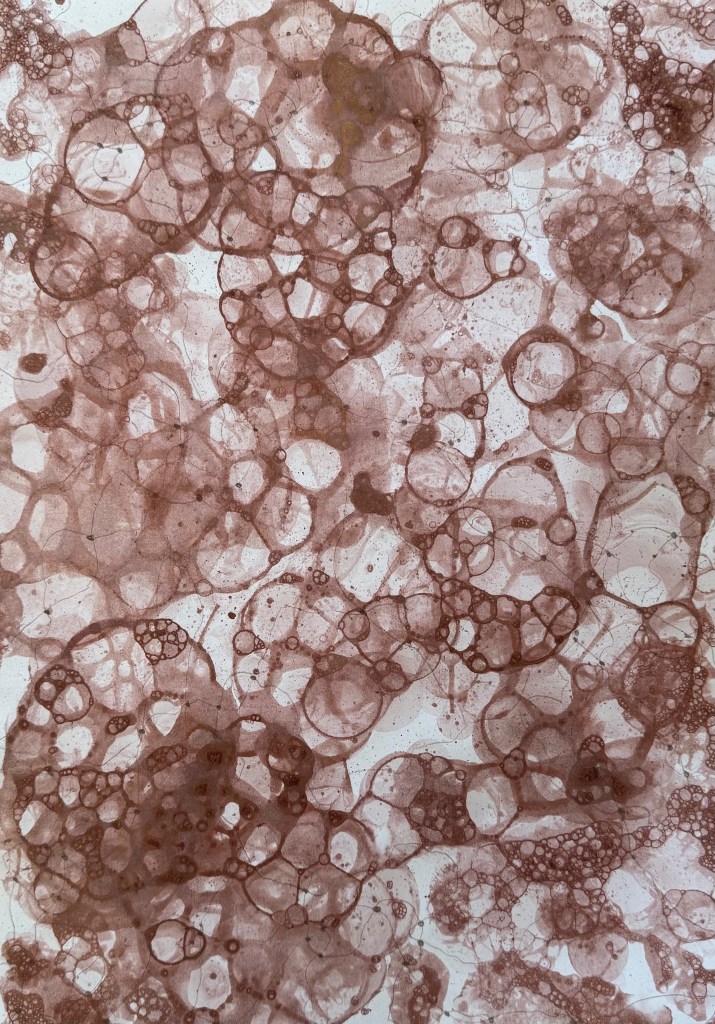
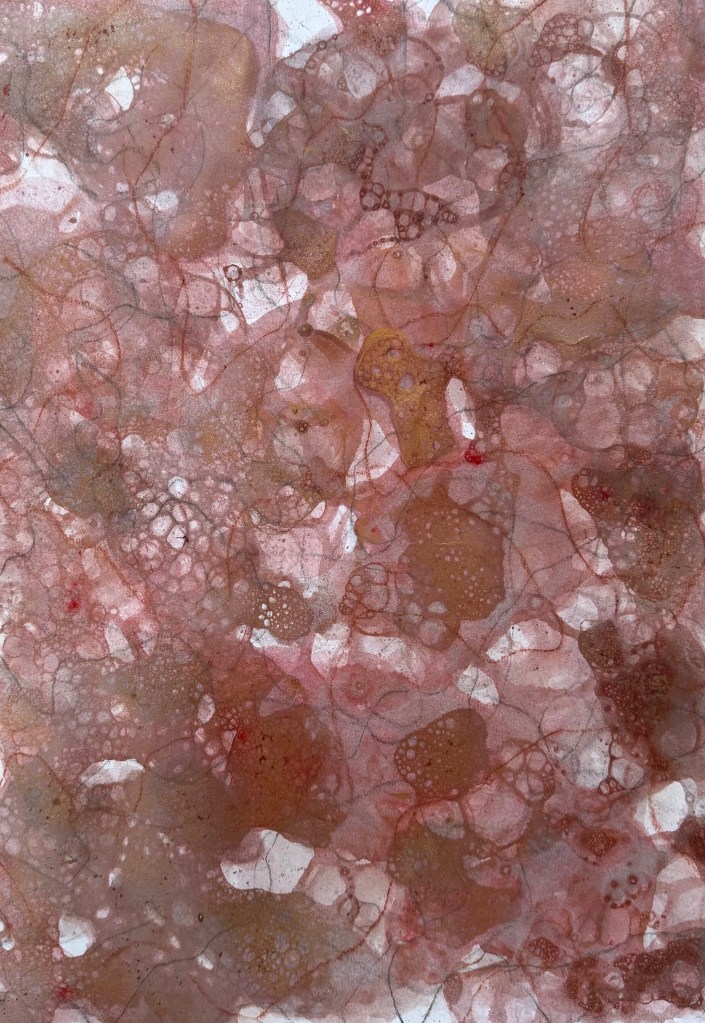
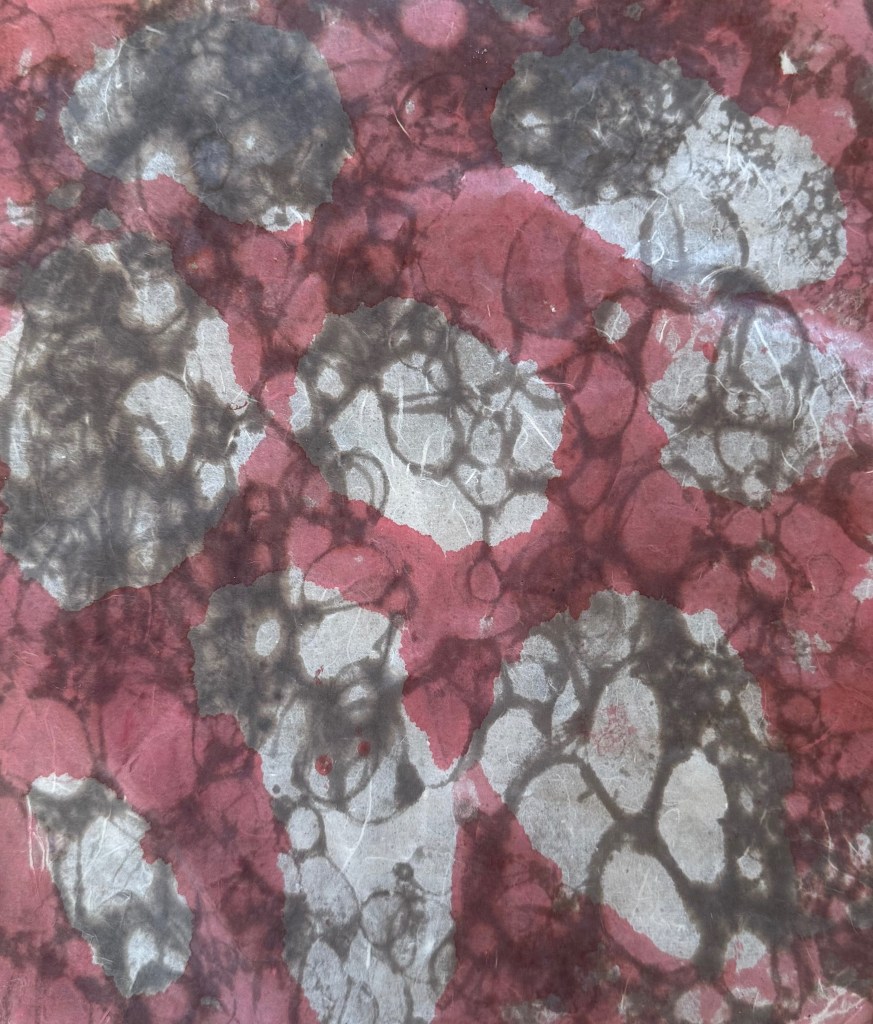
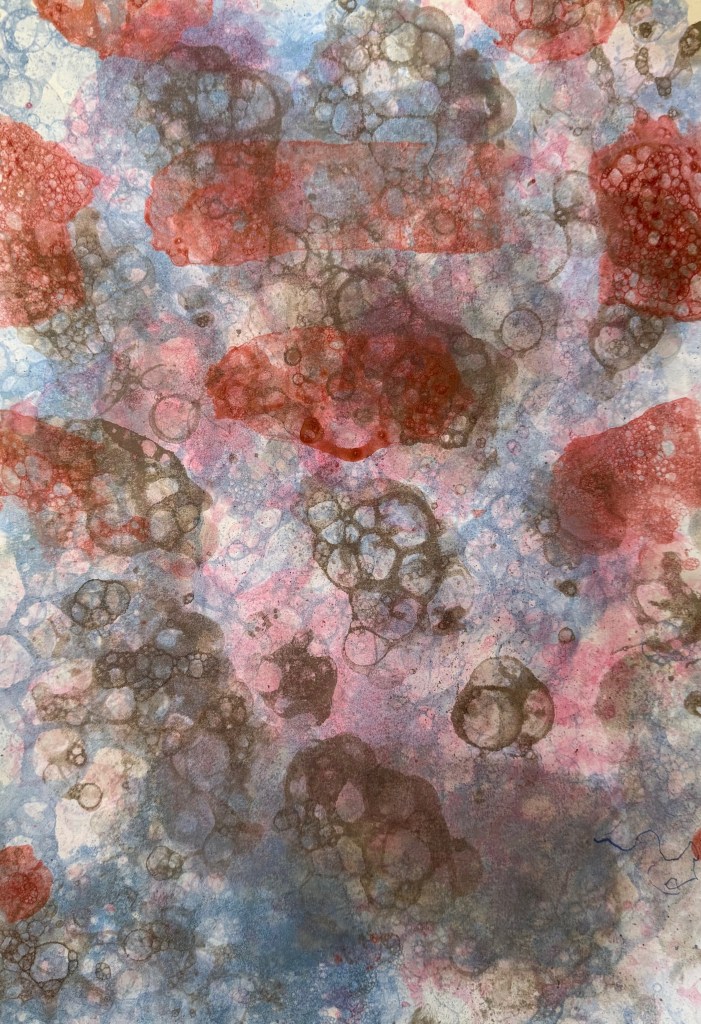
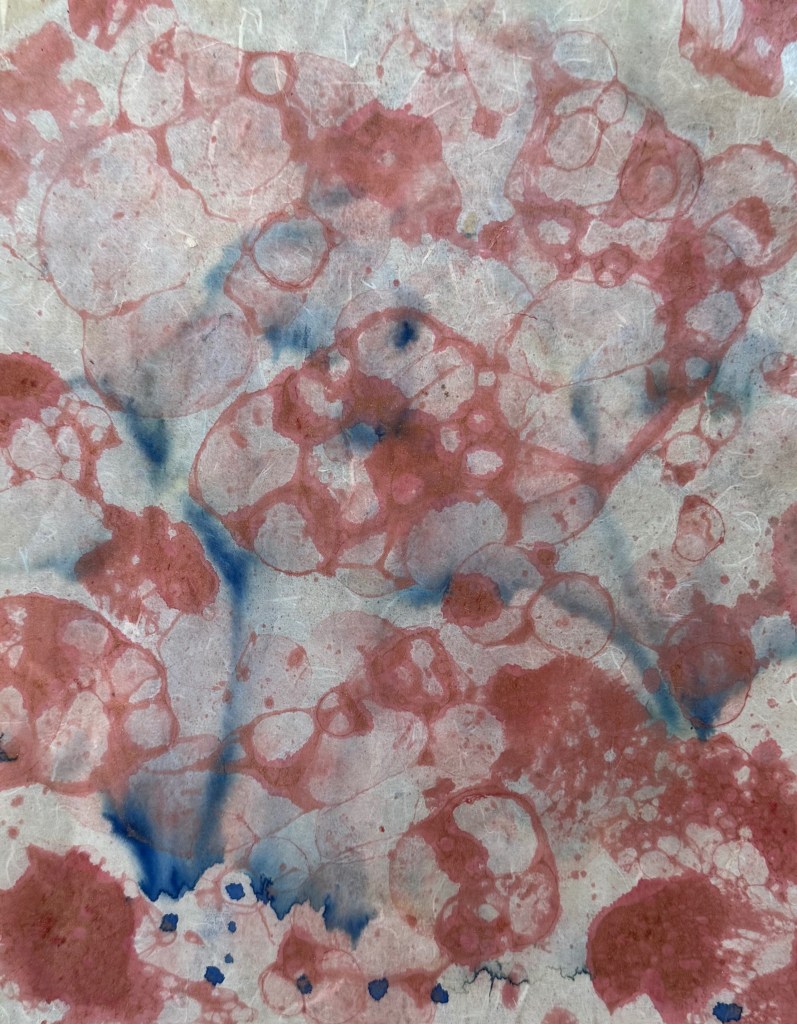
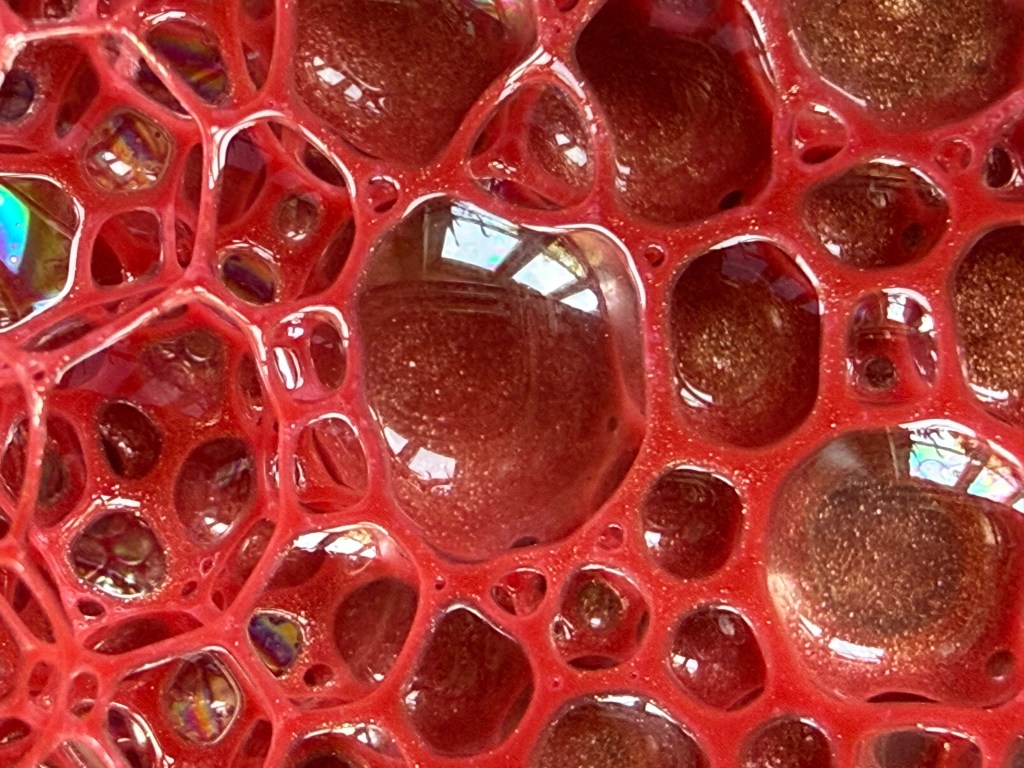
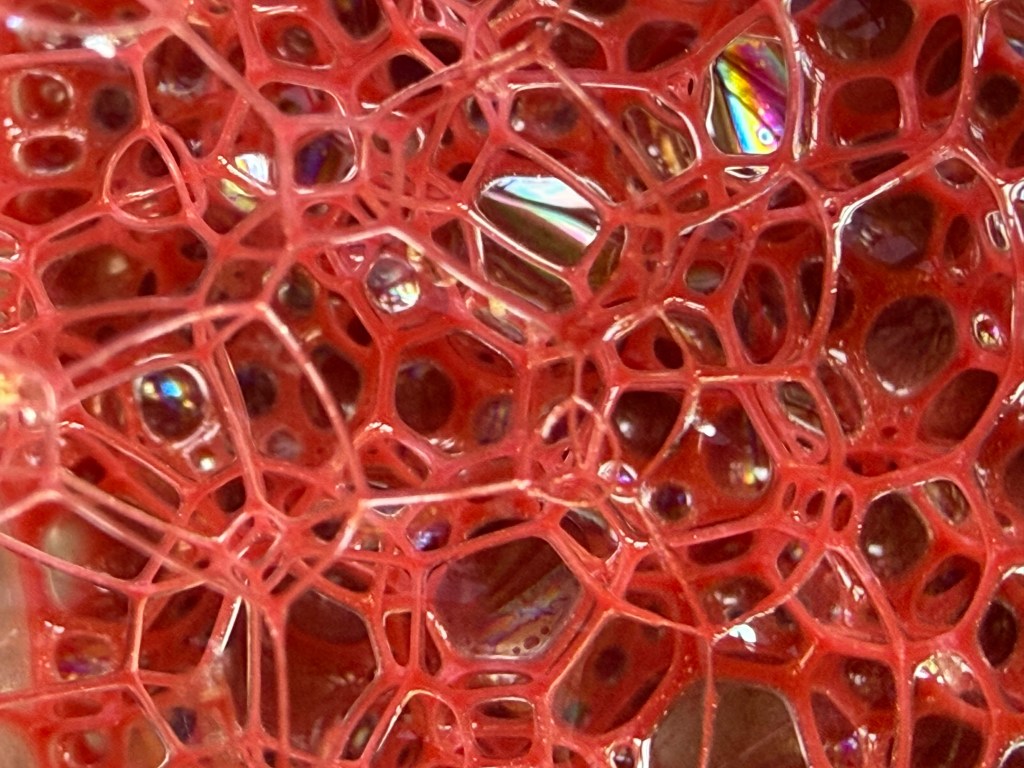
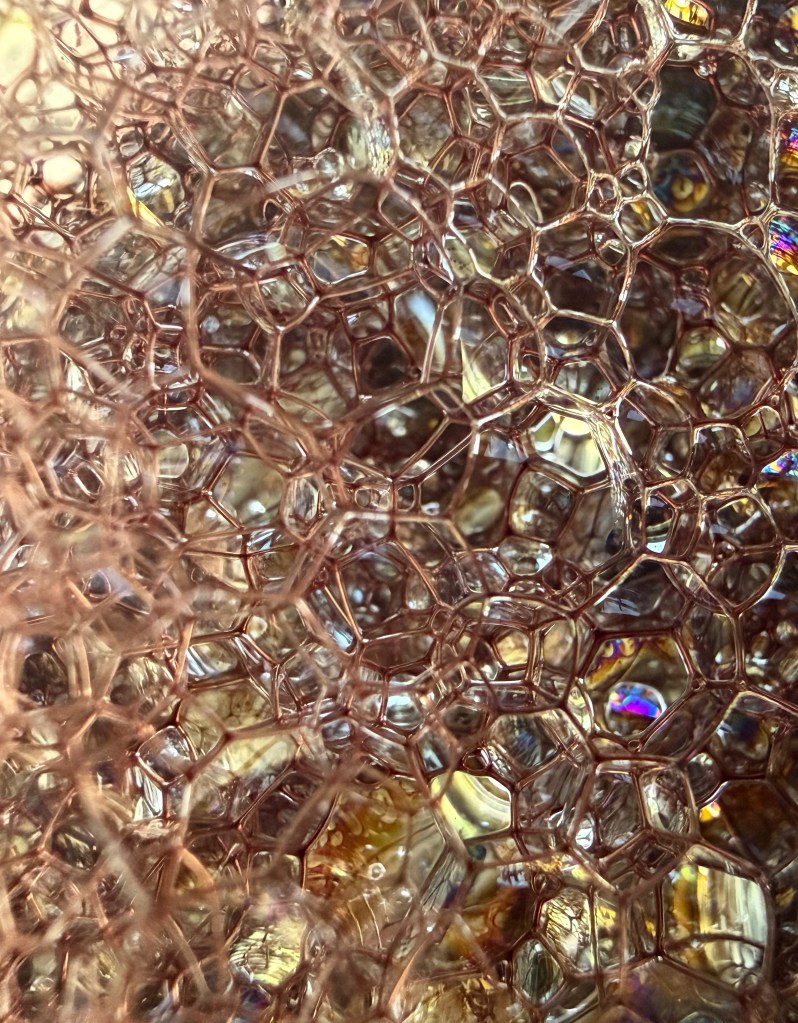
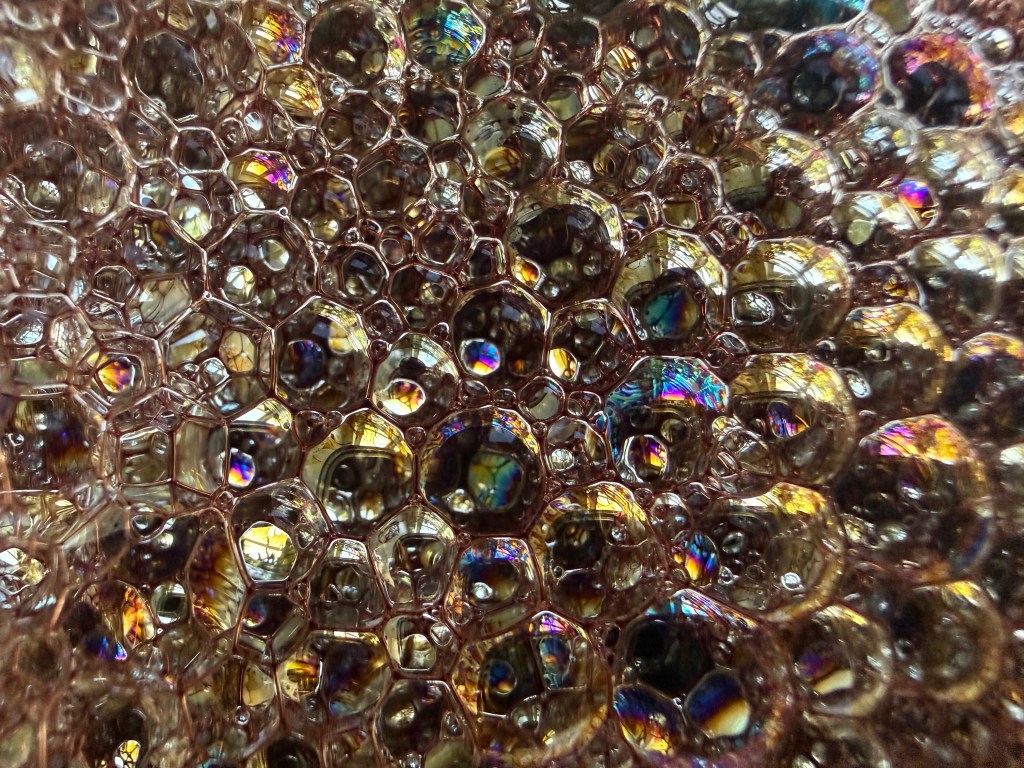
Then it was onto experimenting with bubbles using a mixture of inks and acrylic paints. I want to create a base layer onto which I will print, draw, paint, whatever takes my fancy. I like the idea of it being biological and cell like, hence the bubbles. I tried cartridge paper and the mulberry paper that I’m using for the book. The mulberry paper gives a much less defined edge which I really like. I tried masking with bits of paper – if I ultimately go down this route I’ll use something more robust and less inclined to buckle when wet, although it did provide some pieces to collage. I wanted to see if I could get a layer of lines below, so tried using a fine liner, a pencil and a combination of charcoal and pastel before applying the bubbles.
My first thoughts are to go with something that’s indicative of inside of the body and so I think that for now I’m tending towards reddish tones.
I liked the effect of the shadow cast by the stone.
I became distracted by the bubbles.
I’ve taped all my test sheets together ready for a layer of printing – I just need to get an idea of size and context for the printed elements. I’ve got together some off cuts of lino and made some shapes out of them ready to experiment with tomorrow morning. I’ve given the main shapes some further thought and decided that having said that they have an identity in my mind, I will not use them again. I might try using their outline, but I will probably cut a new shape most likely using loose lines rather than the straight ones I used previously, to give it a more organic feel. That’s the idea for now, but it could well change!
I’d be lying if I said that I don’t get moments of anxiety about the End of Year Show and what I will be showing. After all, the plan is not to have a plan, as I’m treating it as a snapshot and the continuation of my becoming, as opposed to the big finale, the culmination of something. But it’s very difficult when all around me are so far advanced in their own work and I also need to give an idea of what I will be showing from a space planning and curation perspective.
At the very least I will have the book – it was ok to have that as a plan as it seems the most natural thing for me to do, it is something that can continue to develop because it is made up of volumes and also the process of making it has been one of learning and development. After my trial run I decided that I need to have some sense of progress and that I would crack on with the second volume before returning to remake the first. So, I’ve made the book cloth that will be used for the cover and the end papers. I’m currently halfway through formatting the blog – the resizing of all the images to a higher resolution suitable for printing and the creation of QR codes for the videos takes up a lot of time. Hopefully I will have finished it sometime this week and so can get on with making both volumes.
I’ve been thinking about my conversation with Jonathan as to how to display it. I want people to pick it up and have a read of it but at the same time treat it with care. Placing a pair of white gloves like those used by archivists next to the books would indicate that care should be taken – I don’t necessarily intend for people to actually use them and I’m sure that there will be some who would be reluctant to anyway. Hopefully, there will be three volumes, so the idea of two being arranged on a shelf and the third being placed on a separate surface, open and an invitation to be read is a good one, but it is also open to being seen as being on display, something to be looked at, not touched and read. So, I’ve gone with Jonathan’s idea of a student table chair/ conference chair as a possible option. I’ve sourced one – it has a fixed writing tablet so nothing has to be moved or flipped up for the reader to be able to sit down.
I’m also intrigued by Jonathan’s idea of using a video screen as a table and placing the book on that, as well as his comment about watching videos through layers. I had in the back of my mind that I would probably make a layered piece rather like the one in Layering. I tried experimenting with the burnt mulberry paper just to get a feel. I also used some mulberry paper that I had cyanotyped on and decided to burn holes in that to see how a patterned layer would work – a health and safety risk assessment beforehand probably would have alerted me to the risk that paper that had been chemically treated would probably burn quite enthusiastically – let’s just say that it was a bit quicker and harder to blow out than the plain paper. I put the paper on top of an acrylic sheet for the purposes of this exercise and so at times you can see my reflection.
I’m going to have a look at making some new videos and perhaps re-editing some of the existing ones, taking on board all the really helpful suggestions Jonathan made in my tutorial. I’ll keep playing around with layers and see where it takes me.
I also want to try working at a larger scale. I’m still thinking about microchimerism and the piece with the three foetal forms (The Accidental and the Incidental). I still can’t believe how randomly drawing a shape resulted in a form which I now see as having such a strong identity. I could use some of the processes that I have been experimenting with, such as bubbles and ink. I really enjoyed making the paper using the syringe ( Layers) – it feels organic and biological and maybe I could incorporate it in some way into a larger piece or even a layered piece. I can only make it in A2 but I think that I could easily attach sheets together to make a larger sheet. The only question is how I would transport it, but I think that once it’s dry it is quite flexible and more robust than it looks although it would probably be better to take in sheets and then join it together in situ using paper pulp which would have enough time to try over the install period. Failing that there’s always PVA glue.
I’m feeling positive and excited that I have a loose idea – some soft structure – let’s see where it takes me.
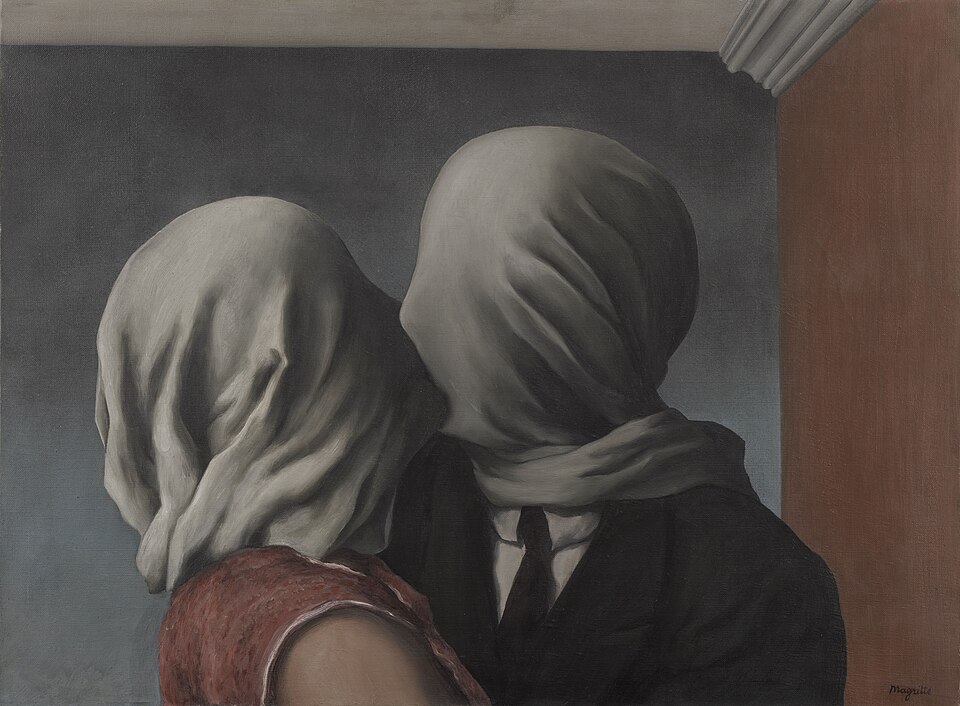
For some very light entertainment I’ve been watching ‘This Is Not a Murder Mystery’ a quirky fictionalisation of the gathering of Surrealists at Edward James’ West Sussex pile, West Dean. Whilst he was a champion and friend of the Surrealists and owned the largest collection of Surrealist art, this particular gathering at which several murders take place is a work of make believe, with Magritte waking up next to the first murder victim in a mise-en-scène exactly like his painting The Lovers which up until that point had not been seen by anyone.
Les Amants, 1928
I was trying to put togther the transcript for my 5-minute video earlier and I was thinking that I would like to make some work with me in it, me now, rather than videos from years ago. I managed to get over my reticence at using my voice and so I think it’s time that I bite the bullet. It seemed to me that being obscured in some way rather like in The Lovers might be the answer, a veil of sorts which could also represent am element of feeling disconnected. Because I’ve been looking at my work and my blog recently, the idea of time passing has been in the forefront of my mind, and I really dislike the sound of clocks, a constant reminder, particularly the one my husband has which belonged to his parents – it ticks so quickly it makes me feel anxious.
I’ve also been wanting to have a go at stop animation. I know that I could have just taken a video and used apps such as Capcut to create the effect, but I wouldn’t really be experiencing the process, so 153 photos later…
Whilst it was time consuming, the act of exporting, rotating and uploading the photos was repetitive and was strangely enjoyable for that reason. There are quite few things I would do differently if I did it again, the sheer fabric has creases in it which really I should have run an iron over before starting but I was so excited to get started. Having said that, I do quite like the diagonal that it creates. Also it was difficult to see the image on the phone screen because of the double layer of fabric and there are a few areas which could have done with being straightened out. Having said that I’m really pleased with the outcome, I enjoyed the process of making it and learnt a lot and even managed to tackle it in a logical way, dealing with just one photo at a time and not rushing it, which is unusual for me, although some of my impatience is obvious in the video, as already mentioned. In particular I really like the effect of double layering the sheer fabric which creates a contour-like effect.
As I was editing the video of the ink in the water I decided to see what it would look like speeded up. It had a whole different feel to it, less calming, more violent, and so I experimented with adding some audio. I’m pleased with the result. I can trace it back its roots – the doodling, the contour lines, the attempt at suminagashi that went wrong and the inspiration that came from that, of observing ink in water, the ink and the fish tank and the curiosity to experiment with effects that I have developed since I’ve been making videos over the last few months. It’s so satisfying to see how it all connects, although I can probably say the same about most of the work that I’ve been making recently.
In many ways this video is as mesmerising as the 5 minute one of the ink moving slowly through the water. After I had increased the speed it reduced from 5 minutes to only 6 seconds, so I duplicated it over and over. The audio clip was slightly longer than the video clip and so the effect of duplication was to delay the audio on each subsequent repetition. This led to me thinking about when we know that something is coming we anticipate it and often it reduces its impact or sometimes, such as scary moments in films, even though we know it’s coming, it still makes us jump. I was then interested to see how many times it had to be repeated to get back to more or less the right place – it was 7 times (the maximum number of times that you can fold a normal piece of paper in half). My daughter didn’t notice the delay in the audio each time and so I gradually reduced the volume to draw attention to it.
The blackness and lines created by the ink remind me of Gnawing Grief in Klimt’s Frieze. The video reminds me of how grief feels – when it initially hit me it was like having the breath knocked out of my body by a monumental force, over and over, and it made me feel disconnected and out of sync with the world, which just seemed to carry on as if nothing had happened. This video is as close as I can encapsulates that feeling for the time being.
I’ve really enjoyed experimenting with ink in water. Next time I’ll try different sorts of inks and perhaps venture into some colour. It’s been a great learning experience well particularly in terms of working out how to apply layered effects in Capcut and also in learning how to load the video to Vimeo instead of YouTube – the quality wasn’t that great on the latter. I think that I’d like to get more proficient at video-making and editing as well as photography and editing tools such as Photoshop as I anticpate them being a significant part of my practice in the future.
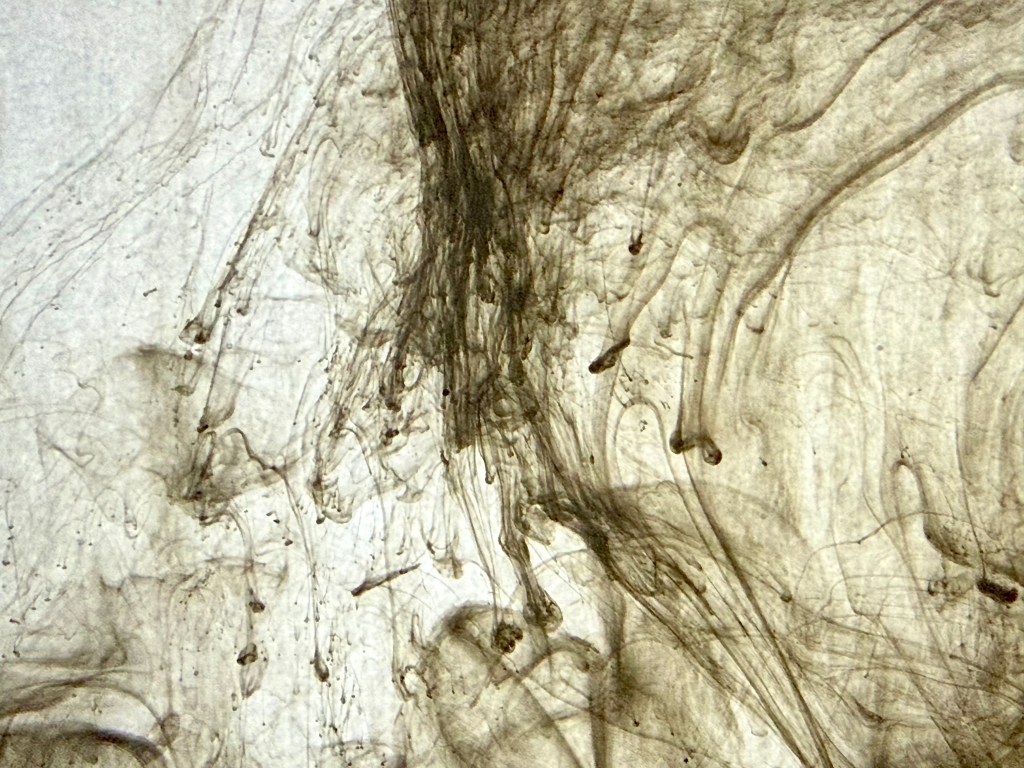
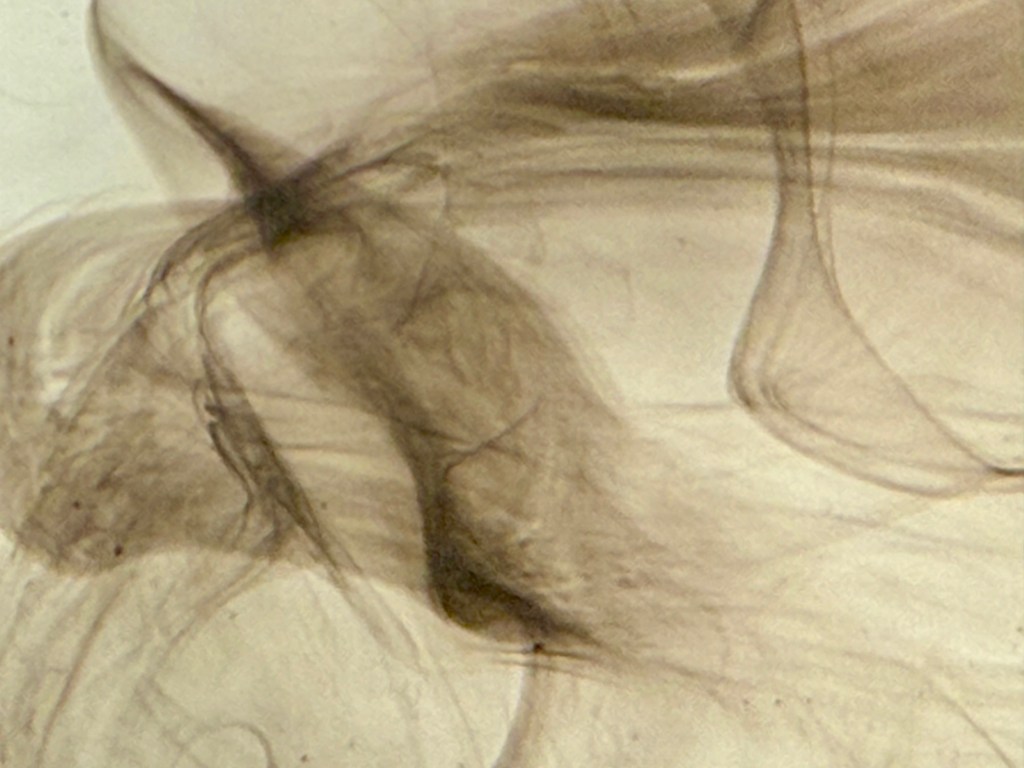
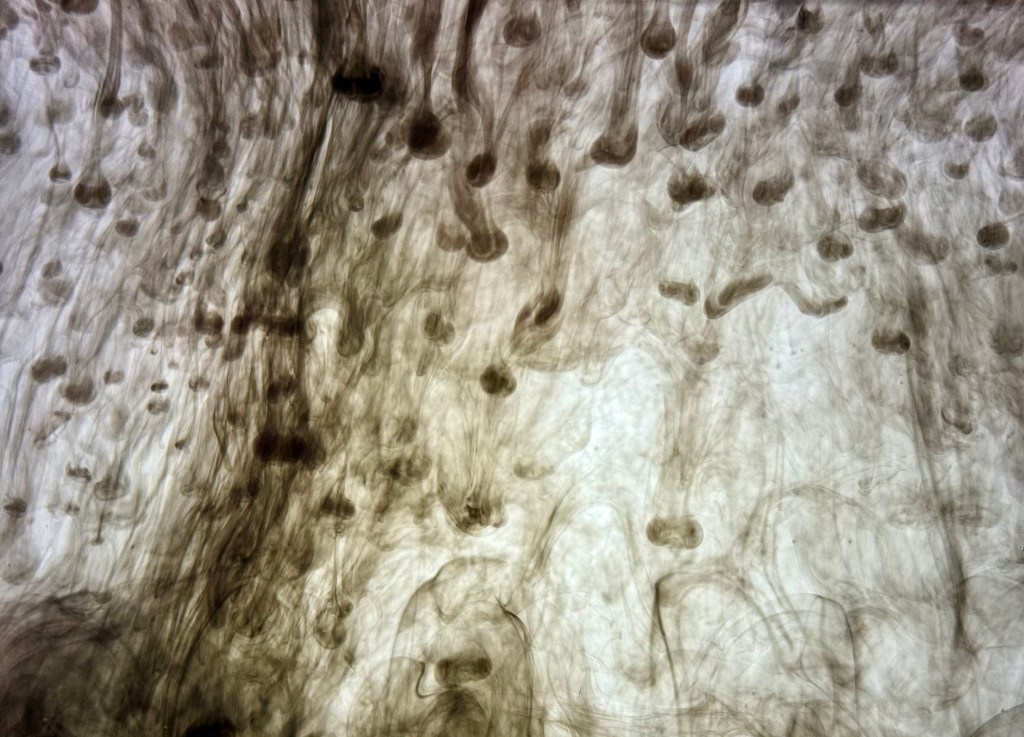
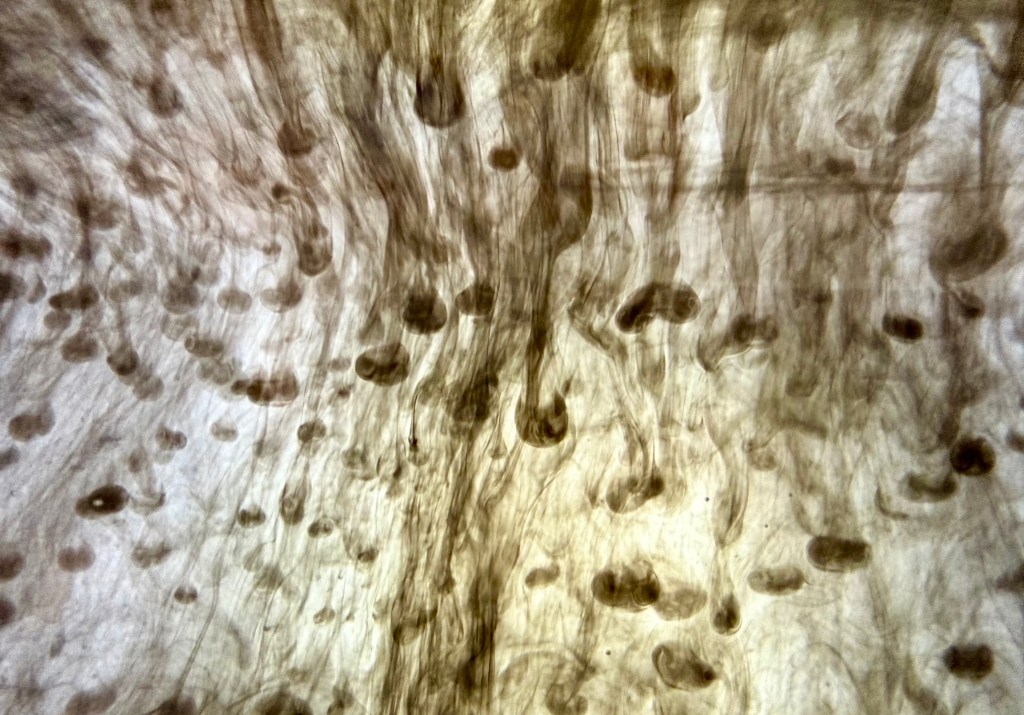
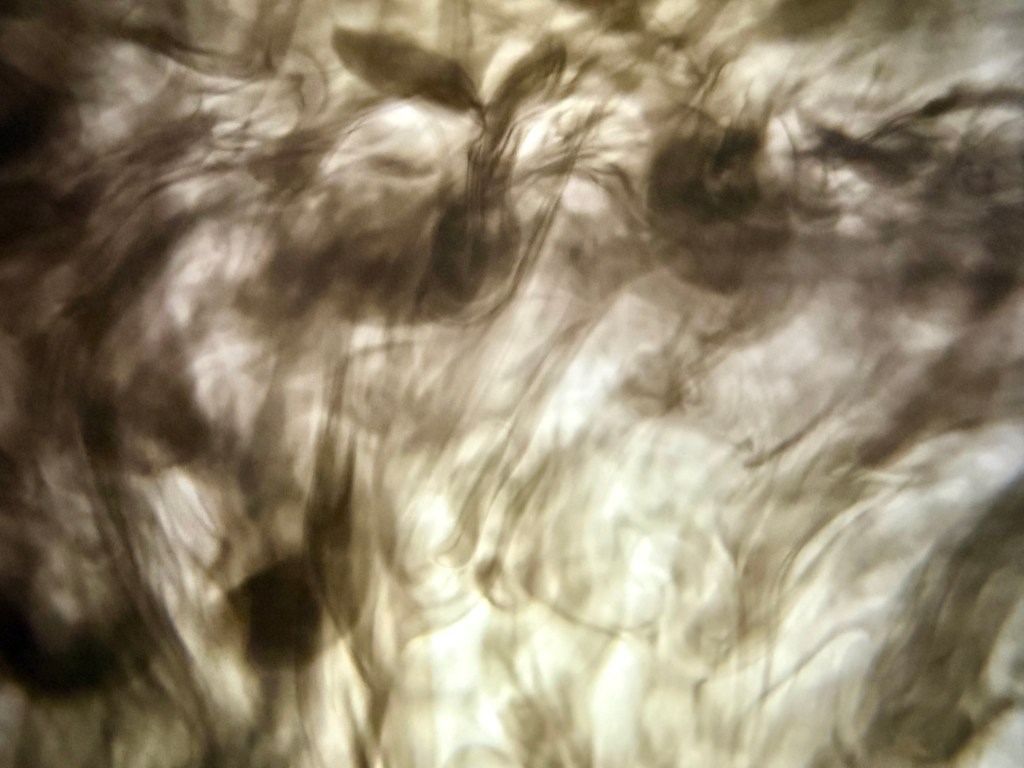
There’s no audio because I don’t want to distract from the visual. I had meant to put in a drop of ink, but it was more like a splodge. Next time I’ll be less heavy handed. It was really exciting to watch the ink slowly flow in the water; it was mesmerising. I really like the way it creates layers and veils of lines, and all the different shapes and images which momentarily appear and then disappear – at the beginning the jellyfish which then grows a nose and transforms into a face.
The ink was in motion for about 10 minutes and when it stopped it just hung there in the water, as if it was frozen in time. It reminded me of stalactites and stalagmites. It was difficult to capture fully what I could see.
I tried slowing down the playback speed to 0.1 which gives it a stop animation feel. It has the effect of mark-making which I find really interesting and perhaps something to bear in mind. Unfortunately the audio became rather unattractive so I removed it.