I went to see Jenny Saville’s The Anatomy of Painting at the National Portrait Gallery a few weeks ago. I went thinking that I admired her work; I came out knowing that I only liked some of it, mainly her early work. It was Michael Craig- Martin all over again.
Her canvases are huge. It made me wonder whether it is all about size. If they were smaller would they still have the same impact? If something is large do we immediately perceive it as being impressive? I always thought that large meant there was nowhere to hide, but now I’m not so sure; maybe it’s just a case of first impressions.


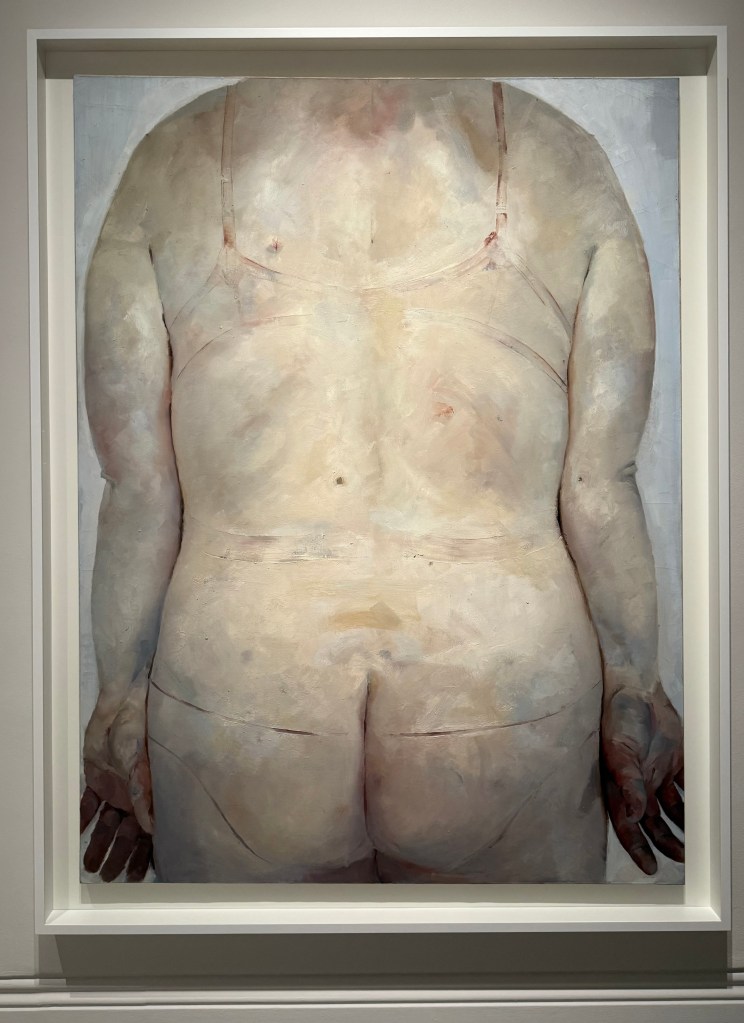
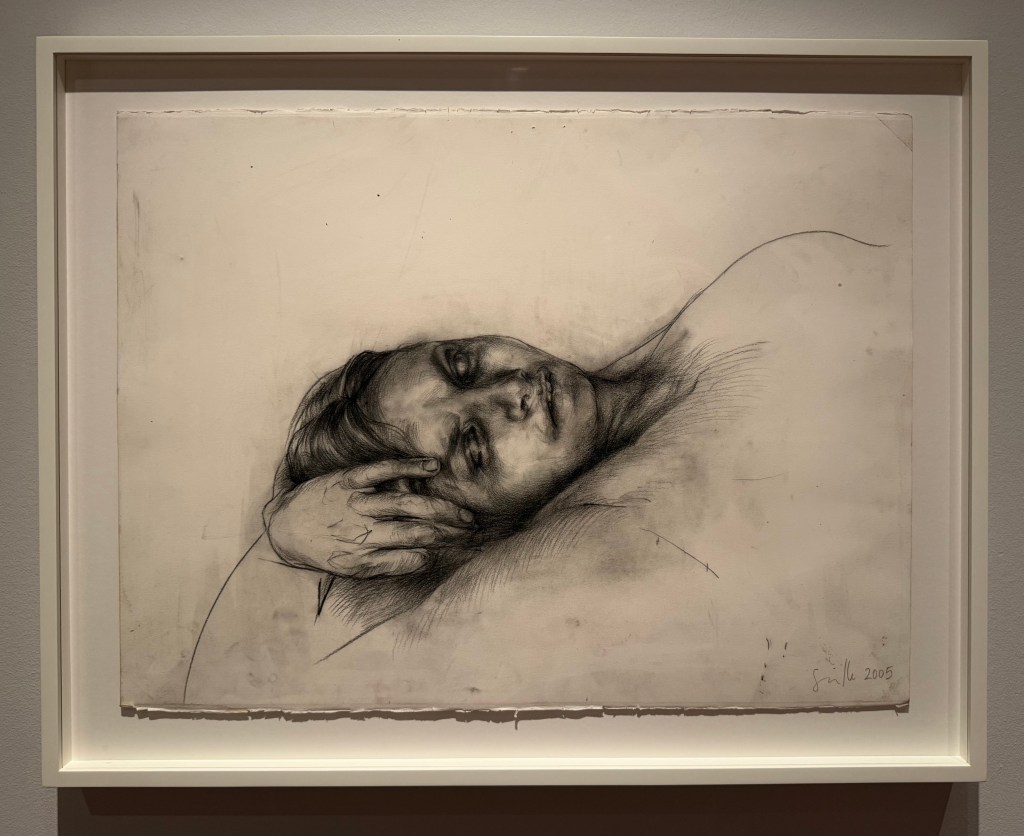
I love the way she paints flesh, in her earlier work that is. I look at my skin and I see those colours, usually with the advent of summer, with a sigh and a determination to keep as much of it covered up as possible, no matter the heat. I have those imprints once I have relieved myself from the claustrophobia of overly restrictive clothing. I can relate.
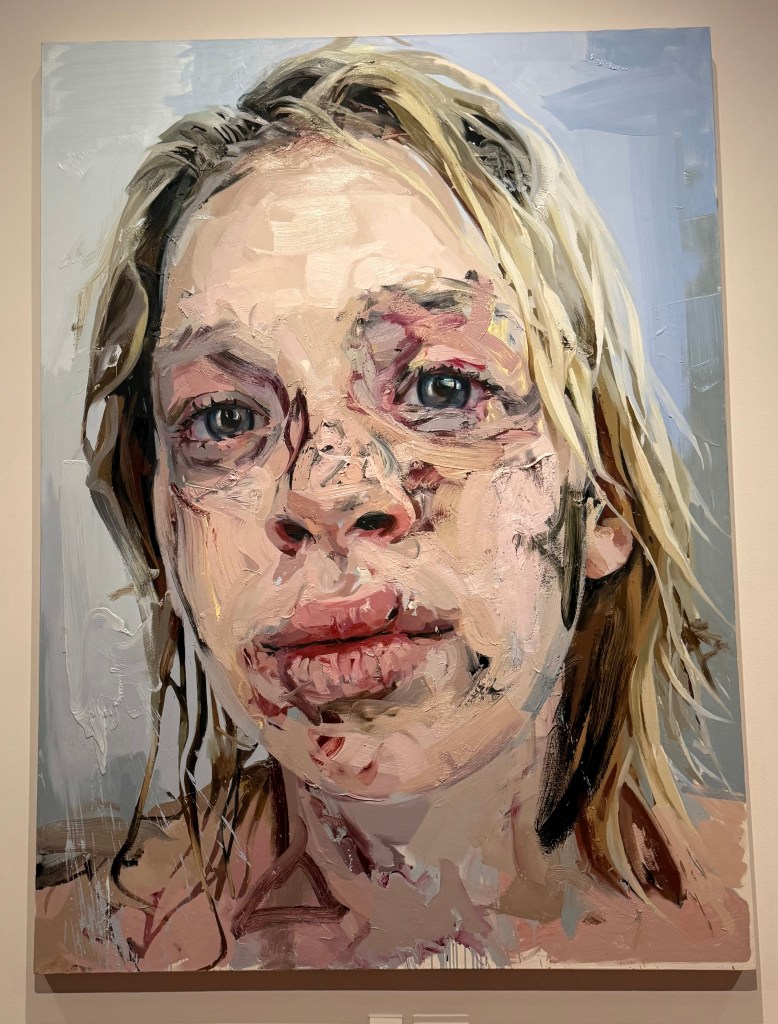
And then there’s the work which comes later, the last image being an example, at the more restrained end of the spectrum. I can’t connect with it; I think to myself, why paint such wonderfully realistic eyes and then treat the rest in the way that she has, bordering on abstract figurativism? I feel like she’s stuck on a fence; she wants to embrace the abstract approach but still wants us to know that she can paint a good eye. I find it jarring and slightly irritating, probably because it resonates with my own feelings of indecision.
Last night I was channel surfing, and came across Alan Yentob’s last interview which he made in March this year, two months before he died. I’m a great fan of his Imagine series; you can tell that he has a real interest in people. The interview is with Jenny Saville, on the eve of the opening of her Gaze exhibition at the Albertina in Vienna. It is only 10 minutes long.
During the interview, in which it rather ironically takes her an age to make eye contact with Yentob, Saville comments that she likes painting eyes; think of all the visual information and memories which go through this structure, something she has been intrigued by since she was a child. Making her heads so large allows her the freedom to experiment with the surface of the paint. From a distance there is the holistic nature of the head, but as you get closer the surface is heightened. She confirms that she is committed to figurative painting but is experimenting with how she can get realism in the face which goes beyond a simple rendering. Whilst looking at one of her large heads, she comments that there is something psychological going on in that you are convinced by the head because of the eyes – something happens in your brain that allows you to piece it together, and as you get closer to it you go on a journey. So she’s using the figurative to help the viewer make sense of the abstract?
That’s explains a lot, but I’m still not convinced by the eyes.















 Kate McCalmont-Woods
