In preparation for this week’s mark-making session with Jo Boddy, I dusted off my charcoal box. I haven’t used charcoal for quite a while.
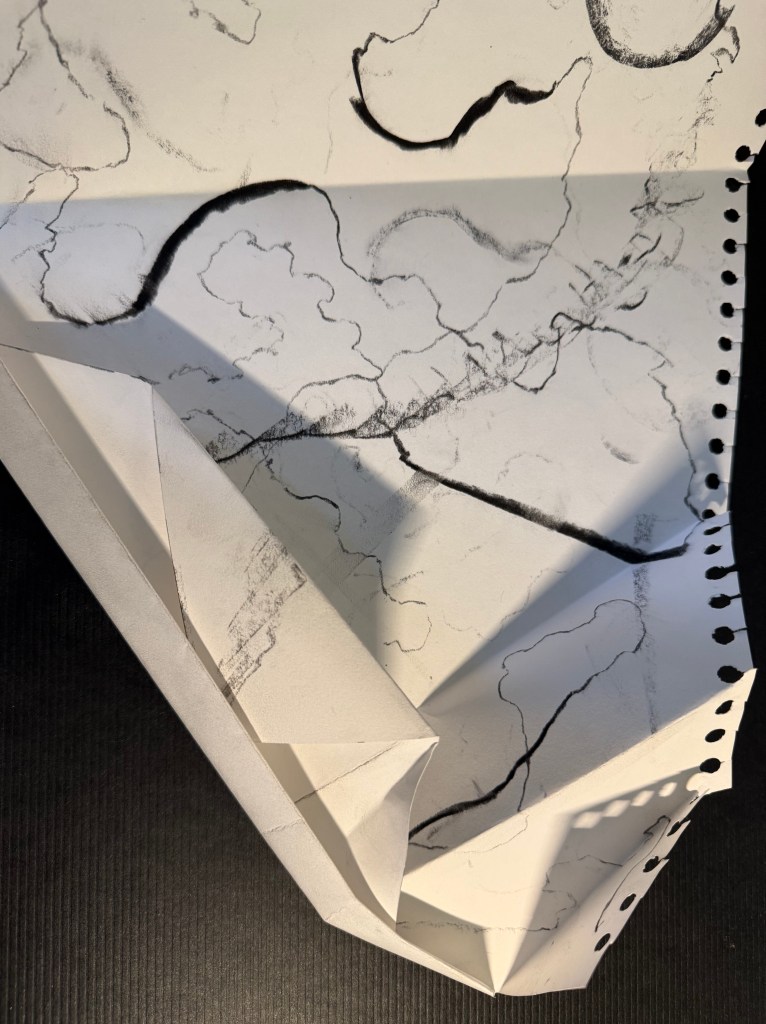
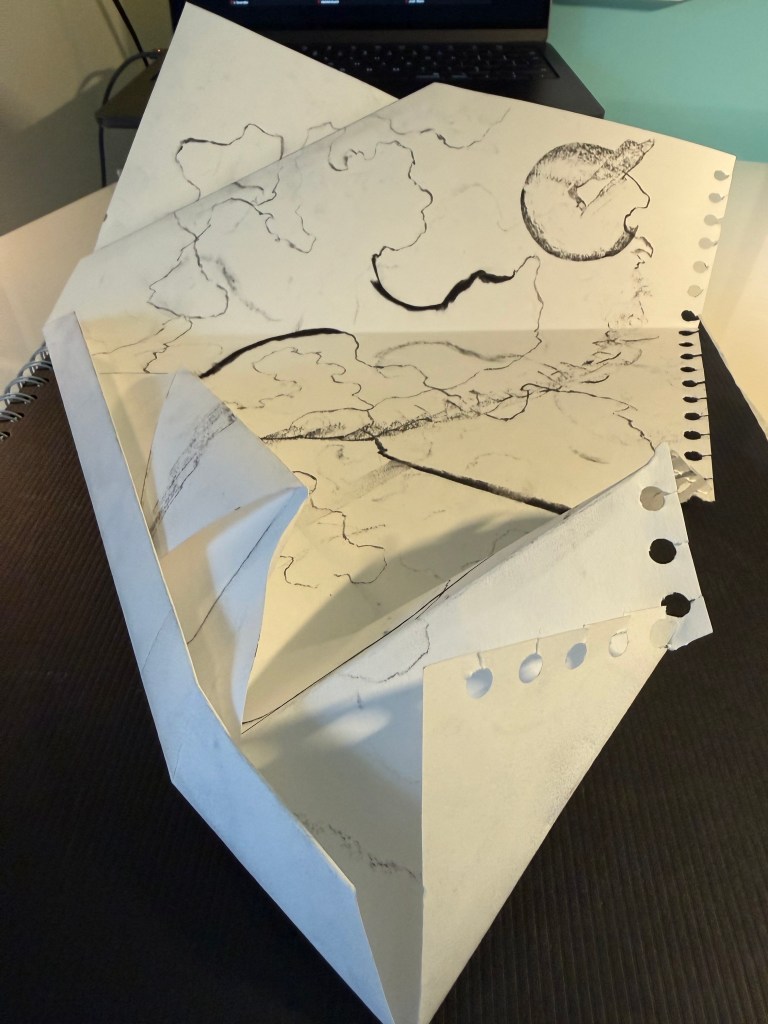
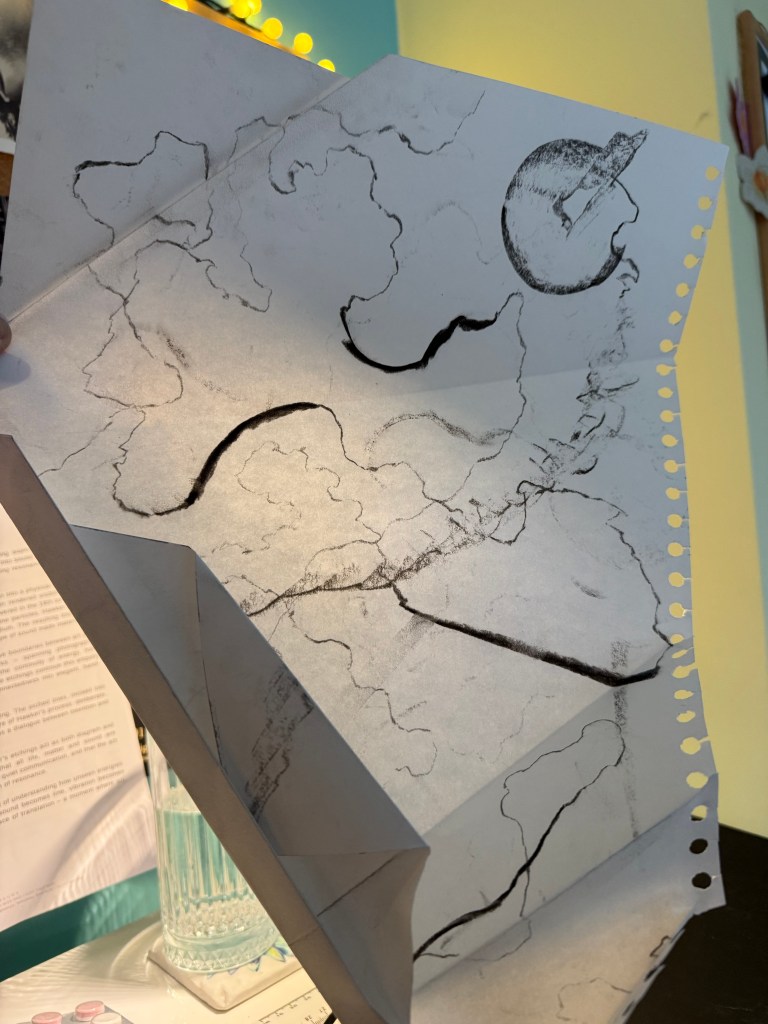
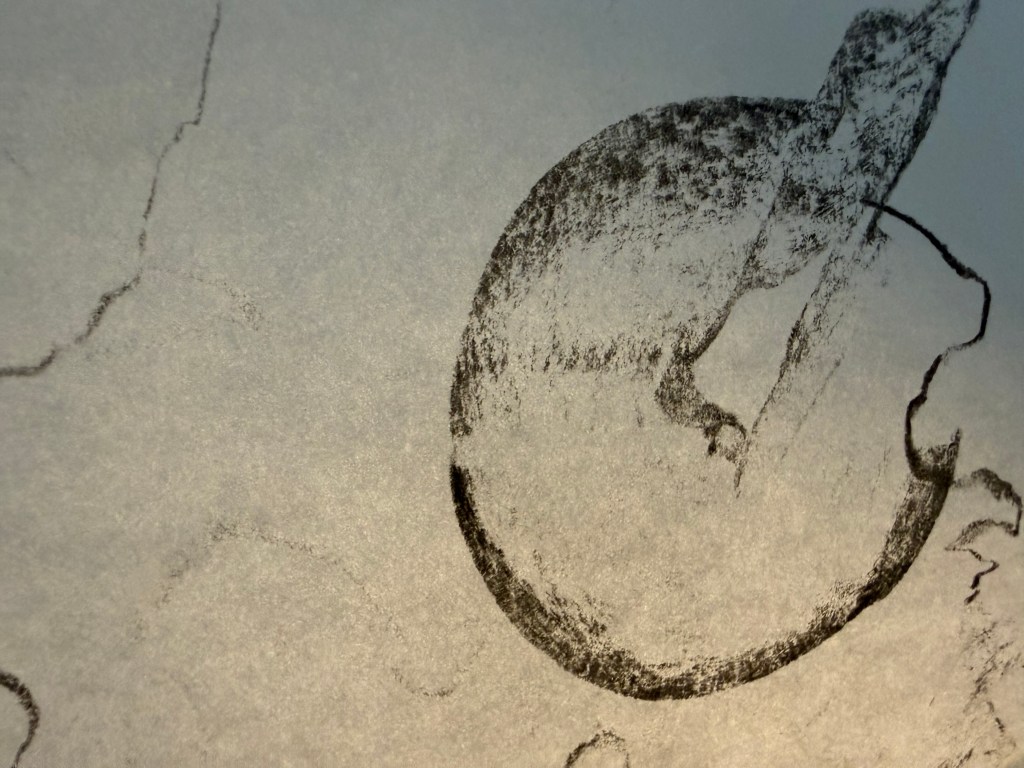
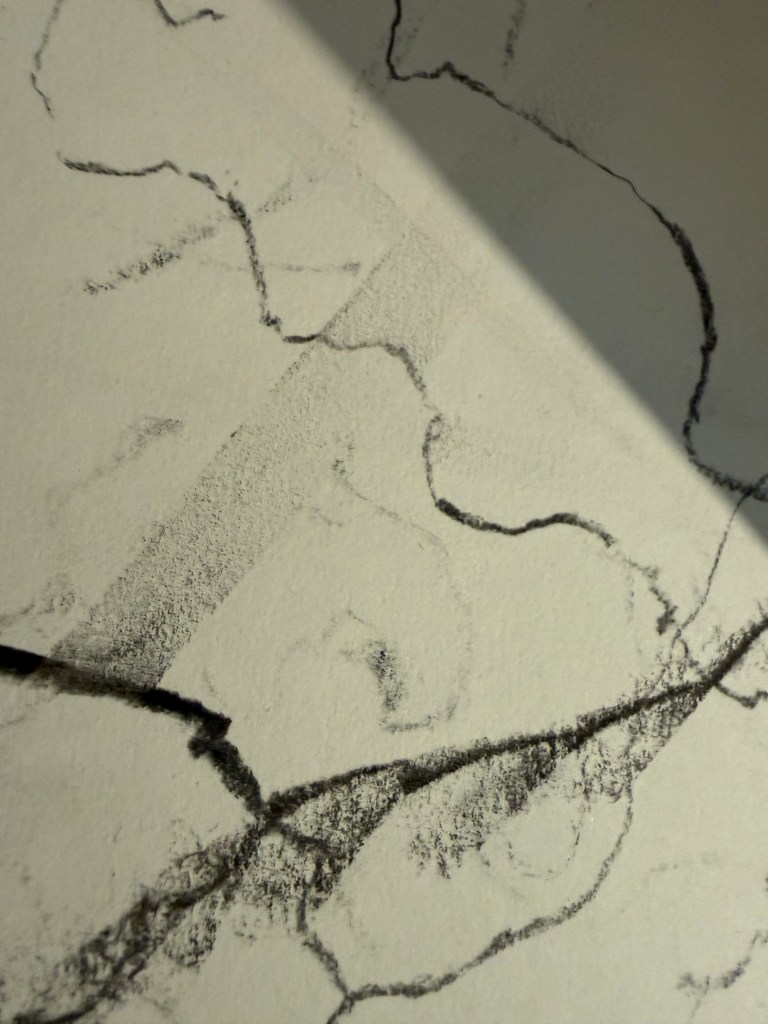
During the session we were instructed to make marks and to think about the context of our practice whilst doing it. We were then paired up and gave each other instructions as to how to make further marks with a view to giving up control, something that I’ve been exploring myself recently. I was instructed to keep my charcoal on the paper and to vary the pressure. We then folded and creased our paper, again taking instructions for a second round of folding – fold an edge as if wrapping a present. This reminded me of our workshop with Christian Azolan in last year’s Low Res – I love how folding and unfolded adds a different dimension, creates shadows, particularly where I had torn the page from my sketchbook.
We took photographs of our piece and uploaded it to the miro board, giving it a title, taking it in turns to talk about it with the rest of the group. I called mine ‘Process’ because it evidenced my process – you can see where I exerted different pressure as I made my marks, how where I folded the paper the charcoal was smudged by my finger and the charcoal left a ghostly print on the opposite part of the paper.
The process felt totally comfortable.
After the session, I carried on doing some more mark-making.
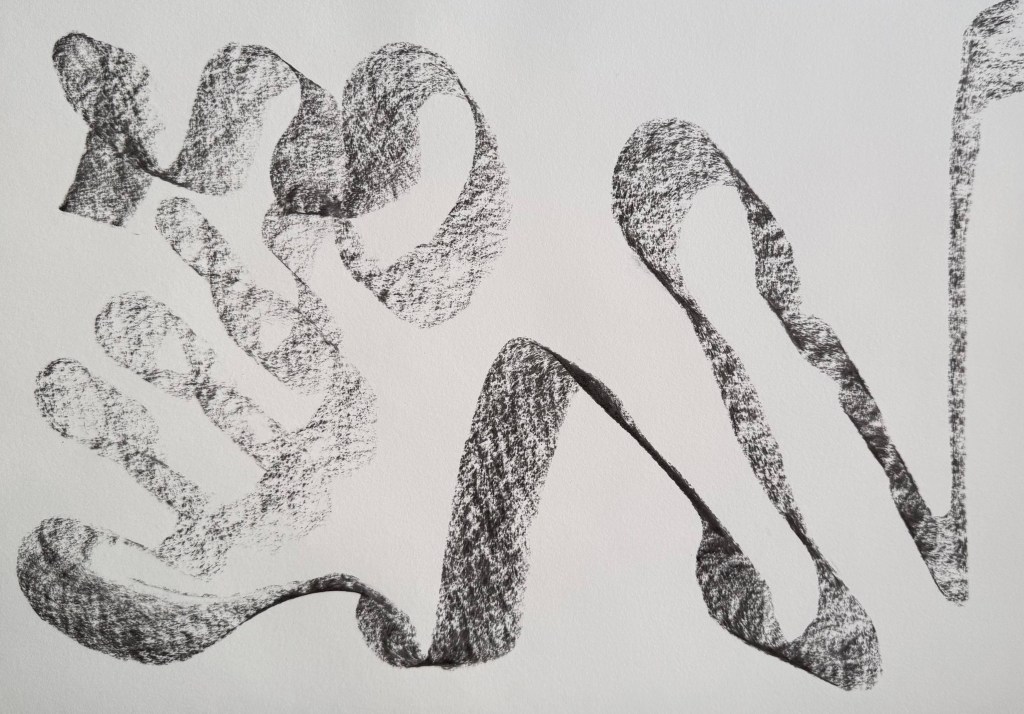
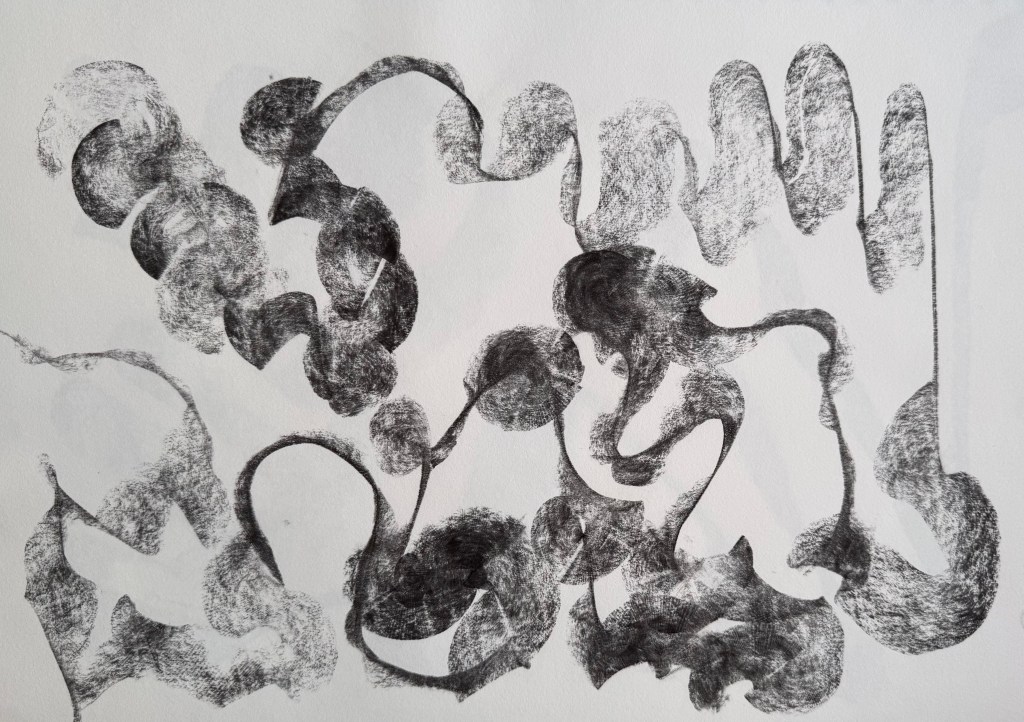
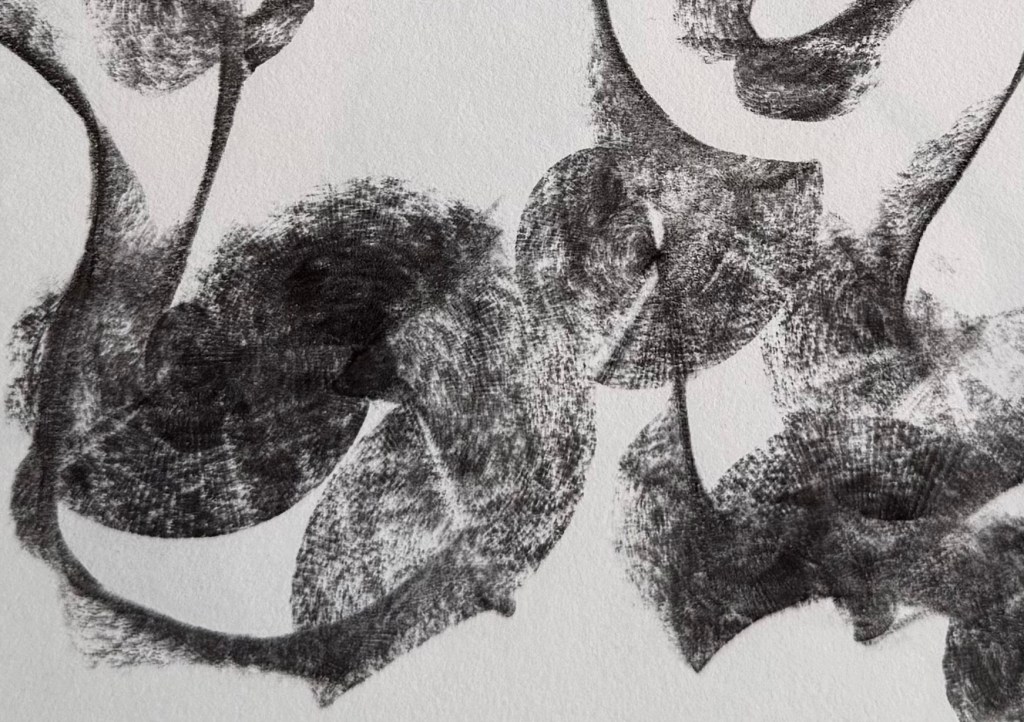
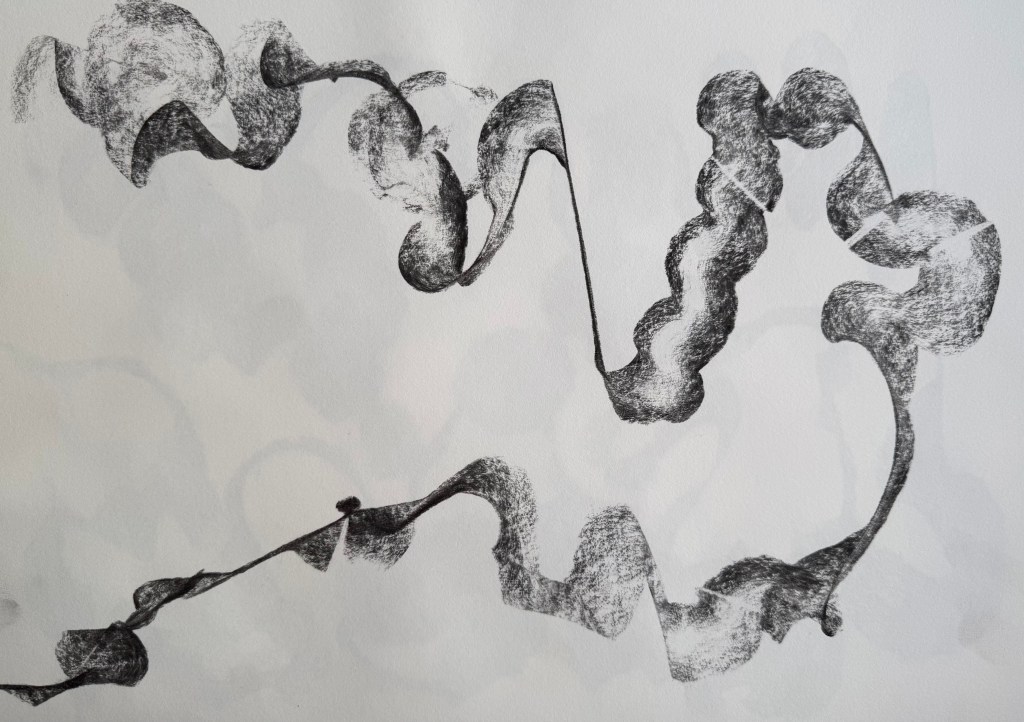
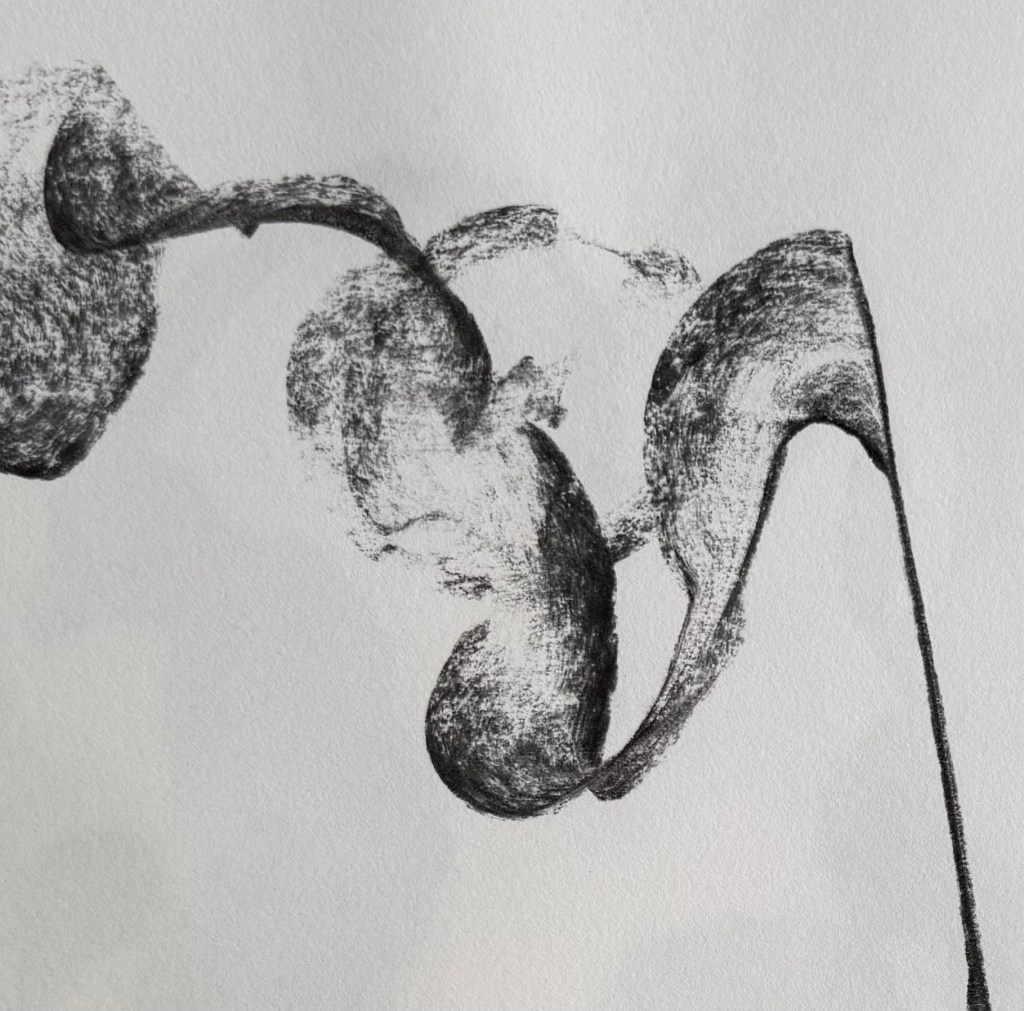
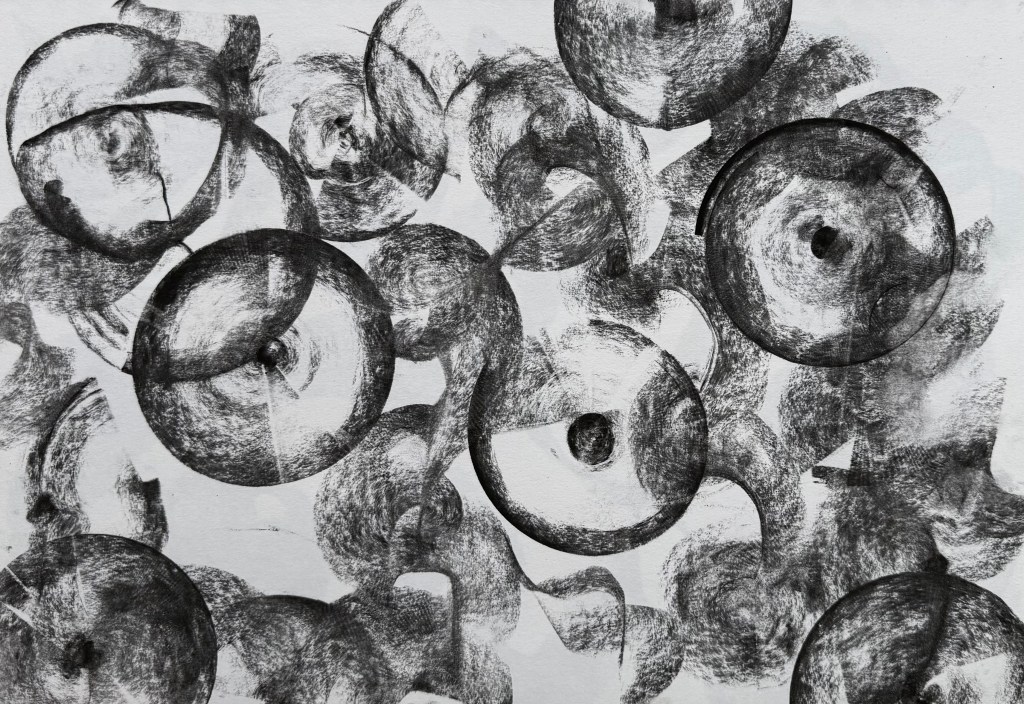
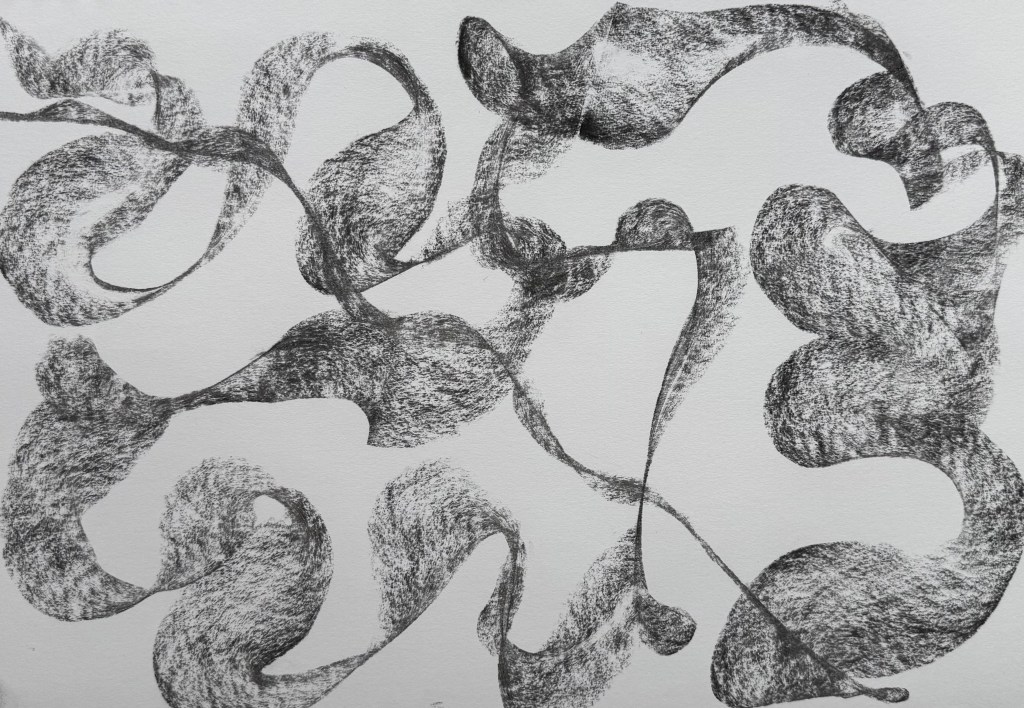
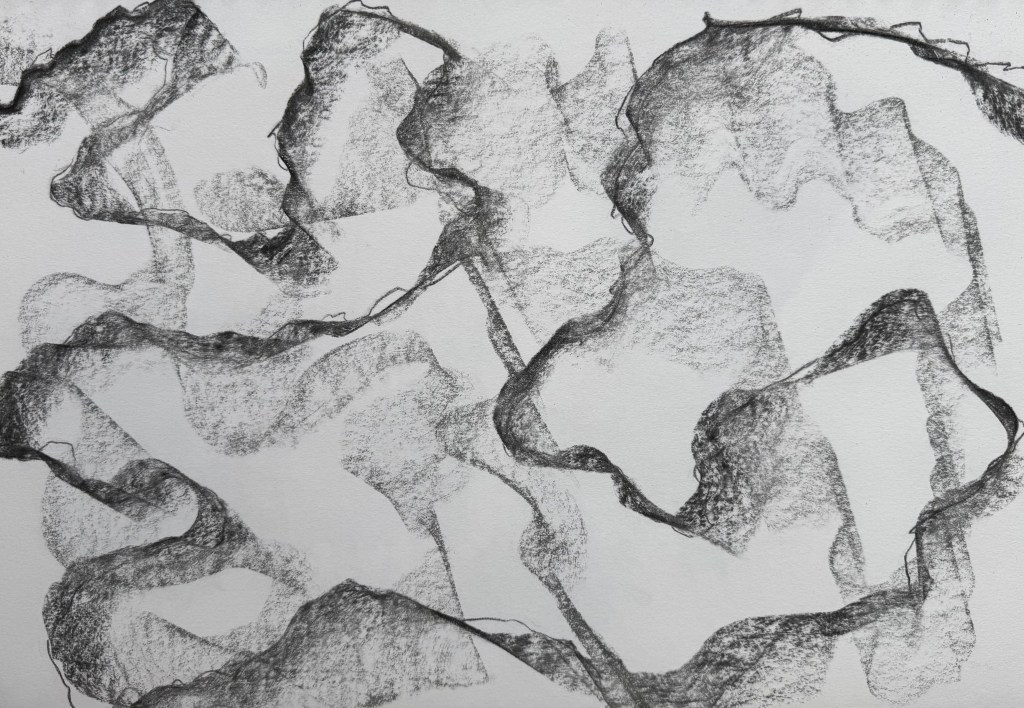
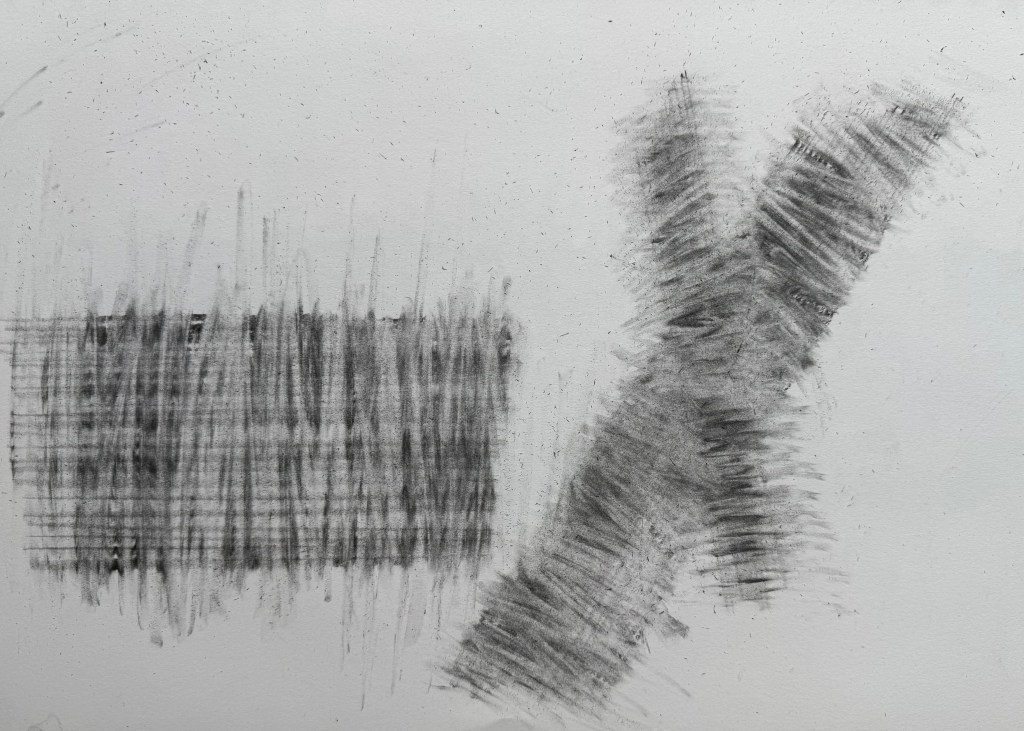
I really enjoy using the charcoal on its side, moving it up and down and rotating it on itself. I used a thick stick as well as a thin stick of willow charcoal. Because I was able to press down harder on the thicker stick I managed to achieve a greater range of tone.
The one above reminds me of coastal cliffs.
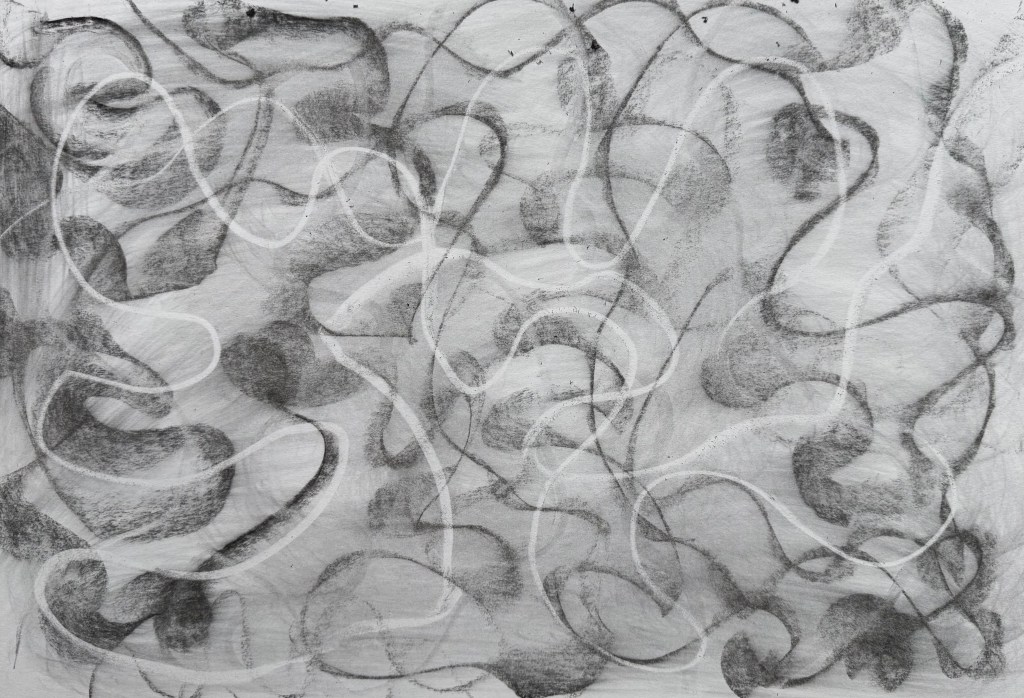
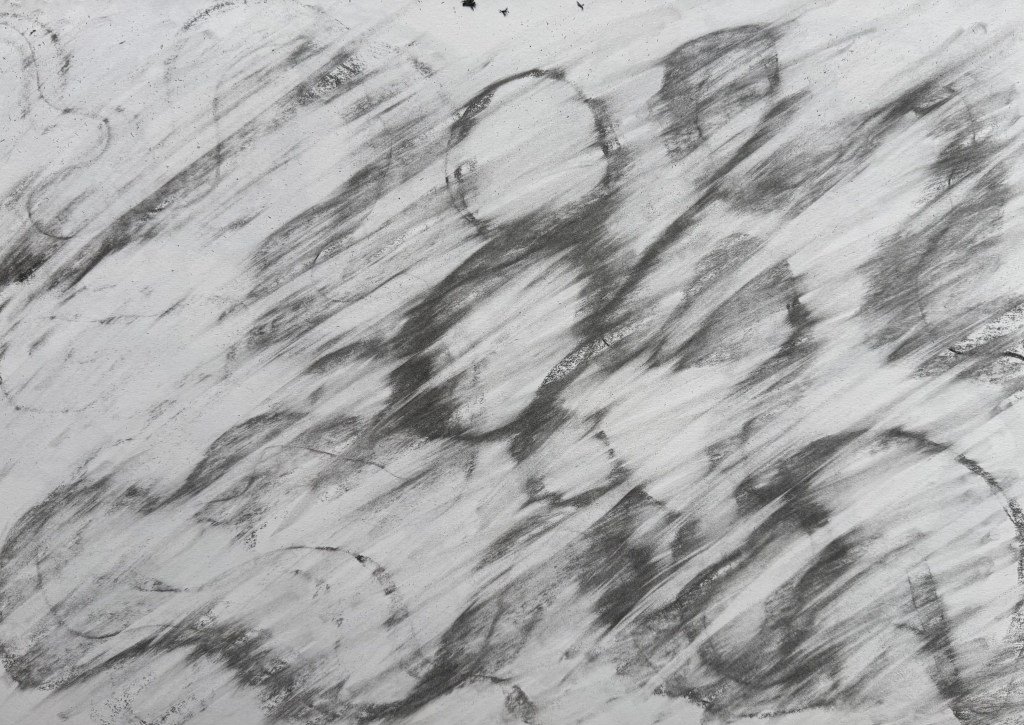
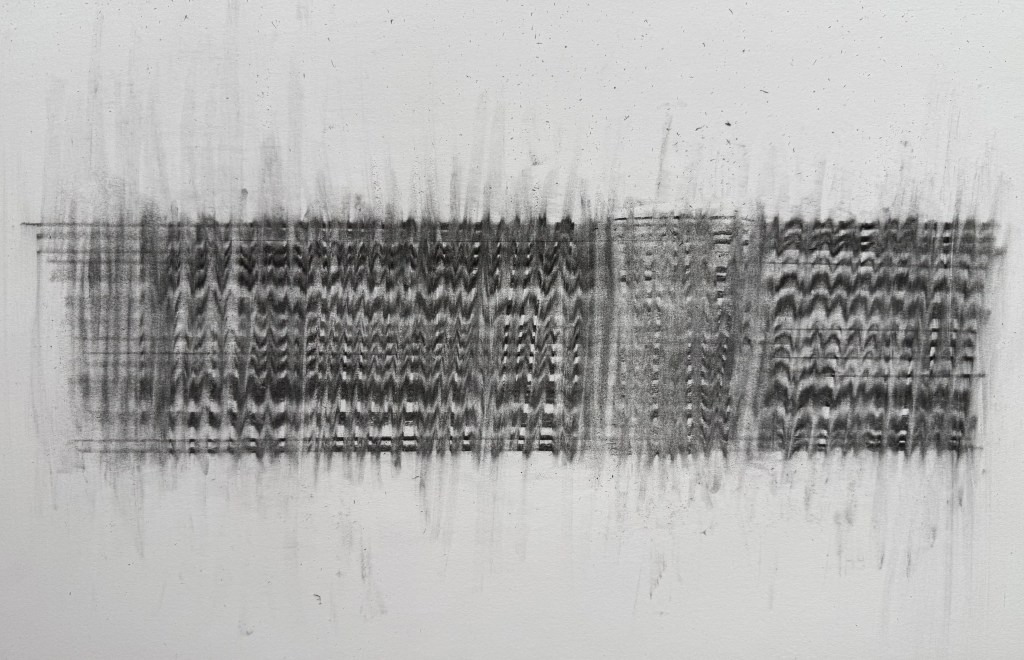
I then got the plastic eraser out.
I really like the one above. It feels really dynamic. I really like the effect of using the eraser perpendicularly to horizontal lines of varying thicknesses. Doing it alternately, reminds me of Bakewell tarts or Missoni.
Moving away from organic shapes for a moment, and developing the sense of overlapping circles in my husband’s outline, I decided to try something more geometric.
I also experimented with different combinations of broken and solid lines to create a different effect, and I left some areas blank. Overall I was really pleased with this. On reflection I think that’s it true to say there’s only been one out of all the images that I’ve produced that I’m not that keen on (at the end of this post), which is unusual for me.
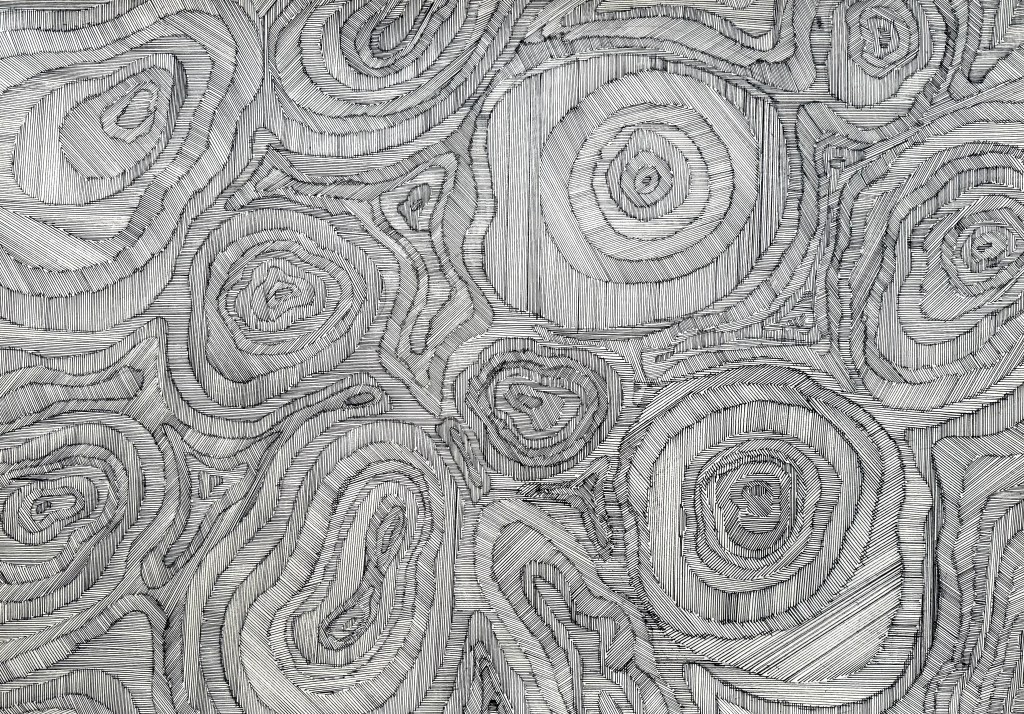
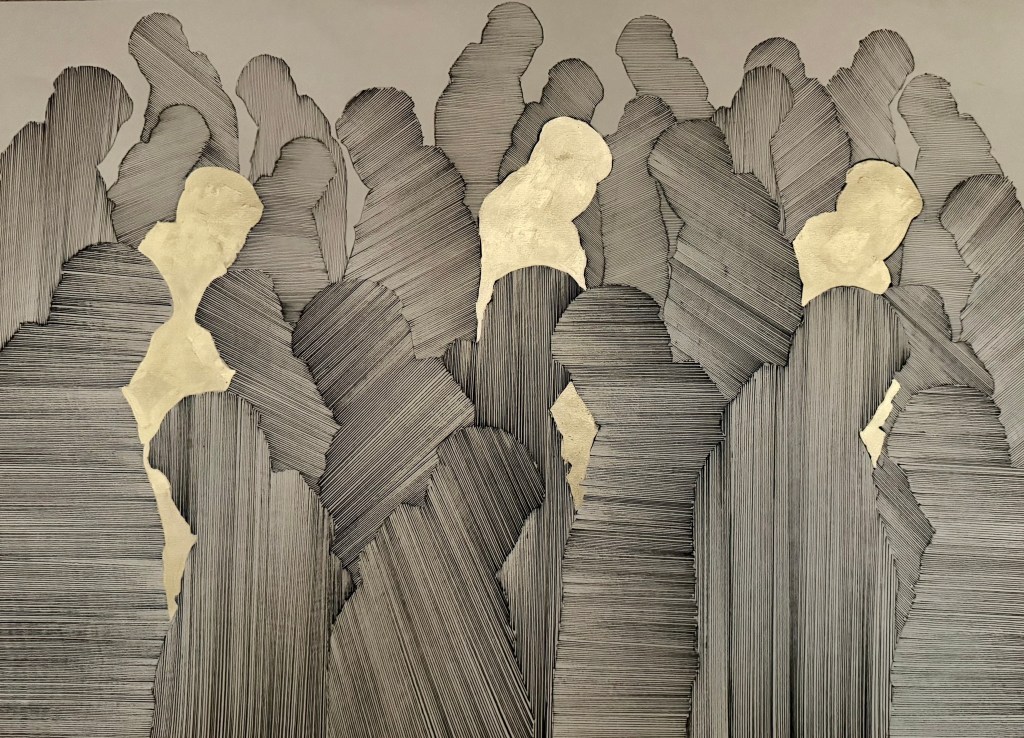
I wanted to try and move things forward so that it didn’t become a merely stylistic treatment – something decorative or a pattern. So, I applied it to some previous motifs – contours and figures.
I really like the effect created using the contour lines. Some parts feel almost three dimensional. My system of working was a bit more regimented this time – I used a variety of different pen widths, using the same width and drawing in the same direction for each of the separate contours. It creates something quite textural, almost woven.
At first I wasn’t quite sure about the figures – I didn’t think that it added very much. Also, originally the three figures were solid black and were very prominent, which I wasn’t sure about so I changed them to gold – I think it gives them more of an absent quality. The more I look at it, the more happy I am with it. I used the thickest pen (0.8mm) in the foreground down to 0.1 – 0.05mm on the figures in the background. The choice of direction was made in the moment.
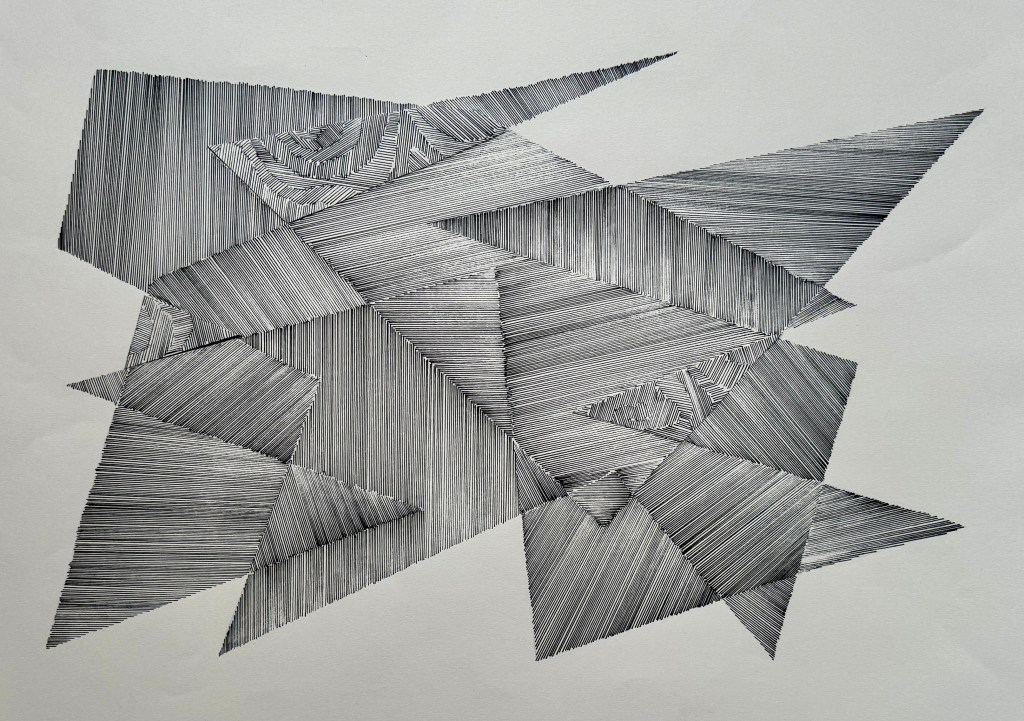
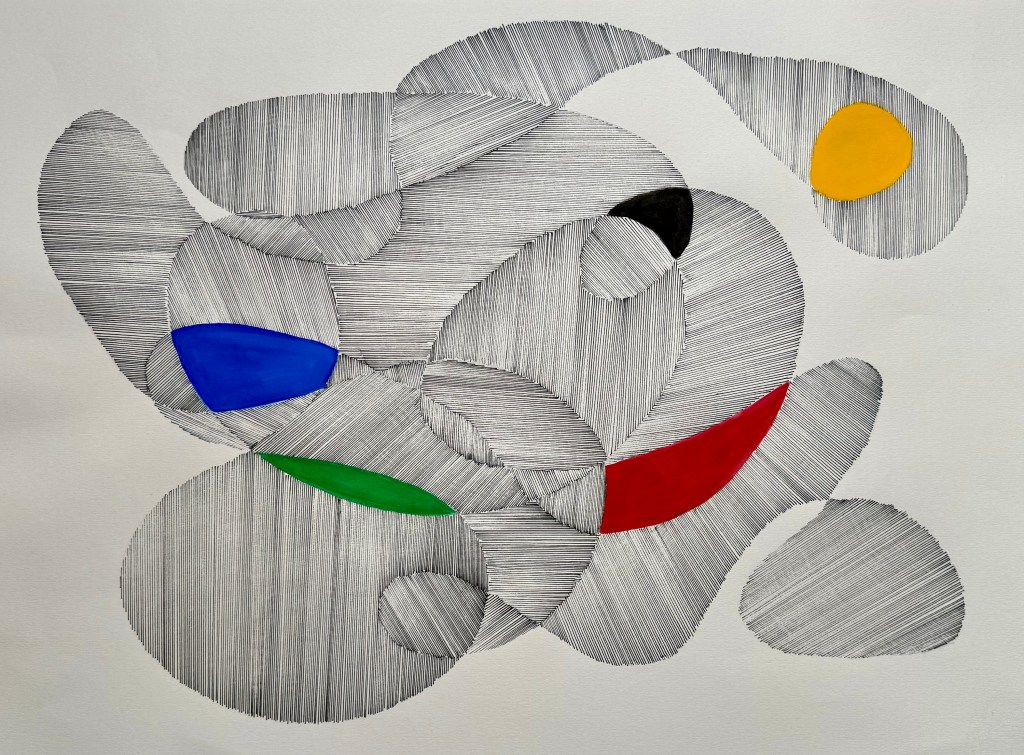
Next, I decided to try lines and I used the same pen throughout (0.8mm). I incorporated a collage element in some of the sections – cut outs from some contour work – which I think creates an effective contrast. There’s a strong sense of something having been folded, creating numerous different planes – almost like origami. The collages areas remind me of chipboard.
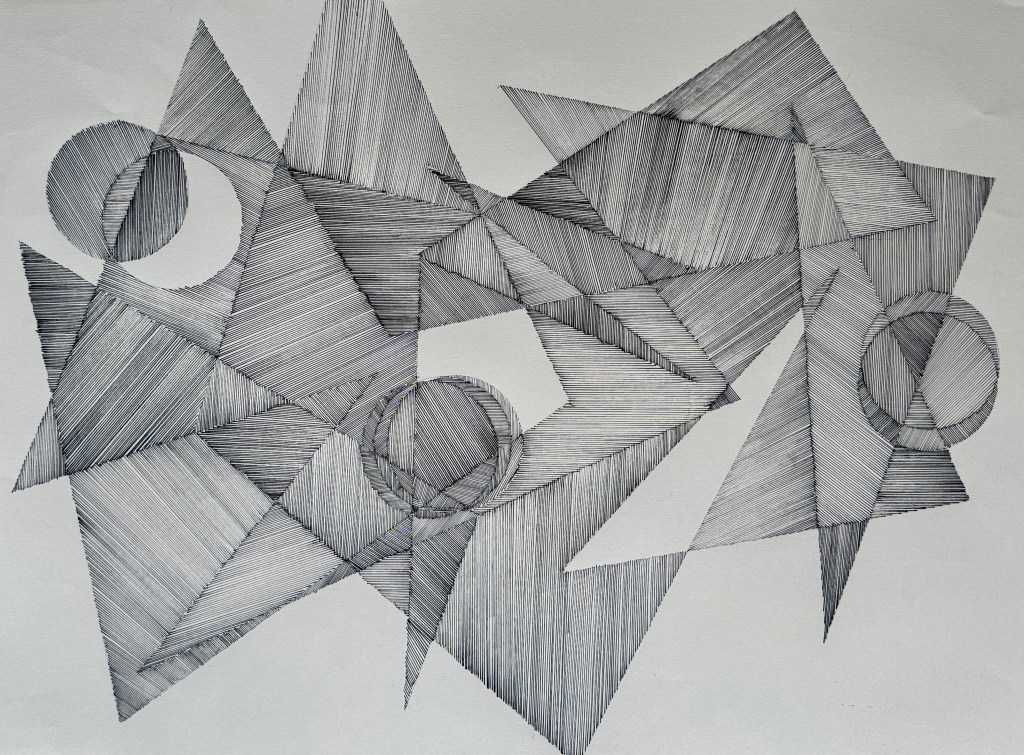
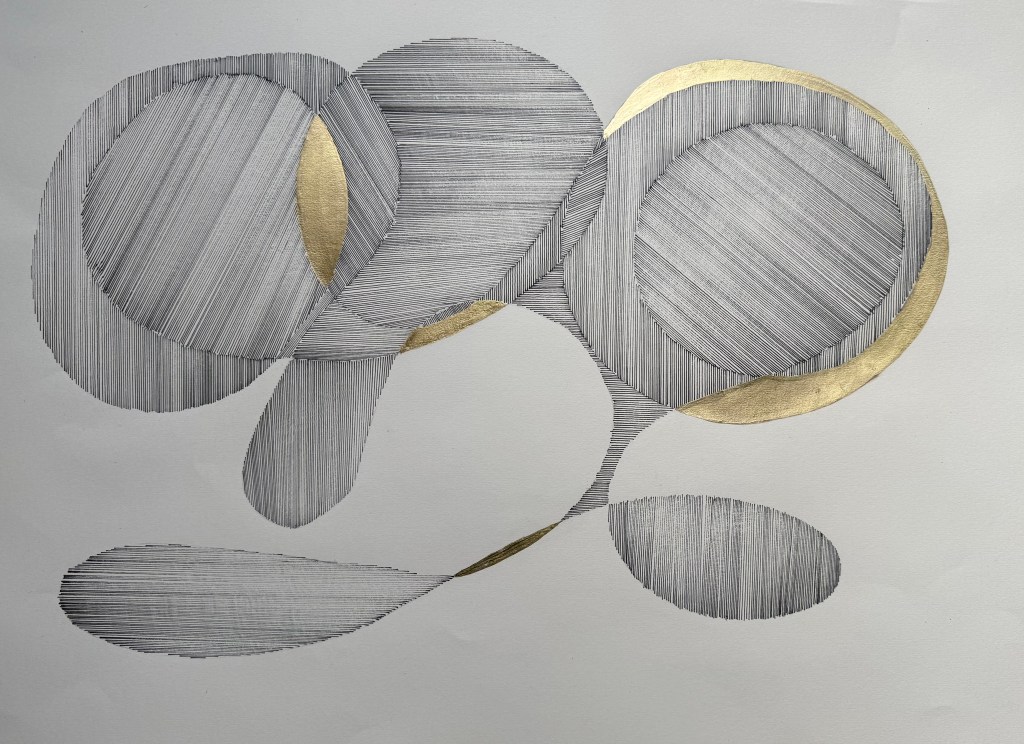
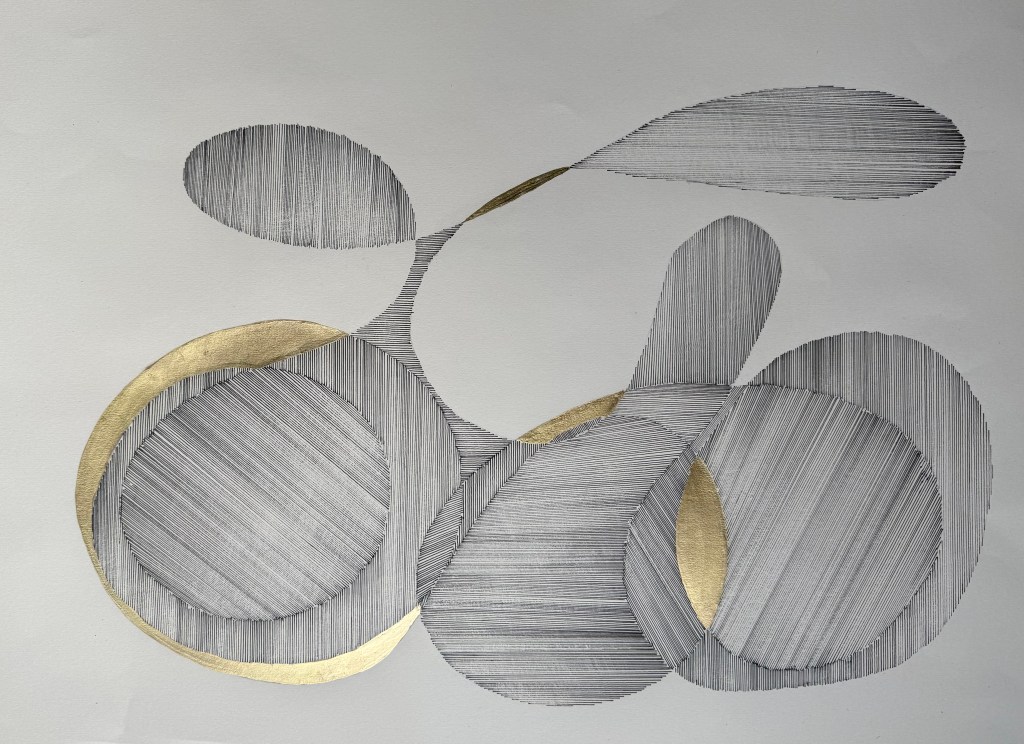
I then combined straight lines and circles using different widths of pens. I wanted to create something a bit more complex than the image above so I drew more lines and left some areas blank. I also made a conscious decision to go off the page. I think that the inclusion of circles and blank areas is effective but I think using different pens means that it doesn’t have as much presence as the image above – it’s more subtle – is that good? Is that bad? I’m not sure at the moment. I’ve been making these A2 images one after the other within quite a short space of time and I think that I need to give them some space, and come back to them in the cold light of day.
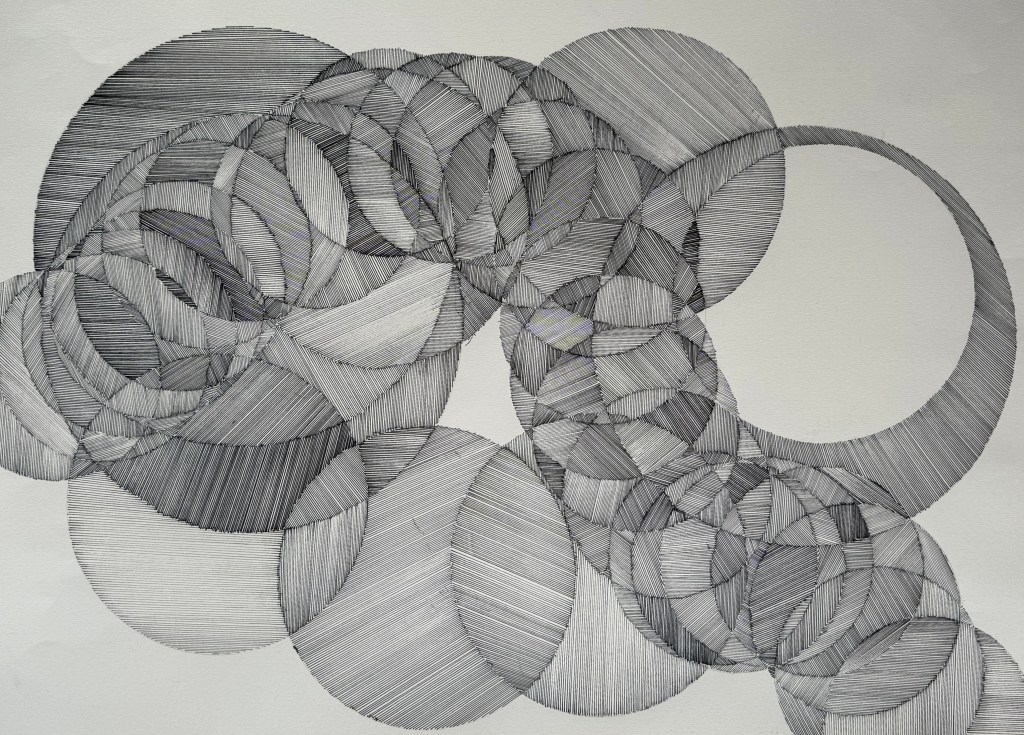
I wanted to experiment further with circles, but not in a uniform way.
Again, I used different pen widths and made a conscious decision to go off the page (which is the norm for me as I don’t like to be restricted – but here I am filling in shapes with nothing but lines…). Yet again, I’m pleased with it, and I particularly like the tumbling section – there’s a sense of movement. But I’m starting to think of parquet flooring for some reason.
I went back to the more organic form incorporating some more linear elements.
This time I used the same width of pen throughout but included some areas with broken lines as well as black gouache. I think this has caused it to be a more stylised image reminiscent of my original ‘doodles’. I think that I’ve gone backwards.
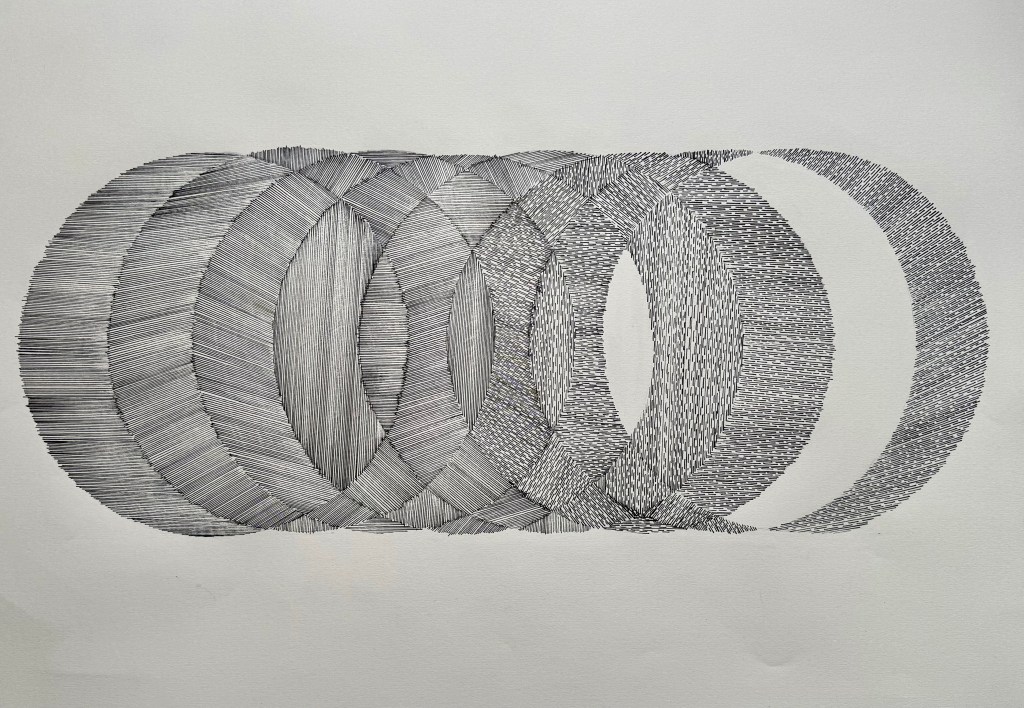
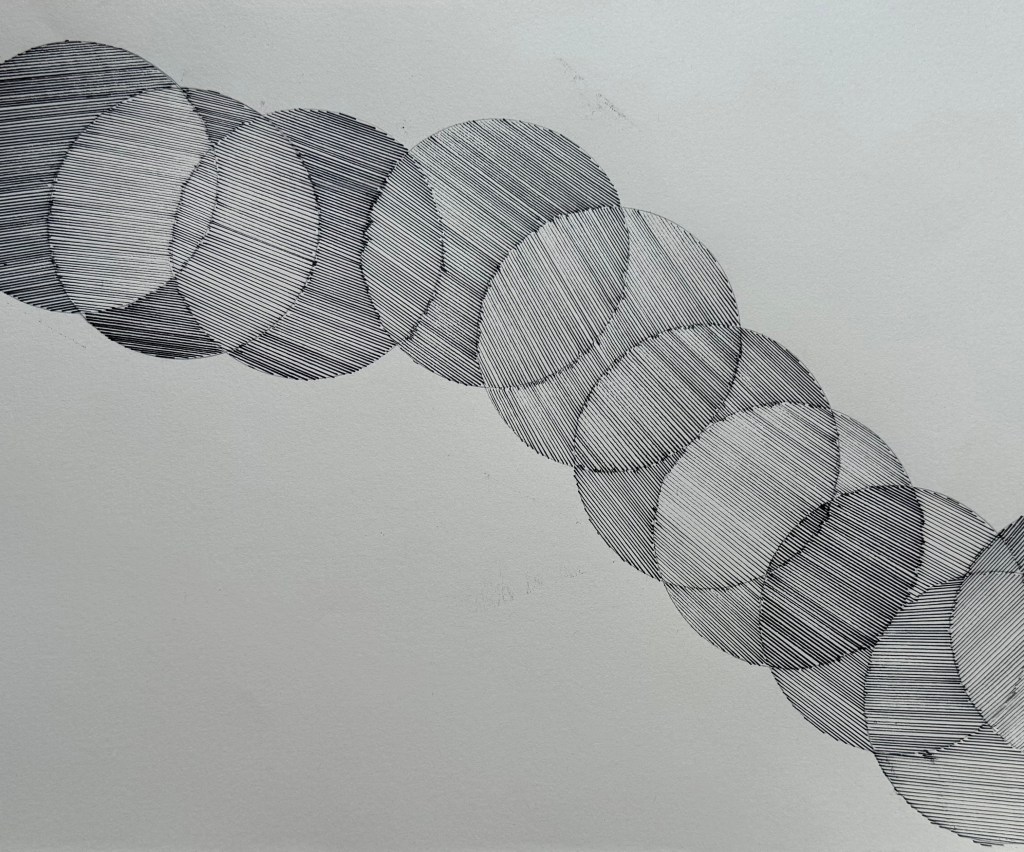
And then the wheels fell off, when I realised that I hadn’t thought about using different widths of pen, but keeping the lines in the same direction. I used a series of overlapping circles and filled in the sections within each circle in the same direction.
They might have a sense of movement but that’s about it. After making 11 A2 drawings in as many days, I’ve come to the end of the road, for now. Time to move on.
Moving forward I will further explore the giving up of control by enlisting some friends who don’t make art and someone I don’t know at all (how weird that relinquishing control is what we explored with Jo Boddy in this week’s session – I’m taking it as a sign). Otherwise I need to think about how I can progress what I have made so far. I’m thinking about layers, and perhaps cut outs revealing layers below. Stitching? Nails, pins and threads to map?
I’m generally quite a logical person, but I’m not always methodological. Often I’ll have an idea that I want to try out, and instead of following the steps which logically come before it, I launch straight in. Maybe I’m just not that interested in the preceding steps, or maybe I’m just impatient.
Anyway, armed with some Micron fine liners I decided that rather than start again where I left off last time, I would change a few things all at once. Sometimes in my art class we will do an exercise where we draw something and then pass our work onto the next person who then adds to or modifies it. I’m not keen on this exercise, in relinquishing control to someone else, of letting someone else be a part of my work.
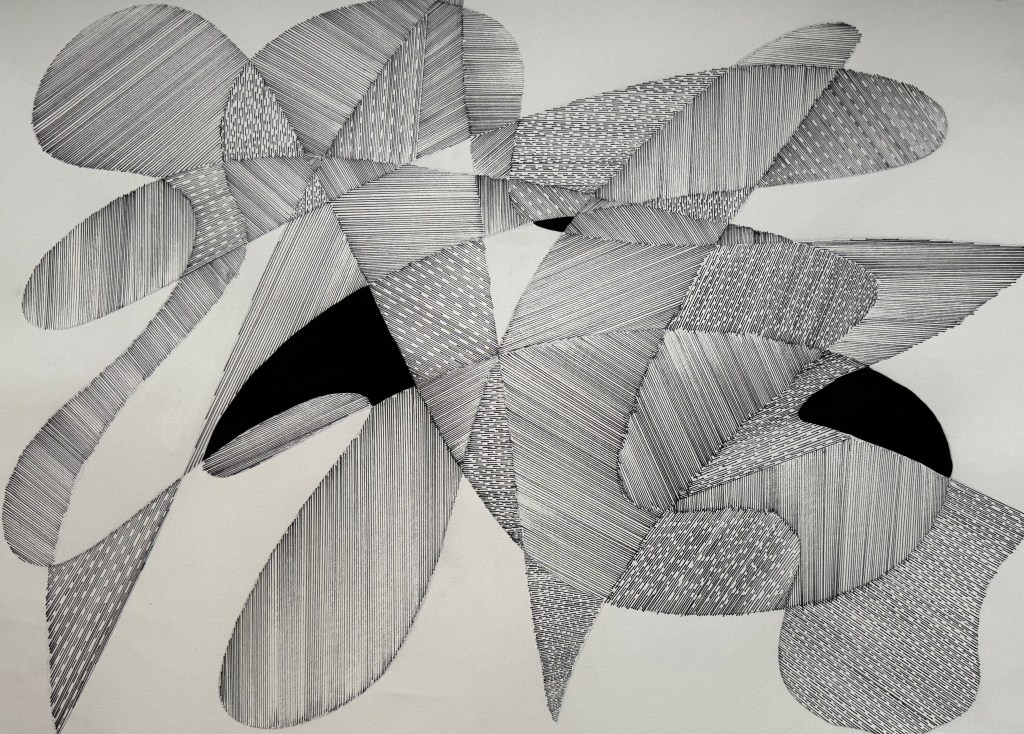
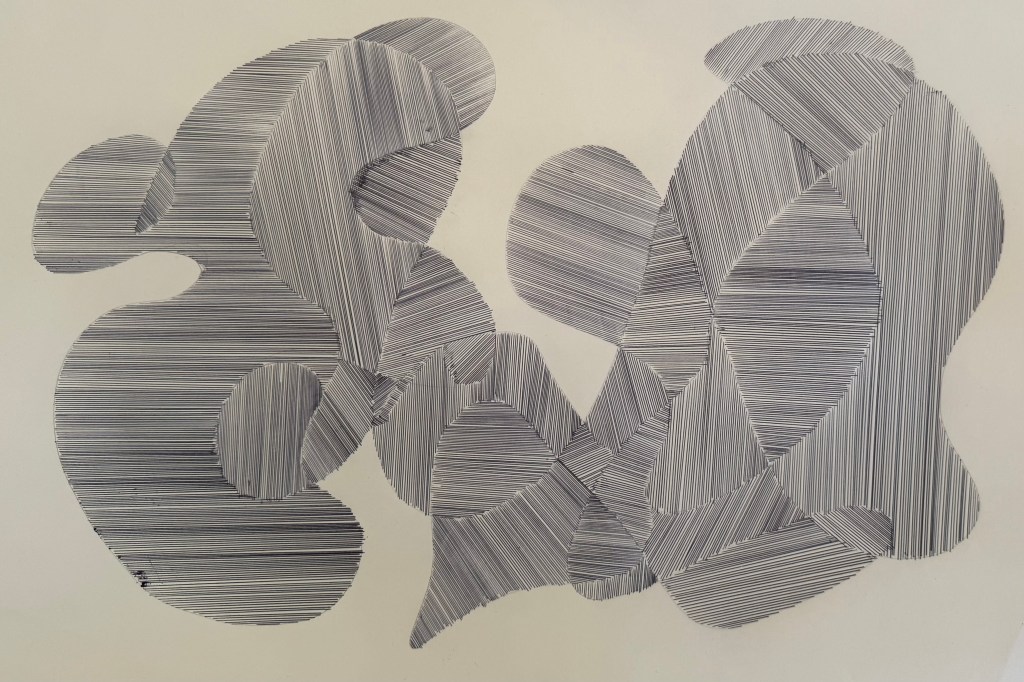
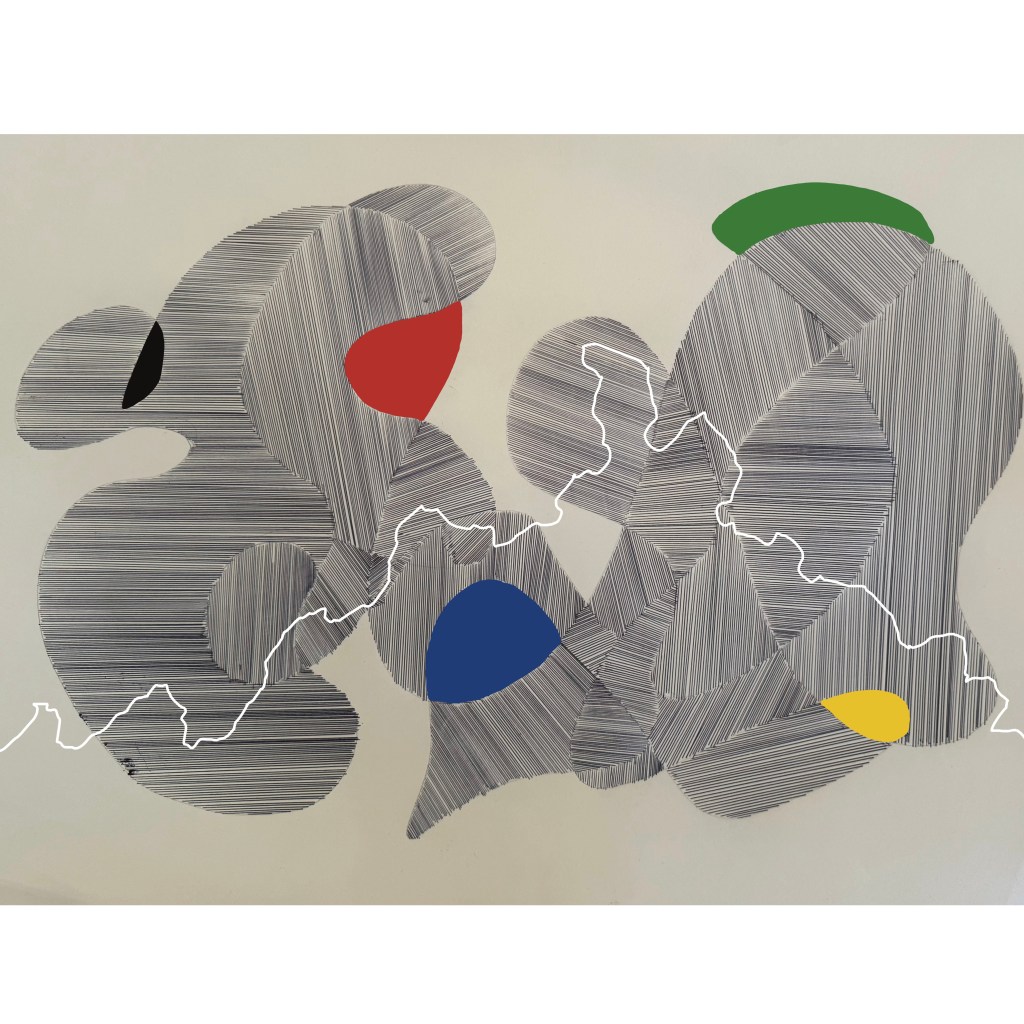
As drawing lines is a repetitive, controlled and focussed act, I decided that I wanted to shake it up a bit, to introduce an element of unpredictability. Whilst drawing a random outline is to all intents and purposes unpredictable, because I’ve done it so many times I suspected that I might have developed an unconscious pattern of movement, a comfortable way of doing it. So, I decided to ask my husband and daughter each to draw an outline to which I would then respond with a simple system of using the same width of pen and filling in each section with lines, ensuring the lines in adjacent sections are going in different directions. I also allowed myself the opportunity of leaving a few sections blank or treating them in a different way. I worked on A2 off white cartridge paper.
My husband’s:
This is the orientation it was drawn in and I prefer it this way as it gives it a feeling of instability, discord, of something melting. Anyway, the other way up it reads as a cyclist with a flat rear tyre.
My daughter’s:
The first thing that strikes me is the relevance of selfhood and the act of becoming. Becoming happens through entanglement with others and selfhood is shaped by those relationships, and the world around us. These images embody my relationship with the people who drew the outlines. I didn’t choose the outlines but I can choose how I respond to them, how I engage, how I attend to them. I transform the outlines with time and devotion much as I do in the relationships with my husband and daughter. They then respond to what I have done and all of us are changed by the process.
I really enjoyed making these images. The repetitive act of drawing the lines allowed me to switch off and to engage fully with the process rather than thinking about the result. I had no idea how they would turn out. The decision as to direction was made in the moment – it may not even have been a decision as such, just an intuitive adjustment of the angle of the ruler. I like that the mark-making is the subject of the images and consequently so is the process. The only active decision was which parts to leave out and how to deal with them. I love how the process is so evident – the times when the repetitive act and the sound of the pen on the paper made me lose focus and overshoot, how when I moved the ruler it left a spidery trail, how the areas where the lines cross form and edge which is at times irregular, creating a distortion, an interference, almost a vibration. Against the flat areas of colour the lines even appear to have a dynamism about them which I think is helped by the variation in tone – there are lighter areas where the pen is starting to dry up.
Whilst I was making them I felt content, as if two parts of myself were both being satisfied, balanced – the part which likes order and certainty and the other which likes the unpredictable and the unknown. There must be something about it which resonates with me because I subsequently went on to spend the following week experimenting with more images.
It would be interesting to see what the process is like involving people who aren’t experienced with making art to see how their outlines might differ in the sense that they might be less confident and their mark making more hesitant. Also, what about strangers? How might I feel responding to outlines which have not been made by people that I know?
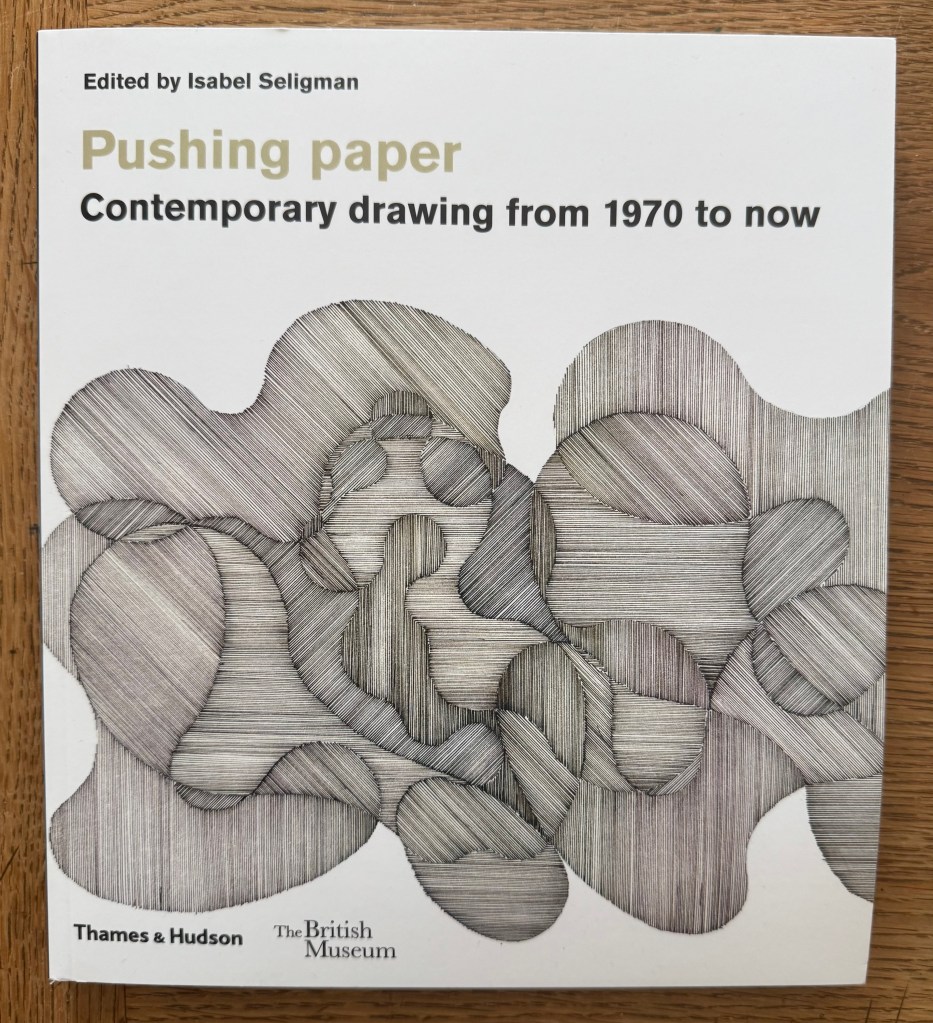
I bought ‘Pushing Paper’ in the hope that I would find its contents enlightening, but primarily because I felt drawn to the cover. The image is ‘Some Interference’ (2006) by Richard Deacon, which he made during his residency at the Oxford Centre for the Study of Gene Function. According to the book, Deacon was initially trying to represent multiple surfaces on a flat plane – the paper splitting into interconnected layers. As things developed, he realised that what he was drawing was difficult to clarify.
Something about it really appeals to me. It reminds me of the doodle type drawings I’ve been doing (On Your Marks… & Lines). Aside from Etch-A-Sketch and Spirograph, this process entertained me for hours as a child. I would draw a random enclosed shape with overlapping lines which created segments to be coloured in. It takes me right back to my childhood. Maybe that’s why I’m drawn to it. Maybe it’s because it embodies its simple process as well as having a temporal dimension – the act of drawing each individual straight line. I like the darker line which is formed around the edges of the shapes where the lines have crossed.
Well, whatever the reason, I picked up the nearest pen, a leaky biro, and had a go.
It was a very satisying exercise, despite the blobs and smears. The ‘me’ at the beginning of this course would have discarded it. Instead, the blobs and smears are all part of the process, caused by the movement of the ruler and my hand, a moment hesitating too long in one spot. Nevertheless, I’d like to repeat the exercise with a proper pen, maybe a variety of pens of different thicknesses. In the meantime, I experimented in Procreate.
The idea of layering has always been in the background. It could be in the form of separate physical layers or the layering of media, or the remediation of images. I wanted to explore layering the moving image over the static image. I have to confess to adopting Lyberis’s approach of the monotone audio on his 3-minute video. To me, it’s the sound of silence, the sound that sometimes keeps me awake at night when I’m convinced someone’s running a car engine nearby or there’s an extractor fan which has been left on. It’s not quite right at the moment and it needs some more work, but I’m quite pleased with it so far.
I felt a connection with this week’s visiting artist, Johanna Love. She remediates photographs and videos of car journeys.
I often make videos of car journeys, recreating those of my childhood when I sat in the back seat watching the passing landscape. My latest one was In A Flash.
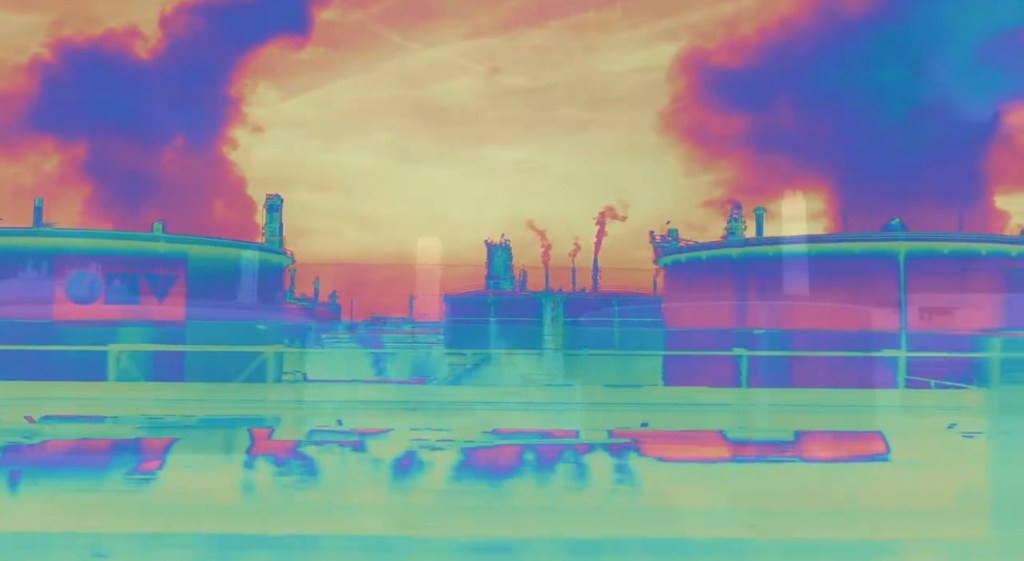
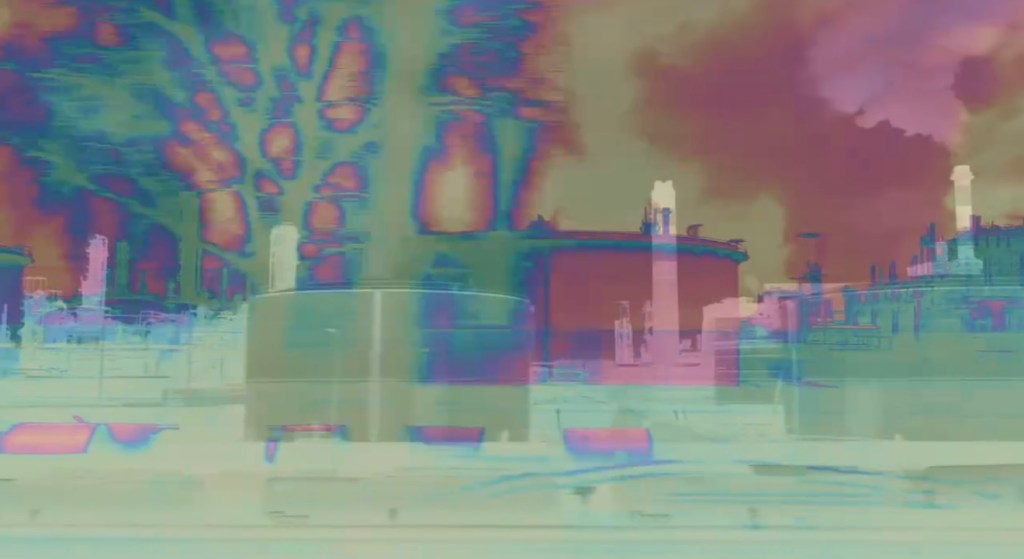
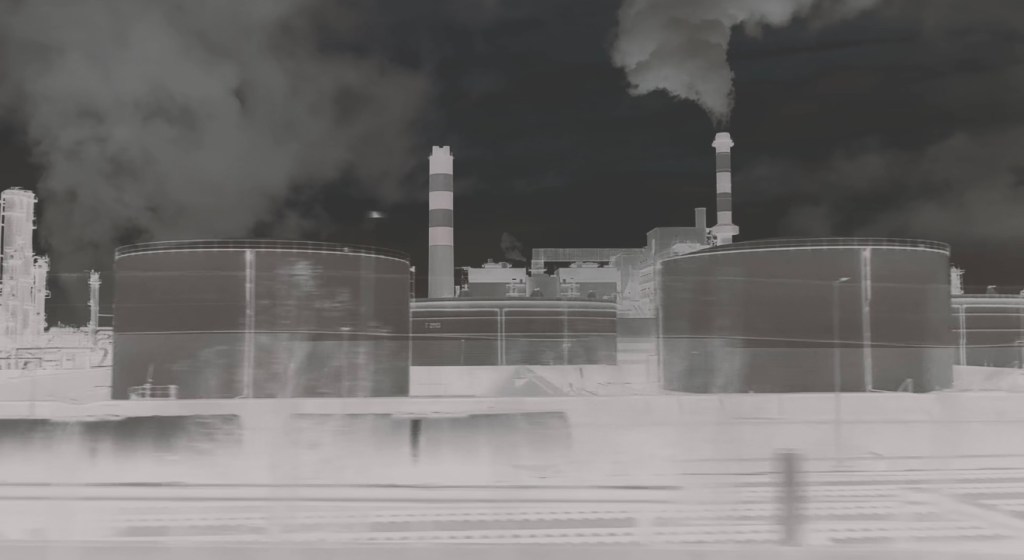
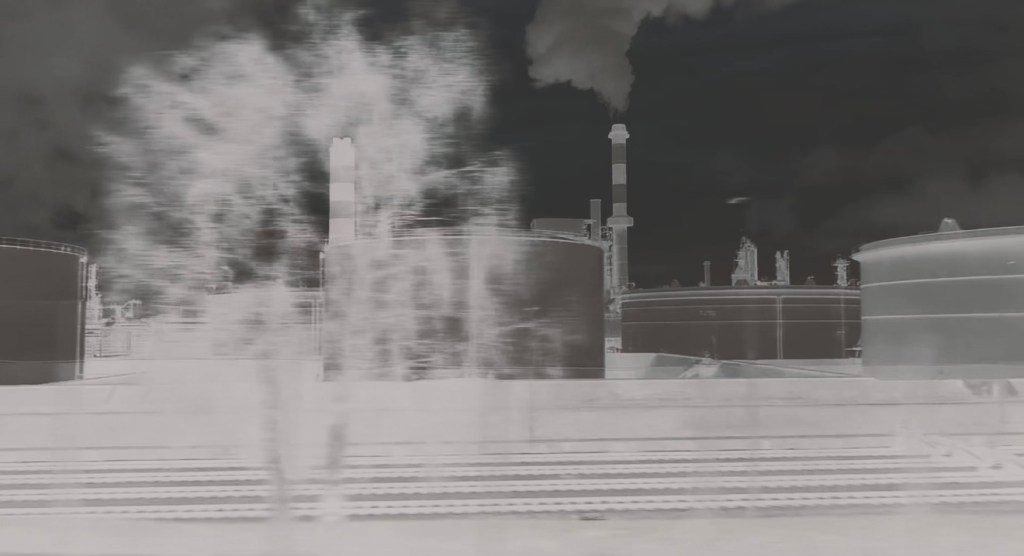
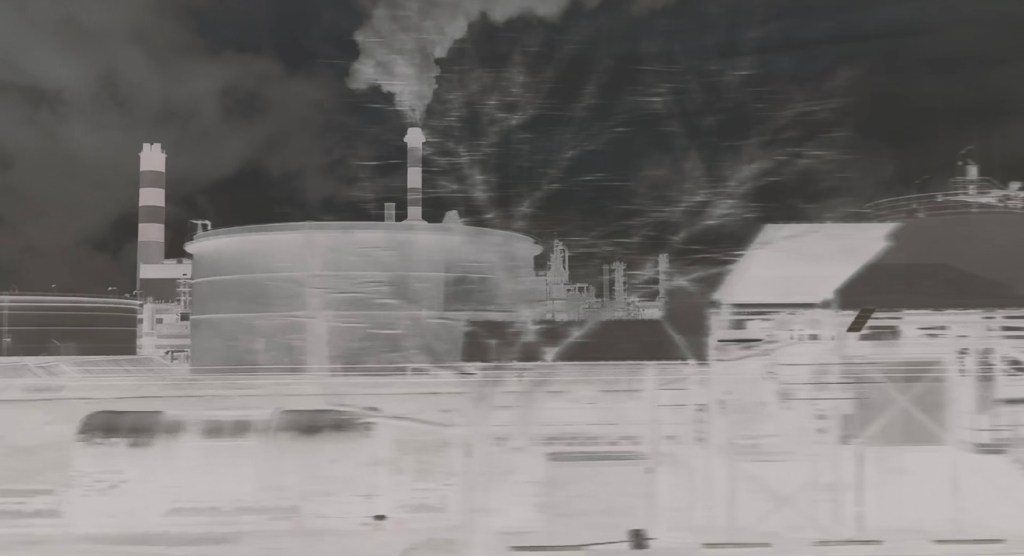
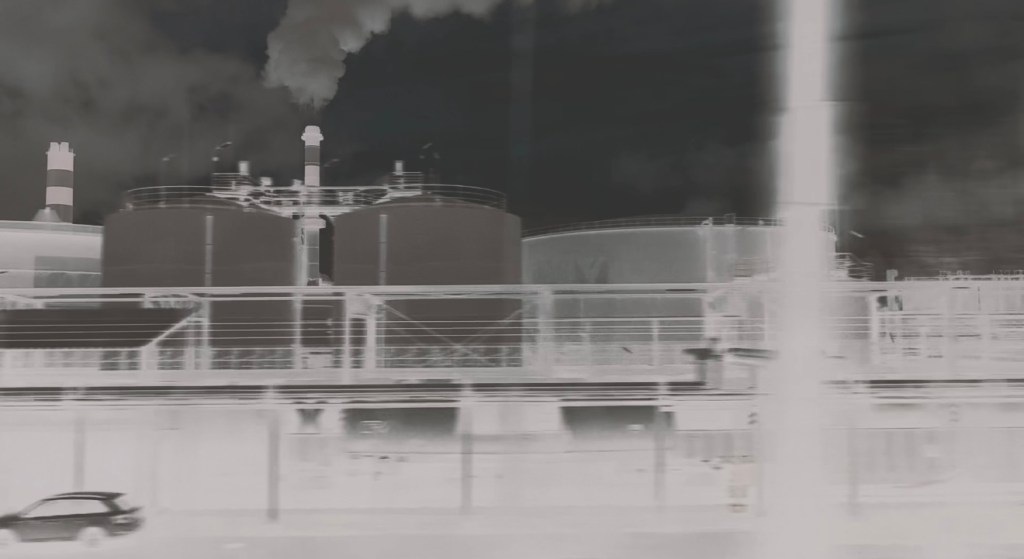
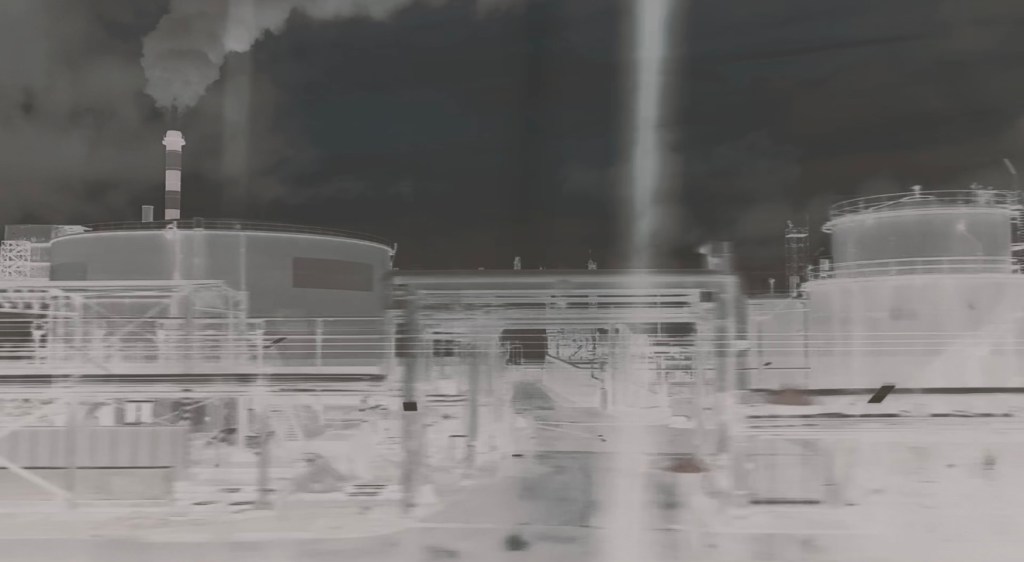
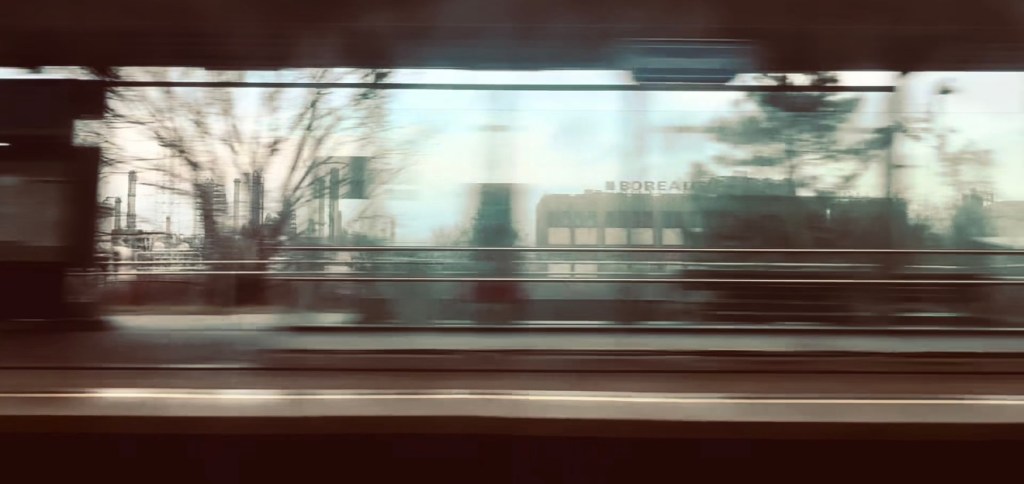
The year before last, on the taxi ride from the airport to the centre of Vienna, the flat landscape gradually gave way to a looming mass of industrial buildings belching gases into the atmosphere: the scene took my breath away – it felt so out of place, intimidating, shocking. The area is called Schwechat, and is home to one of Europe’s largest inland refineries owned by OMV. In Spring last year it began producing green hydrogen, currently at a rate of up to 1,500 metric tonnes per year making an annual saving in CO2 emissions of 15,000 metric tonnes. I was back in Vienna a couple of months ago and I managed to video it from the City Airport Train.
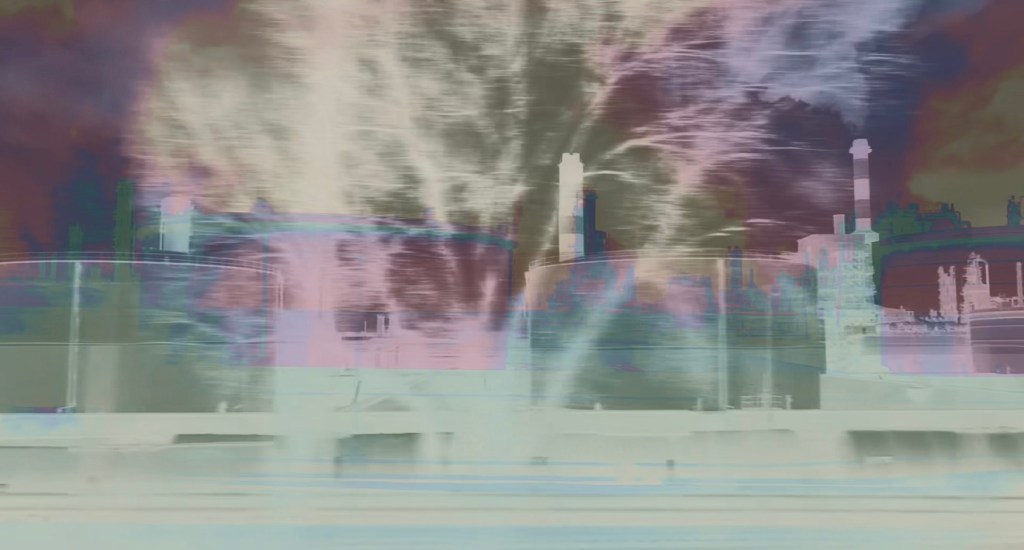
I applied a neon filter to the first section to reflect my initial reaction of disbelief, slowly moving through monotone to reality. I particularly like the moments of transition, the overlay and monotone effect on the trees and the chimney stacks. Screenshots reveal moments when the image is neither one thing or another; moments of transience and liminality.
I’m intrigued by those moments. They inherently represent change, the process and becoming: they are what was once, what is now and what is to become. Becoming is fundamentally a state of liminality.
The process of making the 3 minute video was interesting. I don’t like listening to myself. It sounds different to how I hear myself in my head. As we’re going to have to make another video in the near future – this time 5 minutes’ worth – I think I need to get over it.
So, here’s my first video post. I’m, not sure why, but the YouTube embed isn’t working for me at the moment.
So, we’ve received our feedback and grade for Unit 2.
The feedback, the most important bit, is incredibly helpful, and has lots of questions for me to continue to think about. Once I’ve finished ruminating, I will discuss it in more detail. In general terms it mirrored my feelings that I have made significant progress over the past few months. I think this was the reason why I felt the way I did when I saw that I had been given the same grade as for Unit 1. I felt disappointed. I told myself that the grade itself doesn’t matter; what matters is the process, not the result. I should be happy with the knowledge that I have made progress, and developed within the process. That is, after all, my mantra: I choose the process, not the result.
So why is there still a part of me that cares about the grade? I spent quite a while talking to myself, trying to resolve it, and in the end the answer I reached is this: whilst I am all about the process, it does not mean that the result does not matter at all, it is just that I care more about the process.
Since Ambivalence, I have reflected further, and I think that it is either a case of wanting the product to reflect the process (which I didn’t think the grade did), or that there will always be a part of me that is invested in the product; I just need to learn to live with it and allow it to be heard, but not to dominate as it has done in the past.
And so, I listened to it, and asked what else I could have done. A typo. All’s well that ends well.
Is it an undesirable trait because it displays a lack of consistency and predictability? Does it make me an unknown quantity, fickle, unreliable, or even hypocritical? And specifically, in terms of the art world, how does this relate to the need to establish a defined and consistent style for commercial success and gallery representation, in creating a brand? I asked Perplexity AI what it thought.
In a nutshell, it’s not the paradox which is the issue but being unable to accept it. Embracing paradox is linked with greater creativity, psychological growth and is a realistic way of understanding selfhood in a complex world. It is the basis of dialectical thinking: two truths which seem to conflict but which both accurately describe you or your situation e.g. being independent but needing connection.
According to Kierkegaard, the self is essentially a tension between different poles and the process of becoming is learning to live with the contradiction rather than to abolish it. In fact, problems arise when the paradox turns into a chronic self-contradiction that seems unresolvable, which is often tied to perfectionism or all-or-nothing thinking. It creates a state of ambivalence. As long as I genuinely value and am honest about my paradoxical nature, then I am not a hypocrite or lacking in integrity. I need to accept both parts of myself and embrace the tension the paradox creates; to ‘develop the container large enough to hold it’.
In terms of the art world, whilst a paradoxical nature is an asset for making art, it is not for selling it. It does not fulfil the desire for consistency, recognition and stability. So, what is the answer?
Distinguish between practice (paradox) and brand (the curated external interface). Curate consistently eg strategise the release of work; lead with one voice whilst nurturing the other.
Be like Gerhard Richter, developing separate and opposing lines of enquiry which never merge – be distinctly one thing, then the other, do not mix them and become a muddy average.
Have a consistent conceptual narrative – make the paradox the subject matter itself
The Trojan Horse is an extension of the first bullet point: pick a lane and develop it and once you have a foothold introduce the other, pivoting under the guise of evolution.
Most importantly, don’t suppress the shadow side, and keep feeding it.
That all makes sense. So, how do I feel about it all now? A bit better, I think…
 Kate McCalmont-Woods