Couldn’t resist, on the way to the recycling bin with an old loo roll.
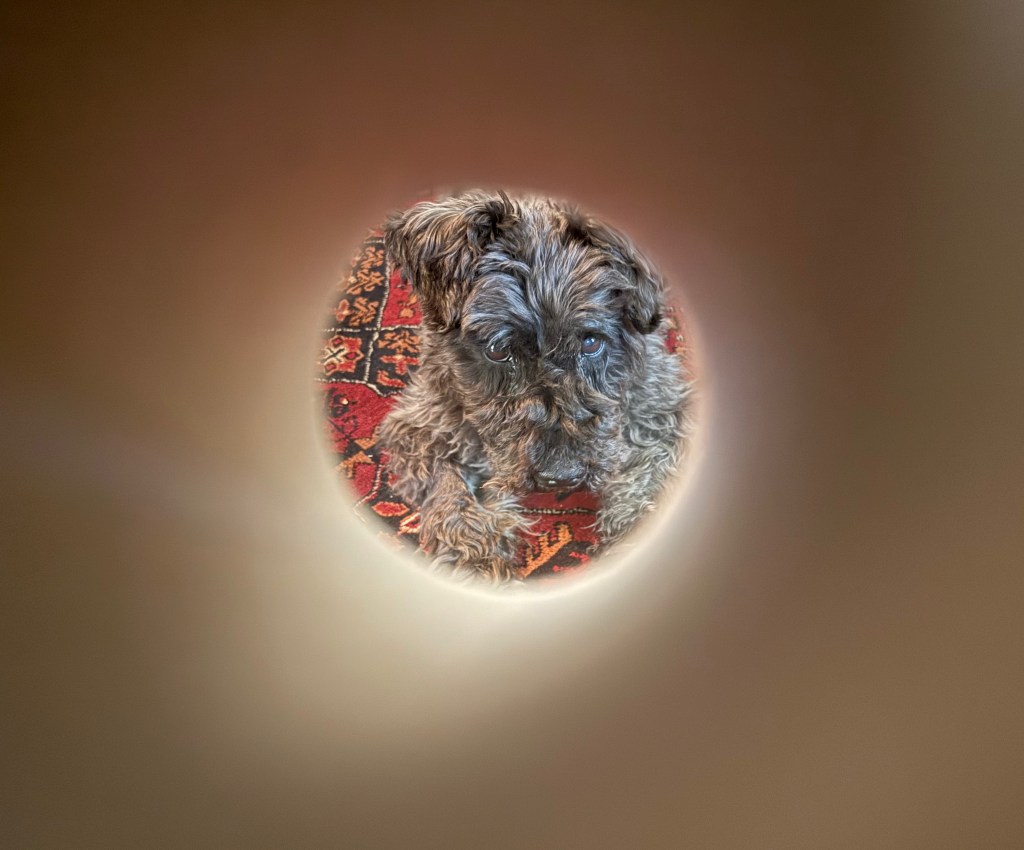

Couldn’t resist, on the way to the recycling bin with an old loo roll.
I’ve been looking back at some of my previous posts to try and assimilate my thoughts and ideas.
In this week’s session we considered an excerpt from Art & Fear by Bayles & Orland. We discussed the gap: “…Making art provides uncomfortably accurate feedback about the gap that inevitably exists between what you intended to do, and what you did…”
My earlier post,Making A Sound, referenced a comment made by Maggi Hambling:
”…there wouldn’t be much point in painting a picture that it was possible to paint…”
So, we shouldn’t mind the gap. If there is no gap, we are not pushing ourselves or allowing exploration in our work.
Art & Fear also threw up another corker. It’s from Stephen De Staebler:
“Artists don’t get down to work until the pain of working is exceeded by the pain of not working.”
Almost there!…
Well, it was either that, or For Richter, For Poorer…
I couldn’t quite work out why, during the Low Res, I arrived at CSM each day feeling increasingly out of sorts. And then it struck me. As I came up through Kings Cross underground station from the Piccadilly Line, I walked through a tunnel with music playing in the background. The music was Vivaldi’s Spring 1 by Max Richter and this is where I’d heard it before.
It’s amazing how music can alter your mood or take you back in time. The other day, I heard Queen and David Bowie’s Under Pressure playing in the background somewhere, and I was immediately a teenager in my bedroom on a Sunday evening listening to the chart show on the radio, trying to tape my favourite songs whilst doing my homework, which I had left until the last minute, as always. It made me feel that Sunday feeling again.
Another Richter, this time Gerhard, was the subject of the book I selected in the CSM library during our small group visual exercise.
In my wanderings I first came across this book and was intrigued.

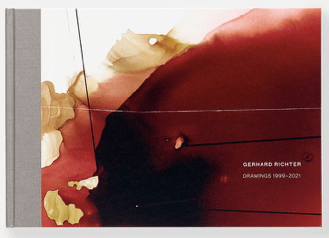
I had decided to pick the second book along from the first artist I recognised beginning with ‘E’. I was drawn to the spine, but put it back, abandoned my plan and walked on into the ‘R’s. I like Richter’s blurred images, but this book – and would you believe it, I forgot to take a photo of it – includes recent drawings and photographs with lacquer.
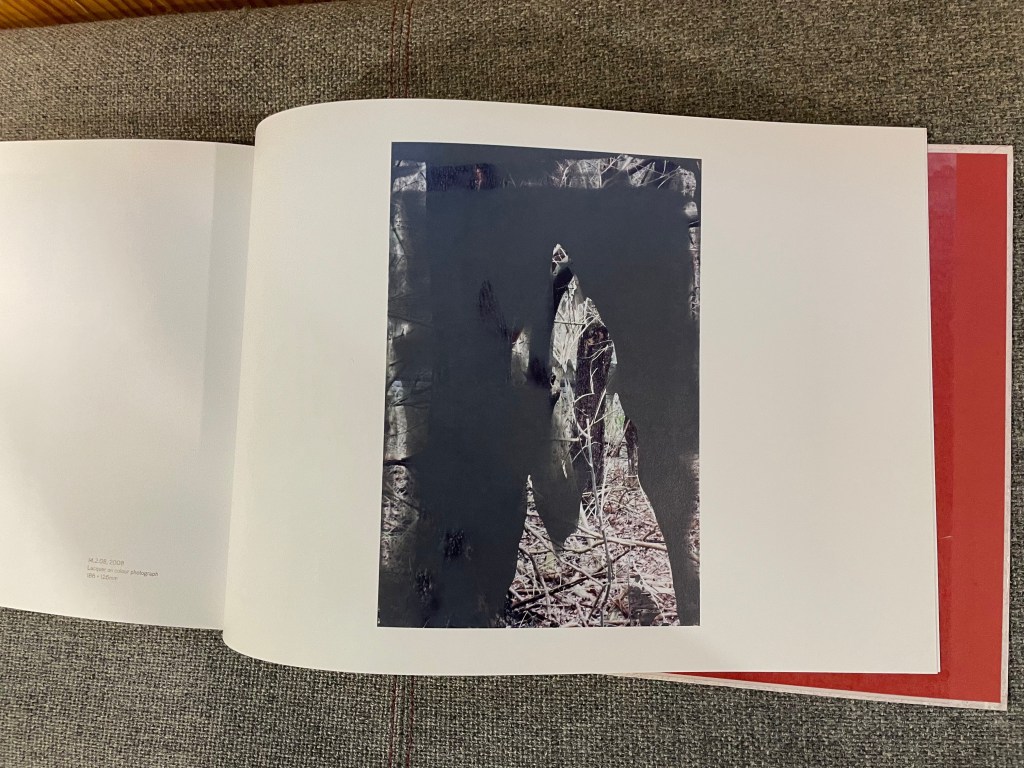
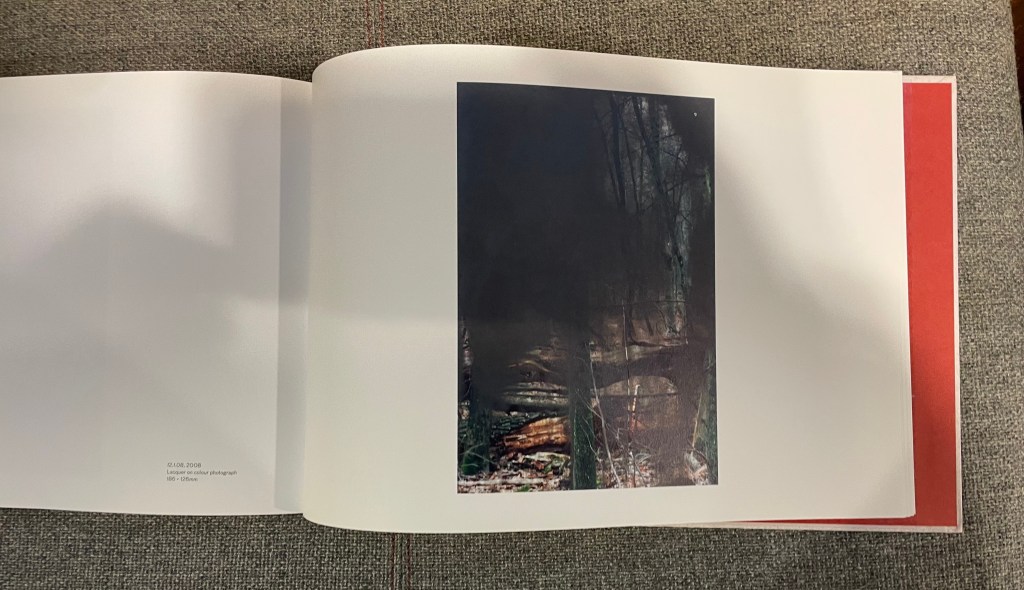
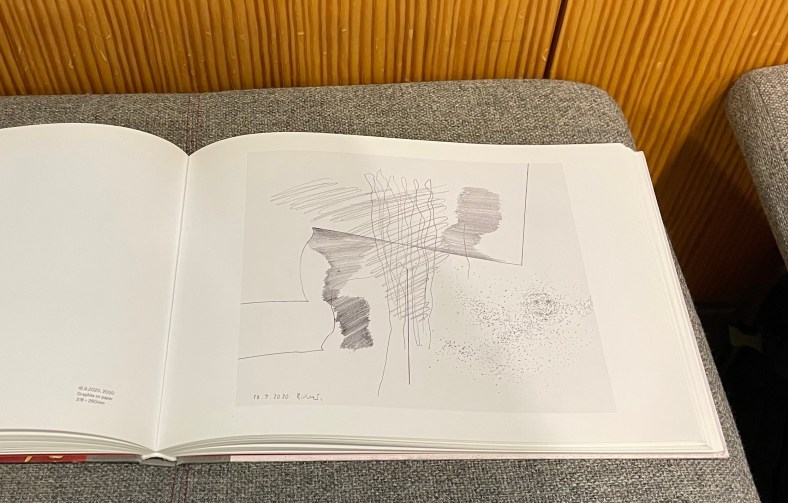
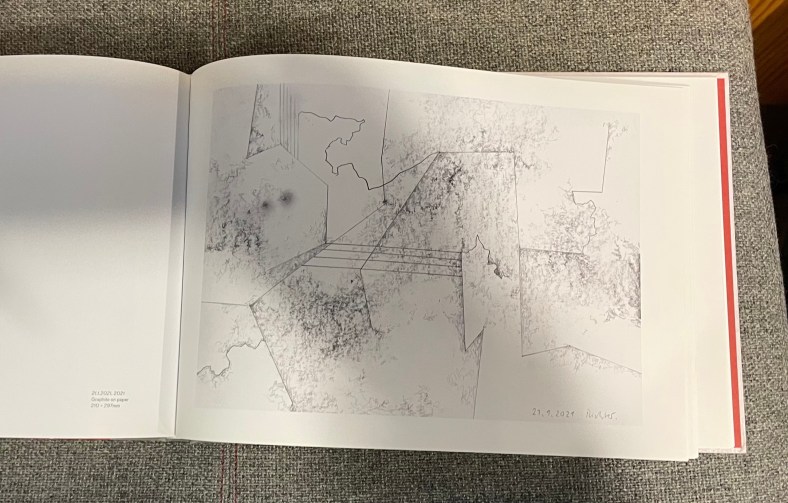
I particularly like the last drawing which includes what looks like frottage to create texture. They are less than A4 in size, in stark contrast to his huge canvasses of colour.
Having just done a quick search in the online library, I’m 99% certain that this is the book.
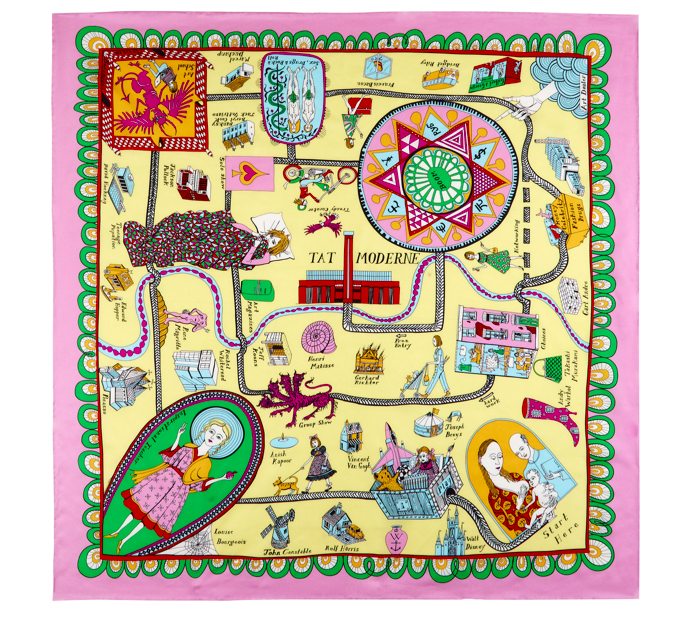
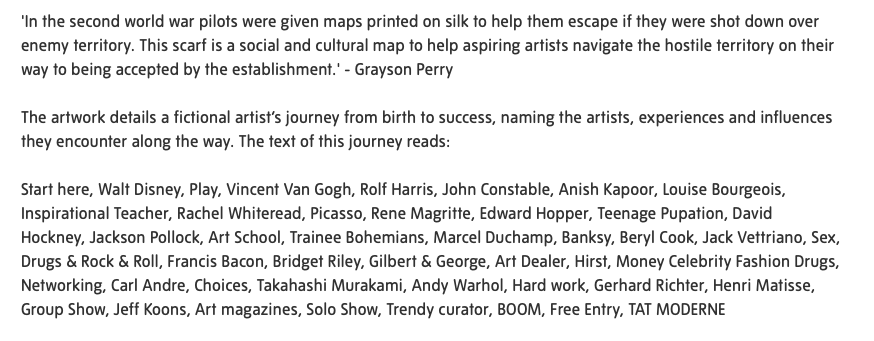
Is my destination, according to the Grayson Perry scarf which the wonderfully generous ladies in my oil painting class gifted me last weekend. Just when I thought that I was directionless, I now have a map. I’m an incredibly lucky person to have these marvellously creative, funny and supportive women in my life.
And, the accompanying blurb:
Amidst all the excitement of the Low Res, I received my annual rejection letter from the RA.
Immersed in all the distraction, I wasn’t bothered, which is why I have left it until now to reflect on this rejection. I’m still not bothered. Why? I’m not sure, in the end I invested quite a lot of time into the process of producing A Die, A Log, With You. However, I didn’t invest very much in an emotional sense – yes, it made me titter but it’s not as if I put my heart and soul into it. Why? because it was an arbitrary task I had set myself which was, frankly, getting in the way of more interesting things. Also, entering the Summer Exhibition is no longer my only artistic outlet into the big wide world. This blog has changed that.
Based on our discussion in yesterday’s session on the subject of success as an artist, I would say that I failed. The piece didn’t connect with others, and, perhaps more importantly, it didn’t connect with me. I used to think that my work was like a Harry Potter Horcrux with each piece containing a little bit of my emotional being. This piece has none of me, so was always destined to be a failure as a piece of work. However, as an exercise in ‘that will do’ as opposed to the normal quest for perfection it was a total success. So. I’m still left in a quandary as to why I didn’t feel connected – was it that in accepting something less than perfection I detached myself from it, or was I just not that into it to start with?
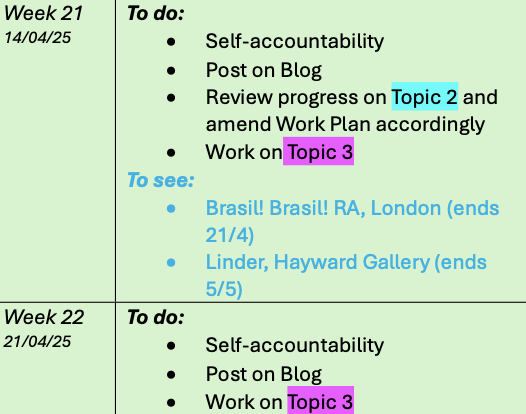
On the basis that I’ve ditched the individual topics areas, for the time being, I’ve not done too badly although I still haven’t made anything. That’s not such a problem because it’s been a hectic and emotional couple of weeks from both ends of the spectrum. I tend to chunk my life as a way to avoid feeling overwhelmed. If I have events coming up whether it be organising a birthday party, entertaining friends, jobs which I’ve been putting off, I can’t generally look beyond them. The future is looking relatively event free for the moment so I feel like I have some space to progress. I’m feeling optimistic. I started back at my oil painting class last week – I missed the last half-term because of the low res week.
I’ve been to Brasil! Brasil! at the RA – I managed to fit that in on the first Thursday of the Low Res, and I’ll cover it in a separate post.
I managed, finally, to attend Chris Koning’s online workshop on the perception of edges.
I’ve also been giving further thought to the research paper; I’m still thinking that I will do something associated with the fallibility of memory. I became interested in memory when my daughter was studying for her psychology A Level a few years ago, and I bought Julia Shaw’s The Memory Illusion, started reading it and never finished it. I’ve started reading it again.
I’ve found an artist, Al Hopwood, who explores themes of memory, identity and perception at the intersection of art, psychology and story-telling…to reflect on the construction of personal and collective narratives. Also, Perplexity has thrown up some other artists who explore the ways in which we remember, but I haven’t been able to research them any further for the moment.
Going forward…

I’m hoping to squeeze in Linder at the Hayward, Donald Rodney and Arthur Neal this weekend.
I’ve also been thinking about how else I can progress my work. I’ve been mulling over the unfillable hole issue and I keep coming back to the Alex Schady workshop and possibly making a video, or maybe painting a self-portrait and just slathering it with junk food, or just making a water feature for the garden! Who knows, but I’m sure there’s something there, I just need to think about it some more. The discussion on tacit agency with Paul Haywood also planted a seed as to how I might explore some of my childhood memories.
As ever, lots to think about…
Last week was a week of two halves.
At the beginning we were told that our dog, Monty, has metastatic melanoma. Without treatment he will rapidly decline in a matter of weeks. With treatment he has a chance of possibly living to his natural life expectancy. With no significant side effects to the treatment, we are giving it a go, and he had the first dose of chemo and immunotherapy on Friday. If it becomes obvious that it isn’t working, we will stop.
We are devastated. I know he’s only a dog but he’s been a part of our family for the last 12 years; he’s been a part of my daughter’s childhood for more time than he hasn’t. I also can’t help thinking that some of the desperately crippling sadness I’m feeling is unresolved grief from my mother’s death, because I’ve been teleported straight back there.
For me, emotion and food are intrinsically linked. The need to eat in order to survive is a primal instinct. I have a need to feed. When I became a mother, my need to nurture and provide nourishment, in all its forms, for my family became paramount. And, of course, many people express their love by making food for others.
The refusal of food is one of the first steps in withdrawing from the world. I remember the lengths I would go to in order to try and encourage my mother to eat. I would spend so much time making her dishes which she said she fancied only for her to take one taste and decide that she didn’t want it anymore. The most difficult moment was when I had to accept that all I could do was to offer it, and not to try and browbeat her into eating it.
Monty’s not as keen on his food as he was. I have dishes full of different vegetables and meats that I’ve cooked, in an attempt to encourage him, in the fridge. Unfortunately, the only food he seems keen on at the moment is steak. When he eats it I feel like everything will be ok, but in the back of my mind is the nagging thought that all I’m succeeding in doing is nourishing the very thing which is killing him.
On a happier note, we had a party to celebrate my daughter’s 21st birthday this weekend. Family and friends came from all over to join us to sit down and have dinner together. There was much drinking and dancing, and everyone had a good time, welcoming the chance to reconnect with old friends or form new connections over food. Some of them I hadn’t seen for a few years – they looked older, as I’m sure I did to them. Even more reason to make the time to meet up with people as much as possible – to walk the walk, and not just talk the talk.
Just booked my ticket.
Apparently, Guns N’ Roses didn’t know how to end their most successful song, Sweet Child O Mine. Whilst in the recording studio, Axl Rose reputedly started singing, ‘Where do we go? Where do we go now?’ And the rest is history and, in my humble opinion, probably the best bit of the song.
So a moment of inspired creativity can come from a total lack of direction and confusion. Here’s hoping…
I’m resolved to wallowing in the myre of confusion. There’s not much point in fighting it; I can’t understand everything. The latest book we read in my book club was Michael Ondaatje’s Coming Through Slaughter. I’ve never read a book like it. It deals with the mental decline and eventual death of the New Orleans cornet player, Buddy Bolden, who is considered to be the father of jazz. I didn’t understand what was going on half of the time, who was talking, and to whom. It jumped around all over the place. There aren’t any chapters as such, just three parts, no speech marks and paragraphs end at odd points on the page and continue on the next – visually it is striking. It is a book to be read, not to be listened to; its format echoes the improvisation and syncopation of jazz music. Once I had decided that perhaps I wasn’t supposed to understand it and just went along with it, reading each phrase and word in its own right, looking at the patterns, and the sounds of the words, a bit like reading a poem (after all, Ondaatje is a poet), I got a lot more out of it.
So this is how I intend to move forward. And it’s just as well, because try as I might to keep up with the constant flow of information being offered up by Paul in the Low Res etching workshop, I just couldn’t. I started taking notes, but just gave up in the end and surrendered myself up to not understanding anything and just enjoying being along for the ride.
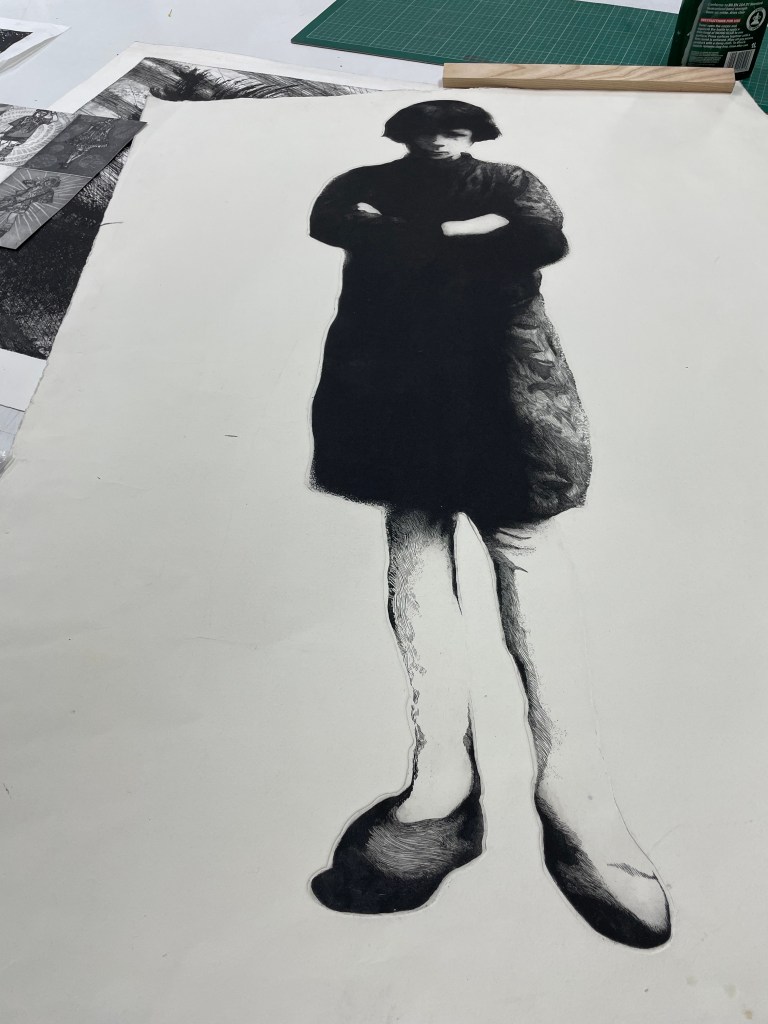
It kicked off with Paul showing us what we could have gone home with, had we the requisite skills. There were some impressive prints which demonstrated the versatility of printmaking which I hadn’t really fully appreciated until now.
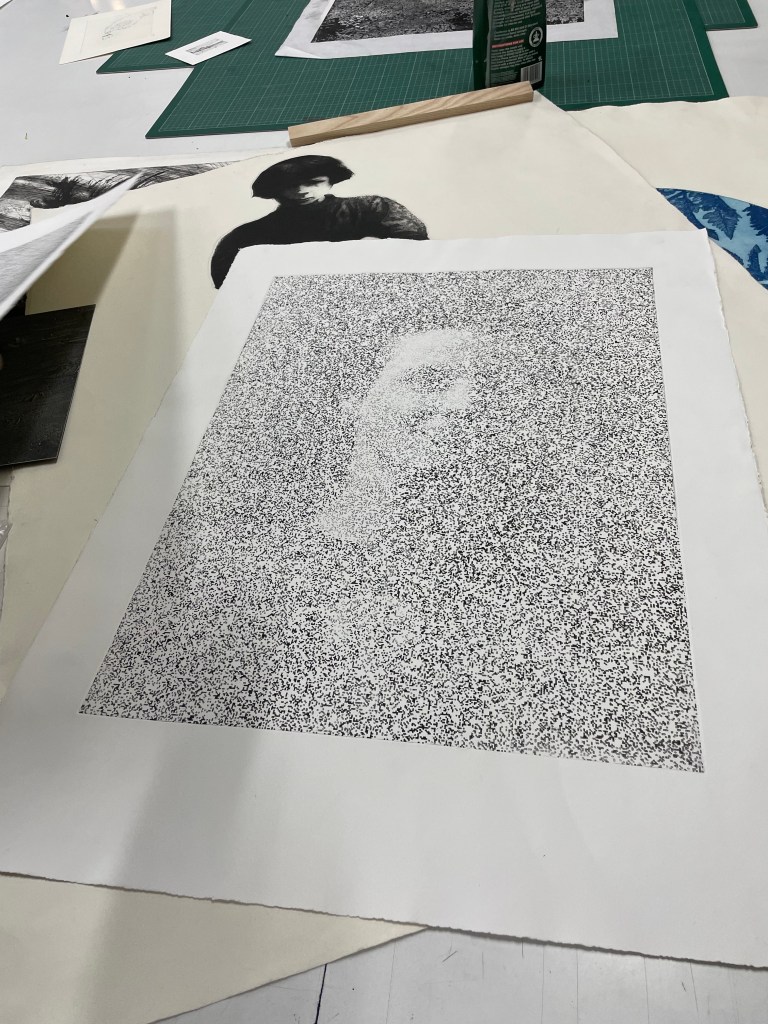

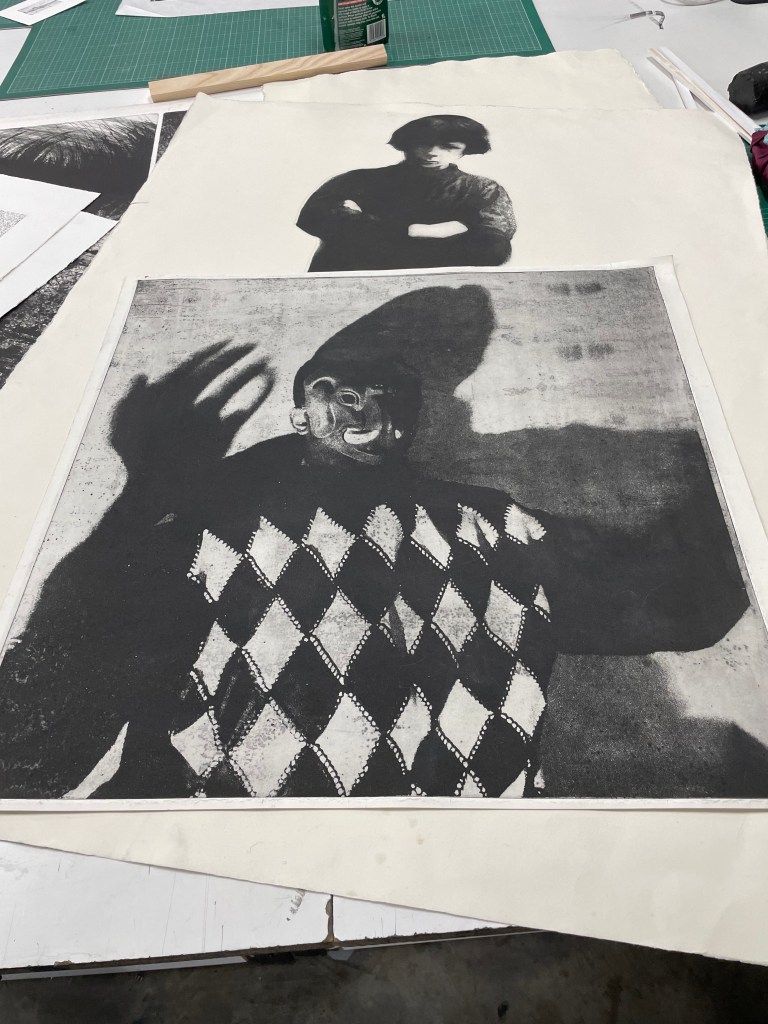
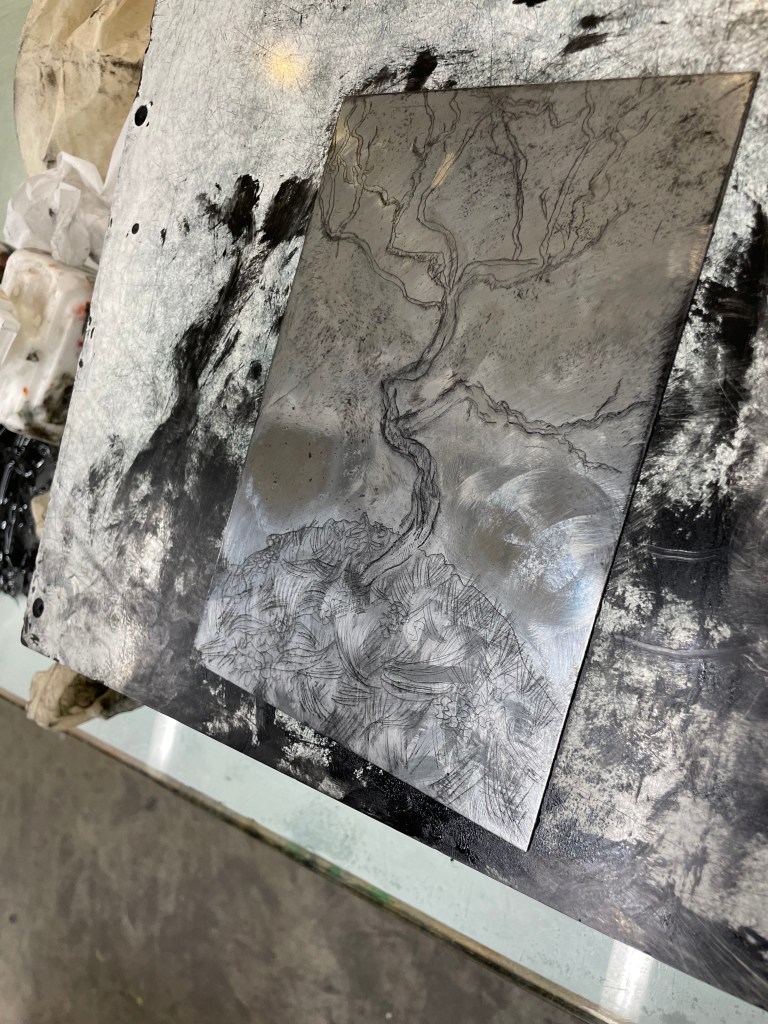
We started off by putting down a hard ground on a zinc plate and then we had about 20 minutes to create the image using a selection of Paul’s tools. What to do? I had a quick look on my phone and chose Schiele’s Small Tree in Late Autumn.

This is the plate once the hard ground had been removed and it had been cleaned followed by the printed images, using aquatint on the last one.
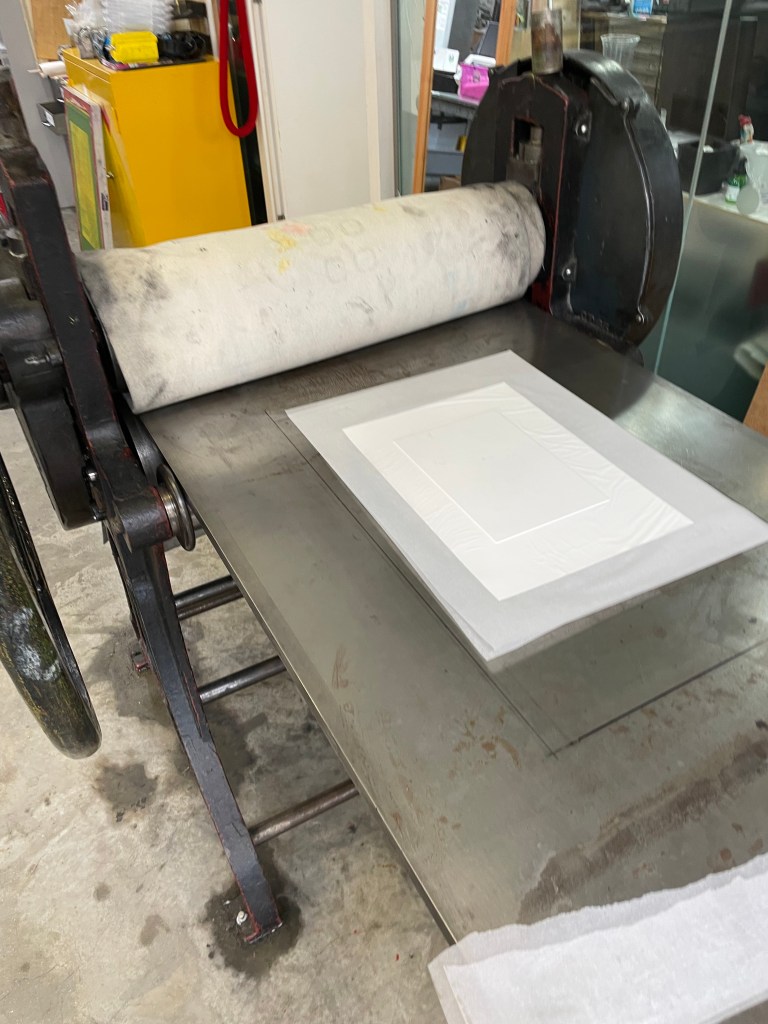
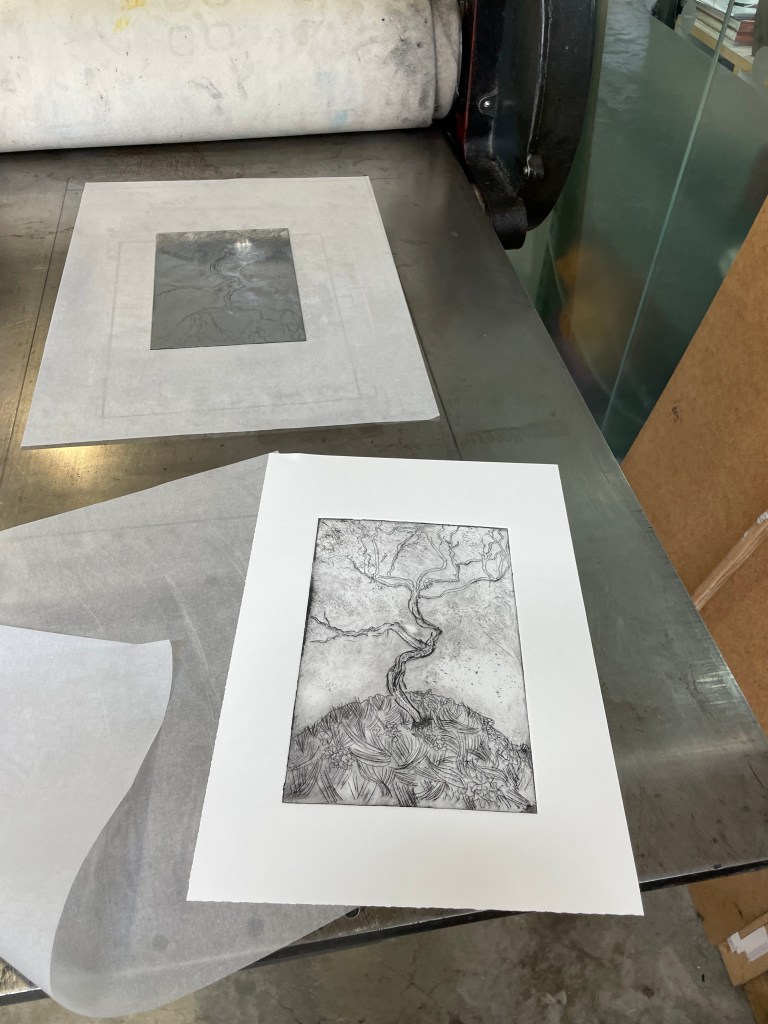

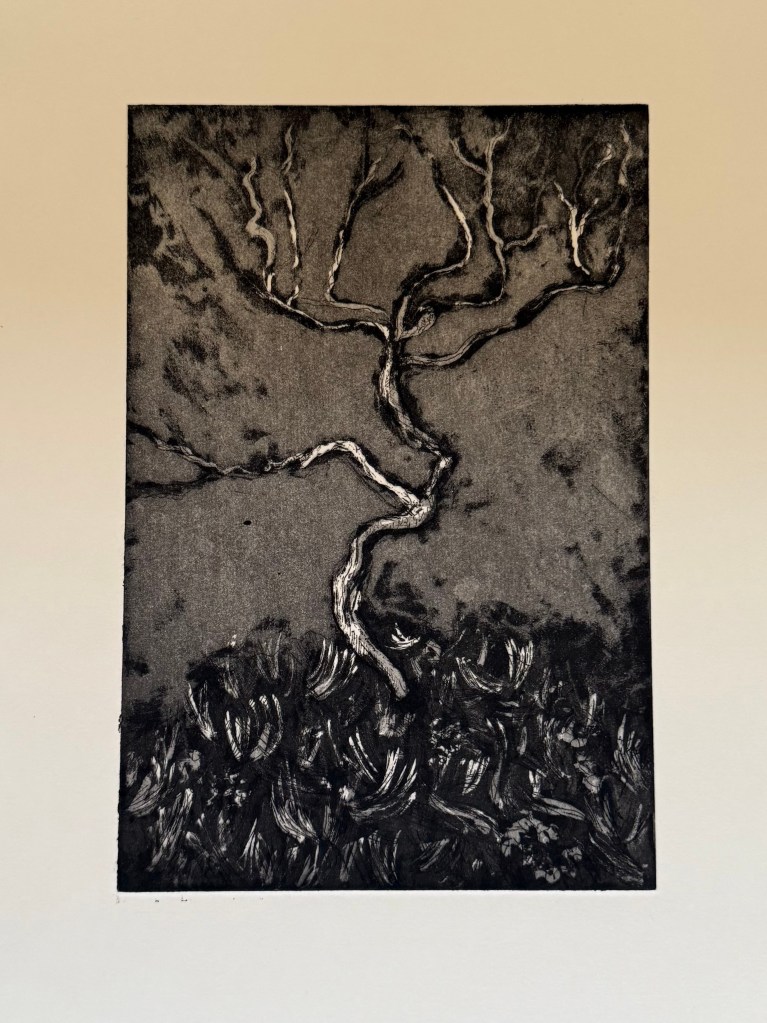
How do I feel about them? Pretty good bearing in mind I only had 20 minutes to create the plate and I had very little idea what I was supposed to be doing most of the time. Will I do it again? I don’t know – it’s very process driven, and whilst I love the excitement and anticipation of the big reveal, I’m more of an instant gratification kind of person. That’s not to say that I’ve ruled out etching altogether, it’s just that I would need a greater understanding of the different and quite complicated steps involved to do it any justice, and that’s just not compatible with the ‘new me’ at the moment.
In this week’s session, as preparation to discussing the impending research paper, we discussed the value of writing for artists. For me, it is a way of organising my thoughts and recording my decision-making so that I can look back and remember why I did what I did, also allowing me to identify any patterns in my way of working or thinking. It also allows a breathing space to step back, to reflect and evaluate. The process of writing often triggers the development of existing thoughts as well as generating new ones. It is also another means of expression; sometimes writing about something provides inspiration as to how I might convey an idea; I often find inspiration from other people’s writing (Parental Loss I Motherhood I); and sometimes writing is the only way to express something, Three Conversations With My Mother. It is an invaluable process.
Jonathan then asked us to spend some time thinking about what is intriguing us.
I have been thinking a lot lately about a conversation I had with Lyberis on the last day of the Low Res. We were in the bar discussing the talk with Jeremy Deller we had just been to, and also the Whitechapel Library audio walk by Janet Cardiff we had experienced in the morning. We had both been blown away by it. I’m trying to understand why it excited me so much; possibly because there was an element of immersiveness, but at the same time I was aware of what was going on around me both visually and audibly; being both removed from and in my surroundings simultaneously was a really interesting experience, particularly when what I was hearing synced with what was actually going on in the real world, like the sound of a moped, just as one went past. The section at St Botolph-without-Bishopsgate was fascinating as she describes two men, one in blue, sitting on a bench, and there actually were two men sitting on a bench chatting. If I had been them, I would have felt unnerved by 20 odd people all sitting down in silence and then getting up and leaving at the same time. It was difficult to work out what was going on. It seemed to be part detective drama, that we were with her looking for someone, as well as a collection of memories, and then, when we reached Liverpool Street Station, she theoretically abandoned us to find our own way back to Whitechapel to return the discman to the library, presumably relying on our memory. It’s just as well they were downloadable files!
But this got Lyberis and me on to talking about memory; how we are made up of our memories; but what if the memories are incorrect or false? I started thinking about how what I am doing is based solely on my memory. My memory is fallible, even photographs are open to interpretation, as we discovered in one of our previous weekly sessions. What if I am my own unreliable narrator? Even if my memories are factually incorrect, if I have a strong emotional response associated with something, surely that can’t be wrong? Is emotion the only true memory? Even if my memories aren’t correct, does that make them any less true to me? And then I was listening to the news on Radio 4 the other day and they mentioned that the writer, Mario Vargas Llosa, had died – he believed that novels should present lies as truths. This gives rise to the possibility that I could even invent my own history.
After taking us through the ins and outs of the research paper, Jonathan raised the issue of AI. He said he uses it to have a dialogue, to challenge his thinking. I’ve used it to critique a piece of work. I came across this article in the Guardian yesterday morning about the artist, David Salle, who has turned to AI to breathe new life into old paintings which hadn’t been rapturously received ‘I sent AI to Art School’.
 Kate McCalmont-Woods