Reflecting on Resentment II

I’ve rewritten this post so many times. It has become progressively shorter. Sitting back and reflecting, I can see what is important. The first version was just a rant.

In late 2022, my mother was diagnosed with oesophageal cancer. No treatment was offered. At best she had 6 months left. Her GP had messed up. The hospital messed up. My sister and I cared for her full-time. It was the worst, and darkest period of my life.

This wasn’t how it was supposed to be. Six months to live? Well, we could go places and make the most of it, create some new memories. But she was already too weak. Instead, the memories I have of that time seep into my mind when it’s not thinking of something else, usually before I go to sleep; then I can’t go to sleep and I sit up alone in the kitchen turning it all over, reliving it. Nothing makes it feel any better.

My mother died at home in the spring of 2023, three days before her 85th birthday. I cannot say with any honesty that she experienced quality of life in those last months. She was waiting to die, and I was just watching her gradually turn into a skeleton.

I resent that medical professionals have failed my family, not just in respect of my mother, but also my father – I made formal complaints in both instances – lessons will be learnt, apparently – but this has done nothing to ease my resentment.

I resent that because she was old, my mother was effectively written off.

I resent that everything was such a battle and I had to spend so much time chasing and making sure things were done.

I resent that there are old people in hospital who are overlooked, and who don’t have a voice or someone to speak up for them.

I resent that my sister and I were left to deal with everything, both before and after my mother’s death.

I resent that in the last few months of my mother’s life the days were short, and the nights were long.

I resent that those last few precious months were stolen from me.

I resent that the last words my mother spoke to me were when she wasn’t herself.

But, most of all, I resent the resentment that I feel: it’s preventing me from moving on.
Lines

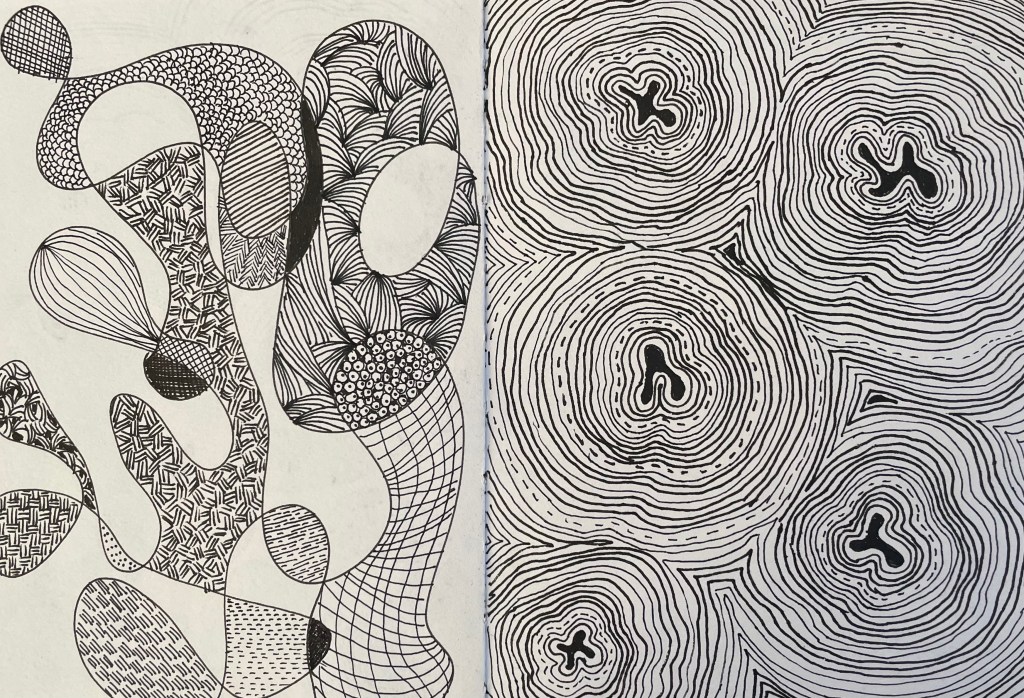
There’s something very satisfying about drawing a line.

Paul Klee loved a line. Taking a line for a walk.

Bewölkung (Clouds), Paul Klee, 1926

I stand in front of this Paul Klee every time I go to the Pallant House Gallery in Chichester. Ink lines drawn over watercolour evoke feelings and moods, suggesting, not defining.

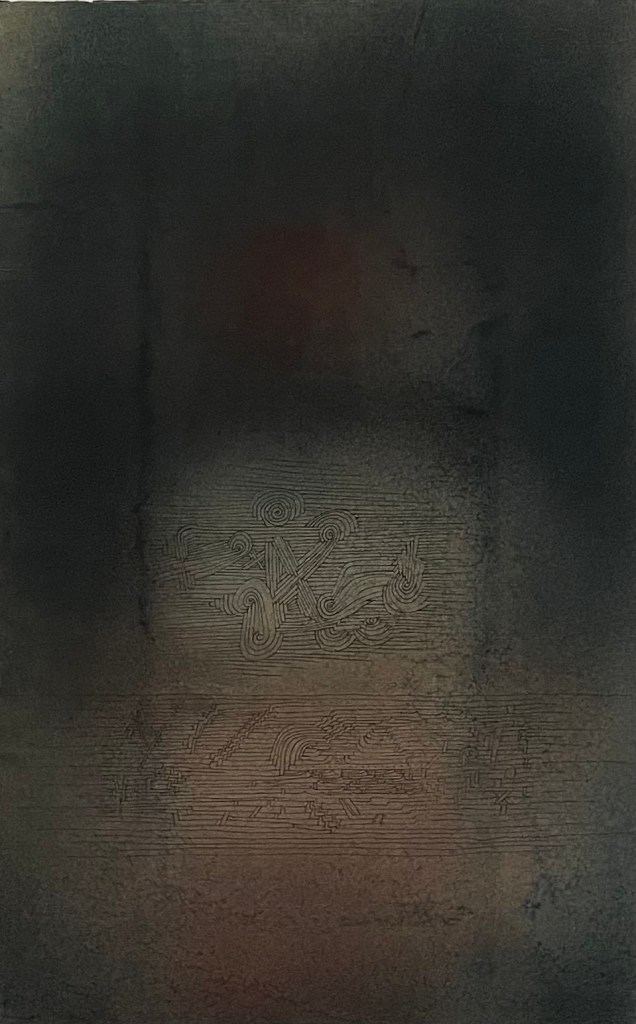
I listened to a film whilst I did this. I like the suggestion of form created by the pattern of the lines. It’s made me think about something underneath trying to get out. The real me? I find these sculptures to be disturbing but compelling at the same time.

Maybe the lines are the contours of my life on a map. My own satnav so I know where I’ve been and where I’m going. Lots to think about.

Reflecting on Resentment I

During the last session we considered the premise that resentment blocks creativity.

Resentment is a feeling of anger or unhappiness about something that you have been forced to accept and you don’t like, or think is unfair. It comes from the Latin verb sentire, and so it is an emotion which is ‘re-sensed’ time after time, perhaps even increasing in intensity. Perhaps we feel resentment that other artists are better than us, or that they have works accepted in exhibitions and we don’t.

As I get older, I try as best I can to keep as much negativity out of my life as possible. I may initially feel it, but then I try to process it by turning it on its head, or actively dealing with it. I can’t feel resentment (in the sense of it being a recurring emotion) that other artists are better than me or are more successful – instead I use the initial negative feeling (which is probably more envy than anything else) to spur me on to try again, to fail again and to fail better, because inherent in that form of resentment is the feeling of failure.

For the last few years I have submitted work to the RA Summer Exhibition but I have never made it to the next round of judging. Each year I experience a moment of crushing disappointment and vow never to do it again, but then January comes around and off I go again. I’m clearly looking for validation, but I often think to myself that if ever I do get in I’ll probably never submit again, and maybe it won’t even make me happy.

My husband confessed to me that he had always wanted to paint. Why don’t you just do it, I asked him. He started with watercolours and over time became good at it. I suggested that he try oils as they are far more forgiving and I thought he might enjoy the freedom of using them. I bought him some as a gift along with some boards and brushes. He signed up to an oil painting class and shortly afterwards submitted one of his oil paintings to the Summer Exhibition. He made it through to the last 4,000 out of 16,000 entries on his first attempt. Did I feel resentment? No – I felt proud, with a strong sense of irony. He felt ecstatic with a strong sense of embarrassment.

If someone treats me badly I tend to think that it is more about them rather than me, but if it is something that I know will eat away at me and become a resentment I try to deal with it head on, unless doing so will cause irreparable harm. But, there is one particular instance of resentment which I haven’t been able to let go of no matter what I do, and I feel it as strongly today as the day I first felt it.

On Your Marks…

Well, the starting pistol has gone off, and I’m still sat here, procrastinating, allowing myself to be distracted, doing anything other than what I should be concentrating on: producing something for the pop-up show. My problem with deadlines is that I tend to ignore them until the very last minute – goal driven, that’s me.

What, with thinking about the pop-up and trying to come up with an inspirational text for Tuesday’s session, I’m feeling just the tiniest bit sick. I would say that I have stuck my head in the sand but apparently that’s a popular misconception: when they sense danger and cannot run away, ostriches will flop to the ground and remain still, attempting to blend in with the terrain – that sounds just about right!

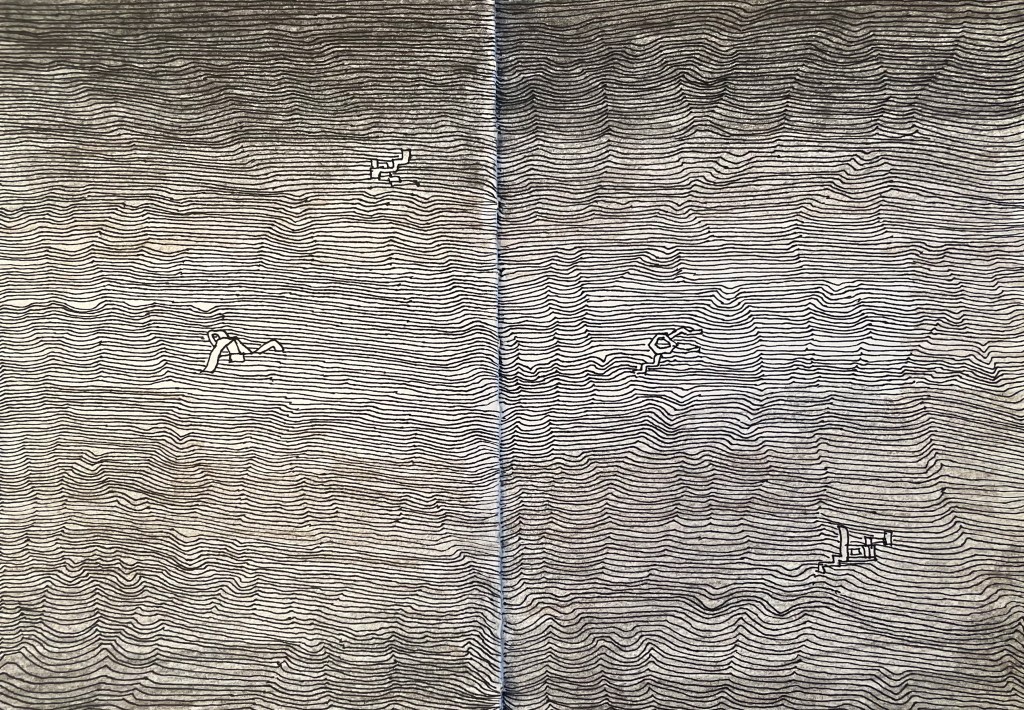
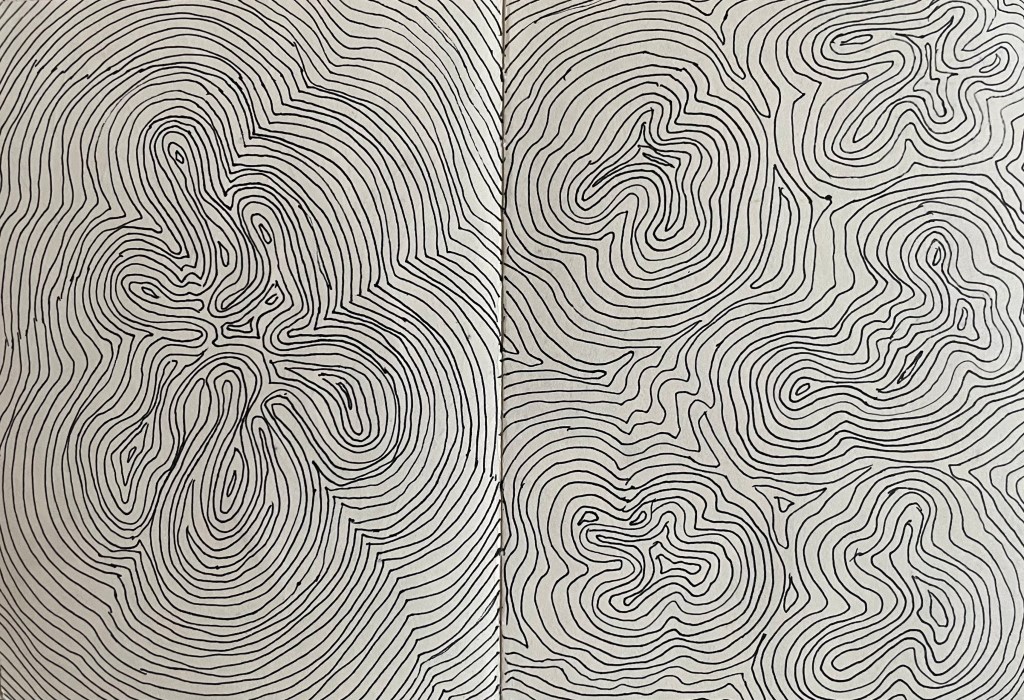
Anyway, following on from my ‘Less’ post, I’ve been thinking about working with a limited palette and how it narrows choice. Using a pen narrows choice even further – just black and white and nothing much else in between. Using a pen forces you to think about mark-making in order to create tonal values and areas of interest. So, I’ve been using my time constructively by doodling with a pen in my sketchbook whilst listening to an audio book – who says I can’t multi-task!

I found the process of mark-making to be meditative and grounding, totally different from the anticipation of putting ink onto wet paper and waiting to see what happens. Strangely, I like it. I think I am a person of extremes: I’m either fastidiously tidy or chaotically messy; organised or haphazard; focused in on the minutiae or just wanting to see the bigger picture. Somehow I have to find a path along which both sides of me are satisfied.

I will definitely use pen again, if only as a way to order my thoughts. Going forward I think I should try to build up a bank of possible marks, almost like a painter might have a bank of colour swatches. Having said that, I’m mindful that I’ve still got to do a few things to which I’ve committed in earlier posts, so I think I need to embark on some self-accountability first.

Should Art Ever Be Destroyed?

This is the question debated in the latest RA magazine.

Mary Beard argues yes…

”To suggest that images are inviolable, to be protected from harm in the safe space of a gallery, denies them power. Part of the job of art is to challenge certainties, and make us see the world differently, in uncomfortable ways… But if we surround all art with a glow of pious reverence, if we put it on a pedestal with a ‘Do Not Touch’ label, protected by its very definition as ‘art’, we will have deprived it of one of its necessary functions: to make us angry. Ocassional destruction is the price we pay for art doing its job.”

Tomiwa Owolade argues no…

”Anyone who defends the right of art to be free of censorship needs to acknowledge a basic truth: not all works of art are great. Many are bad. Some are even morally offensive… No art should be destroyed. Because to destroy it it or call for its destruction, is to legitimise something even more pernicious than the existence of morally repellent art: the furies of the mob… The defence of art against destruction is not simply a defence of the soaring works that universally enchant and enrapture us. It is more importantly a defence against the baser instinct to destroy that, once unleashed against art, is likely to spill into cruelty against people. As the German poet Heinriche Heine said: ‘Where they burn books, they will, in the end, burn human beings too’.”

What do I think? I wholeheartedly agree with Mary Beard that the job of art is to challenge and at times anger but anger is an emotion and is purely subjective. Just because one person is offended by something does not make it offensive. Others may not be, and her proposition that those who are offended should be able to destroy art and that the only power that piece of art has is in its destruction is not something I can hop on board with. It also doesn’t address the issue as to whether it is the art itself or the maker which is considered to be offensive. Would it be acceptable to destroy great art because it has been made by bad people?

Light & Shadows

I attended another of Chris Koning’s online drawing workshops at lunchtime, to brush up.

She explained the concept of light logic:

  • Highlight – the brightest light
  • Cast Shadow – caused by the object blocking the light and so the darkest dark
  • Reflected Light – dim light bounced back up from light on the surface
  • Crest/Form Shadow – shadow which lies on the crest of a rounded form between highlight and reflected light

When drawing we are not interested in contrast, but in value ie what something looks like against something else.

‘The Artist’s Mother’, Georges Seurat, 1883

This drawing by Seurat is made up of lots of different areas of tone. The parting in the hair is not a definite line; it has been created by different areas of tonal value. There are no harsh lines anywhere and there is very little contrast in the image. It is Seurat’s flawless light logic which allows us to create the rest of the information ourselves.

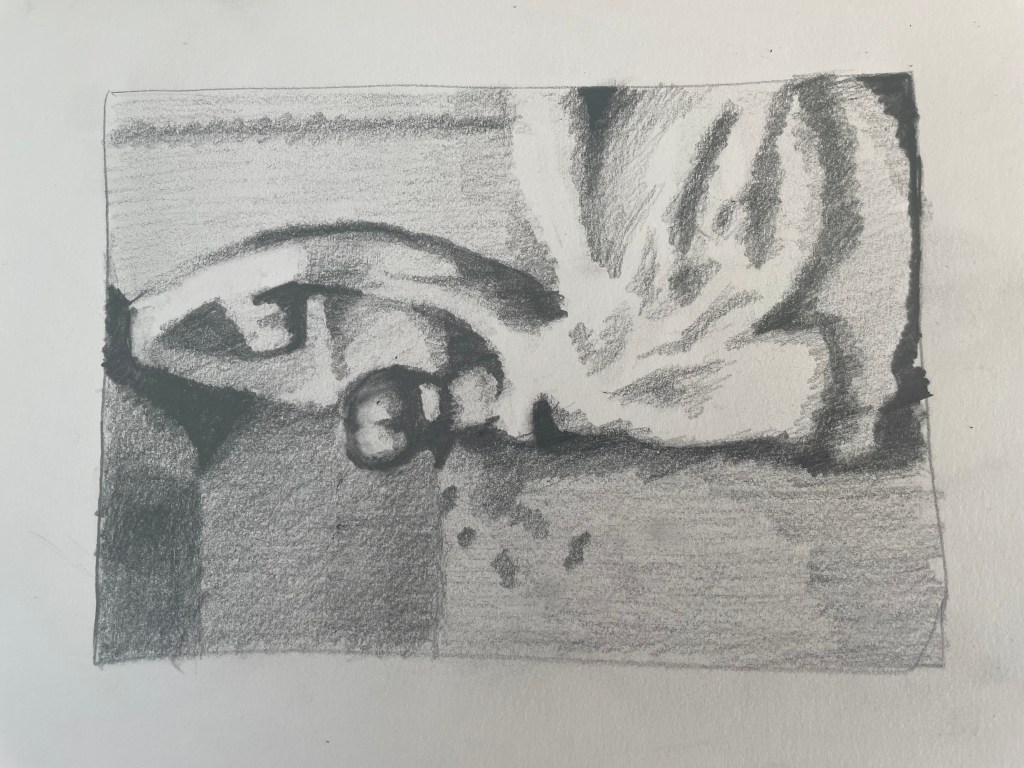
We then did a quick 10 minute exercise. We lightly shaded in a rectangle. Then we were shown a blurred image and told to fill in the darkest areas and then use an eraser to show the lightest. We then had to fill in the rest of the tonal values in the knowledge that nothing else will be as dark or as light as the existing areas of tone.

Chris then inverted the image and made it clearer:

It was a helpful reminder not to ‘see’ what I’m drawing and thereby create an expectation, but just to see shapes of tone, and to start from the general, keeping in mind the relationships between areas in the whole of the composition, and then move towards the specific.

The Weeping Woman

I draw you in with suggestions of Picasso, but I’m afraid it’s me, again.

I’ve always known that art can move, but reduce one to tears? Someone once told me that they couldn’t stand in front of a Rothko without crying – ‘Get a grip’ is how I responded, in my head.

Then I stood in front of Van Gogh’s ‘A Wheatfield, with Cypresses’ in the National Gallery. Why can’t I see it clearly anymore? Why do I have tears running down my cheeks? Why hadn’t I put any tissues in my bag? Why is the guard coming towards me with a strange expression on his face?

Was it because I had recently watched ‘Loving Vincent’ and a documentary about this tortured and anguished soul? That he had died without knowing of the fame and recognition which was to come? Or was it something else – the way he applied paint perhaps? Does it actually matter?

For me, I can’t separate the artist from his work – his mental and emotional fragility is embedded in his work and I find it both beautiful and overwhelmingly sad. So sad, that just someone talking about it can make me well up.

So, after spending one and a half hours in a virtual queue on the National Gallery website I have managed to secure two very precious tickets to ‘Poets and Lovers’, except that for one time only, on the morning of 9th December, there will be a lone Picasso amongst all the Van Goghs.

Less

I haven’t posted for a while – I’ve been busy sorting things out before going off to Marrakech for a four day trip with my book club.

Marrakech was amazing. Colour. Noise. Smells. People. Heat. Contrast that with this morning when I had to defrost the car before heading off to my weekly art class. I love this drive, along an old Roman road – straight and undulating through the Hampshire countryside to Stockbridge, a small town in the Test Valley. The sun came out and the trees came to life – burning oranges, golds and yellows. It was beautiful, and by the time I arrived at my class, late because I couldn’t find anywhere to park, I was still feeling its effects.

I can’t deal with too much choice – it paralyses me and then I can’t make a choice. Needless to say, I didn’t buy anything in the souks in Marrakech – the choice was overwhelming, so I resolved not to buy anything at all, and was then able just to wander and enjoy the atmosphere and culture.

So today’s task was perfect for how I was feeling. A landscape using a limited palette of burnt sienna, burnt umber, ultramarine, pale cadmium yellow, white and cadmium red. We took a board, roughly primed – in my case it was an old piece of MDF which I had previously coated with professional Dulux oil-based primer, which can make it a bit like an ice rink – and put down a loose ground of burnt sienna with a bit of sansador which ended up not drying for some reason. Then we put in some outlines using burnt umber following with thick patches of colour keeping it very general, but the wet burnt sienna contaminated some areas and lifted off the board in others. We experimented with dragging a dry brush across the paint and I also did a bit of sgraffito which I can’t help doing when using thicker paint.

This is the result:

I haven’t painted for ages – not since beginning this course – I don’t know why. Perhaps it’s because I’ve been doing a lot of thinking and experimenting with other media. At first, it felt a bit strange coming back to it, almost awkward, like I’d been unfaithful in some way.

It’s not my best by far, but it’s ok for an hour and a half. I am leaving it. The ‘me’ I’m trying to change would say that it is not finished by a long way. There’s lots I don’t like and would love to change – I’m itching to tinker – but I’m exercising some will power and calling it a day. Just like I’ve been trying to change my mindset about having an expectation as to how a piece will turn out, I am also trying to train myself to walk away.

Jonathan told me that the job of mark-making is to tell us what to do next. These marks are telling me to leave it alone and to be happy with what bits of it appeal to me – I like the lack of clarity and blurriness caused by the dry brush; the light coming through the burnt sienna ground in the foreground; the energy in the marks, which I would absolutely kill if I allowed myself to do more; the lack of definition which gives a sense of a fleeting moment; and the recreation of the feeling I had whilst driving to class.

Will I do this again? Yes, I always like going back to basics and using a limited palette – I’ll use a different image and next time I will definitely make sure that the ground is dry before carrying on so that the colours aren’t so muddy in places.

Blot II

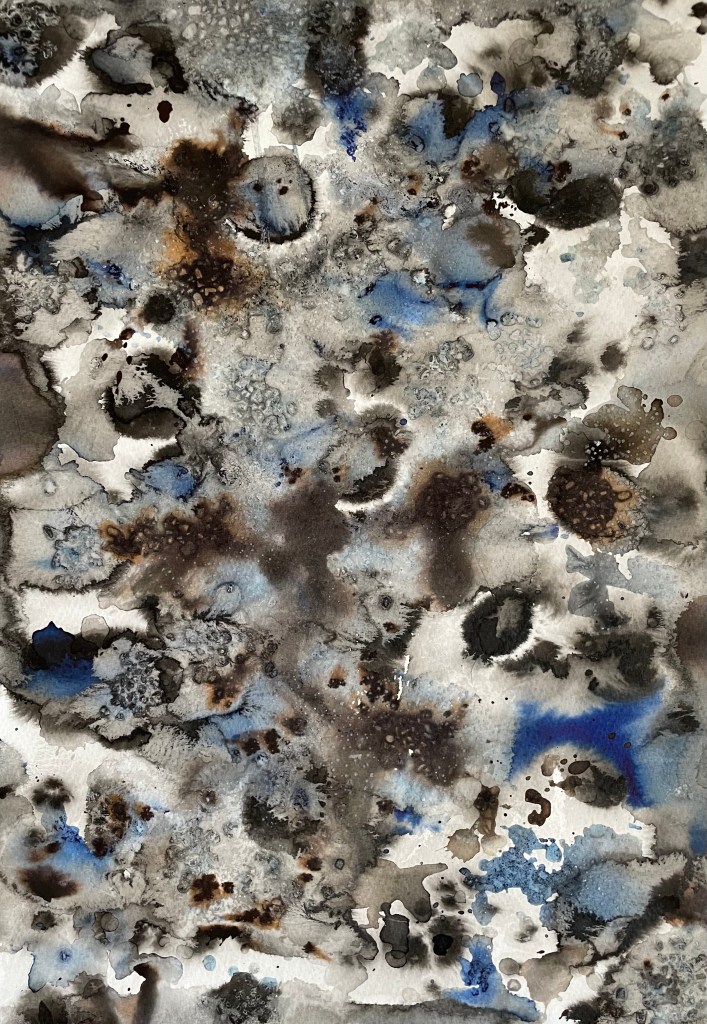
I’m really enjoying experimenting with ink.

There’s no expectation. It feels free. I like that you have to wait until they are dry to see the full effect. I feel like I have made them, which is an important step for me as I have struggled to accept the concept of randomness in art making; but I applied the water, the ink, chose the brush and I dropped and flicked the ink where I did, and just because I didn’t control what happened next doesn’t mean I didn’t in some way influence it. I like the combination of the different inks. The black Indian ink did not reveal as many tones as I was expecting, so I also used black writing ink which revealed tones of brown. I enjoy looking at them and identifying areas of interest as well as random shapes of faces, flowers, and cuddly toys! I have an idea as to how I might incorporate them into future work.

Responsibility

I watched an old documentary on Tracey Emin last night – Mad Tracey From Margate.

It referred to a piece of work which included a letter Tracey had written about her twin brother, Paul, and the work’s subsequent appearance on a TV show which then led to her brother losing a job. She expressed regret and acknowledged that her work would have to change or she risked being censored by her family.

It’s a stark reminder that when producing deeply personal work, there is a responsibility to protect others who have not signed up to having their personal lives made public.