Food For Thought

Last week was a week of two halves.

At the beginning we were told that our dog, Monty, has metastatic melanoma. Without treatment he will rapidly decline in a matter of weeks. With treatment he has a chance of possibly living to his natural life expectancy. With no significant side effects to the treatment, we are giving it a go, and he had the first dose of chemo and immunotherapy on Friday. If it becomes obvious that it isn’t working, we will stop.

We are devastated. I know he’s only a dog but he’s been a part of our family for the last 12 years; he’s been a part of my daughter’s childhood for more time than he hasn’t. I also can’t help thinking that some of the desperately crippling sadness I’m feeling is unresolved grief from my mother’s death, because I’ve been teleported straight back there.

For me, emotion and food are intrinsically linked. The need to eat in order to survive is a primal instinct. I have a need to feed. When I became a mother, my need to nurture and provide nourishment, in all its forms, for my family became paramount. And, of course, many people express their love by making food for others.

The refusal of food is one of the first steps in withdrawing from the world. I remember the lengths I would go to in order to try and encourage my mother to eat. I would spend so much time making her dishes which she said she fancied only for her to take one taste and decide that she didn’t want it anymore. The most difficult moment was when I had to accept that all I could do was to offer it, and not to try and browbeat her into eating it.

Monty’s not as keen on his food as he was. I have dishes full of different vegetables and meats that I’ve cooked, in an attempt to encourage him, in the fridge. Unfortunately, the only food he seems keen on at the moment is steak. When he eats it I feel like everything will be ok, but in the back of my mind is the nagging thought that all I’m succeeding in doing is nourishing the very thing which is killing him.

On a happier note, we had a party to celebrate my daughter’s 21st birthday this weekend. Family and friends came from all over to join us to sit down and have dinner together. There was much drinking and dancing, and everyone had a good time, welcoming the chance to reconnect with old friends or form new connections over food. Some of them I hadn’t seen for a few years – they looked older, as I’m sure I did to them. Even more reason to make the time to meet up with people as much as possible – to walk the walk, and not just talk the talk.

Three Conversations With My Mother

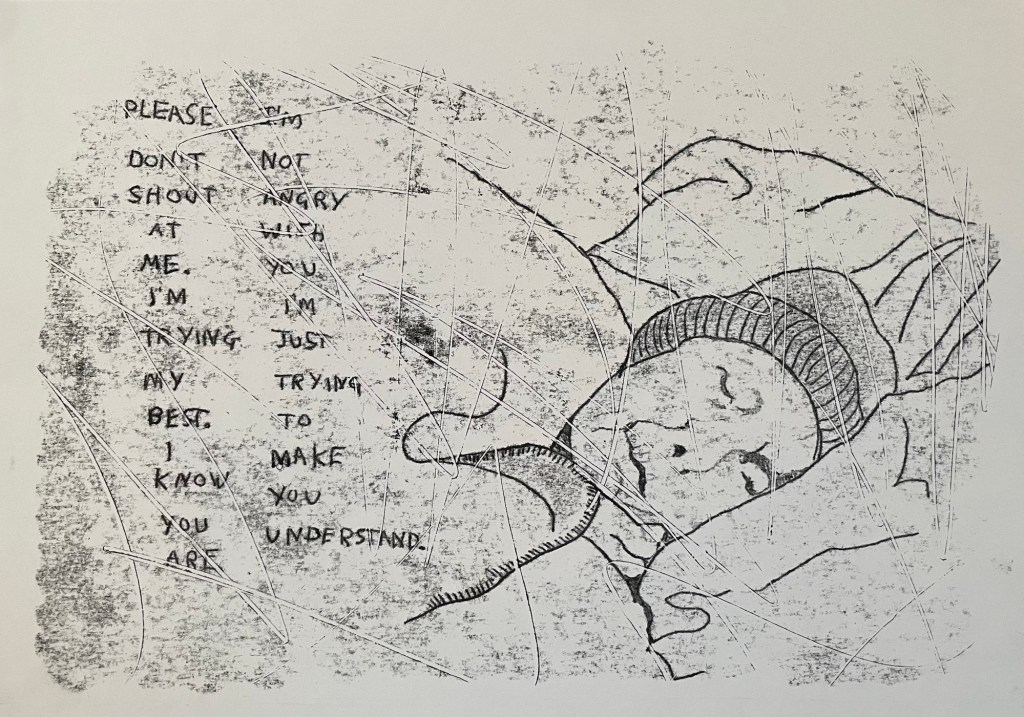
Some were surreal, others were sad. Sometimes she was lucid, sometimes she was delirious, sometimes it was morphine. Three in particular have lodged themselves in my memory. My logical brain tells me that she wasn’t herself, that her brain chemistry was all over the place, trying to cope with the enormity of it all.

It’s just that the last conversation I had with her, was the last.

I suppose I could talk about them to someone, together with the rest of it, but I’m not sure the spoken word will work: the words will come out of my mouth and vibrate through the air to enter someone else’s head. Then they are gone. I need a more substantial, tangible way of dealing with them, through the written word and imagery. I need to be able to confront them, physically.

I’ve had some inner conflict as to whether I should publish the image in which her face is visible; when she was ill and at her most vulnerable. This was a woman who dragged herself through the house, after breaking her leg, in order to phone for my sister to come over and make her look presentable before calling for an ambulance. She was a very private person. But she is no longer here. If it helps me come to terms with it, I think she would be ok with it. My sister’s on board – she reads this blog. She has her own conversations.

Three Conversations With My Mother No 1, Montotype on A4 Cartridge Paper

Three Conversations With My Mother No 2, Monotype on A4 Cartridge Paper

Three Conversations With My Mother No 3, Monotype on A4 Cartridge Paper

I don’t need to reflect on them. I don’t want to reflect on them. Not yet.

If You See It, Just Buy It.

This post has been sitting in draft for a while now. I’m not sure why I’ve been delaying in publishing it – maybe a reticence to commit in case something better comes along. Rather like the way I shop: I like to browse in every single shop to see all the available options, and for the most part end up going back to the first shop, several hours later. My husband, on the other hand, sets out with a list and buys the first item which fits the bill – his advice to me is that if I see it, I should just buy it, and save myself the aggravation. So what if I do have a better idea further down the line? That’s part of the process isn’t it? To reflect, adapt and recognise the need for a change of direction.

I’ve been giving further thought to what I would like to explore over the next couple of years. I’m afraid it’s not a laugh a minute, but it’s something that’s been on my mind for a while.

Not to be egocentric about it, but it’s ME! Then again that’s not a surprise as everything I make, even within the constraints of my art class, is subconsciously about me in one way or another: how I see the world; what matters to me; what interests me; about me; my experiences.

I remember sitting in the back of the family car as a child, probably on one of those Sunday afternoon drives in the Black Forest my parents used to like, with my brother on the back seat playing my dad’s favourite Elvis Presley and James Last songs on his double deck cassette player and thinking to myself: Who am I? This is me. Here. Right now. I almost tried to climb inside myself which messed with my head a bit. I must have been about 7 years old.

Who am I, as a person, as an artist? Hopefully by the end of the next two years I might have a better idea.

I’m particularly interested in my identity in the sense of nature and nurture: who is the authentic me – the one that drew its first breath? As Z recently mused on her blog ‘we will never be as unmarked as when we were born’. How has that version of me been influenced by my life experience, in particular, the roles I have had in my life?

This line of thought was prompted by the death of my mother in 2023. As my father had passed away in 2013, she was my lone parent. It struck me that my role as a daughter was coming to an end. Arguably it had gone on hiatus sometime earlier when I started to care for her following her cancer diagnosis, whereupon my role became that of carer. Some roles in life are mutually exclusive and in my case this was more or less true of my roles as daughter and carer – maybe it was a coping mechanism. As a result, I have issues in processing that brief, but cataclysmic, period of my life.

My mother’s death also made me consider my role as a sibling and the subsequent sense of estrangement I feel from my brother and, conversely, the closeness I have with my sister as a result of our shared experience of caring: sometimes only someone who has gone through the same experience can truly understand how it feels.

What effect does the ending of a role have on identity? What if I feel that I have failed in some roles? What if others think that I have failed? What if my roles conflict or were not mine by choice?

In being a mother I reflected on my experiences as a daughter to try and be the best mother I could be, and so the cycle will continue, perhaps. I’ve been a career woman, a homemaker and, still am a wife. At some stage I have lost the sense of the real me, if there is one: some roles allowed others to prosper whilst I took a back seat. Words which particularly resonate with me are from Deborah Levy’s The Cost of Living :

“It requires skill, time, dedication and empathy to create a home that everyone enjoys and that functions well. Above all else, it is an act of immense generosity to be the architect of everyone else’s well-being.”

In my head I’ve been Norman Foster.

Feeling Our Way

During our second session half of the group gave short individual presentations about themselves and their work. It was fascinating to learn how they have come to be here and their inspirations. We then went on to consider how we are feeling at the beginning of the course and the idea of vulnerability was a recurring emotion.

This is something that I have been thinking about a lot recently: to expose one’s vulnerabilities takes courage. It reminded me of an interview I watched between between Alan Yentob and the actress, Miriam Margolyes, in his ‘Imagine…’ series for the BBC which was made shortly after she had published her autobiography.

ALAN:”Have you hidden anything in this book? Are there things that you haven’t spoken of?

MIRIAM: “I didn’t mention something that I should have mentioned and that was that I hit my mother when she was paralysed. Anyone who has been a carer will know how frustrating and difficult it is and I let that happen and I’m deeply ashamed of it. But the thing that really gets to me is that my mother forgave me. I hit her when she was paralysed and she forgave me.”

I remember thinking how tremendously brave she was to admit to an act which most of society would view as anathema. I was shocked by it; it was a stark statement made without context or explanation and without looking for sympathy.

They say that before you judge a person you should walk a mile in their shoes; two years later I was caring for my terminally ill mother and if I had watched that interview then, it would have spoken to me and I would have been more understanding.

So, I need to have the courage to embrace vulnerability because there’s just a chance that someone else might be feeling the same way.