A Wobble

I’ve often suffered from buyer’s remorse; the last time it happened was when I bought my new rug in Marrakech. Did I just buy it in the fervour of the moment? Would it actually fit in at home? How was I going to get it back home on the plane? Would it fit in my suitcase? Did I pay too much? I did haggle for it, but did I haggle enough? Had someone else bought something similar and paid a lot less? If they had, how would that make me feel? Whilst I appreciate that the worth of something is what someone is prepared to pay for it, everything is so much simpler and fairer when there is a fixed price.

I experienced a new feeling recently – blogger’s remorse. Should I have posted ‘Three Conversations With My Mother’? In the moment it felt right, but as is always the case with me, the doubt started to creep in. The phrase ‘act in haste, repent at leisure’ could have been coined for me.

I’ve already mentioned that I seem to be a person of extremes – I’m either very guarded or a total oversharer, particularly after a couple, after which I’m plagued by cringe inducing thoughts. I had one such cringe whilst having a shower the other morning. I suddenly thought, everyone who sees my blog (I’m not kidding myself – it’s not that many!) now knows the most personal information about my relationship with my mother in her last days. Also, how would I feel if I saw my images elsewhere in the public domain? In all honesty, I felt a bit panicky and decided just not to think about it.

But not thinking about things and hoping they will just go away is not an answer. So, later that day I decided that I would process this sudden feeling of regret. I’ve always known, in the back of my mind, that I have to deal with that period of my life in order to move forward. Memories of it have taken my head hostage and I needed to offer a swap – somewhere else for them to inhabit, to free up my mind so that I have the space to remember all that was good. In essence, I have emotionally vomitted the negative and harmful feelings onto the page, and I can now look at them and still feel the way I did, but when I put them away, hopefully, they will stay away.

This course is a once in a lifetime opportunity for me, and I need to wring everything I possibly can out of it. I’m trying to find out who I am, and in so doing I need to be fully committed to the process. To avoid sharing parts of my life because they are too personal would be to cheat myself, and so, I’m all in.

The Cost Of Living

One of my favourite actresses, Lesley Manville, was on Desert Island Discs a few weeks ago. On her divorce from one of my favourite actors, Gary Oldman, who left her a few months after she had given birth to their son, she said:

“I thought we’d be together forever and have a big family. But maybe if that had happened, maybe, I wouldn’t have had the career I have now. I think I’d have given up a lot for a good long marriage, but the price would have been something – I don’t know what.”

This reminded me of ‘The Cost of Living’ by Deborah Levy, in which Levy refers to the relationship between the French philosopher and writer, Simone de Beauvoir, and the American writer, Nelson Algren.

“Algren had written to her when he feared their transatlantic love affair was ending, to tell her the truth about the things he wanted: ‘a place of my own to live in, with a woman of my own and perhaps a child of my own. There’s nothing extraordinary about wanting such things.’

No, there is nothing extraordinary about all those nice things. Except she knew it would cost her more than it would cost him. In the end she decided she couldn’t afford it.”

‘The Cost of Living’ was my choice of inspirational text for our last session.

After listening to the actress, Billie Piper, speaking about it, coincidentally on Desert Island Discs, I thought I would give it a go. I have re-read it many times since, and gifted copies to friends at every opportunity.

Deborah Levy is South African by birth; her father was a political activist who had been imprisoned during Apartheid. The family subsequently relocated to England when she was nine years old.

It’s the second book in a series of three living autobiographies. It covers the period in her life when her marriage fell into difficulties, although her career was on the up having been shortlisted for the Booker Prize. She decided that her marriage was a boat to which she didn’t want to swim back, and so she and her husband divorced. Her family home life no longer fulfilled her need to create, and so it was slowly dismantled.

We sold the family house. This action of dismantling and packing up a long life lived together seemed to flip time into a weird shape; a flashback to leaving South Africa, the country of my birth, when I was nine years old and a flash-forward to an unknown life I was yet to live at fifty. I was unmaking the home that I’d spent much of my life’s energy creating.

To strip the wallpaper off the fairy tale of The Family House in which the comfort and happiness of men and children have been the priority is to find behind it an unthanked, unloved, neglected, exhausted woman. It requires skill, time, dedication and empathy to create a home that everyone enjoys and that functions well. Above all else, it is an act of immense generosity to be the architect of everyone else’s well-being… To not feel at home in her family home is the beginning of the bigger story of society and its female discontents. If she is not too defeated by the societal story she has enacted with hope, pride, happiness, ambivalence and rage, she will change the story… To unmake a family home is like breaking a clock. So much time has passed through all the dimensions of that home. Apparently, a fox can hear a clock ticking from forty yards away. There was a clock on the kitchen wall of our family home, less than forty yards from the garden. The foxes must have heard it ticking for over a decade. It was now all packed up, lying face down in a box.”

There was a cost to this freedom; this way of living. She moves into a small sixth floor flat at the top of a hill in North London with her daughters and has to teach, and write pieces which she wouldn’t ordinarily choose to, in order to earn a living. She finds that she can’t write in the flat: she needs her own space, so she rents her friend’s garden shed in which she wrote this book and two others.

“It was calm and silent and dark in my shed. I had let go of the life I had planned and was probably out of my depth every day. It’s hard to write and be open and let things in when life is tough, but to keep everything out means there is nothing to work with.”

The book also deals with the death of her mother from cancer. This resonated with me profoundly when I re-read the book after the death of my own mother. There is a moving account of Levy having a meltdown in a local newsagents which had run out of the ice lollies which had been keeping her mother going, as well as her subsequent apology to the three Turkish brothers who owned it.

Another poignant moment is when she reflects on a postcard received from her mother:

“Love did find its way through the on and off war between myself and my mother. The poet Audre Lorde said it best: ‘I am a reflection of my mother’s secret poetry as well as of her hidden angers.’… My mother had made a biro’d X on the front of the postcard and written’ X is where I am’… It is this X that touches me most now, her hand holding the biro, pressing it into the postcard, marking where she is so that I can find her.”

She goes on to say:

“I lost all sense of geographical direction for a few weeks after my mother’s death. I was disorientated, as if some sort of internal navigation system was drifting… It was she who had raised her children and most childhood memories were twinned with her presence on earth. She was my primal satnav, but now the screen had gone blank.”

I love her way of writing: she can create an impactful image with a few words. Whilst on Eurostar to Paris, she is talking to a teenager sitting next to her, who is using a laptop to learn French, when a man gets on the train and asks the teenager to make space on the table.

” She moved it to her lap. This was a small rearrangement of space, but its outcome meant she had entirely removed herself from the table to make space for his newspaper, sandwich and apple.”

When she is asked to provide a list of the minor and major characters in one of her novels for film execs looking to option it, Levy considers the minor and major characters in her own life.

“If I ever felt free enough to write my life as I felt it, would the point be to feel more real? What was it that I was reaching for? Not for more reality, that was for sure. I certainly did not want to write the major female character that has always been written for Her. I was more interested in a major unwritten female character.”

And that is what I take away from this book, what inspires me: I should be the major character in my own story. It is for this reason that I am on this course, that I am making a change and adopting a new way of living.

This struck a chord with Dalal, who has been thinking a lot recently about the possibility of marriage and family, but is concerned how this might fit in with her need to be an artist. Alex had already established herself as an artist by the time she married and had a family, so her artistic practice had already marked out its boundaries. Pritish is not thinking long-term: his main concern at present is to concentrate on his artistic practice.

I was fascinated to hear about what inspires everyone else. Pritish is inspired by London, in particular, he likes the anonymity it provides and he referenced the photographer, John Deakin; Dalal is inspired by Kerouac’s ‘Satori in Paris’, Murakami’s ‘South of the Border, West of the Sun’ and Muayad H Hussain’s thesis on Khalifa Qattan and circulism; and Rachel Whitehead’s Turner Prize winning House (1993) inspires Alex, a sculpture formed from a concrete cast of the inside of a house condemned for destruction – something made out of nothing containing the past life of the house and its inhabitants, without utility but fascinating.

Now that I have cast myself as the main character in my story, how do I play her?
Three Conversations With My Mother

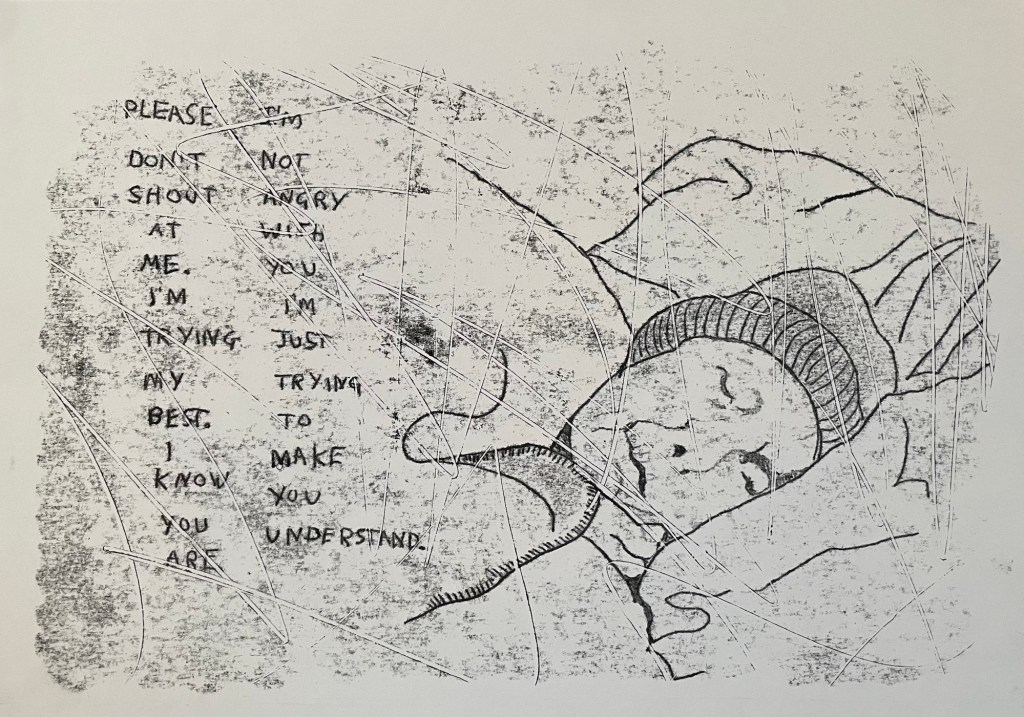
Some were surreal, others were sad. Sometimes she was lucid, sometimes she was delirious, sometimes it was morphine. Three in particular have lodged themselves in my memory. My logical brain tells me that she wasn’t herself, that her brain chemistry was all over the place, trying to cope with the enormity of it all.

It’s just that the last conversation I had with her, was the last.

I suppose I could talk about them to someone, together with the rest of it, but I’m not sure the spoken word will work: the words will come out of my mouth and vibrate through the air to enter someone else’s head. Then they are gone. I need a more substantial, tangible way of dealing with them, through the written word and imagery. I need to be able to confront them, physically.

I’ve had some inner conflict as to whether I should publish the image in which her face is visible; when she was ill and at her most vulnerable. This was a woman who dragged herself through the house, after breaking her leg, in order to phone for my sister to come over and make her look presentable before calling for an ambulance. She was a very private person. But she is no longer here. If it helps me come to terms with it, I think she would be ok with it. My sister’s on board – she reads this blog. She has her own conversations.

Three Conversations With My Mother No 1, Montotype on A4 Cartridge Paper

Three Conversations With My Mother No 2, Monotype on A4 Cartridge Paper

Three Conversations With My Mother No 3, Monotype on A4 Cartridge Paper

I don’t need to reflect on them. I don’t want to reflect on them. Not yet.

Bitter Sweet Symphony

…Tryna make ends meet, you’re a slave to the money then you die…”

I don’t want to give the impression that I’m on a downer; I’m not, it’s just a coincidence that the things I want to post about at the moment all involve an element of death, which is not a bad thing, as it reminds me to live.

I had never really contemplated my own death until my father passed away in 2013; then I obsessed about it for quite some time. There I was sitting quite happily on my branch in the tree of life when suddenly there was one less person between me and the end; to be fair I was so far along it that it was becoming more of a twig than a branch and had started to bob up and down quite precariously in the breeze. But there’s nothing like the death of someone of a similar age to drum home my own mortality. I had lost friends at university, but I was young then, and whilst the sense of loss was immense, I still felt invincible; those were extraordinary deaths.

Last night my husband told me that an old work colleague of mine had died a couple of weeks ago. I worked with him for seven years; I hadn’t seen him for twenty, yet still the news profoundly affected me. We were more or less the same age and level of qualification; I had previously worked at two law firms before joining the firm where we worked together. He had trained, qualified, and become a partner at that firm, a period spanning 32 years. He had never known any different, had never stepped outside of his comfort zone or worked with new people who may have inspired him or influenced him in different ways. Why not? My husband ventured that maybe he stayed for the money which financed a certain lifestyle and that he was happy with that, with that way of living. That’s true; just because it is a path that I would not have chosen does not make it less valid, and, in this respect, I appreciate that I am lucky in that I have a choice; a lot of people don’t have that luxury.

He would have been earning a fair amount, working incredibly long hours and have been under intense pressure. Was it all worth it? If I had said to him 20 years ago, when we shared the same office in which he would tell me all about his salsa classes, his training for the triathlon he was planning to compete in, or the latest date with his girlfriend, that he had a ticking time bomb inside him which would kill him at the age of 55, would he have made the same choices? Maybe not, but that’s the benefit of hindsight. As Kierkegaard says:

It is really true what philosophy tells us that life must be understood backwards. But with this, one forgets the second proposition, that it must be lived forwards.”

If You See It, Just Buy It.

This post has been sitting in draft for a while now. I’m not sure why I’ve been delaying in publishing it – maybe a reticence to commit in case something better comes along. Rather like the way I shop: I like to browse in every single shop to see all the available options, and for the most part end up going back to the first shop, several hours later. My husband, on the other hand, sets out with a list and buys the first item which fits the bill – his advice to me is that if I see it, I should just buy it, and save myself the aggravation. So what if I do have a better idea further down the line? That’s part of the process isn’t it? To reflect, adapt and recognise the need for a change of direction.

I’ve been giving further thought to what I would like to explore over the next couple of years. I’m afraid it’s not a laugh a minute, but it’s something that’s been on my mind for a while.

Not to be egocentric about it, but it’s ME! Then again that’s not a surprise as everything I make, even within the constraints of my art class, is subconsciously about me in one way or another: how I see the world; what matters to me; what interests me; about me; my experiences.

I remember sitting in the back of the family car as a child, probably on one of those Sunday afternoon drives in the Black Forest my parents used to like, with my brother on the back seat playing my dad’s favourite Elvis Presley and James Last songs on his double deck cassette player and thinking to myself: Who am I? This is me. Here. Right now. I almost tried to climb inside myself which messed with my head a bit. I must have been about 7 years old.

Who am I, as a person, as an artist? Hopefully by the end of the next two years I might have a better idea.

I’m particularly interested in my identity in the sense of nature and nurture: who is the authentic me – the one that drew its first breath? As Z recently mused on her blog ‘we will never be as unmarked as when we were born’. How has that version of me been influenced by my life experience, in particular, the roles I have had in my life?

This line of thought was prompted by the death of my mother in 2023. As my father had passed away in 2013, she was my lone parent. It struck me that my role as a daughter was coming to an end. Arguably it had gone on hiatus sometime earlier when I started to care for her following her cancer diagnosis, whereupon my role became that of carer. Some roles in life are mutually exclusive and in my case this was more or less true of my roles as daughter and carer – maybe it was a coping mechanism. As a result, I have issues in processing that brief, but cataclysmic, period of my life.

My mother’s death also made me consider my role as a sibling and the subsequent sense of estrangement I feel from my brother and, conversely, the closeness I have with my sister as a result of our shared experience of caring: sometimes only someone who has gone through the same experience can truly understand how it feels.

What effect does the ending of a role have on identity? What if I feel that I have failed in some roles? What if others think that I have failed? What if my roles conflict or were not mine by choice?

In being a mother I reflected on my experiences as a daughter to try and be the best mother I could be, and so the cycle will continue, perhaps. I’ve been a career woman, a homemaker and, still am a wife. At some stage I have lost the sense of the real me, if there is one: some roles allowed others to prosper whilst I took a back seat. Words which particularly resonate with me are from Deborah Levy’s The Cost of Living :

“It requires skill, time, dedication and empathy to create a home that everyone enjoys and that functions well. Above all else, it is an act of immense generosity to be the architect of everyone else’s well-being.”

In my head I’ve been Norman Foster.