Raita Bitless

Not only did I not get the obvious joke with the placeholder name of ‘Noah Bitmore’ until half-way into the session on Tacit Agency with Prof Paul Haywood, but I didn’t really get the session itself at first.

I think part of my problem was that I came into it with a preconception from the title. My understanding of tacit agency is a legal one. It turned out to be about the relationship between who I am and where I am – an individual’s sense of connectedness with their physical and social environment.

The exercise of describing an important place without naming it was a revelation. I wrote white railings, the smell of coal fires, lemon curd tarts in a Family Circle tin. I was describing staying with my grandmother. I’ve previously mentioned that visiting my grandmothers is a strong childhood memory and one which evokes a feeling of constancy. We mostly stayed with my mother’s mother. I recently came across some glasses on eBay and ended up buying them because they were very similar to the ones she had, out of which I had my pop, usually dandelion and burdock, or sometimes shandy, poured out of a glass bottle for which you would get some money if you returned it, which was stored on the floor in her pantry.

I love a pantry. Shelves full of interesting things like bottles of Camp coffee, and biscuit tins of jam and lemon curd tarts, packets of crisps and jars of marmalade.

She’d ask me to shell peas from her garden for dinner (I’d eat most of them), the outside loo with the wooden seat, housecoats, woolly hats and Victory V sweets on the ‘buz’ to Derby sitting next to her on the front seat on the top deck so that I felt like I was flying as we went over Swarkestone Bridge, walking down to the village shop where she’d buy me cola bottles and Swizzels double lollipops, going past the pub on the way and breathing in the hoppy aroma, stodgy Yorkshire pudding whilst we watched Emmerdale Farm, the seersucker checked table cloths, the cupboard full of Woman’s Own and People’s Friend magazines from which I used to read the serialised stories, sometimes annoyingly having to miss an instalment because she hadn’t bought that week’s issue, going to Swad and having a cream doughnut, spending hours making mud pies and selling them from my shop in her front porch, the tops of her hold ups visible as she bent over to clean out the grate in the morning and lay and light a new fire – she must have had asbestos fingers – with her horse brasses hanging either side of the fireplace and her ornamental carthorses on the mantlepiece, climbing up the stairs at night into a freezing cold bedroom, shivering under the counterpane until I warmed up, memorising the Lord’s Prayer from the framed embroidery on the wall, watching horse racing and wrestling on the TV with her on Saturdays, hours of country walks pretending to be a horse, and many hours of playing with her plastic cowboy horse in the front room, playing cards and going up the passageway to visit Uncle Walter who would slip me 50p and Auntie Tamar with her slightly greasy hair who never seemed to move from her chair beside her 3 bar electric fire, but most of all, the white railings – a flutter of excitement because we were almost there.

As for my father’s mother, not so many memories. Although we visited her a lot, we rarely stayed with her as she didn’t live far from my other grandmother. The garden shed where I used to spend a lot of time lost in my imagination, I loved the smell, I loved the greenhouse, the smell of tomatoes, when I smell that smell I’m right back there, I saw a candle in Sainsbury’s the other day which was supposed to smell of tomato plants, but I’m not sure, searching for frogs on her rockery at the bottom of the garden, jumping over her decorative white fencing, yes, pretending to be a horse, being fascinated with her dressing table, glass containers and hairbrushes with tortoiseshell, the plastic pink powder container with a puff and her stone Westie doorstop I used to pretend was a real dog, Battenberg cake, her taking exception to me repeatedly playing my Growing Up With Wally Whyton record which I had got as a Christmas present one year, which included the lyrics:

Oh you canny shove your granny off a bus, oh you canny shove your granny off a bus, oh you canny shove your granny for she’s your mammy’s mammy, oh you canny shove your granny off a bus. You can shove your other granny off a bus, you can shove your other granny off a bus, you can shove your other granny for she’s your daddy’s mammy, you can shove your other granny off a bus.

Visiting her in the nursing home with my father and the patch on her forehead she kept on scratching, her limp arm and having to go with her when she wanted to go to the loo, watching her eat a slice of bread and butter with her cup of tea whilst she told us about the old man who kept going AWOL, told off by my father for not singing at her funeral, and the bracelet and the ring that she left me.

In my Unit One feedback there was a question: Beyond the photographs you are using, are you channelling memories through your practical experimentation in other ways – how might you explore more of this? Might you introduce more conversational elements – your voice is already present in your work, but would it feel relevant or interesting to explore recordings in text or sound? What would happen if you were to layer those recordings over animated/ simple stop-frame slide sequences of your cyanotypes and prints?

I’d been thinking of exploring using video before the feedback, and having just written this post I think that these childhood memories are so rooted in the sense of place that I need to go back there and make some mud pies.

By the way I dislike my voice, it sounds totally different to how it does in my head, and that’s why I resorted to using Siri on the recorded message on my red telephone, which is one more thing that I’ve yet to progress…

In the meantime, in the words of Kazimir Malevich,

Swim! The free white sea, infinity, lies before you.

The Rich Are Getting Richter

Well, it was either that, or For Richter, For Poorer…

I couldn’t quite work out why, during the Low Res, I arrived at CSM each day feeling increasingly out of sorts. And then it struck me. As I came up through Kings Cross underground station from the Piccadilly Line, I walked through a tunnel with music playing in the background. The music was Vivaldi’s Spring 1 by Max Richter and this is where I’d heard it before.
https://youtu.be/e-ymoWfHBwI

It’s amazing how music can alter your mood or take you back in time. The other day, I heard Queen and David Bowie’s Under Pressure playing in the background somewhere, and I was immediately a teenager in my bedroom on a Sunday evening listening to the chart show on the radio, trying to tape my favourite songs whilst doing my homework, which I had left until the last minute, as always. It made me feel that Sunday feeling again.

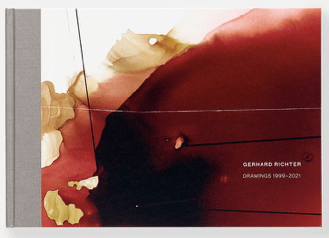
Another Richter, this time Gerhard, was the subject of the book I selected in the CSM library during our small group visual exercise.

In my wanderings I first came across this book and was intrigued.

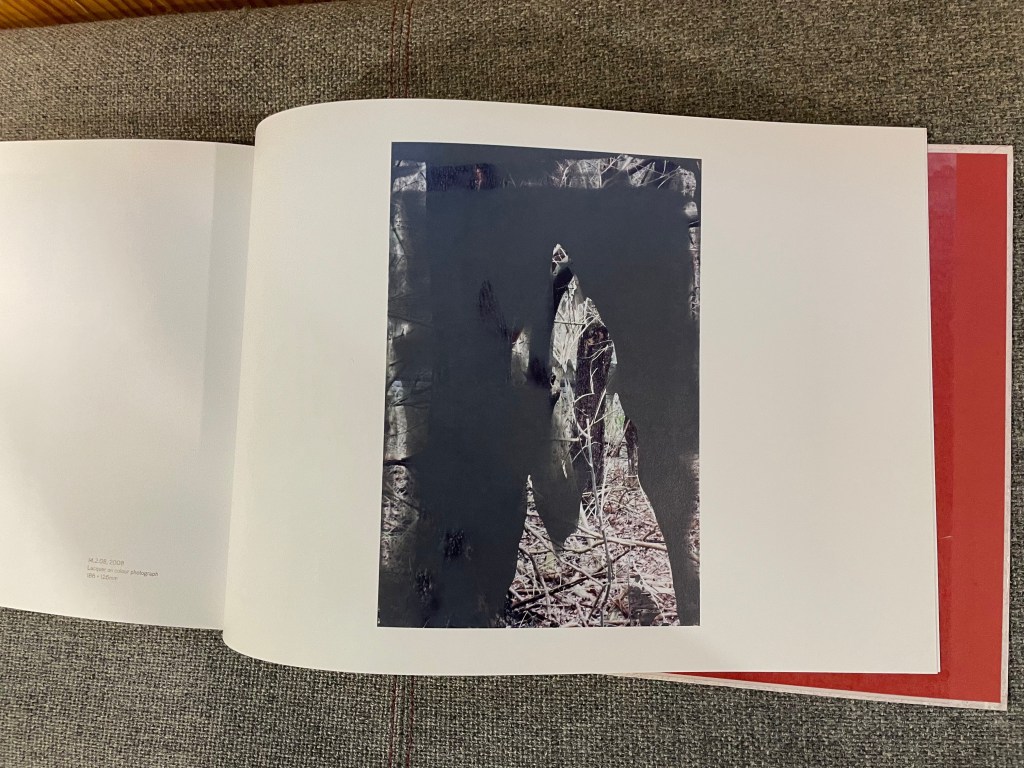
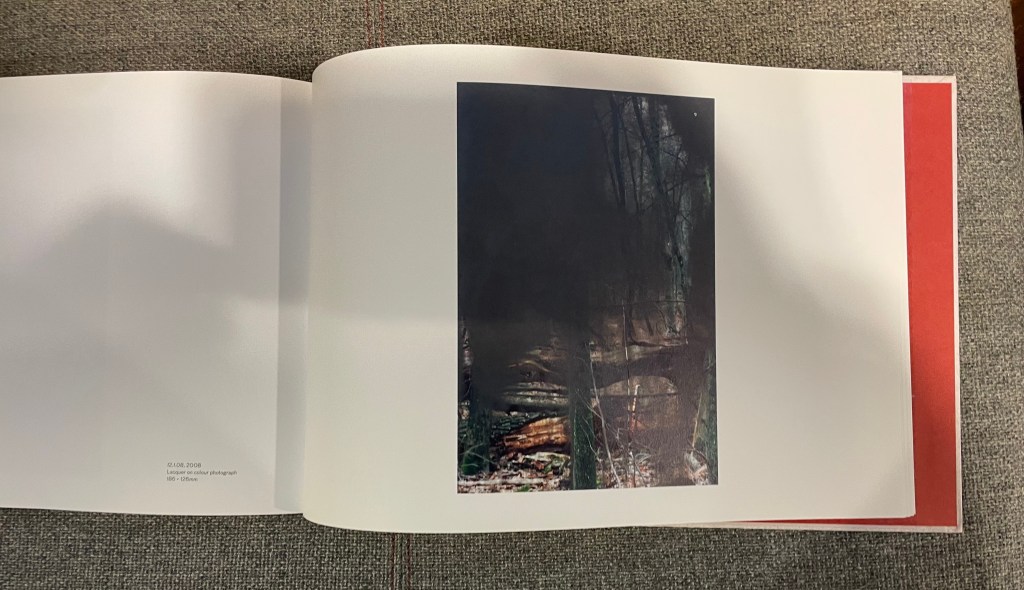
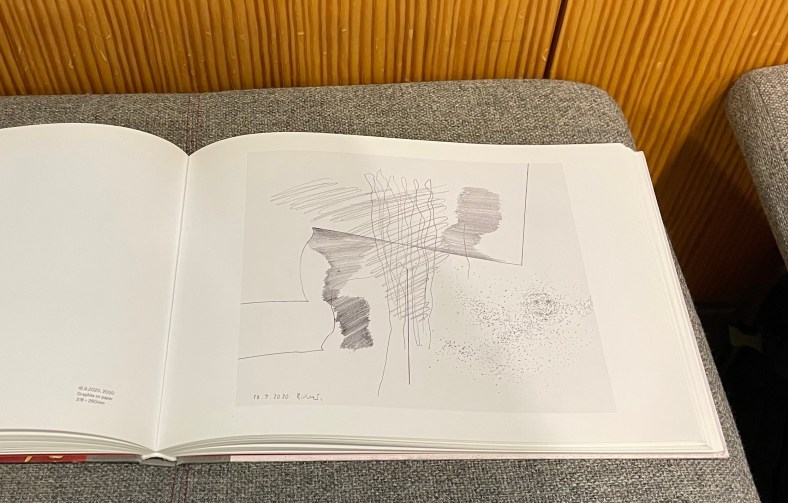
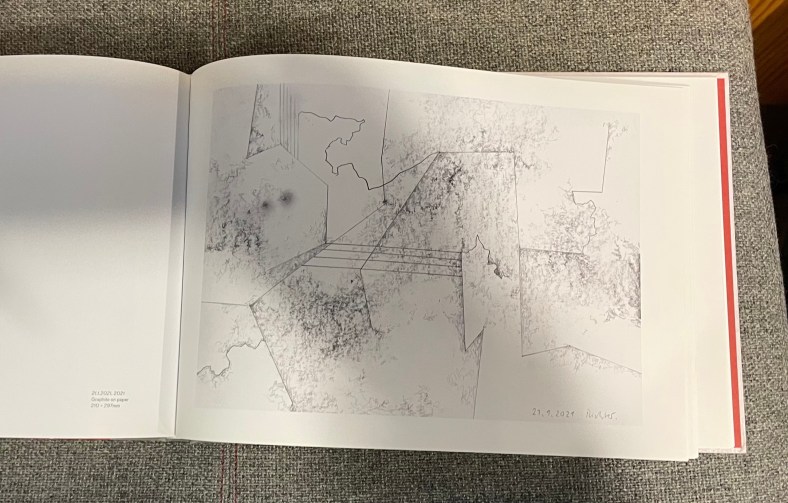
I had decided to pick the second book along from the first artist I recognised beginning with ‘E’. I was drawn to the spine, but put it back, abandoned my plan and walked on into the ‘R’s. I like Richter’s blurred images, but this book – and would you believe it, I forgot to take a photo of it – includes recent drawings and photographs with lacquer.

I particularly like the last drawing which includes what looks like frottage to create texture. They are less than A4 in size, in stark contrast to his huge canvasses of colour.

Having just done a quick search in the online library, I’m 99% certain that this is the book.

Where Do We Go? Where Do We Go Now?

Apparently, Guns N’ Roses didn’t know how to end their most successful song, Sweet Child O Mine. Whilst in the recording studio, Axl Rose reputedly started singing, ‘Where do we go? Where do we go now?’ And the rest is history and, in my humble opinion, probably the best bit of the song.

So a moment of inspired creativity can come from a total lack of direction and confusion. Here’s hoping…

I’m resolved to wallowing in the myre of confusion. There’s not much point in fighting it; I can’t understand everything. The latest book we read in my book club was Michael Ondaatje’s Coming Through Slaughter. I’ve never read a book like it. It deals with the mental decline and eventual death of the New Orleans cornet player, Buddy Bolden, who is considered to be the father of jazz. I didn’t understand what was going on half of the time, who was talking, and to whom. It jumped around all over the place. There aren’t any chapters as such, just three parts, no speech marks and paragraphs end at odd points on the page and continue on the next – visually it is striking. It is a book to be read, not to be listened to; its format echoes the improvisation and syncopation of jazz music. Once I had decided that perhaps I wasn’t supposed to understand it and just went along with it, reading each phrase and word in its own right, looking at the patterns, and the sounds of the words, a bit like reading a poem (after all, Ondaatje is a poet), I got a lot more out of it.

So this is how I intend to move forward. And it’s just as well, because try as I might to keep up with the constant flow of information being offered up by Paul in the Low Res etching workshop, I just couldn’t. I started taking notes, but just gave up in the end and surrendered myself up to not understanding anything and just enjoying being along for the ride.

It kicked off with Paul showing us what we could have gone home with, had we the requisite skills. There were some impressive prints which demonstrated the versatility of printmaking which I hadn’t really fully appreciated until now.

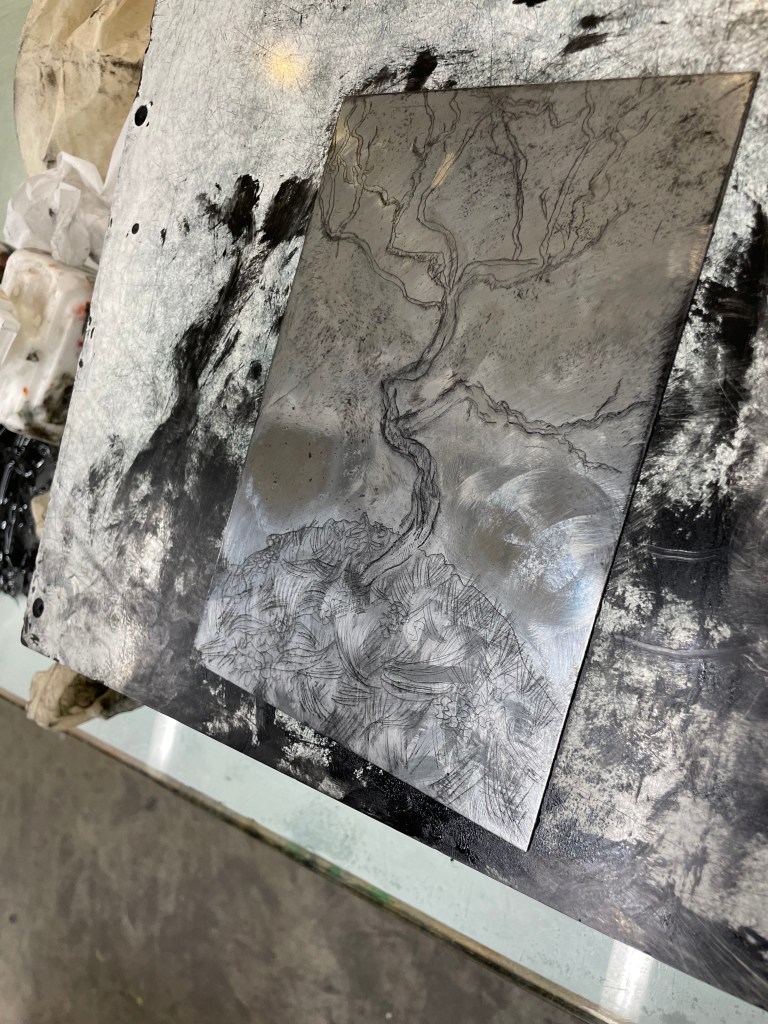
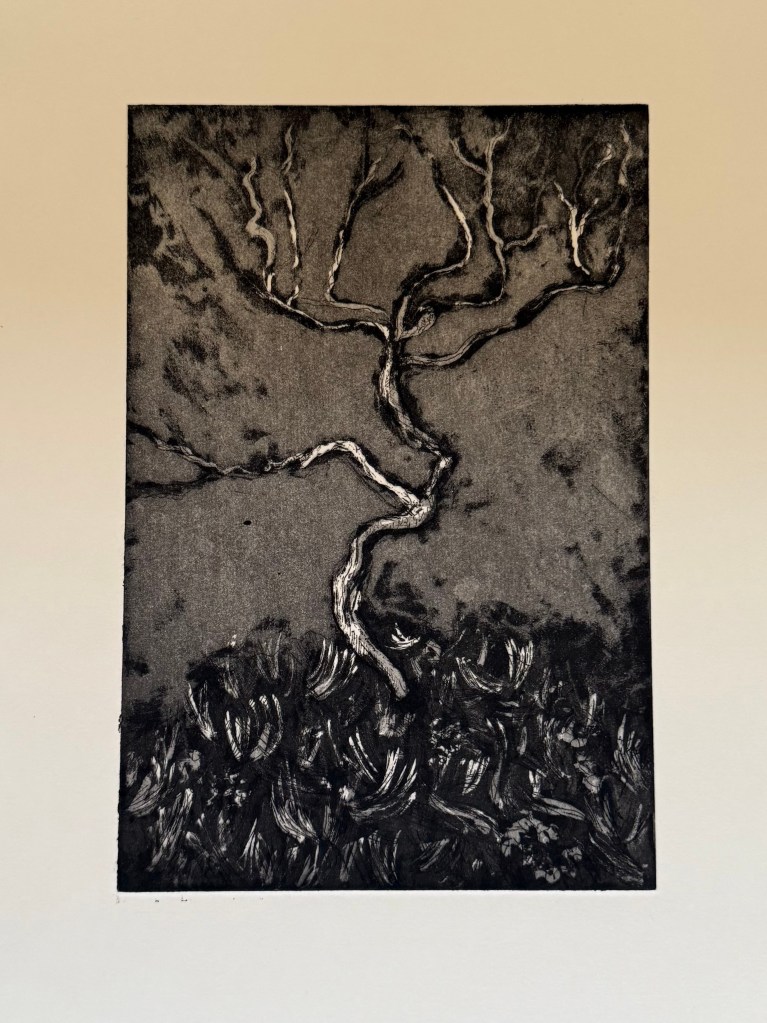
We started off by putting down a hard ground on a zinc plate and then we had about 20 minutes to create the image using a selection of Paul’s tools. What to do? I had a quick look on my phone and chose Schiele’s Small Tree in Late Autumn.

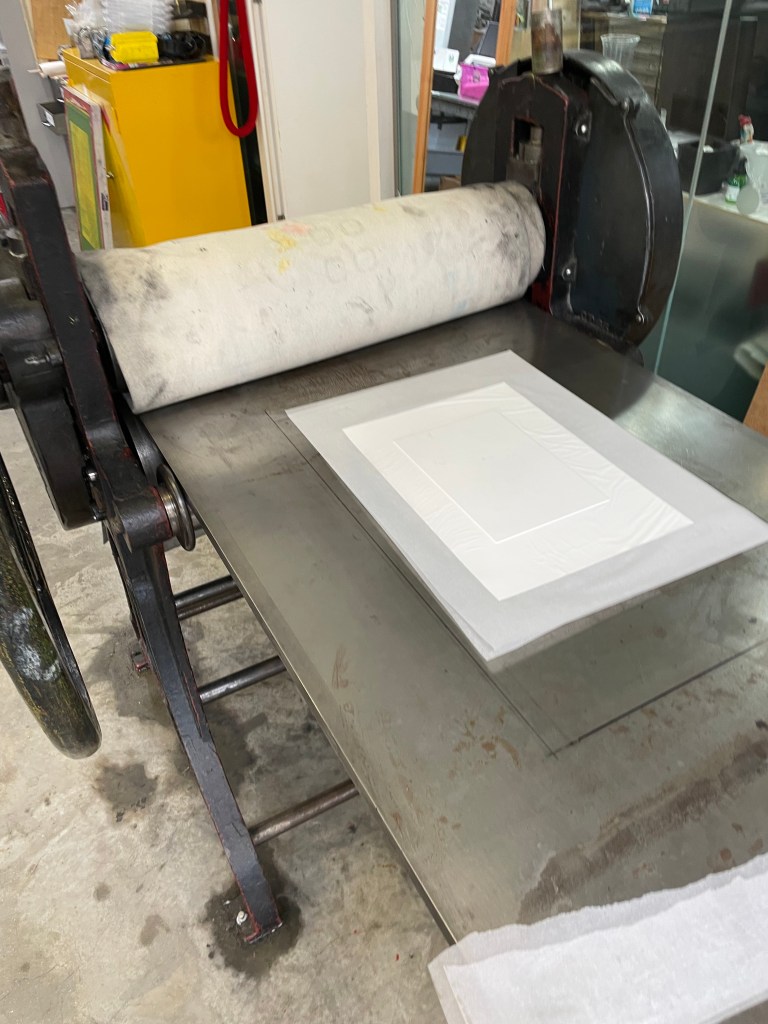
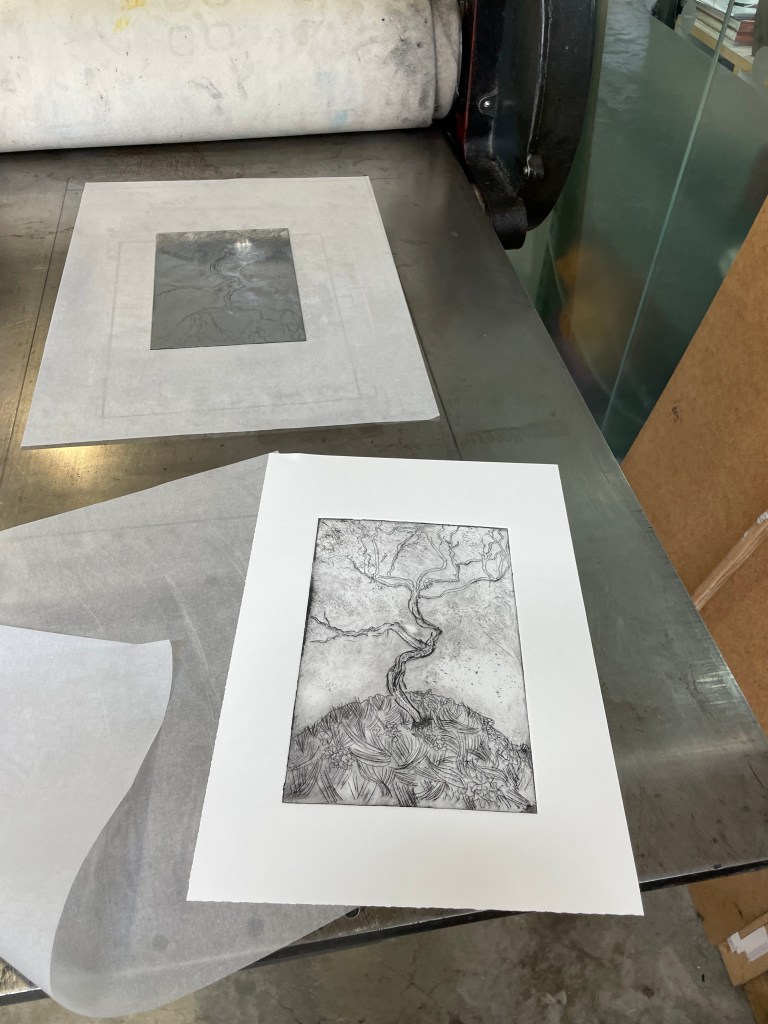
This is the plate once the hard ground had been removed and it had been cleaned followed by the printed images, using aquatint on the last one.

How do I feel about them? Pretty good bearing in mind I only had 20 minutes to create the plate and I had very little idea what I was supposed to be doing most of the time. Will I do it again? I don’t know – it’s very process driven, and whilst I love the excitement and anticipation of the big reveal, I’m more of an instant gratification kind of person. That’s not to say that I’ve ruled out etching altogether, it’s just that I would need a greater understanding of the different and quite complicated steps involved to do it any justice, and that’s just not compatible with the ‘new me’ at the moment.

Keep Making Art!

In this week’s session, as preparation to discussing the impending research paper, we discussed the value of writing for artists. For me, it is a way of organising my thoughts and recording my decision-making so that I can look back and remember why I did what I did, also allowing me to identify any patterns in my way of working or thinking. It also allows a breathing space to step back, to reflect and evaluate. The process of writing often triggers the development of existing thoughts as well as generating new ones. It is also another means of expression; sometimes writing about something provides inspiration as to how I might convey an idea; I often find inspiration from other people’s writing (Parental Loss I Motherhood I); and sometimes writing is the only way to express something, Three Conversations With My Mother. It is an invaluable process.

Jonathan then asked us to spend some time thinking about what is intriguing us.

I have been thinking a lot lately about a conversation I had with Lyberis on the last day of the Low Res. We were in the bar discussing the talk with Jeremy Deller we had just been to, and also the Whitechapel Library audio walk by Janet Cardiff we had experienced in the morning. We had both been blown away by it. I’m trying to understand why it excited me so much; possibly because there was an element of immersiveness, but at the same time I was aware of what was going on around me both visually and audibly; being both removed from and in my surroundings simultaneously was a really interesting experience, particularly when what I was hearing synced with what was actually going on in the real world, like the sound of a moped, just as one went past. The section at St Botolph-without-Bishopsgate was fascinating as she describes two men, one in blue, sitting on a bench, and there actually were two men sitting on a bench chatting. If I had been them, I would have felt unnerved by 20 odd people all sitting down in silence and then getting up and leaving at the same time. It was difficult to work out what was going on. It seemed to be part detective drama, that we were with her looking for someone, as well as a collection of memories, and then, when we reached Liverpool Street Station, she theoretically abandoned us to find our own way back to Whitechapel to return the discman to the library, presumably relying on our memory. It’s just as well they were downloadable files!

But this got Lyberis and me on to talking about memory; how we are made up of our memories; but what if the memories are incorrect or false? I started thinking about how what I am doing is based solely on my memory. My memory is fallible, even photographs are open to interpretation, as we discovered in one of our previous weekly sessions. What if I am my own unreliable narrator? Even if my memories are factually incorrect, if I have a strong emotional response associated with something, surely that can’t be wrong? Is emotion the only true memory? Even if my memories aren’t correct, does that make them any less true to me? And then I was listening to the news on Radio 4 the other day and they mentioned that the writer, Mario Vargas Llosa, had died – he believed that novels should present lies as truths. This gives rise to the possibility that I could even invent my own history.

After taking us through the ins and outs of the research paper, Jonathan raised the issue of AI. He said he uses it to have a dialogue, to challenge his thinking. I’ve used it to critique a piece of work. I came across this article in the Guardian yesterday morning about the artist, David Salle, who has turned to AI to breathe new life into old paintings which hadn’t been rapturously received ‘I sent AI to Art School’.

Will The Real Alex Schady Please Stand Up?

I’ve always thought it a good idea to try to see the world through someone else’s eyes, but perhaps misappropriating Alex Schady’s glasses during our collaborative making workshop wasn’t the best way to go about it, although I’d love to see the world the way he does! I imagine that it would be a lot like the experience I had in the Apple Store the other day when I accompanied my daughter who was buying a new laptop. Whilst she was doing her thing, I wandered over to the table with the futuristic looking Vision Pro headsets. Did I have time for a demo? Hell, yeah!

Apparently someone very technically minded in a back room somewhere was building my device for me based on my head size and glasses prescription, and then out it came ceremoniously offered up on a velvet cushion for my delight. Well, an hour later, having held a butterfly on my hand, walked with a tightrope walker across a ravine, ducked to avoid the flick of a dinosaur tail and had VIP access to a Metallica concert, I rather reluctantly removed ‘my precious’ and handed it back. My cheeks hurt through the stupid grin which must have been plastered all over my face. According to my daughter, I had turned into a child and had been making quite a lot of noise which had attracted quite a lot of attention. All the way home I was considering what I might sell to raise enough money to buy one. But then reality set in; I’d never go out of the house again, and would be destined always to watch films by myself (hang on, is that such a bad thing?). But it turns out that it’s had some mixed reviews, and so I resolved that I could spend the money I had saved by going on a nice holiday, and try to get my hands on one of Alex Schady’s spare pairs of glasses instead – he has quite a few apparently because he keeps on losing them. I wonder if he ever walks past someone and thinks, those glasses look familiar.

Until then I’ll have to make do with his fascination with holes. All sorts of holes; sink holes, caves, the holes the Road Runner used to fall down, black holes, white holes. He explained that the thing about holes is that they are defined by what is around them rather than the hole itself. Thinking about it, generally speaking, a hole is the void where something used to be. I have a hole somewhere inside me. I don’t know what used to be there, but I find myself trying to fill it with food, rubbish food, even when I’m not hungry and particularly when I’m bored. The thing is, I know that it’s a hole incapable of being filled, and that I’m not doing myself any favours in terms of my health whilst I engage in such a fruitless activity, but, nevertheless, still I try. I once told a counsellor, who was helping my daughter with her needle phobia, that I thought that my brain was trying to kill me. I could see the pound signs light up in his eyes.

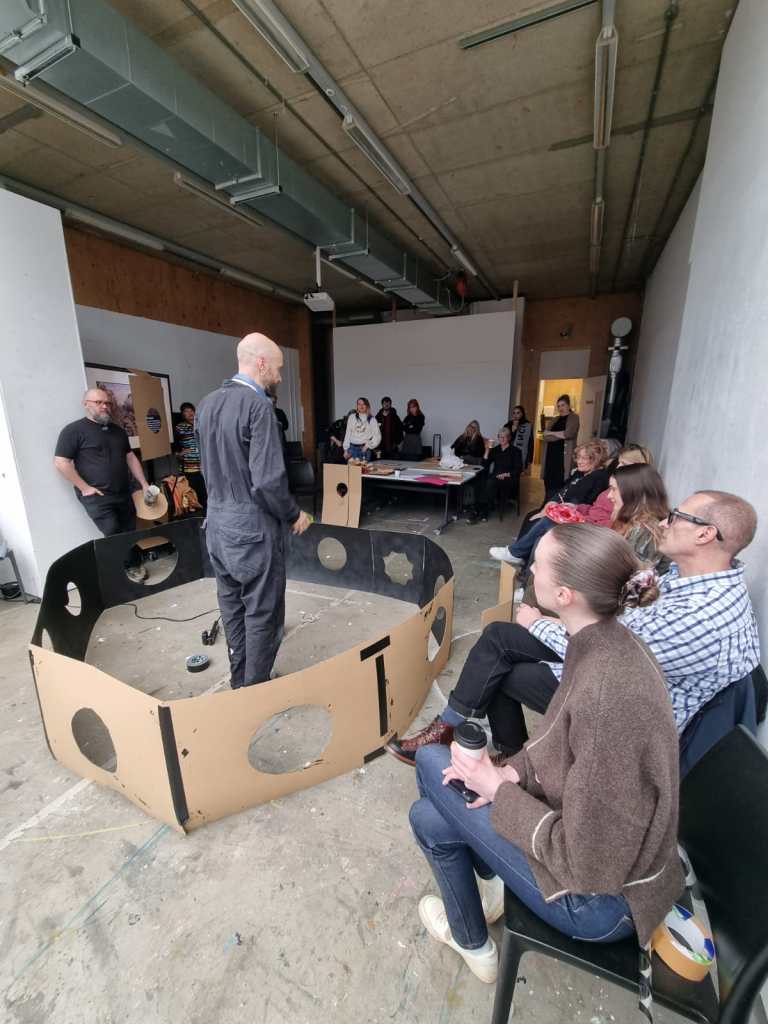
So, Alex got us to cut holes in some card and took us off into the outside world where we stopped still, on his bell, and focussed on what we could see through our differently shaped holes; a lot of perplexed passersby and the fruit and vegetable section of Waitrose. It became something close to a performance, and I half expected some members of the public to whip out their cardboard holes and join us. It’s interesting how masking the extraneous can make you notice more details which perhaps you wouldn’t notice in the round. I found myself slightly adjusting my hole so what I could see through it became more compositionally pleasing.

Then it was back indoors where our holes were repurposed by being joined together to form a circle and painted black. We then had to make something which would move inside the holes as Alex filmed them from the inside using a small turntable.

I forgot to photograph my piece which was a circular piece of card with tissue paper and a length of finger-knitting glued onto it in a spiral to represent my oesophagus, which I was going to spin around on a pencil. A strange choice, I agree, but I had just been talking to Zoë (to whom I owe thanks for allowing the use of her photos from the day) about recently having had an endoscopy. I’d been experiencing a sensation of having a lump in my throat for a while, and Dr Google had diagnosed it as being globus, which is a common side effect of reflux, but the GP didn’t necessarily agree and decided, in light of my family history of oesophageal cancer, that it was better to be safe than sorry. I told them to give me all the drugs they had, and all went fine (turns out I have a hiatus hernia) although I do remember seeing inside myself at one point which was ever so slightly weird. Zoë and I agreed that I should get hold of the images by making a data access request to see if I can use them in my work.

The last activity of the day was to make a cardboard structure which was to have a phone at one end and, at the other end, an image with a hole cut out of it. The trick was to get the distance between the two just right so that neither the image nor what could be seen through it would be out of focus, which proved to be quite difficult. We then went out onto the roof and did some filming for one minute. I filmed using one continuous take – it didn’t really cross my mind to pause and change focus. Thinking about it now, this meant that the decisions I made as to where to go next were determined solely by what I could see through the camera and not by extraneous influences. Rather than moving from left to right, I think, in retrospect, it would have been more effective moving in the opposite direction which would have created a relationship with the image itself, as if the figure is being thrown off balance by the movement.

Developing this idea further, it would be possible to see, quite literally, through someone else’s eyes. In this respect, Sophie chose an image in which a model was wearing sunglasses, which she cut out, which was ingenious.

All in all, a super-charged day which has provided lots of food for thought.

Six Degrees Of Separation

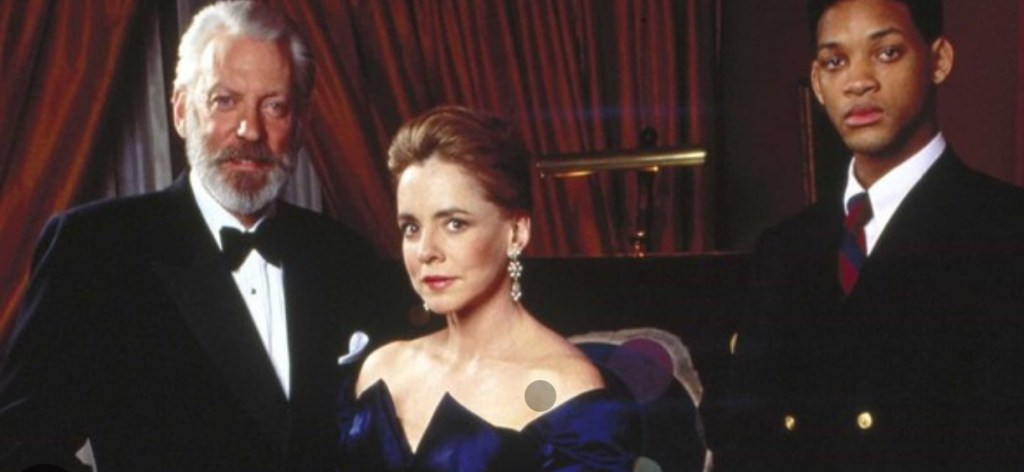
Image: http://www.justwatch.com

In the film Six Degrees of Separation (based on the play of the same name written by John Guare) one of the main characters, Ouisa Kittredge played by Stockard Channing, says:

I read somewhere that everybody on this planet is separated by only six people. Six degrees of separation between us and everyone else on this planet. The President of the United States, a gondolier in Venice, just fill in the names. I find it extremely comforting that we’re so close. But I also find it like … water torture that we’re so close because you have to find the right six people to make the connection. I am bound, you are bound, to everyone on this planet by a trail of six people. It’s a profound thought… How everyone is a new door opening into other worlds.”

I don’t think I agree with her that it’s comforting to be that close to the President of the United States, or to many other people who live in this world of ours, for that matter.

The film was made in 1993, more than 10 years before the advent of social media, and so application of the theory would be dependent on your level of knowledge of the networks of friends and acquaintances. It was a fun game to play when we didn’t have anything better to do. I once got to Nelson Mandela in 4, Edward VII in 3 and perhaps most impressive of all, Ant & Dec in 2. In the age of social media it’s definitely a lot easier, and research carried out a while ago by Meta suggests that, certainly in terms of social networking, the number of degrees is probably closer to 3.5.

But, yes, connections are important and they enhance our lives and can be discovered in the most unlikely of circumstances. Unexpected connections can provide comfort that the choices we have made are the right ones. Who would have thought that even if I wasn’t on this course I would still be able to connect to Jonathan in 2? I just wouldn’t know it.

There are connections which become long-lasting and develop into relationships, and those that stay transitory. On my first night in London for the Low Res, I was having dinner in a restaurant near to my hotel, trying to make some headway into Stephen Fry’s Mythos but getting terribly distracted people-watching. A couple came in and sat at the table next to me. The woman saw my book and asked me whether it was his latest. One and a half hours’ of non-stop talking later, with the restaurant staff clearly eager to close up and head off home, we said our goodbyes never to see each other again. He was a lawyer with a keen interest in Roman civilisation and Greek mythology, and he would read books to his wife in bed (each to their own). I told him my story and encouraged him to embrace his passion and seize the day. He won’t, but that doesn’t matter because we talked about anything and everything connecting on so many different levels, but sometimes that’s all it’s destined to be, a connection in a moment in time.

I have been able to make even stronger connections with the majority of my course mates having now met them in person and spent hours in their company. We did a lot of travelling and walking over the course of the week which was a great opportunity to chat with everyone including the second year students who imparted some really helpful advice. It was a strange experience meeting people who I have seen on Zoom every week – would greeting them with a hug be appropriate?

It was an amazing time spent with like-minded people. I spent hours chatting about life and work with Rebecca who is such good company. She was explaining how each piece of her work is influenced by one of her stories (one of my favourites being Maureen and the Pope) whilst we were on our way back to CSM on the tube one day, when I noticed a young girl sitting opposite us holding a camera in her lap absolutely transfixed by Rebecca. After a couple of stops she got up from her seat and moved to stand next to Rebecca (who later confessed to being slightly worried that she was going to ask her to give up her seat because she wasn’t feeling well). She then rather apologetically explained that she couldn’t help but listen to what Rebecca had been saying, and that she found it really interesting as she is doing an Art A level and has had difficulty in finding focus in her work. The conversation continued for several more stops, up the escalators and through the tunnel until we parted ways. Another connection for just a moment in time, but hopefully one which was inspirational.

Sorry, Are You Talking To Me?

I’ve decided that I’m probably learning far more about myself by simply being in this process than I am by looking back on my life.

I need to retrain my brain. My legal training has made me focus on detail, anticipate every possible eventuality, dot every ‘i’ and cross every ‘t’ all within a rigid framework of rules and regulations. That way of thinking served its purpose then, but it now stultifies creativity.

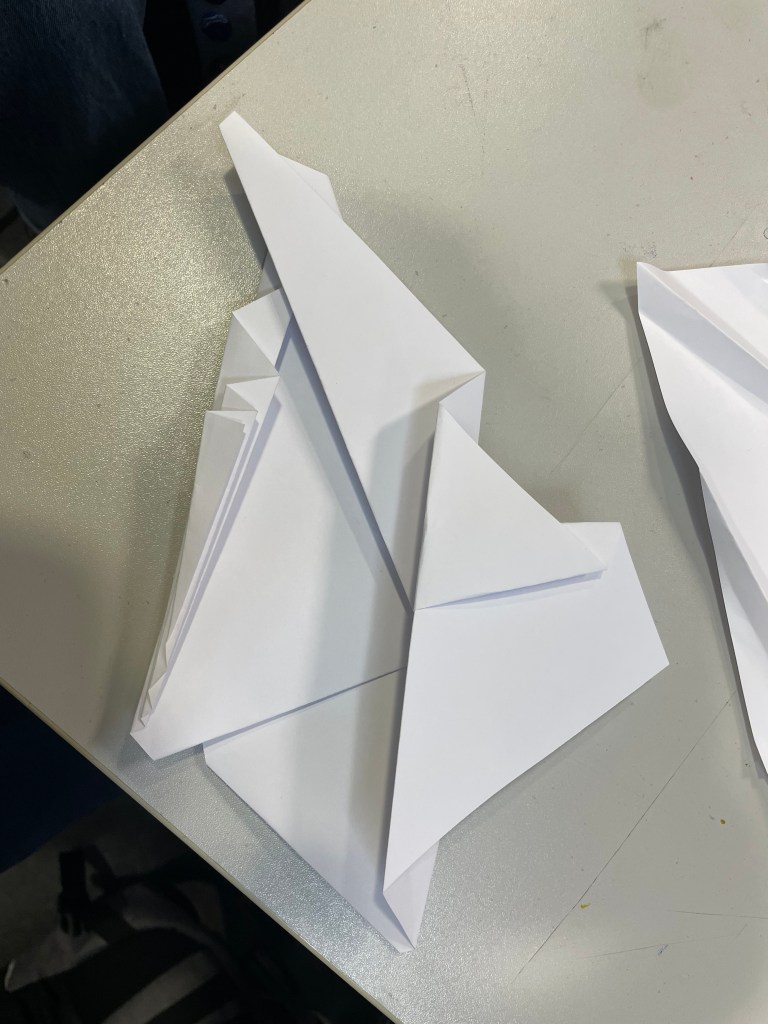
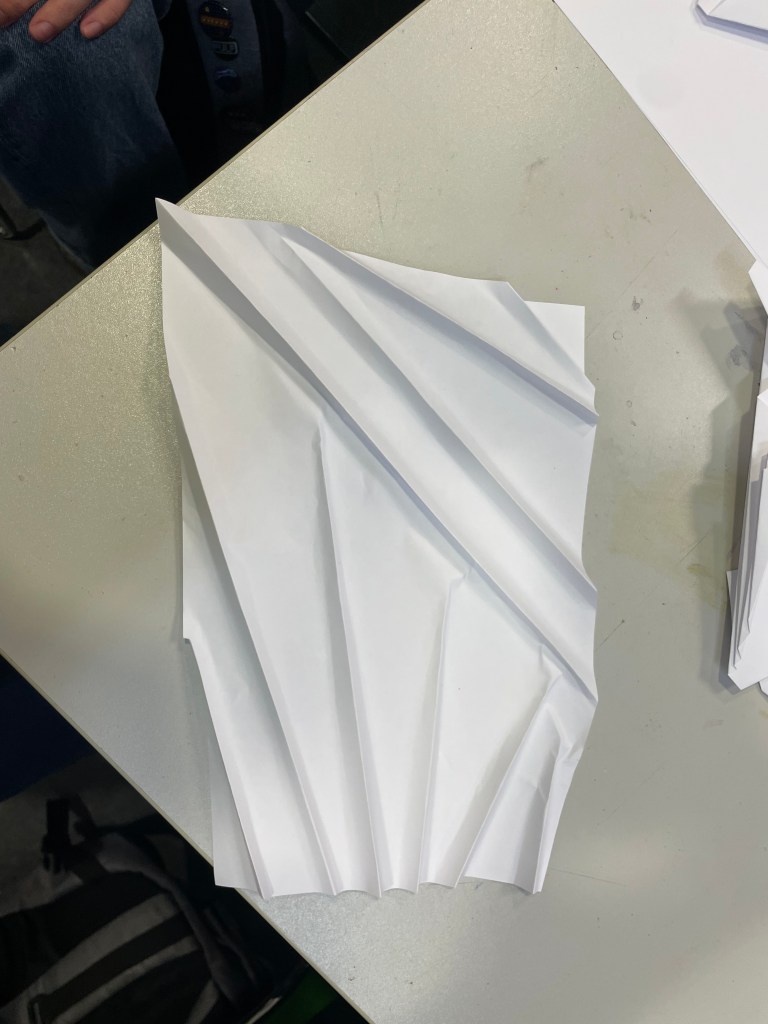
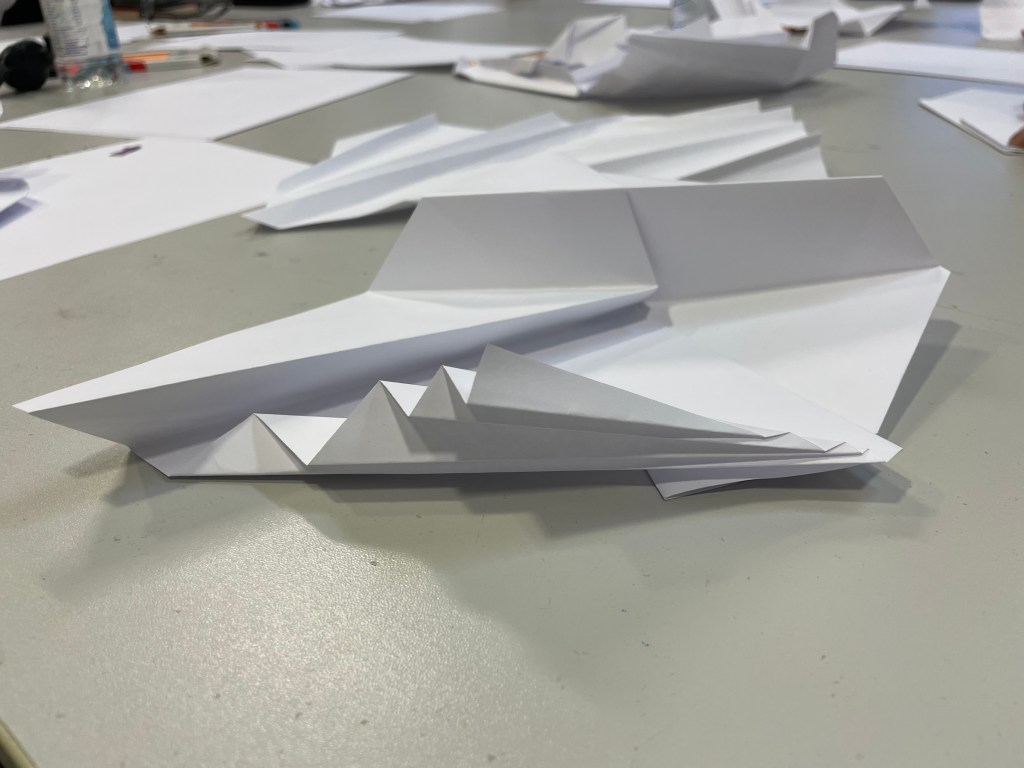
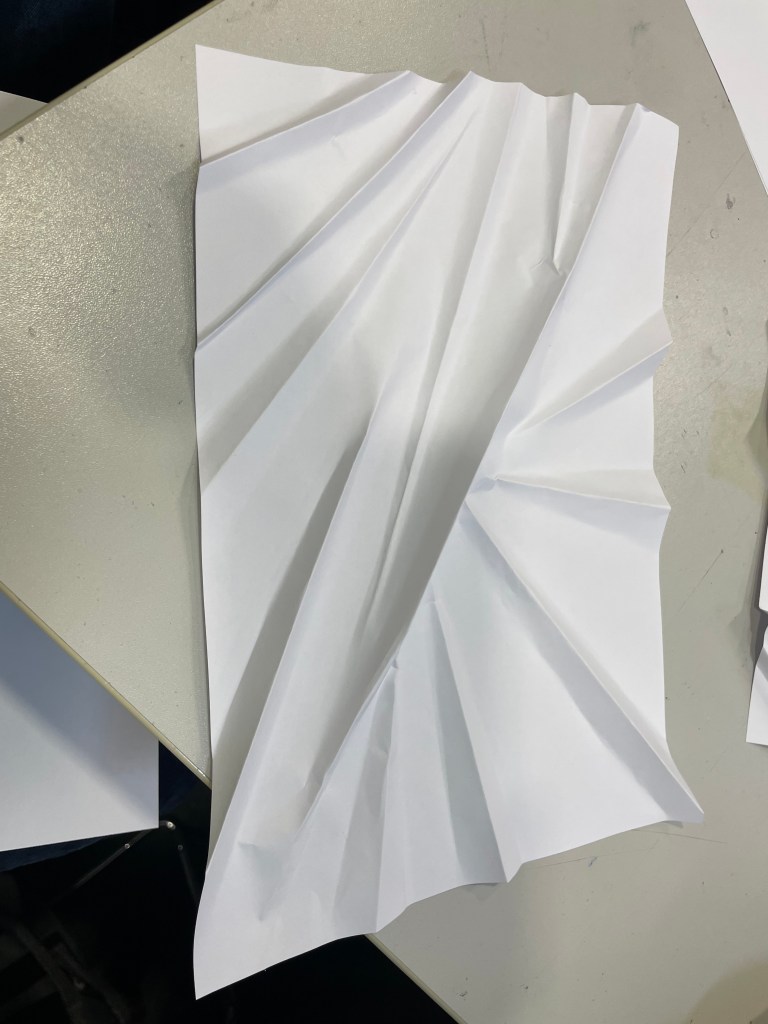
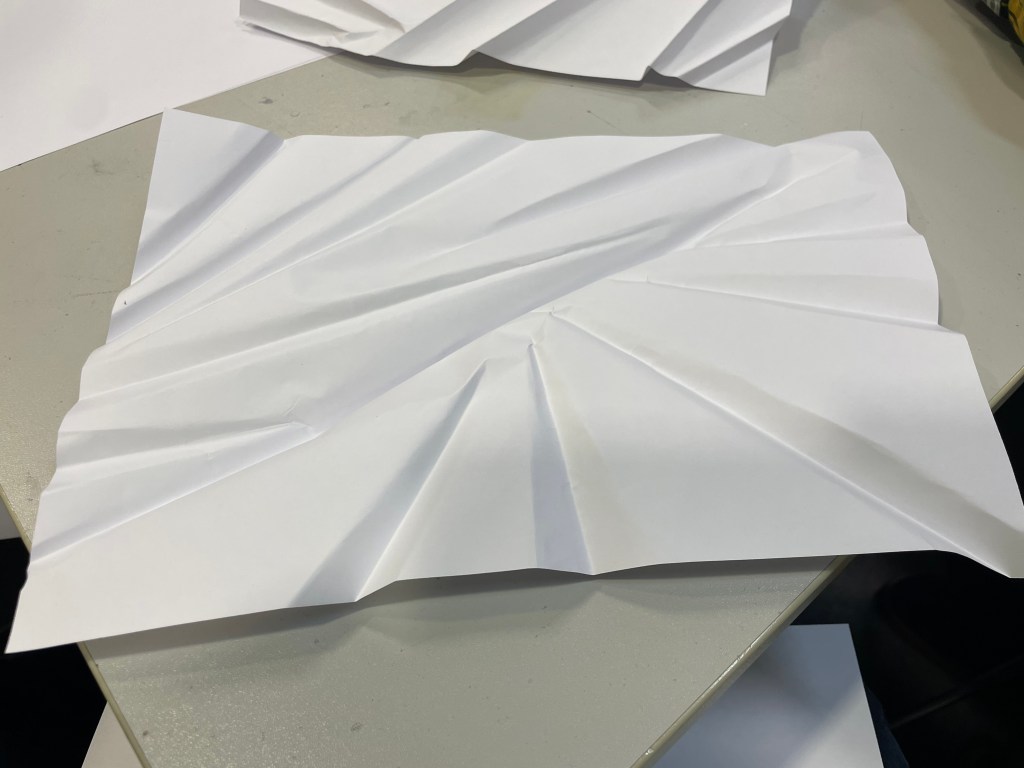
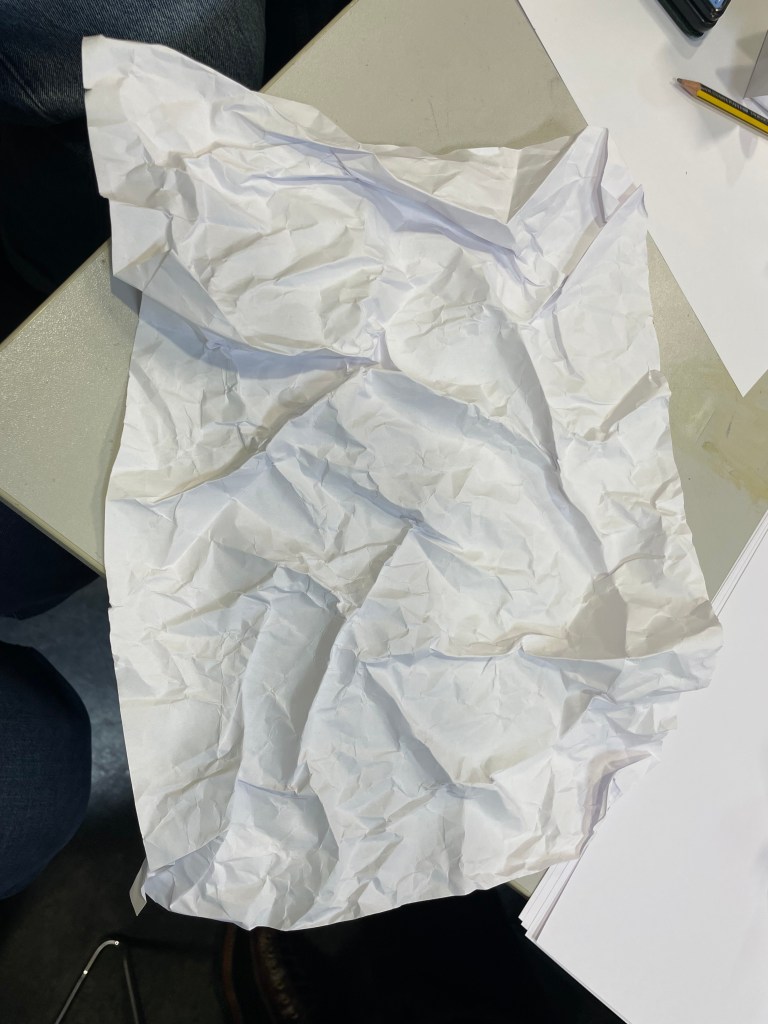
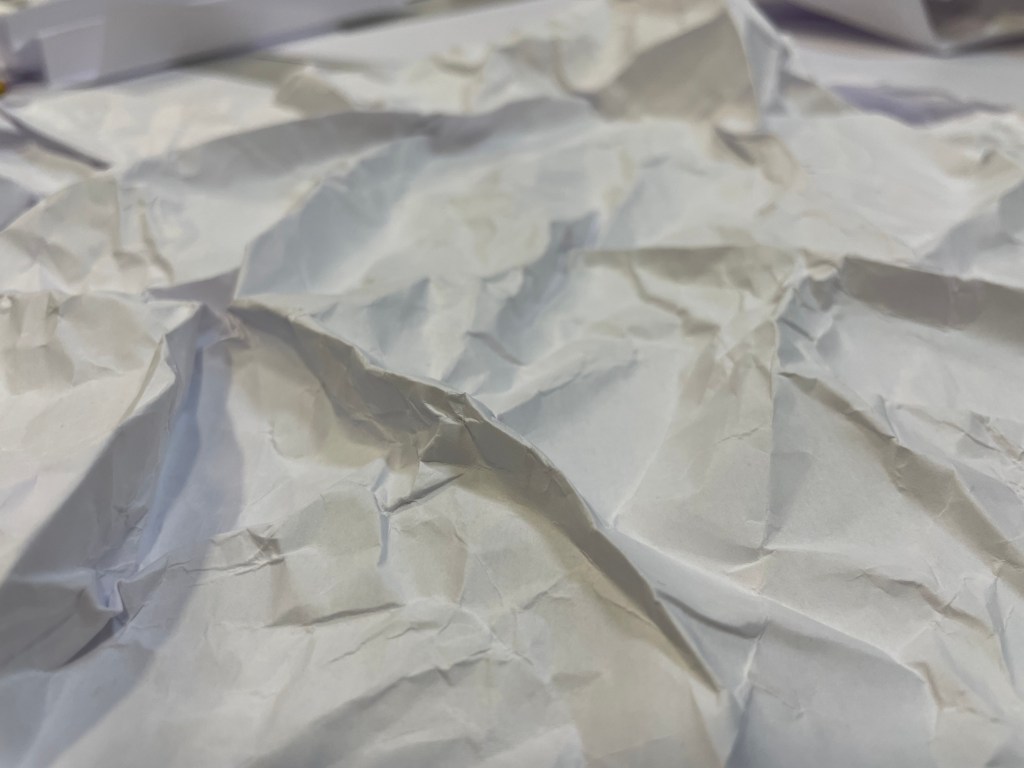
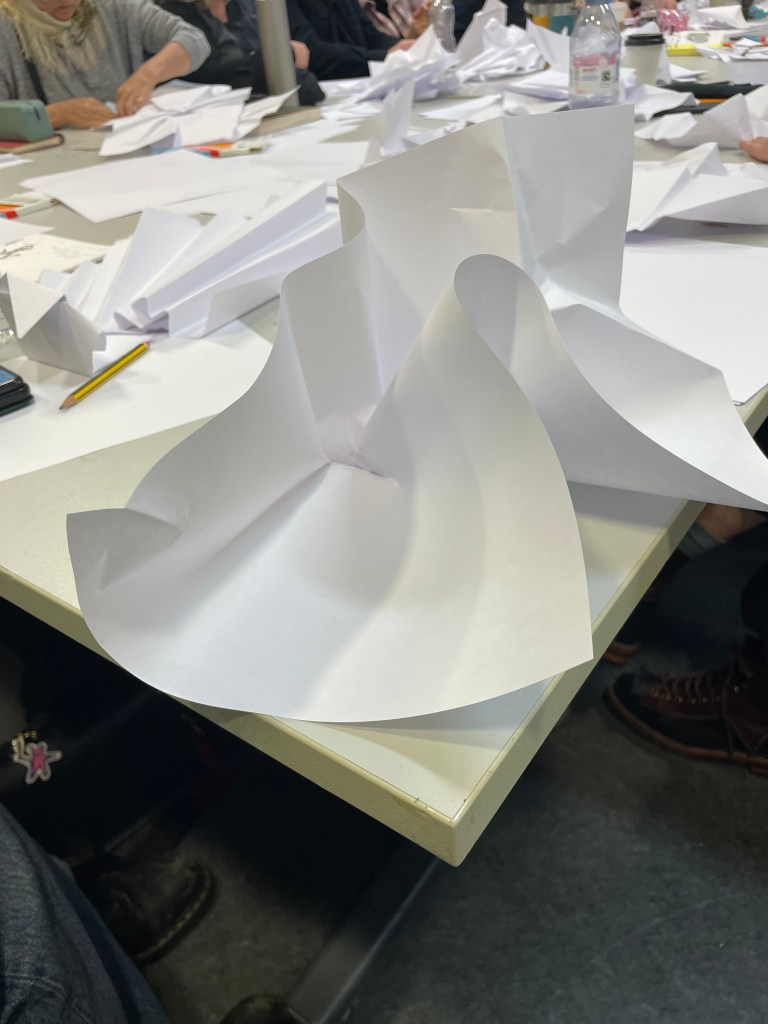
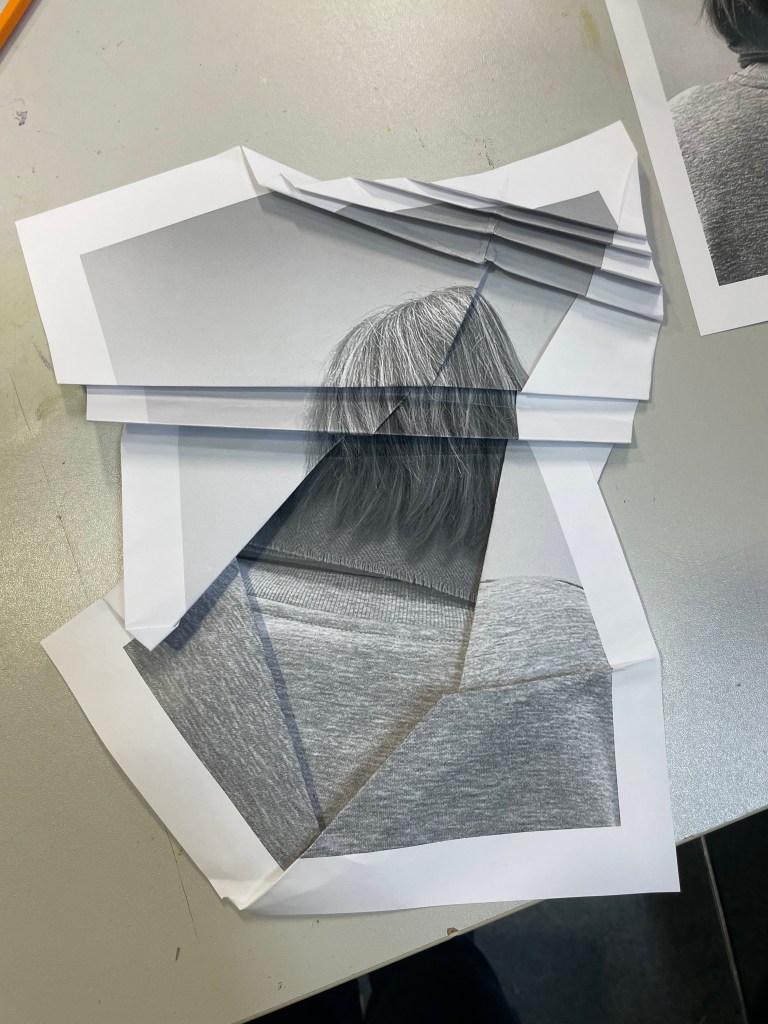
When I’m in a scenario which is unfamiliar, I like to know the parameters within which I’m expected to navigate; quite often I feel discombobulated when things don’t go the way I am expecting, the paper workshop with Christian Azolan being a case in point. We were instructed to fold the paper. To my pedantic mind, folding involves a deliberate act of bending something over on itself to create a clearly defined edge. It doesn’t include scrunching. But once I had overcome my initial confusion and accepted this unexpected variation of the parameters, I enjoyed myself.

I definitely preferred using the blank paper – I don’t know what brand it was, but it felt really good. It led me to confess my fetish for pristine white paper to some of my fellow students. I think it stems from being at primary school when the teacher would write my name on the front of a new exercise book with a marker pen and I would go back to my desk and give it a good sniff. I now appear to associate blank paper with a solvent high. I don’t think that my school ever had a pupil who was so keen to man the stationery cupboard at break time. In fact, I used to get palpitations and a bit of a sweat on just walking into WH Smith (R.I.P).

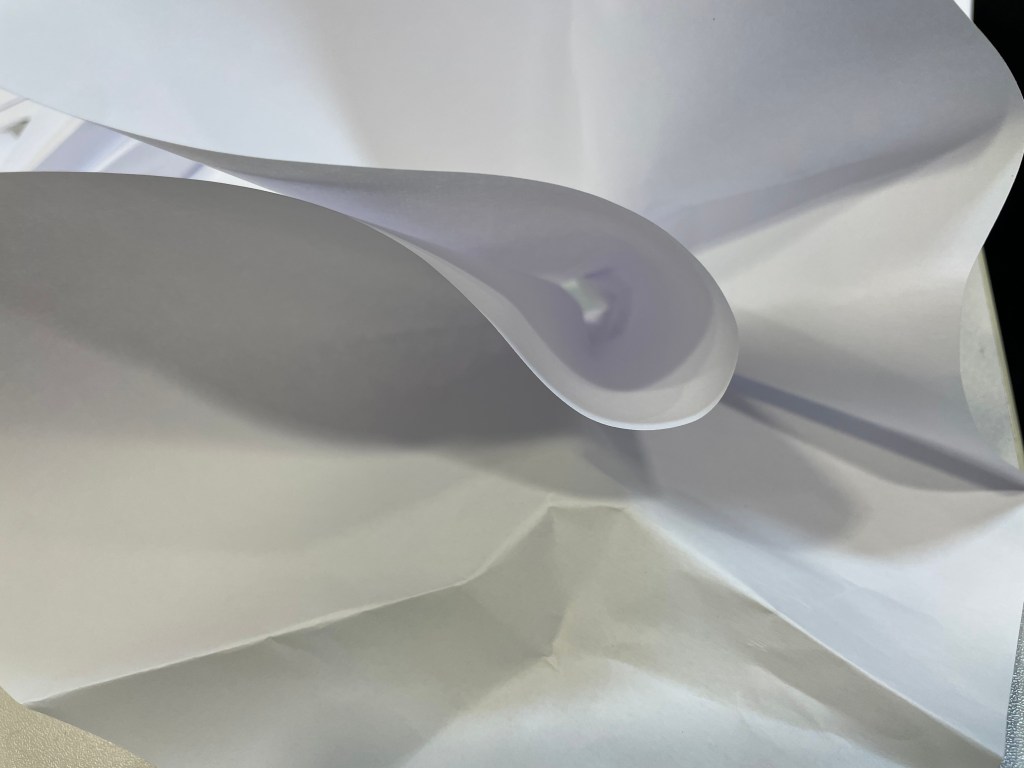
Working with the blank paper seemed to allow more freedom and I liked that the results took on a sculptural quality. The effect of the folding on the reverse of the paper was equally, if not more, interesting at times than the right side; areas which were peaks on one side became troughs on the other and vice versa.

I felt inhibited using the print of the back of my head; I became too concerned with the resultant image which seemed to impose restrictions on how I folded, so maybe I like clear parameters, but not too many of them? Also, the effect is less sculptural than when using the blank paper; the areas of shadow are less apparent and the focus shifts to the distortion and concealment of parts of the image rather than the creation of form.

We then went on to do some linocutting – it seemed a bit incongruous with the folding activity, but nevertheless we all launched into it with equal enthusiasm.

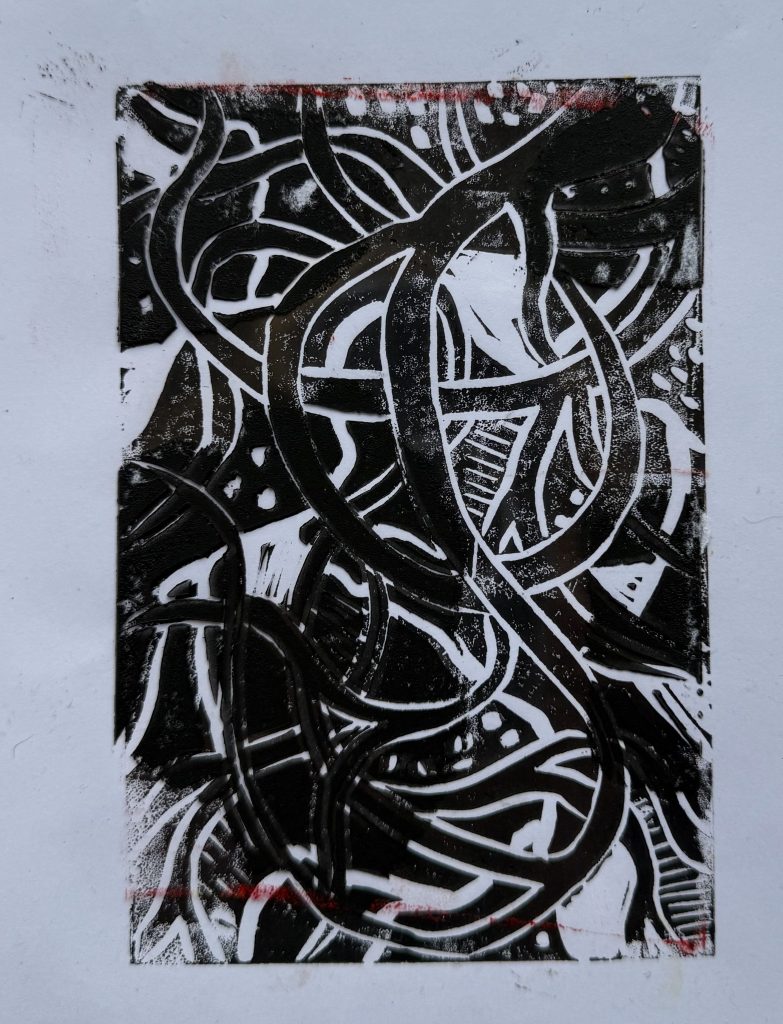
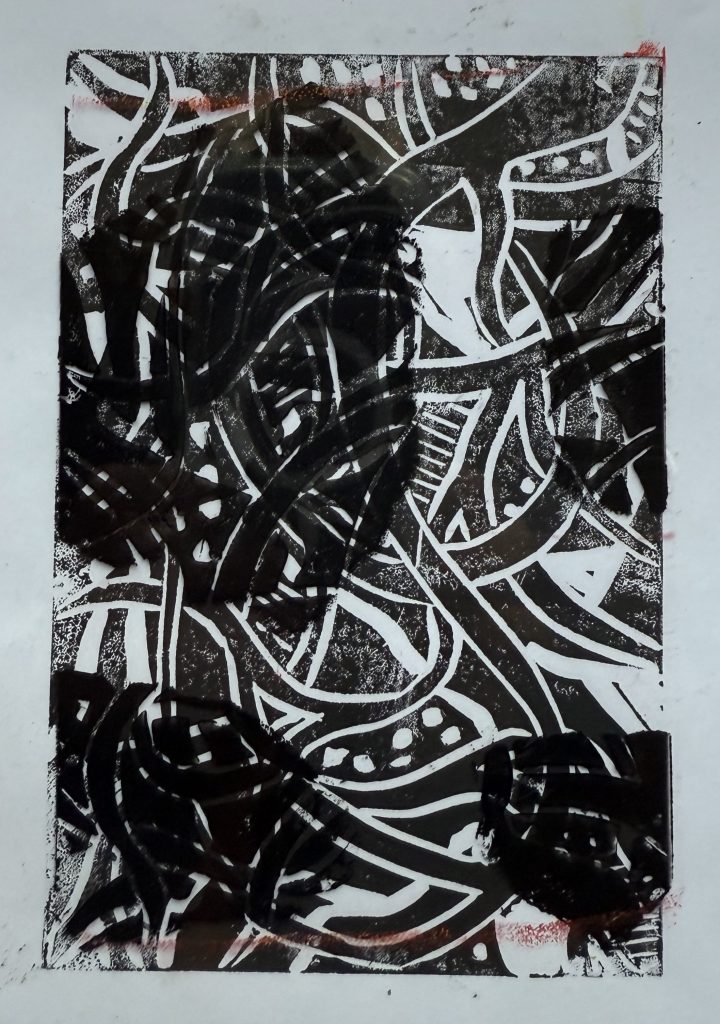
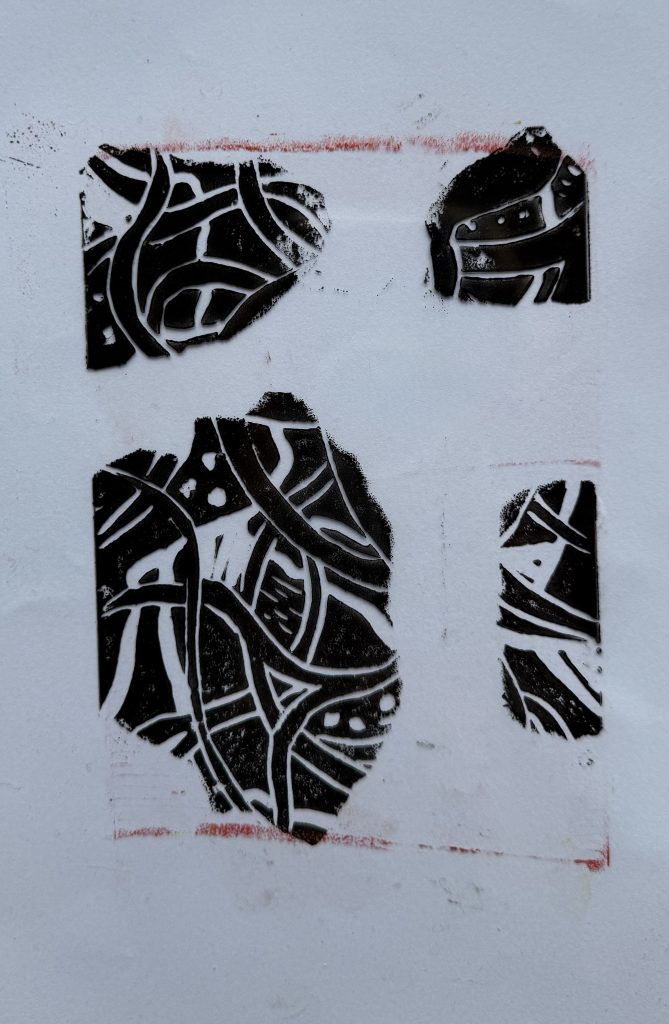
I prepared two linocuts; one inspired by tree roots and the other a reduction linocut of an abstract shape – I printed it using yellow ink first, then cut away more lino and printed using red ink.

I also printed the tree roots image on a transparency, having torn up bits of paper to create a random mask. It is interesting to see the effect of overlaying it with the two prints; how it creates a sense of discord on the prints where it’s not in sync with the image below, and how it creates areas of intensity on the print over which it lines up.

As I was taking my lino into the next door room to print it, Christian heard me reminding myself as to what I was planning to do. Sorry, are you talking to me? No, just myself. Doesn’t everyone do that? Yes, of course. When I went back in to print my second lino, I asked him how long we had left. Sorry, are you talking to me?…

Out Of Sorts

I haven’t done anything since coming home from the Low Res.

There was an intense period building up to it, followed by a period of sitting back and taking stock. I’m still thinking about it all, but whilst doing so I’ve allowed myself to get sucked back into domestic life. My daughter’s now home from uni for a month, along with all her ‘stuff’. Whilst it’s lovely that she’s back, it’s upset the normal way of things. Glasses and crockery disappear into the blackhole that is her bedroom, and the bottom of the stairs has become a footwear hotspot. Could be worse, I suppose.

Also, one of our dogs, Monty, hasn’t been so good. He’s an old boy at 12. Enlarged prostrate, chemical castration, hormonal inbalance making him not himself, and removal of a malignant melanoma. Waiting to talk to the vet about prognosis. I suspect there may be trouble ahead and difficult decisions to make. He’s out of sorts. We’re all out of sorts. But tomorrow’s another day.

I haven’t made anything. I am conscious that I haven’t and it’s starting to stress me a bit. My last two posts could have been cheerier, but there’s no point in putting on a fake smile. My colours are definitely muted at the moment. I feel like I’m stuck and I can’t progress until I’ve managed to process and order all that I took away from the week in London, but up until now I haven’t been able to set aside the time to do it. Also, my logical side dictates that I should deal with it all in chronological order, but that’s impossible to do because it all seems to be intertwined.

Second year Catherine told me that she feels like a spider spinning a web. I told Jonathan that I felt like I had been collecting during the week; it’s as if I’m accumulating pieces of a jigsaw puzzle, but I don’t have the benefit of an image on a box to guide me. I just hope it makes something, because it’s making me feel out of sorts.

I’m looking forward to the start of a new term next week. I need some structure.

Back To Life, Back To Reality

It’s been a blast of a week, with the Interim Show and then the Low Residency. Spending time with like-minded people in an environment of creativity, away from the humdrum of everyday life. And now I’m home, and struggling to get back into the swing of things. I haven’t posted on here for almost a fortnight, which is unusual for me. There is so much to think about and process. I’m not sure where to begin.

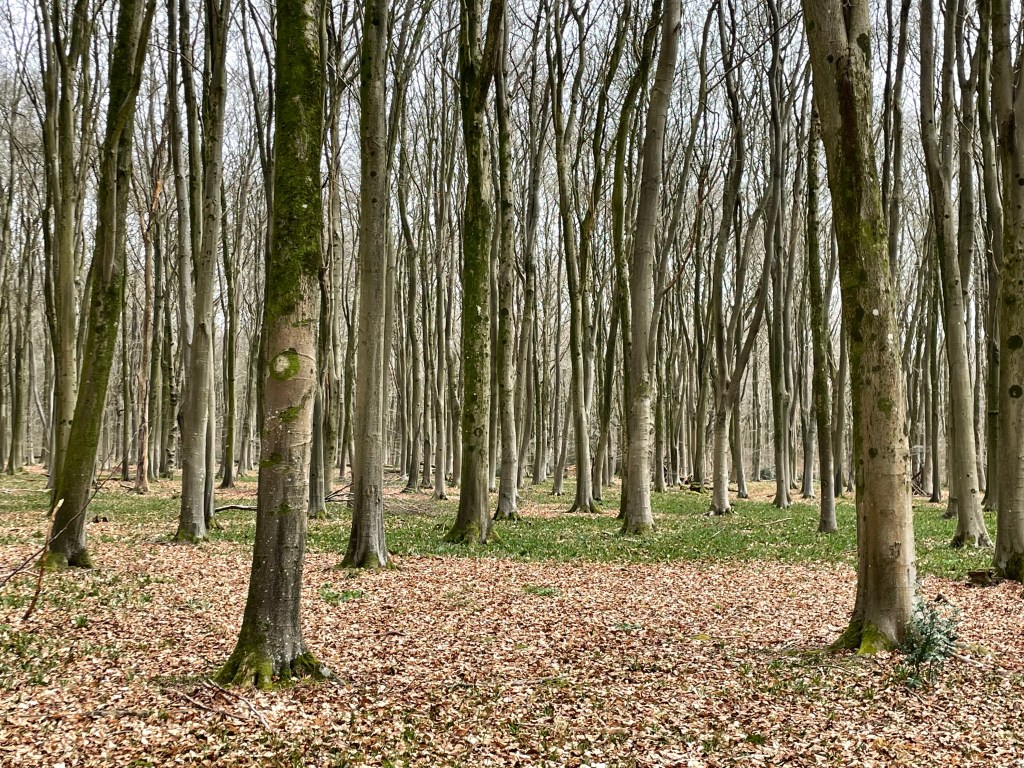
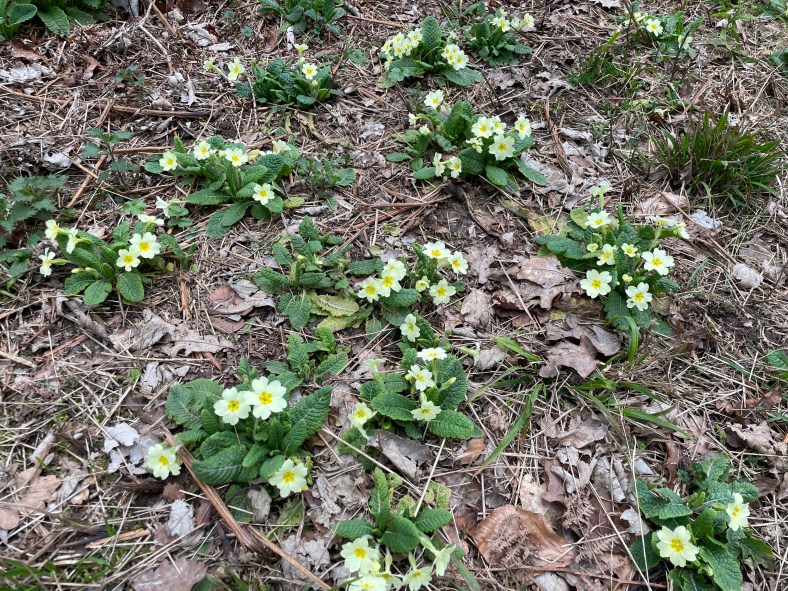
In the meantime, I’ve been trying to get on with tasks which don’t require much thought. Today I took the dogs for a walk in some woods which I haven’t been to for a while. It’s predominantly a beech wood. I love beech trees, even when they are leafless. It won’t be long until the bluebells are out and most of the floor of the wood is carpeted in blue, or is it purple? In the meantime, the primroses make me smile. A gentle reminder that time is passing. Maybe my motivation will return tomorrow…