Mapped

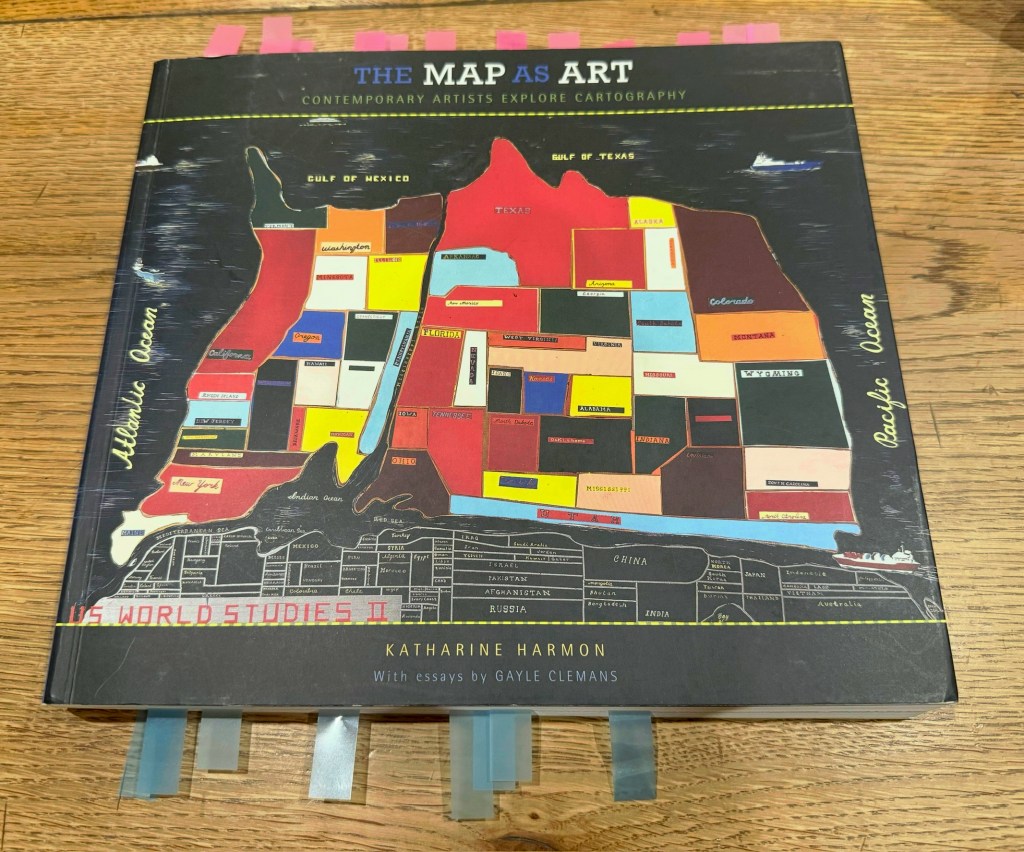
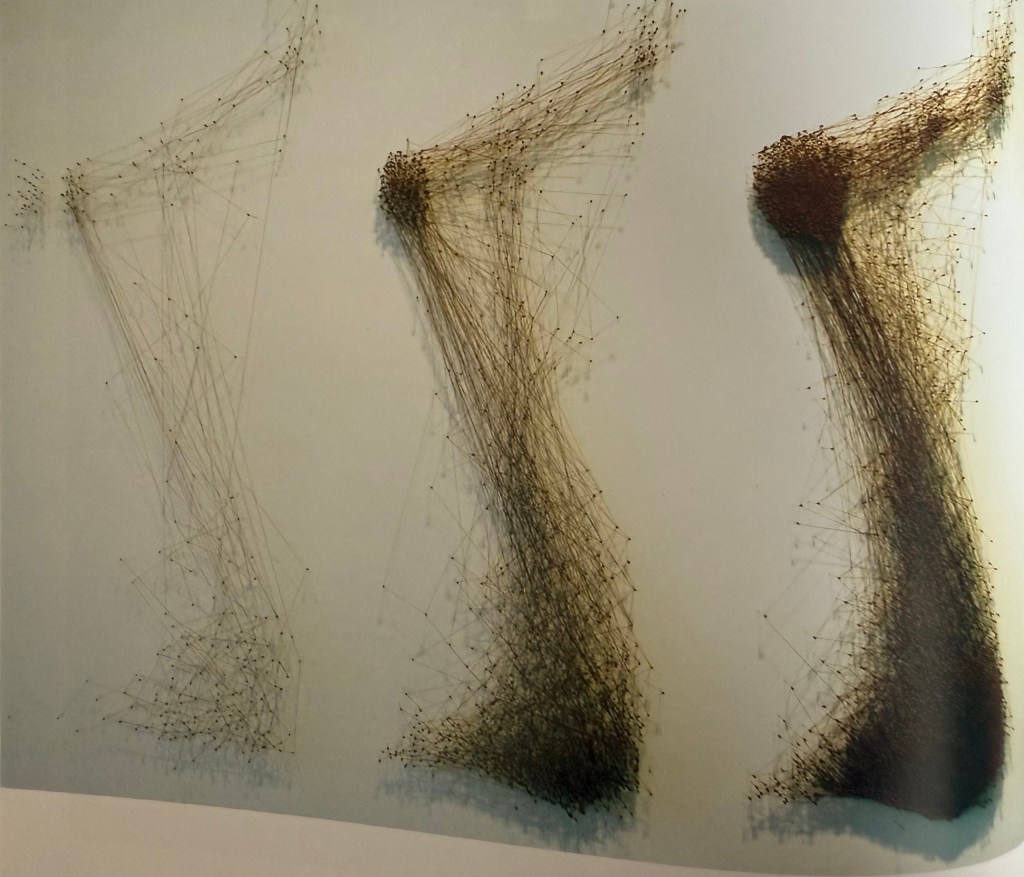
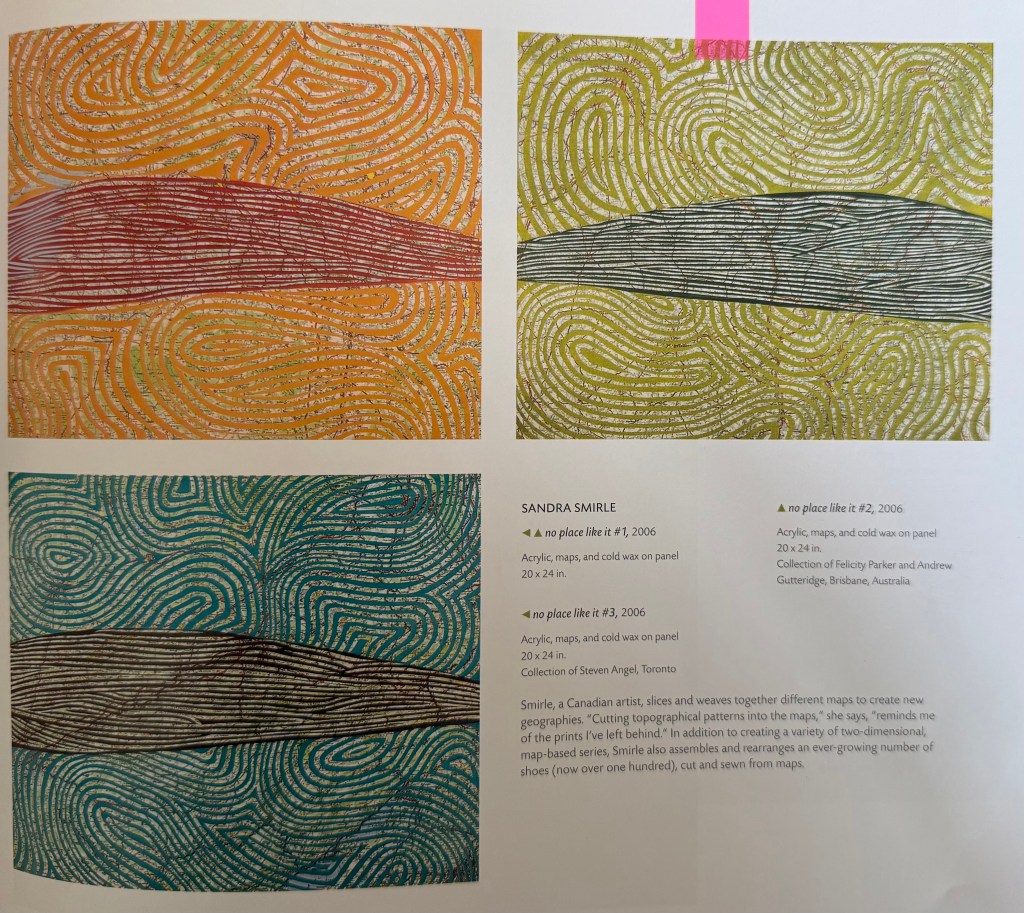
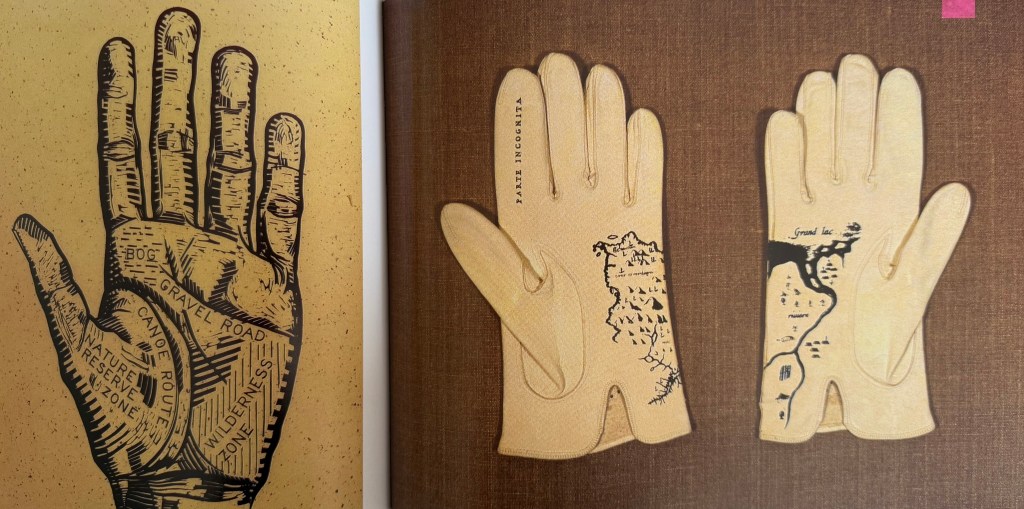
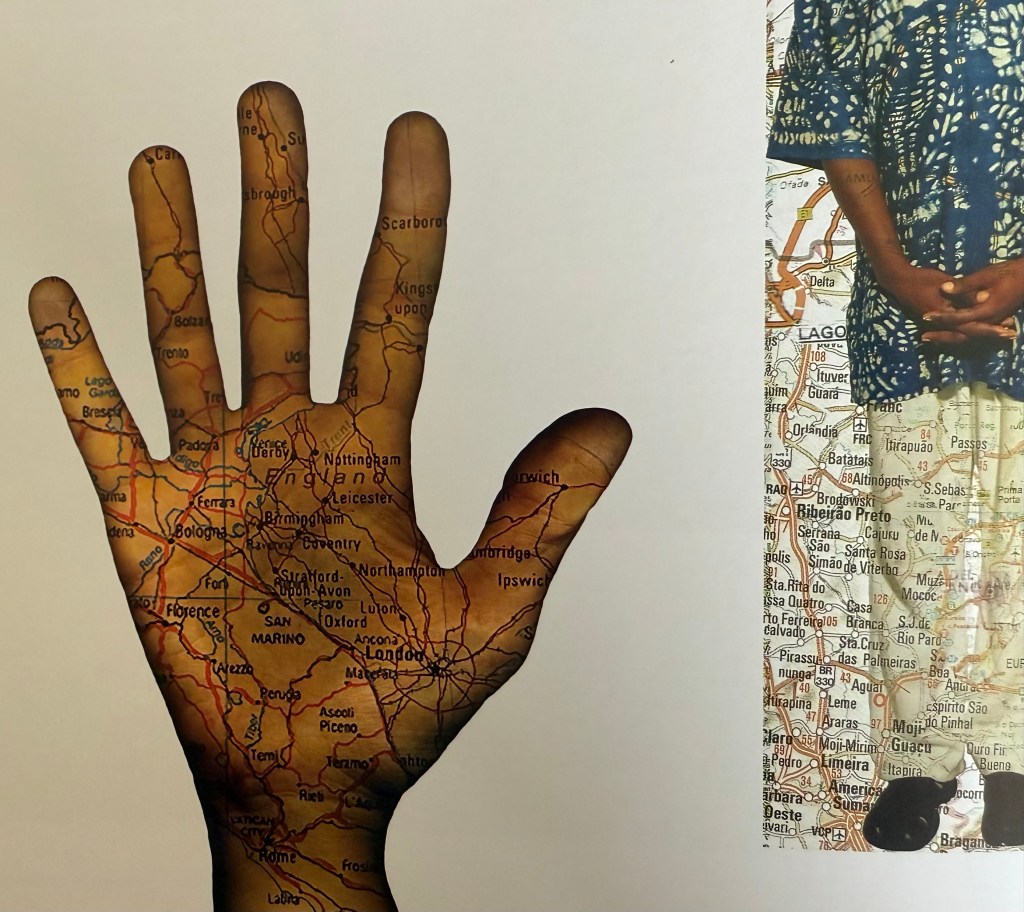
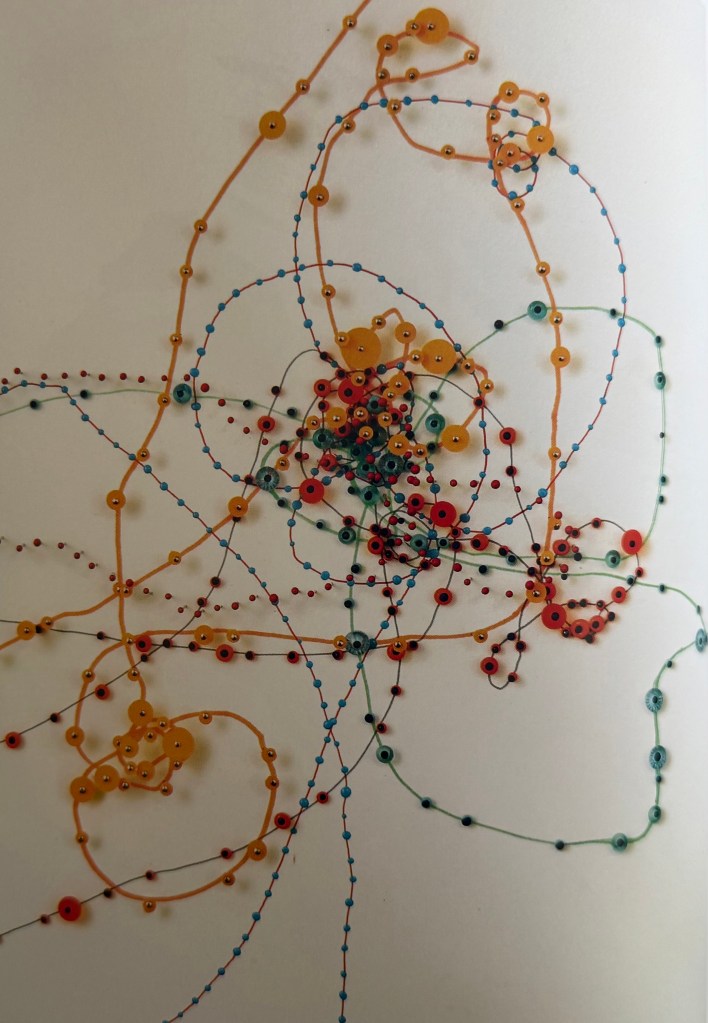
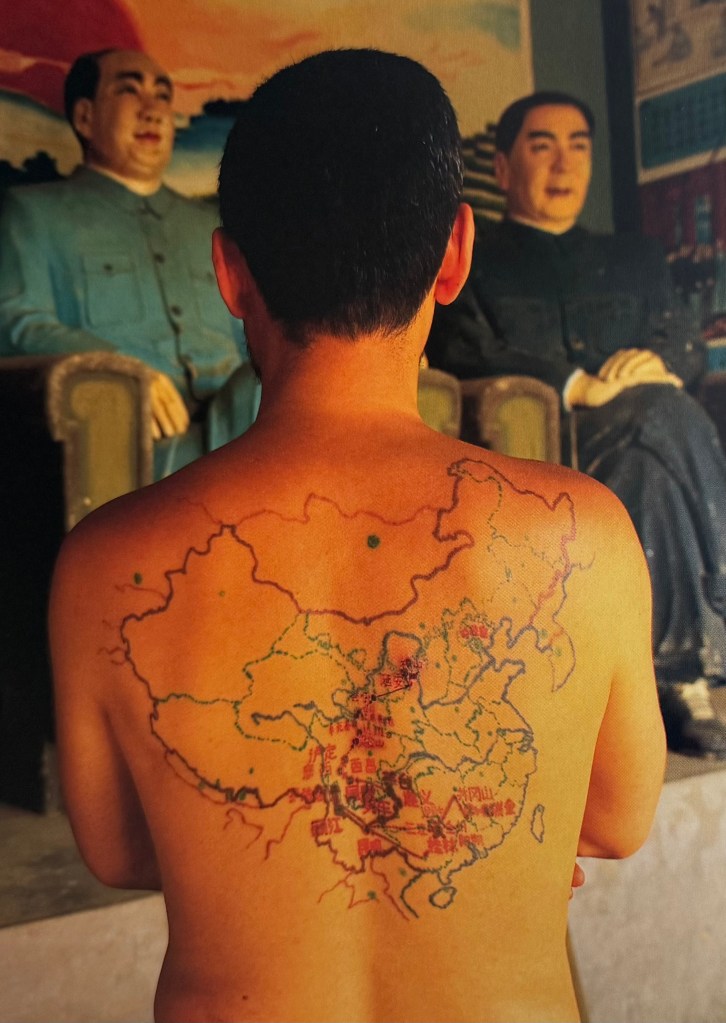
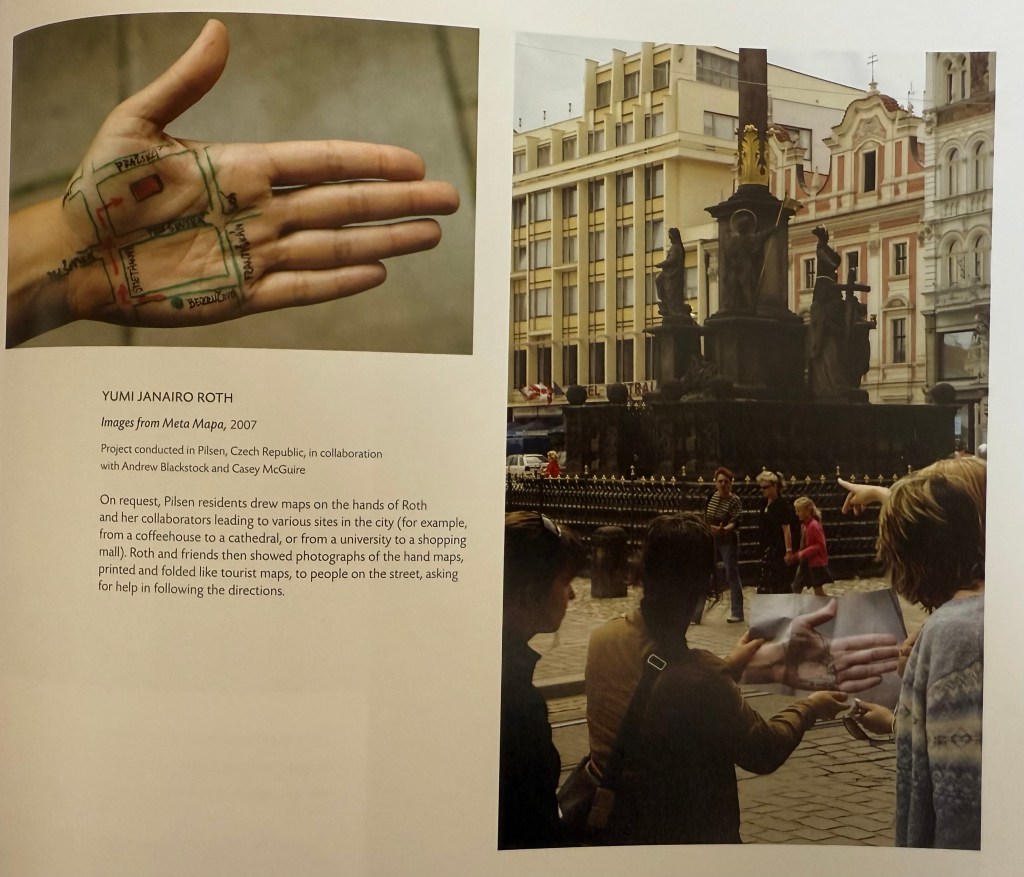
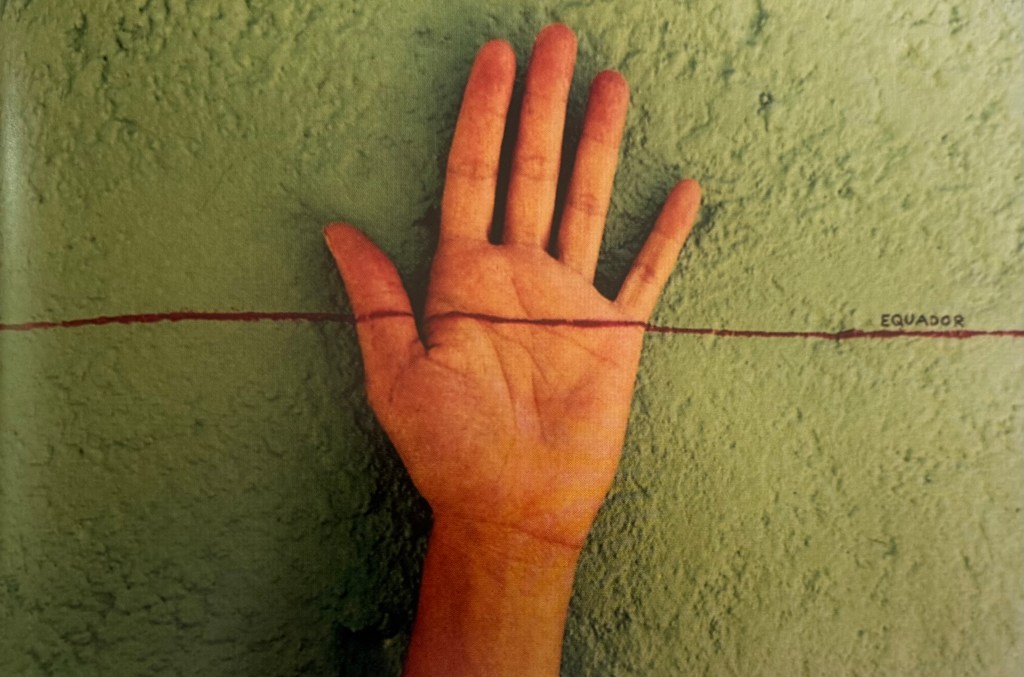
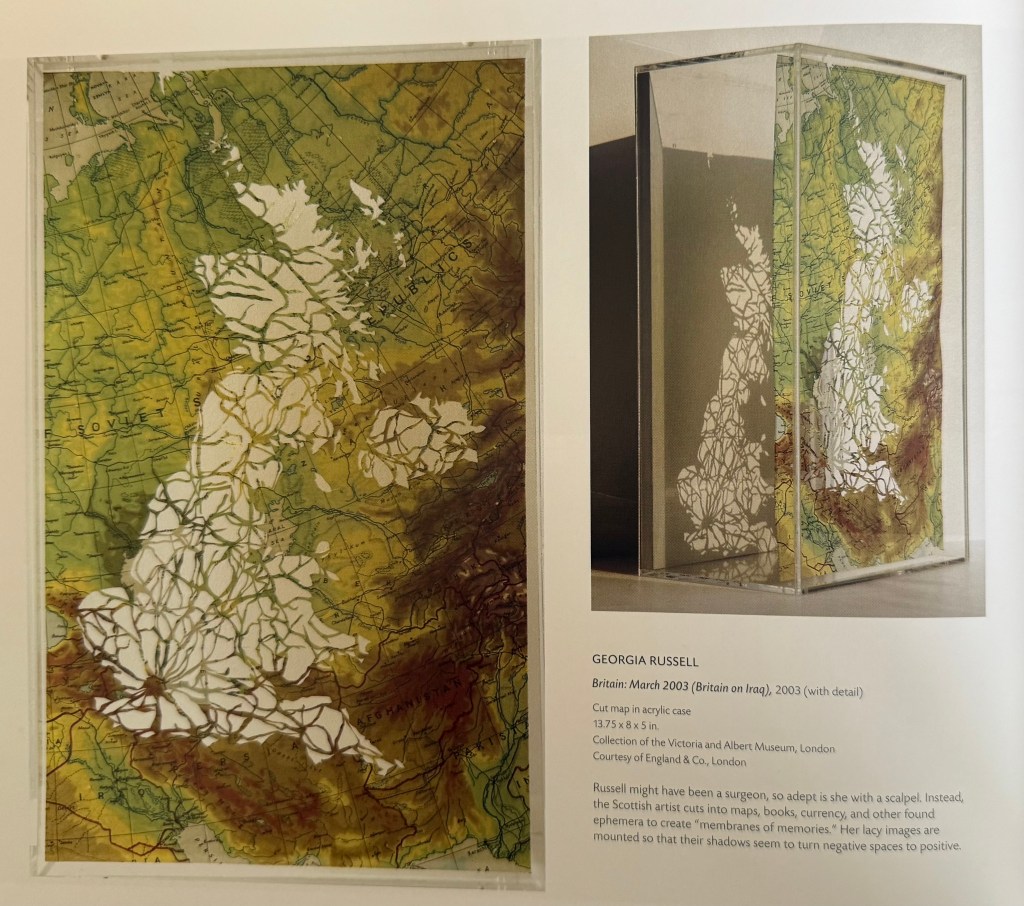
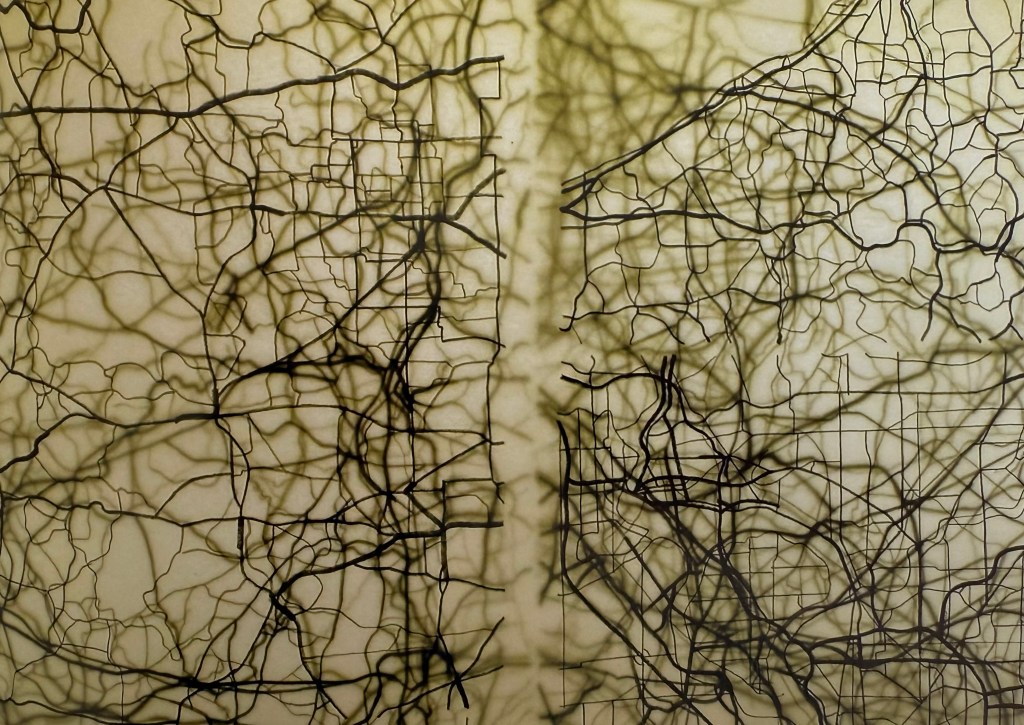
As part of my research I read ‘The Map As Art’ by Katharine Harmon.

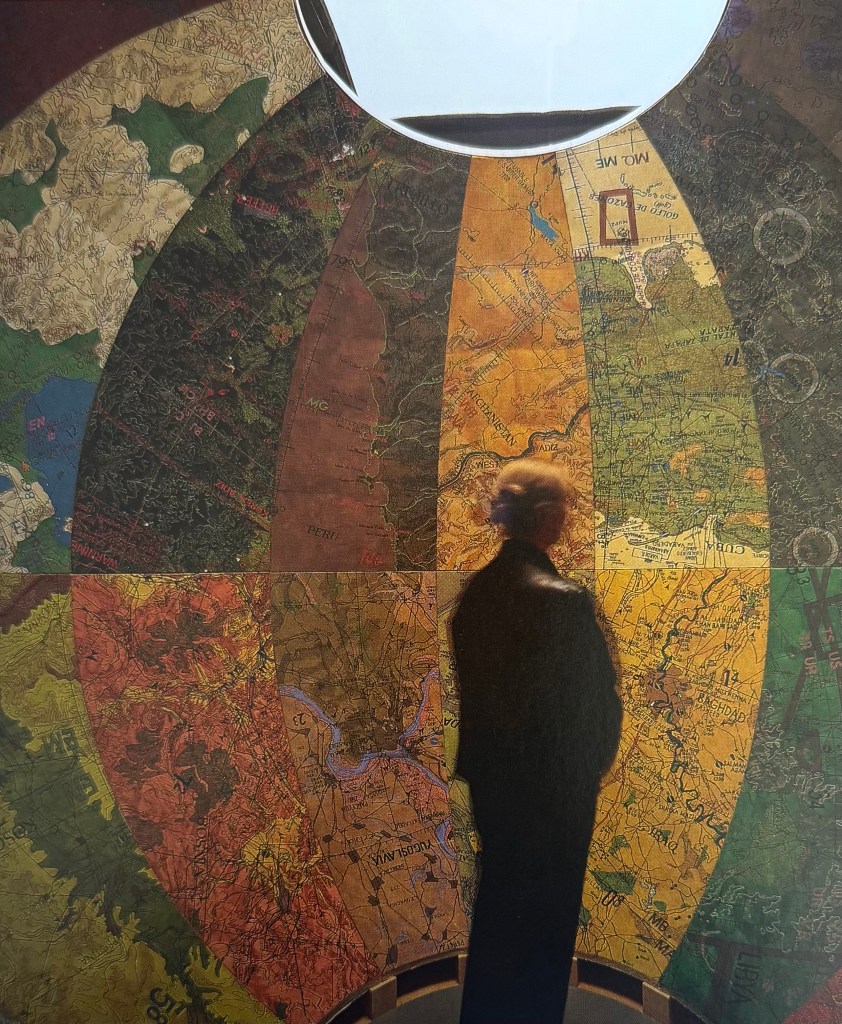
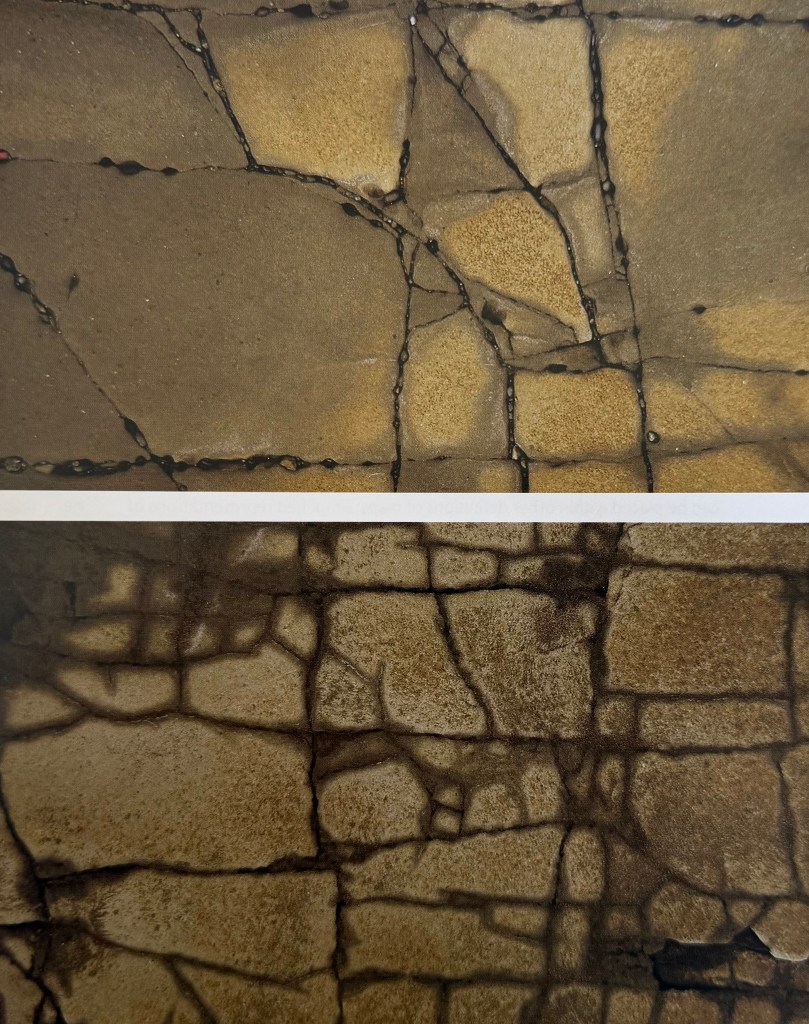
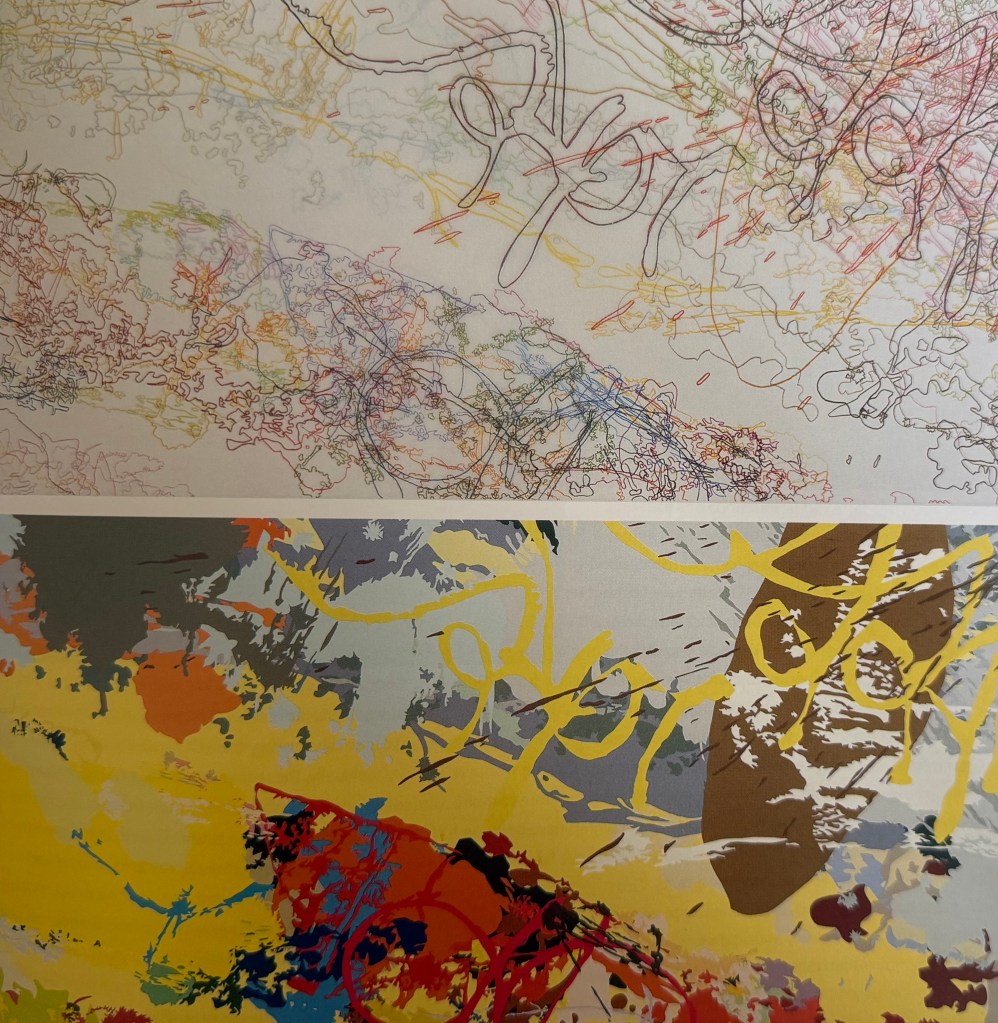
Whilst my research ultimately went off in a different direction, below are some of the images which stood out to me and which might influence some of my work going forward, but maybe not the tattoo.

But even as I’ve been flicking through the book to get the artists’ details there are others which catch my eye. I think this is a book that I will keep coming back to.

What’s In A Name?

I used Perplexity AI as an aid to narrow down areas of research for my research paper. A strange choice of name bearing in mind that to everyday people ‘perplexity’ means to be bewildered or in a state of confusion. But in tech-talk it is a measurement of how well a probability model predicts a sample. Even so, I’m still not convinced that it’s the best brand name for a product which is supposed to inform, and this is perhaps best explained by the reason it was chosen for the start-up: the domain name was affordable.

It was an interesting experience, which at times left me feeling frustrated, despite its excessive flattery. On a number of occasions, it told me what it thought I wanted to hear by making up sources and references. When I challenged it, it eventually owned up, apologised profusely and complimented me on my academic rigour. Such hallucinations are common place, apparently, as well as its inability to answer a question the same way twice.

There’s No Time Like The Present

For a post-mortem.

Well, I’ve submitted my research paper.

How do I feel about it? I’m pleased with how it turned out and I found it to be a rewarding experience – it has certainly made me think a lot more, and has been incisively relevant for my work.

This morning was a bit stressful as the broadband was playing up and I had some last minute changes to make and quite a few references to double check. It didn’t help that I was constantly switching between laptop and iPad because my laptop is so old that it turns out that it no longer supports the latest browsers. As a result, it was submitted a few minutes past the deadline, which has really disappointed me. Even more so, that when I’d taken a break and had another look, I saw a few incomplete references and other errors in the paper. Word blindness.

Previously, I have completed work with time enough left to review at my leisure, and so I’m wondering what went wrong this time. I certainly planned to have it completed with time to spare, and it’s not like I haven’t had since the Spring to do it.

On reflection:

  • I struggled for ages to think of a subject – I kicked the proverbial can down the road.
  • it took me a long time to work out how I could encompass the areas in which I’m interested – self, memory, mapping, and materials – into a cohesive and comprehensive research question.
  • maybe the scope of it was too much – it encompassed philosophy, psychology, cartography and cognitive archaeology. There was a lot to research to extrapolate relevant concepts. Whilst Perplexity helped refine searches, I still had to read all the sources eg material engagement theory was developed over a period of a couple of decades, through numerous published papers, and a lot of the sources were heavy and difficult reading, my aged brain not being able to digest and assimilate a vast amount of information anymore
  • I can’t multi-think the way I used to. I can only focus on one demanding mental load at a time otherwise I feel overwhelmed and can’t function
  • I didn’t appreciate the amount of work that was still to do after my last session with Janet. I was so relieved that my second draft had legs that I think I took my foot off the pedal and let other things get in the way, although I did make some work.
  • I think that I anticipated being able to really crack on in the last month but various things got in the way of this, feeling under the weather with one thing after another, and the print sale. I spent so much more time and mental bandwidth on that than I anticipated, but, it was a valuable learning experience.

This really does sound like a roll call of excuses, but at the end of the day, what’s done is done, and all I can do is try not to repeat the same mistakes in the future.

Now for the video and blog curation…

Time Capsule

She went back to uni today. She was looking forward to getting back to some normality and having independence again. The house seems empty – don’t get me wrong, I’m not one to suffer from empty nest, but there is a presence missing, along with all her stuff that seemed to have found its way into every single room of the house. The creation station that she had set up in the sitting room is no longer there – watching tv whilst she painted by numbers to try and occupy herself and at the same time rehabilitate her hand. And then the quilt, which she didn’t manage to finish before she left; she was disappointed because she wanted to have something to show for what she saw as having been a wasted summer. Never mind – she’ll complete it over the next few weeks, and it will serve as a reminder of ‘that summer’, imbued with fear, frustration, pain, resilience and hope.

It never ceases to amaze me how, in the act of making, memories and emotions are stored within the object, like a creative time capsule.

Clay!

I missed our final session, so I watched the video.

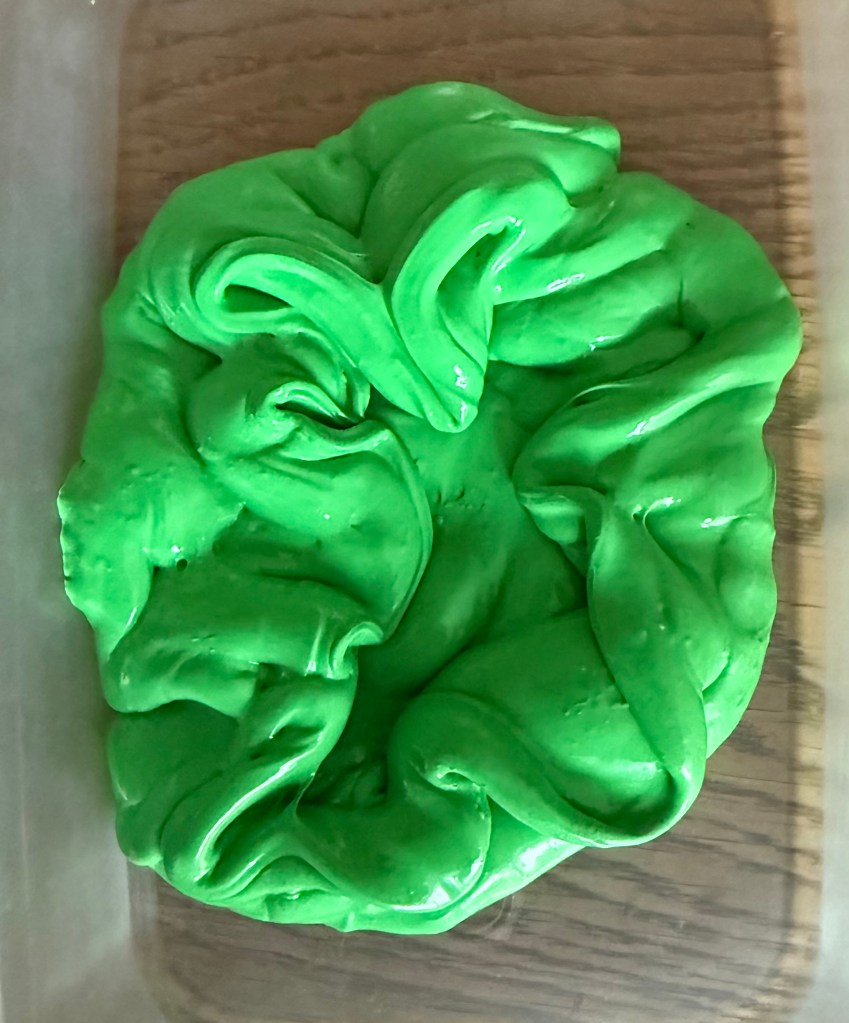
It was raining and I didn’t fancy going outside to get some proper clay, so I used my daughter’s physio putty – a silicone based non-Newtonian liquid which changes to a malleable solid with pressure. I made a little bowl.

Thinking about it, it’s very much like me: it becomes resistant when pressured, will embrace change temporarily but generally just wants to revert back to its natural state.

The exercise of feeling the material with awareness and the subsequent discussion with Alexis Rago on his experience of working with clay was particularly interesting as I’m currently researching materiality, in particular, Malafouris’ Material Engagement Theory – the act of making is a lived and relational state of becoming in which selfhood is enacted and transformed through the ongoing dialogue between the maker and the material.

You’re Turning Into Your Father

‘And what’s wrong with my father?’

’Nothing. But I didn’t marry him; I married you.’

It was our 23rd wedding anniversary yesterday. Neither of us is the same as we were 23 years ago and nor should we be according to K H Tan’s Fluctuational Identity Theory, ‘FIT’ (The Dissolution of the Self: How Ontological Instability Reconfigures Identity, Ego and the Nature of Selfhood, July 2025).

In his thesis Tan proposes a framework for understanding selfhood as a dynamic process of becoming that never achieves stable being. He argues against the notion inherent in Western traditional thinking that there is a stable foundation which grounds identity across time and change: a stable and unified self. This traditional way of thinking raises numerous fundamental issues eg how much change can happen before original identity is lost on a cellular and psychological level? When does the self come into existence? Conception? Birth? When does it come to an end? Brain death? Bodily death? It is not only incompatible with the dynamic, temporal and relational nature of existence, but our attempts to achieve a stable identity in an unstable reality could also be the cause of conflict, unhappiness, and the persistence of suffering in trying to control what cannot be controlled, the anxiety of trying to predict what cannot be predicted and the exhaustion of trying to maintain what cannot be maintained.

He is not promoting the idea of ontological instability per se, and he rejects the idea of chaotic instability (random fluctuations without pattern or direction) as these are incompatible with the coherence and continuity implicit in personal existence; we need to be able to recognise ourselves in order to be able to function. Instead he argues for creative instability. The self is not a thing that has experiences, but the ongoing process of experiencing the self; with every experience we integrate our past, our present and the possibilities of our future. It is a process of maintaining patterns while introducing variation and at the same time the self remains recognisably oneself while becoming other than what it was. The self undergoes ‘inter subject becoming’ – it is not a pregiven entity that enters into relations with others but emerges through and as a result of these relations.

He sees instability as a positive condition which encourages growth, creativity and meaning-making which would not be possible if the self were a fixed and stable entity. He considers fluctuational personas eg parent, friend, spouse, citizen, as genuine modes of being as opposed to roles and temporary performances, and as such negates the idea of authentic and inauthentic personas because all personas are genuine expressions of our capacity for becoming.

He advocates aiming for the middle ground. The more we try to define our identity the less capacity we have for growth and transformation, and too much self-awareness can lead to psychological overwhelm. Conversely, complete openness to transformation and abandoning any attempt to understand ourselves leads to a loss of any sense of identity and the continuity necessary for coherent existence, as well as disconnection from experience.

Achieving accurate self knowledge cannot as a matter of logic be achieved: we cannot bridge the gap between who we are and who we understand ourselves to be. He sees this area of misrecognition as being a ground for new possibilities of selfhood; it can become a creative force that helps us to become what we see ourselves as being. He gives examples of considering ourselves to be more creative, more confident than we are, and how this might lead to us ultimately having these attributes. Presumably the same could be said about negative attributes, but he doesn’t deal with these in any detail.

He compares traditional approaches and FIT in terms of personal development and growth including education and the effect of technology and algorithms on digital identity, psychological health, political and social implications, and human flourishing. He posits that FIT provides the framework within which we can better understand and navigate the challenges of contemporary existence.

It’s certainly an argument for revising the vows of marriage to reflect not only a change in financial status and health, but also in selfhood. Our wedding vows were in Italian and we haven’t the foggiest what we agreed to.

Wayfinding

I think that I’m finally getting some clarity. Or maybe I’m seeing connections and signs where perhaps there aren’t any, but it seems to make sense, in my head anyway. In my second tutorial, Jonathan commented that he had a sense that it was all leading to something (the first sign).

So far during this course, trite as it may be (although Jonathan has assured me that it is essentially what art is about), I have been concerned with understanding myself and my place in the world as a practising artist. I’ve been working from memories, guiding me like a compass on my exploration, probably slightly off kilter, as well as my day to day life, thoughts and feelings. I have been trying to concentrate on the process as opposed to the result (a sign), experimenting along the way, and producing very few finished pieces of work. I did feel uneasy about the lack of finalised output, but no longer. I’ve been on a dérive (our session on Guy Debord being another sign).

In my Study Statement I question whether it is actually possible to ‘find myself’. Kierkegaard thinks not, in the sense of a static and unified concept, for the self is constantly being formed not just by reflecting on the past but also by engaging with the present; it is in a state of becoming, in a state of flux, something I have said I feel on several occasions in this blog (a sign). I accept in my Study Statement that I can only hope to know myself as at a certain point in time, and that reflection is something which will have to be a continuing process. Something else I have mentioned on several occasions in this blog, to fellow course mates and to Jonathan, is that I feel like I am a different person to the one that started the course back in October last year (a sign); I have changed and I will continue to change – to become.

Recently, I’ve become interested in the subject of maps – the comment in my Unit One feedback that I seem to be engaging in a process of mapping jumped out at me (a sign). That led me to start thinking about maps and the process of mapping and map-making, experimenting with cartographic symbols and mark-making. The subject of maps is a huge one but during my research I came across the philosopher, Korzybski, the father of general semantics, a central principle of which is that the map is not the territory (rather like the image is not the thing: Magritte’s Ceci n’est pas une pipe (I used this idea with my red telephone at the Interim Show (yes, another sign)). In short, our models of the world are abstracts of reality, and do not represent it. This is a principle I’ve been trying to be more mindful of since I read about it – my map of the world is not the same as everyone else’s, so we can be in the same situation or look at the same photograph but have our own very different experiences and interpretations of it (our sessions with the photographs being another sign). Something which is blindingly obvious, but which I don’t always appreciate.

This then led to the notion that geographical maps themselves do not reflect the territory in the sense that there is abstraction and subjectivity in the production of all maps: the size of countries and borders can be manipulated for political and social ends, the purpose for which a map is intended can determine what is included and what is left out, viewpoint and projection can distort the world view.

Mercator Projection

Authagraph Projection

The Authagraph Projection is considered to be the most accurate flat representation of the world. It highlights the distortion caused by the traditional Mercator projection in terms of the size of Africa, South America and Greenland, amongst others.

I have been reading a lot about cartographic theory, a discipline which has only become a thing relatively recently. There is lots of disagreement about what a map is and the separation between the artefact of the map and the process of mapmaking and mapping. Post-representational cartographic theory does what it says on the tin – it argues that maps are not the territory but actually create the territory, are in a state of flux and are constantly changing, and theorists have moved away from the idea of a map as an artefact, but as being performative and processual, and always in a state of becoming.

Whilst working, I have been reflecting on past events and experiences, but whilst doing so I have been conscious that my recollections are probably my version of the truth; that I am my own unreliable narrator. I have been interested in memory for a while, particularly as to its probable unreliability and its potential to be manipulated. The way memories are formed and retrieved means that they are not fixed archives, but are constantly being formed and reformed with each retrieval; they are in a state of becoming.

The link between selfhood, mapping and memory is the concept of the state of becoming: ontogenesis. In my research paper I want to explore ontogenesis in the context of autobiographical artistic practice because it is the essence of what I am trying to do. In my experimentation and production of unfinished work I am engaging in the process of mapping, changing and becoming, relying on my memories which are also in a state of becoming but how can I represent this in a visual form which is also in a state of becoming? Hopefully, by the end of the research paper, I will have a better understanding as to how it can be achieved, if at all.

That’s the plan for now anyway, although I may change my mind, in my state of becoming.
Trying to Move Forward

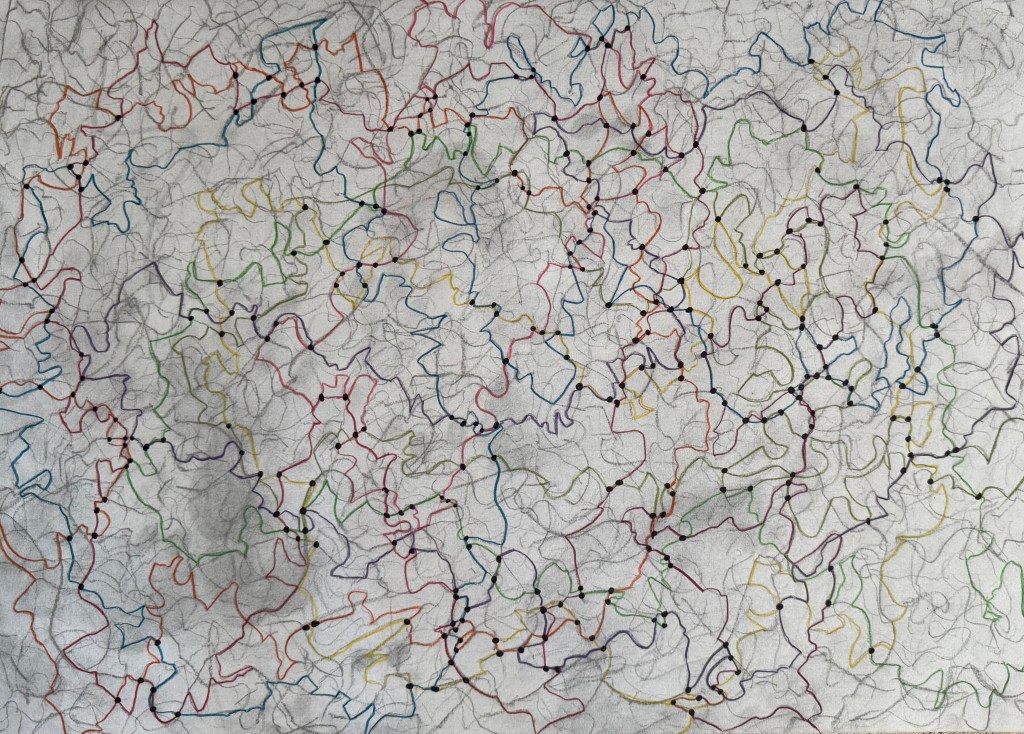
I decided to try and progress the idea of automatic map-like drawing by experimenting with charcoal. I drew a single line and then rubbed it out and repeated the process numerous times, building up layers of mark-making. I then took some coloured pencils and traced a path randomly following the marks.

I’m not sure that it takes me much further forward in developing this line of enquiry. However, I enjoyed the process and I like the different nature of the coloured lines which I made consciously by making decisions as to which of the paths of faded charcoal to follow, almost like a dérive – they have a different character to the ones I make when I draw automatically.

I’ve been thinking a lot recently about the course, about being half-way through and what I would like to have achieved by the time it finishes – what work I might produce by the end of it. At the moment, the concept of mapping is at the centre of it. I want to produce something which reflects all that I have learnt during the course, about myself and how I relate to the world around me. It will inevitably be an artifact, a map, of some shape or form, but I want it to reflect a process which is ongoing, that will never be complete, a piece of work in a state of flux, constantly subject to change, so there has to be some sense of impermanence, of it being unfinished. I also want to encompass the idea that memory plays a large part in the process and much like maps which are constantly being made and remade, so are the memories on which the map is based. The idea of layers and distorted imagery seem to be relevant in this respect.

I’ve thought about paper and canvas, maps being folded and rolled , but I don’t think that these offer the ability to create layers in the way that I want. I’m currently thinking that I may make a number of squares which together make up the grids of a map.

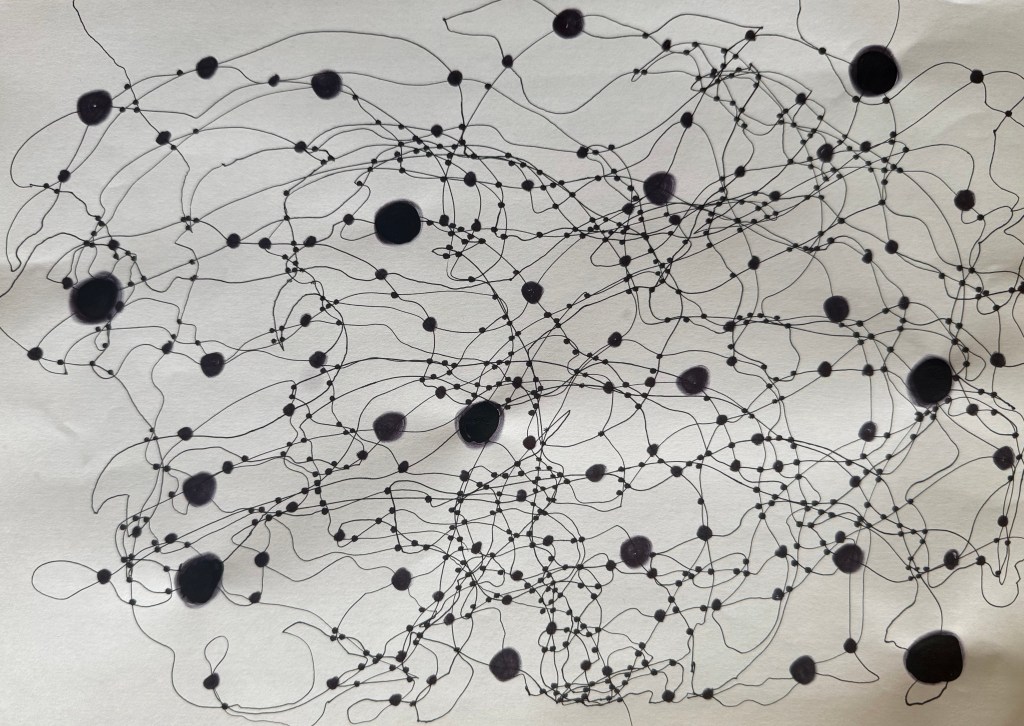
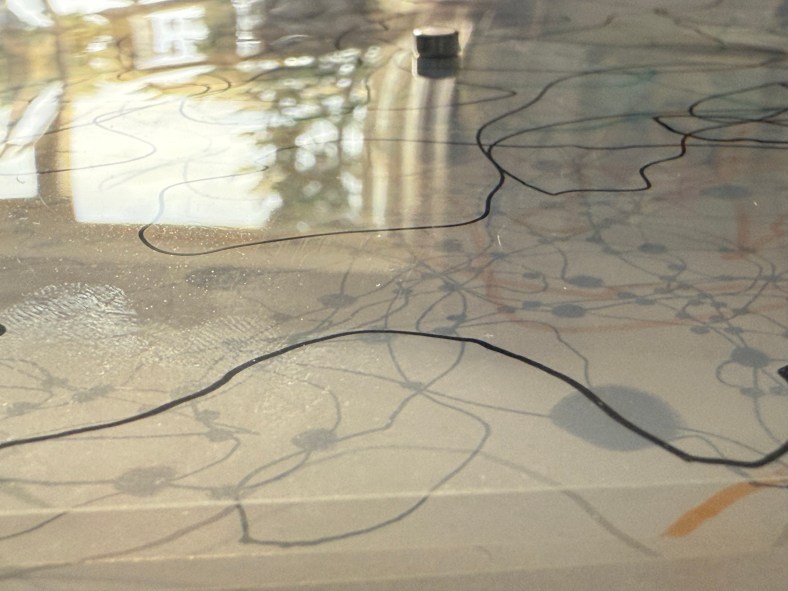
I used a pen to try and keep a marble on the paper. I like the lines which were made as a result – they have a sense of fluidity about them, much more than the lines that I have been making up until now. I’ve been meaning to experiment with the size of the dots at the intersections, to see if different sizes create a sense of perspective and three dimensionality. I don’t think that I have managed to achieve enough diversity in the sizes – it was very much an afterthought – I’ll try again another time. The image makes me think of something neural, cognitive mapping?

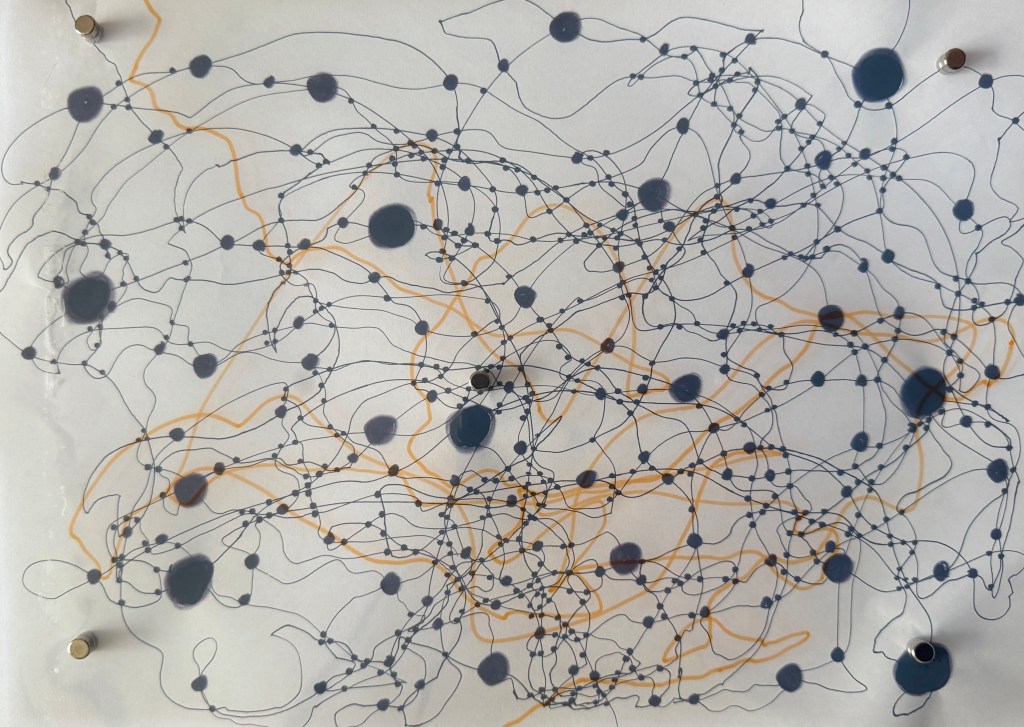
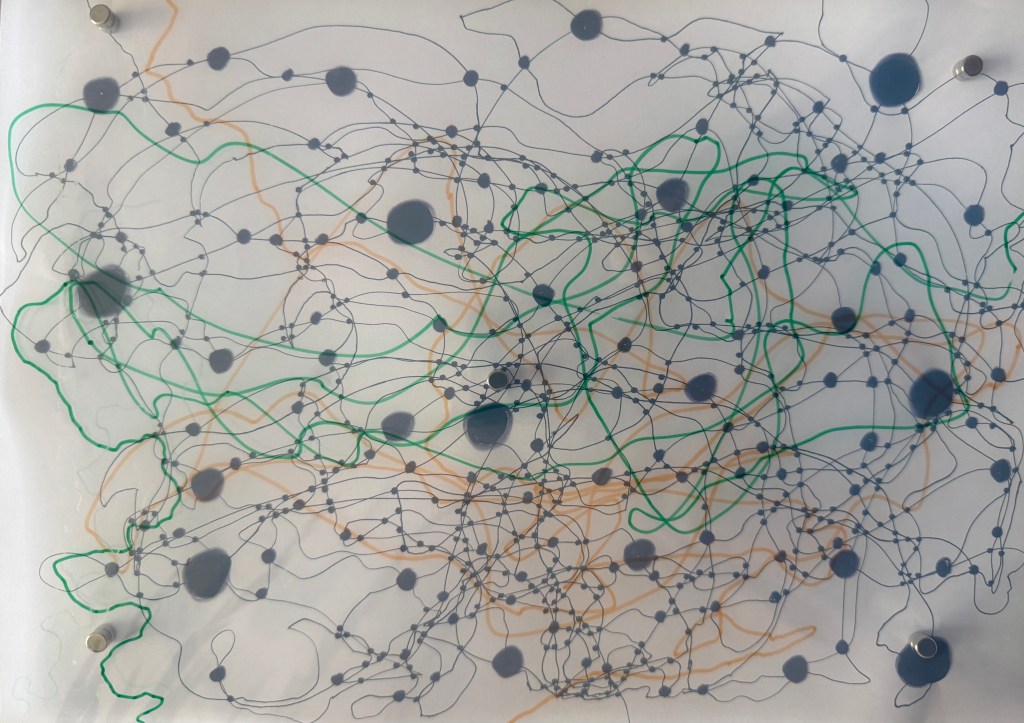
I took some inkjet compatible transparencies and drew some lines to see if I could create layers. Unfortunately, they are not totally clear – they have a milky appearance, probably because of the coating which allows them to be used in inkjet printers. I need to do some research to see if this is the case or whether I can source some others. Having said that, the milky film does cloud what’s underneath, making it hazy, almost like a memory that’s not quite there. Ultimately, I’m thinking that I could use layers of acrylic sheets over a background image, possibly together with milky transparencies, some can be drawn, painted and printed on, and I can also include some cyanotype images as well a negatives. I could cut holes in some layers to allow direct access to layers below. The use of reflective surfaces would also add depth.

I layered up the sheets using small magnets which not only hold them stacked together but also act as spacers between the layers. I had to add one in the middle because otherwise the sheets would sag – this won’t be a problem with rigid acrylic sheets. The magnets themselves suggest impermanence, the ability to be easily changed.

One-to-One No 1

I had my one-to-one with Janet on 20th June.

She kicked off by suggesting that I look at ‘autoethnography’ [a qualitative research method in which researchers use their personal experiences to examine and understand cultural phenomena] as well considering the Tao; an approach to life which is more of a wandering.
I should aim to have few references which are not apparently connected and find a new pathway from synthesis which is uniquely mine.

She ran through her notes.

  • It has strong potential particularly its exploratory stance and willingness to probe instability
  • There is a compelling central enquiry into mapping as a dynamic, active process
  • Its strength is the questions it raises rather than its answers

I need to:

  • Work towards refining the focus
  • Tighten the language and clarify the relationship between the concepts eg what’s the relationship between Kierkegaard and Grayson Perry? Map/mapping, reality/memory
  • The title is too long and general – need to specify the argumentative focus – although the title can come at the end
  • Personal voice in the opening paragraph is authentic but need to transition more clearly into the critical voice – set down where I’m coming from to start to see it as a critical analysis of where I’m coming from rather than a ‘hello’
  • Define what I mean by autobiographical mapping
  • Consider the difference between mapping the self and representing the self.
  • Consider psychogeography and subjective cartography – artistic tradition sits at the intersection of these terms
  • Dodge & Kitchin – ontogenesis – links to autobiographical process lived and relived through memory
  • Look at Carol Tills – a geographer
  • Memory is VITAL ie alive
  • Consider adding another disciplinary depth – so far have art, cartography, philosophy – inter-disciplinary is good. Have breadth, now need depth.
  • Instability of memory related to instability of maps
  • Good concepts and thoughtful reflection
  • Need to read more in order to narrow down the focus and more rigorous integration of theory and artistic examples
  • Philosophers don’t know much about material dimensions – when making something it gives information to you. Am I being me?
  • Paul Ricoeur, Henri Bergeron

Carbon Dating

During my tutorial Jonathan mentioned carbon paper.

It brings back memories of a time when it was the only way to make copies, of secretaries putting a sheet between the top and bottom copies when they typed. Those were the days when the most technologically advanced piece of equipment in the office was a fax machine, which would regularly spew out reams of documents on thin, shiny paper, the print fading away to nothingness over time, thus requiring photocopies to be made, just like some present day shop receipts, so I’ve discovered.

So what to do with it? Recently, I have been reading about map-making and the act of mapping, considering the difference between the two. Contemporary cartographic theorists consider the process of mapping to be of paramount of importance, the creation of the artifact of the map being just one step in the process. In particular, psychogeographic mapping seeks to represent how individuals feel about the place they are in, a process in which subjective experience is prioritised over factual accuracy. Artist, Christian Nold, who uses a bio-mapping device to record individuals’ changes in emotional state, creates emotional maps of places, and one I’m particularly interested in is Brentford Biopsy because I used to live next door in Chiswick before I moved out of London. The project was undertaken in 2008 before areas of Brentford were redeveloped, and it’s really interesting to see how people felt about the area: it reveals so much more information than you would get by simply looking at a map: a map details the historic buildings and the riverside, but not how people respond to them, their view as to how they should be dealt with in future development, and how it actually feels to be there.

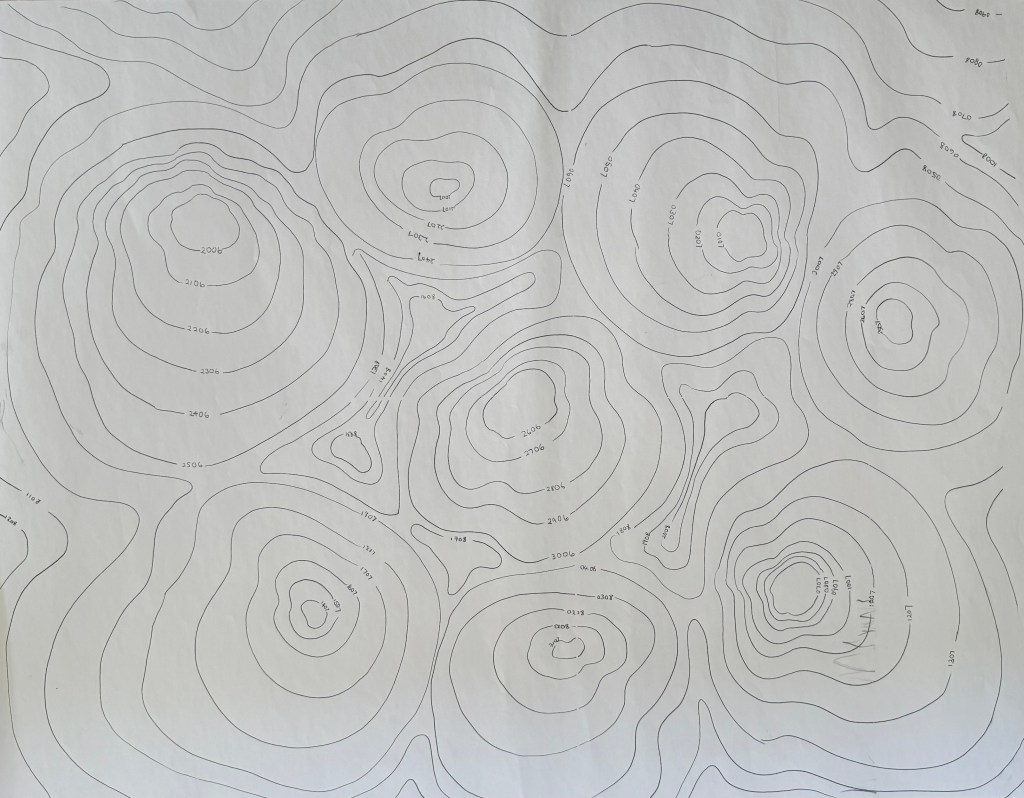
So, I’ve decided to embark on some emotional mapping of my own, not in relation to a sense of place (that may come later when I revisit my grandmother’s village) but of my day to day life. The bonus is that it means that I have to make a line everyday which will hopefully lead me to doing other making. I have drawn the contour lines using carbon paper (I‘m currently thinking that they may be too dark and overpowering, but we’ll see how it goes; it’s an experiment after all) and each one relates to an individual day.
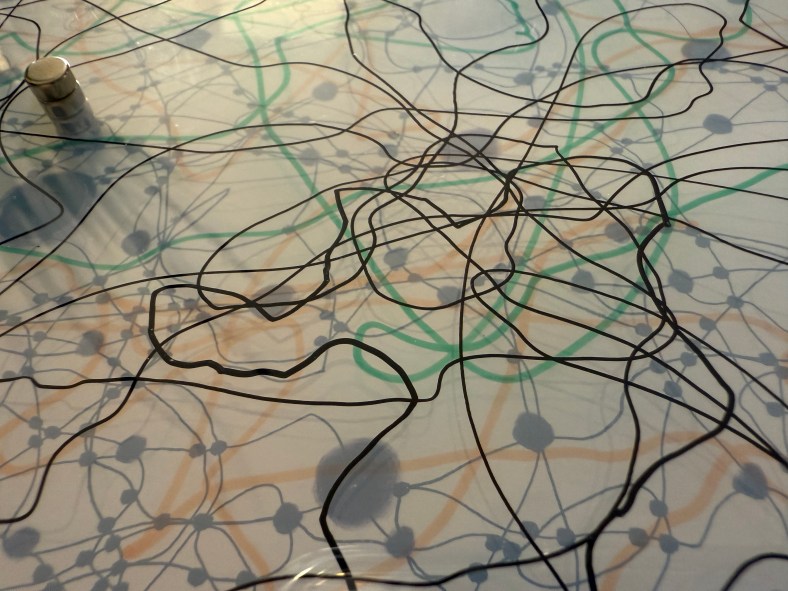
I’ve already started, and it should take me up to the 12th of August. I’ve had to invoke some rules. There are three colours which represent three emotional states which I assess at the end of the day; green represents a neutral emotional state, orange positive and blue negative. Obviously within the generalised emotional states is a whole range of different specific emotions, but I decided just to keep it simple. Each line starts from the contour of the day in question and ends by going off the sheet otherwise it may be associated with more than one day. I draw each line for no longer than two minutes. I had thought about allowing myself however long I felt I needed and varying the intensity of the line depending on how I felt, but decided that would over-complicate things. The map will give an indication of how often I was in each emotional state over a period of time. I’m now thinking that I should have had another map on the go at the same time; not just to depict frequency but also depth of emotion. Maybe next time, if this works out.

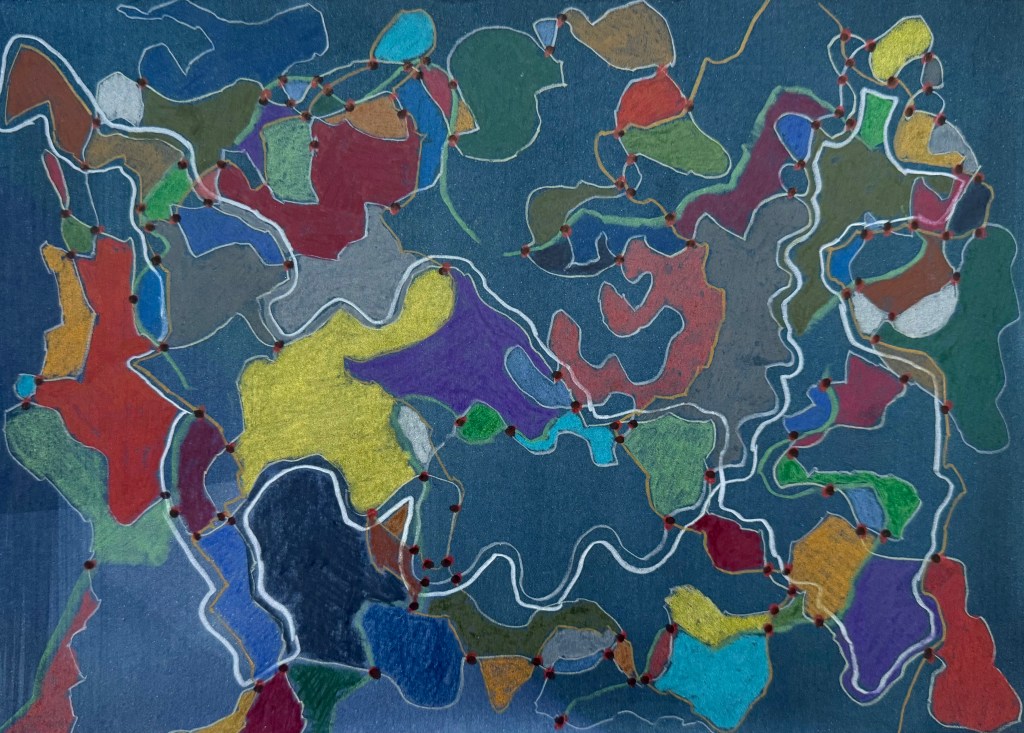
I also found some watercolour paper which I had used for an unsuccessful cyanotype and experimented with it. I like the intensity of the colour against the blue background, and the way the coloured in areas look like countries on a map of the world.

The groupings of colours also remind me in a way of the Art Emotions Map which has been produced by Google Arts & Culture and the University of California, Berkeley, which I’ve spent a bit of time exploring and which reminds me of one of our Miro boards. My husband suggested that I could do something similar relating to life experiences, with getting married to him falling within ‘Wonder & Awe’. Oh, he does have a sense of humour!