Metallic

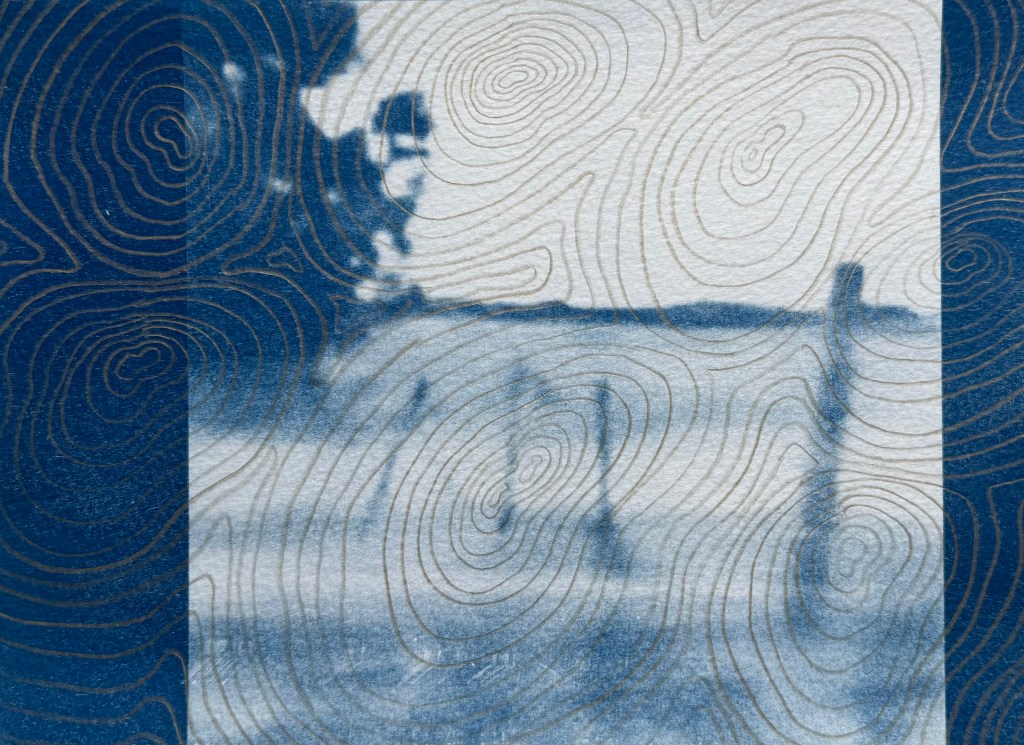
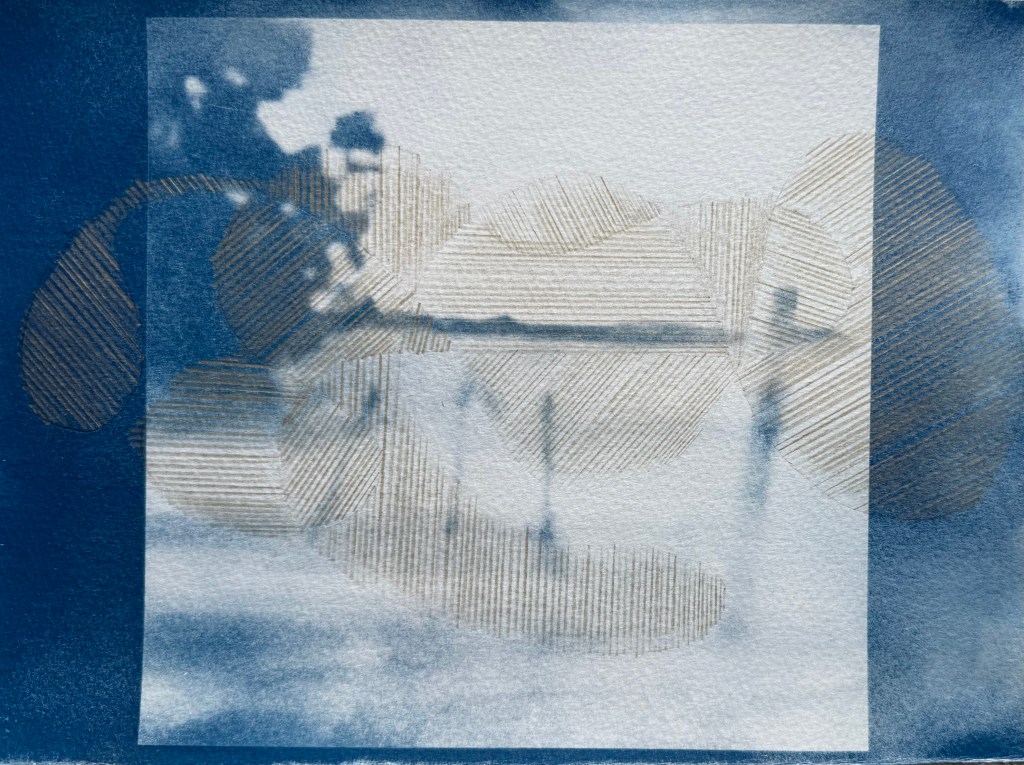
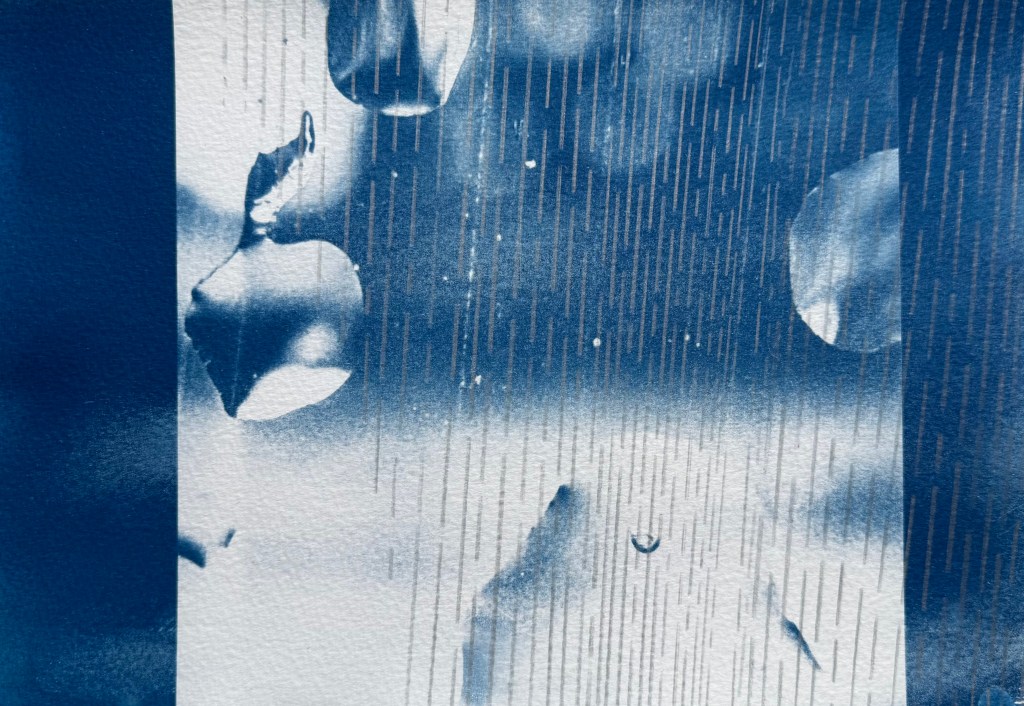
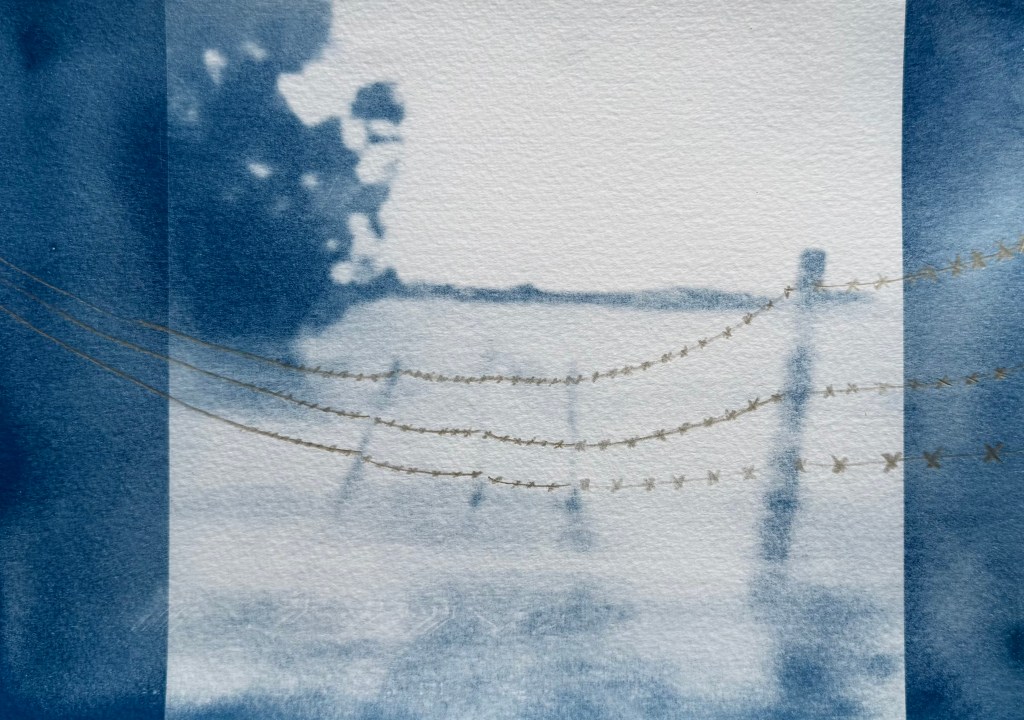
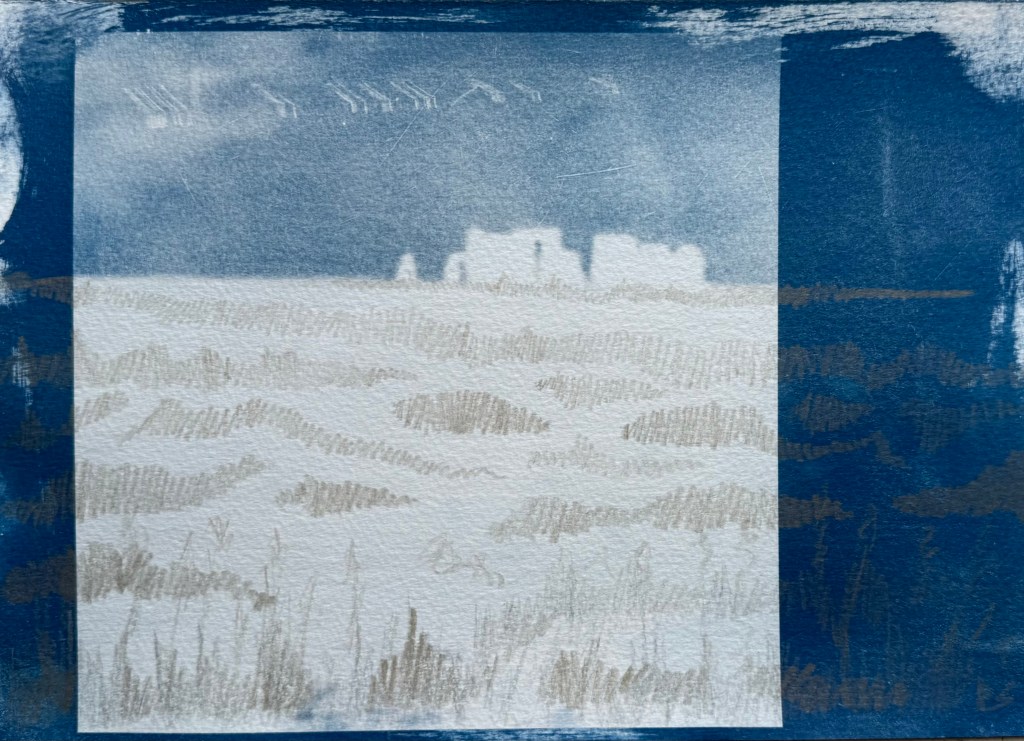
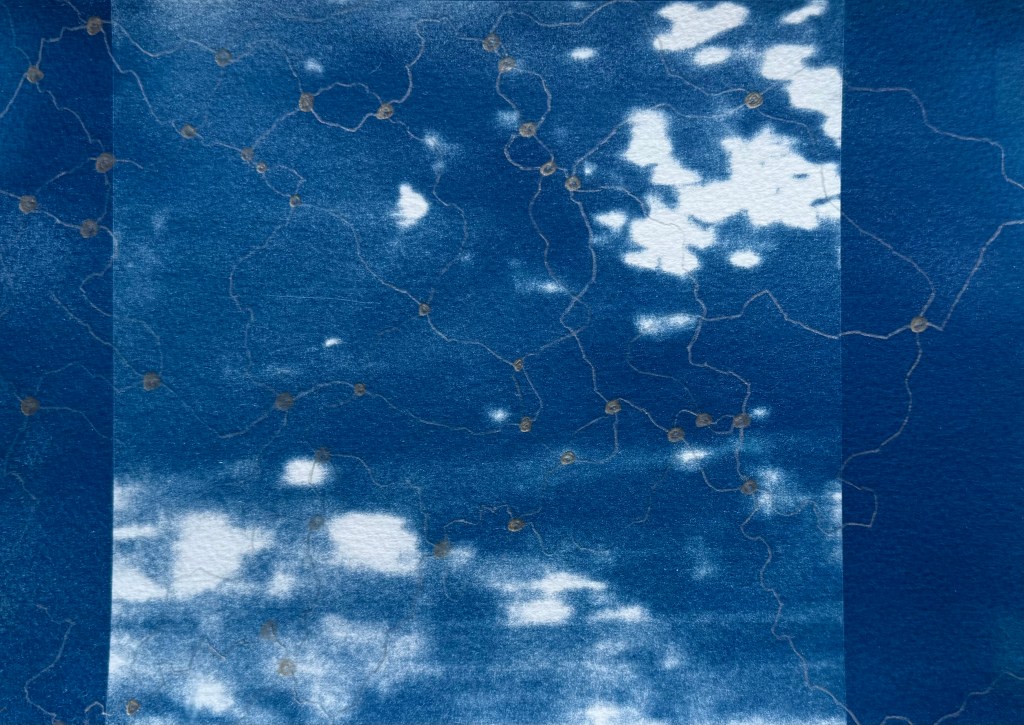
I was interested to see Jo Love’s remediation of old black and white photos using metallic pencils, in our session a couple of weeks ago. Photographic images quite often form the basis of my work. I decided to experiment with gold and silver pencils on some old unsuccessful cyanotypes I made from the video stills in In A Flash. The results were varied.

I used the silver pencil first but thought that it didn’t stand out enough. On reflection I think there is a subtlety about it which I like, and perhaps it would have been a better choice than the gold.

I’m not particularly drawn to any of them, but if I had to make a choice I prefer the last two images, particularly the last one. What works for me are the marks outside of the original image, the sunlike shape on the left and the drifting cloud on the top right. The overdrawing creates an image within an image, something which always appeals to me. I think part of the problem is the fact that the images are on watercolour paper which wasn’t overly receptive of the pencil. Overdrawing does appeal to me as a concept, though.

Making Contact

In yesterday’s session we looked at ‘thick description’ as opposed to ‘thin description’. Thick description gives extra information, creates a mental image, and prompts questions. Thick description is using language to expand understanding and allows us to recognise what we bring to it, emphasising that we are the makers of our work and we are bound into it. For me, this echoes material engagement theory: as humans we make things and are, in turn, made by the things we make.

We were given a few minutes to describe what was in front of us – the part that no-one ever gets to see on our Zoom sessions. I use my daughter’s bedroom whilst she’s at uni. I wrote down:

A sea blue wall displaying the board wrapped with small, glowing lights – a showcase of scraps of paper arranged haphazardly with multi-coloured pins, some images, some reminders of future tasks. Numerous containers with an assortment of writing materials; pens and pencils standing to attention, ready for action. The white desk with its marks of ink and nail varnish – traces of past actions of my daughter. It makes me feel connected. I sit where she sat. I feel her presence.

As I was writing it, I suddenly felt emotional – I don’t know where it came from – maybe because I was thinking in a sentimental way, and that became a release valve for the stress and tiredness that I’ve been feeling. Or maybe, despite my bravado, I just really miss her.

We went on to think about our own contact zones, and how we are influenced or changed by the contact, and how it impacts our work and the reason we make it. This discussion generated a whole host of different ideas. For me, it is about how they make me feel; I am influenced by contact zones that generate an interest, prod me and provoke a response from me, and I often put myself in zones which make me feel uncomfortable and challenge me, that take me out of my comfort contact zone. I am not sure that if my contact zones made me feel completely at peace and in equilibrium, with nothing to respond to or process, I would even feel the need to make art.

A Light Bulb Moment, Or Is It?

In last week’s session we thought about ideas.

Where do my ideas come from?

From my lived experience; my past, my present, my interactions with the world and the people in it, a moment in time, what I read, hear, see, feel, smell and taste.

What do they look like?

A network or web where they interconnect, or wait to be connected.

What kind of a web is it?

A spider’s web. Some ideas are fleeting and wispy and drift away, whilst others are more robust and have some form.

Other’s ideas are like seeds which grow over time (akin to Bateson’s ecology of the mind in which, like organisms, ideas grow and flourish whilst others become extinct) which need to be cared for and nurtured, or a breeze or mist, pre-existing ideas waiting to be received.

Maybe the source of the idea depends on what interests you at any point in time. I’m interested in my experience of living in the world, and so I don’t think that my ideas pre-exist because they are bespoke to my unique lived experience. Often they are triggered by something, a reaction to something, and so they don’t often come to me out of the blue. They are a combination of everything and anything, but at their very basic I believe that they are a matter of neuroscience; the complex neural interactions between knowledge, memory, emotions, and experience, all being broken down and continuously recombined in infinitesimal permutations, consciously and subconsciously in dreams, flow states, and acts of automatism.

Just because they are bespoke to me doesn’t necessarily mean that they are original. Gompertz doesn’t think that originality in a completely pure form actually exists and that all ideas are additional links in an existing chain (Part One: Think Like An Artist). There are numerous quotes from creatives who have built on the ideas of others: Newton and the shoulders of giants; Jobs and stealing great ideas; Twain who said that all ideas are secondhand, consciously or unconsciously drawn from a million outside sources.

We then considered Brian Eno’s concept of the ‘scenius’ (a creative co-operative of intelligence) and the articulation of the ideas of the scenius by an individual who is then held up by society as being a genius. On reflection, I think that he is right to the extent that the genius is just the tip of the scenius iceberg, but that both should be equally celebrated, and the attribution of the idea should be shared. It’s not enough to have an idea – it needs to be acted upon and often this involves elements of risk, courage and persistence.

Undoubtedly, collective recognition encourages greater sharing of ideas and increased creativity. In this respect, the existence of a scientific scenius goes some way to explaining why two different people can come up with same idea at the same time eg Bell and Gray, who both came up with same idea of the telephone. But, the idea didn’t come from nowhere – the circumstances at the time were demanding a solution to an existing problem, and the latest scientific developments and knowledge in the field, which were needed to devise the solution, were already widely known and shared amongst the scientific community, to the extent that Gray and Bell had detailed knowledge of each other’s work. So really, it was just a matter of time before someone came up with it. Maybe to that extent, it could be said that the idea was in the ether waiting to be received by someone who was attuned and had the requisite knowledge to implement it.
Making Sense of Worth

Yesterday’s session turned out to be quite timely for me.

We watched a video of William Kentridge’s Tide Table and part of an interview with him. He likes working with charcoal because it can be erased very easily, and speed of thinking is equal to the speed of drawing. This reminded me of paint being liquid thought (Elkins, J What Paint Is). Kentridge describes his work as being on a trajectory – a path followed, which finds structure and subject through being made.

Amongst other things, we considered what advantage exists in using material that changes easily, and what the advantages are of working in a fast or slow way? We discussed how working quickly can be more intuitive and stops the conscious mind from overthinking. In this respect, some expressed the opinion that work made in a short period of time does not have as much value as work which takes longer to make.

This is a concept that I have been grappling with for some time, in an attempt to shake it off (Dialogue I; Dialogue IV – I’m So Over It; We’re So Excited; Am I Bovvered?). It seems to me to be illogical, because I wouldn’t think that a book which took a year to write is of greater value than a book which only took a month. Maybe one author was in a flow state and it all came easily, whilst the other had to struggle, but theoretically they are of equal value.

What determines art’s worth? The time spent on it, the skill involved, the size, the materials used? Would a small piece using 24 carat gold leaf encrusted with diamonds which took me 5 minutes to make using quite complex skills be worth the same as something I took days to produce using a child’s wax crayon and a piece of scrap paper, but into which I poured all of my emotional being? I’m trying to bring myself over to the point of view that none of it matters; what matters is that I made it because I thought it worth making, and that it connects with me. But it’s very difficult to shift the mindset.

In my posts, which I refer to above, I was considering value in terms of rejection and how that might impact how I felt. I have the opposite scenario at the moment; I saw one of Rebecca’s blog posts about an exhibition she had been to, and I was intrigued by the technique used by the artist. I thought that I would quite like to try it out, and so I did. I made ‘Siblings’. It took me about 45 minutes or less to make. It didn’t take much skill to make – to be fair it could have been made by a primary school child with appropriate supervision while using the craft knife – but it represents and embodies something deeply emotional to me and it was very much about the process. As it turned out, I wasn’t disappointed with the end result and so I decided, on a whim, to enter it into the ING Discerning Eye Open Call, for which the deadline was the following day. It has been selected. You would think that I would be over the moon. I pretend to be to the outside world, but inside I still can’t help feeling that it’s unworthy because of the limited time it took to make.

Clay!

I missed our final session, so I watched the video.

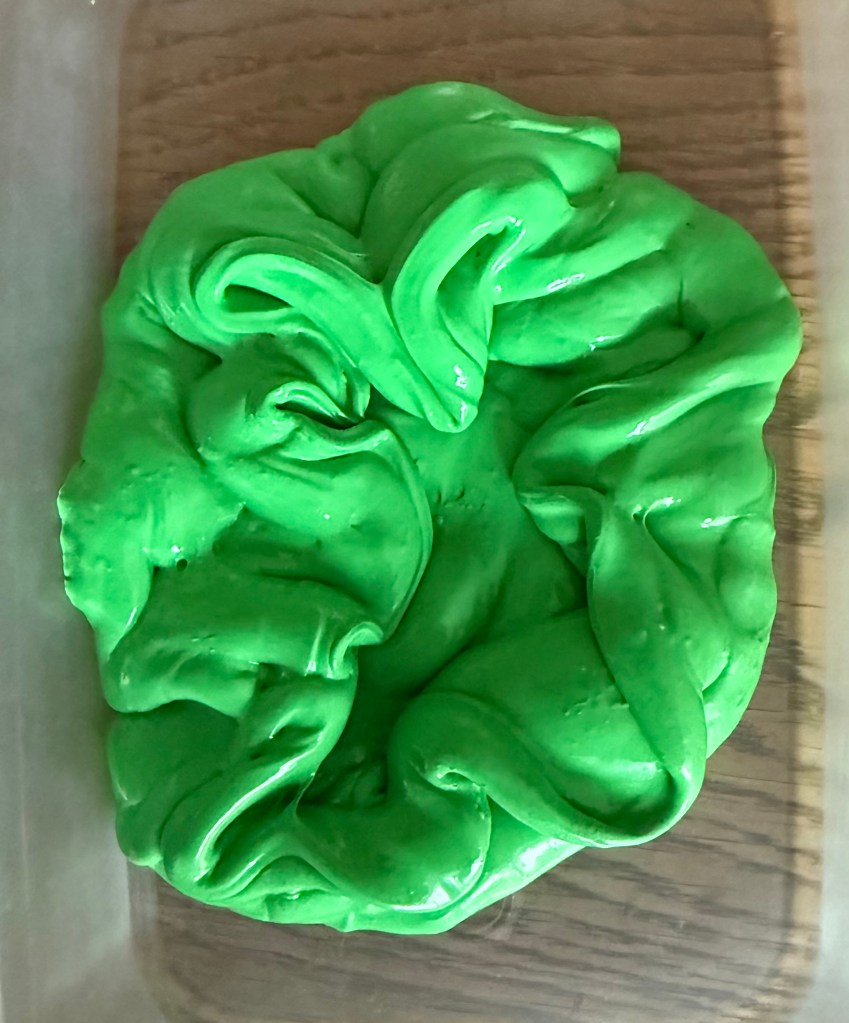
It was raining and I didn’t fancy going outside to get some proper clay, so I used my daughter’s physio putty – a silicone based non-Newtonian liquid which changes to a malleable solid with pressure. I made a little bowl.

Thinking about it, it’s very much like me: it becomes resistant when pressured, will embrace change temporarily but generally just wants to revert back to its natural state.

The exercise of feeling the material with awareness and the subsequent discussion with Alexis Rago on his experience of working with clay was particularly interesting as I’m currently researching materiality, in particular, Malafouris’ Material Engagement Theory – the act of making is a lived and relational state of becoming in which selfhood is enacted and transformed through the ongoing dialogue between the maker and the material.

Maps

I was very lucky to have Cheng and Dalal in my group for this week’s group crit.

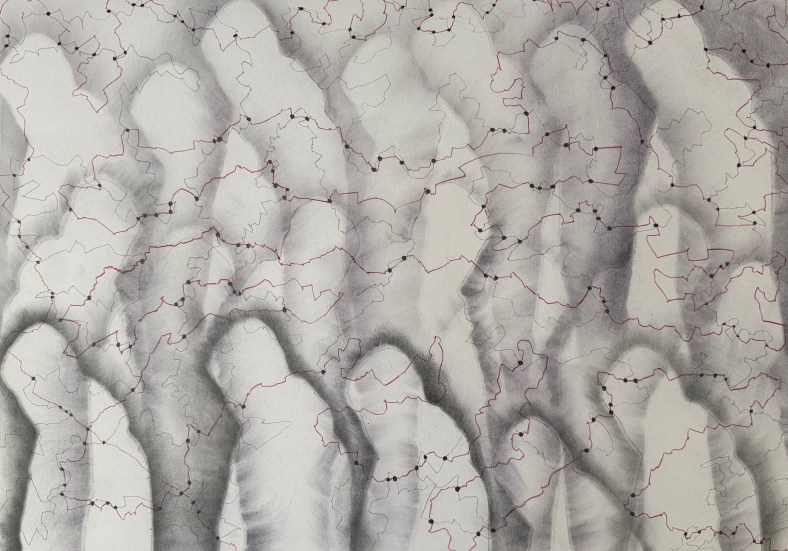
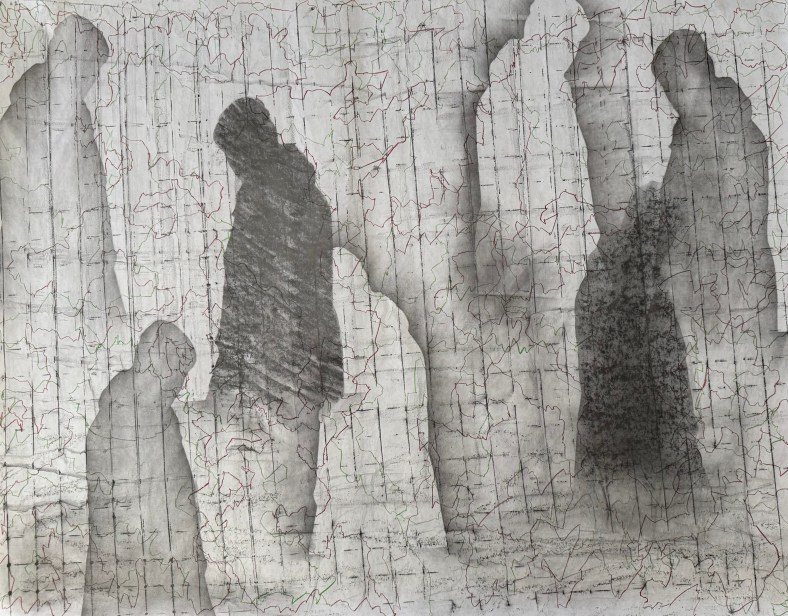
I showed my recent experiments with graphite and pencil.

I explained that I have become interested in the idea of inheritance recently and mentioned Donald Rodney’s work. We had a really interesting discussion about where we come from and our legacy, how it’s sometimes comforting to know that someone else before us was like us which frees us from feelings of fault and guilt, the idea of all that has gone before distilling down into us, much like our family tree before us, ends with us. How what we pass on feels like a responsibility or a burden.

Cheng commented that the white shapes give the impression of something that is no longer there and the dark shapes are reminiscent of shadows. Thinking about it, the shadows are cast by something that is there but is not visible. A figure’s absence is felt yet we feel a figure’s presence somewhere – it just about sums up ancestry.

I explained the process of making the pieces and how they seemed to develop into a type of map. I mentioned that the subject of maps has come to the forefront of my thinking recently along with the idea of connection. In my Unit 1 feedback one of the comments was: “It feels as though you have been working through an abundance of techniques that are maybe a type of mapping – now is the time to compare and contrast all of those experiments in order to develop an intuitive and personal way of mapping your experiences…”.

For sometime I’ve been interested in Deborah Levy’s idea of her mother being her internal sat nav and I used Google maps to obtain the aerial image I used in Parental Loss. My art class recently gave me a scarf with a Grayson Perry map on it. I was thinking earlier in the year of mapping the course of a river. The coincidence that I chose to draw the lines in colours which reminded me of maps somehow has linked all of this together. That, and the fact that I have been complaining ad nauseum about not having a sense of direction.

During these two years, I am, to all intents and purposes, mapping my life.

There seems to be a strong unintentional link to maps in the images: Cheng said that the images in which I’ve marked the intersections remind her of constellations, and Dalal observed that the lines themselves could be interpreted as borders, which then feeds into borders marking the the point where countries connect. This led to me seeing that the outline of the shapes themselves resemble coastlines.

Cheng and Dalal both made some really helpful comments about potential development:

  • playing with scale: a large image on a wall giving the impression of a map but then coming in close on a small scale to create a more personal experience and stronger connections
  • Drawing on a vintage map or incorporating old family photos
  • Using a pin to attach separate images to the points of intersection – this has since led me to think about criminal investigation maps – maps with string coming off from them to images and additional information on the perimeter
  • Thinking about how I can use materials to create something that looks older, that comes from a past time – this brought to mind highly decorative old maps with sea monsters in the oceans
  • creating a large scale reimagined map

Shortly after our session ended, I had a thought about making a digital map of my life with events or periods of significance being marked by specific points, a bit like a Google map, which you could then drag the yellow man to and drop into a space where you have a street view – maybe of images relating to that particular event. And then I laughed, Alexa laughed, Siri laughed, my husband laughed.

Lots to think about, as ever.

Witness

We talked about consumption of content during this week’s session. I admitted that the first thing I do in the morning is to pick up my phone. I use it as an alarm clock. It’s reliable unlike other alternatives I have tried. Also, I don’t leave my phone downstairs ever since I was told by a firefighter that it would be my only means of contacting the emergency services if a fire broke out and damaged the landline. That was when we lived in London and a mobile signal was something taken for granted. In deepest, darkest Hampshire it’s a luxury and dependent on WiFi, so we’d be completely stuffed if a fire takes out the power and the router goes down. So, really it’s born out of habit, and the knowledge that our means of escape would be to hop out of the spare bedroom window onto the flat roof and down onto the ground, hoping to get at least one bar if we stand 10 paces east of the base of the oak tree. Not that I’ve given it much thought…

I love a reel. I try not to spend too much time watching them. The last one I watched which interested me was a clip from Shall We Dance?

Maybe that’s why I make art. The process of art-making is important but it wouldn’t be enough in itself – it needs to see the light of day, to be seen, to be witnessed. To be witnessed by me as an act of self-reflection and by others, even if it is limited to those who are close to me.

Mind The Gap

I’ve been looking back at some of my previous posts to try and assimilate my thoughts and ideas.

In this week’s session we considered an excerpt from Art & Fear by Bayles & Orland. We discussed the gap: “…Making art provides uncomfortably accurate feedback about the gap that inevitably exists between what you intended to do, and what you did…”

My earlier post,Making A Sound, referenced a comment made by Maggi Hambling:

…there wouldn’t be much point in painting a picture that it was possible to paint…”

So, we shouldn’t mind the gap. If there is no gap, we are not pushing ourselves or allowing exploration in our work.

Art & Fear also threw up another corker. It’s from Stephen De Staebler:

“Artists don’t get down to work until the pain of working is exceeded by the pain of not working.”

Almost there!…

Am I Bovvered?

Amidst all the excitement of the Low Res, I received my annual rejection letter from the RA.

Immersed in all the distraction, I wasn’t bothered, which is why I have left it until now to reflect on this rejection. I’m still not bothered. Why? I’m not sure, in the end I invested quite a lot of time into the process of producing A Die, A Log, With You. However, I didn’t invest very much in an emotional sense – yes, it made me titter but it’s not as if I put my heart and soul into it. Why? because it was an arbitrary task I had set myself which was, frankly, getting in the way of more interesting things. Also, entering the Summer Exhibition is no longer my only artistic outlet into the big wide world. This blog has changed that.

Based on our discussion in yesterday’s session on the subject of success as an artist, I would say that I failed. The piece didn’t connect with others, and, perhaps more importantly, it didn’t connect with me. I used to think that my work was like a Harry Potter Horcrux with each piece containing a little bit of my emotional being. This piece has none of me, so was always destined to be a failure as a piece of work. However, as an exercise in ‘that will do’ as opposed to the normal quest for perfection it was a total success. So. I’m still left in a quandary as to why I didn’t feel connected – was it that in accepting something less than perfection I detached myself from it, or was I just not that into it to start with?

Keep Making Art!

In this week’s session, as preparation to discussing the impending research paper, we discussed the value of writing for artists. For me, it is a way of organising my thoughts and recording my decision-making so that I can look back and remember why I did what I did, also allowing me to identify any patterns in my way of working or thinking. It also allows a breathing space to step back, to reflect and evaluate. The process of writing often triggers the development of existing thoughts as well as generating new ones. It is also another means of expression; sometimes writing about something provides inspiration as to how I might convey an idea; I often find inspiration from other people’s writing (Parental Loss I Motherhood I); and sometimes writing is the only way to express something, Three Conversations With My Mother. It is an invaluable process.

Jonathan then asked us to spend some time thinking about what is intriguing us.

I have been thinking a lot lately about a conversation I had with Lyberis on the last day of the Low Res. We were in the bar discussing the talk with Jeremy Deller we had just been to, and also the Whitechapel Library audio walk by Janet Cardiff we had experienced in the morning. We had both been blown away by it. I’m trying to understand why it excited me so much; possibly because there was an element of immersiveness, but at the same time I was aware of what was going on around me both visually and audibly; being both removed from and in my surroundings simultaneously was a really interesting experience, particularly when what I was hearing synced with what was actually going on in the real world, like the sound of a moped, just as one went past. The section at St Botolph-without-Bishopsgate was fascinating as she describes two men, one in blue, sitting on a bench, and there actually were two men sitting on a bench chatting. If I had been them, I would have felt unnerved by 20 odd people all sitting down in silence and then getting up and leaving at the same time. It was difficult to work out what was going on. It seemed to be part detective drama, that we were with her looking for someone, as well as a collection of memories, and then, when we reached Liverpool Street Station, she theoretically abandoned us to find our own way back to Whitechapel to return the discman to the library, presumably relying on our memory. It’s just as well they were downloadable files!

But this got Lyberis and me on to talking about memory; how we are made up of our memories; but what if the memories are incorrect or false? I started thinking about how what I am doing is based solely on my memory. My memory is fallible, even photographs are open to interpretation, as we discovered in one of our previous weekly sessions. What if I am my own unreliable narrator? Even if my memories are factually incorrect, if I have a strong emotional response associated with something, surely that can’t be wrong? Is emotion the only true memory? Even if my memories aren’t correct, does that make them any less true to me? And then I was listening to the news on Radio 4 the other day and they mentioned that the writer, Mario Vargas Llosa, had died – he believed that novels should present lies as truths. This gives rise to the possibility that I could even invent my own history.

After taking us through the ins and outs of the research paper, Jonathan raised the issue of AI. He said he uses it to have a dialogue, to challenge his thinking. I’ve used it to critique a piece of work. I came across this article in the Guardian yesterday morning about the artist, David Salle, who has turned to AI to breathe new life into old paintings which hadn’t been rapturously received ‘I sent AI to Art School’.