Call Me

I had a thing for Richard Gere when I was a teenager. I remember watching the film ‘American Gigolo’ which I had rented on video – one of his early films, before the likes of ‘An Officer and a Gentleman’ and ‘Pretty Woman’ – which had a brilliant soundtrack, ‘Call Me’ by Blondie. I tried to source the 7” from my local record shop, but had no luck as it had been released a few years before. One of my classmates at school told me her brother had it, and that he would sell it to me for £10 – in those days I could have bought almost 2 LPs for that amount; a single was just over £1. Needless to say, my crush on Richard and my newly discovered love of Blondie made me cough up some of the cash that I had earned from my Saturday job at the local Sainsbury’s. Even now when I hear the track, it takes me back to the opening scene with Richard driving along in his convertible, shades on, the wind in his hair. Ah, I could but dream…

’Call me’ is a strange phrase – often uttered when someone is pushed for time and can’t stop to talk; doesn’t want to talk; can’t make the time to talk; wants to leave it up to someone else to initiate the talk; is desperate to talk; is extending an invitation to talk. It’s not even as if we speak on the phone that often anymore – many households in the UK don’t have a landline, relying on their mobile phones instead, but as Donald commented in one of our sessions, we tend to use a device designed to allow us to communicate on the move, to message, take photos, make videos, play games, navigate, play music, and look things up, instead.

Anyway, I have managed to source a telephone for the interim show, as discussed with Jonathan in my last tutorial.

Am I bothered about using an object which I have sourced rather than made? No, as Jonathan commented, there’s no point making something which already exists; I don’t grind my own pigments to make oil paint, although many do as they feel it provides a greater connection with the work, and I respect that level of patience and dedication – it’s just not for me. But I do, now and then, and if time permits, stretch and prime my own canvases, but this is something I know how to do – all things electronic are alien to me. Also, I generally only do it when I want to recycle some old stretchers. And at the end of the day, ‘readymades’ were ok for Duchamp. I think what is most important to me is the haptics of using the dial – many of the phones I researched had push buttons. I used to love dialling a number – the slight resistance, followed by that sound.

The phone will enable me to leave a pre-recorded message and allow members of the public to leave messages for me, which will then form part of my research – I plan to exploit the public nature of the space. My issue now is, what’s the message going to be, and how will I exhibit it?

It’s not a new idea, not surprisingly, but I will put my own take on it. Having done a bit of research about artists who have used phones as interactive exhibits in their work, I came across Joe Sweeney who, in 2019, installed a phone booth facing France on a beach in Dungeness entitled ‘+44… Leave A Message for Europe!’. Members of the public were invited to leave messages relaying their feelings about Brexit, forming part of a permanent archive of public opinion. The statement on site explains: “The inactive phone box acts as a beacon. It is a nostalgic call to action – a reminder of the way we once communicated – with the nuance of the voice.”

(Source: http://www.ignant.com – 17/2/25)

I also discovered a project in Basildon, Essex – the Rotary Dial Phone Project which is part of a bigger initiative, ‘Bit Time’, devised by artists Dave Norton and Laura Travail. https://magpi.raspberrypi.com/articles/bit-time-rotary-dial-phone-project-showcase (17/2/25)

Norton: “The inspiration for the question/answer phones came from a desire to build a device that lets you share a message with someone you’ll never meet. A digital time capsule of anonymous thoughts, advice, stories, and memories that could be listened to by anyone. You have no idea who might hear your message and how it could affect them.”
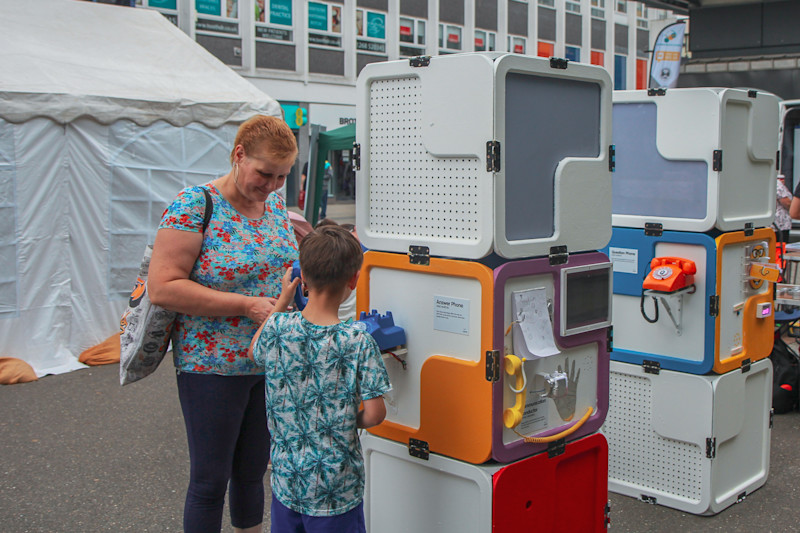
Unlike in these two installations, my phone won’t have the ability to allow viewers to hear other people’s messages. Mine’s not so complex, but I still think it gives the person a sense of speaking to someone anonymously, and perhaps sharing thoughts which they haven’t shared with anyone else. Those words initially communicated by a phone, then also have the potential to be further communicated in my work.

Where Do You Come From?

It’s a question that I find quite difficult to answer. It always makes me sigh; inwardly, if not outwardly. Nowhere, is an answer I sometimes give: it’s a short version, but demands an explanation.

I don’t really ‘come’ from anywhere.

My father was a soldier in the British Army. I was born in Germany, as were my siblings. Apart from a couple of short stints in England, a year in Omagh, Northern Ireland, and two years near Kowloon, Hong Kong, I spent most of my formative years in various locations in Germany.

It was a peripatetic life, the only constant being trips back to visit my grandmothers in the UK, both of whom lived near Derby in the Midlands. At the time, it was exciting regularly packing up our belongings in big army crates and stencilling the details of our next destination on the outside. Even more exciting was the unpacking at the other end, waiting for the crate with our favourite toys to be opened.

When my father retired from the army, we settled in Essex, for no other reason than that is where he got a job. I went to a local secondary school and then went off to university in Leeds, followed by law school in Chester. Then it was London until I moved to Hampshire twelve years ago. I don’t intend to stay here forever.

So, if I don’t come from anywhere, where do I belong? I can’t think of any geographical location to which I feel any sense of belonging. Maybe the answer lies in where I would like to be buried, but I still can’t think of anywhere. The ashes of both of my parents are buried at the church where they were married, in the village where my mother grew up, where most of her relatives are buried. If I die now I’m likely to end up in Basingstoke Cemetry at the intersection between the A303 and the M3 – just think of the noise!

I think the only sense of belonging I have is to my family.

My husband, on the other hand, is very clear as to where he comes from: Liverpool. He’s not lived there since his early twenties, but that matters not a jot. Personally, I don’t think I have come across a geographical location that instils in the people who come from it such a strong sense of place, belonging and identity. And it’s not just about the Beatles and football, although my husband would quote Shankly and say that Liverpool has the two best football teams in the world: Liverpool FC and Liverpool FC Reserves. It is something more than that, and I can’t quite put my finger on it.

I’m in two minds whether I’m incredibly envious of my husband, or whether I like not belonging anywhere – there’s a feeling that you could leave everything at the drop of a hat and move on. There is also something quite appealing about the idea of starting afresh, and leaving behind old baggage – a metamorphosis.

This train of thought was triggered by going through old family photos. Before he died, my father had started reorganising the family albums. Half of the photos are in brown envelopes. I’m attempting to bring some order to them, and to digitize them. It’s a long, slow process, picking through a family’s history; my history.

Resisting The Urge

It’s been difficult, but I’ve been managing to stop myself from altering things after the event. To leave things undone with elements which really jar with me, which are clearly wrong and which look awful, and to post them anyway. I think that it’s starting to make a difference as to how I work – if I can get into the habit of showing the worst of it, the imperfect, work which I’d much rather never see the light of day, and preferably end up in the bin, I hope that I will be able to engage fully with the process, and not worry about the result.

The mantras I’ve adopted so far:

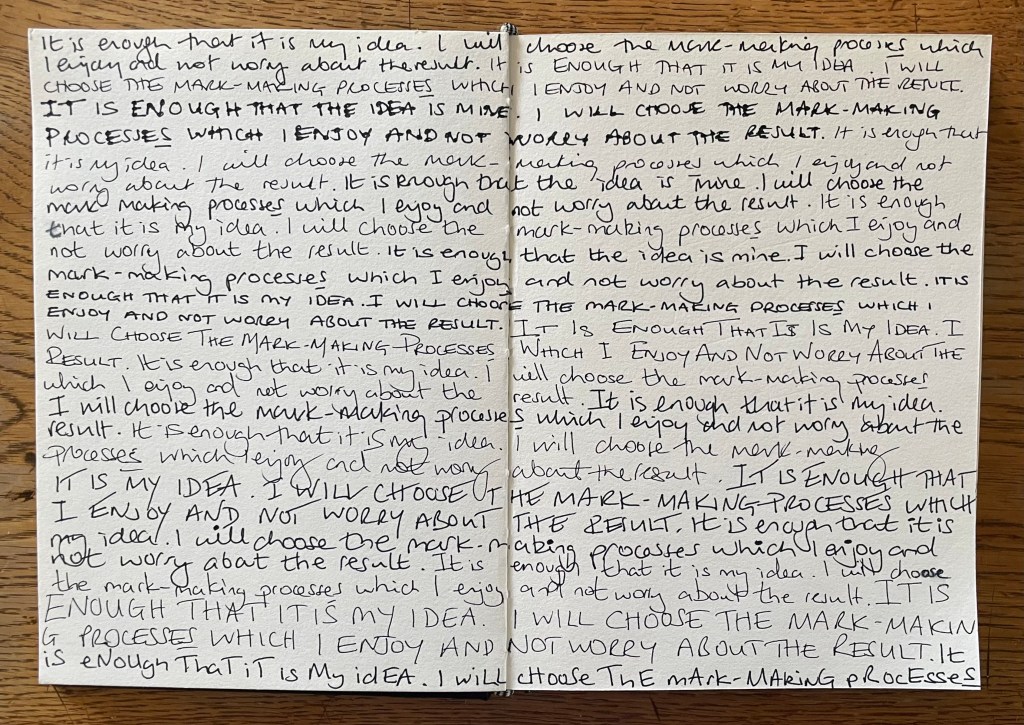
  • I will choose the mark-making processes which I enjoy, and not worry about the result
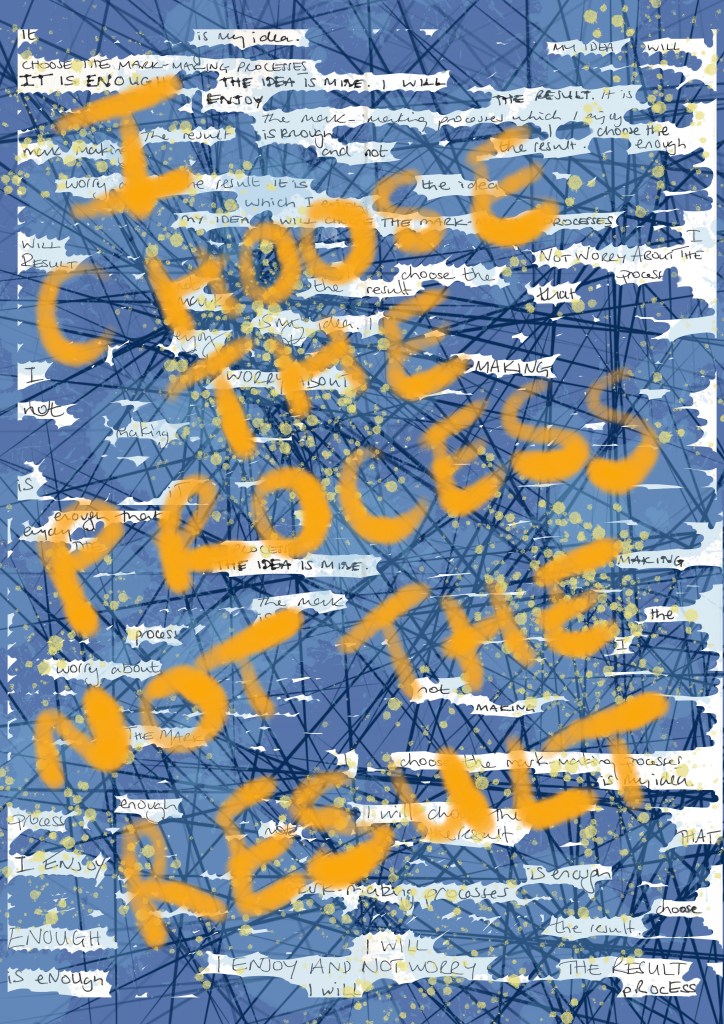
  • I choose the process, not the result
  • I don’t have to like what I make, and I don’t have to make what I like

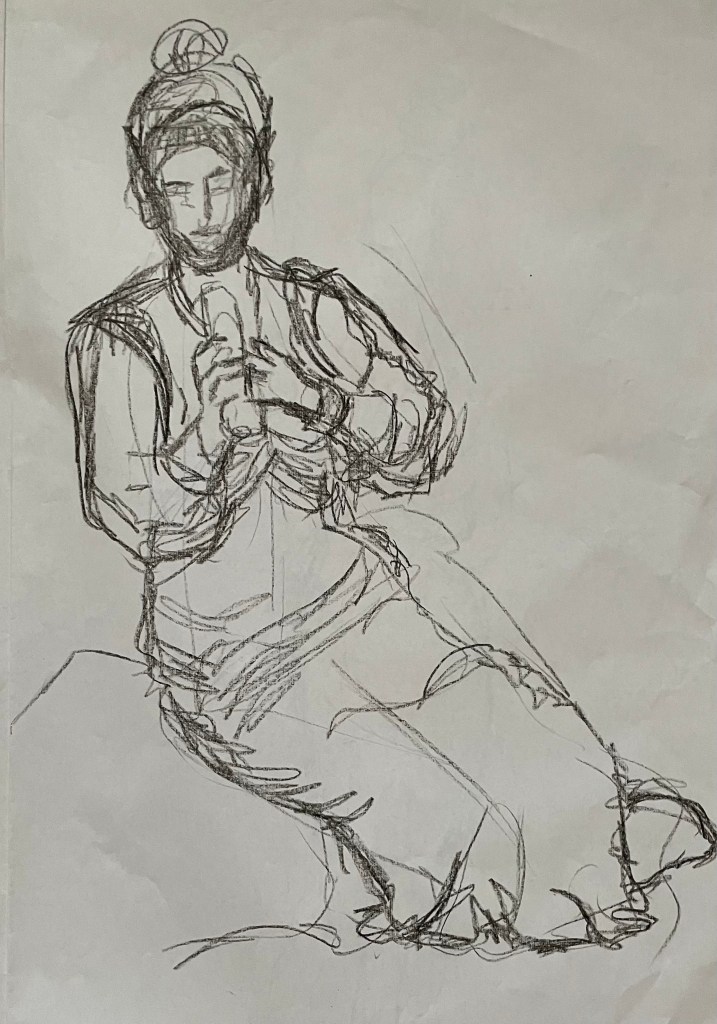
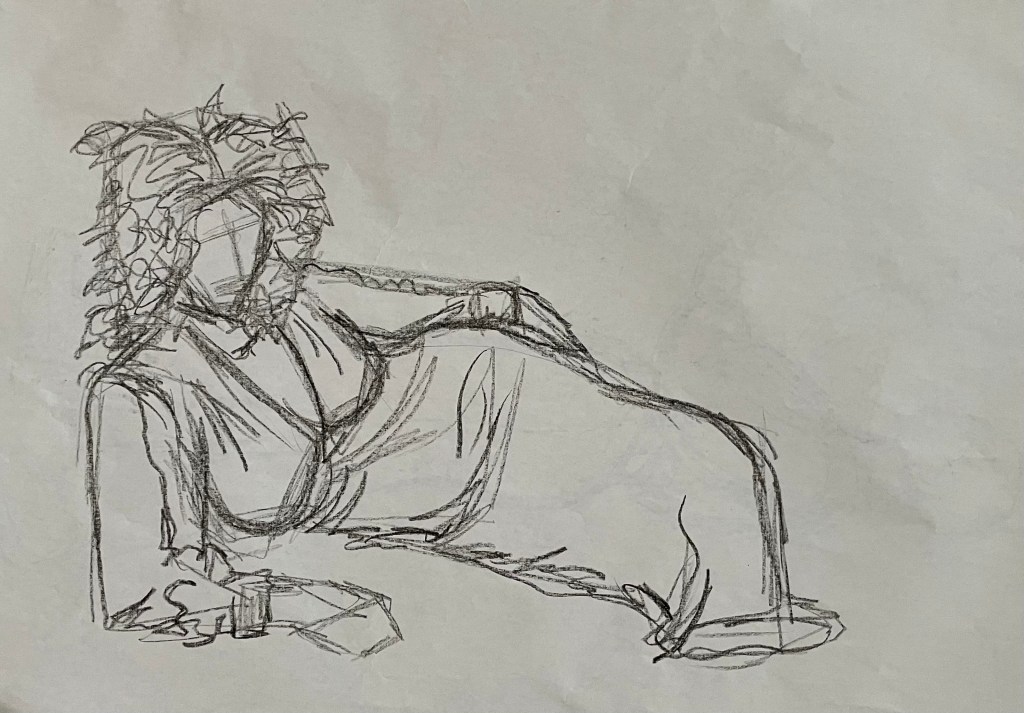
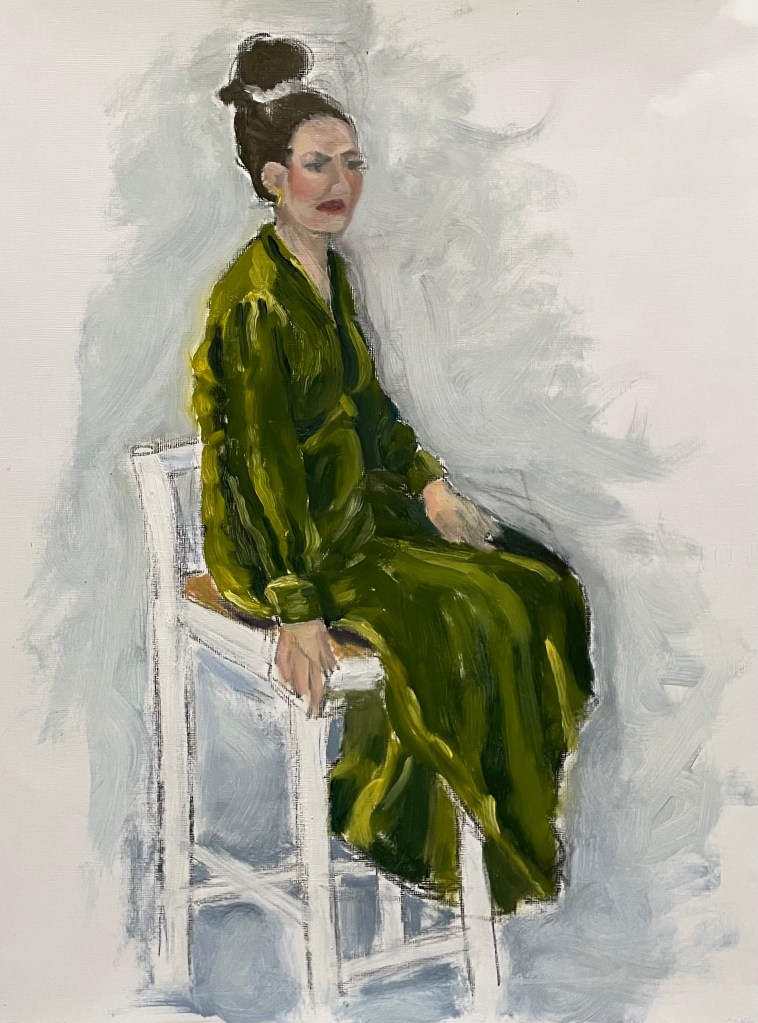
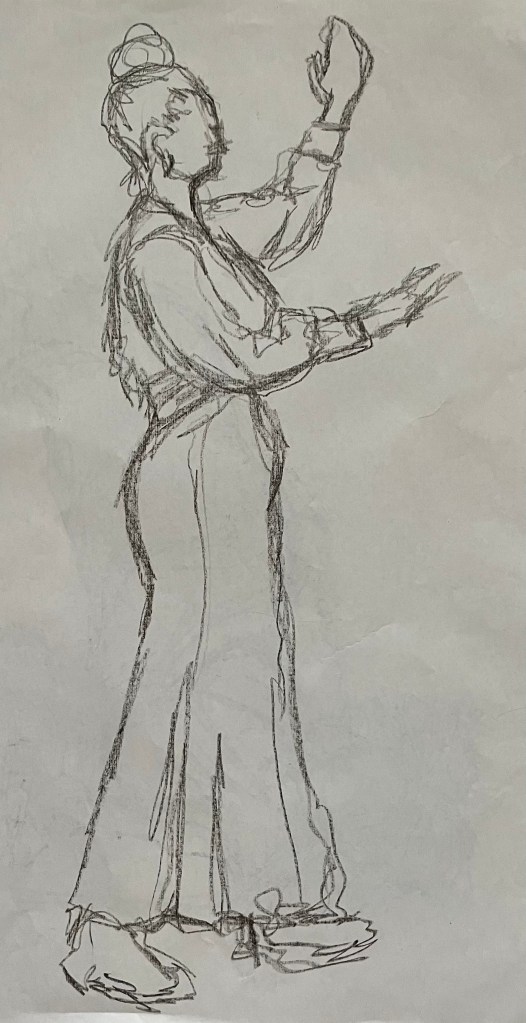
So, we’ve been continuing with the subject of figures in my weekly oil painting class. We had a model today. I certainly haven’t done her justice, and just don’t get me onto the subject of faces. We had to do a few warm up drawings, starting with continuous line – always difficult to get things in the right place – and then just normal sketching, a couple of minutes each. I used an oil pastel – I like that it’s a commitment, and can’t be rubbed out. There’s nowhere to hide, mistakes remain visible – the new me. Then an hour painting.

What to say? I’ve realised that since I’ve been posting my ‘Undones’ (seems a more positive word than failures), no matter how unhappy I am with the result, I can always find something that I like, if I look hard enough. It has just dawned on me, that I probably wouldn’t notice these elements if I was happy with the end result if, indeed, they managed to survive the perfecting process. There’s always some beauty, no matter the ugliness.

I think that I’ve unintentionally transferred my feelings of being weighed down onto the model. The dress looks so heavy; although it was velvet. I think I’ve managed to capture the sense of velvet. I’m trying to avoid using any blending in my paintings at the moment – I’m working on keeping my brushstrokes defined and with a sense of movement – I think I’ve achieved this. The figure is generally good and I particularly like the neck.

I’ve just been watching Sky Arts LAOTY, and now Gareth Reid is now giving a masterclass on drawing faces – I could definitely do with watching this.

Stuff

During our session at the brain gym this week, I explained to Dalal and Josh that I have been struggling to make finished work, as opposed to the products of experimentation. They both agreed with Jonathan, who, during my tutorial, had questioned whether I felt a pressure to make finished pieces; the experimentation stage is a place to stay for a while, and will, at the right point, turn into something more complete. I commented to Josh and Dalal that part of the problem may be that I’m ever conscious of time passing, and so I feel that I should be making the most of every minute – preparing the work plan had brought into perspective that there are a finite number of weeks left of the course, and that made me experience a moment of what I can only describe as loss.

I had hoped that a more productive phase would be imminent, but I suspect that at the moment this is being hampered by not having the headspace, or the physical space.

My husband is about (fingers crossed) to complete on the sale of his parents’ house in Liverpool – his childhood family home. He has been up and down, bringing things back. I find the process very difficult – I don’t have a problem with keeping things of use or of sentimental value, but another can opener? We have enough of our own stuff. We, or more specifically I, don’t need to add our parents’ stuff to the mix. I feel like I’m suffocating under the weight of belongings, many of which are occupying the physical space where I should be creating (more stuff?). Admittedly, I’ve been sorting this space out for I can’t remember how long, and made absolutely no progress. I’m conscious that my daughter will, one day, hopefully not in the foreseeable, have to undergo the same process – I don’t want her to be weighed down by all the stuff.

Along with the stuff, he also brought back what remains of one of his best friends from school, who died suddenly last year. His friend had left instructions as to all the places where he wanted to be scattered, including our garden, as he enjoyed coming to visit. Unbeknownst to me, my husband had brought him into the house and put him on the shelf, next to a glass bowl which had belonged to his parents, and which he had smuggled in as contraband whilst I wasn’t looking. My heart sank as I saw the bowl, and then the black bag next to it – what’s in here I thought as I opened the bag and took off the lid, another ornament?…

It’s All In The Tag

I was surprised when Jonathan pointed out in my tutorial that the most frequently used words in my tag cloud were ‘mother’ and ‘drawing’.

I thought that it would be words like ‘death’, ‘emotion’ etc – I feel that I’ve written enough about them. So, I’ve been through all of my posts and checked that I’ve categorised and tagged them correctly. I haven’t. I’ve failed to use more general terms – words like ‘resentment’ and ‘loss’ appeared but not the umbrella term of ‘emotion’. It’s important moving forward that I keep on top of this as the tag cloud will be integral in determining what is important to me.

Having completed that exercise, the words of the moment are ‘emotion’ and ‘process’. That sounds about right…

Dialogue IV – I’m So Over It

I’ve had enough of this side quest (©️Rebecca). I regret the day that I started it. Have I enjoyed any part of it? Maybe the beginning, the anticipation, the thinking about it. But when it comes to the process, it has been a monumental headache, from the execution to the photographing.

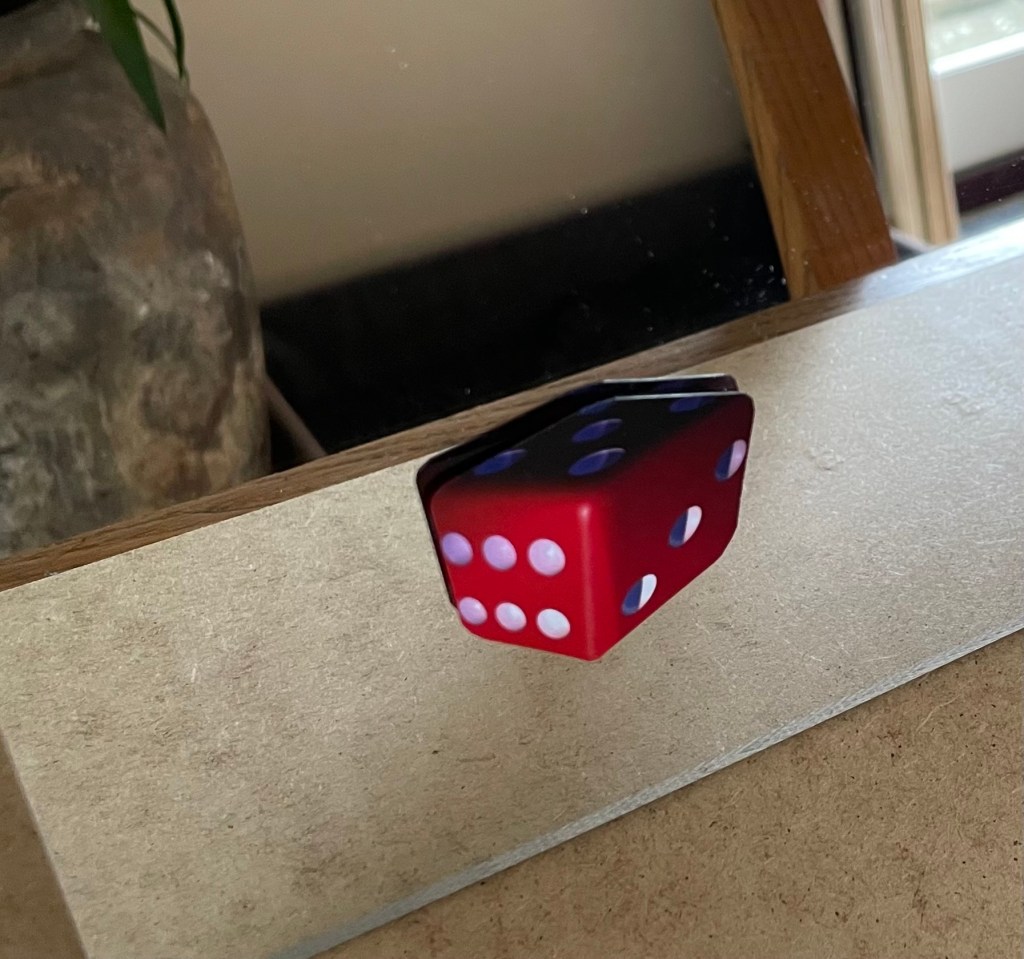
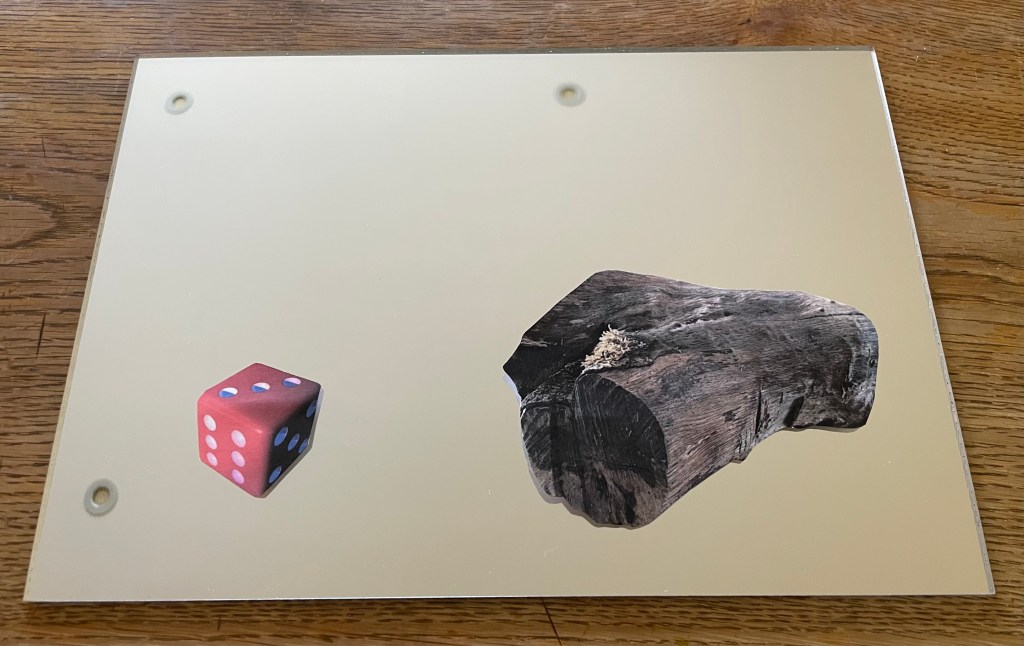
I realise a few things may be influencing my feelings about it. I keep getting reminder emails that the submission deadline is approaching – like I don’t know. Also, my daughter phoned me up yesterday morning in a crisis during an online exam – she was having IT issues. She had already contacted the helpdesk and taken screenshots, so my only advice was that she could only do what she could and not to stress, they must have procedures for this sort of thing. A couple of hours later she was feeling better, whilst I was still feeling the effects of all her stress, and trying to work out how on earth I was going to take a photo of a reflective surface. That, and the fact that some of the glue had managed to escape from under the cut-outs, and the realisation that I had fixed the die on the wrong way round.

Anyway, this morning it wasn’t raining for a change, so I took it outside. I’m not entirely sure how I’m supposed to convey its reflective qualities without including a reflection which then looks like it’s part of the work. Well, following my own advice, I can only do what I can do.

I feel like it’s been a shambles and that I’ve been amateurishly stumbling from one thing to another. The process hasn’t been the experience I thought that it would be. Because I had no expectations, I thought that there would be no stress – instead I’ve experienced confusion and frustration, and it has taken just as much out of me as other years, just in a different way. The only difference is, if it doesn’t get anywhere, I really don’t think I care at this point.

But every experience is a useful one. So what have I learnt?

  • Mirrored acrylic has an amazing quality of turning into a super static magnetic for all manner of minute particles floating around in the air and so is impossible to get clean.
  • Whilst deadlines can assist in making decision making and getting on with it, a lack of time reduces options, options which may have been the better course to follow. I should have had the image screen printed – it would have avoided so many issues – but I just didn’t leave myself enough time.
  • I’m not neat, and I don’t do small and fiddly.
  • I’ve tried something different – maybe next time I’ll enjoy it.
  • I can submit work which I don’t like and which contains what I know to be obvious errors.
  • I’m going to do mirrors again, sometime – they will not defeat me.
  • The process of exploration and experimentation is not just about serendipity and happy accidents or things that just don’t work, it can provoke feelings of confusion, frustration and it’s just not that easy.

But for the moment, I’m so over it.

Dialogue III – That Will Do

I’ve always thought that if you do something, you should do it to the very best of your ability, no matter what. My husband is very much of the ‘that will do’ approach, which used to really irritate me.

With hindsight, it was an impossible ideal – it’s obvious that I couldn’t do my absolute best at everything I did in life; there’s only so much time, and so much of me. It was a tall order to impose not only on myself, but also on others – it led to feelings of disappointment and dissatisfaction. It was also the slippery slope which led me to strive for perfectionism in my art. Over the last few months, my mindset has shifted, I would say, seismically.

That’s not to say that I’ve stopped caring, or have become laissez-faire. I would like to say it’s because I now care much less about the result, and more about the process, but I’m not quite at that point yet. It’s more that I’ve stopped imposing such high expectations on myself – in the past their achievement might ultimately have given me a moment of satisfaction, but it was rarely ever enjoyable or something that I actually wanted to do. Now, I feel that I am motivated by what interests me, and I would still like to do my best, for example, in the sense of making the most of opportunities and ideas, but I recognise that there are so many variables which could influence what that might be.

Anyway, long story short, I’m done, finito, and heaven forbid – it’ll do.

So, I had the mirror images printed and fixed them to the back of the existing cut outs. I used a crafter’s glue – Tombow mono liquid glue – as it seemed the least likely to cause buckling etc. Now the cut-outs were thicker than they were originally which caused a problem of the white edging. Also, even using a brand new craft knife didn’t prevent some of the edging being visible face on, which was particularly irritating – I don’t really do fiddly stuff and I’m not the neatest – as I had been really careful when cutting them out. I used some highly pigmented coloured pencil to get rid of the white as best I could. I then glued the cutouts onto the mirror, which proved tricky as the mirror surface had to be wet for the glue to cure properly. I managed it as best I could, but it was a tricky process trying to get enough glue on the back of the cutout for it to fix, but not so much that it would ooze out from underneath and react with the water on the surface.

It will do.

Next problem: photographing the finished piece.

Doing Lines

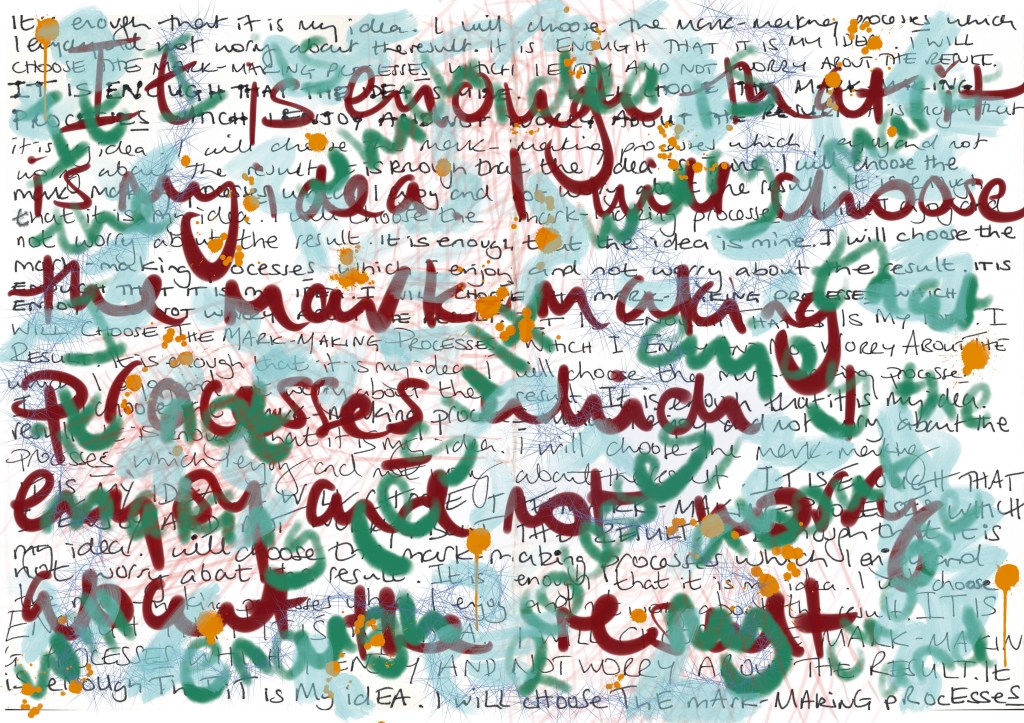
Following my tutorial with Jonathan, I decided to test the theory that if you say something to yourself enough times, you’ll start to believe it. So, I’ve been doing lines. To be honest I didn’t have to do lines as a punishment at school: I was a conformist.

We make marks everyday in one way or another. An obvious one is our handwriting. I learnt handwriting at school in the same way as every other child, in the book with the lines which indicated where the top and bottom of your letters should go, and the line in the middle indicating the height of the small letters. Once we had mastered the basics, we were allowed to go free range, first with a pencil, and then with a pen, as a reward for continued neatness, and perfection. Those were the days when everyone was taught to write with their right hand; left-handedness was not tolerated. But the need to express ourselves in how we write the words, not just with the words we choose, will always out.

Our handwriting reveals things about us, from the tilt, the size, the pressure, the failure to close our loops. I’ve never had consistent handwriting. It changes depending on my mood. I wonder what that says about me. Maybe I’ve never found a style which says to me: yes, this is you. And maybe that’s the point – I’m forever changing. Or maybe I just haven’t found my mark-making processes. It doesn’t really bother me, but at times I do feel jealous of the beautifully formed letters of others. I think – yes, you’ve got it together; you know who you are.

Doing Lines I

I like that the redaction is scruffy and that there are jagged edges. When I was doing it I wasn’t aware how scruffy it was because I was doing it against a white background, and so it just looked like the redacted words were disappearing. Surprisingly, I didn’t even have the urge to tidy it up once it revealed itself to me. As I was going through the words trying to make different phrases each time, there was a section in the middle which became a bit negative. It’s quite difficult to find different phrases from the same words in the same order. Phrases like ‘I worry about not making’, ‘Is it enough that I enjoy the process’ and ‘I worry about not making the mark’ started to pop up.

Doing Lines II

Well, I’ve written the words that many times, that if they haven’t sunk in by now, they never will.

It seems to have all been about words recently. What are words worth? That’s what the Tom Tom Club asked in their rather bizarre new wave hit from the early eighties, Wordy Rappinghood. You have to be of a certain age to remember this one. I rather like the artwork.

A State of Flux

That’s my phrase of the moment. I feel like I’m in a state of flux.

I’ve been reflecting on State of Flow I and State of Flow II. Flowing water is in a state of flux.

Does that make me a river? Squeezed out of a tiny hole, small to start with, fast and quick, agile, fresh and exciting, periods of calm punctuated with the tumbles and effervescence of waterfalls and weirs, twisting and turning, carving out my way, sustaining the lives of others, being held back and contained by dams until being finally released, picking up along the way, depositing along the way, slowly getting wider and wider, slower and slower, filling up with sludge and pollution, before finally being discharged into a mass of indeterminate nothingness.

Dialogue II

“So, what do you think?”

”It’s not one of your best”

And now I’m in a state of flux, and feeling a bit stressed, thinking where do I go from here? I have nothing else.

I use my husband as a sounding board and as a gauge as to what I’m feeling and what I’m doing. I value having someone to give me feedback, to hold a mirror up to me. But to what extent should I rely on this and allow it to influence how I see my own ideas and work? Why is it when someone says they really like my work, I feel it’s easy to ‘do it down’ – ‘oh, it’s not one of my best’, ‘there are some bits of it I’m not totally happy with’ (when actually I think that it’s as good as it could possibly be and I’m actually quite pleased with it), and yet when someone is ambivalent about my work, I feel unable to ‘big it up’?

Anyway, I now feel directionless, and at a loss as to what to do.

I have looked at how other artists have approached the concept of dialogue, and, in the main, they all involve figures. None of what I have looked at has inspired me so I haven’t even bothered to include any images of them in this post.

I don’t know what it is, but I’m feeling a bit fed up at the moment. Maybe it’s the theme of ‘Dialogues’ and the idea of connections etc. – it all seems as if it’s something that has been done before ad infinitum. Maybe it actually bores me – I don’t know – I just can’t seem to get inspired by it. Maybe it’s the fact that I only have a week to make something and I’ve got other more pressing things to be getting on with. Maybe this little side quest of mine is becoming an unnecessary distraction.

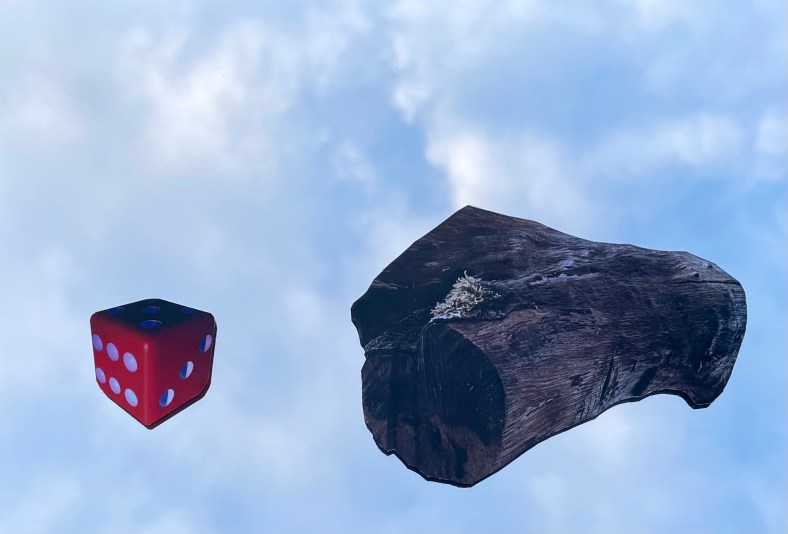
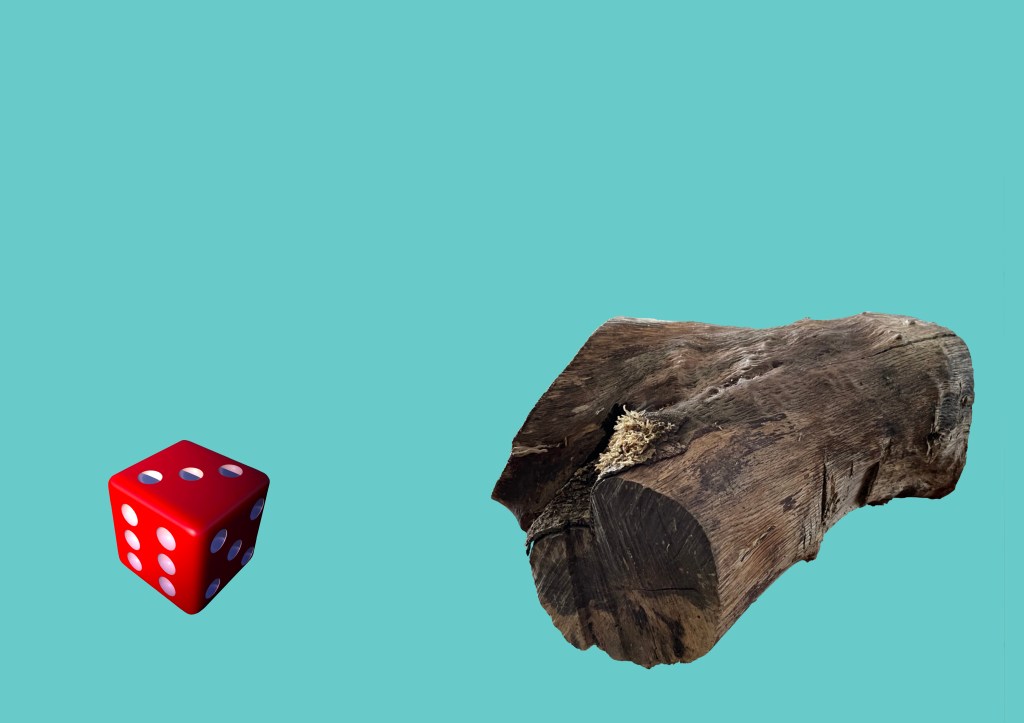
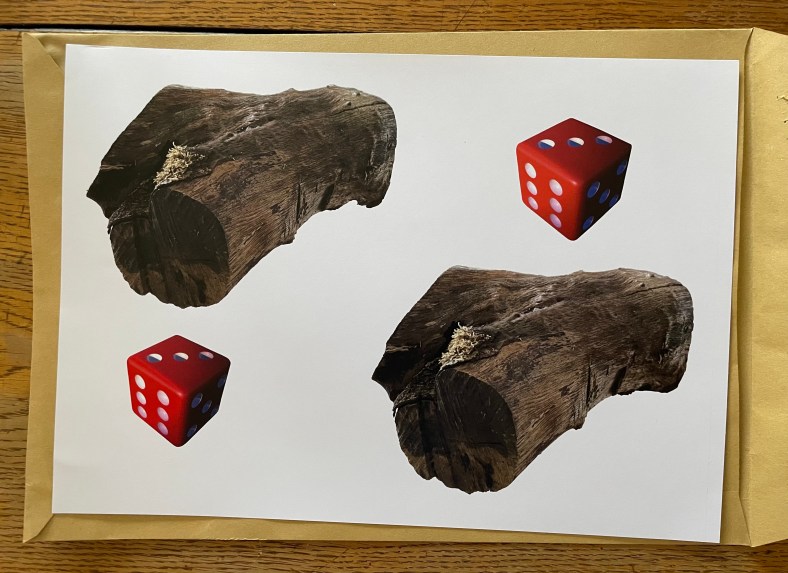
As a reaction to this feeling, I decided to take a literal, and some might say, infantile approach. I kept on coming back to my perverse love of Catchphrase and the birthday card. I started fiddling around on Procreate and came up with this:

A die, a log.

It’s pretty basic, but strangely appeals to something inside me. Maybe it’s a bit cheesy – but do I care? – maybe I need a bit of cheese at the moment. Then I remembered a piece I saw at the Pallant Gallery last weekend.

’Neighbourhood Witch’, 2008, Simon Periton, Silkscreen on mirror coated polyester

I really like the use of the mirror which reflects the viewer so that they then form part of the work. It reminded me of Craig-Martin’s ‘Conviction’ which I had seen at the RA. I could use this idea because one of the thoughts on my mind map referenced the need to reflect when engaged in dialogue.

I have decided to incorporate a mirror, possibly with the images of the die and log being raised slightly away from it so that they reflect in the mirror as well as the viewer – a die, a log, with you. It’s now becoming a fully matured wedge of Stilton!

I experimented by printing them off on some inkjet friendly acetate but my home printer didn’t do a particularly good job, but good enough to allow me to see whether the idea had legs. I wasn’t averse to it: it would mean that I would have to have it professionally printed on something more rigid, such as acrylic/perspex, and frankly, I don’t really have the time to get this done. Also, on reflection, I wasn’t sure about the reflections creating multiple images, as it was no longer a die and a log.

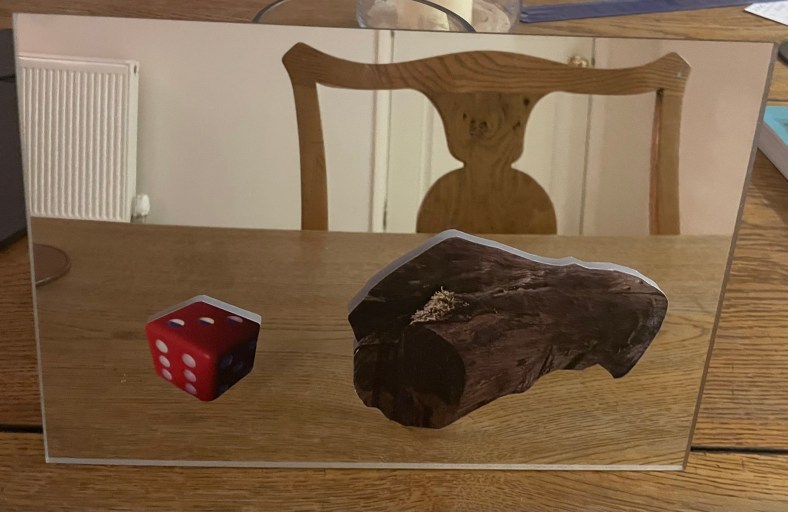
The only solution that I can think of is to fix the image directly to the mirror. The image in ‘Neighbourhood Witch’ above is screen printed on. I don’t know how to do this and I don’t have time to learn. I could get it done professionally, and after having done some research, it may still be a possibility but it depends on timing. Another solution would be just to collage them on. I researched the best type of adhesive and came up with Gorilla Clear Glue which is used a lot in glass mosaics. I will need to experiment with how best to apply it. In the meantime, I put some image cut-outs on a A4 mirrored piece of acrylic. I like the size.

Despite its luke warm reception, I’m going to carry on with my current train of thought. It may not be my best, but I like it because it is something that is totally different for me and it’s way outside of my box, and frankly, I’m all out of other ideas. And as General Patton said – a good plan violently executed now, is better than a perfect plan executed next week.

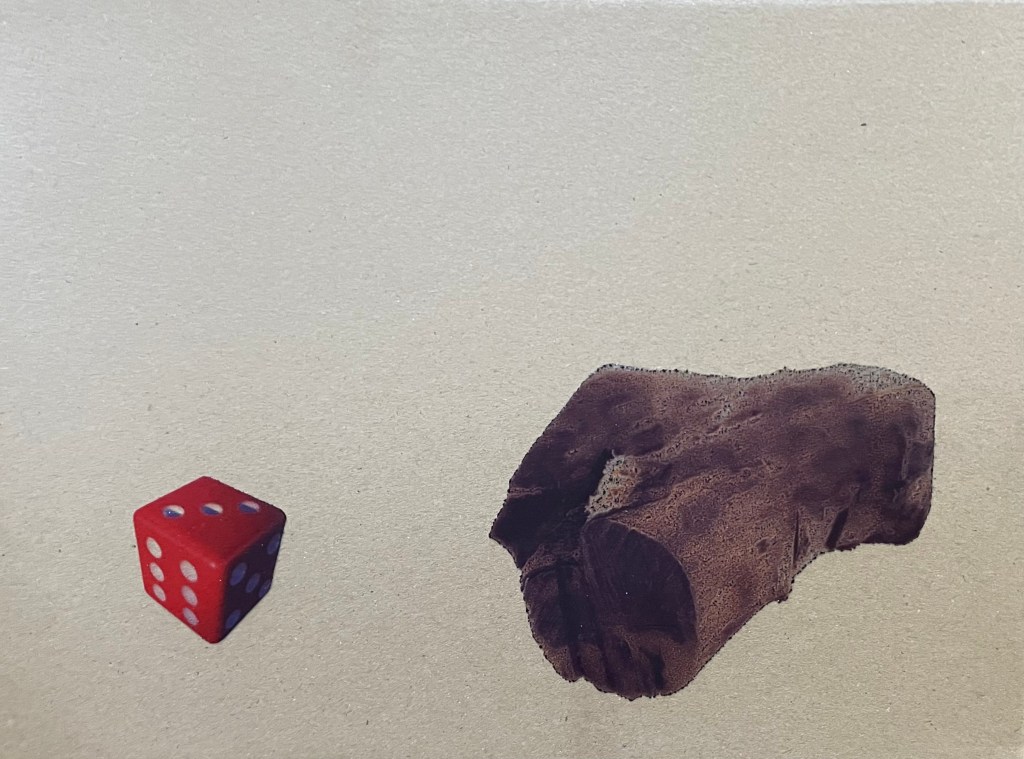
So I had a couple of sets of the images printed up on some 200gsm paper by my local print shop and cut them out and placed them on the mirrored acrylic to see how they would look.

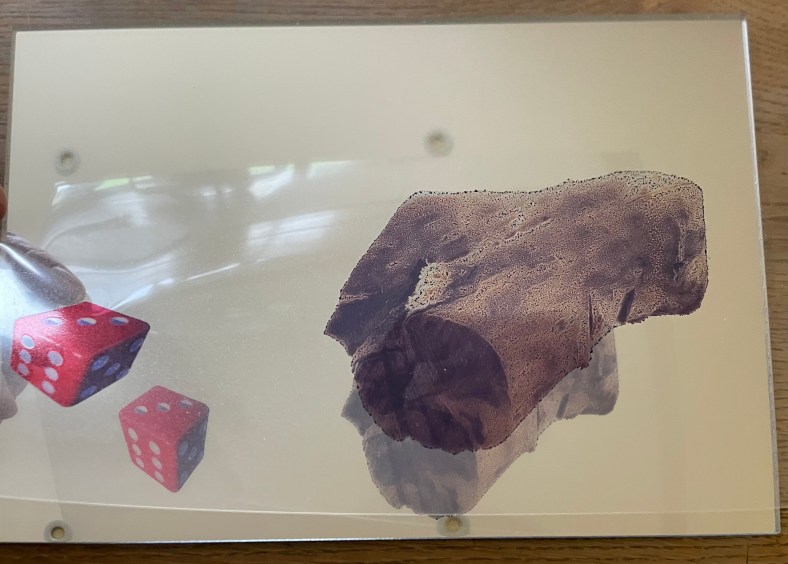
I don’t know why I didn’t realise that this would happen, as it seems so obvious now – unless you stand dead straight on to it you can see the white reverse of the cut out image in the mirror.

My proposed solution is to have the mirror images printed and then fix them together so that any reflection is of the image itself.

Onwards and upwards, I hope!