Miscellany I

I’m conscious that I committed to doing an automatic drawing a day to try and change my mindset. I’m allowing myself the inclusion of exploring Procreate as well!
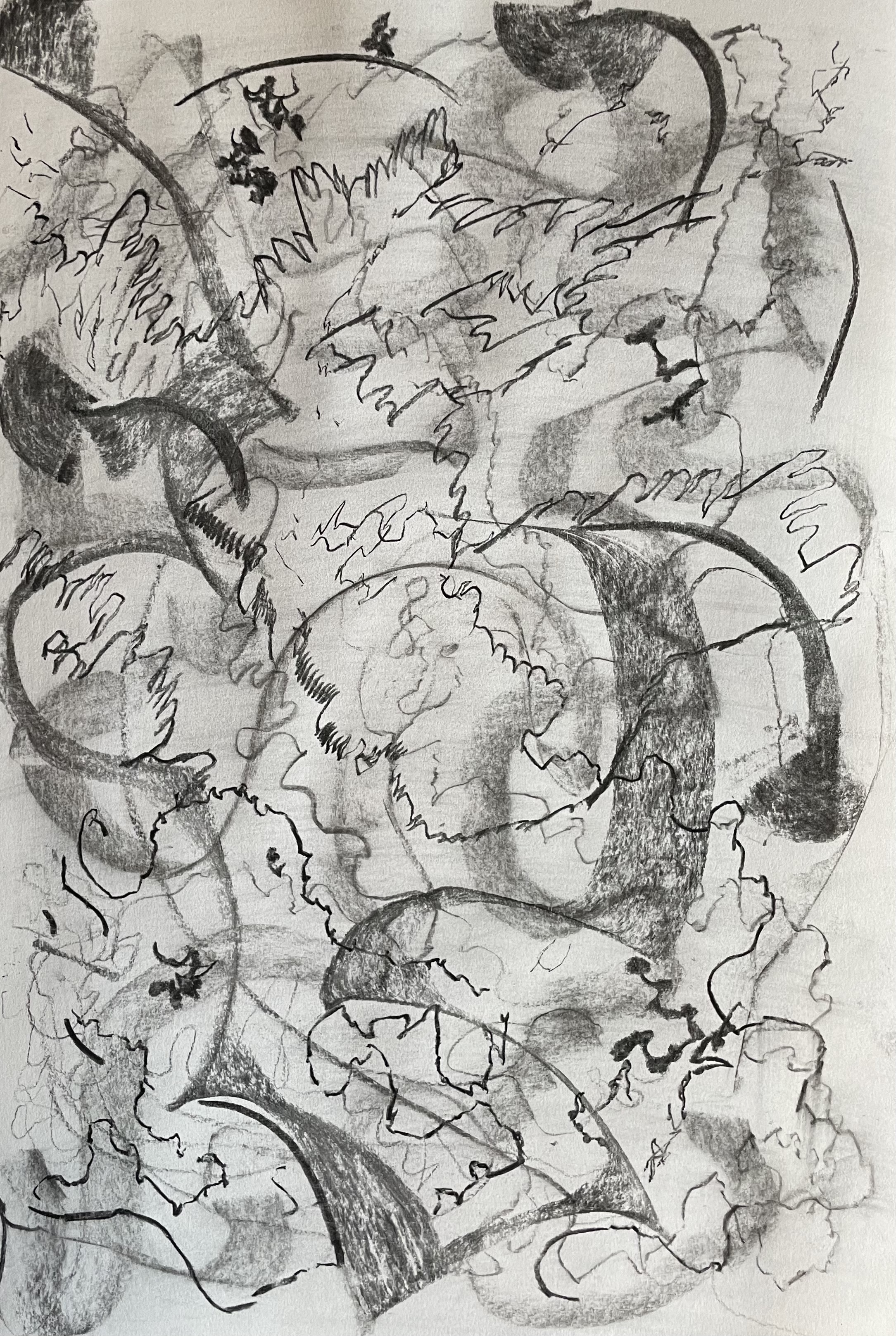
I particularly like the charcoal drawing. I used a piece of compressed charcoal and made swirling marks using it on its narrow edge and full on its side. I then rubbed it out and repeated it but this time playing around with the end and varying the motions. The concept of layers appeals to me (memories, past lives/ identities…) particularly the traces left behind of the first drawing and I was surprised by the range of marks I made depending on how I held the charcoal and the pressure I used. There are some delicate areas, followed by some jagged, harsh marks. Some lines appear to be faltering and hesitant whilst others have more purpose and at times are almost punctuation marks in what would otherwise be a stream of unconsciousness.

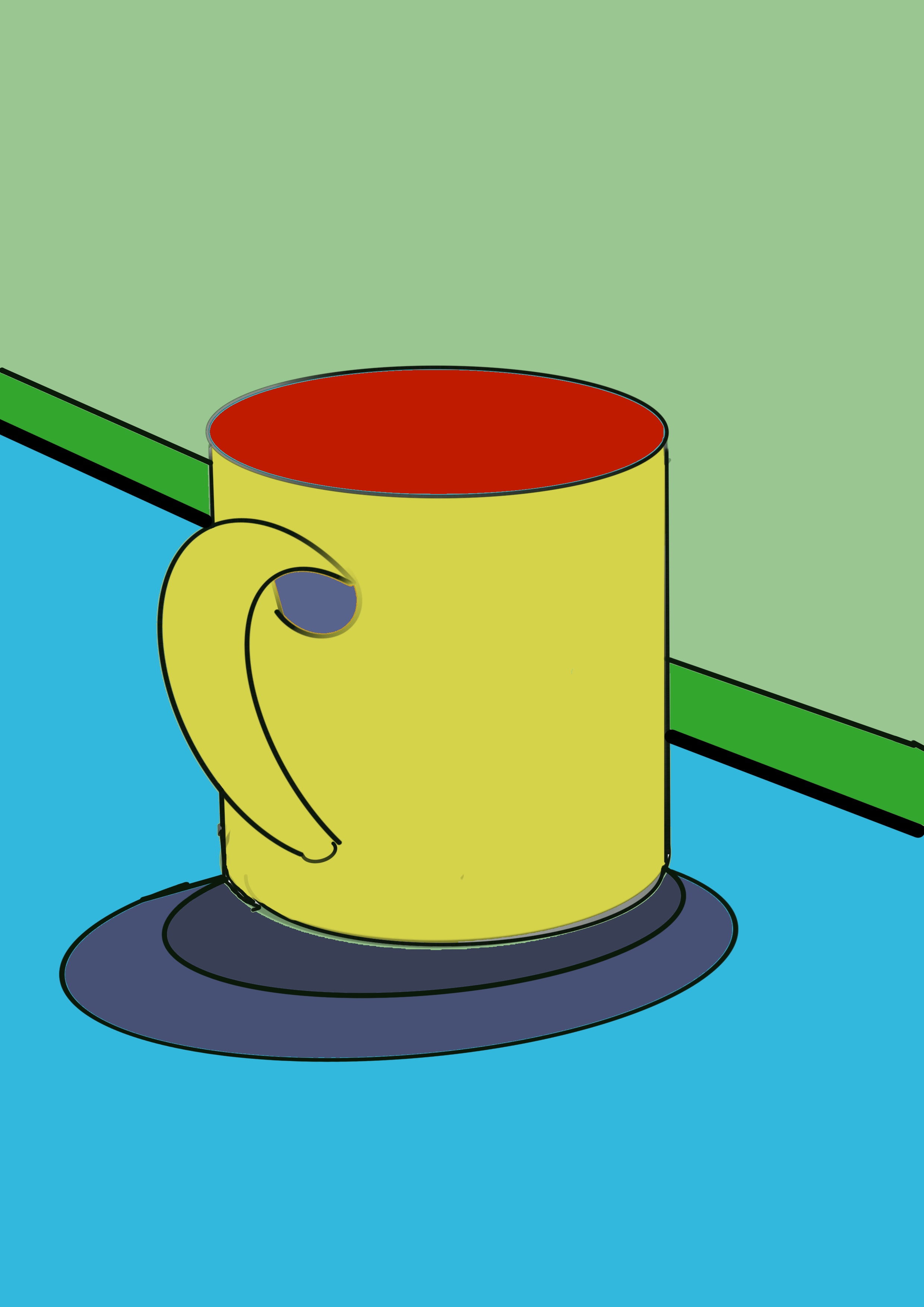
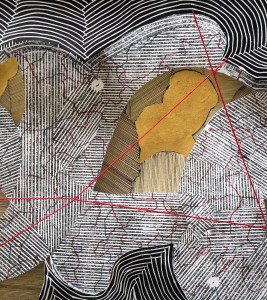
The second image I am treating as an automatic pastel drawing – I randomly chose colours and effects from the Procreate menu and I think the result is interesting, although I miss the haptics and the smell of the real thing as well as the tactile relationship between the medium and support. I’m not sure that I would use it going forward, except maybe as a tool to experiment with, although I have previously decreed that collage is just not my bag – how times change! I might use it if I decided to go down a graphic flat colour route (as in the third image) and digital collage is something I will definitely explore further – no bits on the floor and no need to glue – what’s not to like? I’ve been thinking about how I could incorporate digital collage into a mixed media piece of work – perhaps a giclée print onto a canvas, sealed with medium and then oil paint?

There are lots of thoughts chasing themselves around my head – I’ve been ignoring them in the hope that as and when I consciously acknowledge them they may have already got themselves into some kind of order. Just doing what I’m doing at the moment seems to be creating even more possibilities and permutations which is exciting.

I can sense that I’m feeling a lot more relaxed about making my experimental work ‘public’. I really look forward to starting the day by just letting my hand wander across the page – it’s the only time when there’s no expectation on me to achieve anything – renewing the buildings insurance, fixing the E20 error message on the washing machine – just a moment when I’m at one…
And Now For Something Completely Different

Last week’s task was to try something different in our artistic practice: something which might not work out.

I’ve been thinking about trying digital art for a while. I like the feel of a paintbrush or piece of charcoal in my hand and so a foray into the world of an Apple Pencil and a flat screen would seem to lack the tactile nature of applying paint to a canvas or smudging and blending charcoal with my fingers. It is, as expected sadly lacking, although Procreate, the app I used, has a wide range of effects and tricks, it’s not at all the same.

I’m not the most technically minded person, so I had to watch numerous YouTube videos and even then with my current inability to retain information, I decided that the best way to learn is to get stuck in. It took me ages just get to grips with the basics!

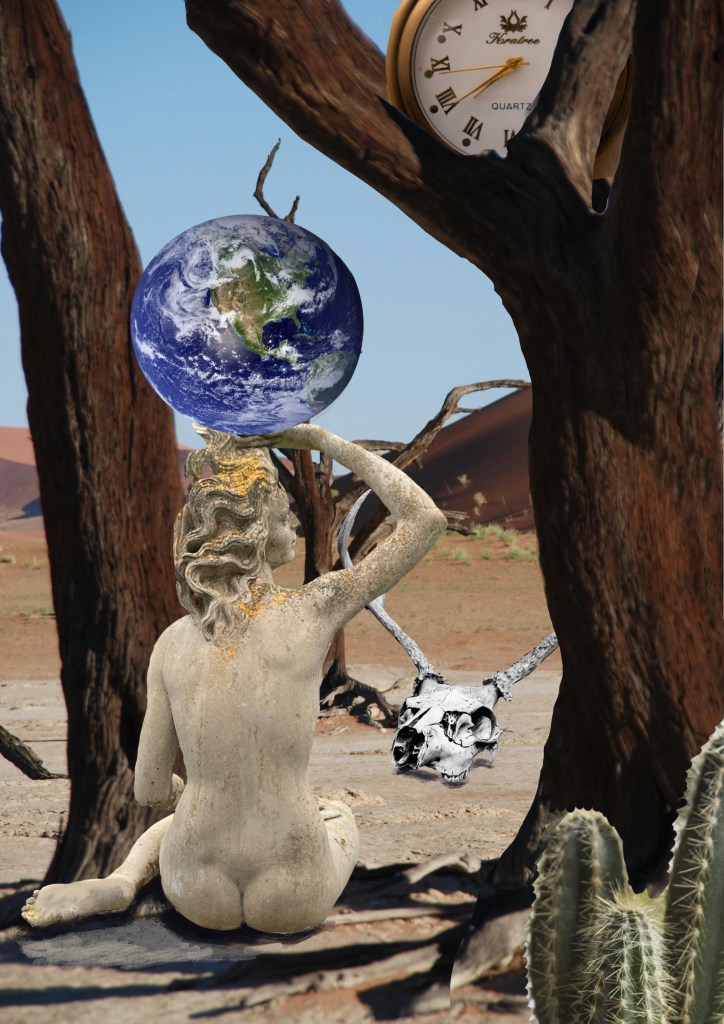
I discovered that one area in which using Procreate might be of use is in collage. Instead of cutting out images and assembling them, I created several different layers of images which I first isolated from their backgrounds. It was much easier to move them around than using physical pieces and the ability to use my own photographic images and images from websites such as Pexels, means that there won’t be any issues in terms of copyright, something of which I’ve always been mindful.

This is the result:

I’m quite pleased with it as a first attempt and I can see that there is a lot of potential in producing digital collages. I found the process quite frustrating at times, but that was mainly due to my incompetence and this will improve with practice, hopefully. Next time I will take a bit more care in selecting my images; I don’t think the cactus in the foreground works particularly well, but I just needed something to detract from the lack of clarity in the tree roots. I used the paintbrush option to put in a shadow under the skull, but the shadow of the figure doesn’t work at all – I was unable to alter it as I had merged several layers together by that stage. Going forward, I think I need to give more thought to the interaction of the layers and also, to save time, it would be a good idea to start to create a collection of images rather than searching through photos and websites on the hoof.

“Ever Tried. Ever Failed…

No matter. Try again. Fail again. Fail better.” (Samuel Beckett)

I hadn’t come across this quote until my daughter went to secondary school, where the headmistress used it as her mantra in her quest to produce strong, independent young women who would leave school ready to deal with whatever complexities the world threw at them. It was used to encourage the girls to go beyond their comfort zone in trying new things and not to be put off by the risk of failure – “feel the fear and do it anyway” was another one of her favourites!

There are many inspirational quotations dealing with the concept of failure such as:

“Try and fail, but don’t fail to try” – John Quincy Adams

“Success is the ability to go from failure to failure without losing your enthusiasm” – attributed to Winston Churchill

That’s all very well, but they don’t deal with how we should actually process the feeling of failure, and this is something we touched on in our online session this afternoon. The problem of dealing with failure is that the ego gets in the way. Strategies to overcome the ego include sharing stories (this allows others to learn from the failure without actually experiencing it); over-acceptance of the failure (that is actively taking it and collaborating with it to make an alternative outcome); and distancing the failure (for example, by using the third person when reflecting on it). The last strategy is particularly effective as it allows you to view the failure and the person who failed objectively giving rise to feelings of empathy.

So, our task for next week is to take a risk and do something in our art practice which might not work out!

For the first part of today’s session we finished our short introductions. I had been feeling ok about it, but towards the end I felt quite overwhelmed by emotion – maybe it was because I had mentioned my constant feeling that time is ticking by at quite a rate, or maybe it was the sudden realisation that it is only now that I have made the time to do something that I have always really wanted to do. Either way it came from nowhere and left me feeling quite out of sorts for some time afterwards. Even more reason to carpe diem!

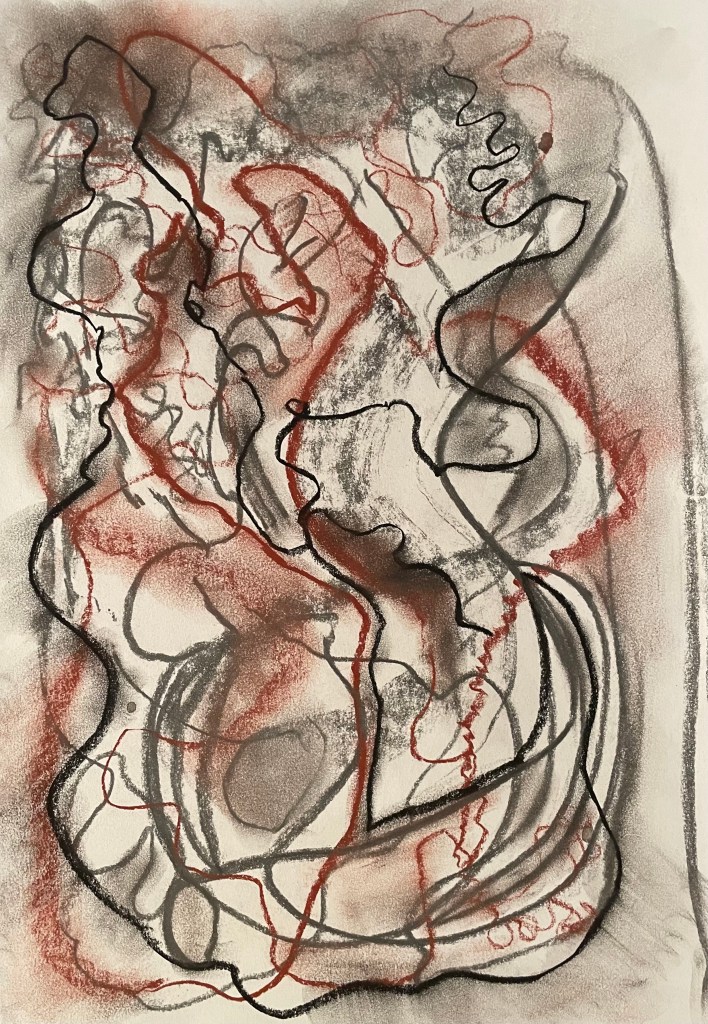
Below is today’s automatic drawing in which I used a thin and a thick piece of willow charcoal, holding a piece in each hand moving at the same time. I then used a sanguine and black conte pastel on top. It’s not as dynamic as the previous drawing and seems a bit contained – maybe because I was using both hands at the same time – I’ve never been able to do the head pat/ tummy rub thing. Next time I think I will stick with charcoal, but maybe build up some layers, and also begin from a different starting point.

Trying Not To Overthink It

Guilty as charged: I have form for overthinking, overworking, not knowing when to stop and basically bludgeoning a piece until there is no life left in it. My problem is that I have an expectation of how it should be. It’s not even as if I enjoy the process – it makes me frustrated, stressed, and downhearted to the point of threatening to pack it all in. So, to put an end to this way of working I need to adopt a new approach; create a new habit but one which opens up possibilities, as opposed to closing them down. Admittedly, I have already begun to experiment more recently, but it needs to become second nature.

There’s a lot to be said for drawing exercises; I’m a particular fan of continuous line drawing but the drawback (excuse the pun) is that I’m still drawing something, I’m just not allowing myself to draw it as accurately as I might otherwise want to, and so there is still an expectation as to how it should look.

Sometime ago, I watched a documentary about Maggi Hambling. She gets up at 5am every morning and with a cup of coffee and cigarette in hand, she starts her day by making a drawing – she doesn’t like the term sketch – using an ink dropper and, in this particular instance, with her eyes closed. It is a form of automatic drawing, a concept embraced by the surrealists and latterly by the abstract expressionists, which involves the artist making marks without any conscious control.

I think this is for me!

There are numerous possibilities: pencil, charcoal, ink, paint, collage, eyes open, eyes closed, different ways of holding, holding more than one, dominant hand, non-dominant hand and the list goes on.

So this is the first of my daily automatic drawings:

I used a charcoal pencil in my dominant hand and, with my eyes open, I just let it wander over the page without any conscious thought or control. Maintaining the same pressure and manner of mark-making started to become a bit tedious so I almost unconsciously varied the pressure and the way I made the marks, holding the pencil higher up so that there was less control from my hand, rocking it backwards and forwards in my hand, holding it perpendicular to the page and then on its side. It was a sensory experience in that I was aware of the feel and the sound of it: the sound of the charcoal on the paper and the squeaking and stuttering of it on the upward stroke creating broken lines, as opposed to the smooth downward marks. I then randomly smudged and blended some areas.

There are some quite interesting passages and if this is my subconscious expressing itself then I might have cause for concern! All in all, I’m pleased with what I produced because I enjoyed the process – instead of being mindful, it was mindless – and I hope that if I do this often enough I might just free myself up.

That Sunday Feeling…

Well, it’s Sunday. I can’t believe how quickly the days have gone by. Thoughts inevitably turn to the week ahead, in particular, our next session on Tuesday when I will ask myself: What have I done this last week and what am I planning to do this coming week? Last week I planned to de-clutter: my mind, by dealing with lots of loose ends which are getting in the way of committing time and headspace to creative endeavours and, physically, by sorting out the physical space in which I hope to pursue them. How have I done? Not particularly well in all honesty – I have made some progress in trying to bring ongoing commitments to an end, but I have made absolutely no progress in creating my physical space. Also, in all fairness, I lost a couple of days to illness.

I suspect that there is an element of self-sabotage at play: making the act of actually engaging in the art making process dependent on having achieved something else first. I need to change this – this week I will start the process even if it means doing it on the kitchen table!

On a positive, I have posted twice on my blog, which hopefully means that I’m now feeling much more comfortable with the idea of self-reflection and the act of making it public. I have also done a lot of thinking: that counts, right? A bit like crossed fingers and vampires? Does fingers work? (Credit: the sublimely brilliant Eddie Izzard).

Feeling Our Way

During our second session half of the group gave short individual presentations about themselves and their work. It was fascinating to learn how they have come to be here and their inspirations. We then went on to consider how we are feeling at the beginning of the course and the idea of vulnerability was a recurring emotion.

This is something that I have been thinking about a lot recently: to expose one’s vulnerabilities takes courage. It reminded me of an interview I watched between between Alan Yentob and the actress, Miriam Margolyes, in his ‘Imagine…’ series for the BBC which was made shortly after she had published her autobiography.

ALAN:”Have you hidden anything in this book? Are there things that you haven’t spoken of?

MIRIAM: “I didn’t mention something that I should have mentioned and that was that I hit my mother when she was paralysed. Anyone who has been a carer will know how frustrating and difficult it is and I let that happen and I’m deeply ashamed of it. But the thing that really gets to me is that my mother forgave me. I hit her when she was paralysed and she forgave me.”

I remember thinking how tremendously brave she was to admit to an act which most of society would view as anathema. I was shocked by it; it was a stark statement made without context or explanation and without looking for sympathy.

They say that before you judge a person you should walk a mile in their shoes; two years later I was caring for my terminally ill mother and if I had watched that interview then, it would have spoken to me and I would have been more understanding.

So, I need to have the courage to embrace vulnerability because there’s just a chance that someone else might be feeling the same way.

First Group Session

Well, we’re finally off! It was an inspiring 3 hour session on Tuesday afternoon meeting fellow intrepid students on a two year adventure into the unknown. A lovely bunch who readily explored concepts of compassion and kindness – something I will probably need in bucketfuls along the way. I’m feeling very much like a small fish in a big pond, but I wouldn’t really want it any other way…