One-to-One No 2

I had my second session with Janet yesterday to discuss the my current draft research paper.
It was a relief. I’ve been battling for a lot of the summer, mainly in my head, trying to get to grips with how I could incorporate all the aspects which I’m interested in, trying to find something to latch on to. I’ve been doubting whether there is anything there at all, whether it is actually saying anything, so it was a relief to hear Janet’s feedback.

Her general view is that I’m doing well, and that she found it really interesting. She can see that it is immensely valuable for my own practice – it is, and the process itself, irrespective of the end result, has opened up other areas of exploration. I reflected that when we last met, I was thinking in general terms about selfhood, mapping and memory and that I’ve have been struggling to find a direction to go in. Since then the common thread of ontogenesis has made me think about it in terms of practice : how can an artist capture something which is forever changing particularly when the very processes being used to do it are themselves in a state of flux? She commented that this gives a contextual understanding which is important in art; there is an intensity about art, something to do with the resistance in it, resisting the chaos by ordering the thinking and the work. There’s a need to be able to perceive the depth of the attempt of trying. When an artist makes work there has to be some kind of structure, but that the use of thought is poetic.

She commented that the draft is comprehensive and well researched, and that the themes are coherent. She particularly liked the conclusion. The draft navigates complex ideas in an accessible way, although I need to refine and tighten the argumentative flow. In particular, the conclusion should ordinarily consolidate the argument rather than reopening it, but she actually likes how it reopens it.

She thought that the Dylan quote as a way in was effective, but that I need to define what I mean by ‘ontogenesis’ – it is a motif word which needs to be shaped from the beginning. I could look towards biology, developmental psychology or even etymology.

We then went through the draft in detail – see Research Paper page.

I came away feeling a lot more positive and reinvigorated than I did before the session – I would even say that I had been feeling anxious about it.

Making Sense of Worth

Yesterday’s session turned out to be quite timely for me.

We watched a video of William Kentridge’s Tide Table and part of an interview with him. He likes working with charcoal because it can be erased very easily, and speed of thinking is equal to the speed of drawing. This reminded me of paint being liquid thought (Elkins, J What Paint Is). Kentridge describes his work as being on a trajectory – a path followed, which finds structure and subject through being made.

Amongst other things, we considered what advantage exists in using material that changes easily, and what the advantages are of working in a fast or slow way? We discussed how working quickly can be more intuitive and stops the conscious mind from overthinking. In this respect, some expressed the opinion that work made in a short period of time does not have as much value as work which takes longer to make.

This is a concept that I have been grappling with for some time, in an attempt to shake it off (Dialogue I; Dialogue IV – I’m So Over It; We’re So Excited; Am I Bovvered?). It seems to me to be illogical, because I wouldn’t think that a book which took a year to write is of greater value than a book which only took a month. Maybe one author was in a flow state and it all came easily, whilst the other had to struggle, but theoretically they are of equal value.

What determines art’s worth? The time spent on it, the skill involved, the size, the materials used? Would a small piece using 24 carat gold leaf encrusted with diamonds which took me 5 minutes to make using quite complex skills be worth the same as something I took days to produce using a child’s wax crayon and a piece of scrap paper, but into which I poured all of my emotional being? I’m trying to bring myself over to the point of view that none of it matters; what matters is that I made it because I thought it worth making, and that it connects with me. But it’s very difficult to shift the mindset.

In my posts, which I refer to above, I was considering value in terms of rejection and how that might impact how I felt. I have the opposite scenario at the moment; I saw one of Rebecca’s blog posts about an exhibition she had been to, and I was intrigued by the technique used by the artist. I thought that I would quite like to try it out, and so I did. I made ‘Siblings’. It took me about 45 minutes or less to make. It didn’t take much skill to make – to be fair it could have been made by a primary school child with appropriate supervision while using the craft knife – but it represents and embodies something deeply emotional to me and it was very much about the process. As it turned out, I wasn’t disappointed with the end result and so I decided, on a whim, to enter it into the ING Discerning Eye Open Call, for which the deadline was the following day. It has been selected. You would think that I would be over the moon. I pretend to be to the outside world, but inside I still can’t help feeling that it’s unworthy because of the limited time it took to make.

Summer I

Whilst I don’t know where the summer went, it seems that I have quite a bit to catch up on.

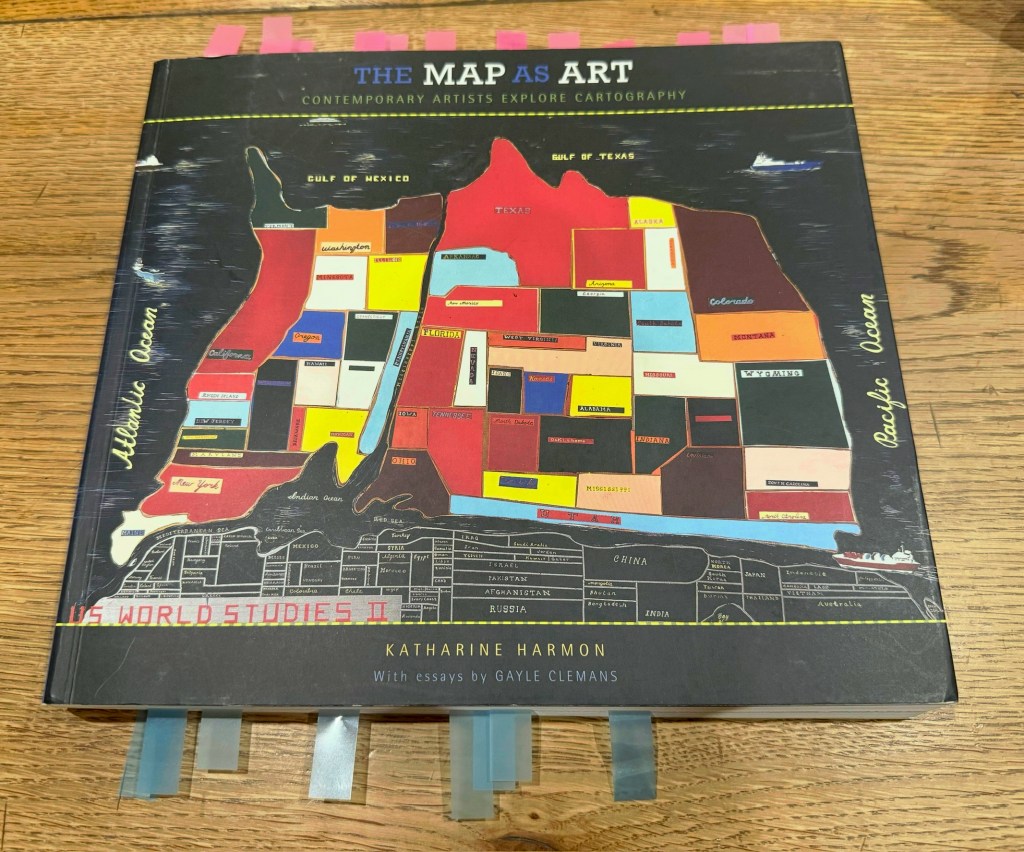
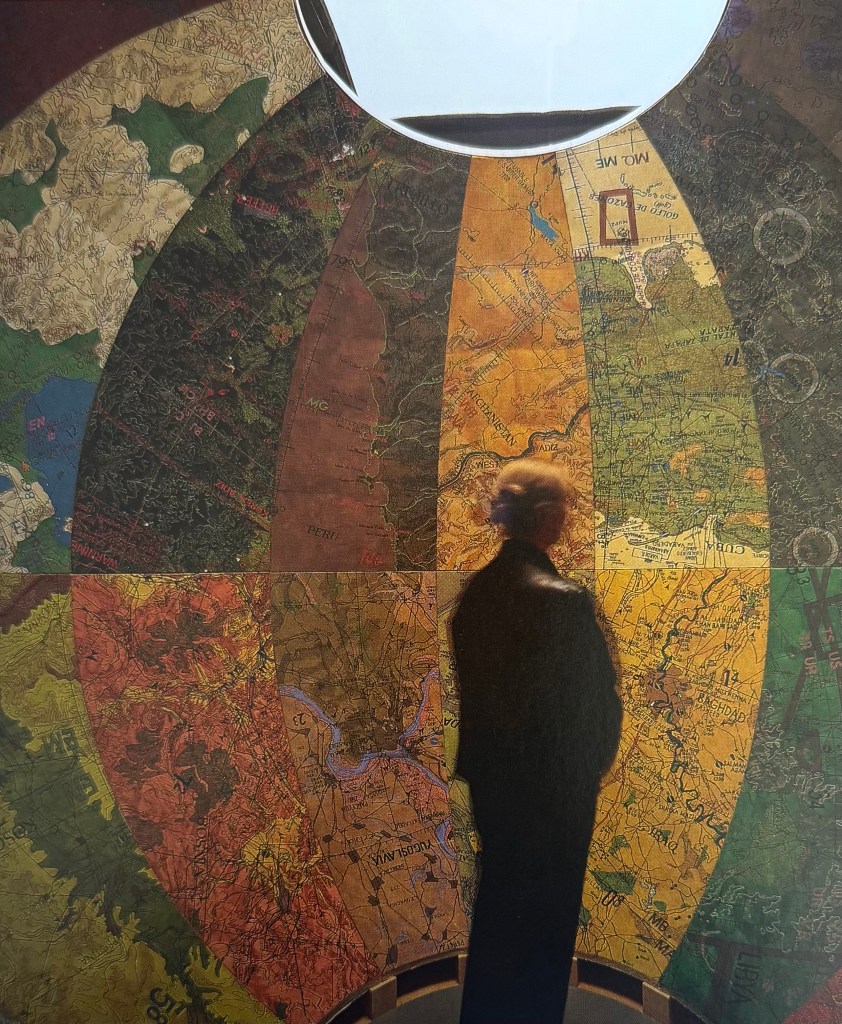
As is our habit, we went to the RA for the Summer Exhibition. I don’t think ‘A Die, A Log, With You’ was much missed. There was the usual mixed bag. I felt myself drawn to any pieces which bore any resemblance to maps or mapping.

I think I know what my entry next year will be, irrespective of theme.

Then we went into the Kiefer/Van Gogh exhibition. I didn’t expect to enjoy it and I’m not sure that enjoy is the right word anyway. The works are huge and for once I didn’t really even register their size, because it was inherently obvious why they were the way they were. I sat in front of the first image below (Crows) for ages. In my mind the path leading up the centre was wet and muddy, the kind on which you can’t get any traction, putting in lots of effort but slipping and sliding all over the place and getting nowhere. Despite its warm colours, it felt bleak and desolate.

The works have a three dimensional quality with Keifer’s use of straw and clay. It’s as if he is reconstructing reality on the canvas, the surface of the works offering up their own landscapes, casting their own shadows. It must have taken ages for them to dry.

In A Flash

Whenever I don’t have to drive, but am driven, I like to look out of the window at the world as it passes by, to daydream. It reminds me of my childhood and Sunday afternoon drives, safe in the car away from all the witches and ghouls which were out there in the woods, which were left behind – those were the days when you didn’t have to wear seatbelts – I was fascinated with looking out of the rear window to make sure that we weren’t being followed, to watch as we left behind.

I remember my father driving us in the darkness to catch the ferry back to England to visit my grandmothers, the bright lights of the car dashboard, of the ferry and port. The moment of held breath as we embarked, over the ramp, the car laden with all of our stuff, low to the ground. Even now I get a buzz of excitement when driving late at night and the heavy machinery rolls out onto the motorway, the flashlights, the hi vis, the noise.

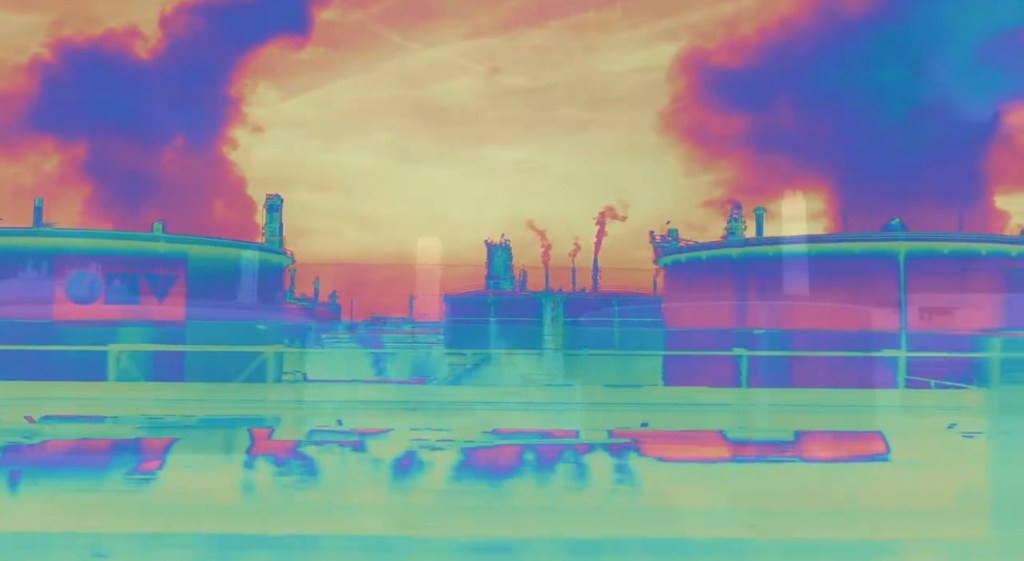
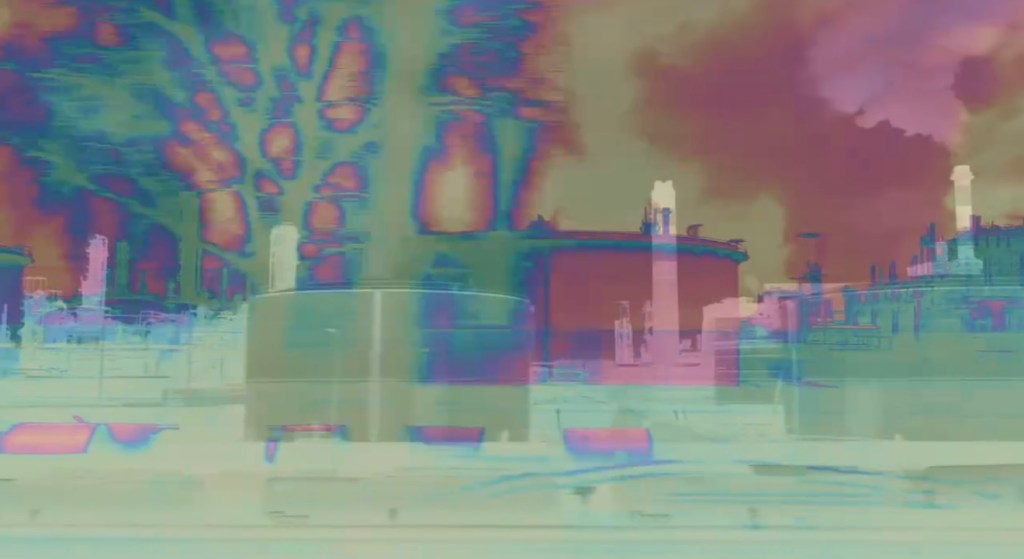
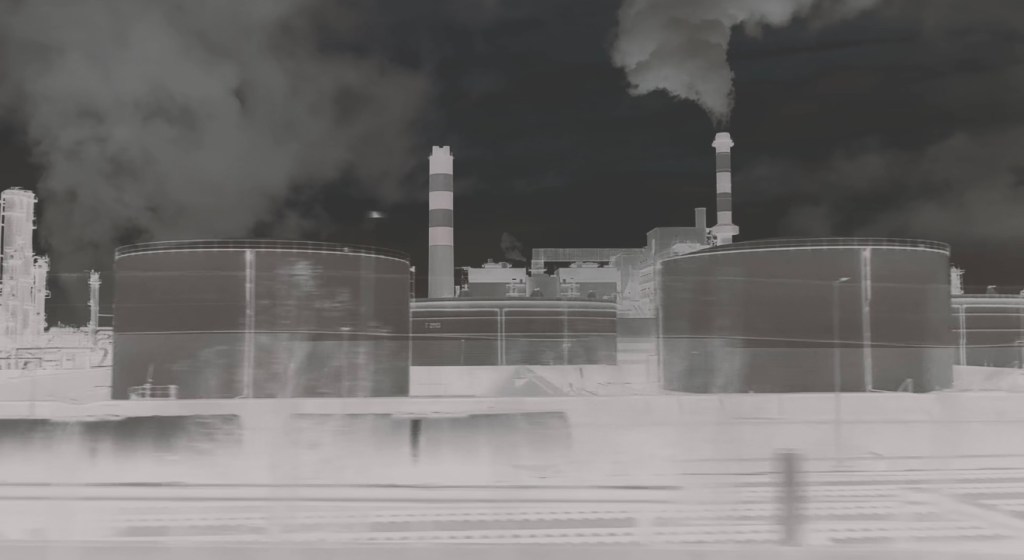
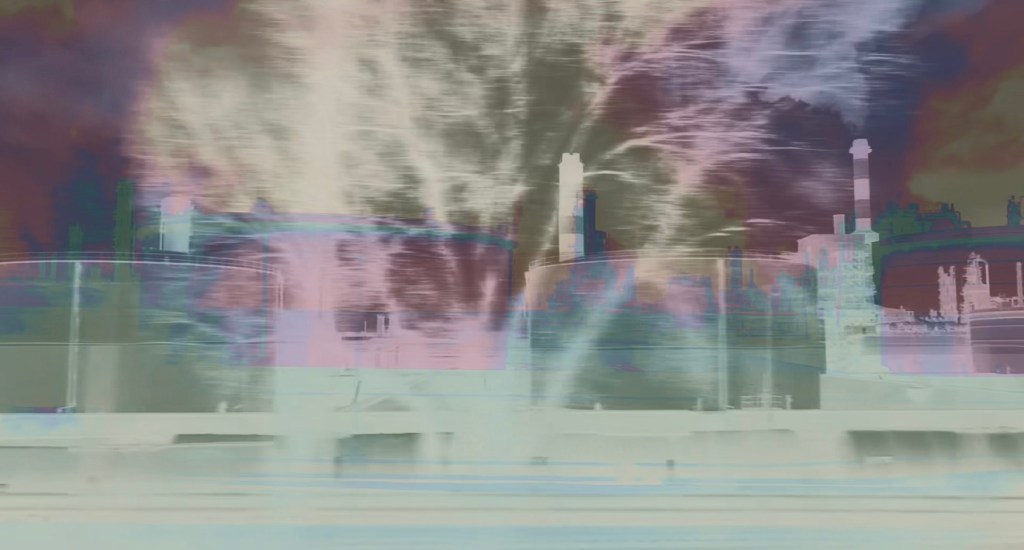
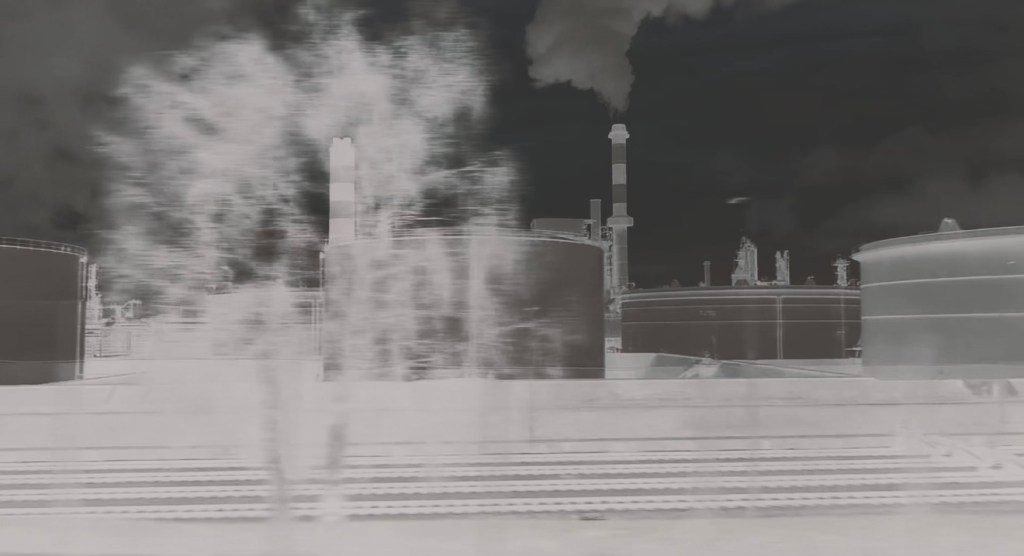
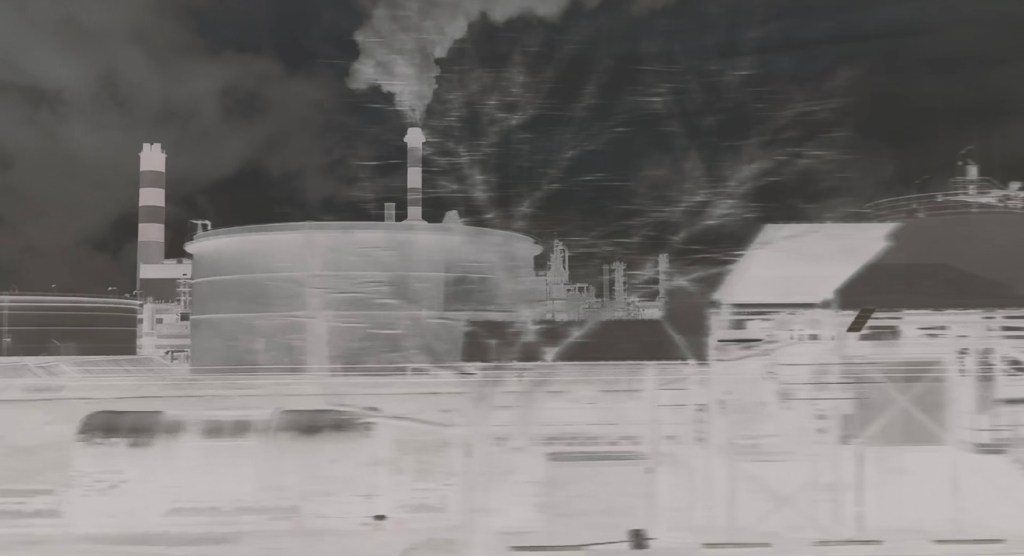
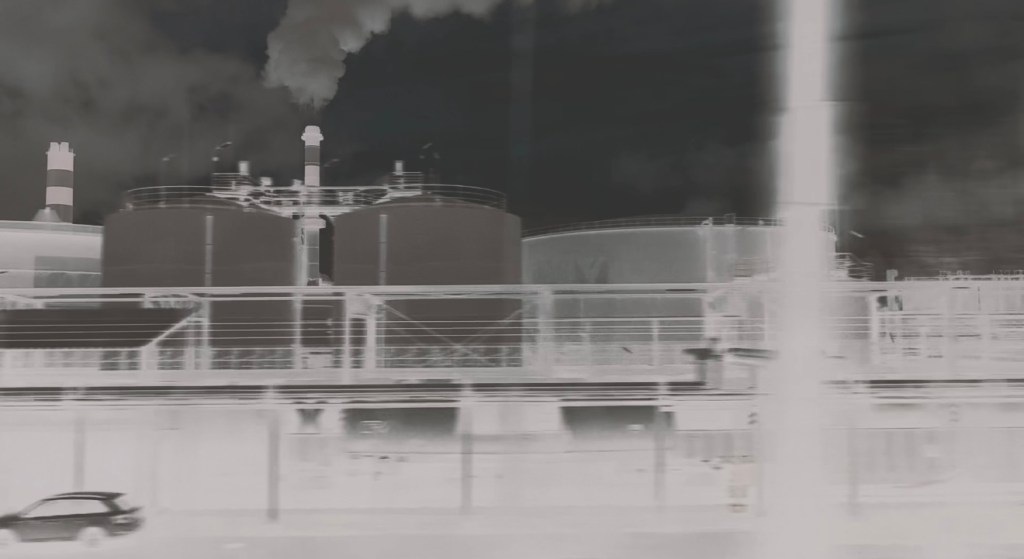
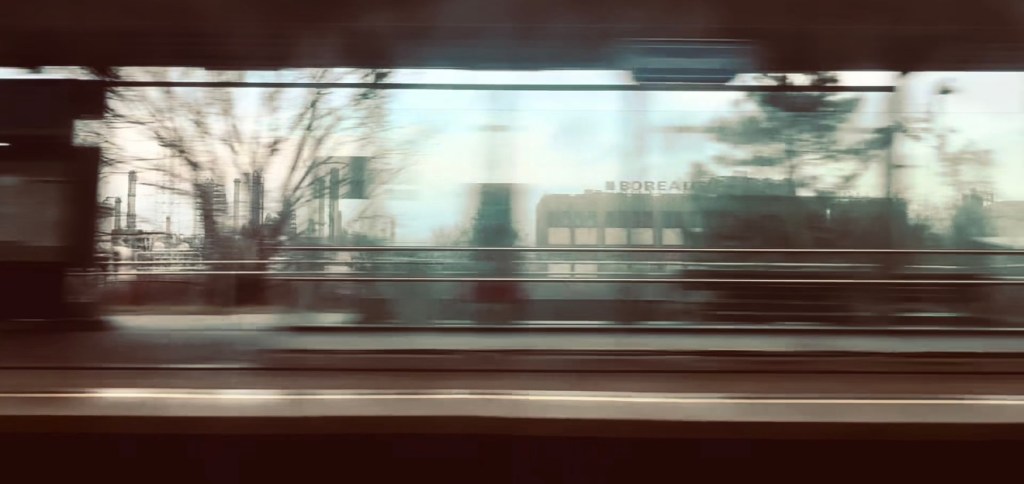
Over the last year I’ve started filming the landscape as it rushes by. We went past Stonehenge on our way back from Exeter in June with all of our daughter’s stuff in the car.
The sky is more or less static and the mid ground moves a long quite slowly, with Stonehenge almost gliding across the screen. And then there is the fast moving foreground – I find the fence line and the traffic paraphernalia fascinating – the way in which the posts seem to be animated, punctuating the foreground, jumping up and down, reminding me of the graphic equalisers on my first stereo.
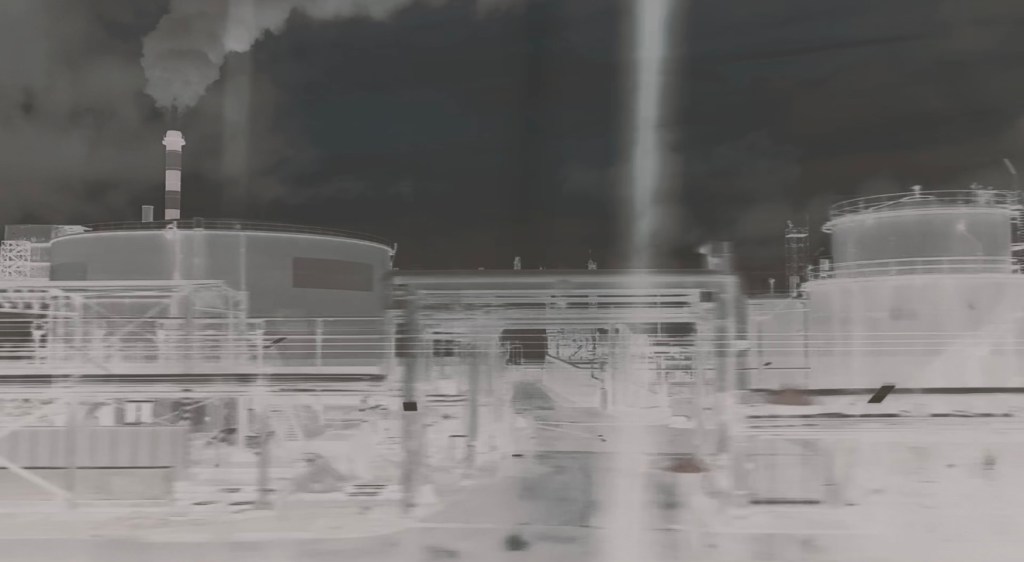
I wanted to create an image with less immediacy, with some distance, some sense of layering and so I experimented by filming the footage from my iPad with layered clingfilm over the screen.

I like this shortened version, I think it has more impact, or maybe it gets to the point a lot sooner – my social media shortened attention span at work.

I played around with different effects and took some random screenshots.

I like the abstract nature of some of the images, the sense of ghostly imprints, an image which is not quite there, or that was there, but has since moved on.

Sticker

I brought in my one remaining pinhole camera the other day. It was really disappointing – although it had captured some good trails of the sun, it had fallen sideways (my bad) and the constant switching between really hot and cold weather recently must have caused condensation to form inside the can. It’s a shame because it seemed to me to be a good way of capturing the passage of time in a static image. Never mind, I may try again.

I’m not very techie and when I was converting the original image into black and white on my phone before I got into bed last night, I accidentally created a sticker. I’ve never really paid much attention to the white line which cuts out the sticker before, but on an abstract image it was fascinating to see where it went and what it chose to cutout. I decided to screen record the process, add some filters and play around with the replay speed.

I particularly like the one above – it reminds me of paper burning around the edges.

I used the image from What Was I Thinking? as it has both curved and straight lines amidst the multiple figures, and I was interested to see what path the line chose to follow.

Finally, I wondered what would happen if I tried an image which has a myriad of shapes within it and a white line of its own, so I used an image from Carbon Dating.

I had a great time experimenting, but when I finished an hour later my brain was still trying to process it all and thinking of how I might be able to develop it. It’s proving to be a tiring day today.

Rule Breaker

We’re looking at Turner in my weekly art class, in the context of climate catastrophe; forest fires, flooding. He didn’t follow the rules and did whatever took his fancy. Layer upon layer, ignoring fat over lean, whiting out. A conservator’s nightmare.

We started off by looking at some imagery and then, without any further reference to it, got to work. We put down a ground with acrylic paint and then applied layers of thin oil paint and solvent with a rag.

It wasn’t a conscious decision, but I ended up using a very limited palette of cadmium red light, cadmium yellow, ultramarine blue, burnt umber and some white. Once the thin paint was dry we applied glazes on top. I did a lot of wiping on and wiping off – it seems to be my modus operandi, as well as doing a lot of scratching – not particularly Turneresque, but never mind.

What do I think of it? As a study of an imaginary forest fire à la Turner, well, I think I’ve done ok. I’ve managed to create lots of layers and there is definitely some optical mixing going on. I think that I’ve managed to keep it quite loose (for me, anyway). I enjoyed putting the glazes on, colour was caught in the marks and grooves in lower layers which had been made when I had loosely put down the ground. I like that it was out of my control to a certain extent.

At the end of the day, I don’t like it. It was an exercise which I completed, I haven’t invested any of me into it, and it doesn’t do anything for me. But that doesn’t really matter because it is about trying different things, being open to new approaches and trying them out with an enquiring mind.

Putting paint on and wiping or scratching it off is something I instinctively do – it’s a very tactile way of working, and I’ve realised that it’s all about the materiality and the dialogue, which seems to be a bit of a tussle at times.

Time Capsule

She went back to uni today. She was looking forward to getting back to some normality and having independence again. The house seems empty – don’t get me wrong, I’m not one to suffer from empty nest, but there is a presence missing, along with all her stuff that seemed to have found its way into every single room of the house. The creation station that she had set up in the sitting room is no longer there – watching tv whilst she painted by numbers to try and occupy herself and at the same time rehabilitate her hand. And then the quilt, which she didn’t manage to finish before she left; she was disappointed because she wanted to have something to show for what she saw as having been a wasted summer. Never mind – she’ll complete it over the next few weeks, and it will serve as a reminder of ‘that summer’, imbued with fear, frustration, pain, resilience and hope.

It never ceases to amaze me how, in the act of making, memories and emotions are stored within the object, like a creative time capsule.

Clay!

I missed our final session, so I watched the video.

It was raining and I didn’t fancy going outside to get some proper clay, so I used my daughter’s physio putty – a silicone based non-Newtonian liquid which changes to a malleable solid with pressure. I made a little bowl.

Thinking about it, it’s very much like me: it becomes resistant when pressured, will embrace change temporarily but generally just wants to revert back to its natural state.

The exercise of feeling the material with awareness and the subsequent discussion with Alexis Rago on his experience of working with clay was particularly interesting as I’m currently researching materiality, in particular, Malafouris’ Material Engagement Theory – the act of making is a lived and relational state of becoming in which selfhood is enacted and transformed through the ongoing dialogue between the maker and the material.

You’re Turning Into Your Father

‘And what’s wrong with my father?’

’Nothing. But I didn’t marry him; I married you.’

It was our 23rd wedding anniversary yesterday. Neither of us is the same as we were 23 years ago and nor should we be according to K H Tan’s Fluctuational Identity Theory, ‘FIT’ (The Dissolution of the Self: How Ontological Instability Reconfigures Identity, Ego and the Nature of Selfhood, July 2025).

In his thesis Tan proposes a framework for understanding selfhood as a dynamic process of becoming that never achieves stable being. He argues against the notion inherent in Western traditional thinking that there is a stable foundation which grounds identity across time and change: a stable and unified self. This traditional way of thinking raises numerous fundamental issues eg how much change can happen before original identity is lost on a cellular and psychological level? When does the self come into existence? Conception? Birth? When does it come to an end? Brain death? Bodily death? It is not only incompatible with the dynamic, temporal and relational nature of existence, but our attempts to achieve a stable identity in an unstable reality could also be the cause of conflict, unhappiness, and the persistence of suffering in trying to control what cannot be controlled, the anxiety of trying to predict what cannot be predicted and the exhaustion of trying to maintain what cannot be maintained.

He is not promoting the idea of ontological instability per se, and he rejects the idea of chaotic instability (random fluctuations without pattern or direction) as these are incompatible with the coherence and continuity implicit in personal existence; we need to be able to recognise ourselves in order to be able to function. Instead he argues for creative instability. The self is not a thing that has experiences, but the ongoing process of experiencing the self; with every experience we integrate our past, our present and the possibilities of our future. It is a process of maintaining patterns while introducing variation and at the same time the self remains recognisably oneself while becoming other than what it was. The self undergoes ‘inter subject becoming’ – it is not a pregiven entity that enters into relations with others but emerges through and as a result of these relations.

He sees instability as a positive condition which encourages growth, creativity and meaning-making which would not be possible if the self were a fixed and stable entity. He considers fluctuational personas eg parent, friend, spouse, citizen, as genuine modes of being as opposed to roles and temporary performances, and as such negates the idea of authentic and inauthentic personas because all personas are genuine expressions of our capacity for becoming.

He advocates aiming for the middle ground. The more we try to define our identity the less capacity we have for growth and transformation, and too much self-awareness can lead to psychological overwhelm. Conversely, complete openness to transformation and abandoning any attempt to understand ourselves leads to a loss of any sense of identity and the continuity necessary for coherent existence, as well as disconnection from experience.

Achieving accurate self knowledge cannot as a matter of logic be achieved: we cannot bridge the gap between who we are and who we understand ourselves to be. He sees this area of misrecognition as being a ground for new possibilities of selfhood; it can become a creative force that helps us to become what we see ourselves as being. He gives examples of considering ourselves to be more creative, more confident than we are, and how this might lead to us ultimately having these attributes. Presumably the same could be said about negative attributes, but he doesn’t deal with these in any detail.

He compares traditional approaches and FIT in terms of personal development and growth including education and the effect of technology and algorithms on digital identity, psychological health, political and social implications, and human flourishing. He posits that FIT provides the framework within which we can better understand and navigate the challenges of contemporary existence.

It’s certainly an argument for revising the vows of marriage to reflect not only a change in financial status and health, but also in selfhood. Our wedding vows were in Italian and we haven’t the foggiest what we agreed to.