“Ever Tried. Ever Failed…

No matter. Try again. Fail again. Fail better.” (Samuel Beckett)

I hadn’t come across this quote until my daughter went to secondary school, where the headmistress used it as her mantra in her quest to produce strong, independent young women who would leave school ready to deal with whatever complexities the world threw at them. It was used to encourage the girls to go beyond their comfort zone in trying new things and not to be put off by the risk of failure – “feel the fear and do it anyway” was another one of her favourites!

There are many inspirational quotations dealing with the concept of failure such as:

“Try and fail, but don’t fail to try” – John Quincy Adams

“Success is the ability to go from failure to failure without losing your enthusiasm” – attributed to Winston Churchill

That’s all very well, but they don’t deal with how we should actually process the feeling of failure, and this is something we touched on in our online session this afternoon. The problem of dealing with failure is that the ego gets in the way. Strategies to overcome the ego include sharing stories (this allows others to learn from the failure without actually experiencing it); over-acceptance of the failure (that is actively taking it and collaborating with it to make an alternative outcome); and distancing the failure (for example, by using the third person when reflecting on it). The last strategy is particularly effective as it allows you to view the failure and the person who failed objectively giving rise to feelings of empathy.

So, our task for next week is to take a risk and do something in our art practice which might not work out!

For the first part of today’s session we finished our short introductions. I had been feeling ok about it, but towards the end I felt quite overwhelmed by emotion – maybe it was because I had mentioned my constant feeling that time is ticking by at quite a rate, or maybe it was the sudden realisation that it is only now that I have made the time to do something that I have always really wanted to do. Either way it came from nowhere and left me feeling quite out of sorts for some time afterwards. Even more reason to carpe diem!

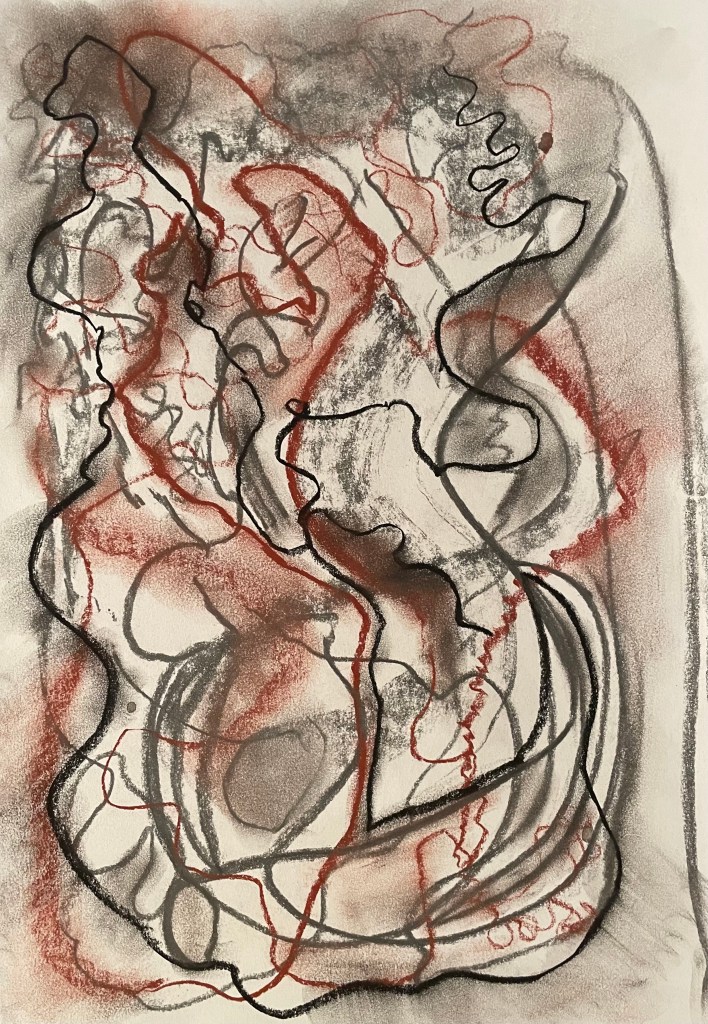
Below is today’s automatic drawing in which I used a thin and a thick piece of willow charcoal, holding a piece in each hand moving at the same time. I then used a sanguine and black conte pastel on top. It’s not as dynamic as the previous drawing and seems a bit contained – maybe because I was using both hands at the same time – I’ve never been able to do the head pat/ tummy rub thing. Next time I think I will stick with charcoal, but maybe build up some layers, and also begin from a different starting point.
Trying Not To Overthink It

Guilty as charged: I have form for overthinking, overworking, not knowing when to stop and basically bludgeoning a piece until there is no life left in it. My problem is that I have an expectation of how it should be. It’s not even as if I enjoy the process – it makes me frustrated, stressed, and downhearted to the point of threatening to pack it all in. So, to put an end to this way of working I need to adopt a new approach; create a new habit but one which opens up possibilities, as opposed to closing them down. Admittedly, I have already begun to experiment more recently, but it needs to become second nature.

There’s a lot to be said for drawing exercises; I’m a particular fan of continuous line drawing but the drawback (excuse the pun) is that I’m still drawing something, I’m just not allowing myself to draw it as accurately as I might otherwise want to, and so there is still an expectation as to how it should look.

Sometime ago, I watched a documentary about Maggi Hambling. She gets up at 5am every morning and with a cup of coffee and cigarette in hand, she starts her day by making a drawing – she doesn’t like the term sketch – using an ink dropper and, in this particular instance, with her eyes closed. It is a form of automatic drawing, a concept embraced by the surrealists and latterly by the abstract expressionists, which involves the artist making marks without any conscious control.

I think this is for me!

There are numerous possibilities: pencil, charcoal, ink, paint, collage, eyes open, eyes closed, different ways of holding, holding more than one, dominant hand, non-dominant hand and the list goes on.

So this is the first of my daily automatic drawings:

I used a charcoal pencil in my dominant hand and, with my eyes open, I just let it wander over the page without any conscious thought or control. Maintaining the same pressure and manner of mark-making started to become a bit tedious so I almost unconsciously varied the pressure and the way I made the marks, holding the pencil higher up so that there was less control from my hand, rocking it backwards and forwards in my hand, holding it perpendicular to the page and then on its side. It was a sensory experience in that I was aware of the feel and the sound of it: the sound of the charcoal on the paper and the squeaking and stuttering of it on the upward stroke creating broken lines, as opposed to the smooth downward marks. I then randomly smudged and blended some areas.

There are some quite interesting passages and if this is my subconscious expressing itself then I might have cause for concern! All in all, I’m pleased with what I produced because I enjoyed the process – instead of being mindful, it was mindless – and I hope that if I do this often enough I might just free myself up.