Wondering About Wandering

It’s been almost 3 weeks since my tutorial with Jonathan, and even longer since my last blog post. I’m usually very good at writing tutorials up immediately afterwards, whilst I can still remember what we discussed. I don’t usually take notes – it’s too distracting.

Oh, how I wish I had taken notes, but I think that I can still remember the gist of it.

My clearest recollection is just how good it was to have a chat about something other than accidents, operations, hospitals and pain relief. On this subject Jonathan mentioned Late Night Ramblings, how at first glance it looks like a map but then when you look closer you realise that it doesn’t relate to anywhere. We talked about the methodology – what came first? I explained that I started off with the coloured lines, placed the dots at the intersections and then decided to add the contours and finally the grid – in retrospect I probably should have reversed the order as it was particularly difficult putting in the contour lines after the event – I couldn’t see the lines for the lines. We discussed the previous experiments which led to this point in particular the use of the photo of my father to create the outline of the figure, how the pose still retains its meaning, the angle of the shoulders and the head looking down, and how, because he reads my blog backwards from top to bottom, it only became apparent that the photo was the source of the outline once he had worked his way down. He also referred to What Was I Thinking? and my openness as to how I viewed my actions.

We talked about whether I would experiment with other media – I explained that I liked the flimsiness of the flip chart paper as it reminds me of the paper on which maps are produced and how I am interested in the idea of folding. Jonathan referenced how maps are folded, in a concertina, and how a piece of paper no matter what size it is can only be folded in half 7 times. Intrigued, I looked into this further after the tutorial finished. Generally, this is the case although in 2002, Britney Gallivan, a high school student in California, set a new world record by folding a piece of tissue paper 12 times, but it was 1.219km long. Funnily enough, whilst driving to Exeter yesterday morning to start and finish what my daughter was en route to do when she had her accident, clear out her room at uni, we had the pleasure of listening to Radio 2 when the Paddy McGuiness show came on, and listeners were invited to message in to explain how it can be true that if you fold a piece of paper 42 times it could reach the Moon? Did you know that you can only fold a piece of paper 7 times I asked my husband. Yes, you’ve already told me that, he replied. It’s a matter of exponential growth – if you assume that the thickness of a piece of paper is, say, 0.1mm, then when you fold it in half 42 times it will theoretically be 439,804km thick, approximately 55,000km in excess of the distance between the Earth and the Moon, the same kind of principle as in A Bird In The Hand.

I mentioned that I was thinking of creating a ‘map’ which would embody all that I have learnt over the course, and have been toying with experimenting with canvas, how I would need to think about image transfer etc. Jonathan mentioned Citrasolv which works really well on laser print, especially high quality print such as National Geographic. After the tutorial I watched a few YouTube videos, ordered some and have had to wait a couple of weeks for its arrival, this Thursday.

We then discussed Raita Bitless, and how Jonathan felt that there are some very important elements which are emerging and this is one of them. It feels like these are important memories which need to be explored further, and I agreed, explaining that sometime over the next couple of months I want to go back up to the Midlands and spend some time just wandering and reliving.

I’m sure that some of these discussions were prompted by a question, but the only one I can vaguely remember is when Jonathan asked me whether I was missing anything or needed anything more. I said that I didn’t think so, that I am quite happy just doing what I am doing. I have realised a lot about myself and the way I work (or not) – I had been attempting to squeeze the round me into a square hole. As such, I have effectively torn up my work plan, as it’s just not who I am, and have decided just to wander; to go on a dérive, and to wonder. Jonathan liked the idea of wondering whilst wandering – there’s a name for it, he said. I thought of it afterwards – a homophone – although apparently wonder and wander are not actually homophones because of a very subtle difference in pronunciation of the first syllable – what killjoys! I like it anyway, and there is a lovely interplay between the two.

We then got onto the subject of the research paper and he referred to The Paradox Of Choice. I told him that I felt as if I had been told to go out and buy something, anything; that I had decided that I wanted to buy a cake but that I couldn’t specify which cake I wanted until I had visited all the cake shops and seen all that was on offer. I would have responded much better to having been given a choice of topic out of a small selection, akin to an exam paper; that I felt overwhelmed by choice and asking me what intrigues me doesn’t really narrow it down at all. Anyway, because of where my current experiments have taken me, I have decided to think about maps particularly in an autobiographical sense. We then went on to discuss maps and the issues with them in terms of distortion both physically in respect of projections and political motivations, perspective etc. Jonathan also mentioned Professor Steve Peters – Jonathan had been to a talk and had been given a copy of The Chimp Paradox – I had started reading it a while ago but didn’t finish it as I was probably distracted by something else. He referred specifically to the idea of the helicopter view. It’s a technique to gain perspective on something by imagining hovering over the issue in a helicopter which enables detachment and a more rational and objective view.

Does the need to do the research paper risk having a negative impact on my current wandering? This was a difficult question to answer, but on the whole I don’t think so – I’ve already recognised that I am a person of extremes, either really tidy or messy, focussed or distracted, honed in on the detail or preferring the bigger picture – each will appeal to my polar opposite needs and I am optimistic that what I discover whilst writing the research paper will have significant impact on my current practice.

I hope that I have covered everything we discussed although we must have talked about carbon paper at some point because I have used it recently. I have done a few things recently – I need to include them in a post but, frankly, all I have wanted to do is to make and not necessarily reflect on and write about it.
The Paradox Of Choice

Choice = Freedom + Power

Or does it?

Just recently I’ve been running away. Fight or flight. Apparently flight is an underrated stress response.

At the moment, I feel like I’ve got a lot on my mind; too much. More times than not, I just get on with it in a resilient effort, and other times I indulge in some escapism and don’t deal with anything, waiting for something to blow up and become urgent, preferring to lose myself streaming box sets. But, of course, that’s just prolonging the inevitable.

Anyway, I met a friend the other day. I mentioned the research paper to her. I explained that I feel the need to think of all the possible options to make sure that what I choose is the right decision. She said that I shouldn’t worry about making the right choice, I should just make a choice and make it right.

Apparently, it’s called choice overload, and it’s an evil of the modern world. Whilst choice brings freedom and a sense of empowerment, too much choice can cause anxiety; a paralysis which results in no decision being made at at all; higher expectations of making the right decision by virtue of the sheer number of available choices; and consequently an increased probability of dissatisfaction with the final decision. I’m what’s termed a maximiser – someone who has to consider all the options before making an informed decision which in essence is a good thing but in a world of infinite choices can lead to choice overload. I need to become more of a satisficer, someone who is content with good, rather than the best and who, as a result, doesn’t feel the need to research every option and consequently manages to avoid the paradox of choice.

In short, I need to shop more like my husband.

Bitter Sweet Symphony

…Tryna make ends meet, you’re a slave to the money then you die…”

I don’t want to give the impression that I’m on a downer; I’m not, it’s just a coincidence that the things I want to post about at the moment all involve an element of death, which is not a bad thing, as it reminds me to live.

I had never really contemplated my own death until my father passed away in 2013; then I obsessed about it for quite some time. There I was sitting quite happily on my branch in the tree of life when suddenly there was one less person between me and the end; to be fair I was so far along it that it was becoming more of a twig than a branch and had started to bob up and down quite precariously in the breeze. But there’s nothing like the death of someone of a similar age to drum home my own mortality. I had lost friends at university, but I was young then, and whilst the sense of loss was immense, I still felt invincible; those were extraordinary deaths.

Last night my husband told me that an old work colleague of mine had died a couple of weeks ago. I worked with him for seven years; I hadn’t seen him for twenty, yet still the news profoundly affected me. We were more or less the same age and level of qualification; I had previously worked at two law firms before joining the firm where we worked together. He had trained, qualified, and become a partner at that firm, a period spanning 32 years. He had never known any different, had never stepped outside of his comfort zone or worked with new people who may have inspired him or influenced him in different ways. Why not? My husband ventured that maybe he stayed for the money which financed a certain lifestyle and that he was happy with that, with that way of living. That’s true; just because it is a path that I would not have chosen does not make it less valid, and, in this respect, I appreciate that I am lucky in that I have a choice; a lot of people don’t have that luxury.

He would have been earning a fair amount, working incredibly long hours and have been under intense pressure. Was it all worth it? If I had said to him 20 years ago, when we shared the same office in which he would tell me all about his salsa classes, his training for the triathlon he was planning to compete in, or the latest date with his girlfriend, that he had a ticking time bomb inside him which would kill him at the age of 55, would he have made the same choices? Maybe not, but that’s the benefit of hindsight. As Kierkegaard says:

It is really true what philosophy tells us that life must be understood backwards. But with this, one forgets the second proposition, that it must be lived forwards.”

On Your Marks…

Well, the starting pistol has gone off, and I’m still sat here, procrastinating, allowing myself to be distracted, doing anything other than what I should be concentrating on: producing something for the pop-up show. My problem with deadlines is that I tend to ignore them until the very last minute – goal driven, that’s me.

What, with thinking about the pop-up and trying to come up with an inspirational text for Tuesday’s session, I’m feeling just the tiniest bit sick. I would say that I have stuck my head in the sand but apparently that’s a popular misconception: when they sense danger and cannot run away, ostriches will flop to the ground and remain still, attempting to blend in with the terrain – that sounds just about right!

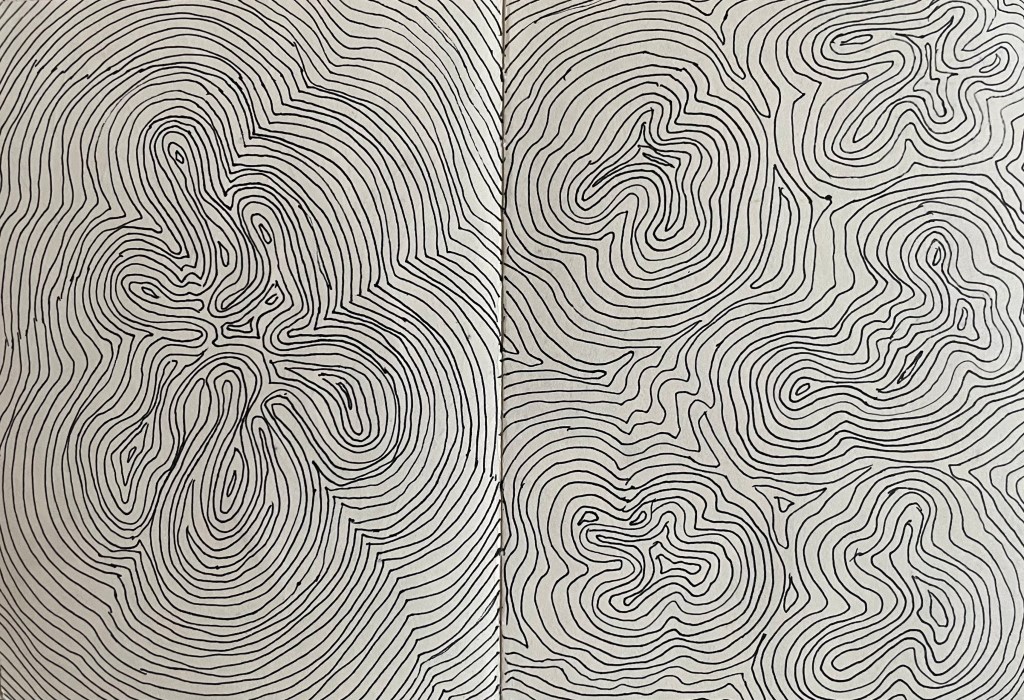
Anyway, following on from my ‘Less’ post, I’ve been thinking about working with a limited palette and how it narrows choice. Using a pen narrows choice even further – just black and white and nothing much else in between. Using a pen forces you to think about mark-making in order to create tonal values and areas of interest. So, I’ve been using my time constructively by doodling with a pen in my sketchbook whilst listening to an audio book – who says I can’t multi-task!

I found the process of mark-making to be meditative and grounding, totally different from the anticipation of putting ink onto wet paper and waiting to see what happens. Strangely, I like it. I think I am a person of extremes: I’m either fastidiously tidy or chaotically messy; organised or haphazard; focused in on the minutiae or just wanting to see the bigger picture. Somehow I have to find a path along which both sides of me are satisfied.

I will definitely use pen again, if only as a way to order my thoughts. Going forward I think I should try to build up a bank of possible marks, almost like a painter might have a bank of colour swatches. Having said that, I’m mindful that I’ve still got to do a few things to which I’ve committed in earlier posts, so I think I need to embark on some self-accountability first.

Less

I haven’t posted for a while – I’ve been busy sorting things out before going off to Marrakech for a four day trip with my book club.

Marrakech was amazing. Colour. Noise. Smells. People. Heat. Contrast that with this morning when I had to defrost the car before heading off to my weekly art class. I love this drive, along an old Roman road – straight and undulating through the Hampshire countryside to Stockbridge, a small town in the Test Valley. The sun came out and the trees came to life – burning oranges, golds and yellows. It was beautiful, and by the time I arrived at my class, late because I couldn’t find anywhere to park, I was still feeling its effects.

I can’t deal with too much choice – it paralyses me and then I can’t make a choice. Needless to say, I didn’t buy anything in the souks in Marrakech – the choice was overwhelming, so I resolved not to buy anything at all, and was then able just to wander and enjoy the atmosphere and culture.

So today’s task was perfect for how I was feeling. A landscape using a limited palette of burnt sienna, burnt umber, ultramarine, pale cadmium yellow, white and cadmium red. We took a board, roughly primed – in my case it was an old piece of MDF which I had previously coated with professional Dulux oil-based primer, which can make it a bit like an ice rink – and put down a loose ground of burnt sienna with a bit of sansador which ended up not drying for some reason. Then we put in some outlines using burnt umber following with thick patches of colour keeping it very general, but the wet burnt sienna contaminated some areas and lifted off the board in others. We experimented with dragging a dry brush across the paint and I also did a bit of sgraffito which I can’t help doing when using thicker paint.

This is the result:

I haven’t painted for ages – not since beginning this course – I don’t know why. Perhaps it’s because I’ve been doing a lot of thinking and experimenting with other media. At first, it felt a bit strange coming back to it, almost awkward, like I’d been unfaithful in some way.

It’s not my best by far, but it’s ok for an hour and a half. I am leaving it. The ‘me’ I’m trying to change would say that it is not finished by a long way. There’s lots I don’t like and would love to change – I’m itching to tinker – but I’m exercising some will power and calling it a day. Just like I’ve been trying to change my mindset about having an expectation as to how a piece will turn out, I am also trying to train myself to walk away.

Jonathan told me that the job of mark-making is to tell us what to do next. These marks are telling me to leave it alone and to be happy with what bits of it appeal to me – I like the lack of clarity and blurriness caused by the dry brush; the light coming through the burnt sienna ground in the foreground; the energy in the marks, which I would absolutely kill if I allowed myself to do more; the lack of definition which gives a sense of a fleeting moment; and the recreation of the feeling I had whilst driving to class.

Will I do this again? Yes, I always like going back to basics and using a limited palette – I’ll use a different image and next time I will definitely make sure that the ground is dry before carrying on so that the colours aren’t so muddy in places.