Resisting The Urge

It’s been difficult, but I’ve been managing to stop myself from altering things after the event. To leave things undone with elements which really jar with me, which are clearly wrong and which look awful, and to post them anyway. I think that it’s starting to make a difference as to how I work – if I can get into the habit of showing the worst of it, the imperfect, work which I’d much rather never see the light of day, and preferably end up in the bin, I hope that I will be able to engage fully with the process, and not worry about the result.

The mantras I’ve adopted so far:

  • I will choose the mark-making processes which I enjoy, and not worry about the result
  • I choose the process, not the result
  • I don’t have to like what I make, and I don’t have to make what I like

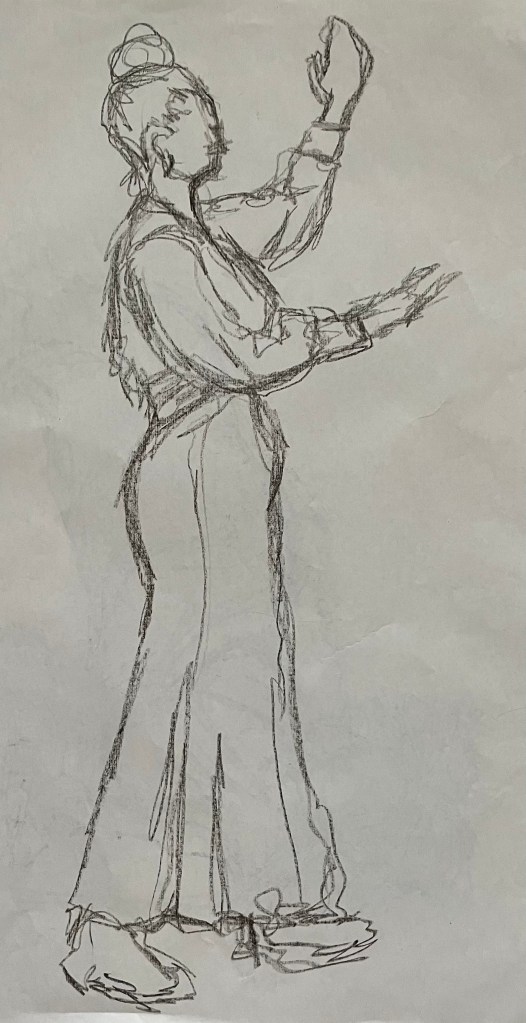
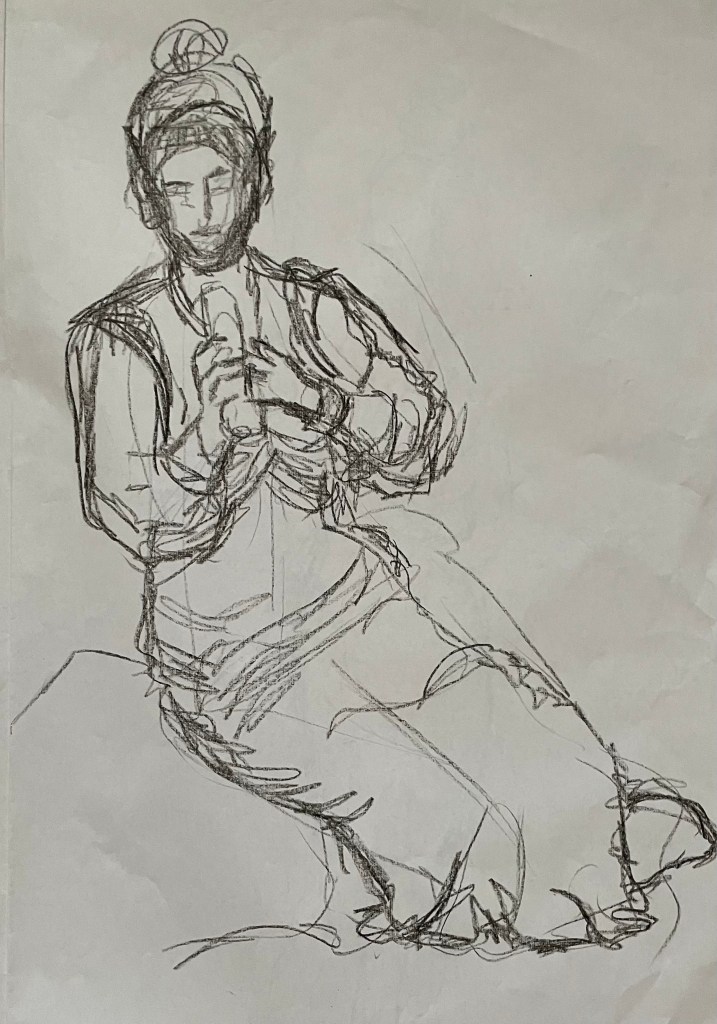
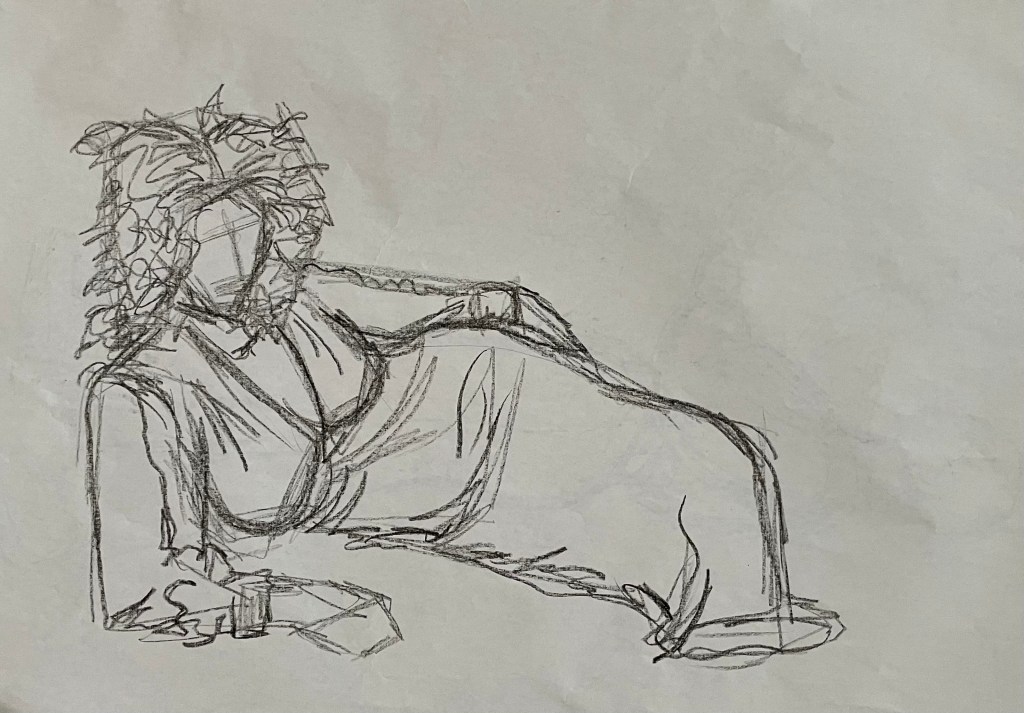
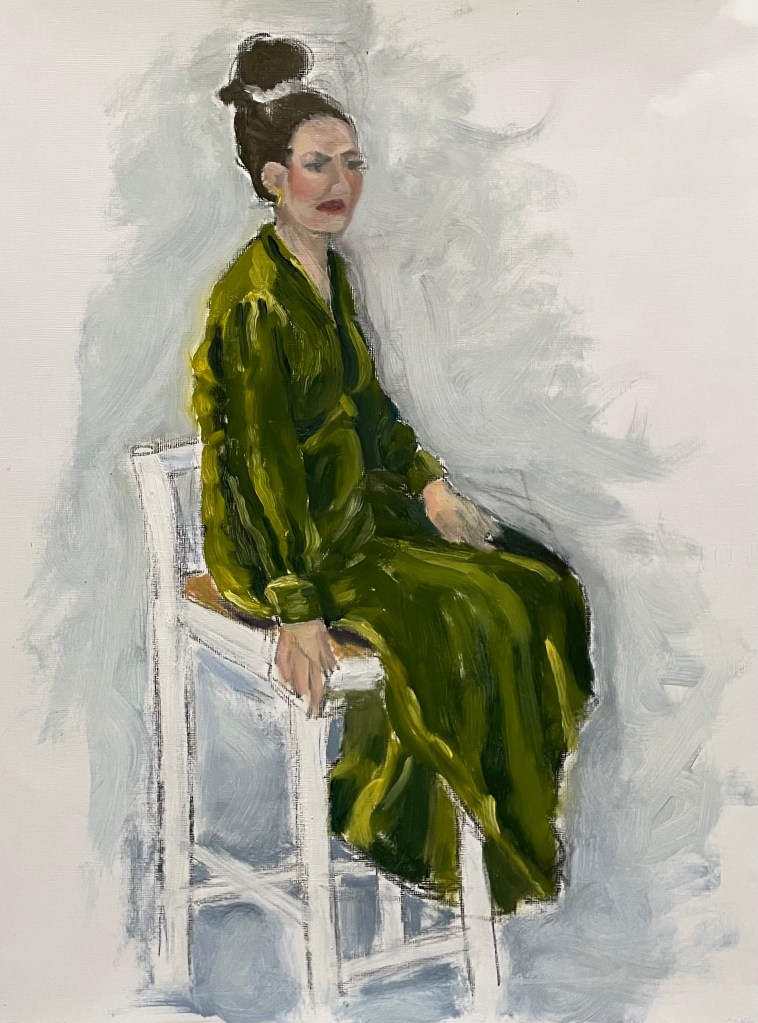
So, we’ve been continuing with the subject of figures in my weekly oil painting class. We had a model today. I certainly haven’t done her justice, and just don’t get me onto the subject of faces. We had to do a few warm up drawings, starting with continuous line – always difficult to get things in the right place – and then just normal sketching, a couple of minutes each. I used an oil pastel – I like that it’s a commitment, and can’t be rubbed out. There’s nowhere to hide, mistakes remain visible – the new me. Then an hour painting.

What to say? I’ve realised that since I’ve been posting my ‘Undones’ (seems a more positive word than failures), no matter how unhappy I am with the result, I can always find something that I like, if I look hard enough. It has just dawned on me, that I probably wouldn’t notice these elements if I was happy with the end result if, indeed, they managed to survive the perfecting process. There’s always some beauty, no matter the ugliness.

I think that I’ve unintentionally transferred my feelings of being weighed down onto the model. The dress looks so heavy; although it was velvet. I think I’ve managed to capture the sense of velvet. I’m trying to avoid using any blending in my paintings at the moment – I’m working on keeping my brushstrokes defined and with a sense of movement – I think I’ve achieved this. The figure is generally good and I particularly like the neck.

I’ve just been watching Sky Arts LAOTY, and now Gareth Reid is now giving a masterclass on drawing faces – I could definitely do with watching this.

It Doesn’t Mean We’re In A Relationship

January has come around again, and I have bought my entry to this year’s RA Summer Exhibition. Will 2025 be my year? Or will I fall at the first hurdle, yet again? The theme for this year’s exhibition is ‘Dialogues’.

When I read this, two other words spring to mind: ‘connection’ and ‘relationship’.

Definitions:

Connection: a relationship in which a person or thing is linked or associated with something else.

Relationship: the way in which two people or things are connected; the state of being connected

Dialogue: a conversation between two or more people; an exchange of ideas and opinions on a particular subject; a process by which people with different perspectives seek understanding.

In the above definitions ‘connection’ and ‘relationship’ seem to be interchangeable. Personally, I think it is possible to have a connection without having a relationship. To me, a connection is an initial link based on shared interests, experiences, understanding and values, whereas a relationship is a sustained connection over a period of time.

I would suggest the following:

  • for there to be a dialogue, there at least has to be a connection.
  • it is possible to have a connection and a dialogue without having a relationship.
  • it is necessary for there to be a connection and a dialogue for there to be a relationship, and to maintain that relationship requires actively nurturing the initial connection, or repeating it, through consistent dialogue, shared experiences and commitment over a period of time.
  • it is possible to retain a connection and a dialogue despite the ending of a relationship.

When my daughter comes home from uni she likes to visit her favourite local eatery, the kebab van parked up in a lay-by frequented by lorry drivers. Every time she goes she makes a connection with the owner; they talk; they don’t know each other’s names but he knows, and remembers, where she goes to uni, what she’s studying, that she works at the local Sainsbury’s in the holidays, and how she likes not only her kebab but how we all like ours; my husband, as it comes, me with a little meat and lots of salad, and both garlic and chilli sauce. One might say that they have a relationship.

So, where does all this take me?

To disconnection. We seem to be living in a world in which we are increasingly becoming disconnected, in the sense that we have less meaningful interactions, and consequently we are limiting the opportunity for dialogue and relationships with ourselves, each other and the world around us.

Connections can be made quite easily, for example, on social networking sites, but does that allow for meaningful communication? Does a post followed by a like or a comment constitute dialogue? In fact, by their very nature of facilitating lifestyle curation, social networking sites can cause users to feel disconnected.

One might take the view that dialogue is something more than a mere exchange of words; it involves active listening, empathy, picking up on visual cues, making eye contact, challenging assumptions to create a sense of stronger connection and understanding, the latter being a form of Socratic Dialogue; a continual process of inquiry to deepen understanding. You don’t have the opportunity to exploit these to their fullest when communicating by text, speaking on the phone or on Zoom.

People have even stopped sending the one thing that keeps us connected, particularly to those that are not in our daily lives: Christmas cards. The trend is now to make a donation to charity, apparently. I send Christmas cards every year with the best intentions of reconnecting and furthering some old relationships which have been neglected. If I don’t manage to follow up, at least they’ll send me a change of address if they move, so I can give it another go in the future.

Some of it is a legacy of Covid: it’s easier to deliver university lectures online, to have doctors’ appointments online, to work from home. Whilst I agree that there should be a good work/life balance, not going into a workplace at all and not being able to interact face to face with colleagues, and have water cooler conversations, can’t be a good thing, particularly for young people just starting out in their working lives. The workplace is somewhere to meet friends, or even partners. You can’t really go out for a drink after work, if you’re working from home.

This is a low residency course: we meet weekly on Zoom and communicate with each other on our WhatsApp group. We had an initial connection – our passion for creativity. After the first term we have a deeper connection, and possibly even a relationship in the sense that our connection is fundamentally anchored in a mutual understanding of trust between us. That relationship will deepen further when we meet in person.

I’m not sure where I’m going to go with all of this. Possibly nowhere.

Entries have to be submitted by 11 February, so the next four weeks are going to be very busy with this and my study statement. I’m sort of regretting doing it now: I think that I just wanted to shock myself into doing something. I’m trying not to panic – if I don’t manage it, then that’s fine – I could always submit something I’ve already done, but, if I can, I would prefer to go through the process from scratch.

A Wobble

I’ve often suffered from buyer’s remorse; the last time it happened was when I bought my new rug in Marrakech. Did I just buy it in the fervour of the moment? Would it actually fit in at home? How was I going to get it back home on the plane? Would it fit in my suitcase? Did I pay too much? I did haggle for it, but did I haggle enough? Had someone else bought something similar and paid a lot less? If they had, how would that make me feel? Whilst I appreciate that the worth of something is what someone is prepared to pay for it, everything is so much simpler and fairer when there is a fixed price.

I experienced a new feeling recently – blogger’s remorse. Should I have posted ‘Three Conversations With My Mother’? In the moment it felt right, but as is always the case with me, the doubt started to creep in. The phrase ‘act in haste, repent at leisure’ could have been coined for me.

I’ve already mentioned that I seem to be a person of extremes – I’m either very guarded or a total oversharer, particularly after a couple, after which I’m plagued by cringe inducing thoughts. I had one such cringe whilst having a shower the other morning. I suddenly thought, everyone who sees my blog (I’m not kidding myself – it’s not that many!) now knows the most personal information about my relationship with my mother in her last days. Also, how would I feel if I saw my images elsewhere in the public domain? In all honesty, I felt a bit panicky and decided just not to think about it.

But not thinking about things and hoping they will just go away is not an answer. So, later that day I decided that I would process this sudden feeling of regret. I’ve always known, in the back of my mind, that I have to deal with that period of my life in order to move forward. Memories of it have taken my head hostage and I needed to offer a swap – somewhere else for them to inhabit, to free up my mind so that I have the space to remember all that was good. In essence, I have emotionally vomitted the negative and harmful feelings onto the page, and I can now look at them and still feel the way I did, but when I put them away, hopefully, they will stay away.

This course is a once in a lifetime opportunity for me, and I need to wring everything I possibly can out of it. I’m trying to find out who I am, and in so doing I need to be fully committed to the process. To avoid sharing parts of my life because they are too personal would be to cheat myself, and so, I’m all in.

A Bird In The Hand…

…is worth two in the bush.

Or, is it?

My sister told me about something which she had seen on her Facebook feed: a man asks his wife, what would she rather have – a million pounds today or a penny which will double in value over the next 30 days?

This question is based on the fable of the Grain of Rice.

A penny doubling each day for 30 days would give you a grand total of circa £5.37 million pounds, proving that sometimes it is better to wait for what is to come, rather than taking what is immediately available. I pointed out to my sister that this is, of course, dependent on all things being equal, that is, that the bank in which the penny is invested, and which is offering such a great compound interest rate, doesn’t go to the wall before the end of the 30 days, or, indeed, that I don’t come to a sticky end, in which case I would have been better off taking the million on offer and having a blast.

Maybe the moral of this story is about making small incremental gains. Maybe me faffing around experimenting, posting and not committing to producing a piece of work will ultimately reap a greater reward than me bashing something out and being unhappy with it, which could possibly lead to demotivation.

Who knows? All I know is that I really do need to bash something out by next week, but it was an entertaining diversion watching my husband try to work out what interest he could earn on a million pounds in 30 days, and then double check the penny figures!

Caught In A Paradox

I’m typing this just as I’ve finished my tutorial with Jonathan, whilst I can still remember what we discussed – I did start taking notes at the beginning but ditched them as the act of note-taking became too intrusive. Consequently, I will probably forget bits, but this is the gist.

I explained that I’m feeling really positive about the course – just to be in the process is enough, and anything over and above is a bonus. Jonathan asked me what I wanted to get out of the course. What I would like is to find out who I am, which is a bit of a cliché, and to develop a rhythm of working so that art becomes a major part of my life: up until now I have had to carve out time to spend making art.

Jonathan asked me what my life is like in terms of whether it is ordered: no, it’s totally disordered with no real routine, fire-fighting issues and dealing with lots of things at the same time. Jonathan commented that the idea of spinning plates has its own rhythm. It has, but I feel that I need to develop a discipline in my artistic practice – I have no real self-discipline in many areas of my life.

Jonathan then asked me what my strength is. It’s getting things done: I can be determined, persistent and I don’t give up. The downside to this is that I’m goal driven (which causes issues in terms of concentrating on the end product, rather than the process), and I tend to jump right in. Thinking about it now as I write, not giving up can result in me being relentless and not knowing when to walk away and leave something – my mother used to describe me as a terrier.

Jonathan mentioned the story on my blog about my shopping habits: the act of wandering from shop to shop contradicts the idea of jumping in. I agreed that actually I should shop more like my husband in terms of reaching a goal, and that the act of wandering is not enjoyable but full of pressure: to find something which meets the criteria by the deadline. Not buying the first thing I see which would suffice, may indicate a reluctance to commit before exploring all the options.

What does it feel like to be working at my best? I lose all sense of time. I’m lost in time. Nothing else matters. I can look up and find that it’s dark and it’s 9.30pm and the dogs and my family haven’t eaten. But then I can look at what I’ve done and, if I’m not happy with it , think how I’ve wasted those hours of my life which I’ll never get back and which I could have spent doing something more productive. Jonathan commented that there was a paradox in terms of being lost in time and losing time. He asked me to describe the sense of loss of time: it’s huge and full of resentment in the moment, but then dissipates as everyday life starts to take over again, until it eventually disappears.

We talked about some of the things that I’ve been trying out, and I explained that I’ve been purposely not viewing things as good or bad (although I did on my last post!) or as a success or failure. You can only fail if you have an expectation and that every experience, whether good or bad, is a valuable learning experience. Jonathan agreed and commented that the purpose of the act of mark-making is to tell us what to do next and if it does this, then it’s done its job, even if it is to tell us not to carry on. He sensed a real frustration in my experiments with the iPad. I did feel frustrated but even though I had reached the view that it wasn’t something for me in terms of producing a final piece of work, I did appreciate its usefulness for preparatory work. Jonathan mentioned that a lot of artists use it for this purpose in terms of working things out, like composition, and referred to Justin Mortimer who produces large oil paintings.

I explained that I have been doing a lot of thinking recently and have a lot of ideas inside my head – In fact, I can’t stop thinking about it. I’ve also been getting a lot of inspiration as to how to express these ideas in terms of producing work. If we had had this tutorial a few days ago I would have been excited and energised, but I now seem to be less so, as I feel a resistance to attempt to translate the ideas into actual work. It’s not a fear of failure as such, but a reluctance, or maybe a fear that once I try to capture the idea it won’t be as good as it is in my head. I would usually jump straight in and, more often than not, end up feeling frustrated or disappointed. I’ve recently found that thinking about and planning a work results in less dissatisfaction in the end result, but it seems that the act of stopping and thinking creates a barrier, an inertia, to moving forward. It’s a bit like how I would imagine doing a parachute jump: I check that I have everything I need in order to jump safely, but I still can’t get myself out of the plane. The other side of me would just jump. I mentioned the blog: I’m not on social media and I like to keep myself to myself and fly under the radar, yet I enjoy the process of writing the blog and this is fine as long as I don’t think too much about it ie that it’s public (as an aside whilst I’m writing this, I have actually searched for it on Google and it doesn’t come up so that makes me feel better!).

I then told Jonathan about a proof-reading distance learning course I signed up for many years ago, as I thought it could be something I could do whilst my daughter was young. I received the first couple of modules in the post and did the first assignment. The feedback was good but finished with a reminder that the marks from all subsequent assignments would count towards the final mark. That was it for me, I couldn’t carry on. We discussed why this might have been the case. I think it was because I hadn’t done perfectly on my first assignment and that I might not even do as well in future assignments. When I was young I would come home from school eager to tell my mother how I had done in a test – then she would ask me how everyone else had done – I didn’t understand at the time, why she couldn’t just be pleased with my result, like I was. I grew up to be a perfectionist, with a view that if you are going to do something, you should do it to the best of your abilities – I have since realised that what is your best can be influenced by the circumstances at the time. Jonathan reassured me that that is why the course is the way it is – there is no assessment of a final work or comparative approach for the very reason that it would cause students to freeze up.

Jonathan commented that my perceived weaknesses are actually also strengths in that the tendency to rush in, would deal with this issue. He observed that I had mentioned the word ‘fear’ quite a lot and asked me to describe the fear. It’s like a barrier in front of me but it’s not insurmountable and it’s transparent in that I can see beyond it, to where I need to get to. Having said that it clearly wasn’t insurmountable in terms of the proof-reading episode, but that was a long time ago! To get past it I need to act, and in this respect, Jonathan said that’s where I need to draw on my strength of jumping right in without thinking about it.

We concluded that there were many paradoxes in what we had discussed and that perhaps the solution is to try and combine the two sides of me in terms of moving forward in my art practice. I commented that perhaps the paradoxes are caused by me thinking that I’m one version of me when actually the real me is someone else, which is what I want to explore. Is the real me the baby who was born, or the person I now am with all the baggage I’ve collected along the way? I recognise that my strength of getting things done is probably as a result of my career. Jonathan commented that it is the question of nature and nurture and who they are is something artists ask themselves, so it’s far from being a cliché, it is actually what art is all about.

I then asked Jonathan about something which has been niggling at me: I draw inspiration from various sources to help me see ways to express my thoughts in work. I gave the example of the Two Fridas and the passage I had come across in a book I had seen in Waterstones about siblings and the primal connection through umbilical cords. In drawing on these sources, am I creating anything new, unique, or will someone just look at it and think ‘that reminds me of the Two Fridas’? Is it enough that it is coming from me and about how I feel? Jonathan assured me that it is ok to draw inspiration from others – the Two Fridas was personal to Kahlo and painted 80 years ago – I would be making it now, in 2024, and it would be personal to me.

What will I do for the next hour? Go away and write up my note of the tutorial before I forget it, which will be a useful process to consider what we discussed. Jonathan pointed out that at the beginning I had said that I had wanted to make art a bigger part of my life and that during our chat I had said that I couldn’t stop thinking about it, so I’m on my way and I should just keep doing what I’m doing.

I’m still feeling positive, and I would venture to say, even more so. I need to cogitate on what we discussed to move forward, but for the moment, everything is all ok.
That Sunday Feeling…

Well, it’s Sunday. I can’t believe how quickly the days have gone by. Thoughts inevitably turn to the week ahead, in particular, our next session on Tuesday when I will ask myself: What have I done this last week and what am I planning to do this coming week? Last week I planned to de-clutter: my mind, by dealing with lots of loose ends which are getting in the way of committing time and headspace to creative endeavours and, physically, by sorting out the physical space in which I hope to pursue them. How have I done? Not particularly well in all honesty – I have made some progress in trying to bring ongoing commitments to an end, but I have made absolutely no progress in creating my physical space. Also, in all fairness, I lost a couple of days to illness.

I suspect that there is an element of self-sabotage at play: making the act of actually engaging in the art making process dependent on having achieved something else first. I need to change this – this week I will start the process even if it means doing it on the kitchen table!

On a positive, I have posted twice on my blog, which hopefully means that I’m now feeling much more comfortable with the idea of self-reflection and the act of making it public. I have also done a lot of thinking: that counts, right? A bit like crossed fingers and vampires? Does fingers work? (Credit: the sublimely brilliant Eddie Izzard).