
Call Me

I had a thing for Richard Gere when I was a teenager. I remember watching the film ‘American Gigolo’ which I had rented on video – one of his early films, before the likes of ‘An Officer and a Gentleman’ and ‘Pretty Woman’ – which had a brilliant soundtrack, ‘Call Me’ by Blondie. I tried to source the 7” from my local record shop, but had no luck as it had been released a few years before. One of my classmates at school told me her brother had it, and that he would sell it to me for £10 – in those days I could have bought almost 2 LPs for that amount; a single was just over £1. Needless to say, my crush on Richard and my newly discovered love of Blondie made me cough up some of the cash that I had earned from my Saturday job at the local Sainsbury’s. Even now when I hear the track, it takes me back to the opening scene with Richard driving along in his convertible, shades on, the wind in his hair. Ah, I could but dream…

’Call me’ is a strange phrase – often uttered when someone is pushed for time and can’t stop to talk; doesn’t want to talk; can’t make the time to talk; wants to leave it up to someone else to initiate the talk; is desperate to talk; is extending an invitation to talk. It’s not even as if we speak on the phone that often anymore – many households in the UK don’t have a landline, relying on their mobile phones instead, but as Donald commented in one of our sessions, we tend to use a device designed to allow us to communicate on the move, to message, take photos, make videos, play games, navigate, play music, and look things up, instead.

Anyway, I have managed to source a telephone for the interim show, as discussed with Jonathan in my last tutorial.

Am I bothered about using an object which I have sourced rather than made? No, as Jonathan commented, there’s no point making something which already exists; I don’t grind my own pigments to make oil paint, although many do as they feel it provides a greater connection with the work, and I respect that level of patience and dedication – it’s just not for me. But I do, now and then, and if time permits, stretch and prime my own canvases, but this is something I know how to do – all things electronic are alien to me. Also, I generally only do it when I want to recycle some old stretchers. And at the end of the day, ‘readymades’ were ok for Duchamp. I think what is most important to me is the haptics of using the dial – many of the phones I researched had push buttons. I used to love dialling a number – the slight resistance, followed by that sound.

The phone will enable me to leave a pre-recorded message and allow members of the public to leave messages for me, which will then form part of my research – I plan to exploit the public nature of the space. My issue now is, what’s the message going to be, and how will I exhibit it?

It’s not a new idea, not surprisingly, but I will put my own take on it. Having done a bit of research about artists who have used phones as interactive exhibits in their work, I came across Joe Sweeney who, in 2019, installed a phone booth facing France on a beach in Dungeness entitled ‘+44… Leave A Message for Europe!’. Members of the public were invited to leave messages relaying their feelings about Brexit, forming part of a permanent archive of public opinion. The statement on site explains: “The inactive phone box acts as a beacon. It is a nostalgic call to action – a reminder of the way we once communicated – with the nuance of the voice.”

(Source: http://www.ignant.com – 17/2/25)

I also discovered a project in Basildon, Essex – the Rotary Dial Phone Project which is part of a bigger initiative, ‘Bit Time’, devised by artists Dave Norton and Laura Travail. https://magpi.raspberrypi.com/articles/bit-time-rotary-dial-phone-project-showcase (17/2/25)

Norton: “The inspiration for the question/answer phones came from a desire to build a device that lets you share a message with someone you’ll never meet. A digital time capsule of anonymous thoughts, advice, stories, and memories that could be listened to by anyone. You have no idea who might hear your message and how it could affect them.”
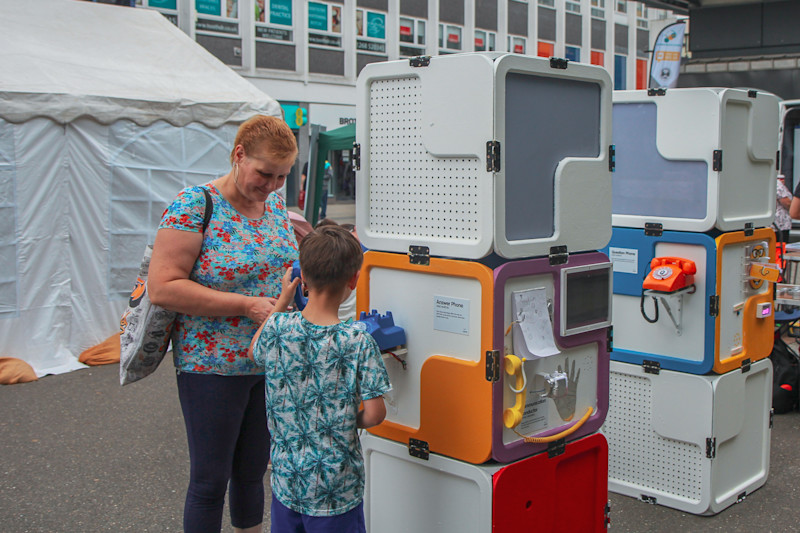
Unlike in these two installations, my phone won’t have the ability to allow viewers to hear other people’s messages. Mine’s not so complex, but I still think it gives the person a sense of speaking to someone anonymously, and perhaps sharing thoughts which they haven’t shared with anyone else. Those words initially communicated by a phone, then also have the potential to be further communicated in my work.

It Doesn’t Mean We’re In A Relationship

January has come around again, and I have bought my entry to this year’s RA Summer Exhibition. Will 2025 be my year? Or will I fall at the first hurdle, yet again? The theme for this year’s exhibition is ‘Dialogues’.

When I read this, two other words spring to mind: ‘connection’ and ‘relationship’.

Definitions:

Connection: a relationship in which a person or thing is linked or associated with something else.

Relationship: the way in which two people or things are connected; the state of being connected

Dialogue: a conversation between two or more people; an exchange of ideas and opinions on a particular subject; a process by which people with different perspectives seek understanding.

In the above definitions ‘connection’ and ‘relationship’ seem to be interchangeable. Personally, I think it is possible to have a connection without having a relationship. To me, a connection is an initial link based on shared interests, experiences, understanding and values, whereas a relationship is a sustained connection over a period of time.

I would suggest the following:

  • for there to be a dialogue, there at least has to be a connection.
  • it is possible to have a connection and a dialogue without having a relationship.
  • it is necessary for there to be a connection and a dialogue for there to be a relationship, and to maintain that relationship requires actively nurturing the initial connection, or repeating it, through consistent dialogue, shared experiences and commitment over a period of time.
  • it is possible to retain a connection and a dialogue despite the ending of a relationship.

When my daughter comes home from uni she likes to visit her favourite local eatery, the kebab van parked up in a lay-by frequented by lorry drivers. Every time she goes she makes a connection with the owner; they talk; they don’t know each other’s names but he knows, and remembers, where she goes to uni, what she’s studying, that she works at the local Sainsbury’s in the holidays, and how she likes not only her kebab but how we all like ours; my husband, as it comes, me with a little meat and lots of salad, and both garlic and chilli sauce. One might say that they have a relationship.

So, where does all this take me?

To disconnection. We seem to be living in a world in which we are increasingly becoming disconnected, in the sense that we have less meaningful interactions, and consequently we are limiting the opportunity for dialogue and relationships with ourselves, each other and the world around us.

Connections can be made quite easily, for example, on social networking sites, but does that allow for meaningful communication? Does a post followed by a like or a comment constitute dialogue? In fact, by their very nature of facilitating lifestyle curation, social networking sites can cause users to feel disconnected.

One might take the view that dialogue is something more than a mere exchange of words; it involves active listening, empathy, picking up on visual cues, making eye contact, challenging assumptions to create a sense of stronger connection and understanding, the latter being a form of Socratic Dialogue; a continual process of inquiry to deepen understanding. You don’t have the opportunity to exploit these to their fullest when communicating by text, speaking on the phone or on Zoom.

People have even stopped sending the one thing that keeps us connected, particularly to those that are not in our daily lives: Christmas cards. The trend is now to make a donation to charity, apparently. I send Christmas cards every year with the best intentions of reconnecting and furthering some old relationships which have been neglected. If I don’t manage to follow up, at least they’ll send me a change of address if they move, so I can give it another go in the future.

Some of it is a legacy of Covid: it’s easier to deliver university lectures online, to have doctors’ appointments online, to work from home. Whilst I agree that there should be a good work/life balance, not going into a workplace at all and not being able to interact face to face with colleagues, and have water cooler conversations, can’t be a good thing, particularly for young people just starting out in their working lives. The workplace is somewhere to meet friends, or even partners. You can’t really go out for a drink after work, if you’re working from home.

This is a low residency course: we meet weekly on Zoom and communicate with each other on our WhatsApp group. We had an initial connection – our passion for creativity. After the first term we have a deeper connection, and possibly even a relationship in the sense that our connection is fundamentally anchored in a mutual understanding of trust between us. That relationship will deepen further when we meet in person.

I’m not sure where I’m going to go with all of this. Possibly nowhere.

Entries have to be submitted by 11 February, so the next four weeks are going to be very busy with this and my study statement. I’m sort of regretting doing it now: I think that I just wanted to shock myself into doing something. I’m trying not to panic – if I don’t manage it, then that’s fine – I could always submit something I’ve already done, but, if I can, I would prefer to go through the process from scratch.