Water

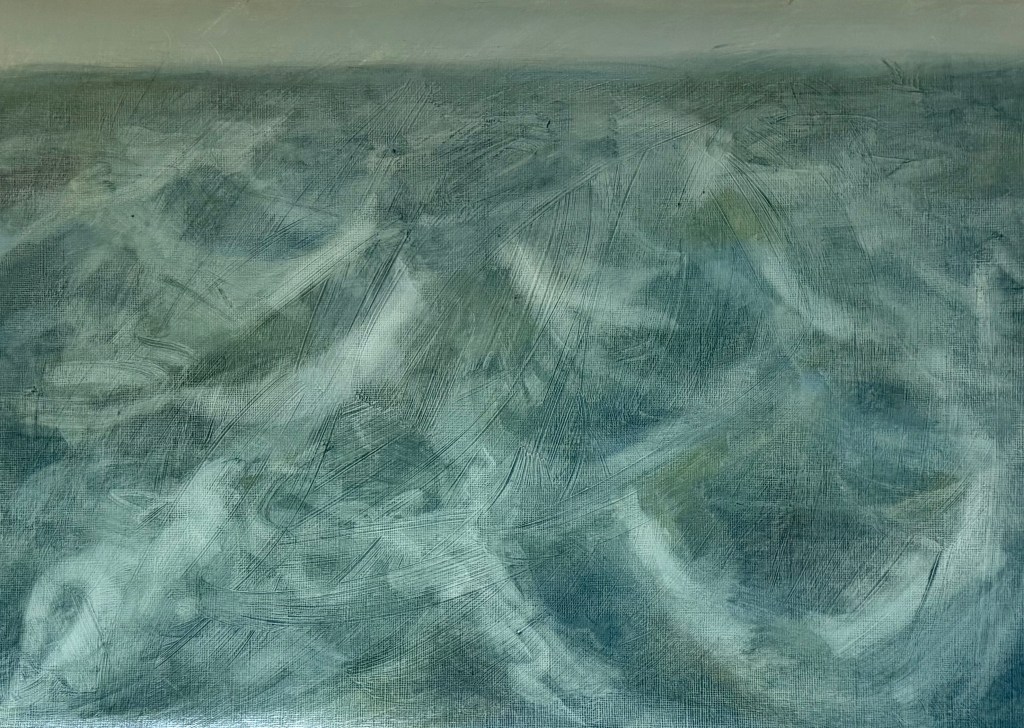
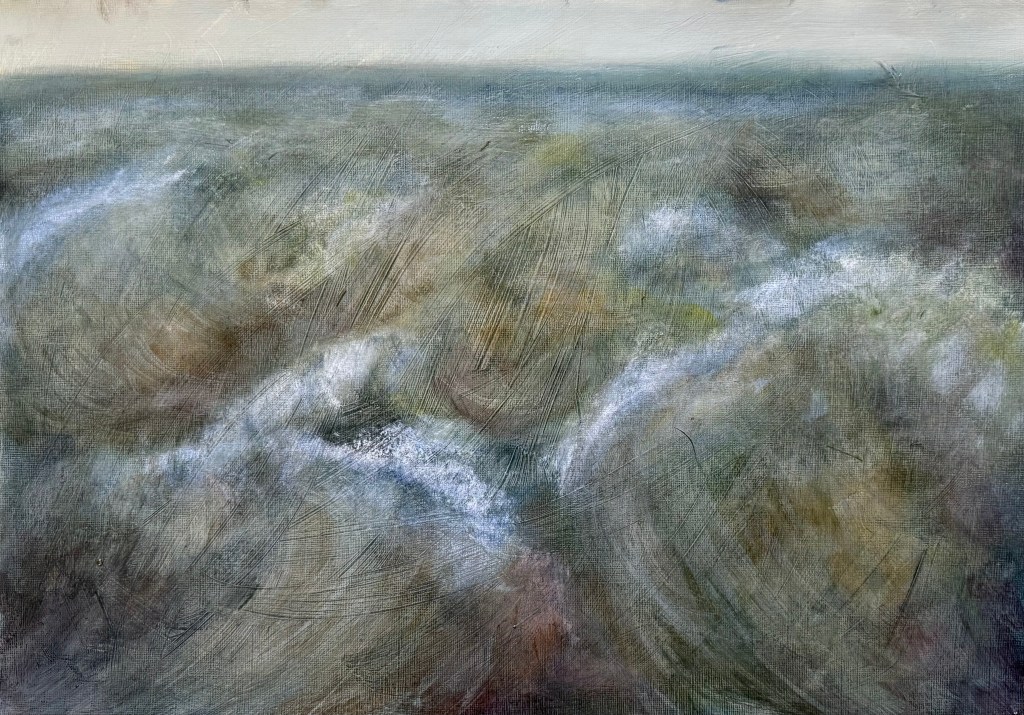
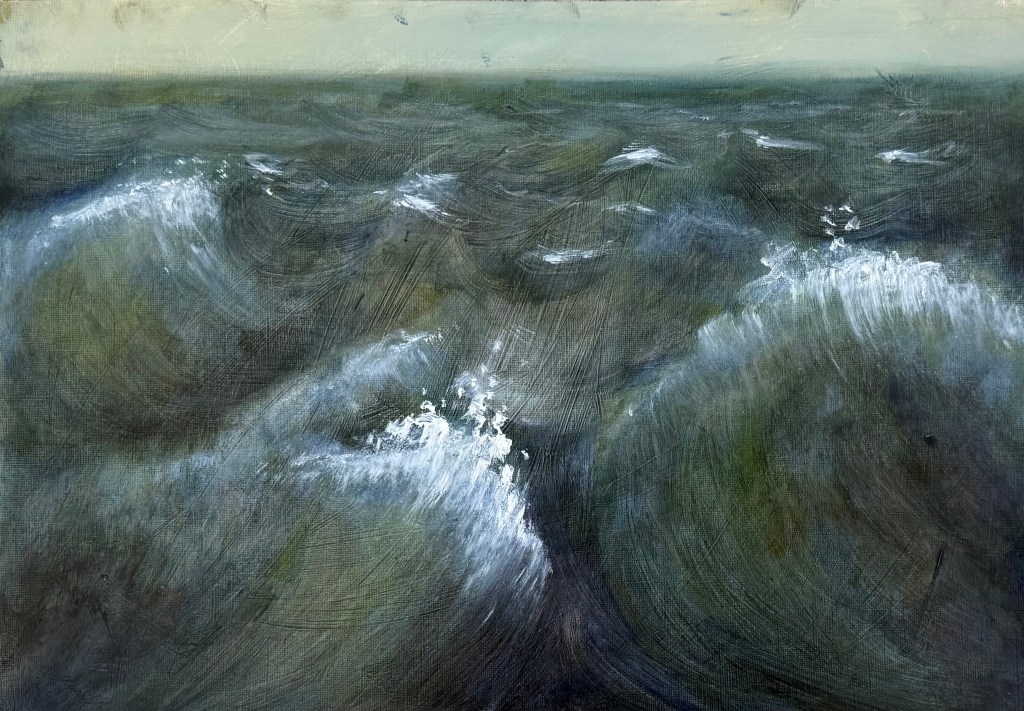
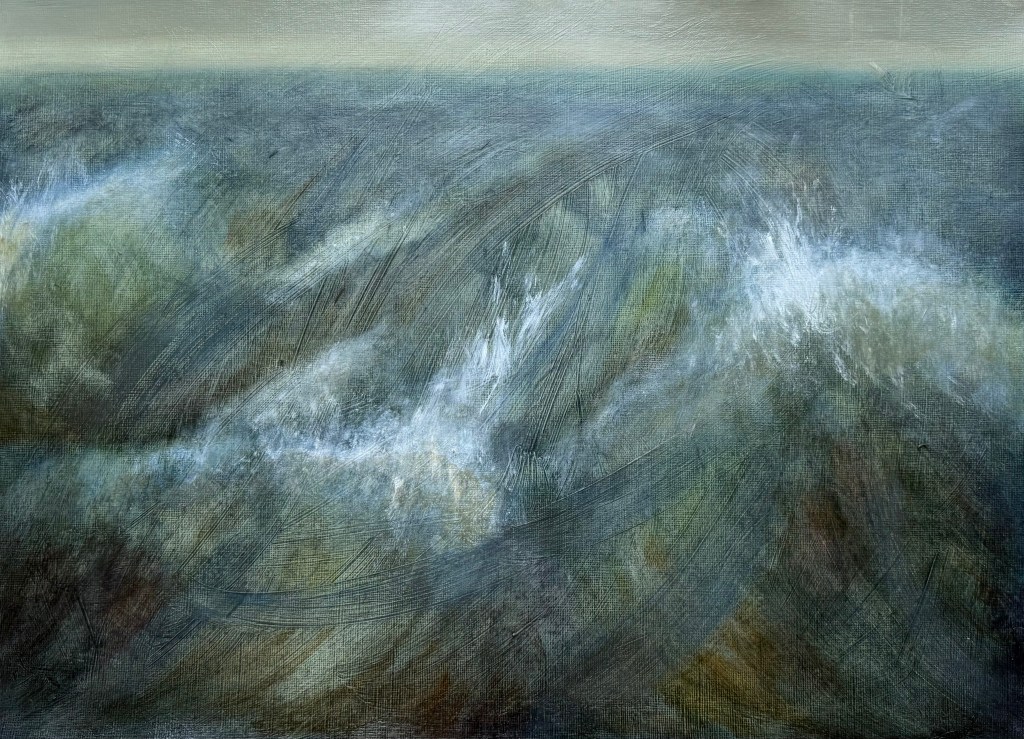
For the last couple of weeks we’ve been continuing to explore Turner in my painting class. The subject is water and stormy weather. As before, we’ve been applying thin layers of paint and sansador with a rag, and then applying several layers of glazing.

We started with a couple of small studies.
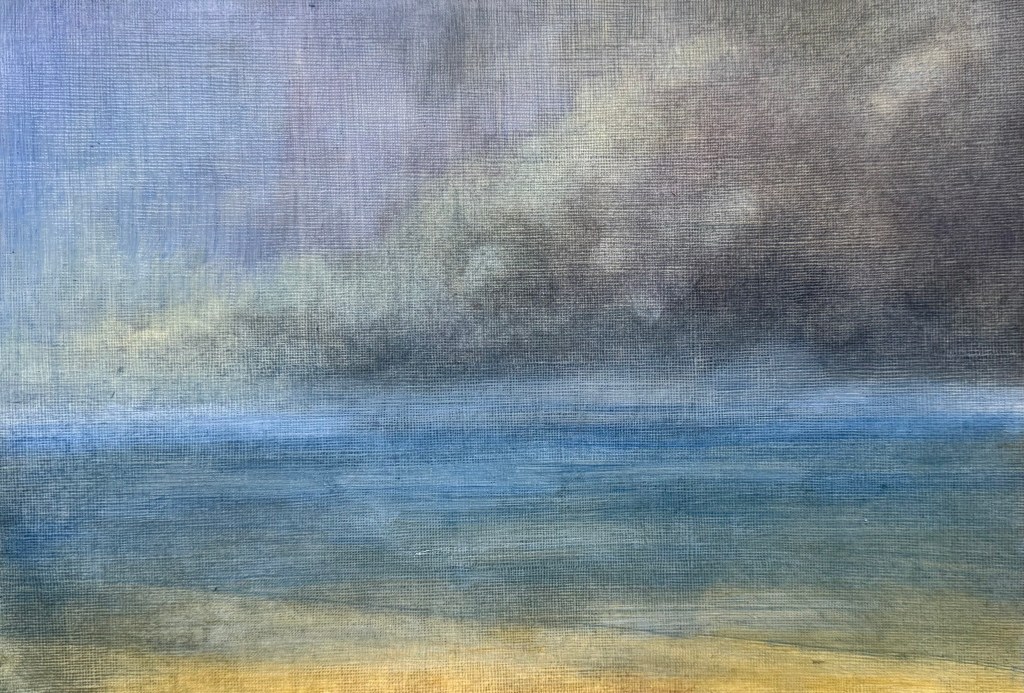
I used a limited palette of mineral colours – ultramarine blue, cadmium yellow light, burnt umber, alizarin crimson and titanium white. I’m not keen on it, it jars with me, in fact, I really don’t like it, but it meets the brief.
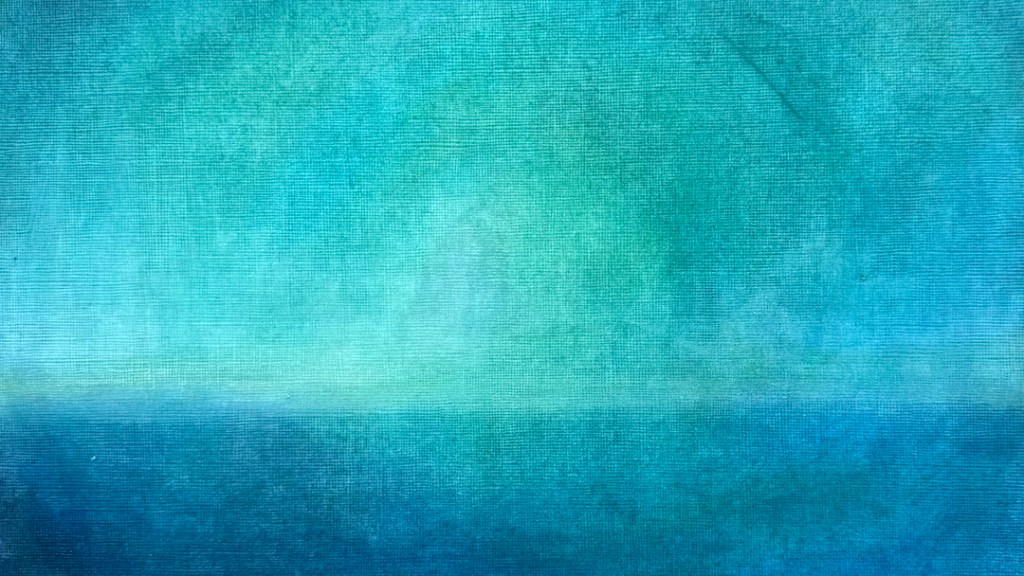
I much prefer this one – to me, it’s less figurative, although as soon as you put in a horizontal it automatically reads as a seascape. A post-Turner palette of cerulean blue, Prussian blue, phthalocyanine turquoise, cadmium free yellow, winsor violet and titanium white.

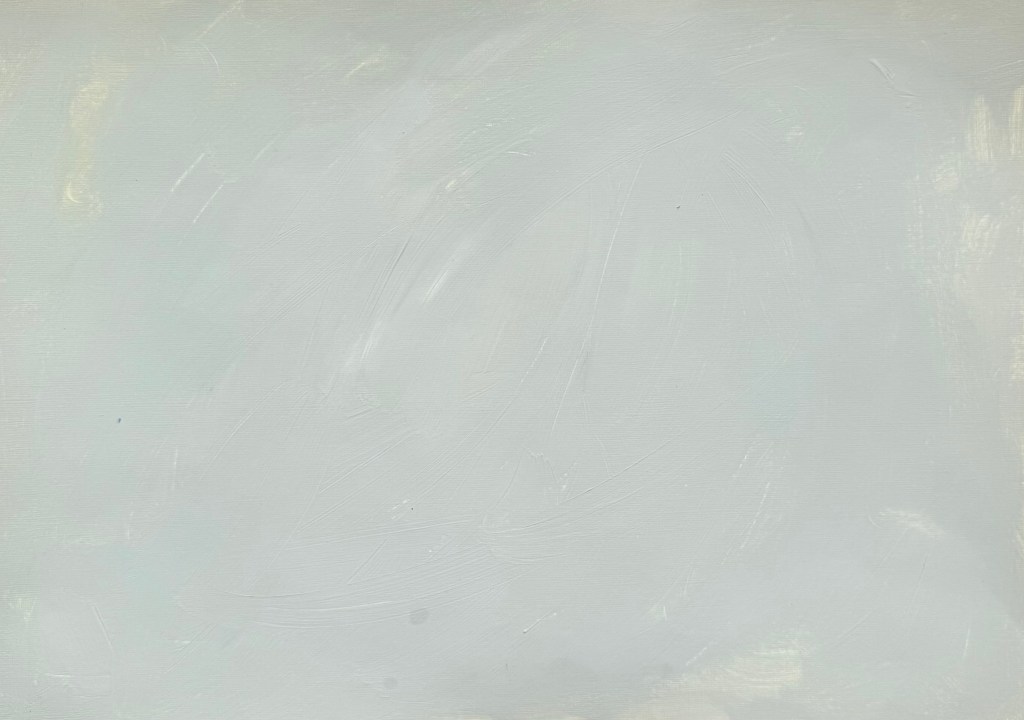
Then starting with an acrylic ground of a yellow grey, applied thickly and roughly so that definite brushstrokes are visible, I used the same limited palette of mineral pigments as in the first study.
It all started to become a bit twee, for want of a better word, so I blurred the horizon, and tried to break it all up, knocked it back and accentuated the sweeping brushstrokes in the ground using an ultramarine glaze. I feel better about it, but in retrospect maybe I should have done away with the horizon completely, as Turner tended to do, or maybe the horizon allows it some space? I think I need to put it away and reflect on it at a later date.
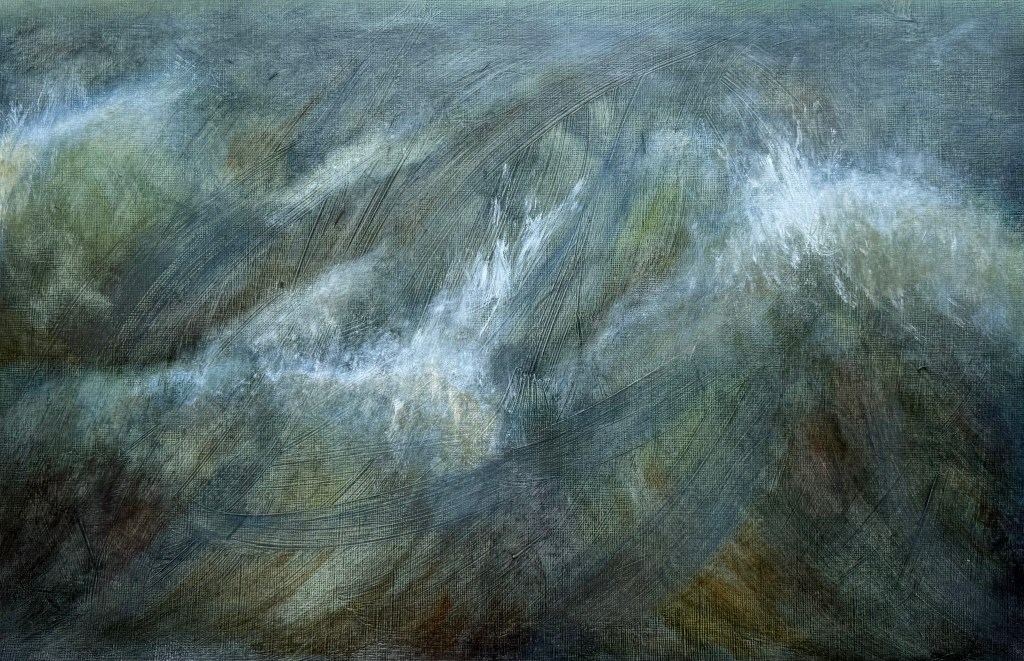
I’m conflicted; over the last year, I have found that I have been moving away from figurative work, particularly in terms of art that I like to look at, perhaps in an attempt to free myself. I’ve always taken the view that I attend these weekly classes because I like to explore different directions, and that there is no point just turning up and making what I want to make each week regardless. I try my best to complete the task, but I’m finding it increasingly difficult. Maybe this is a lesson for the future – of not always being able to make the work which I want to make.

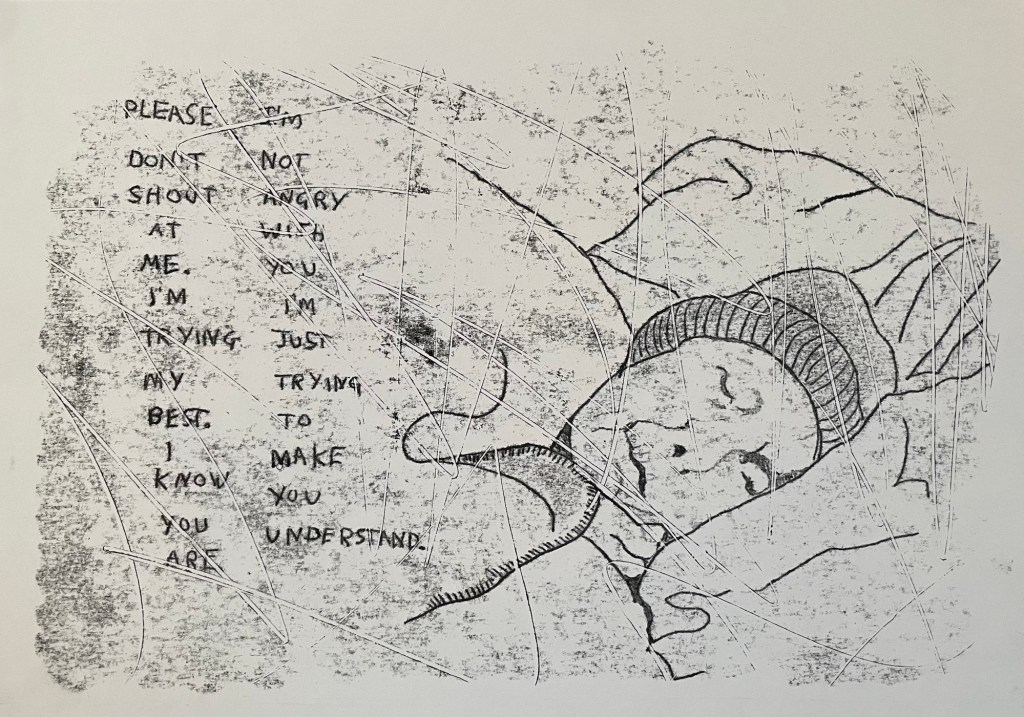
Three Conversations With My Mother

Some were surreal, others were sad. Sometimes she was lucid, sometimes she was delirious, sometimes it was morphine. Three in particular have lodged themselves in my memory. My logical brain tells me that she wasn’t herself, that her brain chemistry was all over the place, trying to cope with the enormity of it all.

It’s just that the last conversation I had with her, was the last.

I suppose I could talk about them to someone, together with the rest of it, but I’m not sure the spoken word will work: the words will come out of my mouth and vibrate through the air to enter someone else’s head. Then they are gone. I need a more substantial, tangible way of dealing with them, through the written word and imagery. I need to be able to confront them, physically.

I’ve had some inner conflict as to whether I should publish the image in which her face is visible; when she was ill and at her most vulnerable. This was a woman who dragged herself through the house, after breaking her leg, in order to phone for my sister to come over and make her look presentable before calling for an ambulance. She was a very private person. But she is no longer here. If it helps me come to terms with it, I think she would be ok with it. My sister’s on board – she reads this blog. She has her own conversations.

Three Conversations With My Mother No 1, Montotype on A4 Cartridge Paper

Three Conversations With My Mother No 2, Monotype on A4 Cartridge Paper

Three Conversations With My Mother No 3, Monotype on A4 Cartridge Paper

I don’t need to reflect on them. I don’t want to reflect on them. Not yet.

Sisters

“A sister is not a friend. Who can explain the urge to take a relationship as primal and complex as a sibling and reduce it to something as replaceable, as banal as a friend? Yet this status is used again and again to connote the highest intimacy. My mother is my best friend. My husband is my best friend. No. True sisterhood, the kind where you grew fingernails in the same womb, were pushed screaming through identical birth canals, is not the same as friendship. You don’t choose each other, and there’s no furtive period of getting to know the other. You’re part of each other, right from the start. Look at an umbilical cord – tough, sinuous, unlovely, yet essential – and compare it to a friendship bracelet of brightly woven thread. That is the difference between a sister and a friend.”

‘Blue Sisters’, by Coco Mellors

I stumbled across this passage whilst I was having a mooch in Waterstones on Saturday. It cuts right to the heart of what it is to be a sibling. I find the imagery particularly strong – the inhabited space of the womb, growth and development, umbilical cord, connection. Lots of food for thought.

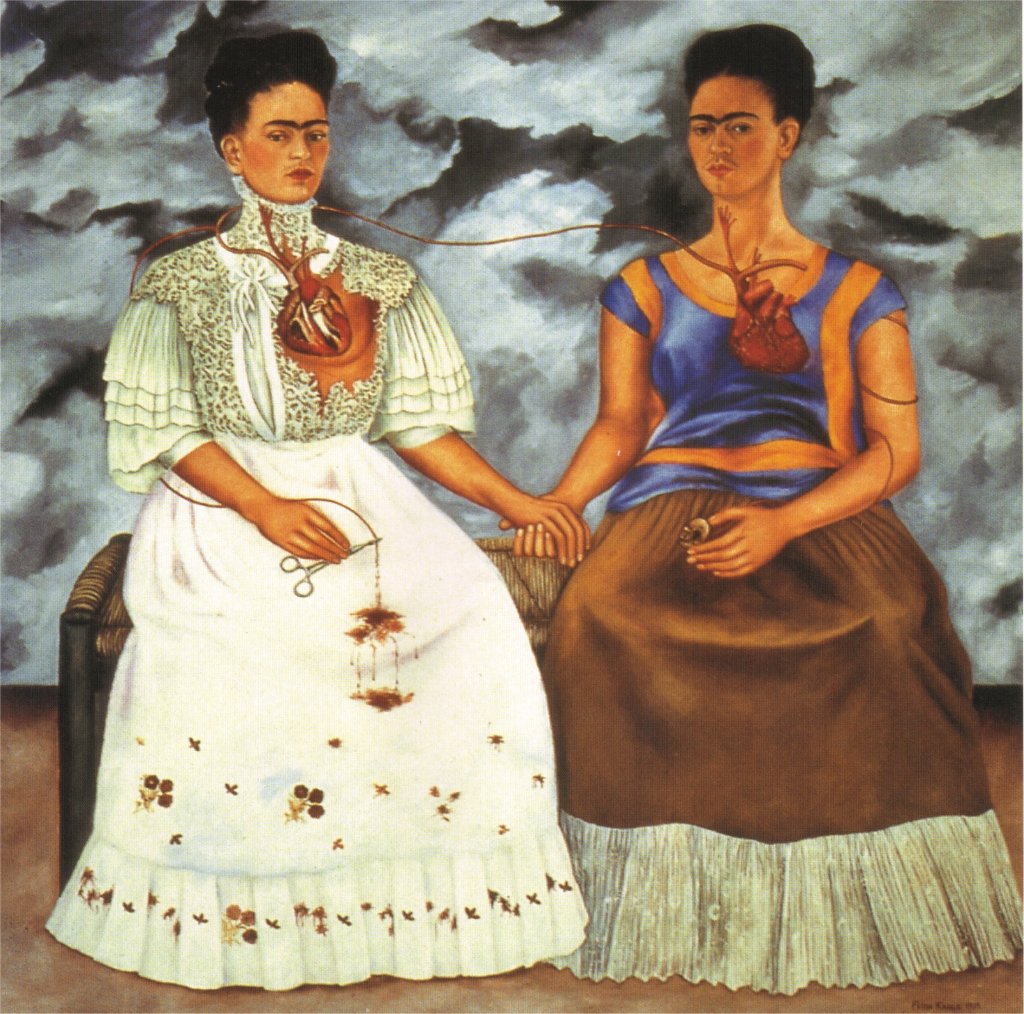
‘The Two Fridas’, Frida Kahlo 1939 (oil on canvas)

On the subject of thinking, this image above has been floating around in the back of my head whilst I’ve been contemplating my role as a sibling, and as a mother, but more on the latter some other time. In this painting, Kahlo’s traditional identity is connected by an artery from her complete heart to the heart of her modern identity which has been torn apart by her divorce from Diego Rivera. I find it a very powerful image: full of pain and conflict, but, at the same time, resilience. It’s already informing some ideas for a piece of work.

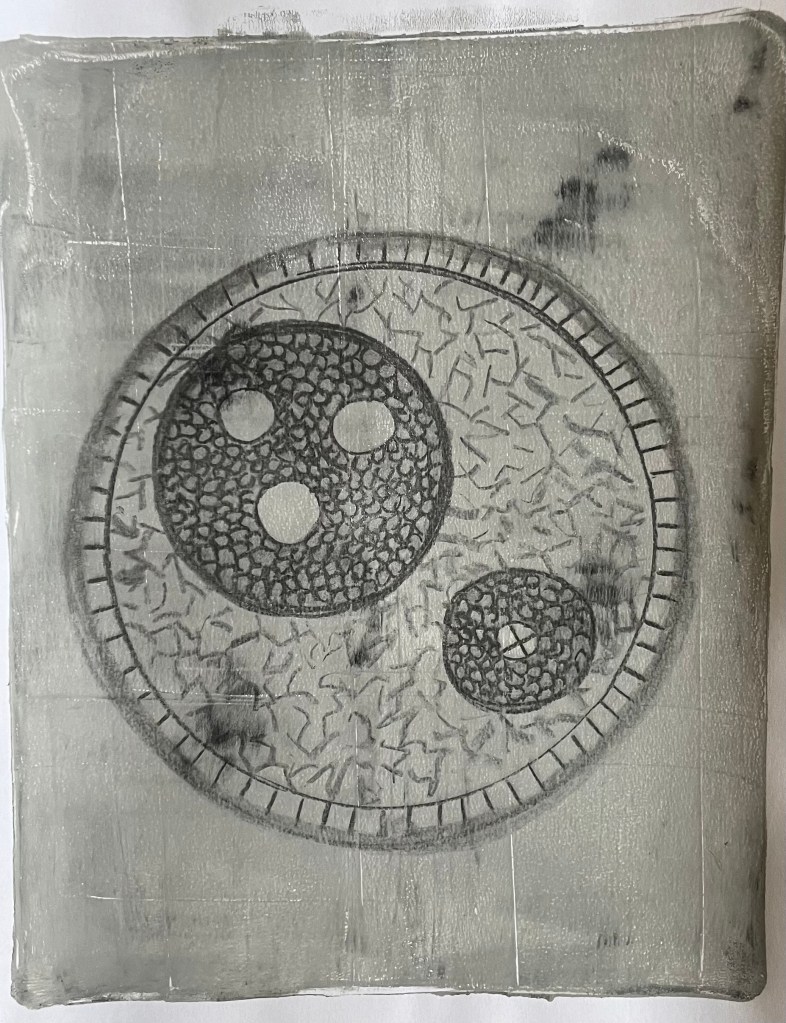
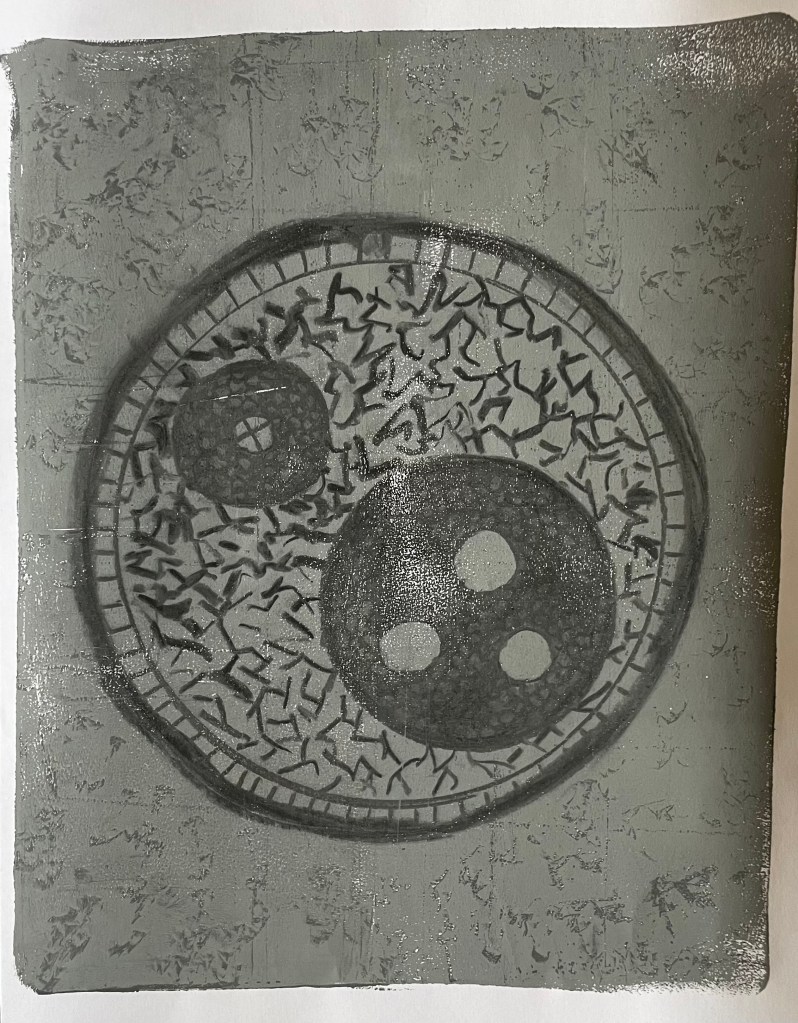
I’ve been experimenting with pressing charcoal drawings onto a gelatine plate and then printing – the archival quality it produces is interesting – and also applying paint onto the plate randomly. It was all done in a bit of a rush as I suddenly thought: less thinking, more doing. I didn’t find the process satisfying: the colours are really unappealing and murky – in fact they are just varying shades of grey. I’ve been meaning to try this process for sometime now, since I saw it on a facebook reel, so I was really quite excited at the outset but I ended up feeling underwhelmed – the subtleties inherent in charcoal are totally lost. Maybe starting with a cross-section of an unlovely umbilical cord inadvertently set the tone, but my quickie self-portrait certainly expresses how I felt!

So, here’s the bad and the ugly…