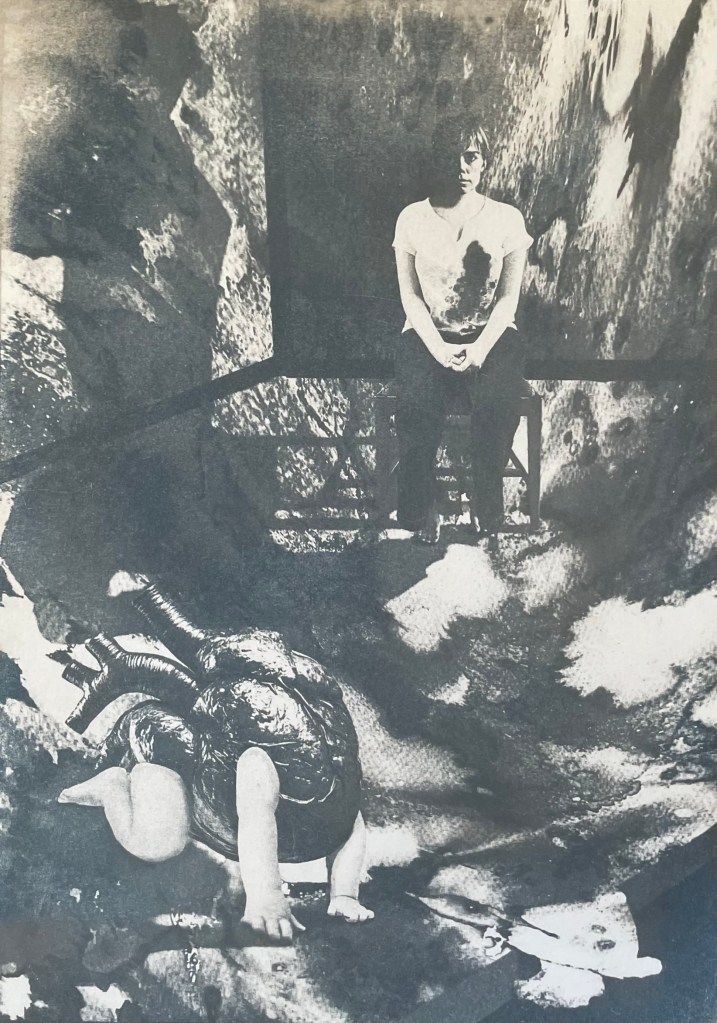
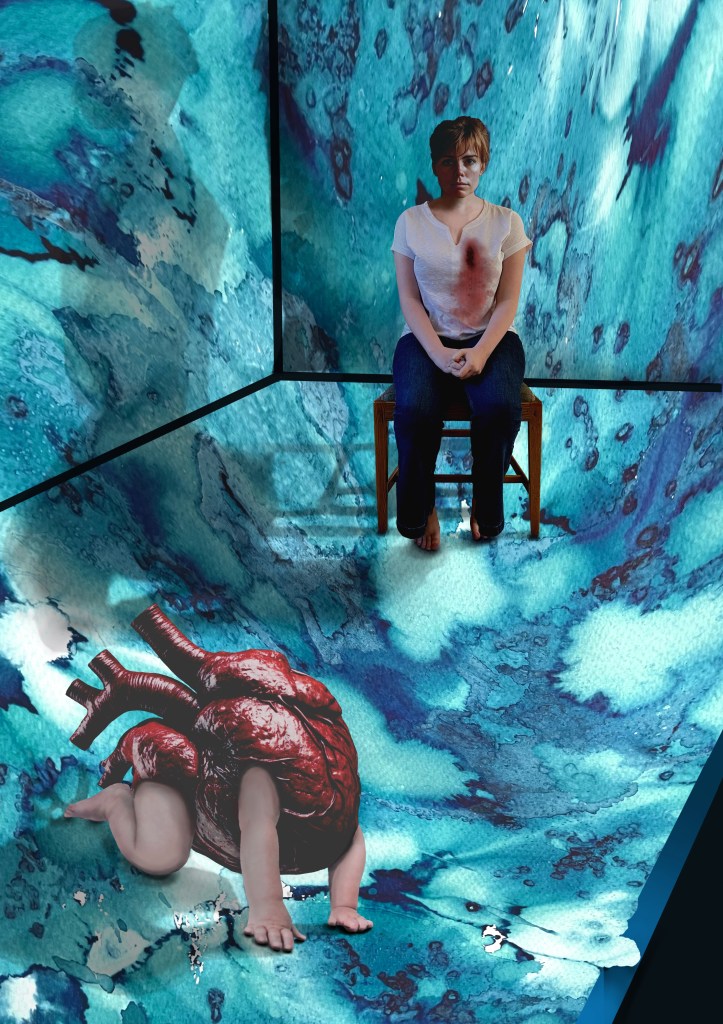
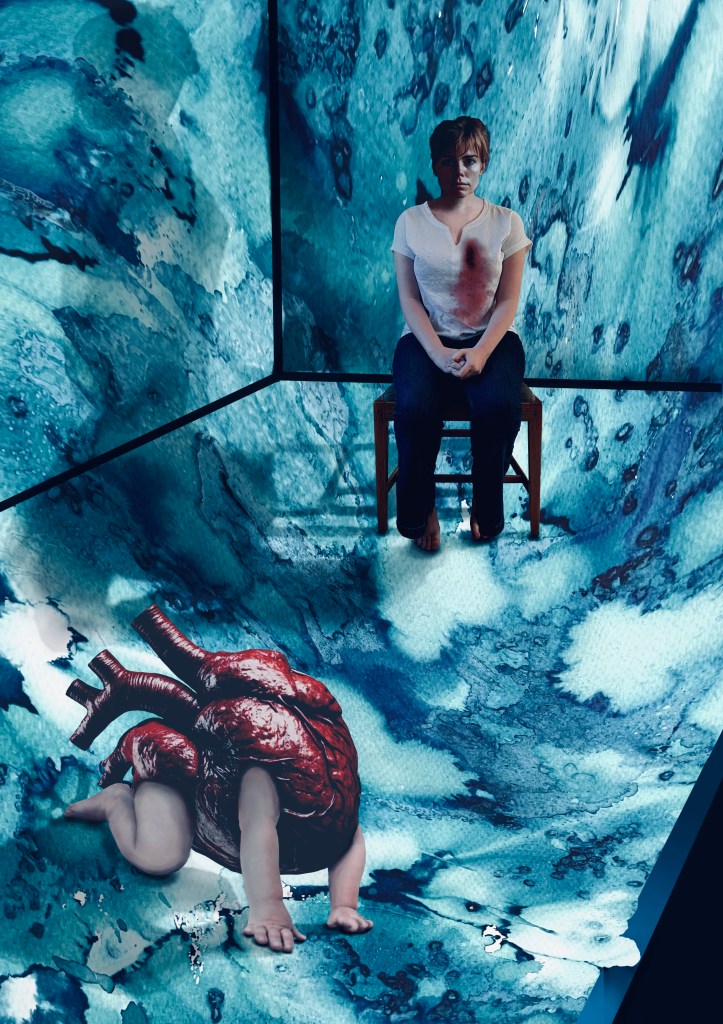
I have had an image in my mind for months. It came from the Elizabeth Stone quotation, I first mentioned in Hearts & Linos .
”Making the decision to have a child – it is momentous. It is to decide forever to have your heart go walking around outside your body.”
I think it encapsulates perfectly how I felt when I became a mother. My whole world was turned upside down. I was suddenly responsible for raising and protecting another human being. I felt overwhelmed by the magnitude of it all; that life would never be the same again. It made me question the sort of world I had brought her into, how her life might be; how much of it I would be a part of, the unthinkable and unbearable pain I would suffer if anything happened to her. She was precious and intrinsic to me, now living and breathing in the world, independently of me.
Original VersionDramatic FilterCyanotypeCoffee Toned CyanotypeAltered background and darker tonesDramatic Filter.Dramatic cool Filter. Worked on hands.
It’s taken a while. Bearing in mind that I’m still finding my way around Procreate I don’t think that I’ve done too badly. I’m sure that I’ve done lots of things incorrectly, but I don’t really care. It’s all a learning process and it was fundamentally about me trying to realise an image that I had in my head. I feel that I’ve achieved what I set out to do. In that respect, I’m pleased with it. I think it conveys the visceral nature of my feelings.
Actually, it has taken me more than a while; it’s taken ages, probably because I kept on making mistakes, but I have learnt lots along the way. I’ve redone parts of it several times but I have to say that it has all been about the process of discovery and realisation. It’s allowed me time to focus on the detail, but it’s been as part of the process rather than with a view to trying to achieve a perfect result. I don’t think that Procreate is a tool with which I can be loose and expressive in the physical sense, but it seems to satisfy that part of me that likes to focus on surreal detail every now and then. Hopefully that will allow the other part of me to enjoy the experimentation of being looser and more expressive in my mark-making when, say, painting.
I decided ages ago that I wanted to incorporate my ink experiments as a background to a collage type piece. I sourced the heart, crawling baby and head of the woman from royalty free image sites which allow for reproduction of the resultant work, if need be. The body is my daughter. She’s a bit freaked out by someone else’s head being on it, but I wanted a neutral character, and I couldn’t find an image of a woman sitting on a chair that fitted my requirements, so I roped in a free model.
It was challenging constructing the crawling heart. I’ve had to rebuild parts of it including the hands as some of the fingers were hidden in the original image. It was quite difficult finding source images whose licences allowed me to do what I wanted to do, and were also free. I’ve played around with editing effects and colours and I think that I’m settled on the last image for now. The slight greenish tones, complement the red heart. I really like the cyanotypes, but unfortunately there isn’t enough tonal variation and the slightly chaotic background loses its delicate tonal transitions in the process. I might try again but change the background to something a little less busy. But I like the historical, almost Victorian Penny Dreadful feel to them. I might develop it further, but I’ll leave it on the back burner for now.
The time delay video created by Procreate is of epic proportions, but it’s helpful for me to watch it back so I can see what a song and dance I made of it all. This is a shortened version.
During our session at the brain gym this week, I explained to Dalal and Josh that I have been struggling to make finished work, as opposed to the products of experimentation. They both agreed with Jonathan, who, during my tutorial, had questioned whether I felt a pressure to make finished pieces; the experimentation stage is a place to stay for a while, and will, at the right point, turn into something more complete. I commented to Josh and Dalal that part of the problem may be that I’m ever conscious of time passing, and so I feel that I should be making the most of every minute – preparing the work plan had brought into perspective that there are a finite number of weeks left of the course, and that made me experience a moment of what I can only describe as loss.
I had hoped that a more productive phase would be imminent, but I suspect that at the moment this is being hampered by not having the headspace, or the physical space.
My husband is about (fingers crossed) to complete on the sale of his parents’ house in Liverpool – his childhood family home. He has been up and down, bringing things back. I find the process very difficult – I don’t have a problem with keeping things of use or of sentimental value, but another can opener? We have enough of our own stuff. We, or more specifically I, don’t need to add our parents’ stuff to the mix. I feel like I’m suffocating under the weight of belongings, many of which are occupying the physical space where I should be creating (more stuff?). Admittedly, I’ve been sorting this space out for I can’t remember how long, and made absolutely no progress. I’m conscious that my daughter will, one day, hopefully not in the foreseeable, have to undergo the same process – I don’t want her to be weighed down by all the stuff.
Along with the stuff, he also brought back what remains of one of his best friends from school, who died suddenly last year. His friend had left instructions as to all the places where he wanted to be scattered, including our garden, as he enjoyed coming to visit. Unbeknownst to me, my husband had brought him into the house and put him on the shelf, next to a glass bowl which had belonged to his parents, and which he had smuggled in as contraband whilst I wasn’t looking. My heart sank as I saw the bowl, and then the black bag next to it – what’s in here I thought as I opened the bag and took off the lid, another ornament?…
Dora The Explorer was one of my daughter’s favourite TV programmes when she was a toddler. I don’t know how they did it, but Nickelodeon managed to give Dora the most irritatingly grating voice possible. Anyway, thankfully, this is not the Dora the Explorer who is the subject of this post.
I went to the Pallant House Gallery in Chichester yesterday morning to have a look at the DoraCarrington: Beyond Bloomsbury exhibition. I had heard of her, and had a vague recollection of having seen some of her work.
Dora Carrington certainly was an explorer of sorts: associated with, but not a fully paid up member of, the Bloomsbury Group, she explored her art as well as her relationships and sexuality. To be honest, I couldn’t quite keep up with the complexity of it all. At the heart of it was her enduring love for the gay writer, Lytton Strachey, who was 13 years older than her and with whom she set up home. At one point they lived with Ralph Partridge who Carrington (whilst studying at the Slade, she dropped the name ‘Dora’ preferring to be known by her surname) married in order to keep their ‘triangular trinity of happiness’: Partridge was enamoured with Carrington, Strachey fancied Partridge, and they all had relationships with each other (apart from Carrington and Strachey whose relationship was only ever platonic) as well as others of the same or opposite sex. It seems all and sundry found themselves hopelessly in love with Carrington, not least the artist, Mark Gertler, with whom she had a moment, but otherwise whose long-lasting passion was unrequited.
Alas, it all ended tragically in 1932 with Carrington shooting herself in the chest shortly after Strachey died. She was 38 years old.
The last exhibition of her work was 30 years ago at the Barbican. During her life she rarely exhibited, and her work, many pieces of which she destroyed, seems to have been overshadowed by her adventurous private life and tragic death. She has been described by a former director of the Tate as being’ the mostneglected serious painter of her time’.
It was a mixed bag, but there were a few pieces which caught my interest. Her early drawings and paintings of nudes were very good, but I found myself lingering in front of these.
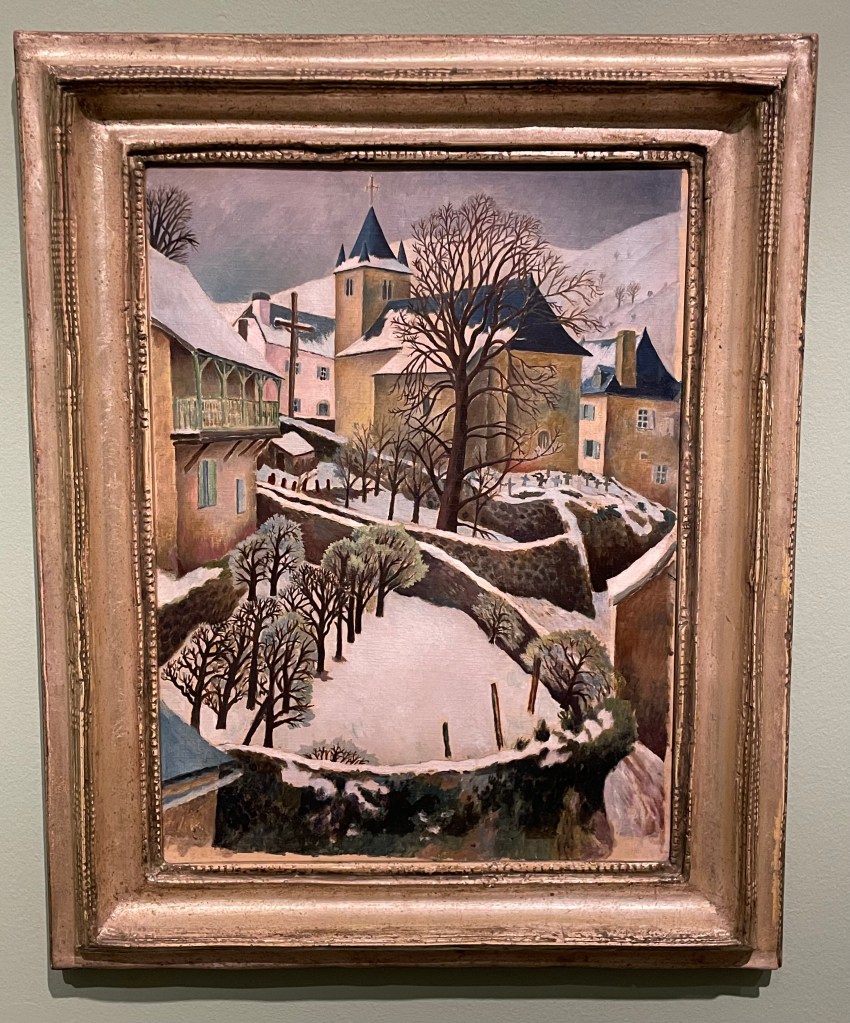
Larrau in the Snow, 1922
Perfect Christmas card material, I really like the simplicity of this painting; its muted colours and, in particular, the composition with its recurring curved shapes of the stone walls and the use of verticals in the posts and trees in the foreground, the large tree and the church with its spire punctuating the sky in the middle ground and the mountains in the background. The positioning of the trees leads the eye up through the painting in a zig zag pattern.
Farm at Watendlath, 1921
Again, I like the composition: the path leads across from left to right, up through the farmhouse along the rear stone wall to the large ominous trees, up to the huge hills in the background which seem to squeeze out the sky. The three areas of white – the figures in the foreground, the farmhouse (and what look like sheets on a washing line) in the middle ground and the clouds in the sky in the background – break up the large areas of green preventing them from becoming too overpowering, but leaving enough areas unbroken to give a sense of being overpowered: the tall trees and hills seem to be bearing down on the woman and child, creating a feeling of foreboding, and the stillness (if they are sheets on a line, they’re not moving at all) and claustrophobia created by the tiny sliver of sky adds to the mood.
It was suggested by the blurb accompanying this piece, that its unsettling atmosphere might have reflected the turmoil which Carrington was experiencing at the time: she had gone to Cumbria on holiday with Partridge and his friend, Gerald Brenan, and they had stayed at the farm. Whilst there, she began a relationship with Brenan.
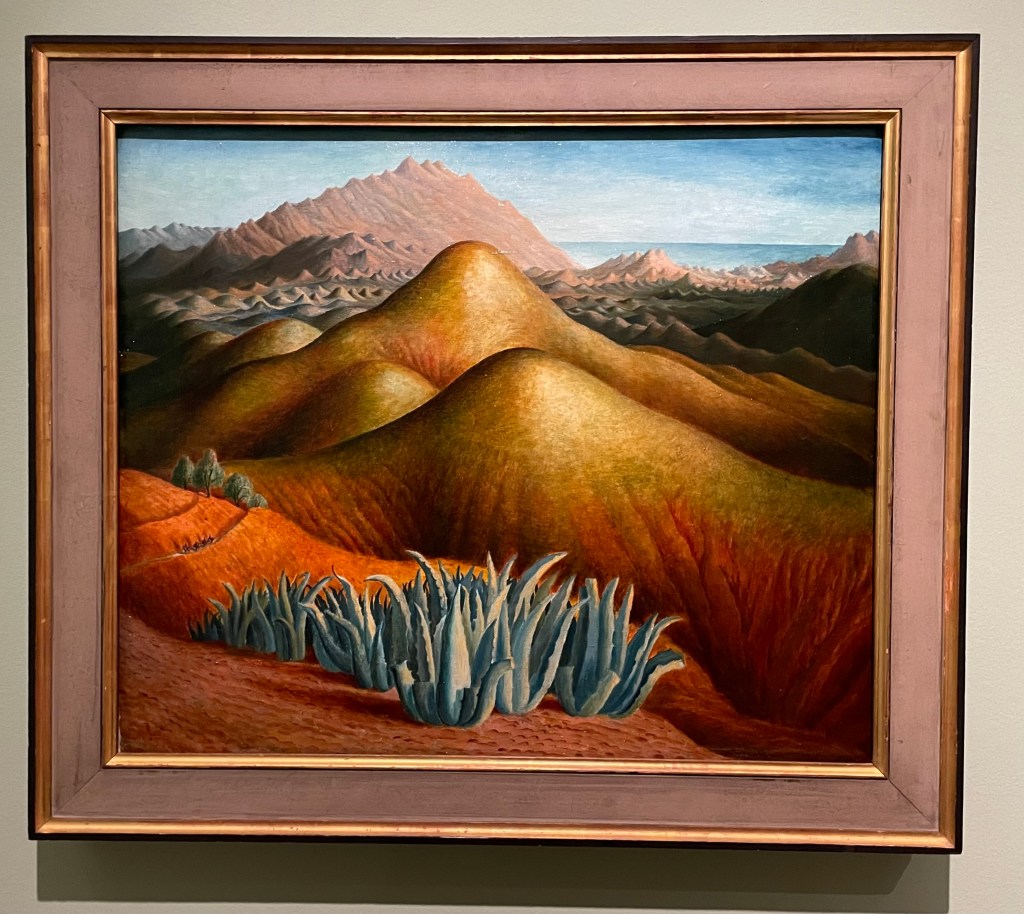
Spanish Landscape with Mountains, 1924
I was drawn to the surreal nature of this painting. Carrington made it from memory, after visiting Brenan in Andalusia, where he lived. According to the blurb, she built up the colour by layers upon layers of glazing on top of what was already a vibrant underpainting. She painted it on a cold day in March, which may have been a contributing factor to her use of colour and the sense of heat and aridity which she manages to create. There are menacing looking succulents in the foreground and a few token olive trees just behind, and these, together with the slight greenish tone to the area in from of the background mountain range, cleverly break up the large areas of warm reds and yellows which form the undulating hills in the middle ground. There is the lovely detail of the figures on horseback moving towards the viewer along the ridge on the left hand side. It has an otherworldly quality to it: apparently Carrington felt transported to another world when she visited Spain.
Lytton Strachey, 1916
“He was everything to me. He never expected me to be anything different to what I was.” This was how Carrington described Strachey, and it is apparent in this portrait of him which she painted towards the beginning of their relationship which was to last 16 years, and which survived numerous relationships on both sides. It shows Strachey deep in concentration reading a book which he is holding in his delicately painted hands, which Carrington has strangely elongated. Maybe his hands were her favourite feature, because she captures them in a detailed way, down to the highlights on his nails, even their white tips, particularly on his little finger. Or maybe she used them as a compositional device to create a dynamic and bold vertical marking the final vertical third of the painting. The image wouldn’t have the same impact if his hands were sized more realistically, and the book he is holding didn’t go off the top of the panel.
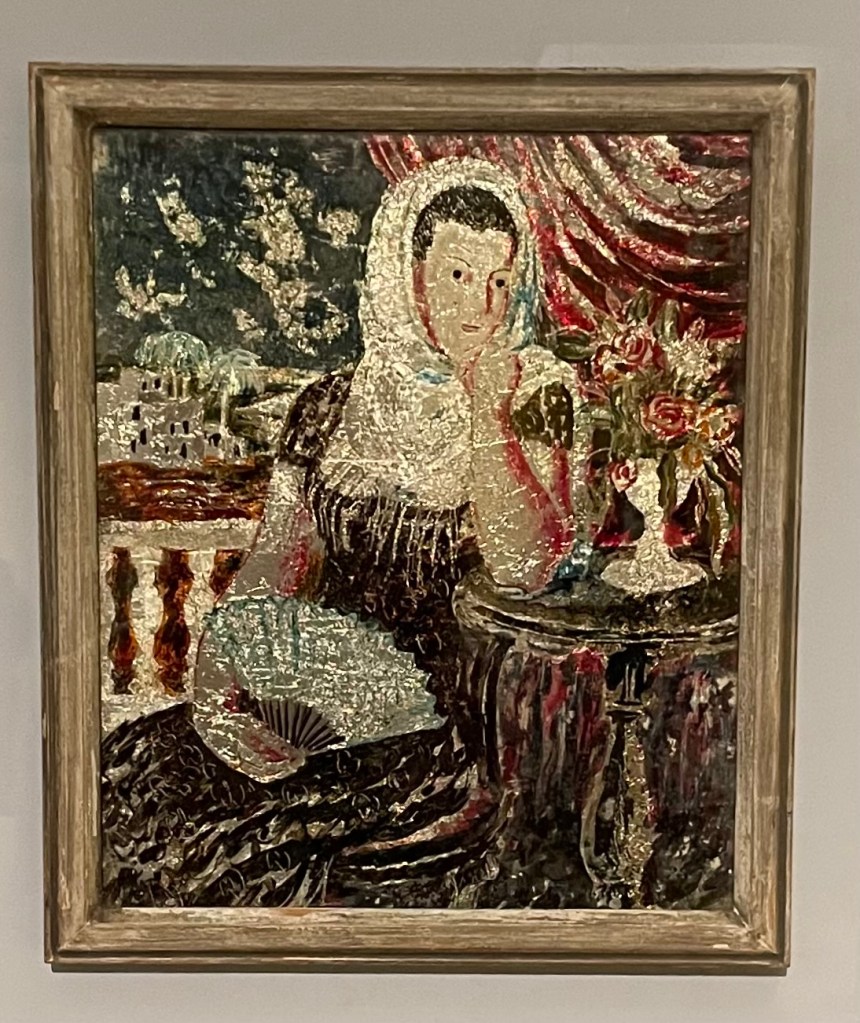
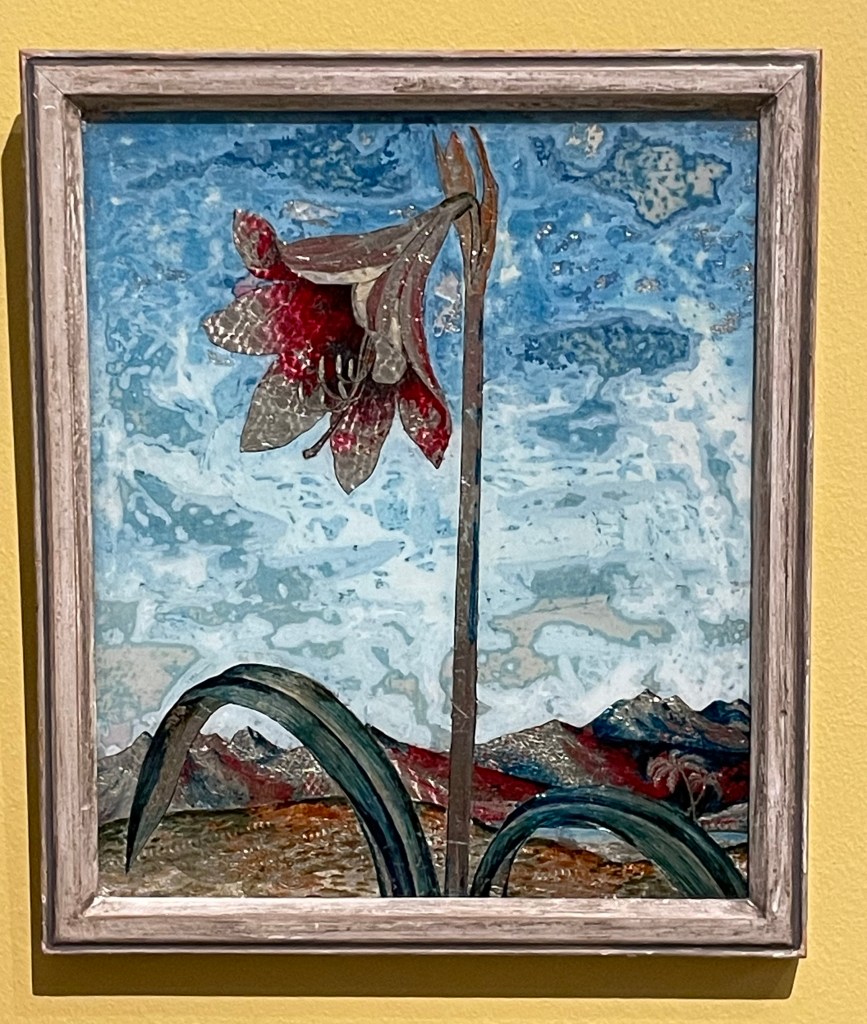
Carrington had a fascination for Victorian ‘treacle’ paintings and from 1923 began making her own which were called tinsel paintings. They weren’t very large and involved making a painting on the reverse of a piece of glass using foil from sweet wrappers and cigarette packets together with inks and oil paint. She sold them through Fortnum & Mason as a way to earn an income in the winter months to finance her serious art making. She also made them for friends: the ones below were made for Augustus John’s wife, Dorelia. Very few of the tinsel paintings survived, and one of them sold 4 years ago for £57,000.
Spanish Woman
Lily
I’m strangely drawn to them as I’ve never seen anything like them before. They have a strange luminescent quality to them and I particularly like the textures in the sky in Lily – the combination of the resplendent lily in a barren landscape reminds me of Georgia O’Keefe.
Anyway, I’ve done some further research: Dora Carrington’s life was made the subject of a film in 1995 – ‘Carrington’ – starring Emma Thompson and some other notable actors. I watched it last night. Perhaps not surprisingly, it’s a film about her, based on a book about him. I’m not sure that it managed to truly capture the complexities of her life and certainly only touched on her relationships with men, and not women. It was a tearjerker.
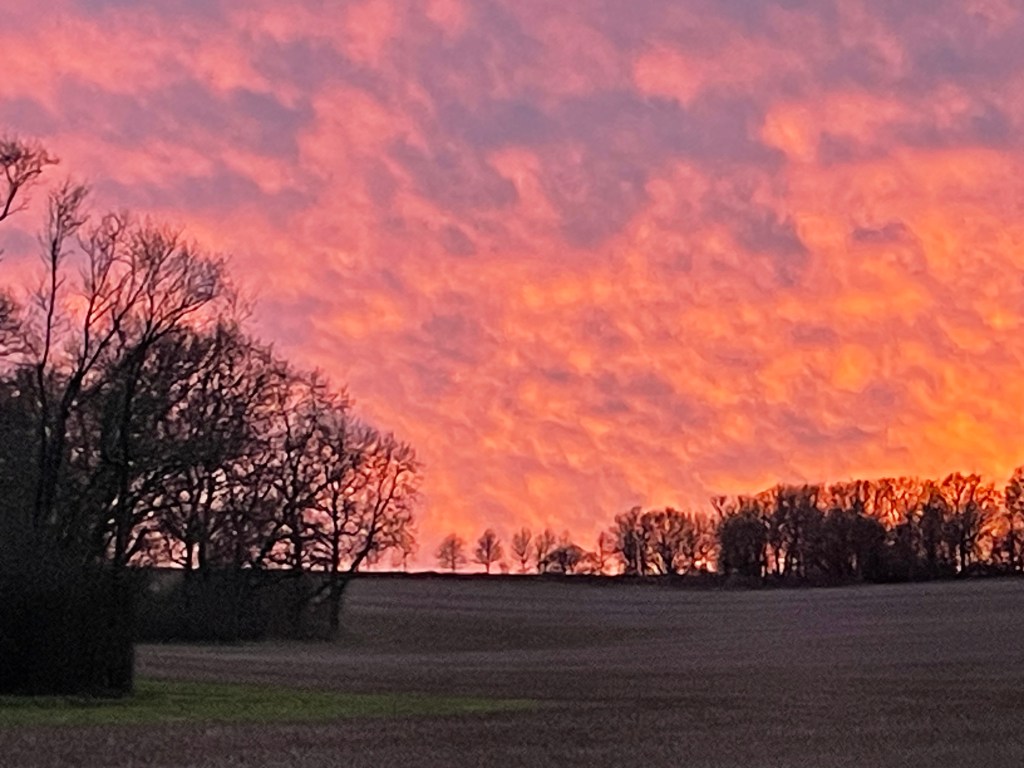
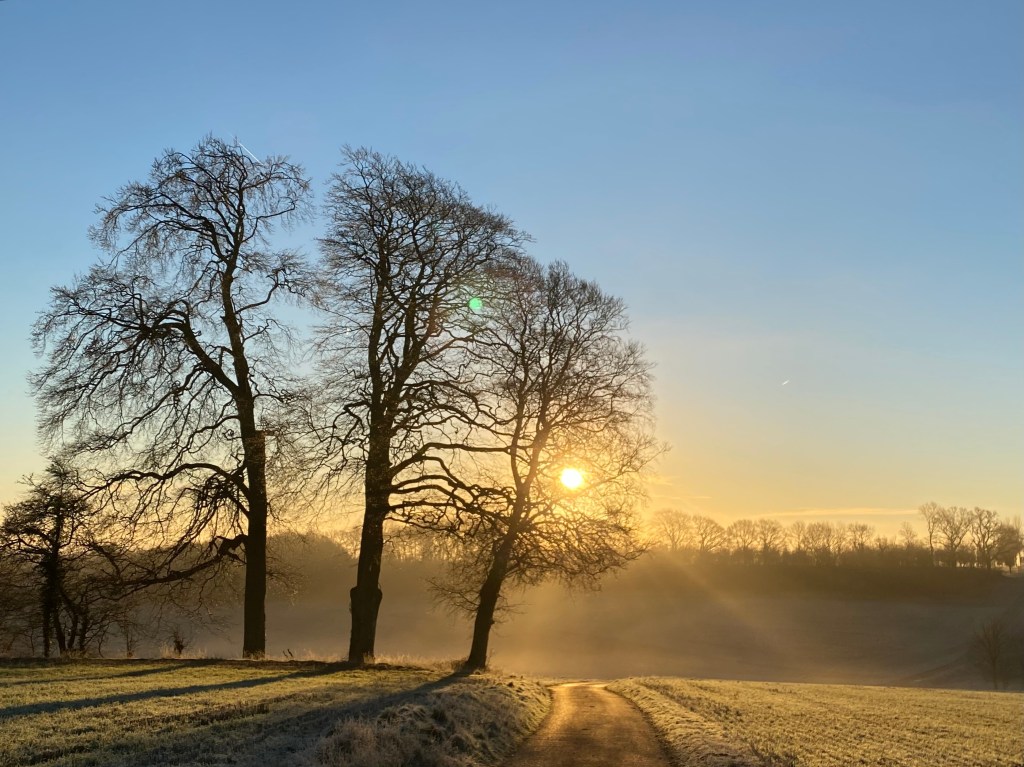
Whilst I was starting to write this post yesterday evening, I looked up and saw the most amazing sky through the kitchen window and had to go outside and take a photo of it. As usual, the image doesn’t really do it justice.
That wasn’t how the last couple of days were supposed to have gone.
My daughter came home from uni just after our session ended on Tuesday with rapid onset tonsillitis. By Wednesday she was in tears. She is one of the bravest and most stoical people I know, so this unsettled me. It’s heartbreaking watching your child suffer in pain. When I was in pain, my mother used to tell me that, if she could, she would swap places with me. I wish I could say the same, but the truth is my daughter is far better equipped to deal with it than me. When it comes to pain, I don’t mind admitting that I’m a wimp. If there are drugs going that will make me feel better, just pump me full of them – that’s what advances in medical science are for, after all.
I don’t care that I didn’t have a ‘natural’ birth, without pain relief; that she came out of the sunroof. I wasn’t ‘too posh to push’ – she wasn’t going anywhere, and at risk of becoming distressed, and would it have mattered if she hadn’t been, anyway? Is a natural birth somehow superior to one with medical intervention? Why are we told, in that patronising way, that we are not the only woman to have ever given birth? I am the only ‘me’ to have given birth.
Whilst I’m doing my best to keep negativity out of my life, some things do just make me angry. I think it is now generally accepted that women are expected to put up with an unnecessary level of pain when it comes to matters of their health, just because they are women. Studies have shown that women experience pain more intensely, and for more of the time than men. However, they are less likely to have their pain scores recorded, or to be prescribed pain relief than men. Apparently, this is based on the misguided notion that women are more emotional, which means that they may exaggerate the pain they are feeling – after all, ‘hysteria’ comes from the Greek word hystera, which means uterus. Really? There is now a term for this way of thinking: medical misogyny.
It reminds me of a comment made by a male healthcare professional whilst discussing pain relief during the discharge process after an exploratory procedure, which had been initially attempted without sedation. Some women can ‘tolerate’ the ‘discomfort’. I wasn’t putting up with the intense pain. Did I feel like a failure, that I’d somehow let myself and womanhood down; that I should have been able to ‘tolerate’ the ‘discomfort’ like all those women who had gone before? Initially, yes, and it is very intimidating to be in a situation where you are surrounded by healthcare professionals, both men and women, where you feel that you have lost agency over what is being done to your body. Did I look in their eyes for judgement, particularly in the women’s, whilst I dressed, gathered my things and left? Yes. But the word ‘no’ is empowering, and so it was sedation for me. Anyway, getting back on point, I think I made some quip as to knowing what pain feels like, being a woman. He must have interpreted that comment as alluding to a badge of honour as to the amount of pain women can tolerate, as he replied, something along the lines of: “Women can’t have it both ways”.
Anyway, I’ve managed to make it all about me again; that wasn’t how this post was supposed to have gone. After several trips to, and many hours spent in A&E, pain relief, antibiotics, fluids, steroids, and a bit of an exploration up her nose and down her throat with a camera, she’s thankfully on the mend with plans to whip the little troublemakers out in due course.
January has come around again, and I have bought my entry to this year’s RA Summer Exhibition. Will 2025 be my year? Or will I fall at the first hurdle, yet again? The theme for this year’s exhibition is ‘Dialogues’.
When I read this, two other words spring to mind: ‘connection’ and ‘relationship’.
Definitions:
Connection: a relationship in which a person or thing is linked or associated with something else.
Relationship:the way in which two people or things are connected; the state of being connected
Dialogue: a conversation between two or more people; an exchange of ideas and opinions on a particular subject; a process by which people with different perspectives seek understanding.
In the above definitions ‘connection’ and ‘relationship’ seem to be interchangeable. Personally, I think it is possible to have a connection without having a relationship. To me, a connection is an initial link based on shared interests, experiences, understanding and values, whereas a relationship is a sustained connection over a period of time.
I would suggest the following:
for there to be a dialogue, there at least has to be a connection.
it is possible to have a connection and a dialogue without having a relationship.
it is necessary for there to be a connection and a dialogue for there to be a relationship, and to maintain that relationship requires actively nurturing the initial connection, or repeating it, through consistent dialogue, shared experiences and commitment over a period of time.
it is possible to retain a connection and a dialogue despite the ending of a relationship.
When my daughter comes home from uni she likes to visit her favourite local eatery, the kebab van parked up in a lay-by frequented by lorry drivers. Every time she goes she makes a connection with the owner; they talk; they don’t know each other’s names but he knows, and remembers, where she goes to uni, what she’s studying, that she works at the local Sainsbury’s in the holidays, and how she likes not only her kebab but how we all like ours; my husband, as it comes, me with a little meat and lots of salad, and both garlic and chilli sauce. One might say that they have a relationship.
So, where does all this take me?
To disconnection. We seem to be living in a world in which we are increasingly becoming disconnected, in the sense that we have less meaningful interactions, and consequently we are limiting the opportunity for dialogue and relationships with ourselves, each other and the world around us.
Connections can be made quite easily, for example, on social networking sites, but does that allow for meaningful communication? Does a post followed by a like or a comment constitute dialogue? In fact, by their very nature of facilitating lifestyle curation, social networking sites can cause users to feel disconnected.
One might take the view that dialogue is something more than a mere exchange of words; it involves active listening, empathy, picking up on visual cues, making eye contact, challenging assumptions to create a sense of stronger connection and understanding, the latter being a form of Socratic Dialogue; a continual process of inquiry to deepen understanding. You don’t have the opportunity to exploit these to their fullest when communicating by text, speaking on the phone or on Zoom.
People have even stopped sending the one thing that keeps us connected, particularly to those that are not in our daily lives: Christmas cards. The trend is now to make a donation to charity, apparently. I send Christmas cards every year with the best intentions of reconnecting and furthering some old relationships which have been neglected. If I don’t manage to follow up, at least they’ll send me a change of address if they move, so I can give it another go in the future.
Some of it is a legacy of Covid: it’s easier to deliver university lectures online, to have doctors’ appointments online, to work from home. Whilst I agree that there should be a good work/life balance, not going into a workplace at all and not being able to interact face to face with colleagues, and have water cooler conversations, can’t be a good thing, particularly for young people just starting out in their working lives. The workplace is somewhere to meet friends, or even partners. You can’t really go out for a drink after work, if you’re working from home.
This is a low residency course: we meet weekly on Zoom and communicate with each other on our WhatsApp group. We had an initial connection – our passion for creativity. After the first term we have a deeper connection, and possibly even a relationship in the sense that our connection is fundamentally anchored in a mutual understanding of trust between us. That relationship will deepen further when we meet in person.
I’m not sure where I’m going to go with all of this. Possibly nowhere.
Entries have to be submitted by 11 February, so the next four weeks are going to be very busy with this and my study statement. I’m sort of regretting doing it now: I think that I just wanted to shock myself into doing something. I’m trying not to panic – if I don’t manage it, then that’s fine – I could always submit something I’ve already done, but, if I can, I would prefer to go through the process from scratch.
I’ve decided to take a leaf out of Sophie’s book and formalise the thoughts I’ve had since we finished our first term.
I don’t think that I have felt more like myself (whoever that might be) than I have over the course of the last 3 months. I can’t pinpoint why exactly; I’ve just felt like ‘me’.
It has been overwhelming (I suspect that I use this word an awful lot) in the sense that I have been totally free to create and, more importantly, to think about creating. I feel as if I am at the start of an important journey – I don’t want to rush into it; I want to take my time and be prepared. I don’t even know where I’m going – there are no limitations – but I know that I will discover something by the end of it.
I think that I have mostly engaged in the preparation side of things rather than the physical manifestation of work, but that’s been the best bit. I’ve been collecting ideas, inspiration, and information. I think about it most of the time. I’ll have a thought and think, yes, I could use that, and then it’s gone. I need to find a workable way of recording my thoughts – I can’t really open a notebook or Notes on my phone whilst driving – maybe I’ll have to call someone (hands free, of course) and get them to record it for me. Funnily enough, I used to do that: if, whilst at home, I thought of something I needed to do at work the next day, I would call my work phone and leave a voicemail. Just writing that has made me think about what voicemails I might leave younger versions of myself at various points in my life. And that is how it’s been, going off on tangents, suddenly striking up a conversation with whoever I’m with, on the thought I’ve just had.
It has also made me feel anxious – I don’t want to miss anything. I have amassed a large pile of books which I ‘need’ to read. I haven’t really tackled the online library resources with any conviction just yet – the thought of it makes my heart race – all that information out there – how can I take it all in?
The preparation of my study statement has come at just the right time. I need to marshall my thoughts and commit them to words, but in the knowledge that it is a living document which can change over time. I’m actually really looking forward to it as it will bring a sense of calm and order. I hope. Who knows, I might be feeling differently come the beginning of February.
Thinking back on the work I have done over the last few months, I think I have become much freer – I’ve been leaving things as being what I would term as ‘unfinished’ and managing not to go back to them. Making them public by putting them on this blog has helped tremendously. I’m now enjoying the process of making much more than I have previously – it was often an ordeal.
I think I have identified areas which I would like to explore in more depth: I have invested in a book on Procreate (it’s not going to beat me) which I’m working my way through, and I have some ideas in my head as to a series of three digital collages on the subject of motherhood which I may or may not develop further. I like the number three: I am one of three; there are three in my immediate family; there are three trees which together form one tree on my favourite walk near my home; and three is the smallest number by which you can seek the input of others and still avoid a deadlock. Having said that, it’s probably not so great for a friendship group.
I would also like to experiment with printing techniques, photography and a previous obsession, cyanotypes. This term I’m determined to book some sessions and get into CSM on a regular basis.
I’m now able to look back at the three monotypes that I made of my mother. I feel that it was the right thing to do. It was something that I always knew I would have to address and it was something that I had to tackle early doors. I think it has helped. I went back to my mother’s house not so long ago and I didn’t feel the usual sinking feeling of dread as I walked through the front door. I was actually able to sit down by myself in silence and remember some of the good times when we all lived there as a family, even when it became dark outside. A small positive step in the right direction.
As finished pieces of work, they are what they are, vehicles by which I transferred debilitating thoughts into another space. Could I have done them differently or executed them better? Yes, obviously, but I don’t look at them that way; it is what they signify and make me feel that matters: despair, confusion, sadness, resentment, helplessness, isolation and fear. I chose monotype because it is, as soon as it is, and there is no way back. It was all about the process, not the result. If I had to make a change I would change their order – I made them in the order of the conversations – they would work better as a series if their order was reversed, with each one making more sense of the one before.
I took my daughter back to uni at the weekend, and she phoned me up earlier, chasing me for some information I was supposed to give her. My husband chipped in that it wasn’t any wonder that I hadn’t got round to it as I seem to spend all my time blogging – well, if I don’t have anything else to show for the next year and a half, at least I’ll have this blog!
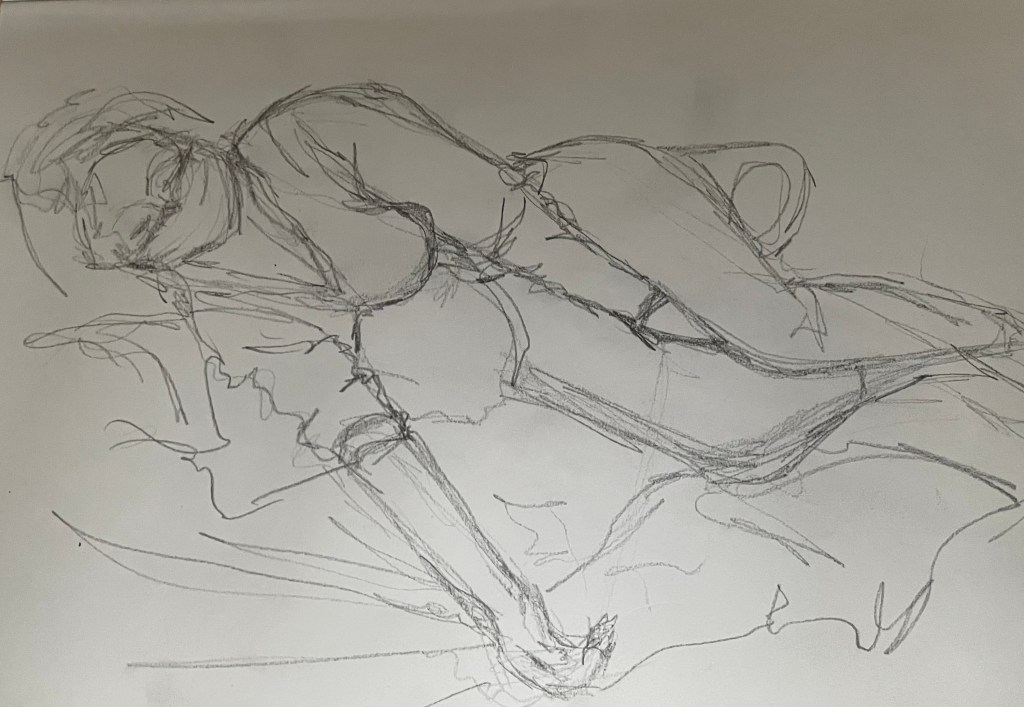
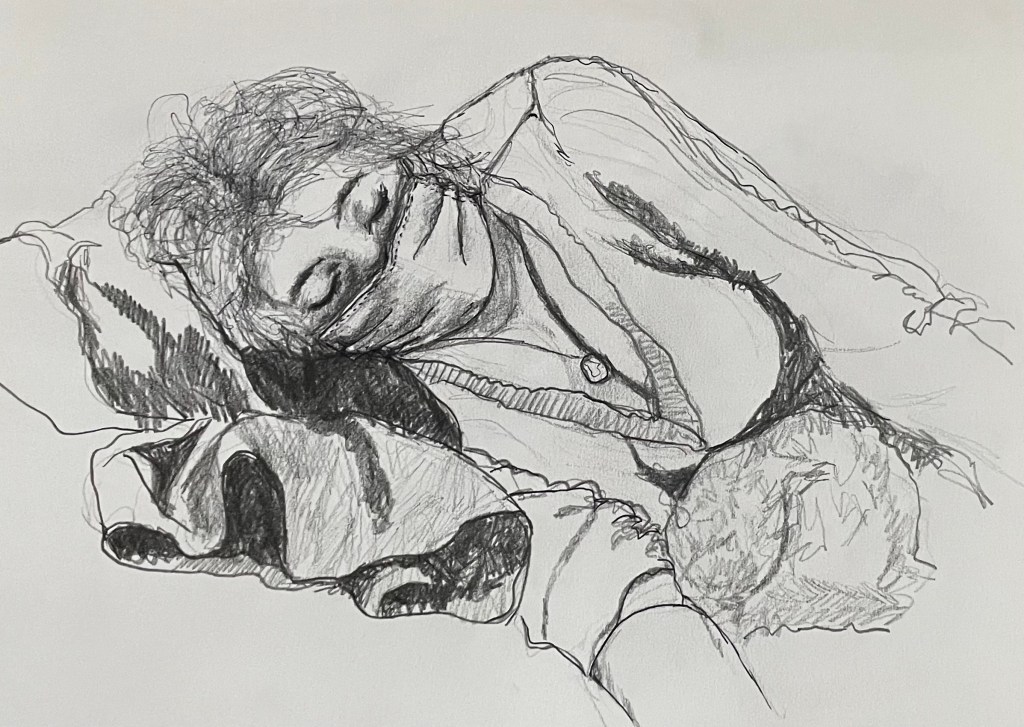
Some were surreal, others were sad. Sometimes she was lucid, sometimes she was delirious, sometimes it was morphine. Three in particular have lodged themselves in my memory. My logical brain tells me that she wasn’t herself, that her brain chemistry was all over the place, trying to cope with the enormity of it all.
It’s just that the last conversation I had with her, was the last.
I suppose I could talk about them to someone, together with the rest of it, but I’m not sure the spoken word will work: the words will come out of my mouth and vibrate through the air to enter someone else’s head. Then they are gone. I need a more substantial, tangible way of dealing with them, through the written word and imagery. I need to be able to confront them, physically.
I’ve had some inner conflict as to whether I should publish the image in which her face is visible; when she was ill and at her most vulnerable. This was a woman who dragged herself through the house, after breaking her leg, in order to phone for my sister to come over and make her look presentable before calling for an ambulance. She was a very private person. But she is no longer here. If it helps me come to terms with it, I think she would be ok with it. My sister’s on board – she reads this blog. She has her own conversations.
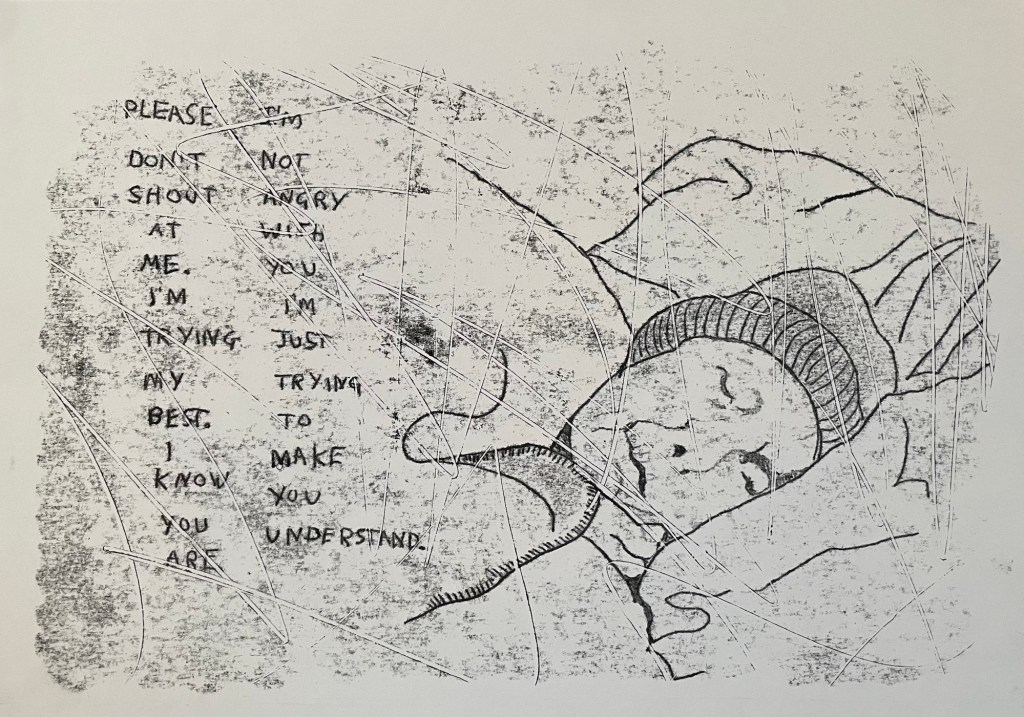
Three Conversations With My Mother No 1, Montotype on A4 Cartridge Paper
Three Conversations With My Mother No 2, Monotype on A4 Cartridge Paper
Three Conversations With My Mother No 3, Monotype on A4 Cartridge Paper
I don’t need to reflect on them. I don’t want to reflect on them. Not yet.
My daughter turns 21 next year and my husband and I have decided to throw a bash not only to celebrate her birthday but also some milestone ones of our own which have gone by not properly celebrated.
I was chatting to my daughter the other day about the fact that my brother, who lives in Belgium, has declined the invitation. I explained to her that I felt really quite upset because the last time I had seen him was when we interred my mother’s ashes in April this year and before that, at her funeral in May last year.
My daughter is not one to get into emotional discussions, despite (or maybe because) she is studying for a psychology degree, and in response she informed me that I shouldn’t worry about not seeing him because he’s inside me. Inside me? Yes, she informed me as I tried to quell the rising tide of nausea – when he was born he left some of his DNA behind in the womb and that then ended up in me.
Microchimerism, it’s called – I looked it up. It means the presence of a small number of cells in an individual that have originated from another individual and are, therefore, genetically distinct.
As I understand it, on my very limited research, when a baby is in the womb the umbilical cord can act as a two-way street – the mother’s cells travel to the baby, and vice versa, so that some foetal cells can remain in the mother, even if the baby is not subsequently born. As they are effectively stem cells they can travel to parts of the mother’s body and grow as other cells eg cardiac cells (so the baby is forever part of the mother’s heart) or they can hang around and become part of future offspring. From what I can tell, the research has mainly been in terms of cells left by male babies, as it is easier to distinguish rogue Y chromosomes in the mother’s body, however, it is generally thought that it equally applies to female cells and that female babies may leave more cells behind than male babies. This process can play a part in autoimmune diseases and also the sex of the baby may influence the development of Parkinson’s and Alzheimer’s. All exciting stuff!
I was talking to my sister about it and the possibility of expressing this by making something akin to a set of Russian dolls with her as the outside one, and my brother and me on the inside – she wasn’t keen. I fear that our conversation may have been a contributing factor to her dream that night in which she was being chased by an artist who wanted to possess her body!
This post has been sitting in draft for a while now. I’m not sure why I’ve been delaying in publishing it – maybe a reticence to commit in case something better comes along. Rather like the way I shop: I like to browse in every single shop to see all the available options, and for the most part end up going back to the first shop, several hours later. My husband, on the other hand, sets out with a list and buys the first item which fits the bill – his advice to me is that if I see it, I should just buy it, and save myself the aggravation. So what if I do have a better idea further down the line? That’s part of the process isn’t it? To reflect, adapt and recognise the need for a change of direction.
I’ve been giving further thought to what I would like to explore over the next couple of years. I’m afraid it’s not a laugh a minute, but it’s something that’s been on my mind for a while.
Not to be egocentric about it, but it’s ME! Then again that’s not a surprise as everything I make, even within the constraints of my art class, is subconsciously about me in one way or another: how I see the world; what matters to me; what interests me; about me; my experiences.
I remember sitting in the back of the family car as a child, probably on one of those Sunday afternoon drives in the Black Forest my parents used to like, with my brother on the back seat playing my dad’s favourite Elvis Presley and James Last songs on his double deck cassette player and thinking to myself: Who am I? This is me. Here. Right now. I almost tried to climb inside myself which messed with my head a bit. I must have been about 7 years old.
Who am I, as a person, as an artist? Hopefully by the end of the next two years I might have a better idea.
I’m particularly interested in my identity in the sense of nature and nurture: who is the authentic me – the one that drew its first breath? As Z recently mused on her blog ‘we will never be as unmarked as when we were born’. How has that version of me been influenced by my life experience, in particular, the roles I have had in my life?
This line of thought was prompted by the death of my mother in 2023. As my father had passed away in 2013, she was my lone parent. It struck me that my role as a daughter was coming to an end. Arguably it had gone on hiatus sometime earlier when I started to care for her following her cancer diagnosis, whereupon my role became that of carer. Some roles in life are mutually exclusive and in my case this was more or less true of my roles as daughter and carer – maybe it was a coping mechanism. As a result, I have issues in processing that brief, but cataclysmic, period of my life.
My mother’s death also made me consider my role as a sibling and the subsequent sense of estrangement I feel from my brother and, conversely, the closeness I have with my sister as a result of our shared experience of caring: sometimes only someone who has gone through the same experience can truly understand how it feels.
What effect does the ending of a role have on identity? What if I feel that I have failed in some roles? What if others think that I have failed? What if my roles conflict or were not mine by choice?
In being a mother I reflected on my experiences as a daughter to try and be the best mother I could be, and so the cycle will continue, perhaps. I’ve been a career woman, a homemaker and, still am a wife. At some stage I have lost the sense of the real me, if there is one: some roles allowed others to prosper whilst I took a back seat. Words which particularly resonate with me are from Deborah Levy’s “The Cost of Living” :
“It requires skill, time, dedication and empathy to create a home that everyone enjoys and that functions well. Above all else, it is an act of immense generosity to be the architect of everyone else’s well-being.”











 Kate McCalmont-Woods