Wayfinding

I think that I’m finally getting some clarity. Or maybe I’m seeing connections and signs where perhaps there aren’t any, but it seems to make sense, in my head anyway. In my second tutorial, Jonathan commented that he had a sense that it was all leading to something (the first sign).

So far during this course, trite as it may be (although Jonathan has assured me that it is essentially what art is about), I have been concerned with understanding myself and my place in the world as a practising artist. I’ve been working from memories, guiding me like a compass on my exploration, probably slightly off kilter, as well as my day to day life, thoughts and feelings. I have been trying to concentrate on the process as opposed to the result (a sign), experimenting along the way, and producing very few finished pieces of work. I did feel uneasy about the lack of finalised output, but no longer. I’ve been on a dérive (our session on Guy Debord being another sign).

In my Study Statement I question whether it is actually possible to ‘find myself’. Kierkegaard thinks not, in the sense of a static and unified concept, for the self is constantly being formed not just by reflecting on the past but also by engaging with the present; it is in a state of becoming, in a state of flux, something I have said I feel on several occasions in this blog (a sign). I accept in my Study Statement that I can only hope to know myself as at a certain point in time, and that reflection is something which will have to be a continuing process. Something else I have mentioned on several occasions in this blog, to fellow course mates and to Jonathan, is that I feel like I am a different person to the one that started the course back in October last year (a sign); I have changed and I will continue to change – to become.

Recently, I’ve become interested in the subject of maps – the comment in my Unit One feedback that I seem to be engaging in a process of mapping jumped out at me (a sign). That led me to start thinking about maps and the process of mapping and map-making, experimenting with cartographic symbols and mark-making. The subject of maps is a huge one but during my research I came across the philosopher, Korzybski, the father of general semantics, a central principle of which is that the map is not the territory (rather like the image is not the thing: Magritte’s Ceci n’est pas une pipe (I used this idea with my red telephone at the Interim Show (yes, another sign)). In short, our models of the world are abstracts of reality, and do not represent it. This is a principle I’ve been trying to be more mindful of since I read about it – my map of the world is not the same as everyone else’s, so we can be in the same situation or look at the same photograph but have our own very different experiences and interpretations of it (our sessions with the photographs being another sign). Something which is blindingly obvious, but which I don’t always appreciate.

This then led to the notion that geographical maps themselves do not reflect the territory in the sense that there is abstraction and subjectivity in the production of all maps: the size of countries and borders can be manipulated for political and social ends, the purpose for which a map is intended can determine what is included and what is left out, viewpoint and projection can distort the world view.

Mercator Projection

Authagraph Projection

The Authagraph Projection is considered to be the most accurate flat representation of the world. It highlights the distortion caused by the traditional Mercator projection in terms of the size of Africa, South America and Greenland, amongst others.

I have been reading a lot about cartographic theory, a discipline which has only become a thing relatively recently. There is lots of disagreement about what a map is and the separation between the artefact of the map and the process of mapmaking and mapping. Post-representational cartographic theory does what it says on the tin – it argues that maps are not the territory but actually create the territory, are in a state of flux and are constantly changing, and theorists have moved away from the idea of a map as an artefact, but as being performative and processual, and always in a state of becoming.

Whilst working, I have been reflecting on past events and experiences, but whilst doing so I have been conscious that my recollections are probably my version of the truth; that I am my own unreliable narrator. I have been interested in memory for a while, particularly as to its probable unreliability and its potential to be manipulated. The way memories are formed and retrieved means that they are not fixed archives, but are constantly being formed and reformed with each retrieval; they are in a state of becoming.

The link between selfhood, mapping and memory is the concept of the state of becoming: ontogenesis. In my research paper I want to explore ontogenesis in the context of autobiographical artistic practice because it is the essence of what I am trying to do. In my experimentation and production of unfinished work I am engaging in the process of mapping, changing and becoming, relying on my memories which are also in a state of becoming but how can I represent this in a visual form which is also in a state of becoming? Hopefully, by the end of the research paper, I will have a better understanding as to how it can be achieved, if at all.

That’s the plan for now anyway, although I may change my mind, in my state of becoming.
Trying to Move Forward

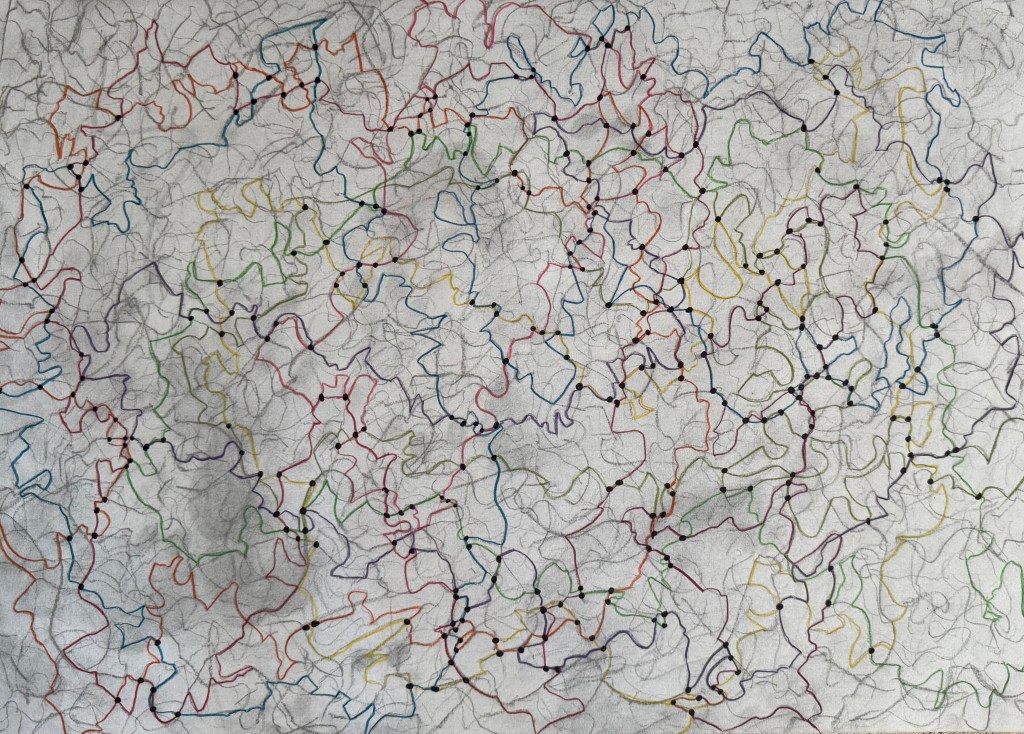
I decided to try and progress the idea of automatic map-like drawing by experimenting with charcoal. I drew a single line and then rubbed it out and repeated the process numerous times, building up layers of mark-making. I then took some coloured pencils and traced a path randomly following the marks.

I’m not sure that it takes me much further forward in developing this line of enquiry. However, I enjoyed the process and I like the different nature of the coloured lines which I made consciously by making decisions as to which of the paths of faded charcoal to follow, almost like a dérive – they have a different character to the ones I make when I draw automatically.

I’ve been thinking a lot recently about the course, about being half-way through and what I would like to have achieved by the time it finishes – what work I might produce by the end of it. At the moment, the concept of mapping is at the centre of it. I want to produce something which reflects all that I have learnt during the course, about myself and how I relate to the world around me. It will inevitably be an artifact, a map, of some shape or form, but I want it to reflect a process which is ongoing, that will never be complete, a piece of work in a state of flux, constantly subject to change, so there has to be some sense of impermanence, of it being unfinished. I also want to encompass the idea that memory plays a large part in the process and much like maps which are constantly being made and remade, so are the memories on which the map is based. The idea of layers and distorted imagery seem to be relevant in this respect.

I’ve thought about paper and canvas, maps being folded and rolled , but I don’t think that these offer the ability to create layers in the way that I want. I’m currently thinking that I may make a number of squares which together make up the grids of a map.

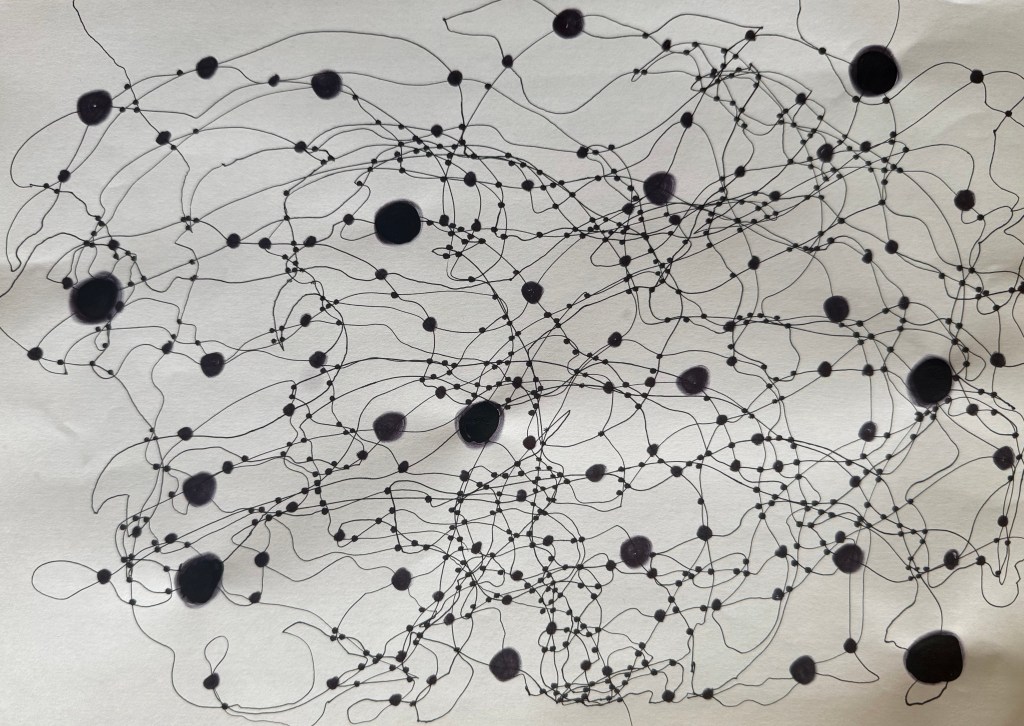
I used a pen to try and keep a marble on the paper. I like the lines which were made as a result – they have a sense of fluidity about them, much more than the lines that I have been making up until now. I’ve been meaning to experiment with the size of the dots at the intersections, to see if different sizes create a sense of perspective and three dimensionality. I don’t think that I have managed to achieve enough diversity in the sizes – it was very much an afterthought – I’ll try again another time. The image makes me think of something neural, cognitive mapping?

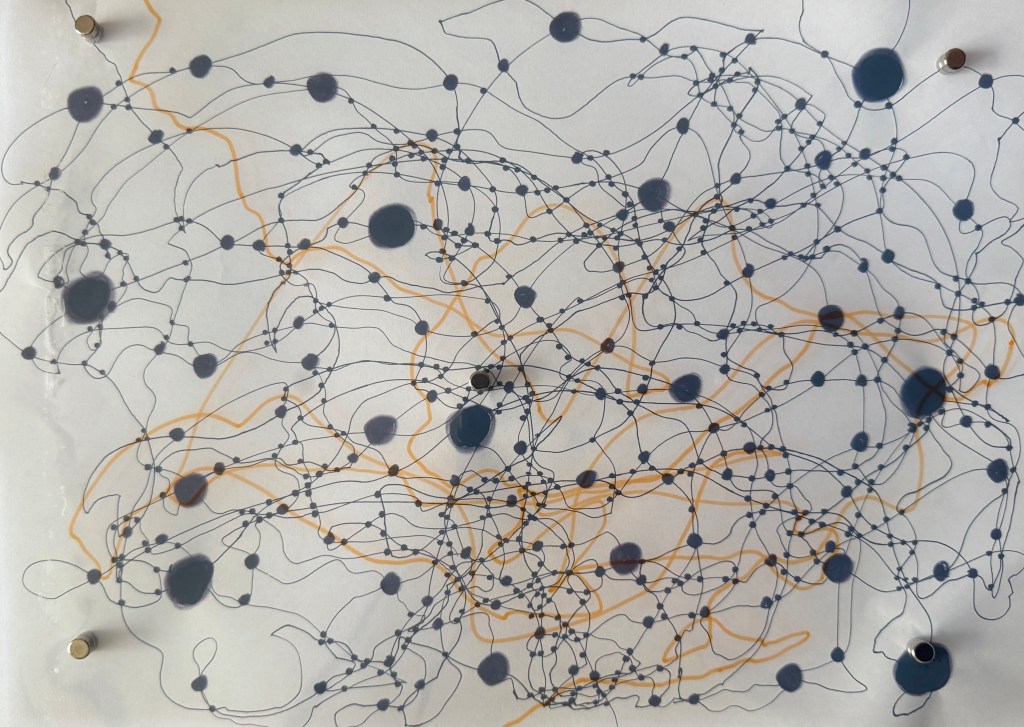
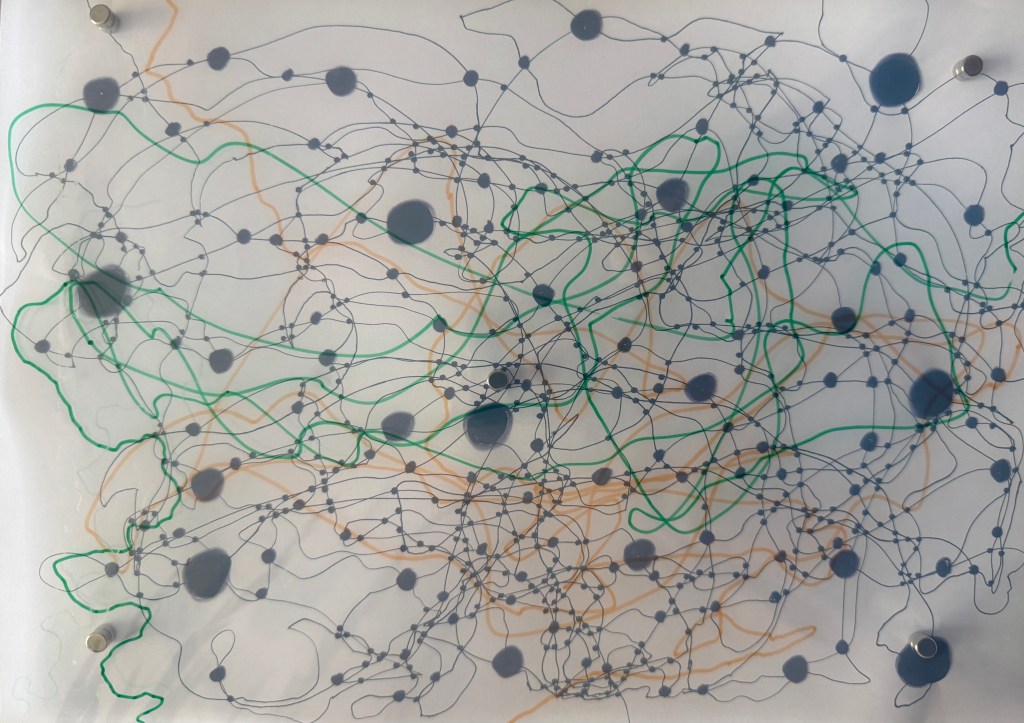
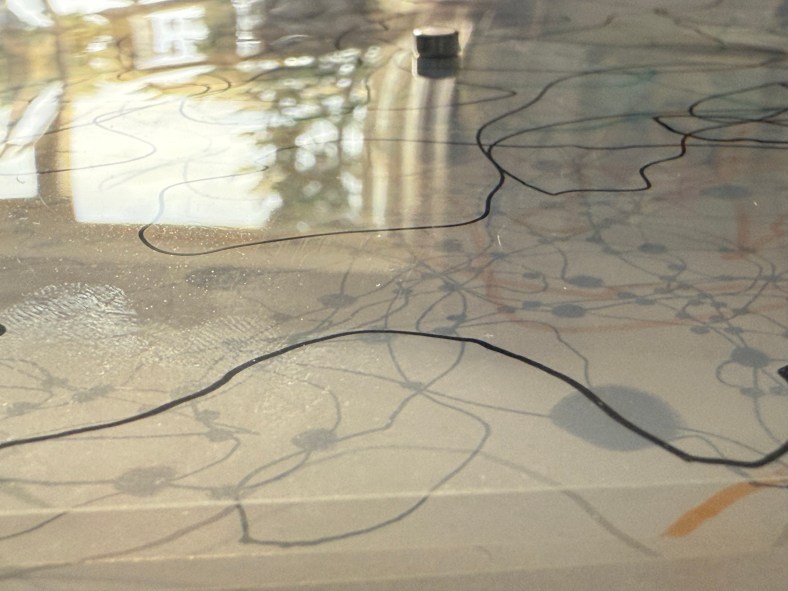
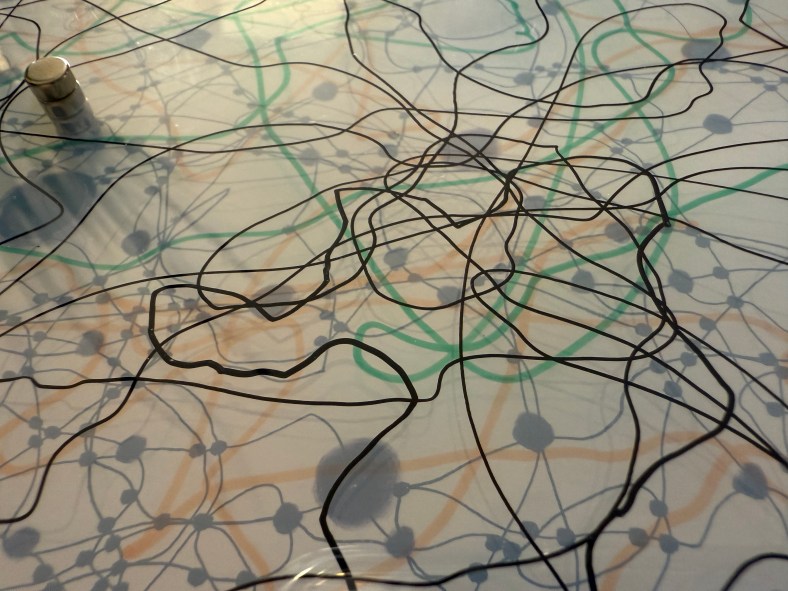
I took some inkjet compatible transparencies and drew some lines to see if I could create layers. Unfortunately, they are not totally clear – they have a milky appearance, probably because of the coating which allows them to be used in inkjet printers. I need to do some research to see if this is the case or whether I can source some others. Having said that, the milky film does cloud what’s underneath, making it hazy, almost like a memory that’s not quite there. Ultimately, I’m thinking that I could use layers of acrylic sheets over a background image, possibly together with milky transparencies, some can be drawn, painted and printed on, and I can also include some cyanotype images as well a negatives. I could cut holes in some layers to allow direct access to layers below. The use of reflective surfaces would also add depth.

I layered up the sheets using small magnets which not only hold them stacked together but also act as spacers between the layers. I had to add one in the middle because otherwise the sheets would sag – this won’t be a problem with rigid acrylic sheets. The magnets themselves suggest impermanence, the ability to be easily changed.

Wondering About Wandering

It’s been almost 3 weeks since my tutorial with Jonathan, and even longer since my last blog post. I’m usually very good at writing tutorials up immediately afterwards, whilst I can still remember what we discussed. I don’t usually take notes – it’s too distracting.

Oh, how I wish I had taken notes, but I think that I can still remember the gist of it.

My clearest recollection is just how good it was to have a chat about something other than accidents, operations, hospitals and pain relief. On this subject Jonathan mentioned Late Night Ramblings, how at first glance it looks like a map but then when you look closer you realise that it doesn’t relate to anywhere. We talked about the methodology – what came first? I explained that I started off with the coloured lines, placed the dots at the intersections and then decided to add the contours and finally the grid – in retrospect I probably should have reversed the order as it was particularly difficult putting in the contour lines after the event – I couldn’t see the lines for the lines. We discussed the previous experiments which led to this point in particular the use of the photo of my father to create the outline of the figure, how the pose still retains its meaning, the angle of the shoulders and the head looking down, and how, because he reads my blog backwards from top to bottom, it only became apparent that the photo was the source of the outline once he had worked his way down. He also referred to What Was I Thinking? and my openness as to how I viewed my actions.

We talked about whether I would experiment with other media – I explained that I liked the flimsiness of the flip chart paper as it reminds me of the paper on which maps are produced and how I am interested in the idea of folding. Jonathan referenced how maps are folded, in a concertina, and how a piece of paper no matter what size it is can only be folded in half 7 times. Intrigued, I looked into this further after the tutorial finished. Generally, this is the case although in 2002, Britney Gallivan, a high school student in California, set a new world record by folding a piece of tissue paper 12 times, but it was 1.219km long. Funnily enough, whilst driving to Exeter yesterday morning to start and finish what my daughter was en route to do when she had her accident, clear out her room at uni, we had the pleasure of listening to Radio 2 when the Paddy McGuiness show came on, and listeners were invited to message in to explain how it can be true that if you fold a piece of paper 42 times it could reach the Moon? Did you know that you can only fold a piece of paper 7 times I asked my husband. Yes, you’ve already told me that, he replied. It’s a matter of exponential growth – if you assume that the thickness of a piece of paper is, say, 0.1mm, then when you fold it in half 42 times it will theoretically be 439,804km thick, approximately 55,000km in excess of the distance between the Earth and the Moon, the same kind of principle as in A Bird In The Hand.

I mentioned that I was thinking of creating a ‘map’ which would embody all that I have learnt over the course, and have been toying with experimenting with canvas, how I would need to think about image transfer etc. Jonathan mentioned Citrasolv which works really well on laser print, especially high quality print such as National Geographic. After the tutorial I watched a few YouTube videos, ordered some and have had to wait a couple of weeks for its arrival, this Thursday.

We then discussed Raita Bitless, and how Jonathan felt that there are some very important elements which are emerging and this is one of them. It feels like these are important memories which need to be explored further, and I agreed, explaining that sometime over the next couple of months I want to go back up to the Midlands and spend some time just wandering and reliving.

I’m sure that some of these discussions were prompted by a question, but the only one I can vaguely remember is when Jonathan asked me whether I was missing anything or needed anything more. I said that I didn’t think so, that I am quite happy just doing what I am doing. I have realised a lot about myself and the way I work (or not) – I had been attempting to squeeze the round me into a square hole. As such, I have effectively torn up my work plan, as it’s just not who I am, and have decided just to wander; to go on a dérive, and to wonder. Jonathan liked the idea of wondering whilst wandering – there’s a name for it, he said. I thought of it afterwards – a homophone – although apparently wonder and wander are not actually homophones because of a very subtle difference in pronunciation of the first syllable – what killjoys! I like it anyway, and there is a lovely interplay between the two.

We then got onto the subject of the research paper and he referred to The Paradox Of Choice. I told him that I felt as if I had been told to go out and buy something, anything; that I had decided that I wanted to buy a cake but that I couldn’t specify which cake I wanted until I had visited all the cake shops and seen all that was on offer. I would have responded much better to having been given a choice of topic out of a small selection, akin to an exam paper; that I felt overwhelmed by choice and asking me what intrigues me doesn’t really narrow it down at all. Anyway, because of where my current experiments have taken me, I have decided to think about maps particularly in an autobiographical sense. We then went on to discuss maps and the issues with them in terms of distortion both physically in respect of projections and political motivations, perspective etc. Jonathan also mentioned Professor Steve Peters – Jonathan had been to a talk and had been given a copy of The Chimp Paradox – I had started reading it a while ago but didn’t finish it as I was probably distracted by something else. He referred specifically to the idea of the helicopter view. It’s a technique to gain perspective on something by imagining hovering over the issue in a helicopter which enables detachment and a more rational and objective view.

Does the need to do the research paper risk having a negative impact on my current wandering? This was a difficult question to answer, but on the whole I don’t think so – I’ve already recognised that I am a person of extremes, either really tidy or messy, focussed or distracted, honed in on the detail or preferring the bigger picture – each will appeal to my polar opposite needs and I am optimistic that what I discover whilst writing the research paper will have significant impact on my current practice.

I hope that I have covered everything we discussed although we must have talked about carbon paper at some point because I have used it recently. I have done a few things recently – I need to include them in a post but, frankly, all I have wanted to do is to make and not necessarily reflect on and write about it.