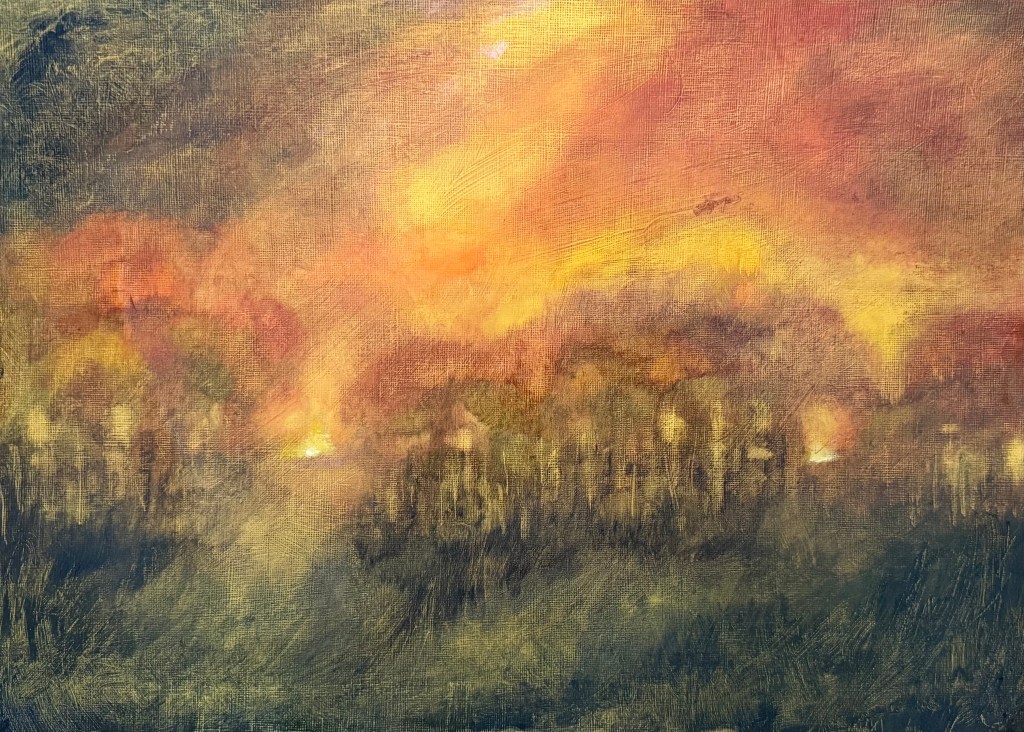
We’re looking at Turner in my weekly art class, in the context of climate catastrophe; forest fires, flooding. He didn’t follow the rules and did whatever took his fancy. Layer upon layer, ignoring fat over lean, whiting out. A conservator’s nightmare.
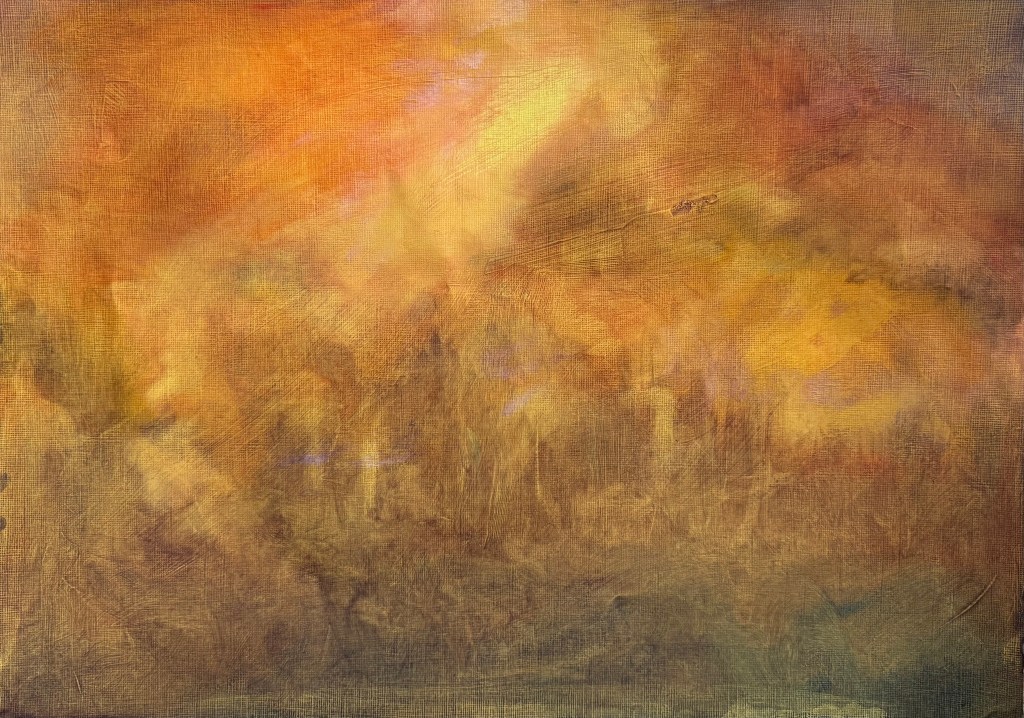
We started off by looking at some imagery and then, without any further reference to it, got to work. We put down a ground with acrylic paint and then applied layers of thin oil paint and solvent with a rag.
It wasn’t a conscious decision, but I ended up using a very limited palette of cadmium red light, cadmium yellow, ultramarine blue, burnt umber and some white. Once the thin paint was dry we applied glazes on top. I did a lot of wiping on and wiping off – it seems to be my modus operandi, as well as doing a lot of scratching – not particularly Turneresque, but never mind.
What do I think of it? As a study of an imaginary forest fire à la Turner, well, I think I’ve done ok. I’ve managed to create lots of layers and there is definitely some optical mixing going on. I think that I’ve managed to keep it quite loose (for me, anyway). I enjoyed putting the glazes on, colour was caught in the marks and grooves in lower layers which had been made when I had loosely put down the ground. I like that it was out of my control to a certain extent.
At the end of the day, I don’t like it. It was an exercise which I completed, I haven’t invested any of me into it, and it doesn’t do anything for me. But that doesn’t really matter because it is about trying different things, being open to new approaches and trying them out with an enquiring mind.
Putting paint on and wiping or scratching it off is something I instinctively do – it’s a very tactile way of working, and I’ve realised that it’s all about the materiality and the dialogue, which seems to be a bit of a tussle at times.
And now I’m in a state of flux, and feeling a bit stressed, thinking where do I go from here? I have nothing else.
I use my husband as a sounding board and as a gauge as to what I’m feeling and what I’m doing. I value having someone to give me feedback, to hold a mirror up to me. But to what extent should I rely on this and allow it to influence how I see my own ideas and work? Why is it when someone says they really like my work, I feel it’s easy to ‘do it down’ – ‘oh, it’s not one of my best’, ‘there are some bits of it I’m not totally happy with’ (when actually I think that it’s as good as it could possibly be and I’m actually quite pleased with it), and yet when someone is ambivalent about my work, I feel unable to ‘big it up’?
Anyway, I now feel directionless, and at a loss as to what to do.
I have looked at how other artists have approached the concept of dialogue, and, in the main, they all involve figures. None of what I have looked at has inspired me so I haven’t even bothered to include any images of them in this post.
I don’t know what it is, but I’m feeling a bit fed up at the moment. Maybe it’s the theme of ‘Dialogues’ and the idea of connections etc. – it all seems as if it’s something that has been done before ad infinitum. Maybe it actually bores me – I don’t know – I just can’t seem to get inspired by it. Maybe it’s the fact that I only have a week to make something and I’ve got other more pressing things to be getting on with. Maybe this little side quest of mine is becoming an unnecessary distraction.
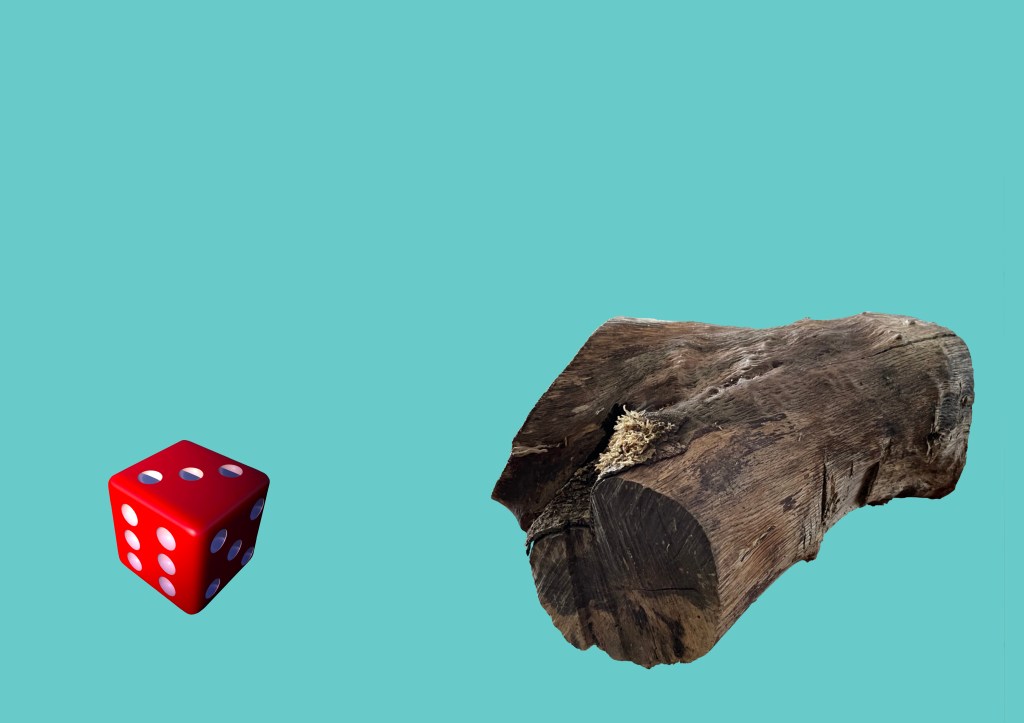
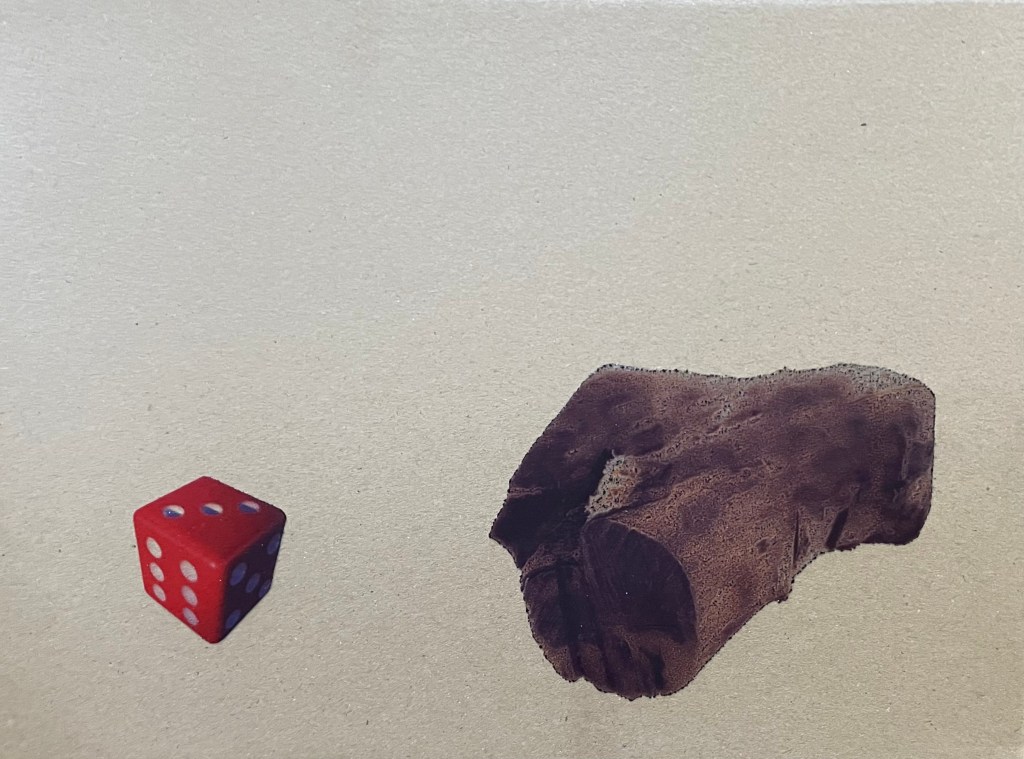
As a reaction to this feeling, I decided to take a literal, and some might say, infantile approach. I kept on coming back to my perverse love of Catchphrase and the birthday card. I started fiddling around on Procreate and came up with this:
A die, a log.
It’s pretty basic, but strangely appeals to something inside me. Maybe it’s a bit cheesy – but do I care? – maybe I need a bit of cheese at the moment. Then I remembered a piece I saw at the Pallant Gallery last weekend.
’Neighbourhood Witch’, 2008, Simon Periton, Silkscreen on mirror coated polyester
I really like the use of the mirror which reflects the viewer so that they then form part of the work. It reminded me of Craig-Martin’s ‘Conviction’ which I had seen at the RA. I could use this idea because one of the thoughts on my mind map referenced the need to reflect when engaged in dialogue.
I have decided to incorporate a mirror, possibly with the images of the die and log being raised slightly away from it so that they reflect in the mirror as well as the viewer – a die, a log, with you. It’s now becoming a fully matured wedge of Stilton!
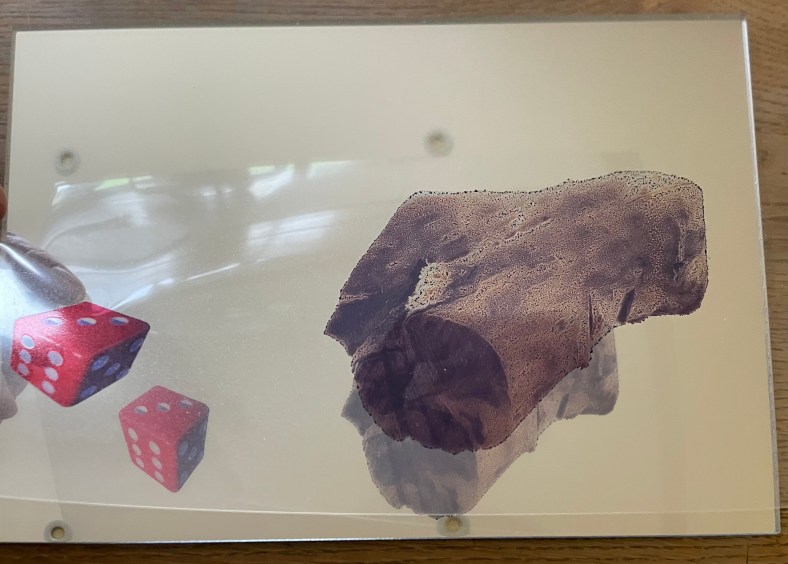
I experimented by printing them off on some inkjet friendly acetate but my home printer didn’t do a particularly good job, but good enough to allow me to see whether the idea had legs. I wasn’t averse to it: it would mean that I would have to have it professionally printed on something more rigid, such as acrylic/perspex, and frankly, I don’t really have the time to get this done. Also, on reflection, I wasn’t sure about the reflections creating multiple images, as it was no longer a die and a log.
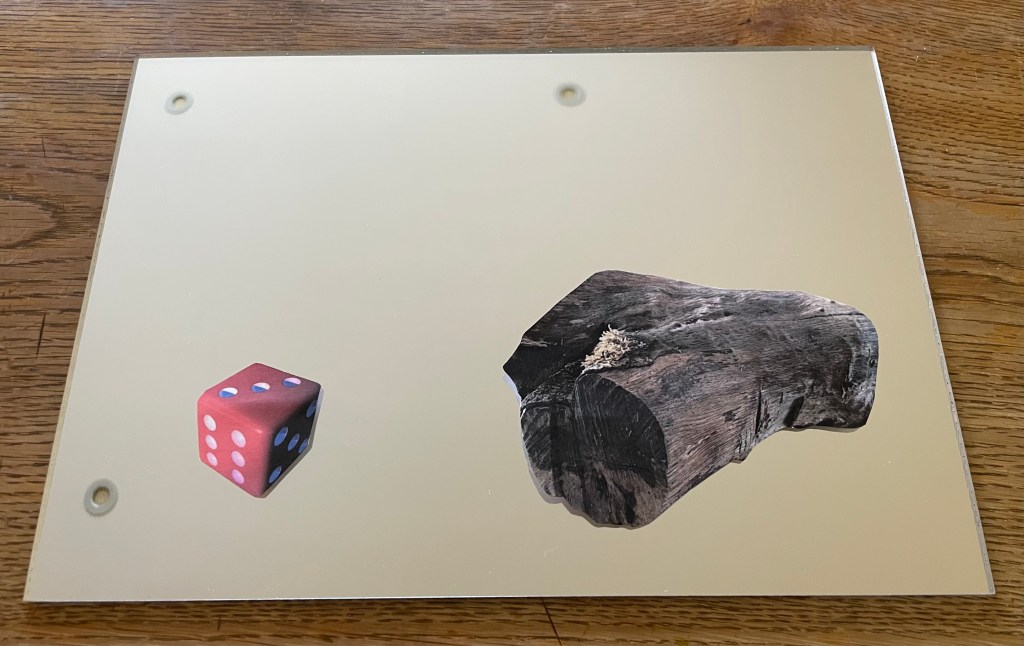
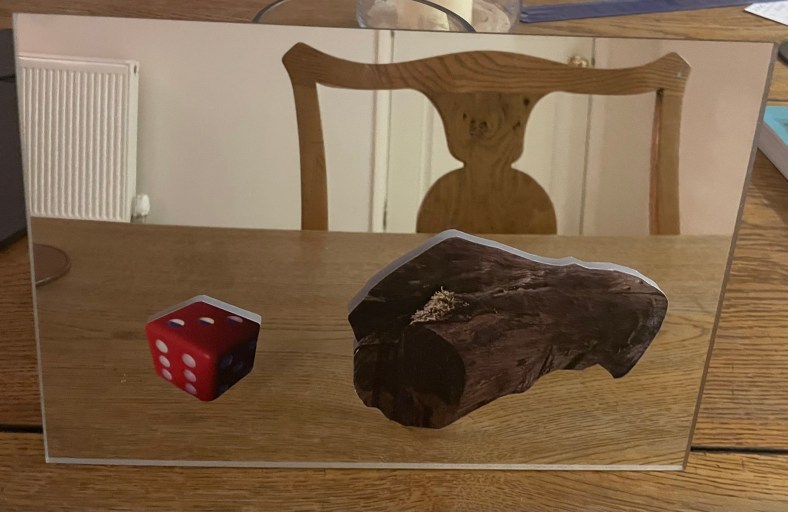
The only solution that I can think of is to fix the image directly to the mirror. The image in ‘Neighbourhood Witch’ above is screen printed on. I don’t know how to do this and I don’t have time to learn. I could get it done professionally, and after having done some research, it may still be a possibility but it depends on timing. Another solution would be just to collage them on. I researched the best type of adhesive and came up with Gorilla Clear Glue which is used a lot in glass mosaics. I will need to experiment with how best to apply it. In the meantime, I put some image cut-outs on a A4 mirrored piece of acrylic. I like the size.
Despite its luke warm reception, I’m going to carry on with my current train of thought. It may not be my best, but I like it because it is something that is totally different for me and it’s way outside of my box, and frankly, I’m all out of other ideas. And as General Patton said – a good plan violently executed now, is better than a perfect plan executed next week.
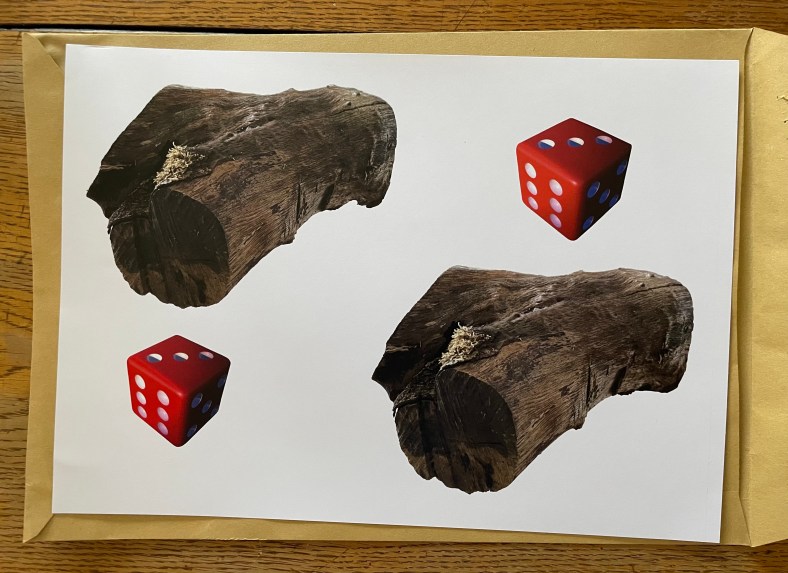
So I had a couple of sets of the images printed up on some 200gsm paper by my local print shop and cut them out and placed them on the mirrored acrylic to see how they would look.
I don’t know why I didn’t realise that this would happen, as it seems so obvious now – unless you stand dead straight on to it you can see the white reverse of the cut out image in the mirror.
My proposed solution is to have the mirror images printed and then fix them together so that any reflection is of the image itself.
I’ve been thinking about what I can do for my submission to the Summer Exhibition.
One thing is for certain, the resource of time over the next two weeks is extremely limited, what with the deadlines for my study statement, curation of my blog and something for the interim show in March, all of which take precedence. In previous years I’ve given a lot of thought and time to my entry and got precisely nowhere, so this year I’m going to do something different. It will be interesting to see whether rejection feels different depending on how much time has been invested. I’m going to follow the philosophy of Gino D’Acampo – minimum effort, maximum satisfaction – have a bit of an experiment and not get too hung up about it.
I’ve put my initial thoughts into a mind map although, to be honest, when I’ve been round the exhibition in previous years, I’ve struggled to see the relevance of some works to the theme.
There are quite a few ideas to consider:
I quite like the idea that ‘dialogue’ literally means ‘through words’ – words in the work itself/ posing a question?
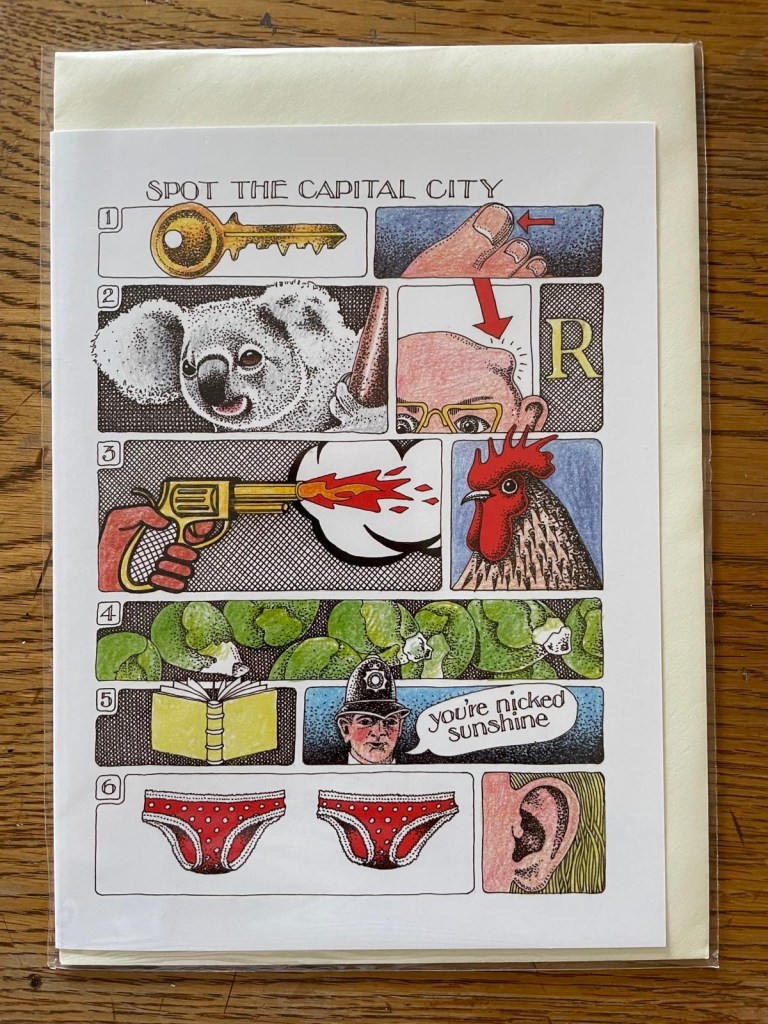
What about the ability of images to convey phrases and words? One of my favourite TV programmes when I was a teenager was Catchphrase, in which contestants had to guess the phrases being represented by a short animation. Those were the days when it was hosted by Roy Walker – much better than the revival hosted by Stephen Mulhern. A while ago I was looking for a birthday card, and I came across this one. It took me ages to get out of the shop – I tried to solve the clues, the women behind the counter had been trying to solve them all morning, it seemed everyone in the shop wanted to have a go.
Exchange – does a dialogue have to be continuous or can there be pauses eg written dialogue in letters, email etc? Can it be in different forms eg verbal met with non-verbal response?
Dialogue between the viewer and the work?
Anyway, I’m going to have a quick look to see how other artists have dealt with the subject of dialogue, whilst giving it all some further thought.
In the hope of finding some inspiration, I sorted out my art bookcase and came across the exhibition handout to the Michael Craig-Martin exhibition at the Royal Academy. This quote caught my attention:
I dislike jargon intensely and cannot stand people who think that complex ideas need to be expressed in a way that is obscure or rarified… The great minds whom I have admired … are precise and economic in their use of simple language.”
Michael Craig- Martin, “On Being An Artist”
I have to agree with him. I’m very much an advocate of the Plain English campaign. Maybe it’s because I don’t have the necessary range of vocabulary to achieve such verbal smoke and mirrors, or the attention span.
Clarity of language is what made reading Will Gompertz’s ‘Think Like An Artist…’ such a breath of fresh air. He cuts through all the jargon and makes his points in such a way that someone who doesn’t have an ounce of art knowledge would be able to understand and appreciate them.
As Craig-Martin says, it’s not about having very complex ideas: ideas which challenge are good but, if we want art to be accessible to all, why use convoluted and, frankly, nonsensical language to explain and critique it? Is it to maintain an air of mystery, of intellectual superiority? And who is responsible? The artists, the critics, the galleries or curators, or all of them?
Thinking back to our first sessions when we introduced ourselves and our work, I can’t think of a single instance when I didn’t understand the ideas being expressed. There was just authenticity.
This year’s Summer Exhibition is dedicated to art’s capacity to forge dialogues but, how can art ever hope to change things if people just don’t get it? It goes back to the idea of ‘connection’ in my previous post: without a connection, however small, there can’t be engagement, and without engagement there can’t be a dialogue.
When I started this course a friend asked me whether I was going to become all arty-farty. I said I hope not but, if I ever come across that way, she should give me good slap!
January has come around again, and I have bought my entry to this year’s RA Summer Exhibition. Will 2025 be my year? Or will I fall at the first hurdle, yet again? The theme for this year’s exhibition is ‘Dialogues’.
When I read this, two other words spring to mind: ‘connection’ and ‘relationship’.
Definitions:
Connection: a relationship in which a person or thing is linked or associated with something else.
Relationship:the way in which two people or things are connected; the state of being connected
Dialogue: a conversation between two or more people; an exchange of ideas and opinions on a particular subject; a process by which people with different perspectives seek understanding.
In the above definitions ‘connection’ and ‘relationship’ seem to be interchangeable. Personally, I think it is possible to have a connection without having a relationship. To me, a connection is an initial link based on shared interests, experiences, understanding and values, whereas a relationship is a sustained connection over a period of time.
I would suggest the following:
for there to be a dialogue, there at least has to be a connection.
it is possible to have a connection and a dialogue without having a relationship.
it is necessary for there to be a connection and a dialogue for there to be a relationship, and to maintain that relationship requires actively nurturing the initial connection, or repeating it, through consistent dialogue, shared experiences and commitment over a period of time.
it is possible to retain a connection and a dialogue despite the ending of a relationship.
When my daughter comes home from uni she likes to visit her favourite local eatery, the kebab van parked up in a lay-by frequented by lorry drivers. Every time she goes she makes a connection with the owner; they talk; they don’t know each other’s names but he knows, and remembers, where she goes to uni, what she’s studying, that she works at the local Sainsbury’s in the holidays, and how she likes not only her kebab but how we all like ours; my husband, as it comes, me with a little meat and lots of salad, and both garlic and chilli sauce. One might say that they have a relationship.
So, where does all this take me?
To disconnection. We seem to be living in a world in which we are increasingly becoming disconnected, in the sense that we have less meaningful interactions, and consequently we are limiting the opportunity for dialogue and relationships with ourselves, each other and the world around us.
Connections can be made quite easily, for example, on social networking sites, but does that allow for meaningful communication? Does a post followed by a like or a comment constitute dialogue? In fact, by their very nature of facilitating lifestyle curation, social networking sites can cause users to feel disconnected.
One might take the view that dialogue is something more than a mere exchange of words; it involves active listening, empathy, picking up on visual cues, making eye contact, challenging assumptions to create a sense of stronger connection and understanding, the latter being a form of Socratic Dialogue; a continual process of inquiry to deepen understanding. You don’t have the opportunity to exploit these to their fullest when communicating by text, speaking on the phone or on Zoom.
People have even stopped sending the one thing that keeps us connected, particularly to those that are not in our daily lives: Christmas cards. The trend is now to make a donation to charity, apparently. I send Christmas cards every year with the best intentions of reconnecting and furthering some old relationships which have been neglected. If I don’t manage to follow up, at least they’ll send me a change of address if they move, so I can give it another go in the future.
Some of it is a legacy of Covid: it’s easier to deliver university lectures online, to have doctors’ appointments online, to work from home. Whilst I agree that there should be a good work/life balance, not going into a workplace at all and not being able to interact face to face with colleagues, and have water cooler conversations, can’t be a good thing, particularly for young people just starting out in their working lives. The workplace is somewhere to meet friends, or even partners. You can’t really go out for a drink after work, if you’re working from home.
This is a low residency course: we meet weekly on Zoom and communicate with each other on our WhatsApp group. We had an initial connection – our passion for creativity. After the first term we have a deeper connection, and possibly even a relationship in the sense that our connection is fundamentally anchored in a mutual understanding of trust between us. That relationship will deepen further when we meet in person.
I’m not sure where I’m going to go with all of this. Possibly nowhere.
Entries have to be submitted by 11 February, so the next four weeks are going to be very busy with this and my study statement. I’m sort of regretting doing it now: I think that I just wanted to shock myself into doing something. I’m trying not to panic – if I don’t manage it, then that’s fine – I could always submit something I’ve already done, but, if I can, I would prefer to go through the process from scratch.






 Kate McCalmont-Woods