Maps

I was very lucky to have Cheng and Dalal in my group for this week’s group crit.

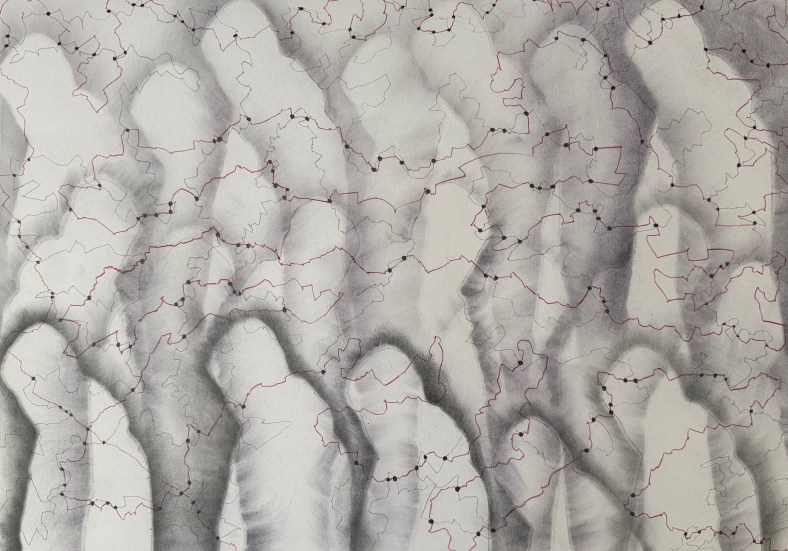
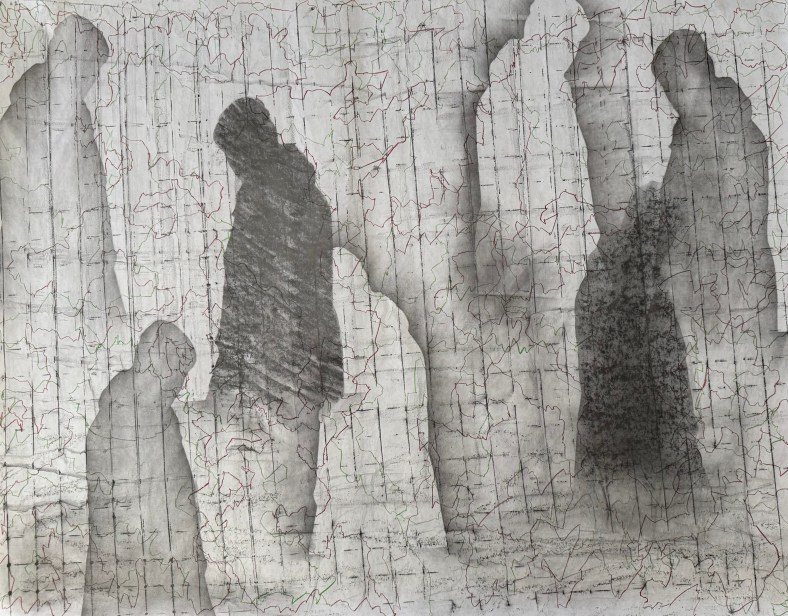
I showed my recent experiments with graphite and pencil.

I explained that I have become interested in the idea of inheritance recently and mentioned Donald Rodney’s work. We had a really interesting discussion about where we come from and our legacy, how it’s sometimes comforting to know that someone else before us was like us which frees us from feelings of fault and guilt, the idea of all that has gone before distilling down into us, much like our family tree before us, ends with us. How what we pass on feels like a responsibility or a burden.

Cheng commented that the white shapes give the impression of something that is no longer there and the dark shapes are reminiscent of shadows. Thinking about it, the shadows are cast by something that is there but is not visible. A figure’s absence is felt yet we feel a figure’s presence somewhere – it just about sums up ancestry.

I explained the process of making the pieces and how they seemed to develop into a type of map. I mentioned that the subject of maps has come to the forefront of my thinking recently along with the idea of connection. In my Unit 1 feedback one of the comments was: “It feels as though you have been working through an abundance of techniques that are maybe a type of mapping – now is the time to compare and contrast all of those experiments in order to develop an intuitive and personal way of mapping your experiences…”.

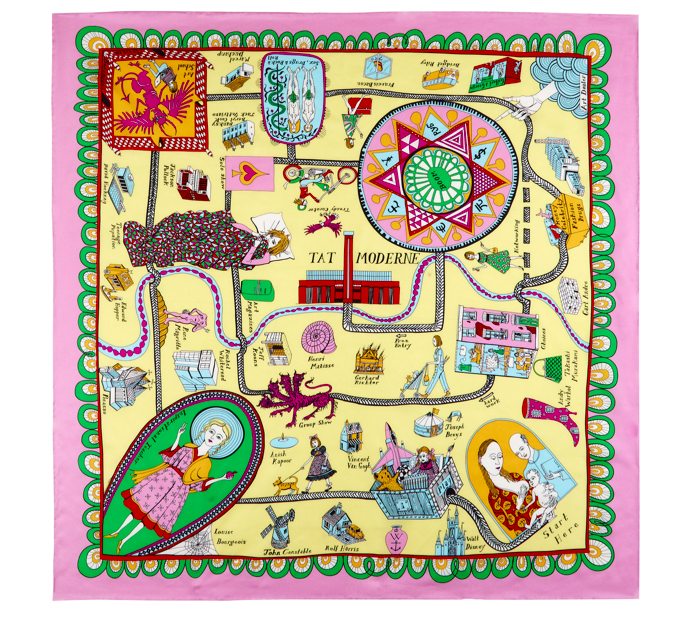
For sometime I’ve been interested in Deborah Levy’s idea of her mother being her internal sat nav and I used Google maps to obtain the aerial image I used in Parental Loss. My art class recently gave me a scarf with a Grayson Perry map on it. I was thinking earlier in the year of mapping the course of a river. The coincidence that I chose to draw the lines in colours which reminded me of maps somehow has linked all of this together. That, and the fact that I have been complaining ad nauseum about not having a sense of direction.

During these two years, I am, to all intents and purposes, mapping my life.

There seems to be a strong unintentional link to maps in the images: Cheng said that the images in which I’ve marked the intersections remind her of constellations, and Dalal observed that the lines themselves could be interpreted as borders, which then feeds into borders marking the the point where countries connect. This led to me seeing that the outline of the shapes themselves resemble coastlines.

Cheng and Dalal both made some really helpful comments about potential development:

  • playing with scale: a large image on a wall giving the impression of a map but then coming in close on a small scale to create a more personal experience and stronger connections
  • Drawing on a vintage map or incorporating old family photos
  • Using a pin to attach separate images to the points of intersection – this has since led me to think about criminal investigation maps – maps with string coming off from them to images and additional information on the perimeter
  • Thinking about how I can use materials to create something that looks older, that comes from a past time – this brought to mind highly decorative old maps with sea monsters in the oceans
  • creating a large scale reimagined map

Shortly after our session ended, I had a thought about making a digital map of my life with events or periods of significance being marked by specific points, a bit like a Google map, which you could then drag the yellow man to and drop into a space where you have a street view – maybe of images relating to that particular event. And then I laughed, Alexa laughed, Siri laughed, my husband laughed.

Lots to think about, as ever.
Tat Moderne

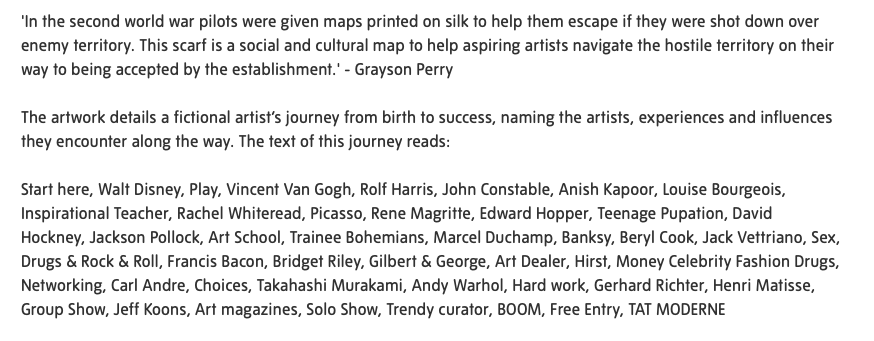
Is my destination, according to the Grayson Perry scarf which the wonderfully generous ladies in my oil painting class gifted me last weekend. Just when I thought that I was directionless, I now have a map. I’m an incredibly lucky person to have these marvellously creative, funny and supportive women in my life.

And, the accompanying blurb:

Where Do We Go? Where Do We Go Now?

Apparently, Guns N’ Roses didn’t know how to end their most successful song, Sweet Child O Mine. Whilst in the recording studio, Axl Rose reputedly started singing, ‘Where do we go? Where do we go now?’ And the rest is history and, in my humble opinion, probably the best bit of the song.

So a moment of inspired creativity can come from a total lack of direction and confusion. Here’s hoping…

I’m resolved to wallowing in the myre of confusion. There’s not much point in fighting it; I can’t understand everything. The latest book we read in my book club was Michael Ondaatje’s Coming Through Slaughter. I’ve never read a book like it. It deals with the mental decline and eventual death of the New Orleans cornet player, Buddy Bolden, who is considered to be the father of jazz. I didn’t understand what was going on half of the time, who was talking, and to whom. It jumped around all over the place. There aren’t any chapters as such, just three parts, no speech marks and paragraphs end at odd points on the page and continue on the next – visually it is striking. It is a book to be read, not to be listened to; its format echoes the improvisation and syncopation of jazz music. Once I had decided that perhaps I wasn’t supposed to understand it and just went along with it, reading each phrase and word in its own right, looking at the patterns, and the sounds of the words, a bit like reading a poem (after all, Ondaatje is a poet), I got a lot more out of it.

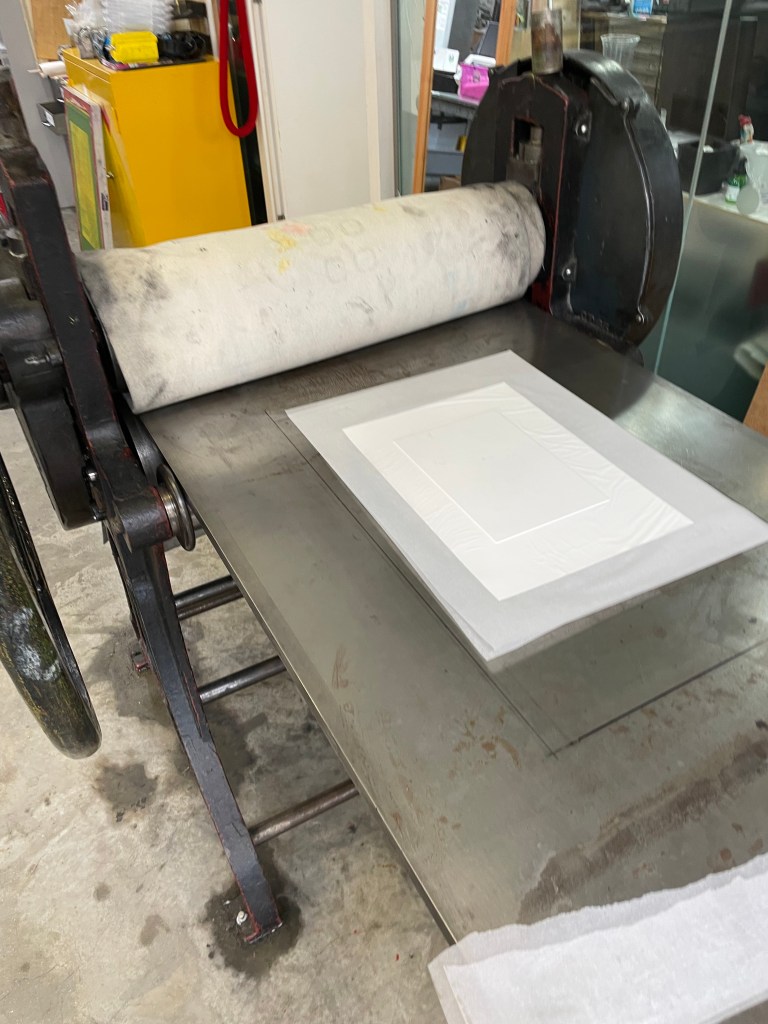
So this is how I intend to move forward. And it’s just as well, because try as I might to keep up with the constant flow of information being offered up by Paul in the Low Res etching workshop, I just couldn’t. I started taking notes, but just gave up in the end and surrendered myself up to not understanding anything and just enjoying being along for the ride.

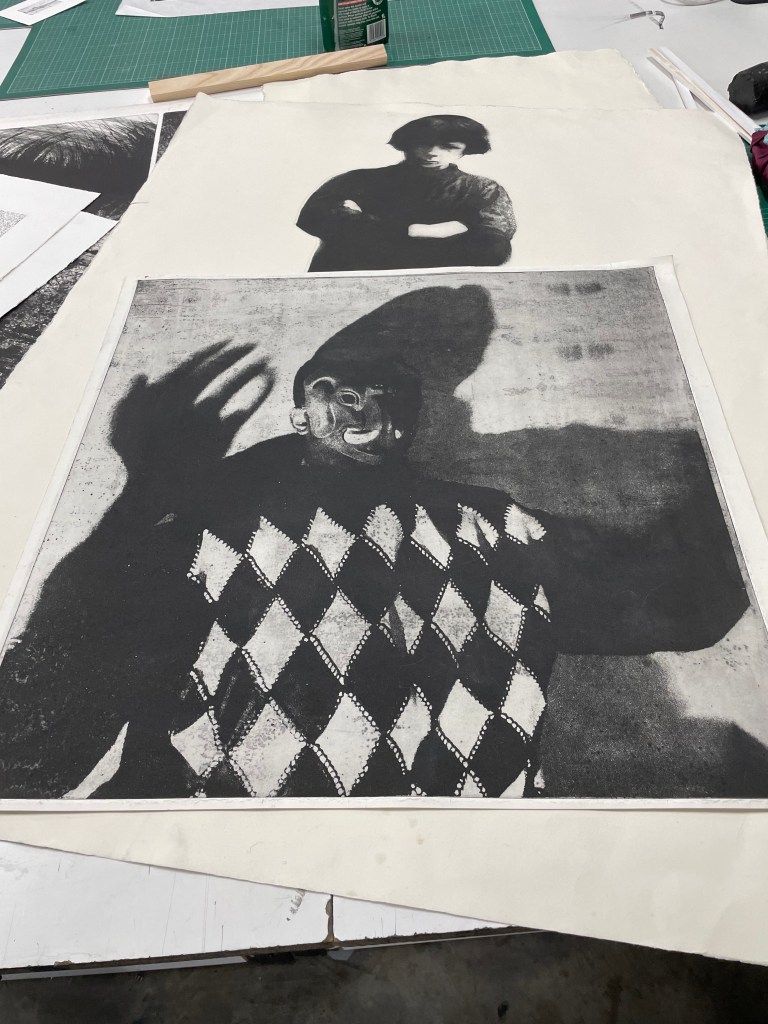
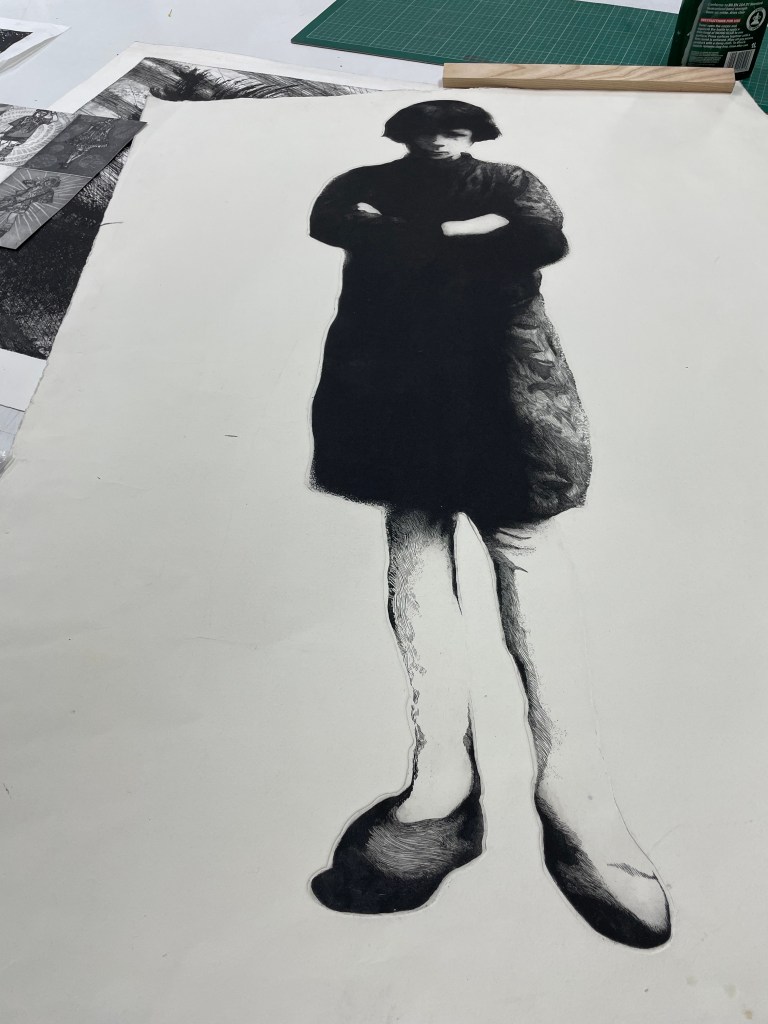
It kicked off with Paul showing us what we could have gone home with, had we the requisite skills. There were some impressive prints which demonstrated the versatility of printmaking which I hadn’t really fully appreciated until now.

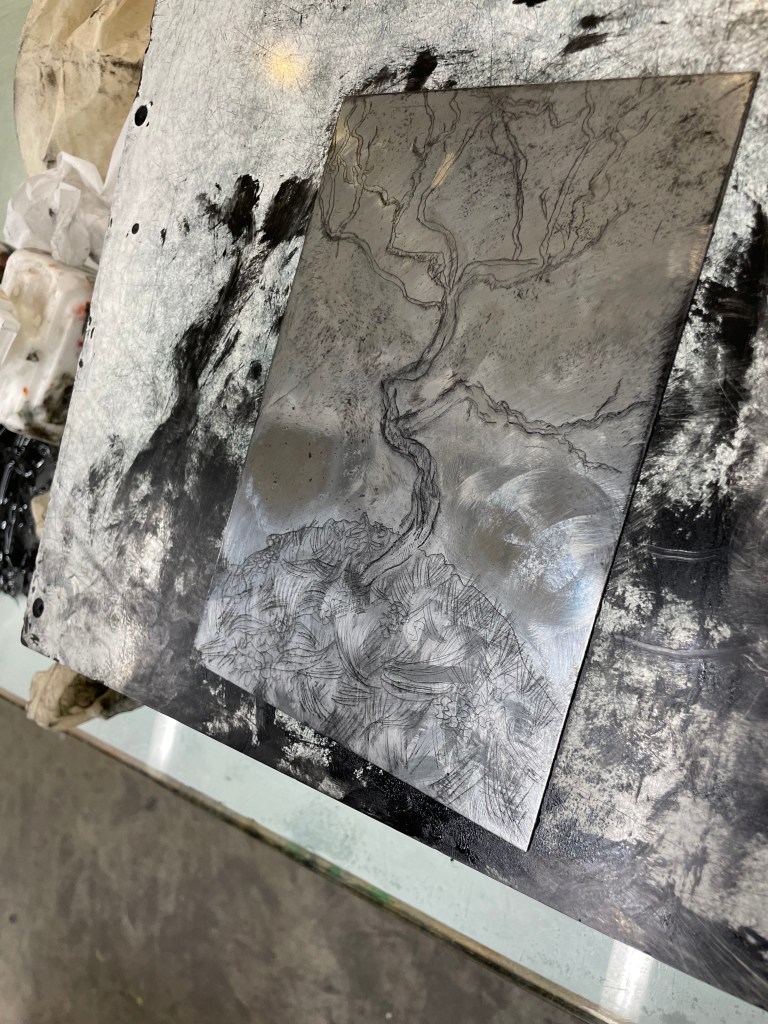
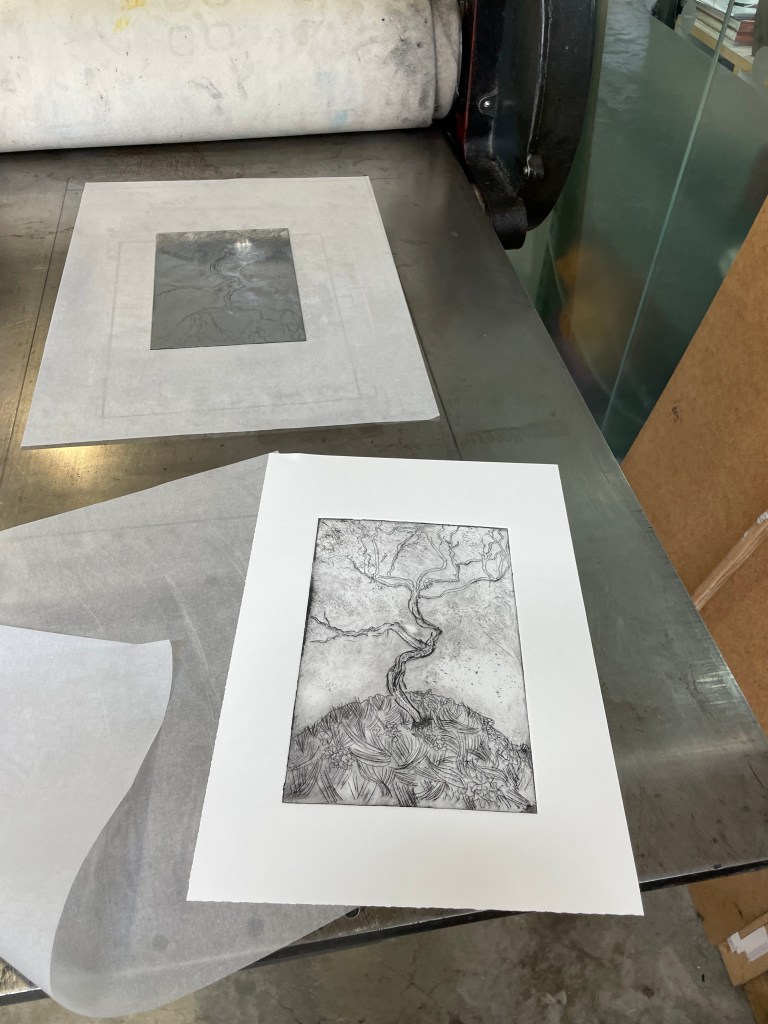
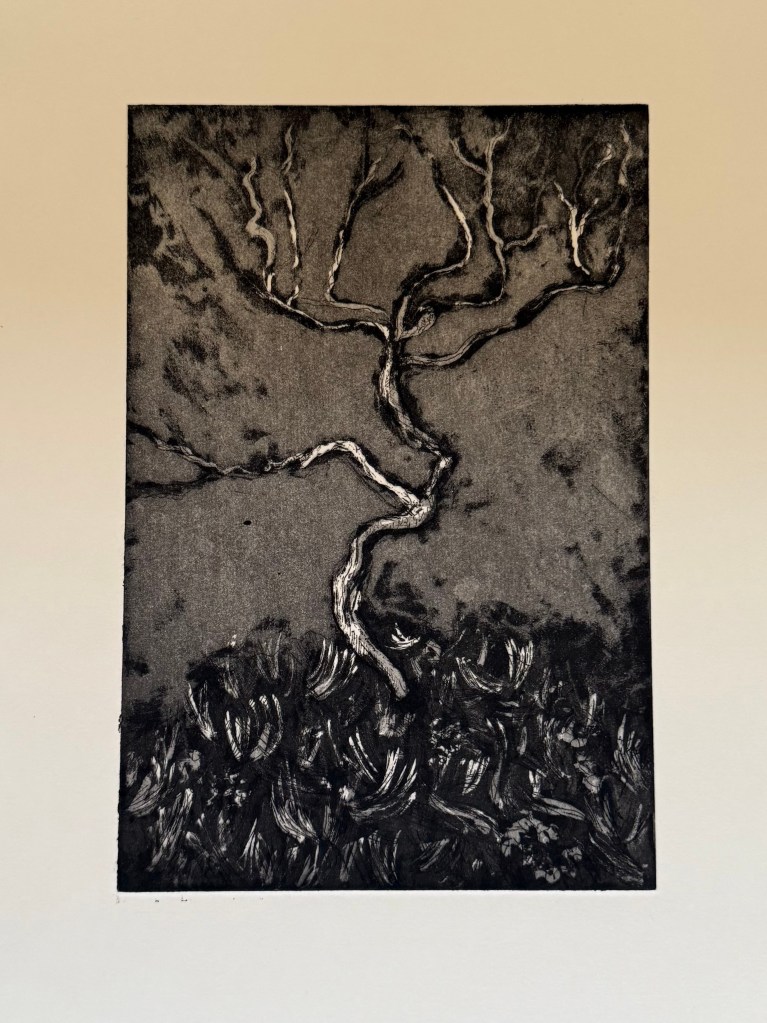
We started off by putting down a hard ground on a zinc plate and then we had about 20 minutes to create the image using a selection of Paul’s tools. What to do? I had a quick look on my phone and chose Schiele’s Small Tree in Late Autumn.

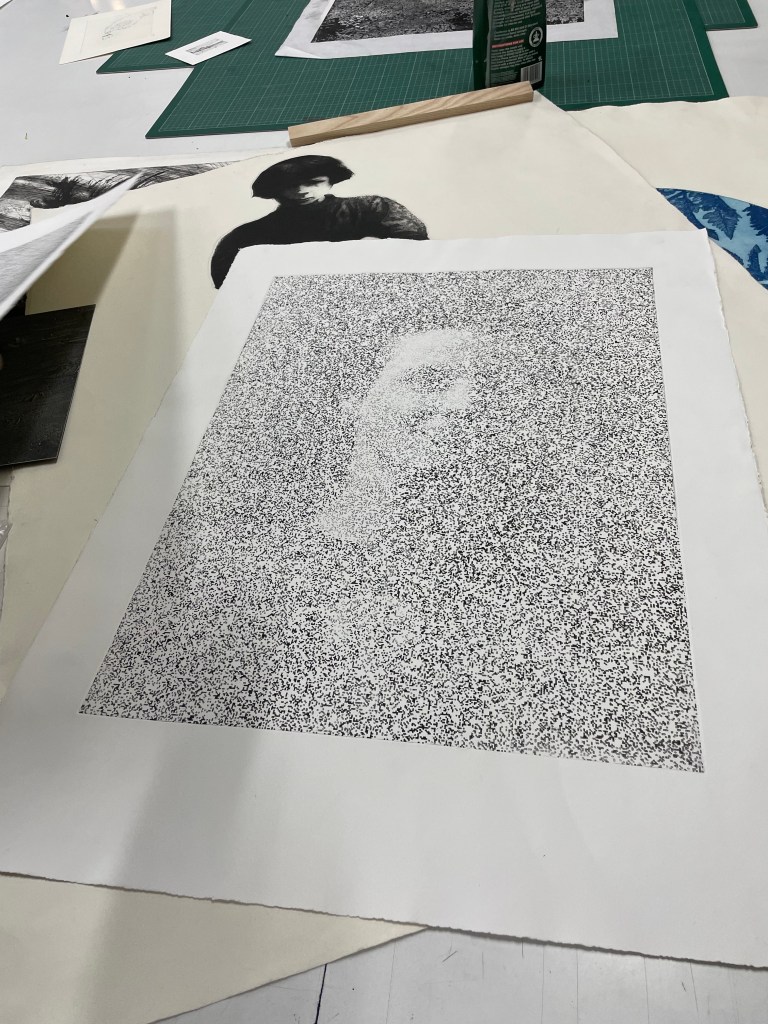
This is the plate once the hard ground had been removed and it had been cleaned followed by the printed images, using aquatint on the last one.

How do I feel about them? Pretty good bearing in mind I only had 20 minutes to create the plate and I had very little idea what I was supposed to be doing most of the time. Will I do it again? I don’t know – it’s very process driven, and whilst I love the excitement and anticipation of the big reveal, I’m more of an instant gratification kind of person. That’s not to say that I’ve ruled out etching altogether, it’s just that I would need a greater understanding of the different and quite complicated steps involved to do it any justice, and that’s just not compatible with the ‘new me’ at the moment.

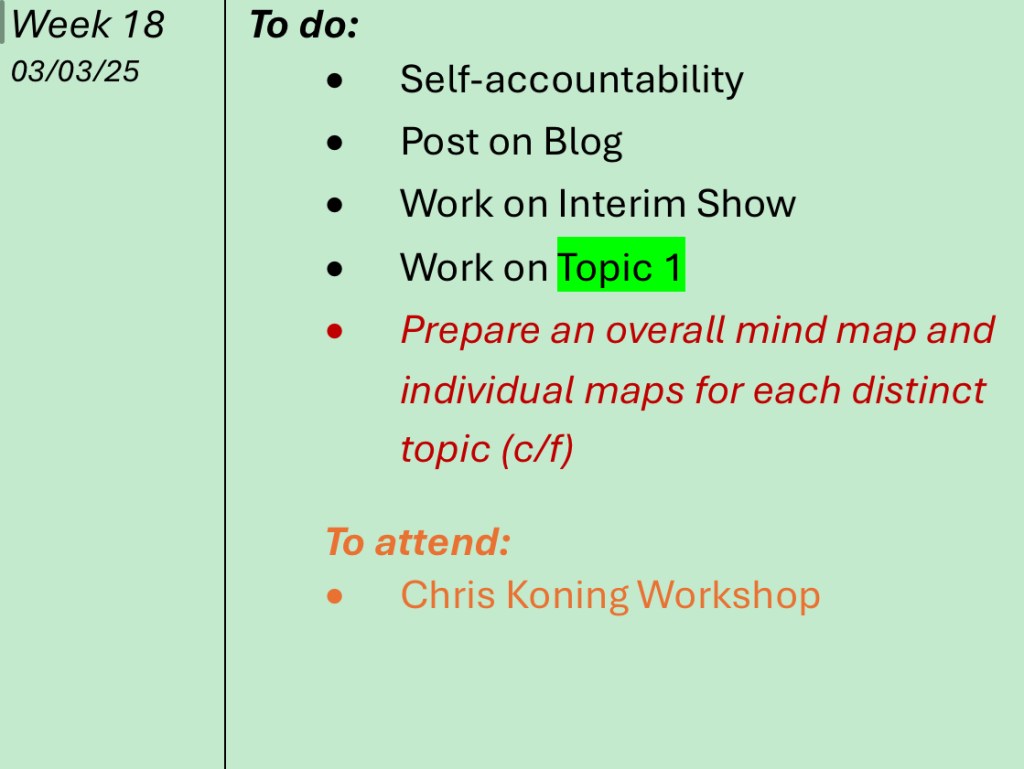
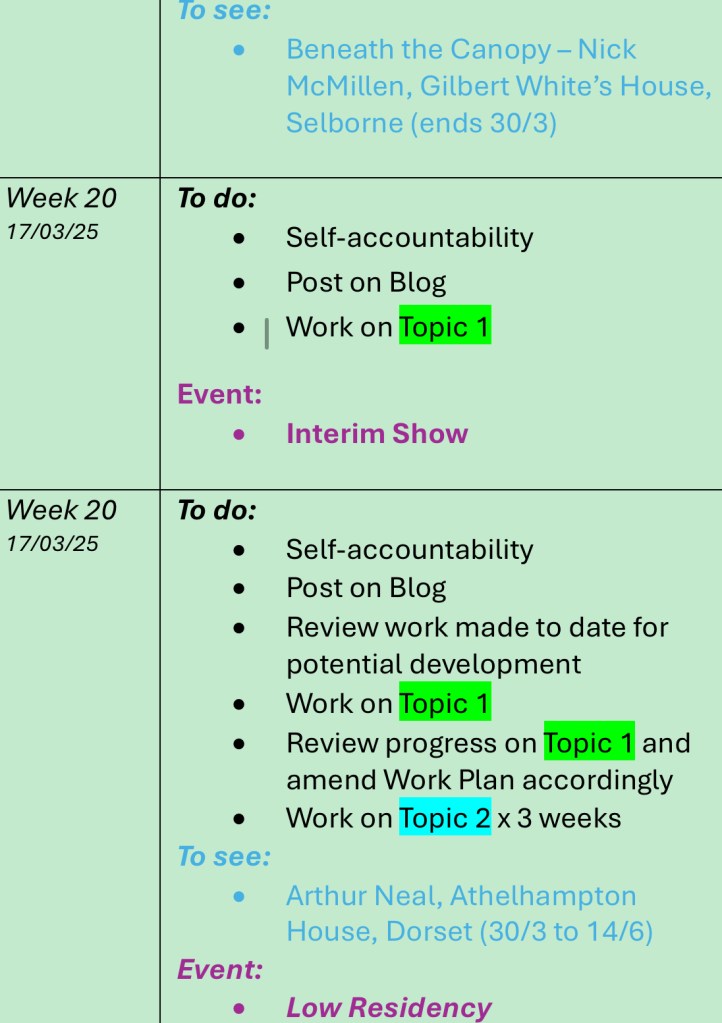
Self-Accountability W/C 15/4/25

What I was supposed to have done:

What I did:

  • Finished my work for the Interim Show
  • Attended the Interim Show and the Low Residency Week
  • Posted on the blog a few times

I’ve mentioned in previous posts that I haven’t really done very much over the last 3 weeks since the Low Res. My inactivity has caused me some stress. But I have been thinking, and feeling a bit overwhelmed: processing everything I experienced and learnt from the week, cogitating as to how it could inform my work, thinking about where it all leaves me and where I go from here, trying to find a sense of direction, but to be honest I’ve been feeling more than a little lost. I think that was why I felt the way I did when I looked at the second year blogs; they all seemed to have such a clear sense of direction.

When I curated my blog for the Unit 1 Assessment and looked back at my Study Statement I had a sudden realisation that I might never get to the end, that I had bitten off more than I could chew, that I would only be able to cover all of the individual elements I had identified in a cursory, superficial manner which would not do the subject, or me, any justice. For this reason, my request for specific feedback was:

“I am concerned that the subject matter of my programme of study is too broad and, that by its very nature, is a process which will continue beyond the end of this course, something that I have already acknowledged in my Study Statement. I would like some feedback as to the consequences, if any, of there being no ‘conclusion’ as such, and whether I should consider narrowing my line of enquiry.

I had hoped that maybe I would be gifted a steer, or a hint. But, the response was:

You asked about whether you ought to be narrowing your approach but arguably you have to explore a double diamond shape for practice…

start at a narrow point

then expand wide

then narrow again

then open out again

— this good and a helpful place to be and probably clarity will emerge organically. You are certainly doing all the right things to create the environment where focus emerges.”

I felt like I was being told to step up to the edge and jump, and trust that there is probably a safety net waiting to catch me. A blind faith that the process will lead me through the confusion and show me the way.

But having thought about it some more over the last couple of weeks, I now realise that to progress forward I need to concentrate on those aspects which interest me the most, which I believe have affected me the most. In doing so, I will naturally leave to one side matters about which I don’t really have a lot to say. Already, in my mind, the possible avenues to explore have been significantly reduced to those which have been the strongest emotional experiences. In exploring these events, I still want to keep open a range of possible media, although I already sense that some appeal to me more than others, but I want to finish exploring the possibilities before concentrating on just a few: I tend to choose the medium which I think would best express what I’m trying to convey. Whilst I don’t like too much choice, I do like to have a few options. I don’t think that I could only ever work in one medium – I would find that too restrictive, particularly as I think that I have quite different needs to be met – a need for detail and control at the same time as a need for loose expression and experimentation.

I have also resolved to scrap my work plan in so far as I have sought to set myself on a prescriptive path; I will work on whatever interests me when I wake up in the morning. In my work plan I have also attempted to impose a way of working which really isn’t who I am. I’m trying to force myself into a pigeon-hole which isn’t my shape; to have some self-discipline, which frankly I don’t have. I work to deadlines, although just recently I haven’t left things to the last minute, which has been a huge change in me. I completed my Study Statement and Unit 1 Assessment leaving myself plenty of time to review and reflect. I also recognise that I don’t have a constant rhythm of working; I have periods of intense activity and then I reward myself with a period of doing nothing, although I am – I’m thinking and processing and doing other activities such as reading and looking at art, which are equally as valuable.

So, I’m not going to beat myself up that I haven’t produced anything over the last few weeks. Instead, I’m going into this week having recognised some truths about myself and intending to do whatever takes my fancy, if anything, although I do need to finish my posts on the Low Res. Maybe if I do make something I will feel differently about it because I have chosen to do it rather than feeling that I ought to have done it. I came across a reel of Steven Bartlett’s podcast with Chris van Tulleken, who was explaining a time when, at the end of a family dinner, he had decided to to clear the table and put the dishes in the dishwasher, but before he could do so, his wife turned to him and asked him to clear the dishes away. He commented that he had gone from having agency and contributing to family life willingly, to doing someone else’s bidding.