Maps

I was very lucky to have Cheng and Dalal in my group for this week’s group crit.

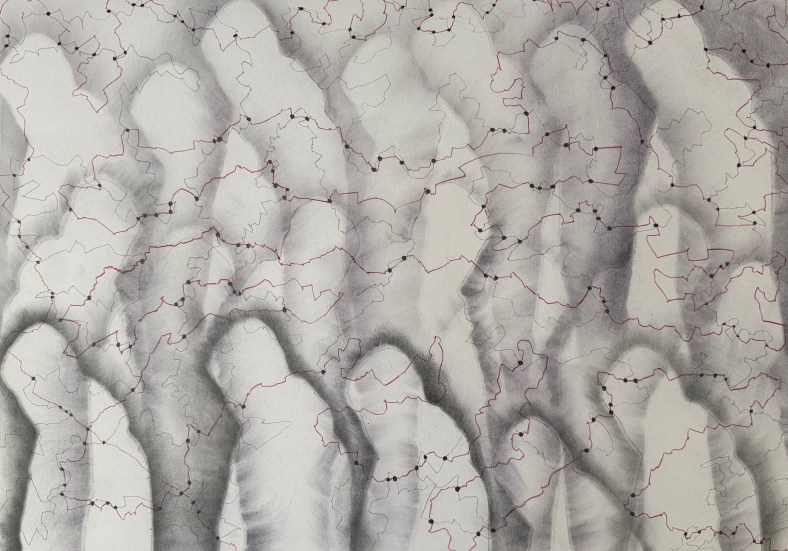
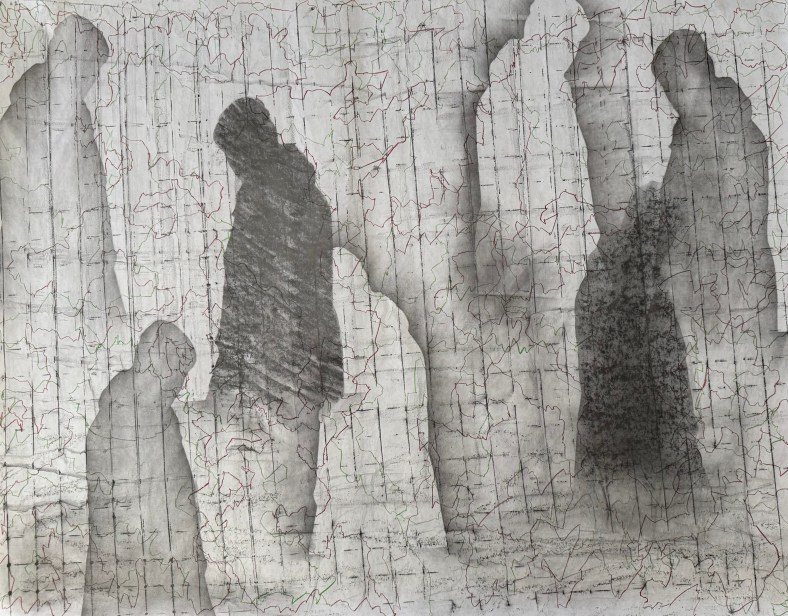
I showed my recent experiments with graphite and pencil.

I explained that I have become interested in the idea of inheritance recently and mentioned Donald Rodney’s work. We had a really interesting discussion about where we come from and our legacy, how it’s sometimes comforting to know that someone else before us was like us which frees us from feelings of fault and guilt, the idea of all that has gone before distilling down into us, much like our family tree before us, ends with us. How what we pass on feels like a responsibility or a burden.

Cheng commented that the white shapes give the impression of something that is no longer there and the dark shapes are reminiscent of shadows. Thinking about it, the shadows are cast by something that is there but is not visible. A figure’s absence is felt yet we feel a figure’s presence somewhere – it just about sums up ancestry.

I explained the process of making the pieces and how they seemed to develop into a type of map. I mentioned that the subject of maps has come to the forefront of my thinking recently along with the idea of connection. In my Unit 1 feedback one of the comments was: “It feels as though you have been working through an abundance of techniques that are maybe a type of mapping – now is the time to compare and contrast all of those experiments in order to develop an intuitive and personal way of mapping your experiences…”.

For sometime I’ve been interested in Deborah Levy’s idea of her mother being her internal sat nav and I used Google maps to obtain the aerial image I used in Parental Loss. My art class recently gave me a scarf with a Grayson Perry map on it. I was thinking earlier in the year of mapping the course of a river. The coincidence that I chose to draw the lines in colours which reminded me of maps somehow has linked all of this together. That, and the fact that I have been complaining ad nauseum about not having a sense of direction.

During these two years, I am, to all intents and purposes, mapping my life.

There seems to be a strong unintentional link to maps in the images: Cheng said that the images in which I’ve marked the intersections remind her of constellations, and Dalal observed that the lines themselves could be interpreted as borders, which then feeds into borders marking the the point where countries connect. This led to me seeing that the outline of the shapes themselves resemble coastlines.

Cheng and Dalal both made some really helpful comments about potential development:

  • playing with scale: a large image on a wall giving the impression of a map but then coming in close on a small scale to create a more personal experience and stronger connections
  • Drawing on a vintage map or incorporating old family photos
  • Using a pin to attach separate images to the points of intersection – this has since led me to think about criminal investigation maps – maps with string coming off from them to images and additional information on the perimeter
  • Thinking about how I can use materials to create something that looks older, that comes from a past time – this brought to mind highly decorative old maps with sea monsters in the oceans
  • creating a large scale reimagined map

Shortly after our session ended, I had a thought about making a digital map of my life with events or periods of significance being marked by specific points, a bit like a Google map, which you could then drag the yellow man to and drop into a space where you have a street view – maybe of images relating to that particular event. And then I laughed, Alexa laughed, Siri laughed, my husband laughed.

Lots to think about, as ever.
Bus Replacement Service

I was planning on going into London yesterday to catch Donald Rodney: Visceral Canker at Whitechapel Gallery (as well as revisit the Cardiff audio walk), and Linder: Danger Came Smiling at the Hayward, before they close in the next day or two. But what I forgot was that it was a Sunday on a Bank Holiday weekend, a perfect time for railway engineering works. A bus replacement service would almost double my usual journey time, and so I decided to stay at home. Instead, I had a look on Whitechapel Gallery website, to see what I had missed. There is an interesting piece on Rodney by Caleb Azumah Nelson, particularly on their relationships with their fathers.

Rodney had, and ultimately died at the age of 37 from a complication of, sickle cell anemia. He was in the midst of a sickle cell crisis when his father died and he was unable to attend his Nine Night.

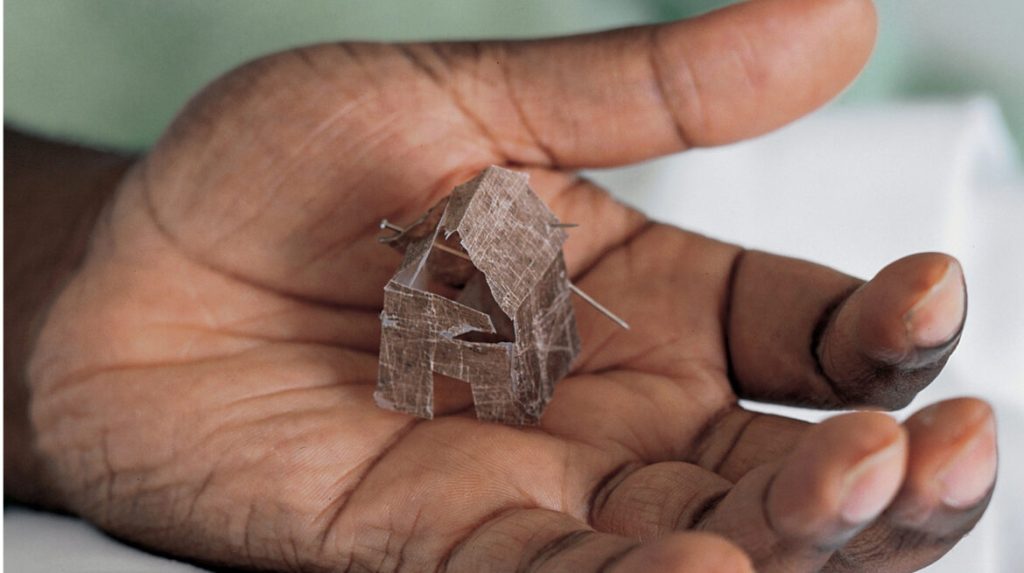
In the House of My Father 1977, photograph (Image Source: http://www.whitechapelgallery.org accessed 5/5/25)

Made from his own skin, the house is held together with small dressmaking pins.

This is the first piece of work by Rodney which Nelson encountered, purely by accident:

’The strength, not in the structure, but in the vulnerability of exposure, his open palm an invitation into his heart, his family. With this gesture, Rodney suggests, this is who I am, this is who I might be.

How does the self come to be? And how do we make space to be our whole selves? … a condition he would have inherited from his father, who would’ve inherited it from his father before that. Their selves, our selves, folding into one another: we contain multitudes. And what else do we inherit? And how do we carry around these inheritances, how do we make space for them in our lives?…’

At the time he was reflecting on his own relationship with his father:

’… wrangling with the things he cannot say to me, or doesn’t have the language for, the many rooms in the house to which I do not have the key…’

He finishes his piece with:

I believe Art gives us a space to be honest, to confront, to dismantle, to reassemble. To imagine. Visiting and revisiting Rodney’s work reminds me that other worlds are possible. It reminds me, that even in the face of continued crisis, it is necessary to dream. It reminds me that , even in the face of death, we must continue to inhabit many rooms, to hold space where we can be honest, where we can be our whole selves. Where we can feel alive.’

So many thoughts have come to mind:

  • The idea of inheritance and how we find a space for it in our everyday lives. To me this feels like a burden not just in the physical sense of belongings, and ‘stuff’, but to the extent that I might feel defined by it: I don’t want to be, I want to be my own person steering my own course independently of what has gone on before, but I can’t ignore the extent to which others have shaped me. Last weekend, I lost count of the number of times friends commented how my daughter is a mini-me or the spitting image. No, she’s not. She’s her own person, living her own life. But, inevitably, I will have had an input into who she is, even if it’s just a matter of genetics.
  • I have inherited my family history from my parents. I used to spend ages looking through the family photo albums talking to my mother about the contents. I feel an enormous responsibility to pass this knowledge on. It’s a burden. My daughter is not particularly interested. Maybe it’s an age thing – as we age we need a greater understanding of who we are? Or maybe it’s a digital thing, we don’t have a physical record of our lives lying around the house to prompt an inquiry and so the questions never get asked. Sometimes I think that I should write it all down in case she’s ever interested, and other times I think that I’ll take it all with me and free her from the burden.
  • I think that I’ve been dismantling myself over the last few months. I’m not entirely sure that I’ll be able to reassemble myself, but maybe a few left over bits here and there wouldn’t be such a bad thing. I could even write my own instruction manual.
  • The child/ parent relationship: I remember the moment when I realised that my parents didn’t know or have the answer to everything; that they were human. It really stopped me in my tracks.
  • The idea of the house with many rooms; our ancestors folding into one another; the self containing multitudes.