Edition

I thought about what size to do the print. If anyone buys it, I would like them to be able to frame it at home with a shop bought frame. So I needed to leave enough of a border so that it could go into an A3 frame without a mount, but not too much so that there is a lot of white space if they choose an A2 frame with an A3 mount. I decided to leave a 2cm border on the top and sides, and 4cm at the bottom.

I decided at the outset that I would not aim for perfection, that there are bound to be mistakes and that it should just be good enough.

It started off well. I made 12 prints

When I came to print the next layer of dark grey the registration of the print went awry. I went from feeling quite happy about the process to feeling despondent and frustrated. I made a few adjustments but it still didn’t work. So I stopped myself from ploughing on in the vain hope that doing the same thing again and again would somehow miraculously give a different result.

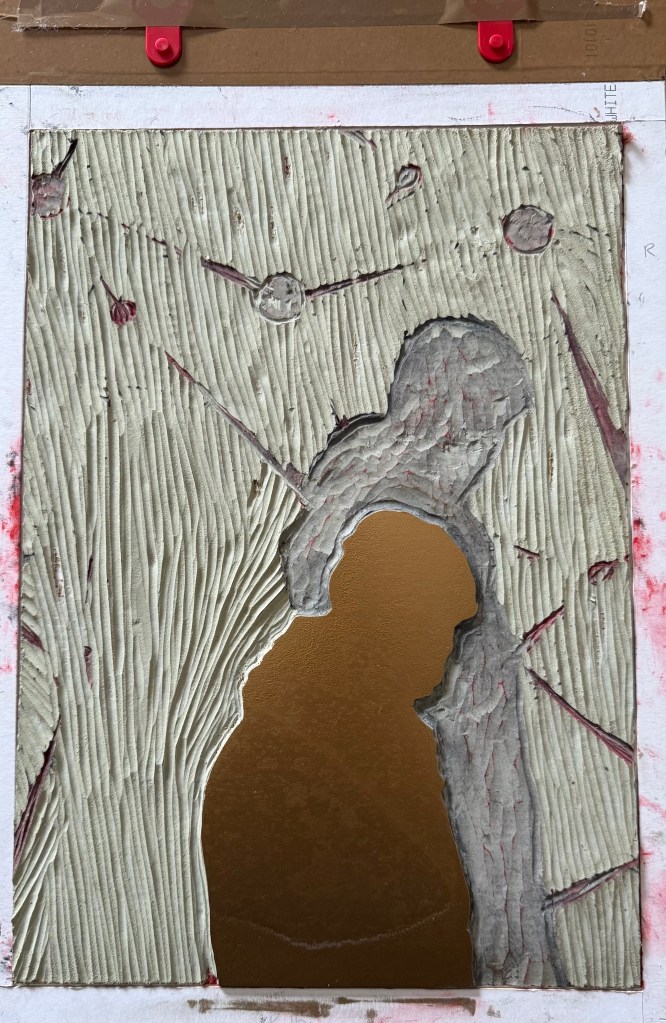
After some time away, it became obvious that the lino block, which had been washed and left to dry, was not sitting totally flat, which may have been the cause of the issue. So, I warmed it up and put it under a pile of heavy books whilst it cooled down. I came back to it a while later and tried making another print, which worked much better. Feeling a bit happier about things I went on and finished the rest of the prints. I must have inadvertently caught some of the cut out areas whilst inking up which caused some chatter on the base red layer (I clearly hadn’t taken on board the lessons from the first session) and on a couple of prints there was too much give in the blanket allowing the paper to be pushed down onto the cut out areas which caused marks on the red ink. This was resolved by adding in some folded newsprint which created some rigidity over those areas.
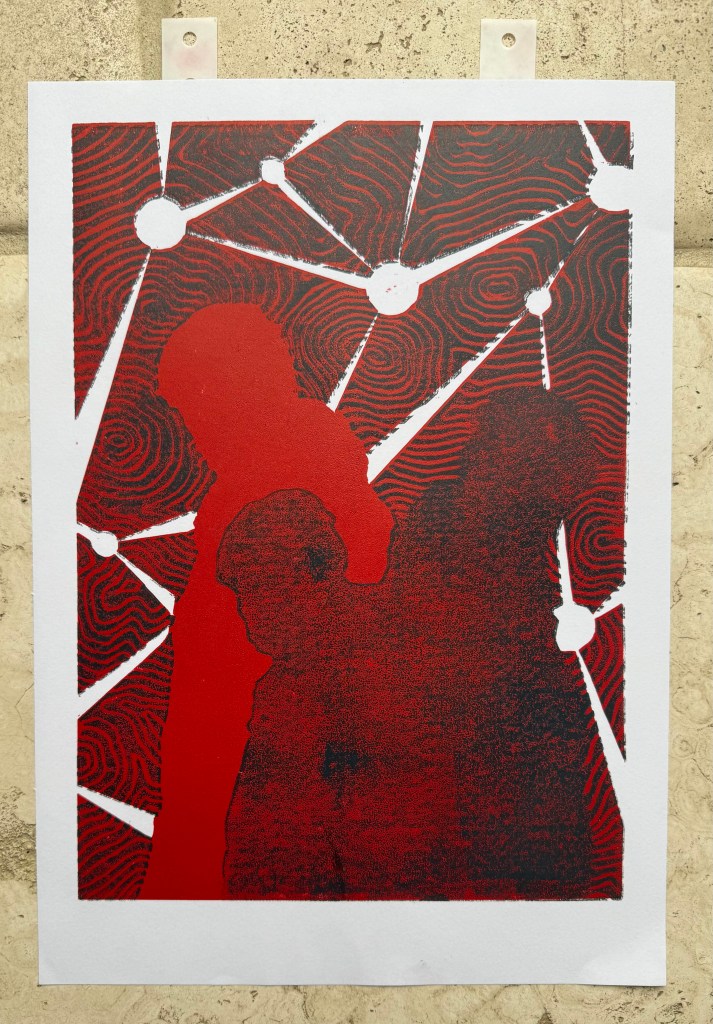
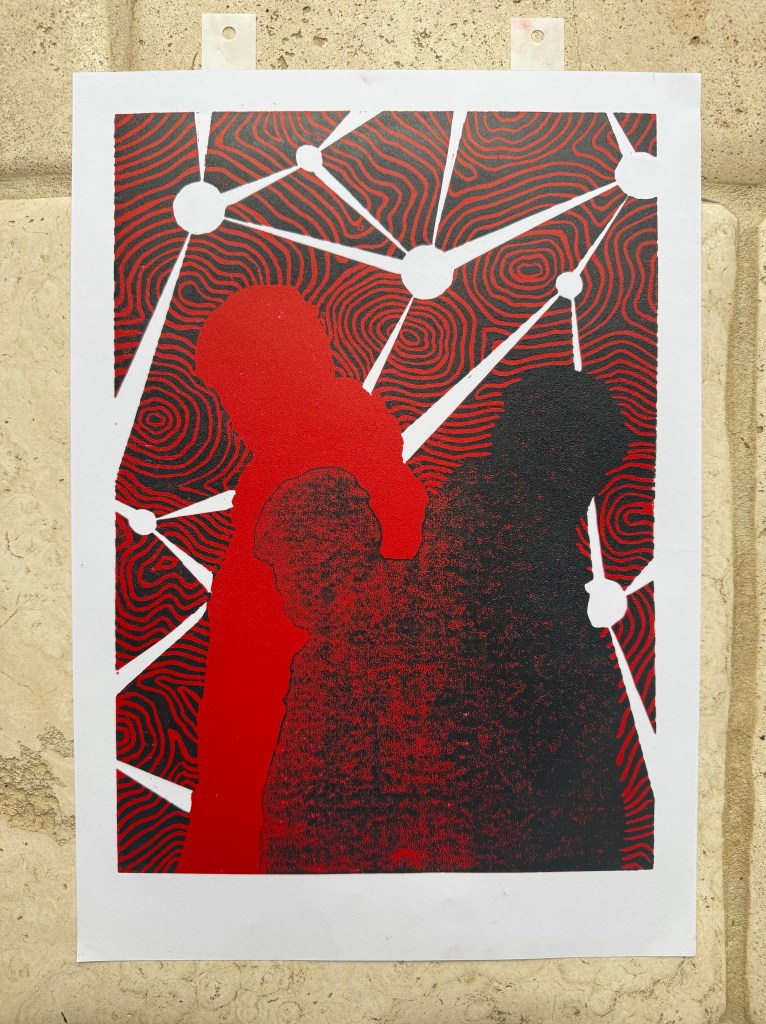
I liked the slightly mottled effect of the grey on the figures – it gave the sense of light falling on the figures or a lack of solidity. I wanted the head silhouette to be stronger so I burnished the head and the front side of the figure with a spoon to get a darker print. I liked the prints at this stage, but I felt that the two grey figures didn’t have enough definition between them, so I went on with the final gold layer.

My total of usable prints had reduced to 8.
Last Minute II

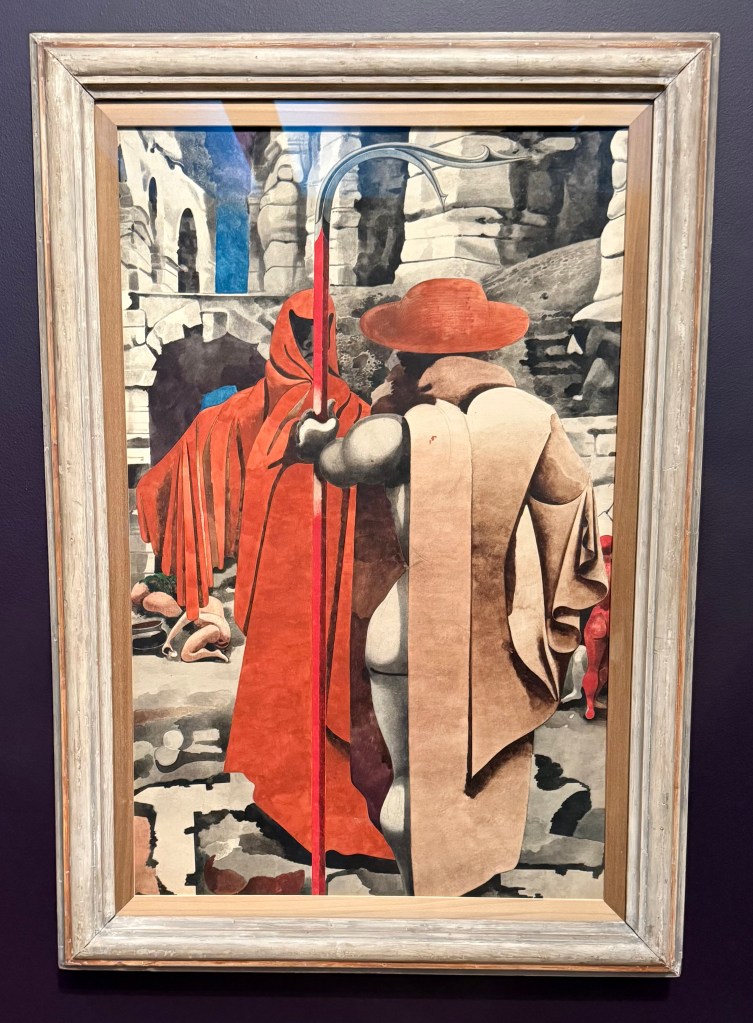
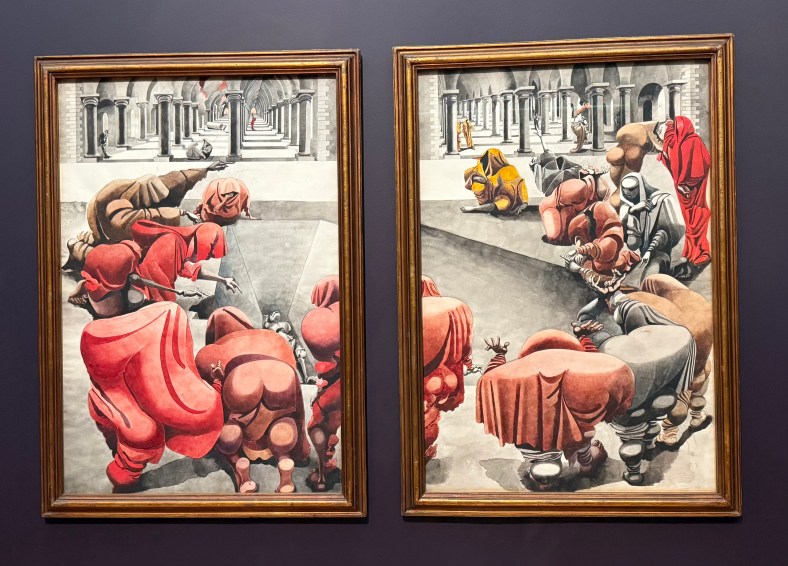
I didn’t expect to enjoy the Edward Burra exhibition at Tate Britain. His earlier works of figures in bars and cafés in France and the US were interesting, but I was particularly intrigued by his work during the Spanish Civil War, the Second World War, and his later work. He was diagnosed with rheumatoid arthritis as a young boy, and during the war his medication was subject to rationing which meant that not only was he isolated from his friends, but he was also in pain for most of the time.

He mostly drew from memory, and used watercolour to build up layers. They were extraordinary. They had the solidity of oil paintings, and yet had a remarkable quality of luminescence about them.

As he got older, and couldn’t travel abroad because of his failing health, he went on road trips with his sister, often accompanied by friends. When they stopped to enjoy the views he would just look, later recreating the scene months later in his work.

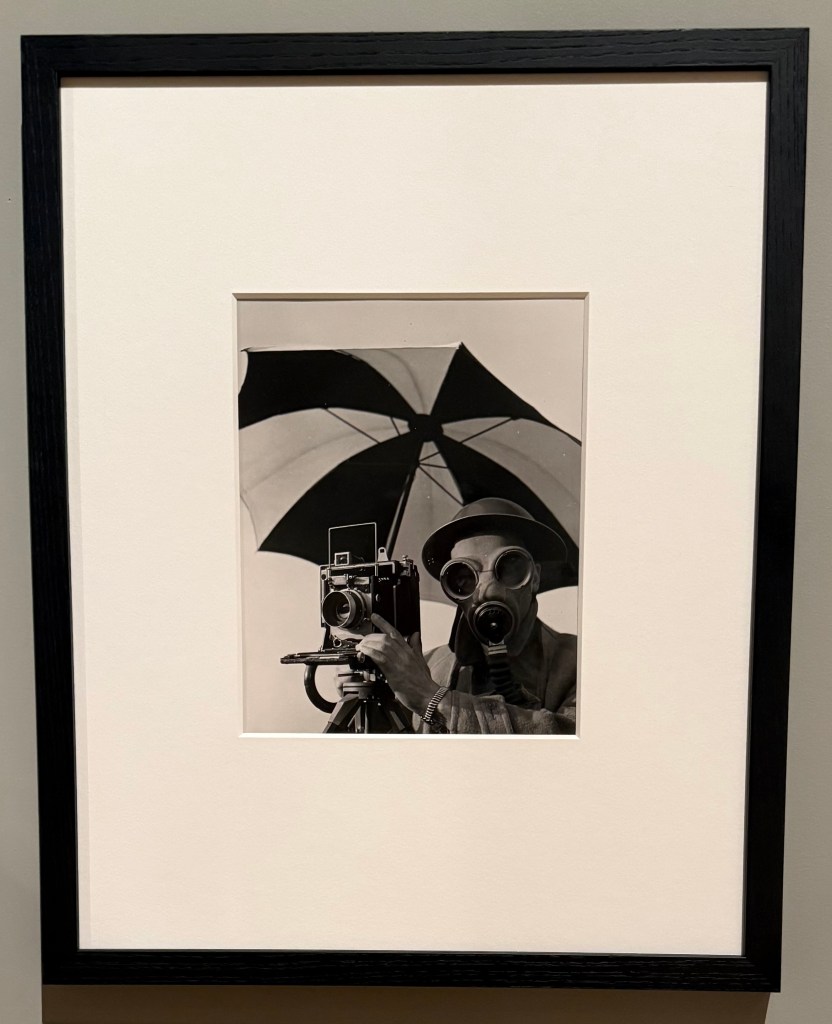
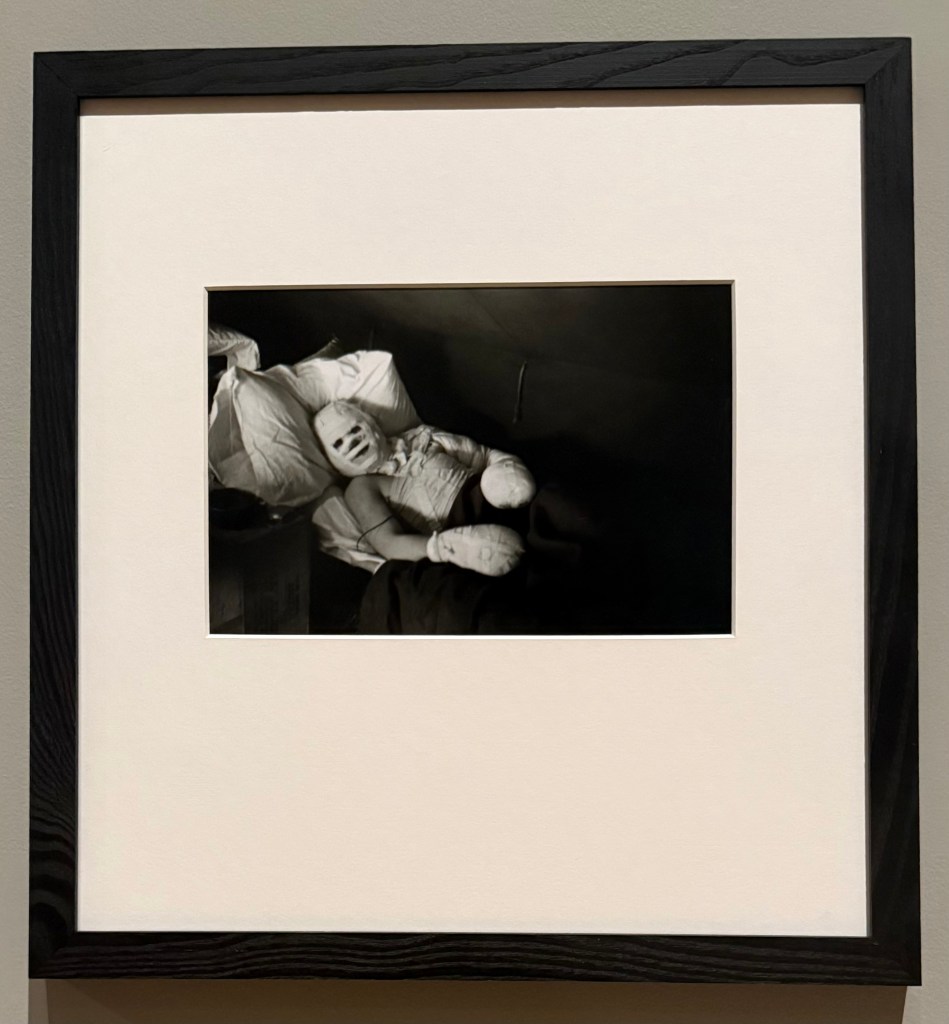
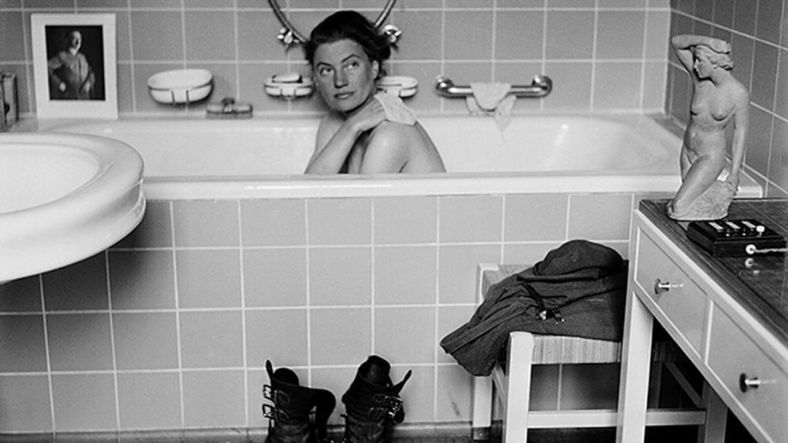
I then went round the Lee Miller retrospective which has around 250 photographic images on display. Originally a Vogue model, she moved from being in front of the camera to being behind it, working closely and experimenting with Man Ray in Paris. During the Second World War she was a war correspondent for British Vogue taking photographs of the Blitz, the liberation of Paris and the concentration camps at Buchenwald and Dachau.

I hadn’t really been aware of Lee Miller before I went to see the film Lee, in which Kate Winslet plays her. At the end of the film, you see a selection of some of her most famous photographs including the one of her bathing in Hitler’s bath taken by her colleague, David E Scherman, as well as the scenes she witnessed at Buchenwald and Dachau, the mud of which is still on her boots which she has purposefully placed in front of the bath. Seeing them in the flesh, in a small side room, was incredibly moving. Not surprisingly, photography was not permitted in this part of the exhibition.

Available at http://www.bbc.co.uk

British Vogue was reluctant to publish her photos of the concentration camps, on the basis that people wanted to move on from the war, and whilst they published a few, American Vogue published a comprehensive spread of them in the June 1945 issue, including the most harrowing, under the title ‘Believe It’. Her work, particularly her war photography, was not widely known about until after her death when her son found her collection of photographs. She had given up photography, too traumatised by what she had experienced during the war, and taken up gourmet cooking.

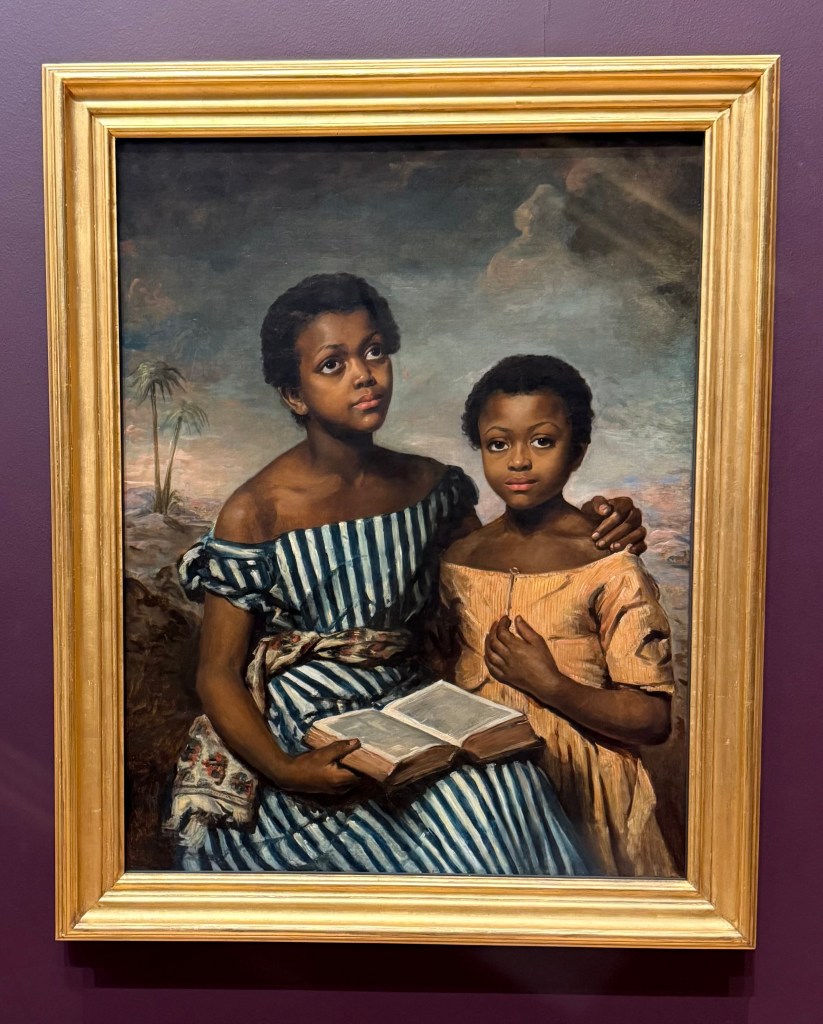
I finished off the day by having a look around the general exhibition and came across the subject of one of my favourite Fake or Fortune episodes (other than Frink’s Warrior found at an Essex car boot sale), Emma Soyer’s Two Children with a Book.

Making Sense of Worth

Yesterday’s session turned out to be quite timely for me.

We watched a video of William Kentridge’s Tide Table and part of an interview with him. He likes working with charcoal because it can be erased very easily, and speed of thinking is equal to the speed of drawing. This reminded me of paint being liquid thought (Elkins, J What Paint Is). Kentridge describes his work as being on a trajectory – a path followed, which finds structure and subject through being made.

Amongst other things, we considered what advantage exists in using material that changes easily, and what the advantages are of working in a fast or slow way? We discussed how working quickly can be more intuitive and stops the conscious mind from overthinking. In this respect, some expressed the opinion that work made in a short period of time does not have as much value as work which takes longer to make.

This is a concept that I have been grappling with for some time, in an attempt to shake it off (Dialogue I; Dialogue IV – I’m So Over It; We’re So Excited; Am I Bovvered?). It seems to me to be illogical, because I wouldn’t think that a book which took a year to write is of greater value than a book which only took a month. Maybe one author was in a flow state and it all came easily, whilst the other had to struggle, but theoretically they are of equal value.

What determines art’s worth? The time spent on it, the skill involved, the size, the materials used? Would a small piece using 24 carat gold leaf encrusted with diamonds which took me 5 minutes to make using quite complex skills be worth the same as something I took days to produce using a child’s wax crayon and a piece of scrap paper, but into which I poured all of my emotional being? I’m trying to bring myself over to the point of view that none of it matters; what matters is that I made it because I thought it worth making, and that it connects with me. But it’s very difficult to shift the mindset.

In my posts, which I refer to above, I was considering value in terms of rejection and how that might impact how I felt. I have the opposite scenario at the moment; I saw one of Rebecca’s blog posts about an exhibition she had been to, and I was intrigued by the technique used by the artist. I thought that I would quite like to try it out, and so I did. I made ‘Siblings’. It took me about 45 minutes or less to make. It didn’t take much skill to make – to be fair it could have been made by a primary school child with appropriate supervision while using the craft knife – but it represents and embodies something deeply emotional to me and it was very much about the process. As it turned out, I wasn’t disappointed with the end result and so I decided, on a whim, to enter it into the ING Discerning Eye Open Call, for which the deadline was the following day. It has been selected. You would think that I would be over the moon. I pretend to be to the outside world, but inside I still can’t help feeling that it’s unworthy because of the limited time it took to make.

Time Capsule

She went back to uni today. She was looking forward to getting back to some normality and having independence again. The house seems empty – don’t get me wrong, I’m not one to suffer from empty nest, but there is a presence missing, along with all her stuff that seemed to have found its way into every single room of the house. The creation station that she had set up in the sitting room is no longer there – watching tv whilst she painted by numbers to try and occupy herself and at the same time rehabilitate her hand. And then the quilt, which she didn’t manage to finish before she left; she was disappointed because she wanted to have something to show for what she saw as having been a wasted summer. Never mind – she’ll complete it over the next few weeks, and it will serve as a reminder of ‘that summer’, imbued with fear, frustration, pain, resilience and hope.

It never ceases to amaze me how, in the act of making, memories and emotions are stored within the object, like a creative time capsule.

Carbon Dating II

In the words of Vinnie Jones: it’s been emotional.

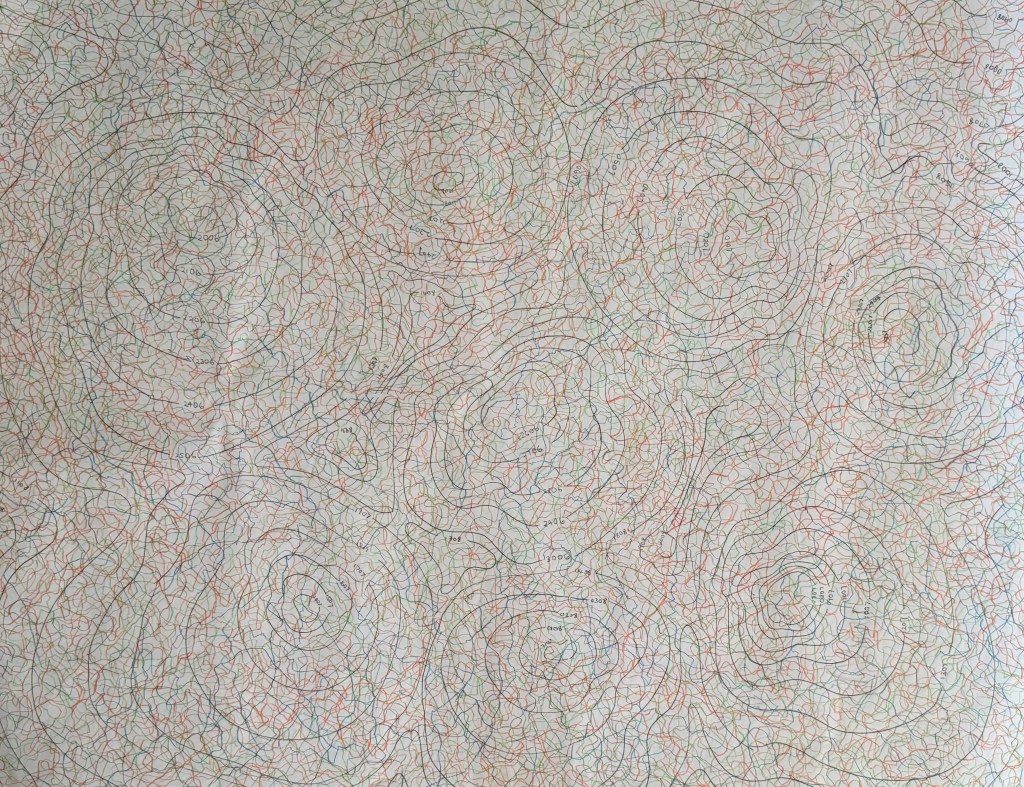
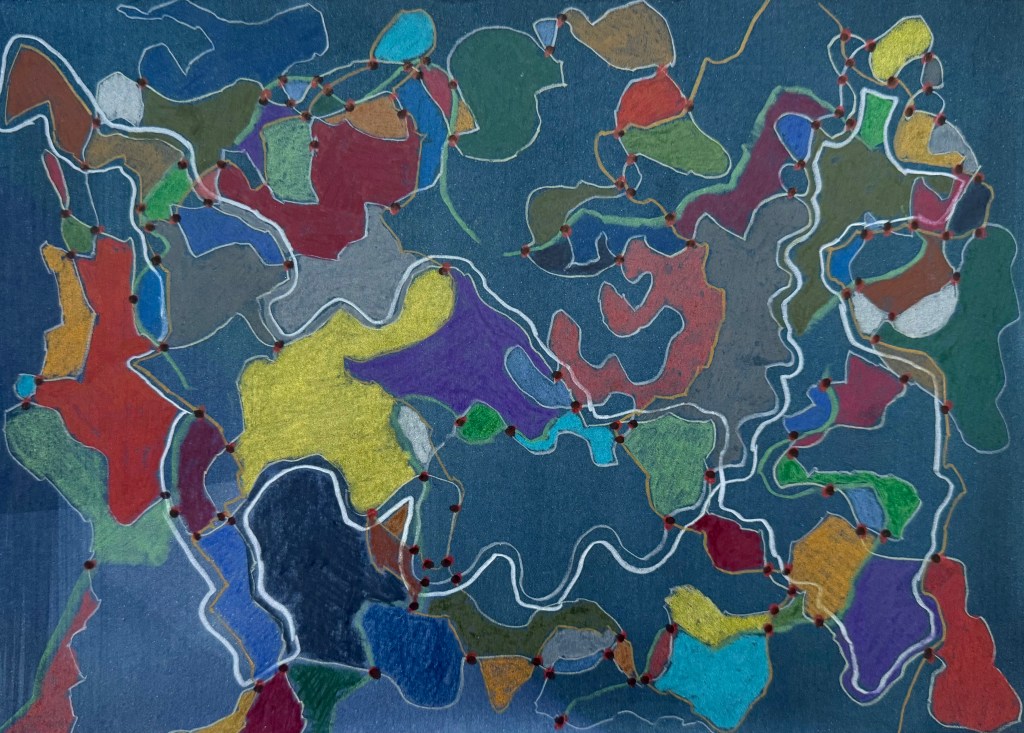
Over the last 54 days I have been mapping my emotions each day, using orange for positive, green for neutral and blue for negative. At the beginning, I was going to use different shades of each colour but I soon realised that this would over-complicate things. I also realised that I needed to put some rules into place: I started each line from the dated contour line, drew for two minutes, trying to explore as much of the sheet as possible to achieve an even distribution of mark-making, and finished the line off the page. I wanted to make it so that theoretically I can pick any day and trace the line which represents it. I drew each line at the end of the day, and took a photo. Unfortunately, sometimes it wasn’t light enough and so I had to take photos including a number of days’ worth of lines, so instead of having 54 photos, I’ve only got 46 which has resulted in a sudden surge in orange lines towards the end – maybe I was enjoying the positive. They are not the best photos – the lighting is all over the place. Next time I do something like this I will try and make them consistent, although I do quite like the movement it creates.

What have I learnt from this exercise? Had I not done it and you had asked me what the last 2 months have been like for me, I would have said that they have been difficult, and that for the most part I have felt negative emotions such as sadness, grief, stress, frustration and anxiety. However, looking at the end result I can see that this isn’t actually the case; I can see that there are more orange lines than green, which in turn outnumber the blue. This must mean that I feel negative emotions more strongly than positive ones, and this results in my perception of life being somewhat skewed. The map reflects this, in that, whilst they are few in number, the blue lines jump out at me from the rest. I think the technical term is the negativity bias. I don’t think that I would have had the same result had I represented my daily emotions diagrammatically in a chart – it matters that each day is individually represented. Maybe there is another way of doing it – I’m just not a mathematician!

I found the exercise to be a positive one; the act of drawing a line each day not only meant that I was making, but it also allowed me to reflect on the day as I drew – a form of visual journaling. I enjoyed the process of it and whilst it can be said that the resultant map is interesting, what it reveals also became apparent during the process itself; as the map was becoming each time I engaged with it, so I was becoming.

As ever, I’m not sure how I can develop this, if at all. Or maybe, there’s no need. Today was the last day. I think I will miss doing it, so I might just continue.

Leave The Party Whilst You’re Still Having Fun

My mother always used to tell me to leave the party whilst I was still having fun.

Fortunately, we were able to make sure that Monty left the party whilst he was still having some fun. And, as I was sitting there in the garden with the sun on my back, stroking him as his heart stopped beating and his last breaths left his body, I thought to myself, not for the first time, why can’t we do this for people?

My mother would have wanted to have had the choice to leave the party while she was still having fun, but she couldn’t, and so she turned to face the corner and disengaged from the party until the bitter end.

I don’t think that I am afraid of death. But I am petrified as to the manner of it. Best to go quickly without warning. If that’s not possible, then I’d like the choice to leave the party whilst I’m still having fun. Who knows? When the time comes to face it, I may decide, what the hell, let’s party until dawn, mine sweep all the half empty glasses and wake up with the mother of all hangovers face down in a puddle of who knows what. But at least it will have been my choice.

Carbon Dating

During my tutorial Jonathan mentioned carbon paper.

It brings back memories of a time when it was the only way to make copies, of secretaries putting a sheet between the top and bottom copies when they typed. Those were the days when the most technologically advanced piece of equipment in the office was a fax machine, which would regularly spew out reams of documents on thin, shiny paper, the print fading away to nothingness over time, thus requiring photocopies to be made, just like some present day shop receipts, so I’ve discovered.

So what to do with it? Recently, I have been reading about map-making and the act of mapping, considering the difference between the two. Contemporary cartographic theorists consider the process of mapping to be of paramount of importance, the creation of the artifact of the map being just one step in the process. In particular, psychogeographic mapping seeks to represent how individuals feel about the place they are in, a process in which subjective experience is prioritised over factual accuracy. Artist, Christian Nold, who uses a bio-mapping device to record individuals’ changes in emotional state, creates emotional maps of places, and one I’m particularly interested in is Brentford Biopsy because I used to live next door in Chiswick before I moved out of London. The project was undertaken in 2008 before areas of Brentford were redeveloped, and it’s really interesting to see how people felt about the area: it reveals so much more information than you would get by simply looking at a map: a map details the historic buildings and the riverside, but not how people respond to them, their view as to how they should be dealt with in future development, and how it actually feels to be there.

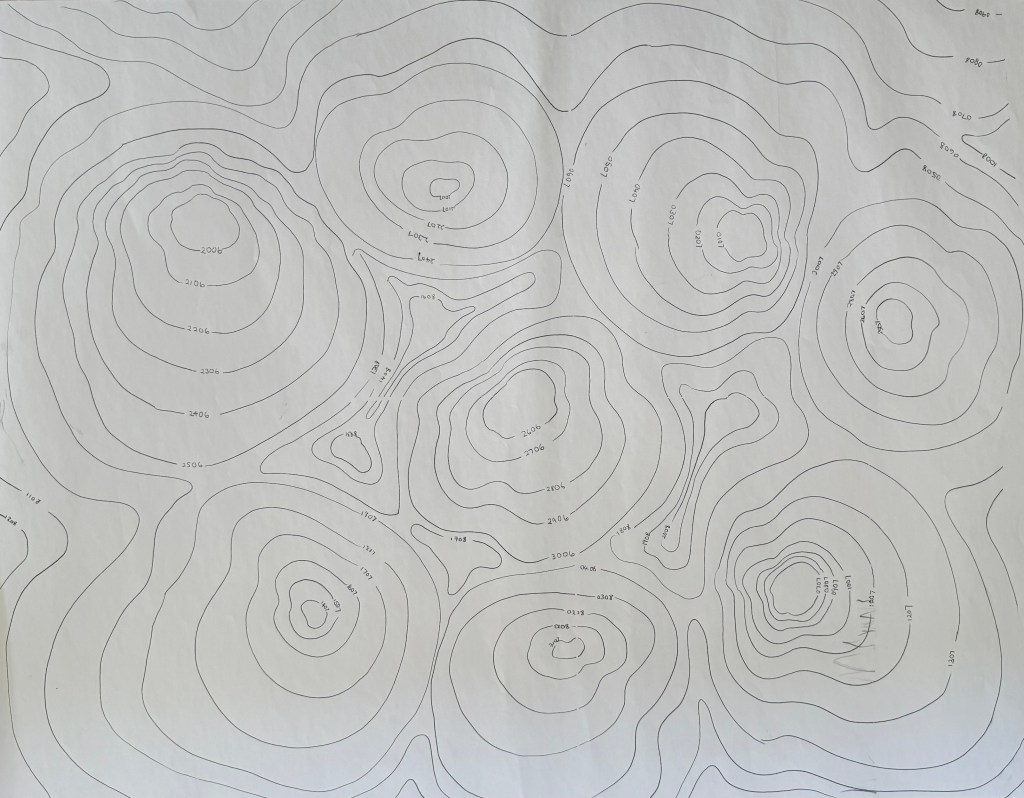
So, I’ve decided to embark on some emotional mapping of my own, not in relation to a sense of place (that may come later when I revisit my grandmother’s village) but of my day to day life. The bonus is that it means that I have to make a line everyday which will hopefully lead me to doing other making. I have drawn the contour lines using carbon paper (I‘m currently thinking that they may be too dark and overpowering, but we’ll see how it goes; it’s an experiment after all) and each one relates to an individual day.

I’ve already started, and it should take me up to the 12th of August. I’ve had to invoke some rules. There are three colours which represent three emotional states which I assess at the end of the day; green represents a neutral emotional state, orange positive and blue negative. Obviously within the generalised emotional states is a whole range of different specific emotions, but I decided just to keep it simple. Each line starts from the contour of the day in question and ends by going off the sheet otherwise it may be associated with more than one day. I draw each line for no longer than two minutes. I had thought about allowing myself however long I felt I needed and varying the intensity of the line depending on how I felt, but decided that would over-complicate things. The map will give an indication of how often I was in each emotional state over a period of time. I’m now thinking that I should have had another map on the go at the same time; not just to depict frequency but also depth of emotion. Maybe next time, if this works out.

I also found some watercolour paper which I had used for an unsuccessful cyanotype and experimented with it. I like the intensity of the colour against the blue background, and the way the coloured in areas look like countries on a map of the world.

The groupings of colours also remind me in a way of the Art Emotions Map which has been produced by Google Arts & Culture and the University of California, Berkeley, which I’ve spent a bit of time exploring and which reminds me of one of our Miro boards. My husband suggested that I could do something similar relating to life experiences, with getting married to him falling within ‘Wonder & Awe’. Oh, he does have a sense of humour!

Am I Bovvered?

Amidst all the excitement of the Low Res, I received my annual rejection letter from the RA.

Immersed in all the distraction, I wasn’t bothered, which is why I have left it until now to reflect on this rejection. I’m still not bothered. Why? I’m not sure, in the end I invested quite a lot of time into the process of producing A Die, A Log, With You. However, I didn’t invest very much in an emotional sense – yes, it made me titter but it’s not as if I put my heart and soul into it. Why? because it was an arbitrary task I had set myself which was, frankly, getting in the way of more interesting things. Also, entering the Summer Exhibition is no longer my only artistic outlet into the big wide world. This blog has changed that.

Based on our discussion in yesterday’s session on the subject of success as an artist, I would say that I failed. The piece didn’t connect with others, and, perhaps more importantly, it didn’t connect with me. I used to think that my work was like a Harry Potter Horcrux with each piece containing a little bit of my emotional being. This piece has none of me, so was always destined to be a failure as a piece of work. However, as an exercise in ‘that will do’ as opposed to the normal quest for perfection it was a total success. So. I’m still left in a quandary as to why I didn’t feel connected – was it that in accepting something less than perfection I detached myself from it, or was I just not that into it to start with?

Food For Thought

Last week was a week of two halves.

At the beginning we were told that our dog, Monty, has metastatic melanoma. Without treatment he will rapidly decline in a matter of weeks. With treatment he has a chance of possibly living to his natural life expectancy. With no significant side effects to the treatment, we are giving it a go, and he had the first dose of chemo and immunotherapy on Friday. If it becomes obvious that it isn’t working, we will stop.

We are devastated. I know he’s only a dog but he’s been a part of our family for the last 12 years; he’s been a part of my daughter’s childhood for more time than he hasn’t. I also can’t help thinking that some of the desperately crippling sadness I’m feeling is unresolved grief from my mother’s death, because I’ve been teleported straight back there.

For me, emotion and food are intrinsically linked. The need to eat in order to survive is a primal instinct. I have a need to feed. When I became a mother, my need to nurture and provide nourishment, in all its forms, for my family became paramount. And, of course, many people express their love by making food for others.

The refusal of food is one of the first steps in withdrawing from the world. I remember the lengths I would go to in order to try and encourage my mother to eat. I would spend so much time making her dishes which she said she fancied only for her to take one taste and decide that she didn’t want it anymore. The most difficult moment was when I had to accept that all I could do was to offer it, and not to try and browbeat her into eating it.

Monty’s not as keen on his food as he was. I have dishes full of different vegetables and meats that I’ve cooked, in an attempt to encourage him, in the fridge. Unfortunately, the only food he seems keen on at the moment is steak. When he eats it I feel like everything will be ok, but in the back of my mind is the nagging thought that all I’m succeeding in doing is nourishing the very thing which is killing him.

On a happier note, we had a party to celebrate my daughter’s 21st birthday this weekend. Family and friends came from all over to join us to sit down and have dinner together. There was much drinking and dancing, and everyone had a good time, welcoming the chance to reconnect with old friends or form new connections over food. Some of them I hadn’t seen for a few years – they looked older, as I’m sure I did to them. Even more reason to make the time to meet up with people as much as possible – to walk the walk, and not just talk the talk.