Out Of Sorts

I haven’t done anything since coming home from the Low Res.

There was an intense period building up to it, followed by a period of sitting back and taking stock. I’m still thinking about it all, but whilst doing so I’ve allowed myself to get sucked back into domestic life. My daughter’s now home from uni for a month, along with all her ‘stuff’. Whilst it’s lovely that she’s back, it’s upset the normal way of things. Glasses and crockery disappear into the blackhole that is her bedroom, and the bottom of the stairs has become a footwear hotspot. Could be worse, I suppose.

Also, one of our dogs, Monty, hasn’t been so good. He’s an old boy at 12. Enlarged prostrate, chemical castration, hormonal inbalance making him not himself, and removal of a malignant melanoma. Waiting to talk to the vet about prognosis. I suspect there may be trouble ahead and difficult decisions to make. He’s out of sorts. We’re all out of sorts. But tomorrow’s another day.

I haven’t made anything. I am conscious that I haven’t and it’s starting to stress me a bit. My last two posts could have been cheerier, but there’s no point in putting on a fake smile. My colours are definitely muted at the moment. I feel like I’m stuck and I can’t progress until I’ve managed to process and order all that I took away from the week in London, but up until now I haven’t been able to set aside the time to do it. Also, my logical side dictates that I should deal with it all in chronological order, but that’s impossible to do because it all seems to be intertwined.

Second year Catherine told me that she feels like a spider spinning a web. I told Jonathan that I felt like I had been collecting during the week; it’s as if I’m accumulating pieces of a jigsaw puzzle, but I don’t have the benefit of an image on a box to guide me. I just hope it makes something, because it’s making me feel out of sorts.

I’m looking forward to the start of a new term next week. I need some structure.

It’s All In The Tag

I was surprised when Jonathan pointed out in my tutorial that the most frequently used words in my tag cloud were ‘mother’ and ‘drawing’.

I thought that it would be words like ‘death’, ‘emotion’ etc – I feel that I’ve written enough about them. So, I’ve been through all of my posts and checked that I’ve categorised and tagged them correctly. I haven’t. I’ve failed to use more general terms – words like ‘resentment’ and ‘loss’ appeared but not the umbrella term of ‘emotion’. It’s important moving forward that I keep on top of this as the tag cloud will be integral in determining what is important to me.

Having completed that exercise, the words of the moment are ‘emotion’ and ‘process’. That sounds about right…

Dialogue IV – I’m So Over It

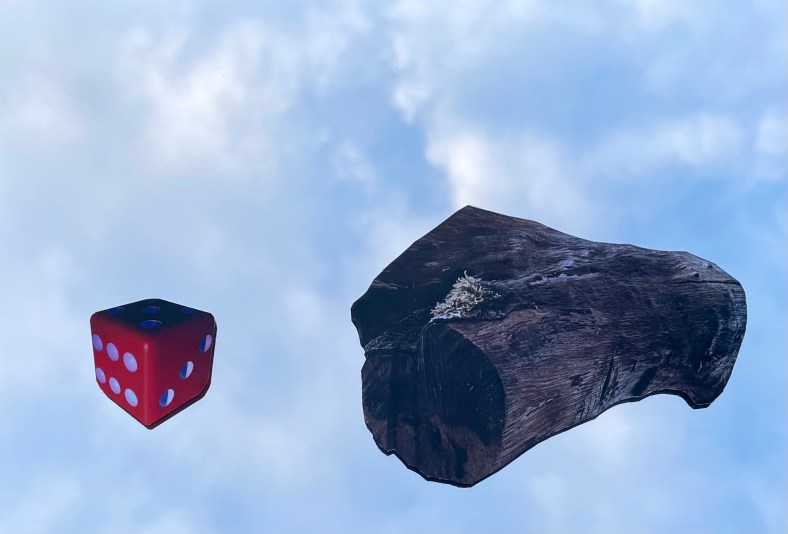
I’ve had enough of this side quest (©️Rebecca). I regret the day that I started it. Have I enjoyed any part of it? Maybe the beginning, the anticipation, the thinking about it. But when it comes to the process, it has been a monumental headache, from the execution to the photographing.

I realise a few things may be influencing my feelings about it. I keep getting reminder emails that the submission deadline is approaching – like I don’t know. Also, my daughter phoned me up yesterday morning in a crisis during an online exam – she was having IT issues. She had already contacted the helpdesk and taken screenshots, so my only advice was that she could only do what she could and not to stress, they must have procedures for this sort of thing. A couple of hours later she was feeling better, whilst I was still feeling the effects of all her stress, and trying to work out how on earth I was going to take a photo of a reflective surface. That, and the fact that some of the glue had managed to escape from under the cut-outs, and the realisation that I had fixed the die on the wrong way round.

Anyway, this morning it wasn’t raining for a change, so I took it outside. I’m not entirely sure how I’m supposed to convey its reflective qualities without including a reflection which then looks like it’s part of the work. Well, following my own advice, I can only do what I can do.

I feel like it’s been a shambles and that I’ve been amateurishly stumbling from one thing to another. The process hasn’t been the experience I thought that it would be. Because I had no expectations, I thought that there would be no stress – instead I’ve experienced confusion and frustration, and it has taken just as much out of me as other years, just in a different way. The only difference is, if it doesn’t get anywhere, I really don’t think I care at this point.

But every experience is a useful one. So what have I learnt?

  • Mirrored acrylic has an amazing quality of turning into a super static magnetic for all manner of minute particles floating around in the air and so is impossible to get clean.
  • Whilst deadlines can assist in making decision making and getting on with it, a lack of time reduces options, options which may have been the better course to follow. I should have had the image screen printed – it would have avoided so many issues – but I just didn’t leave myself enough time.
  • I’m not neat, and I don’t do small and fiddly.
  • I’ve tried something different – maybe next time I’ll enjoy it.
  • I can submit work which I don’t like and which contains what I know to be obvious errors.
  • I’m going to do mirrors again, sometime – they will not defeat me.
  • The process of exploration and experimentation is not just about serendipity and happy accidents or things that just don’t work, it can provoke feelings of confusion, frustration and it’s just not that easy.

But for the moment, I’m so over it.

We’re So Excited

No, not the Pointer Sisters. My second tutorial with Jonathan this morning.

I’ve had some additional thoughts whilst writing this up and put them in brackets in italics as a reminder to me – they didn’t form part of our discussion.

He asked me whether I feel that I have been productive.

I told him about something my husband had read out to me from his Facebook feed last night on the basis that he thought it was relevant to me: “ambition without action turns into anxiety”.

In terms of posting on my blog and thinking and having ideas, yes. In terms of actual physical output, no. But that doesn’t really concern me as I feel that I am about to enter a different phase; up until now I have been collecting ideas and inspiration. I’ve done enough now, although the process of collecting will always continue. I tend to have periods of inactivity, of thinking and pondering, followed by intense periods of activity.

We talked about the exhibitions that I’ve visited and written about in my blog; my thoughts and takes on the artists and work I have seen, which he found interesting.

I mentioned entering the Summer Exhibition as a way to make myself make and how I’m viewing it as an experiment. In previous years I have spent a lot of time and emotional energy in creating work which has then been rejected, but still I enter every year – it is almost a masochistic ritual. This year I’m not investing the same amount of energy, although it’s turning out that my time has been taken up with problem-solving, rather than emotional input anyway. It will be interesting to see whether the feeling of rejection stings as much. Theoretically it should, because a work which I create in 5 minutes should still have the same value to me as a work which takes me 5 years to create.

*(How to value work? Time spent? Size? Type of material used? Obviously, there’s a break even point, but beyond that?)*

This feeds into my concern about the extent to which I can take credit for a work in which others have had an input, or in which chance has played a major part. I mentioned the possibility of having to engage the services of a professional printer to screen print on a mirror and referred to the Phyllida Barlow video in yesterday’s session; I saw an exhibition of Barlow’s work last year at Hauser + Wirth and watched the accompanying video documentary in which she had technicians assisting her. I also mentioned artists such as Damien Hirst who have a team of people who help make their work. I tell myself that it is enough that it is my idea, or that I created the particular circumstances in which chance created something. It is a mantra I keep repeating to myself, and I think that I am starting to accept it.

Jonathan advised that it’s absolutely ok to have others involved in the making. He mentioned master printmakers to whom artists would look to print their images and his augmented reality project in Cornwall in which he had to enlist help with the more complex coding he couldn’t do himself. These others don’t necessarily have to be acknowledged on the label (although he did acknowledge his) – it is enough that they are acknowledged in the process and the work itself. In fact, printmakers would often supply a certificate in an edition print to confirm that they had destroyed the plate, their input being acknowledged that way.

We then went onto to discuss readymades. I mentioned that I’d had an idea for the Summer Exhibition (which in the end wouldn’t have worked because it would require having to be regularly recharged) of using an old rotary telephone with a message on it from me inviting the viewing public to leave their own messages. Donald had mentioned in the session last week about mobile phones no longer being used for their initial primary purpose of calling people but as a messaging tool. I have researched sourcing an old one and getting a sound board fitted etc, but then discovered that the wedding industry has actually already produced one. I thought that I could possibly use this idea for the interim show; the fact that it is a space which is open to the public for a prolonged period of time seems to me to be a resource which shouldn’t be wasted – I could use the phone as a way to collect research data and then use that to inform my work. Jonathan commented that it is interesting that I have thought about the space and what it offers as a potential for interactivity. A student in one of the past interim shows had a work which was made by the public writing on postcards on the subject of grief and loss – there were the odd few on which children had drawn pictures, and that’s the issue with interactive exhibits. Usually in a gallery setting there is a line across which the public cannot cross; once the public are encouraged to cross it by an interactive piece, they are without any guidance as to how they should behave. He referred to an interactive exhibition where many of the exhibits had elements which had been damaged by the public, although not maliciously, even whilst the exhibition was being invigilated. I would probably need to think about maybe just having it there for the opening night, which would give me the opportunity to engage with people.

*(I need to think about this. The benefit of people using it when no-one else is around is that it would encourage a more personal response? What is the piece of work? The telephone or the messages? Does it matter if it is damaged after the first night as long as I have downloaded the messages from it? Leaving it longer will increase the number of interactions, but increase the risk of misuse.) *

Jonathan asked me what energises me. I don’t really have much energy at the moment, but maintaining my blog energises me: I enjoy doing it and it’s something that I find easy to do on a regular basis. I see it as being very important to me as both a note making tool which I can just scroll through to remind myself of what has interested me and as a record of the process. I see it as being a piece of work in its own right at the end of the course as it will embody everything about me. Jonathan mentioned that a past student had actually turned her blog into a book, which takes a lot of time to work out how to do particularly when deciding what to do about videos etc. This is actually something that I have been thinking about doing myself. Jonathan commented that the tag cloud at the moment shows ‘mother’ and ‘drawing’ as being the areas of interest. I need to go through all my past posts and make sure that I have categorised and tagged them correctly and this process itself, Jonathan observed, would be a valuable reflective exercise.

Jonathan then asked me what is a challenge. Making ‘finished’ work. I feel that I have been dipping my toes in various ponds, trying things out, experimenting but not taking things that step further. We talked about the kitchen lithography and whether I would do it again. I think I will. The DIY aspect really appeals to me in the sense that I can do it at home, and not have to go into a specialist place, with expert people, where I don’t really know what I’m doing. I mentioned that last summer I became obsessed with cyanotypes and want to revisit them. To this end I’ve googled how to make my own lightbox and have bought a UV light etc.

He asked me whether there is any particular mark-making process that I like. I am not sure at the moment, I’m still dipping my toes. On the subject of liking something, I mentioned my painting which I recently did in my oil painting class, and not liking it but enjoying the process and my subsequent quandary about thinking that I should, as an artist, embody everything that I like in other artists and their work, which I think has made me feel as if I’m in an identity crisis. I can’t be every artist that I admire, I can only be me. I love colour but I’m not a colourful person in terms of the way I dress. I don’t want to pigeon hole myself. Jonathan asked whether I felt that there is an expectation to. I have in the past in the sense that people have told me that as an artist people expect a consistency in approach, although Picasso was a painter, printmaker, ceramicist and sculptor.

I’ve also asked myself whether I should even have to like my work or if enjoying the process is enough. I think I have reached a place where I will choose the mark-making processes which I enjoy, and not worry about the result. Jonathan read my comment back to me, because this is a huge shift in perspective for me. I really think that the blog has been instrumental in this – making me put work up which ordinarily wouldn’t see the light of day. He said that he gets a real sense of everything that I’ve been doing is being directed towards a point, which is unknown as yet, and that I shouldn’t feel a pressure to produce work.

Whilst I can multi-task, I find it difficult dealing with several things which are mentally and emotionally draining at the same time. I think that once I get the study statement out of the way, I’ll feel like I can start to make. It’s not that I see the statement as a barrier to making, unlike the inertia I felt at the time of my last tutorial. It’s been incredibly helpful to focus my thoughts and set out a framework within which to operate but which allows enough room for exploration. I commented that I often go off on tangents, for example, I was looking again at the flowing water posts and thought to myself that it would be interesting to follow a river from its source to its end, and make a body of work. Jonathan said that would be an interesting project as it could involve all sorts of media, such as video. He said that it is important to make note of these ideas so that they can be revisited in the future.

As from next week I feel that things will change. It’s a bit like learning how to play a new game. You can look at the rules, but the real knowledge comes from actually playing it. I feel like I’ve been having a quick look through the rule book to get the general gist, and now I’m ready to play the game. Jonathan asked whether the interim show is helping with this. It is, definitely. Aside from the telephone, I have been thinking about cyanotypes on fabric which can be draped – I’m in the process of digitising my parents’ family photos which I’m thinking I could use – or maybe some prints. I hope to become a bit clearer on where I’m going from next week.

I told Jonathan that I feel like a different person to the one who started the course in October. I feel like me, whoever that is. I feel alive.

*(On that basis, I should have answered the question about what energises me, as being the course. I mean ‘alive’ in the sense of feeling open to new experiences, noticing so many more things, feeling whole, engaged and energised.)*

Jonathan ended by reflecting that it’s great that I’ve really put myself into the blog and that I’m letting myself get lost in the confusion. He’s looking forward to seeing what comes next, and that I should carry on as I’m doing. He’s excited. I’m excited.
Changing Places

That wasn’t how the last couple of days were supposed to have gone.

My daughter came home from uni just after our session ended on Tuesday with rapid onset tonsillitis. By Wednesday she was in tears. She is one of the bravest and most stoical people I know, so this unsettled me. It’s heartbreaking watching your child suffer in pain. When I was in pain, my mother used to tell me that, if she could, she would swap places with me. I wish I could say the same, but the truth is my daughter is far better equipped to deal with it than me. When it comes to pain, I don’t mind admitting that I’m a wimp. If there are drugs going that will make me feel better, just pump me full of them – that’s what advances in medical science are for, after all.

I don’t care that I didn’t have a ‘natural’ birth, without pain relief; that she came out of the sunroof. I wasn’t ‘too posh to push’ – she wasn’t going anywhere, and at risk of becoming distressed, and would it have mattered if she hadn’t been, anyway? Is a natural birth somehow superior to one with medical intervention? Why are we told, in that patronising way, that we are not the only woman to have ever given birth? I am the only ‘me’ to have given birth.

Whilst I’m doing my best to keep negativity out of my life, some things do just make me angry. I think it is now generally accepted that women are expected to put up with an unnecessary level of pain when it comes to matters of their health, just because they are women. Studies have shown that women experience pain more intensely, and for more of the time than men. However, they are less likely to have their pain scores recorded, or to be prescribed pain relief than men. Apparently, this is based on the misguided notion that women are more emotional, which means that they may exaggerate the pain they are feeling – after all, ‘hysteria’ comes from the Greek word hystera, which means uterus. Really? There is now a term for this way of thinking: medical misogyny.

It reminds me of a comment made by a male healthcare professional whilst discussing pain relief during the discharge process after an exploratory procedure, which had been initially attempted without sedation. Some women can ‘tolerate’ the ‘discomfort’. I wasn’t putting up with the intense pain. Did I feel like a failure, that I’d somehow let myself and womanhood down; that I should have been able to ‘tolerate’ the ‘discomfort’ like all those women who had gone before? Initially, yes, and it is very intimidating to be in a situation where you are surrounded by healthcare professionals, both men and women, where you feel that you have lost agency over what is being done to your body. Did I look in their eyes for judgement, particularly in the women’s, whilst I dressed, gathered my things and left? Yes. But the word ‘no’ is empowering, and so it was sedation for me. Anyway, getting back on point, I think I made some quip as to knowing what pain feels like, being a woman. He must have interpreted that comment as alluding to a badge of honour as to the amount of pain women can tolerate, as he replied, something along the lines of: “Women can’t have it both ways”.

Anyway, I’ve managed to make it all about me again; that wasn’t how this post was supposed to have gone. After several trips to, and many hours spent in A&E, pain relief, antibiotics, fluids, steroids, and a bit of an exploration up her nose and down her throat with a camera, she’s thankfully on the mend with plans to whip the little troublemakers out in due course.

Reflection

I’ve decided to take a leaf out of Sophie’s book and formalise the thoughts I’ve had since we finished our first term.

I don’t think that I have felt more like myself (whoever that might be) than I have over the course of the last 3 months. I can’t pinpoint why exactly; I’ve just felt like ‘me’.

It has been overwhelming (I suspect that I use this word an awful lot) in the sense that I have been totally free to create and, more importantly, to think about creating. I feel as if I am at the start of an important journey – I don’t want to rush into it; I want to take my time and be prepared. I don’t even know where I’m going – there are no limitations – but I know that I will discover something by the end of it.

I think that I have mostly engaged in the preparation side of things rather than the physical manifestation of work, but that’s been the best bit. I’ve been collecting ideas, inspiration, and information. I think about it most of the time. I’ll have a thought and think, yes, I could use that, and then it’s gone. I need to find a workable way of recording my thoughts – I can’t really open a notebook or Notes on my phone whilst driving – maybe I’ll have to call someone (hands free, of course) and get them to record it for me. Funnily enough, I used to do that: if, whilst at home, I thought of something I needed to do at work the next day, I would call my work phone and leave a voicemail. Just writing that has made me think about what voicemails I might leave younger versions of myself at various points in my life. And that is how it’s been, going off on tangents, suddenly striking up a conversation with whoever I’m with, on the thought I’ve just had.

It has also made me feel anxious – I don’t want to miss anything. I have amassed a large pile of books which I ‘need’ to read. I haven’t really tackled the online library resources with any conviction just yet – the thought of it makes my heart race – all that information out there – how can I take it all in?

The preparation of my study statement has come at just the right time. I need to marshall my thoughts and commit them to words, but in the knowledge that it is a living document which can change over time. I’m actually really looking forward to it as it will bring a sense of calm and order. I hope. Who knows, I might be feeling differently come the beginning of February.

Thinking back on the work I have done over the last few months, I think I have become much freer – I’ve been leaving things as being what I would term as ‘unfinished’ and managing not to go back to them. Making them public by putting them on this blog has helped tremendously. I’m now enjoying the process of making much more than I have previously – it was often an ordeal.

I think I have identified areas which I would like to explore in more depth: I have invested in a book on Procreate (it’s not going to beat me) which I’m working my way through, and I have some ideas in my head as to a series of three digital collages on the subject of motherhood which I may or may not develop further. I like the number three: I am one of three; there are three in my immediate family; there are three trees which together form one tree on my favourite walk near my home; and three is the smallest number by which you can seek the input of others and still avoid a deadlock. Having said that, it’s probably not so great for a friendship group.

I would also like to experiment with printing techniques, photography and a previous obsession, cyanotypes. This term I’m determined to book some sessions and get into CSM on a regular basis.

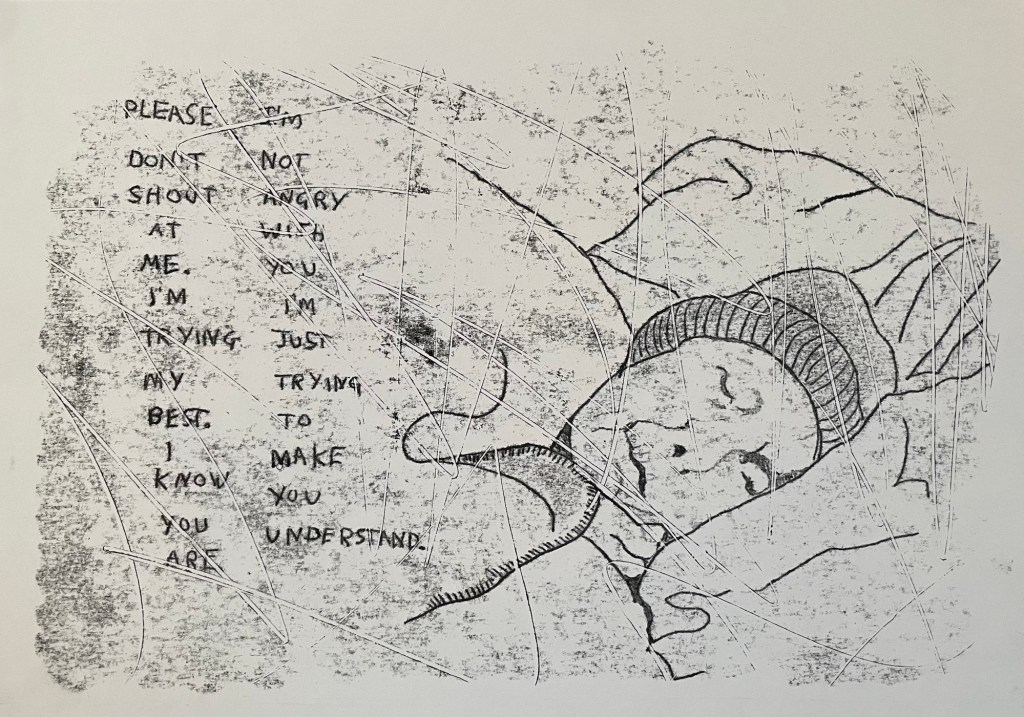
I’m now able to look back at the three monotypes that I made of my mother. I feel that it was the right thing to do. It was something that I always knew I would have to address and it was something that I had to tackle early doors. I think it has helped. I went back to my mother’s house not so long ago and I didn’t feel the usual sinking feeling of dread as I walked through the front door. I was actually able to sit down by myself in silence and remember some of the good times when we all lived there as a family, even when it became dark outside. A small positive step in the right direction.

As finished pieces of work, they are what they are, vehicles by which I transferred debilitating thoughts into another space. Could I have done them differently or executed them better? Yes, obviously, but I don’t look at them that way; it is what they signify and make me feel that matters: despair, confusion, sadness, resentment, helplessness, isolation and fear. I chose monotype because it is, as soon as it is, and there is no way back. It was all about the process, not the result. If I had to make a change I would change their order – I made them in the order of the conversations – they would work better as a series if their order was reversed, with each one making more sense of the one before.

I took my daughter back to uni at the weekend, and she phoned me up earlier, chasing me for some information I was supposed to give her. My husband chipped in that it wasn’t any wonder that I hadn’t got round to it as I seem to spend all my time blogging – well, if I don’t have anything else to show for the next year and a half, at least I’ll have this blog!

Vienna Calling

I have just returned from an amazing 4 nights in magically festive Vienna, having had my fill of glühwein, Sachertorte and boiled beef broth (it loses something in translation!).

I’ve never been before, but will definitely be going back. Beautiful architecture, and so much to do, not least the seemingly endless supply of museums and galleries.

The Leopold and Belvedere were on my hit list as housing the greatest number of works by Klimt and Schiele. I had a nagging fear that the episode might end the same way as Michael Craig-Martin but, instead, I came away with a greater appreciation of all the details that can’t be gleaned from a photograph: the brushstrokes, the surprising thickness and coverage of the paint, sometimes leaving areas of the canvas exposed and the purity of colour. It was a revelation to get up really close and just look.

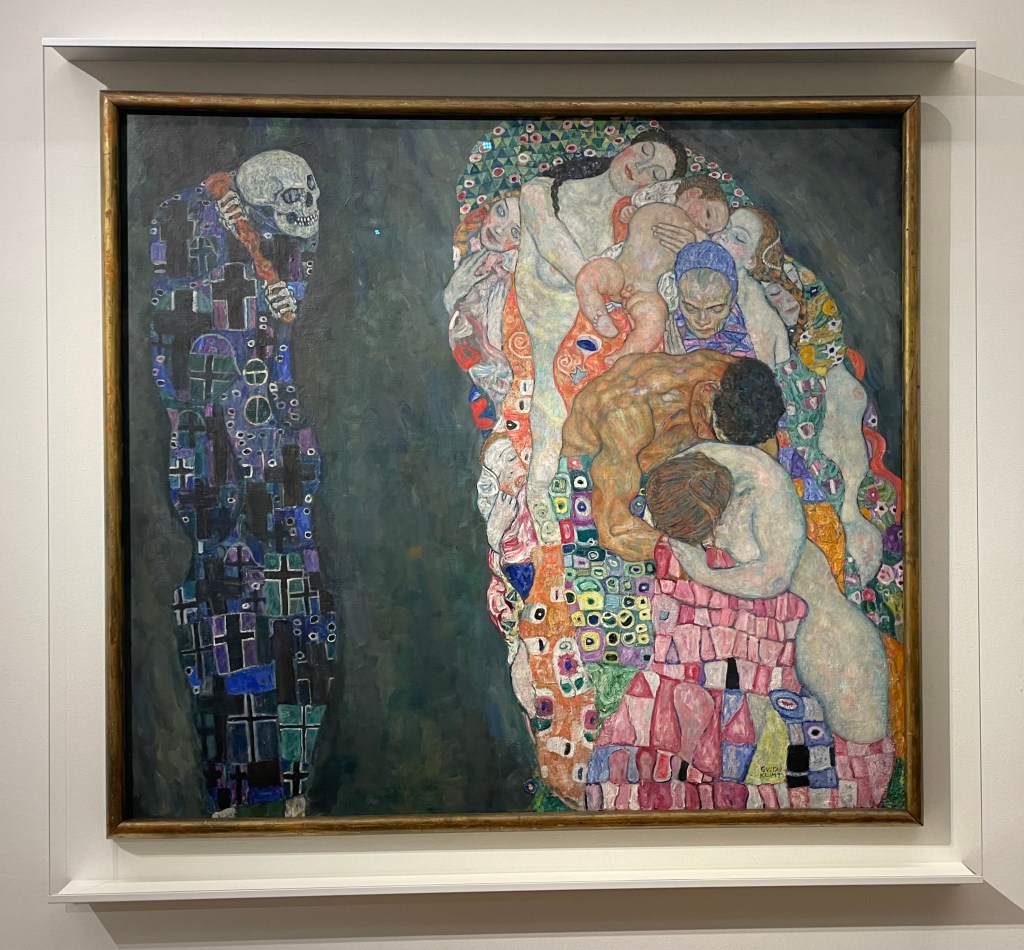
Death and Life 1910/15 , Klimt

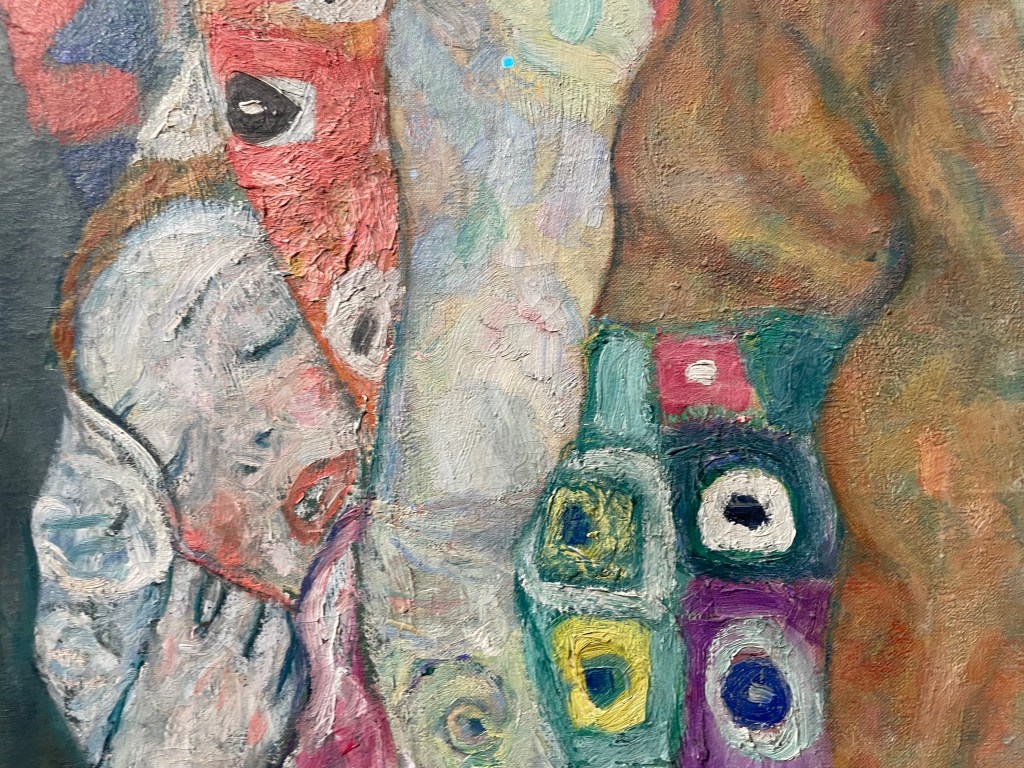
Detail

I had always thought that Klimt applied paint quite uniformly and flat, so I was surprised to see the thickness of the paint and multi-directional brushstrokes. I like the way Klimt paints skin in all its imperfections and blotchiness, ranging from the pale and cold whiteness to the warmer, darker tones of the male figure.

Seeing ‘The Kiss’ was an interesting experience; it reminded me of when I saw the ‘Mona Lisa’ in the Louvre. Being one of Klimt’s most famous works, along with the ‘Mona Lisa’ and Van Gogh’s ‘Starry, Starry Night’, it is one of the most mass reproduced images of all time. I was underwhelmed, and I found it quite sad, as I was expecting to be bowled over by it. It was the most crowded room at the Belvedere, but what I found particularly interesting was that the crowd of people in front of it, holding up their phones and cameras, seemed totally uninterested in looking at it in any great detail – in fact they had left a sizeable gap in front of it so that they could get it in shot. This was handy as it allowed me to perform a flanking manoeuvre to get in front of it, to try and appreciate it as a work of art, as opposed to just a selfie opportunity with a celebrity. There was no point taking a photo – it was so strongly lit, and the lights reflected in the glass covering it. I grappled with my feeling of ‘numbness’ for the rest of the day, and as I was mulling it over in my mind, holding yet another mug of mulled wine in my hand, the answer came to me when I remembered John Berger’s ‘Ways of Seeing’ in which he considers the effect of reproduction:

”When the camera reproduces a painting, it destroys the uniqueness of its image. As a result its meaning changes. Or, more exactly, its meaning multiplies and fragments into many meanings … Alternatively one can forget about the quality of the reproduction and simply be reminded, when one sees the original, that it is a famous painting of which somewhere one has already seen a reproduction. But in either case the uniqueness of the original now lies in it being the original of a reproduction. It is no longer what its image shows that strikes one as unique; its first meaning is no longer to be found in what it says, but in what it is.”

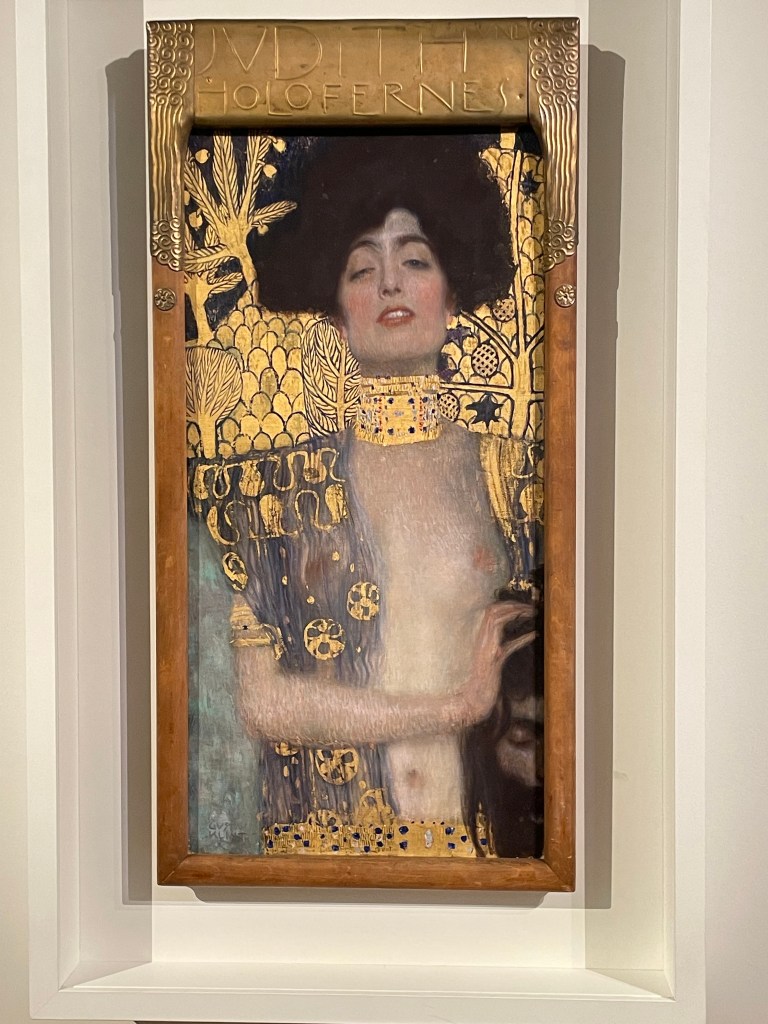
By contrast, in the next room was one of my favourites, ‘Judith and the Head of Holofernes’, a depiction of a strong femme fatale, the polar opposite to ‘The Kiss’.

Judith and the Head of Holofernes, Klimt, 1901

What can I say? I love gold leaf: I’m a magpie. Despite the abundance of gold in the painting, the eye is still drawn to the figure of Judith which is thrown forward by the decorative background. She is holding the head of Holofernes, somewhat gently, which is shown half in and half out of the frame, relegating him to a secondary role in the drama which has unfolded. There are intriguingly two decapitated heads in the painting; the treatment of the choker has effectively severed Judith’s head from her body. It is an image full of female power, sexual and otherwise.

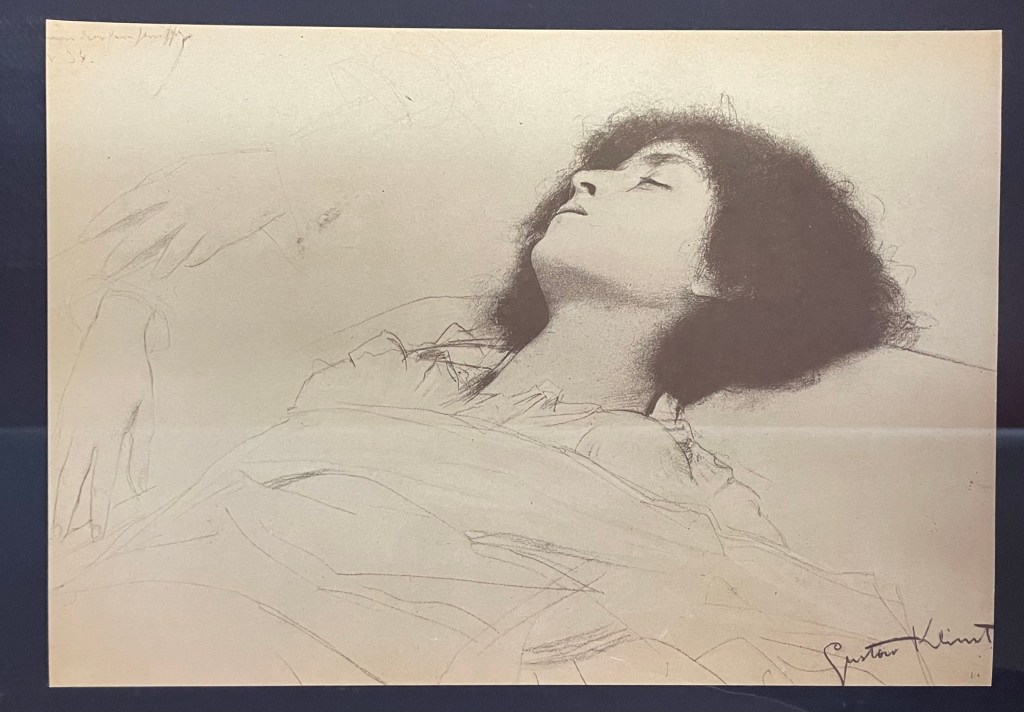
It’s easy to forget that Klimt was a master draughtsman.

His drawings are exquisite. The simple monochrome of pencil or black chalk, a quiet antidote to the noise of gold and vibrant colour.

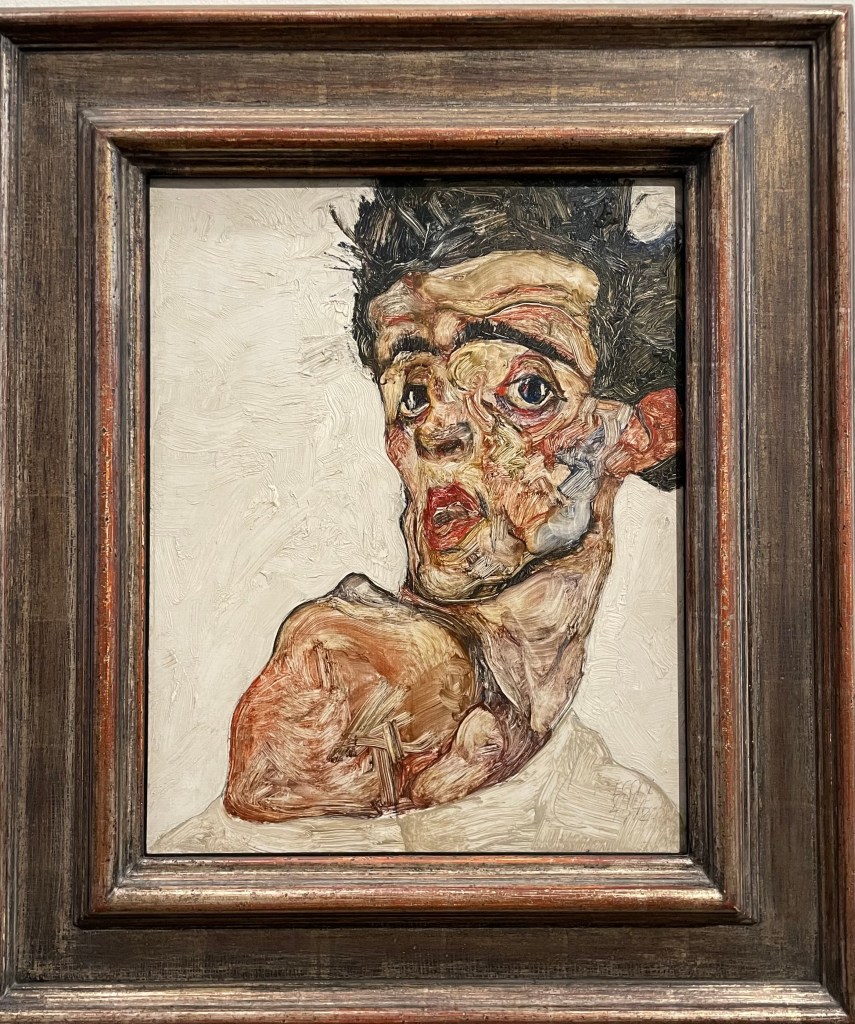
Self-Portrait with Raised bare Shoulder, Egon Schiele, 1912

I love this self-portrait; it is so expressive, and the fluidity of the brushstrokes creates a sense of movement and vitality. It is reminiscent of the Lucian Freud self-portrait in my earlier post, “I’m Sorry, Michael…”. It is quite small but he manages to pack a lot into such a confined space, including his shoulder, which by extension includes his body. The difference in treatment between the figure itself, which is quite thinly painted, and the more heavy impasto in the background is extremely effective. It is painted on wood, which might explain the wonderful textures on the face which would have been caused by the hog bristles in the brushes, although I have read, in a book on artists’ palettes, that Schiele would often use a brush to remove paint from a canvas in order to create texture. I particularly like the simple use of sgrafitto particularly above his left eye, and to delineate the edge of the chin against the neck.

The description next to this piece was interesting in that it described Schiele’s connection with his own body as both a fusion and a dissociation, in the context of the main theme of Viennese Modernism ie the individual becomes a dividual – something that can be divided.

The Embrace, 1917, Egon Schiele

This painting is so impactful. It’s approximately 1.5m by 1m. It shows Schiele with his wife, Edith Harms, in a loving and tender embrace. Unlike a lot of his work, this does not, to me at least, have any sexual or erotic overtones. There is a sense of completeness, in that Schiele depicts himself physically emaciated as he envelops and buries his head in the hair of his wife, almost blending into one, in an act of nourishing love. It’s even more poignant to think that this is one of his last works, as they both died within days of each other a few years later in the flu epidemic of 1918-20. He was only 28.

Both Schiele and Klimt were ahead of their time; they were disruptors. Schiele was akin to Sid Vicious and the punk movement, and Klimt founded the Viennese Secession, breaking away from the constraints of the Künstlerhaus. In today’s art world there is no prescribed way of doing things, no longer any art movements or – isms against which to rebel; artists have never been freer to express themselves in whatever way they wish, so I wonder how it is possible for an artist to stand out; how to make a difference in a world of differences.

ARTificial Intelligence

In our session this week we looked at AI image generation, in particular, how the tools are trained by using a huge number of datasets created by scraping data from the internet; the impact of this form of training including bias and breach of IP rights; its ethical and environmental impact; and the effect on us, as artists, in terms of our own relevance, the potential use of our work as training input, and our ability to use AI to create output in our artistic practice.

It is astonishing how quickly this area is developing. However, until it reaches a stage whereby AI can create an image in which there is human emotion and imperfection, we probably won’t become obsolete just yet.

Being from a legal background, I was particularly interested in the issues that generative AI tools have thrown up in terms of intellectual property rights. The main issues seem to be the potential breach of copyright in both the collection of data for training, and the output created, as well as the question as to who owns the output and whether it should itself be protected by copyright.

The problem with data scraping is that whilst the data is widely available in the public domain, this doesn’t mean that it can be copied and used without limitation (in the UK the only current exception to copyright protection in respect of text and data mining is for non-commercial research). This could mean that any images of artwork which I have produced, and which are publicly available on the internet, could be used to train generative AI and, consequently, could possibly form part of an output image generated by a third party, despite the copyright in the original image belonging to me. It’s a contentious issue, and there is lots of litigation going on at the moment across numerous jurisdictions including the UK and the US. In the UK, Getty Images has taken action against Stability AI for using millions of Getty Images to train its Stable Diffusion tool. Claims have similarly been made in the US against Meta, Midjourney and Anthropic, amongst others.

Another related issue, is that generative AI platforms will generally reserve the right to use any input or prompts from users to improve the performance of the tool, which could have implications in terms of privacy and confidential information.

Whilst it is unlikely that generative AI will create images which are exact reproductions of copyrighted images which have been used for training or as input, should there be sufficient similarity, there may be a potential breach of IP, but this will depend on an assessment being made in each case. It will also depend on being able to pinpoint where the content has come from, bearing in mind the huge number of resources across many jurisdictions. As part of their case with Getty Images, Stability AI are relying on the defence of fair dealing, as well as that of parody, caricature and pastiche i.e. that the image generated is not a replacement for the original image but a pastiche, and so it does not affect the market for the original image or its value. It probably didn’t help that in this case that some of the output images contained parts of the Getty Images watermark. This case is destined to be a trailblazer, but we won’t know the outcome until the middle of next year.

It is theoretically possible that an image created by prompts and inputs from a user of generative AI is capable of being owned by the user. However, the user cannot assume that they own the content or that they are able to use it as they wish. Firstly, who is the owner of the created image varies from country to country. Secondly, the terms and conditions of the platform may determine ownership and rights e.g. Midjourney’s terms and conditions, whilst providing that the user owns the created image, state that by using the service, the user grants Midjourney and all its affiliates etc. extensive rights in relation to the output image to reproduce and sub-license it etc. at no charge, and royalty free.

In the UK, the author of original literary, dramatic, musical or artistic work owns the copyright in that work, unless it was created in the course of employment or by way of commission. There is no need for registration in order for the work to be protected, unlike in the US where it has to be registered with the Copyright Office. In fact, the UK is one of the few countries which recognise copyright protection for computer generated works. However, for the work to be original it must be the author’s intellectual creation and reflect their personality. It is not clear how this might be applied in the context of work created by AI. Furthermore, the ‘author’ is the person by whom the necessary arrangements for the creation of the work are undertaken. So, who is that? The user who specifies the prompts, or the person who created the AI tool? This issue is likely to be decided on the facts of each case, including the T&Cs of the platform.

It’s all very much up in the air, and destined to become even more complicated, the more sophisticated generative AI becomes. For the time being, as artists it would be a good idea to take the precaution of reading the small print of the platform being used, keeping detailed records of the process being used including all the prompts in response to which the image was generated.

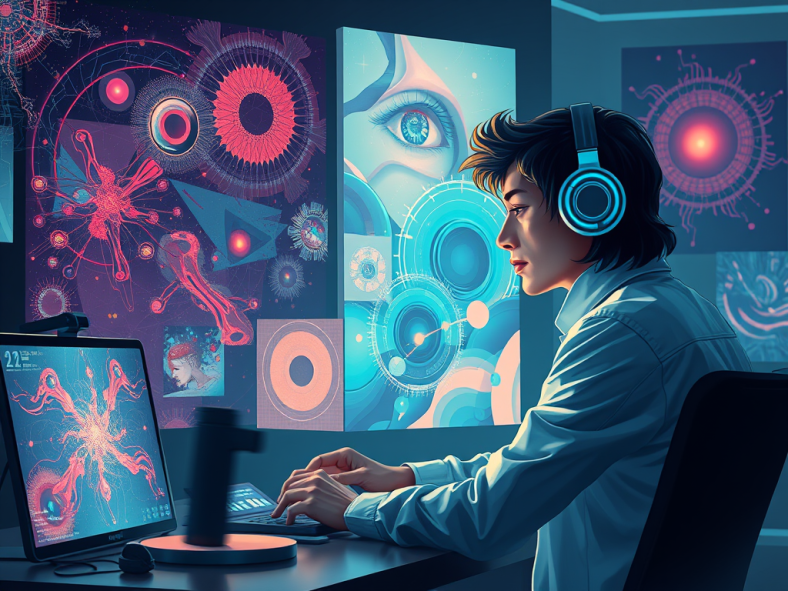
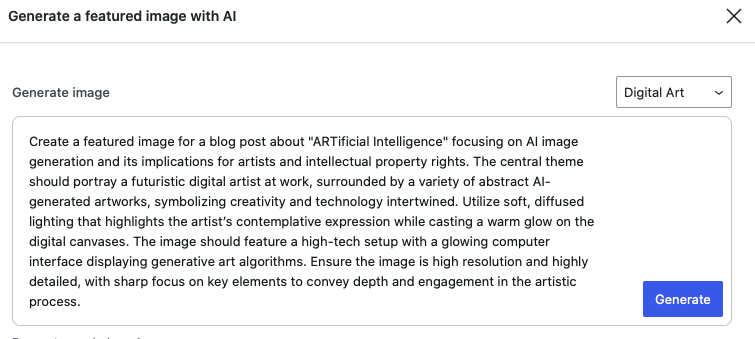
Whilst writing this post, I noticed the WordPress AI Assistant. It created the image at the top of this post after generating the following prompt based on the contents.

I’ll finish with Alan Turing’s warning which he gave in a lecture in 1951:

” Once the machine thinking method had started, it would not take long to outstrip our feeble powers. At some stage, therefore, we should have to expect the machines to take control.”

A Wobble

I’ve often suffered from buyer’s remorse; the last time it happened was when I bought my new rug in Marrakech. Did I just buy it in the fervour of the moment? Would it actually fit in at home? How was I going to get it back home on the plane? Would it fit in my suitcase? Did I pay too much? I did haggle for it, but did I haggle enough? Had someone else bought something similar and paid a lot less? If they had, how would that make me feel? Whilst I appreciate that the worth of something is what someone is prepared to pay for it, everything is so much simpler and fairer when there is a fixed price.

I experienced a new feeling recently – blogger’s remorse. Should I have posted ‘Three Conversations With My Mother’? In the moment it felt right, but as is always the case with me, the doubt started to creep in. The phrase ‘act in haste, repent at leisure’ could have been coined for me.

I’ve already mentioned that I seem to be a person of extremes – I’m either very guarded or a total oversharer, particularly after a couple, after which I’m plagued by cringe inducing thoughts. I had one such cringe whilst having a shower the other morning. I suddenly thought, everyone who sees my blog (I’m not kidding myself – it’s not that many!) now knows the most personal information about my relationship with my mother in her last days. Also, how would I feel if I saw my images elsewhere in the public domain? In all honesty, I felt a bit panicky and decided just not to think about it.

But not thinking about things and hoping they will just go away is not an answer. So, later that day I decided that I would process this sudden feeling of regret. I’ve always known, in the back of my mind, that I have to deal with that period of my life in order to move forward. Memories of it have taken my head hostage and I needed to offer a swap – somewhere else for them to inhabit, to free up my mind so that I have the space to remember all that was good. In essence, I have emotionally vomitted the negative and harmful feelings onto the page, and I can now look at them and still feel the way I did, but when I put them away, hopefully, they will stay away.

This course is a once in a lifetime opportunity for me, and I need to wring everything I possibly can out of it. I’m trying to find out who I am, and in so doing I need to be fully committed to the process. To avoid sharing parts of my life because they are too personal would be to cheat myself, and so, I’m all in.

Three Conversations With My Mother

Some were surreal, others were sad. Sometimes she was lucid, sometimes she was delirious, sometimes it was morphine. Three in particular have lodged themselves in my memory. My logical brain tells me that she wasn’t herself, that her brain chemistry was all over the place, trying to cope with the enormity of it all.

It’s just that the last conversation I had with her, was the last.

I suppose I could talk about them to someone, together with the rest of it, but I’m not sure the spoken word will work: the words will come out of my mouth and vibrate through the air to enter someone else’s head. Then they are gone. I need a more substantial, tangible way of dealing with them, through the written word and imagery. I need to be able to confront them, physically.

I’ve had some inner conflict as to whether I should publish the image in which her face is visible; when she was ill and at her most vulnerable. This was a woman who dragged herself through the house, after breaking her leg, in order to phone for my sister to come over and make her look presentable before calling for an ambulance. She was a very private person. But she is no longer here. If it helps me come to terms with it, I think she would be ok with it. My sister’s on board – she reads this blog. She has her own conversations.

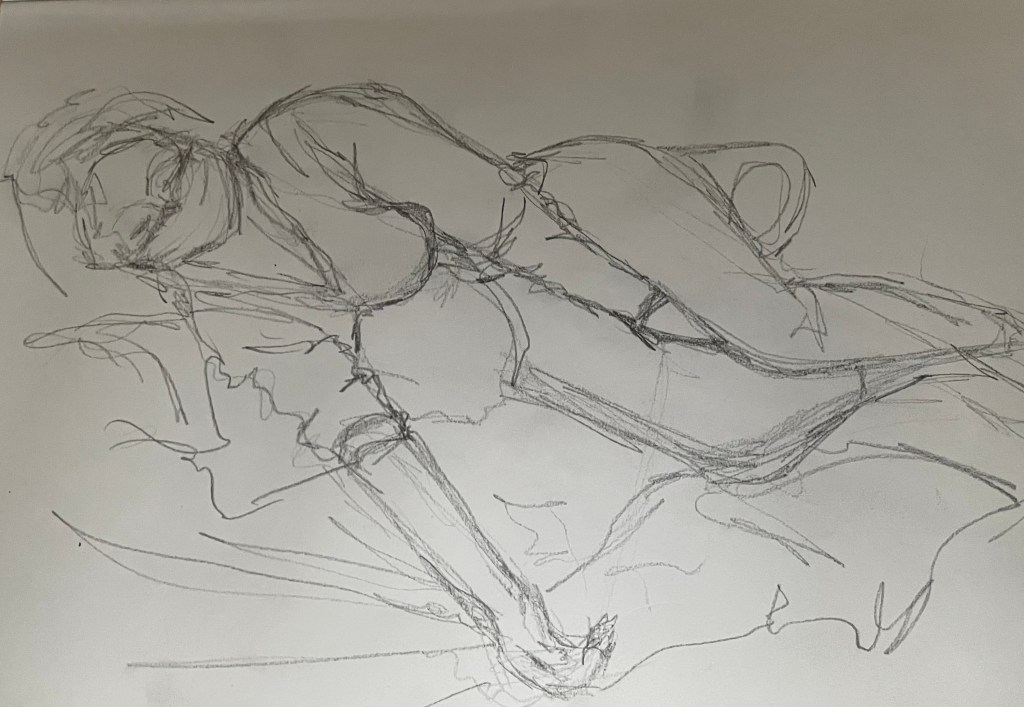
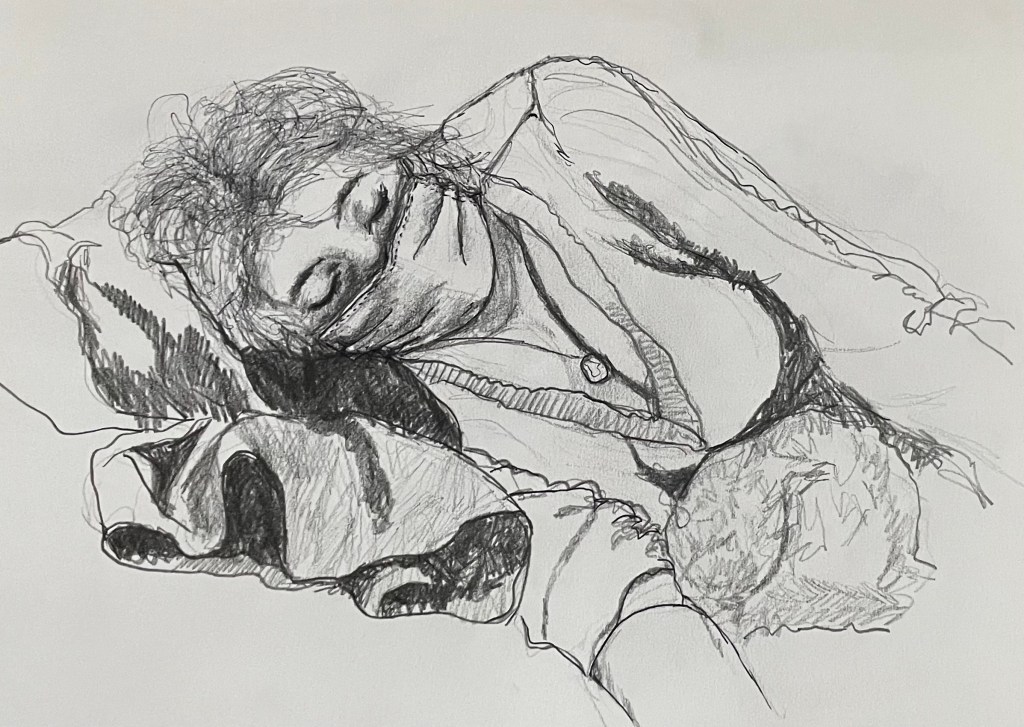
Three Conversations With My Mother No 1, Montotype on A4 Cartridge Paper

Three Conversations With My Mother No 2, Monotype on A4 Cartridge Paper

Three Conversations With My Mother No 3, Monotype on A4 Cartridge Paper

I don’t need to reflect on them. I don’t want to reflect on them. Not yet.