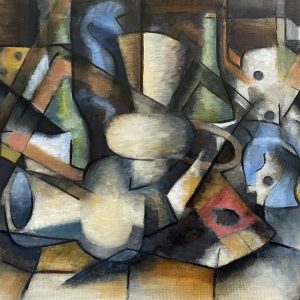
Bitter Sweet Symphony

…Tryna make ends meet, you’re a slave to the money then you die…”

I don’t want to give the impression that I’m on a downer; I’m not, it’s just a coincidence that the things I want to post about at the moment all involve an element of death, which is not a bad thing, as it reminds me to live.

I had never really contemplated my own death until my father passed away in 2013; then I obsessed about it for quite some time. There I was sitting quite happily on my branch in the tree of life when suddenly there was one less person between me and the end; to be fair I was so far along it that it was becoming more of a twig than a branch and had started to bob up and down quite precariously in the breeze. But there’s nothing like the death of someone of a similar age to drum home my own mortality. I had lost friends at university, but I was young then, and whilst the sense of loss was immense, I still felt invincible; those were extraordinary deaths.

Last night my husband told me that an old work colleague of mine had died a couple of weeks ago. I worked with him for seven years; I hadn’t seen him for twenty, yet still the news profoundly affected me. We were more or less the same age and level of qualification; I had previously worked at two law firms before joining the firm where we worked together. He had trained, qualified, and become a partner at that firm, a period spanning 32 years. He had never known any different, had never stepped outside of his comfort zone or worked with new people who may have inspired him or influenced him in different ways. Why not? My husband ventured that maybe he stayed for the money which financed a certain lifestyle and that he was happy with that, with that way of living. That’s true; just because it is a path that I would not have chosen does not make it less valid, and, in this respect, I appreciate that I am lucky in that I have a choice; a lot of people don’t have that luxury.

He would have been earning a fair amount, working incredibly long hours and have been under intense pressure. Was it all worth it? If I had said to him 20 years ago, when we shared the same office in which he would tell me all about his salsa classes, his training for the triathlon he was planning to compete in, or the latest date with his girlfriend, that he had a ticking time bomb inside him which would kill him at the age of 55, would he have made the same choices? Maybe not, but that’s the benefit of hindsight. As Kierkegaard says:

It is really true what philosophy tells us that life must be understood backwards. But with this, one forgets the second proposition, that it must be lived forwards.”
Reflecting on Resentment II

I’ve rewritten this post so many times. It has become progressively shorter. Sitting back and reflecting, I can see what is important. The first version was just a rant.

In late 2022, my mother was diagnosed with oesophageal cancer. No treatment was offered. At best she had 6 months left. Her GP had messed up. The hospital messed up. My sister and I cared for her full-time. It was the worst, and darkest period of my life.

This wasn’t how it was supposed to be. Six months to live? Well, we could go places and make the most of it, create some new memories. But she was already too weak. Instead, the memories I have of that time seep into my mind when it’s not thinking of something else, usually before I go to sleep; then I can’t go to sleep and I sit up alone in the kitchen turning it all over, reliving it. Nothing makes it feel any better.

My mother died at home in the spring of 2023, three days before her 85th birthday. I cannot say with any honesty that she experienced quality of life in those last months. She was waiting to die, and I was just watching her gradually turn into a skeleton.

I resent that medical professionals have failed my family, not just in respect of my mother, but also my father – I made formal complaints in both instances – lessons will be learnt, apparently – but this has done nothing to ease my resentment.

I resent that because she was old, my mother was effectively written off.

I resent that everything was such a battle and I had to spend so much time chasing and making sure things were done.

I resent that there are old people in hospital who are overlooked, and who don’t have a voice or someone to speak up for them.

I resent that my sister and I were left to deal with everything, both before and after my mother’s death.

I resent that in the last few months of my mother’s life the days were short, and the nights were long.

I resent that those last few precious months were stolen from me.

I resent that the last words my mother spoke to me were when she wasn’t herself.

But, most of all, I resent the resentment that I feel: it’s preventing me from moving on.

Reflecting on Resentment I

During the last session we considered the premise that resentment blocks creativity.

Resentment is a feeling of anger or unhappiness about something that you have been forced to accept and you don’t like, or think is unfair. It comes from the Latin verb sentire, and so it is an emotion which is ‘re-sensed’ time after time, perhaps even increasing in intensity. Perhaps we feel resentment that other artists are better than us, or that they have works accepted in exhibitions and we don’t.

As I get older, I try as best I can to keep as much negativity out of my life as possible. I may initially feel it, but then I try to process it by turning it on its head, or actively dealing with it. I can’t feel resentment (in the sense of it being a recurring emotion) that other artists are better than me or are more successful – instead I use the initial negative feeling (which is probably more envy than anything else) to spur me on to try again, to fail again and to fail better, because inherent in that form of resentment is the feeling of failure.

For the last few years I have submitted work to the RA Summer Exhibition but I have never made it to the next round of judging. Each year I experience a moment of crushing disappointment and vow never to do it again, but then January comes around and off I go again. I’m clearly looking for validation, but I often think to myself that if ever I do get in I’ll probably never submit again, and maybe it won’t even make me happy.

My husband confessed to me that he had always wanted to paint. Why don’t you just do it, I asked him. He started with watercolours and over time became good at it. I suggested that he try oils as they are far more forgiving and I thought he might enjoy the freedom of using them. I bought him some as a gift along with some boards and brushes. He signed up to an oil painting class and shortly afterwards submitted one of his oil paintings to the Summer Exhibition. He made it through to the last 4,000 out of 16,000 entries on his first attempt. Did I feel resentment? No – I felt proud, with a strong sense of irony. He felt ecstatic with a strong sense of embarrassment.

If someone treats me badly I tend to think that it is more about them rather than me, but if it is something that I know will eat away at me and become a resentment I try to deal with it head on, unless doing so will cause irreparable harm. But, there is one particular instance of resentment which I haven’t been able to let go of no matter what I do, and I feel it as strongly today as the day I first felt it.

Should Art Ever Be Destroyed?

This is the question debated in the latest RA magazine.

Mary Beard argues yes…

”To suggest that images are inviolable, to be protected from harm in the safe space of a gallery, denies them power. Part of the job of art is to challenge certainties, and make us see the world differently, in uncomfortable ways… But if we surround all art with a glow of pious reverence, if we put it on a pedestal with a ‘Do Not Touch’ label, protected by its very definition as ‘art’, we will have deprived it of one of its necessary functions: to make us angry. Ocassional destruction is the price we pay for art doing its job.”

Tomiwa Owolade argues no…

”Anyone who defends the right of art to be free of censorship needs to acknowledge a basic truth: not all works of art are great. Many are bad. Some are even morally offensive… No art should be destroyed. Because to destroy it it or call for its destruction, is to legitimise something even more pernicious than the existence of morally repellent art: the furies of the mob… The defence of art against destruction is not simply a defence of the soaring works that universally enchant and enrapture us. It is more importantly a defence against the baser instinct to destroy that, once unleashed against art, is likely to spill into cruelty against people. As the German poet Heinriche Heine said: ‘Where they burn books, they will, in the end, burn human beings too’.”

What do I think? I wholeheartedly agree with Mary Beard that the job of art is to challenge and at times anger but anger is an emotion and is purely subjective. Just because one person is offended by something does not make it offensive. Others may not be, and her proposition that those who are offended should be able to destroy art and that the only power that piece of art has is in its destruction is not something I can hop on board with. It also doesn’t address the issue as to whether it is the art itself or the maker which is considered to be offensive. Would it be acceptable to destroy great art because it has been made by bad people?

The Weeping Woman

I draw you in with suggestions of Picasso, but I’m afraid it’s me, again.

I’ve always known that art can move, but reduce one to tears? Someone once told me that they couldn’t stand in front of a Rothko without crying – ‘Get a grip’ is how I responded, in my head.

Then I stood in front of Van Gogh’s ‘A Wheatfield, with Cypresses’ in the National Gallery. Why can’t I see it clearly anymore? Why do I have tears running down my cheeks? Why hadn’t I put any tissues in my bag? Why is the guard coming towards me with a strange expression on his face?

Was it because I had recently watched ‘Loving Vincent’ and a documentary about this tortured and anguished soul? That he had died without knowing of the fame and recognition which was to come? Or was it something else – the way he applied paint perhaps? Does it actually matter?

For me, I can’t separate the artist from his work – his mental and emotional fragility is embedded in his work and I find it both beautiful and overwhelmingly sad. So sad, that just someone talking about it can make me well up.

So, after spending one and a half hours in a virtual queue on the National Gallery website I have managed to secure two very precious tickets to ‘Poets and Lovers’, except that for one time only, on the morning of 9th December, there will be a lone Picasso amongst all the Van Goghs.

Hearts and Lino

”Making the decision to have a child – it is momentous. It is to decide forever to have your heart go walking around outside your body.”

This quote from Elizabeth Stone (I’m yet to fathom out who she is!) is apparently well-known, but I only heard it recently when someone, I think it was an actor, was being interviewed about becoming a parent.

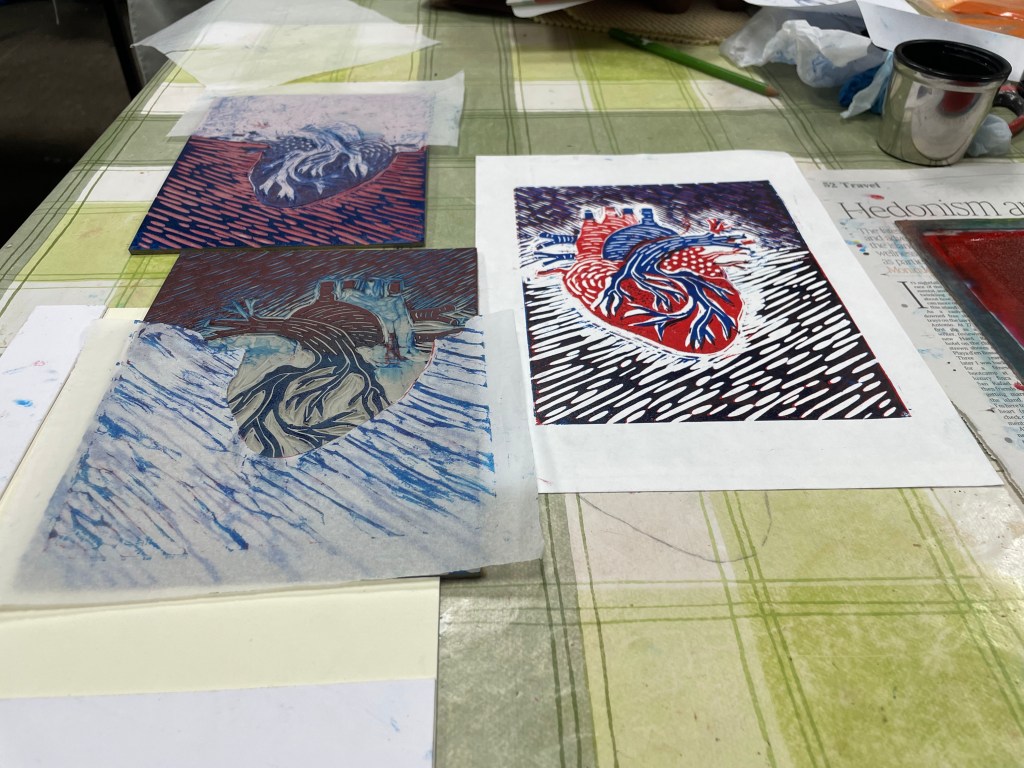
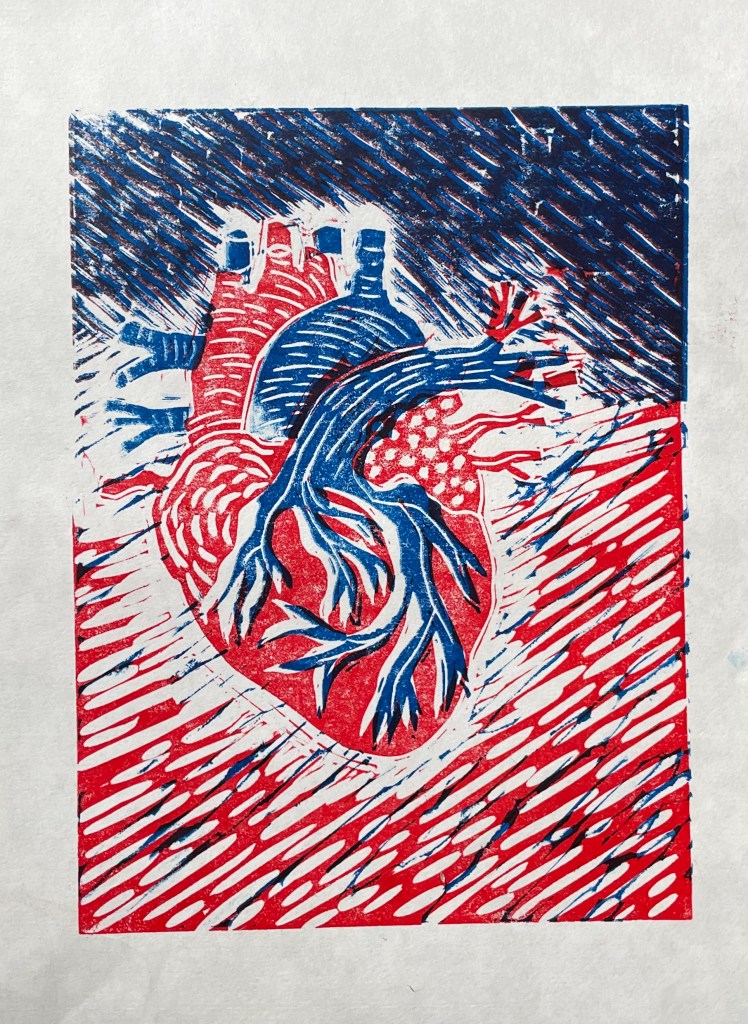
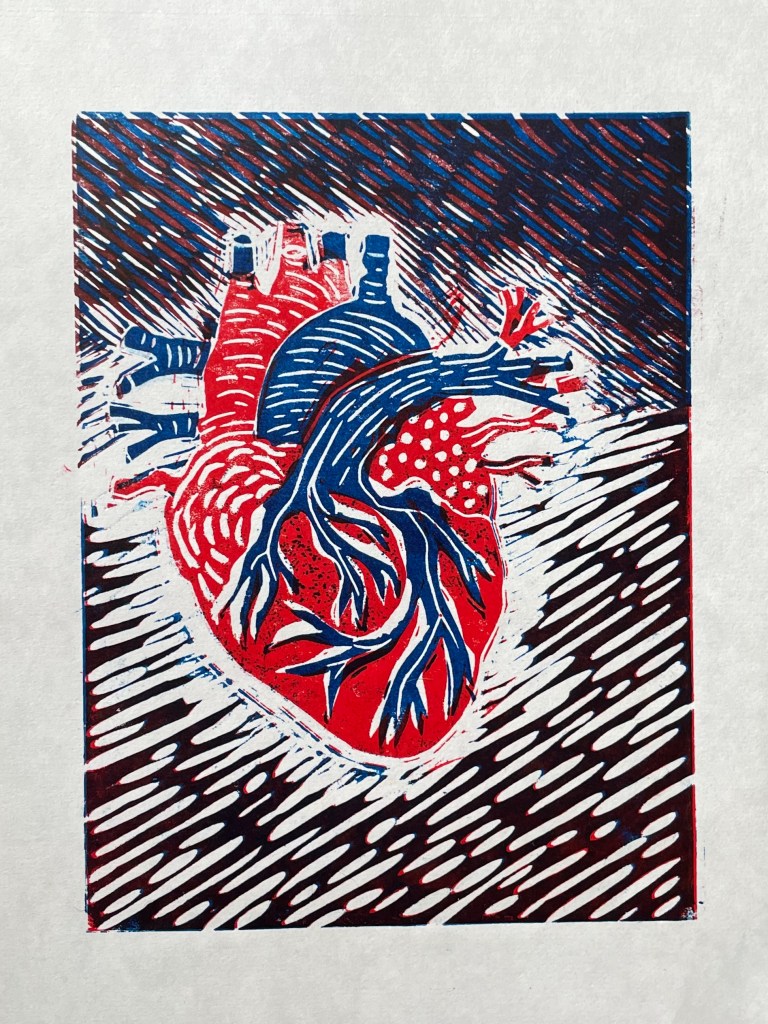
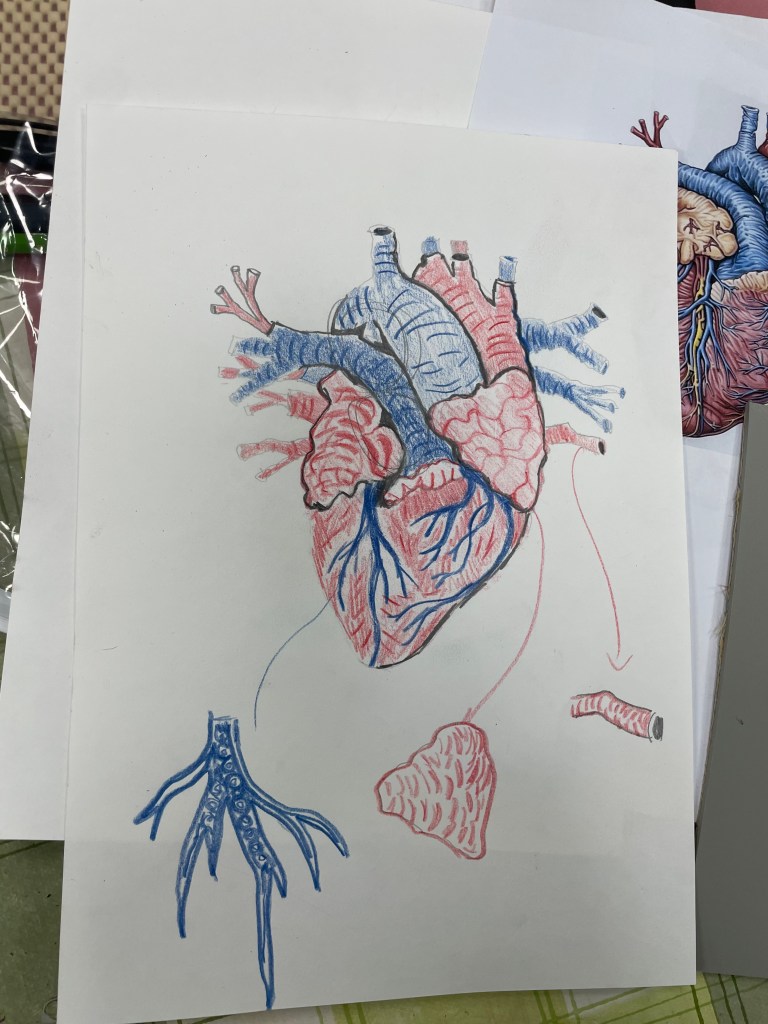
I think it sums up brilliantly the utter overwhelming sense of vulnerability and responsibility that I felt on becoming a mother. With this in mind, I attended a workshop on Saturday and Sunday on linocut led by Lisa Takahashi. Whilst everyone else started working on their images of sea urchins, birds, landscapes and flowers, I sat there, initially reluctant to reveal my chosen image of an anatomical diagram of a heart – it seemed particularly grisly and gruesome in this environment of natural loveliness. I suspect a few eyebrows were raised, on the side!

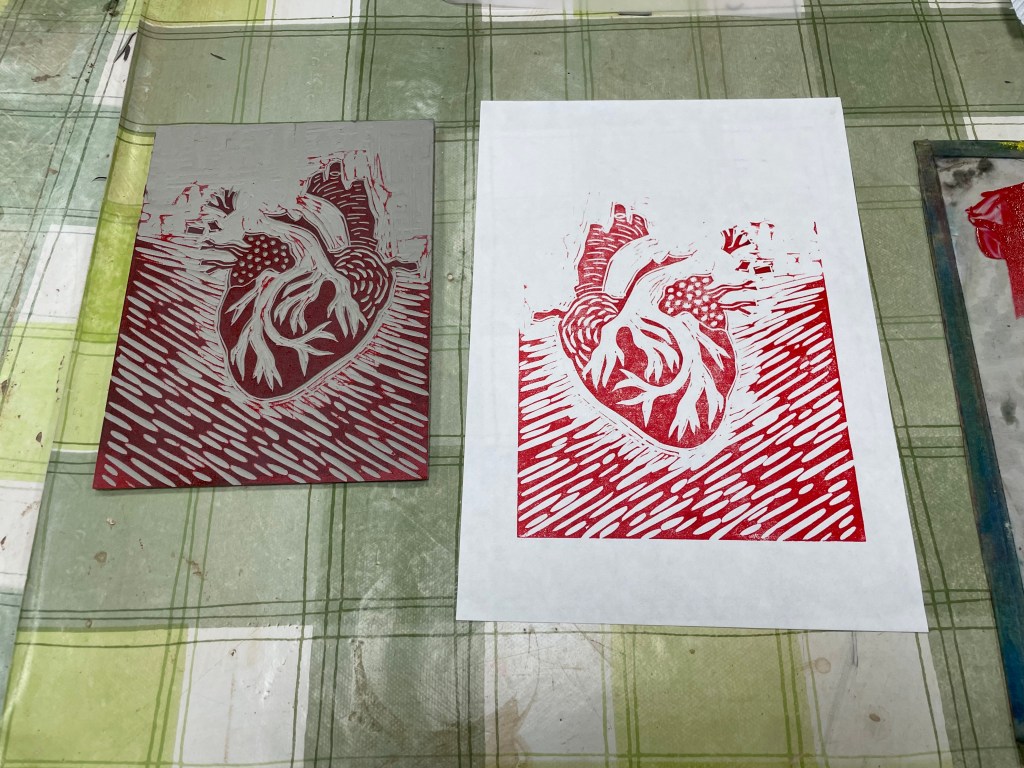
The workshop was on multiple-block linocut, a process in which you use separate blocks of lino to print individual colours, as opposed to reductive linocut where the colours are printed from the same block. I’ve only ever done a basic linocut with a single colour, so the process of working out what areas to cut for each colour meddled with my head a bit. Also, because you use separate blocks you can reprint in different colourways, although there is more room for error in terms of cutting and registration when printing, which can lead to unintended gaps and overlaps which add to the feeling of it being handmade, apparently! Also, as with all linocuts, you can sometimes get marks from ridges of lino which have inadvertently picked up the ink, particularly in large areas which have been cleared out, and this is called “chatter”, which is a lovely term.

We were limited to two colours, which effectively means that there can be up to four colours in the print: the two chosen colours, their resultant mix, and the white of the paper. I chose red and blue as they were the colours on the diagram.

Well, the prints are a bit rough and ready. I’m not keen on the white area around the heart – originally the background was also red and so I wanted some differentiation between the two, but later on I decided that I preferred the darker background. Having said that, I think it does give the image some dynamism, as if the heart is beating and pulsating.

The Invasive Sibling

My daughter turns 21 next year and my husband and I have decided to throw a bash not only to celebrate her birthday but also some milestone ones of our own which have gone by not properly celebrated.

I was chatting to my daughter the other day about the fact that my brother, who lives in Belgium, has declined the invitation. I explained to her that I felt really quite upset because the last time I had seen him was when we interred my mother’s ashes in April this year and before that, at her funeral in May last year.

My daughter is not one to get into emotional discussions, despite (or maybe because) she is studying for a psychology degree, and in response she informed me that I shouldn’t worry about not seeing him because he’s inside me. Inside me? Yes, she informed me as I tried to quell the rising tide of nausea – when he was born he left some of his DNA behind in the womb and that then ended up in me.

Microchimerism, it’s called – I looked it up. It means the presence of a small number of cells in an individual that have originated from another individual and are, therefore, genetically distinct.

As I understand it, on my very limited research, when a baby is in the womb the umbilical cord can act as a two-way street – the mother’s cells travel to the baby, and vice versa, so that some foetal cells can remain in the mother, even if the baby is not subsequently born. As they are effectively stem cells they can travel to parts of the mother’s body and grow as other cells eg cardiac cells (so the baby is forever part of the mother’s heart) or they can hang around and become part of future offspring. From what I can tell, the research has mainly been in terms of cells left by male babies, as it is easier to distinguish rogue Y chromosomes in the mother’s body, however, it is generally thought that it equally applies to female cells and that female babies may leave more cells behind than male babies. This process can play a part in autoimmune diseases and also the sex of the baby may influence the development of Parkinson’s and Alzheimer’s. All exciting stuff!

I was talking to my sister about it and the possibility of expressing this by making something akin to a set of Russian dolls with her as the outside one, and my brother and me on the inside – she wasn’t keen. I fear that our conversation may have been a contributing factor to her dream that night in which she was being chased by an artist who wanted to possess her body!

“Ever Tried. Ever Failed…

No matter. Try again. Fail again. Fail better.” (Samuel Beckett)

I hadn’t come across this quote until my daughter went to secondary school, where the headmistress used it as her mantra in her quest to produce strong, independent young women who would leave school ready to deal with whatever complexities the world threw at them. It was used to encourage the girls to go beyond their comfort zone in trying new things and not to be put off by the risk of failure – “feel the fear and do it anyway” was another one of her favourites!

There are many inspirational quotations dealing with the concept of failure such as:

“Try and fail, but don’t fail to try” – John Quincy Adams

“Success is the ability to go from failure to failure without losing your enthusiasm” – attributed to Winston Churchill

That’s all very well, but they don’t deal with how we should actually process the feeling of failure, and this is something we touched on in our online session this afternoon. The problem of dealing with failure is that the ego gets in the way. Strategies to overcome the ego include sharing stories (this allows others to learn from the failure without actually experiencing it); over-acceptance of the failure (that is actively taking it and collaborating with it to make an alternative outcome); and distancing the failure (for example, by using the third person when reflecting on it). The last strategy is particularly effective as it allows you to view the failure and the person who failed objectively giving rise to feelings of empathy.

So, our task for next week is to take a risk and do something in our art practice which might not work out!

For the first part of today’s session we finished our short introductions. I had been feeling ok about it, but towards the end I felt quite overwhelmed by emotion – maybe it was because I had mentioned my constant feeling that time is ticking by at quite a rate, or maybe it was the sudden realisation that it is only now that I have made the time to do something that I have always really wanted to do. Either way it came from nowhere and left me feeling quite out of sorts for some time afterwards. Even more reason to carpe diem!

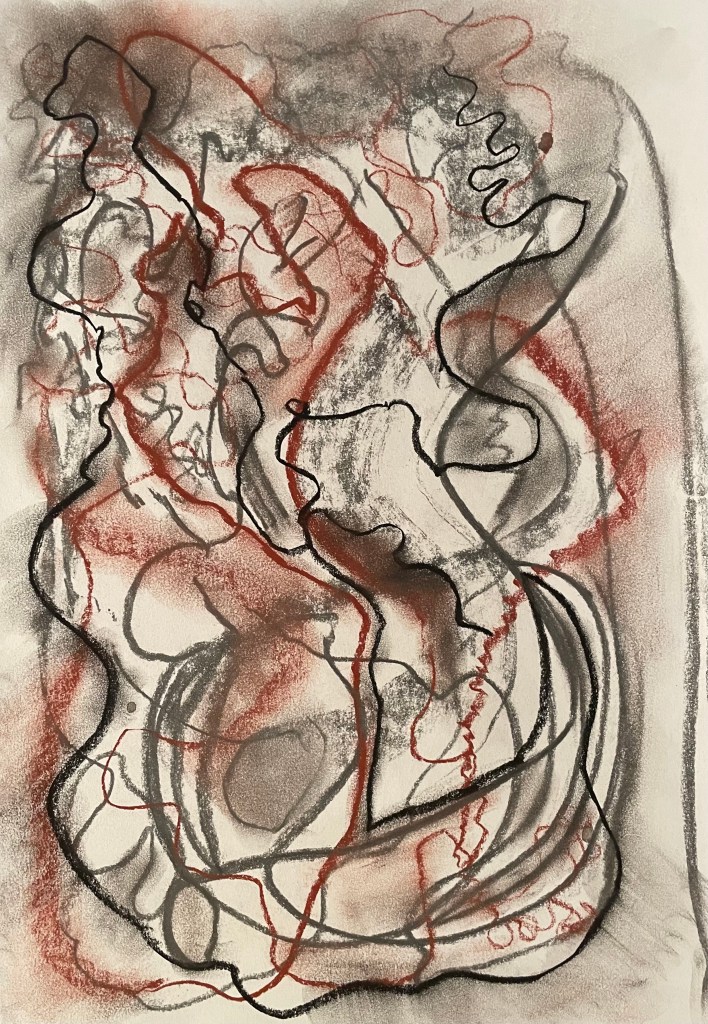
Below is today’s automatic drawing in which I used a thin and a thick piece of willow charcoal, holding a piece in each hand moving at the same time. I then used a sanguine and black conte pastel on top. It’s not as dynamic as the previous drawing and seems a bit contained – maybe because I was using both hands at the same time – I’ve never been able to do the head pat/ tummy rub thing. Next time I think I will stick with charcoal, but maybe build up some layers, and also begin from a different starting point.