It’s All Part Of The Process

I’ve been doing quite a bit of thinking this week.

The first time, as a result of our weekly session, unprofessional v professional. We considered all that is implicit in the terms professional and unprofessional, and then read and discussed an article ‘How to be an Unprofessional Artist’ by Andrew Berardini, 23 March 2016, MOMUS.

I came away from the session feeling confused, and no longer having a clear sense of direction. My aims in my Study Statement are designed to help me fulfil my aspiration of becoming a practising professional artist. I’m now questioning what I even mean when I use the term ‘professional’. If it means losing creative autonomy, losing the love of creating because it has become an expectation or much worse, a chore; having to repeatedly make things because they are popular or asked for, then, no, I don’t think that’s what I want. But what is the alternative, just to carry on as I am now, making art for me and leave it at that – be a hobbyist like my mother said; be an amateur? I don’t think that’s what I want either. That’s not why I’m here.

Maybe when I get there, if I ever do, the answer will become clear. Perhaps the best course of action is to aspire to be a practising artist for the time being, making more time for creating. There’s no point trying to run before I can even walk.

I then spent some time reflecting on the cyanotypes I made, and all the possible further paths that I could go down. I started thinking about processes and re-processing. How you can take a painting, for example, take a photo of it, digitally alter that photo, incorporate other elements, say, by way of collage, print it out, print on top of it, paint on it, photograph it, keep changing it, keep re-processing it.

It then occurred to me that I’m just one big walking process made up innumerable smaller processes – breathing, talking, thinking, digesting, and on and on. Not just that, but that life is a process with all its constituent processes. Growing, having children, loving, caring, grieving, healing, dying are all processes by which we are, ourselves, processed.

So, I think that I’ve reached a point where I’m thinking about the reprocessing of art and the reprocessing of me. It’s probably because I’ve been thinking a lot about process recently, writing the word goodness knows how many times in Doing Lines, and reading ‘Ultra-Processed People’ by Chris van Tulleken. But it does occur to me that I have led most of my life too focused on the product, and not really living in the process.

Something for me to think about.
Dialogue IV – I’m So Over It

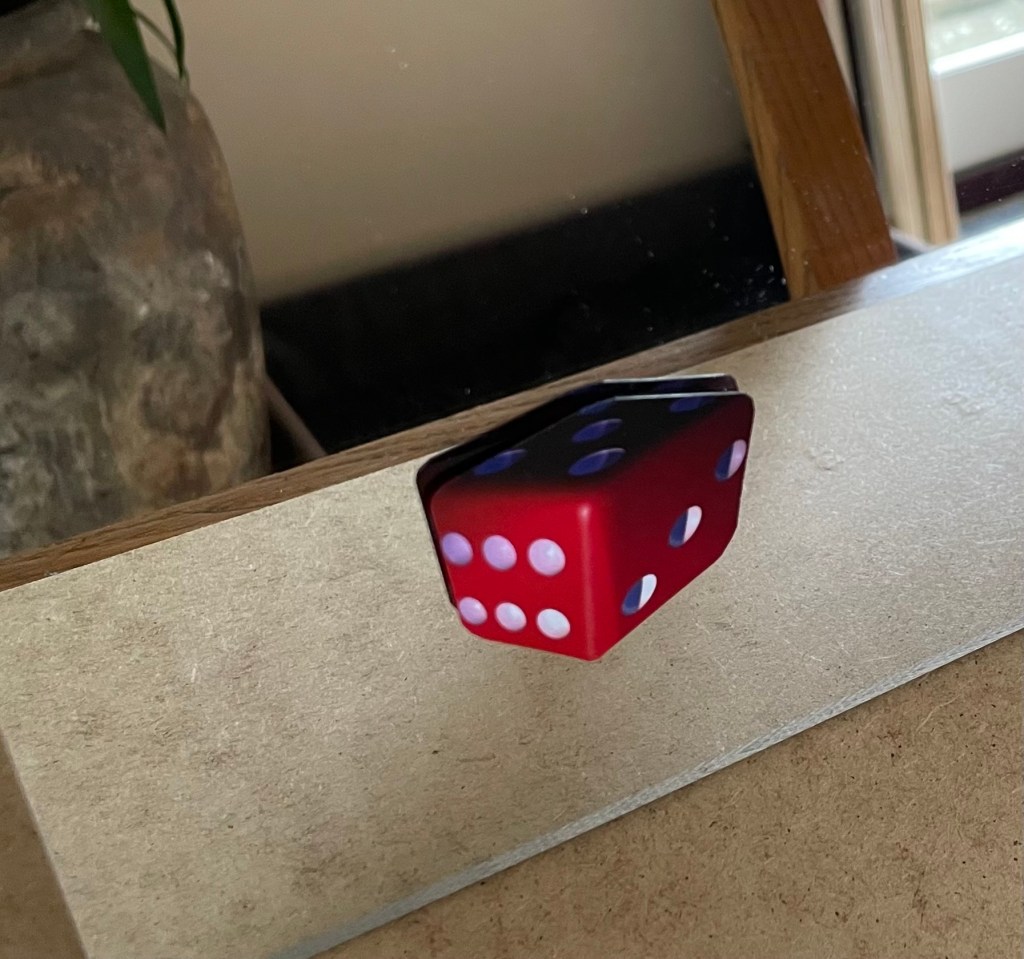
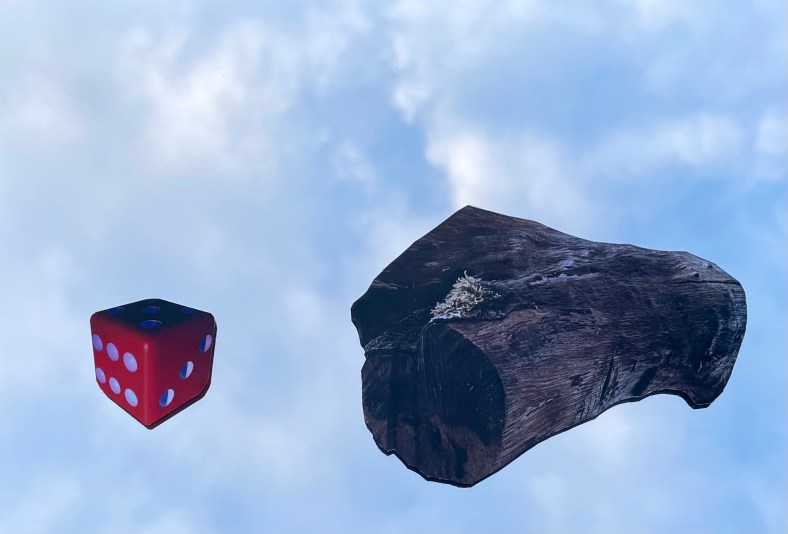
I’ve had enough of this side quest (©️Rebecca). I regret the day that I started it. Have I enjoyed any part of it? Maybe the beginning, the anticipation, the thinking about it. But when it comes to the process, it has been a monumental headache, from the execution to the photographing.

I realise a few things may be influencing my feelings about it. I keep getting reminder emails that the submission deadline is approaching – like I don’t know. Also, my daughter phoned me up yesterday morning in a crisis during an online exam – she was having IT issues. She had already contacted the helpdesk and taken screenshots, so my only advice was that she could only do what she could and not to stress, they must have procedures for this sort of thing. A couple of hours later she was feeling better, whilst I was still feeling the effects of all her stress, and trying to work out how on earth I was going to take a photo of a reflective surface. That, and the fact that some of the glue had managed to escape from under the cut-outs, and the realisation that I had fixed the die on the wrong way round.

Anyway, this morning it wasn’t raining for a change, so I took it outside. I’m not entirely sure how I’m supposed to convey its reflective qualities without including a reflection which then looks like it’s part of the work. Well, following my own advice, I can only do what I can do.

I feel like it’s been a shambles and that I’ve been amateurishly stumbling from one thing to another. The process hasn’t been the experience I thought that it would be. Because I had no expectations, I thought that there would be no stress – instead I’ve experienced confusion and frustration, and it has taken just as much out of me as other years, just in a different way. The only difference is, if it doesn’t get anywhere, I really don’t think I care at this point.

But every experience is a useful one. So what have I learnt?

  • Mirrored acrylic has an amazing quality of turning into a super static magnetic for all manner of minute particles floating around in the air and so is impossible to get clean.
  • Whilst deadlines can assist in making decision making and getting on with it, a lack of time reduces options, options which may have been the better course to follow. I should have had the image screen printed – it would have avoided so many issues – but I just didn’t leave myself enough time.
  • I’m not neat, and I don’t do small and fiddly.
  • I’ve tried something different – maybe next time I’ll enjoy it.
  • I can submit work which I don’t like and which contains what I know to be obvious errors.
  • I’m going to do mirrors again, sometime – they will not defeat me.
  • The process of exploration and experimentation is not just about serendipity and happy accidents or things that just don’t work, it can provoke feelings of confusion, frustration and it’s just not that easy.

But for the moment, I’m so over it.

Dialogue III – That Will Do

I’ve always thought that if you do something, you should do it to the very best of your ability, no matter what. My husband is very much of the ‘that will do’ approach, which used to really irritate me.

With hindsight, it was an impossible ideal – it’s obvious that I couldn’t do my absolute best at everything I did in life; there’s only so much time, and so much of me. It was a tall order to impose not only on myself, but also on others – it led to feelings of disappointment and dissatisfaction. It was also the slippery slope which led me to strive for perfectionism in my art. Over the last few months, my mindset has shifted, I would say, seismically.

That’s not to say that I’ve stopped caring, or have become laissez-faire. I would like to say it’s because I now care much less about the result, and more about the process, but I’m not quite at that point yet. It’s more that I’ve stopped imposing such high expectations on myself – in the past their achievement might ultimately have given me a moment of satisfaction, but it was rarely ever enjoyable or something that I actually wanted to do. Now, I feel that I am motivated by what interests me, and I would still like to do my best, for example, in the sense of making the most of opportunities and ideas, but I recognise that there are so many variables which could influence what that might be.

Anyway, long story short, I’m done, finito, and heaven forbid – it’ll do.

So, I had the mirror images printed and fixed them to the back of the existing cut outs. I used a crafter’s glue – Tombow mono liquid glue – as it seemed the least likely to cause buckling etc. Now the cut-outs were thicker than they were originally which caused a problem of the white edging. Also, even using a brand new craft knife didn’t prevent some of the edging being visible face on, which was particularly irritating – I don’t really do fiddly stuff and I’m not the neatest – as I had been really careful when cutting them out. I used some highly pigmented coloured pencil to get rid of the white as best I could. I then glued the cutouts onto the mirror, which proved tricky as the mirror surface had to be wet for the glue to cure properly. I managed it as best I could, but it was a tricky process trying to get enough glue on the back of the cutout for it to fix, but not so much that it would ooze out from underneath and react with the water on the surface.

It will do.

Next problem: photographing the finished piece.

Light & Shadows

I attended another of Chris Koning’s online drawing workshops at lunchtime, to brush up.

She explained the concept of light logic:

  • Highlight – the brightest light
  • Cast Shadow – caused by the object blocking the light and so the darkest dark
  • Reflected Light – dim light bounced back up from light on the surface
  • Crest/Form Shadow – shadow which lies on the crest of a rounded form between highlight and reflected light

When drawing we are not interested in contrast, but in value ie what something looks like against something else.

‘The Artist’s Mother’, Georges Seurat, 1883

This drawing by Seurat is made up of lots of different areas of tone. The parting in the hair is not a definite line; it has been created by different areas of tonal value. There are no harsh lines anywhere and there is very little contrast in the image. It is Seurat’s flawless light logic which allows us to create the rest of the information ourselves.

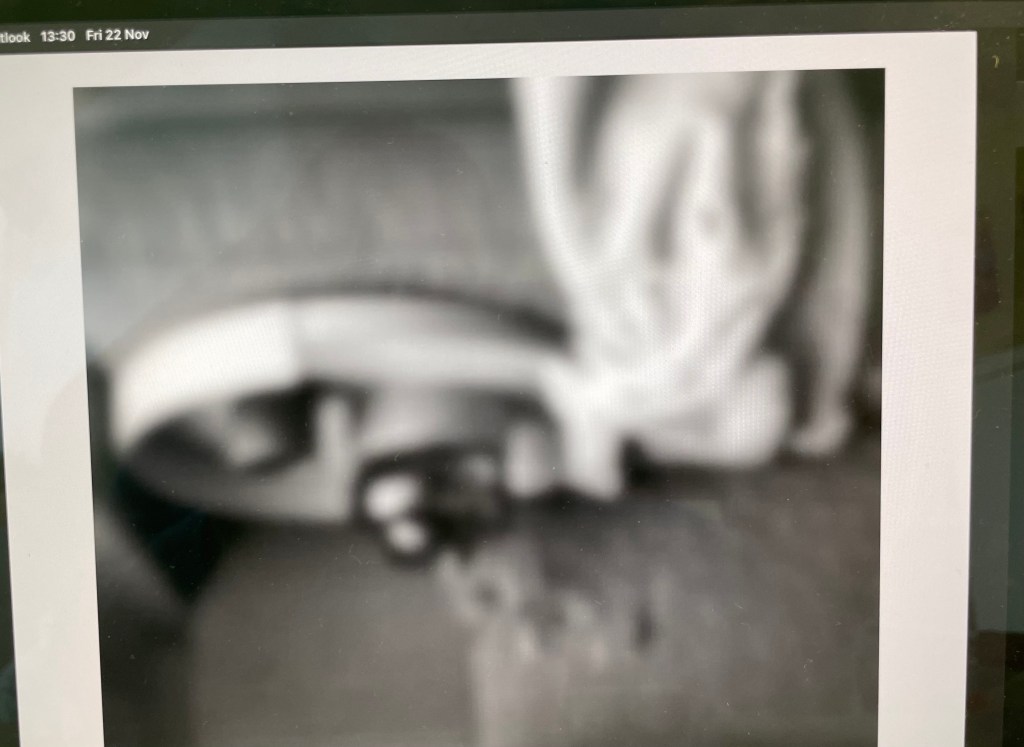
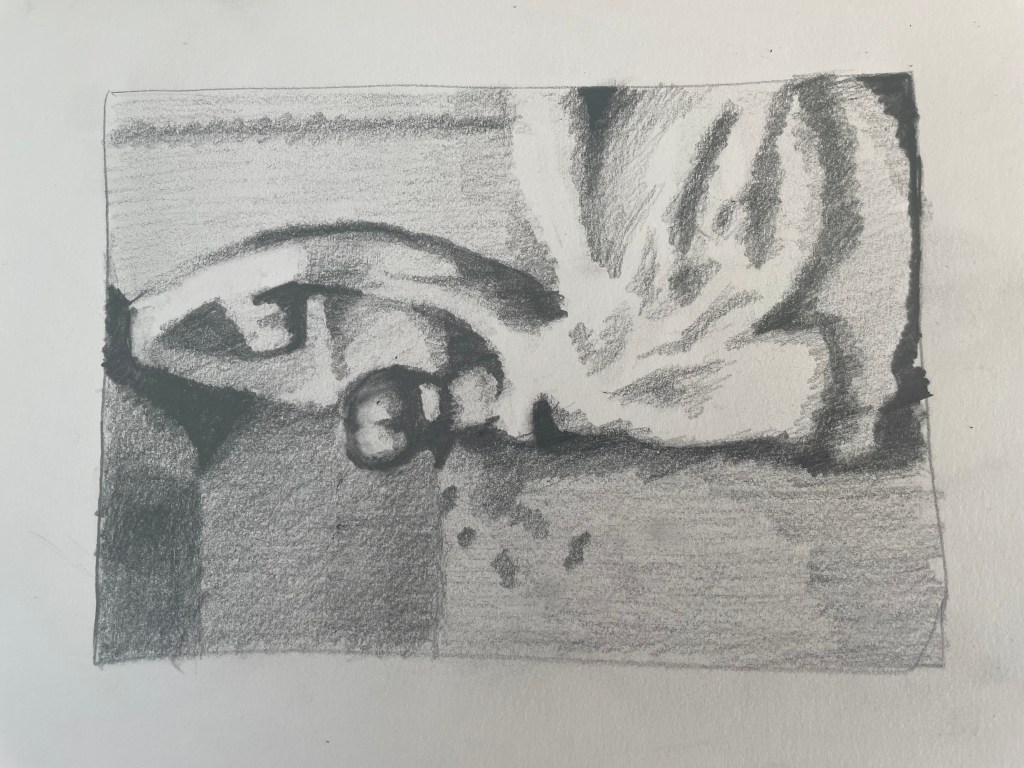
We then did a quick 10 minute exercise. We lightly shaded in a rectangle. Then we were shown a blurred image and told to fill in the darkest areas and then use an eraser to show the lightest. We then had to fill in the rest of the tonal values in the knowledge that nothing else will be as dark or as light as the existing areas of tone.

Chris then inverted the image and made it clearer:

It was a helpful reminder not to ‘see’ what I’m drawing and thereby create an expectation, but just to see shapes of tone, and to start from the general, keeping in mind the relationships between areas in the whole of the composition, and then move towards the specific.

Less

I haven’t posted for a while – I’ve been busy sorting things out before going off to Marrakech for a four day trip with my book club.

Marrakech was amazing. Colour. Noise. Smells. People. Heat. Contrast that with this morning when I had to defrost the car before heading off to my weekly art class. I love this drive, along an old Roman road – straight and undulating through the Hampshire countryside to Stockbridge, a small town in the Test Valley. The sun came out and the trees came to life – burning oranges, golds and yellows. It was beautiful, and by the time I arrived at my class, late because I couldn’t find anywhere to park, I was still feeling its effects.

I can’t deal with too much choice – it paralyses me and then I can’t make a choice. Needless to say, I didn’t buy anything in the souks in Marrakech – the choice was overwhelming, so I resolved not to buy anything at all, and was then able just to wander and enjoy the atmosphere and culture.

So today’s task was perfect for how I was feeling. A landscape using a limited palette of burnt sienna, burnt umber, ultramarine, pale cadmium yellow, white and cadmium red. We took a board, roughly primed – in my case it was an old piece of MDF which I had previously coated with professional Dulux oil-based primer, which can make it a bit like an ice rink – and put down a loose ground of burnt sienna with a bit of sansador which ended up not drying for some reason. Then we put in some outlines using burnt umber following with thick patches of colour keeping it very general, but the wet burnt sienna contaminated some areas and lifted off the board in others. We experimented with dragging a dry brush across the paint and I also did a bit of sgraffito which I can’t help doing when using thicker paint.

This is the result:

I haven’t painted for ages – not since beginning this course – I don’t know why. Perhaps it’s because I’ve been doing a lot of thinking and experimenting with other media. At first, it felt a bit strange coming back to it, almost awkward, like I’d been unfaithful in some way.

It’s not my best by far, but it’s ok for an hour and a half. I am leaving it. The ‘me’ I’m trying to change would say that it is not finished by a long way. There’s lots I don’t like and would love to change – I’m itching to tinker – but I’m exercising some will power and calling it a day. Just like I’ve been trying to change my mindset about having an expectation as to how a piece will turn out, I am also trying to train myself to walk away.

Jonathan told me that the job of mark-making is to tell us what to do next. These marks are telling me to leave it alone and to be happy with what bits of it appeal to me – I like the lack of clarity and blurriness caused by the dry brush; the light coming through the burnt sienna ground in the foreground; the energy in the marks, which I would absolutely kill if I allowed myself to do more; the lack of definition which gives a sense of a fleeting moment; and the recreation of the feeling I had whilst driving to class.

Will I do this again? Yes, I always like going back to basics and using a limited palette – I’ll use a different image and next time I will definitely make sure that the ground is dry before carrying on so that the colours aren’t so muddy in places.

Blot II

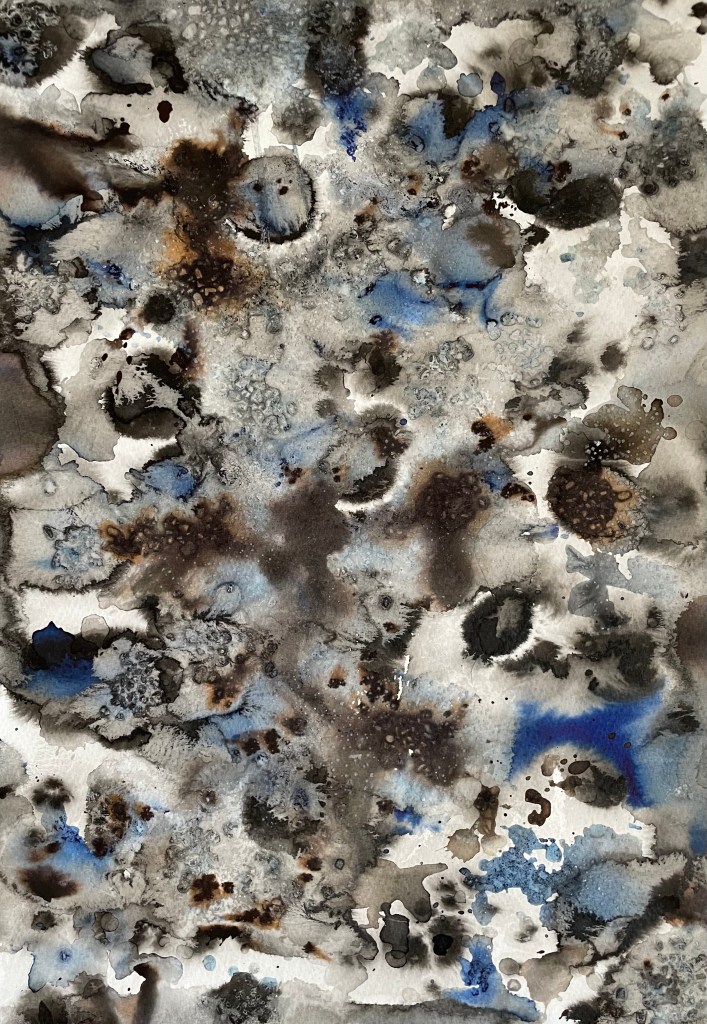
I’m really enjoying experimenting with ink.

There’s no expectation. It feels free. I like that you have to wait until they are dry to see the full effect. I feel like I have made them, which is an important step for me as I have struggled to accept the concept of randomness in art making; but I applied the water, the ink, chose the brush and I dropped and flicked the ink where I did, and just because I didn’t control what happened next doesn’t mean I didn’t in some way influence it. I like the combination of the different inks. The black Indian ink did not reveal as many tones as I was expecting, so I also used black writing ink which revealed tones of brown. I enjoy looking at them and identifying areas of interest as well as random shapes of faces, flowers, and cuddly toys! I have an idea as to how I might incorporate them into future work.

The Power of Ugly Art

I was watching a YouTube video yesterday morning and happened to look at the list of related videos on the right hand side: The Power of Ugly Art – Creativity Exercise for Dealing with your Inner Critic In Your Sketchbook, Marie-Noëlle Wurm, caught my eye.

During our critique session on Tuesday afternoon, whilst talking about my experimental digital collage, I mentioned that I feel particularly drawn to the process and that I have some ideas as to how I can use it to express my feelings on motherhood, in particular, in relation to the quote in Hearts and Lino about the heart walking around outside the body. I commented that it might be a bit gruesome, reflecting that actually that didn’t matter as sometimes art has to be ugly to convey what it needs to; it doesn’t always have to be aesthetically pleasing.

I mentioned N’s reference, in her introduction to her artistic practice, to Louise Fletcher’s course in which she actively encourages the creation of ugly art, which I have also watched. This is what Wurm encourages – an artist’s fear is creating ugly art, so lean into the fear instead of running way from it. Creating beautiful art is an expectation and she suggests detailing the expectations we may have as artists, and then expressing them in our sketchbooks. By letting our expectations exist, instead of pushing them away, we give them space to exist within our art practice, which will lead to more powerful art, growth and compassion for ourselves.

I’m going to give her exercises a go in my sketchbook, ordinarily a safe place for no one’s eyes but my own.

Miscellany I

I’m conscious that I committed to doing an automatic drawing a day to try and change my mindset. I’m allowing myself the inclusion of exploring Procreate as well!

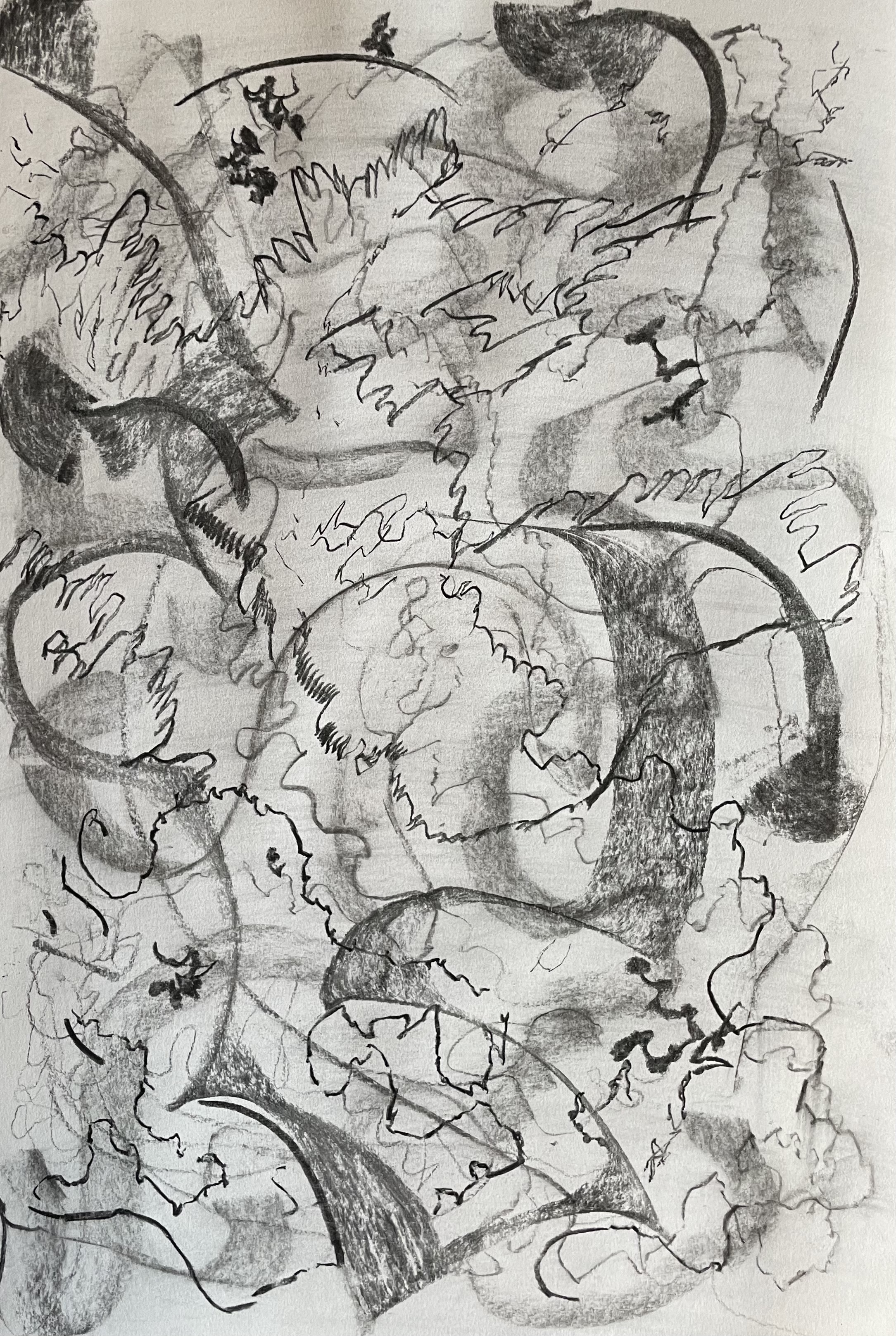
I particularly like the charcoal drawing. I used a piece of compressed charcoal and made swirling marks using it on its narrow edge and full on its side. I then rubbed it out and repeated it but this time playing around with the end and varying the motions. The concept of layers appeals to me (memories, past lives/ identities…) particularly the traces left behind of the first drawing and I was surprised by the range of marks I made depending on how I held the charcoal and the pressure I used. There are some delicate areas, followed by some jagged, harsh marks. Some lines appear to be faltering and hesitant whilst others have more purpose and at times are almost punctuation marks in what would otherwise be a stream of unconsciousness.

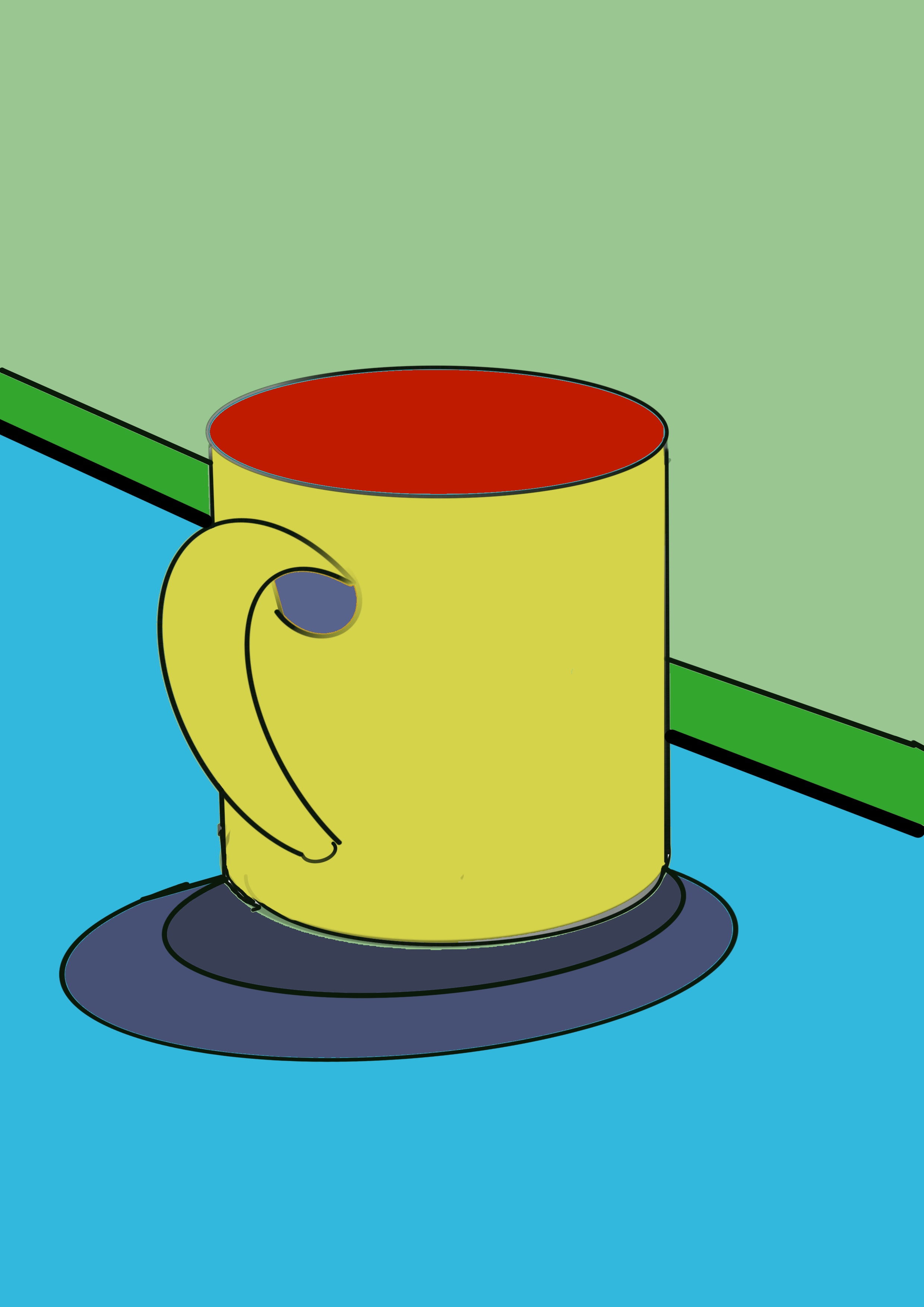
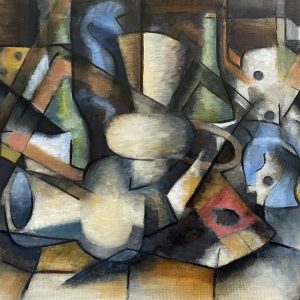
The second image I am treating as an automatic pastel drawing – I randomly chose colours and effects from the Procreate menu and I think the result is interesting, although I miss the haptics and the smell of the real thing as well as the tactile relationship between the medium and support. I’m not sure that I would use it going forward, except maybe as a tool to experiment with, although I have previously decreed that collage is just not my bag – how times change! I might use it if I decided to go down a graphic flat colour route (as in the third image) and digital collage is something I will definitely explore further – no bits on the floor and no need to glue – what’s not to like? I’ve been thinking about how I could incorporate digital collage into a mixed media piece of work – perhaps a giclée print onto a canvas, sealed with medium and then oil paint?

There are lots of thoughts chasing themselves around my head – I’ve been ignoring them in the hope that as and when I consciously acknowledge them they may have already got themselves into some kind of order. Just doing what I’m doing at the moment seems to be creating even more possibilities and permutations which is exciting.

I can sense that I’m feeling a lot more relaxed about making my experimental work ‘public’. I really look forward to starting the day by just letting my hand wander across the page – it’s the only time when there’s no expectation on me to achieve anything – renewing the buildings insurance, fixing the E20 error message on the washing machine – just a moment when I’m at one…

Trying Not To Overthink It

Guilty as charged: I have form for overthinking, overworking, not knowing when to stop and basically bludgeoning a piece until there is no life left in it. My problem is that I have an expectation of how it should be. It’s not even as if I enjoy the process – it makes me frustrated, stressed, and downhearted to the point of threatening to pack it all in. So, to put an end to this way of working I need to adopt a new approach; create a new habit but one which opens up possibilities, as opposed to closing them down. Admittedly, I have already begun to experiment more recently, but it needs to become second nature.

There’s a lot to be said for drawing exercises; I’m a particular fan of continuous line drawing but the drawback (excuse the pun) is that I’m still drawing something, I’m just not allowing myself to draw it as accurately as I might otherwise want to, and so there is still an expectation as to how it should look.

Sometime ago, I watched a documentary about Maggi Hambling. She gets up at 5am every morning and with a cup of coffee and cigarette in hand, she starts her day by making a drawing – she doesn’t like the term sketch – using an ink dropper and, in this particular instance, with her eyes closed. It is a form of automatic drawing, a concept embraced by the surrealists and latterly by the abstract expressionists, which involves the artist making marks without any conscious control.

I think this is for me!

There are numerous possibilities: pencil, charcoal, ink, paint, collage, eyes open, eyes closed, different ways of holding, holding more than one, dominant hand, non-dominant hand and the list goes on.

So this is the first of my daily automatic drawings:

I used a charcoal pencil in my dominant hand and, with my eyes open, I just let it wander over the page without any conscious thought or control. Maintaining the same pressure and manner of mark-making started to become a bit tedious so I almost unconsciously varied the pressure and the way I made the marks, holding the pencil higher up so that there was less control from my hand, rocking it backwards and forwards in my hand, holding it perpendicular to the page and then on its side. It was a sensory experience in that I was aware of the feel and the sound of it: the sound of the charcoal on the paper and the squeaking and stuttering of it on the upward stroke creating broken lines, as opposed to the smooth downward marks. I then randomly smudged and blended some areas.

There are some quite interesting passages and if this is my subconscious expressing itself then I might have cause for concern! All in all, I’m pleased with what I produced because I enjoyed the process – instead of being mindful, it was mindless – and I hope that if I do this often enough I might just free myself up.