Sticker

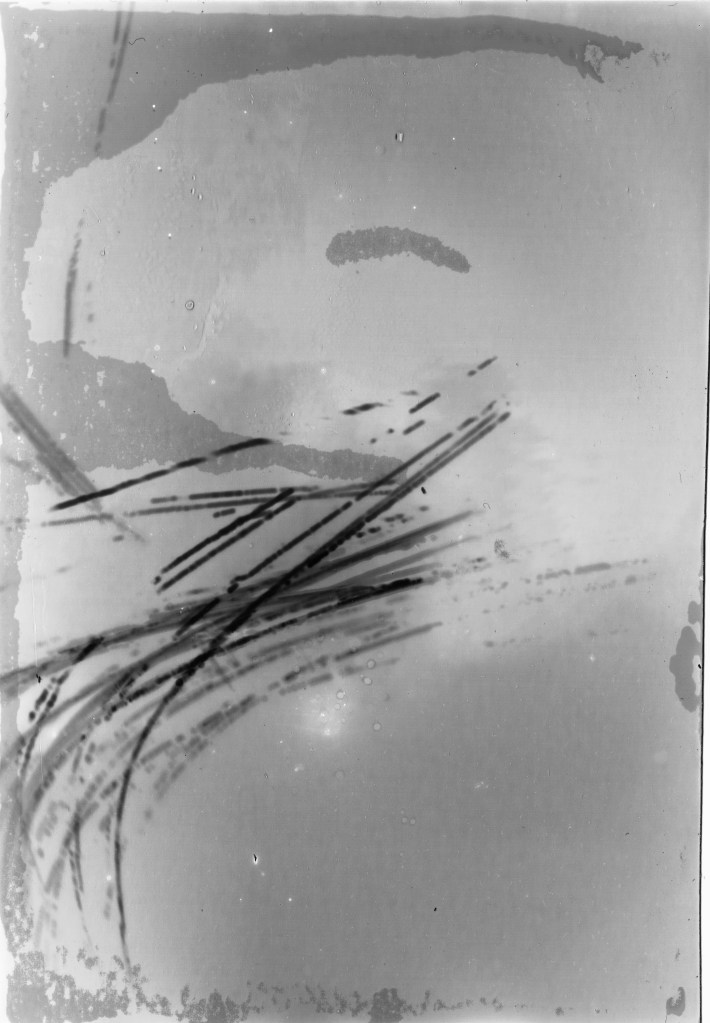
I brought in my one remaining pinhole camera the other day. It was really disappointing – although it had captured some good trails of the sun, it had fallen sideways (my bad) and the constant switching between really hot and cold weather recently must have caused condensation to form inside the can. It’s a shame because it seemed to me to be a good way of capturing the passage of time in a static image. Never mind, I may try again.

I’m not very techie and when I was converting the original image into black and white on my phone before I got into bed last night, I accidentally created a sticker. I’ve never really paid much attention to the white line which cuts out the sticker before, but on an abstract image it was fascinating to see where it went and what it chose to cutout. I decided to screen record the process, add some filters and play around with the replay speed.

I particularly like the one above – it reminds me of paper burning around the edges.

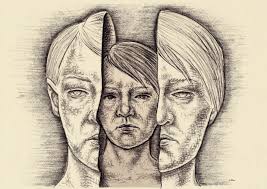
I used the image from What Was I Thinking? as it has both curved and straight lines amidst the multiple figures, and I was interested to see what path the line chose to follow.

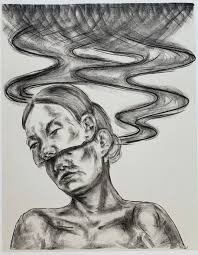
Finally, I wondered what would happen if I tried an image which has a myriad of shapes within it and a white line of its own, so I used an image from Carbon Dating.

I had a great time experimenting, but when I finished an hour later my brain was still trying to process it all and thinking of how I might be able to develop it. It’s proving to be a tiring day today.

Arachnid

Whenever I go to B&Q, I always want to come home and do some DIY; whenever I visit a beautiful garden, I always want to come home and sort out our garden; whenever I go to an exhibition, I always want to come home and make.

I’ve been feeling in need of a pick me up recently, and so yesterday I headed into London on a hot, Notting Hill Carnival, Bank Holiday Monday to catch Louise Bourgois’ ‘Maman’ on its last day at Tate Modern, the very space for which it was commissioned back in 2000. There’s no doubt that it’s impressive at 9m tall – again, I ask myself whether it’s all about the size, but I think any spider larger than real life would have an impact. I had an overwhelming urge to touch it, but resisted in light of the ‘Please Do Not Touch Sign’. I also found myself wondering how they got it into the building, memories of Johnny Vegas’ struggles coming to mind.

It was well worth the trip, a rare chance to see a piece in the flesh in the very place for which it had been made. Having said that, I’ve seen some images of it in a landscape, which I find particularly effective.

Tate Modern’s website on ‘Maman’:

Louise Bourgeois started making sculptures of spiders in the 1990s. This version is her biggest spider. Its title, Maman, is French for mummy. The artist said spiders reminded her of her mother: ‘Like a spider, my mother was a weaver. My family was in the business of tapestry restoration, and my mother was in charge of the workshop. Like spiders, my mother was very clever … spiders are helpful and protective, just like my mother.

I’m a bit behind with things at home, and we’re starting to amass some really impressive cobwebs. I watched as a flying insect became entangled in one of them; in a flash the spider came from nowhere and quickly got to work wrapping it up.

I’m not sure that spiders are clever as such, but they do have great skill. I don’t really think of them as being helpful and protective: they set traps that you can’t see, they ambush you and then swaddle you up until they consume you. Although, I don’t have a problem with them, as they catch flies etc, as long as they are not where they’re not supposed to be, such as on the bedroom ceiling above my head, or in the bed.

Lifelong arachnaphobe, Primo Levi, in his essay ‘The Fear of Spiders’:

“The spider is the enemy-mother who envelops and encompasses, who wants to make us re-enter the womb from which we have issued, bind us tightly and take us back to the impotency of infancy, subject us again to her power…”

I’ve tried not to be either of those spider mothers. I’ve tried not to be suffocating and I’ve tried to resist the urge to fix things. I’ve definitely failed; I often tell my daughter that I’m trying my best, and, when she’s older, not just to remember the times when I’ve not been at my best, like I seem to have done with my own mother. It’s that negative bias again, I suppose. I’m now actively remembering all the times when she was kind and caring, supportive, and all the laughs we had together, which by far outnumber the not so good.

Mind The Gap

I’ve been looking back at some of my previous posts to try and assimilate my thoughts and ideas.

In this week’s session we considered an excerpt from Art & Fear by Bayles & Orland. We discussed the gap: “…Making art provides uncomfortably accurate feedback about the gap that inevitably exists between what you intended to do, and what you did…”

My earlier post,Making A Sound, referenced a comment made by Maggi Hambling:

…there wouldn’t be much point in painting a picture that it was possible to paint…”

So, we shouldn’t mind the gap. If there is no gap, we are not pushing ourselves or allowing exploration in our work.

Art & Fear also threw up another corker. It’s from Stephen De Staebler:

“Artists don’t get down to work until the pain of working is exceeded by the pain of not working.”

Almost there!…

Am I Bovvered?

Amidst all the excitement of the Low Res, I received my annual rejection letter from the RA.

Immersed in all the distraction, I wasn’t bothered, which is why I have left it until now to reflect on this rejection. I’m still not bothered. Why? I’m not sure, in the end I invested quite a lot of time into the process of producing A Die, A Log, With You. However, I didn’t invest very much in an emotional sense – yes, it made me titter but it’s not as if I put my heart and soul into it. Why? because it was an arbitrary task I had set myself which was, frankly, getting in the way of more interesting things. Also, entering the Summer Exhibition is no longer my only artistic outlet into the big wide world. This blog has changed that.

Based on our discussion in yesterday’s session on the subject of success as an artist, I would say that I failed. The piece didn’t connect with others, and, perhaps more importantly, it didn’t connect with me. I used to think that my work was like a Harry Potter Horcrux with each piece containing a little bit of my emotional being. This piece has none of me, so was always destined to be a failure as a piece of work. However, as an exercise in ‘that will do’ as opposed to the normal quest for perfection it was a total success. So. I’m still left in a quandary as to why I didn’t feel connected – was it that in accepting something less than perfection I detached myself from it, or was I just not that into it to start with?

Never Drinking Coke Again

I had some free time yesterday, so I decided to try out kitchen lithography using some aluminium foil and cola.

This is the first time I’ve tried it – I’ve been interested in doing it since I came across a Canadian artist who uses it in her work, in addition to other printing processes, Valerie Syposz. Her work primarily deals with self-perception and existence.

I like the surreal quality of her work, and her subject matter is relevant to what I’m exploring.

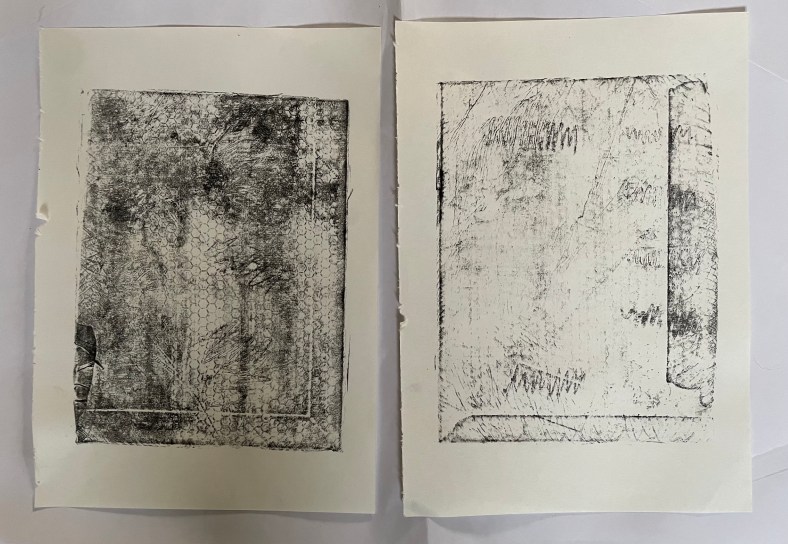
I have to be honest and say that it didn’t really go to plan. First of all, I discovered that the foil I have in my kitchen drawer has a honeycomb pattern embossed on it, and then I forgot to use the dull rather than the shiny side of the foil. I made various marks using different pencils, pens, markers, graphite sticks and pastels, but I was doomed to failure. Not wanting to go out into the cold to my shed to find some plexiglass sheets to wrap the foil around, I had used an Amazon envelope which I found in the recycling bin, which turns out had some raised edges on it. But, hey, it’s just an experiment. I also didn’t apply enough water to the plate which meant that the ink adhered to areas it shouldn’t have.

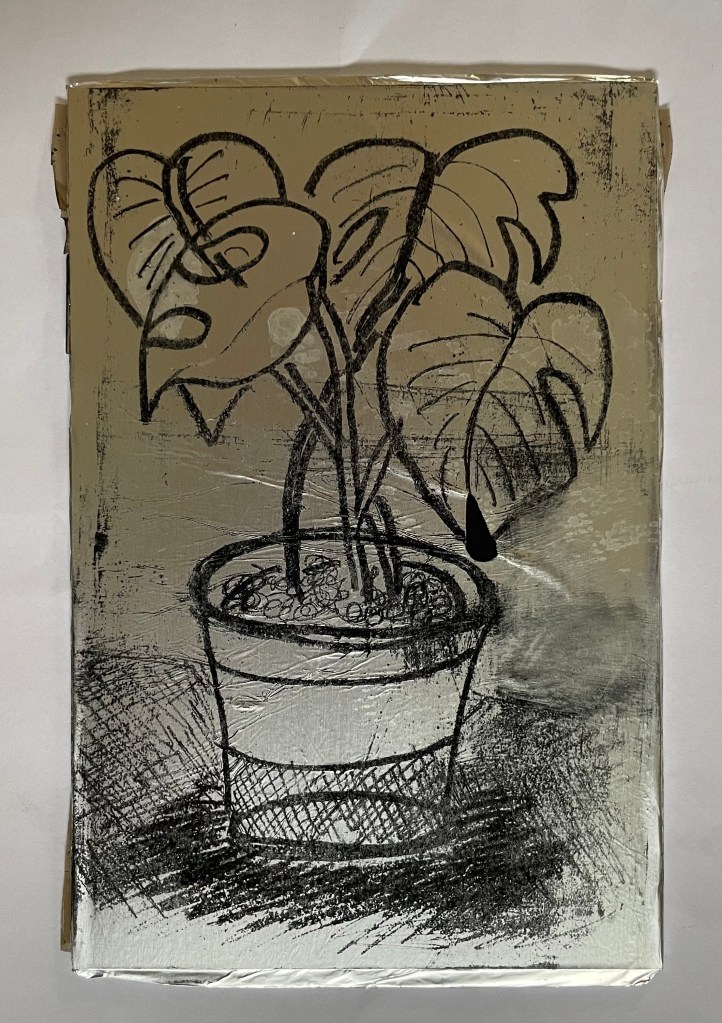
Once I had realised my mistakes I gave it another go. I used a small plexiglass sheet this time, and found some other foil which had a smooth surface. I made a quick, not so good, drawing of the plant in front of me. I used a combination of a chinagraph pencil, basic oil pastel, and a 6B graphite pencil. I did try using a biro, but it ripped a hole in the foil – this was probably because the foil wasn’t very strong. I then poured cola over the top of the plate, rinsed it off, and then rubbed the image away using vegetable oil. Once the plate was dampened with water, I rolled on the ink, re-applying water using a sponge between each ink application. The idea is that the cola contains gum arabic and phosphoric acid which makes the foil which hasn’t been drawn on, hygroscopic. I then used a bamboo baren to transfer the image to a sheet of Hosho paper.

They’re not great, but I’m just happy that I managed to get a defined image at all, bearing in mind my first attempt was such a complete Horlicks.

It felt good trying something new, and what made it particularly enjoyable was the fact that it could be done at home with easily accessible tools and supplies. I will definitely explore it further perhaps after doing some further research so that I can appreciate its full potential. There is a lot of scope for experimentation with different printmakers having different opinions as to the best methodology to adopt: some lightly sand the foil before drawing on it, others use cornflour and maple syrup on the plate; some don’t use a support and just use the foil as a sheet. Maybe the brand of cola has a bearing on whether the process is successful: perhaps I’ll need to have a Pepsi challenge.

Changing Places

That wasn’t how the last couple of days were supposed to have gone.

My daughter came home from uni just after our session ended on Tuesday with rapid onset tonsillitis. By Wednesday she was in tears. She is one of the bravest and most stoical people I know, so this unsettled me. It’s heartbreaking watching your child suffer in pain. When I was in pain, my mother used to tell me that, if she could, she would swap places with me. I wish I could say the same, but the truth is my daughter is far better equipped to deal with it than me. When it comes to pain, I don’t mind admitting that I’m a wimp. If there are drugs going that will make me feel better, just pump me full of them – that’s what advances in medical science are for, after all.

I don’t care that I didn’t have a ‘natural’ birth, without pain relief; that she came out of the sunroof. I wasn’t ‘too posh to push’ – she wasn’t going anywhere, and at risk of becoming distressed, and would it have mattered if she hadn’t been, anyway? Is a natural birth somehow superior to one with medical intervention? Why are we told, in that patronising way, that we are not the only woman to have ever given birth? I am the only ‘me’ to have given birth.

Whilst I’m doing my best to keep negativity out of my life, some things do just make me angry. I think it is now generally accepted that women are expected to put up with an unnecessary level of pain when it comes to matters of their health, just because they are women. Studies have shown that women experience pain more intensely, and for more of the time than men. However, they are less likely to have their pain scores recorded, or to be prescribed pain relief than men. Apparently, this is based on the misguided notion that women are more emotional, which means that they may exaggerate the pain they are feeling – after all, ‘hysteria’ comes from the Greek word hystera, which means uterus. Really? There is now a term for this way of thinking: medical misogyny.

It reminds me of a comment made by a male healthcare professional whilst discussing pain relief during the discharge process after an exploratory procedure, which had been initially attempted without sedation. Some women can ‘tolerate’ the ‘discomfort’. I wasn’t putting up with the intense pain. Did I feel like a failure, that I’d somehow let myself and womanhood down; that I should have been able to ‘tolerate’ the ‘discomfort’ like all those women who had gone before? Initially, yes, and it is very intimidating to be in a situation where you are surrounded by healthcare professionals, both men and women, where you feel that you have lost agency over what is being done to your body. Did I look in their eyes for judgement, particularly in the women’s, whilst I dressed, gathered my things and left? Yes. But the word ‘no’ is empowering, and so it was sedation for me. Anyway, getting back on point, I think I made some quip as to knowing what pain feels like, being a woman. He must have interpreted that comment as alluding to a badge of honour as to the amount of pain women can tolerate, as he replied, something along the lines of: “Women can’t have it both ways”.

Anyway, I’ve managed to make it all about me again; that wasn’t how this post was supposed to have gone. After several trips to, and many hours spent in A&E, pain relief, antibiotics, fluids, steroids, and a bit of an exploration up her nose and down her throat with a camera, she’s thankfully on the mend with plans to whip the little troublemakers out in due course.

Part One: Think Like An Artist

… and Lead a More Creative, Productive Life by Will Gompertz isn’t taking me long to read at all. Gompertz, artistic director at the Barbican, makes some very interesting and thought-provoking observations on what it is to be creative. As I’m galloping through it at such a speed, I thought it best to highlight some parts, as I go along, which I think will either help me in finding my artistic voice, or which reinforce ideas and concepts which we have touched on in the course so far.

On failure:

When it comes to creativity, failure is as inevitable as it is unavoidable. It is part of the very fabric of making. All artists, regardless of their discipline, aim for perfection…But they know perfection is unobtainable. And therefore they have to accept that everything they produce is doomed to be a failure to some extent…Thomas Edison knew all about the notion of sticking at it…But at no point did he countenance failure: ‘I have not failed 10,000 times,’ he said. ‘I have not failed once. I have succeeded in proving that those 10,000 ways will not work. When I have eliminated the ways that will not work, I will find a way that will work‘…There is plenty of time for wrong turns, for getting lost; for feeling generally hopeless. The crucial thing is to keep going. Artists appear glamorous and blessedly detached, but in reality they are tenacious grafters: they are the proverbial dogs with bones… And while they are out there, worrying away, they often discover a hidden truth about the creative process… Their success is very often down to a Plan B. That is, the thing they originally set out to do has morphed along the way into something different.”

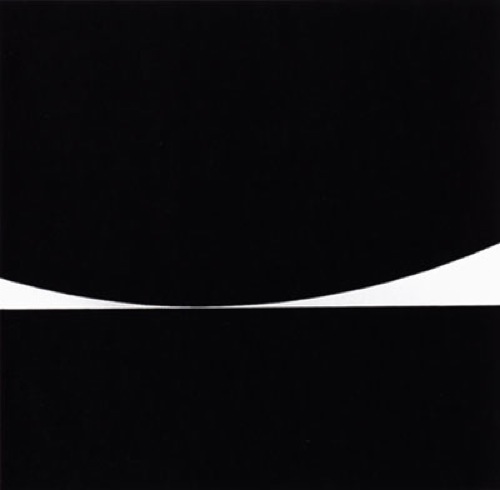
He references several artists who started out in one direction only to find their success through a Plan B, such as Mondrian, Lictenstein and Bridget Riley. In the case of the latter, in the early part of her career Riley was interested in colour theory and the work of the Impressionists, the Pointillism of Seurat, and the composition of Cézanne. It wasn’t working for her; she was directionless and lacked originality, and she was getting older. The ending of a relationship caused her to paint a canvas black, and she took all that she had learnt from her studies of Seurat et al and applied her knowledge in abstract terms. She painted a white horizontal line the lower edge straight, the upper edge forming a curve – it became a painting expressing the dynamism and inequality of relationships, human and spatial.

’Kiss’, 1961, Bridget Riley (Wikiart 4 Jan 2025)

Bridget Riley had to abandon the one thing she thought most important and appealing about painting – colour – in order to make any real progress. It didn’t mean colour could never feature in her work again, only that at that precise moment in time it was the roadblock… Only when [she] went back to the most basic of basics – a canvas covered in black paint – did she find the necessary clarity to progress. Only then did she discover the most precious and liberating of things: her artistic voice… As long as you stick at what you are doing, constantly going through the cycle of experimentation, assessment and correction, the chances are you will reach the moment when everything falls into place.”

The cycle of experimentation, assessment and correction is at the very essence of this course: Practice-based research.

Gompertz also states that if you call yourself an artist and make art, then you are an artist regardless of where you are in the process, or what skills you still need to learn and develop. I think I find this the hardest to embrace – I still can’t quite think of myself that way. I’ve only just got my head around being a student – in retrospect, it probably wasn’t the best idea to try it out first on the border official at Marrakech airport who looked at me with incredulity and repeated “Student?”. Admittedly, it’s been a lot easier since I discovered all the discounts available!

On ideas:

Gompertz asserts that originality in a completely pure form does not exist; that all ideas are additional links in an existing chain, each link adding to the one before. It is a form of disruption: something to react against and respond to, to build upon. He suggests that Picasso, in the quote attributed to him – good artists copy, great artists steal – is actually describing a process that an artist needs to go through: we learn through copying and imitating, and it is only once we have done this and developed the basic techniques that we can identify opportunities to add our own link to the chain, and to find our own artistic voice. This reminds me of my discussion with Jonathan about Frida Kahlo’s ‘The Two Fridas’, when I questioned whether any work I make which is inspired by it will be original enough: he advised me that Kahlo painted it in the late 1930s and I would be doing my version almost 90 years later expressing my own feelings – following Gompertz’s reasoning, I would, in effect, be adding my own link to her existing link in the chain.

In fact there are numerous creatives who have been quoted as admitting to building on the ideas of others.

If I have seen further it is by standing on the shoulders of giants.” Isaac Newton

Creativity is knowing how to hide your sources” Einstein

We have always been shameless about stealing great ideas”. Steve Jobs

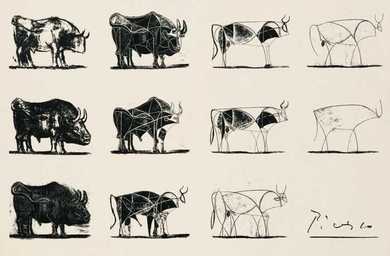
The young Picasso produced work which imitated the likes of Goya, Velázquez and El Greco, and later the Impressionists and Post Impressionists. It was only when his friend, Casagemas, died that he found his own artistic voice in his Blue Period; the blocks of colour, bold lines and expressive manner, which he had learnt from all those artists he had imitated, still influenced him, he just put his own twist on it. He took their ideas and filtered them through his own personality and experience, and used his instincts to simplify and reduce them into his original thought, into new and unique connections. Being creative isn’t always about adding to something; it can be at its most original when taking something away. This is demonstrated perfectly by Picasso’s bull lithographs, which took him a month to complete.

‘Le Taureau‘, 1945/46 (Wikipedia, 5 January 2025)

There is no such thing as a wholly original idea. But there is such a thing as unique combinations.” Gompertz
Reflecting on Resentment II

I’ve rewritten this post so many times. It has become progressively shorter. Sitting back and reflecting, I can see what is important. The first version was just a rant.

In late 2022, my mother was diagnosed with oesophageal cancer. No treatment was offered. At best she had 6 months left. Her GP had messed up. The hospital messed up. My sister and I cared for her full-time. It was the worst, and darkest period of my life.

This wasn’t how it was supposed to be. Six months to live? Well, we could go places and make the most of it, create some new memories. But she was already too weak. Instead, the memories I have of that time seep into my mind when it’s not thinking of something else, usually before I go to sleep; then I can’t go to sleep and I sit up alone in the kitchen turning it all over, reliving it. Nothing makes it feel any better.

My mother died at home in the spring of 2023, three days before her 85th birthday. I cannot say with any honesty that she experienced quality of life in those last months. She was waiting to die, and I was just watching her gradually turn into a skeleton.

I resent that medical professionals have failed my family, not just in respect of my mother, but also my father – I made formal complaints in both instances – lessons will be learnt, apparently – but this has done nothing to ease my resentment.

I resent that because she was old, my mother was effectively written off.

I resent that everything was such a battle and I had to spend so much time chasing and making sure things were done.

I resent that there are old people in hospital who are overlooked, and who don’t have a voice or someone to speak up for them.

I resent that my sister and I were left to deal with everything, both before and after my mother’s death.

I resent that in the last few months of my mother’s life the days were short, and the nights were long.

I resent that those last few precious months were stolen from me.

I resent that the last words my mother spoke to me were when she wasn’t herself.

But, most of all, I resent the resentment that I feel: it’s preventing me from moving on.

Reflecting on Resentment I

During the last session we considered the premise that resentment blocks creativity.

Resentment is a feeling of anger or unhappiness about something that you have been forced to accept and you don’t like, or think is unfair. It comes from the Latin verb sentire, and so it is an emotion which is ‘re-sensed’ time after time, perhaps even increasing in intensity. Perhaps we feel resentment that other artists are better than us, or that they have works accepted in exhibitions and we don’t.

As I get older, I try as best I can to keep as much negativity out of my life as possible. I may initially feel it, but then I try to process it by turning it on its head, or actively dealing with it. I can’t feel resentment (in the sense of it being a recurring emotion) that other artists are better than me or are more successful – instead I use the initial negative feeling (which is probably more envy than anything else) to spur me on to try again, to fail again and to fail better, because inherent in that form of resentment is the feeling of failure.

For the last few years I have submitted work to the RA Summer Exhibition but I have never made it to the next round of judging. Each year I experience a moment of crushing disappointment and vow never to do it again, but then January comes around and off I go again. I’m clearly looking for validation, but I often think to myself that if ever I do get in I’ll probably never submit again, and maybe it won’t even make me happy.

My husband confessed to me that he had always wanted to paint. Why don’t you just do it, I asked him. He started with watercolours and over time became good at it. I suggested that he try oils as they are far more forgiving and I thought he might enjoy the freedom of using them. I bought him some as a gift along with some boards and brushes. He signed up to an oil painting class and shortly afterwards submitted one of his oil paintings to the Summer Exhibition. He made it through to the last 4,000 out of 16,000 entries on his first attempt. Did I feel resentment? No – I felt proud, with a strong sense of irony. He felt ecstatic with a strong sense of embarrassment.

If someone treats me badly I tend to think that it is more about them rather than me, but if it is something that I know will eat away at me and become a resentment I try to deal with it head on, unless doing so will cause irreparable harm. But, there is one particular instance of resentment which I haven’t been able to let go of no matter what I do, and I feel it as strongly today as the day I first felt it.

“Ever Tried. Ever Failed…

No matter. Try again. Fail again. Fail better.” (Samuel Beckett)

I hadn’t come across this quote until my daughter went to secondary school, where the headmistress used it as her mantra in her quest to produce strong, independent young women who would leave school ready to deal with whatever complexities the world threw at them. It was used to encourage the girls to go beyond their comfort zone in trying new things and not to be put off by the risk of failure – “feel the fear and do it anyway” was another one of her favourites!

There are many inspirational quotations dealing with the concept of failure such as:

“Try and fail, but don’t fail to try” – John Quincy Adams

“Success is the ability to go from failure to failure without losing your enthusiasm” – attributed to Winston Churchill

That’s all very well, but they don’t deal with how we should actually process the feeling of failure, and this is something we touched on in our online session this afternoon. The problem of dealing with failure is that the ego gets in the way. Strategies to overcome the ego include sharing stories (this allows others to learn from the failure without actually experiencing it); over-acceptance of the failure (that is actively taking it and collaborating with it to make an alternative outcome); and distancing the failure (for example, by using the third person when reflecting on it). The last strategy is particularly effective as it allows you to view the failure and the person who failed objectively giving rise to feelings of empathy.

So, our task for next week is to take a risk and do something in our art practice which might not work out!

For the first part of today’s session we finished our short introductions. I had been feeling ok about it, but towards the end I felt quite overwhelmed by emotion – maybe it was because I had mentioned my constant feeling that time is ticking by at quite a rate, or maybe it was the sudden realisation that it is only now that I have made the time to do something that I have always really wanted to do. Either way it came from nowhere and left me feeling quite out of sorts for some time afterwards. Even more reason to carpe diem!

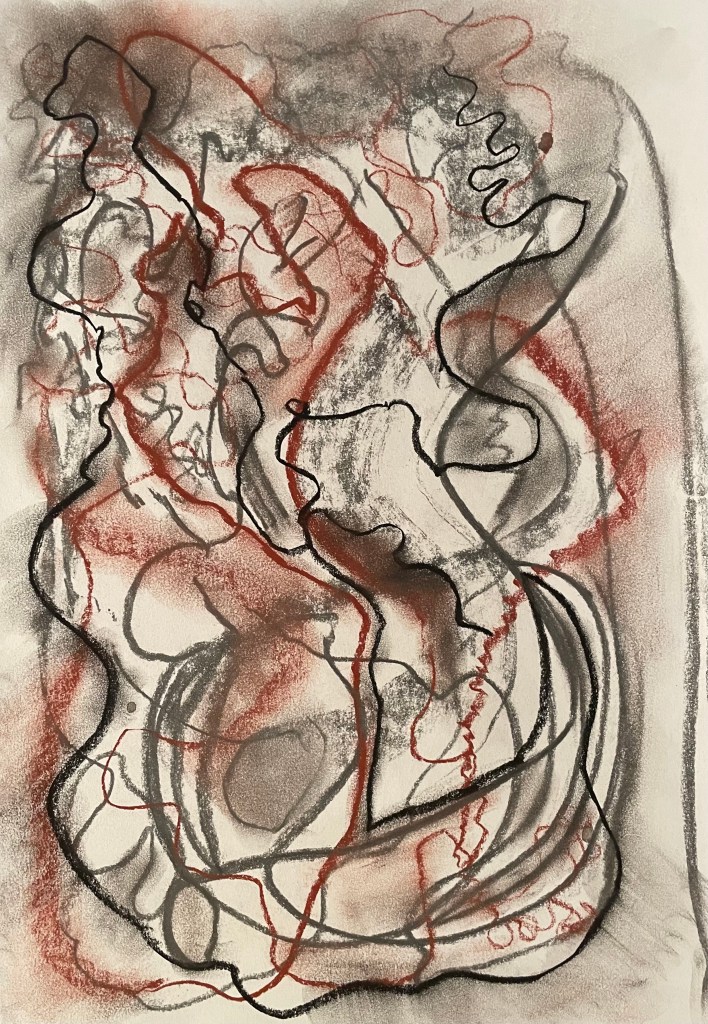
Below is today’s automatic drawing in which I used a thin and a thick piece of willow charcoal, holding a piece in each hand moving at the same time. I then used a sanguine and black conte pastel on top. It’s not as dynamic as the previous drawing and seems a bit contained – maybe because I was using both hands at the same time – I’ve never been able to do the head pat/ tummy rub thing. Next time I think I will stick with charcoal, but maybe build up some layers, and also begin from a different starting point.