Out Of The Blue

Last summer I became obsessed with cyanotypes. Then there was plenty of sun. There was some sun the other day, but not much since, so I decided to make myself an exposure unit using my Speedball UV lamp and following instructions on Handprinted. I do love a bit of DIY; there’s something very satisfying about making do with something handmade which didn’t cost a fortune to buy, or require some fancy kit, or having to go to a specialist location.

I used an old printer box which was large enough to take A3 sheets, cut out a hole for the lamp to sit in, and then lined it with aluminium foil.

I selected a few photographs to experiment with; some from the family photos which I’ve been sorting out, and others which I have collected on my phone as inspirational resources, as well as some images from the experiments earlier on in this blog. I converted them all to black and white and then inverted them in Photoshop, printing them off on transparencies. I had to dust off my old printer to do this as I wasn’t sure how to do it on my husband’s printer. This took a while because between each print I had to perform a ritual of pressing certain buttons in a certain order in order to fool the printer into thinking that I was using genuine HP ink cartridges, which I wasn’t. The things you can learn on YouTube.

Ironically, the sun came out, so I did a mix of au naturel and my DIY unit.
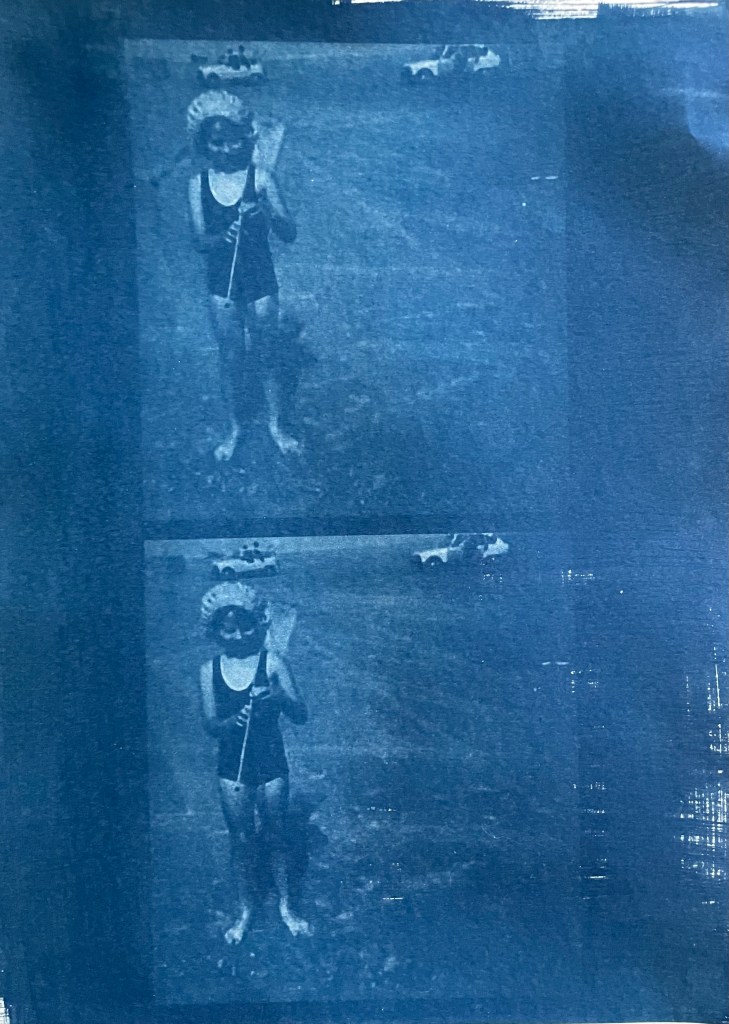
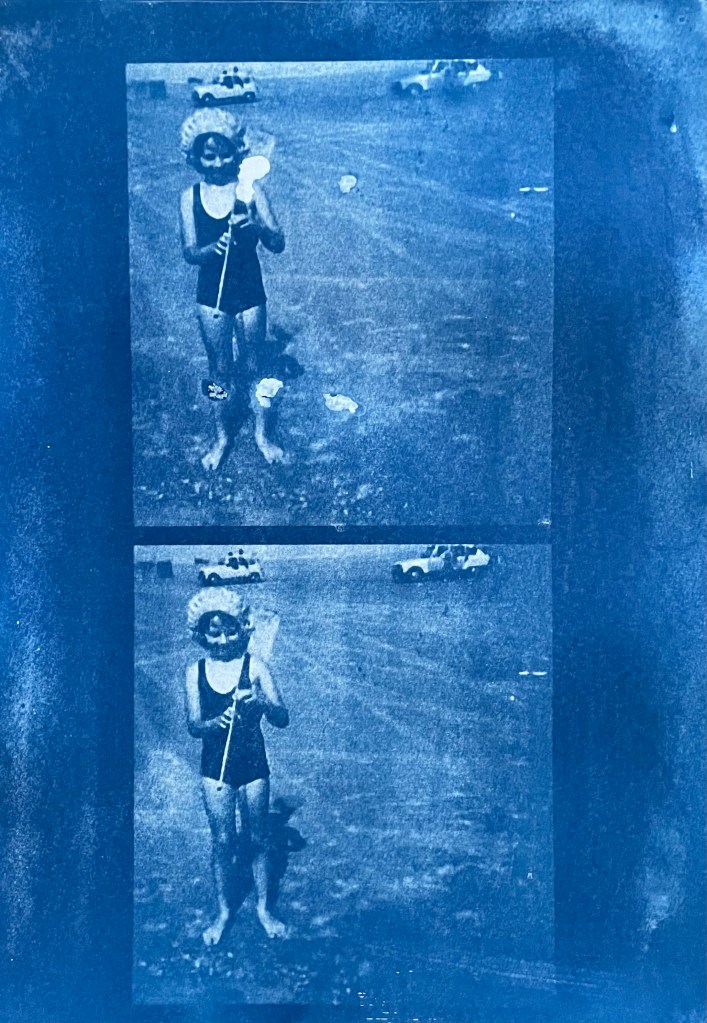
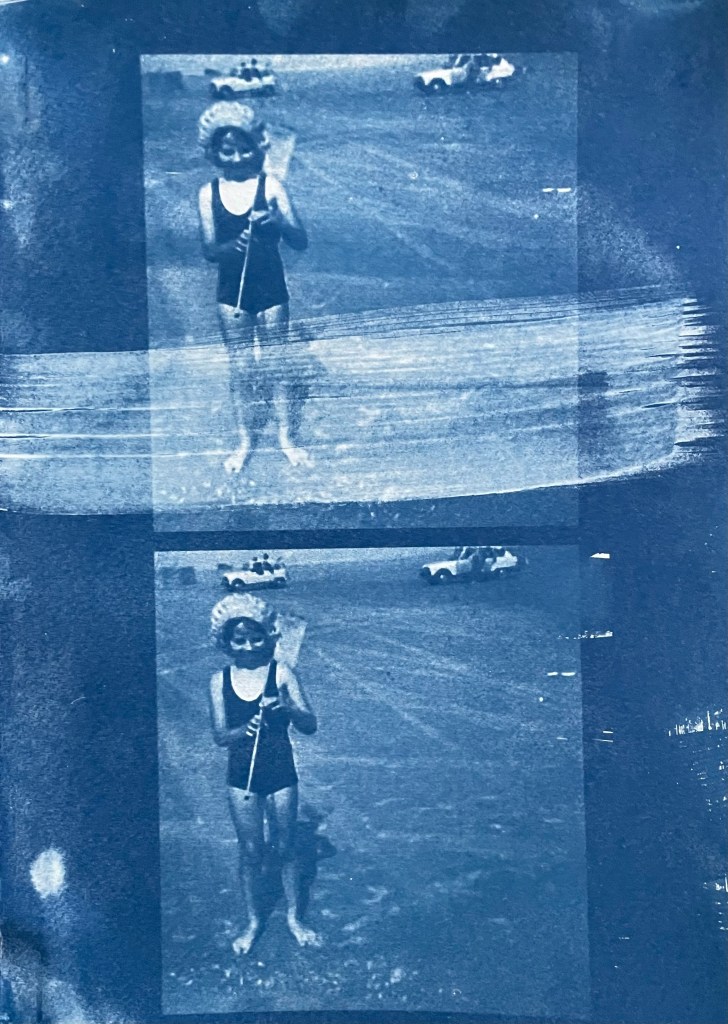
The first two prints were made using the unit, the first being over- exposed at 20 minutes, the second being just about right at 15 minutes. The last two prints I did outside in the sun, which was a bit more hit and miss because the strength of the sun was not constant as it kept disappearing behind some cloud cover. However, I do really like the effect of the visible strokes which I left when applying the solution to the paper, which was A4 300g/m2 hot pressed watercolour paper. The markings give the effect of a moving, flickering , transitory image – there, but not quite there. I put two images on the same negative transparency because I wanted to create a number of smaller images to experiment with. However, the suggestion that the images are on a roll of film is really interesting.

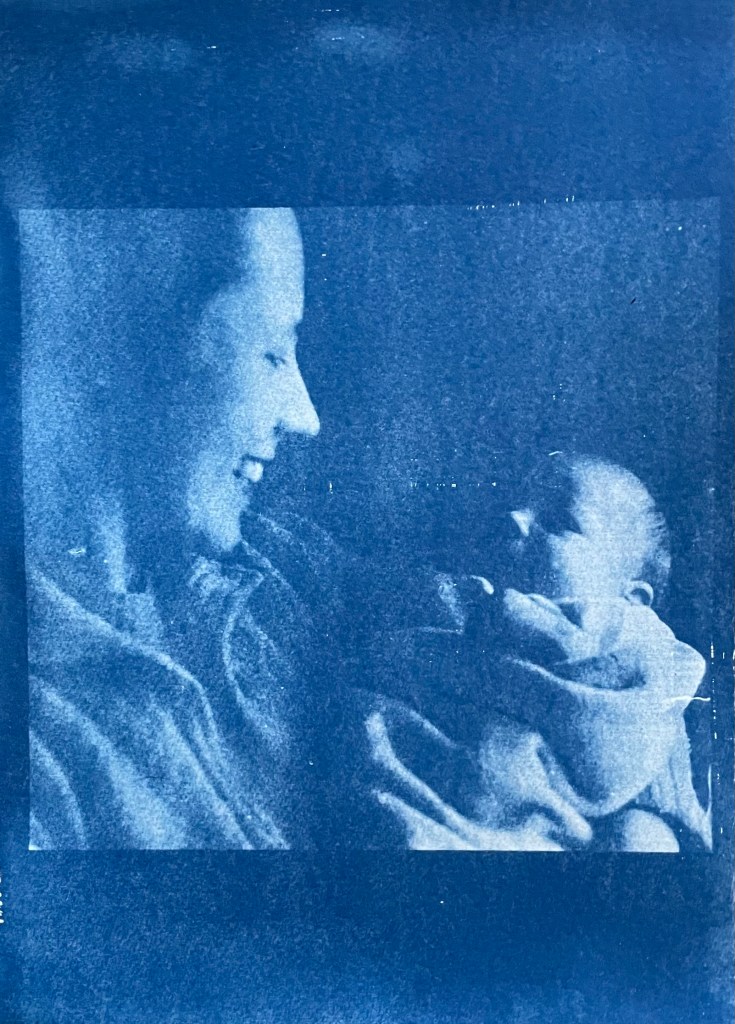
It’s been really difficult getting some of the old photographs out of the albums; they are the sort which have sticky pages on which you position the photos, and then put a transparent film over the top. Over the years the adhesive has seized up and practically bonded to the back of the photos. I’ve tried all sorts including gentle heat, dental floss and a bendy, very sharp filleting knife.

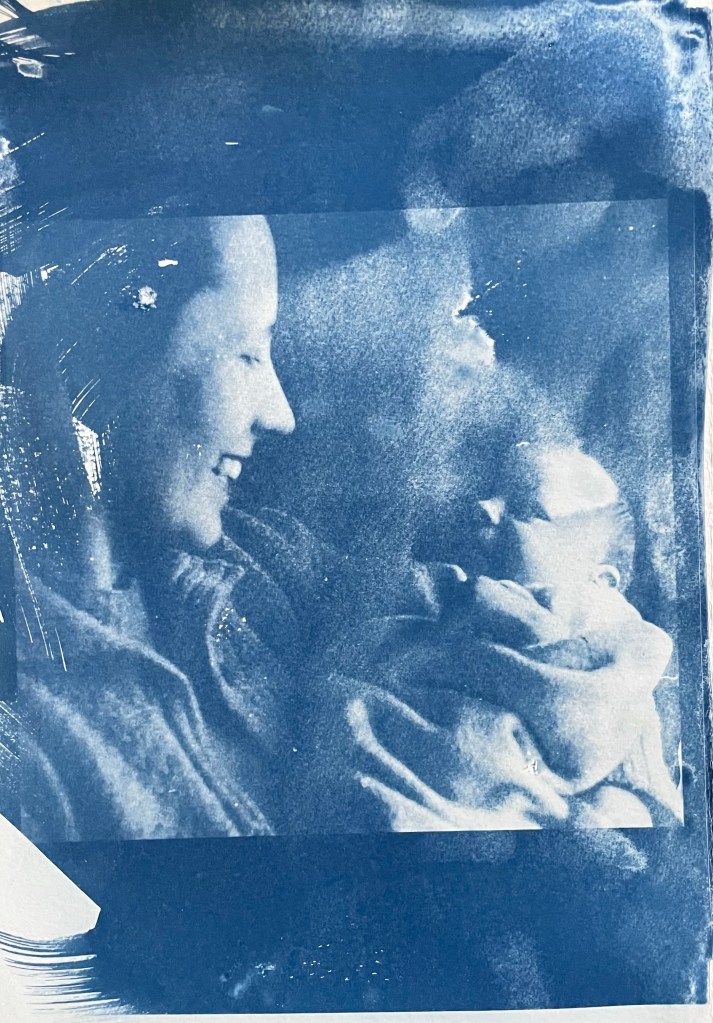
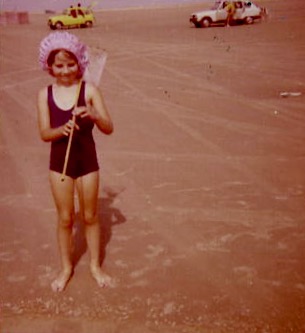
This one of my mother and brother is a favourite, but sustained a small tear on the right. I am pleased with both images – the first one was done outside and the second in the unit, which seems to have more of a Prussian Blue hue to it although I’m not sure that there’s any rhyme or reason as to the differentiation in the blues – but I really like the movement in the second one, again giving the impression of a fleeting moment. I think that the solid areas at the top and bottom add to it, suggesting a frame from a film of a moving image.
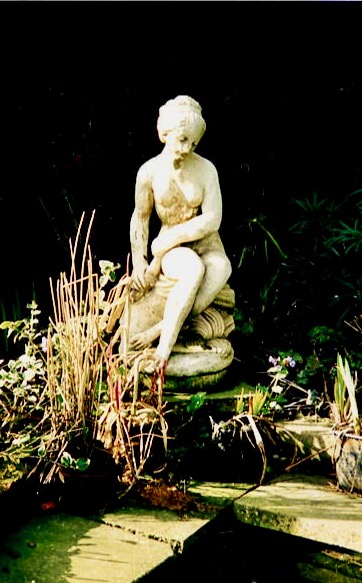
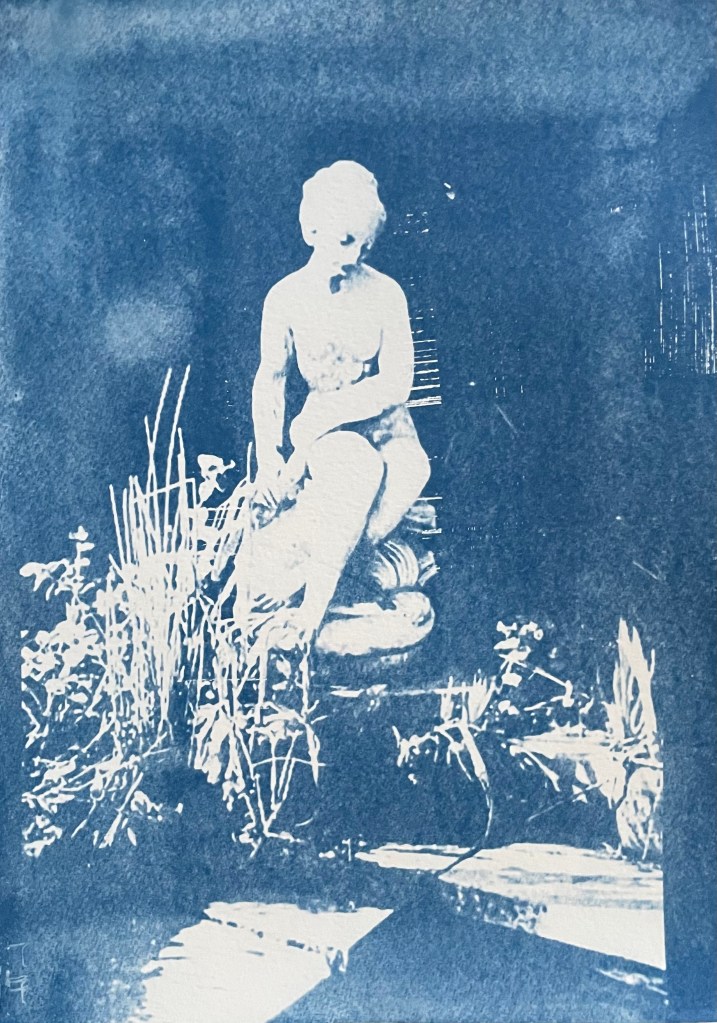
This is a photo of the statue which sits at the bottom of my mother’s garden next to her makeshift pond made out of an old washing-up bowl. I always used to wander around the garden when I visited, stopping at the pond to see if there were any frogs around. I do like a frog – my grandmother on my father’s side used to have a rockery, and I used to spend most of my visits looking for, and trying to catch frogs. That, and hanging out in her shed and greenhouse with the tomato plants – I love the smell of tomatoes; it takes me right back.

The problem with a cyanotype is that if you leave it too long, you over-expose it, and whilst you get deep blues you lose the midtones, which is what I thought I had done with the first one, so I exposed the second one for less, but it turned out to be under-exposed – even putting it in a hydrogen peroxide bath didn’t help. Both were done outside; perhaps I should have done a straight 15 mins in the unit, but where’s the jeopardy in that?

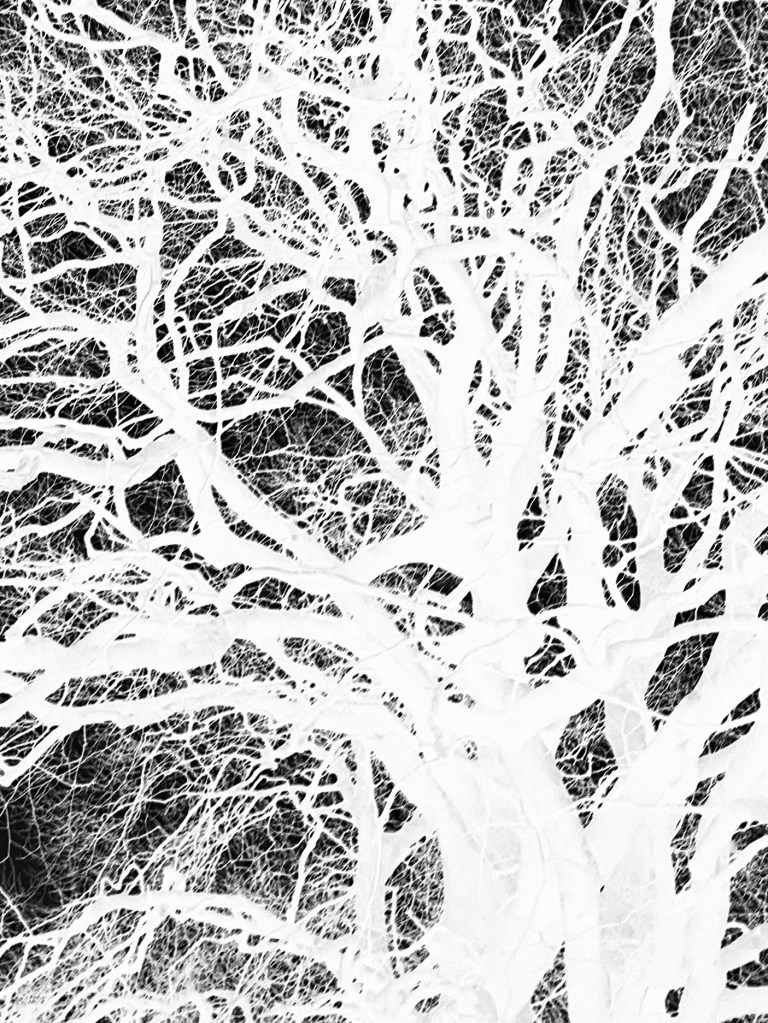
This is a photo that I took looking up into the branches of the three trees that I like. The negative image is also really interesting, and I might do something with that at a later date. The image (last photo) is underexposed again, but has a feeling of being removed, almost as if I’m looking at it through my window (which incidentally does need a good clean). I wanted to try fabric, but could only find some thin cotton lawn. I was so disappointed – it turned out terribly. I had visions of being able to create long, flowing, billowing, wispy cyanotypes, but ended up with the image above. You can just about make out the branches.

I will need to think about this a bit more. My first thoughts are that maybe there was a coating on the fabric, so I’ve washed it; maybe the image was too detailed, but I’ve seen quite detailed images on fabric; that the structure of the fabric is not robust enough – you can get pretreated fabric which is like a sateen so I could try that; or maybe there wasn’t enough contact between the fabric and the negative. I need to take some time to reflect, and try again.
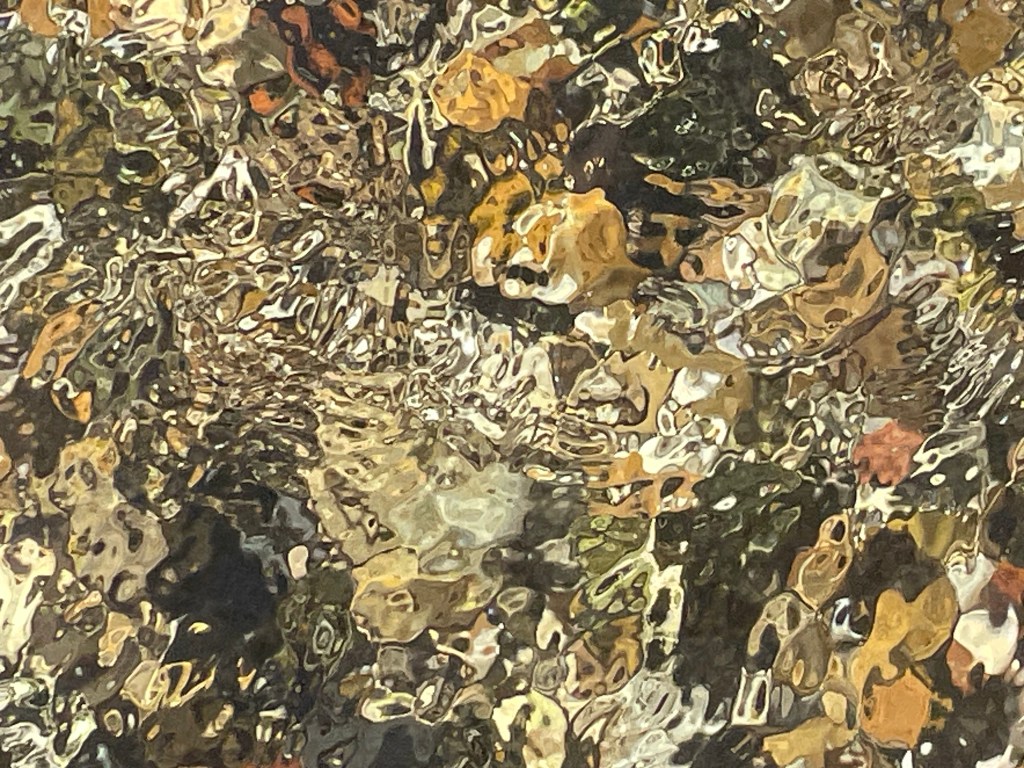
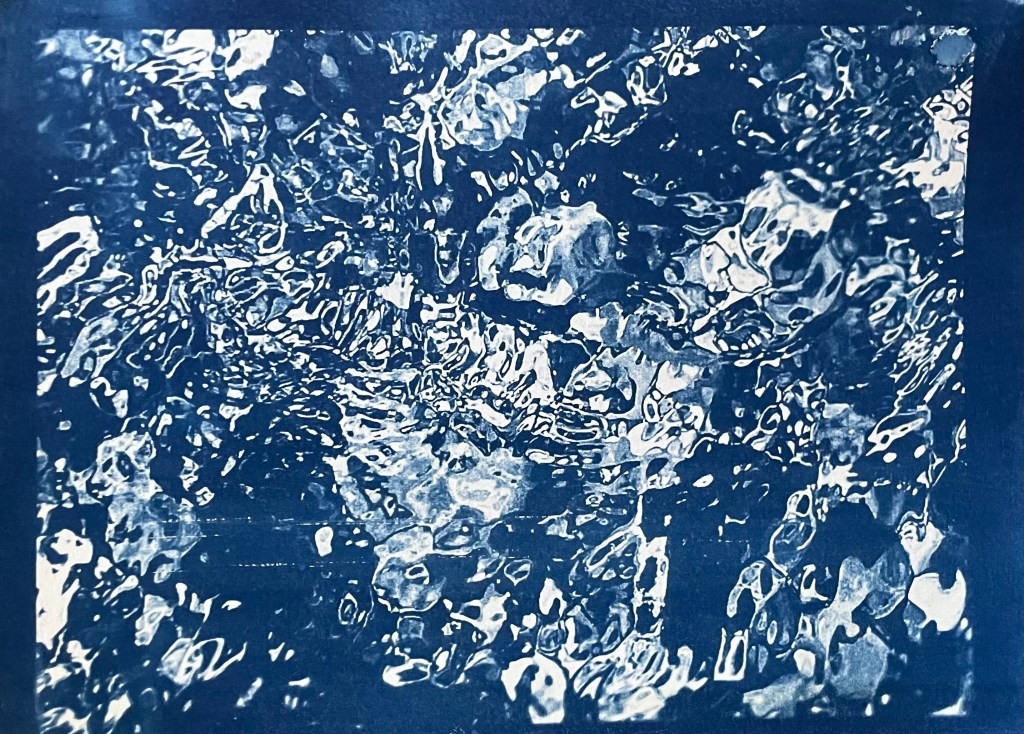
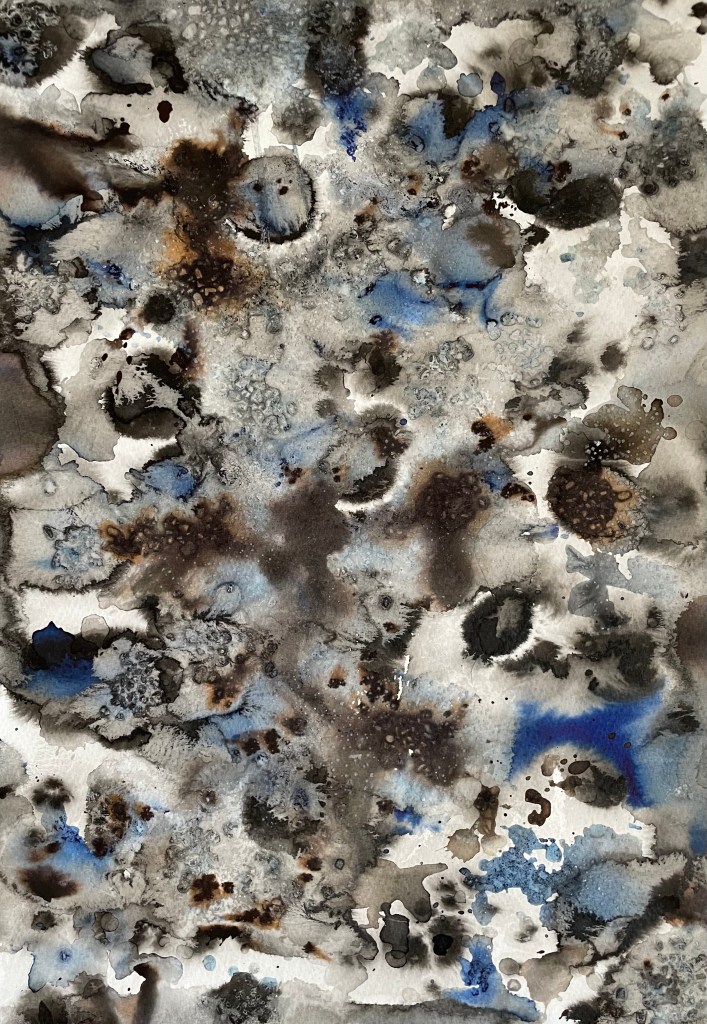
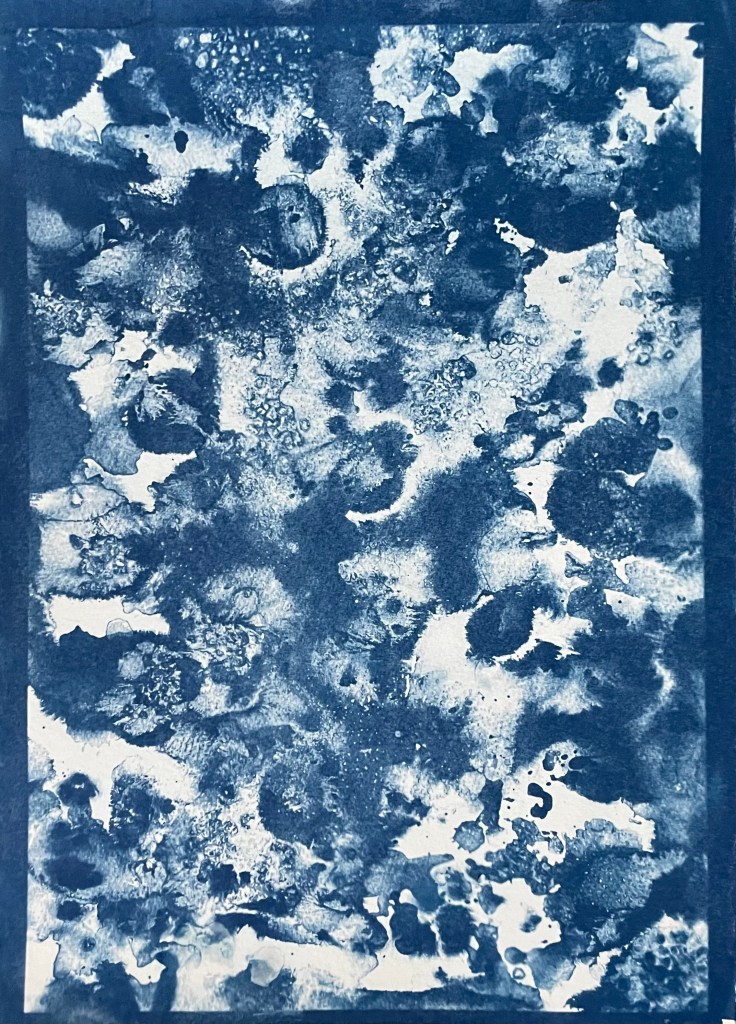
The images above were from my experiment with ink in Blot II , and from A State of Flow II . It was a useful exercise in that it confirmed to me that not everything works as a cyanotype – I much prefer the original images, particularly the ink one, as the edges between areas of flooding and blots are much more defined, and there is more of a delicacy about them. The contrast between the blue and the black ink also adds interest which is lost in the cyanotype.

So, on reflection a really useful and enjoyable exercise. The thing that I really enjoy about this process is the anticipation, and then the slow reveal as you rinse off the solution to see an image slowly emerge, or not, as the case maybe. Doing it outside as opposed to in the controlled environment of the unit adds a degree of extra excitement, but equally there is the risk of crushing disappointment when it doesn’t quite work out.

Moving forwards, I was intending to experiment with toning some of the smaller images of me with tea, coffee, wine etc, but I actually like the last couple as they are, so I will keep them as finished. I’m thinking about how I could use multiple exposures to create layers, and also thinking about manipulating the source image a bit more in Photoshop and printing from the original image rather than reversing etc. I’m not sure whether I’ll get straight to it, or do something else in the meantime – sometimes I go hell for leather with something and then exhaust it, or myself, or become disenchanted with it. I don’t want to get too far down a rabbit hole, so maybe I should leave a bit of space before going back to it, to allow for some more subconscious reflection. I suppose the clue was in the opening sentence: “Last summer I became obsessed with cyanotypes”, and I haven’t done it since.

A State of Flux

That’s my phrase of the moment. I feel like I’m in a state of flux.

I’ve been reflecting on State of Flow I and State of Flow II. Flowing water is in a state of flux.

Does that make me a river? Squeezed out of a tiny hole, small to start with, fast and quick, agile, fresh and exciting, periods of calm punctuated with the tumbles and effervescence of waterfalls and weirs, twisting and turning, carving out my way, sustaining the lives of others, being held back and contained by dams until being finally released, picking up along the way, depositing along the way, slowly getting wider and wider, slower and slower, filling up with sludge and pollution, before finally being discharged into a mass of indeterminate nothingness.

Caught In A Paradox

I’m typing this just as I’ve finished my tutorial with Jonathan, whilst I can still remember what we discussed – I did start taking notes at the beginning but ditched them as the act of note-taking became too intrusive. Consequently, I will probably forget bits, but this is the gist.

I explained that I’m feeling really positive about the course – just to be in the process is enough, and anything over and above is a bonus. Jonathan asked me what I wanted to get out of the course. What I would like is to find out who I am, which is a bit of a cliché, and to develop a rhythm of working so that art becomes a major part of my life: up until now I have had to carve out time to spend making art.

Jonathan asked me what my life is like in terms of whether it is ordered: no, it’s totally disordered with no real routine, fire-fighting issues and dealing with lots of things at the same time. Jonathan commented that the idea of spinning plates has its own rhythm. It has, but I feel that I need to develop a discipline in my artistic practice – I have no real self-discipline in many areas of my life.

Jonathan then asked me what my strength is. It’s getting things done: I can be determined, persistent and I don’t give up. The downside to this is that I’m goal driven (which causes issues in terms of concentrating on the end product, rather than the process), and I tend to jump right in. Thinking about it now as I write, not giving up can result in me being relentless and not knowing when to walk away and leave something – my mother used to describe me as a terrier.

Jonathan mentioned the story on my blog about my shopping habits: the act of wandering from shop to shop contradicts the idea of jumping in. I agreed that actually I should shop more like my husband in terms of reaching a goal, and that the act of wandering is not enjoyable but full of pressure: to find something which meets the criteria by the deadline. Not buying the first thing I see which would suffice, may indicate a reluctance to commit before exploring all the options.

What does it feel like to be working at my best? I lose all sense of time. I’m lost in time. Nothing else matters. I can look up and find that it’s dark and it’s 9.30pm and the dogs and my family haven’t eaten. But then I can look at what I’ve done and, if I’m not happy with it , think how I’ve wasted those hours of my life which I’ll never get back and which I could have spent doing something more productive. Jonathan commented that there was a paradox in terms of being lost in time and losing time. He asked me to describe the sense of loss of time: it’s huge and full of resentment in the moment, but then dissipates as everyday life starts to take over again, until it eventually disappears.

We talked about some of the things that I’ve been trying out, and I explained that I’ve been purposely not viewing things as good or bad (although I did on my last post!) or as a success or failure. You can only fail if you have an expectation and that every experience, whether good or bad, is a valuable learning experience. Jonathan agreed and commented that the purpose of the act of mark-making is to tell us what to do next and if it does this, then it’s done its job, even if it is to tell us not to carry on. He sensed a real frustration in my experiments with the iPad. I did feel frustrated but even though I had reached the view that it wasn’t something for me in terms of producing a final piece of work, I did appreciate its usefulness for preparatory work. Jonathan mentioned that a lot of artists use it for this purpose in terms of working things out, like composition, and referred to Justin Mortimer who produces large oil paintings.

I explained that I have been doing a lot of thinking recently and have a lot of ideas inside my head – In fact, I can’t stop thinking about it. I’ve also been getting a lot of inspiration as to how to express these ideas in terms of producing work. If we had had this tutorial a few days ago I would have been excited and energised, but I now seem to be less so, as I feel a resistance to attempt to translate the ideas into actual work. It’s not a fear of failure as such, but a reluctance, or maybe a fear that once I try to capture the idea it won’t be as good as it is in my head. I would usually jump straight in and, more often than not, end up feeling frustrated or disappointed. I’ve recently found that thinking about and planning a work results in less dissatisfaction in the end result, but it seems that the act of stopping and thinking creates a barrier, an inertia, to moving forward. It’s a bit like how I would imagine doing a parachute jump: I check that I have everything I need in order to jump safely, but I still can’t get myself out of the plane. The other side of me would just jump. I mentioned the blog: I’m not on social media and I like to keep myself to myself and fly under the radar, yet I enjoy the process of writing the blog and this is fine as long as I don’t think too much about it ie that it’s public (as an aside whilst I’m writing this, I have actually searched for it on Google and it doesn’t come up so that makes me feel better!).

I then told Jonathan about a proof-reading distance learning course I signed up for many years ago, as I thought it could be something I could do whilst my daughter was young. I received the first couple of modules in the post and did the first assignment. The feedback was good but finished with a reminder that the marks from all subsequent assignments would count towards the final mark. That was it for me, I couldn’t carry on. We discussed why this might have been the case. I think it was because I hadn’t done perfectly on my first assignment and that I might not even do as well in future assignments. When I was young I would come home from school eager to tell my mother how I had done in a test – then she would ask me how everyone else had done – I didn’t understand at the time, why she couldn’t just be pleased with my result, like I was. I grew up to be a perfectionist, with a view that if you are going to do something, you should do it to the best of your abilities – I have since realised that what is your best can be influenced by the circumstances at the time. Jonathan reassured me that that is why the course is the way it is – there is no assessment of a final work or comparative approach for the very reason that it would cause students to freeze up.

Jonathan commented that my perceived weaknesses are actually also strengths in that the tendency to rush in, would deal with this issue. He observed that I had mentioned the word ‘fear’ quite a lot and asked me to describe the fear. It’s like a barrier in front of me but it’s not insurmountable and it’s transparent in that I can see beyond it, to where I need to get to. Having said that it clearly wasn’t insurmountable in terms of the proof-reading episode, but that was a long time ago! To get past it I need to act, and in this respect, Jonathan said that’s where I need to draw on my strength of jumping right in without thinking about it.

We concluded that there were many paradoxes in what we had discussed and that perhaps the solution is to try and combine the two sides of me in terms of moving forward in my art practice. I commented that perhaps the paradoxes are caused by me thinking that I’m one version of me when actually the real me is someone else, which is what I want to explore. Is the real me the baby who was born, or the person I now am with all the baggage I’ve collected along the way? I recognise that my strength of getting things done is probably as a result of my career. Jonathan commented that it is the question of nature and nurture and who they are is something artists ask themselves, so it’s far from being a cliché, it is actually what art is all about.

I then asked Jonathan about something which has been niggling at me: I draw inspiration from various sources to help me see ways to express my thoughts in work. I gave the example of the Two Fridas and the passage I had come across in a book I had seen in Waterstones about siblings and the primal connection through umbilical cords. In drawing on these sources, am I creating anything new, unique, or will someone just look at it and think ‘that reminds me of the Two Fridas’? Is it enough that it is coming from me and about how I feel? Jonathan assured me that it is ok to draw inspiration from others – the Two Fridas was personal to Kahlo and painted 80 years ago – I would be making it now, in 2024, and it would be personal to me.

What will I do for the next hour? Go away and write up my note of the tutorial before I forget it, which will be a useful process to consider what we discussed. Jonathan pointed out that at the beginning I had said that I had wanted to make art a bigger part of my life and that during our chat I had said that I couldn’t stop thinking about it, so I’m on my way and I should just keep doing what I’m doing.

I’m still feeling positive, and I would venture to say, even more so. I need to cogitate on what we discussed to move forward, but for the moment, everything is all ok.