You Can Take The Girl Out Of Essex…

So, you’re an Essex Girl!

No, I’m not from Essex (I’m not really from anywhere). A pejorative term used to belittle a certain group of women, used so much in everyday speech that it earned itself a formal dictionary definition: promiscuous, unintelligent, materialistic and lacking in taste. It was only 5 years ago that Oxford University Press eventually relented to a petition and agreed to remove the term from one of its dictionaries – the one used to teach foreign students English. A member of the Essex Girls Liberation Front, the campaign which spearheaded the move, is conceptual artist, Elsa James.
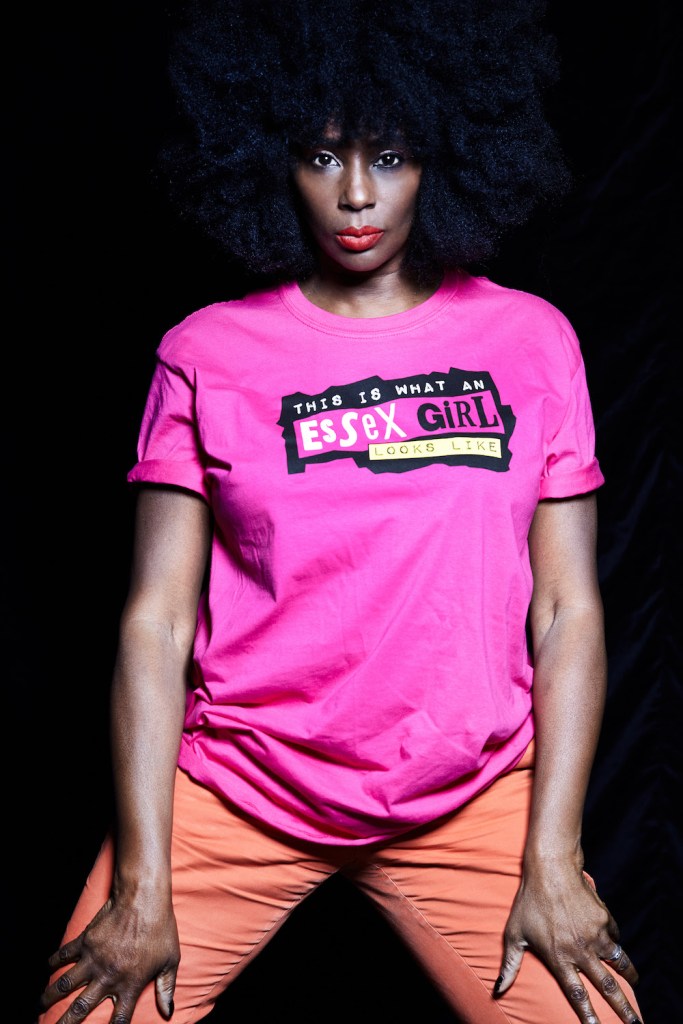
Elsa James (image: Tessa Hallmann http://www.greatbritishlife.co.uk 22/08/25)

Nowadays, I don’t really give two hoots. In fact, I often don the mantle and wear it with pride, even though it’s not really mine to wear. I still don’t understand why it’s the only county which has given rise to such a term of speech. Once you get out of ‘London Essex’ the countryside is beautiful, just like its neighbour, Suffolk, a landscape favoured by Constable, and the accent is so totally different from the stereotype.

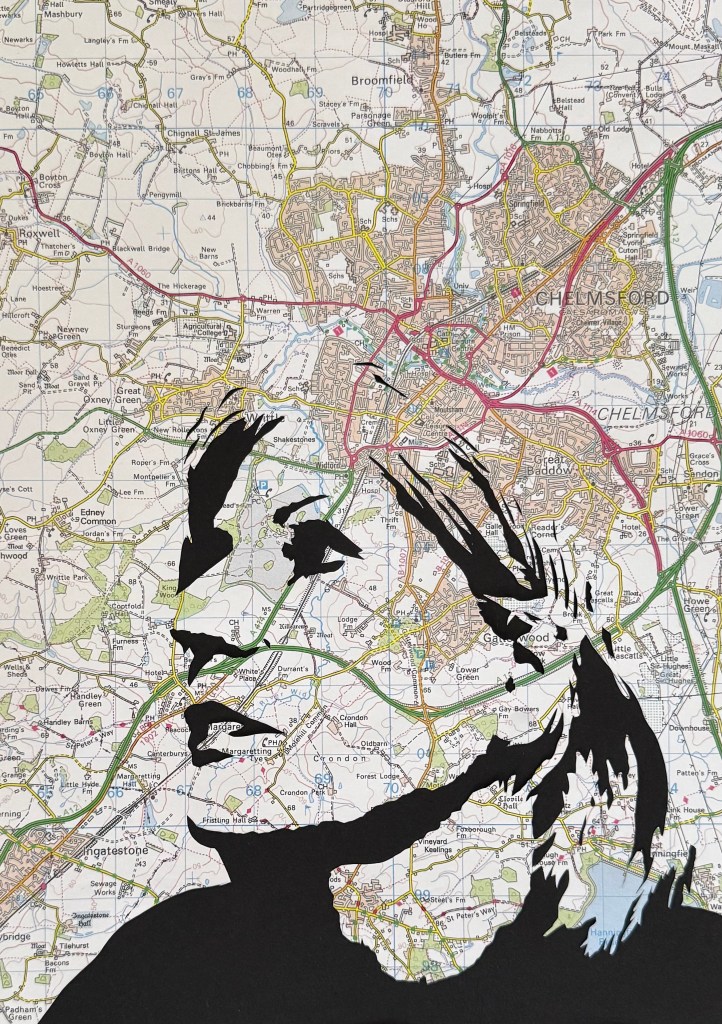
I was in a local bookshop the other day and was looking at their maps when I noticed that they had a bundle of OS maps on sale, and, as if by luck, they had Landranger Map No 167 ‘Chelmsford, Harlow & Bishop’s Stortford’, so I bought it.

I lived in Essex with my parents on and off for about 12 years. I couldn’t wait to leave; it was on a road to nowhere and I spent the school summer holidays, which seemed to go on forever in those days, sunbathing in the back garden with cooking oil, reading Jilly Cooper novels and dreaming of finally breaking free and moving to London or somewhere else equally as exciting, perhaps one of the destinations of the planes that I used to watch leaving trails across the big blue sky.

I’m not sure why, but my old school isn’t on the map (the map is not the territory). It definitely still exists. It should be where the 08 is. I had to travel over half an hour on the 311 bus to get to school; the bus stop was right outside my house, which meant that rolling up my school skirt to make it shorter had to be done with expert precision as the bus pulled up at the bus stop, just in case anyone was watching. Then up to the top deck where you could smoke, with my small stash of cigarettes which I had pilfered from my father’s packet of Rothmans, left on the side in the kitchen.

It was an all girl school. There was a boys’ school across the road, KEGS, and in the fifth year there was a lunchtime club, Senior Christian Fellowship, to which the boys from across the road could come. It was the most popular club.

What has Essex ever done for us?

  • Grayson Perry went to KEGS: he left a few years before my time. He went on to do his foundation at Braintree College of Art. That’s where I wanted to go, but didn’t. We both got out, by different roads, and to very different destinations.
  • Ignoring the obvious ones, there’s The Prodigy, Depeche Mode, Yazoo, Olly Murs, Jamie Oliver, Maggie Smith, Helen Mirren, Damon Albarn, Richard Osman, and Robert the Bruce, amongst others.
  • Colchester is Britain’s oldest town.
  • It has the smallest town (Manningtree) and the largest village (Tiptree, home to jam-makers, Wilkins & Sons).
  • Southend has the world’s longest pier.
  • The world’s oldest wooden church is in Greensted.
  • It has 350 miles of coastline, second only to Cornwall, and the most islands of any county.
  • Chelmsford is the birthplace of radio.
  • The Mayflower was built in Harwich.

But even so, I still don’t think that I’ll ever go back and live there.

I’ve taken myself out of Essex…
Maps

I was very lucky to have Cheng and Dalal in my group for this week’s group crit.

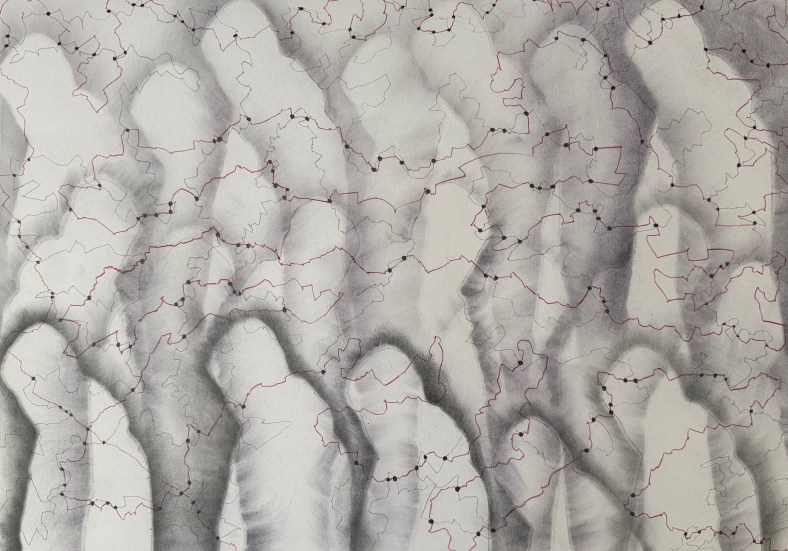
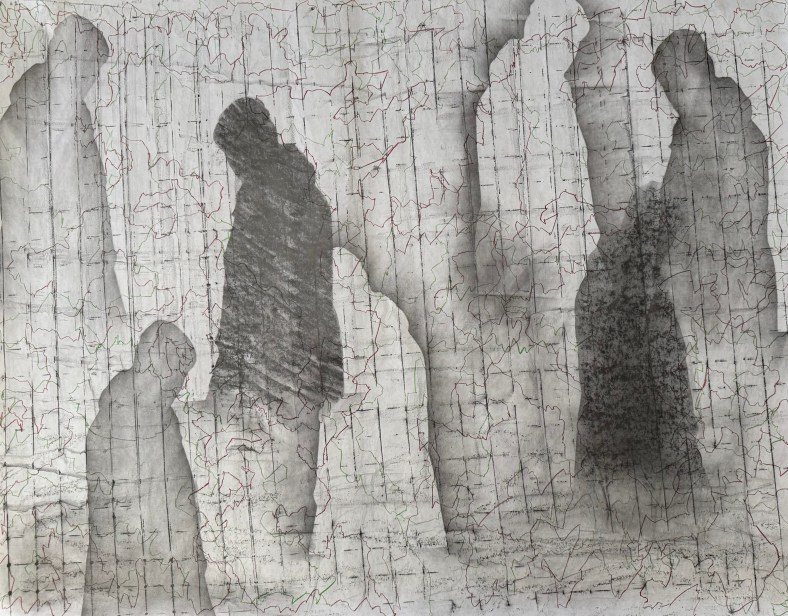
I showed my recent experiments with graphite and pencil.

I explained that I have become interested in the idea of inheritance recently and mentioned Donald Rodney’s work. We had a really interesting discussion about where we come from and our legacy, how it’s sometimes comforting to know that someone else before us was like us which frees us from feelings of fault and guilt, the idea of all that has gone before distilling down into us, much like our family tree before us, ends with us. How what we pass on feels like a responsibility or a burden.

Cheng commented that the white shapes give the impression of something that is no longer there and the dark shapes are reminiscent of shadows. Thinking about it, the shadows are cast by something that is there but is not visible. A figure’s absence is felt yet we feel a figure’s presence somewhere – it just about sums up ancestry.

I explained the process of making the pieces and how they seemed to develop into a type of map. I mentioned that the subject of maps has come to the forefront of my thinking recently along with the idea of connection. In my Unit 1 feedback one of the comments was: “It feels as though you have been working through an abundance of techniques that are maybe a type of mapping – now is the time to compare and contrast all of those experiments in order to develop an intuitive and personal way of mapping your experiences…”.

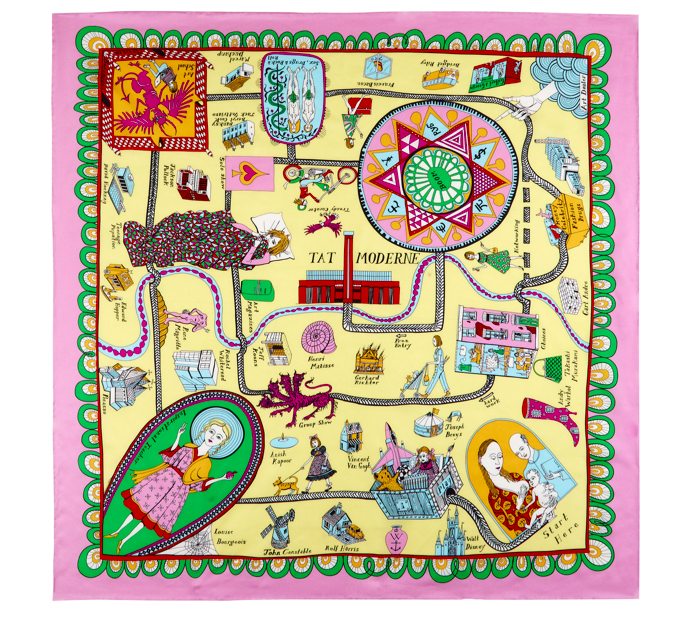
For sometime I’ve been interested in Deborah Levy’s idea of her mother being her internal sat nav and I used Google maps to obtain the aerial image I used in Parental Loss. My art class recently gave me a scarf with a Grayson Perry map on it. I was thinking earlier in the year of mapping the course of a river. The coincidence that I chose to draw the lines in colours which reminded me of maps somehow has linked all of this together. That, and the fact that I have been complaining ad nauseum about not having a sense of direction.

During these two years, I am, to all intents and purposes, mapping my life.

There seems to be a strong unintentional link to maps in the images: Cheng said that the images in which I’ve marked the intersections remind her of constellations, and Dalal observed that the lines themselves could be interpreted as borders, which then feeds into borders marking the the point where countries connect. This led to me seeing that the outline of the shapes themselves resemble coastlines.

Cheng and Dalal both made some really helpful comments about potential development:

  • playing with scale: a large image on a wall giving the impression of a map but then coming in close on a small scale to create a more personal experience and stronger connections
  • Drawing on a vintage map or incorporating old family photos
  • Using a pin to attach separate images to the points of intersection – this has since led me to think about criminal investigation maps – maps with string coming off from them to images and additional information on the perimeter
  • Thinking about how I can use materials to create something that looks older, that comes from a past time – this brought to mind highly decorative old maps with sea monsters in the oceans
  • creating a large scale reimagined map

Shortly after our session ended, I had a thought about making a digital map of my life with events or periods of significance being marked by specific points, a bit like a Google map, which you could then drag the yellow man to and drop into a space where you have a street view – maybe of images relating to that particular event. And then I laughed, Alexa laughed, Siri laughed, my husband laughed.

Lots to think about, as ever.

Tat Moderne

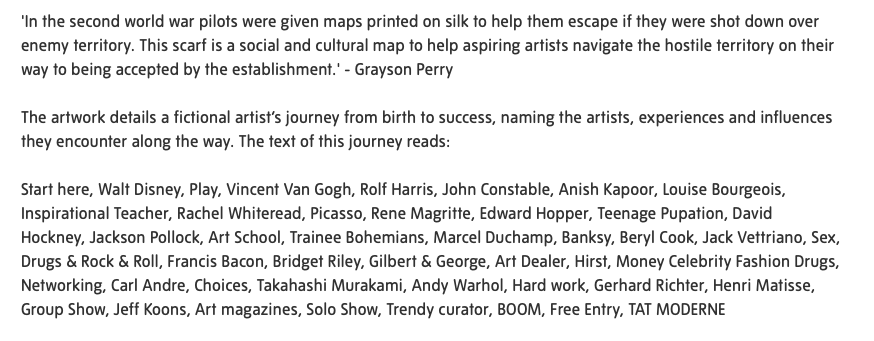
Is my destination, according to the Grayson Perry scarf which the wonderfully generous ladies in my oil painting class gifted me last weekend. Just when I thought that I was directionless, I now have a map. I’m an incredibly lucky person to have these marvellously creative, funny and supportive women in my life.

And, the accompanying blurb: