Dialogue II

“So, what do you think?”

”It’s not one of your best”

And now I’m in a state of flux, and feeling a bit stressed, thinking where do I go from here? I have nothing else.

I use my husband as a sounding board and as a gauge as to what I’m feeling and what I’m doing. I value having someone to give me feedback, to hold a mirror up to me. But to what extent should I rely on this and allow it to influence how I see my own ideas and work? Why is it when someone says they really like my work, I feel it’s easy to ‘do it down’ – ‘oh, it’s not one of my best’, ‘there are some bits of it I’m not totally happy with’ (when actually I think that it’s as good as it could possibly be and I’m actually quite pleased with it), and yet when someone is ambivalent about my work, I feel unable to ‘big it up’?

Anyway, I now feel directionless, and at a loss as to what to do.

I have looked at how other artists have approached the concept of dialogue, and, in the main, they all involve figures. None of what I have looked at has inspired me so I haven’t even bothered to include any images of them in this post.

I don’t know what it is, but I’m feeling a bit fed up at the moment. Maybe it’s the theme of ‘Dialogues’ and the idea of connections etc. – it all seems as if it’s something that has been done before ad infinitum. Maybe it actually bores me – I don’t know – I just can’t seem to get inspired by it. Maybe it’s the fact that I only have a week to make something and I’ve got other more pressing things to be getting on with. Maybe this little side quest of mine is becoming an unnecessary distraction.

As a reaction to this feeling, I decided to take a literal, and some might say, infantile approach. I kept on coming back to my perverse love of Catchphrase and the birthday card. I started fiddling around on Procreate and came up with this:
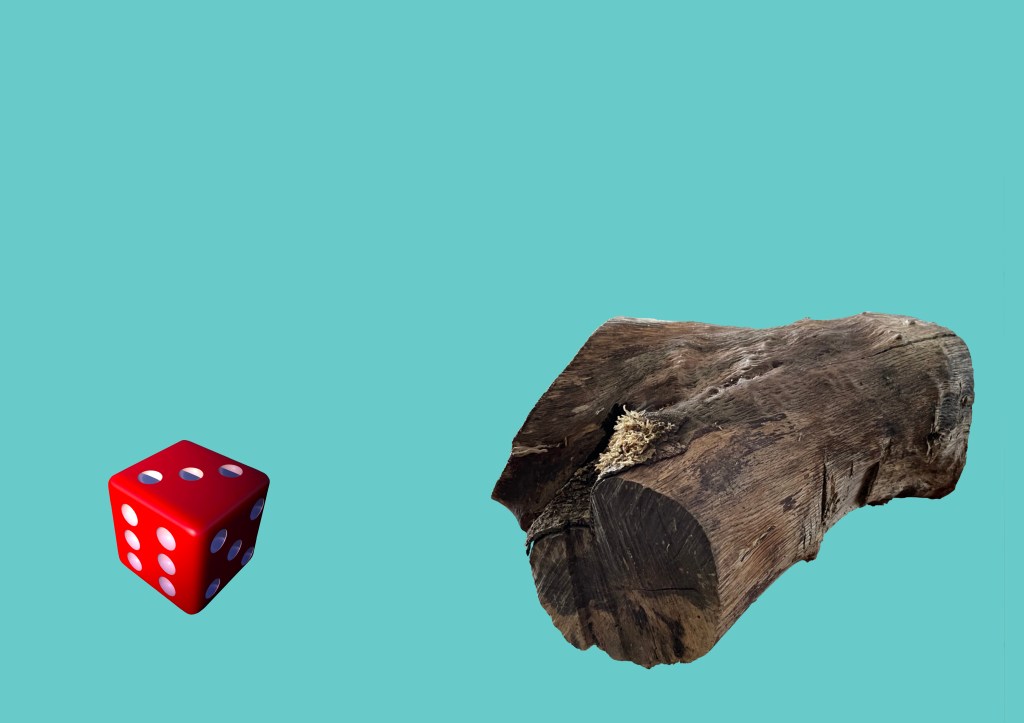
A die, a log.

It’s pretty basic, but strangely appeals to something inside me. Maybe it’s a bit cheesy – but do I care? – maybe I need a bit of cheese at the moment. Then I remembered a piece I saw at the Pallant Gallery last weekend.

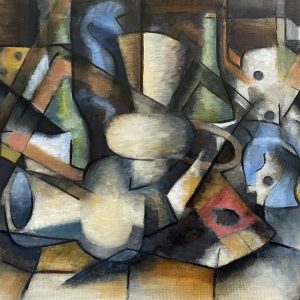
’Neighbourhood Witch’, 2008, Simon Periton, Silkscreen on mirror coated polyester

I really like the use of the mirror which reflects the viewer so that they then form part of the work. It reminded me of Craig-Martin’s ‘Conviction’ which I had seen at the RA. I could use this idea because one of the thoughts on my mind map referenced the need to reflect when engaged in dialogue.

I have decided to incorporate a mirror, possibly with the images of the die and log being raised slightly away from it so that they reflect in the mirror as well as the viewer – a die, a log, with you. It’s now becoming a fully matured wedge of Stilton!

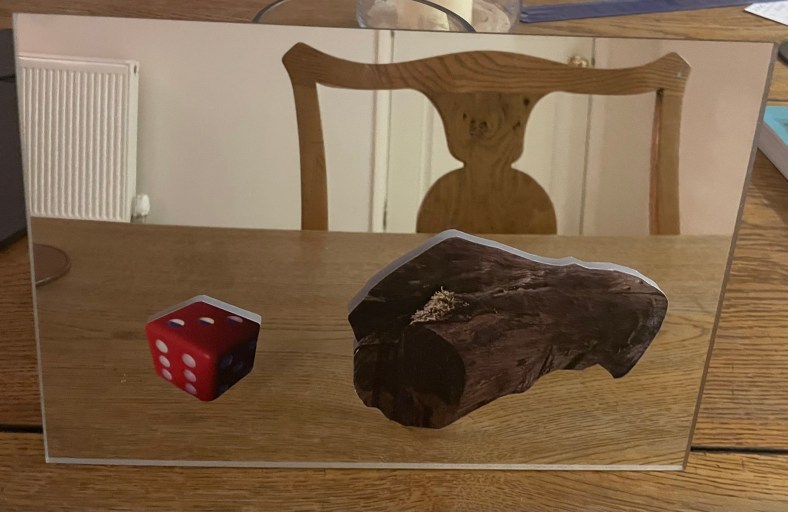
I experimented by printing them off on some inkjet friendly acetate but my home printer didn’t do a particularly good job, but good enough to allow me to see whether the idea had legs. I wasn’t averse to it: it would mean that I would have to have it professionally printed on something more rigid, such as acrylic/perspex, and frankly, I don’t really have the time to get this done. Also, on reflection, I wasn’t sure about the reflections creating multiple images, as it was no longer a die and a log.
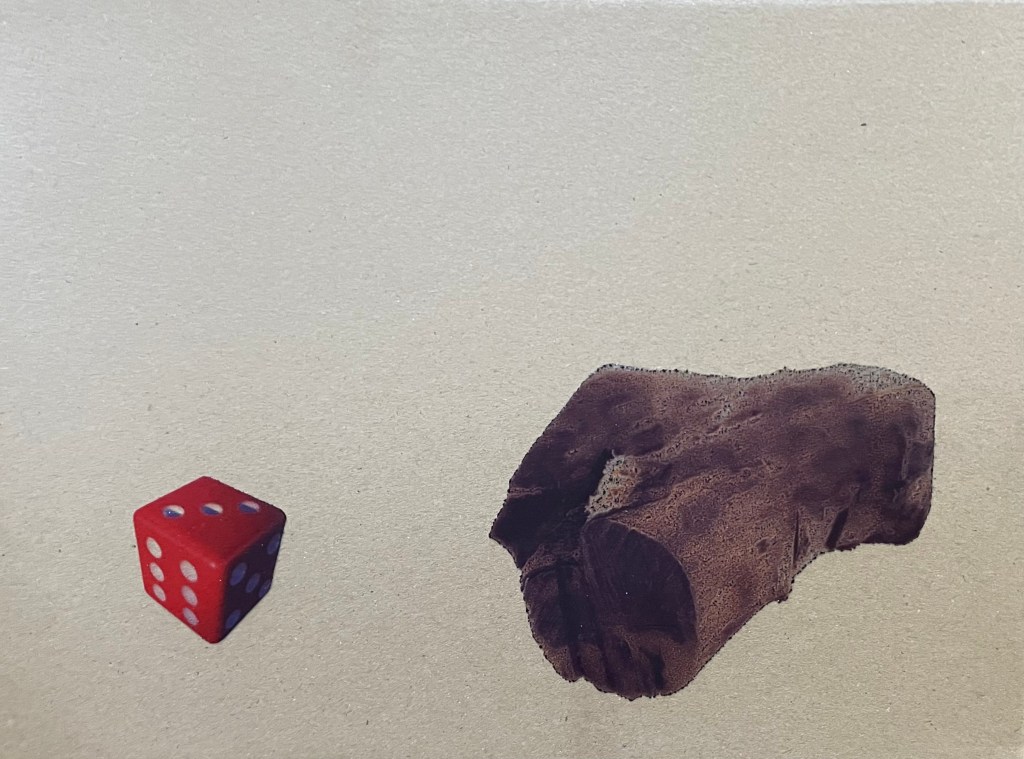
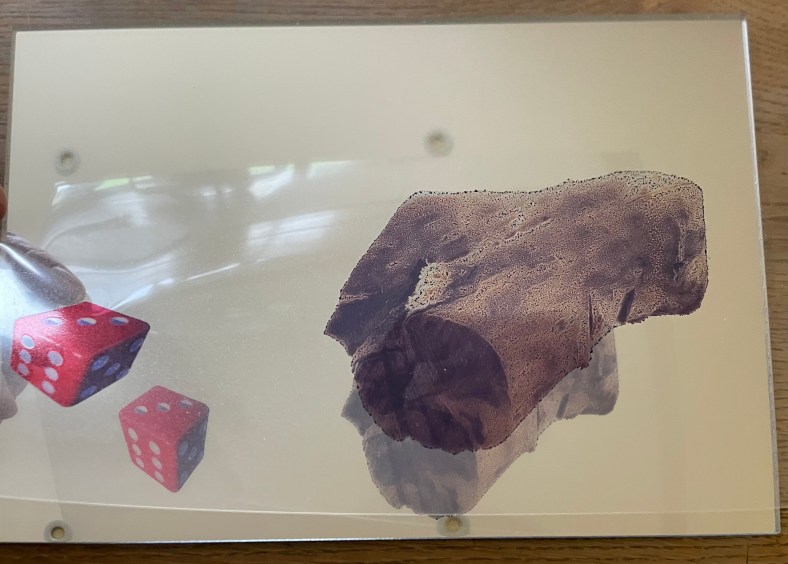
The only solution that I can think of is to fix the image directly to the mirror. The image in ‘Neighbourhood Witch’ above is screen printed on. I don’t know how to do this and I don’t have time to learn. I could get it done professionally, and after having done some research, it may still be a possibility but it depends on timing. Another solution would be just to collage them on. I researched the best type of adhesive and came up with Gorilla Clear Glue which is used a lot in glass mosaics. I will need to experiment with how best to apply it. In the meantime, I put some image cut-outs on a A4 mirrored piece of acrylic. I like the size.
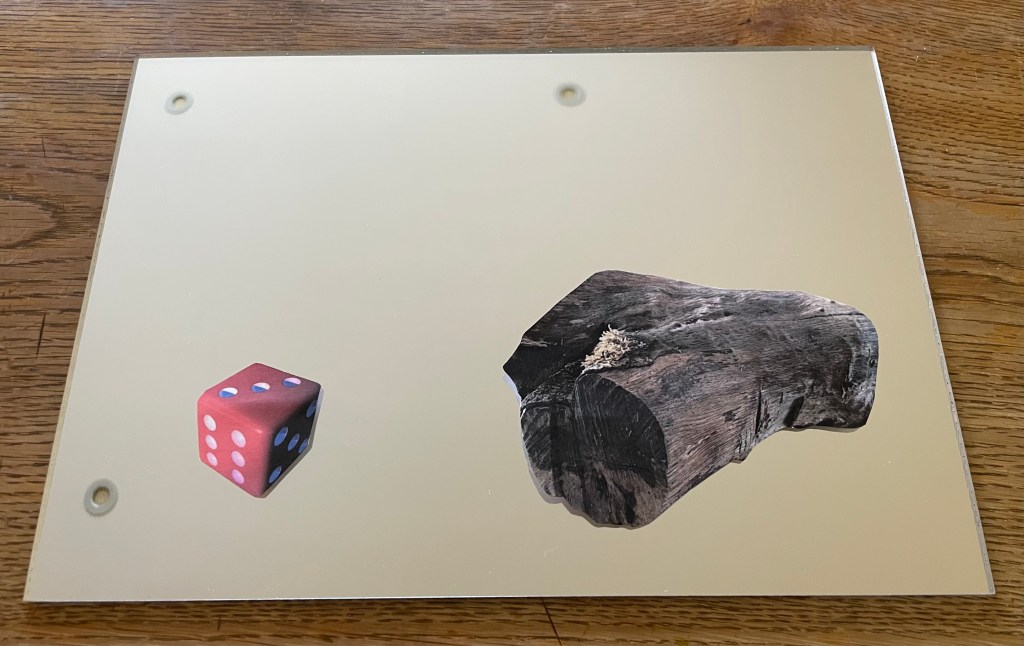
Despite its luke warm reception, I’m going to carry on with my current train of thought. It may not be my best, but I like it because it is something that is totally different for me and it’s way outside of my box, and frankly, I’m all out of other ideas. And as General Patton said – a good plan violently executed now, is better than a perfect plan executed next week.

So I had a couple of sets of the images printed up on some 200gsm paper by my local print shop and cut them out and placed them on the mirrored acrylic to see how they would look.
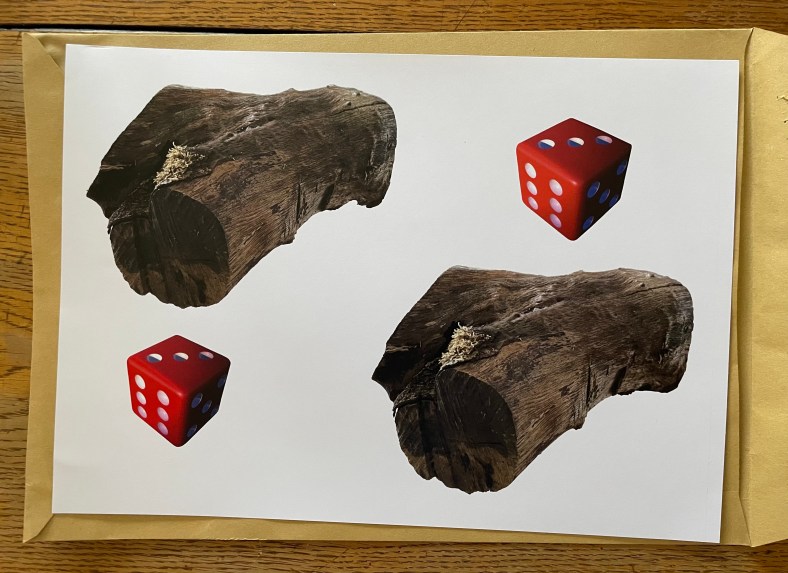
I don’t know why I didn’t realise that this would happen, as it seems so obvious now – unless you stand dead straight on to it you can see the white reverse of the cut out image in the mirror.

My proposed solution is to have the mirror images printed and then fix them together so that any reflection is of the image itself.

Onwards and upwards, I hope!

It Doesn’t Mean We’re In A Relationship

January has come around again, and I have bought my entry to this year’s RA Summer Exhibition. Will 2025 be my year? Or will I fall at the first hurdle, yet again? The theme for this year’s exhibition is ‘Dialogues’.

When I read this, two other words spring to mind: ‘connection’ and ‘relationship’.

Definitions:

Connection: a relationship in which a person or thing is linked or associated with something else.

Relationship: the way in which two people or things are connected; the state of being connected

Dialogue: a conversation between two or more people; an exchange of ideas and opinions on a particular subject; a process by which people with different perspectives seek understanding.

In the above definitions ‘connection’ and ‘relationship’ seem to be interchangeable. Personally, I think it is possible to have a connection without having a relationship. To me, a connection is an initial link based on shared interests, experiences, understanding and values, whereas a relationship is a sustained connection over a period of time.

I would suggest the following:

  • for there to be a dialogue, there at least has to be a connection.
  • it is possible to have a connection and a dialogue without having a relationship.
  • it is necessary for there to be a connection and a dialogue for there to be a relationship, and to maintain that relationship requires actively nurturing the initial connection, or repeating it, through consistent dialogue, shared experiences and commitment over a period of time.
  • it is possible to retain a connection and a dialogue despite the ending of a relationship.

When my daughter comes home from uni she likes to visit her favourite local eatery, the kebab van parked up in a lay-by frequented by lorry drivers. Every time she goes she makes a connection with the owner; they talk; they don’t know each other’s names but he knows, and remembers, where she goes to uni, what she’s studying, that she works at the local Sainsbury’s in the holidays, and how she likes not only her kebab but how we all like ours; my husband, as it comes, me with a little meat and lots of salad, and both garlic and chilli sauce. One might say that they have a relationship.

So, where does all this take me?

To disconnection. We seem to be living in a world in which we are increasingly becoming disconnected, in the sense that we have less meaningful interactions, and consequently we are limiting the opportunity for dialogue and relationships with ourselves, each other and the world around us.

Connections can be made quite easily, for example, on social networking sites, but does that allow for meaningful communication? Does a post followed by a like or a comment constitute dialogue? In fact, by their very nature of facilitating lifestyle curation, social networking sites can cause users to feel disconnected.

One might take the view that dialogue is something more than a mere exchange of words; it involves active listening, empathy, picking up on visual cues, making eye contact, challenging assumptions to create a sense of stronger connection and understanding, the latter being a form of Socratic Dialogue; a continual process of inquiry to deepen understanding. You don’t have the opportunity to exploit these to their fullest when communicating by text, speaking on the phone or on Zoom.

People have even stopped sending the one thing that keeps us connected, particularly to those that are not in our daily lives: Christmas cards. The trend is now to make a donation to charity, apparently. I send Christmas cards every year with the best intentions of reconnecting and furthering some old relationships which have been neglected. If I don’t manage to follow up, at least they’ll send me a change of address if they move, so I can give it another go in the future.

Some of it is a legacy of Covid: it’s easier to deliver university lectures online, to have doctors’ appointments online, to work from home. Whilst I agree that there should be a good work/life balance, not going into a workplace at all and not being able to interact face to face with colleagues, and have water cooler conversations, can’t be a good thing, particularly for young people just starting out in their working lives. The workplace is somewhere to meet friends, or even partners. You can’t really go out for a drink after work, if you’re working from home.

This is a low residency course: we meet weekly on Zoom and communicate with each other on our WhatsApp group. We had an initial connection – our passion for creativity. After the first term we have a deeper connection, and possibly even a relationship in the sense that our connection is fundamentally anchored in a mutual understanding of trust between us. That relationship will deepen further when we meet in person.

I’m not sure where I’m going to go with all of this. Possibly nowhere.

Entries have to be submitted by 11 February, so the next four weeks are going to be very busy with this and my study statement. I’m sort of regretting doing it now: I think that I just wanted to shock myself into doing something. I’m trying not to panic – if I don’t manage it, then that’s fine – I could always submit something I’ve already done, but, if I can, I would prefer to go through the process from scratch.

Reflection

I’ve decided to take a leaf out of Sophie’s book and formalise the thoughts I’ve had since we finished our first term.

I don’t think that I have felt more like myself (whoever that might be) than I have over the course of the last 3 months. I can’t pinpoint why exactly; I’ve just felt like ‘me’.

It has been overwhelming (I suspect that I use this word an awful lot) in the sense that I have been totally free to create and, more importantly, to think about creating. I feel as if I am at the start of an important journey – I don’t want to rush into it; I want to take my time and be prepared. I don’t even know where I’m going – there are no limitations – but I know that I will discover something by the end of it.

I think that I have mostly engaged in the preparation side of things rather than the physical manifestation of work, but that’s been the best bit. I’ve been collecting ideas, inspiration, and information. I think about it most of the time. I’ll have a thought and think, yes, I could use that, and then it’s gone. I need to find a workable way of recording my thoughts – I can’t really open a notebook or Notes on my phone whilst driving – maybe I’ll have to call someone (hands free, of course) and get them to record it for me. Funnily enough, I used to do that: if, whilst at home, I thought of something I needed to do at work the next day, I would call my work phone and leave a voicemail. Just writing that has made me think about what voicemails I might leave younger versions of myself at various points in my life. And that is how it’s been, going off on tangents, suddenly striking up a conversation with whoever I’m with, on the thought I’ve just had.

It has also made me feel anxious – I don’t want to miss anything. I have amassed a large pile of books which I ‘need’ to read. I haven’t really tackled the online library resources with any conviction just yet – the thought of it makes my heart race – all that information out there – how can I take it all in?

The preparation of my study statement has come at just the right time. I need to marshall my thoughts and commit them to words, but in the knowledge that it is a living document which can change over time. I’m actually really looking forward to it as it will bring a sense of calm and order. I hope. Who knows, I might be feeling differently come the beginning of February.

Thinking back on the work I have done over the last few months, I think I have become much freer – I’ve been leaving things as being what I would term as ‘unfinished’ and managing not to go back to them. Making them public by putting them on this blog has helped tremendously. I’m now enjoying the process of making much more than I have previously – it was often an ordeal.

I think I have identified areas which I would like to explore in more depth: I have invested in a book on Procreate (it’s not going to beat me) which I’m working my way through, and I have some ideas in my head as to a series of three digital collages on the subject of motherhood which I may or may not develop further. I like the number three: I am one of three; there are three in my immediate family; there are three trees which together form one tree on my favourite walk near my home; and three is the smallest number by which you can seek the input of others and still avoid a deadlock. Having said that, it’s probably not so great for a friendship group.

I would also like to experiment with printing techniques, photography and a previous obsession, cyanotypes. This term I’m determined to book some sessions and get into CSM on a regular basis.

I’m now able to look back at the three monotypes that I made of my mother. I feel that it was the right thing to do. It was something that I always knew I would have to address and it was something that I had to tackle early doors. I think it has helped. I went back to my mother’s house not so long ago and I didn’t feel the usual sinking feeling of dread as I walked through the front door. I was actually able to sit down by myself in silence and remember some of the good times when we all lived there as a family, even when it became dark outside. A small positive step in the right direction.

As finished pieces of work, they are what they are, vehicles by which I transferred debilitating thoughts into another space. Could I have done them differently or executed them better? Yes, obviously, but I don’t look at them that way; it is what they signify and make me feel that matters: despair, confusion, sadness, resentment, helplessness, isolation and fear. I chose monotype because it is, as soon as it is, and there is no way back. It was all about the process, not the result. If I had to make a change I would change their order – I made them in the order of the conversations – they would work better as a series if their order was reversed, with each one making more sense of the one before.

I took my daughter back to uni at the weekend, and she phoned me up earlier, chasing me for some information I was supposed to give her. My husband chipped in that it wasn’t any wonder that I hadn’t got round to it as I seem to spend all my time blogging – well, if I don’t have anything else to show for the next year and a half, at least I’ll have this blog!

Sniper’s Alley

Well, it’s official – I’m now closer to 60 than I am to 50. Ugh!

I seem to have swapped the paraphernalia of parenthood for a bag of drugs, which I routinely plonk in the tray at airport security, hoping that no-one’s looking too closely – two asthma inhalers (a preventer and a reliever), omeprazole for my acid reflux, progesterone tablets, oestrogen gel, and 4 eipipen adrenaline auto-injectors for my tree nut allergy (yep, sorry – I’m that annoying person who prevents you from eating your nuts with your overpriced inflight drinks).

I’m well and truly in the thick of that period of life known as Sniper’s Alley, when one is constantly dodging the bullets of diabetes, heart disease, stroke, cancer and much more. My mother and her brother both died of oesophageal cancer, their brother basically suffocated to death from ‘pigeon fancier’s lung’, their mother nodded off whilst sitting on her sofa and died of a heart attack, and my father and his mother both died after having strokes. Well, it’s a rather limited menu, but if I really have to choose, I think I’ll go for the sofa option, please!

Having said that, life itself is Sniper’s Alley. I was driving my husband to the train station the other morning; he was late and not a little stressed. The traffic lights changed – shall I be an ambler gambler? I don’t think so. There was a deep sigh and a hand raised to the head on my left as stress levels increased. Luckily the lights changed to green quite quickly. As we rounded the bend, a truck had shed its load of scaffolding poles into our lane, only shortly before. “We could have been under that, had I not stopped at the lights”, I observed.

It was a ‘Sliding Doors’ moment. The idea of an alternative life based on the decisions I have made really intrigues me. To a certain extent, I think that I was meant to make the choices I did, when I did, in a nod to fate, but, nevertheless, imagining my own ‘Midnight Library’ has its attractions.

I recently read a book called ‘The Gentleman from Peru’ by André Aciman. I saw it in Waterstones and bought it just because I liked the cover. A group of American college friends are on a sailing trip in the Mediterranean when there is a problem with their yacht, and they have to stay at a hotel on the Amalfi Coast whilst it is being repaired. They meet an elderly gentleman, and the book centres on their relationship with this mysterious character. During one of their conversations he says:

“We may no longer be the person we once were, but what if this person did not necessarily die but continued his life in the shadowland of our own, so that you could say that our life is filled with shadow-selves who continue to tag along and to beckon us in all directions even as we live our own lives – all these selves clamouring to have their say, their time, their life, if only we listened and gave into them…

…The old self, the new self, the shadow-self, self number seven or eleven, the self we always knew we were but never became, the self we left behind and never recovered, the might-have-been self that couldn’t be but might still be, though we both fear yet hope it might come along one day and rescue us from the person we’ve had to be all our years.

But as I said, it’s not just the past that haunts us. What haunts us with equal magnitude is what has not happened yet, for there are shadow-selves and shadow-lives waiting in the wings all the time. We are constantly reworking or reinventing both the past and the future. Sometimes we’re in the street or in a crowded bus, and we just know: that one day this person whose glance we caught or whose path we just crossed is another version of someone we know we’ve loved before and have yet to love again. But that person could just as easily be us in another body. And the beauty of it is that they feel it just as much as we do. Is this other person us or is it someone destined for us whom we keep missing each lifetime? Us in others, isn’t this the definition of love?”.

How happy am I that my ‘might-have-been’ 18 year old shadow-self has finally caught up, and rescued me? Better late, than never.

Bitter Sweet Symphony

…Tryna make ends meet, you’re a slave to the money then you die…”

I don’t want to give the impression that I’m on a downer; I’m not, it’s just a coincidence that the things I want to post about at the moment all involve an element of death, which is not a bad thing, as it reminds me to live.

I had never really contemplated my own death until my father passed away in 2013; then I obsessed about it for quite some time. There I was sitting quite happily on my branch in the tree of life when suddenly there was one less person between me and the end; to be fair I was so far along it that it was becoming more of a twig than a branch and had started to bob up and down quite precariously in the breeze. But there’s nothing like the death of someone of a similar age to drum home my own mortality. I had lost friends at university, but I was young then, and whilst the sense of loss was immense, I still felt invincible; those were extraordinary deaths.

Last night my husband told me that an old work colleague of mine had died a couple of weeks ago. I worked with him for seven years; I hadn’t seen him for twenty, yet still the news profoundly affected me. We were more or less the same age and level of qualification; I had previously worked at two law firms before joining the firm where we worked together. He had trained, qualified, and become a partner at that firm, a period spanning 32 years. He had never known any different, had never stepped outside of his comfort zone or worked with new people who may have inspired him or influenced him in different ways. Why not? My husband ventured that maybe he stayed for the money which financed a certain lifestyle and that he was happy with that, with that way of living. That’s true; just because it is a path that I would not have chosen does not make it less valid, and, in this respect, I appreciate that I am lucky in that I have a choice; a lot of people don’t have that luxury.

He would have been earning a fair amount, working incredibly long hours and have been under intense pressure. Was it all worth it? If I had said to him 20 years ago, when we shared the same office in which he would tell me all about his salsa classes, his training for the triathlon he was planning to compete in, or the latest date with his girlfriend, that he had a ticking time bomb inside him which would kill him at the age of 55, would he have made the same choices? Maybe not, but that’s the benefit of hindsight. As Kierkegaard says:

It is really true what philosophy tells us that life must be understood backwards. But with this, one forgets the second proposition, that it must be lived forwards.”

Reflecting on Resentment I

During the last session we considered the premise that resentment blocks creativity.

Resentment is a feeling of anger or unhappiness about something that you have been forced to accept and you don’t like, or think is unfair. It comes from the Latin verb sentire, and so it is an emotion which is ‘re-sensed’ time after time, perhaps even increasing in intensity. Perhaps we feel resentment that other artists are better than us, or that they have works accepted in exhibitions and we don’t.

As I get older, I try as best I can to keep as much negativity out of my life as possible. I may initially feel it, but then I try to process it by turning it on its head, or actively dealing with it. I can’t feel resentment (in the sense of it being a recurring emotion) that other artists are better than me or are more successful – instead I use the initial negative feeling (which is probably more envy than anything else) to spur me on to try again, to fail again and to fail better, because inherent in that form of resentment is the feeling of failure.

For the last few years I have submitted work to the RA Summer Exhibition but I have never made it to the next round of judging. Each year I experience a moment of crushing disappointment and vow never to do it again, but then January comes around and off I go again. I’m clearly looking for validation, but I often think to myself that if ever I do get in I’ll probably never submit again, and maybe it won’t even make me happy.

My husband confessed to me that he had always wanted to paint. Why don’t you just do it, I asked him. He started with watercolours and over time became good at it. I suggested that he try oils as they are far more forgiving and I thought he might enjoy the freedom of using them. I bought him some as a gift along with some boards and brushes. He signed up to an oil painting class and shortly afterwards submitted one of his oil paintings to the Summer Exhibition. He made it through to the last 4,000 out of 16,000 entries on his first attempt. Did I feel resentment? No – I felt proud, with a strong sense of irony. He felt ecstatic with a strong sense of embarrassment.

If someone treats me badly I tend to think that it is more about them rather than me, but if it is something that I know will eat away at me and become a resentment I try to deal with it head on, unless doing so will cause irreparable harm. But, there is one particular instance of resentment which I haven’t been able to let go of no matter what I do, and I feel it as strongly today as the day I first felt it.

If You See It, Just Buy It.

This post has been sitting in draft for a while now. I’m not sure why I’ve been delaying in publishing it – maybe a reticence to commit in case something better comes along. Rather like the way I shop: I like to browse in every single shop to see all the available options, and for the most part end up going back to the first shop, several hours later. My husband, on the other hand, sets out with a list and buys the first item which fits the bill – his advice to me is that if I see it, I should just buy it, and save myself the aggravation. So what if I do have a better idea further down the line? That’s part of the process isn’t it? To reflect, adapt and recognise the need for a change of direction.

I’ve been giving further thought to what I would like to explore over the next couple of years. I’m afraid it’s not a laugh a minute, but it’s something that’s been on my mind for a while.

Not to be egocentric about it, but it’s ME! Then again that’s not a surprise as everything I make, even within the constraints of my art class, is subconsciously about me in one way or another: how I see the world; what matters to me; what interests me; about me; my experiences.

I remember sitting in the back of the family car as a child, probably on one of those Sunday afternoon drives in the Black Forest my parents used to like, with my brother on the back seat playing my dad’s favourite Elvis Presley and James Last songs on his double deck cassette player and thinking to myself: Who am I? This is me. Here. Right now. I almost tried to climb inside myself which messed with my head a bit. I must have been about 7 years old.

Who am I, as a person, as an artist? Hopefully by the end of the next two years I might have a better idea.

I’m particularly interested in my identity in the sense of nature and nurture: who is the authentic me – the one that drew its first breath? As Z recently mused on her blog ‘we will never be as unmarked as when we were born’. How has that version of me been influenced by my life experience, in particular, the roles I have had in my life?

This line of thought was prompted by the death of my mother in 2023. As my father had passed away in 2013, she was my lone parent. It struck me that my role as a daughter was coming to an end. Arguably it had gone on hiatus sometime earlier when I started to care for her following her cancer diagnosis, whereupon my role became that of carer. Some roles in life are mutually exclusive and in my case this was more or less true of my roles as daughter and carer – maybe it was a coping mechanism. As a result, I have issues in processing that brief, but cataclysmic, period of my life.

My mother’s death also made me consider my role as a sibling and the subsequent sense of estrangement I feel from my brother and, conversely, the closeness I have with my sister as a result of our shared experience of caring: sometimes only someone who has gone through the same experience can truly understand how it feels.

What effect does the ending of a role have on identity? What if I feel that I have failed in some roles? What if others think that I have failed? What if my roles conflict or were not mine by choice?

In being a mother I reflected on my experiences as a daughter to try and be the best mother I could be, and so the cycle will continue, perhaps. I’ve been a career woman, a homemaker and, still am a wife. At some stage I have lost the sense of the real me, if there is one: some roles allowed others to prosper whilst I took a back seat. Words which particularly resonate with me are from Deborah Levy’s The Cost of Living :

“It requires skill, time, dedication and empathy to create a home that everyone enjoys and that functions well. Above all else, it is an act of immense generosity to be the architect of everyone else’s well-being.”

In my head I’ve been Norman Foster.