Self-Accountability W/C 4/3/25

I knew that last week would be a busy week for other things; I haven’t even managed to post anything, on anything.

I managed to attend Madeline Hook’s online workshop on Visual Research which was very interesting and demonstrated how the online resources are a much richer environment for searching for visual inspiration than a Google search, which is primarily made up of images in a commercial context. I don’t know why that hasn’t dawned on me until now.

As it turned out, I didn’t need to do anything on the New Contemporaries, as the exhibition is part of the low residency week activities.

I did think some more about the interim show in between doing other things; I have now managed to come up with a way of making it obvious that the telephone is interactive – I’m going to do something along the lines of the accompanying piece to Michael Craig-Martin’s ‘An Oak Tree’.

I have started to do some work on Topic 1; I’ve changed it to be about motherhood as I’ve finally started realising some ideas that I’ve had in my head for months and so that seemed the natural place to start, although it’s out of chronological order. Depending on how these go, I might think about putting them in the interim show.

I haven’t done a mind map so I’ll have to shift that as an ongoing item into this week.

We’re So Excited

No, not the Pointer Sisters. My second tutorial with Jonathan this morning.

I’ve had some additional thoughts whilst writing this up and put them in brackets in italics as a reminder to me – they didn’t form part of our discussion.

He asked me whether I feel that I have been productive.

I told him about something my husband had read out to me from his Facebook feed last night on the basis that he thought it was relevant to me: “ambition without action turns into anxiety”.

In terms of posting on my blog and thinking and having ideas, yes. In terms of actual physical output, no. But that doesn’t really concern me as I feel that I am about to enter a different phase; up until now I have been collecting ideas and inspiration. I’ve done enough now, although the process of collecting will always continue. I tend to have periods of inactivity, of thinking and pondering, followed by intense periods of activity.

We talked about the exhibitions that I’ve visited and written about in my blog; my thoughts and takes on the artists and work I have seen, which he found interesting.

I mentioned entering the Summer Exhibition as a way to make myself make and how I’m viewing it as an experiment. In previous years I have spent a lot of time and emotional energy in creating work which has then been rejected, but still I enter every year – it is almost a masochistic ritual. This year I’m not investing the same amount of energy, although it’s turning out that my time has been taken up with problem-solving, rather than emotional input anyway. It will be interesting to see whether the feeling of rejection stings as much. Theoretically it should, because a work which I create in 5 minutes should still have the same value to me as a work which takes me 5 years to create.

*(How to value work? Time spent? Size? Type of material used? Obviously, there’s a break even point, but beyond that?)*

This feeds into my concern about the extent to which I can take credit for a work in which others have had an input, or in which chance has played a major part. I mentioned the possibility of having to engage the services of a professional printer to screen print on a mirror and referred to the Phyllida Barlow video in yesterday’s session; I saw an exhibition of Barlow’s work last year at Hauser + Wirth and watched the accompanying video documentary in which she had technicians assisting her. I also mentioned artists such as Damien Hirst who have a team of people who help make their work. I tell myself that it is enough that it is my idea, or that I created the particular circumstances in which chance created something. It is a mantra I keep repeating to myself, and I think that I am starting to accept it.

Jonathan advised that it’s absolutely ok to have others involved in the making. He mentioned master printmakers to whom artists would look to print their images and his augmented reality project in Cornwall in which he had to enlist help with the more complex coding he couldn’t do himself. These others don’t necessarily have to be acknowledged on the label (although he did acknowledge his) – it is enough that they are acknowledged in the process and the work itself. In fact, printmakers would often supply a certificate in an edition print to confirm that they had destroyed the plate, their input being acknowledged that way.

We then went onto to discuss readymades. I mentioned that I’d had an idea for the Summer Exhibition (which in the end wouldn’t have worked because it would require having to be regularly recharged) of using an old rotary telephone with a message on it from me inviting the viewing public to leave their own messages. Donald had mentioned in the session last week about mobile phones no longer being used for their initial primary purpose of calling people but as a messaging tool. I have researched sourcing an old one and getting a sound board fitted etc, but then discovered that the wedding industry has actually already produced one. I thought that I could possibly use this idea for the interim show; the fact that it is a space which is open to the public for a prolonged period of time seems to me to be a resource which shouldn’t be wasted – I could use the phone as a way to collect research data and then use that to inform my work. Jonathan commented that it is interesting that I have thought about the space and what it offers as a potential for interactivity. A student in one of the past interim shows had a work which was made by the public writing on postcards on the subject of grief and loss – there were the odd few on which children had drawn pictures, and that’s the issue with interactive exhibits. Usually in a gallery setting there is a line across which the public cannot cross; once the public are encouraged to cross it by an interactive piece, they are without any guidance as to how they should behave. He referred to an interactive exhibition where many of the exhibits had elements which had been damaged by the public, although not maliciously, even whilst the exhibition was being invigilated. I would probably need to think about maybe just having it there for the opening night, which would give me the opportunity to engage with people.

*(I need to think about this. The benefit of people using it when no-one else is around is that it would encourage a more personal response? What is the piece of work? The telephone or the messages? Does it matter if it is damaged after the first night as long as I have downloaded the messages from it? Leaving it longer will increase the number of interactions, but increase the risk of misuse.) *

Jonathan asked me what energises me. I don’t really have much energy at the moment, but maintaining my blog energises me: I enjoy doing it and it’s something that I find easy to do on a regular basis. I see it as being very important to me as both a note making tool which I can just scroll through to remind myself of what has interested me and as a record of the process. I see it as being a piece of work in its own right at the end of the course as it will embody everything about me. Jonathan mentioned that a past student had actually turned her blog into a book, which takes a lot of time to work out how to do particularly when deciding what to do about videos etc. This is actually something that I have been thinking about doing myself. Jonathan commented that the tag cloud at the moment shows ‘mother’ and ‘drawing’ as being the areas of interest. I need to go through all my past posts and make sure that I have categorised and tagged them correctly and this process itself, Jonathan observed, would be a valuable reflective exercise.

Jonathan then asked me what is a challenge. Making ‘finished’ work. I feel that I have been dipping my toes in various ponds, trying things out, experimenting but not taking things that step further. We talked about the kitchen lithography and whether I would do it again. I think I will. The DIY aspect really appeals to me in the sense that I can do it at home, and not have to go into a specialist place, with expert people, where I don’t really know what I’m doing. I mentioned that last summer I became obsessed with cyanotypes and want to revisit them. To this end I’ve googled how to make my own lightbox and have bought a UV light etc.

He asked me whether there is any particular mark-making process that I like. I am not sure at the moment, I’m still dipping my toes. On the subject of liking something, I mentioned my painting which I recently did in my oil painting class, and not liking it but enjoying the process and my subsequent quandary about thinking that I should, as an artist, embody everything that I like in other artists and their work, which I think has made me feel as if I’m in an identity crisis. I can’t be every artist that I admire, I can only be me. I love colour but I’m not a colourful person in terms of the way I dress. I don’t want to pigeon hole myself. Jonathan asked whether I felt that there is an expectation to. I have in the past in the sense that people have told me that as an artist people expect a consistency in approach, although Picasso was a painter, printmaker, ceramicist and sculptor.

I’ve also asked myself whether I should even have to like my work or if enjoying the process is enough. I think I have reached a place where I will choose the mark-making processes which I enjoy, and not worry about the result. Jonathan read my comment back to me, because this is a huge shift in perspective for me. I really think that the blog has been instrumental in this – making me put work up which ordinarily wouldn’t see the light of day. He said that he gets a real sense of everything that I’ve been doing is being directed towards a point, which is unknown as yet, and that I shouldn’t feel a pressure to produce work.

Whilst I can multi-task, I find it difficult dealing with several things which are mentally and emotionally draining at the same time. I think that once I get the study statement out of the way, I’ll feel like I can start to make. It’s not that I see the statement as a barrier to making, unlike the inertia I felt at the time of my last tutorial. It’s been incredibly helpful to focus my thoughts and set out a framework within which to operate but which allows enough room for exploration. I commented that I often go off on tangents, for example, I was looking again at the flowing water posts and thought to myself that it would be interesting to follow a river from its source to its end, and make a body of work. Jonathan said that would be an interesting project as it could involve all sorts of media, such as video. He said that it is important to make note of these ideas so that they can be revisited in the future.

As from next week I feel that things will change. It’s a bit like learning how to play a new game. You can look at the rules, but the real knowledge comes from actually playing it. I feel like I’ve been having a quick look through the rule book to get the general gist, and now I’m ready to play the game. Jonathan asked whether the interim show is helping with this. It is, definitely. Aside from the telephone, I have been thinking about cyanotypes on fabric which can be draped – I’m in the process of digitising my parents’ family photos which I’m thinking I could use – or maybe some prints. I hope to become a bit clearer on where I’m going from next week.

I told Jonathan that I feel like a different person to the one who started the course in October. I feel like me, whoever that is. I feel alive.

*(On that basis, I should have answered the question about what energises me, as being the course. I mean ‘alive’ in the sense of feeling open to new experiences, noticing so many more things, feeling whole, engaged and energised.)*

Jonathan ended by reflecting that it’s great that I’ve really put myself into the blog and that I’m letting myself get lost in the confusion. He’s looking forward to seeing what comes next, and that I should carry on as I’m doing. He’s excited. I’m excited.

Arty-farty

In the hope of finding some inspiration, I sorted out my art bookcase and came across the exhibition handout to the Michael Craig-Martin exhibition at the Royal Academy. This quote caught my attention:

I dislike jargon intensely and cannot stand people who think that complex ideas need to be expressed in a way that is obscure or rarified… The great minds whom I have admired … are precise and economic in their use of simple language.”

Michael Craig- Martin, “On Being An Artist

I have to agree with him. I’m very much an advocate of the Plain English campaign. Maybe it’s because I don’t have the necessary range of vocabulary to achieve such verbal smoke and mirrors, or the attention span.

Clarity of language is what made reading Will Gompertz’s ‘Think Like An Artist…’ such a breath of fresh air. He cuts through all the jargon and makes his points in such a way that someone who doesn’t have an ounce of art knowledge would be able to understand and appreciate them.

As Craig-Martin says, it’s not about having very complex ideas: ideas which challenge are good but, if we want art to be accessible to all, why use convoluted and, frankly, nonsensical language to explain and critique it? Is it to maintain an air of mystery, of intellectual superiority? And who is responsible? The artists, the critics, the galleries or curators, or all of them?

Thinking back to our first sessions when we introduced ourselves and our work, I can’t think of a single instance when I didn’t understand the ideas being expressed. There was just authenticity.

This year’s Summer Exhibition is dedicated to art’s capacity to forge dialogues but, how can art ever hope to change things if people just don’t get it? It goes back to the idea of ‘connection’ in my previous post: without a connection, however small, there can’t be engagement, and without engagement there can’t be a dialogue.

When I started this course a friend asked me whether I was going to become all arty-farty. I said I hope not but, if I ever come across that way, she should give me good slap!

Part One: Think Like An Artist

… and Lead a More Creative, Productive Life by Will Gompertz isn’t taking me long to read at all. Gompertz, artistic director at the Barbican, makes some very interesting and thought-provoking observations on what it is to be creative. As I’m galloping through it at such a speed, I thought it best to highlight some parts, as I go along, which I think will either help me in finding my artistic voice, or which reinforce ideas and concepts which we have touched on in the course so far.

On failure:

When it comes to creativity, failure is as inevitable as it is unavoidable. It is part of the very fabric of making. All artists, regardless of their discipline, aim for perfection…But they know perfection is unobtainable. And therefore they have to accept that everything they produce is doomed to be a failure to some extent…Thomas Edison knew all about the notion of sticking at it…But at no point did he countenance failure: ‘I have not failed 10,000 times,’ he said. ‘I have not failed once. I have succeeded in proving that those 10,000 ways will not work. When I have eliminated the ways that will not work, I will find a way that will work‘…There is plenty of time for wrong turns, for getting lost; for feeling generally hopeless. The crucial thing is to keep going. Artists appear glamorous and blessedly detached, but in reality they are tenacious grafters: they are the proverbial dogs with bones… And while they are out there, worrying away, they often discover a hidden truth about the creative process… Their success is very often down to a Plan B. That is, the thing they originally set out to do has morphed along the way into something different.”

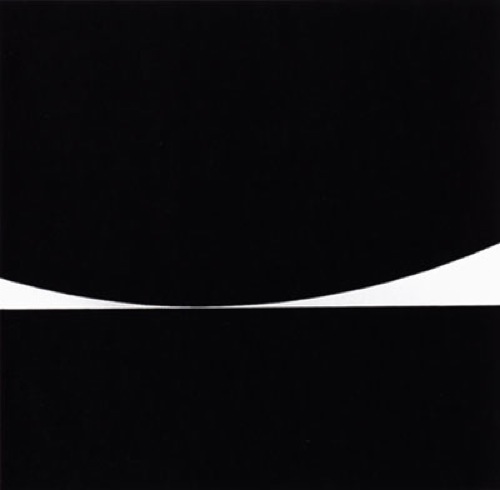
He references several artists who started out in one direction only to find their success through a Plan B, such as Mondrian, Lictenstein and Bridget Riley. In the case of the latter, in the early part of her career Riley was interested in colour theory and the work of the Impressionists, the Pointillism of Seurat, and the composition of Cézanne. It wasn’t working for her; she was directionless and lacked originality, and she was getting older. The ending of a relationship caused her to paint a canvas black, and she took all that she had learnt from her studies of Seurat et al and applied her knowledge in abstract terms. She painted a white horizontal line the lower edge straight, the upper edge forming a curve – it became a painting expressing the dynamism and inequality of relationships, human and spatial.

’Kiss’, 1961, Bridget Riley (Wikiart 4 Jan 2025)

Bridget Riley had to abandon the one thing she thought most important and appealing about painting – colour – in order to make any real progress. It didn’t mean colour could never feature in her work again, only that at that precise moment in time it was the roadblock… Only when [she] went back to the most basic of basics – a canvas covered in black paint – did she find the necessary clarity to progress. Only then did she discover the most precious and liberating of things: her artistic voice… As long as you stick at what you are doing, constantly going through the cycle of experimentation, assessment and correction, the chances are you will reach the moment when everything falls into place.”

The cycle of experimentation, assessment and correction is at the very essence of this course: Practice-based research.

Gompertz also states that if you call yourself an artist and make art, then you are an artist regardless of where you are in the process, or what skills you still need to learn and develop. I think I find this the hardest to embrace – I still can’t quite think of myself that way. I’ve only just got my head around being a student – in retrospect, it probably wasn’t the best idea to try it out first on the border official at Marrakech airport who looked at me with incredulity and repeated “Student?”. Admittedly, it’s been a lot easier since I discovered all the discounts available!

On ideas:

Gompertz asserts that originality in a completely pure form does not exist; that all ideas are additional links in an existing chain, each link adding to the one before. It is a form of disruption: something to react against and respond to, to build upon. He suggests that Picasso, in the quote attributed to him – good artists copy, great artists steal – is actually describing a process that an artist needs to go through: we learn through copying and imitating, and it is only once we have done this and developed the basic techniques that we can identify opportunities to add our own link to the chain, and to find our own artistic voice. This reminds me of my discussion with Jonathan about Frida Kahlo’s ‘The Two Fridas’, when I questioned whether any work I make which is inspired by it will be original enough: he advised me that Kahlo painted it in the late 1930s and I would be doing my version almost 90 years later expressing my own feelings – following Gompertz’s reasoning, I would, in effect, be adding my own link to her existing link in the chain.

In fact there are numerous creatives who have been quoted as admitting to building on the ideas of others.

If I have seen further it is by standing on the shoulders of giants.” Isaac Newton

Creativity is knowing how to hide your sources” Einstein

We have always been shameless about stealing great ideas”. Steve Jobs

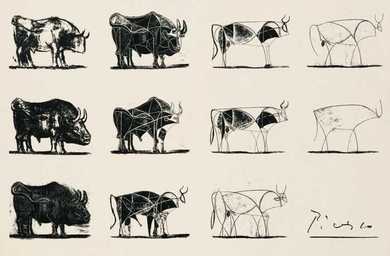
The young Picasso produced work which imitated the likes of Goya, Velázquez and El Greco, and later the Impressionists and Post Impressionists. It was only when his friend, Casagemas, died that he found his own artistic voice in his Blue Period; the blocks of colour, bold lines and expressive manner, which he had learnt from all those artists he had imitated, still influenced him, he just put his own twist on it. He took their ideas and filtered them through his own personality and experience, and used his instincts to simplify and reduce them into his original thought, into new and unique connections. Being creative isn’t always about adding to something; it can be at its most original when taking something away. This is demonstrated perfectly by Picasso’s bull lithographs, which took him a month to complete.

‘Le Taureau‘, 1945/46 (Wikipedia, 5 January 2025)

There is no such thing as a wholly original idea. But there is such a thing as unique combinations.” Gompertz

The Cost Of Living

One of my favourite actresses, Lesley Manville, was on Desert Island Discs a few weeks ago. On her divorce from one of my favourite actors, Gary Oldman, who left her a few months after she had given birth to their son, she said:

“I thought we’d be together forever and have a big family. But maybe if that had happened, maybe, I wouldn’t have had the career I have now. I think I’d have given up a lot for a good long marriage, but the price would have been something – I don’t know what.”

This reminded me of ‘The Cost of Living’ by Deborah Levy, in which Levy refers to the relationship between the French philosopher and writer, Simone de Beauvoir, and the American writer, Nelson Algren.

“Algren had written to her when he feared their transatlantic love affair was ending, to tell her the truth about the things he wanted: ‘a place of my own to live in, with a woman of my own and perhaps a child of my own. There’s nothing extraordinary about wanting such things.’

No, there is nothing extraordinary about all those nice things. Except she knew it would cost her more than it would cost him. In the end she decided she couldn’t afford it.”

‘The Cost of Living’ was my choice of inspirational text for our last session.

After listening to the actress, Billie Piper, speaking about it, coincidentally on Desert Island Discs, I thought I would give it a go. I have re-read it many times since, and gifted copies to friends at every opportunity.

Deborah Levy is South African by birth; her father was a political activist who had been imprisoned during Apartheid. The family subsequently relocated to England when she was nine years old.

It’s the second book in a series of three living autobiographies. It covers the period in her life when her marriage fell into difficulties, although her career was on the up having been shortlisted for the Booker Prize. She decided that her marriage was a boat to which she didn’t want to swim back, and so she and her husband divorced. Her family home life no longer fulfilled her need to create, and so it was slowly dismantled.

We sold the family house. This action of dismantling and packing up a long life lived together seemed to flip time into a weird shape; a flashback to leaving South Africa, the country of my birth, when I was nine years old and a flash-forward to an unknown life I was yet to live at fifty. I was unmaking the home that I’d spent much of my life’s energy creating.

To strip the wallpaper off the fairy tale of The Family House in which the comfort and happiness of men and children have been the priority is to find behind it an unthanked, unloved, neglected, exhausted woman. It requires skill, time, dedication and empathy to create a home that everyone enjoys and that functions well. Above all else, it is an act of immense generosity to be the architect of everyone else’s well-being… To not feel at home in her family home is the beginning of the bigger story of society and its female discontents. If she is not too defeated by the societal story she has enacted with hope, pride, happiness, ambivalence and rage, she will change the story… To unmake a family home is like breaking a clock. So much time has passed through all the dimensions of that home. Apparently, a fox can hear a clock ticking from forty yards away. There was a clock on the kitchen wall of our family home, less than forty yards from the garden. The foxes must have heard it ticking for over a decade. It was now all packed up, lying face down in a box.”

There was a cost to this freedom; this way of living. She moves into a small sixth floor flat at the top of a hill in North London with her daughters and has to teach, and write pieces which she wouldn’t ordinarily choose to, in order to earn a living. She finds that she can’t write in the flat: she needs her own space, so she rents her friend’s garden shed in which she wrote this book and two others.

“It was calm and silent and dark in my shed. I had let go of the life I had planned and was probably out of my depth every day. It’s hard to write and be open and let things in when life is tough, but to keep everything out means there is nothing to work with.”

The book also deals with the death of her mother from cancer. This resonated with me profoundly when I re-read the book after the death of my own mother. There is a moving account of Levy having a meltdown in a local newsagents which had run out of the ice lollies which had been keeping her mother going, as well as her subsequent apology to the three Turkish brothers who owned it.

Another poignant moment is when she reflects on a postcard received from her mother:

“Love did find its way through the on and off war between myself and my mother. The poet Audre Lorde said it best: ‘I am a reflection of my mother’s secret poetry as well as of her hidden angers.’… My mother had made a biro’d X on the front of the postcard and written’ X is where I am’… It is this X that touches me most now, her hand holding the biro, pressing it into the postcard, marking where she is so that I can find her.”

She goes on to say:

“I lost all sense of geographical direction for a few weeks after my mother’s death. I was disorientated, as if some sort of internal navigation system was drifting… It was she who had raised her children and most childhood memories were twinned with her presence on earth. She was my primal satnav, but now the screen had gone blank.”

I love her way of writing: she can create an impactful image with a few words. Whilst on Eurostar to Paris, she is talking to a teenager sitting next to her, who is using a laptop to learn French, when a man gets on the train and asks the teenager to make space on the table.

” She moved it to her lap. This was a small rearrangement of space, but its outcome meant she had entirely removed herself from the table to make space for his newspaper, sandwich and apple.”

When she is asked to provide a list of the minor and major characters in one of her novels for film execs looking to option it, Levy considers the minor and major characters in her own life.

“If I ever felt free enough to write my life as I felt it, would the point be to feel more real? What was it that I was reaching for? Not for more reality, that was for sure. I certainly did not want to write the major female character that has always been written for Her. I was more interested in a major unwritten female character.”

And that is what I take away from this book, what inspires me: I should be the major character in my own story. It is for this reason that I am on this course, that I am making a change and adopting a new way of living.

This struck a chord with Dalal, who has been thinking a lot recently about the possibility of marriage and family, but is concerned how this might fit in with her need to be an artist. Alex had already established herself as an artist by the time she married and had a family, so her artistic practice had already marked out its boundaries. Pritish is not thinking long-term: his main concern at present is to concentrate on his artistic practice.

I was fascinated to hear about what inspires everyone else. Pritish is inspired by London, in particular, he likes the anonymity it provides and he referenced the photographer, John Deakin; Dalal is inspired by Kerouac’s ‘Satori in Paris’, Murakami’s ‘South of the Border, West of the Sun’ and Muayad H Hussain’s thesis on Khalifa Qattan and circulism; and Rachel Whitehead’s Turner Prize winning House (1993) inspires Alex, a sculpture formed from a concrete cast of the inside of a house condemned for destruction – something made out of nothing containing the past life of the house and its inhabitants, without utility but fascinating.

Now that I have cast myself as the main character in my story, how do I play her?
Bitter Sweet Symphony

…Tryna make ends meet, you’re a slave to the money then you die…”

I don’t want to give the impression that I’m on a downer; I’m not, it’s just a coincidence that the things I want to post about at the moment all involve an element of death, which is not a bad thing, as it reminds me to live.

I had never really contemplated my own death until my father passed away in 2013; then I obsessed about it for quite some time. There I was sitting quite happily on my branch in the tree of life when suddenly there was one less person between me and the end; to be fair I was so far along it that it was becoming more of a twig than a branch and had started to bob up and down quite precariously in the breeze. But there’s nothing like the death of someone of a similar age to drum home my own mortality. I had lost friends at university, but I was young then, and whilst the sense of loss was immense, I still felt invincible; those were extraordinary deaths.

Last night my husband told me that an old work colleague of mine had died a couple of weeks ago. I worked with him for seven years; I hadn’t seen him for twenty, yet still the news profoundly affected me. We were more or less the same age and level of qualification; I had previously worked at two law firms before joining the firm where we worked together. He had trained, qualified, and become a partner at that firm, a period spanning 32 years. He had never known any different, had never stepped outside of his comfort zone or worked with new people who may have inspired him or influenced him in different ways. Why not? My husband ventured that maybe he stayed for the money which financed a certain lifestyle and that he was happy with that, with that way of living. That’s true; just because it is a path that I would not have chosen does not make it less valid, and, in this respect, I appreciate that I am lucky in that I have a choice; a lot of people don’t have that luxury.

He would have been earning a fair amount, working incredibly long hours and have been under intense pressure. Was it all worth it? If I had said to him 20 years ago, when we shared the same office in which he would tell me all about his salsa classes, his training for the triathlon he was planning to compete in, or the latest date with his girlfriend, that he had a ticking time bomb inside him which would kill him at the age of 55, would he have made the same choices? Maybe not, but that’s the benefit of hindsight. As Kierkegaard says:

It is really true what philosophy tells us that life must be understood backwards. But with this, one forgets the second proposition, that it must be lived forwards.”

Caught In A Paradox

I’m typing this just as I’ve finished my tutorial with Jonathan, whilst I can still remember what we discussed – I did start taking notes at the beginning but ditched them as the act of note-taking became too intrusive. Consequently, I will probably forget bits, but this is the gist.

I explained that I’m feeling really positive about the course – just to be in the process is enough, and anything over and above is a bonus. Jonathan asked me what I wanted to get out of the course. What I would like is to find out who I am, which is a bit of a cliché, and to develop a rhythm of working so that art becomes a major part of my life: up until now I have had to carve out time to spend making art.

Jonathan asked me what my life is like in terms of whether it is ordered: no, it’s totally disordered with no real routine, fire-fighting issues and dealing with lots of things at the same time. Jonathan commented that the idea of spinning plates has its own rhythm. It has, but I feel that I need to develop a discipline in my artistic practice – I have no real self-discipline in many areas of my life.

Jonathan then asked me what my strength is. It’s getting things done: I can be determined, persistent and I don’t give up. The downside to this is that I’m goal driven (which causes issues in terms of concentrating on the end product, rather than the process), and I tend to jump right in. Thinking about it now as I write, not giving up can result in me being relentless and not knowing when to walk away and leave something – my mother used to describe me as a terrier.

Jonathan mentioned the story on my blog about my shopping habits: the act of wandering from shop to shop contradicts the idea of jumping in. I agreed that actually I should shop more like my husband in terms of reaching a goal, and that the act of wandering is not enjoyable but full of pressure: to find something which meets the criteria by the deadline. Not buying the first thing I see which would suffice, may indicate a reluctance to commit before exploring all the options.

What does it feel like to be working at my best? I lose all sense of time. I’m lost in time. Nothing else matters. I can look up and find that it’s dark and it’s 9.30pm and the dogs and my family haven’t eaten. But then I can look at what I’ve done and, if I’m not happy with it , think how I’ve wasted those hours of my life which I’ll never get back and which I could have spent doing something more productive. Jonathan commented that there was a paradox in terms of being lost in time and losing time. He asked me to describe the sense of loss of time: it’s huge and full of resentment in the moment, but then dissipates as everyday life starts to take over again, until it eventually disappears.

We talked about some of the things that I’ve been trying out, and I explained that I’ve been purposely not viewing things as good or bad (although I did on my last post!) or as a success or failure. You can only fail if you have an expectation and that every experience, whether good or bad, is a valuable learning experience. Jonathan agreed and commented that the purpose of the act of mark-making is to tell us what to do next and if it does this, then it’s done its job, even if it is to tell us not to carry on. He sensed a real frustration in my experiments with the iPad. I did feel frustrated but even though I had reached the view that it wasn’t something for me in terms of producing a final piece of work, I did appreciate its usefulness for preparatory work. Jonathan mentioned that a lot of artists use it for this purpose in terms of working things out, like composition, and referred to Justin Mortimer who produces large oil paintings.

I explained that I have been doing a lot of thinking recently and have a lot of ideas inside my head – In fact, I can’t stop thinking about it. I’ve also been getting a lot of inspiration as to how to express these ideas in terms of producing work. If we had had this tutorial a few days ago I would have been excited and energised, but I now seem to be less so, as I feel a resistance to attempt to translate the ideas into actual work. It’s not a fear of failure as such, but a reluctance, or maybe a fear that once I try to capture the idea it won’t be as good as it is in my head. I would usually jump straight in and, more often than not, end up feeling frustrated or disappointed. I’ve recently found that thinking about and planning a work results in less dissatisfaction in the end result, but it seems that the act of stopping and thinking creates a barrier, an inertia, to moving forward. It’s a bit like how I would imagine doing a parachute jump: I check that I have everything I need in order to jump safely, but I still can’t get myself out of the plane. The other side of me would just jump. I mentioned the blog: I’m not on social media and I like to keep myself to myself and fly under the radar, yet I enjoy the process of writing the blog and this is fine as long as I don’t think too much about it ie that it’s public (as an aside whilst I’m writing this, I have actually searched for it on Google and it doesn’t come up so that makes me feel better!).

I then told Jonathan about a proof-reading distance learning course I signed up for many years ago, as I thought it could be something I could do whilst my daughter was young. I received the first couple of modules in the post and did the first assignment. The feedback was good but finished with a reminder that the marks from all subsequent assignments would count towards the final mark. That was it for me, I couldn’t carry on. We discussed why this might have been the case. I think it was because I hadn’t done perfectly on my first assignment and that I might not even do as well in future assignments. When I was young I would come home from school eager to tell my mother how I had done in a test – then she would ask me how everyone else had done – I didn’t understand at the time, why she couldn’t just be pleased with my result, like I was. I grew up to be a perfectionist, with a view that if you are going to do something, you should do it to the best of your abilities – I have since realised that what is your best can be influenced by the circumstances at the time. Jonathan reassured me that that is why the course is the way it is – there is no assessment of a final work or comparative approach for the very reason that it would cause students to freeze up.

Jonathan commented that my perceived weaknesses are actually also strengths in that the tendency to rush in, would deal with this issue. He observed that I had mentioned the word ‘fear’ quite a lot and asked me to describe the fear. It’s like a barrier in front of me but it’s not insurmountable and it’s transparent in that I can see beyond it, to where I need to get to. Having said that it clearly wasn’t insurmountable in terms of the proof-reading episode, but that was a long time ago! To get past it I need to act, and in this respect, Jonathan said that’s where I need to draw on my strength of jumping right in without thinking about it.

We concluded that there were many paradoxes in what we had discussed and that perhaps the solution is to try and combine the two sides of me in terms of moving forward in my art practice. I commented that perhaps the paradoxes are caused by me thinking that I’m one version of me when actually the real me is someone else, which is what I want to explore. Is the real me the baby who was born, or the person I now am with all the baggage I’ve collected along the way? I recognise that my strength of getting things done is probably as a result of my career. Jonathan commented that it is the question of nature and nurture and who they are is something artists ask themselves, so it’s far from being a cliché, it is actually what art is all about.

I then asked Jonathan about something which has been niggling at me: I draw inspiration from various sources to help me see ways to express my thoughts in work. I gave the example of the Two Fridas and the passage I had come across in a book I had seen in Waterstones about siblings and the primal connection through umbilical cords. In drawing on these sources, am I creating anything new, unique, or will someone just look at it and think ‘that reminds me of the Two Fridas’? Is it enough that it is coming from me and about how I feel? Jonathan assured me that it is ok to draw inspiration from others – the Two Fridas was personal to Kahlo and painted 80 years ago – I would be making it now, in 2024, and it would be personal to me.

What will I do for the next hour? Go away and write up my note of the tutorial before I forget it, which will be a useful process to consider what we discussed. Jonathan pointed out that at the beginning I had said that I had wanted to make art a bigger part of my life and that during our chat I had said that I couldn’t stop thinking about it, so I’m on my way and I should just keep doing what I’m doing.

I’m still feeling positive, and I would venture to say, even more so. I need to cogitate on what we discussed to move forward, but for the moment, everything is all ok.