I quite like the idea of revelation, and layering seems to facilitate this.
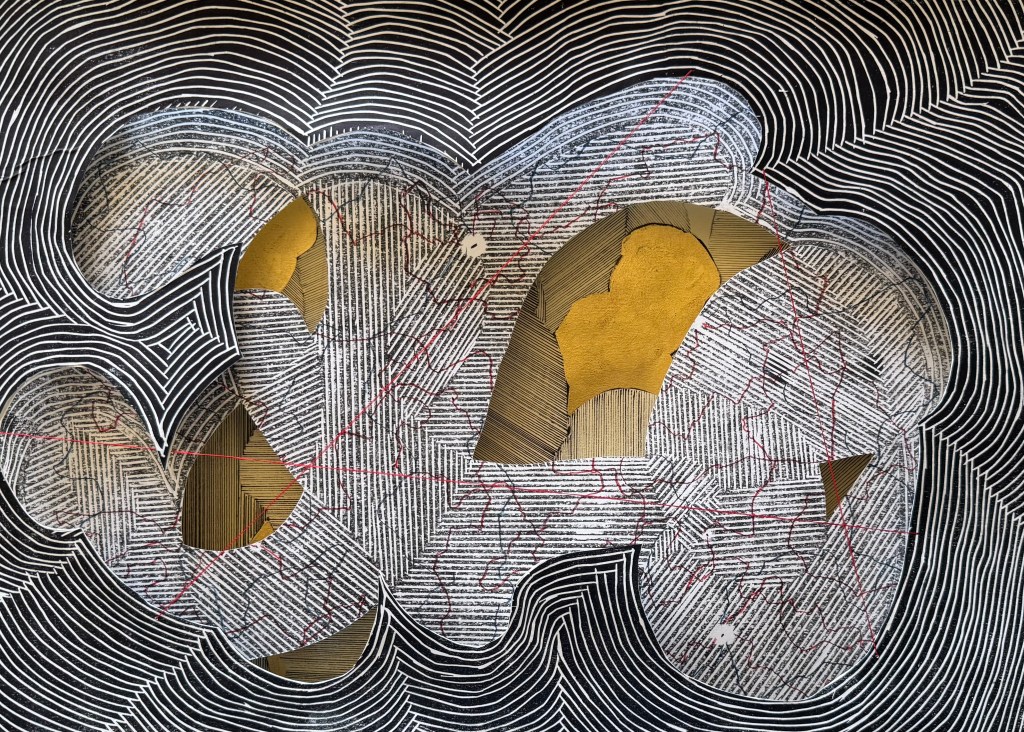
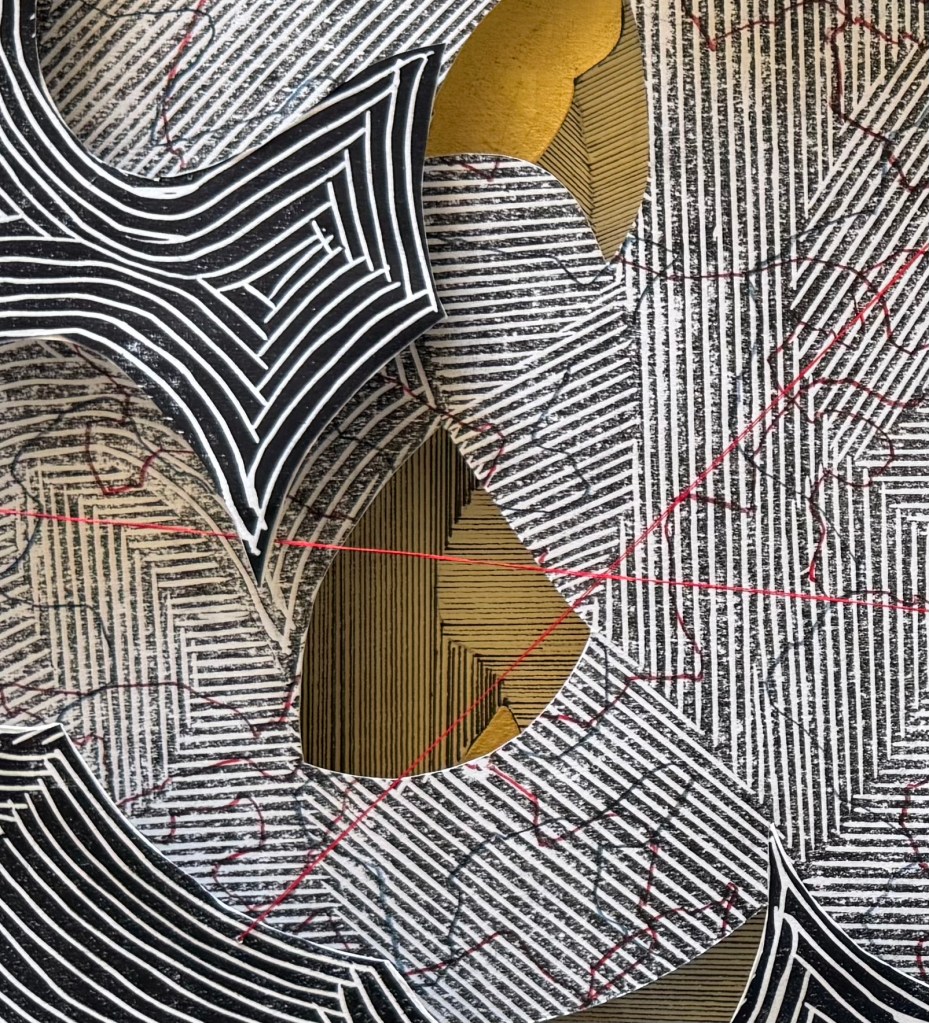
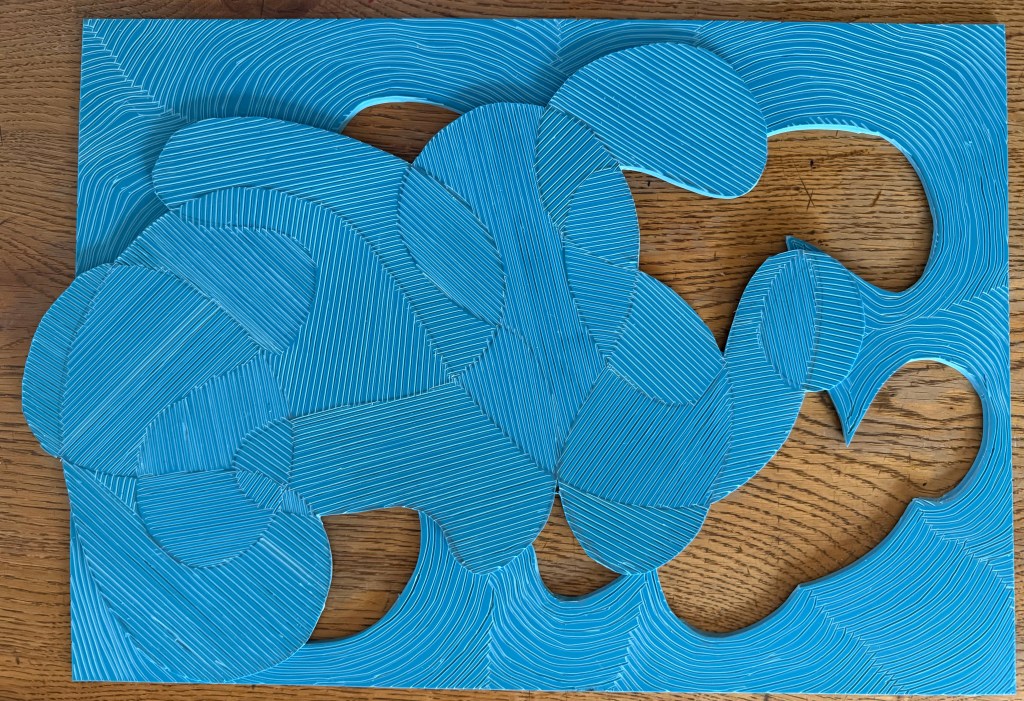
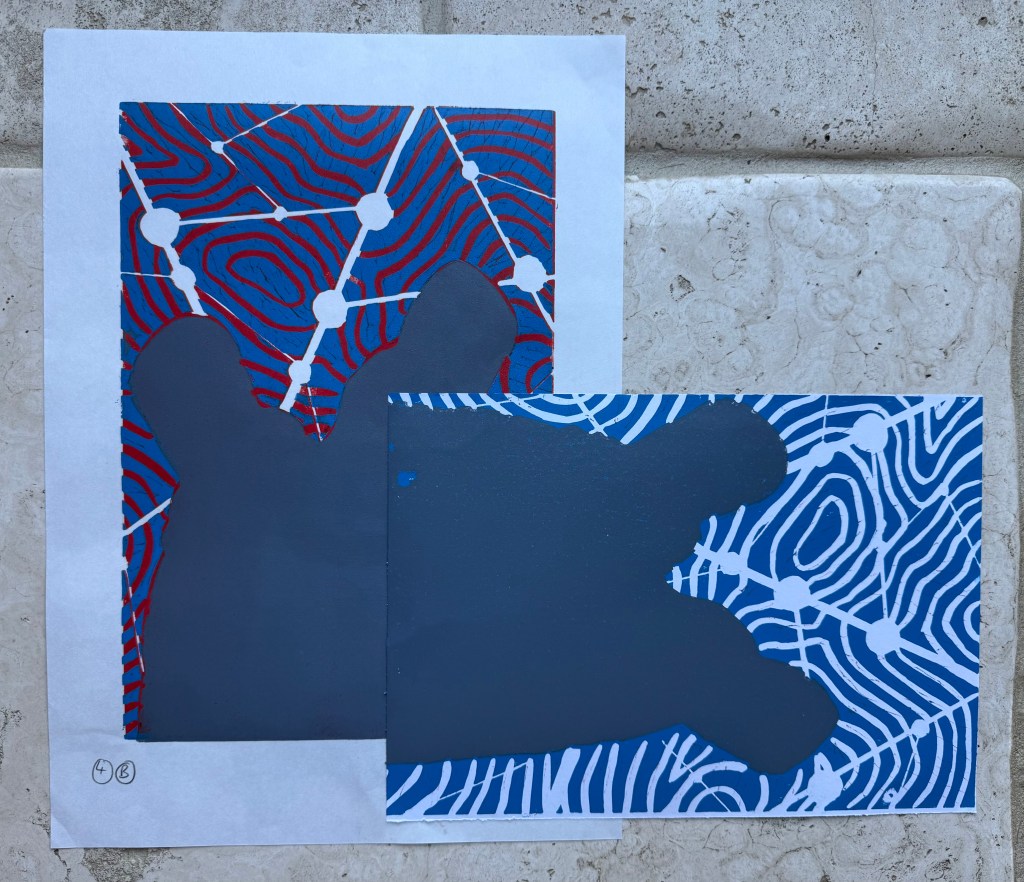
Drawing lines on the first print I made of the linocut – there must have been some loose bits because it left small circular areas of white which reminded me of places or points of interest on a map. I then cut out some areas and laid it on top of a section of the figures line drawing using some cut up old corks as makeshift spacers. I then stuck the print with the large white space onto some watercolour paper and cut out the centre. I sewed some threads across the centre – thicker embroidery silk would have been better but I had to make do with what I had to hand. I laid it on top, slightly off from the print below.
And I was right. And I wish that I had thought about doing this sooner.
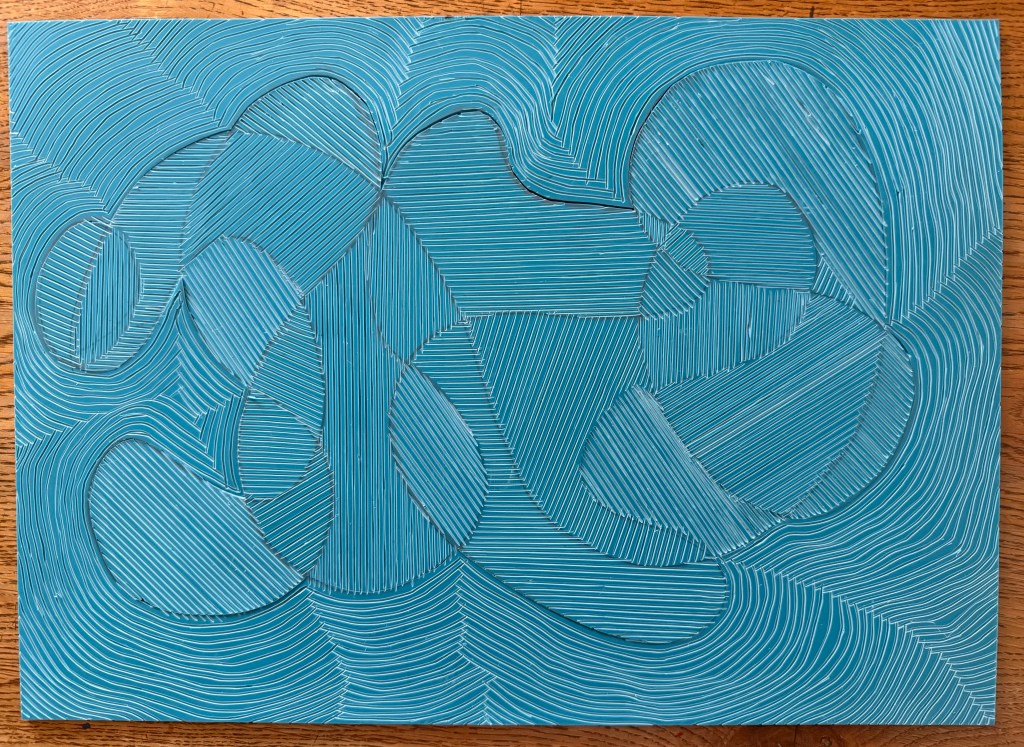
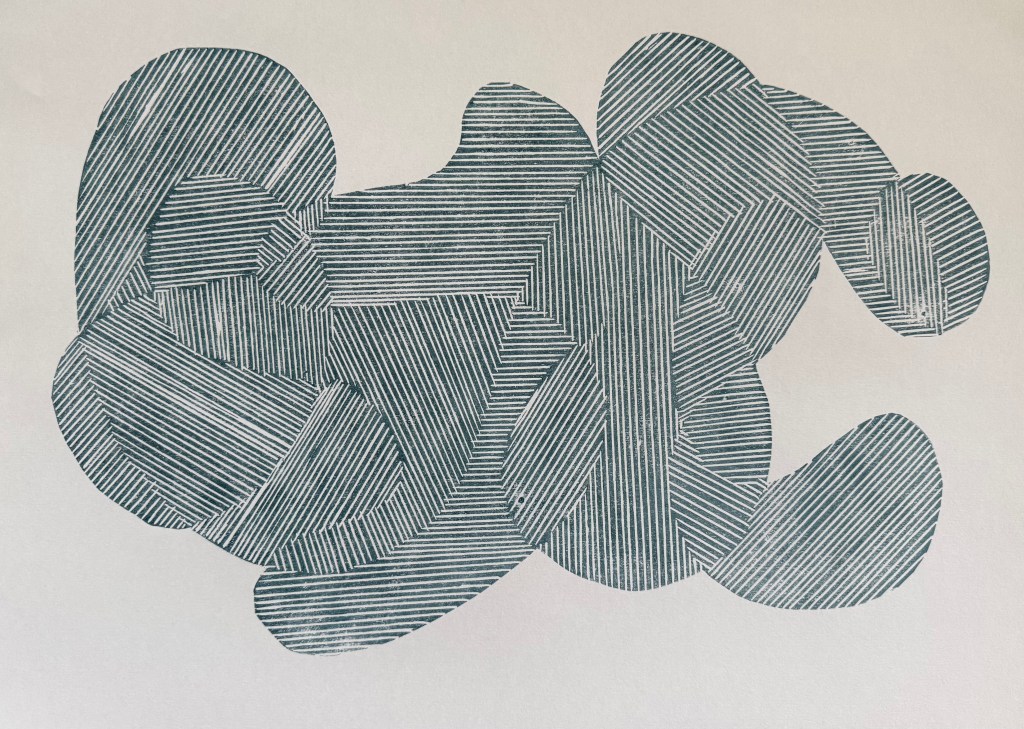
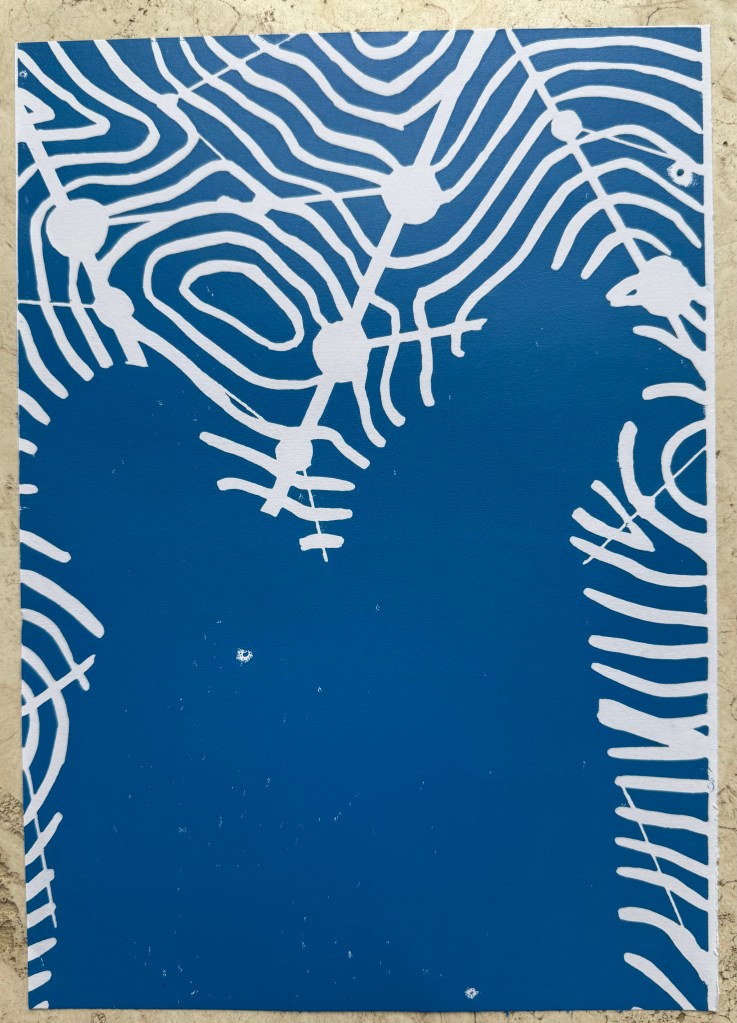
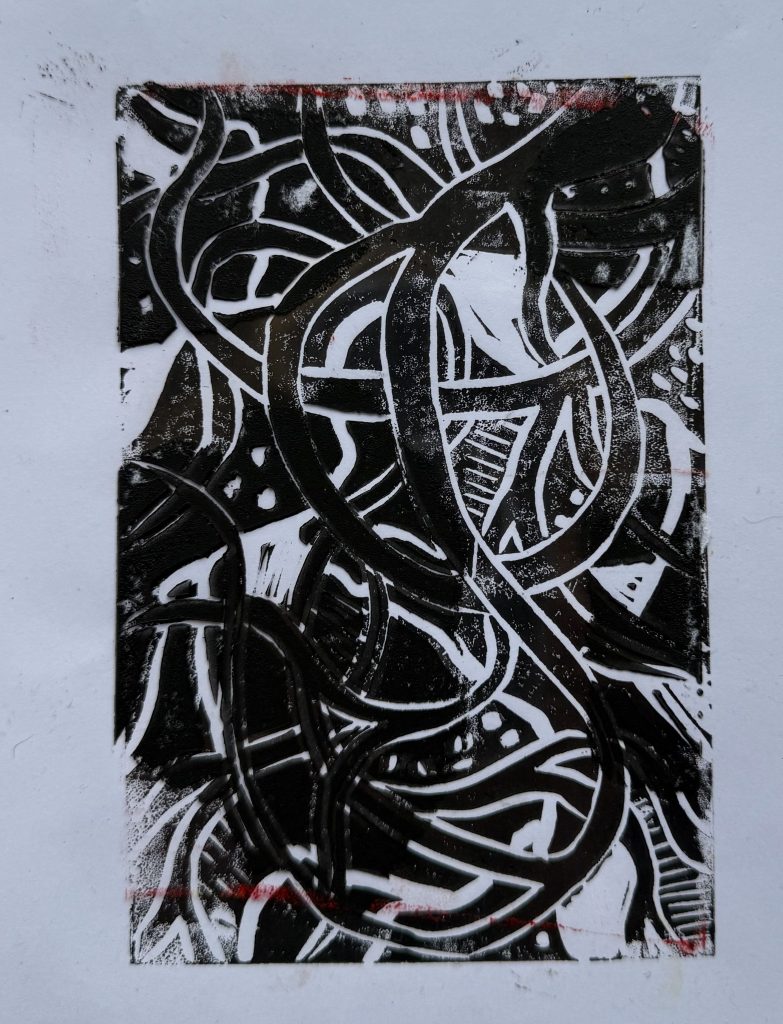
I dusted off my printing box and experimented with printing a line drawing. I used an A3 piece of soft cut Lino as I didn’t want to be shooting off all over the place, and have bits crumbling away. I used my smallest tool. The good thing about soft cut is that you can easily use a craft knife to cut out sections.
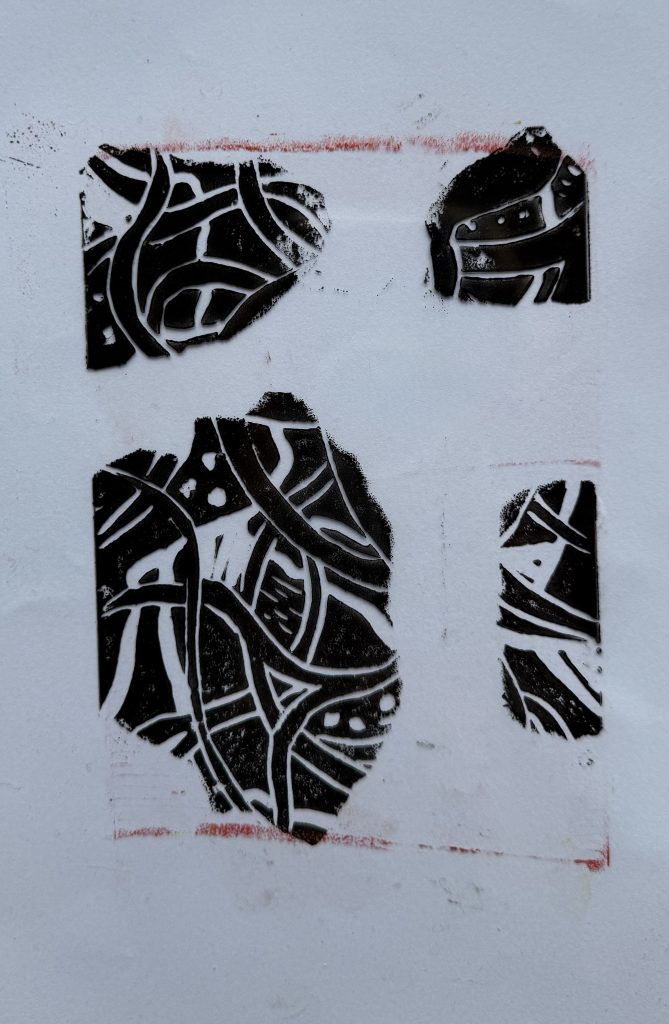
I started by tinting black with some blue, and printing the whole block:
I like.
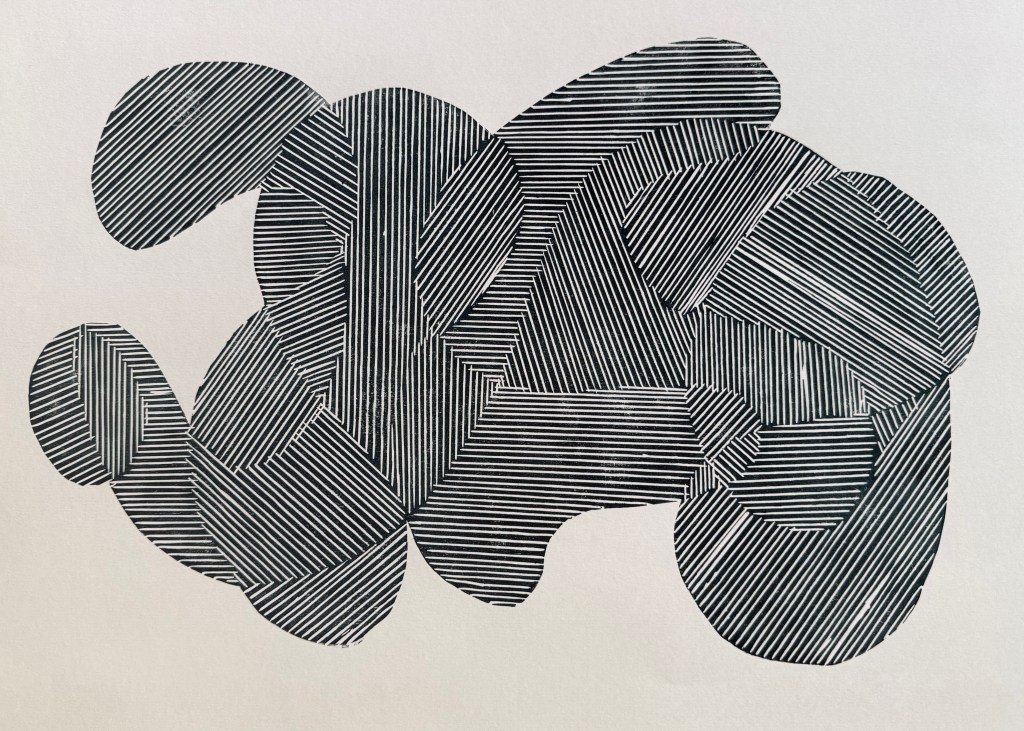
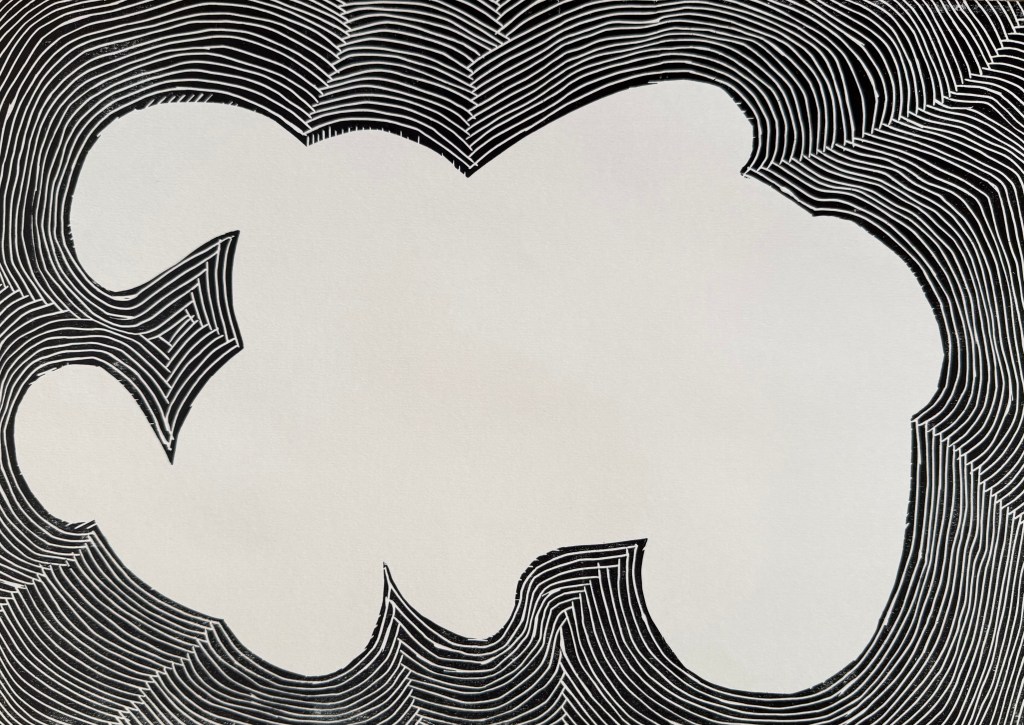
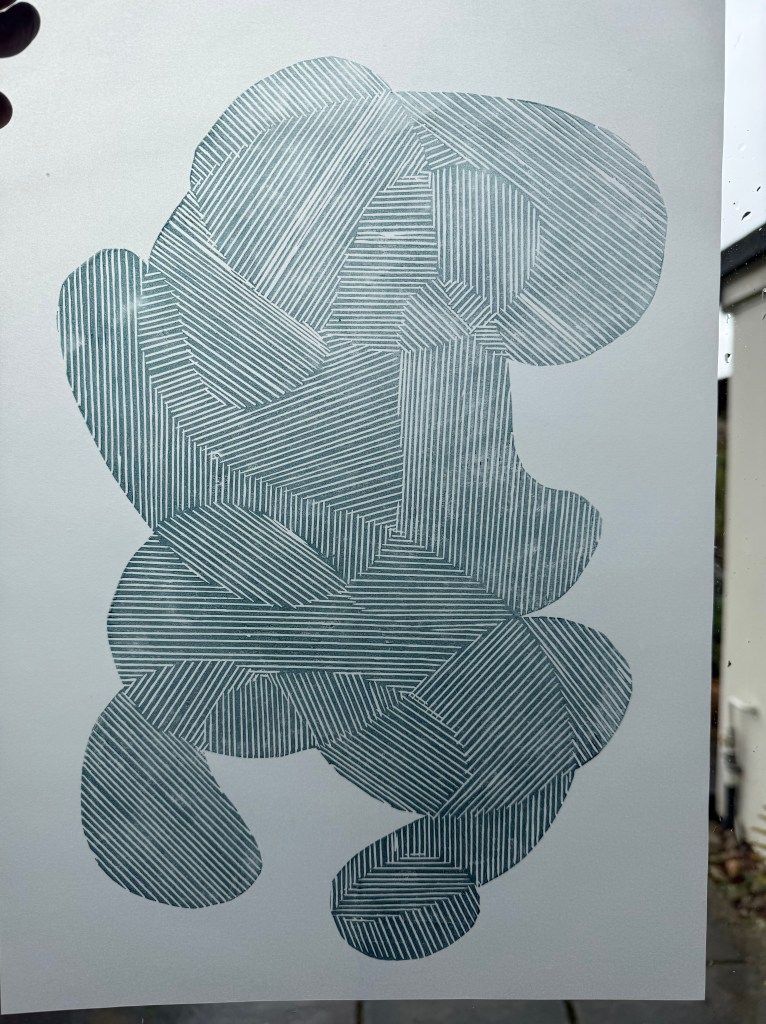
Then the two separate sections:
I also like. This way around, it reminds me of a figure, curled up, cowering, face protected by hands.
Then I added in some extender to make a lighter, more transparent colour:
Nice.
Printing on tracing paper:
Interesting. Possibilities.
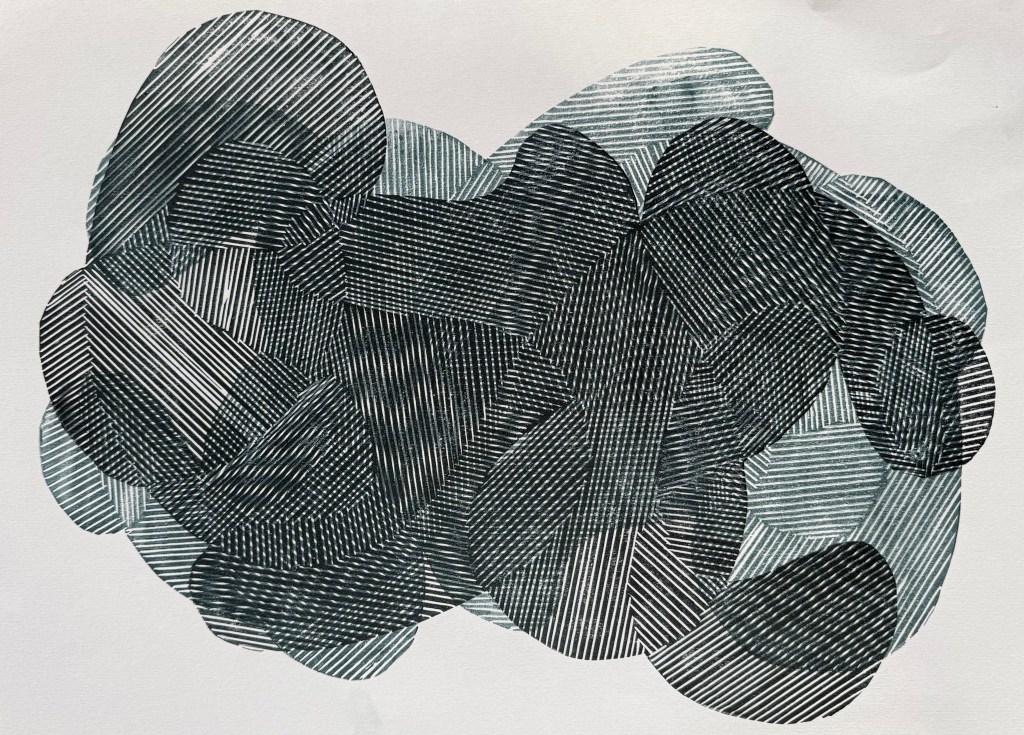
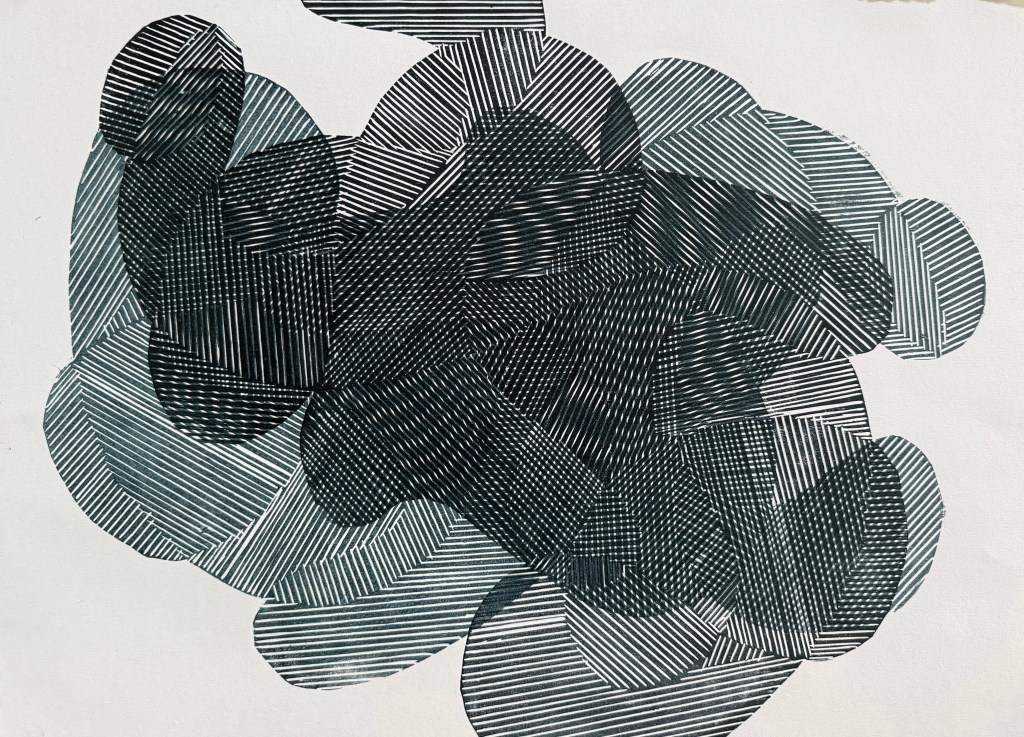
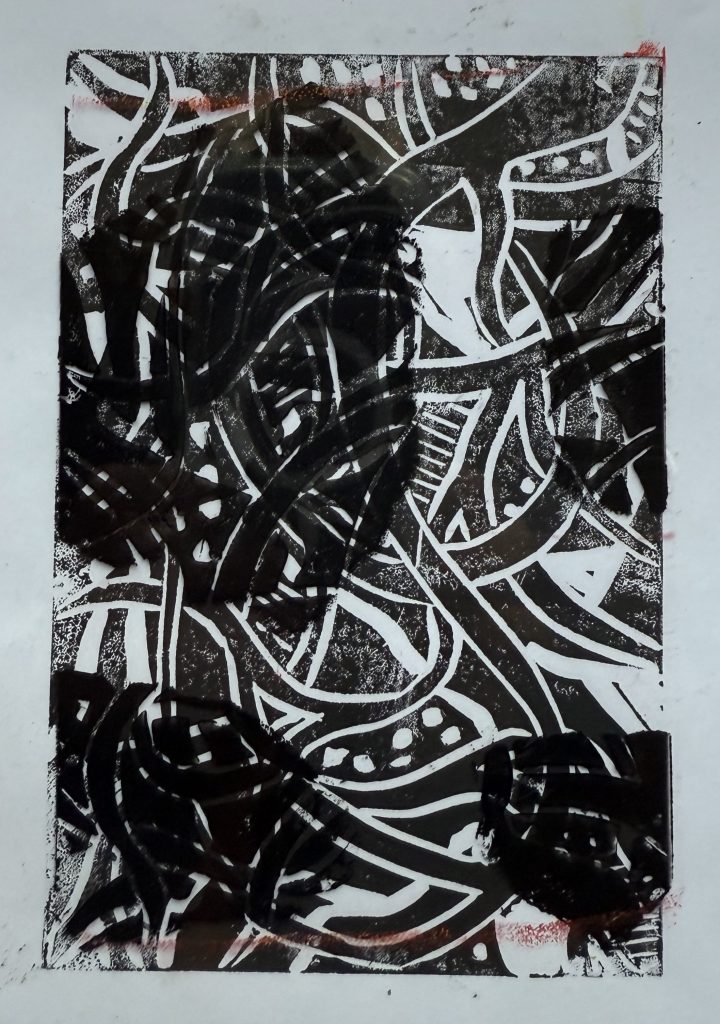
I then experimented with overprinting:
Absolutely love.
I’ve noticed that I’ve been using that word a lot more recently.
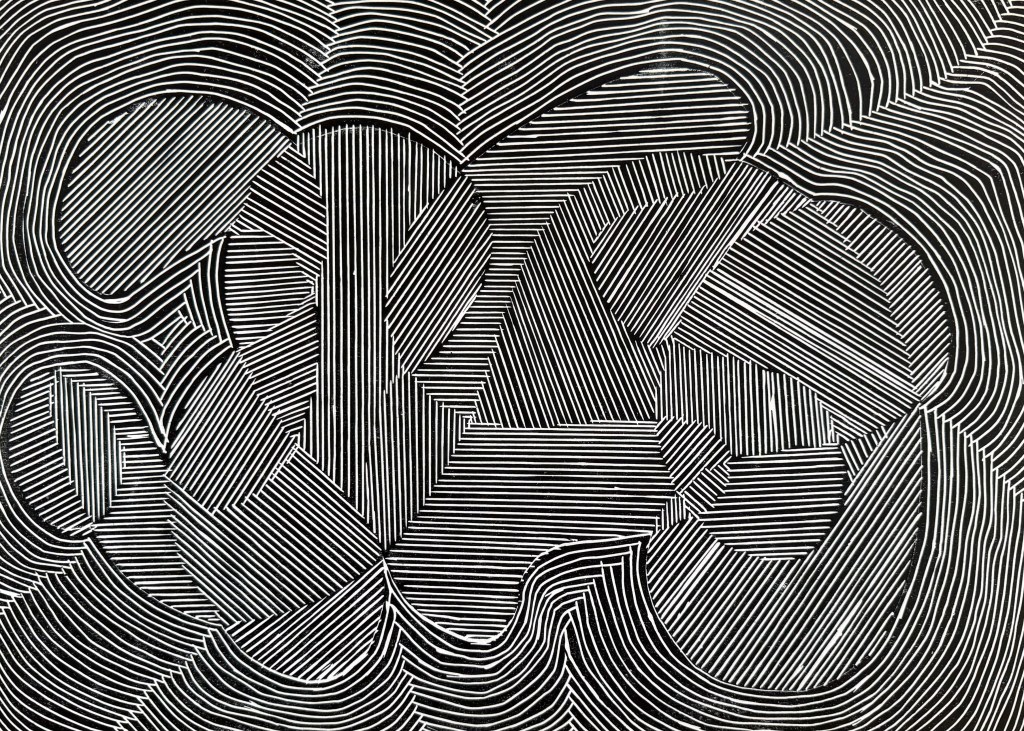
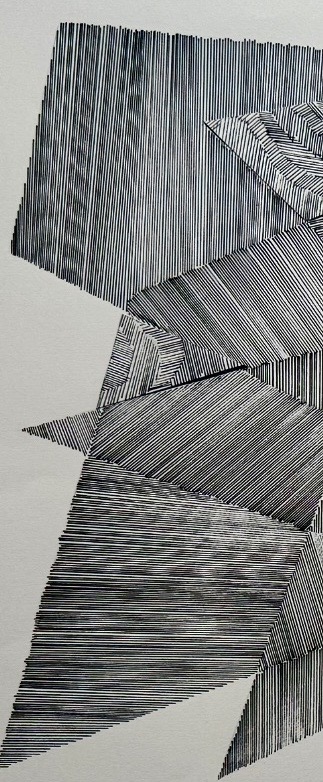
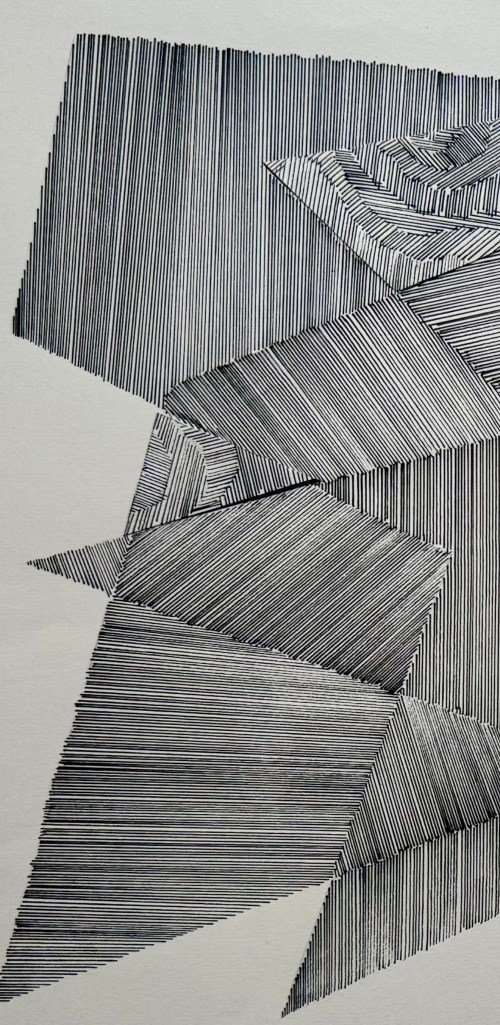
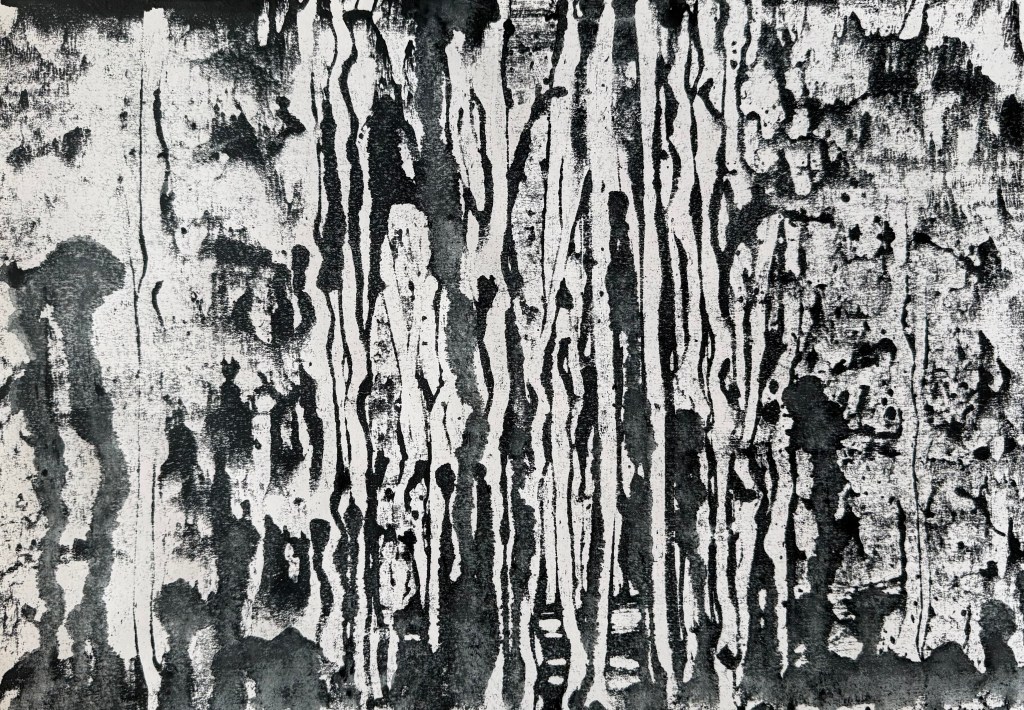
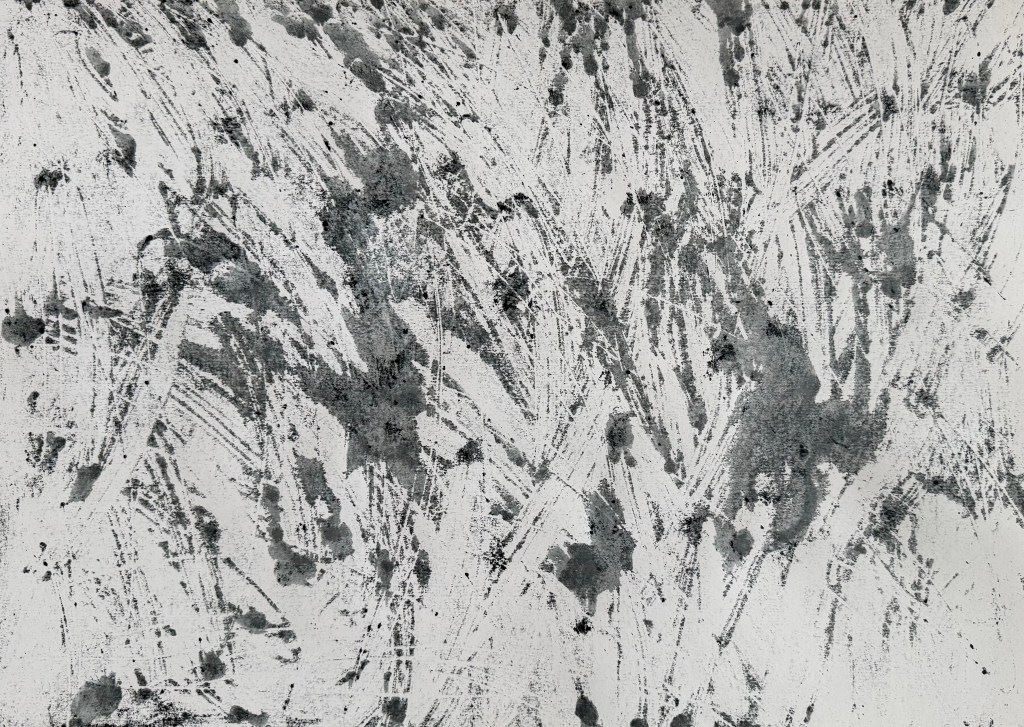
It’s fascinating that by overlapping the prints I’ve recreated some of the mark-making I was experimenting with using the Micron pens (Pushing Paper III) and also the strange effects created when I photographed the pen drawings. It was almost as if the camera couldn’t quite work out what was going on. For example, when the image is displayed on my phone normally it looks like the first image below. It is only when I zoom in, that I can see that the lines look as they do in the second image.
Anyway, I think that it was a very productive session and has given me lots to thinks about. I’ve decided that I’m warming to linocut. It used to bug me before, because it can be quite patchy in places (probably my ineptitude), but since using the fineliners to make line drawings, and noticing the texture created when the ink dried up a bit and the effect of mistakes, I’ve noticed that Lino has the same qualities. They both evidence the process of making which I’ve recently been embracing, rather than a perfect print.
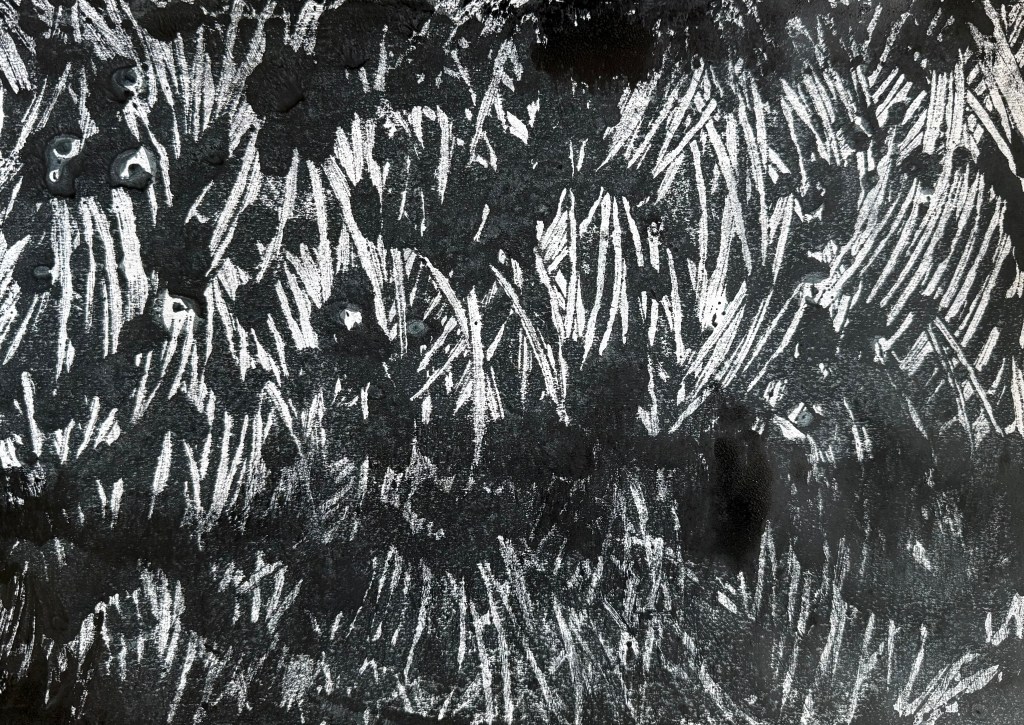
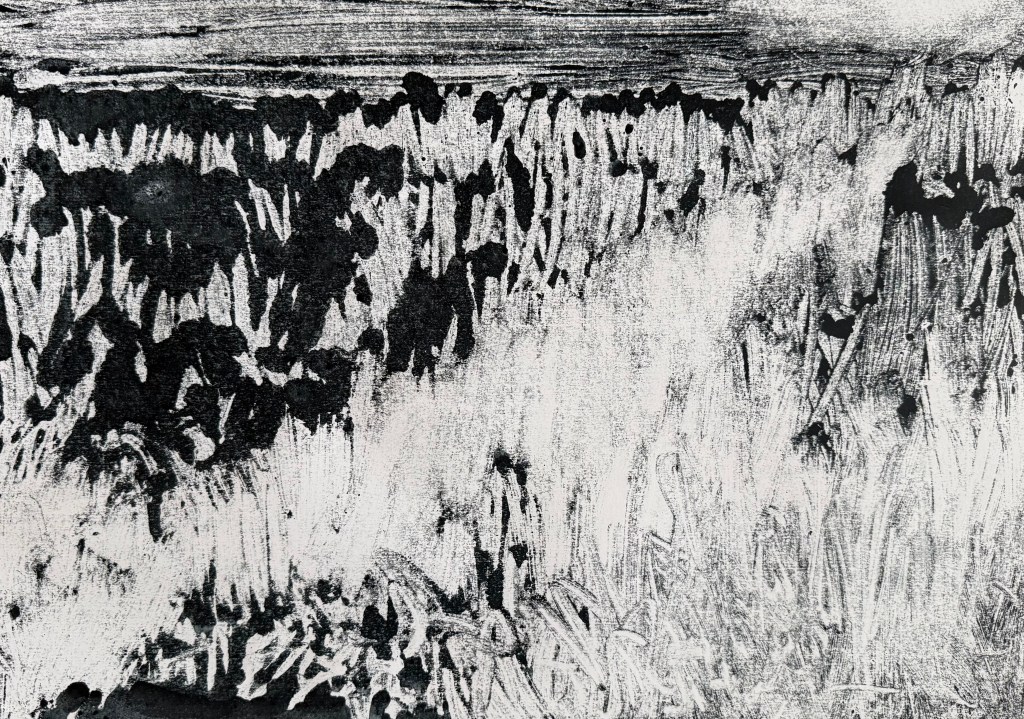
I used up the leftover ink to make some mono prints. The inks are safe wash – they are oil-based but soluble in water. I like the effect of spraying the ink with water, and running the brayer over it. These could maybe form the basis of something else.
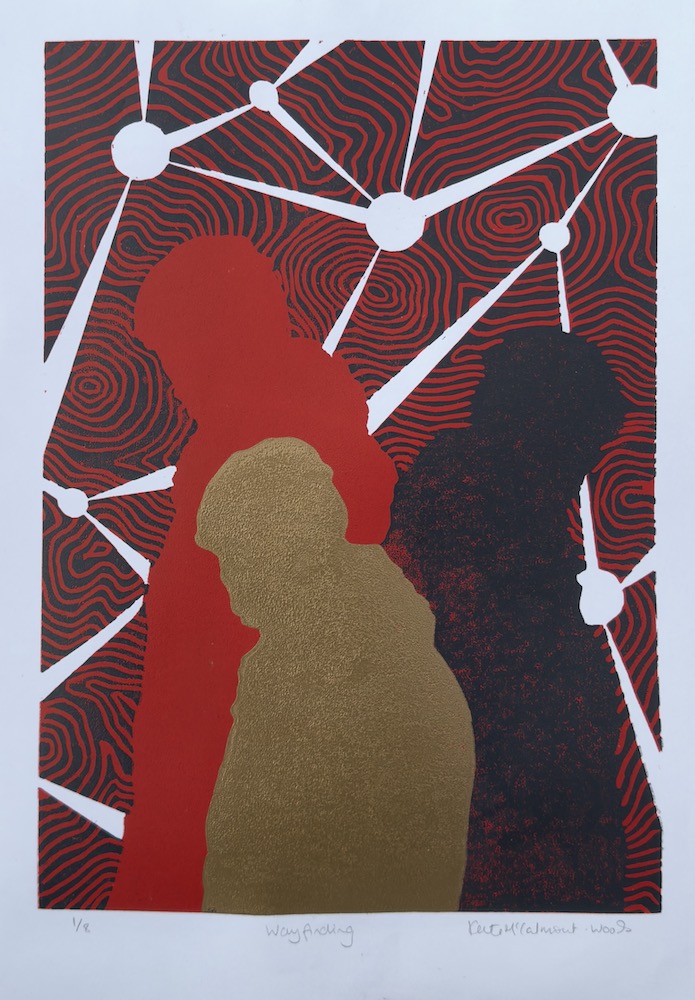
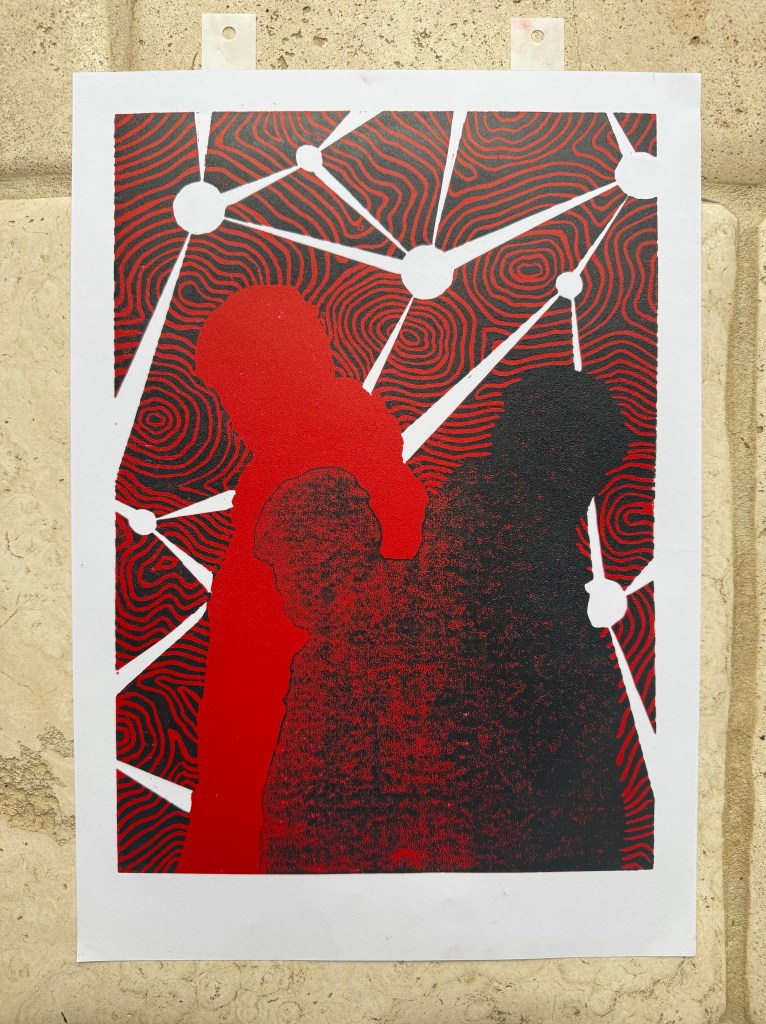
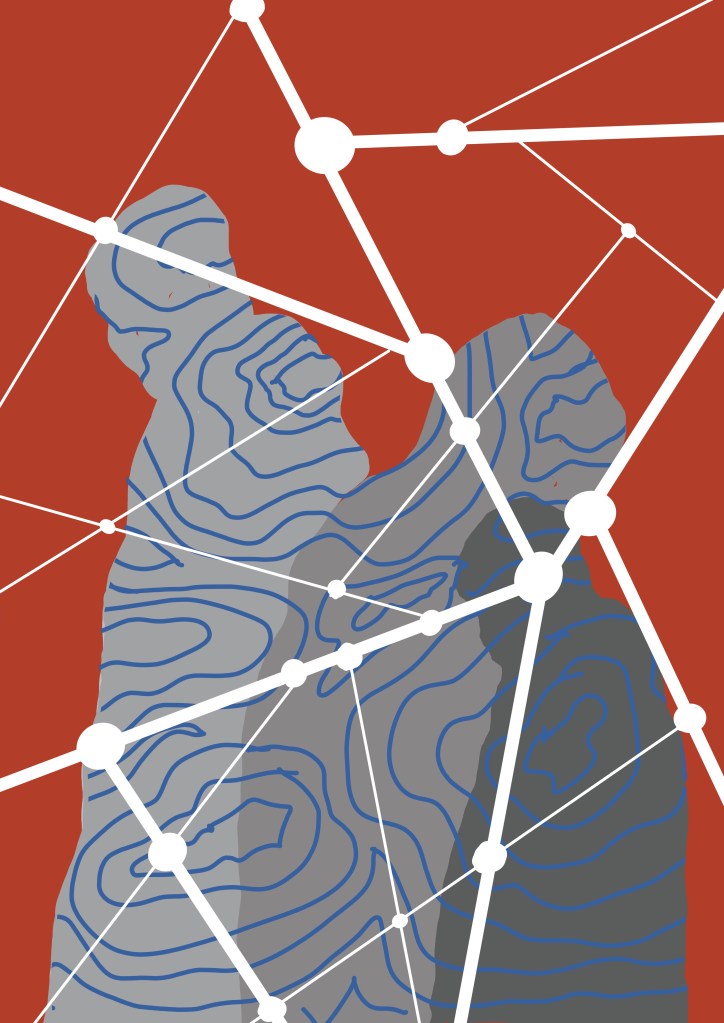
The self is in a constant state of becoming, and each time we reflect, we create iterations of ourselves, crystallised in time; shadow selves. ‘Wayfinding’ – my first reduction linocut – evidences the processual nature of its making, with each layer being a trace of what was once, but is no longer, fixed in time and unalterable. It embodies how the act of making and the evolving self are intertwined, the self being both mapped and remade.
It’s been a steep learning curve, with highs and plummeting lows. I have learnt a lot from the experience – the physical process of the making of the prints, with its inherent breaks from activity, and the potential and restrictions of the materials themselves which have challenged me, requiring me to find solutions to the problems I have encountered along the way.
I liked the contemplative feeling of cutting the lino and the nature of rolling out the ink, observing its texture on the brayer akin to suede, listening to the sound of the brayer and ink sizzling, and the relief (or crushing disappointment) when pulling the print. I feel that the experience has enriched me and that hopefully I will continue to become a better printmaker – I don’t say that I have become a better printmaker because aside from possibly being factually incorrect, that indicates that my becoming has stopped – I want to be in the process of continuing transformation. The prints themselves evidence my learning and development in all their imperfection.
In his paper Making Hands and Tools – Steps to a Process Archaeology of the Mind (2021), Malafouris argues that ‘thinking is thinging’, in that we think with and through things, not simply about them, and that human becoming refers to the process of ongoing transformation that characterizes the human condition as indeterminate and incomplete, or else always about to become. As we engage creatively with the world, the new things we make shape our developmental pathways and our ways of being in the world and, as such, human intelligence is handmade.
’Hands and tools can be moved but they are not moving; it is the brain that moves the hand to move the tool. Taken together hands and tools can be seen as interactive processes. They co-constitute each other’s life by means of thinging. It is now the tool that moves the hand to move the brain because the brain is already attuned to the hand and the hand is aware and responsive to the tool. In one sense, the hand acts as for the tool, in another sense the tool acts on behalf of the hand or other tools…The agency of the hand derives from the tool and the agency of the tool derives from the hand.’
He asserts that hands and tools are made for action, in action. So my hand is made for action and without that action it is not a hand. I pick up the carving tool which is made for action and without my hand it is not a tool. My hand moves the tool to carve the lino and the tool responds to my hand at the same time as my hand responds to the tool. The lino responds to the tool as well as my hand, and in turn my hand and the tool respond to the lino. The lino is not lino without the tool and my hand to carve into it. My hand and the tool are not a hand and a tool without the lino to carve into, and so on. As my brain is in tune with my hand, then so is the carving tool, the lino, the brayer, the ink, and the paper, and, as such, they all influence my developmental pathways and my way of being (or should it be becoming?) in the world.
On reflection, I’m not sure that I enjoyed the process that much. The restrictions of a deadline, the specifics of size and number, the fact that it was being made with a view to being sold, all contributed to a feeling of unease and pressure. I much prefer experimenting with no expectation, focussing on the process, and not the product.
I thought about what size to do the print. If anyone buys it, I would like them to be able to frame it at home with a shop bought frame. So I needed to leave enough of a border so that it could go into an A3 frame without a mount, but not too much so that there is a lot of white space if they choose an A2 frame with an A3 mount. I decided to leave a 2cm border on the top and sides, and 4cm at the bottom.
I decided at the outset that I would not aim for perfection, that there are bound to be mistakes and that it should just be good enough.
It started off well. I made 12 prints
When I came to print the next layer of dark grey the registration of the print went awry. I went from feeling quite happy about the process to feeling despondent and frustrated. I made a few adjustments but it still didn’t work. So I stopped myself from ploughing on in the vain hope that doing the same thing again and again would somehow miraculously give a different result.
After some time away, it became obvious that the lino block, which had been washed and left to dry, was not sitting totally flat, which may have been the cause of the issue. So, I warmed it up and put it under a pile of heavy books whilst it cooled down. I came back to it a while later and tried making another print, which worked much better. Feeling a bit happier about things I went on and finished the rest of the prints. I must have inadvertently caught some of the cut out areas whilst inking up which caused some chatter on the base red layer (I clearly hadn’t taken on board the lessons from the first session) and on a couple of prints there was too much give in the blanket allowing the paper to be pushed down onto the cut out areas which caused marks on the red ink. This was resolved by adding in some folded newsprint which created some rigidity over those areas.
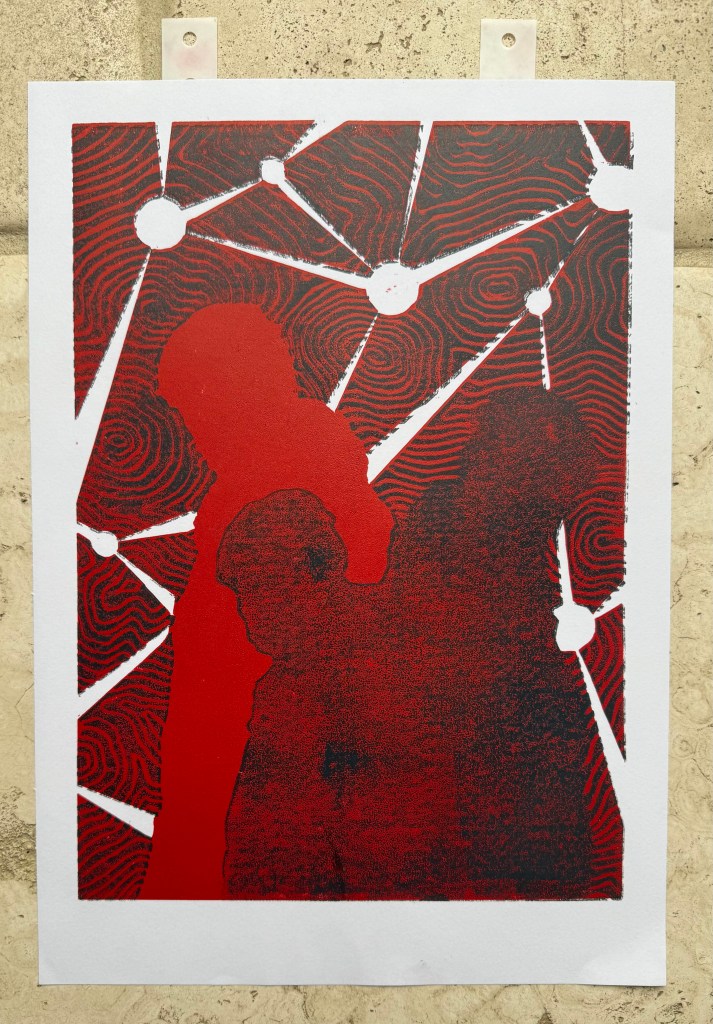
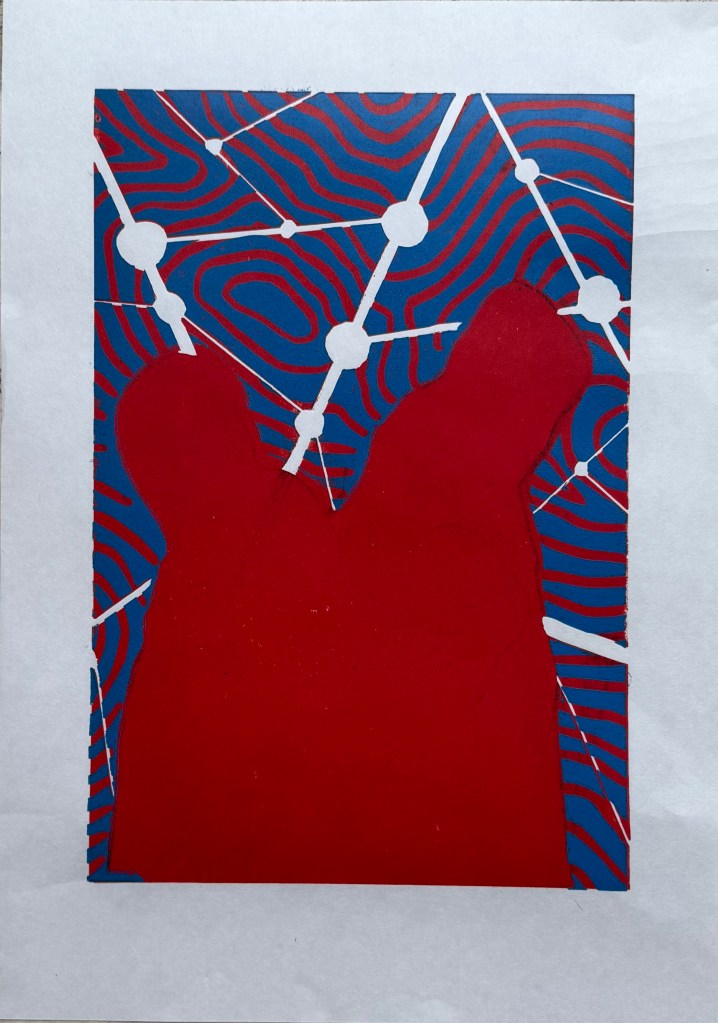
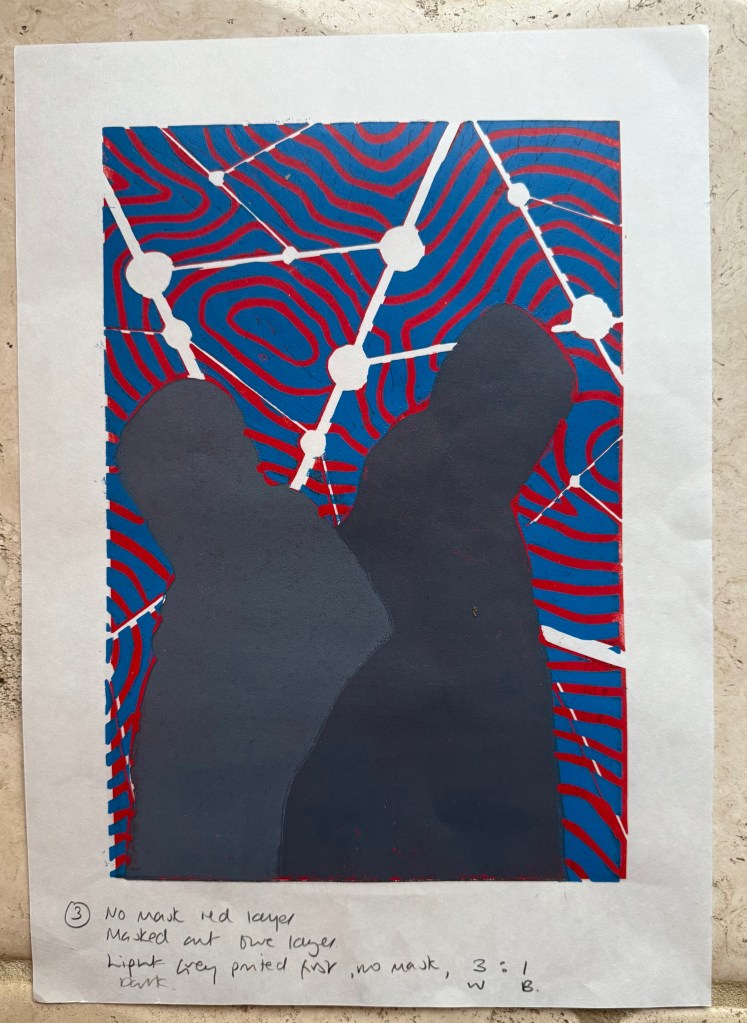
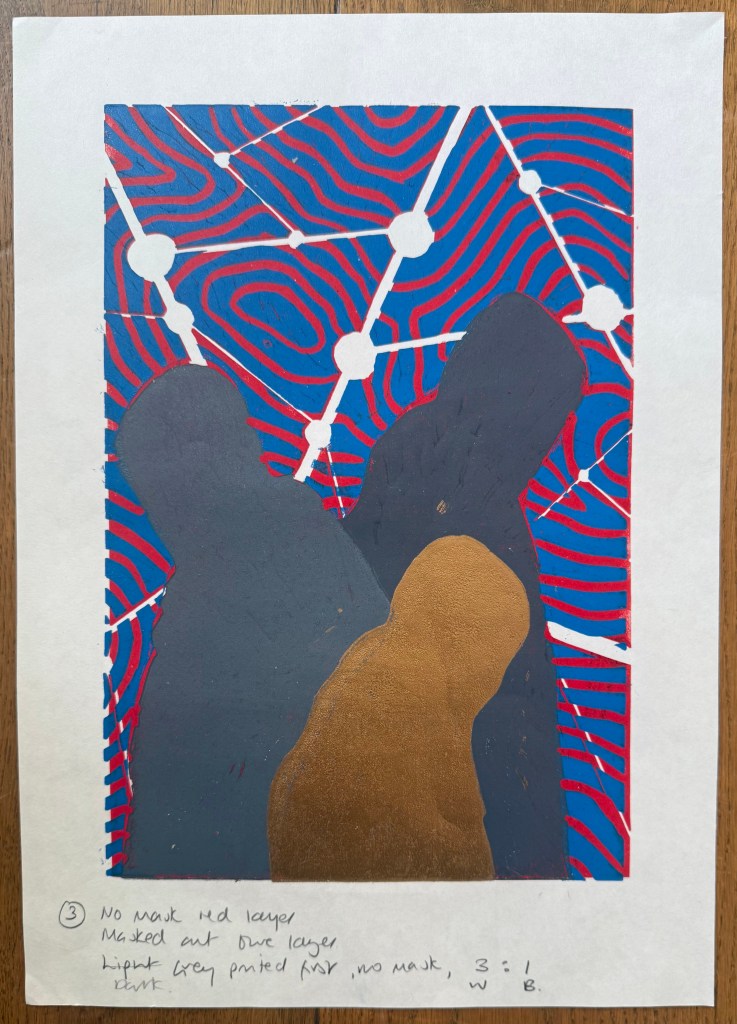
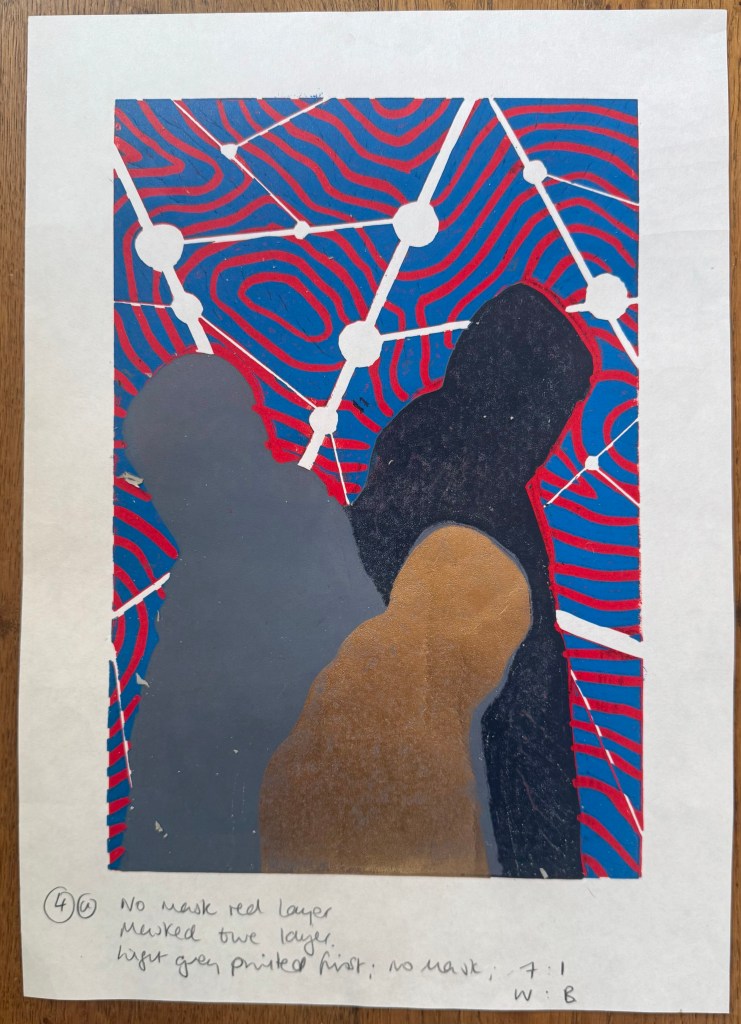
I liked the slightly mottled effect of the grey on the figures – it gave the sense of light falling on the figures or a lack of solidity. I wanted the head silhouette to be stronger so I burnished the head and the front side of the figure with a spoon to get a darker print. I liked the prints at this stage, but I felt that the two grey figures didn’t have enough definition between them, so I went on with the final gold layer.
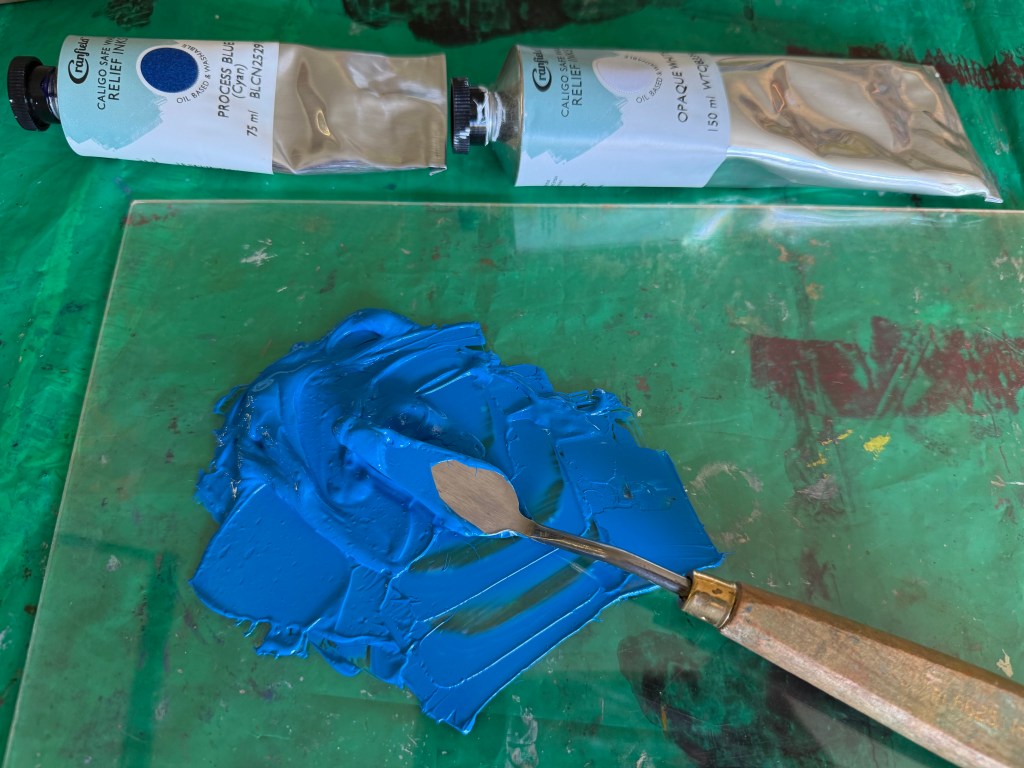
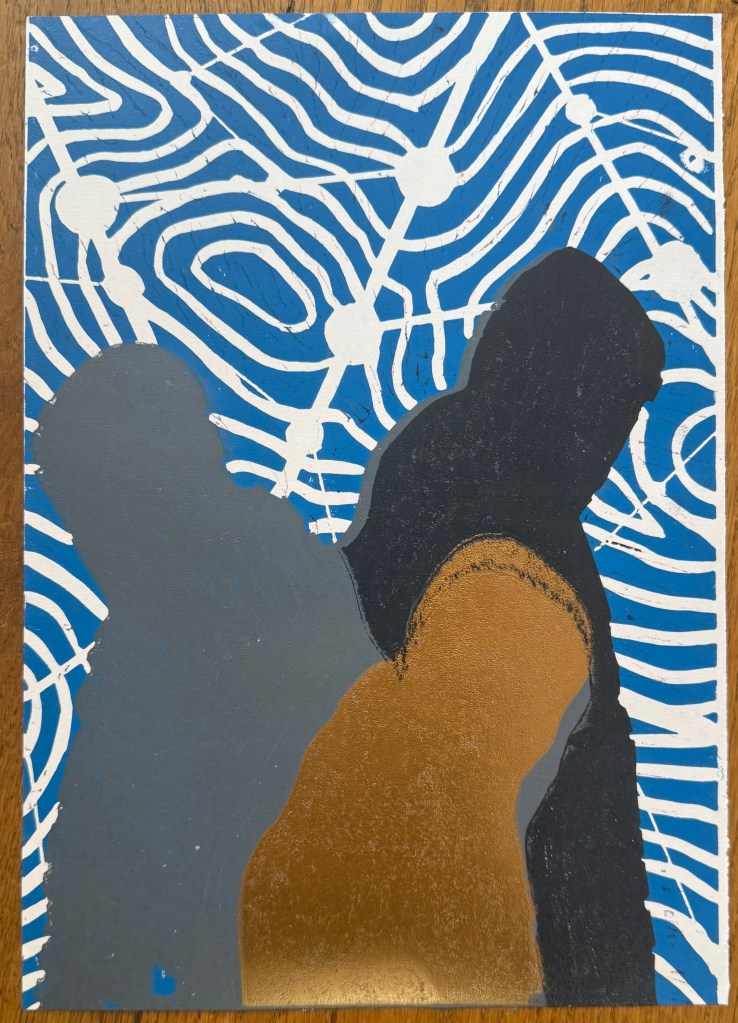
So, Plan A was dependent on me being able to overprint the red with blue. I did a quick test print. The process blue ink I was using must have some transparency as it turned into a very dark purple, so I made it more opaque by adding opaque white which resulted in a kind of cerulean blue which I liked against the red, although the photos don’t do it justice.
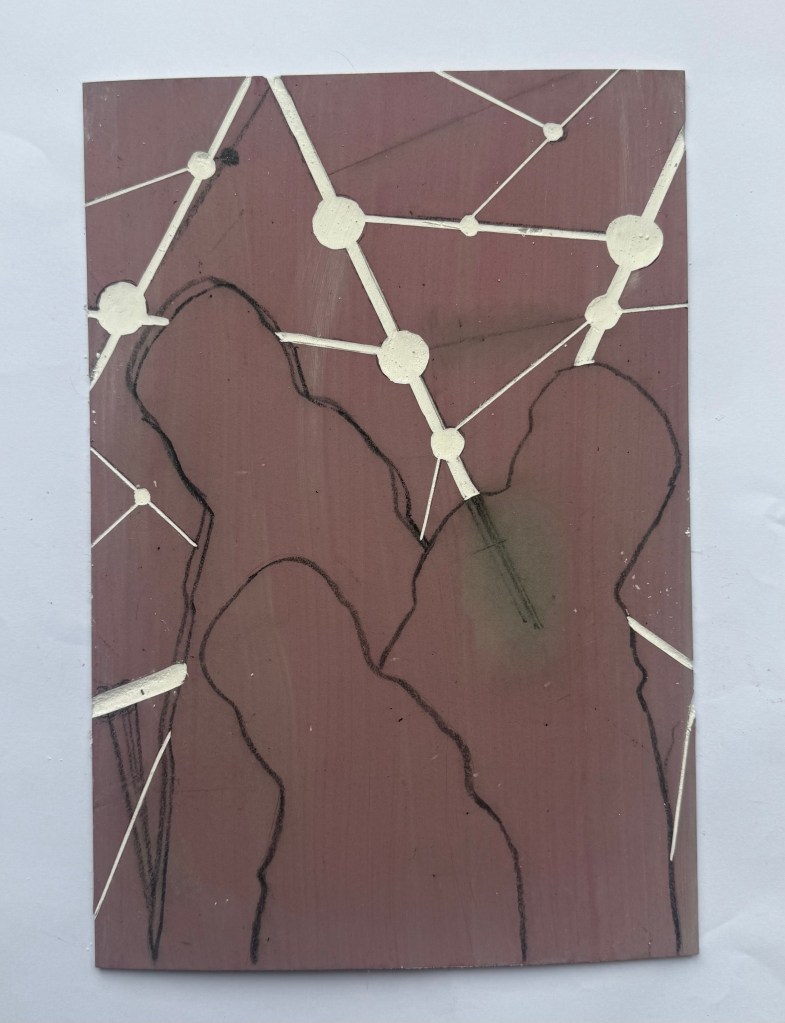
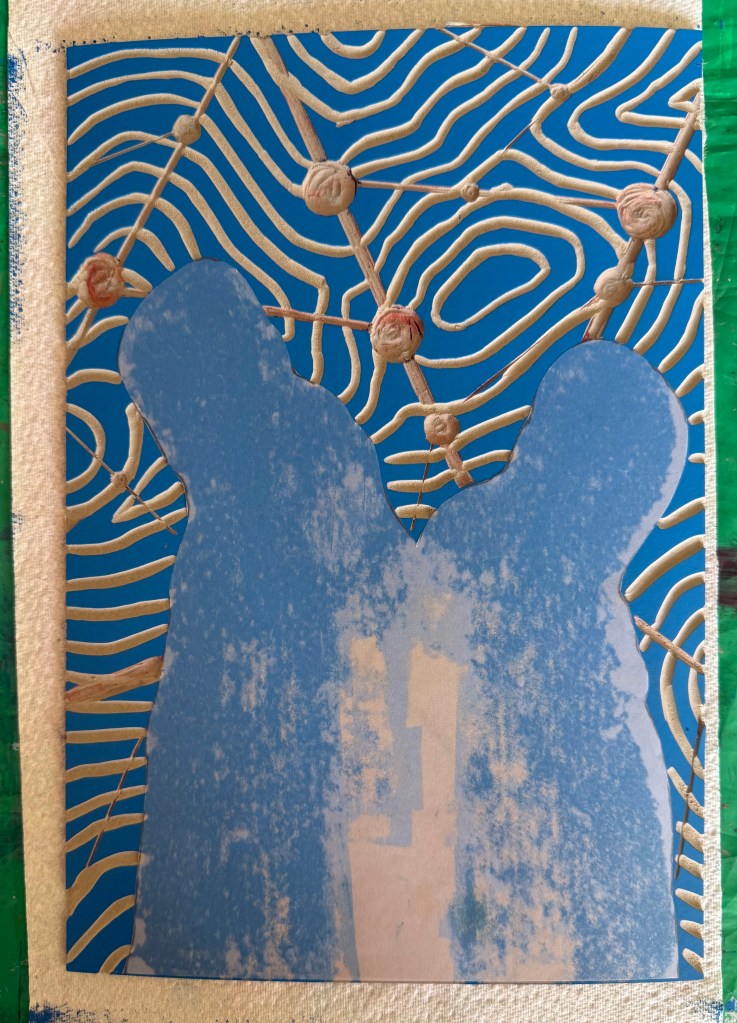
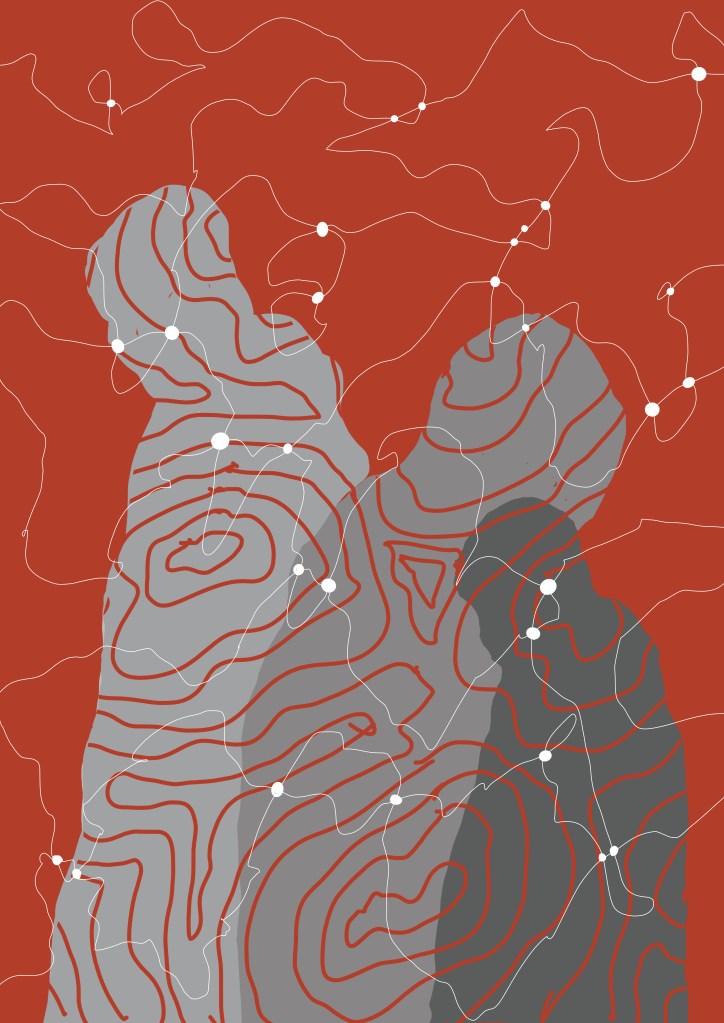
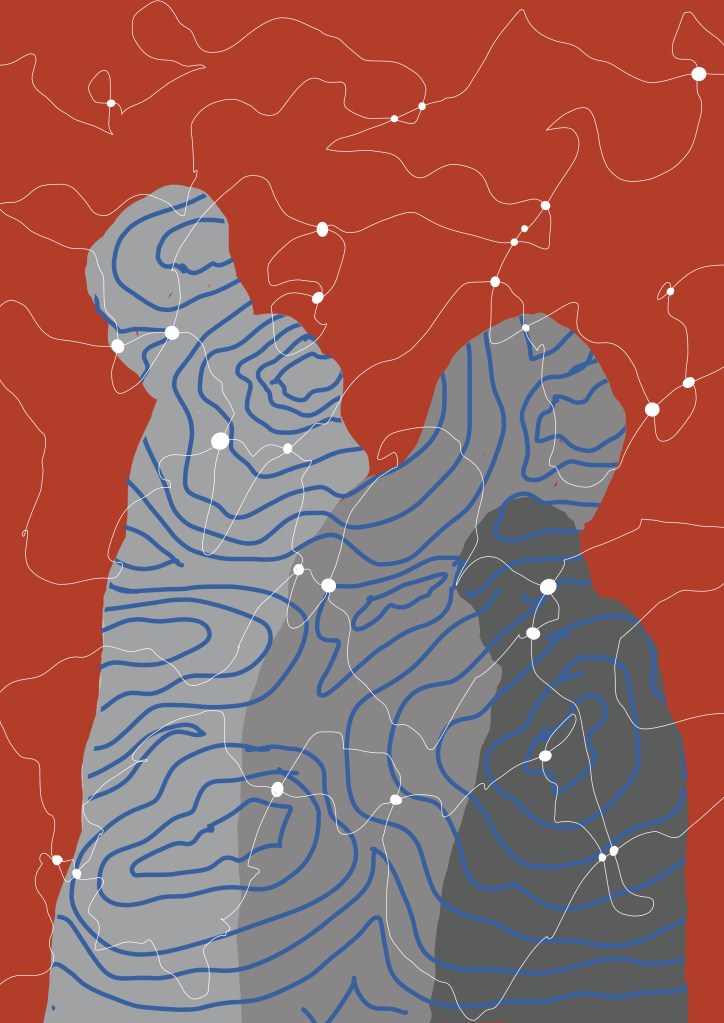
I then prepped a sheet of A4 lino by lightly sanding and wiping with white spirit before staining it with an acrylic ink and drawing on the figures and the white lines. I went over the pencil marks with a chinagraph pencil to make them stand out more. As usual I had launched in without giving it enough thought and ended up having to reposition some lines although I couldn’t erase the chinagraph marks, which becomes relevant later on in the test printing. I used a metal ruler to cut out the white areas and filled them with cornflour to see how they looked, neatening up where necessary – the circles are bit all over the place, so I resolved to use a template when making the actual prints.
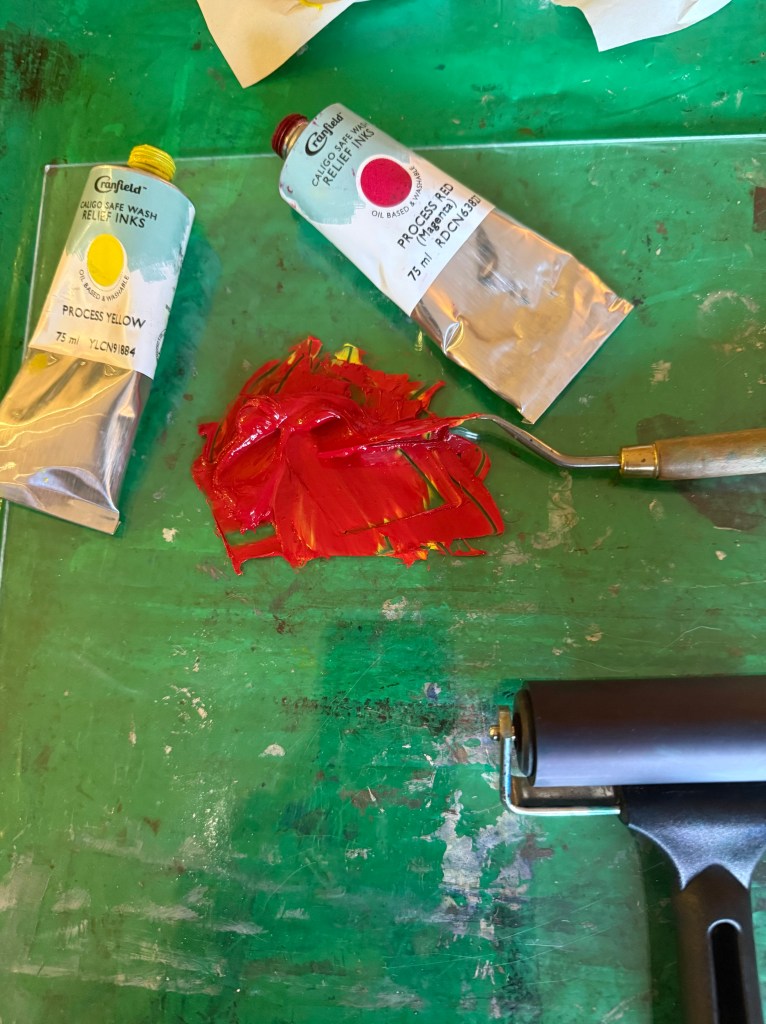
I created a registration board for the lino, drew lines where the paper was to go, and printed the first layer using equal parts process red and process yellow. Initially, I thought that I could mask out the figures using some tracing paper. Reduction linocuts work from light to dark ordinarily, but my image doesn’t really conform to that process. I knew one, if not two, of the figures would be a med/light grey and I wasn’t sure how that would sit on top of a bright red. I tried inking up whilst the mask was on the block and then removing it, but it was difficult to do because the mask kept on sticking to the brayer and the result wasn’t great. I decided to ink up the entire block for the rest of the prints. I also noticed that some of the chinagraph was coming off the block onto the prints.
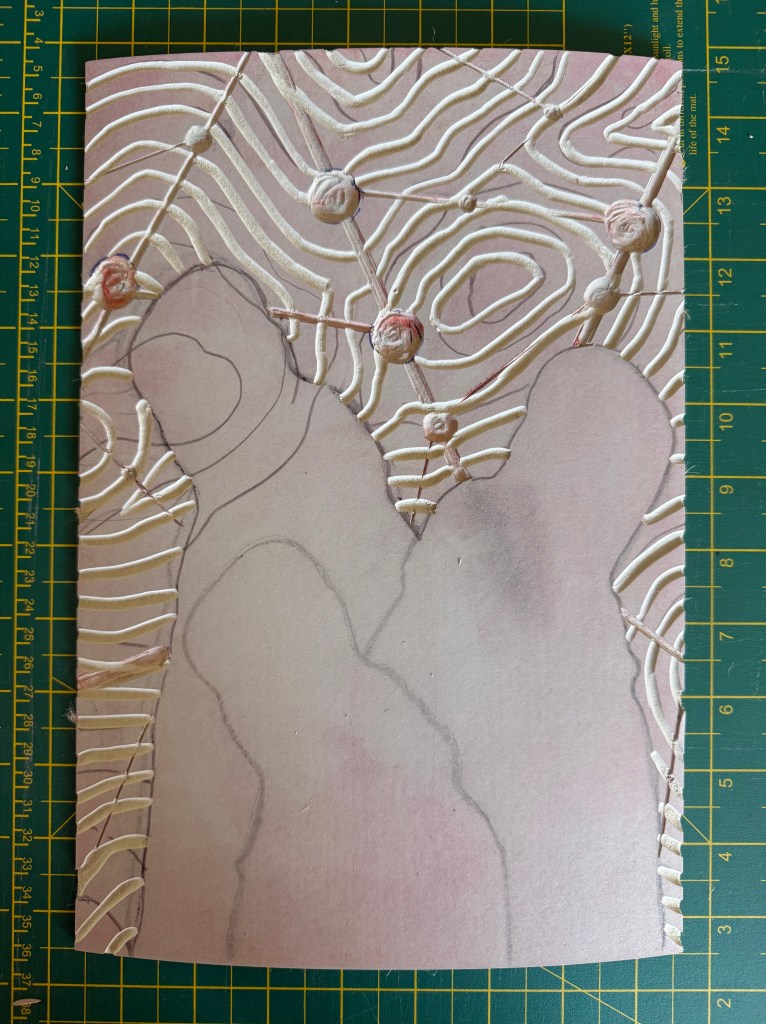
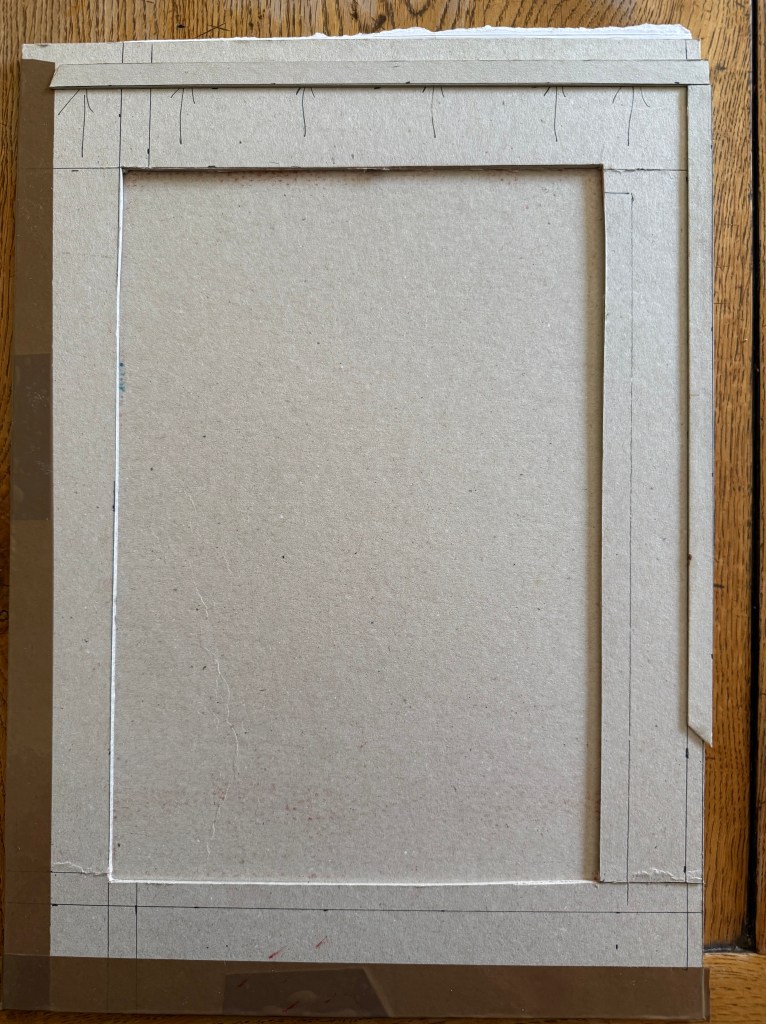
Next, I cut out the contour lines and printed with blue ink. By this stage I had realised my previous error and masked the figures after inking the block, but before printing – a much better result, and I can’t work out why I hadn’t realised this to start with. However, after the first print it was obvious that the registration was off. I had thought that I had lined up the paper the same each time when I was printing the red layer, but I clearly hadn’t. I created a raised edge against which to place the paper on subsequent prints, but I had to accept that the blue and red layers wouldn’t line up on all of the test prints, which would cause problems in relation to the white areas.
There was also misalignment around the edges of the figures which could have been caused by poor registration on the first layer, but could also have been caused by a lack of accuracy in creating the mask, or even applying too much ink.
To complicate matters further, the paper I used was Japanese HoSho paper which being lightweight (90gsm) and strong makes it ideal for printing linocuts. However, it turns out that it is slightly smaller than A3. I already had some Snowdon 130gsm paper, so I thought that I would give that a go, to see if it would be a suitable alternative, even though it is heavier than the HoSho.
Other than a few areas where some bits had managed to get stuck onto the block, it seemed to print quite well.
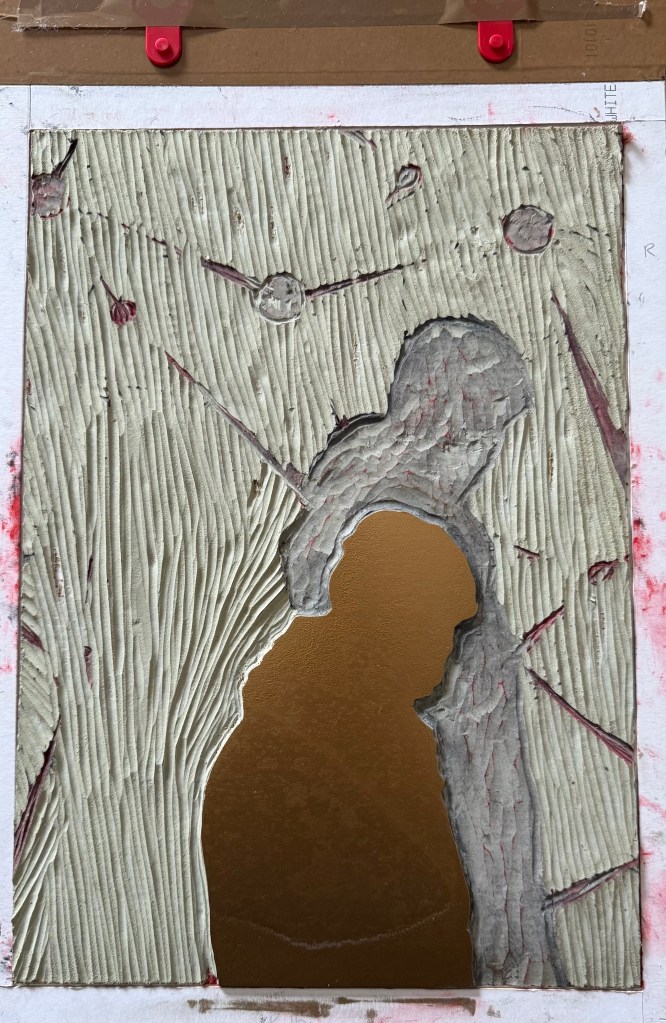
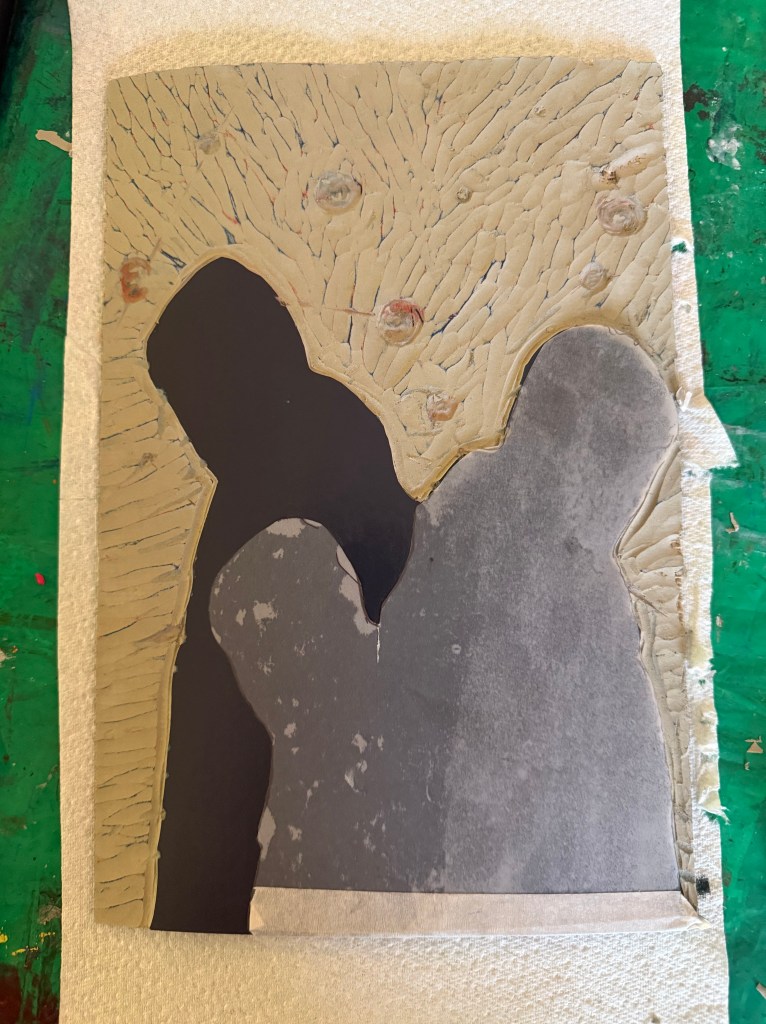
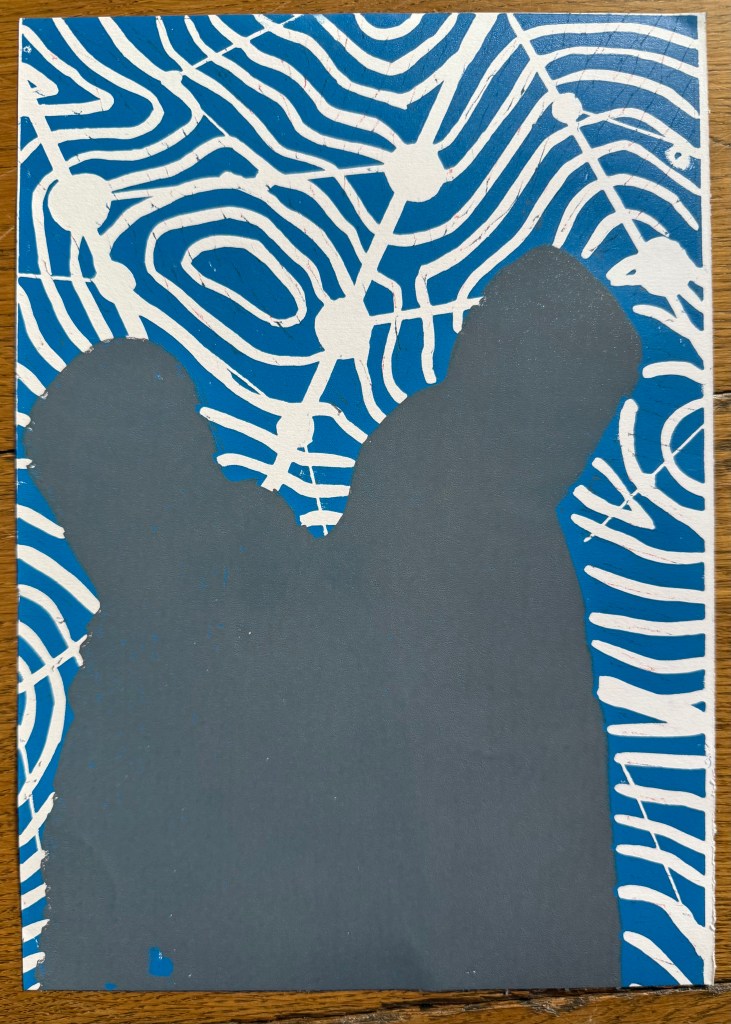
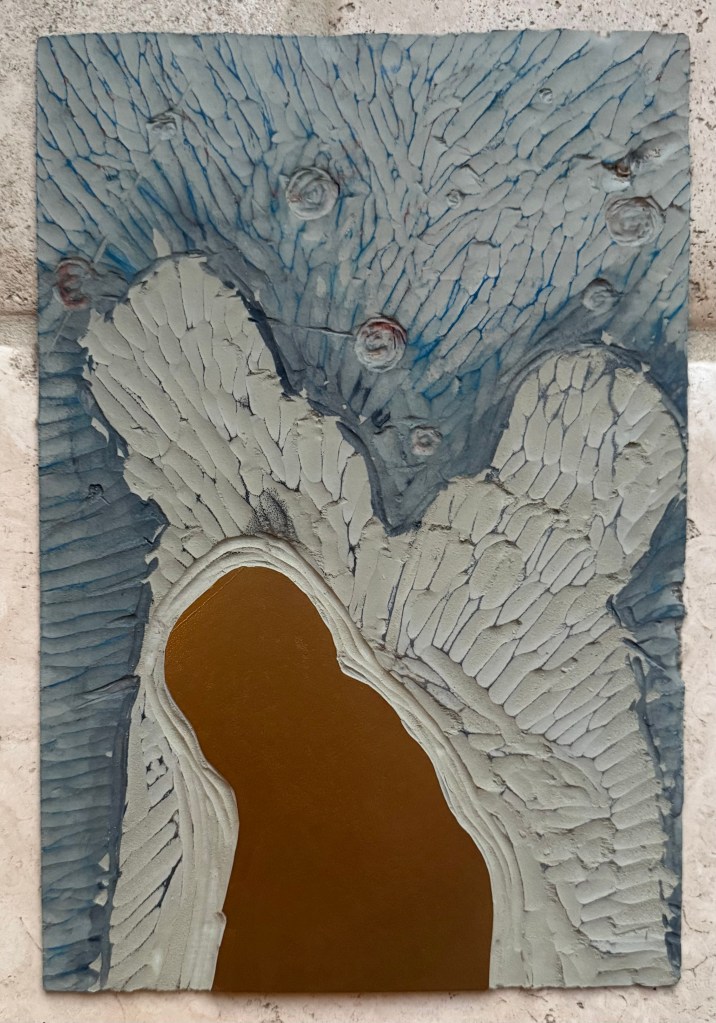
I then cut away the rest of the block leaving just the figures. I wanted to experiment with both masking areas and inking up the whole block to see how the subsequent layers printed so I could decide on a final approach ie whether to use a mask or to layer the ink. I would have preferred not to mask any areas as it seemed to increase the risk of mis-registration of the print. But before I decided I needed to find out how the final metallic gold layer would sit on top of all the other layers. I noticed that there were some indentations in the outlines of the figures from where I had cut out the contour lines.
I also wanted to see how the grey would print on top of the blue as well as the red, and it seemed to fare quite well, although it definitely has a cooler undertone to it than when printed over the red.
The blue and grey layers seemed to dry slower than the red and, as a result, the dark grey/black ink didn’t print well, and also the cut away areas picked up some of some of the blue and transferred it to the prints. I had the same issue with the gold ink, but by that stage I had become a bit frustrated and impatient, and just wanted to see what the colours looked like together. There are agents which can be added to the ink to speed up the drying process but you have to be careful as to the amount used, as they can alter the colours. I could have swapped from oil based to water based inks, which I didn’t have. So I decided to make the best of what I had.
I know that I make things more complicated for myself than they need to be. I could have watched videos on how to make reduction linocuts before starting, but there is a part of me that thinks that learning on the job is a more valuable, if not more frustrating, experience, and that the lessons learnt are more likely to be remembered (and possibly put me off linocuts for good).
So, what did I learn?
Preparation is key
Registration is everything – I watched a couple of videos after the event and invested in some Ternes Burton registration pins and tabs
It’s preferable not to mask areas if possible but to cut away the lino on each layer
Don’t use chinagraph or anything else which could transfer from the block to the paper
Accuracy is important
I should have had a resolved image before I started, rather than winging it in the process
When cutting out the first and second layers I needed to ensure a clean edge with the figures by using a craft knife
I needed to check that there isn’t any ink on the cut out areas of lino before printing
The ink needed to be dry before printing the next layer
But, the most important lesson is that because of the number of layers and the time needed for drying, it would not have been possible to complete the print before the end of the month. I needed to go back to the drawing board and have less colours so that it reduced the amount of drying time etc. So I amended the image to just white, red, grey and gold.
I’ve decided that I would like to make physical prints for the Editions Sale, if possible, and I have resolved to do a linocut, on the basis that I don’t have an etching press at home, and I probably won’t be able to make it in to CSM this month. I also want it to be something which is relevant to, and an extension of, my recent work.
I’ve not much experience of linocutting, but this is a good opportunity to try and improve my skills. I’ve been experimenting with some of the mapping imagery that I’ve been exploring over the last few months.
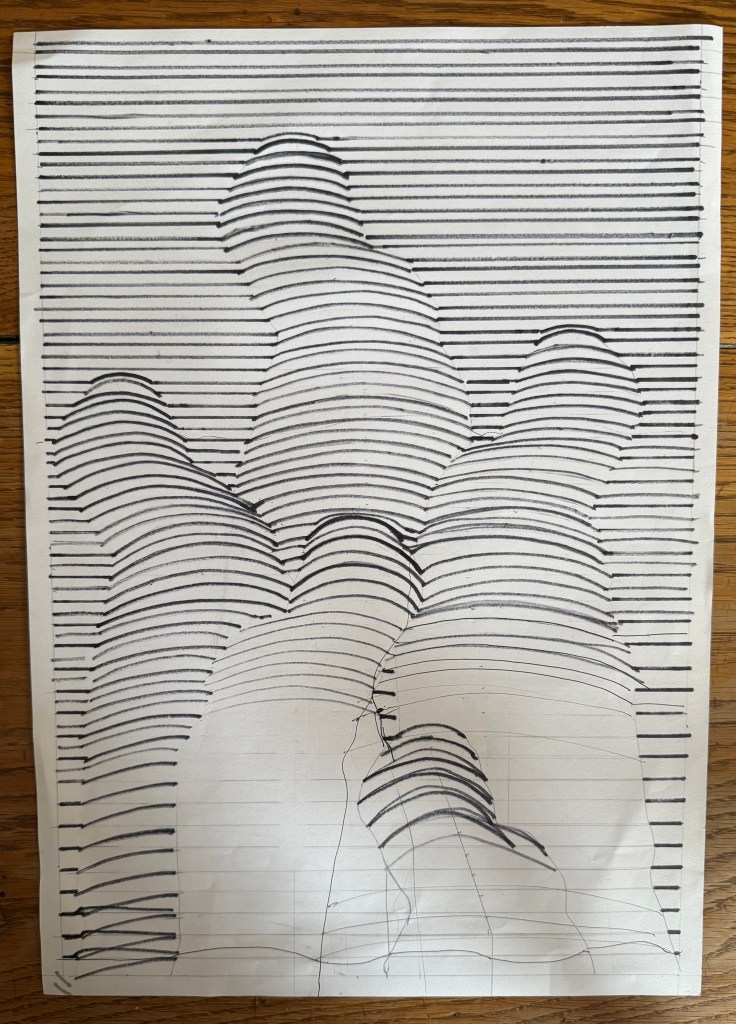
Originally I thought about the line drawing I did and how form can emerge from lines. I used my father’s silhouette from Solitude to experiment.
The lines are all over the place as I did them freehand (how does Bridget Riley manage?) and there were a few errors. In the top half I experimented with rounded curves, whilst in the bottom half the lines are flatter.
I tried drawing out how it might work but in the end I decided that it would just be too difficult, and gave up.
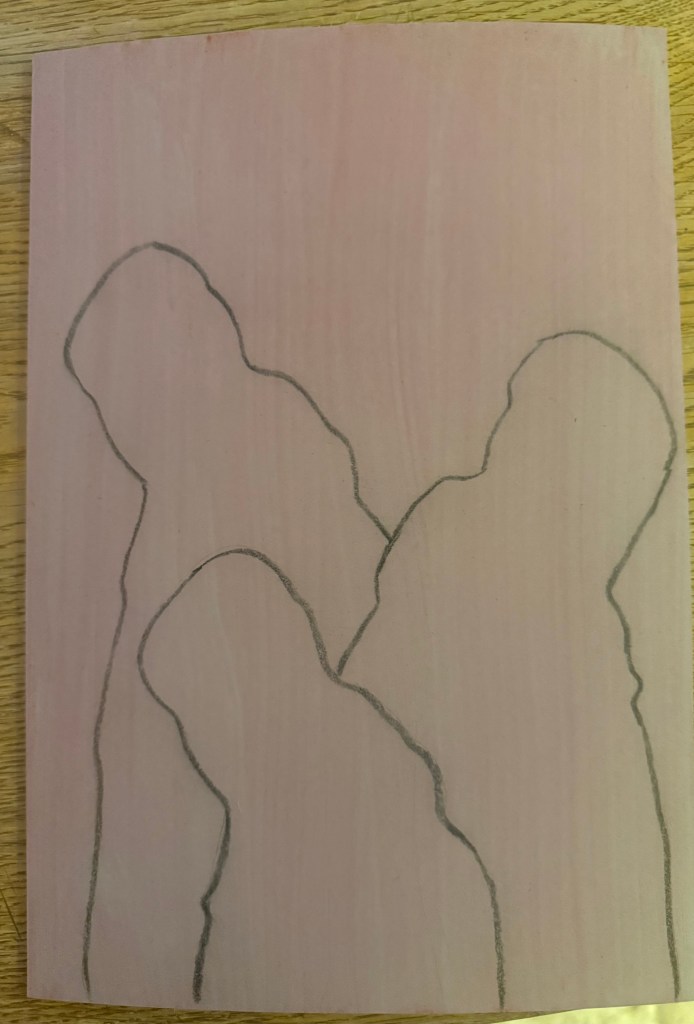
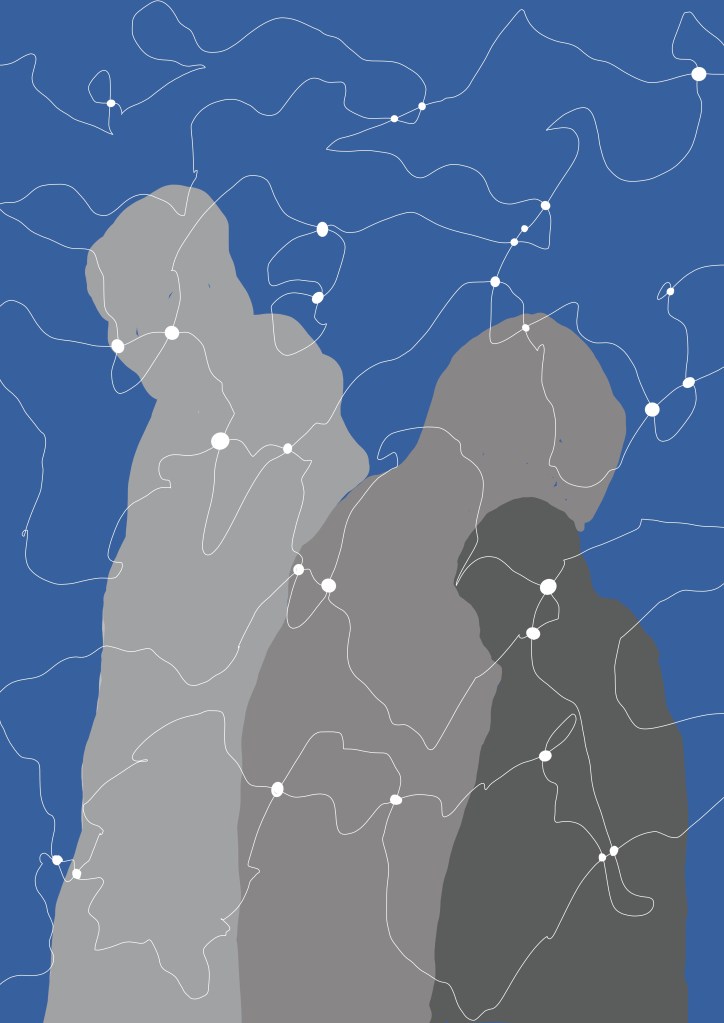
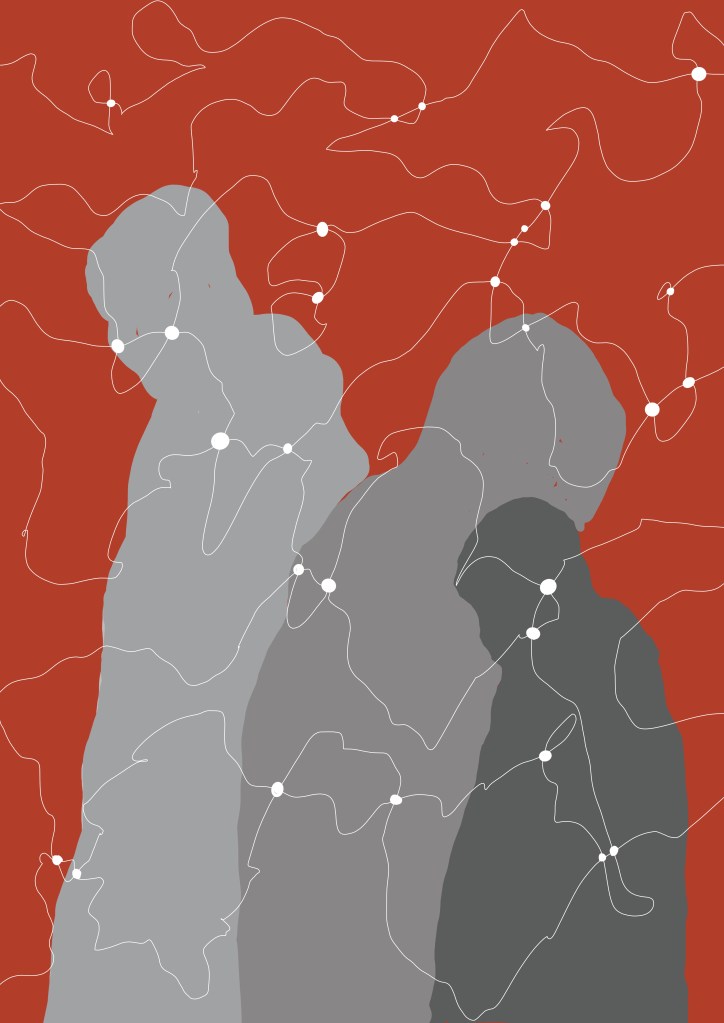
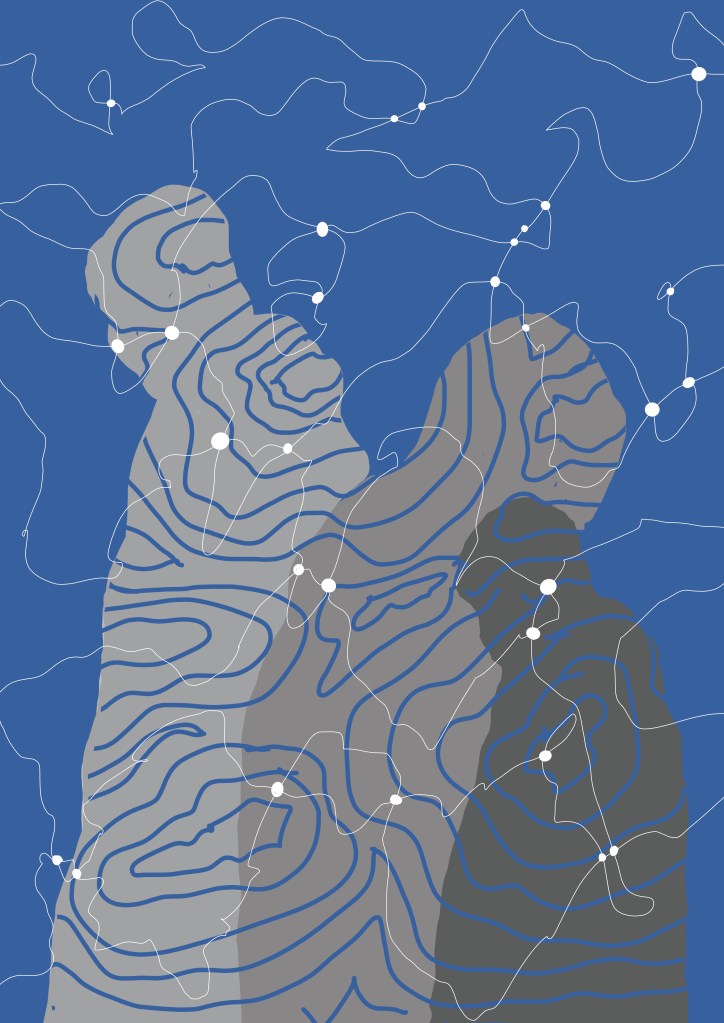
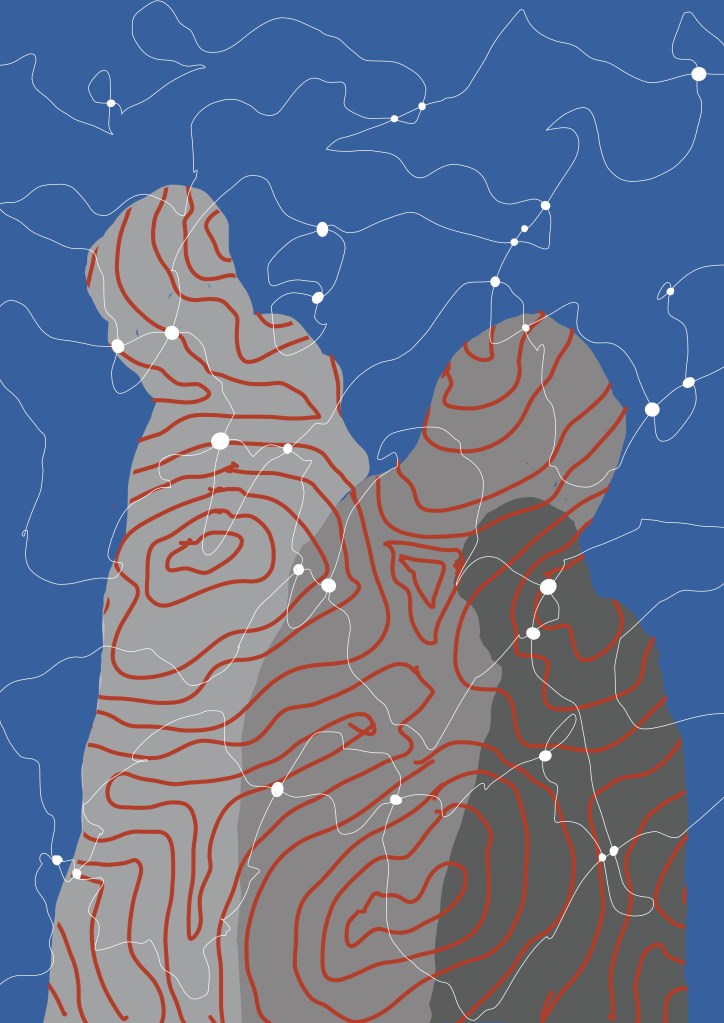
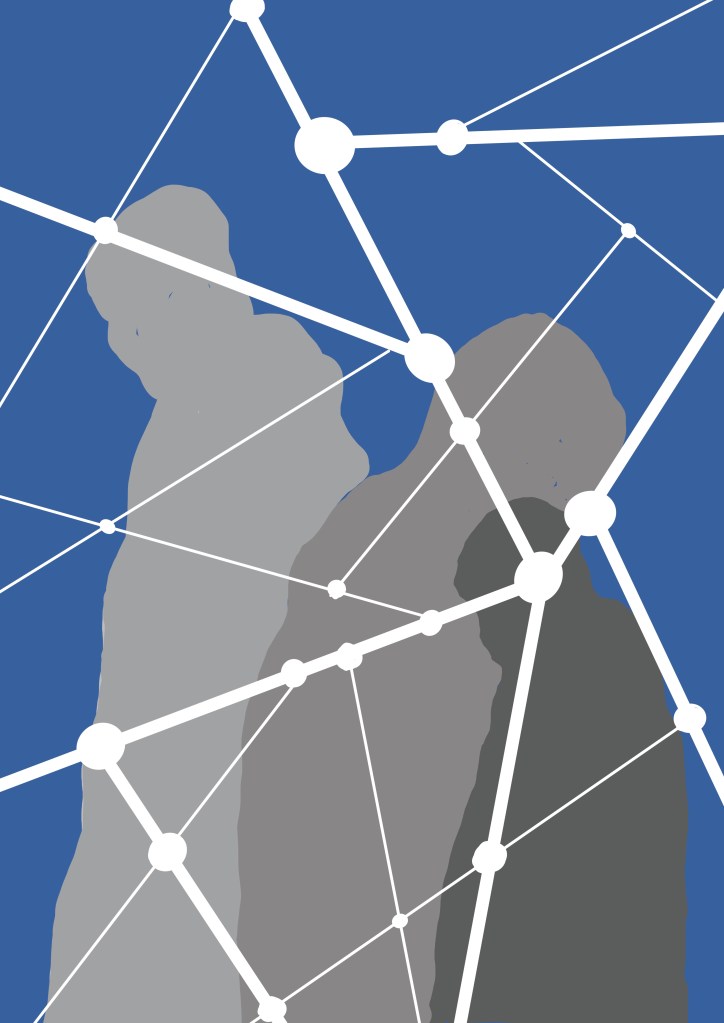
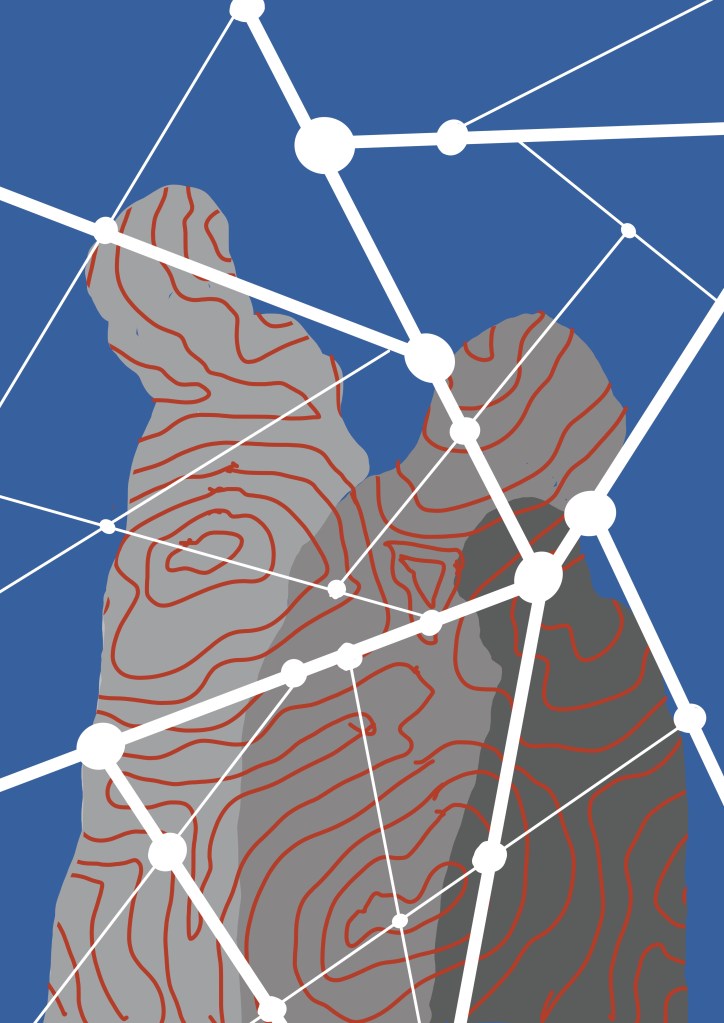
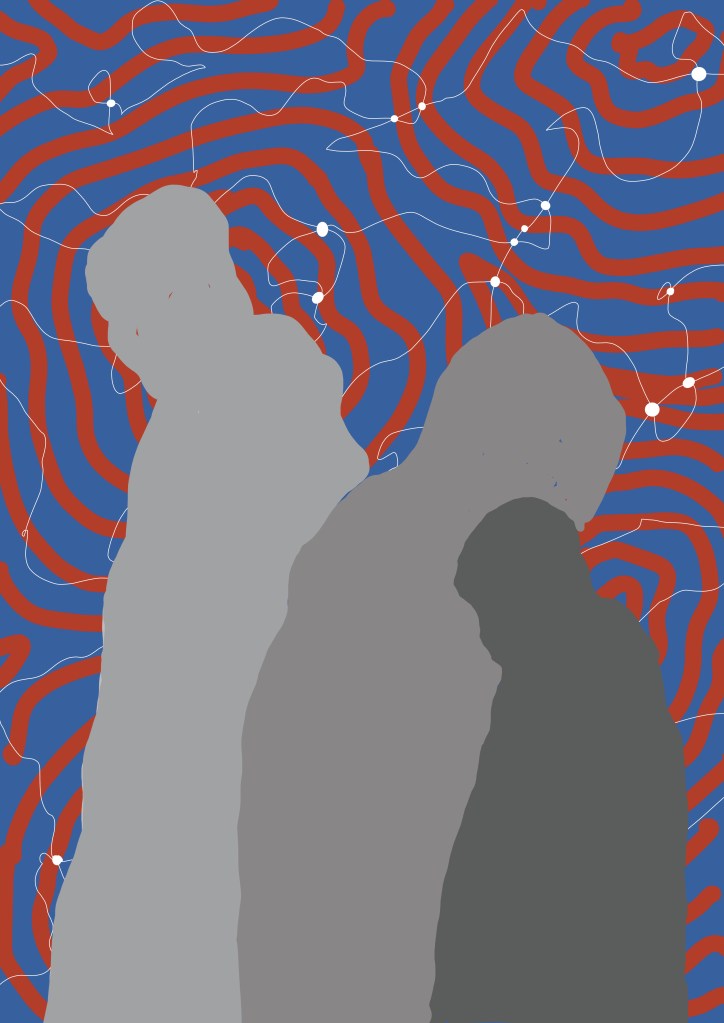
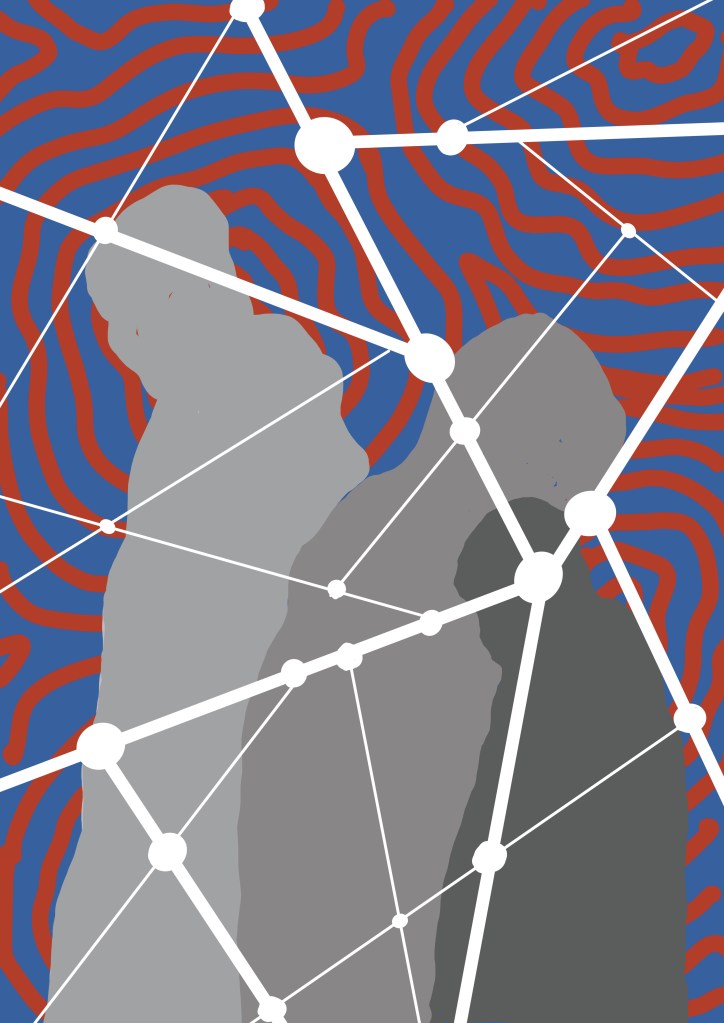
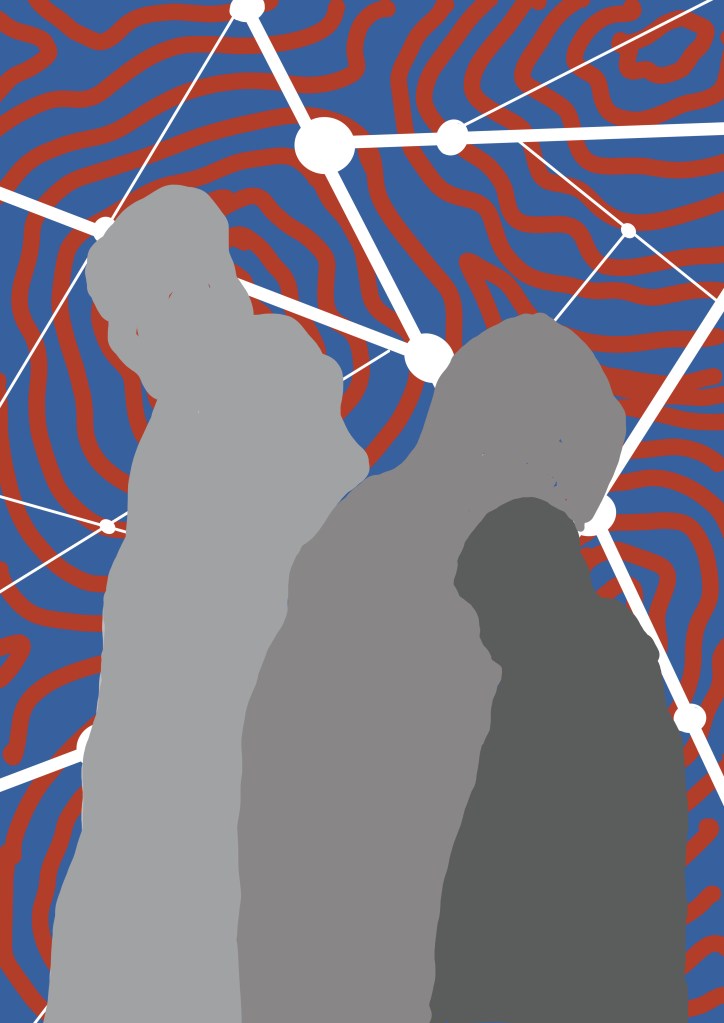
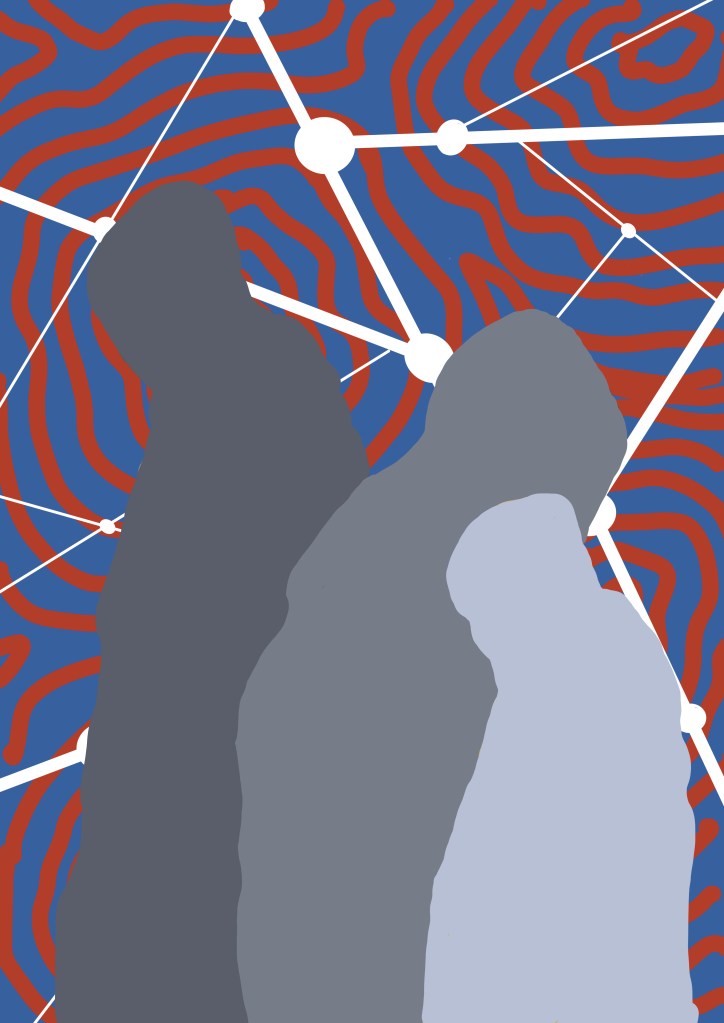
I then looked at the contouring and the automatic drawing that I have incorporated into some of my recent work. I used a group of three figures, composition yet to be decided, and red and blue as the colour choice for the time being. I created multiple layers in Procreate which then allowed me to play around with possible combinations.
I like the red and blue contoured background with the figures standing in front of the straight white lines (last two images), maybe using gold leaf or even metallic ink (which would be cheaper) to add some additional interest. I’ve also put the darker figure in the background so that it gives the feeling of being in the shadows, even though, technically, lighter figures are supposed to recede, which in this case they don’t seem to because of the background.
So I’m sorted, apart from the fact that it will need to be a reduction linocut, something which I haven’t done before, put off by the suspicion that my brain doesn’t work in a reductive way, but there’s nothing like a challenge. Maybe I need a Plan B, just in case.
I’ve decided that I’m probably learning far more about myself by simply being in this process than I am by looking back on my life.
I need to retrain my brain. My legal training has made me focus on detail, anticipate every possible eventuality, dot every ‘i’ and cross every ‘t’ all within a rigid framework of rules and regulations. That way of thinking served its purpose then, but it now stultifies creativity.
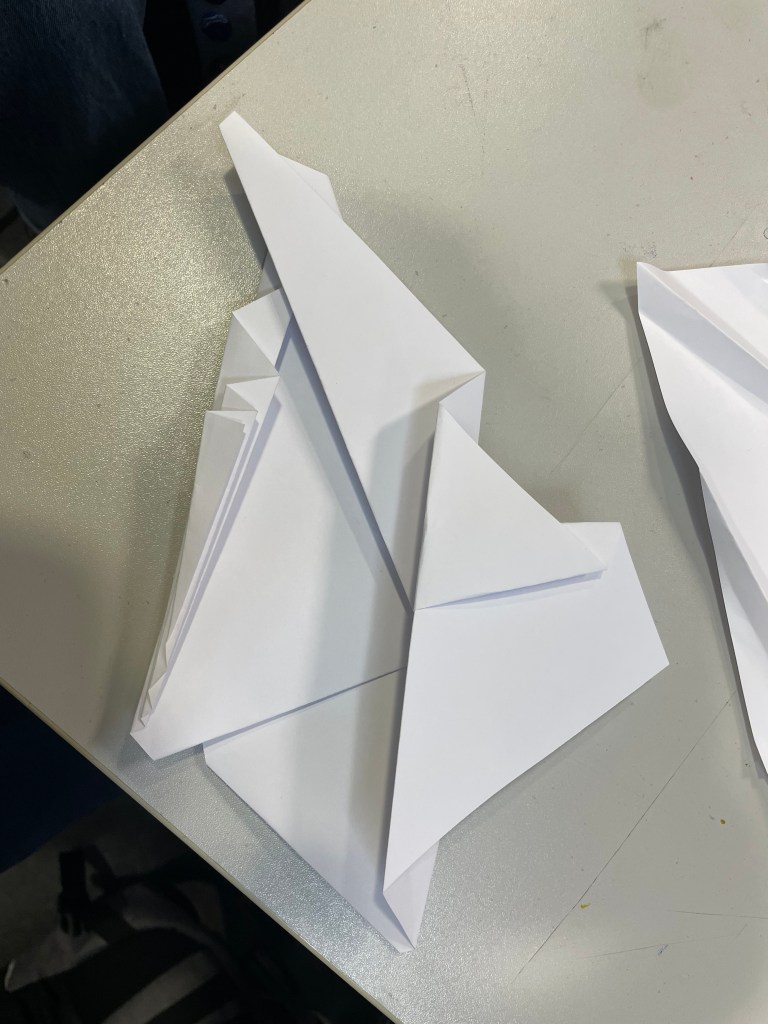
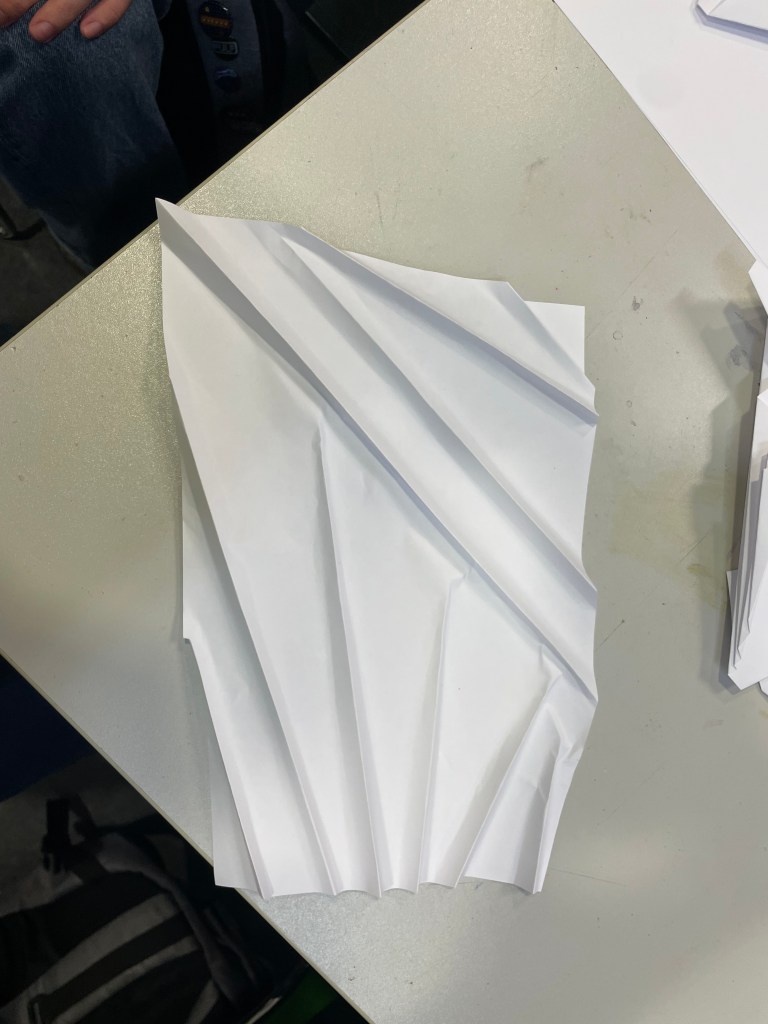
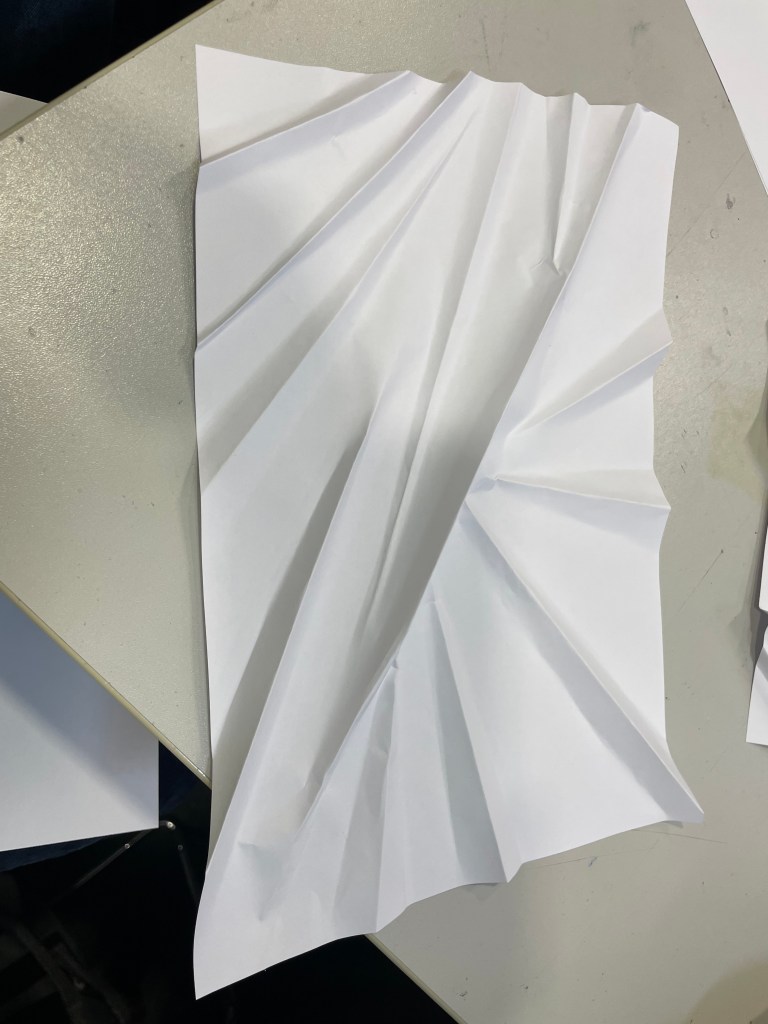
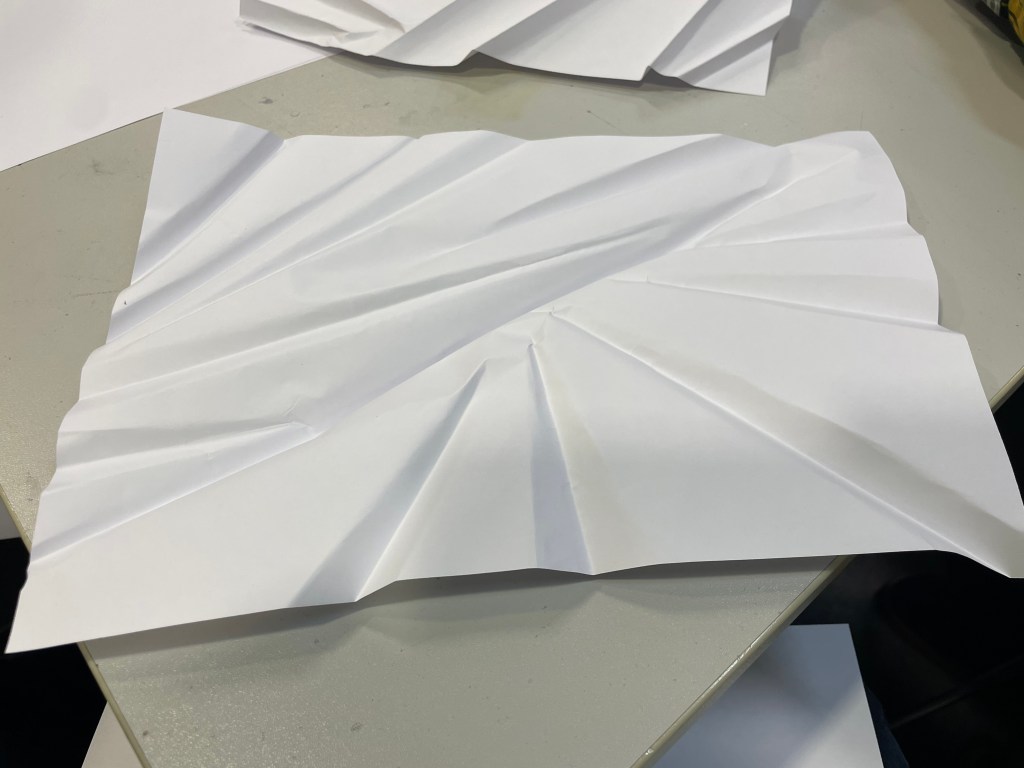
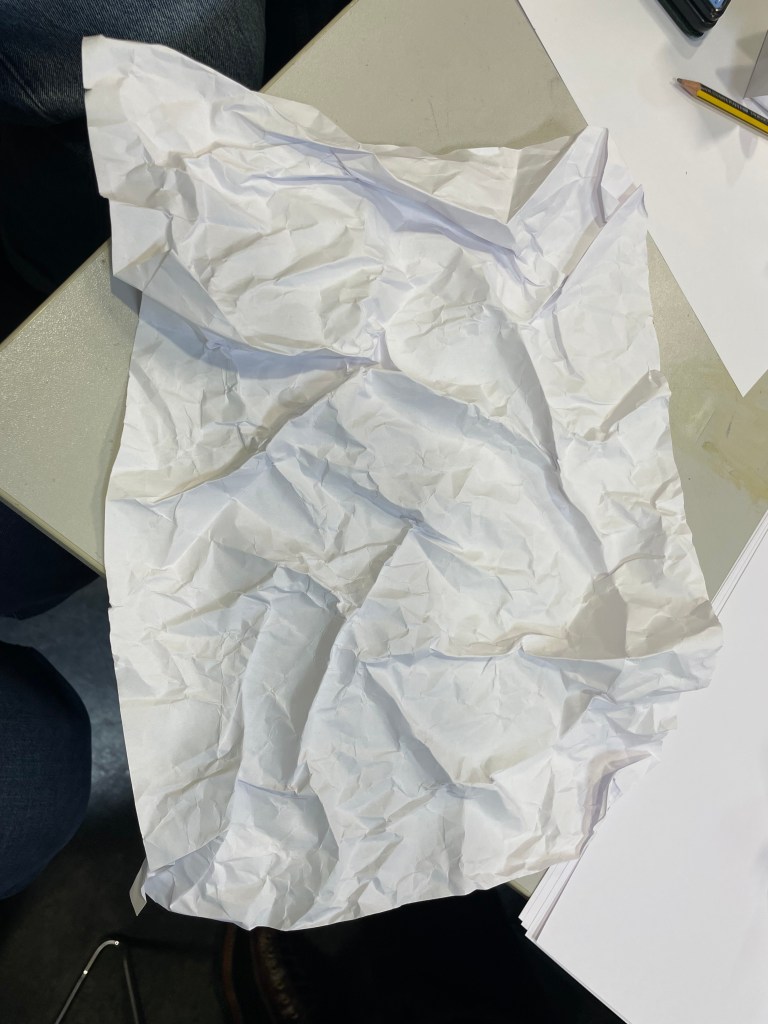
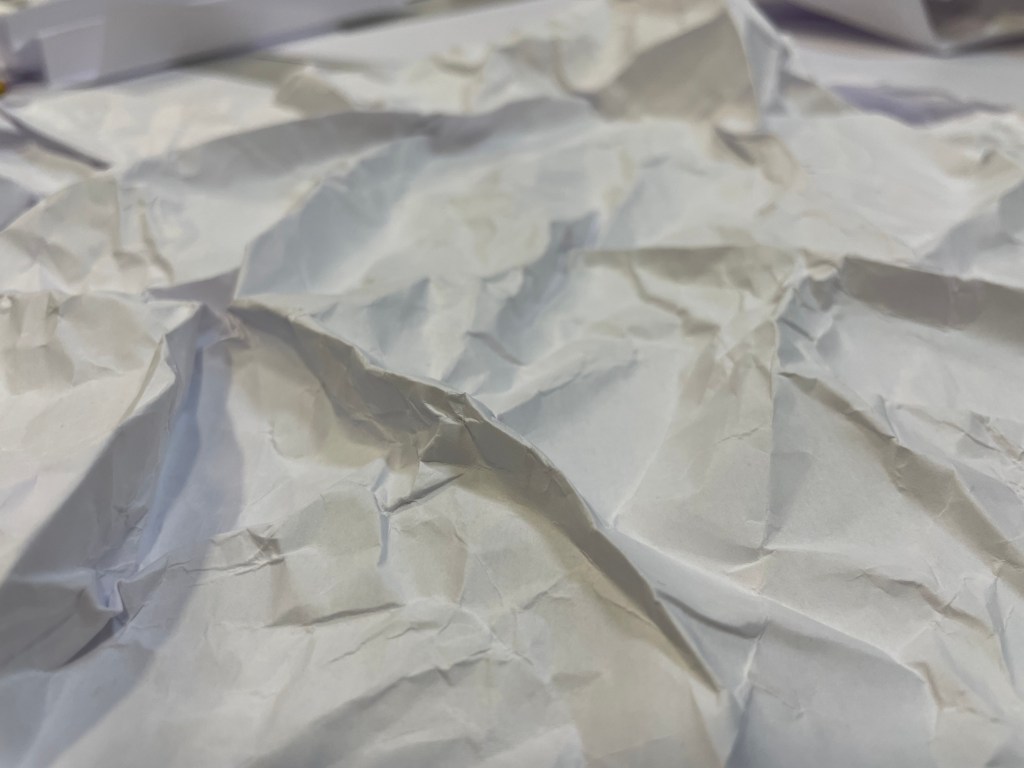
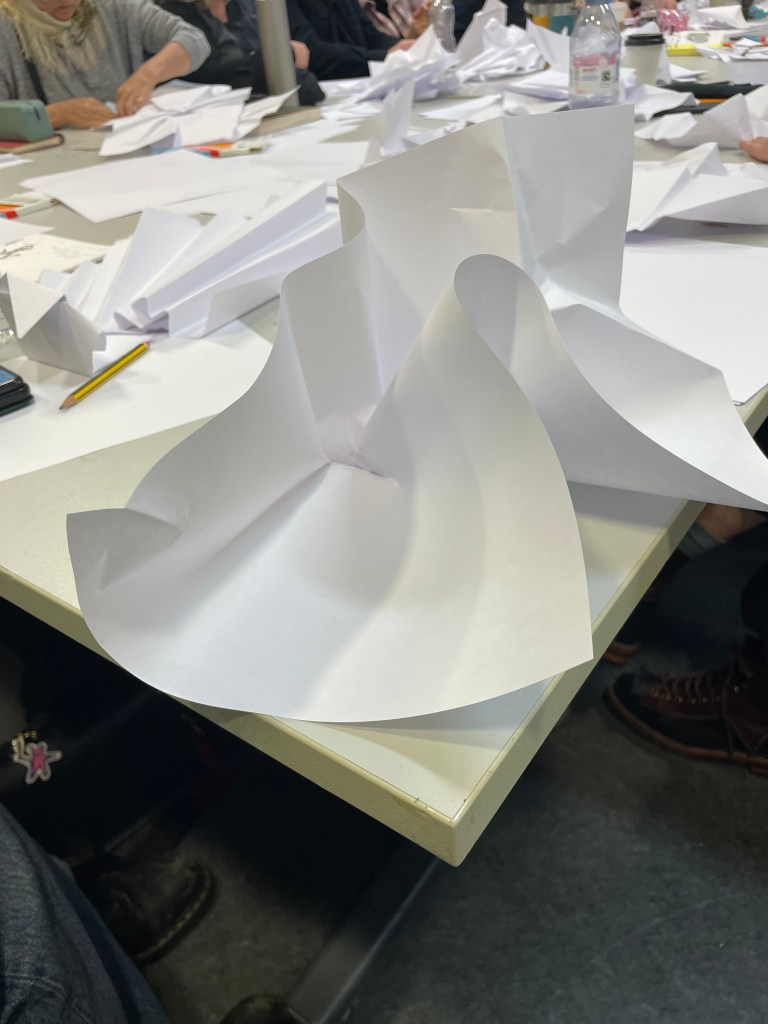
When I’m in a scenario which is unfamiliar, I like to know the parameters within which I’m expected to navigate; quite often I feel discombobulated when things don’t go the way I am expecting, the paper workshop with Christian Azolan being a case in point. We were instructed to fold the paper. To my pedantic mind, folding involves a deliberate act of bending something over on itself to create a clearly defined edge. It doesn’t include scrunching. But once I had overcome my initial confusion and accepted this unexpected variation of the parameters, I enjoyed myself.
I definitely preferred using the blank paper – I don’t know what brand it was, but it felt really good. It led me to confess my fetish for pristine white paper to some of my fellow students. I think it stems from being at primary school when the teacher would write my name on the front of a new exercise book with a marker pen and I would go back to my desk and give it a good sniff. I now appear to associate blank paper with a solvent high. I don’t think that my school ever had a pupil who was so keen to man the stationery cupboard at break time. In fact, I used to get palpitations and a bit of a sweat on just walking into WH Smith (R.I.P).
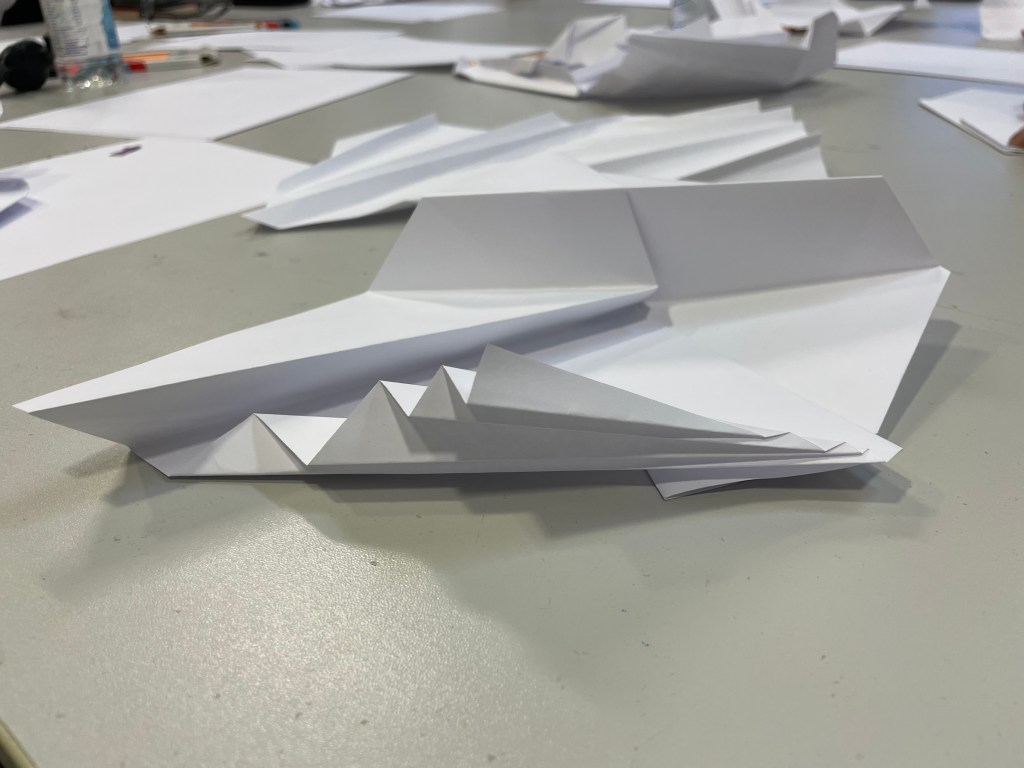
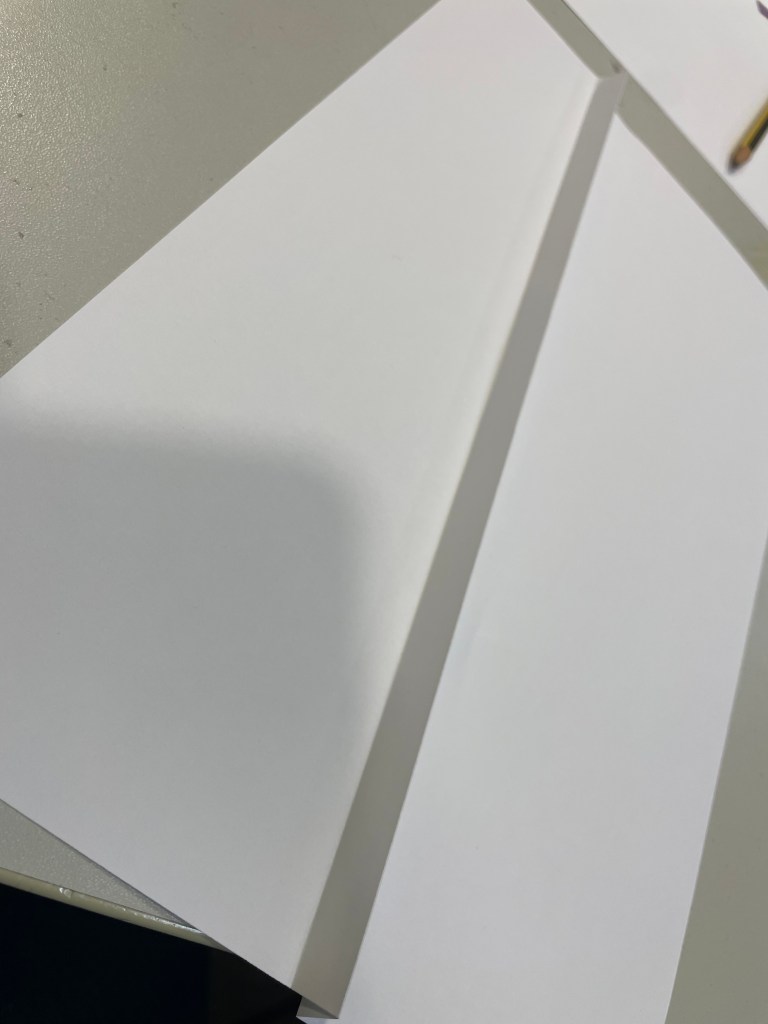
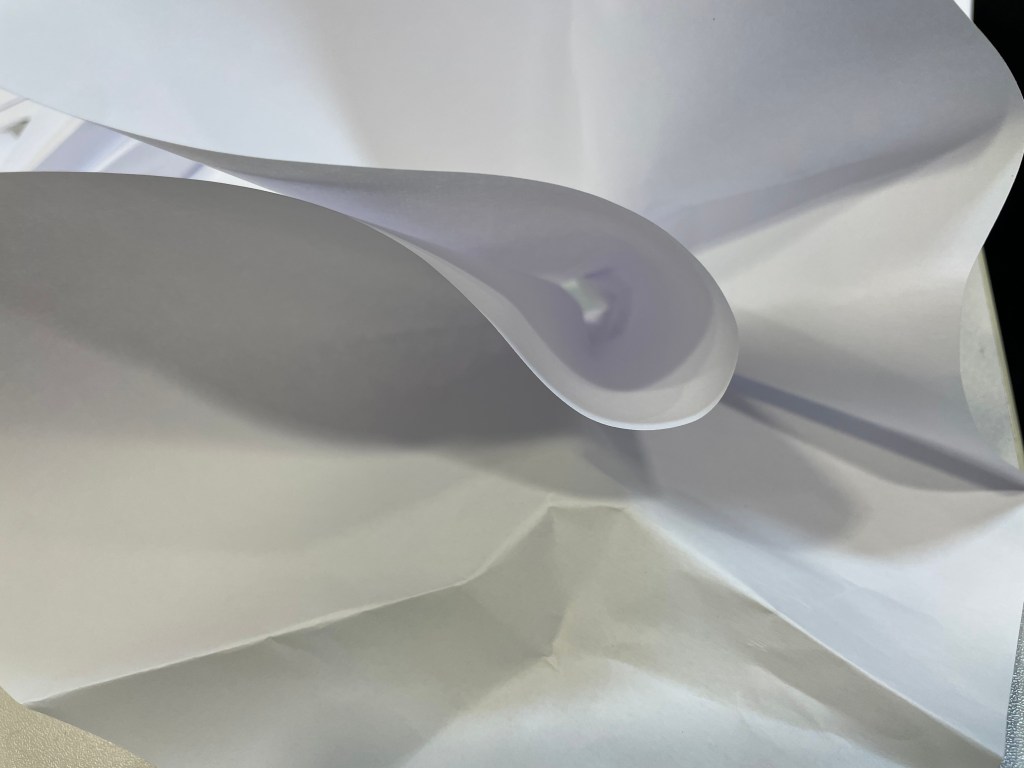
Working with the blank paper seemed to allow more freedom and I liked that the results took on a sculptural quality. The effect of the folding on the reverse of the paper was equally, if not more, interesting at times than the right side; areas which were peaks on one side became troughs on the other and vice versa.
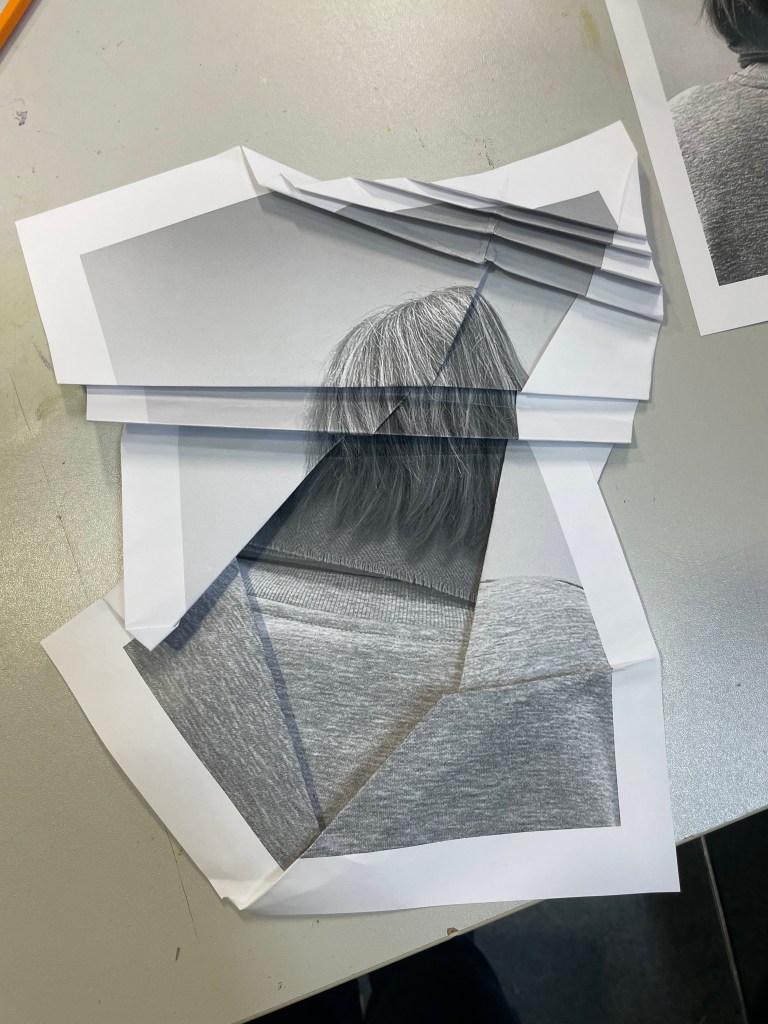
I felt inhibited using the print of the back of my head; I became too concerned with the resultant image which seemed to impose restrictions on how I folded, so maybe I like clear parameters, but not too many of them? Also, the effect is less sculptural than when using the blank paper; the areas of shadow are less apparent and the focus shifts to the distortion and concealment of parts of the image rather than the creation of form.
We then went on to do some linocutting – it seemed a bit incongruous with the folding activity, but nevertheless we all launched into it with equal enthusiasm.
I prepared two linocuts; one inspired by tree roots and the other a reduction linocut of an abstract shape – I printed it using yellow ink first, then cut away more lino and printed using red ink.
I also printed the tree roots image on a transparency, having torn up bits of paper to create a random mask. It is interesting to see the effect of overlaying it with the two prints; how it creates a sense of discord on the prints where it’s not in sync with the image below, and how it creates areas of intensity on the print over which it lines up.
As I was taking my lino into the next door room to print it, Christian heard me reminding myself as to what I was planning to do. Sorry, are you talking to me? No, just myself. Doesn’t everyone do that? Yes, of course. When I went back in to print my second lino, I asked him how long we had left. Sorry, are you talking to me?…
”Making the decision to have a child – it is momentous. It is to decide forever to have your heart go walking around outside your body.”
This quote from Elizabeth Stone (I’m yet to fathom out who she is!) is apparently well-known, but I only heard it recently when someone, I think it was an actor, was being interviewed about becoming a parent.
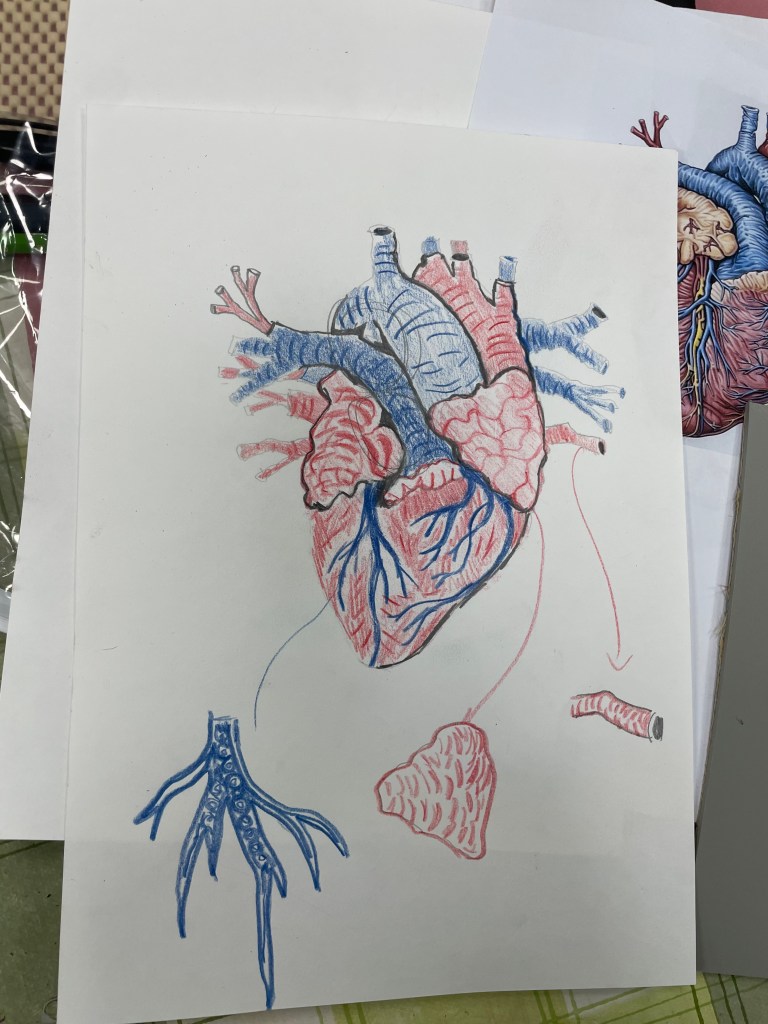
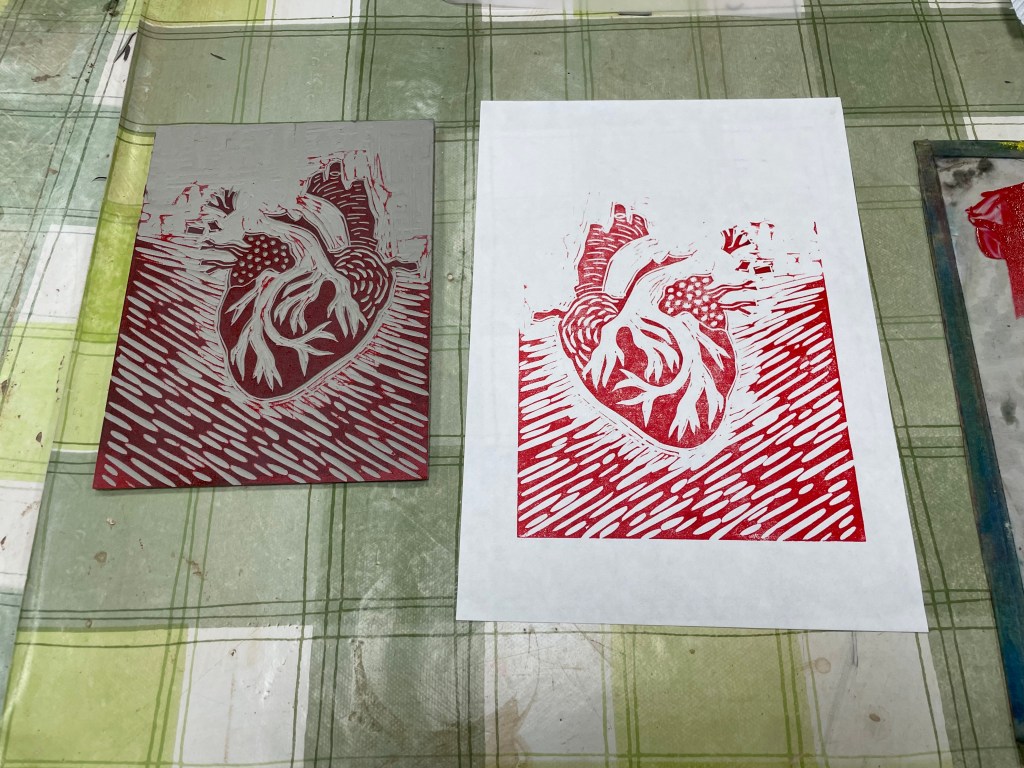
I think it sums up brilliantly the utter overwhelming sense of vulnerability and responsibility that I felt on becoming a mother. With this in mind, I attended a workshop on Saturday and Sunday on linocut led by Lisa Takahashi. Whilst everyone else started working on their images of sea urchins, birds, landscapes and flowers, I sat there, initially reluctant to reveal my chosen image of an anatomical diagram of a heart – it seemed particularly grisly and gruesome in this environment of natural loveliness. I suspect a few eyebrows were raised, on the side!
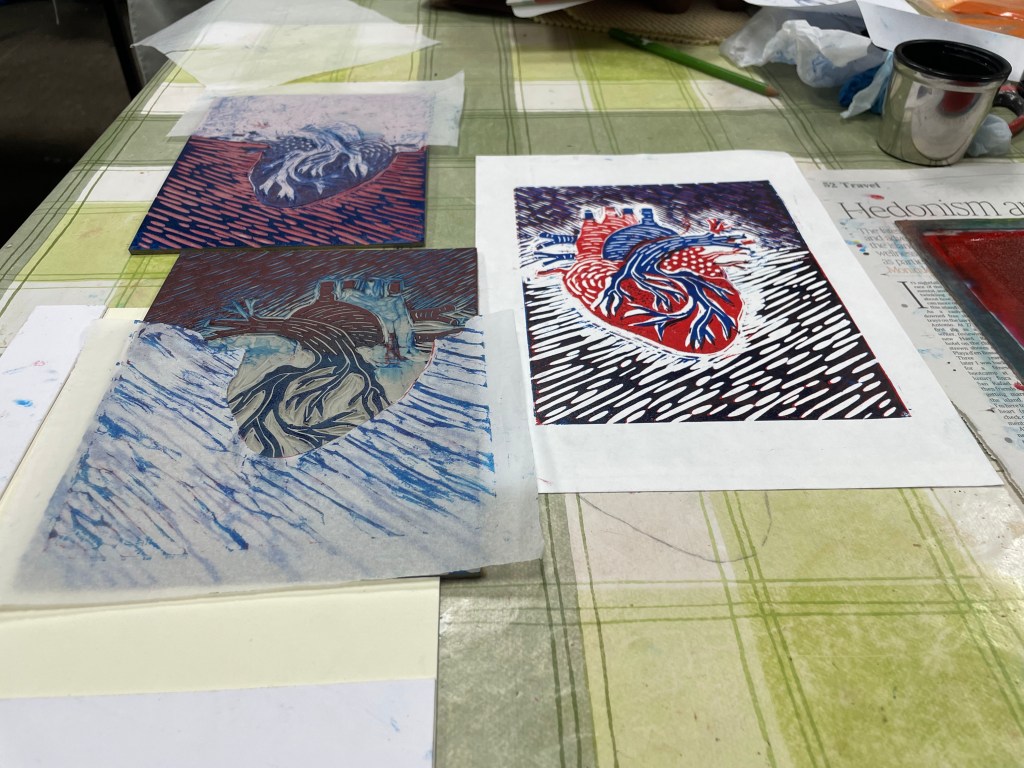
The workshop was on multiple-block linocut, a process in which you use separate blocks of lino to print individual colours, as opposed to reductive linocut where the colours are printed from the same block. I’ve only ever done a basic linocut with a single colour, so the process of working out what areas to cut for each colour meddled with my head a bit. Also, because you use separate blocks you can reprint in different colourways, although there is more room for error in terms of cutting and registration when printing, which can lead to unintended gaps and overlaps which add to the feeling of it being handmade, apparently! Also, as with all linocuts, you can sometimes get marks from ridges of lino which have inadvertently picked up the ink, particularly in large areas which have been cleared out, and this is called “chatter”, which is a lovely term.
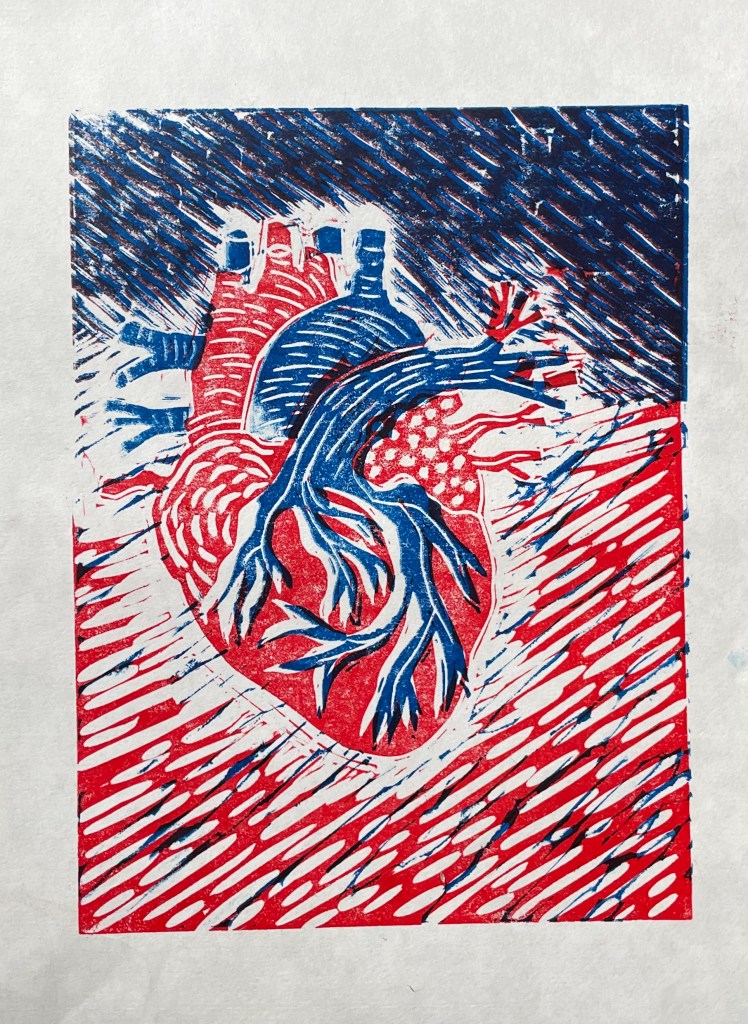
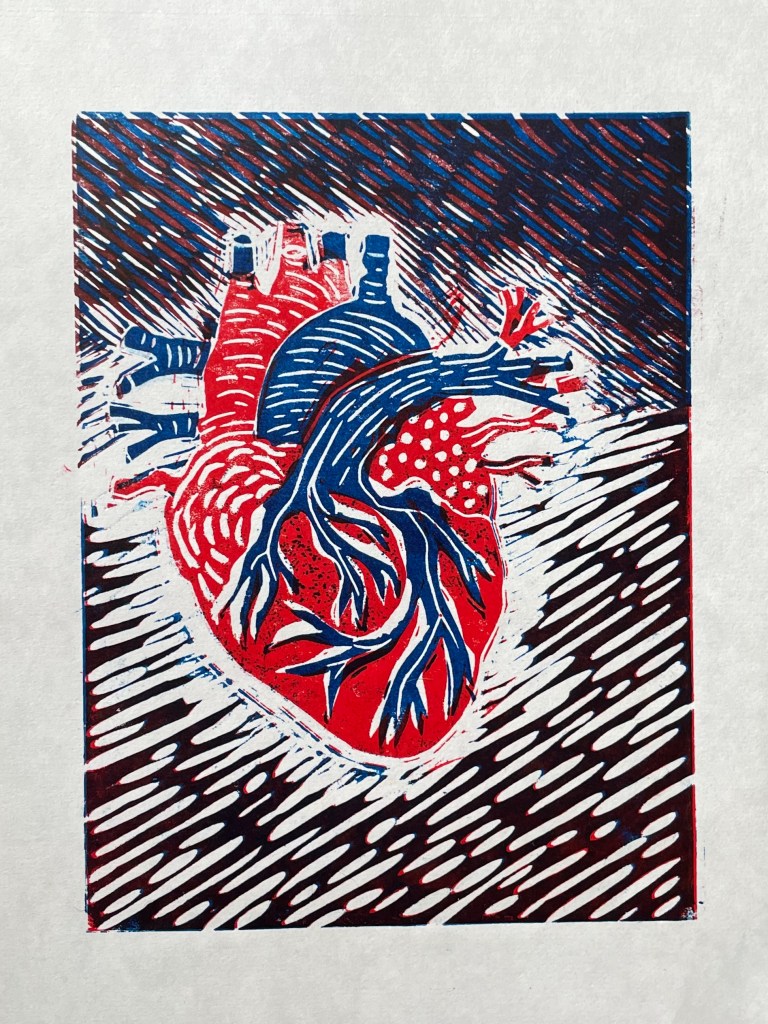
We were limited to two colours, which effectively means that there can be up to four colours in the print: the two chosen colours, their resultant mix, and the white of the paper. I chose red and blue as they were the colours on the diagram.
Well, the prints are a bit rough and ready. I’m not keen on the white area around the heart – originally the background was also red and so I wanted some differentiation between the two, but later on I decided that I preferred the darker background. Having said that, I think it does give the image some dynamism, as if the heart is beating and pulsating.
































 Kate McCalmont-Woods