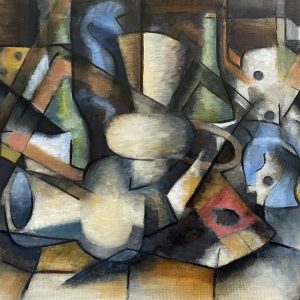
Arachnid

Whenever I go to B&Q, I always want to come home and do some DIY; whenever I visit a beautiful garden, I always want to come home and sort out our garden; whenever I go to an exhibition, I always want to come home and make.

I’ve been feeling in need of a pick me up recently, and so yesterday I headed into London on a hot, Notting Hill Carnival, Bank Holiday Monday to catch Louise Bourgois’ ‘Maman’ on its last day at Tate Modern, the very space for which it was commissioned back in 2000. There’s no doubt that it’s impressive at 9m tall – again, I ask myself whether it’s all about the size, but I think any spider larger than real life would have an impact. I had an overwhelming urge to touch it, but resisted in light of the ‘Please Do Not Touch Sign’. I also found myself wondering how they got it into the building, memories of Johnny Vegas’ struggles coming to mind.

It was well worth the trip, a rare chance to see a piece in the flesh in the very place for which it had been made. Having said that, I’ve seen some images of it in a landscape, which I find particularly effective.

Tate Modern’s website on ‘Maman’:

Louise Bourgeois started making sculptures of spiders in the 1990s. This version is her biggest spider. Its title, Maman, is French for mummy. The artist said spiders reminded her of her mother: ‘Like a spider, my mother was a weaver. My family was in the business of tapestry restoration, and my mother was in charge of the workshop. Like spiders, my mother was very clever … spiders are helpful and protective, just like my mother.

I’m a bit behind with things at home, and we’re starting to amass some really impressive cobwebs. I watched as a flying insect became entangled in one of them; in a flash the spider came from nowhere and quickly got to work wrapping it up.

I’m not sure that spiders are clever as such, but they do have great skill. I don’t really think of them as being helpful and protective: they set traps that you can’t see, they ambush you and then swaddle you up until they consume you. Although, I don’t have a problem with them, as they catch flies etc, as long as they are not where they’re not supposed to be, such as on the bedroom ceiling above my head, or in the bed.

Lifelong arachnaphobe, Primo Levi, in his essay ‘The Fear of Spiders’:

“The spider is the enemy-mother who envelops and encompasses, who wants to make us re-enter the womb from which we have issued, bind us tightly and take us back to the impotency of infancy, subject us again to her power…”

I’ve tried not to be either of those spider mothers. I’ve tried not to be suffocating and I’ve tried to resist the urge to fix things. I’ve definitely failed; I often tell my daughter that I’m trying my best, and, when she’s older, not just to remember the times when I’ve not been at my best, like I seem to have done with my own mother. It’s that negative bias again, I suppose. I’m now actively remembering all the times when she was kind and caring, supportive, and all the laughs we had together, which by far outnumber the not so good.
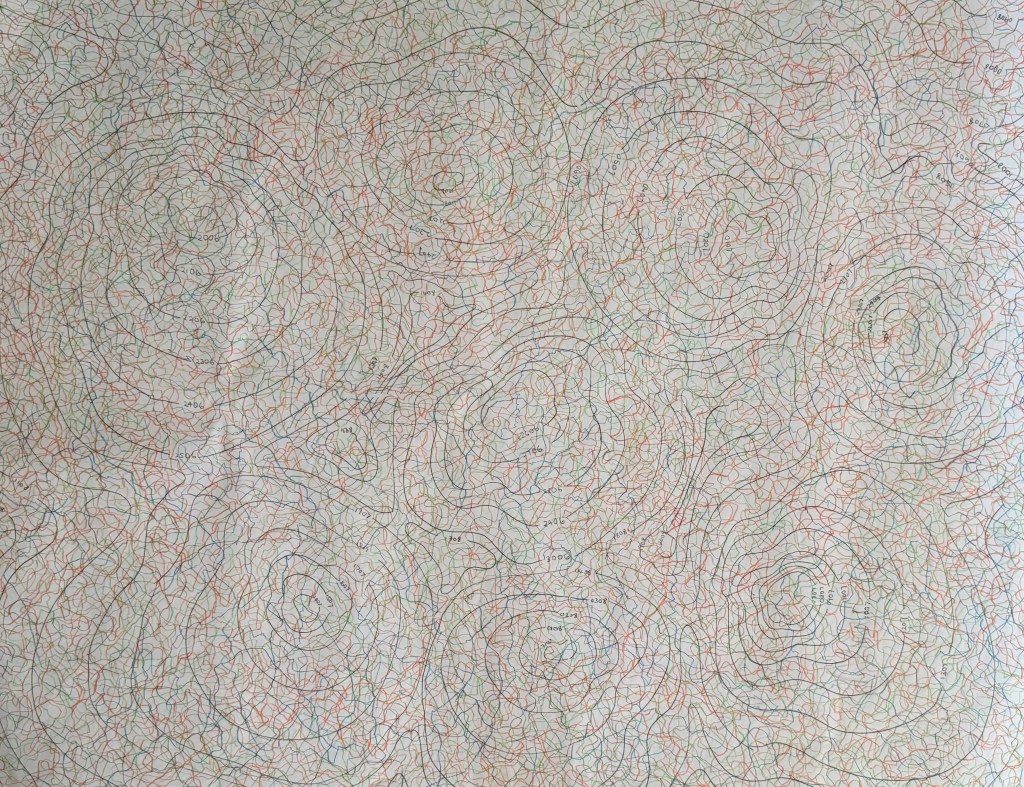
Carbon Dating II

In the words of Vinnie Jones: it’s been emotional.

Over the last 54 days I have been mapping my emotions each day, using orange for positive, green for neutral and blue for negative. At the beginning, I was going to use different shades of each colour but I soon realised that this would over-complicate things. I also realised that I needed to put some rules into place: I started each line from the dated contour line, drew for two minutes, trying to explore as much of the sheet as possible to achieve an even distribution of mark-making, and finished the line off the page. I wanted to make it so that theoretically I can pick any day and trace the line which represents it. I drew each line at the end of the day, and took a photo. Unfortunately, sometimes it wasn’t light enough and so I had to take photos including a number of days’ worth of lines, so instead of having 54 photos, I’ve only got 46 which has resulted in a sudden surge in orange lines towards the end – maybe I was enjoying the positive. They are not the best photos – the lighting is all over the place. Next time I do something like this I will try and make them consistent, although I do quite like the movement it creates.

What have I learnt from this exercise? Had I not done it and you had asked me what the last 2 months have been like for me, I would have said that they have been difficult, and that for the most part I have felt negative emotions such as sadness, grief, stress, frustration and anxiety. However, looking at the end result I can see that this isn’t actually the case; I can see that there are more orange lines than green, which in turn outnumber the blue. This must mean that I feel negative emotions more strongly than positive ones, and this results in my perception of life being somewhat skewed. The map reflects this, in that, whilst they are few in number, the blue lines jump out at me from the rest. I think the technical term is the negativity bias. I don’t think that I would have had the same result had I represented my daily emotions diagrammatically in a chart – it matters that each day is individually represented. Maybe there is another way of doing it – I’m just not a mathematician!

I found the exercise to be a positive one; the act of drawing a line each day not only meant that I was making, but it also allowed me to reflect on the day as I drew – a form of visual journaling. I enjoyed the process of it and whilst it can be said that the resultant map is interesting, what it reveals also became apparent during the process itself; as the map was becoming each time I engaged with it, so I was becoming.

As ever, I’m not sure how I can develop this, if at all. Or maybe, there’s no need. Today was the last day. I think I will miss doing it, so I might just continue.

Out Of The Blue III

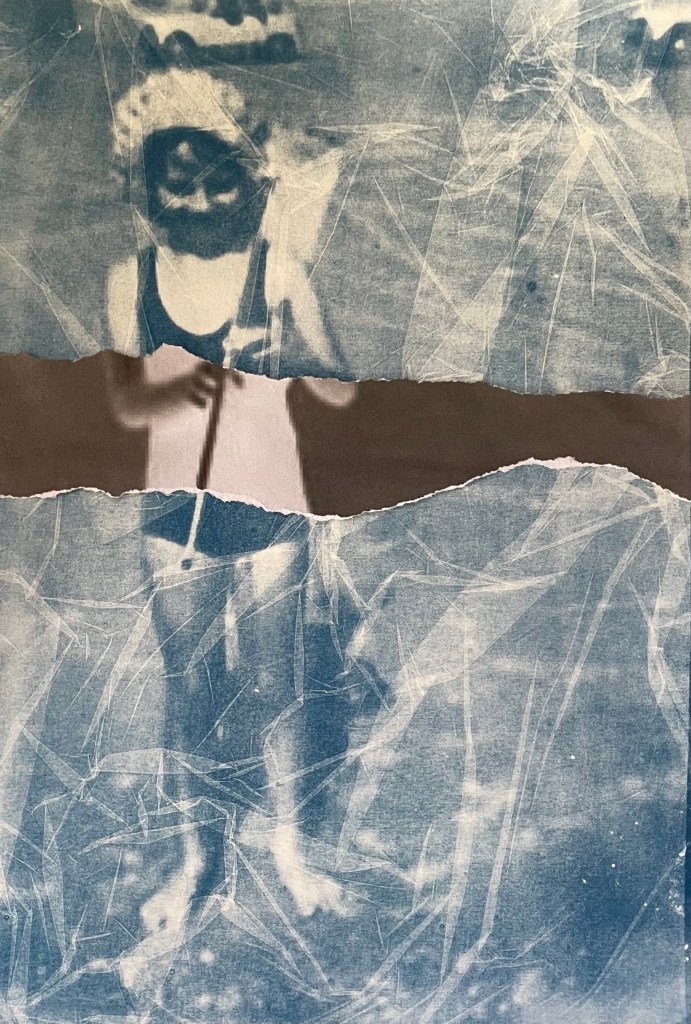
After my disaster trying to do my own, I managed to source some pre-treated fabric and have another go. The result is quite good, but the clingfilm effect suggests that the fabric is creased which irks me somewhere deep inside. Also, I don’t think that I rinsed it thoroughly as some hydrogen peroxide seems to have discoloured the fabric in places. I’m not sure how I might use fabric based cyanotypes yet – I need to think about it, and look for some inspiration.

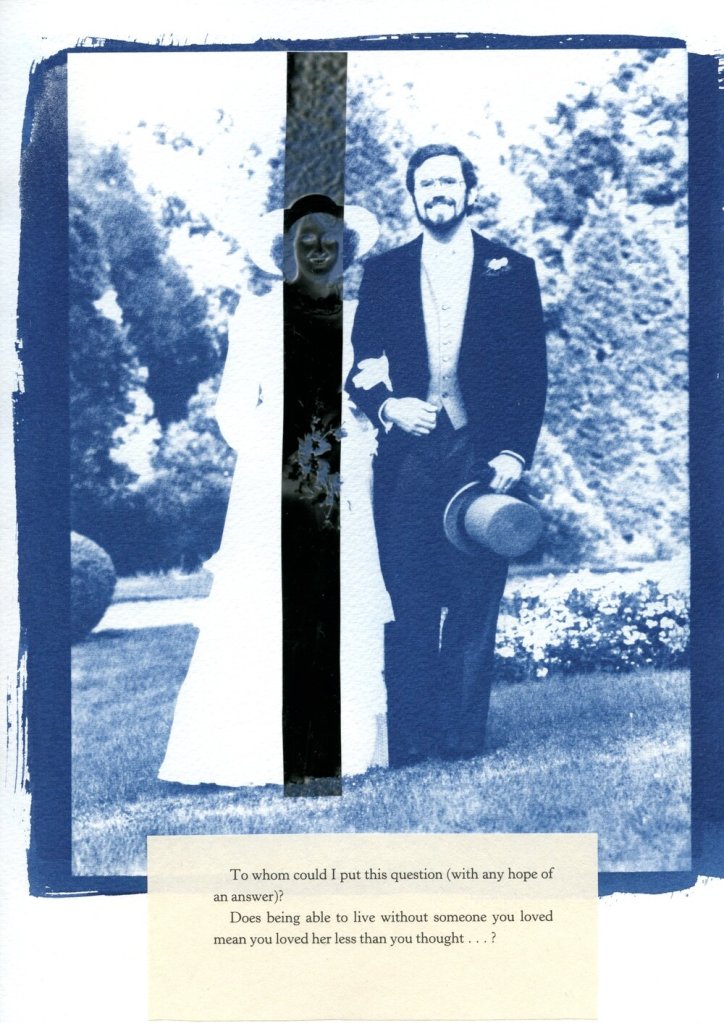
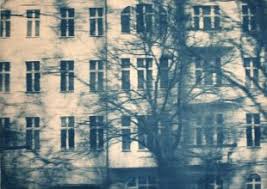
In the meantime, I’ve been experimenting with adding in sections of the negative print. I got this idea from these works by a visual artist and photographer from Luxembourg, Jean Bettingen who is interested in the constructs of identity, memory and self-representation. I also like his use of text to accompany the images. I’m guessing that he has overlaid the transparency over the top of the cyanotype.

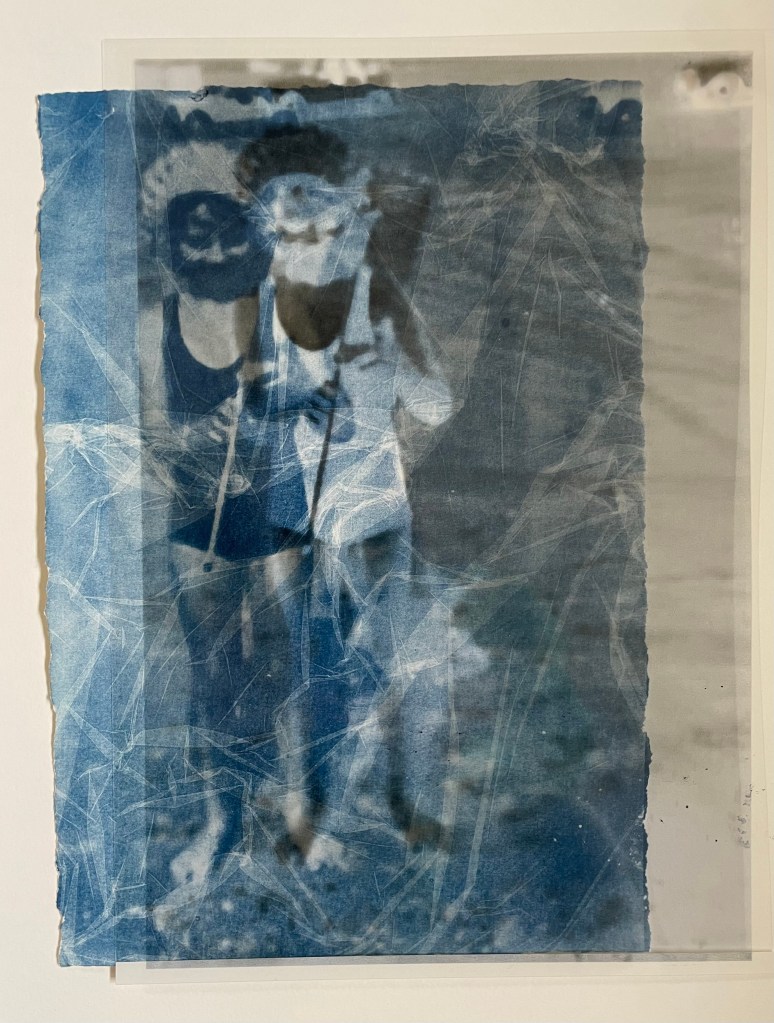
I didn’t want to cut up my negative transparency just yet, so I printed it out and tore off a section. I think that it adds some extra interest, and I particularly like the way in which it’s not obvious which is on top, the cyanotype or the negative. It’s actually the print of the negative which is just lying loose on top of the cyanotype, but it gives a sense of distant space behind it. I tried placing the transparency on top of the print to see what that would look like and I’m intrigued by the effect, so when I’m feeling a little less precious about the transparency I’ll chop it up.

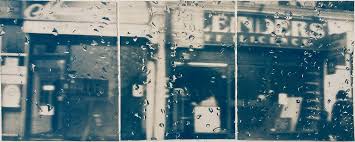
I also came across a German artist called Katja Liebmann, whose work records the energy, isolation and alienation of urban life.

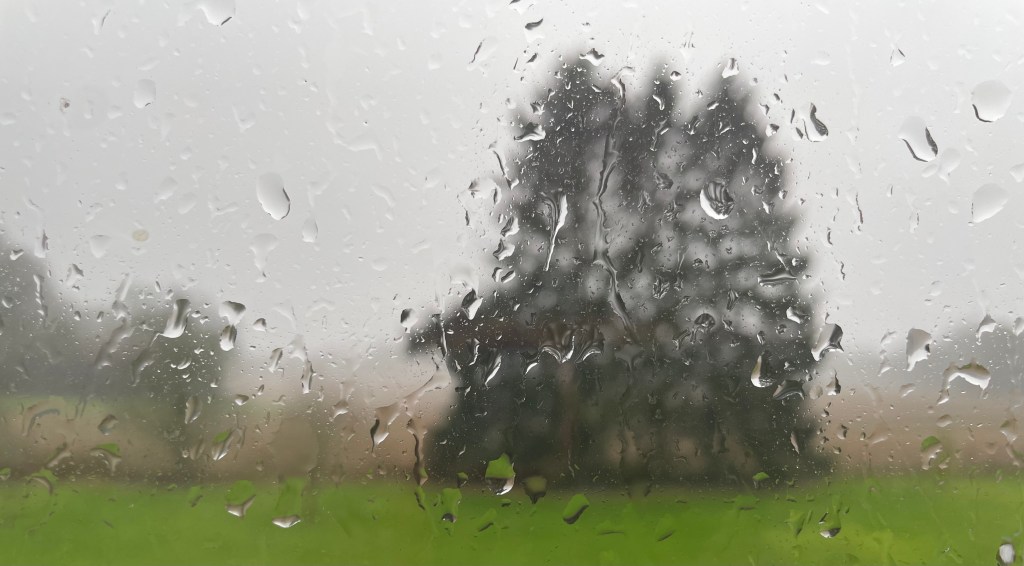
The water droplets on the first image reminded me of a photo I took out of my bedroom window on New Year’s Day this year. I hoped to myself that it wasn’t a taste of things to come.

I really like this image. It’s only A4. I’m going to try and do it as a triptych, like Liebman’s first image.

Changing Places

That wasn’t how the last couple of days were supposed to have gone.

My daughter came home from uni just after our session ended on Tuesday with rapid onset tonsillitis. By Wednesday she was in tears. She is one of the bravest and most stoical people I know, so this unsettled me. It’s heartbreaking watching your child suffer in pain. When I was in pain, my mother used to tell me that, if she could, she would swap places with me. I wish I could say the same, but the truth is my daughter is far better equipped to deal with it than me. When it comes to pain, I don’t mind admitting that I’m a wimp. If there are drugs going that will make me feel better, just pump me full of them – that’s what advances in medical science are for, after all.

I don’t care that I didn’t have a ‘natural’ birth, without pain relief; that she came out of the sunroof. I wasn’t ‘too posh to push’ – she wasn’t going anywhere, and at risk of becoming distressed, and would it have mattered if she hadn’t been, anyway? Is a natural birth somehow superior to one with medical intervention? Why are we told, in that patronising way, that we are not the only woman to have ever given birth? I am the only ‘me’ to have given birth.

Whilst I’m doing my best to keep negativity out of my life, some things do just make me angry. I think it is now generally accepted that women are expected to put up with an unnecessary level of pain when it comes to matters of their health, just because they are women. Studies have shown that women experience pain more intensely, and for more of the time than men. However, they are less likely to have their pain scores recorded, or to be prescribed pain relief than men. Apparently, this is based on the misguided notion that women are more emotional, which means that they may exaggerate the pain they are feeling – after all, ‘hysteria’ comes from the Greek word hystera, which means uterus. Really? There is now a term for this way of thinking: medical misogyny.

It reminds me of a comment made by a male healthcare professional whilst discussing pain relief during the discharge process after an exploratory procedure, which had been initially attempted without sedation. Some women can ‘tolerate’ the ‘discomfort’. I wasn’t putting up with the intense pain. Did I feel like a failure, that I’d somehow let myself and womanhood down; that I should have been able to ‘tolerate’ the ‘discomfort’ like all those women who had gone before? Initially, yes, and it is very intimidating to be in a situation where you are surrounded by healthcare professionals, both men and women, where you feel that you have lost agency over what is being done to your body. Did I look in their eyes for judgement, particularly in the women’s, whilst I dressed, gathered my things and left? Yes. But the word ‘no’ is empowering, and so it was sedation for me. Anyway, getting back on point, I think I made some quip as to knowing what pain feels like, being a woman. He must have interpreted that comment as alluding to a badge of honour as to the amount of pain women can tolerate, as he replied, something along the lines of: “Women can’t have it both ways”.

Anyway, I’ve managed to make it all about me again; that wasn’t how this post was supposed to have gone. After several trips to, and many hours spent in A&E, pain relief, antibiotics, fluids, steroids, and a bit of an exploration up her nose and down her throat with a camera, she’s thankfully on the mend with plans to whip the little troublemakers out in due course.

Reflecting on Resentment I

During the last session we considered the premise that resentment blocks creativity.

Resentment is a feeling of anger or unhappiness about something that you have been forced to accept and you don’t like, or think is unfair. It comes from the Latin verb sentire, and so it is an emotion which is ‘re-sensed’ time after time, perhaps even increasing in intensity. Perhaps we feel resentment that other artists are better than us, or that they have works accepted in exhibitions and we don’t.

As I get older, I try as best I can to keep as much negativity out of my life as possible. I may initially feel it, but then I try to process it by turning it on its head, or actively dealing with it. I can’t feel resentment (in the sense of it being a recurring emotion) that other artists are better than me or are more successful – instead I use the initial negative feeling (which is probably more envy than anything else) to spur me on to try again, to fail again and to fail better, because inherent in that form of resentment is the feeling of failure.

For the last few years I have submitted work to the RA Summer Exhibition but I have never made it to the next round of judging. Each year I experience a moment of crushing disappointment and vow never to do it again, but then January comes around and off I go again. I’m clearly looking for validation, but I often think to myself that if ever I do get in I’ll probably never submit again, and maybe it won’t even make me happy.

My husband confessed to me that he had always wanted to paint. Why don’t you just do it, I asked him. He started with watercolours and over time became good at it. I suggested that he try oils as they are far more forgiving and I thought he might enjoy the freedom of using them. I bought him some as a gift along with some boards and brushes. He signed up to an oil painting class and shortly afterwards submitted one of his oil paintings to the Summer Exhibition. He made it through to the last 4,000 out of 16,000 entries on his first attempt. Did I feel resentment? No – I felt proud, with a strong sense of irony. He felt ecstatic with a strong sense of embarrassment.

If someone treats me badly I tend to think that it is more about them rather than me, but if it is something that I know will eat away at me and become a resentment I try to deal with it head on, unless doing so will cause irreparable harm. But, there is one particular instance of resentment which I haven’t been able to let go of no matter what I do, and I feel it as strongly today as the day I first felt it.