Hand Map

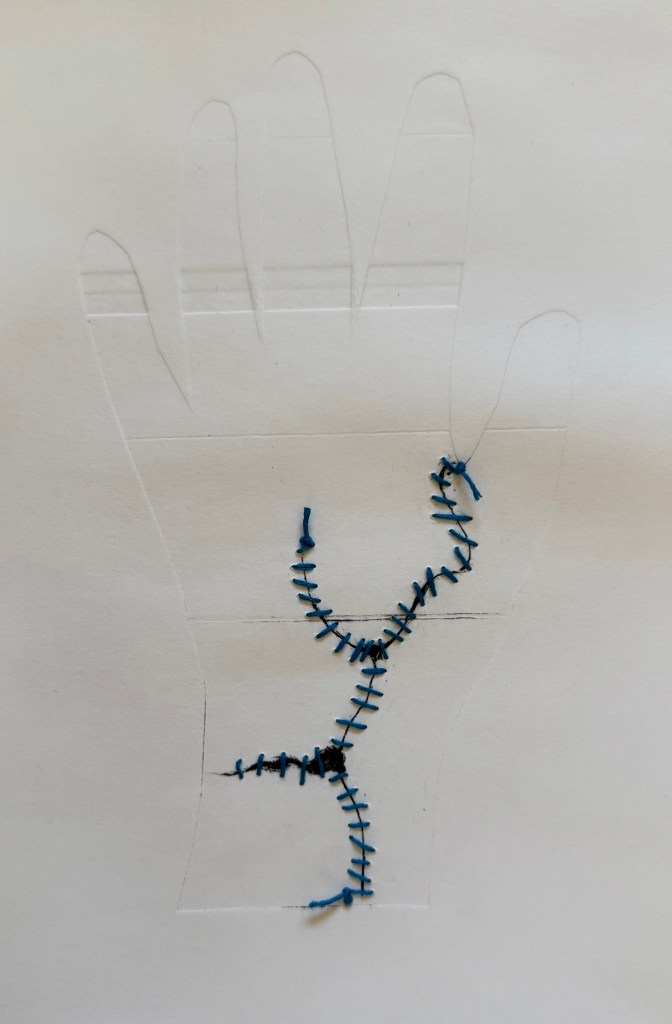
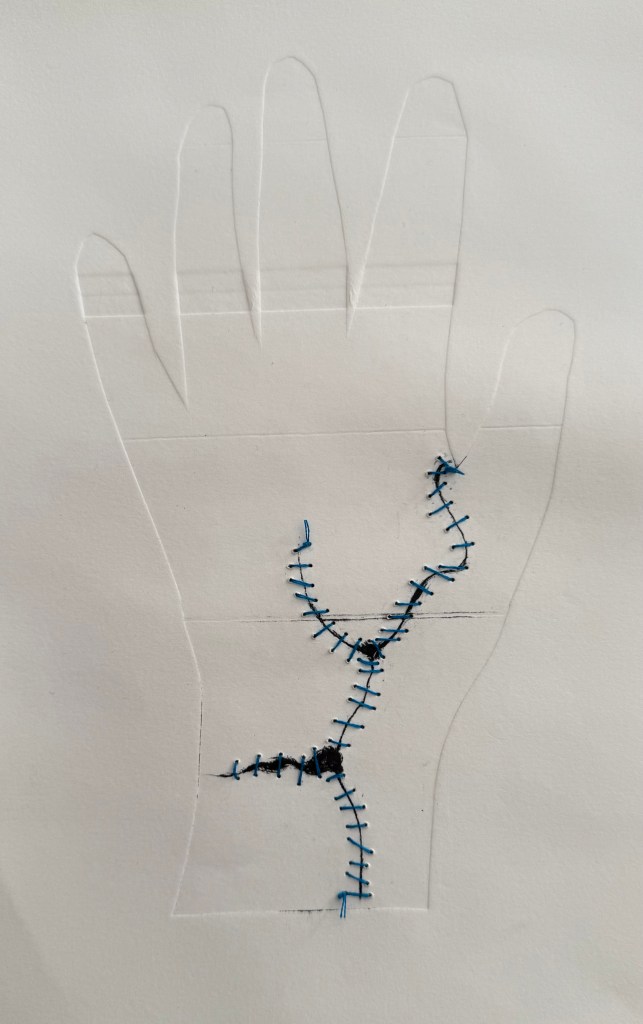
In the accident, a 2 inch piece of glass managed to find its way into my daughter’s thumb via the underside of her wrist (luckily missing her artery) severing the main nerve and two tendons in her dominant right hand. Fortunately, she was taken to Salisbury Hospital, the regional centre for plastics. We make the 2 hour round trip every week for dressing changes and physiotherapy. Every week I take a photograph of her wound, mapping its healing, but also so that she can look at it when we get back home – she can’t look at her hand in the moment. It’s important that she reconnects her brain to her hand otherwise the hand map in her brain will be lost, as will any chance of recovering as much sensation as possible. Whilst some of the physio has been physical exercises to rehabilitate movement in the tendons, the majority of it is brain training: visualisation and mirroring exercises, analysing touch and sensation, using the good hand to teach the injured hand how things feel, teaching the brain the new language with which the hand is trying to communicate.

So, we decided that we would make something. I’ve been meaning to try out some tetrapak printing for a while. The process of incising seemed appropriate. I feel some responsibility – if I hadn’t suggested that she leave earlier, perhaps it wouldn’t have happened. The act of sewing, holding things together, helping things to heal.

I like that the wound is the subject, that the hand is suggested by the embossing. I debated whether to add more detail, more variety of tone but for once went with the less is more option. I used ordinary cotton thread but we decided that the colour wasn’t right so we went for embroidery thread – a brighter blue. As I was sewing I knew that it was too thick, that I should have separated it, but I just kept going. I knew it was wrong; she said it was wrong because now she couldn’t see the wound – I had obliterated the very thing that we were supposed to be embracing. I tried a couple more times until we decided that it was right. By then the holes were quite large but that in itself doesn’t matter – it reinforces the idea that often we have to endure further harm or pain in order to heal.
Changing Places

That wasn’t how the last couple of days were supposed to have gone.

My daughter came home from uni just after our session ended on Tuesday with rapid onset tonsillitis. By Wednesday she was in tears. She is one of the bravest and most stoical people I know, so this unsettled me. It’s heartbreaking watching your child suffer in pain. When I was in pain, my mother used to tell me that, if she could, she would swap places with me. I wish I could say the same, but the truth is my daughter is far better equipped to deal with it than me. When it comes to pain, I don’t mind admitting that I’m a wimp. If there are drugs going that will make me feel better, just pump me full of them – that’s what advances in medical science are for, after all.

I don’t care that I didn’t have a ‘natural’ birth, without pain relief; that she came out of the sunroof. I wasn’t ‘too posh to push’ – she wasn’t going anywhere, and at risk of becoming distressed, and would it have mattered if she hadn’t been, anyway? Is a natural birth somehow superior to one with medical intervention? Why are we told, in that patronising way, that we are not the only woman to have ever given birth? I am the only ‘me’ to have given birth.

Whilst I’m doing my best to keep negativity out of my life, some things do just make me angry. I think it is now generally accepted that women are expected to put up with an unnecessary level of pain when it comes to matters of their health, just because they are women. Studies have shown that women experience pain more intensely, and for more of the time than men. However, they are less likely to have their pain scores recorded, or to be prescribed pain relief than men. Apparently, this is based on the misguided notion that women are more emotional, which means that they may exaggerate the pain they are feeling – after all, ‘hysteria’ comes from the Greek word hystera, which means uterus. Really? There is now a term for this way of thinking: medical misogyny.

It reminds me of a comment made by a male healthcare professional whilst discussing pain relief during the discharge process after an exploratory procedure, which had been initially attempted without sedation. Some women can ‘tolerate’ the ‘discomfort’. I wasn’t putting up with the intense pain. Did I feel like a failure, that I’d somehow let myself and womanhood down; that I should have been able to ‘tolerate’ the ‘discomfort’ like all those women who had gone before? Initially, yes, and it is very intimidating to be in a situation where you are surrounded by healthcare professionals, both men and women, where you feel that you have lost agency over what is being done to your body. Did I look in their eyes for judgement, particularly in the women’s, whilst I dressed, gathered my things and left? Yes. But the word ‘no’ is empowering, and so it was sedation for me. Anyway, getting back on point, I think I made some quip as to knowing what pain feels like, being a woman. He must have interpreted that comment as alluding to a badge of honour as to the amount of pain women can tolerate, as he replied, something along the lines of: “Women can’t have it both ways”.

Anyway, I’ve managed to make it all about me again; that wasn’t how this post was supposed to have gone. After several trips to, and many hours spent in A&E, pain relief, antibiotics, fluids, steroids, and a bit of an exploration up her nose and down her throat with a camera, she’s thankfully on the mend with plans to whip the little troublemakers out in due course.

Three Conversations With My Mother

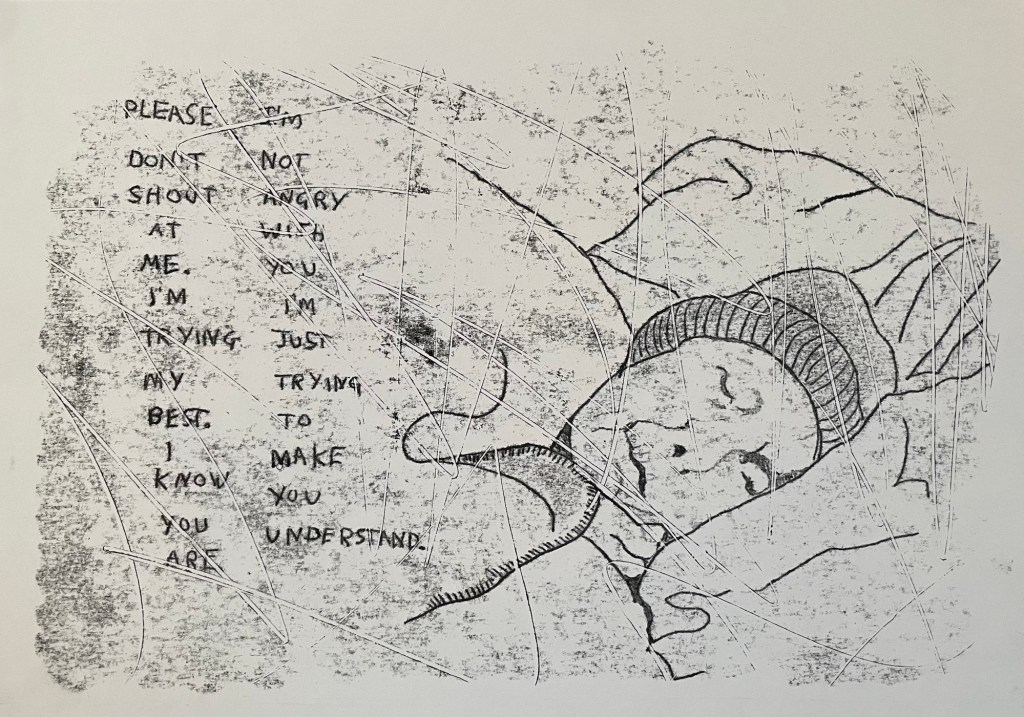
Some were surreal, others were sad. Sometimes she was lucid, sometimes she was delirious, sometimes it was morphine. Three in particular have lodged themselves in my memory. My logical brain tells me that she wasn’t herself, that her brain chemistry was all over the place, trying to cope with the enormity of it all.

It’s just that the last conversation I had with her, was the last.

I suppose I could talk about them to someone, together with the rest of it, but I’m not sure the spoken word will work: the words will come out of my mouth and vibrate through the air to enter someone else’s head. Then they are gone. I need a more substantial, tangible way of dealing with them, through the written word and imagery. I need to be able to confront them, physically.

I’ve had some inner conflict as to whether I should publish the image in which her face is visible; when she was ill and at her most vulnerable. This was a woman who dragged herself through the house, after breaking her leg, in order to phone for my sister to come over and make her look presentable before calling for an ambulance. She was a very private person. But she is no longer here. If it helps me come to terms with it, I think she would be ok with it. My sister’s on board – she reads this blog. She has her own conversations.

Three Conversations With My Mother No 1, Montotype on A4 Cartridge Paper

Three Conversations With My Mother No 2, Monotype on A4 Cartridge Paper

Three Conversations With My Mother No 3, Monotype on A4 Cartridge Paper

I don’t need to reflect on them. I don’t want to reflect on them. Not yet.

Sisters

“A sister is not a friend. Who can explain the urge to take a relationship as primal and complex as a sibling and reduce it to something as replaceable, as banal as a friend? Yet this status is used again and again to connote the highest intimacy. My mother is my best friend. My husband is my best friend. No. True sisterhood, the kind where you grew fingernails in the same womb, were pushed screaming through identical birth canals, is not the same as friendship. You don’t choose each other, and there’s no furtive period of getting to know the other. You’re part of each other, right from the start. Look at an umbilical cord – tough, sinuous, unlovely, yet essential – and compare it to a friendship bracelet of brightly woven thread. That is the difference between a sister and a friend.”

‘Blue Sisters’, by Coco Mellors

I stumbled across this passage whilst I was having a mooch in Waterstones on Saturday. It cuts right to the heart of what it is to be a sibling. I find the imagery particularly strong – the inhabited space of the womb, growth and development, umbilical cord, connection. Lots of food for thought.

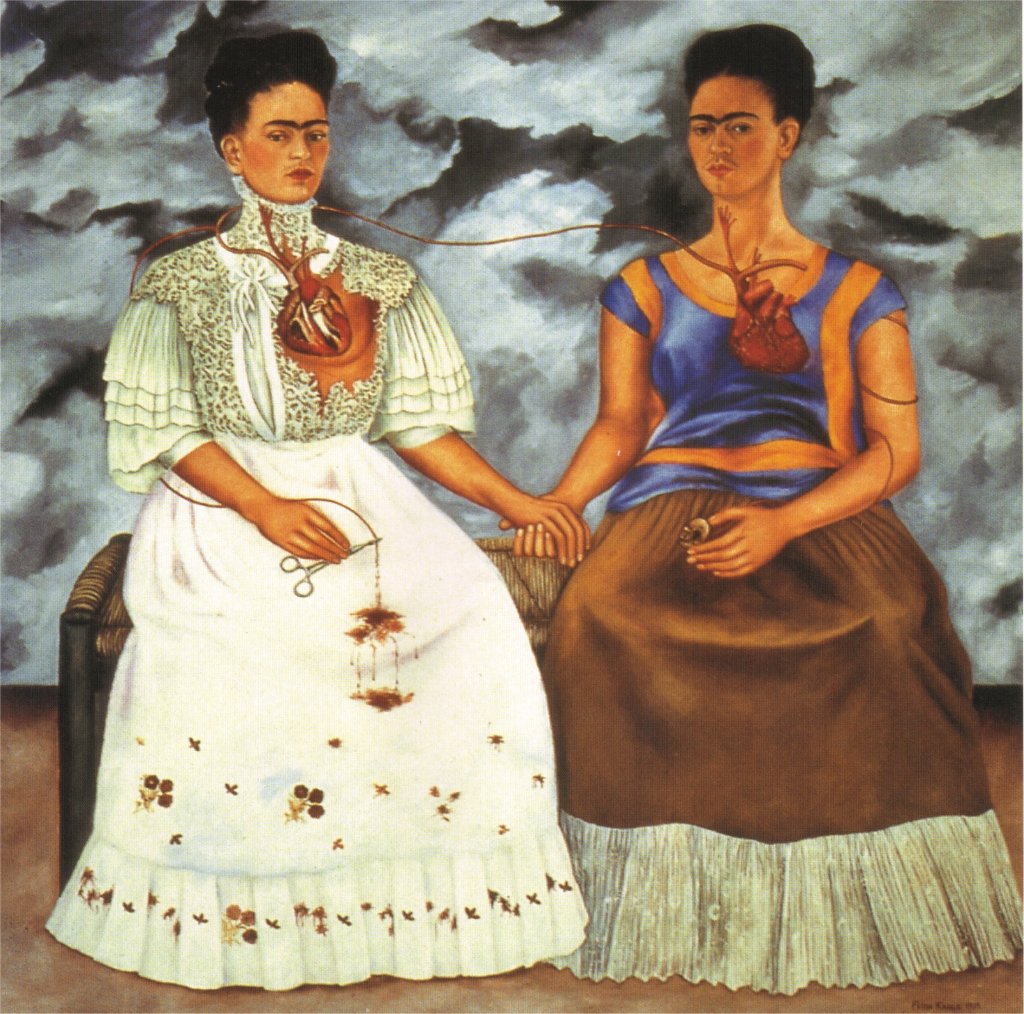
‘The Two Fridas’, Frida Kahlo 1939 (oil on canvas)

On the subject of thinking, this image above has been floating around in the back of my head whilst I’ve been contemplating my role as a sibling, and as a mother, but more on the latter some other time. In this painting, Kahlo’s traditional identity is connected by an artery from her complete heart to the heart of her modern identity which has been torn apart by her divorce from Diego Rivera. I find it a very powerful image: full of pain and conflict, but, at the same time, resilience. It’s already informing some ideas for a piece of work.

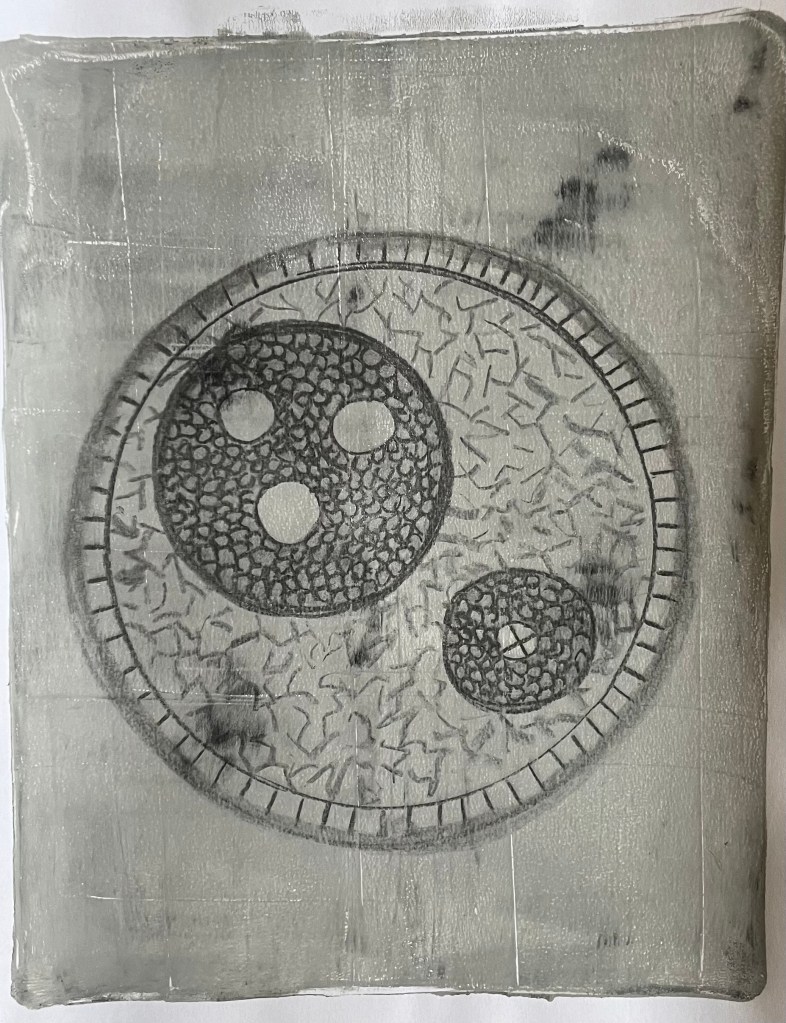
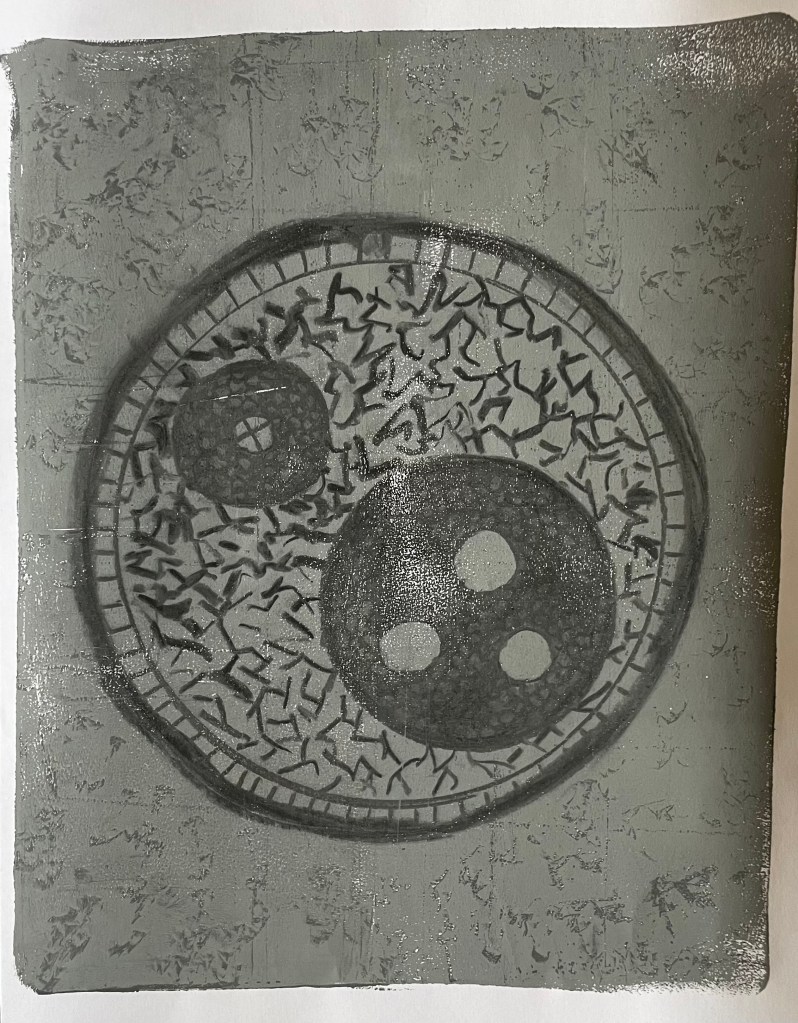
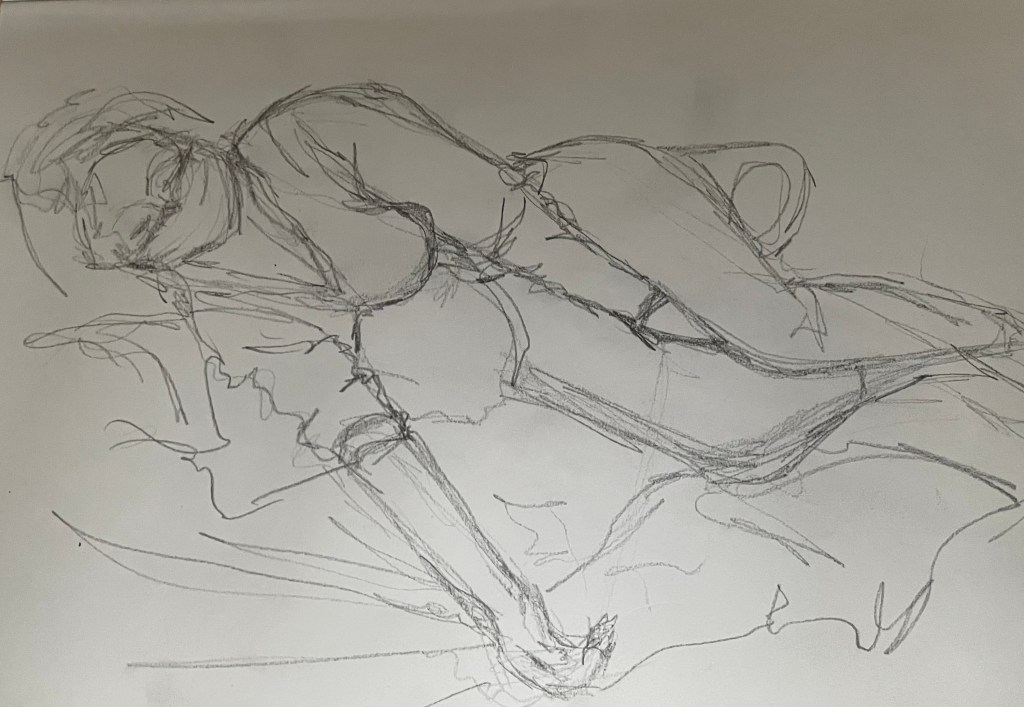
I’ve been experimenting with pressing charcoal drawings onto a gelatine plate and then printing – the archival quality it produces is interesting – and also applying paint onto the plate randomly. It was all done in a bit of a rush as I suddenly thought: less thinking, more doing. I didn’t find the process satisfying: the colours are really unappealing and murky – in fact they are just varying shades of grey. I’ve been meaning to try this process for sometime now, since I saw it on a facebook reel, so I was really quite excited at the outset but I ended up feeling underwhelmed – the subtleties inherent in charcoal are totally lost. Maybe starting with a cross-section of an unlovely umbilical cord inadvertently set the tone, but my quickie self-portrait certainly expresses how I felt!

So, here’s the bad and the ugly…