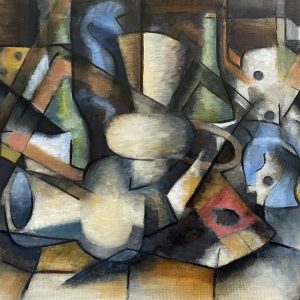
In A Test of Memory I question my paradoxical nature.
Is it an undesirable trait because it displays a lack of consistency and predictability? Does it make me an unknown quantity, fickle, unreliable, or even hypocritical? And specifically, in terms of the art world, how does this relate to the need to establish a defined and consistent style for commercial success and gallery representation, in creating a brand? I asked Perplexity AI what it thought.
In a nutshell, it’s not the paradox which is the issue but being unable to accept it. Embracing paradox is linked with greater creativity, psychological growth and is a realistic way of understanding selfhood in a complex world. It is the basis of dialectical thinking: two truths which seem to conflict but which both accurately describe you or your situation e.g. being independent but needing connection.
According to Kierkegaard, the self is essentially a tension between different poles and the process of becoming is learning to live with the contradiction rather than to abolish it. In fact, problems arise when the paradox turns into a chronic self-contradiction that seems unresolvable, which is often tied to perfectionism or all-or-nothing thinking. It creates a state of ambivalence. As long as I genuinely value and am honest about my paradoxical nature, then I am not a hypocrite or lacking in integrity. I need to accept both parts of myself and embrace the tension the paradox creates; to ‘develop the container large enough to hold it’.
In terms of the art world, whilst a paradoxical nature is an asset for making art, it is not for selling it. It does not fulfil the desire for consistency, recognition and stability. So, what is the answer?
- Distinguish between practice (paradox) and brand (the curated external interface). Curate consistently eg strategise the release of work; lead with one voice whilst nurturing the other.
- Be like Gerhard Richter, developing separate and opposing lines of enquiry which never merge – be distinctly one thing, then the other, do not mix them and become a muddy average.
- Have a consistent conceptual narrative – make the paradox the subject matter itself
- The Trojan Horse is an extension of the first bullet point: pick a lane and develop it and once you have a foothold introduce the other, pivoting under the guise of evolution.
- Most importantly, don’t suppress the shadow side, and keep feeding it.
That all makes sense. So, how do I feel about it all now? A bit better, I think…
 Kate McCalmont-Woods