Forget-me-nots

It’s a long time since I last had a pet, and this may not be anything new, but there’s a business out there, maybe more than one, which is supplying veterinary surgeries with packets of forget-me-not seeds to send to customers whose pets have died. Since Monty died we’ve received cards of condolence from our regular vets and the specialist practice, both enclosing identical packets of seeds.
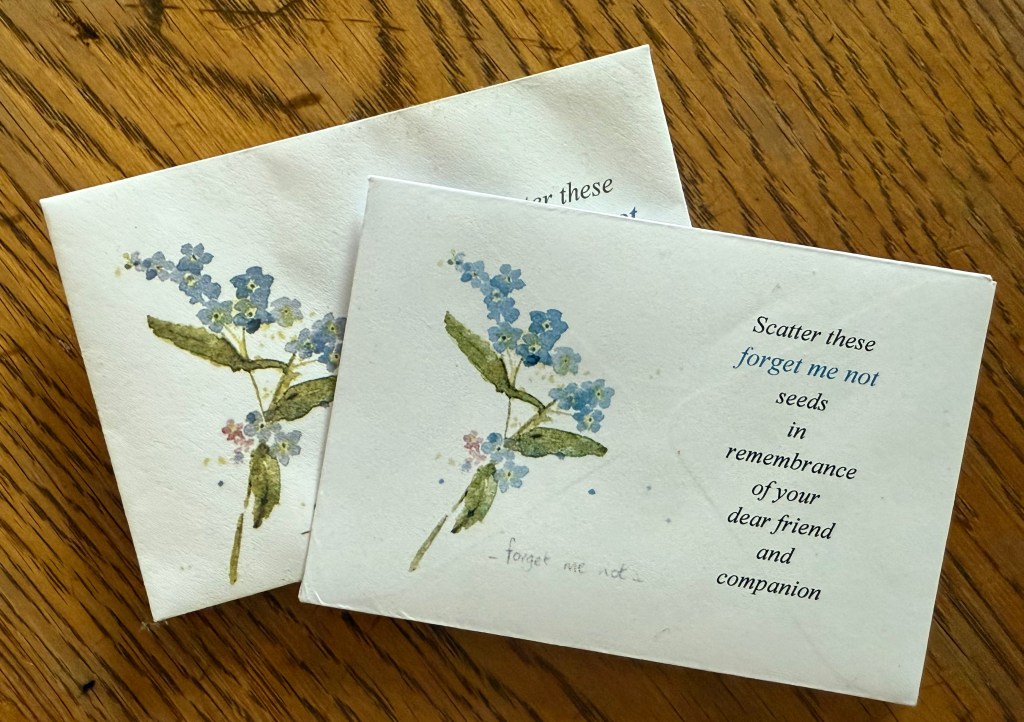
I will sow the seeds and hopefully next year green shoots will emerge from the earth, but with my gardening skills, I don’t hold out much hope.

I appreciate the thought, if it was indeed a thought, and not just a gesture generated automatically by an impersonal process. The cards contained messages from staff I didn’t even know were involved in Monty’s care; general messages of sympathy for our loss, except for one, which stood out because it described him as having been such a character. No sooner had Monty’s heart stopped beating than the vet’s hand was on my shoulder, followed by “I’m sorry for your loss”. Similarly, from the veterinary nurse who had assisted, with an added hug, whose eyes failed to show any sign of recognition a couple of days later when I went into the surgery to speak to her about our other dog.

I’ve decided that I don’t like the phrase; it’s trite and it doesn’t make the pain any easier to bear. In fact, I don’t think that I’m a fan of euphemisms generally, particularly, the idea of passing or passing away. Where to? My father died, my mother died, my dog died. That’s it. They didn’t go anywhere, I didn’t lose them, and there’s no chance of finding them again, and reuniting.

That’s not to say that I don’t believe in something else. Maybe I believe in the law of the conservation of energy: it can neither be created nor destroyed.

Now, where are those forget-me-nots?
Bus Replacement Service

I was planning on going into London yesterday to catch Donald Rodney: Visceral Canker at Whitechapel Gallery (as well as revisit the Cardiff audio walk), and Linder: Danger Came Smiling at the Hayward, before they close in the next day or two. But what I forgot was that it was a Sunday on a Bank Holiday weekend, a perfect time for railway engineering works. A bus replacement service would almost double my usual journey time, and so I decided to stay at home. Instead, I had a look on Whitechapel Gallery website, to see what I had missed. There is an interesting piece on Rodney by Caleb Azumah Nelson, particularly on their relationships with their fathers.

Rodney had, and ultimately died at the age of 37 from a complication of, sickle cell anemia. He was in the midst of a sickle cell crisis when his father died and he was unable to attend his Nine Night.

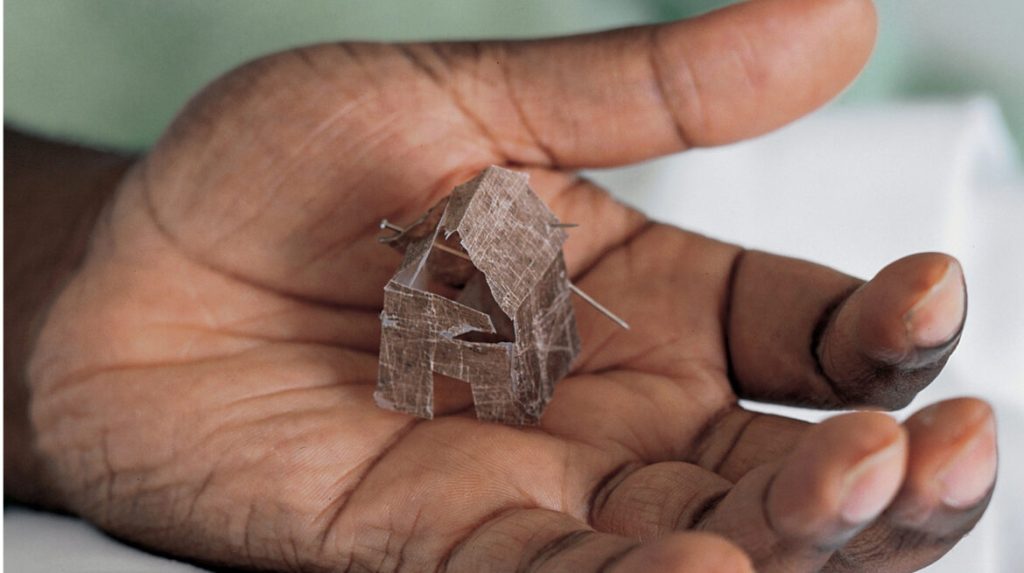
In the House of My Father 1977, photograph (Image Source: http://www.whitechapelgallery.org accessed 5/5/25)

Made from his own skin, the house is held together with small dressmaking pins.

This is the first piece of work by Rodney which Nelson encountered, purely by accident:

’The strength, not in the structure, but in the vulnerability of exposure, his open palm an invitation into his heart, his family. With this gesture, Rodney suggests, this is who I am, this is who I might be.

How does the self come to be? And how do we make space to be our whole selves? … a condition he would have inherited from his father, who would’ve inherited it from his father before that. Their selves, our selves, folding into one another: we contain multitudes. And what else do we inherit? And how do we carry around these inheritances, how do we make space for them in our lives?…’

At the time he was reflecting on his own relationship with his father:

’… wrangling with the things he cannot say to me, or doesn’t have the language for, the many rooms in the house to which I do not have the key…’

He finishes his piece with:

I believe Art gives us a space to be honest, to confront, to dismantle, to reassemble. To imagine. Visiting and revisiting Rodney’s work reminds me that other worlds are possible. It reminds me, that even in the face of continued crisis, it is necessary to dream. It reminds me that , even in the face of death, we must continue to inhabit many rooms, to hold space where we can be honest, where we can be our whole selves. Where we can feel alive.’

So many thoughts have come to mind:

  • The idea of inheritance and how we find a space for it in our everyday lives. To me this feels like a burden not just in the physical sense of belongings, and ‘stuff’, but to the extent that I might feel defined by it: I don’t want to be, I want to be my own person steering my own course independently of what has gone on before, but I can’t ignore the extent to which others have shaped me. Last weekend, I lost count of the number of times friends commented how my daughter is a mini-me or the spitting image. No, she’s not. She’s her own person, living her own life. But, inevitably, I will have had an input into who she is, even if it’s just a matter of genetics.
  • I have inherited my family history from my parents. I used to spend ages looking through the family photo albums talking to my mother about the contents. I feel an enormous responsibility to pass this knowledge on. It’s a burden. My daughter is not particularly interested. Maybe it’s an age thing – as we age we need a greater understanding of who we are? Or maybe it’s a digital thing, we don’t have a physical record of our lives lying around the house to prompt an inquiry and so the questions never get asked. Sometimes I think that I should write it all down in case she’s ever interested, and other times I think that I’ll take it all with me and free her from the burden.
  • I think that I’ve been dismantling myself over the last few months. I’m not entirely sure that I’ll be able to reassemble myself, but maybe a few left over bits here and there wouldn’t be such a bad thing. I could even write my own instruction manual.
  • The child/ parent relationship: I remember the moment when I realised that my parents didn’t know or have the answer to everything; that they were human. It really stopped me in my tracks.
  • The idea of the house with many rooms; our ancestors folding into one another; the self containing multitudes.

Parental Loss I

There’s a passage that I find really moving. It comes from Deborah Levy’s The Cost of Living which I selected as an inspirational text (see The Cost Of Living). In it she describes how she felt after her mother died and, in particular, her reaction after coming across a postcard her mother had sent her.

My mother had made a biro’d X on the front of the postcard and written’ X is where I am’… It is this X that touches me most now, her hand holding the biro, pressing it into the postcard, marking where she is so that I can find her.”

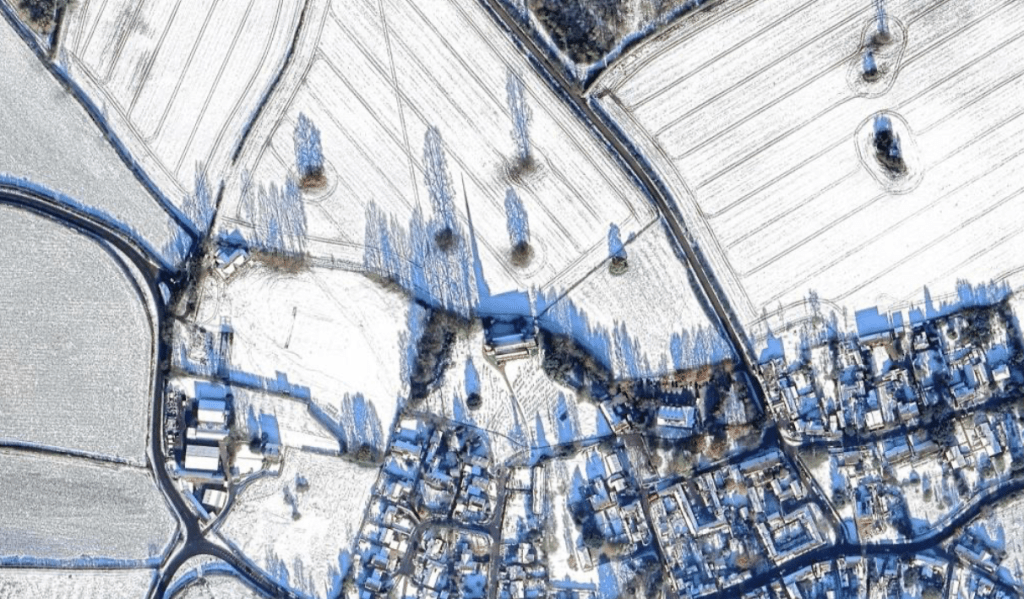
In response, I had an urge to do something similar. I’ve had an image in my head for some time. I looked at the satellite image of the village where my mother grew up, of the church where my parents were married, and of the churchyard where they now rest, together with my grandparents, aunt and uncle, and other distant relations. The image was taken on a sunny day with snow on the ground, and I love the shadows which are cast by the trees and the buildings, in particular, the church; the shadow of the spire revealing a building, which is otherwise indistinct from the air, as being a church.

Luckily, after a bit of research I managed to work out how to remove the road and building labels.

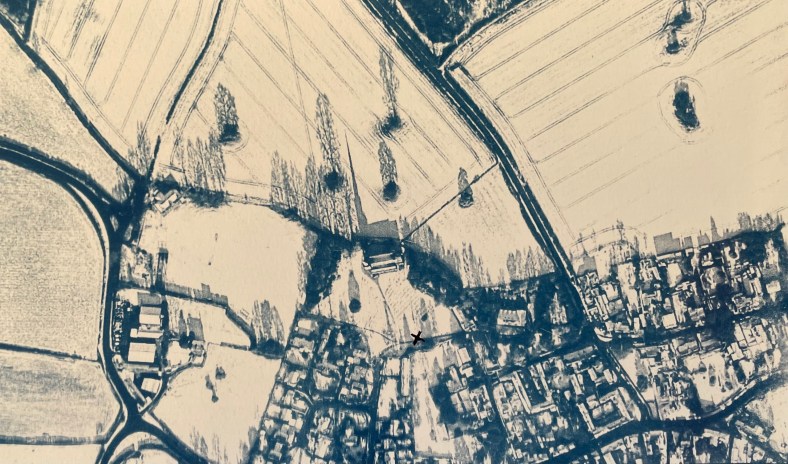
So, I made a cyanotype. It’s only A4 in size. I’m thinking about making it larger, say, A3. I don’t think that I can make the image any sharper, but I don’t think that really matters – it’s not about the detail of the buildings; it’s about the shadows revealing the nature of the buildings, about the sense of place and about the topography; the tramlines in the fields, the clusters of trees in the middle of fields and the pattern of the roads I walked down as a child. I love the patchwork nature of the countryside. I know that I’m coming home when I see it from a plane.

I’ve put in an ‘x’ but black ink doesn’t really work. I might try red, or maybe replace the ‘x’ with a location pin instead which might contrast well with the historical feel of the cyanotype.

There’s not been much experimenting. I think it’s because I’ve known what I wanted to do for a while and it was a clearly formed idea. It’s been an easy process and a cathartic one, but it does make me feel sad. My parents were my anchor to the past and without them I feel adrift from where I came from, and from a substantial part of my history.

Where Do You Come From?

It’s a question that I find quite difficult to answer. It always makes me sigh; inwardly, if not outwardly. Nowhere, is an answer I sometimes give: it’s a short version, but demands an explanation.

I don’t really ‘come’ from anywhere.

My father was a soldier in the British Army. I was born in Germany, as were my siblings. Apart from a couple of short stints in England, a year in Omagh, Northern Ireland, and two years near Kowloon, Hong Kong, I spent most of my formative years in various locations in Germany.

It was a peripatetic life, the only constant being trips back to visit my grandmothers in the UK, both of whom lived near Derby in the Midlands. At the time, it was exciting regularly packing up our belongings in big army crates and stencilling the details of our next destination on the outside. Even more exciting was the unpacking at the other end, waiting for the crate with our favourite toys to be opened.

When my father retired from the army, we settled in Essex, for no other reason than that is where he got a job. I went to a local secondary school and then went off to university in Leeds, followed by law school in Chester. Then it was London until I moved to Hampshire twelve years ago. I don’t intend to stay here forever.

So, if I don’t come from anywhere, where do I belong? I can’t think of any geographical location to which I feel any sense of belonging. Maybe the answer lies in where I would like to be buried, but I still can’t think of anywhere. The ashes of both of my parents are buried at the church where they were married, in the village where my mother grew up, where most of her relatives are buried. If I die now I’m likely to end up in Basingstoke Cemetry at the intersection between the A303 and the M3 – just think of the noise!

I think the only sense of belonging I have is to my family.

My husband, on the other hand, is very clear as to where he comes from: Liverpool. He’s not lived there since his early twenties, but that matters not a jot. Personally, I don’t think I have come across a geographical location that instils in the people who come from it such a strong sense of place, belonging and identity. And it’s not just about the Beatles and football, although my husband would quote Shankly and say that Liverpool has the two best football teams in the world: Liverpool FC and Liverpool FC Reserves. It is something more than that, and I can’t quite put my finger on it.

I’m in two minds whether I’m incredibly envious of my husband, or whether I like not belonging anywhere – there’s a feeling that you could leave everything at the drop of a hat and move on. There is also something quite appealing about the idea of starting afresh, and leaving behind old baggage – a metamorphosis.

This train of thought was triggered by going through old family photos. Before he died, my father had started reorganising the family albums. Half of the photos are in brown envelopes. I’m attempting to bring some order to them, and to digitize them. It’s a long, slow process, picking through a family’s history; my history.

Parents

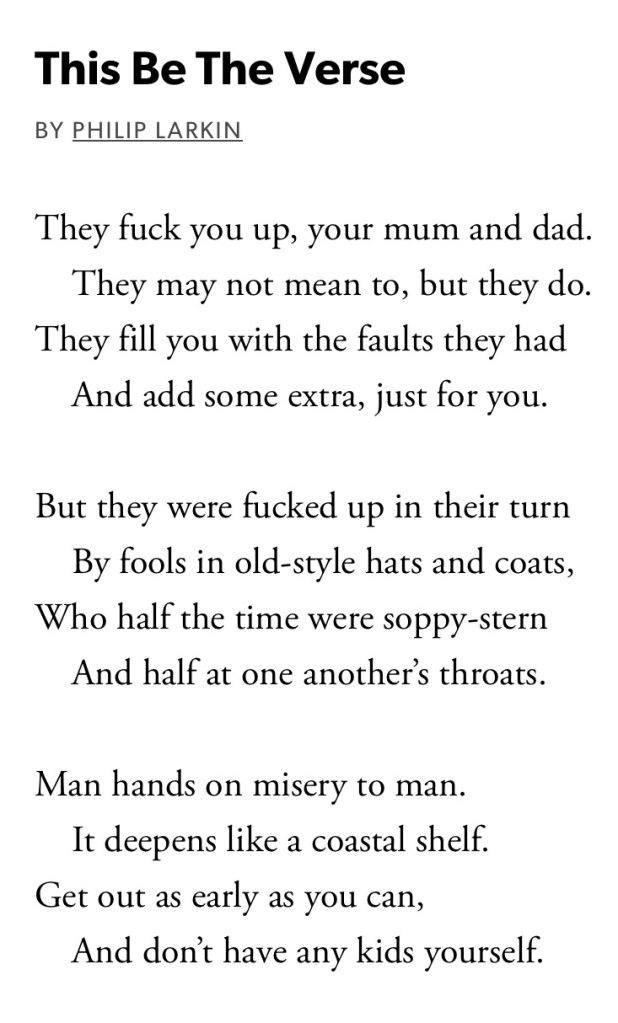
I’ve just been catching up with what my fellow students have been up to by doing my regular blog read. My husband read me this poem last night – it seems particularly relevant in the light of the several references to trauma and Louise Bourgeois.