A Moment

So, we’ve received our feedback and grade for Unit 2.

The feedback, the most important bit, is incredibly helpful, and has lots of questions for me to continue to think about. Once I’ve finished ruminating, I will discuss it in more detail. In general terms it mirrored my feelings that I have made significant progress over the past few months. I think this was the reason why I felt the way I did when I saw that I had been given the same grade as for Unit 1. I felt disappointed. I told myself that the grade itself doesn’t matter; what matters is the process, not the result. I should be happy with the knowledge that I have made progress, and developed within the process. That is, after all, my mantra: I choose the process, not the result.

So why is there still a part of me that cares about the grade? I spent quite a while talking to myself, trying to resolve it, and in the end the answer I reached is this: whilst I am all about the process, it does not mean that the result does not matter at all, it is just that I care more about the process.

Since Ambivalence, I have reflected further, and I think that it is either a case of wanting the product to reflect the process (which I didn’t think the grade did), or that there will always be a part of me that is invested in the product; I just need to learn to live with it and allow it to be heard, but not to dominate as it has done in the past.

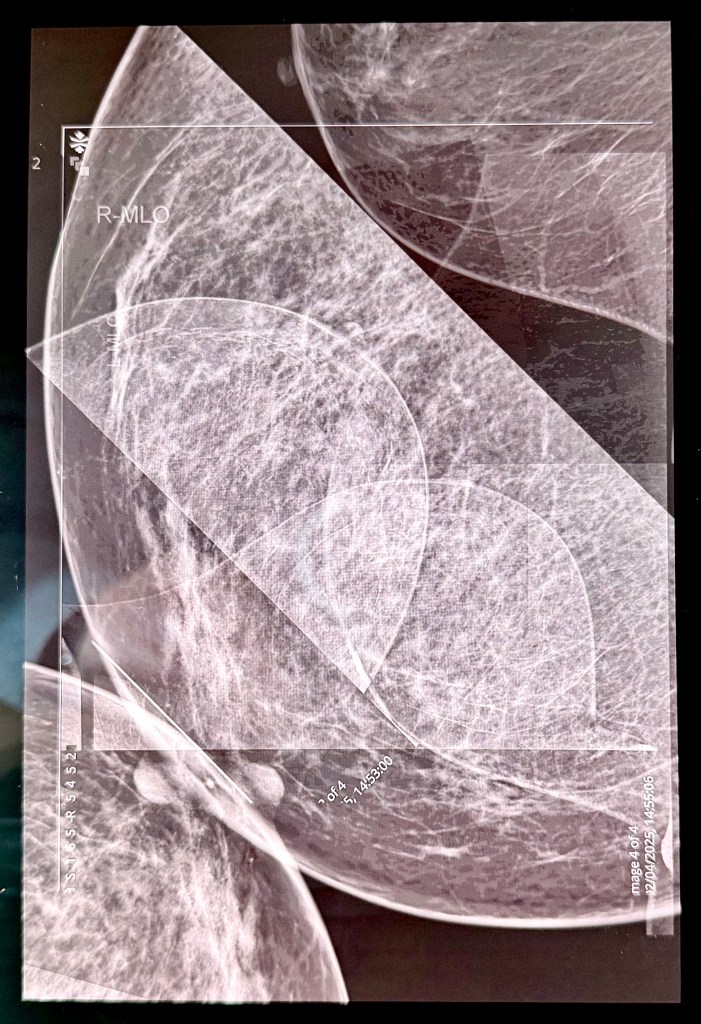
And so, I listened to it, and asked what else I could have done. A typo. All’s well that ends well.

Edition

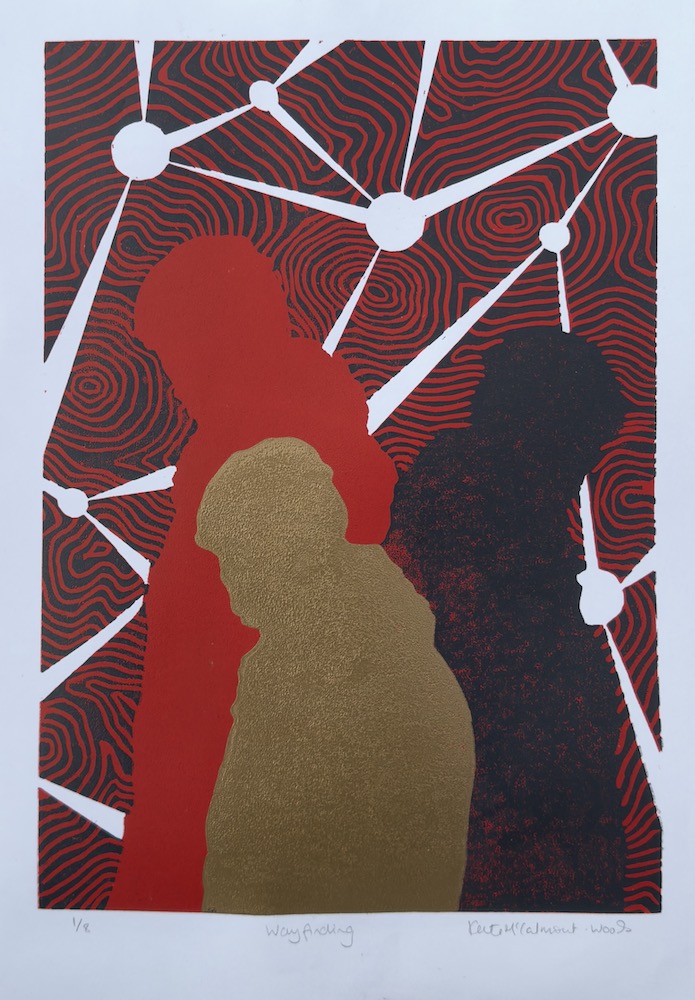
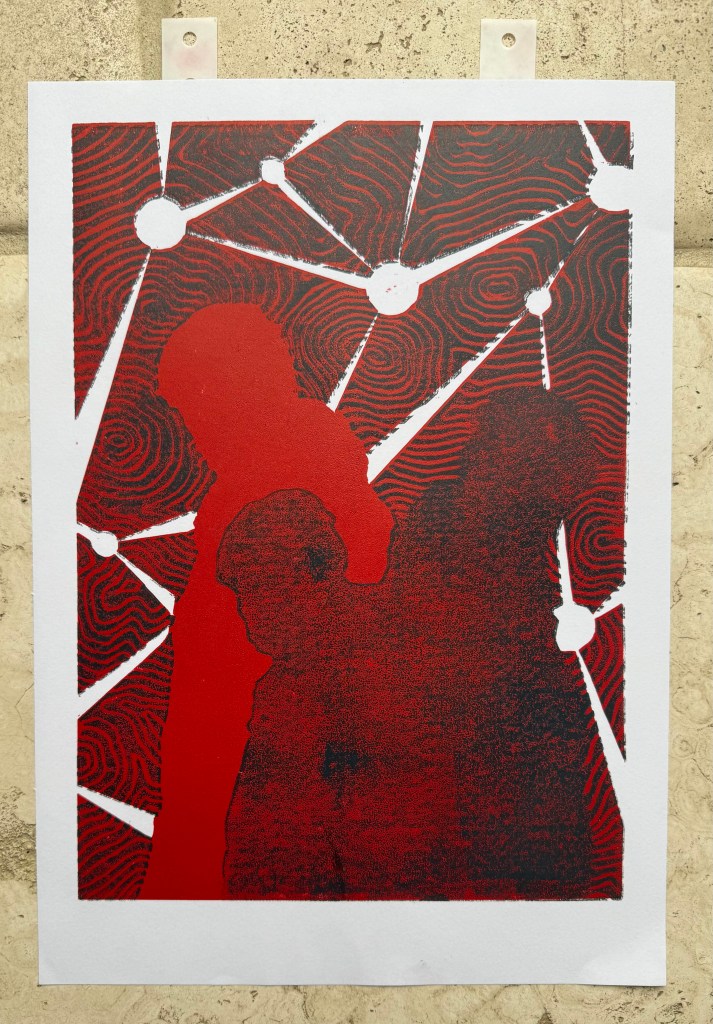
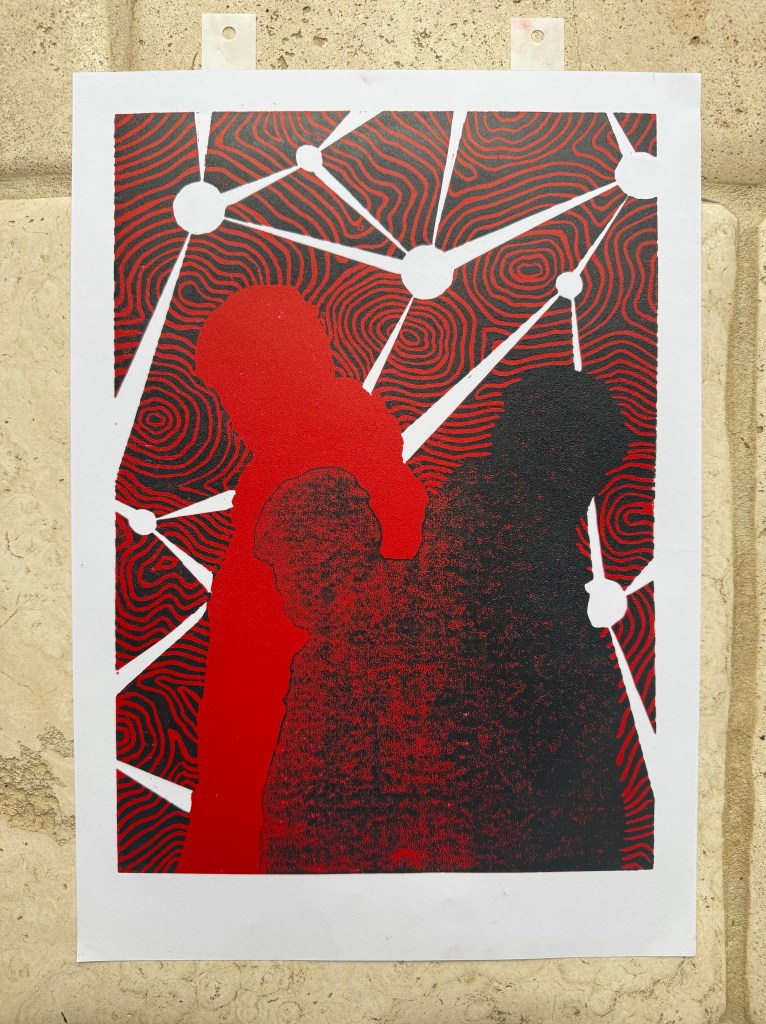
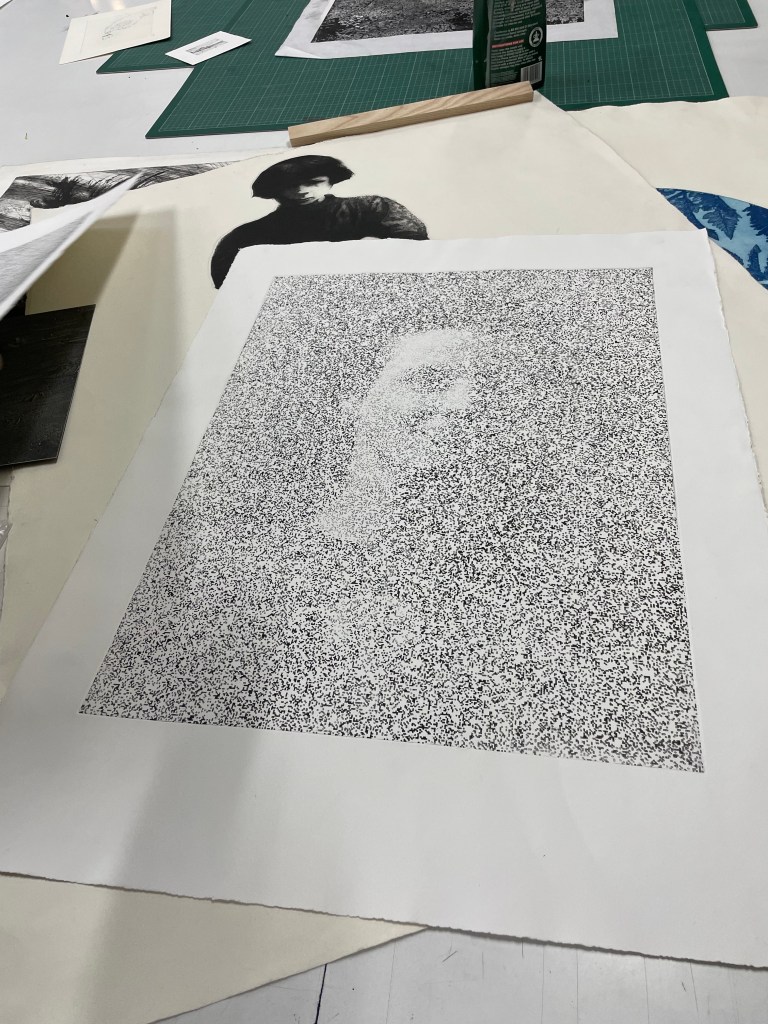
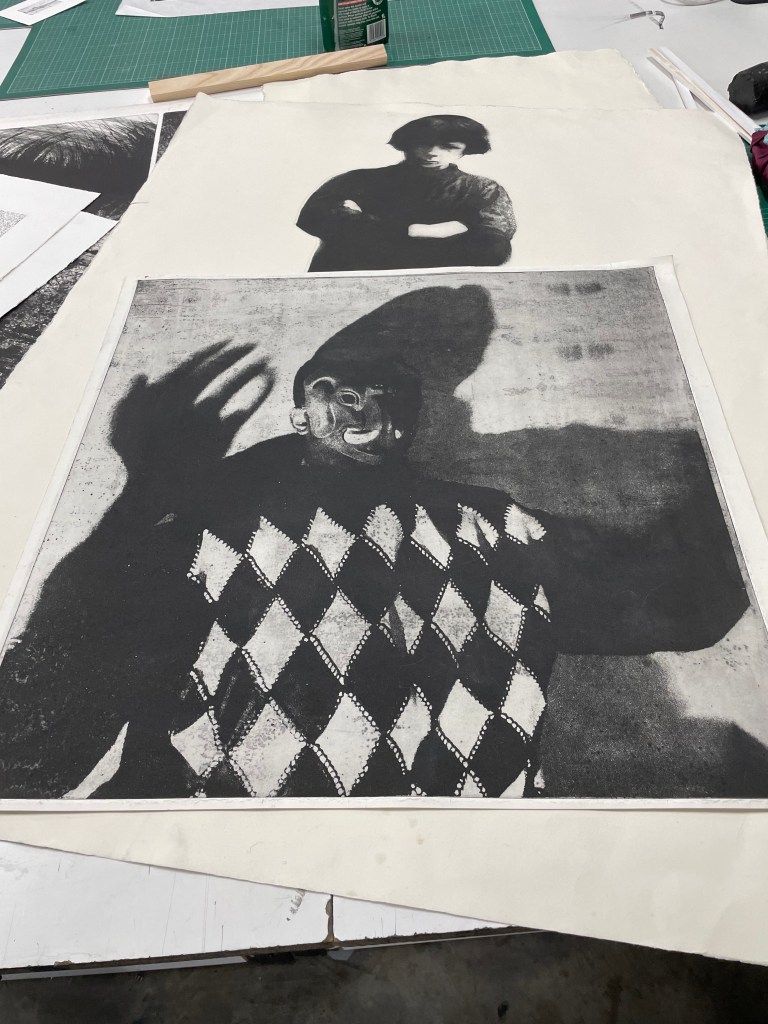
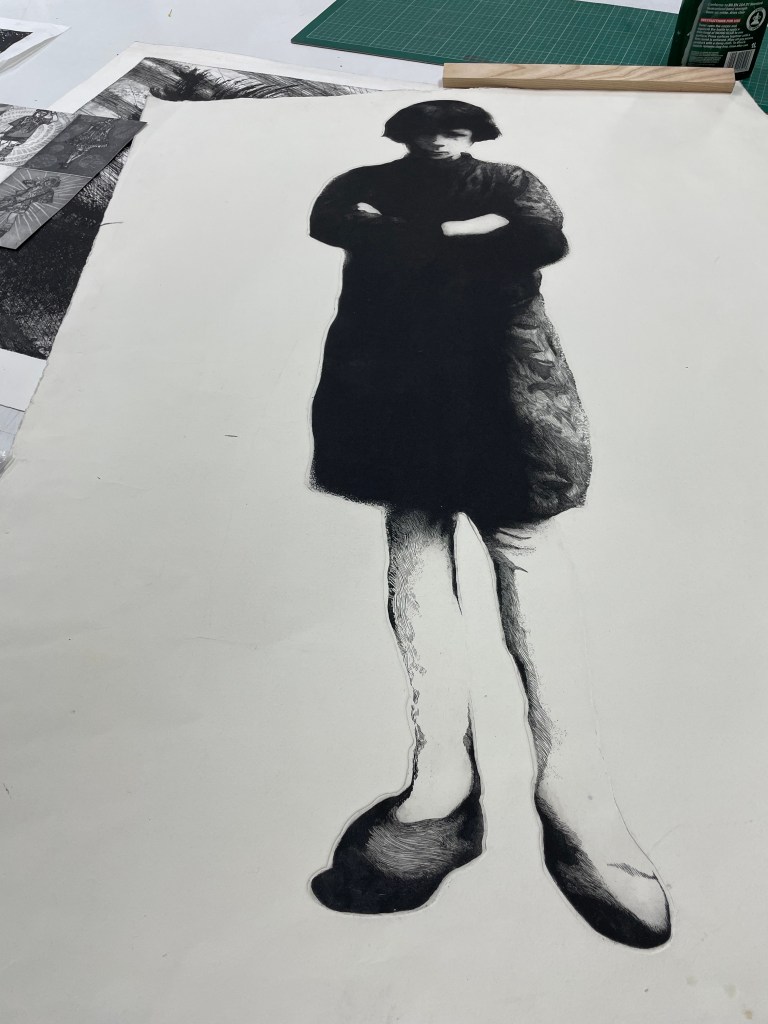
I thought about what size to do the print. If anyone buys it, I would like them to be able to frame it at home with a shop bought frame. So I needed to leave enough of a border so that it could go into an A3 frame without a mount, but not too much so that there is a lot of white space if they choose an A2 frame with an A3 mount. I decided to leave a 2cm border on the top and sides, and 4cm at the bottom.

I decided at the outset that I would not aim for perfection, that there are bound to be mistakes and that it should just be good enough.

It started off well. I made 12 prints

When I came to print the next layer of dark grey the registration of the print went awry. I went from feeling quite happy about the process to feeling despondent and frustrated. I made a few adjustments but it still didn’t work. So I stopped myself from ploughing on in the vain hope that doing the same thing again and again would somehow miraculously give a different result.

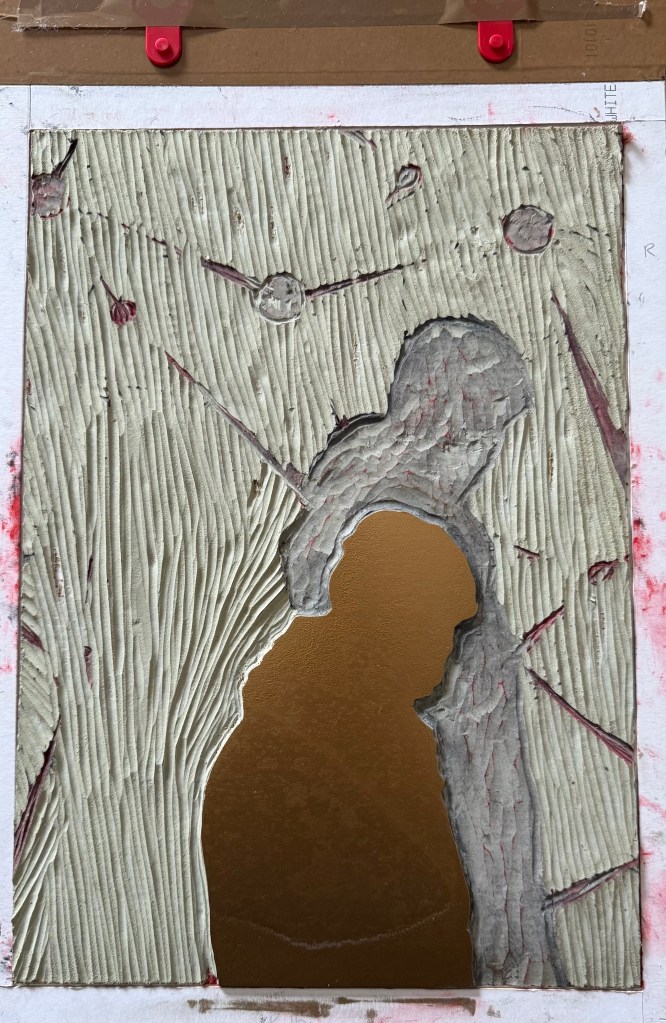
After some time away, it became obvious that the lino block, which had been washed and left to dry, was not sitting totally flat, which may have been the cause of the issue. So, I warmed it up and put it under a pile of heavy books whilst it cooled down. I came back to it a while later and tried making another print, which worked much better. Feeling a bit happier about things I went on and finished the rest of the prints. I must have inadvertently caught some of the cut out areas whilst inking up which caused some chatter on the base red layer (I clearly hadn’t taken on board the lessons from the first session) and on a couple of prints there was too much give in the blanket allowing the paper to be pushed down onto the cut out areas which caused marks on the red ink. This was resolved by adding in some folded newsprint which created some rigidity over those areas.

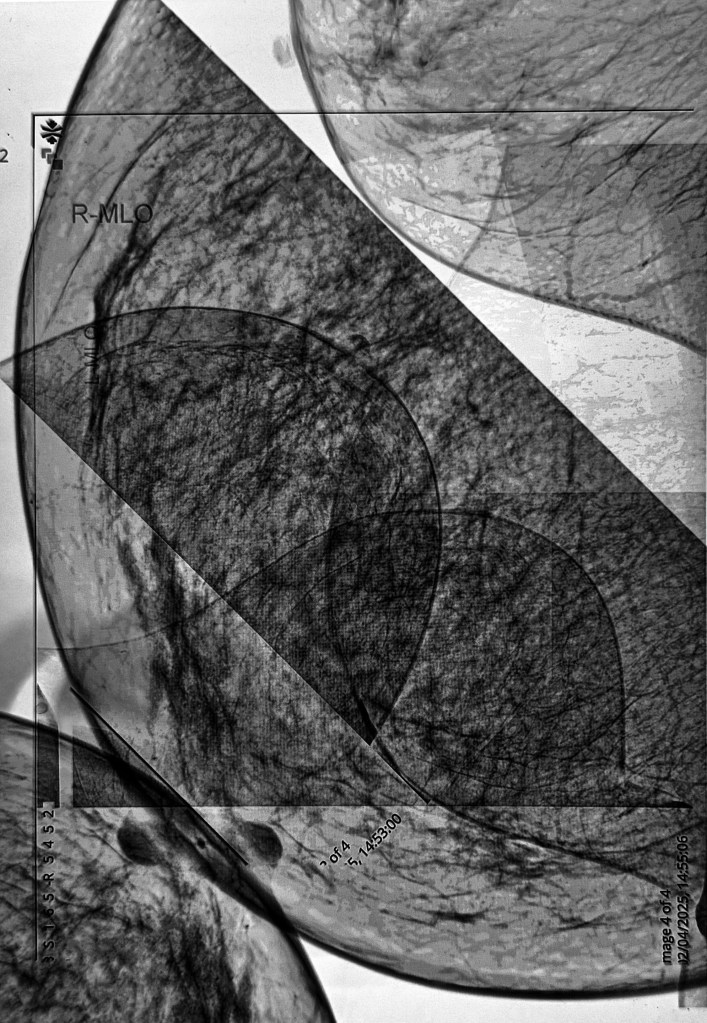
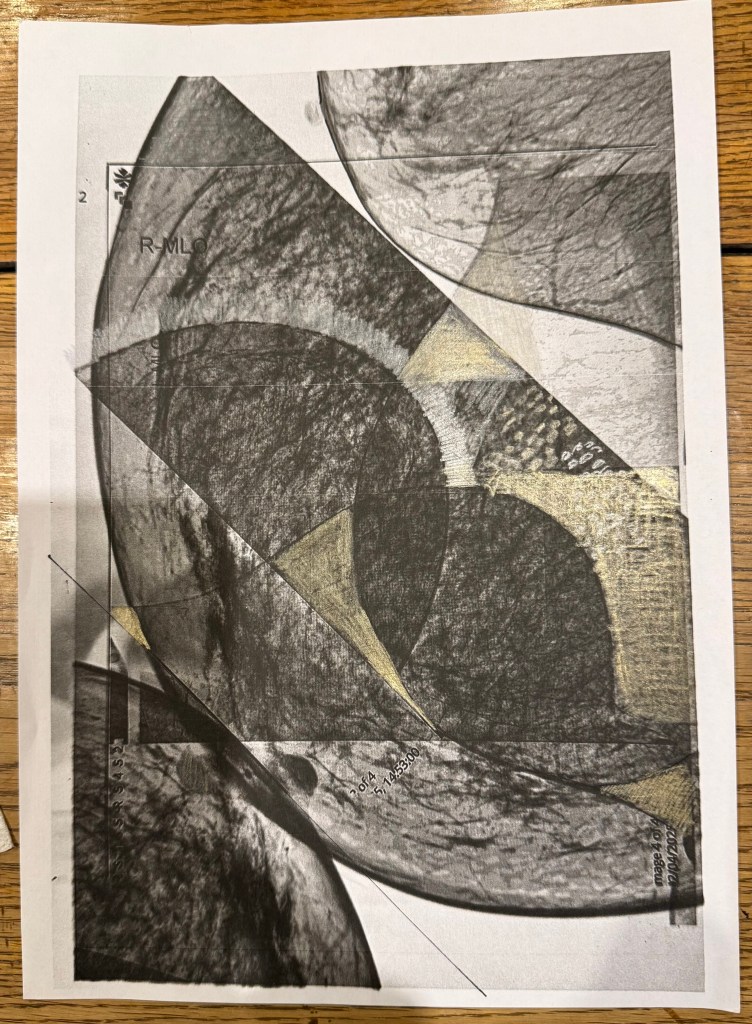
I liked the slightly mottled effect of the grey on the figures – it gave the sense of light falling on the figures or a lack of solidity. I wanted the head silhouette to be stronger so I burnished the head and the front side of the figure with a spoon to get a darker print. I liked the prints at this stage, but I felt that the two grey figures didn’t have enough definition between them, so I went on with the final gold layer.

My total of usable prints had reduced to 8.

Wayfinding

I think that I’m finally getting some clarity. Or maybe I’m seeing connections and signs where perhaps there aren’t any, but it seems to make sense, in my head anyway. In my second tutorial, Jonathan commented that he had a sense that it was all leading to something (the first sign).

So far during this course, trite as it may be (although Jonathan has assured me that it is essentially what art is about), I have been concerned with understanding myself and my place in the world as a practising artist. I’ve been working from memories, guiding me like a compass on my exploration, probably slightly off kilter, as well as my day to day life, thoughts and feelings. I have been trying to concentrate on the process as opposed to the result (a sign), experimenting along the way, and producing very few finished pieces of work. I did feel uneasy about the lack of finalised output, but no longer. I’ve been on a dérive (our session on Guy Debord being another sign).

In my Study Statement I question whether it is actually possible to ‘find myself’. Kierkegaard thinks not, in the sense of a static and unified concept, for the self is constantly being formed not just by reflecting on the past but also by engaging with the present; it is in a state of becoming, in a state of flux, something I have said I feel on several occasions in this blog (a sign). I accept in my Study Statement that I can only hope to know myself as at a certain point in time, and that reflection is something which will have to be a continuing process. Something else I have mentioned on several occasions in this blog, to fellow course mates and to Jonathan, is that I feel like I am a different person to the one that started the course back in October last year (a sign); I have changed and I will continue to change – to become.

Recently, I’ve become interested in the subject of maps – the comment in my Unit One feedback that I seem to be engaging in a process of mapping jumped out at me (a sign). That led me to start thinking about maps and the process of mapping and map-making, experimenting with cartographic symbols and mark-making. The subject of maps is a huge one but during my research I came across the philosopher, Korzybski, the father of general semantics, a central principle of which is that the map is not the territory (rather like the image is not the thing: Magritte’s Ceci n’est pas une pipe (I used this idea with my red telephone at the Interim Show (yes, another sign)). In short, our models of the world are abstracts of reality, and do not represent it. This is a principle I’ve been trying to be more mindful of since I read about it – my map of the world is not the same as everyone else’s, so we can be in the same situation or look at the same photograph but have our own very different experiences and interpretations of it (our sessions with the photographs being another sign). Something which is blindingly obvious, but which I don’t always appreciate.

This then led to the notion that geographical maps themselves do not reflect the territory in the sense that there is abstraction and subjectivity in the production of all maps: the size of countries and borders can be manipulated for political and social ends, the purpose for which a map is intended can determine what is included and what is left out, viewpoint and projection can distort the world view.

Mercator Projection

Authagraph Projection

The Authagraph Projection is considered to be the most accurate flat representation of the world. It highlights the distortion caused by the traditional Mercator projection in terms of the size of Africa, South America and Greenland, amongst others.

I have been reading a lot about cartographic theory, a discipline which has only become a thing relatively recently. There is lots of disagreement about what a map is and the separation between the artefact of the map and the process of mapmaking and mapping. Post-representational cartographic theory does what it says on the tin – it argues that maps are not the territory but actually create the territory, are in a state of flux and are constantly changing, and theorists have moved away from the idea of a map as an artefact, but as being performative and processual, and always in a state of becoming.

Whilst working, I have been reflecting on past events and experiences, but whilst doing so I have been conscious that my recollections are probably my version of the truth; that I am my own unreliable narrator. I have been interested in memory for a while, particularly as to its probable unreliability and its potential to be manipulated. The way memories are formed and retrieved means that they are not fixed archives, but are constantly being formed and reformed with each retrieval; they are in a state of becoming.

The link between selfhood, mapping and memory is the concept of the state of becoming: ontogenesis. In my research paper I want to explore ontogenesis in the context of autobiographical artistic practice because it is the essence of what I am trying to do. In my experimentation and production of unfinished work I am engaging in the process of mapping, changing and becoming, relying on my memories which are also in a state of becoming but how can I represent this in a visual form which is also in a state of becoming? Hopefully, by the end of the research paper, I will have a better understanding as to how it can be achieved, if at all.

That’s the plan for now anyway, although I may change my mind, in my state of becoming.

Trying to Move Forward

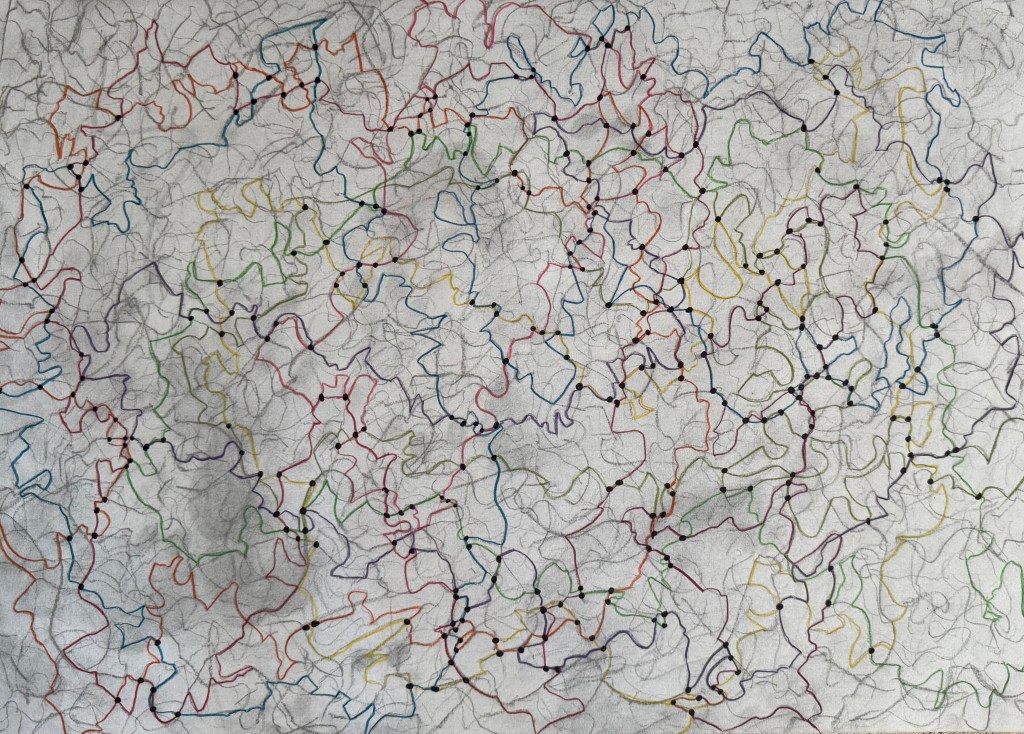
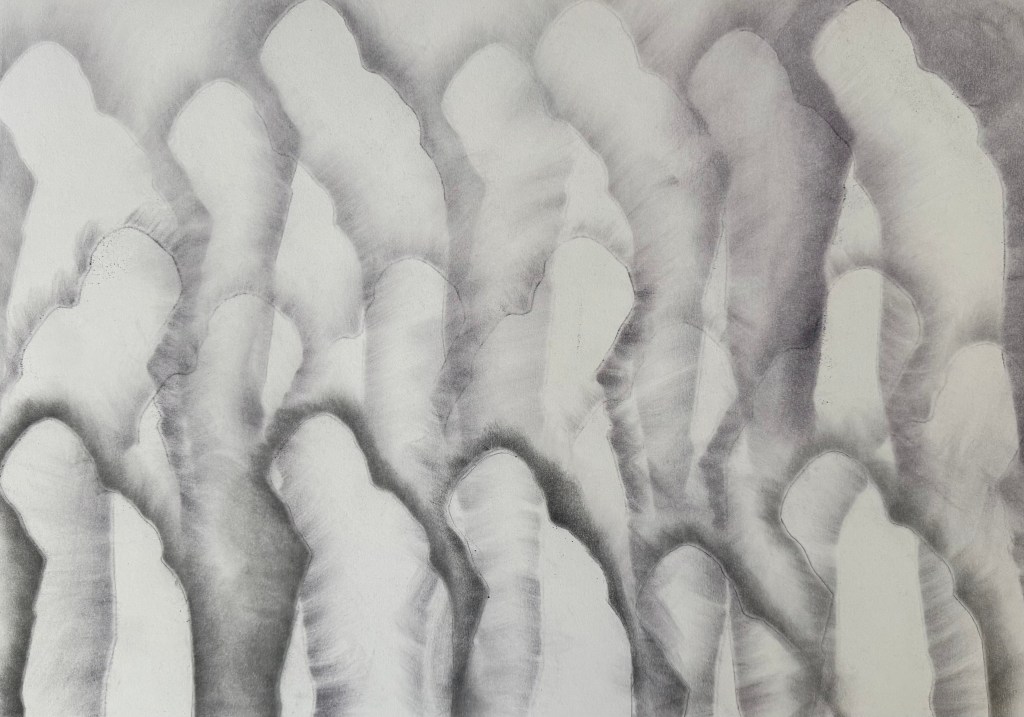
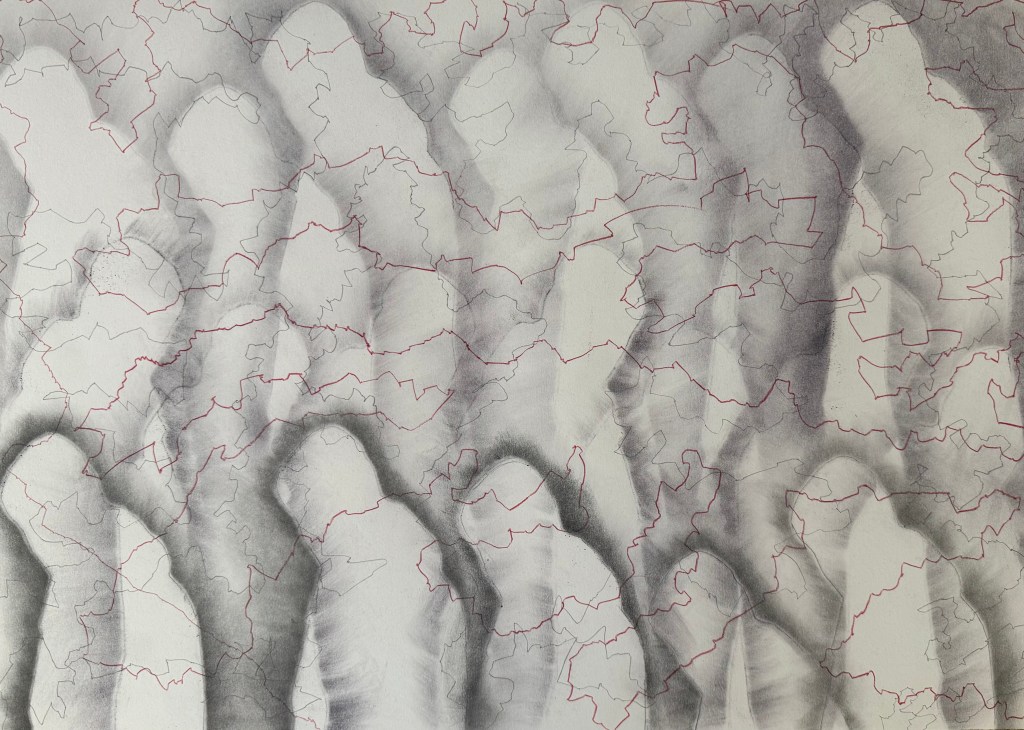
I decided to try and progress the idea of automatic map-like drawing by experimenting with charcoal. I drew a single line and then rubbed it out and repeated the process numerous times, building up layers of mark-making. I then took some coloured pencils and traced a path randomly following the marks.

I’m not sure that it takes me much further forward in developing this line of enquiry. However, I enjoyed the process and I like the different nature of the coloured lines which I made consciously by making decisions as to which of the paths of faded charcoal to follow, almost like a dérive – they have a different character to the ones I make when I draw automatically.

I’ve been thinking a lot recently about the course, about being half-way through and what I would like to have achieved by the time it finishes – what work I might produce by the end of it. At the moment, the concept of mapping is at the centre of it. I want to produce something which reflects all that I have learnt during the course, about myself and how I relate to the world around me. It will inevitably be an artifact, a map, of some shape or form, but I want it to reflect a process which is ongoing, that will never be complete, a piece of work in a state of flux, constantly subject to change, so there has to be some sense of impermanence, of it being unfinished. I also want to encompass the idea that memory plays a large part in the process and much like maps which are constantly being made and remade, so are the memories on which the map is based. The idea of layers and distorted imagery seem to be relevant in this respect.

I’ve thought about paper and canvas, maps being folded and rolled , but I don’t think that these offer the ability to create layers in the way that I want. I’m currently thinking that I may make a number of squares which together make up the grids of a map.

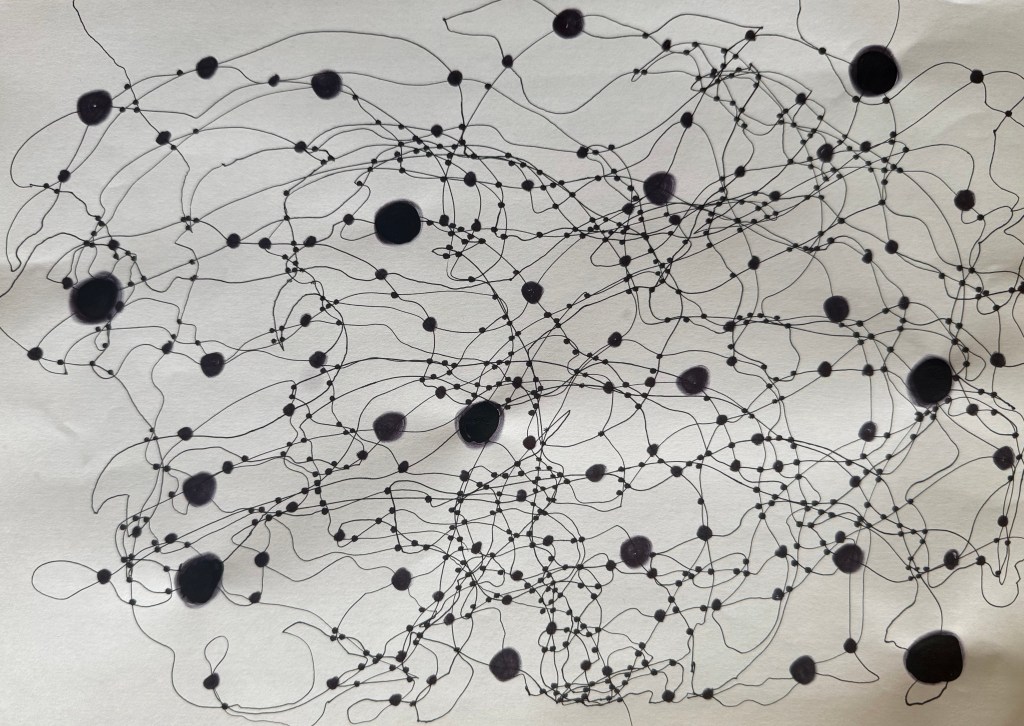
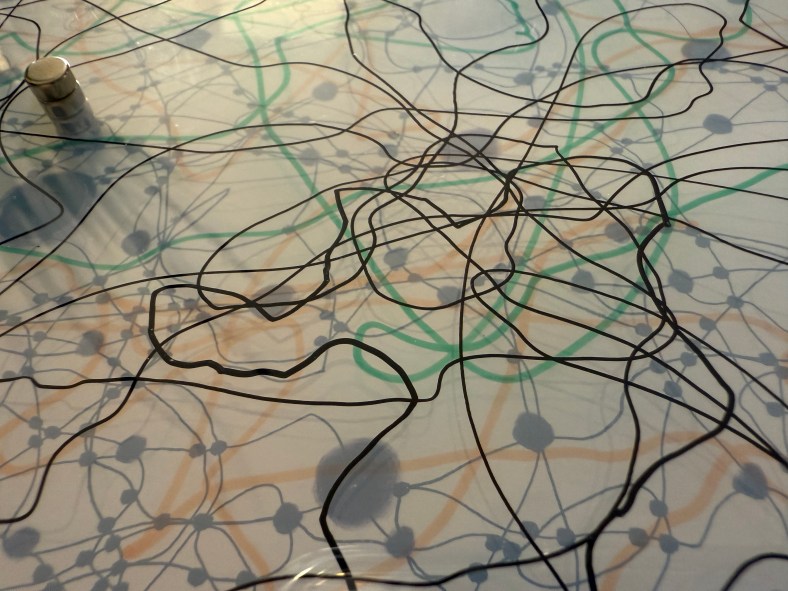
I used a pen to try and keep a marble on the paper. I like the lines which were made as a result – they have a sense of fluidity about them, much more than the lines that I have been making up until now. I’ve been meaning to experiment with the size of the dots at the intersections, to see if different sizes create a sense of perspective and three dimensionality. I don’t think that I have managed to achieve enough diversity in the sizes – it was very much an afterthought – I’ll try again another time. The image makes me think of something neural, cognitive mapping?

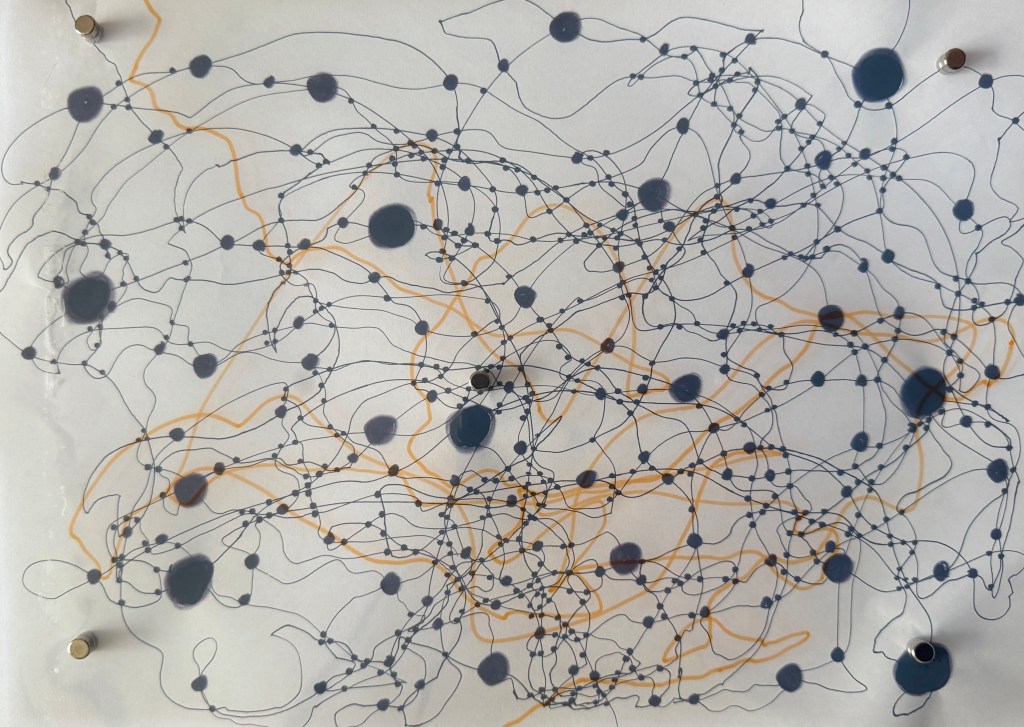
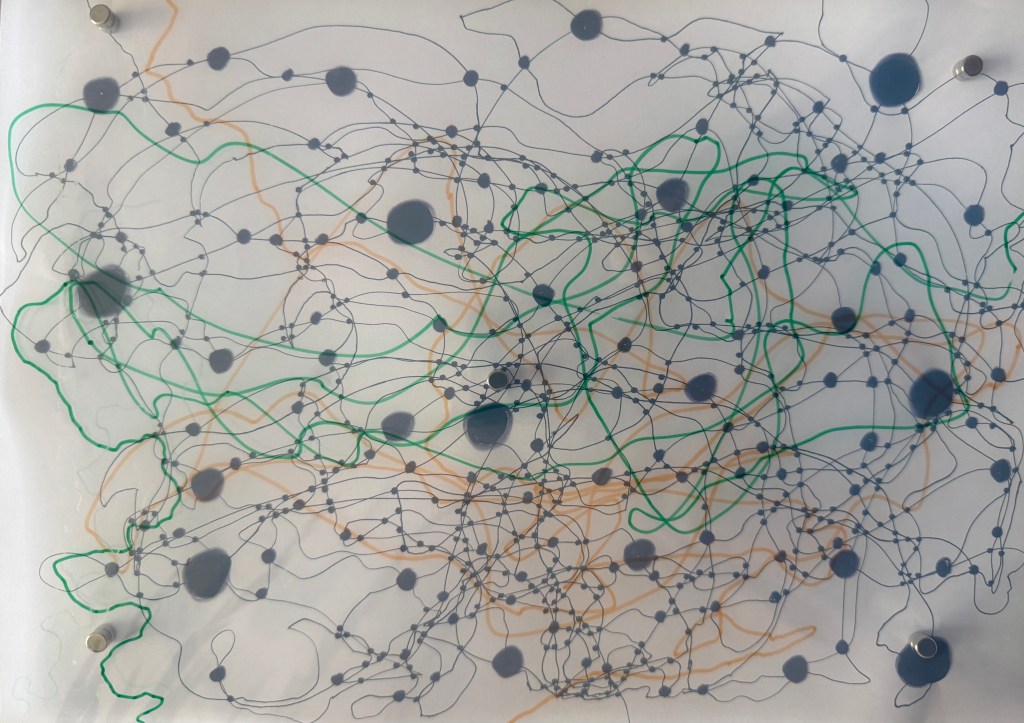
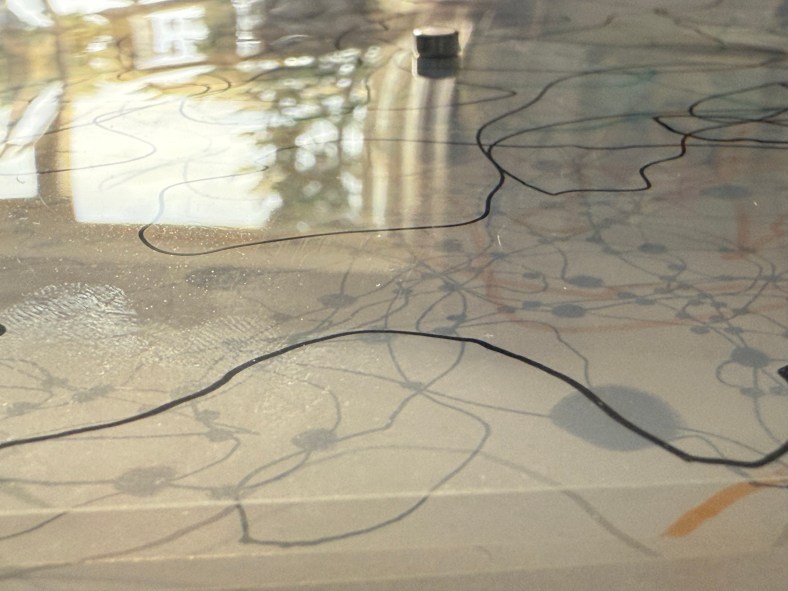
I took some inkjet compatible transparencies and drew some lines to see if I could create layers. Unfortunately, they are not totally clear – they have a milky appearance, probably because of the coating which allows them to be used in inkjet printers. I need to do some research to see if this is the case or whether I can source some others. Having said that, the milky film does cloud what’s underneath, making it hazy, almost like a memory that’s not quite there. Ultimately, I’m thinking that I could use layers of acrylic sheets over a background image, possibly together with milky transparencies, some can be drawn, painted and printed on, and I can also include some cyanotype images as well a negatives. I could cut holes in some layers to allow direct access to layers below. The use of reflective surfaces would also add depth.

I layered up the sheets using small magnets which not only hold them stacked together but also act as spacers between the layers. I had to add one in the middle because otherwise the sheets would sag – this won’t be a problem with rigid acrylic sheets. The magnets themselves suggest impermanence, the ability to be easily changed.

Rubbing It Out

Following on from Solitude, I decided to try and develop it further.

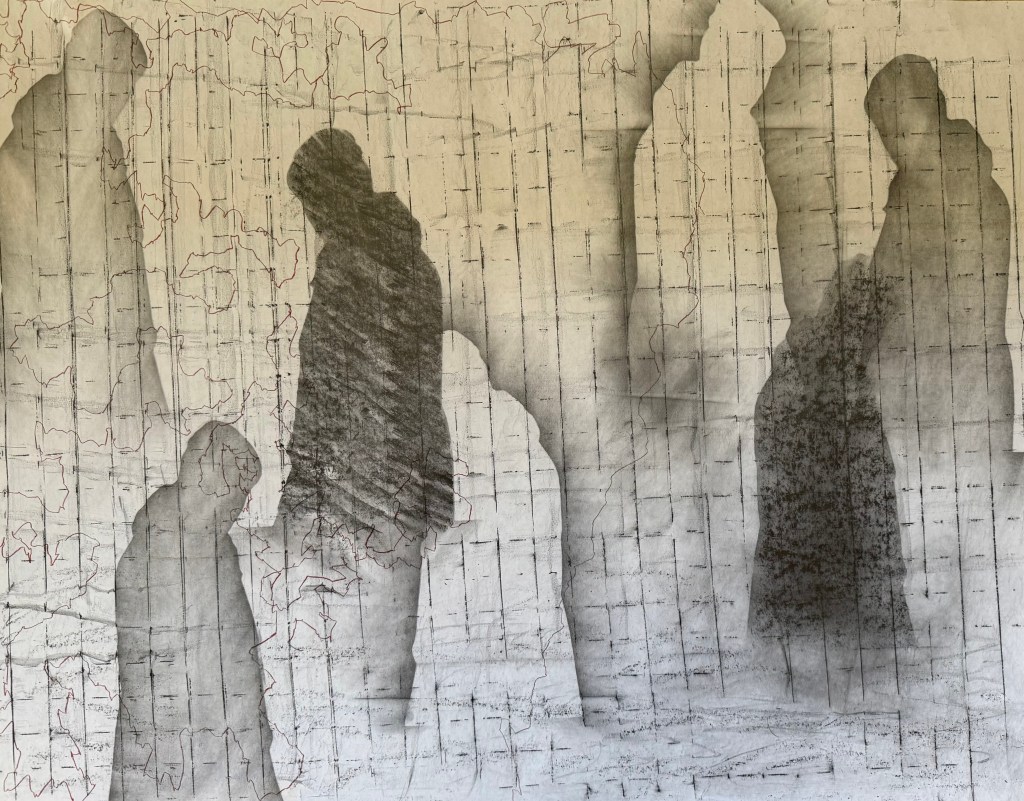
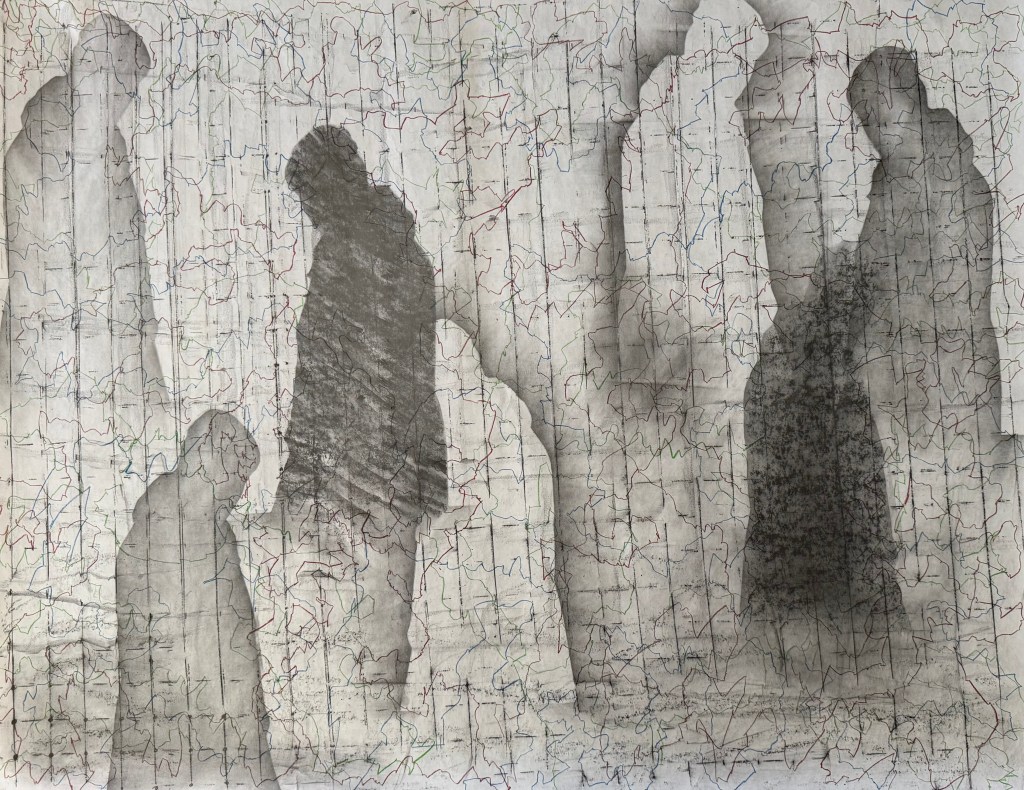
I used flipchart paper again, as it was easier to manhandle it over the obstinately curved wire fencing which I used for the grid effect. A downside was that the grid is a bit off kilter, but nonetheless I like the grid and the lines of coloured automatic drawing – it reminds me of map grid lines, a road map. I explored trying to have some figures behind and some in front of the grid. Not sure I succeeded and I am in two minds about the light figures.

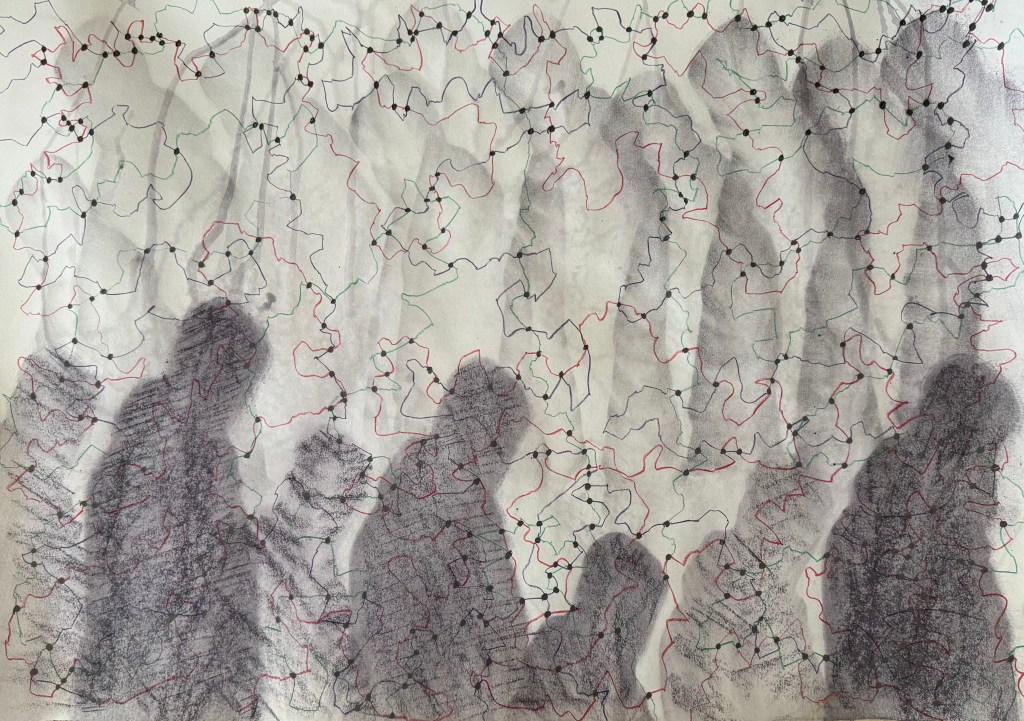
I decided to have a go with soluble graphite sticks using heavyweight cartridge paper.

I wanted to get away from the soft diffused figures and experimented with hatching and rubbing on a textured surface. I sprayed with water and held upside down to create some streaks and drips. Not one for less is more, I drew some green and red lines and then thought it would be interesting to see what kind of a random pattern would be created by drawing dots at the intersections of the lines.

I still didn’t like the dark figures at the bottom and so to try and break them up a bit, I coloured in some random shapes like I’ve done previously using different marks in my monochrome doodles.

I really don’t like it, and I’m struggling to find anything positive to say about it other than I like the idea of the lines and the dots at intersections emphasising the concept of connectedness and the idea of multiple figures in the background; the idea of all those who have come before, and of inheritance (Bus Replacement Service)

This time I left out the water, but I still used the water soluble graphite stick which had a purple tint to it which isn’t apparent in the photos. I don’t think it is as easily blended as normal graphite.

I much prefer this one out of the two. I’m starting to wonder what it would be like on a painted ground or even using thin layers of oil paint gradually building them up. Or am I done for now?

Witness

We talked about consumption of content during this week’s session. I admitted that the first thing I do in the morning is to pick up my phone. I use it as an alarm clock. It’s reliable unlike other alternatives I have tried. Also, I don’t leave my phone downstairs ever since I was told by a firefighter that it would be my only means of contacting the emergency services if a fire broke out and damaged the landline. That was when we lived in London and a mobile signal was something taken for granted. In deepest, darkest Hampshire it’s a luxury and dependent on WiFi, so we’d be completely stuffed if a fire takes out the power and the router goes down. So, really it’s born out of habit, and the knowledge that our means of escape would be to hop out of the spare bedroom window onto the flat roof and down onto the ground, hoping to get at least one bar if we stand 10 paces east of the base of the oak tree. Not that I’ve given it much thought…
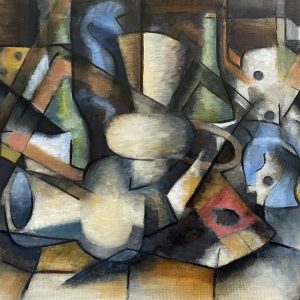
I love a reel. I try not to spend too much time watching them. The last one I watched which interested me was a clip from Shall We Dance?

Maybe that’s why I make art. The process of art-making is important but it wouldn’t be enough in itself – it needs to see the light of day, to be seen, to be witnessed. To be witnessed by me as an act of self-reflection and by others, even if it is limited to those who are close to me.

Where Do We Go? Where Do We Go Now?

Apparently, Guns N’ Roses didn’t know how to end their most successful song, Sweet Child O Mine. Whilst in the recording studio, Axl Rose reputedly started singing, ‘Where do we go? Where do we go now?’ And the rest is history and, in my humble opinion, probably the best bit of the song.

So a moment of inspired creativity can come from a total lack of direction and confusion. Here’s hoping…

I’m resolved to wallowing in the myre of confusion. There’s not much point in fighting it; I can’t understand everything. The latest book we read in my book club was Michael Ondaatje’s Coming Through Slaughter. I’ve never read a book like it. It deals with the mental decline and eventual death of the New Orleans cornet player, Buddy Bolden, who is considered to be the father of jazz. I didn’t understand what was going on half of the time, who was talking, and to whom. It jumped around all over the place. There aren’t any chapters as such, just three parts, no speech marks and paragraphs end at odd points on the page and continue on the next – visually it is striking. It is a book to be read, not to be listened to; its format echoes the improvisation and syncopation of jazz music. Once I had decided that perhaps I wasn’t supposed to understand it and just went along with it, reading each phrase and word in its own right, looking at the patterns, and the sounds of the words, a bit like reading a poem (after all, Ondaatje is a poet), I got a lot more out of it.

So this is how I intend to move forward. And it’s just as well, because try as I might to keep up with the constant flow of information being offered up by Paul in the Low Res etching workshop, I just couldn’t. I started taking notes, but just gave up in the end and surrendered myself up to not understanding anything and just enjoying being along for the ride.

It kicked off with Paul showing us what we could have gone home with, had we the requisite skills. There were some impressive prints which demonstrated the versatility of printmaking which I hadn’t really fully appreciated until now.

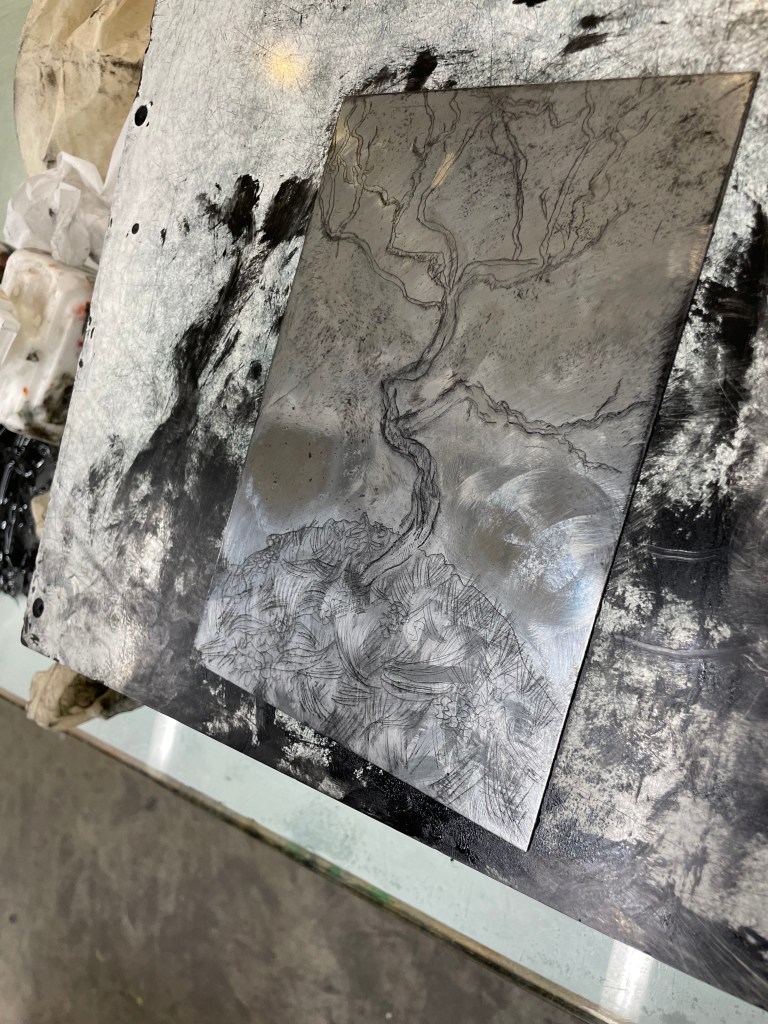
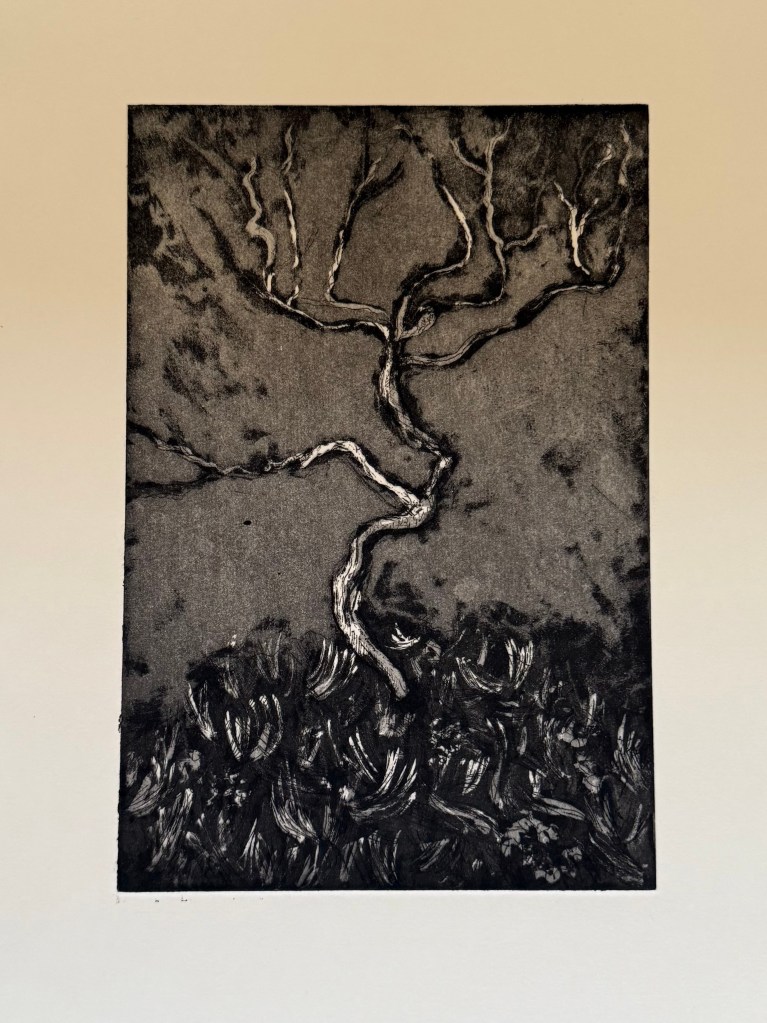
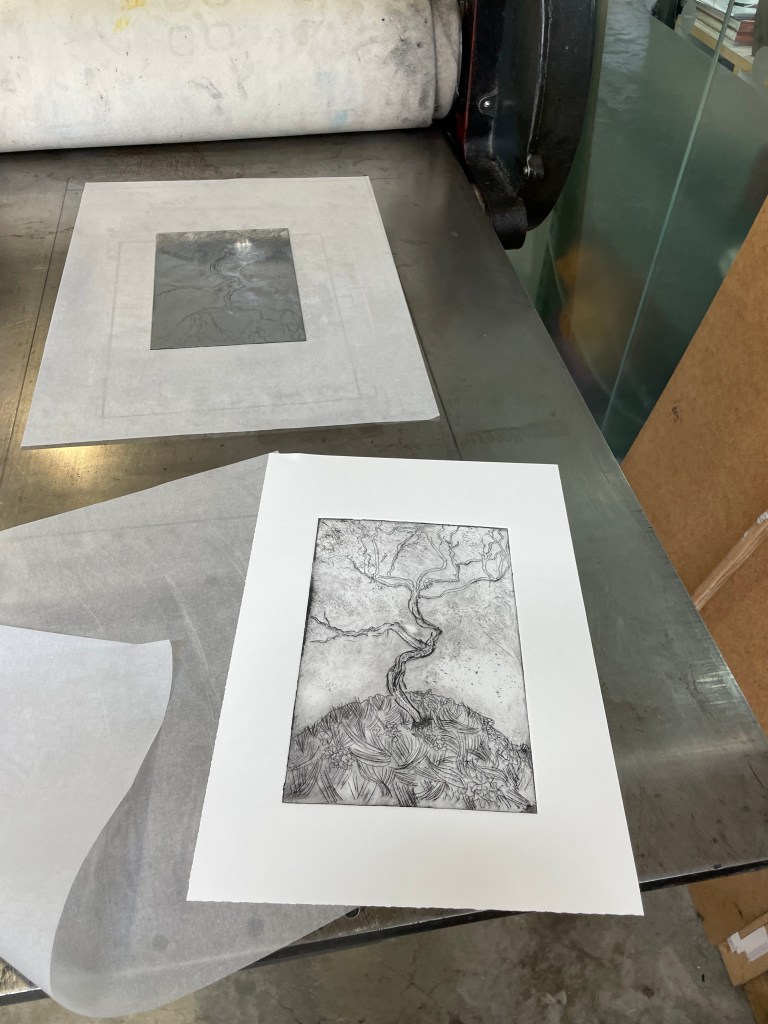
We started off by putting down a hard ground on a zinc plate and then we had about 20 minutes to create the image using a selection of Paul’s tools. What to do? I had a quick look on my phone and chose Schiele’s Small Tree in Late Autumn.

This is the plate once the hard ground had been removed and it had been cleaned followed by the printed images, using aquatint on the last one.

How do I feel about them? Pretty good bearing in mind I only had 20 minutes to create the plate and I had very little idea what I was supposed to be doing most of the time. Will I do it again? I don’t know – it’s very process driven, and whilst I love the excitement and anticipation of the big reveal, I’m more of an instant gratification kind of person. That’s not to say that I’ve ruled out etching altogether, it’s just that I would need a greater understanding of the different and quite complicated steps involved to do it any justice, and that’s just not compatible with the ‘new me’ at the moment.

Sorry, Are You Talking To Me?

I’ve decided that I’m probably learning far more about myself by simply being in this process than I am by looking back on my life.

I need to retrain my brain. My legal training has made me focus on detail, anticipate every possible eventuality, dot every ‘i’ and cross every ‘t’ all within a rigid framework of rules and regulations. That way of thinking served its purpose then, but it now stultifies creativity.

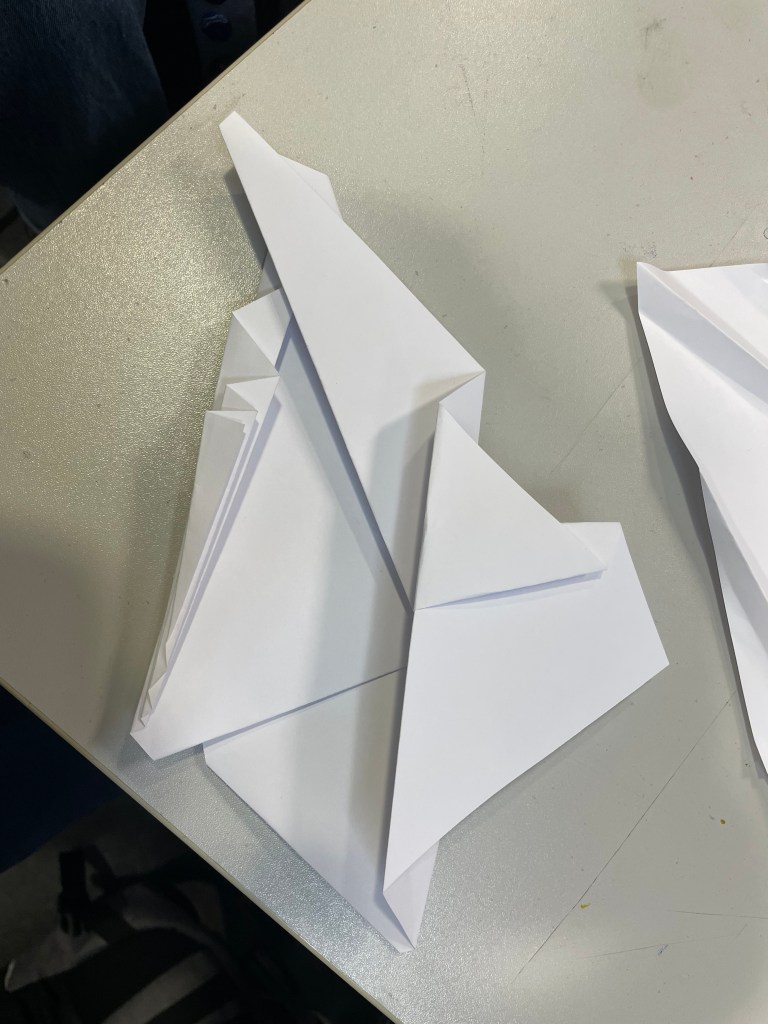
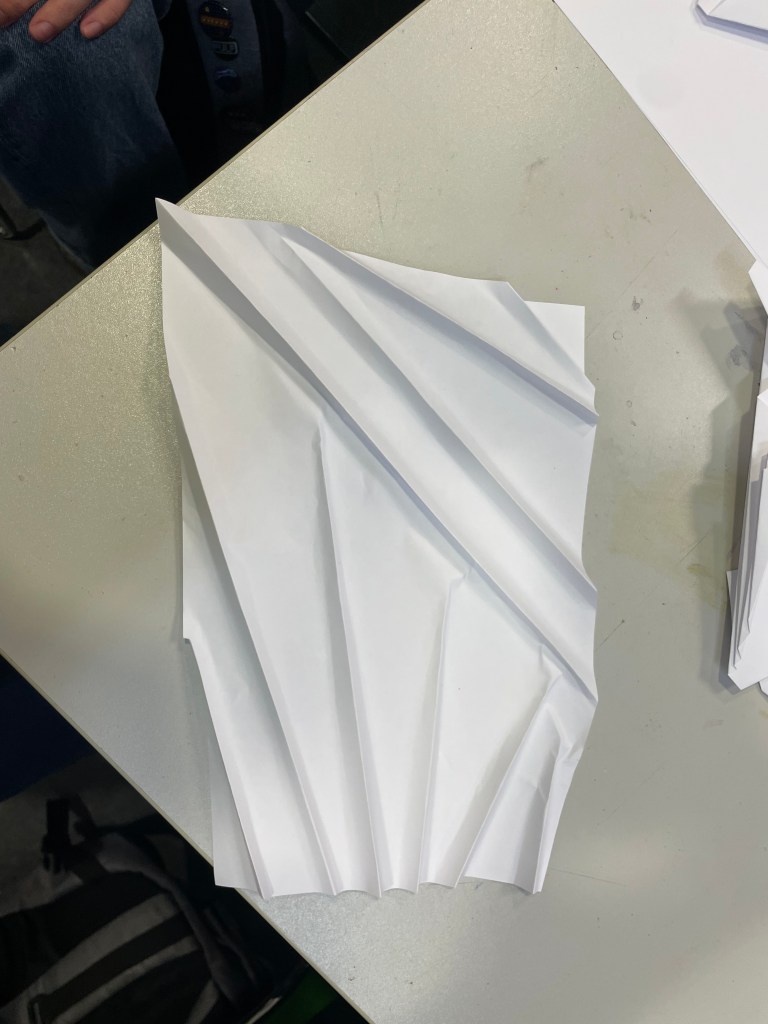
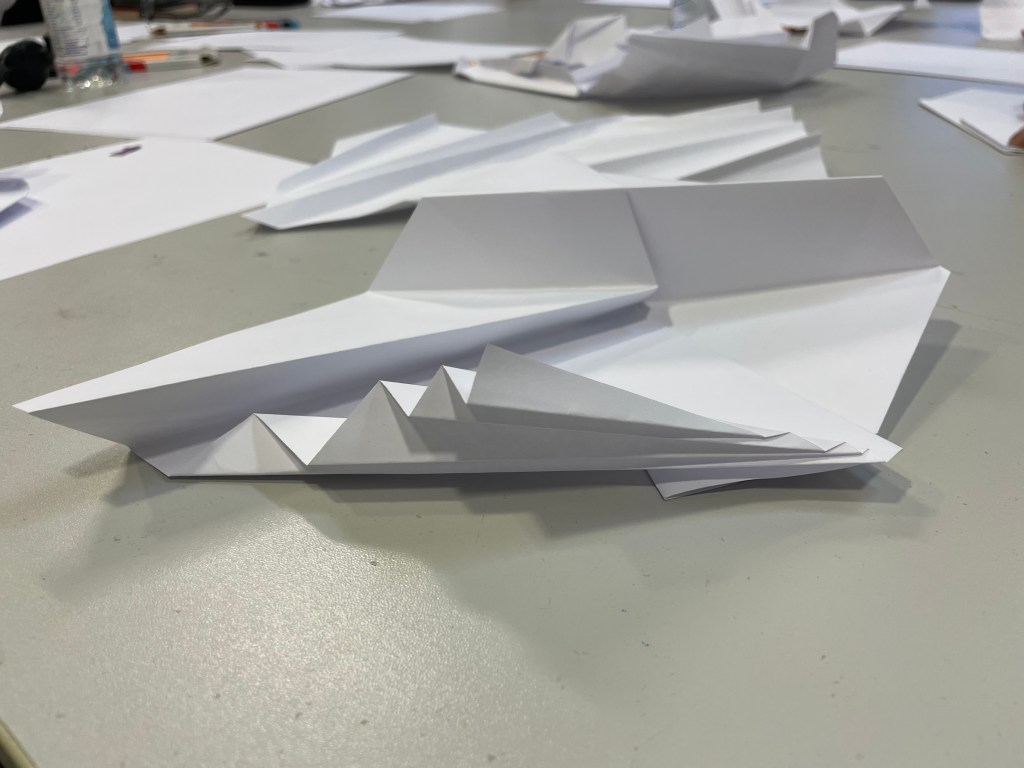
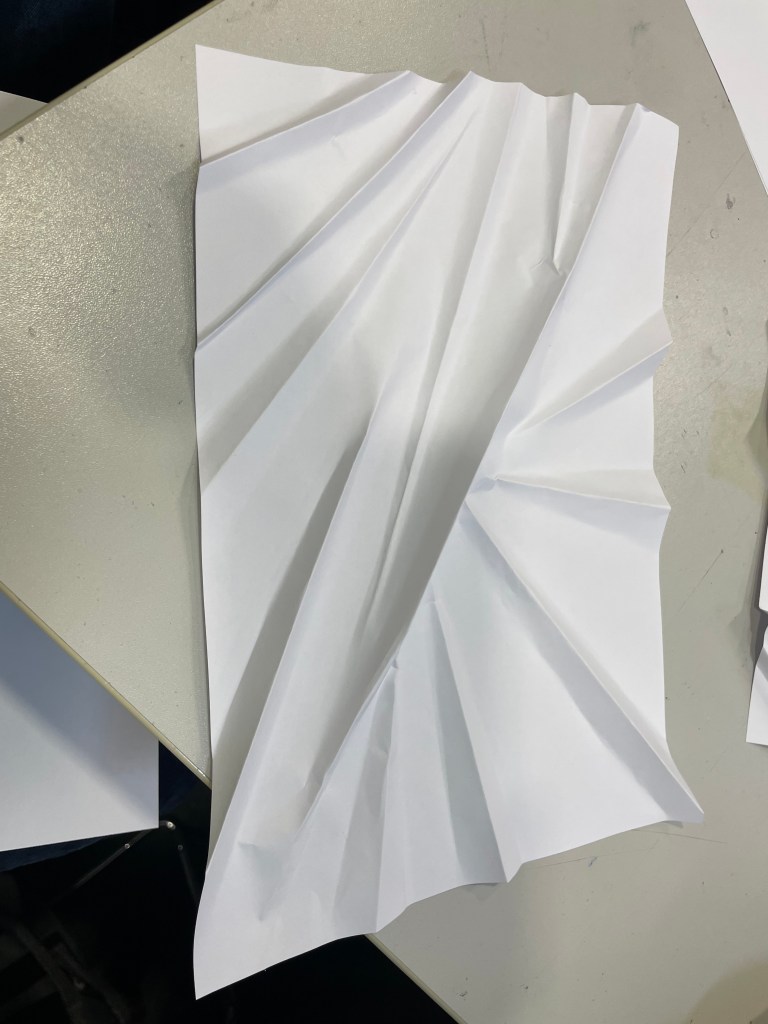
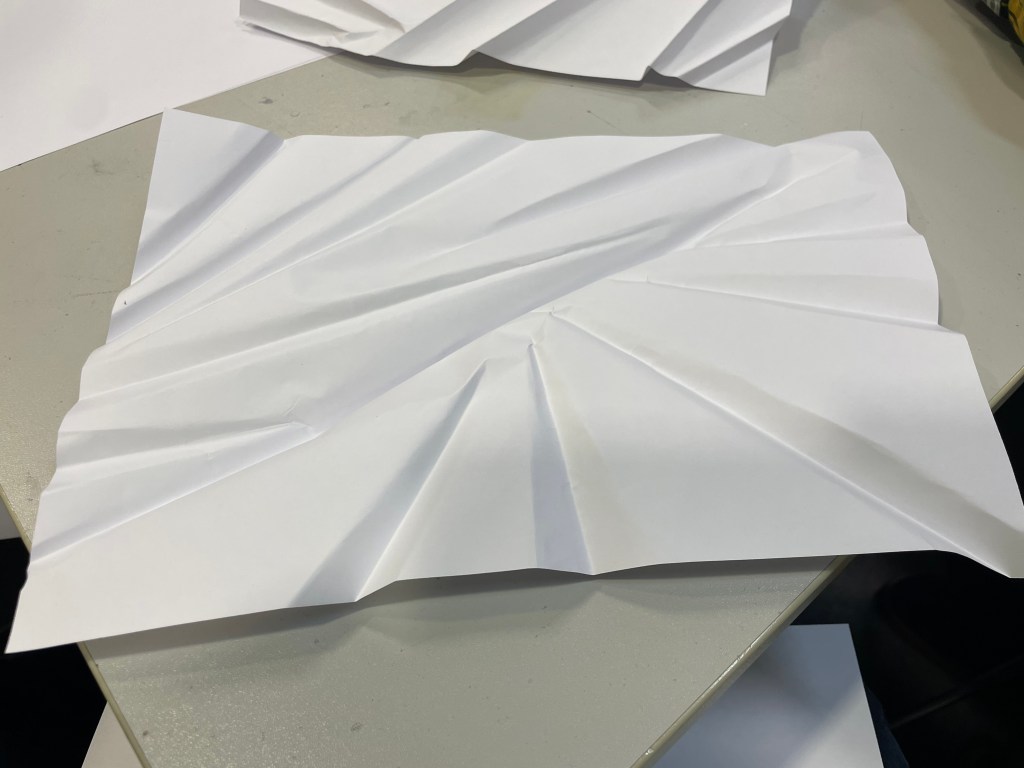
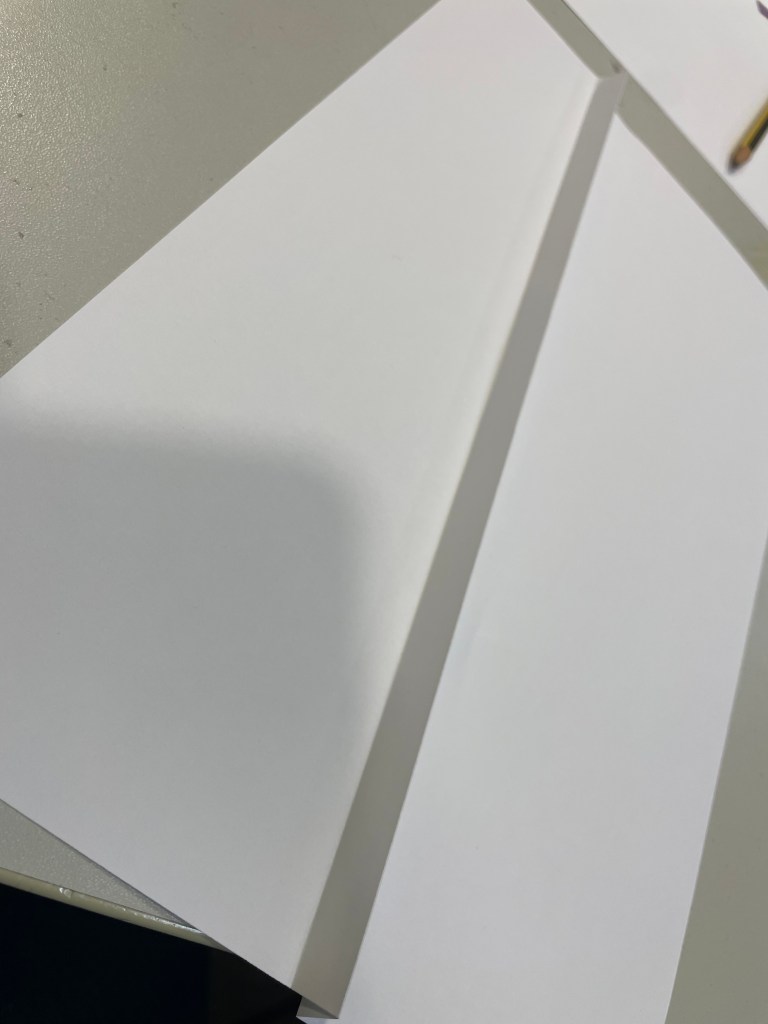
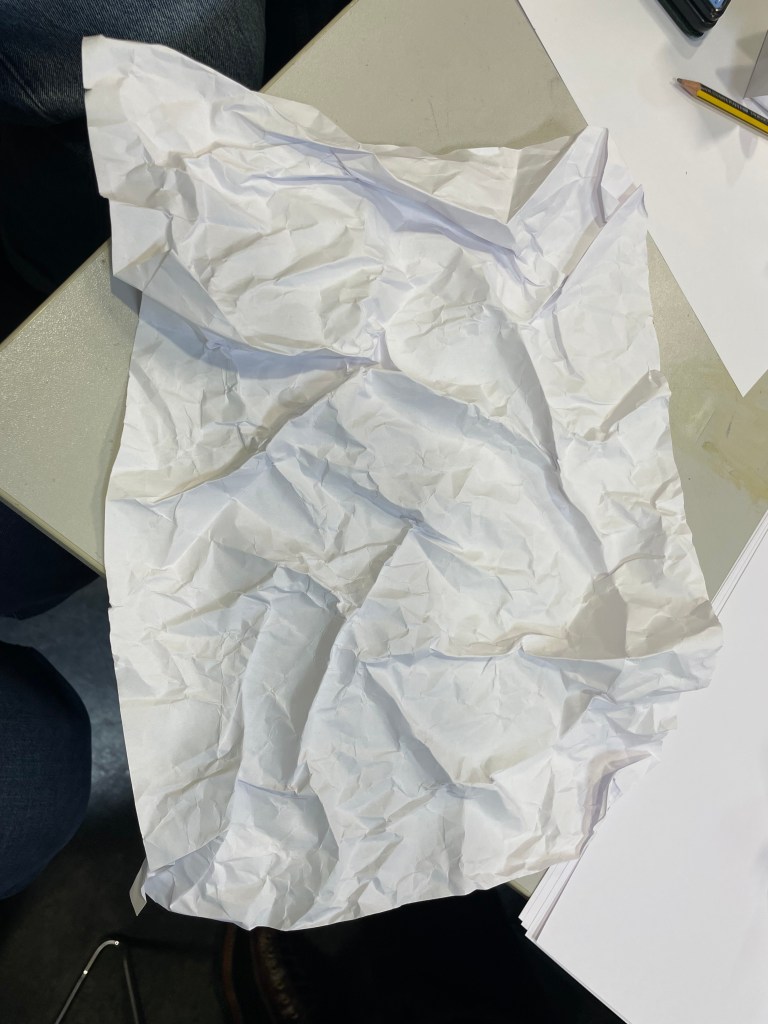
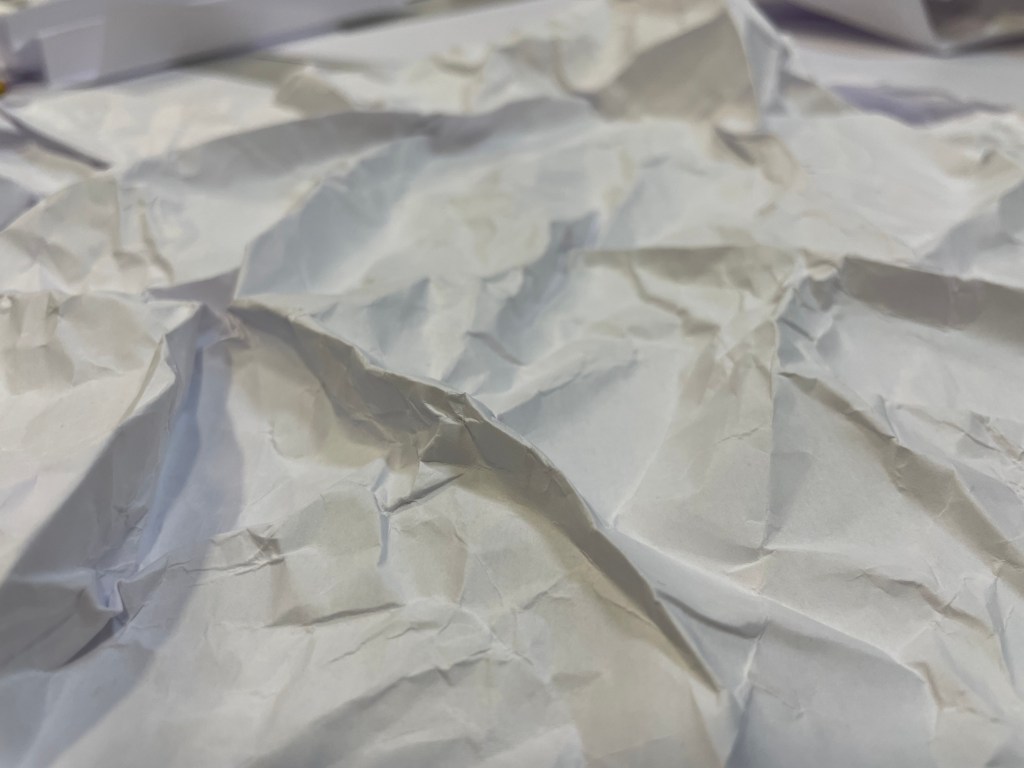
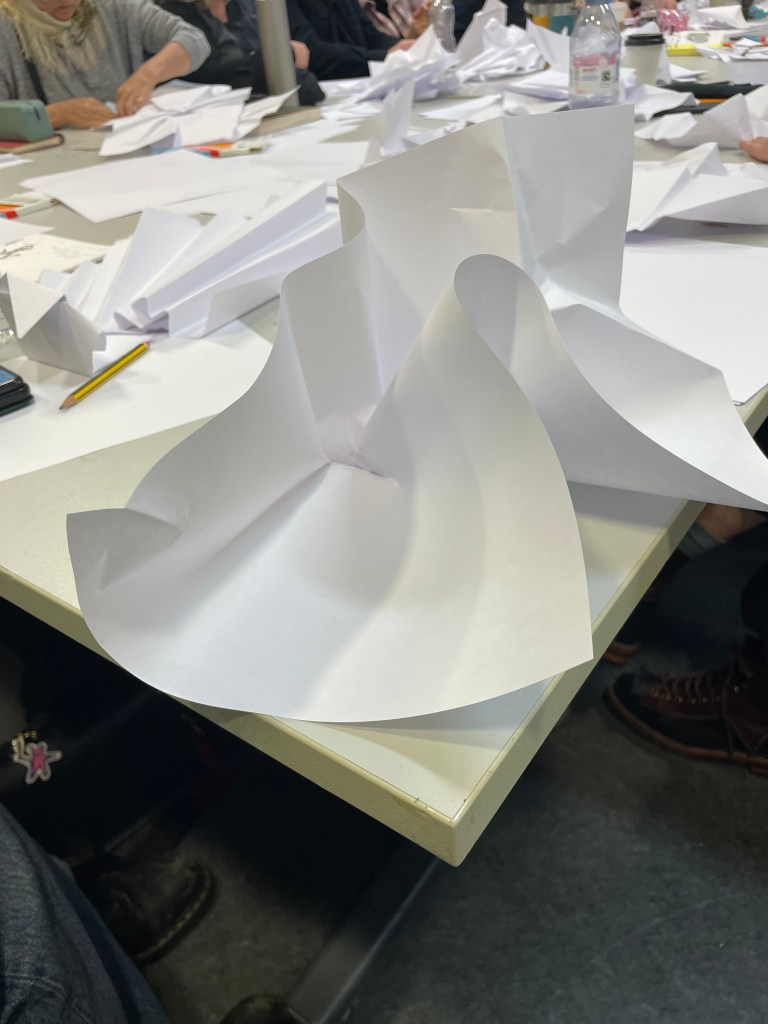
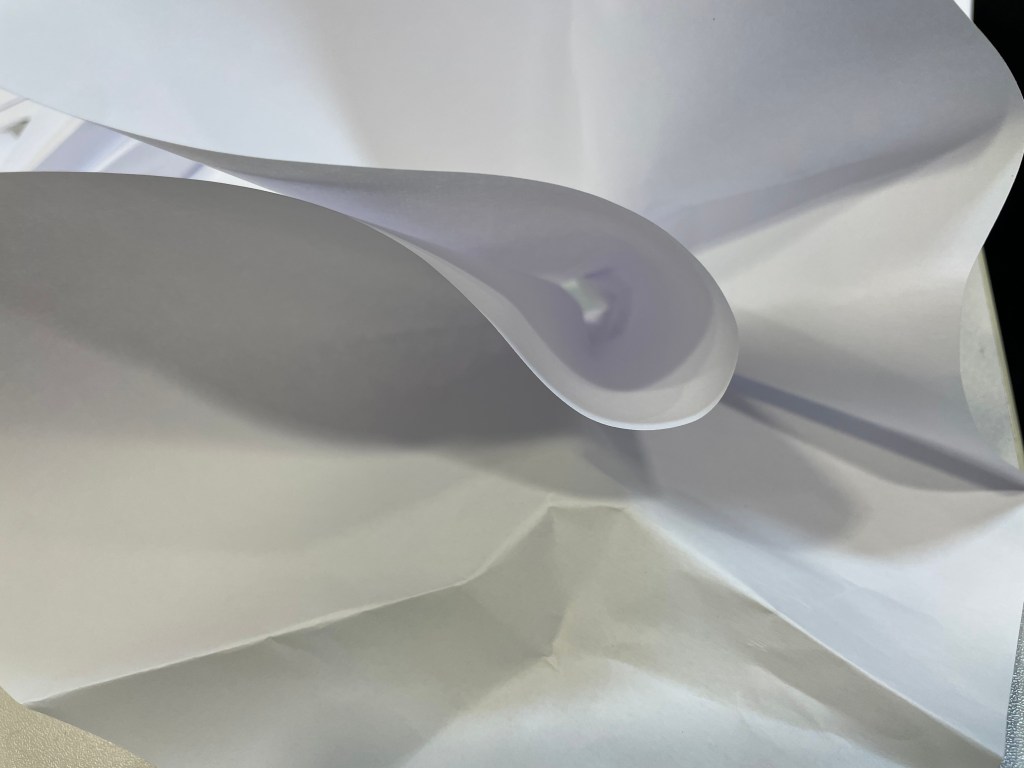
When I’m in a scenario which is unfamiliar, I like to know the parameters within which I’m expected to navigate; quite often I feel discombobulated when things don’t go the way I am expecting, the paper workshop with Christian Azolan being a case in point. We were instructed to fold the paper. To my pedantic mind, folding involves a deliberate act of bending something over on itself to create a clearly defined edge. It doesn’t include scrunching. But once I had overcome my initial confusion and accepted this unexpected variation of the parameters, I enjoyed myself.

I definitely preferred using the blank paper – I don’t know what brand it was, but it felt really good. It led me to confess my fetish for pristine white paper to some of my fellow students. I think it stems from being at primary school when the teacher would write my name on the front of a new exercise book with a marker pen and I would go back to my desk and give it a good sniff. I now appear to associate blank paper with a solvent high. I don’t think that my school ever had a pupil who was so keen to man the stationery cupboard at break time. In fact, I used to get palpitations and a bit of a sweat on just walking into WH Smith (R.I.P).

Working with the blank paper seemed to allow more freedom and I liked that the results took on a sculptural quality. The effect of the folding on the reverse of the paper was equally, if not more, interesting at times than the right side; areas which were peaks on one side became troughs on the other and vice versa.

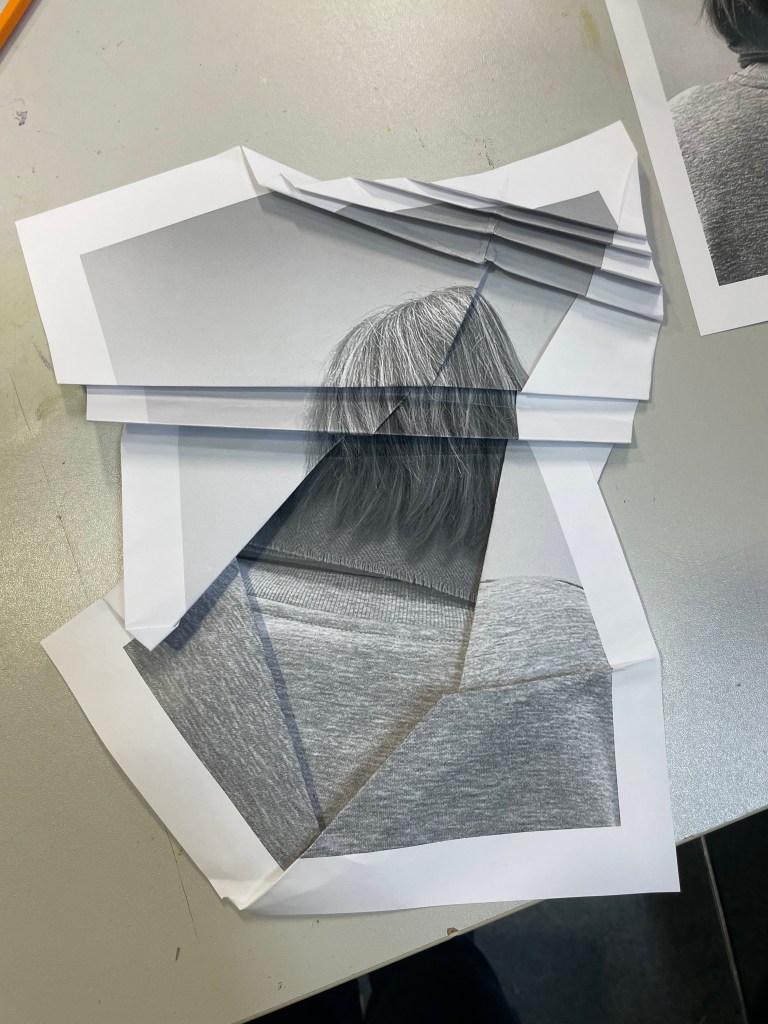
I felt inhibited using the print of the back of my head; I became too concerned with the resultant image which seemed to impose restrictions on how I folded, so maybe I like clear parameters, but not too many of them? Also, the effect is less sculptural than when using the blank paper; the areas of shadow are less apparent and the focus shifts to the distortion and concealment of parts of the image rather than the creation of form.

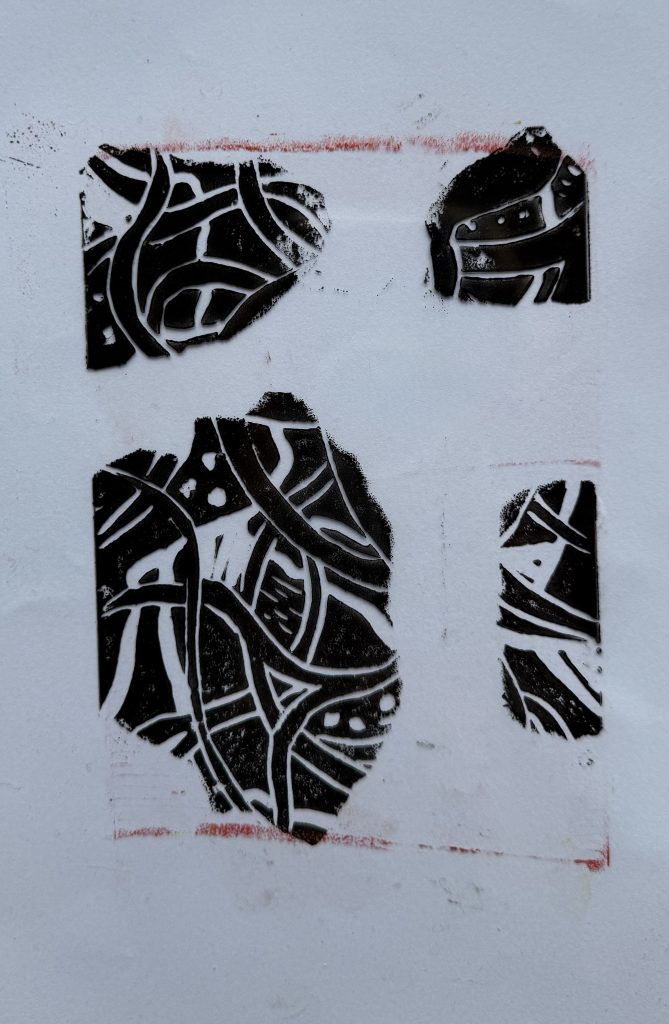
We then went on to do some linocutting – it seemed a bit incongruous with the folding activity, but nevertheless we all launched into it with equal enthusiasm.

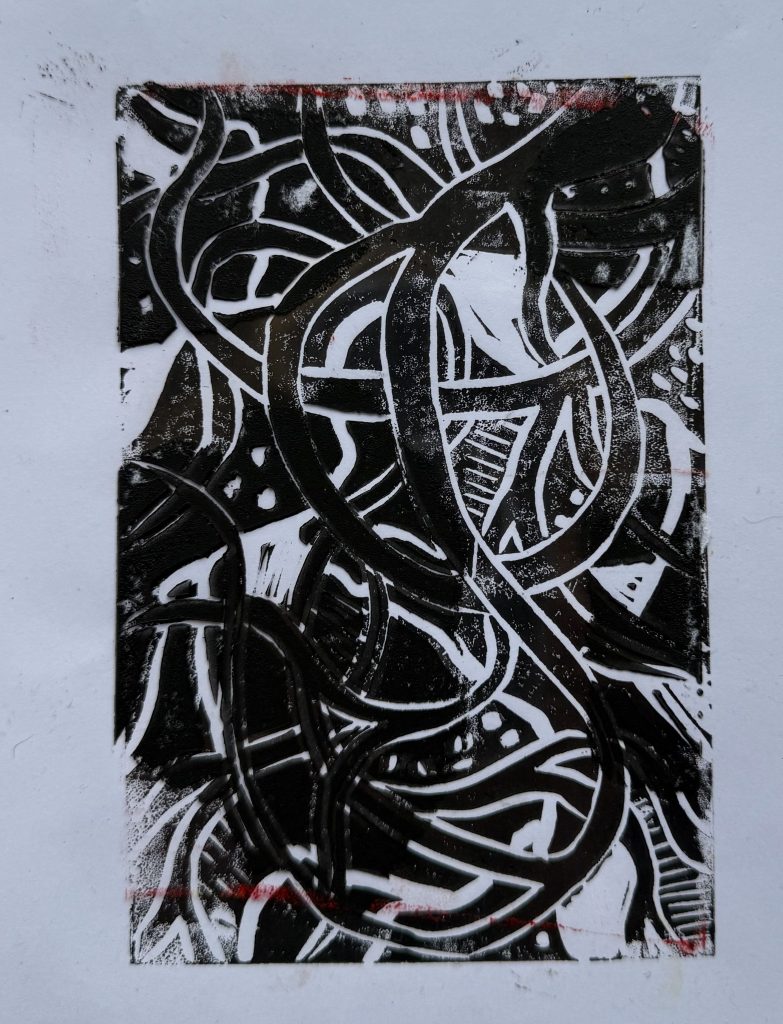
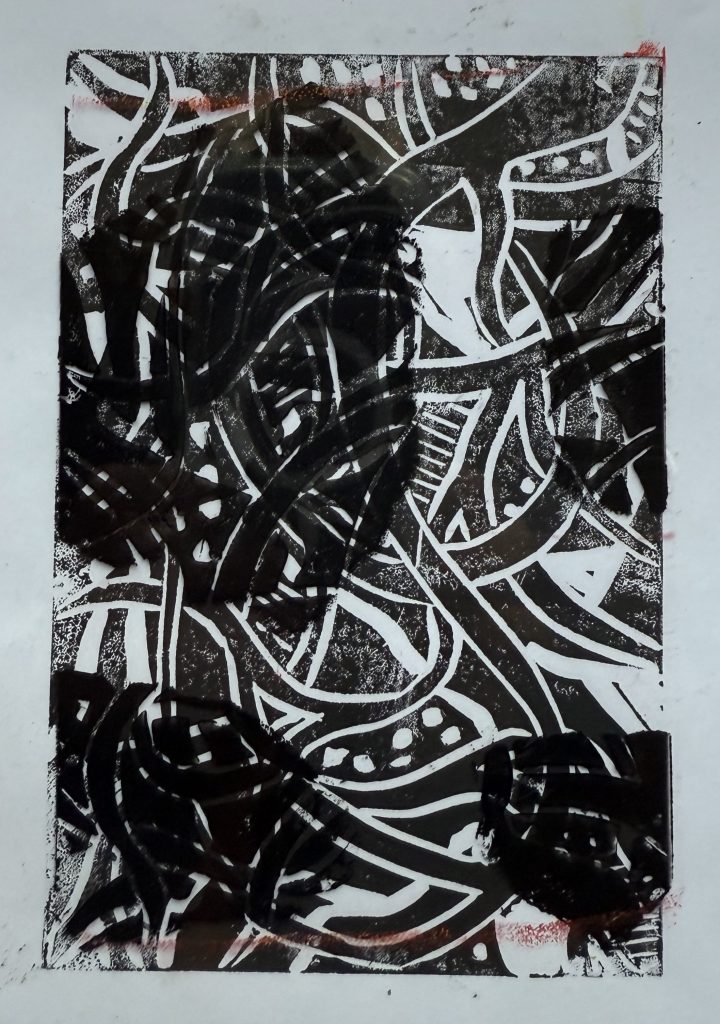
I prepared two linocuts; one inspired by tree roots and the other a reduction linocut of an abstract shape – I printed it using yellow ink first, then cut away more lino and printed using red ink.

I also printed the tree roots image on a transparency, having torn up bits of paper to create a random mask. It is interesting to see the effect of overlaying it with the two prints; how it creates a sense of discord on the prints where it’s not in sync with the image below, and how it creates areas of intensity on the print over which it lines up.

As I was taking my lino into the next door room to print it, Christian heard me reminding myself as to what I was planning to do. Sorry, are you talking to me? No, just myself. Doesn’t everyone do that? Yes, of course. When I went back in to print my second lino, I asked him how long we had left. Sorry, are you talking to me?…

Out Of Sorts

I haven’t done anything since coming home from the Low Res.

There was an intense period building up to it, followed by a period of sitting back and taking stock. I’m still thinking about it all, but whilst doing so I’ve allowed myself to get sucked back into domestic life. My daughter’s now home from uni for a month, along with all her ‘stuff’. Whilst it’s lovely that she’s back, it’s upset the normal way of things. Glasses and crockery disappear into the blackhole that is her bedroom, and the bottom of the stairs has become a footwear hotspot. Could be worse, I suppose.

Also, one of our dogs, Monty, hasn’t been so good. He’s an old boy at 12. Enlarged prostrate, chemical castration, hormonal inbalance making him not himself, and removal of a malignant melanoma. Waiting to talk to the vet about prognosis. I suspect there may be trouble ahead and difficult decisions to make. He’s out of sorts. We’re all out of sorts. But tomorrow’s another day.

I haven’t made anything. I am conscious that I haven’t and it’s starting to stress me a bit. My last two posts could have been cheerier, but there’s no point in putting on a fake smile. My colours are definitely muted at the moment. I feel like I’m stuck and I can’t progress until I’ve managed to process and order all that I took away from the week in London, but up until now I haven’t been able to set aside the time to do it. Also, my logical side dictates that I should deal with it all in chronological order, but that’s impossible to do because it all seems to be intertwined.

Second year Catherine told me that she feels like a spider spinning a web. I told Jonathan that I felt like I had been collecting during the week; it’s as if I’m accumulating pieces of a jigsaw puzzle, but I don’t have the benefit of an image on a box to guide me. I just hope it makes something, because it’s making me feel out of sorts.

I’m looking forward to the start of a new term next week. I need some structure.