Reflection

I’ve decided to take a leaf out of Sophie’s book and formalise the thoughts I’ve had since we finished our first term.

I don’t think that I have felt more like myself (whoever that might be) than I have over the course of the last 3 months. I can’t pinpoint why exactly; I’ve just felt like ‘me’.

It has been overwhelming (I suspect that I use this word an awful lot) in the sense that I have been totally free to create and, more importantly, to think about creating. I feel as if I am at the start of an important journey – I don’t want to rush into it; I want to take my time and be prepared. I don’t even know where I’m going – there are no limitations – but I know that I will discover something by the end of it.

I think that I have mostly engaged in the preparation side of things rather than the physical manifestation of work, but that’s been the best bit. I’ve been collecting ideas, inspiration, and information. I think about it most of the time. I’ll have a thought and think, yes, I could use that, and then it’s gone. I need to find a workable way of recording my thoughts – I can’t really open a notebook or Notes on my phone whilst driving – maybe I’ll have to call someone (hands free, of course) and get them to record it for me. Funnily enough, I used to do that: if, whilst at home, I thought of something I needed to do at work the next day, I would call my work phone and leave a voicemail. Just writing that has made me think about what voicemails I might leave younger versions of myself at various points in my life. And that is how it’s been, going off on tangents, suddenly striking up a conversation with whoever I’m with, on the thought I’ve just had.

It has also made me feel anxious – I don’t want to miss anything. I have amassed a large pile of books which I ‘need’ to read. I haven’t really tackled the online library resources with any conviction just yet – the thought of it makes my heart race – all that information out there – how can I take it all in?

The preparation of my study statement has come at just the right time. I need to marshall my thoughts and commit them to words, but in the knowledge that it is a living document which can change over time. I’m actually really looking forward to it as it will bring a sense of calm and order. I hope. Who knows, I might be feeling differently come the beginning of February.

Thinking back on the work I have done over the last few months, I think I have become much freer – I’ve been leaving things as being what I would term as ‘unfinished’ and managing not to go back to them. Making them public by putting them on this blog has helped tremendously. I’m now enjoying the process of making much more than I have previously – it was often an ordeal.

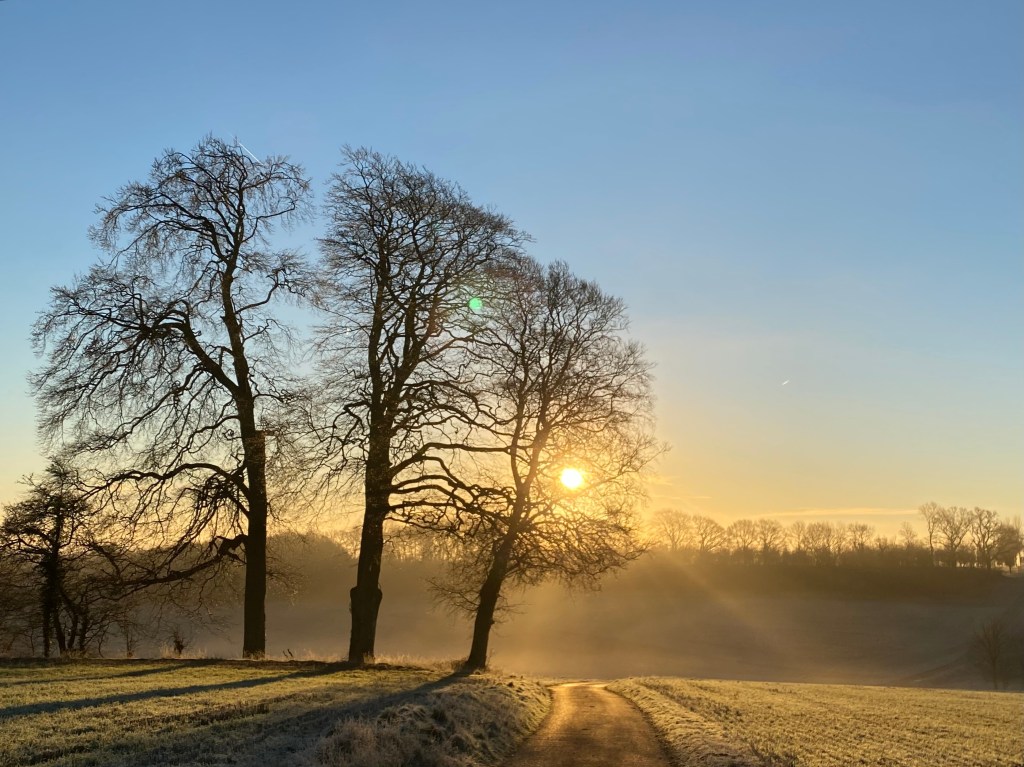
I think I have identified areas which I would like to explore in more depth: I have invested in a book on Procreate (it’s not going to beat me) which I’m working my way through, and I have some ideas in my head as to a series of three digital collages on the subject of motherhood which I may or may not develop further. I like the number three: I am one of three; there are three in my immediate family; there are three trees which together form one tree on my favourite walk near my home; and three is the smallest number by which you can seek the input of others and still avoid a deadlock. Having said that, it’s probably not so great for a friendship group.
I would also like to experiment with printing techniques, photography and a previous obsession, cyanotypes. This term I’m determined to book some sessions and get into CSM on a regular basis.

I’m now able to look back at the three monotypes that I made of my mother. I feel that it was the right thing to do. It was something that I always knew I would have to address and it was something that I had to tackle early doors. I think it has helped. I went back to my mother’s house not so long ago and I didn’t feel the usual sinking feeling of dread as I walked through the front door. I was actually able to sit down by myself in silence and remember some of the good times when we all lived there as a family, even when it became dark outside. A small positive step in the right direction.

As finished pieces of work, they are what they are, vehicles by which I transferred debilitating thoughts into another space. Could I have done them differently or executed them better? Yes, obviously, but I don’t look at them that way; it is what they signify and make me feel that matters: despair, confusion, sadness, resentment, helplessness, isolation and fear. I chose monotype because it is, as soon as it is, and there is no way back. It was all about the process, not the result. If I had to make a change I would change their order – I made them in the order of the conversations – they would work better as a series if their order was reversed, with each one making more sense of the one before.

I took my daughter back to uni at the weekend, and she phoned me up earlier, chasing me for some information I was supposed to give her. My husband chipped in that it wasn’t any wonder that I hadn’t got round to it as I seem to spend all my time blogging – well, if I don’t have anything else to show for the next year and a half, at least I’ll have this blog!
ARTificial Intelligence

In our session this week we looked at AI image generation, in particular, how the tools are trained by using a huge number of datasets created by scraping data from the internet; the impact of this form of training including bias and breach of IP rights; its ethical and environmental impact; and the effect on us, as artists, in terms of our own relevance, the potential use of our work as training input, and our ability to use AI to create output in our artistic practice.

It is astonishing how quickly this area is developing. However, until it reaches a stage whereby AI can create an image in which there is human emotion and imperfection, we probably won’t become obsolete just yet.

Being from a legal background, I was particularly interested in the issues that generative AI tools have thrown up in terms of intellectual property rights. The main issues seem to be the potential breach of copyright in both the collection of data for training, and the output created, as well as the question as to who owns the output and whether it should itself be protected by copyright.

The problem with data scraping is that whilst the data is widely available in the public domain, this doesn’t mean that it can be copied and used without limitation (in the UK the only current exception to copyright protection in respect of text and data mining is for non-commercial research). This could mean that any images of artwork which I have produced, and which are publicly available on the internet, could be used to train generative AI and, consequently, could possibly form part of an output image generated by a third party, despite the copyright in the original image belonging to me. It’s a contentious issue, and there is lots of litigation going on at the moment across numerous jurisdictions including the UK and the US. In the UK, Getty Images has taken action against Stability AI for using millions of Getty Images to train its Stable Diffusion tool. Claims have similarly been made in the US against Meta, Midjourney and Anthropic, amongst others.

Another related issue, is that generative AI platforms will generally reserve the right to use any input or prompts from users to improve the performance of the tool, which could have implications in terms of privacy and confidential information.

Whilst it is unlikely that generative AI will create images which are exact reproductions of copyrighted images which have been used for training or as input, should there be sufficient similarity, there may be a potential breach of IP, but this will depend on an assessment being made in each case. It will also depend on being able to pinpoint where the content has come from, bearing in mind the huge number of resources across many jurisdictions. As part of their case with Getty Images, Stability AI are relying on the defence of fair dealing, as well as that of parody, caricature and pastiche i.e. that the image generated is not a replacement for the original image but a pastiche, and so it does not affect the market for the original image or its value. It probably didn’t help that in this case that some of the output images contained parts of the Getty Images watermark. This case is destined to be a trailblazer, but we won’t know the outcome until the middle of next year.

It is theoretically possible that an image created by prompts and inputs from a user of generative AI is capable of being owned by the user. However, the user cannot assume that they own the content or that they are able to use it as they wish. Firstly, who is the owner of the created image varies from country to country. Secondly, the terms and conditions of the platform may determine ownership and rights e.g. Midjourney’s terms and conditions, whilst providing that the user owns the created image, state that by using the service, the user grants Midjourney and all its affiliates etc. extensive rights in relation to the output image to reproduce and sub-license it etc. at no charge, and royalty free.

In the UK, the author of original literary, dramatic, musical or artistic work owns the copyright in that work, unless it was created in the course of employment or by way of commission. There is no need for registration in order for the work to be protected, unlike in the US where it has to be registered with the Copyright Office. In fact, the UK is one of the few countries which recognise copyright protection for computer generated works. However, for the work to be original it must be the author’s intellectual creation and reflect their personality. It is not clear how this might be applied in the context of work created by AI. Furthermore, the ‘author’ is the person by whom the necessary arrangements for the creation of the work are undertaken. So, who is that? The user who specifies the prompts, or the person who created the AI tool? This issue is likely to be decided on the facts of each case, including the T&Cs of the platform.

It’s all very much up in the air, and destined to become even more complicated, the more sophisticated generative AI becomes. For the time being, as artists it would be a good idea to take the precaution of reading the small print of the platform being used, keeping detailed records of the process being used including all the prompts in response to which the image was generated.

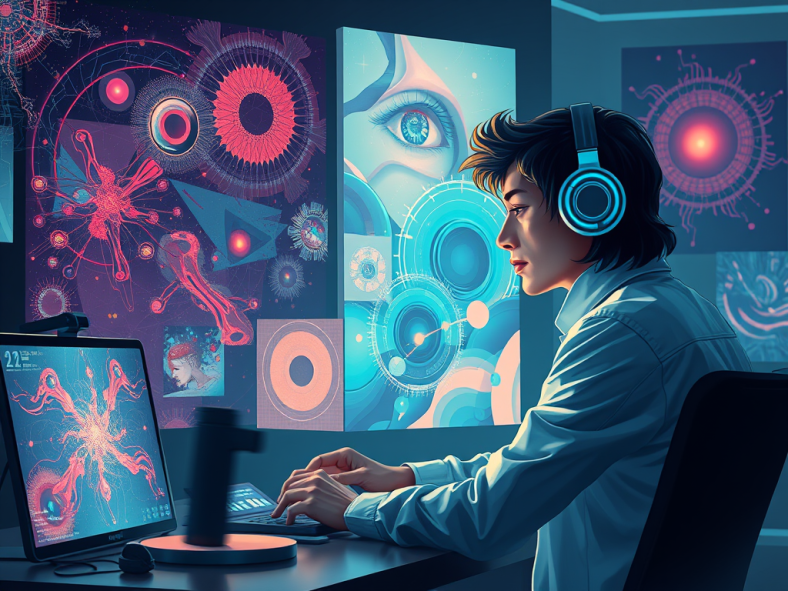
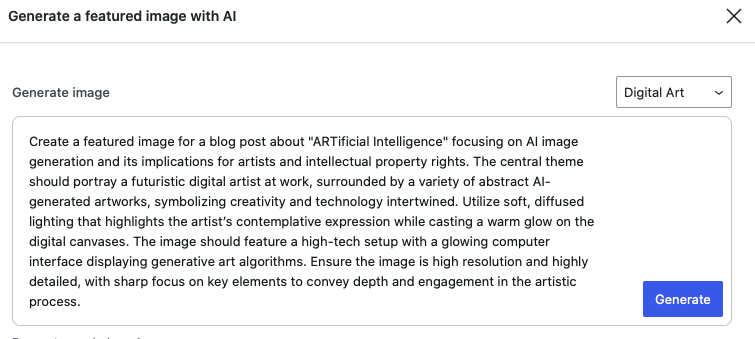
Whilst writing this post, I noticed the WordPress AI Assistant. It created the image at the top of this post after generating the following prompt based on the contents.

I’ll finish with Alan Turing’s warning which he gave in a lecture in 1951:

” Once the machine thinking method had started, it would not take long to outstrip our feeble powers. At some stage, therefore, we should have to expect the machines to take control.”

A Wobble

I’ve often suffered from buyer’s remorse; the last time it happened was when I bought my new rug in Marrakech. Did I just buy it in the fervour of the moment? Would it actually fit in at home? How was I going to get it back home on the plane? Would it fit in my suitcase? Did I pay too much? I did haggle for it, but did I haggle enough? Had someone else bought something similar and paid a lot less? If they had, how would that make me feel? Whilst I appreciate that the worth of something is what someone is prepared to pay for it, everything is so much simpler and fairer when there is a fixed price.

I experienced a new feeling recently – blogger’s remorse. Should I have posted ‘Three Conversations With My Mother’? In the moment it felt right, but as is always the case with me, the doubt started to creep in. The phrase ‘act in haste, repent at leisure’ could have been coined for me.

I’ve already mentioned that I seem to be a person of extremes – I’m either very guarded or a total oversharer, particularly after a couple, after which I’m plagued by cringe inducing thoughts. I had one such cringe whilst having a shower the other morning. I suddenly thought, everyone who sees my blog (I’m not kidding myself – it’s not that many!) now knows the most personal information about my relationship with my mother in her last days. Also, how would I feel if I saw my images elsewhere in the public domain? In all honesty, I felt a bit panicky and decided just not to think about it.

But not thinking about things and hoping they will just go away is not an answer. So, later that day I decided that I would process this sudden feeling of regret. I’ve always known, in the back of my mind, that I have to deal with that period of my life in order to move forward. Memories of it have taken my head hostage and I needed to offer a swap – somewhere else for them to inhabit, to free up my mind so that I have the space to remember all that was good. In essence, I have emotionally vomitted the negative and harmful feelings onto the page, and I can now look at them and still feel the way I did, but when I put them away, hopefully, they will stay away.

This course is a once in a lifetime opportunity for me, and I need to wring everything I possibly can out of it. I’m trying to find out who I am, and in so doing I need to be fully committed to the process. To avoid sharing parts of my life because they are too personal would be to cheat myself, and so, I’m all in.

Reflecting on Resentment I

During the last session we considered the premise that resentment blocks creativity.

Resentment is a feeling of anger or unhappiness about something that you have been forced to accept and you don’t like, or think is unfair. It comes from the Latin verb sentire, and so it is an emotion which is ‘re-sensed’ time after time, perhaps even increasing in intensity. Perhaps we feel resentment that other artists are better than us, or that they have works accepted in exhibitions and we don’t.

As I get older, I try as best I can to keep as much negativity out of my life as possible. I may initially feel it, but then I try to process it by turning it on its head, or actively dealing with it. I can’t feel resentment (in the sense of it being a recurring emotion) that other artists are better than me or are more successful – instead I use the initial negative feeling (which is probably more envy than anything else) to spur me on to try again, to fail again and to fail better, because inherent in that form of resentment is the feeling of failure.

For the last few years I have submitted work to the RA Summer Exhibition but I have never made it to the next round of judging. Each year I experience a moment of crushing disappointment and vow never to do it again, but then January comes around and off I go again. I’m clearly looking for validation, but I often think to myself that if ever I do get in I’ll probably never submit again, and maybe it won’t even make me happy.

My husband confessed to me that he had always wanted to paint. Why don’t you just do it, I asked him. He started with watercolours and over time became good at it. I suggested that he try oils as they are far more forgiving and I thought he might enjoy the freedom of using them. I bought him some as a gift along with some boards and brushes. He signed up to an oil painting class and shortly afterwards submitted one of his oil paintings to the Summer Exhibition. He made it through to the last 4,000 out of 16,000 entries on his first attempt. Did I feel resentment? No – I felt proud, with a strong sense of irony. He felt ecstatic with a strong sense of embarrassment.

If someone treats me badly I tend to think that it is more about them rather than me, but if it is something that I know will eat away at me and become a resentment I try to deal with it head on, unless doing so will cause irreparable harm. But, there is one particular instance of resentment which I haven’t been able to let go of no matter what I do, and I feel it as strongly today as the day I first felt it.

Caught In A Paradox

I’m typing this just as I’ve finished my tutorial with Jonathan, whilst I can still remember what we discussed – I did start taking notes at the beginning but ditched them as the act of note-taking became too intrusive. Consequently, I will probably forget bits, but this is the gist.

I explained that I’m feeling really positive about the course – just to be in the process is enough, and anything over and above is a bonus. Jonathan asked me what I wanted to get out of the course. What I would like is to find out who I am, which is a bit of a cliché, and to develop a rhythm of working so that art becomes a major part of my life: up until now I have had to carve out time to spend making art.

Jonathan asked me what my life is like in terms of whether it is ordered: no, it’s totally disordered with no real routine, fire-fighting issues and dealing with lots of things at the same time. Jonathan commented that the idea of spinning plates has its own rhythm. It has, but I feel that I need to develop a discipline in my artistic practice – I have no real self-discipline in many areas of my life.

Jonathan then asked me what my strength is. It’s getting things done: I can be determined, persistent and I don’t give up. The downside to this is that I’m goal driven (which causes issues in terms of concentrating on the end product, rather than the process), and I tend to jump right in. Thinking about it now as I write, not giving up can result in me being relentless and not knowing when to walk away and leave something – my mother used to describe me as a terrier.

Jonathan mentioned the story on my blog about my shopping habits: the act of wandering from shop to shop contradicts the idea of jumping in. I agreed that actually I should shop more like my husband in terms of reaching a goal, and that the act of wandering is not enjoyable but full of pressure: to find something which meets the criteria by the deadline. Not buying the first thing I see which would suffice, may indicate a reluctance to commit before exploring all the options.

What does it feel like to be working at my best? I lose all sense of time. I’m lost in time. Nothing else matters. I can look up and find that it’s dark and it’s 9.30pm and the dogs and my family haven’t eaten. But then I can look at what I’ve done and, if I’m not happy with it , think how I’ve wasted those hours of my life which I’ll never get back and which I could have spent doing something more productive. Jonathan commented that there was a paradox in terms of being lost in time and losing time. He asked me to describe the sense of loss of time: it’s huge and full of resentment in the moment, but then dissipates as everyday life starts to take over again, until it eventually disappears.

We talked about some of the things that I’ve been trying out, and I explained that I’ve been purposely not viewing things as good or bad (although I did on my last post!) or as a success or failure. You can only fail if you have an expectation and that every experience, whether good or bad, is a valuable learning experience. Jonathan agreed and commented that the purpose of the act of mark-making is to tell us what to do next and if it does this, then it’s done its job, even if it is to tell us not to carry on. He sensed a real frustration in my experiments with the iPad. I did feel frustrated but even though I had reached the view that it wasn’t something for me in terms of producing a final piece of work, I did appreciate its usefulness for preparatory work. Jonathan mentioned that a lot of artists use it for this purpose in terms of working things out, like composition, and referred to Justin Mortimer who produces large oil paintings.

I explained that I have been doing a lot of thinking recently and have a lot of ideas inside my head – In fact, I can’t stop thinking about it. I’ve also been getting a lot of inspiration as to how to express these ideas in terms of producing work. If we had had this tutorial a few days ago I would have been excited and energised, but I now seem to be less so, as I feel a resistance to attempt to translate the ideas into actual work. It’s not a fear of failure as such, but a reluctance, or maybe a fear that once I try to capture the idea it won’t be as good as it is in my head. I would usually jump straight in and, more often than not, end up feeling frustrated or disappointed. I’ve recently found that thinking about and planning a work results in less dissatisfaction in the end result, but it seems that the act of stopping and thinking creates a barrier, an inertia, to moving forward. It’s a bit like how I would imagine doing a parachute jump: I check that I have everything I need in order to jump safely, but I still can’t get myself out of the plane. The other side of me would just jump. I mentioned the blog: I’m not on social media and I like to keep myself to myself and fly under the radar, yet I enjoy the process of writing the blog and this is fine as long as I don’t think too much about it ie that it’s public (as an aside whilst I’m writing this, I have actually searched for it on Google and it doesn’t come up so that makes me feel better!).

I then told Jonathan about a proof-reading distance learning course I signed up for many years ago, as I thought it could be something I could do whilst my daughter was young. I received the first couple of modules in the post and did the first assignment. The feedback was good but finished with a reminder that the marks from all subsequent assignments would count towards the final mark. That was it for me, I couldn’t carry on. We discussed why this might have been the case. I think it was because I hadn’t done perfectly on my first assignment and that I might not even do as well in future assignments. When I was young I would come home from school eager to tell my mother how I had done in a test – then she would ask me how everyone else had done – I didn’t understand at the time, why she couldn’t just be pleased with my result, like I was. I grew up to be a perfectionist, with a view that if you are going to do something, you should do it to the best of your abilities – I have since realised that what is your best can be influenced by the circumstances at the time. Jonathan reassured me that that is why the course is the way it is – there is no assessment of a final work or comparative approach for the very reason that it would cause students to freeze up.

Jonathan commented that my perceived weaknesses are actually also strengths in that the tendency to rush in, would deal with this issue. He observed that I had mentioned the word ‘fear’ quite a lot and asked me to describe the fear. It’s like a barrier in front of me but it’s not insurmountable and it’s transparent in that I can see beyond it, to where I need to get to. Having said that it clearly wasn’t insurmountable in terms of the proof-reading episode, but that was a long time ago! To get past it I need to act, and in this respect, Jonathan said that’s where I need to draw on my strength of jumping right in without thinking about it.

We concluded that there were many paradoxes in what we had discussed and that perhaps the solution is to try and combine the two sides of me in terms of moving forward in my art practice. I commented that perhaps the paradoxes are caused by me thinking that I’m one version of me when actually the real me is someone else, which is what I want to explore. Is the real me the baby who was born, or the person I now am with all the baggage I’ve collected along the way? I recognise that my strength of getting things done is probably as a result of my career. Jonathan commented that it is the question of nature and nurture and who they are is something artists ask themselves, so it’s far from being a cliché, it is actually what art is all about.

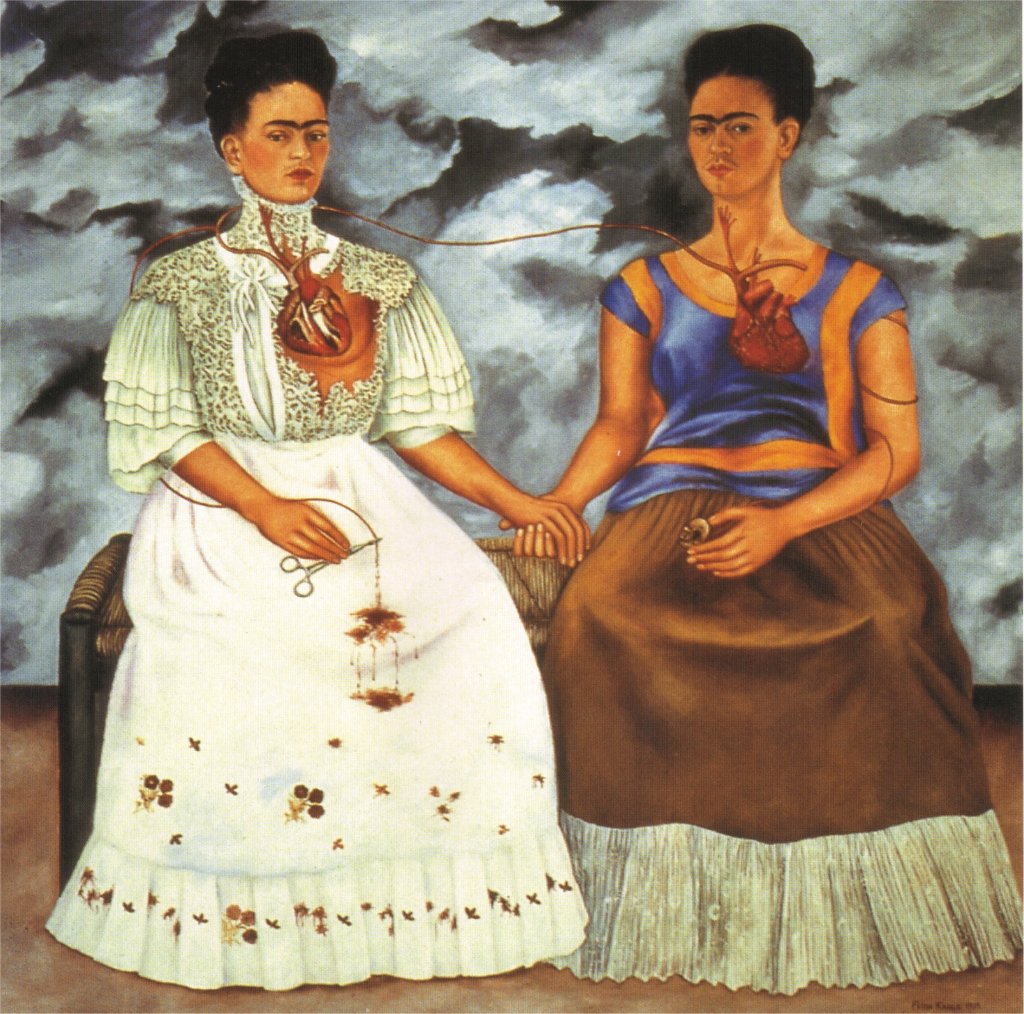
I then asked Jonathan about something which has been niggling at me: I draw inspiration from various sources to help me see ways to express my thoughts in work. I gave the example of the Two Fridas and the passage I had come across in a book I had seen in Waterstones about siblings and the primal connection through umbilical cords. In drawing on these sources, am I creating anything new, unique, or will someone just look at it and think ‘that reminds me of the Two Fridas’? Is it enough that it is coming from me and about how I feel? Jonathan assured me that it is ok to draw inspiration from others – the Two Fridas was personal to Kahlo and painted 80 years ago – I would be making it now, in 2024, and it would be personal to me.

What will I do for the next hour? Go away and write up my note of the tutorial before I forget it, which will be a useful process to consider what we discussed. Jonathan pointed out that at the beginning I had said that I had wanted to make art a bigger part of my life and that during our chat I had said that I couldn’t stop thinking about it, so I’m on my way and I should just keep doing what I’m doing.

I’m still feeling positive, and I would venture to say, even more so. I need to cogitate on what we discussed to move forward, but for the moment, everything is all ok.

Sisters

“A sister is not a friend. Who can explain the urge to take a relationship as primal and complex as a sibling and reduce it to something as replaceable, as banal as a friend? Yet this status is used again and again to connote the highest intimacy. My mother is my best friend. My husband is my best friend. No. True sisterhood, the kind where you grew fingernails in the same womb, were pushed screaming through identical birth canals, is not the same as friendship. You don’t choose each other, and there’s no furtive period of getting to know the other. You’re part of each other, right from the start. Look at an umbilical cord – tough, sinuous, unlovely, yet essential – and compare it to a friendship bracelet of brightly woven thread. That is the difference between a sister and a friend.”

‘Blue Sisters’, by Coco Mellors

I stumbled across this passage whilst I was having a mooch in Waterstones on Saturday. It cuts right to the heart of what it is to be a sibling. I find the imagery particularly strong – the inhabited space of the womb, growth and development, umbilical cord, connection. Lots of food for thought.

‘The Two Fridas’, Frida Kahlo 1939 (oil on canvas)

On the subject of thinking, this image above has been floating around in the back of my head whilst I’ve been contemplating my role as a sibling, and as a mother, but more on the latter some other time. In this painting, Kahlo’s traditional identity is connected by an artery from her complete heart to the heart of her modern identity which has been torn apart by her divorce from Diego Rivera. I find it a very powerful image: full of pain and conflict, but, at the same time, resilience. It’s already informing some ideas for a piece of work.

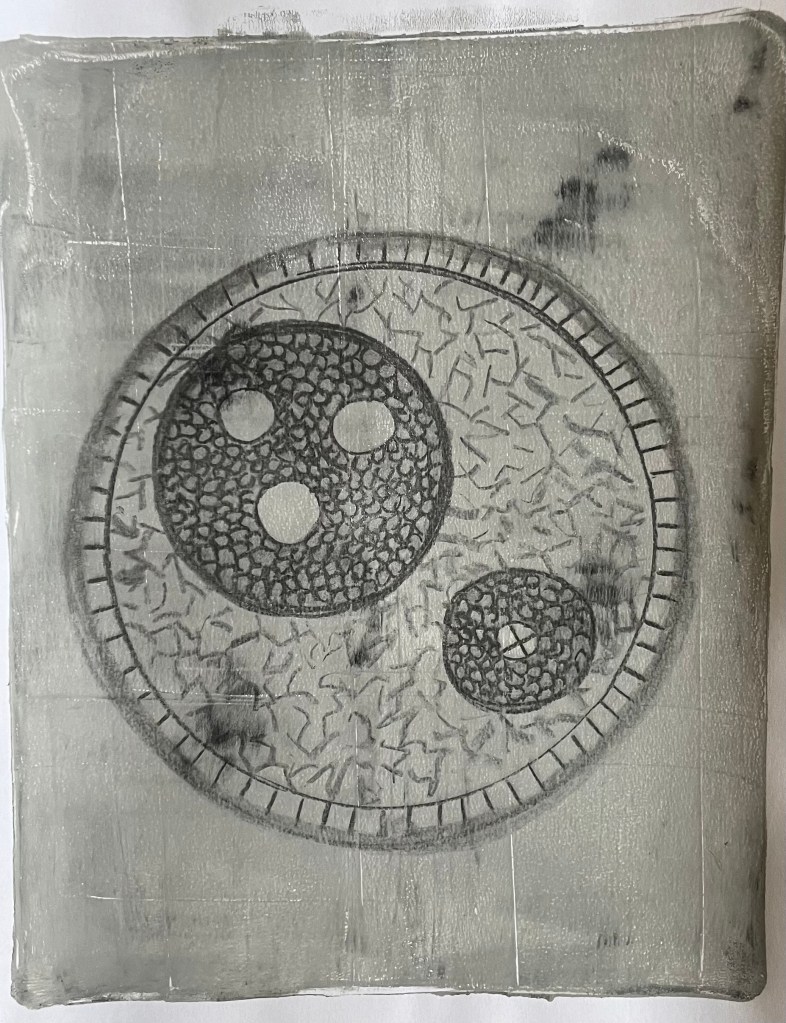
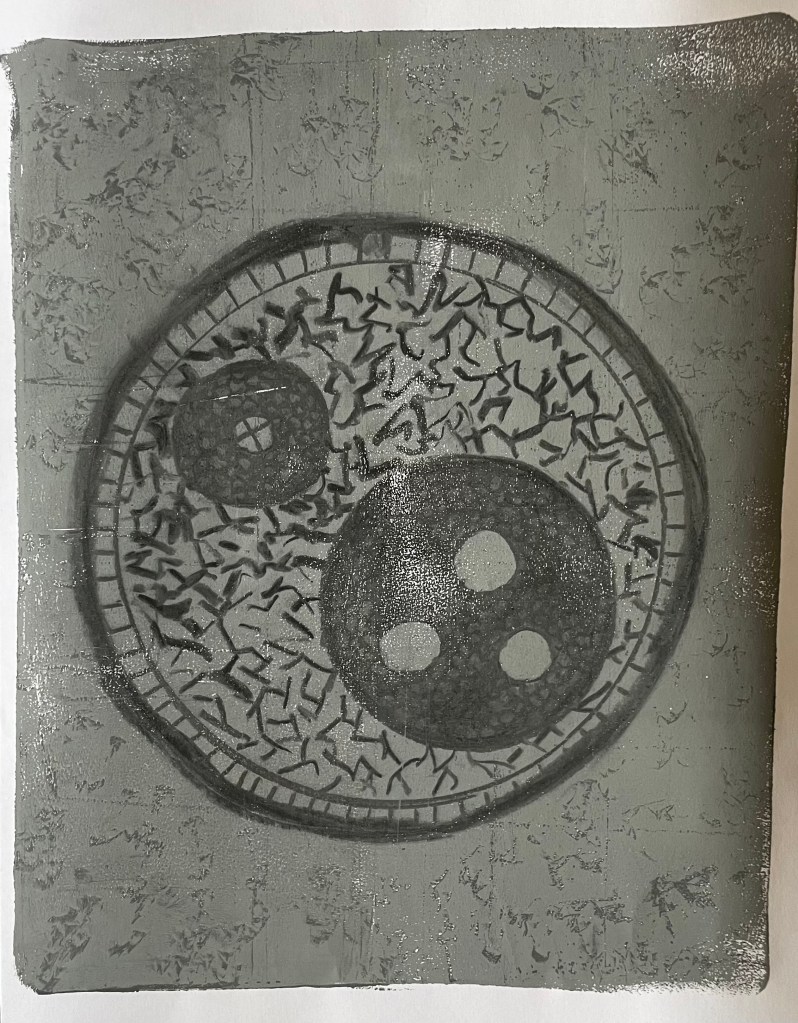
I’ve been experimenting with pressing charcoal drawings onto a gelatine plate and then printing – the archival quality it produces is interesting – and also applying paint onto the plate randomly. It was all done in a bit of a rush as I suddenly thought: less thinking, more doing. I didn’t find the process satisfying: the colours are really unappealing and murky – in fact they are just varying shades of grey. I’ve been meaning to try this process for sometime now, since I saw it on a facebook reel, so I was really quite excited at the outset but I ended up feeling underwhelmed – the subtleties inherent in charcoal are totally lost. Maybe starting with a cross-section of an unlovely umbilical cord inadvertently set the tone, but my quickie self-portrait certainly expresses how I felt!

So, here’s the bad and the ugly…

Miscellany I

I’m conscious that I committed to doing an automatic drawing a day to try and change my mindset. I’m allowing myself the inclusion of exploring Procreate as well!

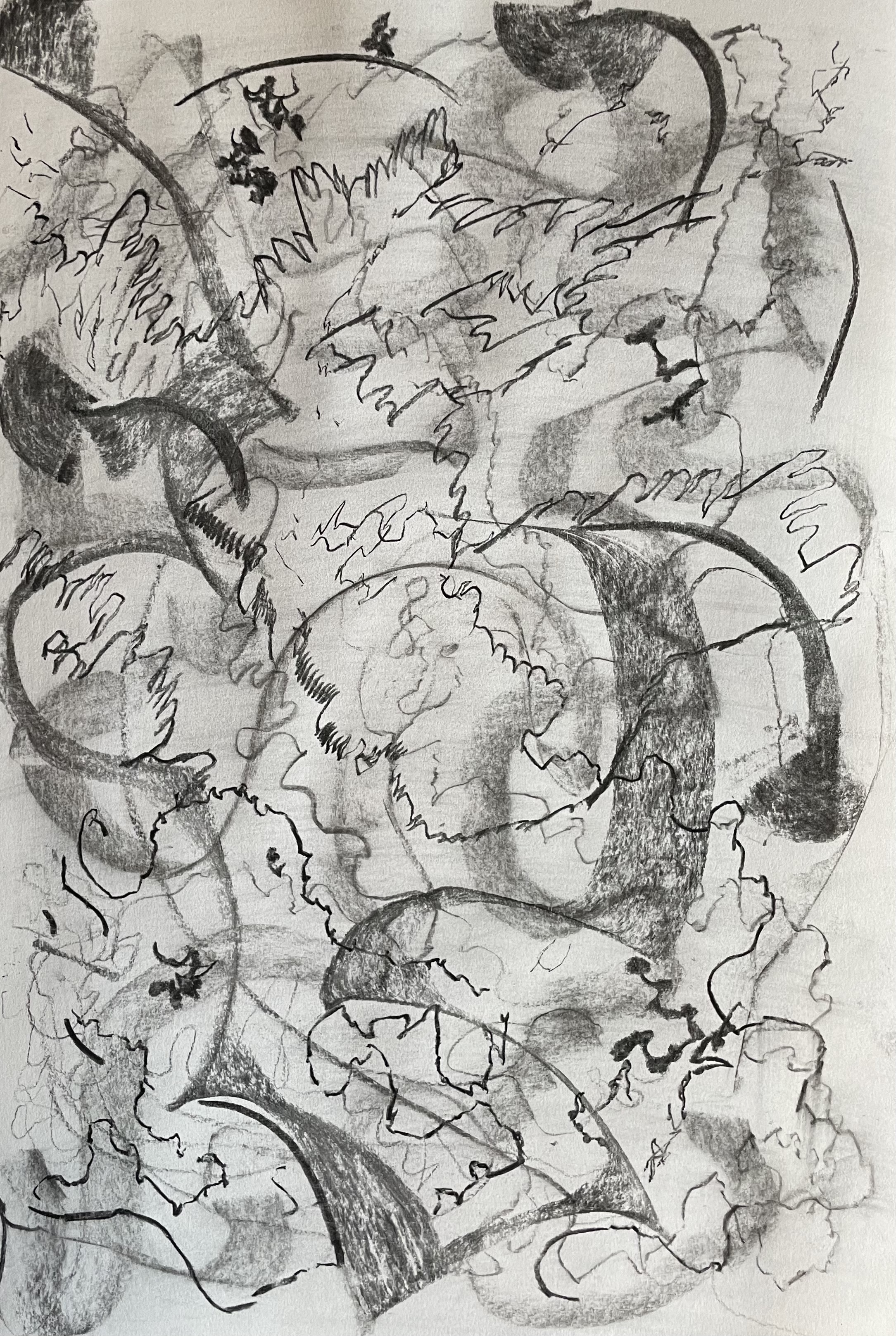
I particularly like the charcoal drawing. I used a piece of compressed charcoal and made swirling marks using it on its narrow edge and full on its side. I then rubbed it out and repeated it but this time playing around with the end and varying the motions. The concept of layers appeals to me (memories, past lives/ identities…) particularly the traces left behind of the first drawing and I was surprised by the range of marks I made depending on how I held the charcoal and the pressure I used. There are some delicate areas, followed by some jagged, harsh marks. Some lines appear to be faltering and hesitant whilst others have more purpose and at times are almost punctuation marks in what would otherwise be a stream of unconsciousness.

The second image I am treating as an automatic pastel drawing – I randomly chose colours and effects from the Procreate menu and I think the result is interesting, although I miss the haptics and the smell of the real thing as well as the tactile relationship between the medium and support. I’m not sure that I would use it going forward, except maybe as a tool to experiment with, although I have previously decreed that collage is just not my bag – how times change! I might use it if I decided to go down a graphic flat colour route (as in the third image) and digital collage is something I will definitely explore further – no bits on the floor and no need to glue – what’s not to like? I’ve been thinking about how I could incorporate digital collage into a mixed media piece of work – perhaps a giclée print onto a canvas, sealed with medium and then oil paint?

There are lots of thoughts chasing themselves around my head – I’ve been ignoring them in the hope that as and when I consciously acknowledge them they may have already got themselves into some kind of order. Just doing what I’m doing at the moment seems to be creating even more possibilities and permutations which is exciting.

I can sense that I’m feeling a lot more relaxed about making my experimental work ‘public’. I really look forward to starting the day by just letting my hand wander across the page – it’s the only time when there’s no expectation on me to achieve anything – renewing the buildings insurance, fixing the E20 error message on the washing machine – just a moment when I’m at one…

Trying Not To Overthink It

Guilty as charged: I have form for overthinking, overworking, not knowing when to stop and basically bludgeoning a piece until there is no life left in it. My problem is that I have an expectation of how it should be. It’s not even as if I enjoy the process – it makes me frustrated, stressed, and downhearted to the point of threatening to pack it all in. So, to put an end to this way of working I need to adopt a new approach; create a new habit but one which opens up possibilities, as opposed to closing them down. Admittedly, I have already begun to experiment more recently, but it needs to become second nature.

There’s a lot to be said for drawing exercises; I’m a particular fan of continuous line drawing but the drawback (excuse the pun) is that I’m still drawing something, I’m just not allowing myself to draw it as accurately as I might otherwise want to, and so there is still an expectation as to how it should look.

Sometime ago, I watched a documentary about Maggi Hambling. She gets up at 5am every morning and with a cup of coffee and cigarette in hand, she starts her day by making a drawing – she doesn’t like the term sketch – using an ink dropper and, in this particular instance, with her eyes closed. It is a form of automatic drawing, a concept embraced by the surrealists and latterly by the abstract expressionists, which involves the artist making marks without any conscious control.

I think this is for me!

There are numerous possibilities: pencil, charcoal, ink, paint, collage, eyes open, eyes closed, different ways of holding, holding more than one, dominant hand, non-dominant hand and the list goes on.

So this is the first of my daily automatic drawings:

I used a charcoal pencil in my dominant hand and, with my eyes open, I just let it wander over the page without any conscious thought or control. Maintaining the same pressure and manner of mark-making started to become a bit tedious so I almost unconsciously varied the pressure and the way I made the marks, holding the pencil higher up so that there was less control from my hand, rocking it backwards and forwards in my hand, holding it perpendicular to the page and then on its side. It was a sensory experience in that I was aware of the feel and the sound of it: the sound of the charcoal on the paper and the squeaking and stuttering of it on the upward stroke creating broken lines, as opposed to the smooth downward marks. I then randomly smudged and blended some areas.

There are some quite interesting passages and if this is my subconscious expressing itself then I might have cause for concern! All in all, I’m pleased with what I produced because I enjoyed the process – instead of being mindful, it was mindless – and I hope that if I do this often enough I might just free myself up.