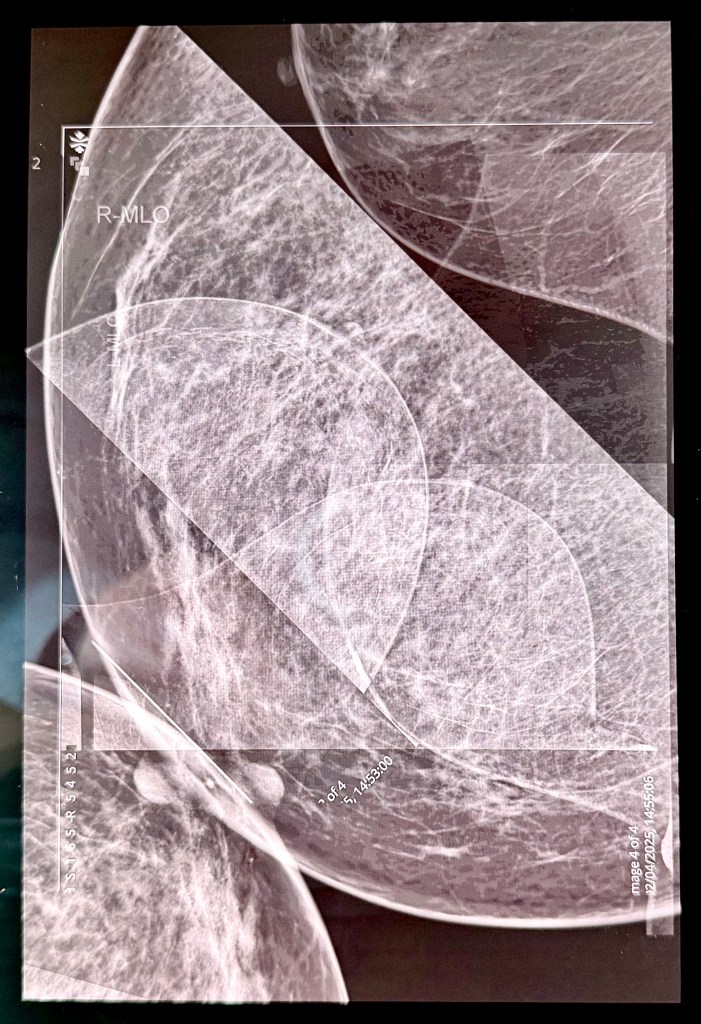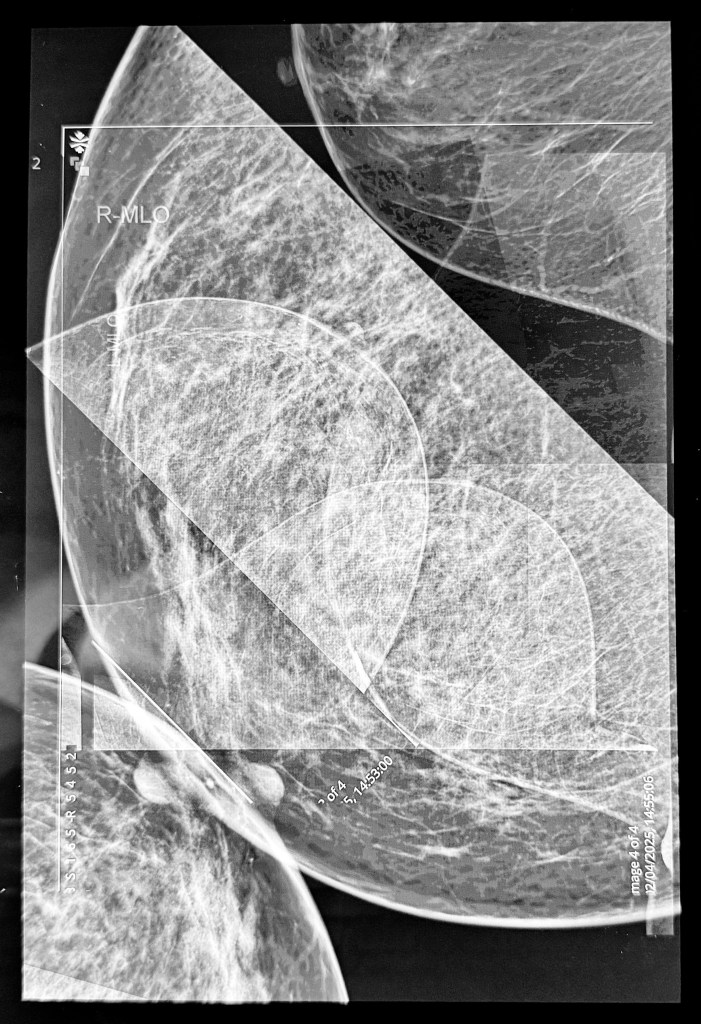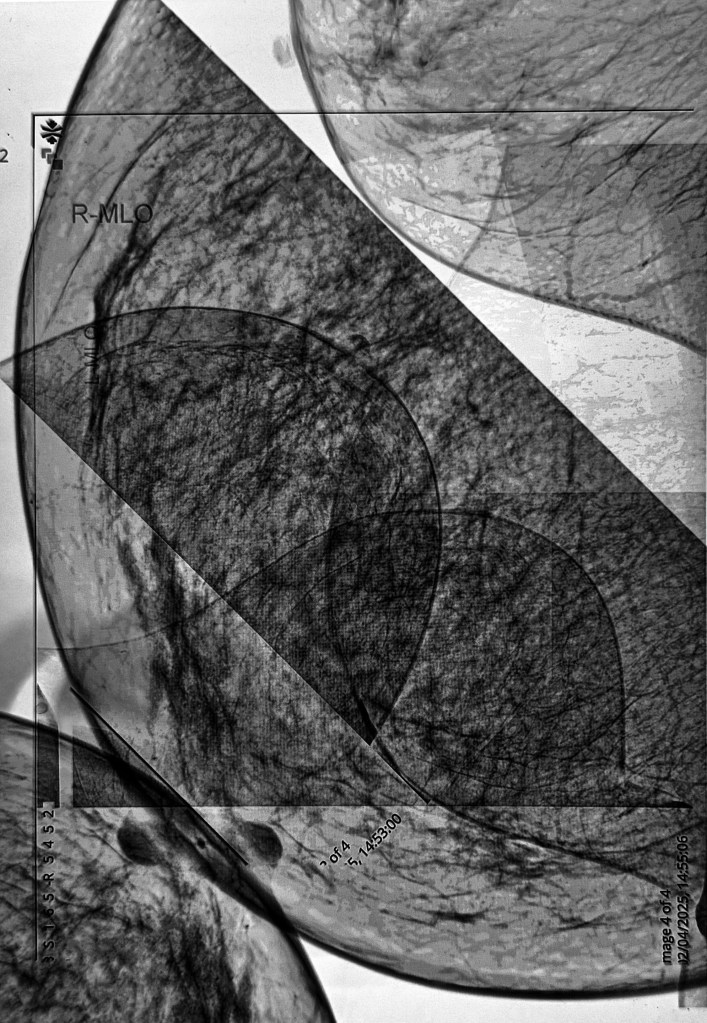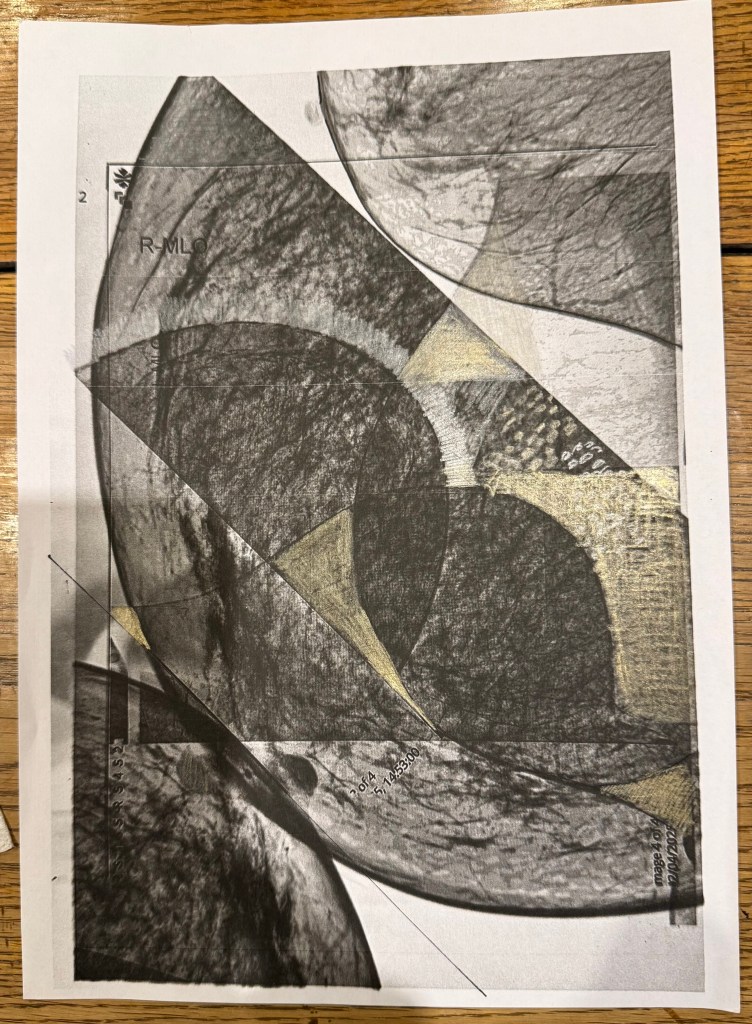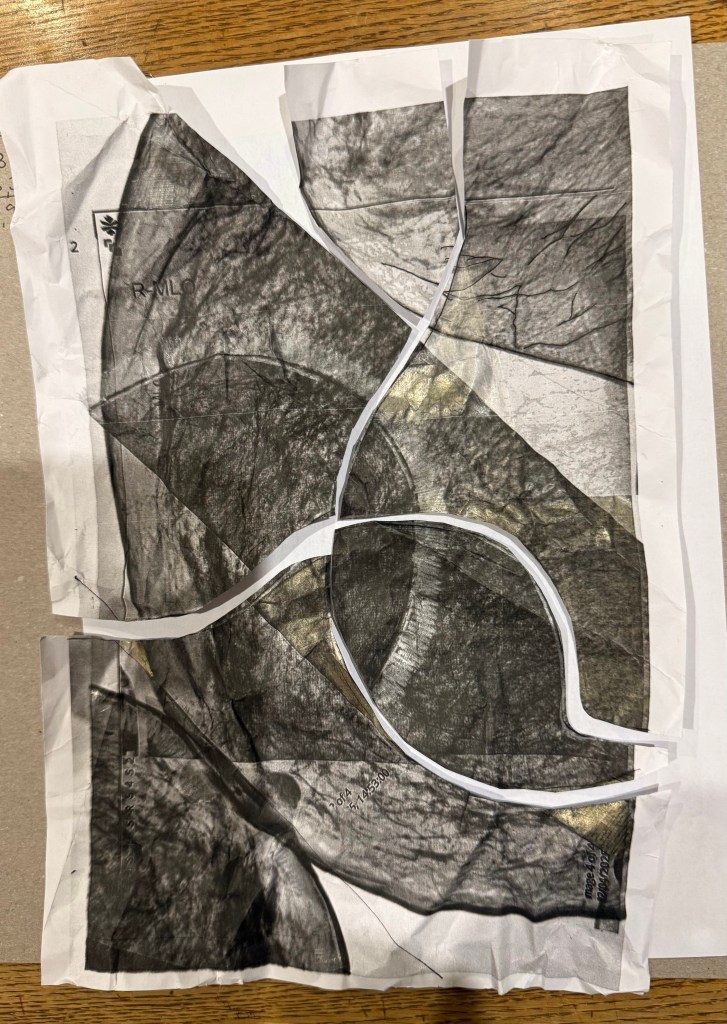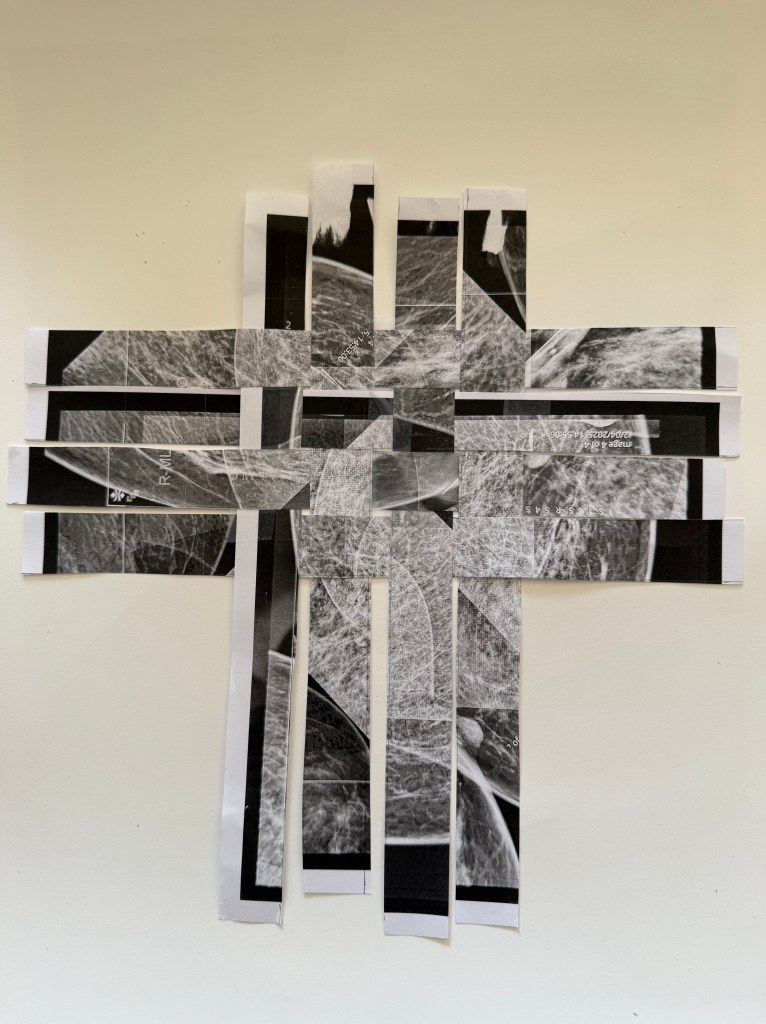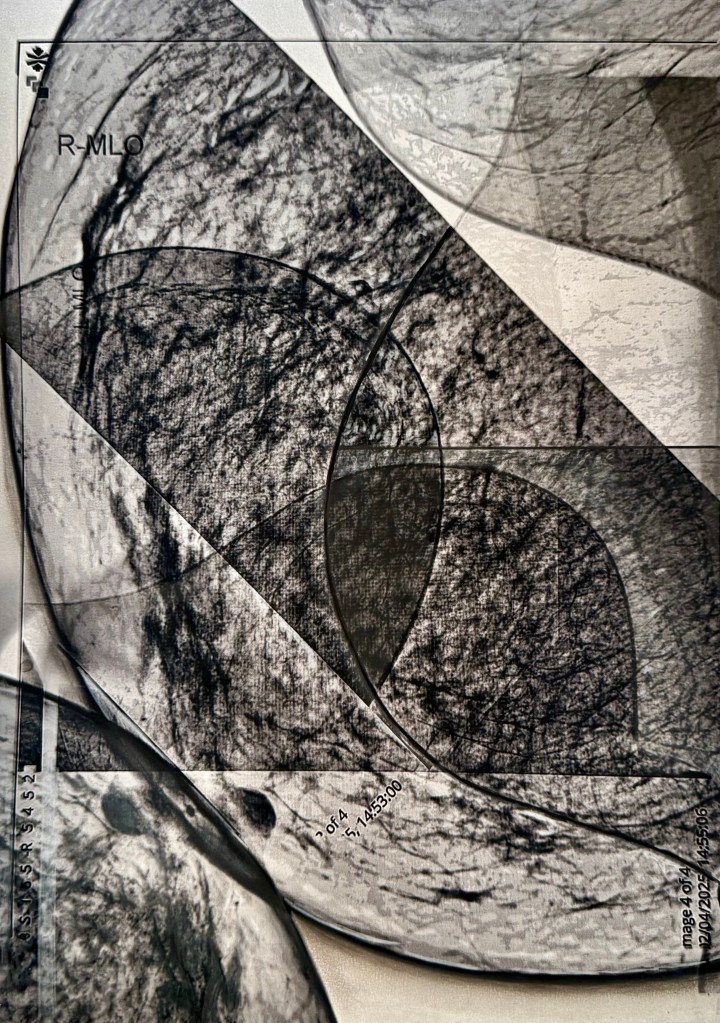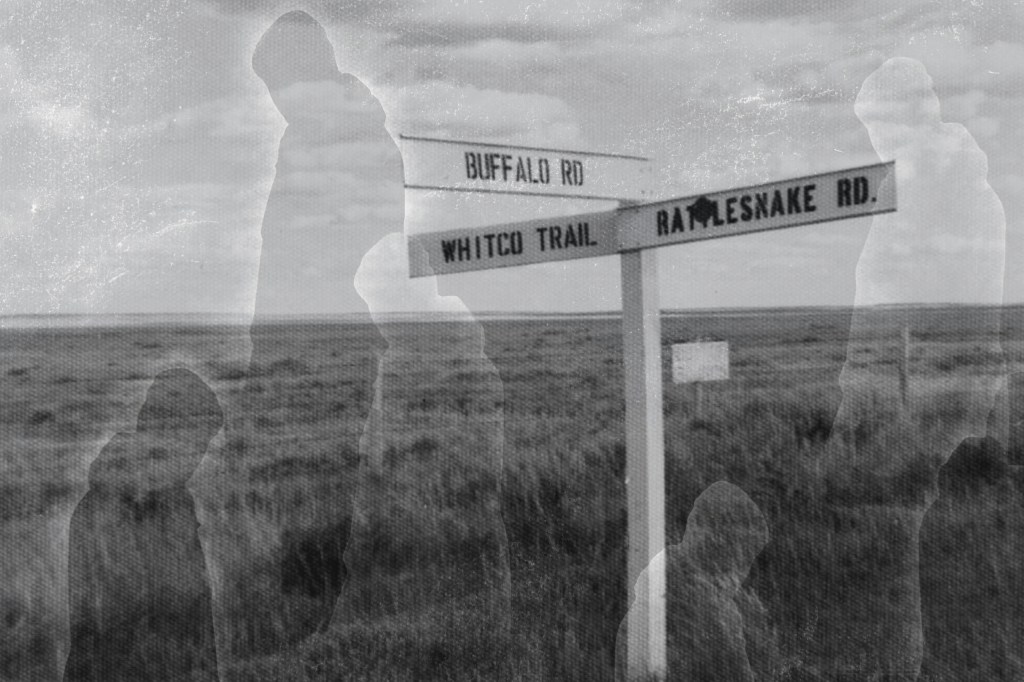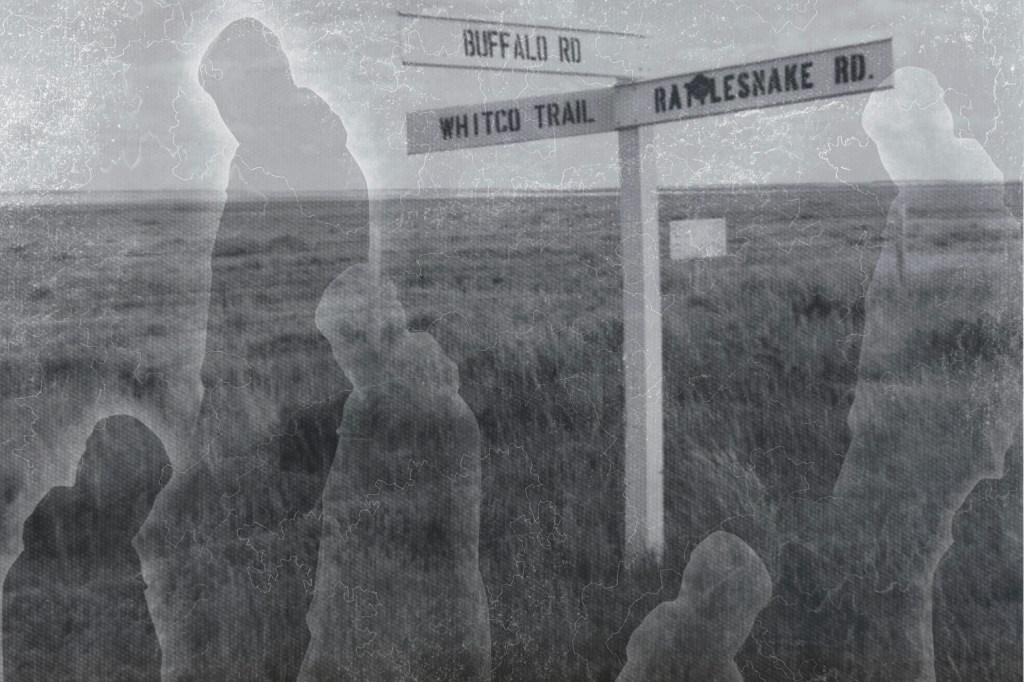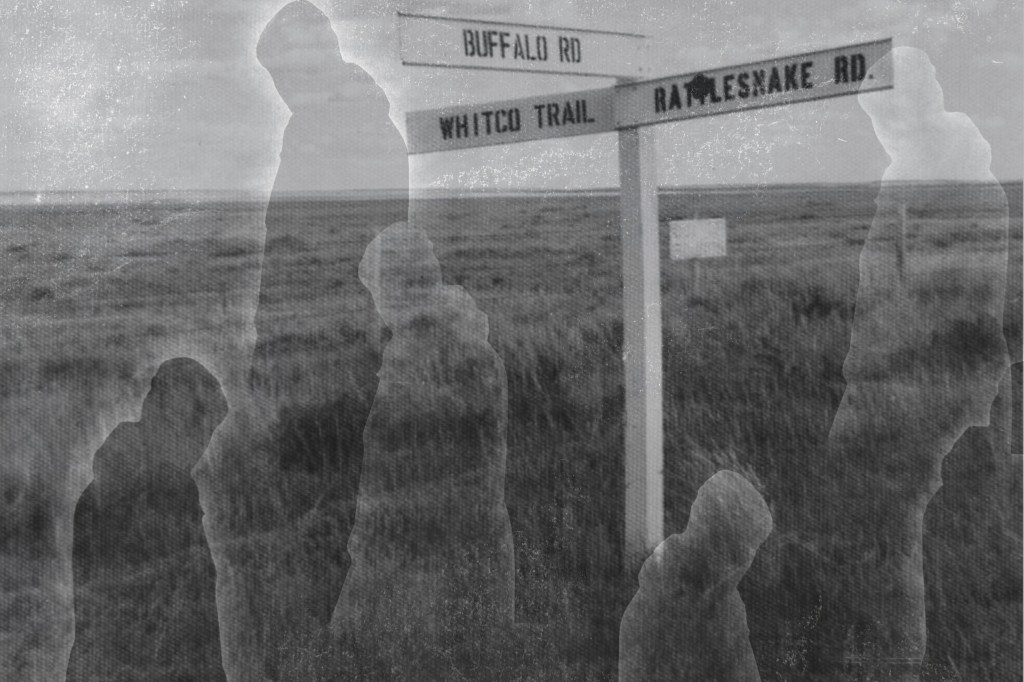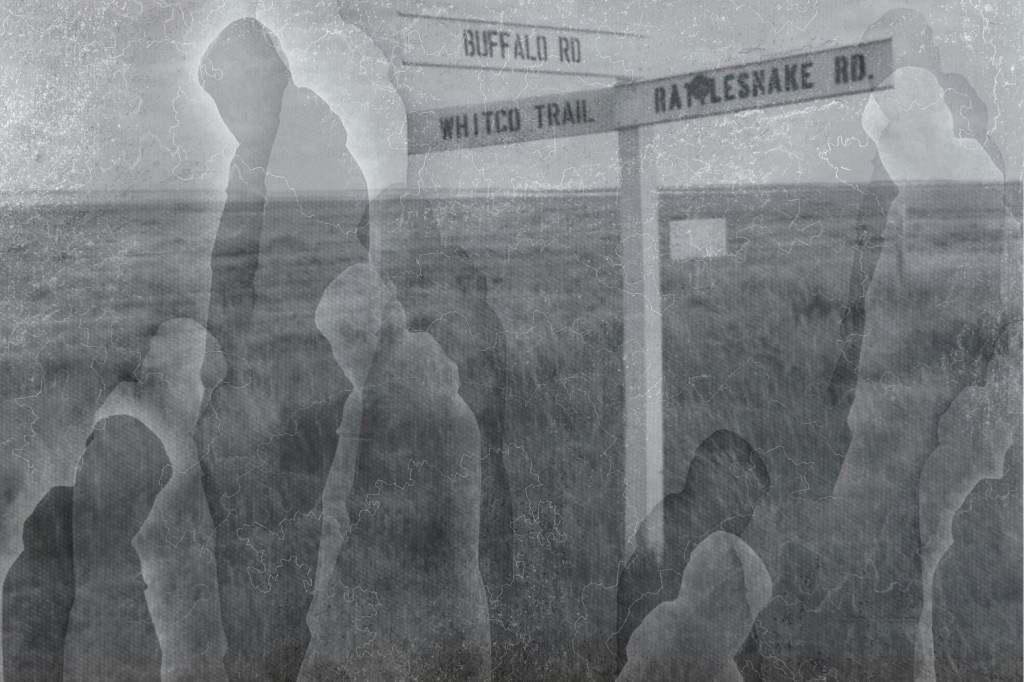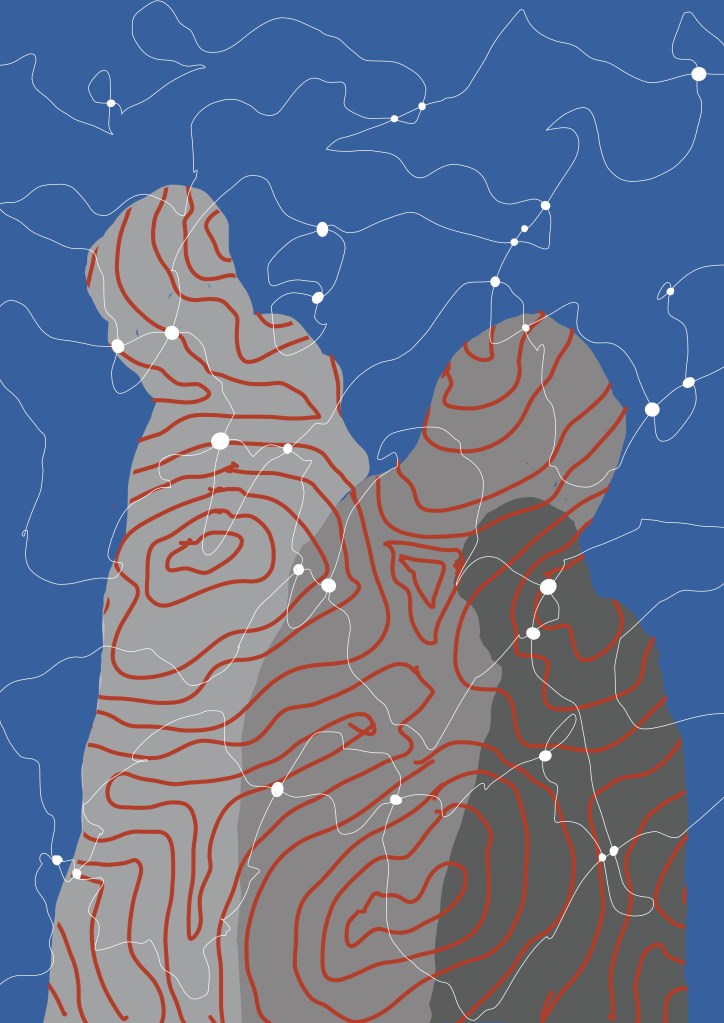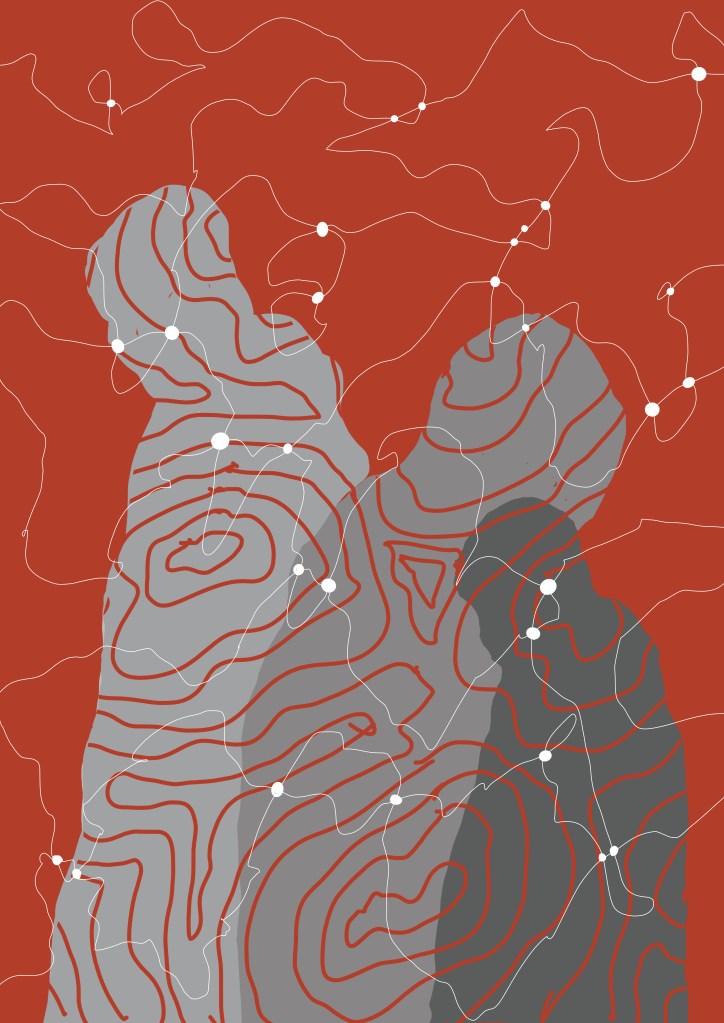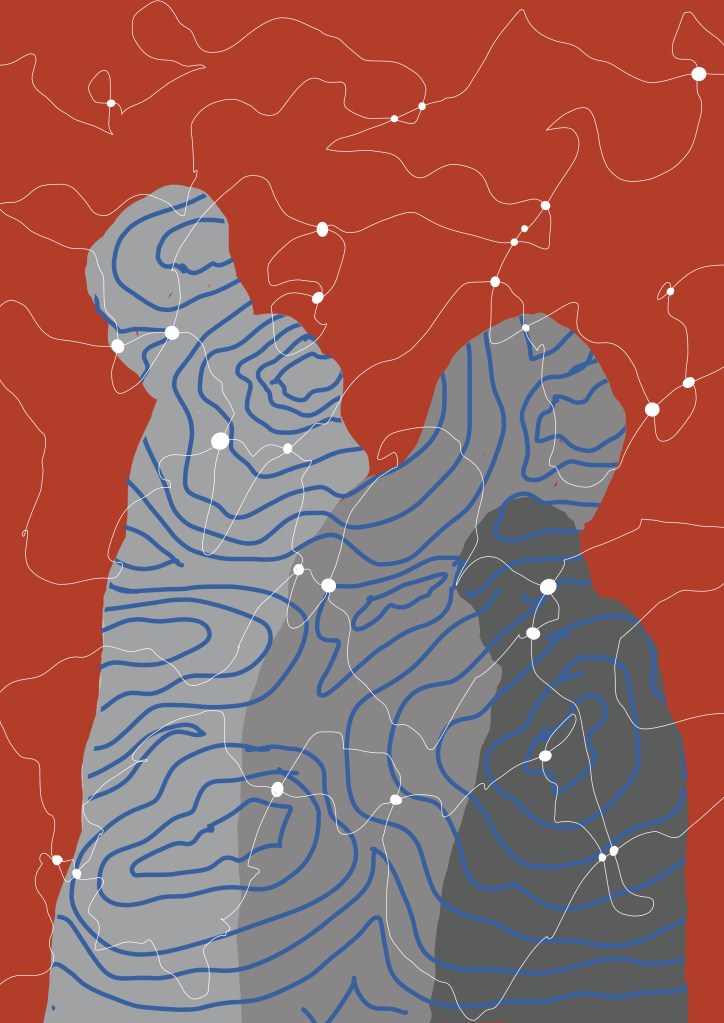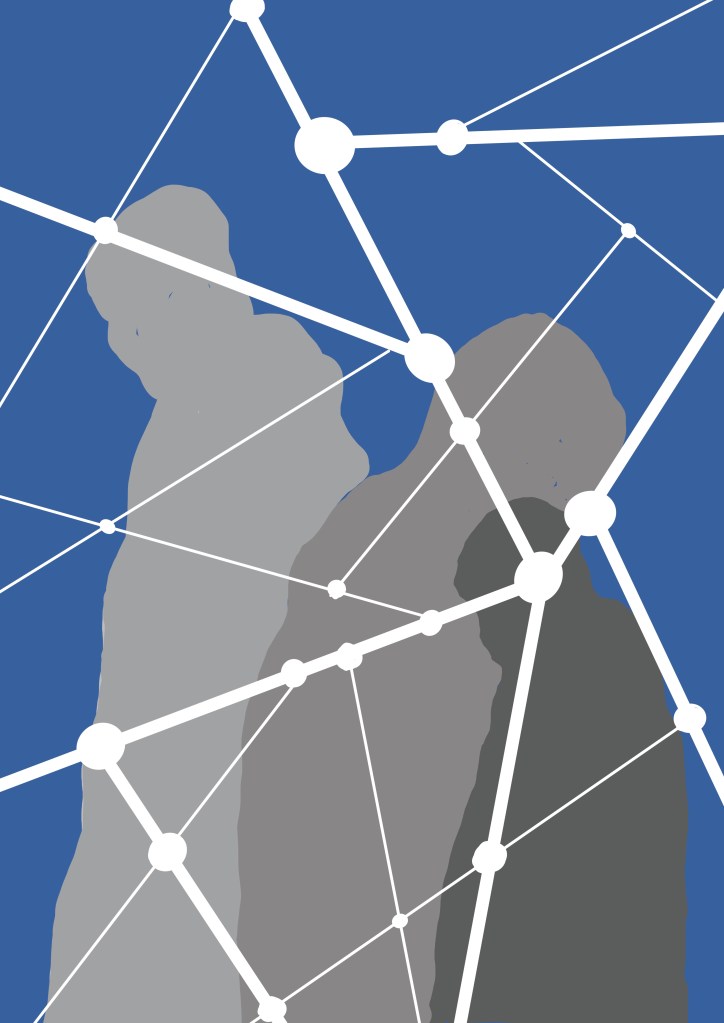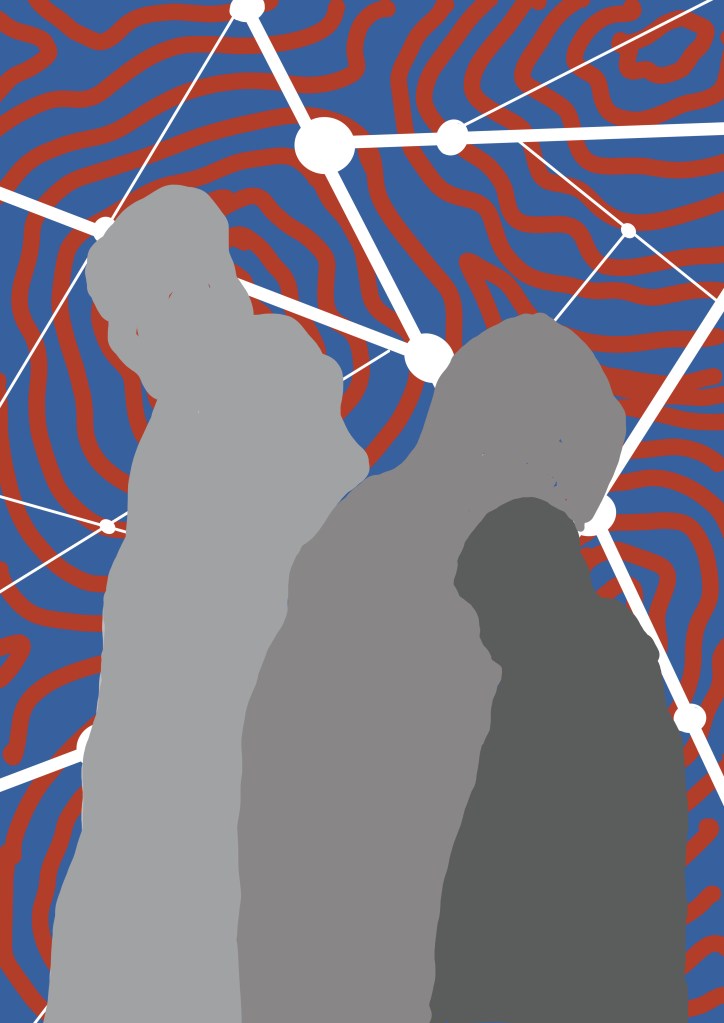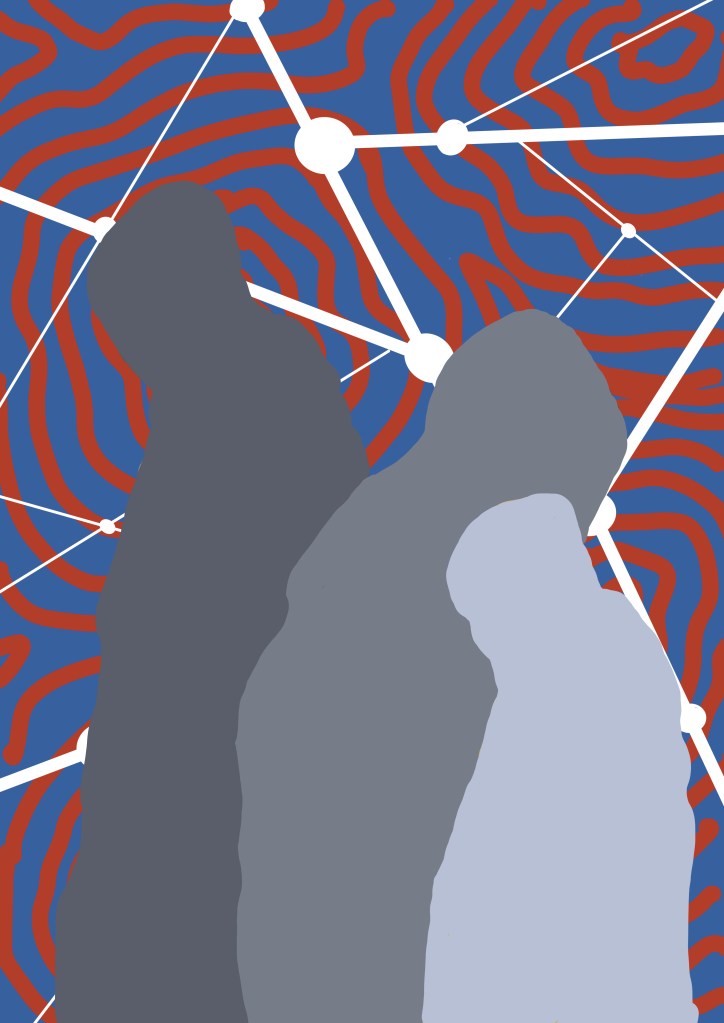
I’ve decided that I would like to make physical prints for the Editions Sale, if possible, and I have resolved to do a linocut, on the basis that I don’t have an etching press at home, and I probably won’t be able to make it in to CSM this month. I also want it to be something which is relevant to, and an extension of, my recent work.
I’ve not much experience of linocutting, but this is a good opportunity to try and improve my skills. I’ve been experimenting with some of the mapping imagery that I’ve been exploring over the last few months.
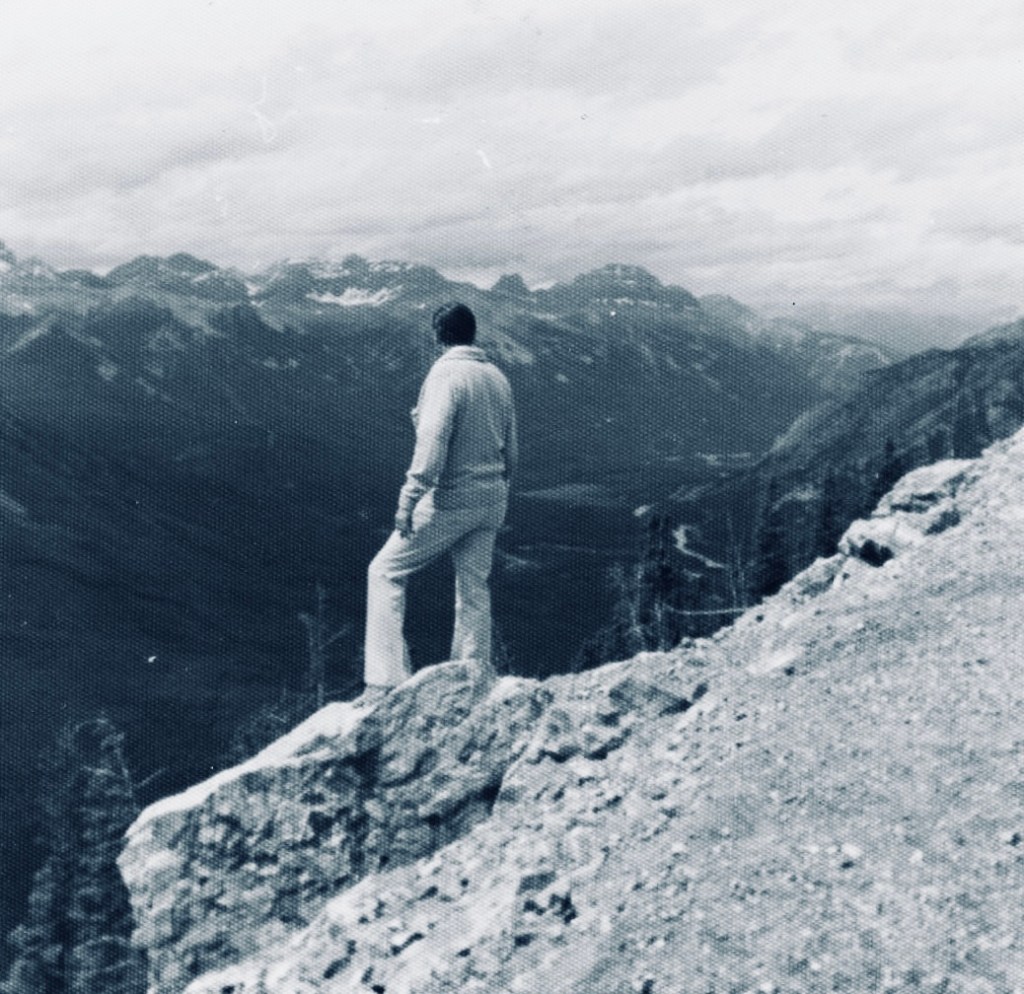
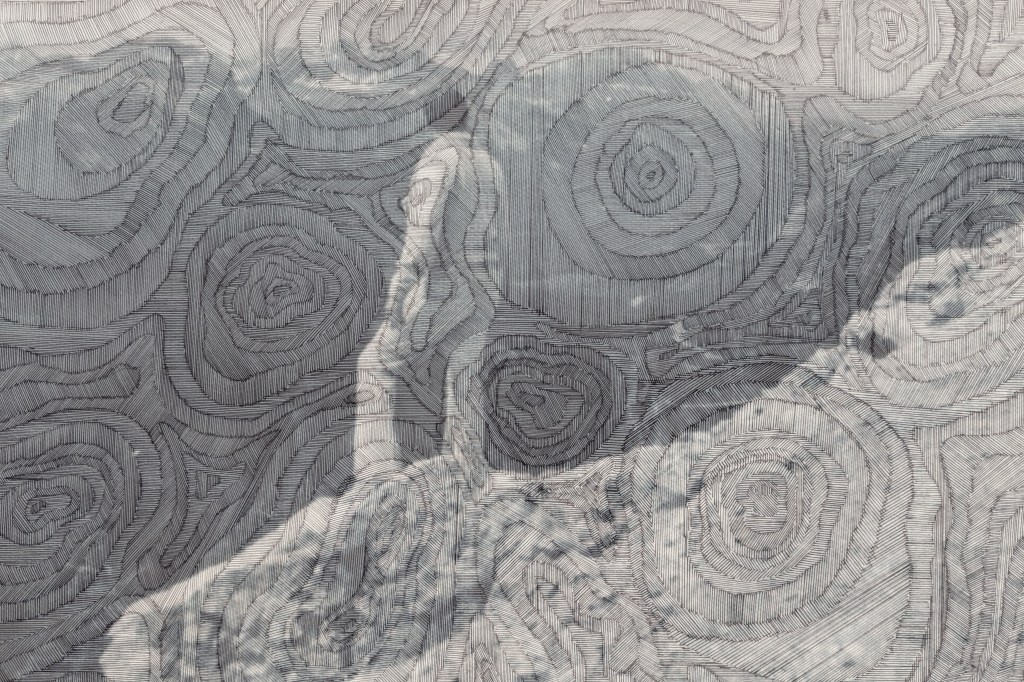
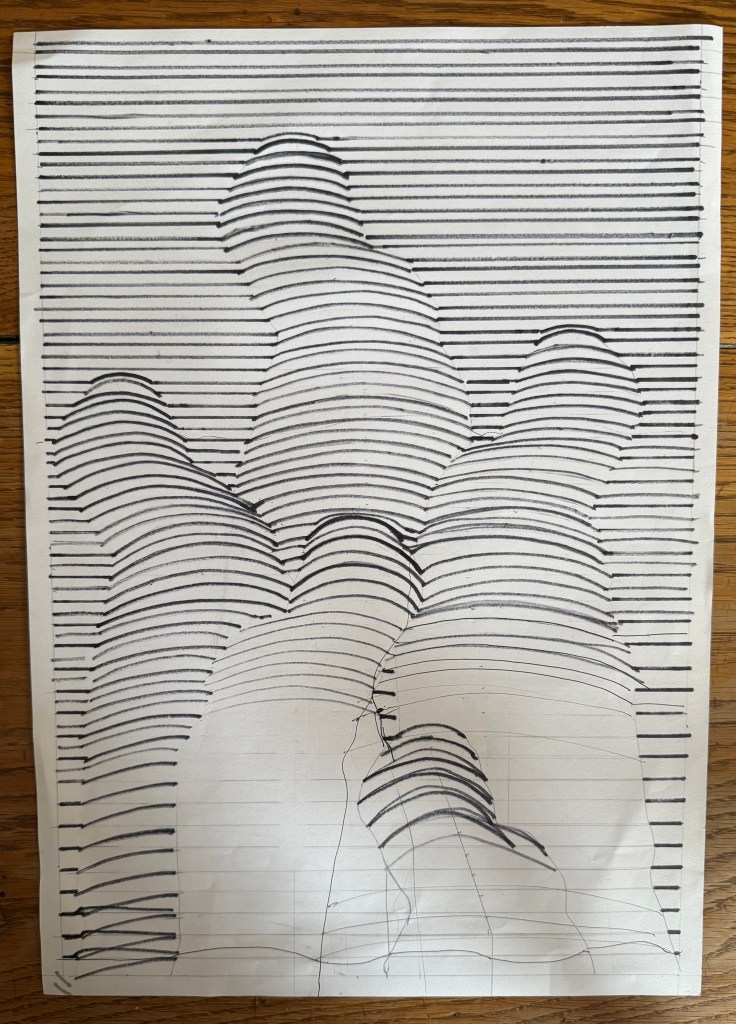
Originally I thought about the line drawing I did and how form can emerge from lines. I used my father’s silhouette from Solitude to experiment.
The lines are all over the place as I did them freehand (how does Bridget Riley manage?) and there were a few errors. In the top half I experimented with rounded curves, whilst in the bottom half the lines are flatter.
I tried drawing out how it might work but in the end I decided that it would just be too difficult, and gave up.
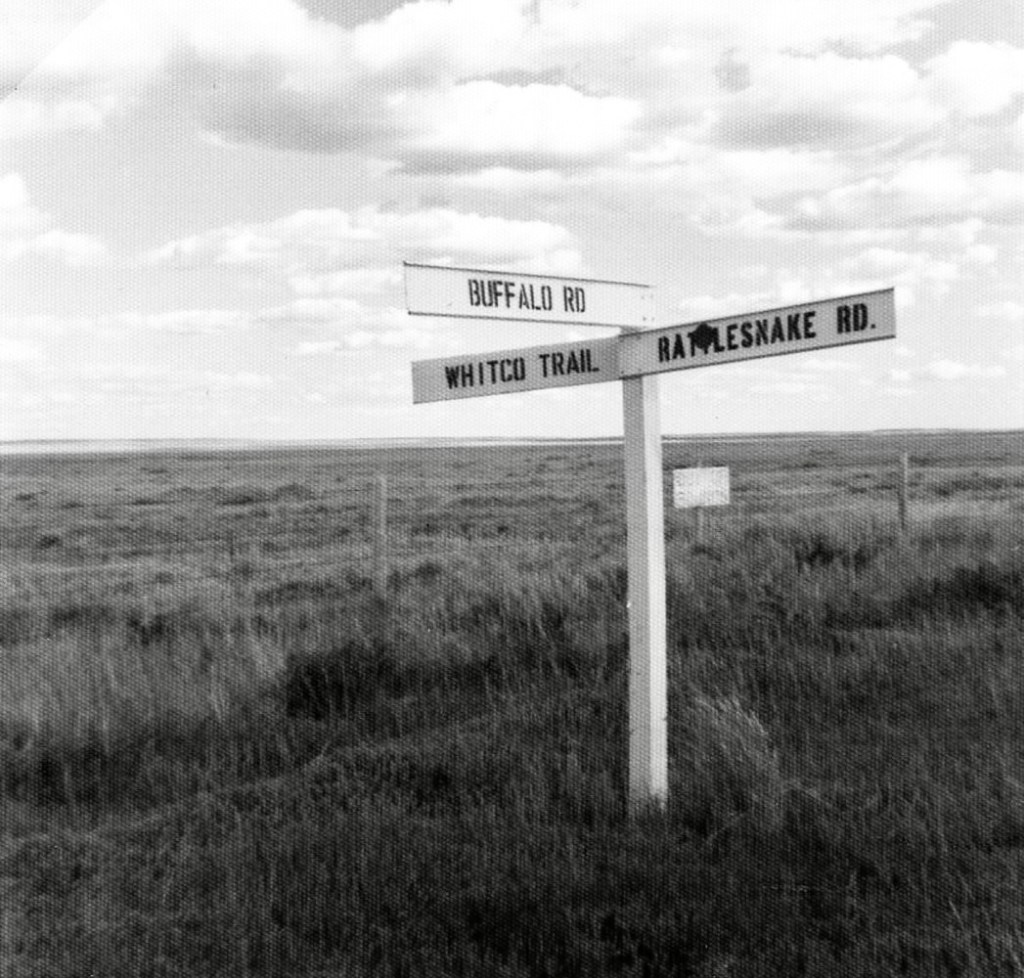
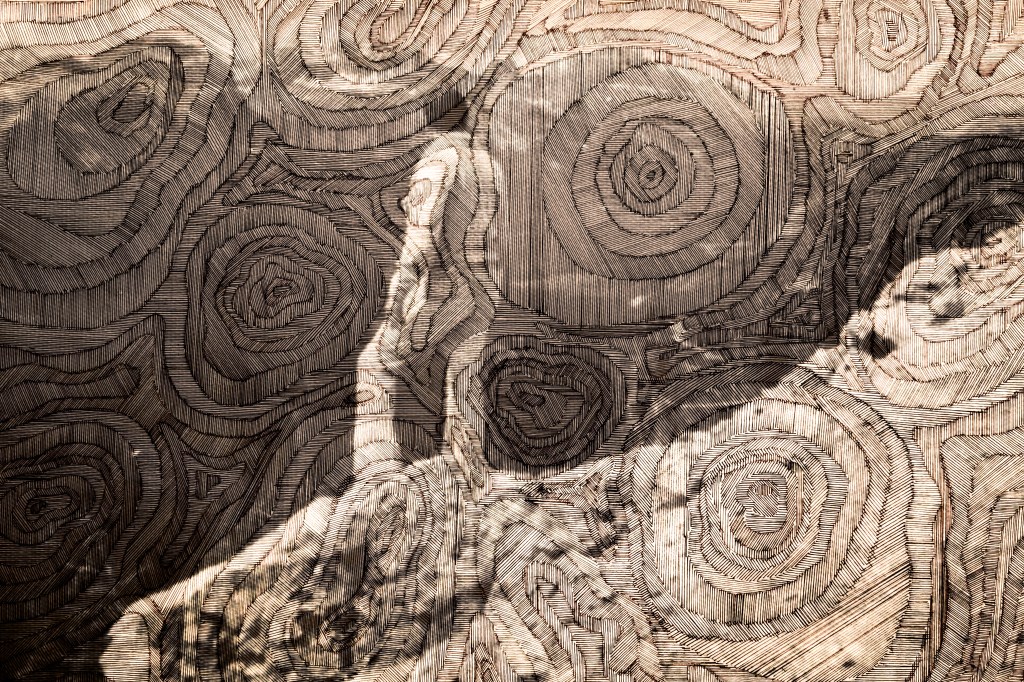
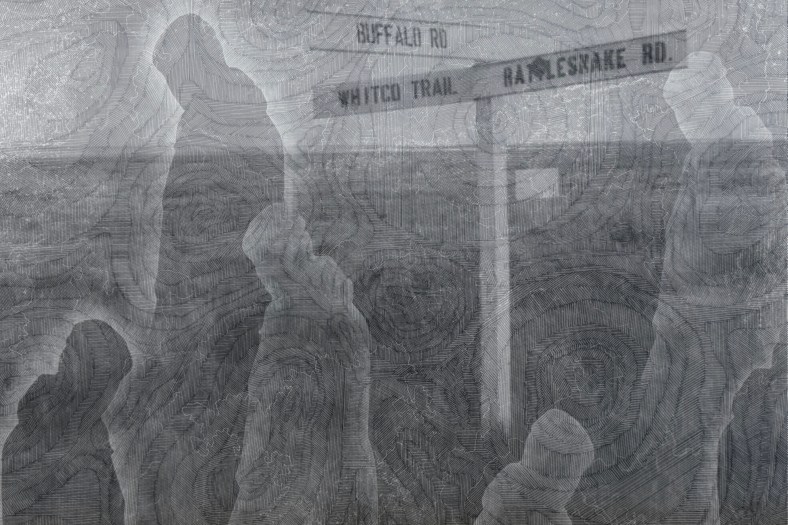
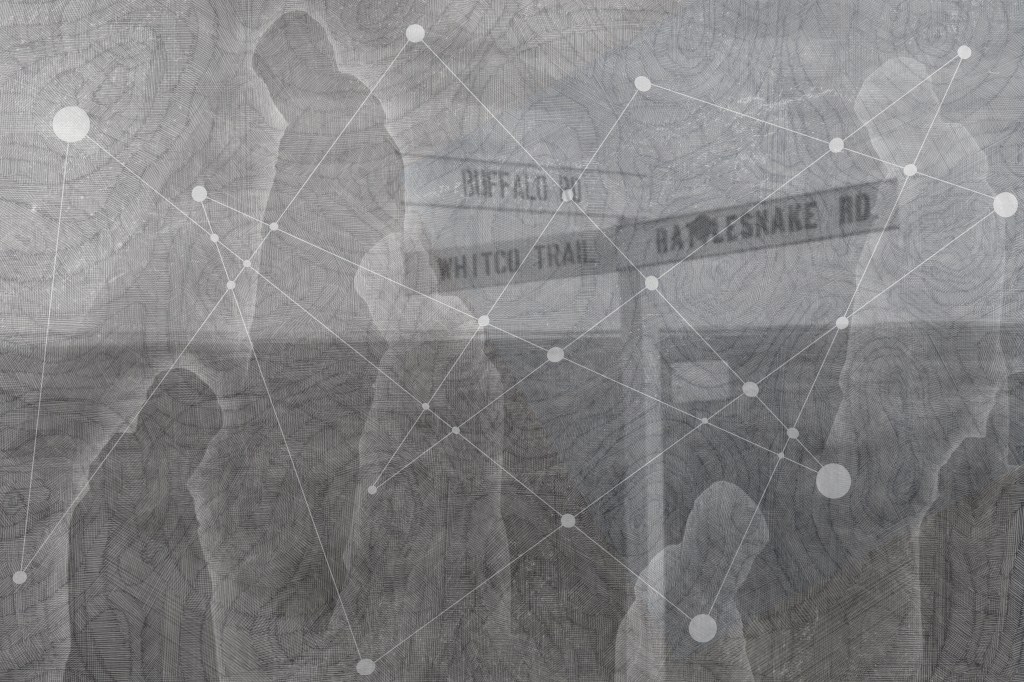
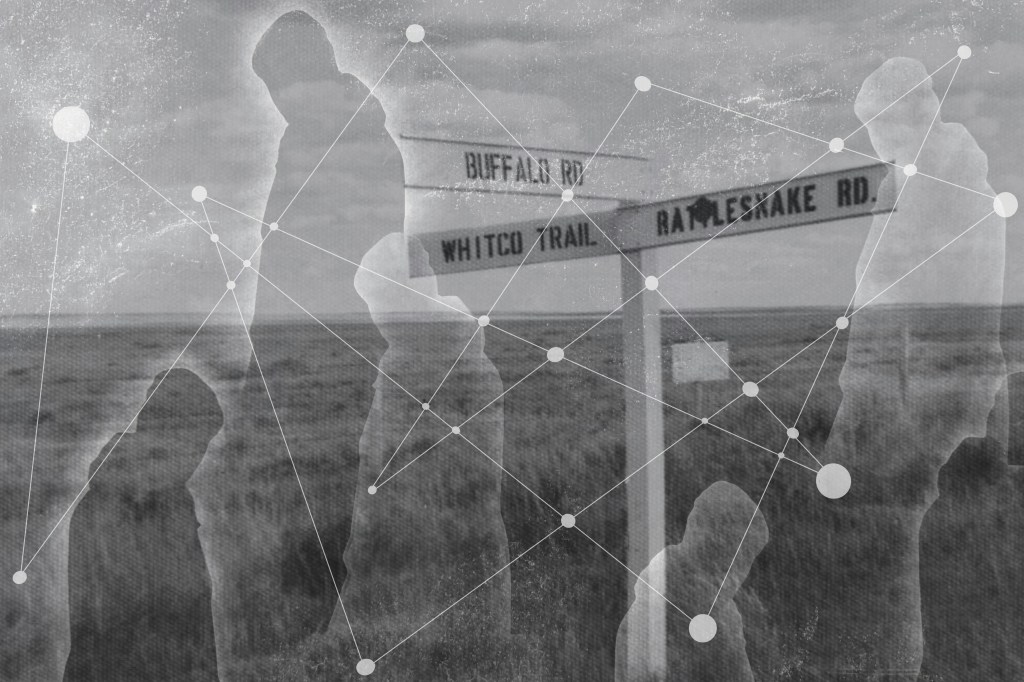
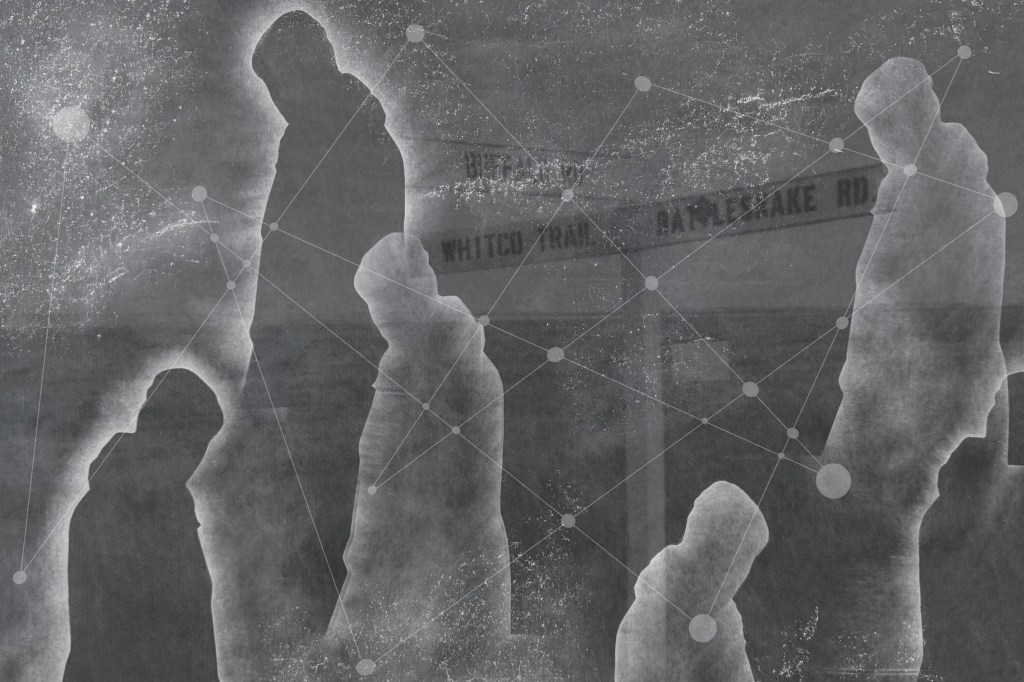
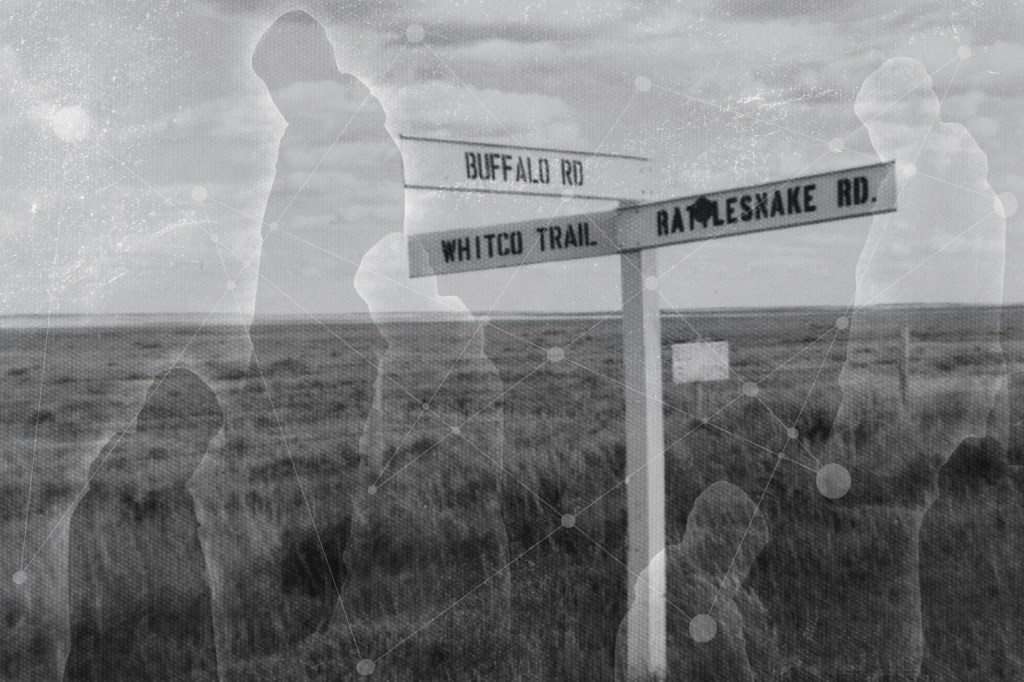
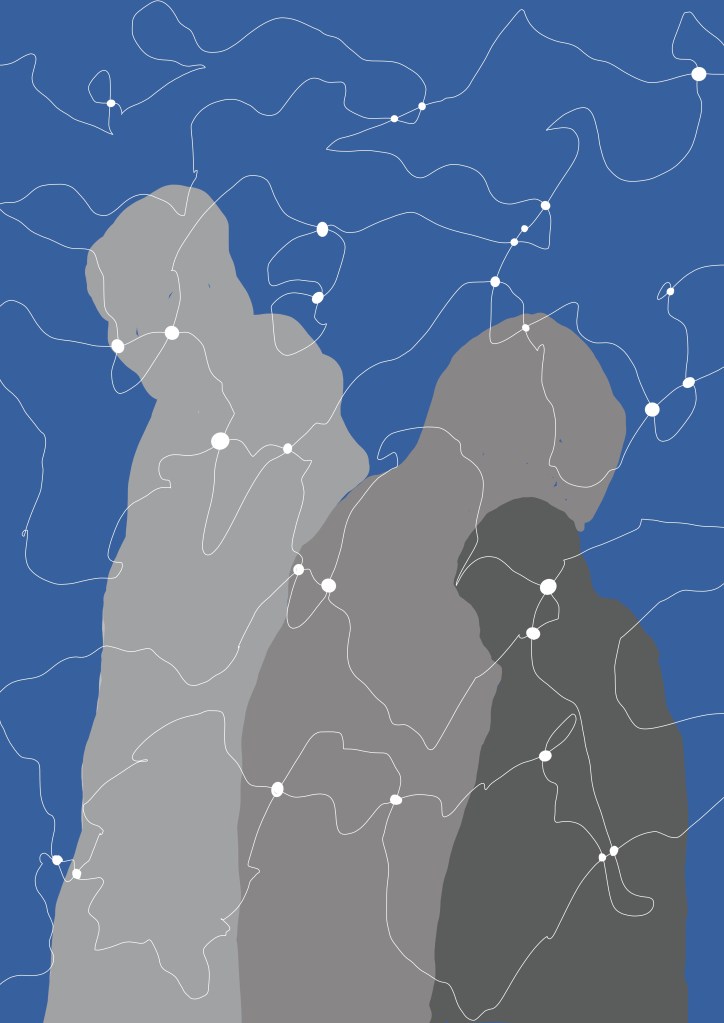
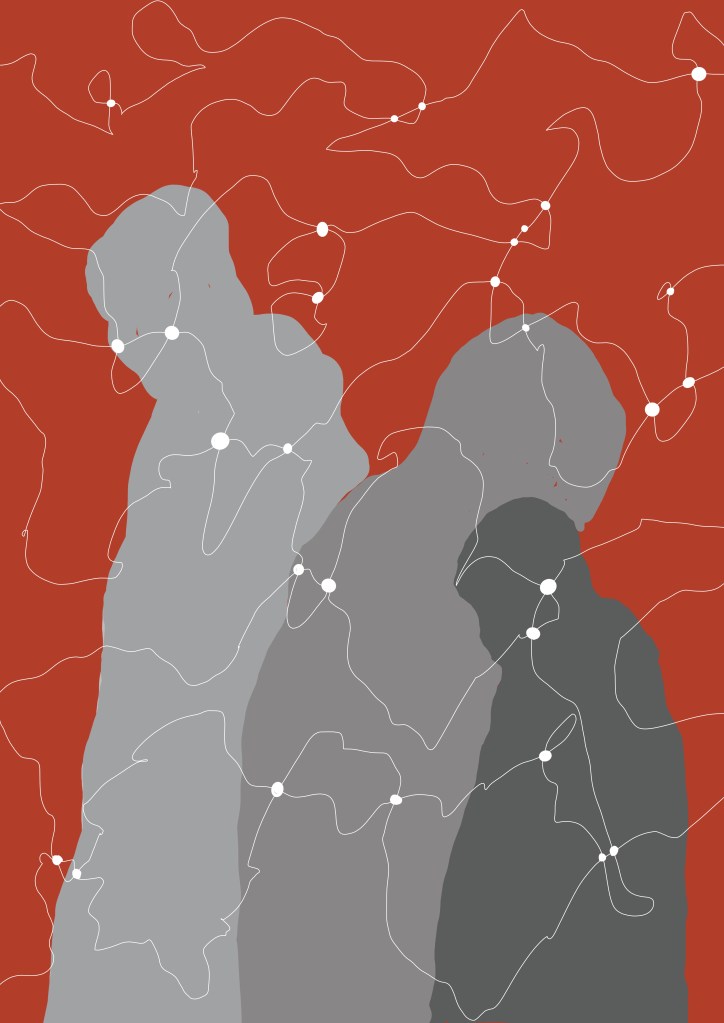
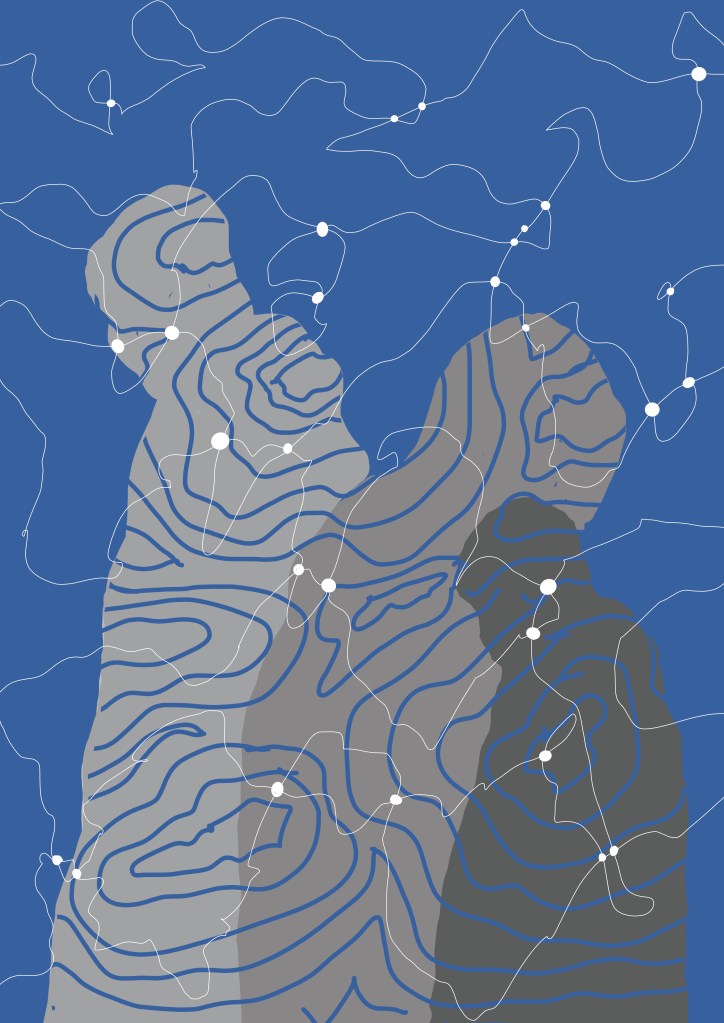
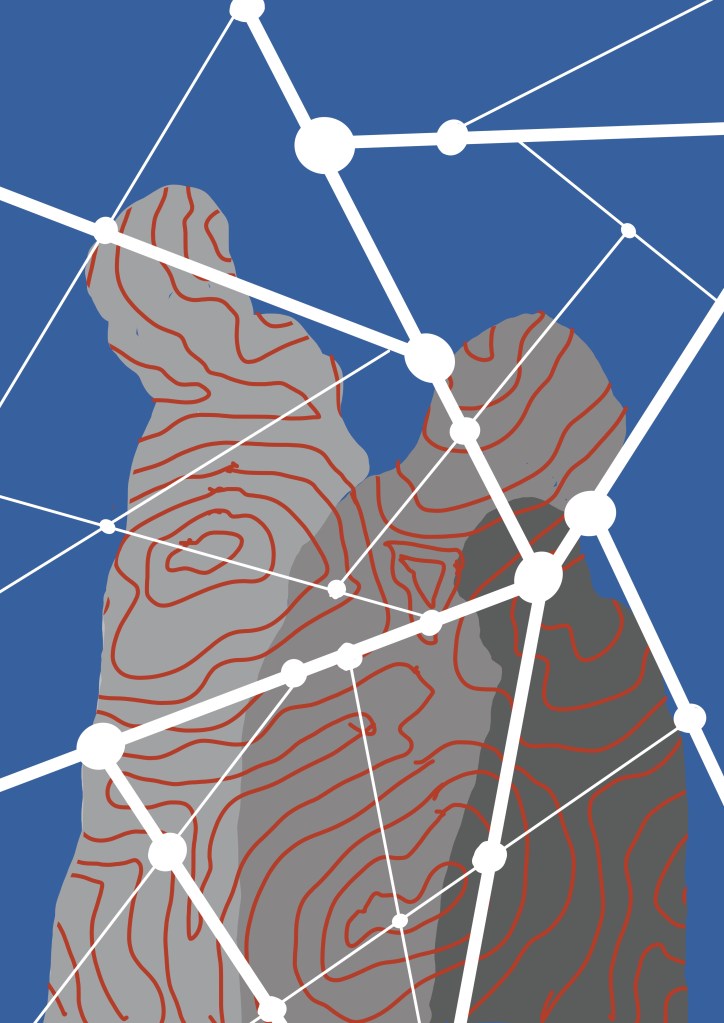
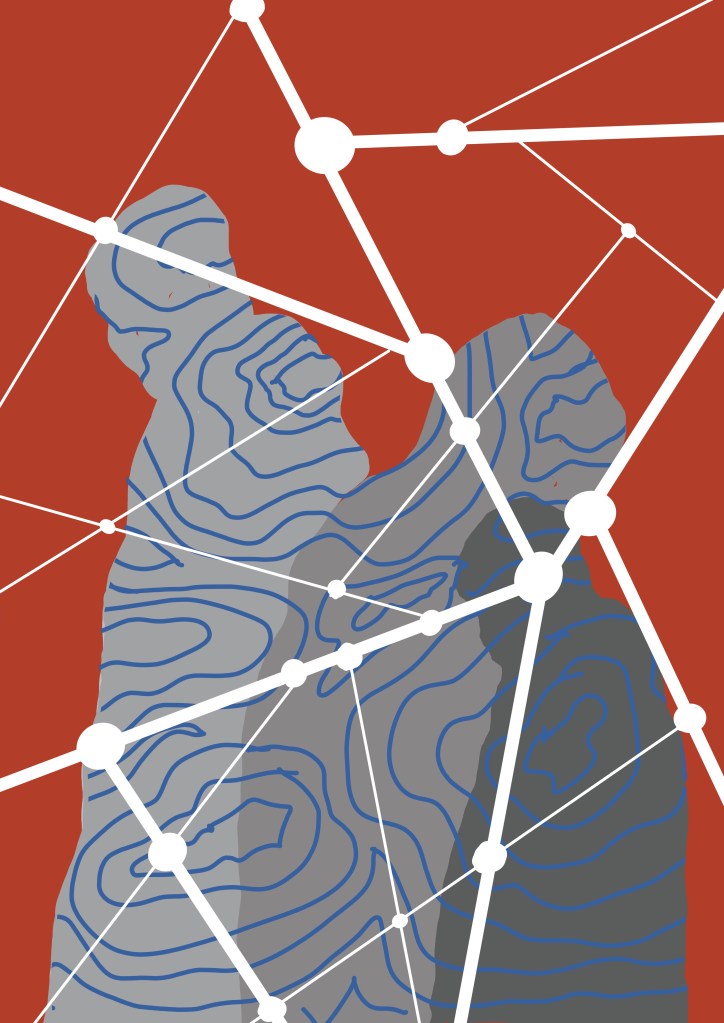
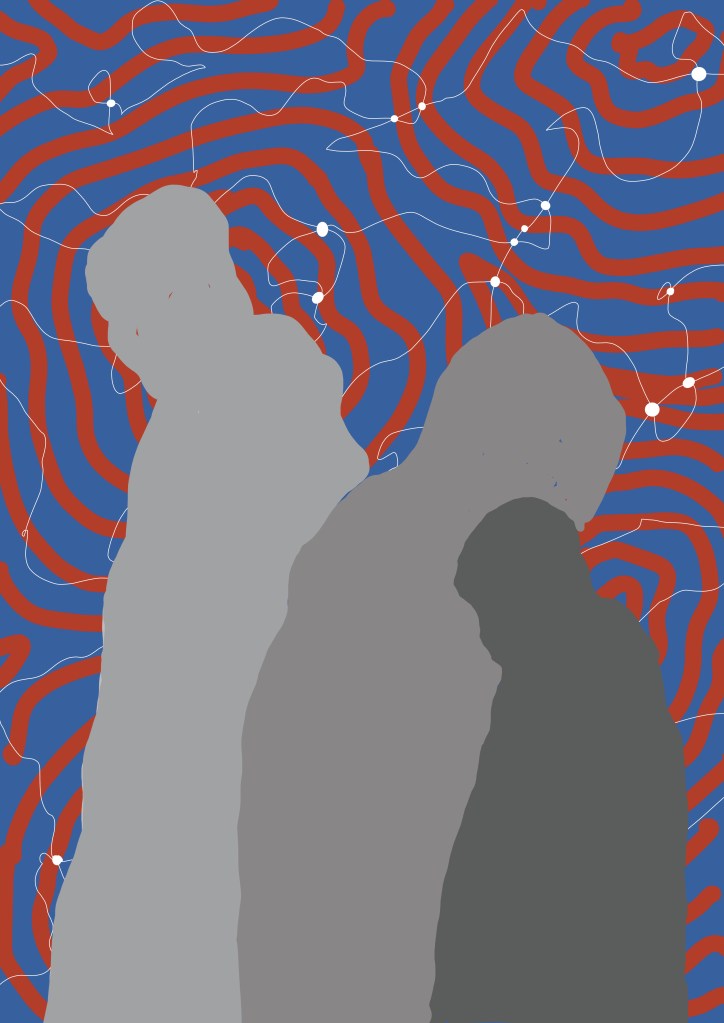
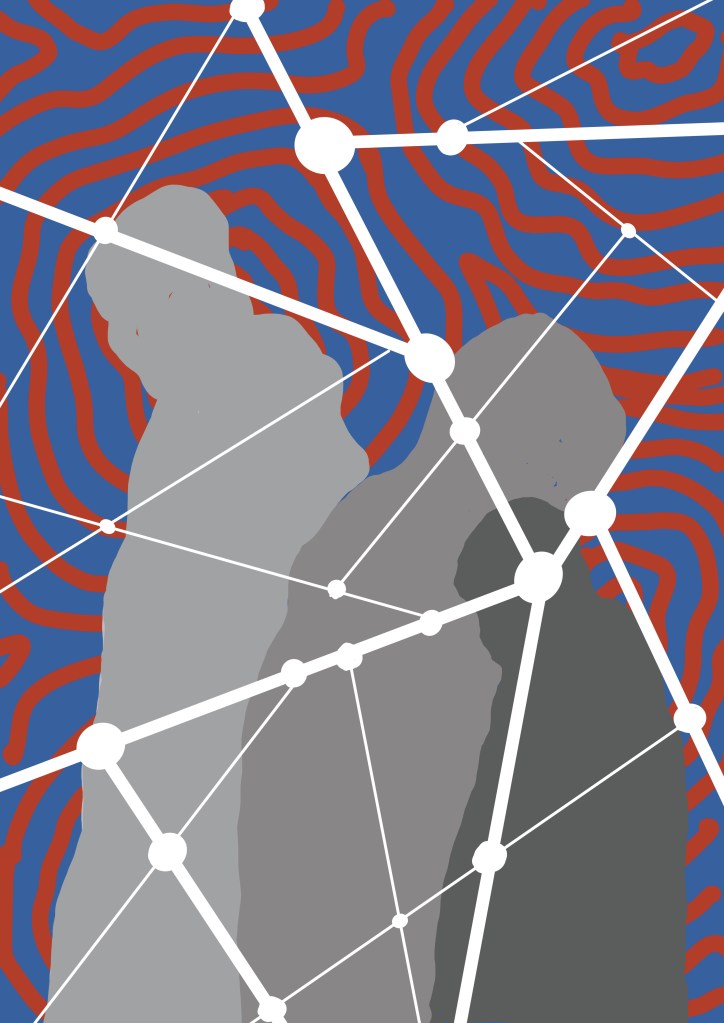
I then looked at the contouring and the automatic drawing that I have incorporated into some of my recent work. I used a group of three figures, composition yet to be decided, and red and blue as the colour choice for the time being. I created multiple layers in Procreate which then allowed me to play around with possible combinations.
I like the red and blue contoured background with the figures standing in front of the straight white lines (last two images), maybe using gold leaf or even metallic ink (which would be cheaper) to add some additional interest. I’ve also put the darker figure in the background so that it gives the feeling of being in the shadows, even though, technically, lighter figures are supposed to recede, which in this case they don’t seem to because of the background.
So I’m sorted, apart from the fact that it will need to be a reduction linocut, something which I haven’t done before, put off by the suspicion that my brain doesn’t work in a reductive way, but there’s nothing like a challenge. Maybe I need a Plan B, just in case.
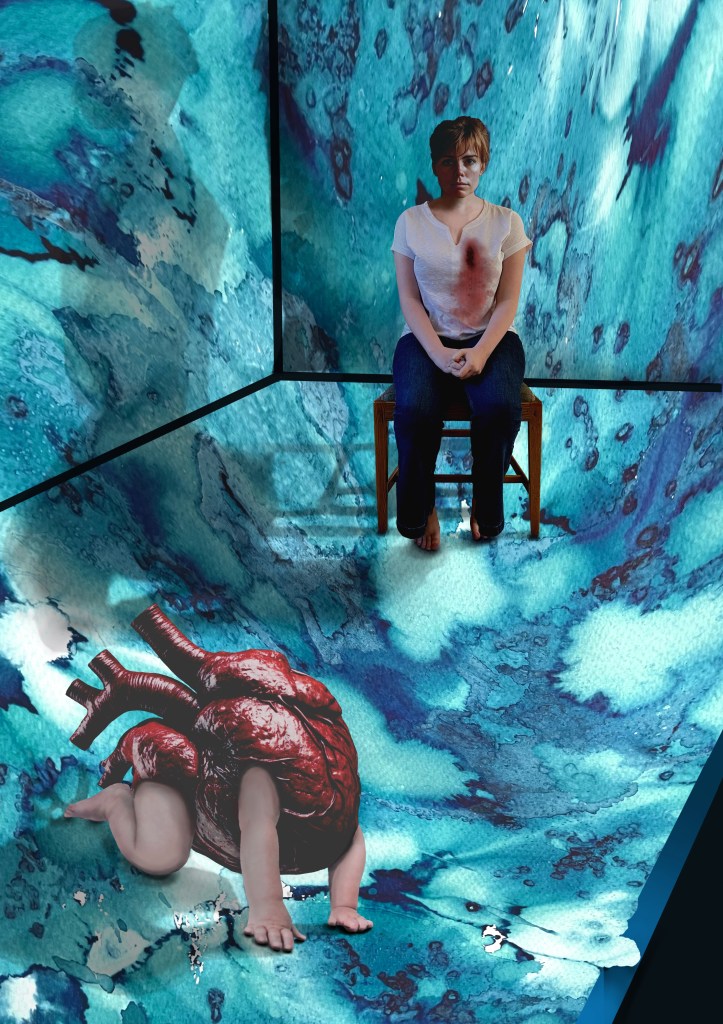
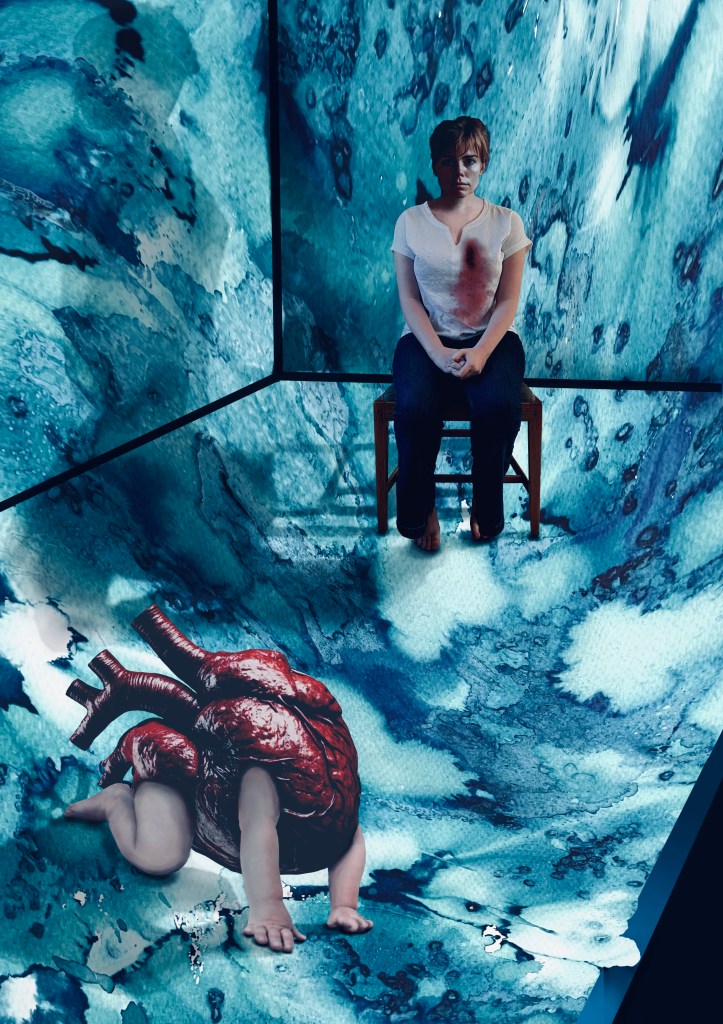
I have had an image in my mind for months. It came from the Elizabeth Stone quotation, I first mentioned in Hearts & Linos .
”Making the decision to have a child – it is momentous. It is to decide forever to have your heart go walking around outside your body.”
I think it encapsulates perfectly how I felt when I became a mother. My whole world was turned upside down. I was suddenly responsible for raising and protecting another human being. I felt overwhelmed by the magnitude of it all; that life would never be the same again. It made me question the sort of world I had brought her into, how her life might be; how much of it I would be a part of, the unthinkable and unbearable pain I would suffer if anything happened to her. She was precious and intrinsic to me, now living and breathing in the world, independently of me.
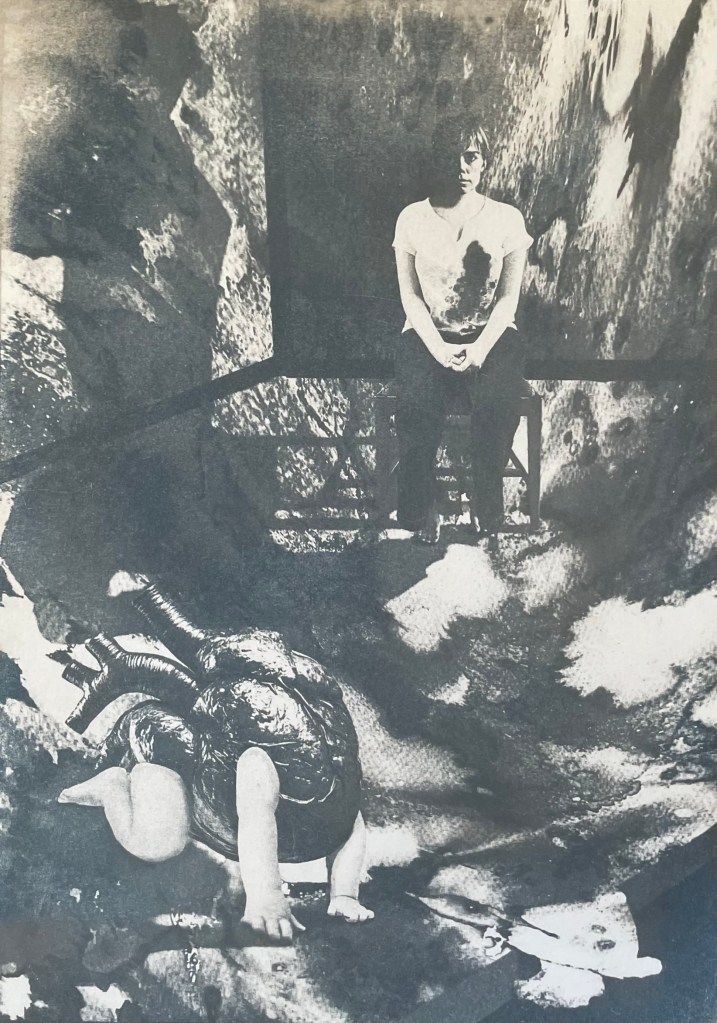
Original VersionDramatic FilterCyanotypeCoffee Toned CyanotypeAltered background and darker tonesDramatic Filter.Dramatic cool Filter. Worked on hands.
It’s taken a while. Bearing in mind that I’m still finding my way around Procreate I don’t think that I’ve done too badly. I’m sure that I’ve done lots of things incorrectly, but I don’t really care. It’s all a learning process and it was fundamentally about me trying to realise an image that I had in my head. I feel that I’ve achieved what I set out to do. In that respect, I’m pleased with it. I think it conveys the visceral nature of my feelings.
Actually, it has taken me more than a while; it’s taken ages, probably because I kept on making mistakes, but I have learnt lots along the way. I’ve redone parts of it several times but I have to say that it has all been about the process of discovery and realisation. It’s allowed me time to focus on the detail, but it’s been as part of the process rather than with a view to trying to achieve a perfect result. I don’t think that Procreate is a tool with which I can be loose and expressive in the physical sense, but it seems to satisfy that part of me that likes to focus on surreal detail every now and then. Hopefully that will allow the other part of me to enjoy the experimentation of being looser and more expressive in my mark-making when, say, painting.
I decided ages ago that I wanted to incorporate my ink experiments as a background to a collage type piece. I sourced the heart, crawling baby and head of the woman from royalty free image sites which allow for reproduction of the resultant work, if need be. The body is my daughter. She’s a bit freaked out by someone else’s head being on it, but I wanted a neutral character, and I couldn’t find an image of a woman sitting on a chair that fitted my requirements, so I roped in a free model.
It was challenging constructing the crawling heart. I’ve had to rebuild parts of it including the hands as some of the fingers were hidden in the original image. It was quite difficult finding source images whose licences allowed me to do what I wanted to do, and were also free. I’ve played around with editing effects and colours and I think that I’m settled on the last image for now. The slight greenish tones, complement the red heart. I really like the cyanotypes, but unfortunately there isn’t enough tonal variation and the slightly chaotic background loses its delicate tonal transitions in the process. I might try again but change the background to something a little less busy. But I like the historical, almost Victorian Penny Dreadful feel to them. I might develop it further, but I’ll leave it on the back burner for now.
The time delay video created by Procreate is of epic proportions, but it’s helpful for me to watch it back so I can see what a song and dance I made of it all. This is a shortened version.
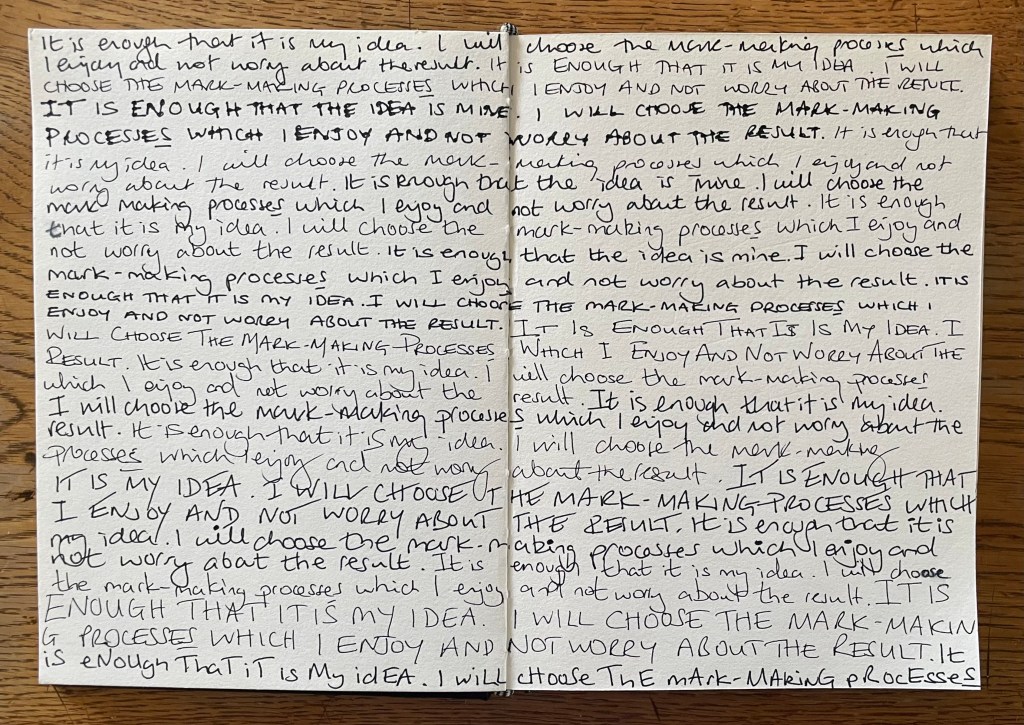
Following my tutorial with Jonathan, I decided to test the theory that if you say something to yourself enough times, you’ll start to believe it. So, I’ve been doing lines. To be honest I didn’t have to do lines as a punishment at school: I was a conformist.
We make marks everyday in one way or another. An obvious one is our handwriting. I learnt handwriting at school in the same way as every other child, in the book with the lines which indicated where the top and bottom of your letters should go, and the line in the middle indicating the height of the small letters. Once we had mastered the basics, we were allowed to go free range, first with a pencil, and then with a pen, as a reward for continued neatness, and perfection. Those were the days when everyone was taught to write with their right hand; left-handedness was not tolerated. But the need to express ourselves in how we write the words, not just with the words we choose, will always out.
Our handwriting reveals things about us, from the tilt, the size, the pressure, the failure to close our loops. I’ve never had consistent handwriting. It changes depending on my mood. I wonder what that says about me. Maybe I’ve never found a style which says to me: yes, this is you. And maybe that’s the point – I’m forever changing. Or maybe I just haven’t found my mark-making processes. It doesn’t really bother me, but at times I do feel jealous of the beautifully formed letters of others. I think – yes, you’ve got it together; you know who you are.
Doing Lines I
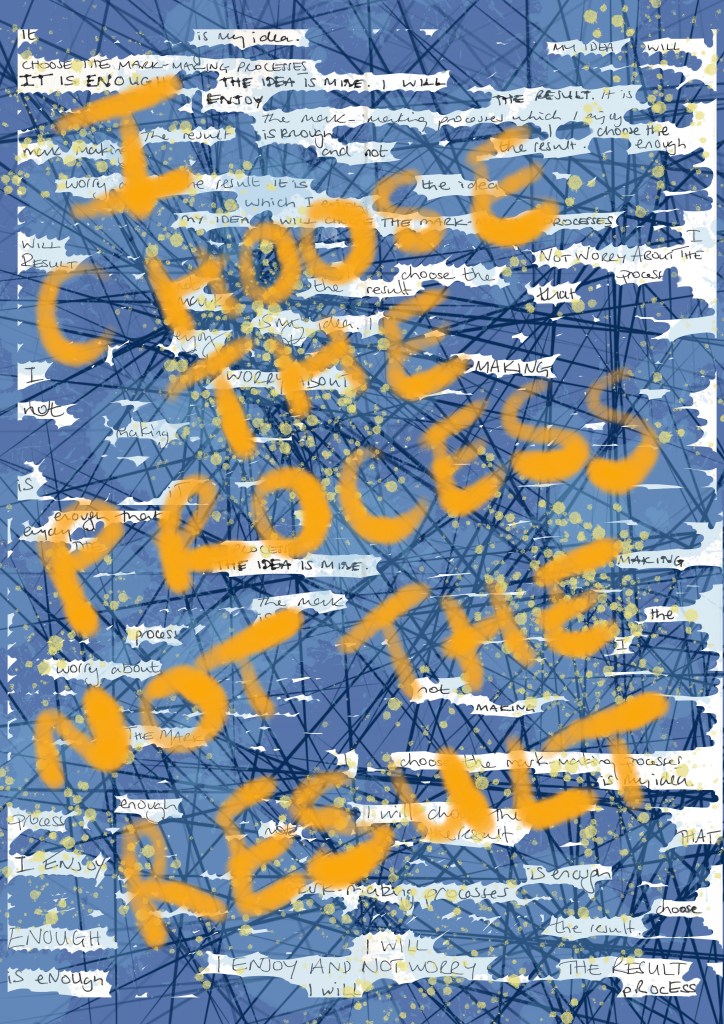
I like that the redaction is scruffy and that there are jagged edges. When I was doing it I wasn’t aware how scruffy it was because I was doing it against a white background, and so it just looked like the redacted words were disappearing. Surprisingly, I didn’t even have the urge to tidy it up once it revealed itself to me. As I was going through the words trying to make different phrases each time, there was a section in the middle which became a bit negative. It’s quite difficult to find different phrases from the same words in the same order. Phrases like ‘I worry about not making’, ‘Is it enough that I enjoy the process’ and ‘I worry about not making the mark’ started to pop up.
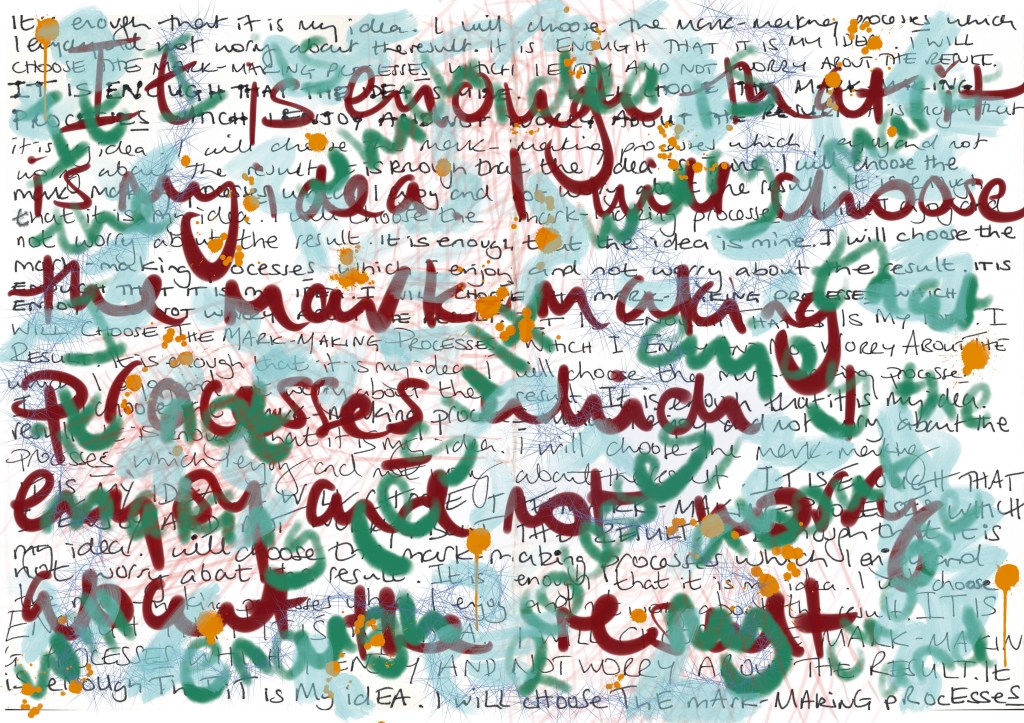
Doing Lines II
Well, I’ve written the words that many times, that if they haven’t sunk in by now, they never will.
It seems to have all been about words recently. What are words worth? That’s what the Tom Tom Club asked in their rather bizarre new wave hit from the early eighties, Wordy Rappinghood. You have to be of a certain age to remember this one. I rather like the artwork.
And now I’m in a state of flux, and feeling a bit stressed, thinking where do I go from here? I have nothing else.
I use my husband as a sounding board and as a gauge as to what I’m feeling and what I’m doing. I value having someone to give me feedback, to hold a mirror up to me. But to what extent should I rely on this and allow it to influence how I see my own ideas and work? Why is it when someone says they really like my work, I feel it’s easy to ‘do it down’ – ‘oh, it’s not one of my best’, ‘there are some bits of it I’m not totally happy with’ (when actually I think that it’s as good as it could possibly be and I’m actually quite pleased with it), and yet when someone is ambivalent about my work, I feel unable to ‘big it up’?
Anyway, I now feel directionless, and at a loss as to what to do.
I have looked at how other artists have approached the concept of dialogue, and, in the main, they all involve figures. None of what I have looked at has inspired me so I haven’t even bothered to include any images of them in this post.
I don’t know what it is, but I’m feeling a bit fed up at the moment. Maybe it’s the theme of ‘Dialogues’ and the idea of connections etc. – it all seems as if it’s something that has been done before ad infinitum. Maybe it actually bores me – I don’t know – I just can’t seem to get inspired by it. Maybe it’s the fact that I only have a week to make something and I’ve got other more pressing things to be getting on with. Maybe this little side quest of mine is becoming an unnecessary distraction.
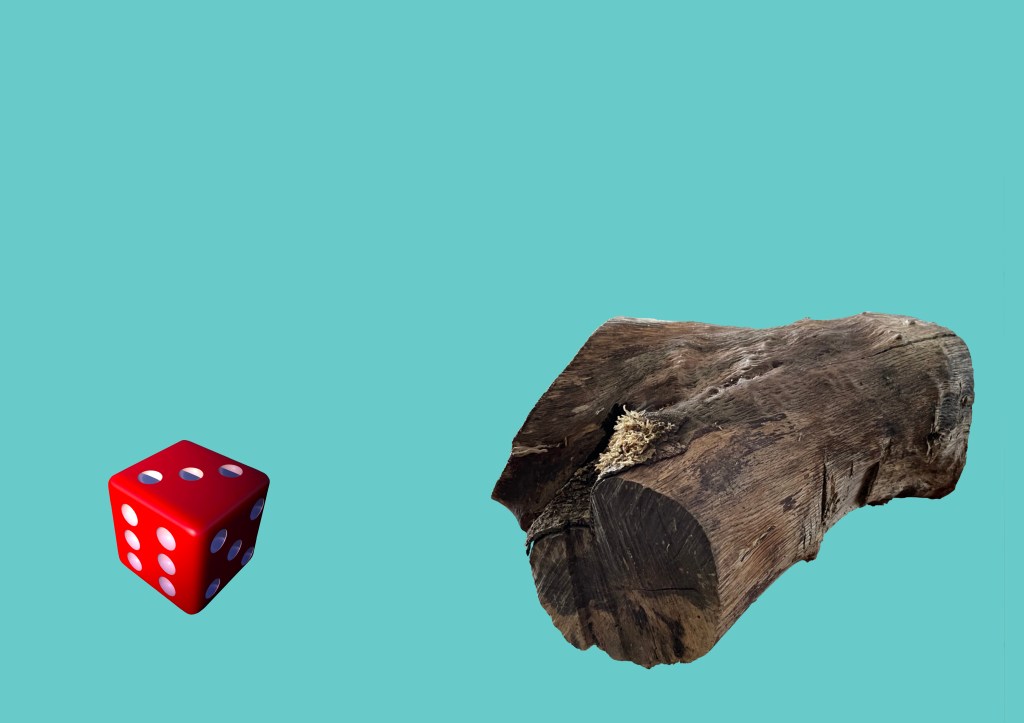
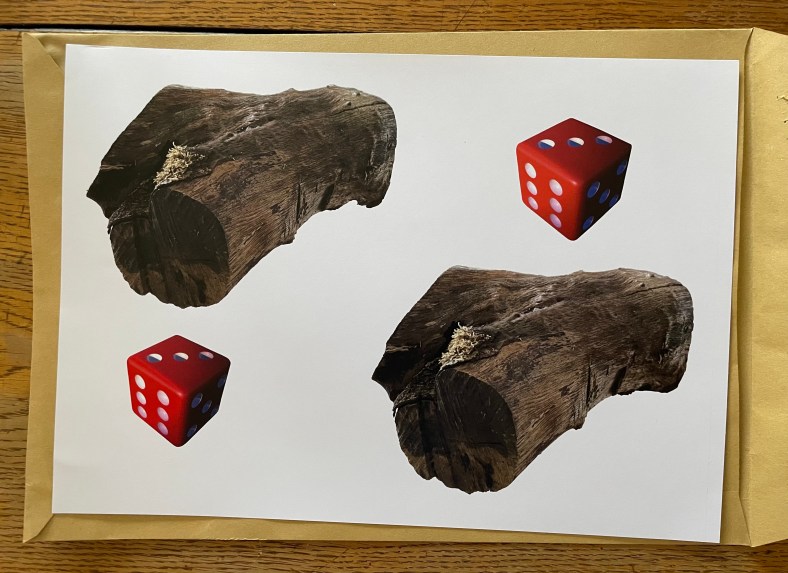
As a reaction to this feeling, I decided to take a literal, and some might say, infantile approach. I kept on coming back to my perverse love of Catchphrase and the birthday card. I started fiddling around on Procreate and came up with this:
A die, a log.
It’s pretty basic, but strangely appeals to something inside me. Maybe it’s a bit cheesy – but do I care? – maybe I need a bit of cheese at the moment. Then I remembered a piece I saw at the Pallant Gallery last weekend.
’Neighbourhood Witch’, 2008, Simon Periton, Silkscreen on mirror coated polyester
I really like the use of the mirror which reflects the viewer so that they then form part of the work. It reminded me of Craig-Martin’s ‘Conviction’ which I had seen at the RA. I could use this idea because one of the thoughts on my mind map referenced the need to reflect when engaged in dialogue.
I have decided to incorporate a mirror, possibly with the images of the die and log being raised slightly away from it so that they reflect in the mirror as well as the viewer – a die, a log, with you. It’s now becoming a fully matured wedge of Stilton!
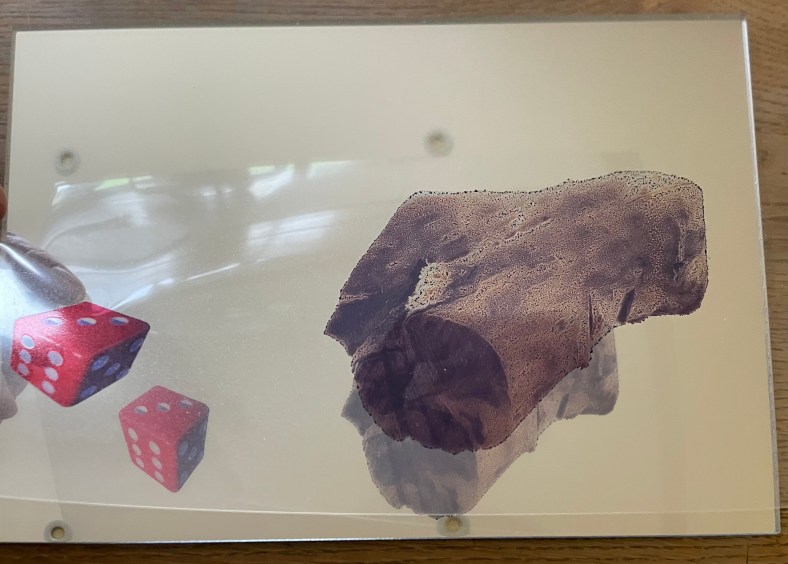
I experimented by printing them off on some inkjet friendly acetate but my home printer didn’t do a particularly good job, but good enough to allow me to see whether the idea had legs. I wasn’t averse to it: it would mean that I would have to have it professionally printed on something more rigid, such as acrylic/perspex, and frankly, I don’t really have the time to get this done. Also, on reflection, I wasn’t sure about the reflections creating multiple images, as it was no longer a die and a log.
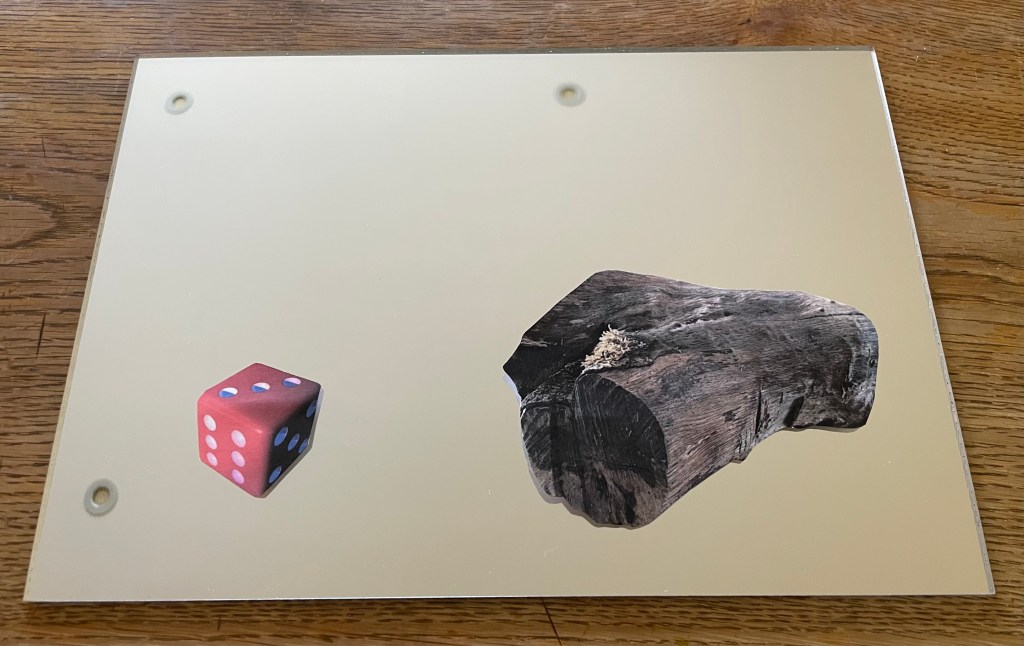
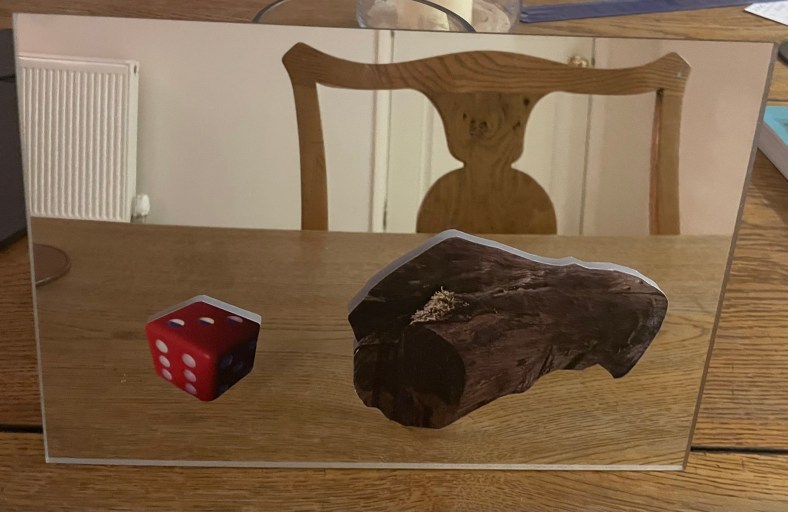
The only solution that I can think of is to fix the image directly to the mirror. The image in ‘Neighbourhood Witch’ above is screen printed on. I don’t know how to do this and I don’t have time to learn. I could get it done professionally, and after having done some research, it may still be a possibility but it depends on timing. Another solution would be just to collage them on. I researched the best type of adhesive and came up with Gorilla Clear Glue which is used a lot in glass mosaics. I will need to experiment with how best to apply it. In the meantime, I put some image cut-outs on a A4 mirrored piece of acrylic. I like the size.
Despite its luke warm reception, I’m going to carry on with my current train of thought. It may not be my best, but I like it because it is something that is totally different for me and it’s way outside of my box, and frankly, I’m all out of other ideas. And as General Patton said – a good plan violently executed now, is better than a perfect plan executed next week.
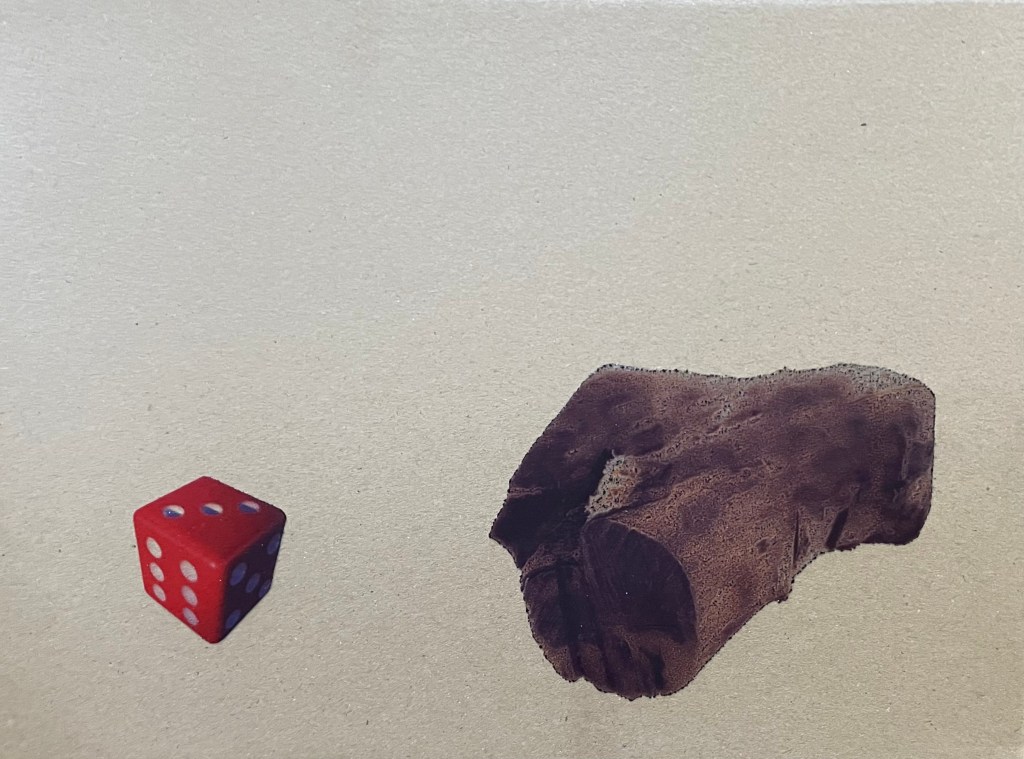
So I had a couple of sets of the images printed up on some 200gsm paper by my local print shop and cut them out and placed them on the mirrored acrylic to see how they would look.
I don’t know why I didn’t realise that this would happen, as it seems so obvious now – unless you stand dead straight on to it you can see the white reverse of the cut out image in the mirror.
My proposed solution is to have the mirror images printed and then fix them together so that any reflection is of the image itself.
I was watching a YouTube video yesterday morning and happened to look at the list of related videos on the right hand side: The Power of Ugly Art – Creativity Exercise for Dealing with your Inner Critic In Your Sketchbook, Marie-Noëlle Wurm, caught my eye.
During our critique session on Tuesday afternoon, whilst talking about my experimental digital collage, I mentioned that I feel particularly drawn to the process and that I have some ideas as to how I can use it to express my feelings on motherhood, in particular, in relation to the quote in Hearts and Lino about the heart walking around outside the body. I commented that it might be a bit gruesome, reflecting that actually that didn’t matter as sometimes art has to be ugly to convey what it needs to; it doesn’t always have to be aesthetically pleasing.
I mentioned N’s reference, in her introduction to her artistic practice, to Louise Fletcher’s course in which she actively encourages the creation of ugly art, which I have also watched. This is what Wurm encourages – an artist’s fear is creating ugly art, so lean into the fear instead of running way from it. Creating beautiful art is an expectation and she suggests detailing the expectations we may have as artists, and then expressing them in our sketchbooks. By letting our expectations exist, instead of pushing them away, we give them space to exist within our art practice, which will lead to more powerful art, growth and compassion for ourselves.
I’m going to give her exercises a go in my sketchbook, ordinarily a safe place for no one’s eyes but my own.
I’m conscious that I committed to doing an automatic drawing a day to try and change my mindset. I’m allowing myself the inclusion of exploring Procreate as well!
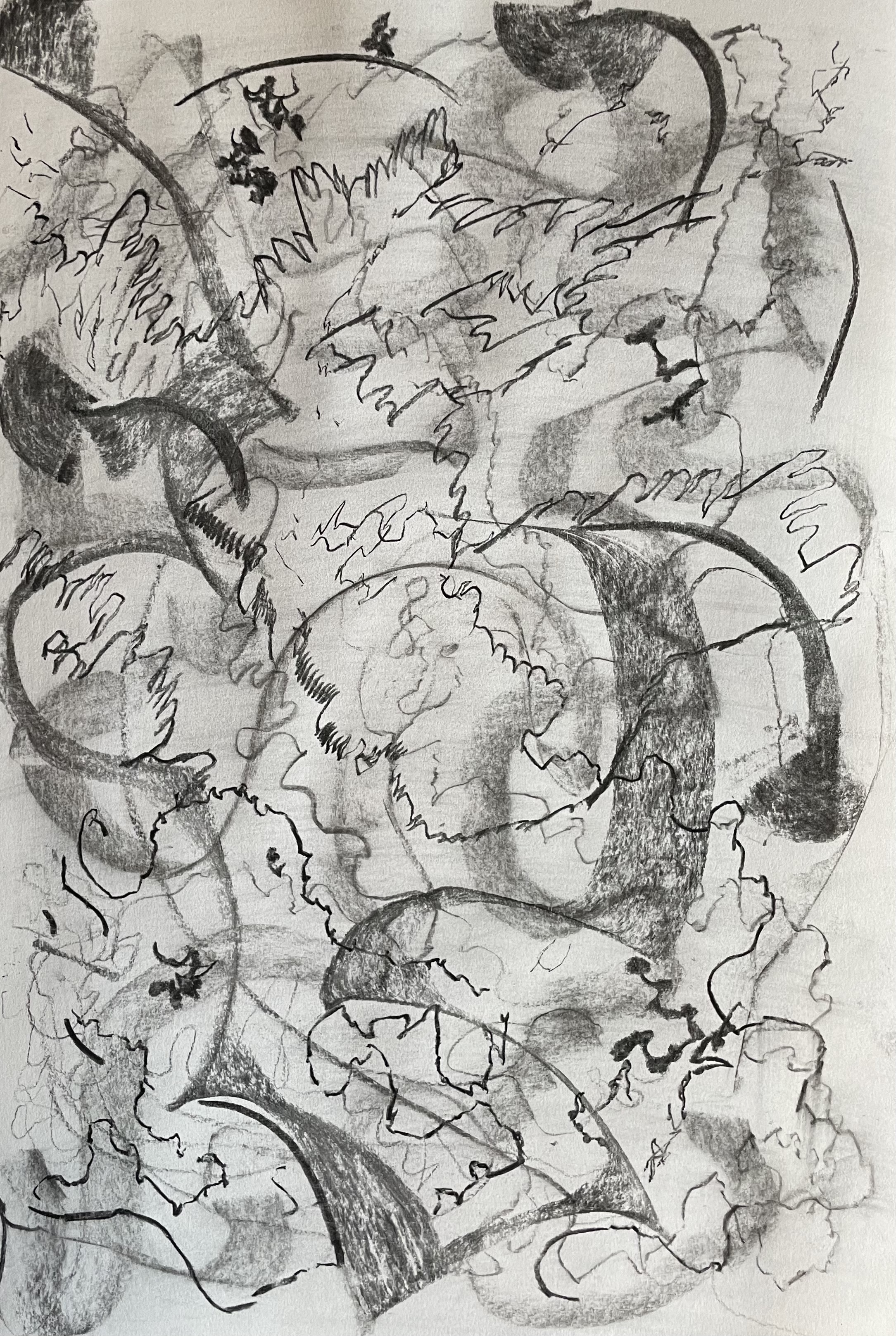
I particularly like the charcoal drawing. I used a piece of compressed charcoal and made swirling marks using it on its narrow edge and full on its side. I then rubbed it out and repeated it but this time playing around with the end and varying the motions. The concept of layers appeals to me (memories, past lives/ identities…) particularly the traces left behind of the first drawing and I was surprised by the range of marks I made depending on how I held the charcoal and the pressure I used. There are some delicate areas, followed by some jagged, harsh marks. Some lines appear to be faltering and hesitant whilst others have more purpose and at times are almost punctuation marks in what would otherwise be a stream of unconsciousness.
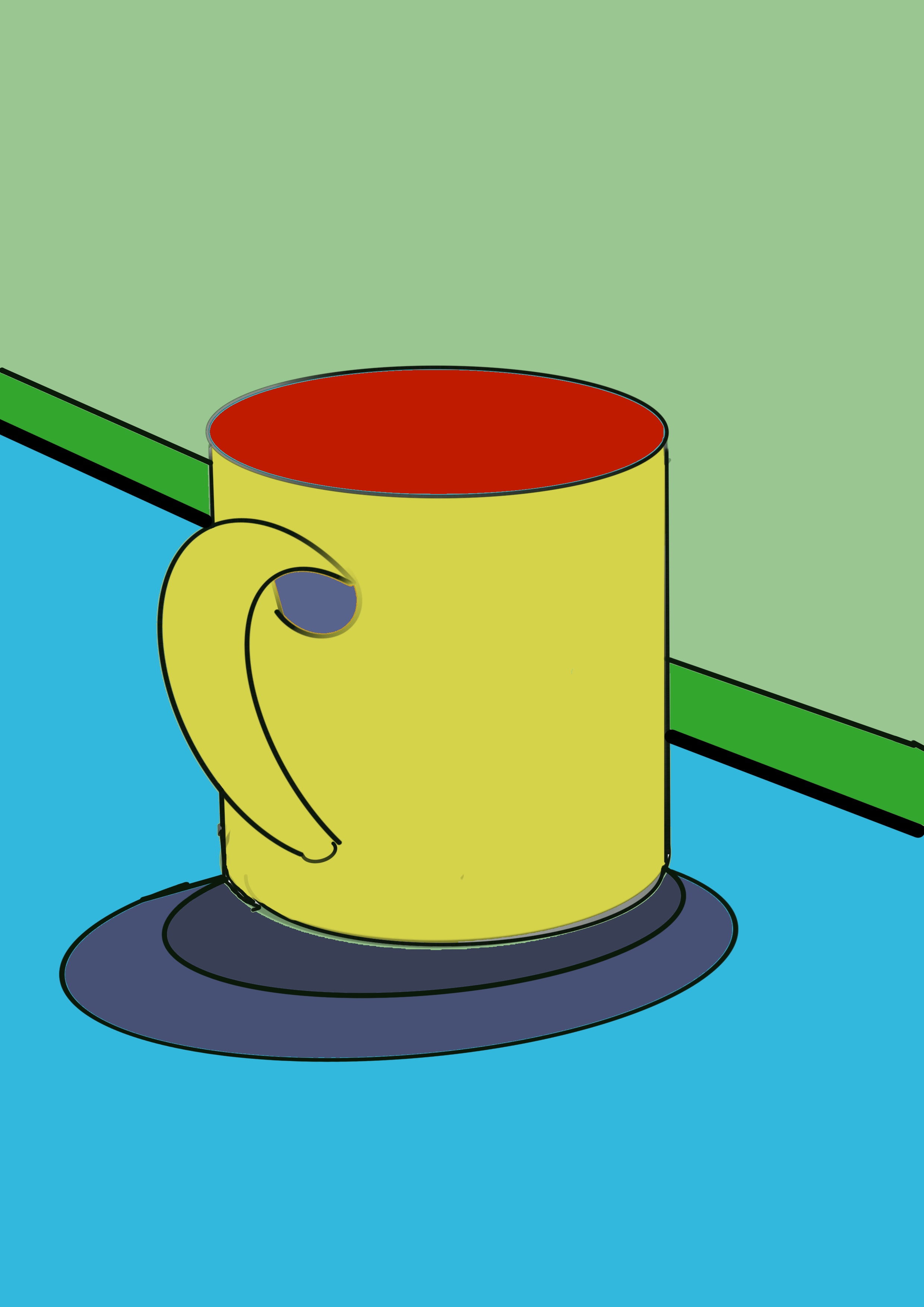
The second image I am treating as an automatic pastel drawing – I randomly chose colours and effects from the Procreate menu and I think the result is interesting, although I miss the haptics and the smell of the real thing as well as the tactile relationship between the medium and support. I’m not sure that I would use it going forward, except maybe as a tool to experiment with, although I have previously decreed that collage is just not my bag – how times change! I might use it if I decided to go down a graphic flat colour route (as in the third image) and digital collage is something I will definitely explore further – no bits on the floor and no need to glue – what’s not to like? I’ve been thinking about how I could incorporate digital collage into a mixed media piece of work – perhaps a giclée print onto a canvas, sealed with medium and then oil paint?
There are lots of thoughts chasing themselves around my head – I’ve been ignoring them in the hope that as and when I consciously acknowledge them they may have already got themselves into some kind of order. Just doing what I’m doing at the moment seems to be creating even more possibilities and permutations which is exciting.
I can sense that I’m feeling a lot more relaxed about making my experimental work ‘public’. I really look forward to starting the day by just letting my hand wander across the page – it’s the only time when there’s no expectation on me to achieve anything – renewing the buildings insurance, fixing the E20 error message on the washing machine – just a moment when I’m at one…
Last week’s task was to try something different in our artistic practice: something which might not work out.
I’ve been thinking about trying digital art for a while. I like the feel of a paintbrush or piece of charcoal in my hand and so a foray into the world of an Apple Pencil and a flat screen would seem to lack the tactile nature of applying paint to a canvas or smudging and blending charcoal with my fingers. It is, as expected sadly lacking, although Procreate, the app I used, has a wide range of effects and tricks, it’s not at all the same.
I’m not the most technically minded person, so I had to watch numerous YouTube videos and even then with my current inability to retain information, I decided that the best way to learn is to get stuck in. It took me ages just get to grips with the basics!
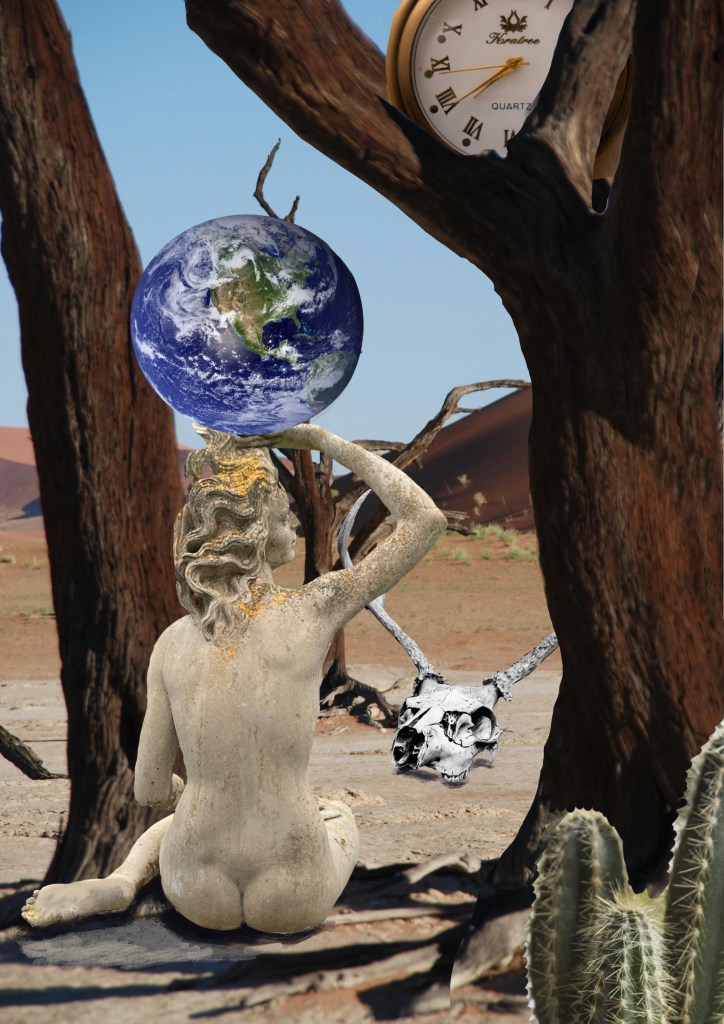
I discovered that one area in which using Procreate might be of use is in collage. Instead of cutting out images and assembling them, I created several different layers of images which I first isolated from their backgrounds. It was much easier to move them around than using physical pieces and the ability to use my own photographic images and images from websites such as Pexels, means that there won’t be any issues in terms of copyright, something of which I’ve always been mindful.
This is the result:
I’m quite pleased with it as a first attempt and I can see that there is a lot of potential in producing digital collages. I found the process quite frustrating at times, but that was mainly due to my incompetence and this will improve with practice, hopefully. Next time I will take a bit more care in selecting my images; I don’t think the cactus in the foreground works particularly well, but I just needed something to detract from the lack of clarity in the tree roots. I used the paintbrush option to put in a shadow under the skull, but the shadow of the figure doesn’t work at all – I was unable to alter it as I had merged several layers together by that stage. Going forward, I think I need to give more thought to the interaction of the layers and also, to save time, it would be a good idea to start to create a collection of images rather than searching through photos and websites on the hoof.