It has been a busy few weeks: the print sale, Research Paper, blog curation and 3-minute video.
Making the video was quite challenging. I started by selecting all of the images that I wanted to include and then I decided what to say. It was far too long. So I decided to change tack and think about what I wanted to say and then choose the images which best demonstrated the narrative. It was a good exercise in distilling everything down into a short space of time; of focussing the mind on what is important.
After such a spate of activity I would usually reward myself with a bit of a rest, but funnily enough I don’t feel like that – I feel energised, and with a sense of purpose. In my Unit 1 Feedback I was advised that I would broaden in scope and then narrow back down, and I think that this last unit has brought about some clarity for me, not necessarily in terms of the breadth of my practice but in terms of its future development. I’m feeling positive and I’m looking forward to tying up some loose ends and producing work which encompasses what I have discovered so far and which is not necessarily finished, but more resolved than it has been up until now.
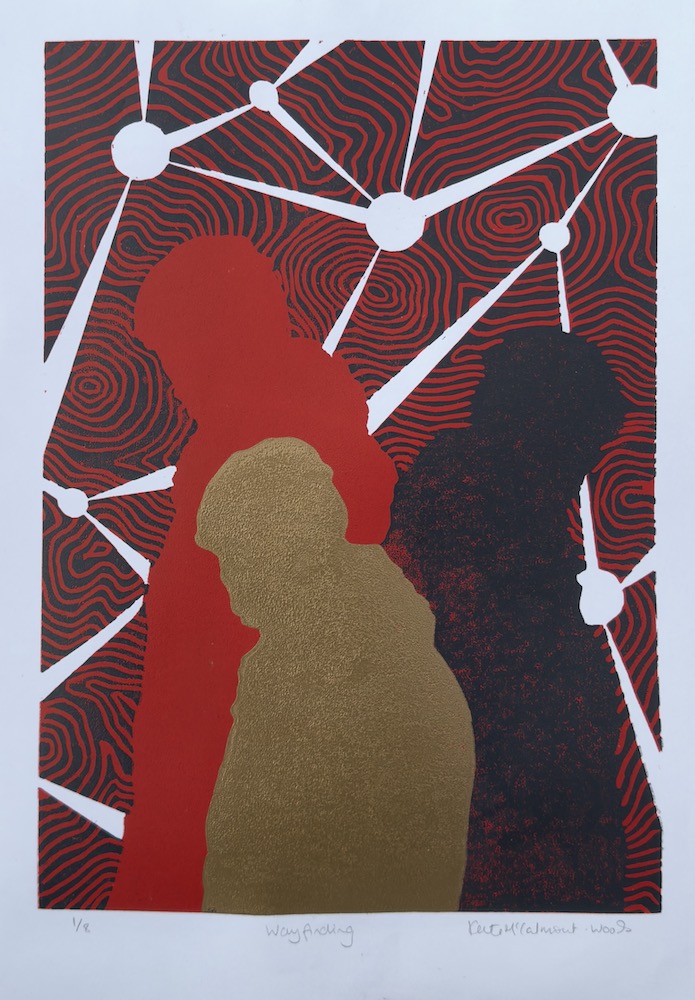
The self is in a constant state of becoming, and each time we reflect, we create iterations of ourselves, crystallised in time; shadow selves. ‘Wayfinding’ – my first reduction linocut – evidences the processual nature of its making, with each layer being a trace of what was once, but is no longer, fixed in time and unalterable. It embodies how the act of making and the evolving self are intertwined, the self being both mapped and remade.
It’s been a steep learning curve, with highs and plummeting lows. I have learnt a lot from the experience – the physical process of the making of the prints, with its inherent breaks from activity, and the potential and restrictions of the materials themselves which have challenged me, requiring me to find solutions to the problems I have encountered along the way.
I liked the contemplative feeling of cutting the lino and the nature of rolling out the ink, observing its texture on the brayer akin to suede, listening to the sound of the brayer and ink sizzling, and the relief (or crushing disappointment) when pulling the print. I feel that the experience has enriched me and that hopefully I will continue to become a better printmaker – I don’t say that I have become a better printmaker because aside from possibly being factually incorrect, that indicates that my becoming has stopped – I want to be in the process of continuing transformation. The prints themselves evidence my learning and development in all their imperfection.
In his paper Making Hands and Tools – Steps to a Process Archaeology of the Mind (2021), Malafouris argues that ‘thinking is thinging’, in that we think with and through things, not simply about them, and that human becoming refers to the process of ongoing transformation that characterizes the human condition as indeterminate and incomplete, or else always about to become. As we engage creatively with the world, the new things we make shape our developmental pathways and our ways of being in the world and, as such, human intelligence is handmade.
’Hands and tools can be moved but they are not moving; it is the brain that moves the hand to move the tool. Taken together hands and tools can be seen as interactive processes. They co-constitute each other’s life by means of thinging. It is now the tool that moves the hand to move the brain because the brain is already attuned to the hand and the hand is aware and responsive to the tool. In one sense, the hand acts as for the tool, in another sense the tool acts on behalf of the hand or other tools…The agency of the hand derives from the tool and the agency of the tool derives from the hand.’
He asserts that hands and tools are made for action, in action. So my hand is made for action and without that action it is not a hand. I pick up the carving tool which is made for action and without my hand it is not a tool. My hand moves the tool to carve the lino and the tool responds to my hand at the same time as my hand responds to the tool. The lino responds to the tool as well as my hand, and in turn my hand and the tool respond to the lino. The lino is not lino without the tool and my hand to carve into it. My hand and the tool are not a hand and a tool without the lino to carve into, and so on. As my brain is in tune with my hand, then so is the carving tool, the lino, the brayer, the ink, and the paper, and, as such, they all influence my developmental pathways and my way of being (or should it be becoming?) in the world.
On reflection, I’m not sure that I enjoyed the process that much. The restrictions of a deadline, the specifics of size and number, the fact that it was being made with a view to being sold, all contributed to a feeling of unease and pressure. I much prefer experimenting with no expectation, focussing on the process, and not the product.
I think that I’m finally getting some clarity. Or maybe I’m seeing connections and signs where perhaps there aren’t any, but it seems to make sense, in my head anyway. In my second tutorial, Jonathan commented that he had a sense that it was all leading to something (the first sign).
So far during this course, trite as it may be (although Jonathan has assured me that it is essentially what art is about), I have been concerned with understanding myself and my place in the world as a practising artist. I’ve been working from memories, guiding me like a compass on my exploration, probably slightly off kilter, as well as my day to day life, thoughts and feelings. I have been trying to concentrate on the process as opposed to the result (a sign), experimenting along the way, and producing very few finished pieces of work. I did feel uneasy about the lack of finalised output, but no longer. I’ve been on a dérive (our session on Guy Debord being another sign).
In my Study Statement I question whether it is actually possible to ‘find myself’. Kierkegaard thinks not, in the sense of a static and unified concept, for the self is constantly being formed not just by reflecting on the past but also by engaging with the present; it is in a state of becoming, in a state of flux, something I have said I feel on several occasions in this blog (a sign). I accept in my Study Statement that I can only hope to know myself as at a certain point in time, and that reflection is something which will have to be a continuing process. Something else I have mentioned on several occasions in this blog, to fellow course mates and to Jonathan, is that I feel like I am a different person to the one that started the course back in October last year (a sign); I have changed and I will continue to change – to become.
Recently, I’ve become interested in the subject of maps – the comment in my Unit One feedback that I seem to be engaging in a process of mapping jumped out at me (a sign). That led me to start thinking about maps and the process of mapping and map-making, experimenting with cartographic symbols and mark-making. The subject of maps is a huge one but during my research I came across the philosopher, Korzybski, the father of general semantics, a central principle of which is that the map is not the territory (rather like the image is not the thing: Magritte’s Ceci n’est pasune pipe (I used this idea with my red telephone at the Interim Show (yes, another sign)). In short, our models of the world are abstracts of reality, and do not represent it. This is a principle I’ve been trying to be more mindful of since I read about it – my map of the world is not the same as everyone else’s, so we can be in the same situation or look at the same photograph but have our own very different experiences and interpretations of it (our sessions with the photographs being another sign). Something which is blindingly obvious, but which I don’t always appreciate.
This then led to the notion that geographical maps themselves do not reflect the territory in the sense that there is abstraction and subjectivity in the production of all maps: the size of countries and borders can be manipulated for political and social ends, the purpose for which a map is intended can determine what is included and what is left out, viewpoint and projection can distort the world view.
Mercator Projection
Authagraph Projection
The Authagraph Projection is considered to be the most accurate flat representation of the world. It highlights the distortion caused by the traditional Mercator projection in terms of the size of Africa, South America and Greenland, amongst others.
I have been reading a lot about cartographic theory, a discipline which has only become a thing relatively recently. There is lots of disagreement about what a map is and the separation between the artefact of the map and the process of mapmaking and mapping. Post-representational cartographic theory does what it says on the tin – it argues that maps are not the territory but actually create the territory, are in a state of flux and are constantly changing, and theorists have moved away from the idea of a map as an artefact, but as being performative and processual, and always in a state of becoming.
Whilst working, I have been reflecting on past events and experiences, but whilst doing so I have been conscious that my recollections are probably my version of the truth; that I am my own unreliable narrator. I have been interested in memory for a while, particularly as to its probable unreliability and its potential to be manipulated. The way memories are formed and retrieved means that they are not fixed archives, but are constantly being formed and reformed with each retrieval; they are in a state of becoming.
The link between selfhood, mapping and memory is the concept of the state of becoming: ontogenesis. In my research paper I want to explore ontogenesis in the context of autobiographical artistic practice because it is the essence of what I am trying to do. In my experimentation and production of unfinished work I am engaging in the process of mapping, changing and becoming, relying on my memories which are also in a state of becoming but how can I represent this in a visual form which is also in a state of becoming? Hopefully, by the end of the research paper, I will have a better understanding as to how it can be achieved, if at all.
That’s the plan for now anyway, although I may change my mind, in my state of becoming.
In this week’s session, as preparation to discussing the impending research paper, we discussed the value of writing for artists. For me, it is a way of organising my thoughts and recording my decision-making so that I can look back and remember why I did what I did, also allowing me to identify any patterns in my way of working or thinking. It also allows a breathing space to step back, to reflect and evaluate. The process of writing often triggers the development of existing thoughts as well as generating new ones. It is also another means of expression; sometimes writing about something provides inspiration as to how I might convey an idea; I often find inspiration from other people’s writing (Parental Loss IMotherhood I); and sometimes writing is the only way to express something, Three Conversations With My Mother. It is an invaluable process.
Jonathan then asked us to spend some time thinking about what is intriguing us.
I have been thinking a lot lately about a conversation I had with Lyberis on the last day of the Low Res. We were in the bar discussing the talk with Jeremy Deller we had just been to, and also the Whitechapel Library audio walk by Janet Cardiff we had experienced in the morning. We had both been blown away by it. I’m trying to understand why it excited me so much; possibly because there was an element of immersiveness, but at the same time I was aware of what was going on around me both visually and audibly; being both removed from and in my surroundings simultaneously was a really interesting experience, particularly when what I was hearing synced with what was actually going on in the real world, like the sound of a moped, just as one went past. The section at St Botolph-without-Bishopsgate was fascinating as she describes two men, one in blue, sitting on a bench, and there actually were two men sitting on a bench chatting. If I had been them, I would have felt unnerved by 20 odd people all sitting down in silence and then getting up and leaving at the same time. It was difficult to work out what was going on. It seemed to be part detective drama, that we were with her looking for someone, as well as a collection of memories, and then, when we reached Liverpool Street Station, she theoretically abandoned us to find our own way back to Whitechapel to return the discman to the library, presumably relying on our memory. It’s just as well they were downloadable files!
But this got Lyberis and me on to talking about memory; how we are made up of our memories; but what if the memories are incorrect or false? I started thinking about how what I am doing is based solely on my memory. My memory is fallible, even photographs are open to interpretation, as we discovered in one of our previous weekly sessions. What if I am my own unreliable narrator? Even if my memories are factually incorrect, if I have a strong emotional response associated with something, surely that can’t be wrong? Is emotion the only true memory? Even if my memories aren’t correct, does that make them any less true to me? And then I was listening to the news on Radio 4 the other day and they mentioned that the writer, Mario Vargas Llosa, had died – he believed that novels should present lies as truths. This gives rise to the possibility that I could even invent my own history.
After taking us through the ins and outs of the research paper, Jonathan raised the issue of AI. He said he uses it to have a dialogue, to challenge his thinking. I’ve used it to critique a piece of work. I came across this article in the Guardian yesterday morning about the artist, David Salle, who has turned to AI to breathe new life into old paintings which hadn’t been rapturously received ‘I sent AI to Art School’.
I haven’t done anything since coming home from the Low Res.
There was an intense period building up to it, followed by a period of sitting back and taking stock. I’m still thinking about it all, but whilst doing so I’ve allowed myself to get sucked back into domestic life. My daughter’s now home from uni for a month, along with all her ‘stuff’. Whilst it’s lovely that she’s back, it’s upset the normal way of things. Glasses and crockery disappear into the blackhole that is her bedroom, and the bottom of the stairs has become a footwear hotspot. Could be worse, I suppose.
Also, one of our dogs, Monty, hasn’t been so good. He’s an old boy at 12. Enlarged prostrate, chemical castration, hormonal inbalance making him not himself, and removal of a malignant melanoma. Waiting to talk to the vet about prognosis. I suspect there may be trouble ahead and difficult decisions to make. He’s out of sorts. We’re all out of sorts. But tomorrow’s another day.
I haven’t made anything. I am conscious that I haven’t and it’s starting to stress me a bit. My last two posts could have been cheerier, but there’s no point in putting on a fake smile. My colours are definitely muted at the moment. I feel like I’m stuck and I can’t progress until I’ve managed to process and order all that I took away from the week in London, but up until now I haven’t been able to set aside the time to do it. Also, my logical side dictates that I should deal with it all in chronological order, but that’s impossible to do because it all seems to be intertwined.
Second year Catherine told me that she feels like a spider spinning a web. I told Jonathan that I felt like I had been collecting during the week; it’s as if I’m accumulating pieces of a jigsaw puzzle, but I don’t have the benefit of an image on a box to guide me. I just hope it makes something, because it’s making me feel out of sorts.
I’m looking forward to the start of a new term next week. I need some structure.
Last summer I became obsessed with cyanotypes. Then there was plenty of sun. There was some sun the other day, but not much since, so I decided to make myself an exposure unit using my Speedball UV lamp and following instructions on Handprinted. I do love a bit of DIY; there’s something very satisfying about making do with something handmade which didn’t cost a fortune to buy, or require some fancy kit, or having to go to a specialist location.
I used an old printer box which was large enough to take A3 sheets, cut out a hole for the lamp to sit in, and then lined it with aluminium foil.
I selected a few photographs to experiment with; some from the family photos which I’ve been sorting out, and others which I have collected on my phone as inspirational resources, as well as some images from the experiments earlier on in this blog. I converted them all to black and white and then inverted them in Photoshop, printing them off on transparencies. I had to dust off my old printer to do this as I wasn’t sure how to do it on my husband’s printer. This took a while because between each print I had to perform a ritual of pressing certain buttons in a certain order in order to fool the printer into thinking that I was using genuine HP ink cartridges, which I wasn’t. The things you can learn on YouTube.
Ironically, the sun came out, so I did a mix of au naturel and my DIY unit.
Me
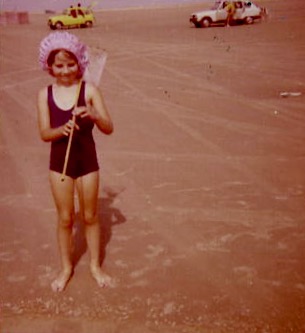
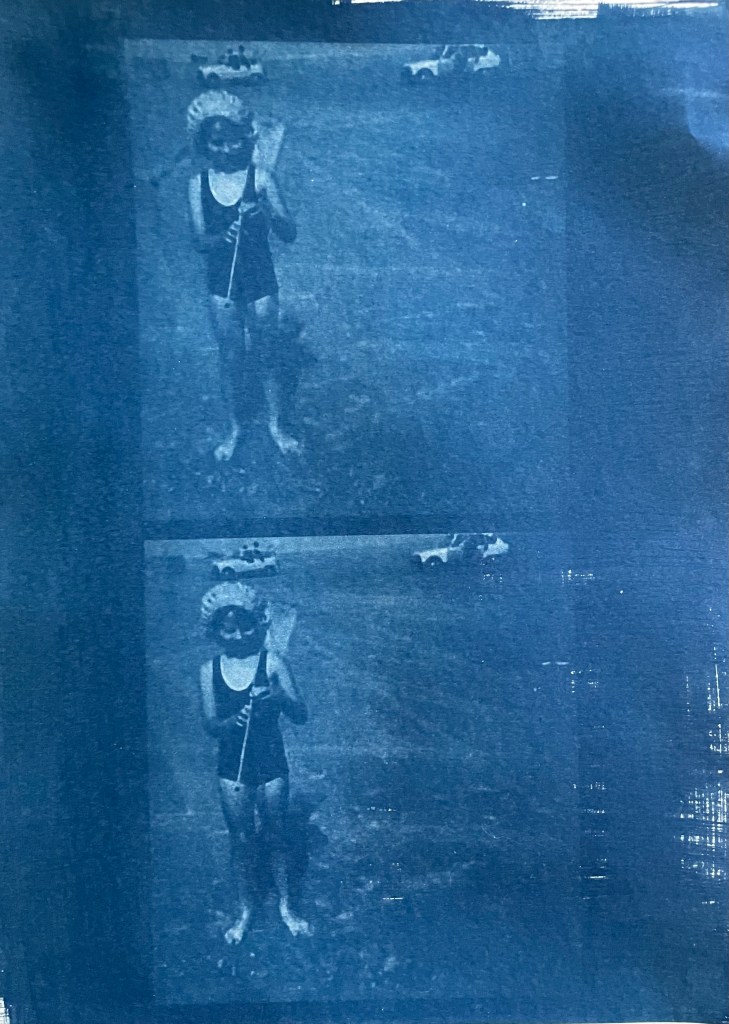
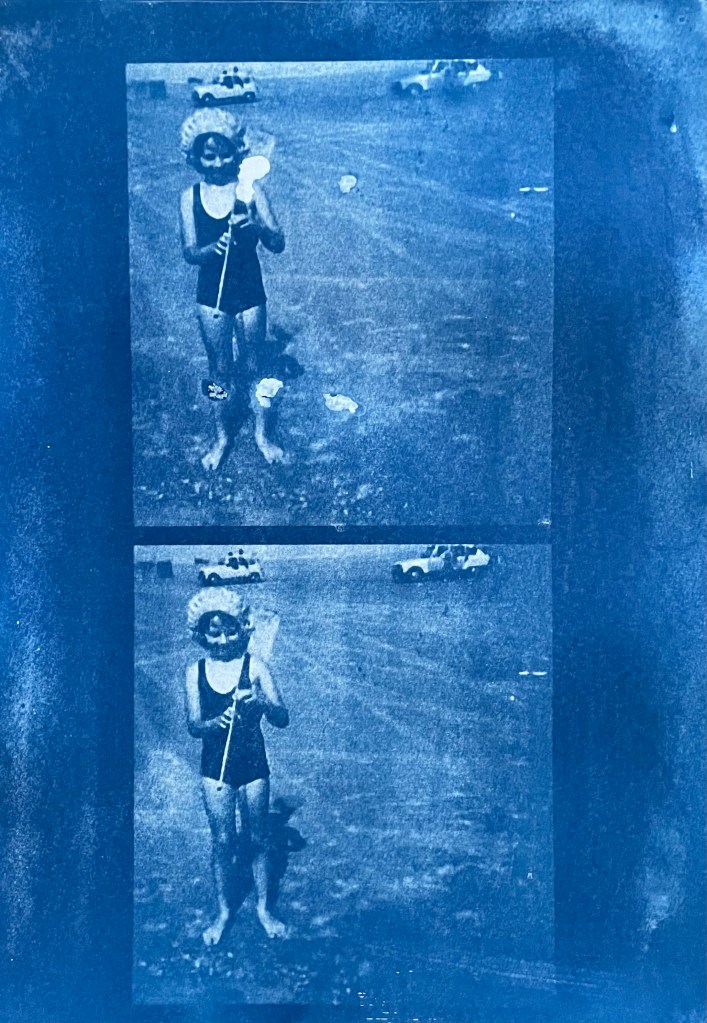
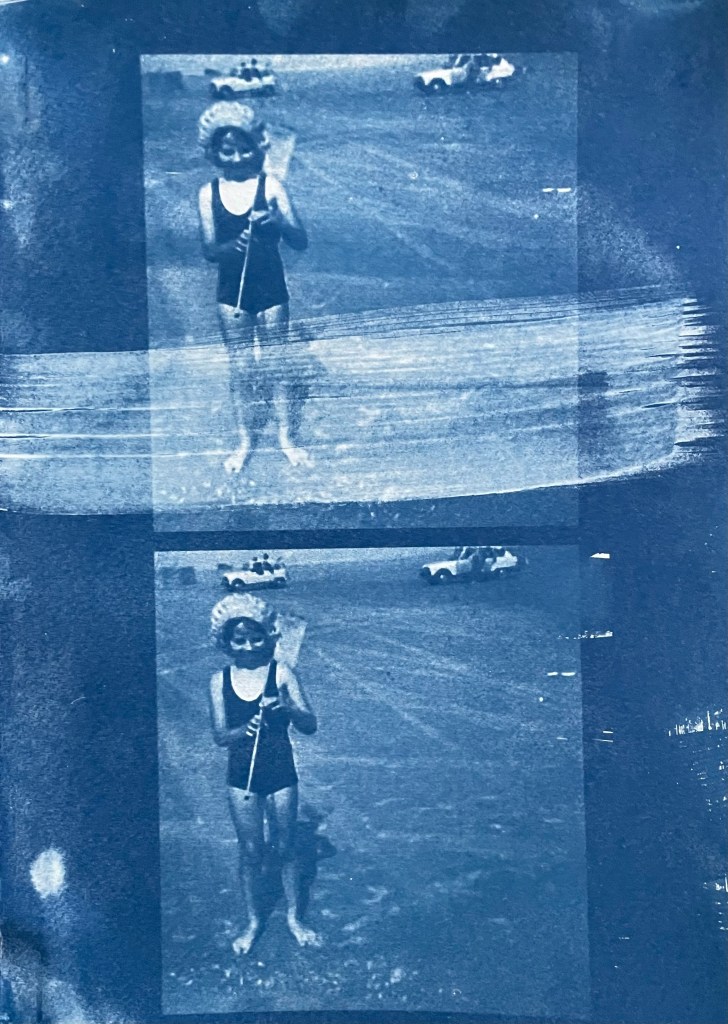
The first two prints were made using the unit, the first being over- exposed at 20 minutes, the second being just about right at 15 minutes. The last two prints I did outside in the sun, which was a bit more hit and miss because the strength of the sun was not constant as it kept disappearing behind some cloud cover. However, I do really like the effect of the visible strokes which I left when applying the solution to the paper, which was A4 300g/m2 hot pressed watercolour paper. The markings give the effect of a moving, flickering , transitory image – there, but not quite there. I put two images on the same negative transparency because I wanted to create a number of smaller images to experiment with. However, the suggestion that the images are on a roll of film is really interesting.
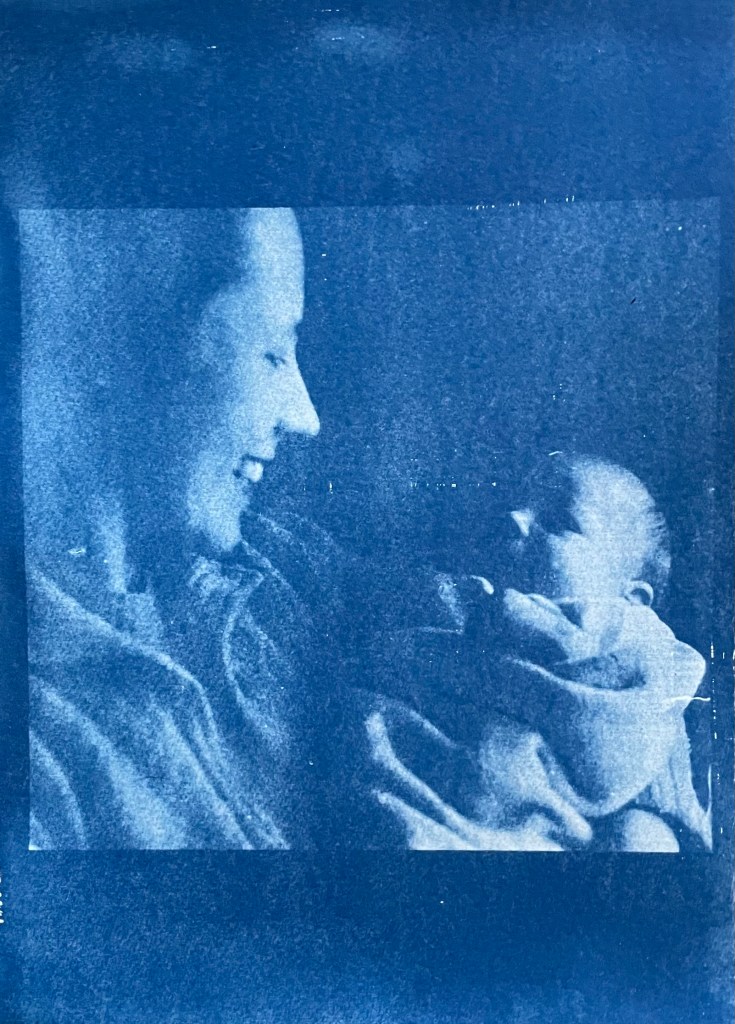
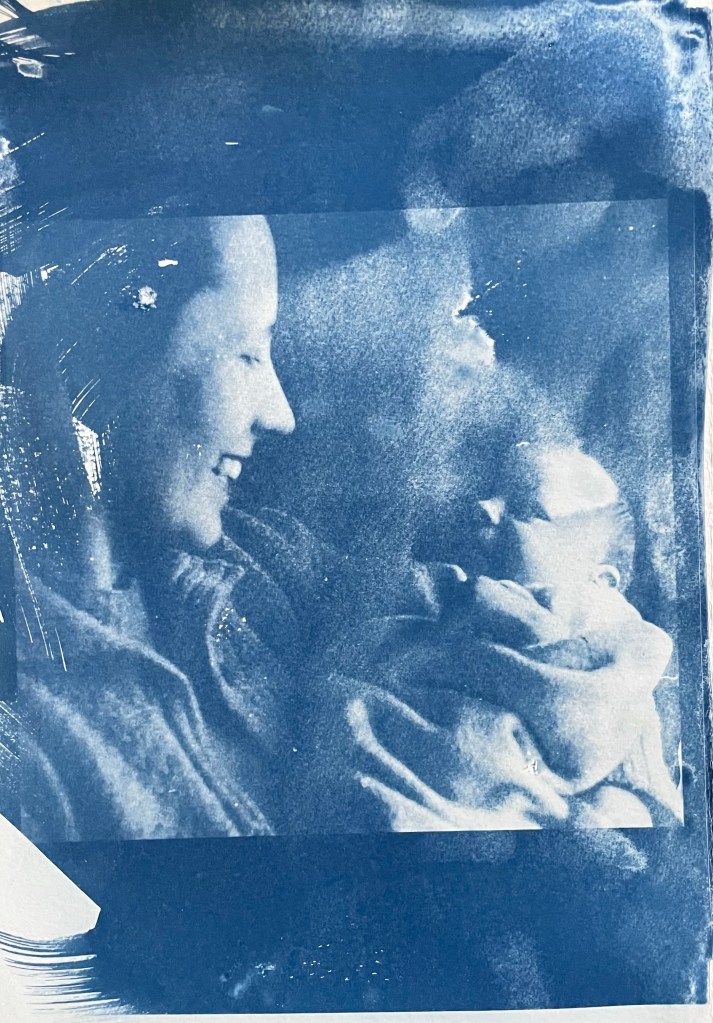
My mother & my brother – capturing a connection and a perfect expression of motherhood
It’s been really difficult getting some of the old photographs out of the albums; they are the sort which have sticky pages on which you position the photos, and then put a transparent film over the top. Over the years the adhesive has seized up and practically bonded to the back of the photos. I’ve tried all sorts including gentle heat, dental floss and a bendy, very sharp filleting knife.
This one of my mother and brother is a favourite, but sustained a small tear on the right. I am pleased with both images – the first one was done outside and the second in the unit, which seems to have more of a Prussian Blue hue to it although I’m not sure that there’s any rhyme or reason as to the differentiation in the blues – but I really like the movement in the second one, again giving the impression of a fleeting moment. I think that the solid areas at the top and bottom add to it, suggesting a frame from a film of a moving image.
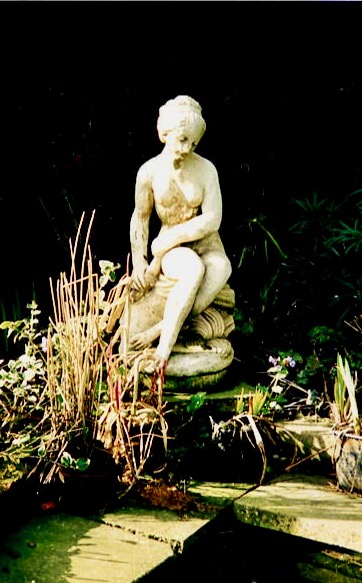
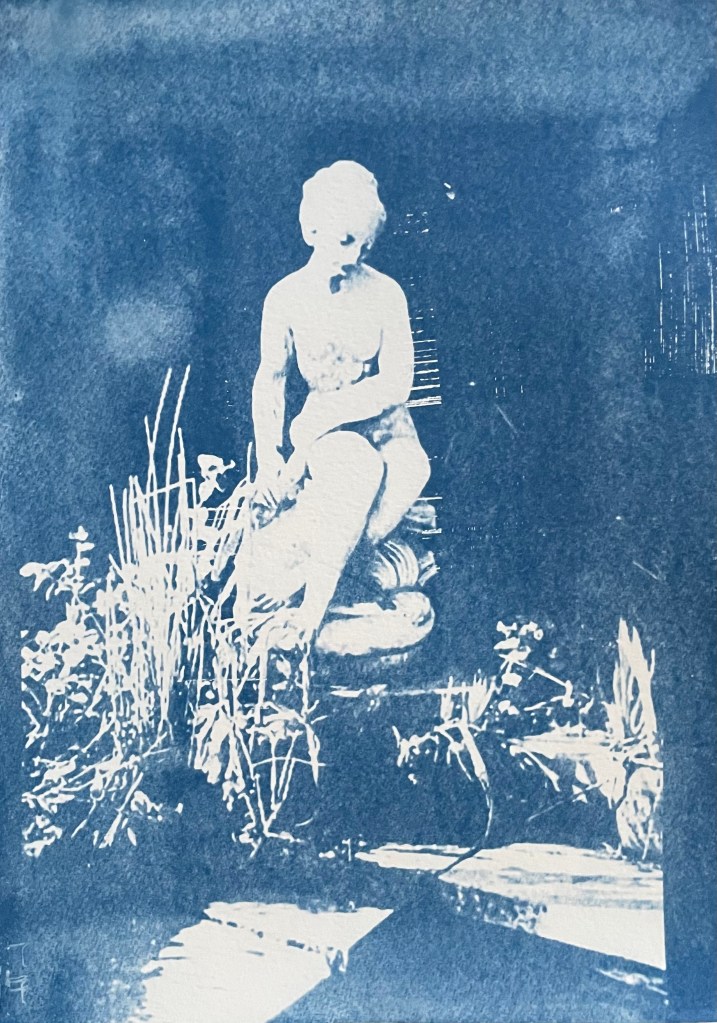
This is a photo of the statue which sits at the bottom of my mother’s garden next to her makeshift pond made out of an old washing-up bowl. I always used to wander around the garden when I visited, stopping at the pond to see if there were any frogs around. I do like a frog – my grandmother on my father’s side used to have a rockery, and I used to spend most of my visits looking for, and trying to catch frogs. That, and hanging out in her shed and greenhouse with the tomato plants – I love the smell of tomatoes; it takes me right back.
The problem with a cyanotype is that if you leave it too long, you over-expose it, and whilst you get deep blues you lose the midtones, which is what I thought I had done with the first one, so I exposed the second one for less, but it turned out to be under-exposed – even putting it in a hydrogen peroxide bath didn’t help. Both were done outside; perhaps I should have done a straight 15 mins in the unit, but where’s the jeopardy in that?
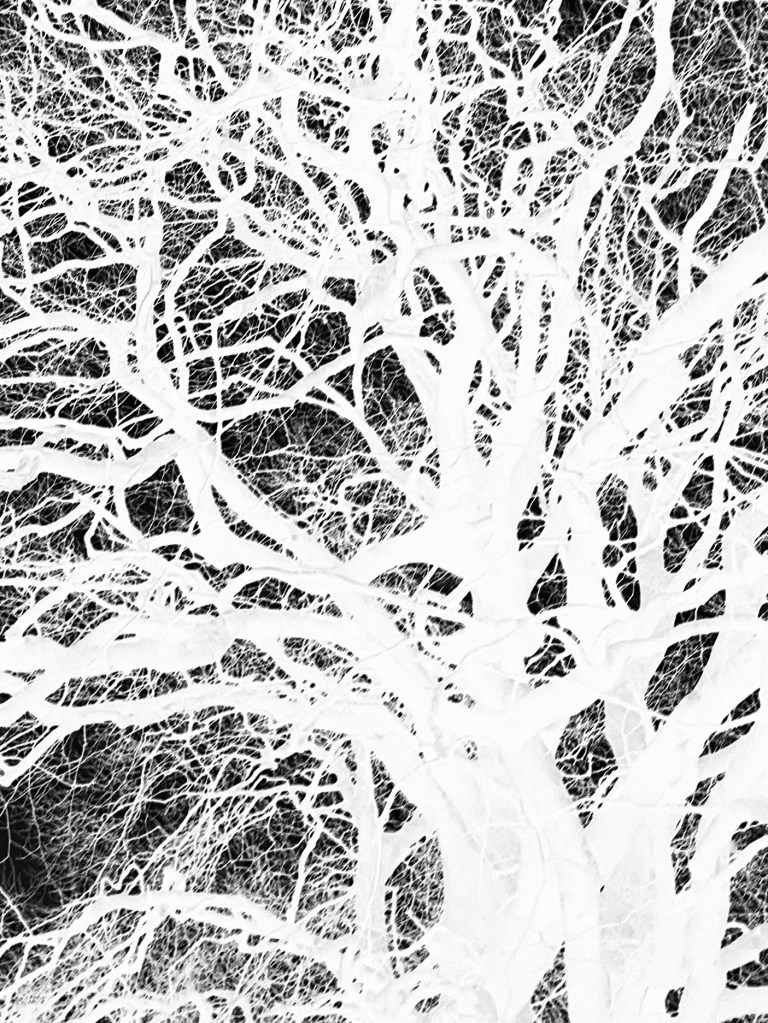
This is a photo that I took looking up into the branches of the three trees that I like. The negative image is also really interesting, and I might do something with that at a later date. The image (last photo) is underexposed again, but has a feeling of being removed, almost as if I’m looking at it through my window (which incidentally does need a good clean). I wanted to try fabric, but could only find some thin cotton lawn. I was so disappointed – it turned out terribly. I had visions of being able to create long, flowing, billowing, wispy cyanotypes, but ended up with the image above. You can just about make out the branches.
I will need to think about this a bit more. My first thoughts are that maybe there was a coating on the fabric, so I’ve washed it; maybe the image was too detailed, but I’ve seen quite detailed images on fabric; that the structure of the fabric is not robust enough – you can get pretreated fabric which is like a sateen so I could try that; or maybe there wasn’t enough contact between the fabric and the negative. I need to take some time to reflect, and try again.
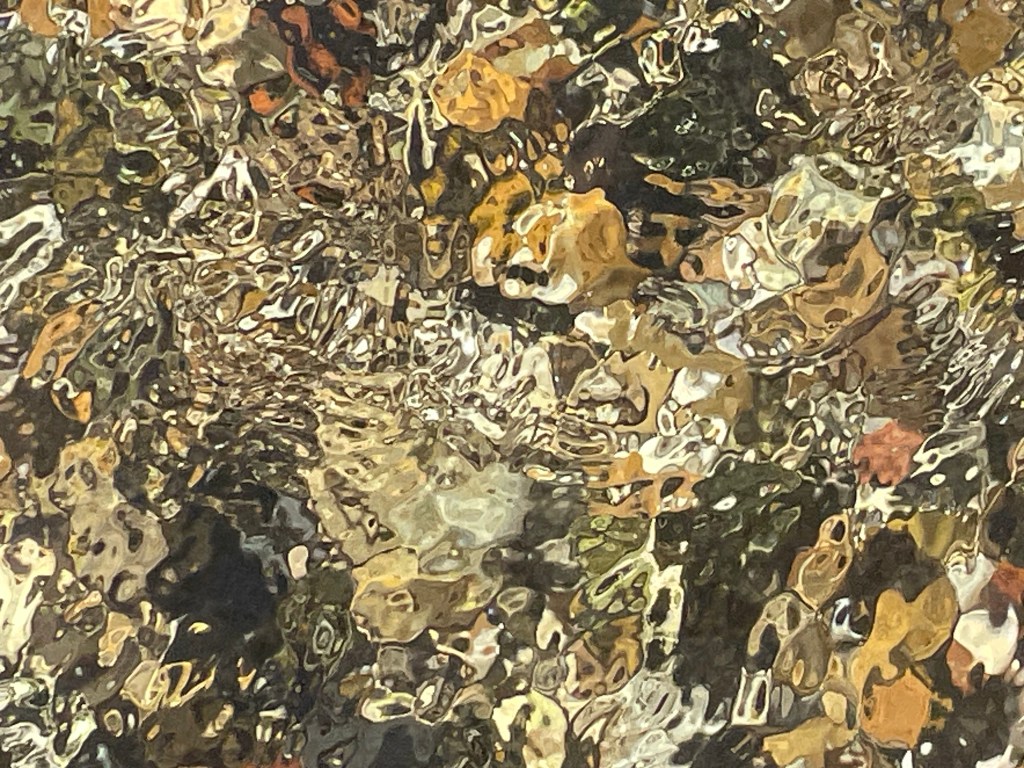
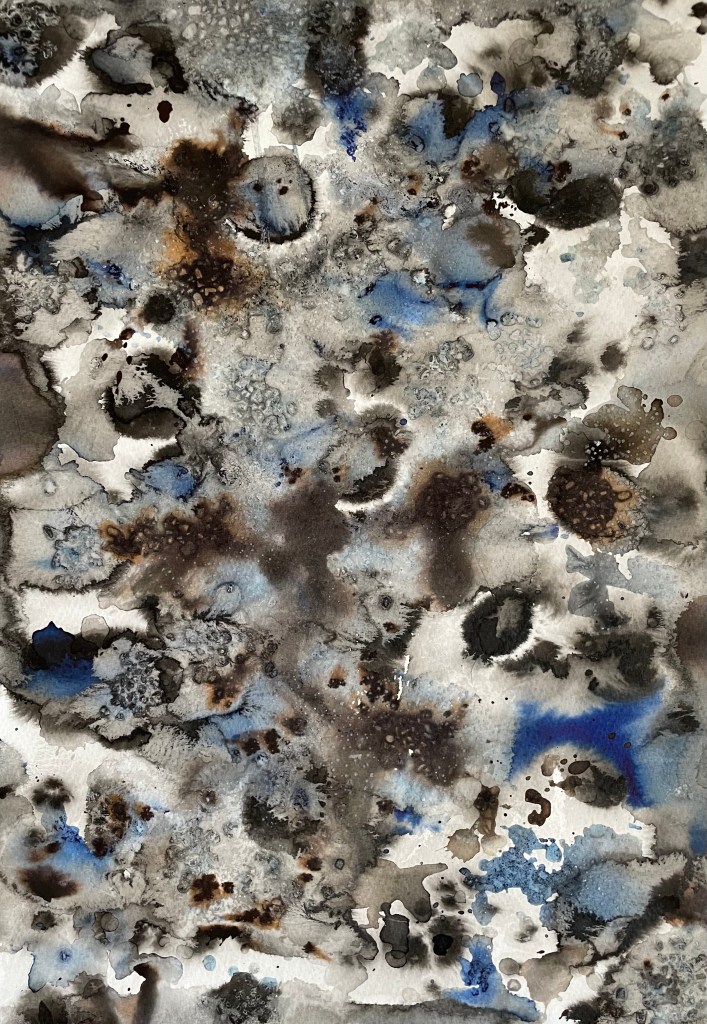
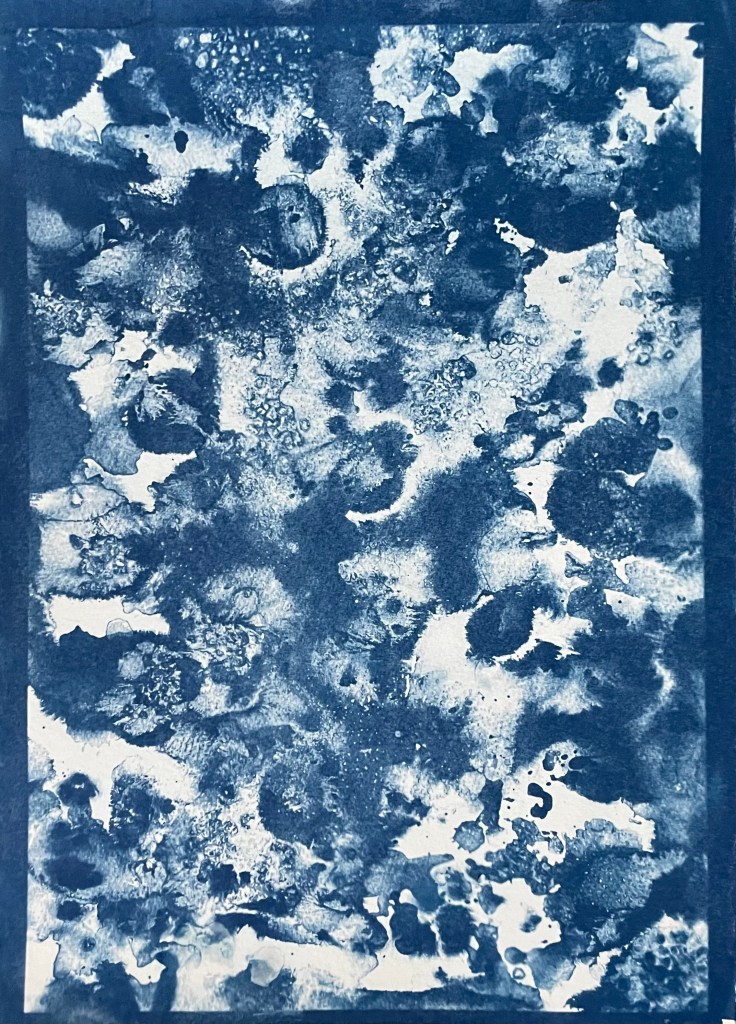
The images above were from my experiment with ink in Blot II , and from A State of Flow II . It was a useful exercise in that it confirmed to me that not everything works as a cyanotype – I much prefer the original images, particularly the ink one, as the edges between areas of flooding and blots are much more defined, and there is more of a delicacy about them. The contrast between the blue and the black ink also adds interest which is lost in the cyanotype.
So, on reflection a really useful and enjoyable exercise. The thing that I really enjoy about this process is the anticipation, and then the slow reveal as you rinse off the solution to see an image slowly emerge, or not, as the case maybe. Doing it outside as opposed to in the controlled environment of the unit adds a degree of extra excitement, but equally there is the risk of crushing disappointment when it doesn’t quite work out.
Moving forwards, I was intending to experiment with toning some of the smaller images of me with tea, coffee, wine etc, but I actually like the last couple as they are, so I will keep them as finished. I’m thinking about how I could use multiple exposures to create layers, and also thinking about manipulating the source image a bit more in Photoshop and printing from the original image rather than reversing etc. I’m not sure whether I’ll get straight to it, or do something else in the meantime – sometimes I go hell for leather with something and then exhaust it, or myself, or become disenchanted with it. I don’t want to get too far down a rabbit hole, so maybe I should leave a bit of space before going back to it, to allow for some more subconscious reflection. I suppose the clue was in the opening sentence: “Last summer I became obsessed with cyanotypes”, and I haven’t done it since.
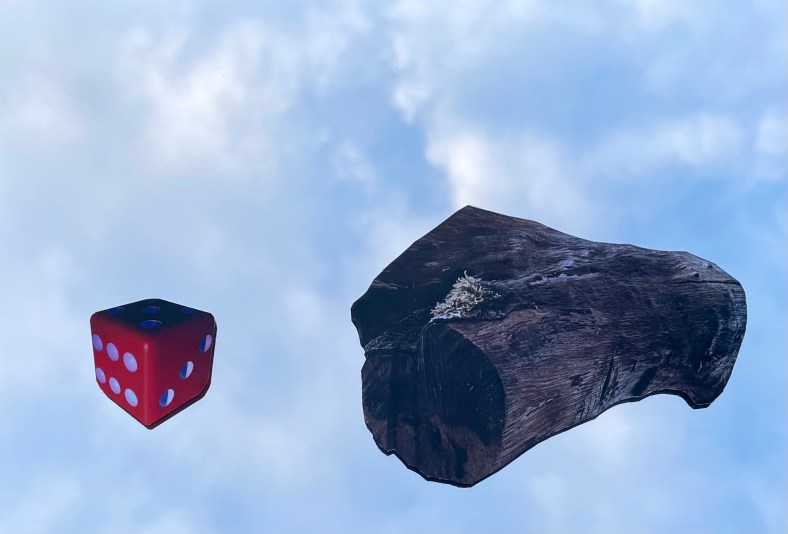
I realise a few things may be influencing my feelings about it. I keep getting reminder emails that the submission deadline is approaching – like I don’t know. Also, my daughter phoned me up yesterday morning in a crisis during an online exam – she was having IT issues. She had already contacted the helpdesk and taken screenshots, so my only advice was that she could only do what she could and not to stress, they must have procedures for this sort of thing. A couple of hours later she was feeling better, whilst I was still feeling the effects of all her stress, and trying to work out how on earth I was going to take a photo of a reflective surface. That, and the fact that some of the glue had managed to escape from under the cut-outs, and the realisation that I had fixed the die on the wrong way round.
Anyway, this morning it wasn’t raining for a change, so I took it outside. I’m not entirely sure how I’m supposed to convey its reflective qualities without including a reflection which then looks like it’s part of the work. Well, following my own advice, I can only do what I can do.
I feel like it’s been a shambles and that I’ve been amateurishly stumbling from one thing to another. The process hasn’t been the experience I thought that it would be. Because I had no expectations, I thought that there would be no stress – instead I’ve experienced confusion and frustration, and it has taken just as much out of me as other years, just in a different way. The only difference is, if it doesn’t get anywhere, I really don’t think I care at this point.
But every experience is a useful one. So what have I learnt?
Mirrored acrylic has an amazing quality of turning into a super static magnetic for all manner of minute particles floating around in the air and so is impossible to get clean.
Whilst deadlines can assist in making decision making and getting on with it, a lack of time reduces options, options which may have been the better course to follow. I should have had the image screen printed – it would have avoided so many issues – but I just didn’t leave myself enough time.
I’m not neat, and I don’t do small and fiddly.
I’ve tried something different – maybe next time I’ll enjoy it.
I can submit work which I don’t like and which contains what I know to be obvious errors.
I’m going to do mirrors again, sometime – they will not defeat me.
The process of exploration and experimentation is not just about serendipity and happy accidents or things that just don’t work, it can provoke feelings of confusion, frustration and it’s just not that easy.
As ever, I’m conscious that time is ticking by. Whilst the study statement will be useful to focus what’s buzzing around in my head, moving forward I need to develop a more concentrated and sustainable way of working in order to ensure that I get the most out of the next 5 terms.
Up until now I’ve been all over the place, immersing myself in art, books, programmes, aimlessly ‘doodling’, without any direction, just exposing myself to everything I can and seeing what might stick. Jumping from one thing to another. This process has given me lots of ideas. It’s not too difficult to have ideas – the difficulty is having good ideas and then developing them into a piece of work. I’m feeling that at the moment I’m talking the talk, but not walking the walk.
I lack self-discipline; I get easily distracted; I get bored; I often don’t finish things; sometimes I wake up and know that the day is not going to work for me, and it’s a case of just getting through it; tomorrow’s always another day; I have no routine. I need to establish a routine, if I can, one that allows me to fulfil my everyday responsibilities but which dedicates time to developing creativity. I have no idea how much time I have spent so far on this course. So, moving forward I’m going to record how long I spend doing what. Just roughly, not down to the minute. I’ve had to do this previously – it’s soul destroying having to account for your existence – but the reason for doing it now is to give me a better understanding of how I work, what works for me, whether I’m doing enough and how I need to plan for the future.
Thirty hours a week is a long time, I’ve realised. So, that’s blog 20 mins…
I’ve decided to take a leaf out of Sophie’s book and formalise the thoughts I’ve had since we finished our first term.
I don’t think that I have felt more like myself (whoever that might be) than I have over the course of the last 3 months. I can’t pinpoint why exactly; I’ve just felt like ‘me’.
It has been overwhelming (I suspect that I use this word an awful lot) in the sense that I have been totally free to create and, more importantly, to think about creating. I feel as if I am at the start of an important journey – I don’t want to rush into it; I want to take my time and be prepared. I don’t even know where I’m going – there are no limitations – but I know that I will discover something by the end of it.
I think that I have mostly engaged in the preparation side of things rather than the physical manifestation of work, but that’s been the best bit. I’ve been collecting ideas, inspiration, and information. I think about it most of the time. I’ll have a thought and think, yes, I could use that, and then it’s gone. I need to find a workable way of recording my thoughts – I can’t really open a notebook or Notes on my phone whilst driving – maybe I’ll have to call someone (hands free, of course) and get them to record it for me. Funnily enough, I used to do that: if, whilst at home, I thought of something I needed to do at work the next day, I would call my work phone and leave a voicemail. Just writing that has made me think about what voicemails I might leave younger versions of myself at various points in my life. And that is how it’s been, going off on tangents, suddenly striking up a conversation with whoever I’m with, on the thought I’ve just had.
It has also made me feel anxious – I don’t want to miss anything. I have amassed a large pile of books which I ‘need’ to read. I haven’t really tackled the online library resources with any conviction just yet – the thought of it makes my heart race – all that information out there – how can I take it all in?
The preparation of my study statement has come at just the right time. I need to marshall my thoughts and commit them to words, but in the knowledge that it is a living document which can change over time. I’m actually really looking forward to it as it will bring a sense of calm and order. I hope. Who knows, I might be feeling differently come the beginning of February.
Thinking back on the work I have done over the last few months, I think I have become much freer – I’ve been leaving things as being what I would term as ‘unfinished’ and managing not to go back to them. Making them public by putting them on this blog has helped tremendously. I’m now enjoying the process of making much more than I have previously – it was often an ordeal.
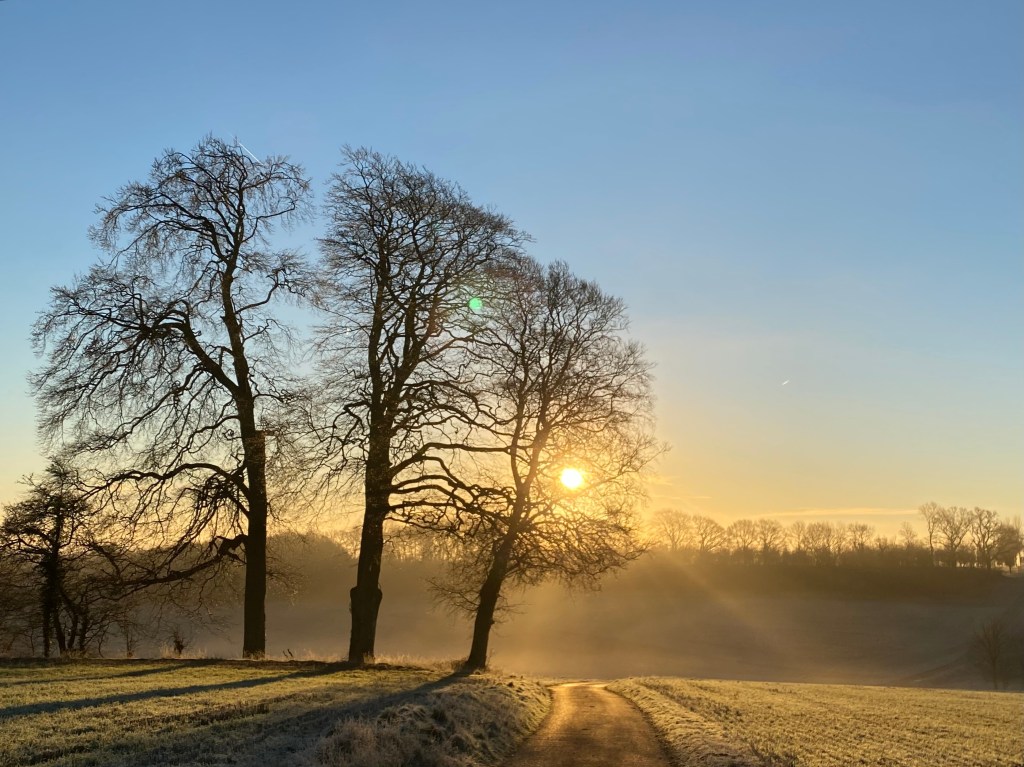
I think I have identified areas which I would like to explore in more depth: I have invested in a book on Procreate (it’s not going to beat me) which I’m working my way through, and I have some ideas in my head as to a series of three digital collages on the subject of motherhood which I may or may not develop further. I like the number three: I am one of three; there are three in my immediate family; there are three trees which together form one tree on my favourite walk near my home; and three is the smallest number by which you can seek the input of others and still avoid a deadlock. Having said that, it’s probably not so great for a friendship group.
I would also like to experiment with printing techniques, photography and a previous obsession, cyanotypes. This term I’m determined to book some sessions and get into CSM on a regular basis.
I’m now able to look back at the three monotypes that I made of my mother. I feel that it was the right thing to do. It was something that I always knew I would have to address and it was something that I had to tackle early doors. I think it has helped. I went back to my mother’s house not so long ago and I didn’t feel the usual sinking feeling of dread as I walked through the front door. I was actually able to sit down by myself in silence and remember some of the good times when we all lived there as a family, even when it became dark outside. A small positive step in the right direction.
As finished pieces of work, they are what they are, vehicles by which I transferred debilitating thoughts into another space. Could I have done them differently or executed them better? Yes, obviously, but I don’t look at them that way; it is what they signify and make me feel that matters: despair, confusion, sadness, resentment, helplessness, isolation and fear. I chose monotype because it is, as soon as it is, and there is no way back. It was all about the process, not the result. If I had to make a change I would change their order – I made them in the order of the conversations – they would work better as a series if their order was reversed, with each one making more sense of the one before.
I took my daughter back to uni at the weekend, and she phoned me up earlier, chasing me for some information I was supposed to give her. My husband chipped in that it wasn’t any wonder that I hadn’t got round to it as I seem to spend all my time blogging – well, if I don’t have anything else to show for the next year and a half, at least I’ll have this blog!
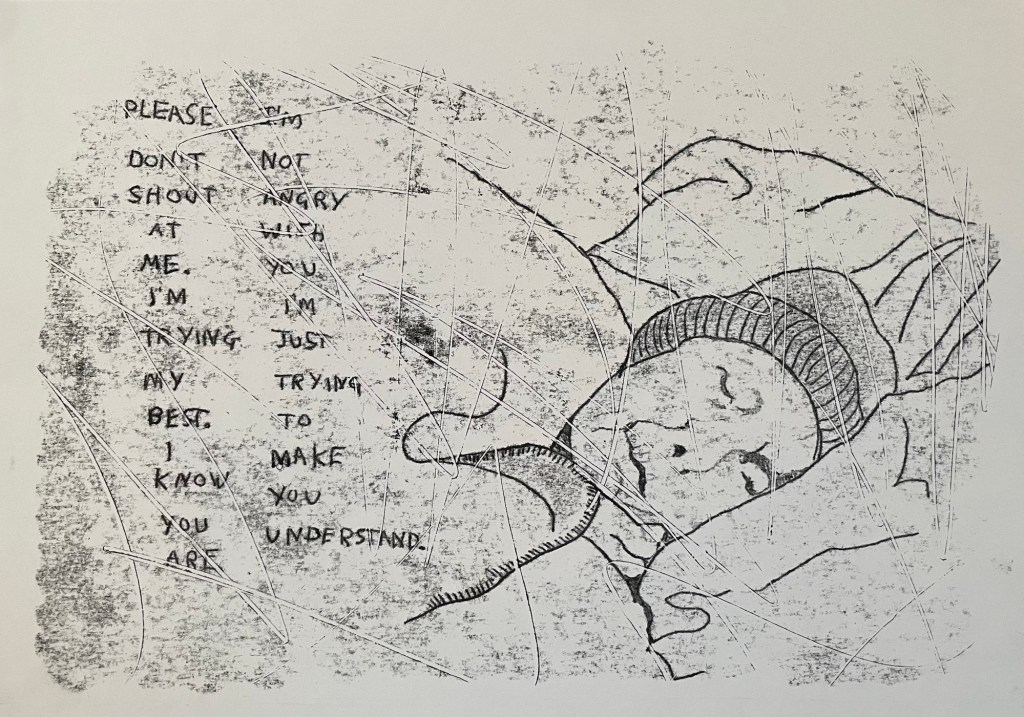
Some were surreal, others were sad. Sometimes she was lucid, sometimes she was delirious, sometimes it was morphine. Three in particular have lodged themselves in my memory. My logical brain tells me that she wasn’t herself, that her brain chemistry was all over the place, trying to cope with the enormity of it all.
It’s just that the last conversation I had with her, was the last.
I suppose I could talk about them to someone, together with the rest of it, but I’m not sure the spoken word will work: the words will come out of my mouth and vibrate through the air to enter someone else’s head. Then they are gone. I need a more substantial, tangible way of dealing with them, through the written word and imagery. I need to be able to confront them, physically.
I’ve had some inner conflict as to whether I should publish the image in which her face is visible; when she was ill and at her most vulnerable. This was a woman who dragged herself through the house, after breaking her leg, in order to phone for my sister to come over and make her look presentable before calling for an ambulance. She was a very private person. But she is no longer here. If it helps me come to terms with it, I think she would be ok with it. My sister’s on board – she reads this blog. She has her own conversations.
Three Conversations With My Mother No 1, Montotype on A4 Cartridge Paper
Three Conversations With My Mother No 2, Monotype on A4 Cartridge Paper
Three Conversations With My Mother No 3, Monotype on A4 Cartridge Paper
I don’t need to reflect on them. I don’t want to reflect on them. Not yet.








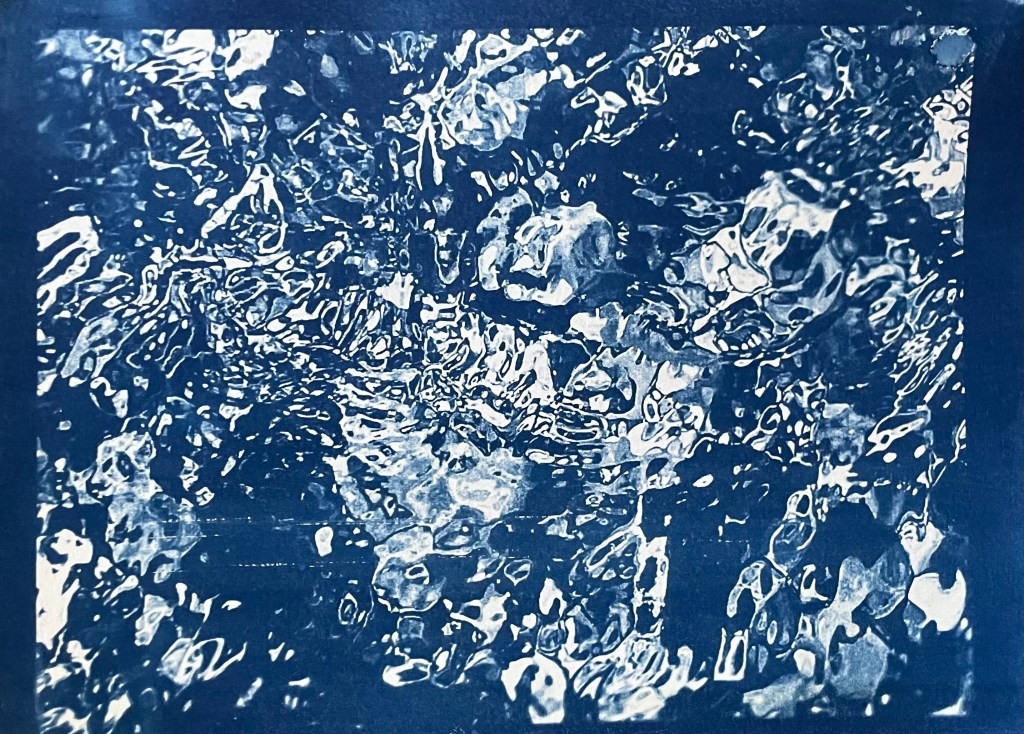


 Kate McCalmont-Woods