Reflecting on Reflecting

It has been a busy few weeks: the print sale, Research Paper, blog curation and 3-minute video.

Making the video was quite challenging. I started by selecting all of the images that I wanted to include and then I decided what to say. It was far too long. So I decided to change tack and think about what I wanted to say and then choose the images which best demonstrated the narrative. It was a good exercise in distilling everything down into a short space of time; of focussing the mind on what is important.

After such a spate of activity I would usually reward myself with a bit of a rest, but funnily enough I don’t feel like that – I feel energised, and with a sense of purpose. In my Unit 1 Feedback I was advised that I would broaden in scope and then narrow back down, and I think that this last unit has brought about some clarity for me, not necessarily in terms of the breadth of my practice but in terms of its future development. I’m feeling positive and I’m looking forward to tying up some loose ends and producing work which encompasses what I have discovered so far and which is not necessarily finished, but more resolved than it has been up until now.

One-to-One No 1

I had my one-to-one with Janet on 20th June.

She kicked off by suggesting that I look at ‘autoethnography’ [a qualitative research method in which researchers use their personal experiences to examine and understand cultural phenomena] as well considering the Tao; an approach to life which is more of a wandering.

I should aim to have few references which are not apparently connected and find a new pathway from synthesis which is uniquely mine.

She ran through her notes.

  • It has strong potential particularly its exploratory stance and willingness to probe instability
  • There is a compelling central enquiry into mapping as a dynamic, active process
  • Its strength is the questions it raises rather than its answers

I need to:

  • Work towards refining the focus
  • Tighten the language and clarify the relationship between the concepts eg what’s the relationship between Kierkegaard and Grayson Perry? Map/mapping, reality/memory
  • The title is too long and general – need to specify the argumentative focus – although the title can come at the end
  • Personal voice in the opening paragraph is authentic but need to transition more clearly into the critical voice – set down where I’m coming from to start to see it as a critical analysis of where I’m coming from rather than a ‘hello’
  • Define what I mean by autobiographical mapping
  • Consider the difference between mapping the self and representing the self.
  • Consider psychogeography and subjective cartography – artistic tradition sits at the intersection of these terms
  • Dodge & Kitchin – ontogenesis – links to autobiographical process lived and relived through memory
  • Look at Carol Tills – a geographer
  • Memory is VITAL ie alive
  • Consider adding another disciplinary depth – so far have art, cartography, philosophy – inter-disciplinary is good. Have breadth, now need depth.
  • Instability of memory related to instability of maps
  • Good concepts and thoughtful reflection
  • Need to read more in order to narrow down the focus and more rigorous integration of theory and artistic examples
  • Philosophers don’t know much about material dimensions – when making something it gives information to you. Am I being me?
  • Paul Ricoeur, Henri Bergeron

Wondering About Wandering

It’s been almost 3 weeks since my tutorial with Jonathan, and even longer since my last blog post. I’m usually very good at writing tutorials up immediately afterwards, whilst I can still remember what we discussed. I don’t usually take notes – it’s too distracting.

Oh, how I wish I had taken notes, but I think that I can still remember the gist of it.

My clearest recollection is just how good it was to have a chat about something other than accidents, operations, hospitals and pain relief. On this subject Jonathan mentioned Late Night Ramblings, how at first glance it looks like a map but then when you look closer you realise that it doesn’t relate to anywhere. We talked about the methodology – what came first? I explained that I started off with the coloured lines, placed the dots at the intersections and then decided to add the contours and finally the grid – in retrospect I probably should have reversed the order as it was particularly difficult putting in the contour lines after the event – I couldn’t see the lines for the lines. We discussed the previous experiments which led to this point in particular the use of the photo of my father to create the outline of the figure, how the pose still retains its meaning, the angle of the shoulders and the head looking down, and how, because he reads my blog backwards from top to bottom, it only became apparent that the photo was the source of the outline once he had worked his way down. He also referred to What Was I Thinking? and my openness as to how I viewed my actions.

We talked about whether I would experiment with other media – I explained that I liked the flimsiness of the flip chart paper as it reminds me of the paper on which maps are produced and how I am interested in the idea of folding. Jonathan referenced how maps are folded, in a concertina, and how a piece of paper no matter what size it is can only be folded in half 7 times. Intrigued, I looked into this further after the tutorial finished. Generally, this is the case although in 2002, Britney Gallivan, a high school student in California, set a new world record by folding a piece of tissue paper 12 times, but it was 1.219km long. Funnily enough, whilst driving to Exeter yesterday morning to start and finish what my daughter was en route to do when she had her accident, clear out her room at uni, we had the pleasure of listening to Radio 2 when the Paddy McGuiness show came on, and listeners were invited to message in to explain how it can be true that if you fold a piece of paper 42 times it could reach the Moon? Did you know that you can only fold a piece of paper 7 times I asked my husband. Yes, you’ve already told me that, he replied. It’s a matter of exponential growth – if you assume that the thickness of a piece of paper is, say, 0.1mm, then when you fold it in half 42 times it will theoretically be 439,804km thick, approximately 55,000km in excess of the distance between the Earth and the Moon, the same kind of principle as in A Bird In The Hand.

I mentioned that I was thinking of creating a ‘map’ which would embody all that I have learnt over the course, and have been toying with experimenting with canvas, how I would need to think about image transfer etc. Jonathan mentioned Citrasolv which works really well on laser print, especially high quality print such as National Geographic. After the tutorial I watched a few YouTube videos, ordered some and have had to wait a couple of weeks for its arrival, this Thursday.

We then discussed Raita Bitless, and how Jonathan felt that there are some very important elements which are emerging and this is one of them. It feels like these are important memories which need to be explored further, and I agreed, explaining that sometime over the next couple of months I want to go back up to the Midlands and spend some time just wandering and reliving.

I’m sure that some of these discussions were prompted by a question, but the only one I can vaguely remember is when Jonathan asked me whether I was missing anything or needed anything more. I said that I didn’t think so, that I am quite happy just doing what I am doing. I have realised a lot about myself and the way I work (or not) – I had been attempting to squeeze the round me into a square hole. As such, I have effectively torn up my work plan, as it’s just not who I am, and have decided just to wander; to go on a dérive, and to wonder. Jonathan liked the idea of wondering whilst wandering – there’s a name for it, he said. I thought of it afterwards – a homophone – although apparently wonder and wander are not actually homophones because of a very subtle difference in pronunciation of the first syllable – what killjoys! I like it anyway, and there is a lovely interplay between the two.

We then got onto the subject of the research paper and he referred to The Paradox Of Choice. I told him that I felt as if I had been told to go out and buy something, anything; that I had decided that I wanted to buy a cake but that I couldn’t specify which cake I wanted until I had visited all the cake shops and seen all that was on offer. I would have responded much better to having been given a choice of topic out of a small selection, akin to an exam paper; that I felt overwhelmed by choice and asking me what intrigues me doesn’t really narrow it down at all. Anyway, because of where my current experiments have taken me, I have decided to think about maps particularly in an autobiographical sense. We then went on to discuss maps and the issues with them in terms of distortion both physically in respect of projections and political motivations, perspective etc. Jonathan also mentioned Professor Steve Peters – Jonathan had been to a talk and had been given a copy of The Chimp Paradox – I had started reading it a while ago but didn’t finish it as I was probably distracted by something else. He referred specifically to the idea of the helicopter view. It’s a technique to gain perspective on something by imagining hovering over the issue in a helicopter which enables detachment and a more rational and objective view.

Does the need to do the research paper risk having a negative impact on my current wandering? This was a difficult question to answer, but on the whole I don’t think so – I’ve already recognised that I am a person of extremes, either really tidy or messy, focussed or distracted, honed in on the detail or preferring the bigger picture – each will appeal to my polar opposite needs and I am optimistic that what I discover whilst writing the research paper will have significant impact on my current practice.

I hope that I have covered everything we discussed although we must have talked about carbon paper at some point because I have used it recently. I have done a few things recently – I need to include them in a post but, frankly, all I have wanted to do is to make and not necessarily reflect on and write about it.
Computer Says ‘No’

If I were a laptop I would say that at the moment I have no RAM, my processor is kaput and my operating system doesn’t support updates.

I’m not in the right headspace to have to think about a research paper. The more I think about it the more I just want to make, but my chunking approach to life means that I have to deal with this before I can entertain anything else.

At the end of the day, it’s just a draft – a draft is inherently subject to change.

What intrigues me? Initially it was the fallibility of memory. Then it was maps and the act of mapping. But do either of these interest me that much or are they just a passing fad? Is there anything which will make this exercise a pleasure and not the chore I suspect it will be? I’ve decided that I have the attention span of a gnat, that I am fickle in that I am interested in something intensely for a period of time and then I get bored and move on, that I am impatient and probably at times a bit lazy – isn’t life too short to have to work at making sense of academic writings which seem to have been written in such a way as to make them inaccessible to anyone but the most ardent of readers? I’m increasingly of the view that if you want me to do something, make it easy for me; that’s the approach I adopt with others.

The Paradox Of Choice

Choice = Freedom + Power

Or does it?

Just recently I’ve been running away. Fight or flight. Apparently flight is an underrated stress response.

At the moment, I feel like I’ve got a lot on my mind; too much. More times than not, I just get on with it in a resilient effort, and other times I indulge in some escapism and don’t deal with anything, waiting for something to blow up and become urgent, preferring to lose myself streaming box sets. But, of course, that’s just prolonging the inevitable.

Anyway, I met a friend the other day. I mentioned the research paper to her. I explained that I feel the need to think of all the possible options to make sure that what I choose is the right decision. She said that I shouldn’t worry about making the right choice, I should just make a choice and make it right.

Apparently, it’s called choice overload, and it’s an evil of the modern world. Whilst choice brings freedom and a sense of empowerment, too much choice can cause anxiety; a paralysis which results in no decision being made at at all; higher expectations of making the right decision by virtue of the sheer number of available choices; and consequently an increased probability of dissatisfaction with the final decision. I’m what’s termed a maximiser – someone who has to consider all the options before making an informed decision which in essence is a good thing but in a world of infinite choices can lead to choice overload. I need to become more of a satisficer, someone who is content with good, rather than the best and who, as a result, doesn’t feel the need to research every option and consequently manages to avoid the paradox of choice.

In short, I need to shop more like my husband.

Self-Accountability W/C 22/4/25 & 29/04/25

On the basis that I’ve ditched the individual topics areas, for the time being, I’ve not done too badly although I still haven’t made anything. That’s not such a problem because it’s been a hectic and emotional couple of weeks from both ends of the spectrum. I tend to chunk my life as a way to avoid feeling overwhelmed. If I have events coming up whether it be organising a birthday party, entertaining friends, jobs which I’ve been putting off, I can’t generally look beyond them. The future is looking relatively event free for the moment so I feel like I have some space to progress. I’m feeling optimistic. I started back at my oil painting class last week – I missed the last half-term because of the low res week.

I’ve been to Brasil! Brasil! at the RA – I managed to fit that in on the first Thursday of the Low Res, and I’ll cover it in a separate post.

I managed, finally, to attend Chris Koning’s online workshop on the perception of edges.

I’ve also been giving further thought to the research paper; I’m still thinking that I will do something associated with the fallibility of memory. I became interested in memory when my daughter was studying for her psychology A Level a few years ago, and I bought Julia Shaw’s The Memory Illusion, started reading it and never finished it. I’ve started reading it again.

I’ve found an artist, Al Hopwood, who explores themes of memory, identity and perception at the intersection of art, psychology and story-telling…to reflect on the construction of personal and collective narratives. Also, Perplexity has thrown up some other artists who explore the ways in which we remember, but I haven’t been able to research them any further for the moment.

Going forward…

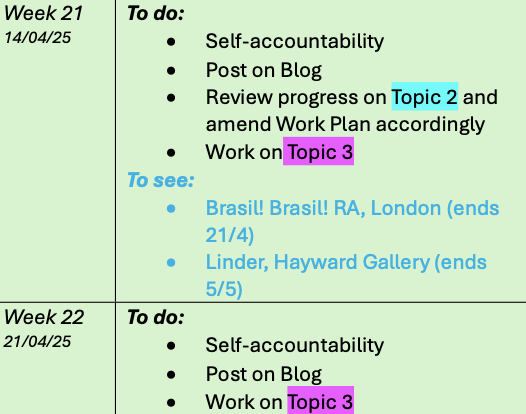
I’m hoping to squeeze in Linder at the Hayward, Donald Rodney and Arthur Neal this weekend.

I’ve also been thinking about how else I can progress my work. I’ve been mulling over the unfillable hole issue and I keep coming back to the Alex Schady workshop and possibly making a video, or maybe painting a self-portrait and just slathering it with junk food, or just making a water feature for the garden! Who knows, but I’m sure there’s something there, I just need to think about it some more. The discussion on tacit agency with Paul Haywood also planted a seed as to how I might explore some of my childhood memories.

As ever, lots to think about…

Keep Making Art!

In this week’s session, as preparation to discussing the impending research paper, we discussed the value of writing for artists. For me, it is a way of organising my thoughts and recording my decision-making so that I can look back and remember why I did what I did, also allowing me to identify any patterns in my way of working or thinking. It also allows a breathing space to step back, to reflect and evaluate. The process of writing often triggers the development of existing thoughts as well as generating new ones. It is also another means of expression; sometimes writing about something provides inspiration as to how I might convey an idea; I often find inspiration from other people’s writing (Parental Loss I Motherhood I); and sometimes writing is the only way to express something, Three Conversations With My Mother. It is an invaluable process.

Jonathan then asked us to spend some time thinking about what is intriguing us.

I have been thinking a lot lately about a conversation I had with Lyberis on the last day of the Low Res. We were in the bar discussing the talk with Jeremy Deller we had just been to, and also the Whitechapel Library audio walk by Janet Cardiff we had experienced in the morning. We had both been blown away by it. I’m trying to understand why it excited me so much; possibly because there was an element of immersiveness, but at the same time I was aware of what was going on around me both visually and audibly; being both removed from and in my surroundings simultaneously was a really interesting experience, particularly when what I was hearing synced with what was actually going on in the real world, like the sound of a moped, just as one went past. The section at St Botolph-without-Bishopsgate was fascinating as she describes two men, one in blue, sitting on a bench, and there actually were two men sitting on a bench chatting. If I had been them, I would have felt unnerved by 20 odd people all sitting down in silence and then getting up and leaving at the same time. It was difficult to work out what was going on. It seemed to be part detective drama, that we were with her looking for someone, as well as a collection of memories, and then, when we reached Liverpool Street Station, she theoretically abandoned us to find our own way back to Whitechapel to return the discman to the library, presumably relying on our memory. It’s just as well they were downloadable files!

But this got Lyberis and me on to talking about memory; how we are made up of our memories; but what if the memories are incorrect or false? I started thinking about how what I am doing is based solely on my memory. My memory is fallible, even photographs are open to interpretation, as we discovered in one of our previous weekly sessions. What if I am my own unreliable narrator? Even if my memories are factually incorrect, if I have a strong emotional response associated with something, surely that can’t be wrong? Is emotion the only true memory? Even if my memories aren’t correct, does that make them any less true to me? And then I was listening to the news on Radio 4 the other day and they mentioned that the writer, Mario Vargas Llosa, had died – he believed that novels should present lies as truths. This gives rise to the possibility that I could even invent my own history.

After taking us through the ins and outs of the research paper, Jonathan raised the issue of AI. He said he uses it to have a dialogue, to challenge his thinking. I’ve used it to critique a piece of work. I came across this article in the Guardian yesterday morning about the artist, David Salle, who has turned to AI to breathe new life into old paintings which hadn’t been rapturously received ‘I sent AI to Art School’.