Ambivalence

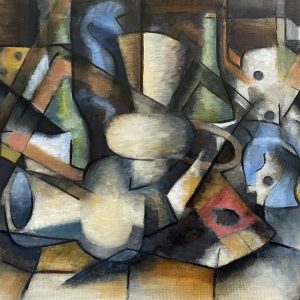
In A Test of Memory I question my paradoxical nature.

Is it an undesirable trait because it displays a lack of consistency and predictability? Does it make me an unknown quantity, fickle, unreliable, or even hypocritical? And specifically, in terms of the art world, how does this relate to the need to establish a defined and consistent style for commercial success and gallery representation, in creating a brand? I asked Perplexity AI what it thought.

In a nutshell, it’s not the paradox which is the issue but being unable to accept it. Embracing paradox is linked with greater creativity, psychological growth and is a realistic way of understanding selfhood in a complex world. It is the basis of dialectical thinking: two truths which seem to conflict but which both accurately describe you or your situation e.g. being independent but needing connection.

According to Kierkegaard, the self is essentially a tension between different poles and the process of becoming is learning to live with the contradiction rather than to abolish it. In fact, problems arise when the paradox turns into a chronic self-contradiction that seems unresolvable, which is often tied to perfectionism or all-or-nothing thinking. It creates a state of ambivalence. As long as I genuinely value and am honest about my paradoxical nature, then I am not a hypocrite or lacking in integrity. I need to accept both parts of myself and embrace the tension the paradox creates; to ‘develop the container large enough to hold it’.

In terms of the art world, whilst a paradoxical nature is an asset for making art, it is not for selling it. It does not fulfil the desire for consistency, recognition and stability. So, what is the answer?

  • Distinguish between practice (paradox) and brand (the curated external interface). Curate consistently eg strategise the release of work; lead with one voice whilst nurturing the other.
  • Be like Gerhard Richter, developing separate and opposing lines of enquiry which never merge – be distinctly one thing, then the other, do not mix them and become a muddy average.
  • Have a consistent conceptual narrative – make the paradox the subject matter itself
  • The Trojan Horse is an extension of the first bullet point: pick a lane and develop it and once you have a foothold introduce the other, pivoting under the guise of evolution.
  • Most importantly, don’t suppress the shadow side, and keep feeding it.

That all makes sense. So, how do I feel about it all now? A bit better, I think…

You’re Turning Into Your Father

‘And what’s wrong with my father?’

’Nothing. But I didn’t marry him; I married you.’

It was our 23rd wedding anniversary yesterday. Neither of us is the same as we were 23 years ago and nor should we be according to K H Tan’s Fluctuational Identity Theory, ‘FIT’ (The Dissolution of the Self: How Ontological Instability Reconfigures Identity, Ego and the Nature of Selfhood, July 2025).

In his thesis Tan proposes a framework for understanding selfhood as a dynamic process of becoming that never achieves stable being. He argues against the notion inherent in Western traditional thinking that there is a stable foundation which grounds identity across time and change: a stable and unified self. This traditional way of thinking raises numerous fundamental issues eg how much change can happen before original identity is lost on a cellular and psychological level? When does the self come into existence? Conception? Birth? When does it come to an end? Brain death? Bodily death? It is not only incompatible with the dynamic, temporal and relational nature of existence, but our attempts to achieve a stable identity in an unstable reality could also be the cause of conflict, unhappiness, and the persistence of suffering in trying to control what cannot be controlled, the anxiety of trying to predict what cannot be predicted and the exhaustion of trying to maintain what cannot be maintained.

He is not promoting the idea of ontological instability per se, and he rejects the idea of chaotic instability (random fluctuations without pattern or direction) as these are incompatible with the coherence and continuity implicit in personal existence; we need to be able to recognise ourselves in order to be able to function. Instead he argues for creative instability. The self is not a thing that has experiences, but the ongoing process of experiencing the self; with every experience we integrate our past, our present and the possibilities of our future. It is a process of maintaining patterns while introducing variation and at the same time the self remains recognisably oneself while becoming other than what it was. The self undergoes ‘inter subject becoming’ – it is not a pregiven entity that enters into relations with others but emerges through and as a result of these relations.

He sees instability as a positive condition which encourages growth, creativity and meaning-making which would not be possible if the self were a fixed and stable entity. He considers fluctuational personas eg parent, friend, spouse, citizen, as genuine modes of being as opposed to roles and temporary performances, and as such negates the idea of authentic and inauthentic personas because all personas are genuine expressions of our capacity for becoming.

He advocates aiming for the middle ground. The more we try to define our identity the less capacity we have for growth and transformation, and too much self-awareness can lead to psychological overwhelm. Conversely, complete openness to transformation and abandoning any attempt to understand ourselves leads to a loss of any sense of identity and the continuity necessary for coherent existence, as well as disconnection from experience.

Achieving accurate self knowledge cannot as a matter of logic be achieved: we cannot bridge the gap between who we are and who we understand ourselves to be. He sees this area of misrecognition as being a ground for new possibilities of selfhood; it can become a creative force that helps us to become what we see ourselves as being. He gives examples of considering ourselves to be more creative, more confident than we are, and how this might lead to us ultimately having these attributes. Presumably the same could be said about negative attributes, but he doesn’t deal with these in any detail.

He compares traditional approaches and FIT in terms of personal development and growth including education and the effect of technology and algorithms on digital identity, psychological health, political and social implications, and human flourishing. He posits that FIT provides the framework within which we can better understand and navigate the challenges of contemporary existence.

It’s certainly an argument for revising the vows of marriage to reflect not only a change in financial status and health, but also in selfhood. Our wedding vows were in Italian and we haven’t the foggiest what we agreed to.

Wayfinding

I think that I’m finally getting some clarity. Or maybe I’m seeing connections and signs where perhaps there aren’t any, but it seems to make sense, in my head anyway. In my second tutorial, Jonathan commented that he had a sense that it was all leading to something (the first sign).

So far during this course, trite as it may be (although Jonathan has assured me that it is essentially what art is about), I have been concerned with understanding myself and my place in the world as a practising artist. I’ve been working from memories, guiding me like a compass on my exploration, probably slightly off kilter, as well as my day to day life, thoughts and feelings. I have been trying to concentrate on the process as opposed to the result (a sign), experimenting along the way, and producing very few finished pieces of work. I did feel uneasy about the lack of finalised output, but no longer. I’ve been on a dérive (our session on Guy Debord being another sign).

In my Study Statement I question whether it is actually possible to ‘find myself’. Kierkegaard thinks not, in the sense of a static and unified concept, for the self is constantly being formed not just by reflecting on the past but also by engaging with the present; it is in a state of becoming, in a state of flux, something I have said I feel on several occasions in this blog (a sign). I accept in my Study Statement that I can only hope to know myself as at a certain point in time, and that reflection is something which will have to be a continuing process. Something else I have mentioned on several occasions in this blog, to fellow course mates and to Jonathan, is that I feel like I am a different person to the one that started the course back in October last year (a sign); I have changed and I will continue to change – to become.

Recently, I’ve become interested in the subject of maps – the comment in my Unit One feedback that I seem to be engaging in a process of mapping jumped out at me (a sign). That led me to start thinking about maps and the process of mapping and map-making, experimenting with cartographic symbols and mark-making. The subject of maps is a huge one but during my research I came across the philosopher, Korzybski, the father of general semantics, a central principle of which is that the map is not the territory (rather like the image is not the thing: Magritte’s Ceci n’est pas une pipe (I used this idea with my red telephone at the Interim Show (yes, another sign)). In short, our models of the world are abstracts of reality, and do not represent it. This is a principle I’ve been trying to be more mindful of since I read about it – my map of the world is not the same as everyone else’s, so we can be in the same situation or look at the same photograph but have our own very different experiences and interpretations of it (our sessions with the photographs being another sign). Something which is blindingly obvious, but which I don’t always appreciate.

This then led to the notion that geographical maps themselves do not reflect the territory in the sense that there is abstraction and subjectivity in the production of all maps: the size of countries and borders can be manipulated for political and social ends, the purpose for which a map is intended can determine what is included and what is left out, viewpoint and projection can distort the world view.

Mercator Projection

Authagraph Projection

The Authagraph Projection is considered to be the most accurate flat representation of the world. It highlights the distortion caused by the traditional Mercator projection in terms of the size of Africa, South America and Greenland, amongst others.

I have been reading a lot about cartographic theory, a discipline which has only become a thing relatively recently. There is lots of disagreement about what a map is and the separation between the artefact of the map and the process of mapmaking and mapping. Post-representational cartographic theory does what it says on the tin – it argues that maps are not the territory but actually create the territory, are in a state of flux and are constantly changing, and theorists have moved away from the idea of a map as an artefact, but as being performative and processual, and always in a state of becoming.

Whilst working, I have been reflecting on past events and experiences, but whilst doing so I have been conscious that my recollections are probably my version of the truth; that I am my own unreliable narrator. I have been interested in memory for a while, particularly as to its probable unreliability and its potential to be manipulated. The way memories are formed and retrieved means that they are not fixed archives, but are constantly being formed and reformed with each retrieval; they are in a state of becoming.

The link between selfhood, mapping and memory is the concept of the state of becoming: ontogenesis. In my research paper I want to explore ontogenesis in the context of autobiographical artistic practice because it is the essence of what I am trying to do. In my experimentation and production of unfinished work I am engaging in the process of mapping, changing and becoming, relying on my memories which are also in a state of becoming but how can I represent this in a visual form which is also in a state of becoming? Hopefully, by the end of the research paper, I will have a better understanding as to how it can be achieved, if at all.

That’s the plan for now anyway, although I may change my mind, in my state of becoming.