I was planning on going into London yesterday to catch Donald Rodney: Visceral Canker at Whitechapel Gallery (as well as revisit the Cardiff audio walk), and Linder: Danger Came Smiling at the Hayward, before they close in the next day or two. But what I forgot was that it was a Sunday on a Bank Holiday weekend, a perfect time for railway engineering works. A bus replacement service would almost double my usual journey time, and so I decided to stay at home. Instead, I had a look on Whitechapel Gallery website, to see what I had missed. There is an interesting piece on Rodney by Caleb Azumah Nelson, particularly on their relationships with their fathers.
Rodney had, and ultimately died at the age of 37 from a complication of, sickle cell anemia. He was in the midst of a sickle cell crisis when his father died and he was unable to attend his Nine Night.
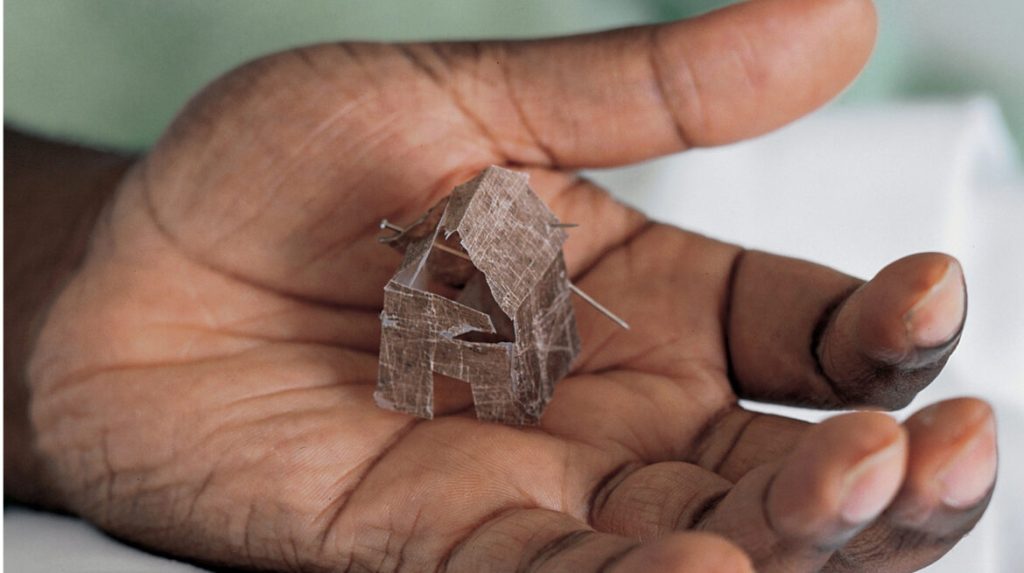
In the House of My Father 1977, photograph (Image Source: http://www.whitechapelgallery.org accessed 5/5/25)
Made from his own skin, the house is held together with small dressmaking pins.
This is the first piece of work by Rodney which Nelson encountered, purely by accident:
’The strength, not in the structure, but in the vulnerability of exposure, his open palm an invitation into his heart, his family. With this gesture, Rodney suggests, this is who I am, this is who I might be.
How does the self come to be? And how do we make space to be our whole selves? … a condition he would have inherited from his father, who would’ve inherited it from his father before that. Their selves, our selves, folding into one another: we contain multitudes. And what else do we inherit? And how do we carry around these inheritances, how do we make space for them in our lives?…’
At the time he was reflecting on his own relationship with his father:
’… wrangling with the things he cannot say to me, or doesn’t have the language for, the many rooms in the house to which I do not have the key…’
He finishes his piece with:
’I believe Art gives us a space to be honest, to confront, to dismantle, to reassemble. To imagine. Visiting and revisiting Rodney’s work reminds me that other worlds are possible. It reminds me, that even in the face of continued crisis, it is necessary to dream. It reminds me that , even in the face of death, we must continue to inhabit many rooms, to hold space where we can be honest, where we can be our whole selves. Where we can feel alive.’
So many thoughts have come to mind:
- The idea of inheritance and how we find a space for it in our everyday lives. To me this feels like a burden not just in the physical sense of belongings, and ‘stuff’, but to the extent that I might feel defined by it: I don’t want to be, I want to be my own person steering my own course independently of what has gone on before, but I can’t ignore the extent to which others have shaped me. Last weekend, I lost count of the number of times friends commented how my daughter is a mini-me or the spitting image. No, she’s not. She’s her own person, living her own life. But, inevitably, I will have had an input into who she is, even if it’s just a matter of genetics.
- I have inherited my family history from my parents. I used to spend ages looking through the family photo albums talking to my mother about the contents. I feel an enormous responsibility to pass this knowledge on. It’s a burden. My daughter is not particularly interested. Maybe it’s an age thing – as we age we need a greater understanding of who we are? Or maybe it’s a digital thing, we don’t have a physical record of our lives lying around the house to prompt an inquiry and so the questions never get asked. Sometimes I think that I should write it all down in case she’s ever interested, and other times I think that I’ll take it all with me and free her from the burden.
- I think that I’ve been dismantling myself over the last few months. I’m not entirely sure that I’ll be able to reassemble myself, but maybe a few left over bits here and there wouldn’t be such a bad thing. I could even write my own instruction manual.
- The child/ parent relationship: I remember the moment when I realised that my parents didn’t know or have the answer to everything; that they were human. It really stopped me in my tracks.
- The idea of the house with many rooms; our ancestors folding into one another; the self containing multitudes.
 Kate McCalmont-Woods