Summer II

I’m now playing catch up, tying up all the loose ends from the summer, which now seems an age away.

Once I’d seen Bourgeois’ ‘Maman’ I had a wander around the rest of Tate Modern.
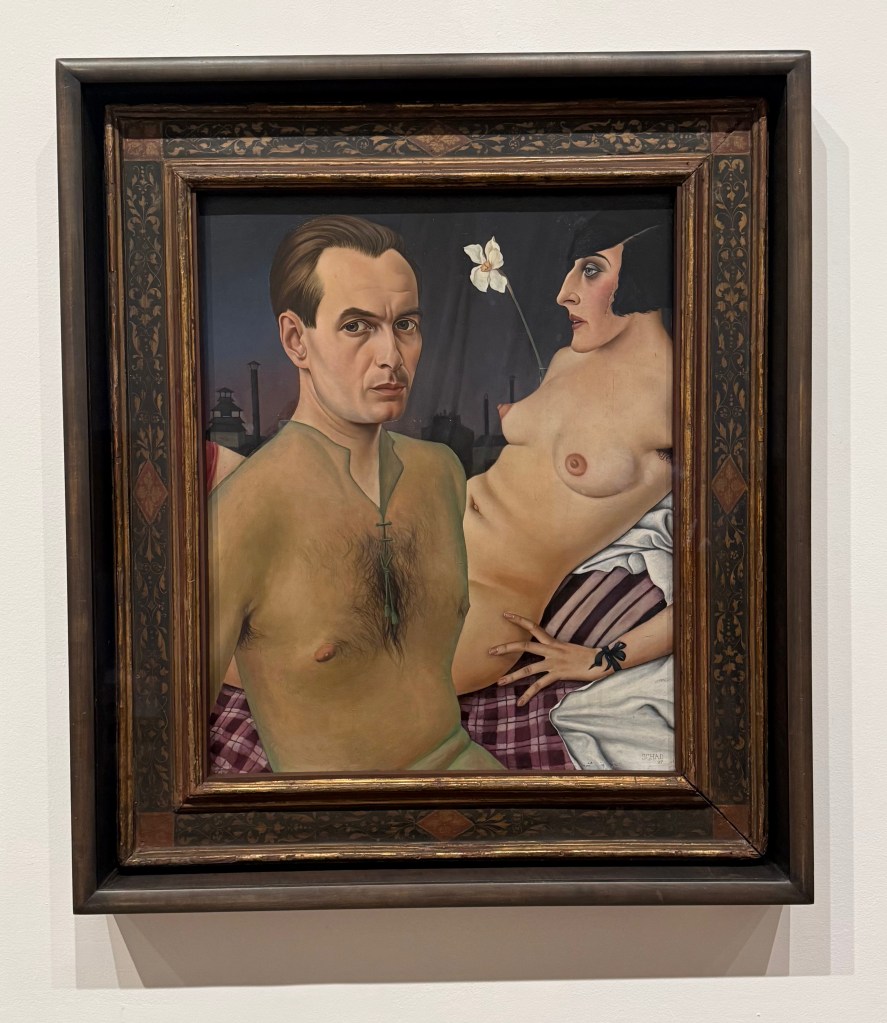
I don’t know what it is about this painting, but I always find myself standing in front of it. It’s a self-portrait by German artist, Christian Schad, in 1927. Having previously been influenced by Dadaism, after returning from Naples he started painting in a smooth, realistic style as part of the New Objectivity, a reaction against Expressionism. He also created Schadographs, which I may have to have a look at. Maybe I’m drawn to it because it was painted at a time of decadence in Berlin and Vienna, or because of the narcissistic symbolism, or maybe it’s just the way he’s painted that really sheer shirt.

This is by British modernist, John Tunnard in 1942. It is an abstract landscape painting of Tol Pedn near the Lizard Peninsular, where Tunnard served as a coastguard during the war. The two small chesslike objects represent the two artificial landmarks on the coast warning ships to keep away from the Runnel Stone, a dangerous reef. I like the areas of texture which contrast with the flatter paint, and the overall balance of the composition.
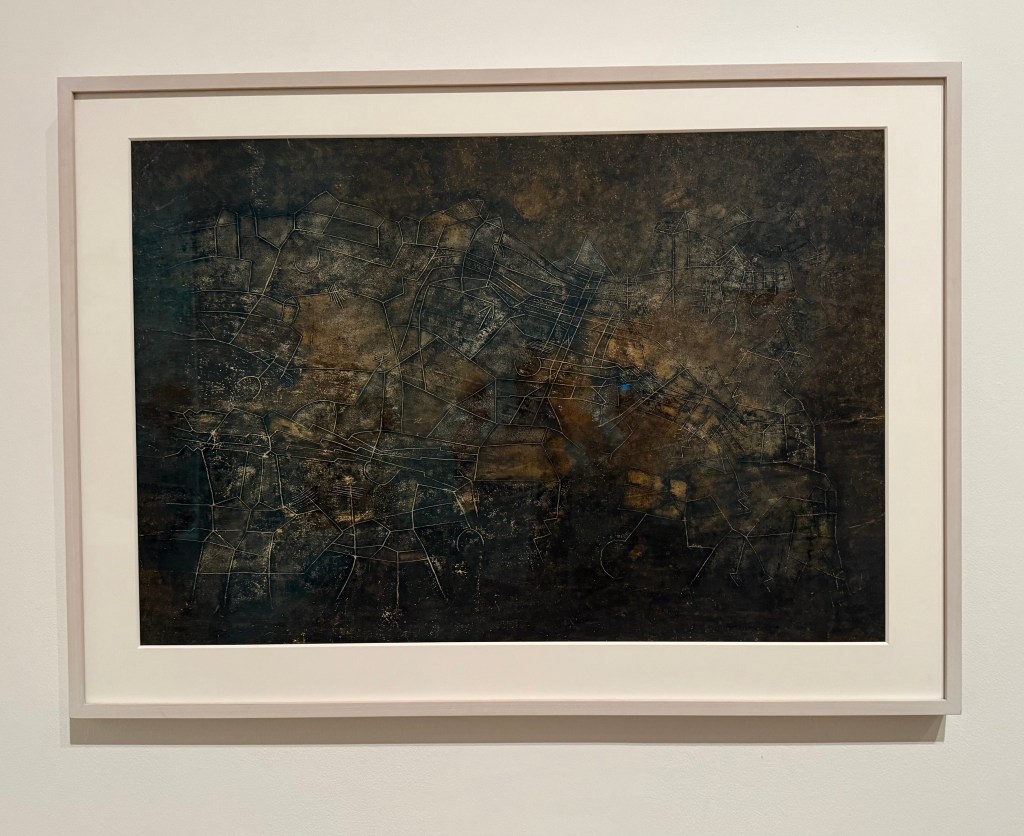
I particularly like the aerial view feel of this work. It is Nocturnal City, by Maliheh Afnan made in 1987 – wax, crayon, oil pastel and ink on paper. She is influenced by the written form, in particular, Persian manuscript paintings. She ‘writes’ her paintings layering materials in which she explores, memory and places. Text has appeared in some of my work, and I like the effect of scraping into the surface to make marks, something that I do a lot of instinctively.

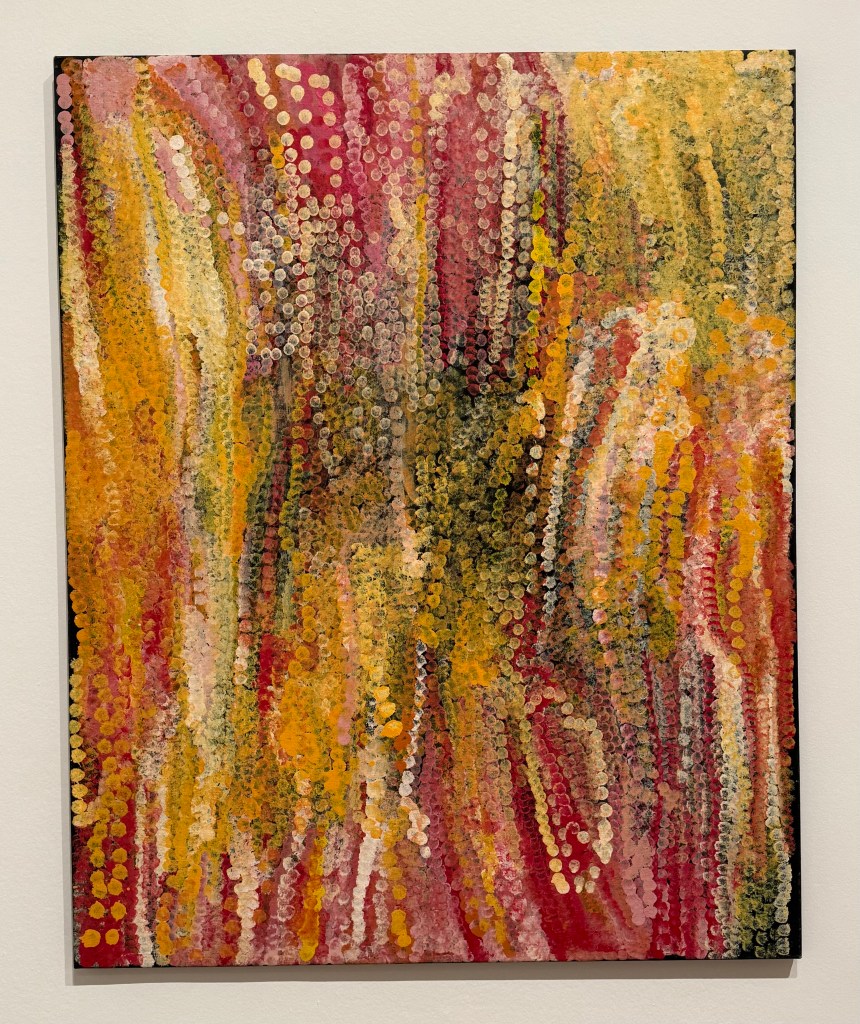
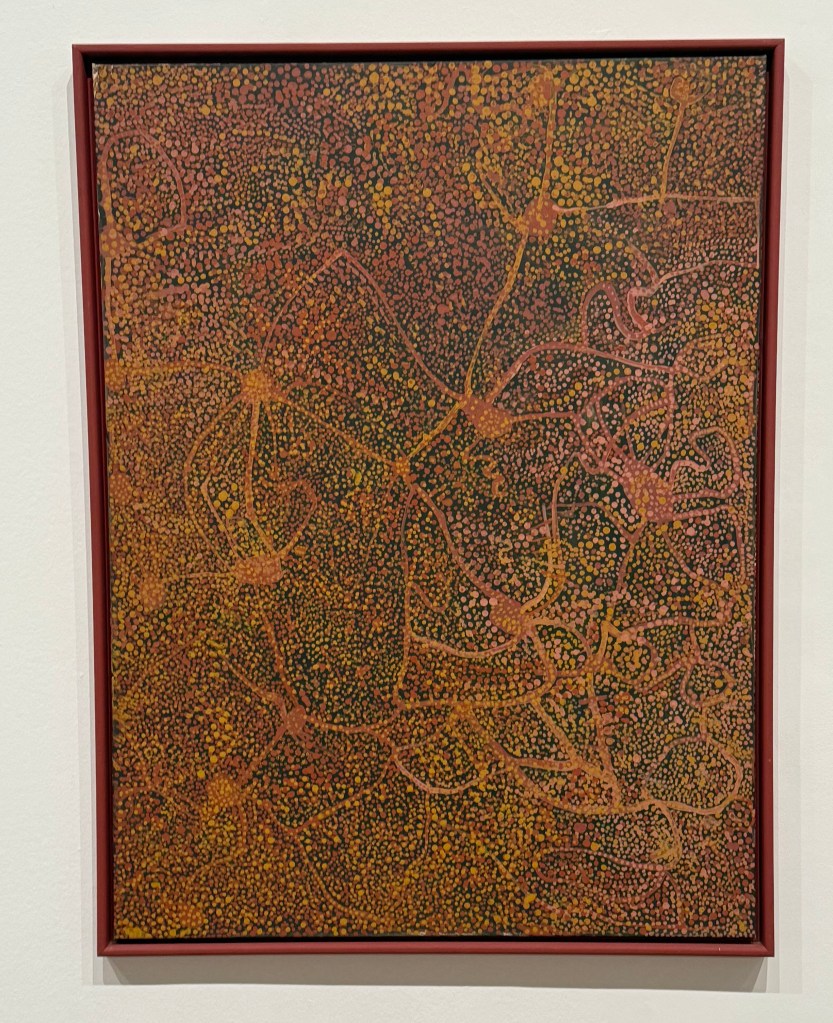
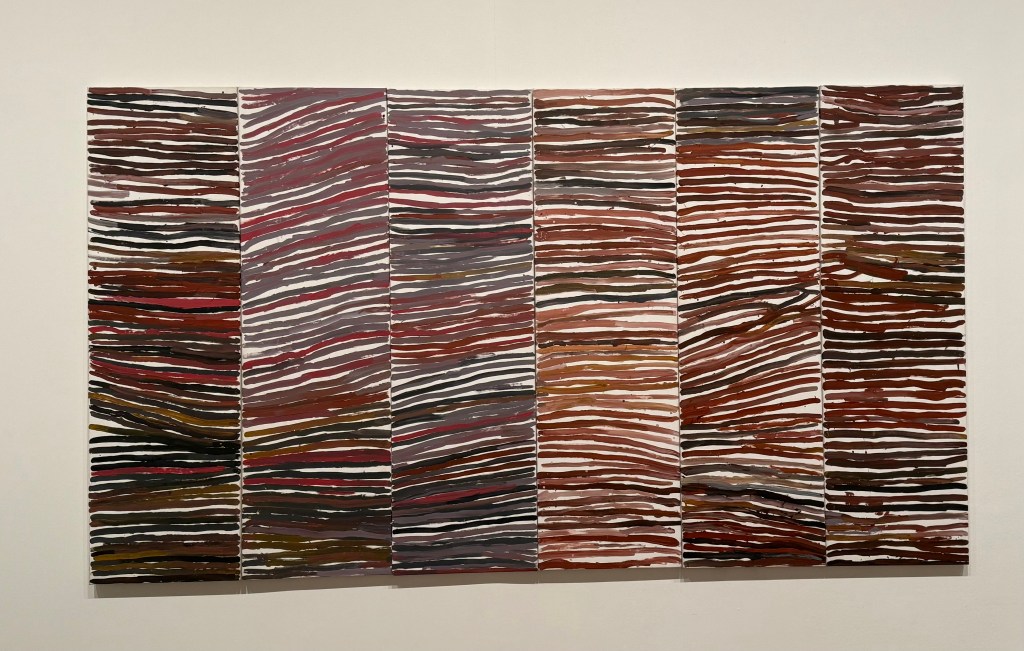
I had a look around the Emily Kam Kngwarray exhibition: she started painting in old age and made a mind-blowing 3,000 odd works in just a few years. I enjoyed looking at the mark-making and the colours, some reminiscent of mapping.
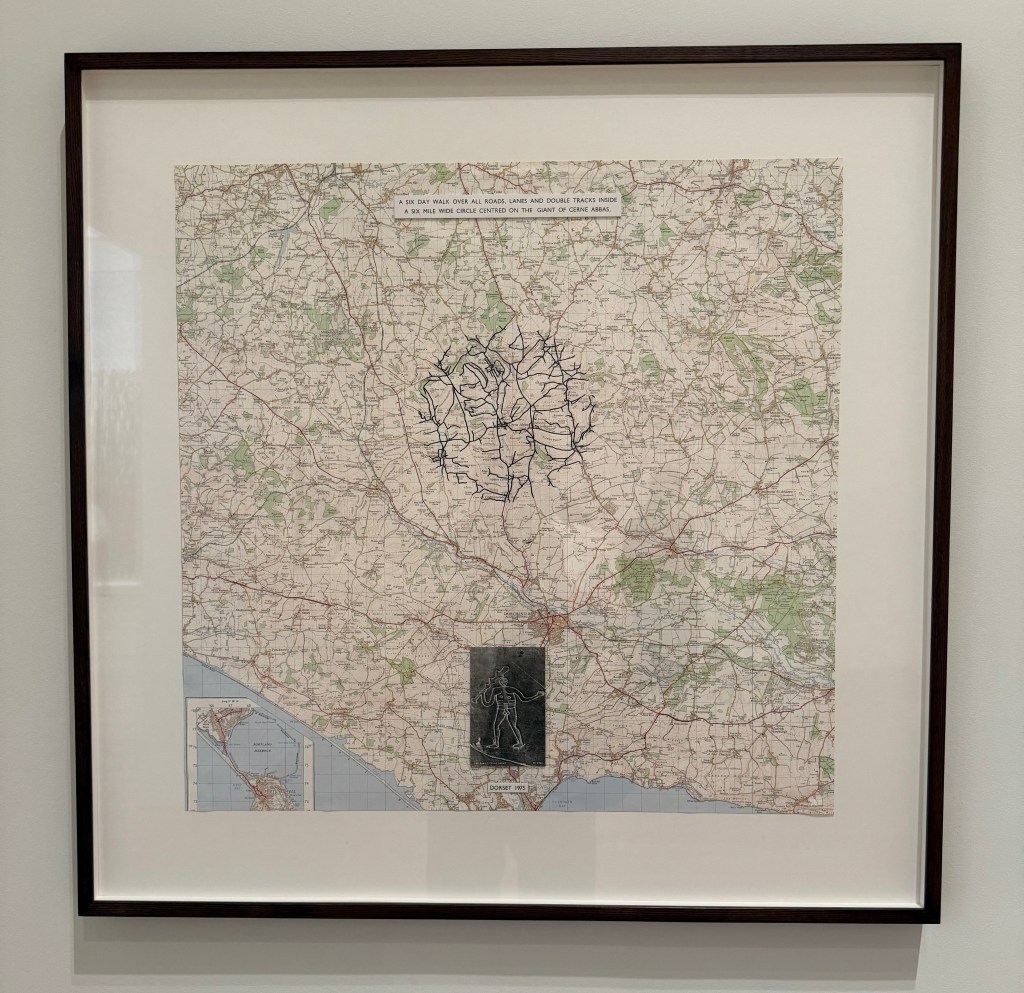
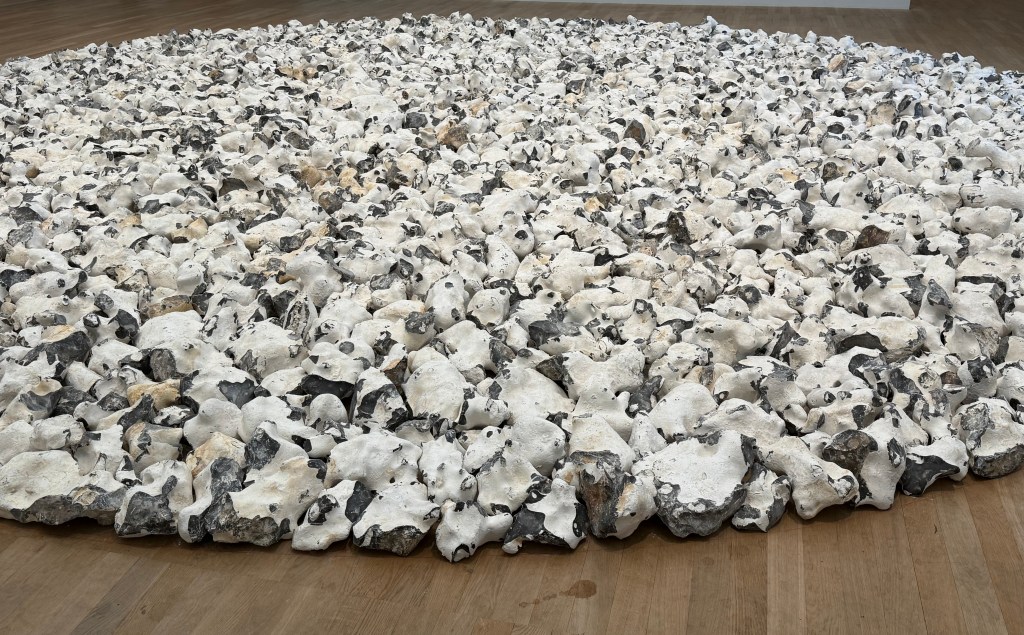
And then I saw an actual map in Richard Long’s Cerne Abbas Walk (1975) in which the sculptor/ land artist documents a six-day walk at a well known Dorset landmark, detailing his physical interaction with the landscape. I couldn’t help but stop and spend quite a long time just looking at his 8 metre wide Norfolk Flint Circle (1990) which creates its own extraordinary landscape.
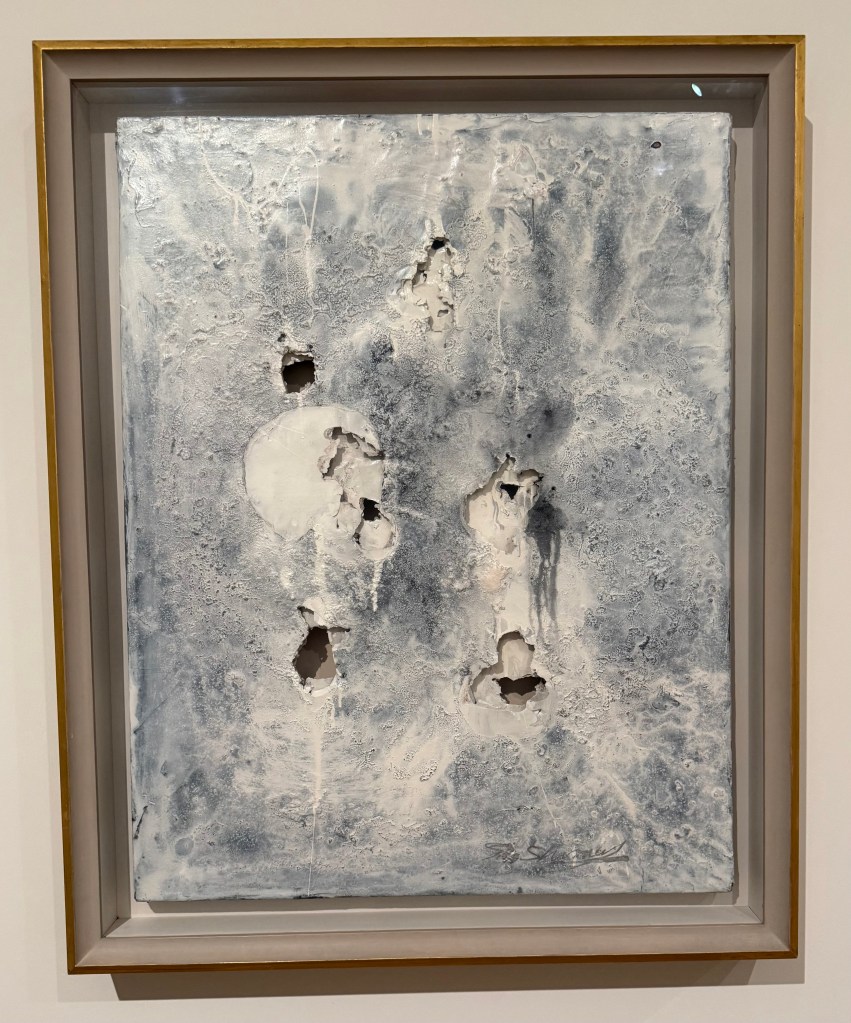
I didn’t make a note of this next work which is frustrating as I was intrigued by the holes and layers beneath.
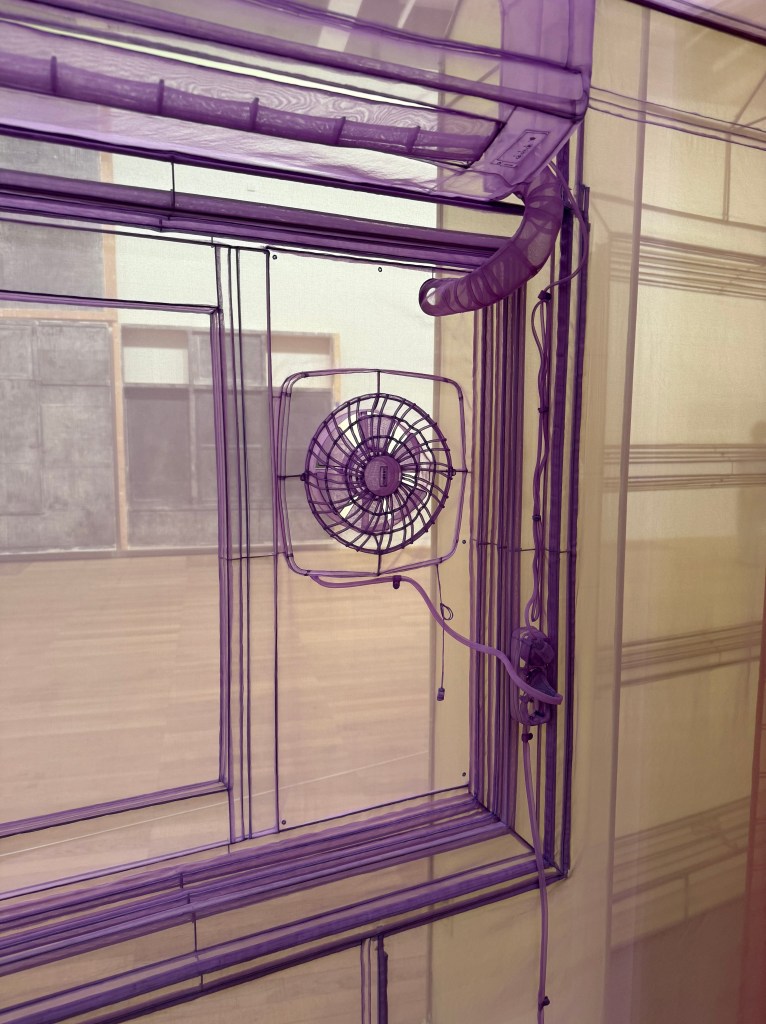
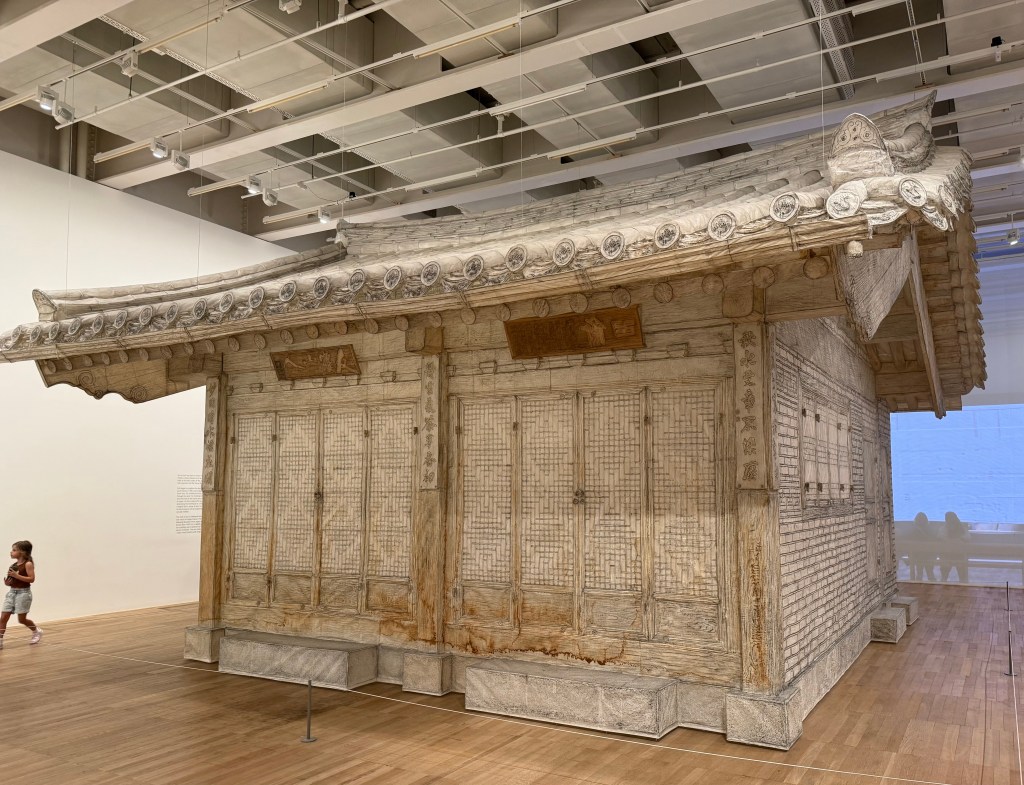
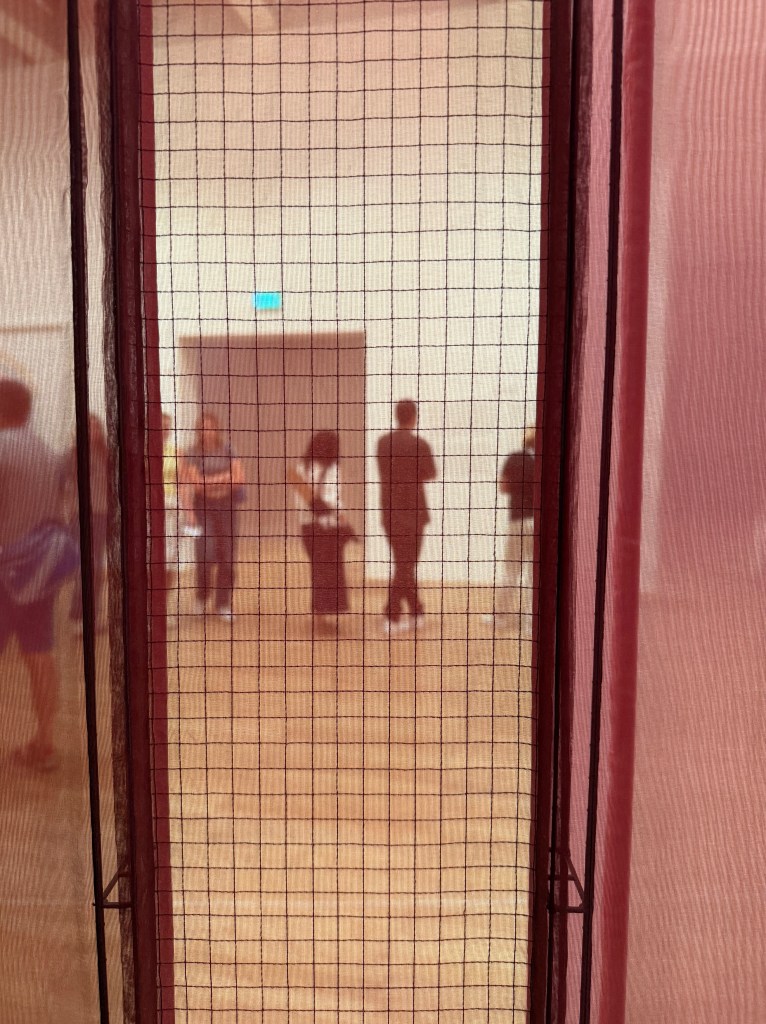
Then it was on to Do Ho Suh’s Genesis exhibition. Lots of transparent layers, grids and threads, all of which appealed to me.
Some wonderful Giacometti’s in the Tanks, emerging from the darkness and given form by the wonderful lighting.

An accidental slip of the phone, but an interesting image.

Arachnid

Whenever I go to B&Q, I always want to come home and do some DIY; whenever I visit a beautiful garden, I always want to come home and sort out our garden; whenever I go to an exhibition, I always want to come home and make.

I’ve been feeling in need of a pick me up recently, and so yesterday I headed into London on a hot, Notting Hill Carnival, Bank Holiday Monday to catch Louise Bourgois’ ‘Maman’ on its last day at Tate Modern, the very space for which it was commissioned back in 2000. There’s no doubt that it’s impressive at 9m tall – again, I ask myself whether it’s all about the size, but I think any spider larger than real life would have an impact. I had an overwhelming urge to touch it, but resisted in light of the ‘Please Do Not Touch Sign’. I also found myself wondering how they got it into the building, memories of Johnny Vegas’ struggles coming to mind.

It was well worth the trip, a rare chance to see a piece in the flesh in the very place for which it had been made. Having said that, I’ve seen some images of it in a landscape, which I find particularly effective.

Tate Modern’s website on ‘Maman’:

Louise Bourgeois started making sculptures of spiders in the 1990s. This version is her biggest spider. Its title, Maman, is French for mummy. The artist said spiders reminded her of her mother: ‘Like a spider, my mother was a weaver. My family was in the business of tapestry restoration, and my mother was in charge of the workshop. Like spiders, my mother was very clever … spiders are helpful and protective, just like my mother.

I’m a bit behind with things at home, and we’re starting to amass some really impressive cobwebs. I watched as a flying insect became entangled in one of them; in a flash the spider came from nowhere and quickly got to work wrapping it up.

I’m not sure that spiders are clever as such, but they do have great skill. I don’t really think of them as being helpful and protective: they set traps that you can’t see, they ambush you and then swaddle you up until they consume you. Although, I don’t have a problem with them, as they catch flies etc, as long as they are not where they’re not supposed to be, such as on the bedroom ceiling above my head, or in the bed.

Lifelong arachnaphobe, Primo Levi, in his essay ‘The Fear of Spiders’:

“The spider is the enemy-mother who envelops and encompasses, who wants to make us re-enter the womb from which we have issued, bind us tightly and take us back to the impotency of infancy, subject us again to her power…”

I’ve tried not to be either of those spider mothers. I’ve tried not to be suffocating and I’ve tried to resist the urge to fix things. I’ve definitely failed; I often tell my daughter that I’m trying my best, and, when she’s older, not just to remember the times when I’ve not been at my best, like I seem to have done with my own mother. It’s that negative bias again, I suppose. I’m now actively remembering all the times when she was kind and caring, supportive, and all the laughs we had together, which by far outnumber the not so good.