It’s All Part Of The Process

I’ve been doing quite a bit of thinking this week.

The first time, as a result of our weekly session, unprofessional v professional. We considered all that is implicit in the terms professional and unprofessional, and then read and discussed an article ‘How to be an Unprofessional Artist’ by Andrew Berardini, 23 March 2016, MOMUS.

I came away from the session feeling confused, and no longer having a clear sense of direction. My aims in my Study Statement are designed to help me fulfil my aspiration of becoming a practising professional artist. I’m now questioning what I even mean when I use the term ‘professional’. If it means losing creative autonomy, losing the love of creating because it has become an expectation or much worse, a chore; having to repeatedly make things because they are popular or asked for, then, no, I don’t think that’s what I want. But what is the alternative, just to carry on as I am now, making art for me and leave it at that – be a hobbyist like my mother said; be an amateur? I don’t think that’s what I want either. That’s not why I’m here.

Maybe when I get there, if I ever do, the answer will become clear. Perhaps the best course of action is to aspire to be a practising artist for the time being, making more time for creating. There’s no point trying to run before I can even walk.

I then spent some time reflecting on the cyanotypes I made, and all the possible further paths that I could go down. I started thinking about processes and re-processing. How you can take a painting, for example, take a photo of it, digitally alter that photo, incorporate other elements, say, by way of collage, print it out, print on top of it, paint on it, photograph it, keep changing it, keep re-processing it.

It then occurred to me that I’m just one big walking process made up innumerable smaller processes – breathing, talking, thinking, digesting, and on and on. Not just that, but that life is a process with all its constituent processes. Growing, having children, loving, caring, grieving, healing, dying are all processes by which we are, ourselves, processed.

So, I think that I’ve reached a point where I’m thinking about the reprocessing of art and the reprocessing of me. It’s probably because I’ve been thinking a lot about process recently, writing the word goodness knows how many times in Doing Lines, and reading ‘Ultra-Processed People’ by Chris van Tulleken. But it does occur to me that I have led most of my life too focused on the product, and not really living in the process.

Something for me to think about.

ARTificial Intelligence II

I’ve just been watching ‘Sunday with Laura Kuenssberg’ and one of her guests was Baroness Beeban Kidron, a former film director who was appointed as a crossbench peer. She specialises in protecting children’s rights in the digital world, and is an authority on digital regulation and accountability.

The topic of conversation was Labour’s plan to change copyright law so that tech companies can scrape copyrighted work from the internet to train their generative AI tools free of charge, unless individual creatives decide to opt out. They are proposing what is, in essence, legalised theft.

Labour launched their AI Opportunities Action Plan two weeks ago. They intend that the UK should become a world leader in AI with the amount of computing power under public control being increased 20 times over by 2030. They will achieve this by making huge investments (£14bn provided by tech companies, of course!) in setting up the infrastructure needed to create AI growth zones, a ‘super computer’ as well as huge energy intensive data centres necessary to support it. Clearly this will have a significant environmental impact and is at odds with Labour’s election promise to hit its green target to create a clean power system by the same date of 2030, which some experts think was going to be difficult to meet anyway.

Apparently, this will result in the UK’s economy being boosted by £470bn over the next 10 years. This may well turn out to be Starmer’s figure on the side of the bus. Kidron commented that the small print reveals that the figure was sourced from a tech lobbying group which was paid for Google and which was arrived at by asking generative AI, and which, in any event, reflects the global, not the national, uplift in the economy.

Kidron is a vocal supporter of the option to opt-in rather than putting the onus on the individual creative to contact each of the AI companies, who are using their work, to opt out. In fact, opting-out is something that’s not technically possible to do at the moment. To this end, she has put forward amendments to the Data (Use and Access) Bill which will be debated in the House of Lords this week. She has also previously commented in the press that she can’t think of another situation in which someone who is protected by law must actively wrap it around themselves on an individual basis. I think she makes a good point, and I agree with her view that the solution is to review the copyright laws and make them fit for purpose in an AI age. The creative sector, which includes artists, photographers, musicians, writers, journalists, and anyone else who creates original content, is made up of about 2.4 million people and is hugely important to the country’s economy, generating £126bn. That money should be kept within the economy, and not be siphoned off to Silicon Valley.

Not surprisingly there has been a great deal of backlash from creatives including actors and musicians, such as Kate Bush and Sir Paul McCartney, since Labour announced their plans. As part of the segment, Kuenssberg interviewed McCartney who is very concerned as to the effect this will have, especially on young up and coming artists. He commented that art is not just about the ‘muse’ but is about earning an income which allows the artist to keep on creating. He fears that people will just stop creating because they won’t own what they create, and someone else will profit from it. AI is also a positive thing: he explained that they used it to clean up John Lennon’s voice from a scratchy cassette recording making it sound like he only recorded it yesterday, but he is, nevertheless, concerned by its ability to ‘rip off’ artists. He mentioned that there is a recording of him singing ‘God Only Knows’ by the Beach Boys. He never recorded the track; it was created by AI. He can tell it doesn’t quite sound like him, but a normal bystander wouldn’t be able to tell the difference. In a year’s time, even he won’t be able to tell the difference.

There is a petition which has been signed by over 40,000 creatives, and the Government is undergoing a consultation procedure which you can respond to with your comments online here. The consultation ends on 25th February.

So, what can we do in the meantime?

Short of going offline, which isn’t really an option, there is nothing which will ensure that our work is not used in training generative AI. Just from some cursory research, which incidentally was helpfully summarised by Google’s AI Overview, there is the possibility of using a watermark to protect images either physically (not so good for promoting work) or invisibly embedded in the image, using digital signatures, or a cloaking app such as Glaze, which was developed by the University of Chicago, which confuses the way AI sees your image by altering the pixels, or by using another of their apps, Nightshade, which alters the match between image and descriptive text.

For now, all I can do is to change my privacy settings on my Facebook and Instagram accounts to prevent Meta from being able to use data from my posts to train its own AI tools. I had to fill in a form explaining why I objected to them using the data, and I received email confirmation that they would honour my objection, but who’s to know if they do or not? Apparently, there is a website, Have I Been Trained?, which allows you to search for your work in the most popular AI image dataset, LAION-5B.

What’s possibly just as disturbing is the Government’s plan to allow big tech access to one of the biggest and comprehensive datasets in the world – the NHS. It’s all in one place, we all have an NHS number which gives access to a lifetime’s history of personal and health data. It will be done on an anonymous basis, but with enough data, even experts say it’s easy to re-identify people. No-one’s doubting the incredible possibilities that AI offers in terms of delivering healthcare, but proper safeguards are needed.

Anyway, I asked the WordPress AI to generate a header image based on its own prompt:

“Create a high-resolution, highly detailed image illustrating the theme of digital rights and AI regulation. Feature Baroness Beeban Kidron in a thoughtful pose, surrounded by symbols of creativity such as art supplies, musical instruments, and books. The backdrop should convey a digital landscape, with elements representing technology and copyright, like binary code and padlocks. Use soft, natural light to evoke a sense of seriousness, yet hopefulness. The image should be in a documentary style, capturing the urgency of the conversation about protecting creatives’ rights in the age of AI. Ensure sharp focus to highlight the intricate details in each element.”

Sorry, Jonathan – I will switch my mobile phone off for the rest of the day so I don’t have to recharge the battery, but, in the meantime, do we have much to worry about? It doesn’t even look like Beeban Kidron.
Part One: Think Like An Artist

… and Lead a More Creative, Productive Life by Will Gompertz isn’t taking me long to read at all. Gompertz, artistic director at the Barbican, makes some very interesting and thought-provoking observations on what it is to be creative. As I’m galloping through it at such a speed, I thought it best to highlight some parts, as I go along, which I think will either help me in finding my artistic voice, or which reinforce ideas and concepts which we have touched on in the course so far.

On failure:

When it comes to creativity, failure is as inevitable as it is unavoidable. It is part of the very fabric of making. All artists, regardless of their discipline, aim for perfection…But they know perfection is unobtainable. And therefore they have to accept that everything they produce is doomed to be a failure to some extent…Thomas Edison knew all about the notion of sticking at it…But at no point did he countenance failure: ‘I have not failed 10,000 times,’ he said. ‘I have not failed once. I have succeeded in proving that those 10,000 ways will not work. When I have eliminated the ways that will not work, I will find a way that will work‘…There is plenty of time for wrong turns, for getting lost; for feeling generally hopeless. The crucial thing is to keep going. Artists appear glamorous and blessedly detached, but in reality they are tenacious grafters: they are the proverbial dogs with bones… And while they are out there, worrying away, they often discover a hidden truth about the creative process… Their success is very often down to a Plan B. That is, the thing they originally set out to do has morphed along the way into something different.”

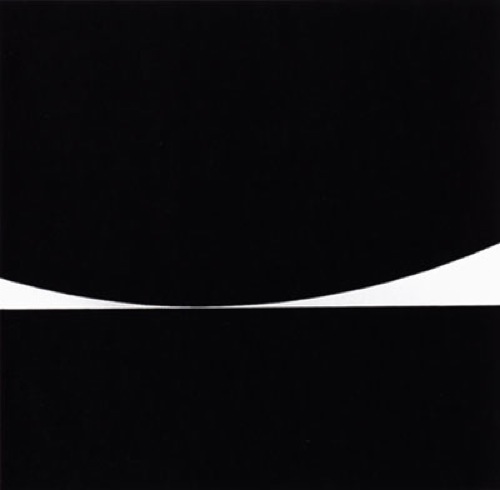
He references several artists who started out in one direction only to find their success through a Plan B, such as Mondrian, Lictenstein and Bridget Riley. In the case of the latter, in the early part of her career Riley was interested in colour theory and the work of the Impressionists, the Pointillism of Seurat, and the composition of Cézanne. It wasn’t working for her; she was directionless and lacked originality, and she was getting older. The ending of a relationship caused her to paint a canvas black, and she took all that she had learnt from her studies of Seurat et al and applied her knowledge in abstract terms. She painted a white horizontal line the lower edge straight, the upper edge forming a curve – it became a painting expressing the dynamism and inequality of relationships, human and spatial.

’Kiss’, 1961, Bridget Riley (Wikiart 4 Jan 2025)

Bridget Riley had to abandon the one thing she thought most important and appealing about painting – colour – in order to make any real progress. It didn’t mean colour could never feature in her work again, only that at that precise moment in time it was the roadblock… Only when [she] went back to the most basic of basics – a canvas covered in black paint – did she find the necessary clarity to progress. Only then did she discover the most precious and liberating of things: her artistic voice… As long as you stick at what you are doing, constantly going through the cycle of experimentation, assessment and correction, the chances are you will reach the moment when everything falls into place.”

The cycle of experimentation, assessment and correction is at the very essence of this course: Practice-based research.

Gompertz also states that if you call yourself an artist and make art, then you are an artist regardless of where you are in the process, or what skills you still need to learn and develop. I think I find this the hardest to embrace – I still can’t quite think of myself that way. I’ve only just got my head around being a student – in retrospect, it probably wasn’t the best idea to try it out first on the border official at Marrakech airport who looked at me with incredulity and repeated “Student?”. Admittedly, it’s been a lot easier since I discovered all the discounts available!

On ideas:

Gompertz asserts that originality in a completely pure form does not exist; that all ideas are additional links in an existing chain, each link adding to the one before. It is a form of disruption: something to react against and respond to, to build upon. He suggests that Picasso, in the quote attributed to him – good artists copy, great artists steal – is actually describing a process that an artist needs to go through: we learn through copying and imitating, and it is only once we have done this and developed the basic techniques that we can identify opportunities to add our own link to the chain, and to find our own artistic voice. This reminds me of my discussion with Jonathan about Frida Kahlo’s ‘The Two Fridas’, when I questioned whether any work I make which is inspired by it will be original enough: he advised me that Kahlo painted it in the late 1930s and I would be doing my version almost 90 years later expressing my own feelings – following Gompertz’s reasoning, I would, in effect, be adding my own link to her existing link in the chain.

In fact there are numerous creatives who have been quoted as admitting to building on the ideas of others.

If I have seen further it is by standing on the shoulders of giants.” Isaac Newton

Creativity is knowing how to hide your sources” Einstein

We have always been shameless about stealing great ideas”. Steve Jobs

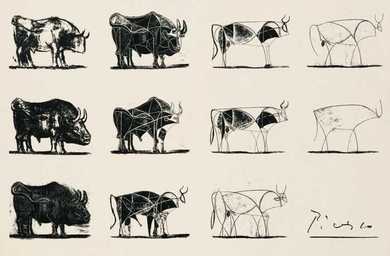
The young Picasso produced work which imitated the likes of Goya, Velázquez and El Greco, and later the Impressionists and Post Impressionists. It was only when his friend, Casagemas, died that he found his own artistic voice in his Blue Period; the blocks of colour, bold lines and expressive manner, which he had learnt from all those artists he had imitated, still influenced him, he just put his own twist on it. He took their ideas and filtered them through his own personality and experience, and used his instincts to simplify and reduce them into his original thought, into new and unique connections. Being creative isn’t always about adding to something; it can be at its most original when taking something away. This is demonstrated perfectly by Picasso’s bull lithographs, which took him a month to complete.

‘Le Taureau‘, 1945/46 (Wikipedia, 5 January 2025)

There is no such thing as a wholly original idea. But there is such a thing as unique combinations.” Gompertz

ARTificial Intelligence

In our session this week we looked at AI image generation, in particular, how the tools are trained by using a huge number of datasets created by scraping data from the internet; the impact of this form of training including bias and breach of IP rights; its ethical and environmental impact; and the effect on us, as artists, in terms of our own relevance, the potential use of our work as training input, and our ability to use AI to create output in our artistic practice.

It is astonishing how quickly this area is developing. However, until it reaches a stage whereby AI can create an image in which there is human emotion and imperfection, we probably won’t become obsolete just yet.

Being from a legal background, I was particularly interested in the issues that generative AI tools have thrown up in terms of intellectual property rights. The main issues seem to be the potential breach of copyright in both the collection of data for training, and the output created, as well as the question as to who owns the output and whether it should itself be protected by copyright.

The problem with data scraping is that whilst the data is widely available in the public domain, this doesn’t mean that it can be copied and used without limitation (in the UK the only current exception to copyright protection in respect of text and data mining is for non-commercial research). This could mean that any images of artwork which I have produced, and which are publicly available on the internet, could be used to train generative AI and, consequently, could possibly form part of an output image generated by a third party, despite the copyright in the original image belonging to me. It’s a contentious issue, and there is lots of litigation going on at the moment across numerous jurisdictions including the UK and the US. In the UK, Getty Images has taken action against Stability AI for using millions of Getty Images to train its Stable Diffusion tool. Claims have similarly been made in the US against Meta, Midjourney and Anthropic, amongst others.

Another related issue, is that generative AI platforms will generally reserve the right to use any input or prompts from users to improve the performance of the tool, which could have implications in terms of privacy and confidential information.

Whilst it is unlikely that generative AI will create images which are exact reproductions of copyrighted images which have been used for training or as input, should there be sufficient similarity, there may be a potential breach of IP, but this will depend on an assessment being made in each case. It will also depend on being able to pinpoint where the content has come from, bearing in mind the huge number of resources across many jurisdictions. As part of their case with Getty Images, Stability AI are relying on the defence of fair dealing, as well as that of parody, caricature and pastiche i.e. that the image generated is not a replacement for the original image but a pastiche, and so it does not affect the market for the original image or its value. It probably didn’t help that in this case that some of the output images contained parts of the Getty Images watermark. This case is destined to be a trailblazer, but we won’t know the outcome until the middle of next year.

It is theoretically possible that an image created by prompts and inputs from a user of generative AI is capable of being owned by the user. However, the user cannot assume that they own the content or that they are able to use it as they wish. Firstly, who is the owner of the created image varies from country to country. Secondly, the terms and conditions of the platform may determine ownership and rights e.g. Midjourney’s terms and conditions, whilst providing that the user owns the created image, state that by using the service, the user grants Midjourney and all its affiliates etc. extensive rights in relation to the output image to reproduce and sub-license it etc. at no charge, and royalty free.

In the UK, the author of original literary, dramatic, musical or artistic work owns the copyright in that work, unless it was created in the course of employment or by way of commission. There is no need for registration in order for the work to be protected, unlike in the US where it has to be registered with the Copyright Office. In fact, the UK is one of the few countries which recognise copyright protection for computer generated works. However, for the work to be original it must be the author’s intellectual creation and reflect their personality. It is not clear how this might be applied in the context of work created by AI. Furthermore, the ‘author’ is the person by whom the necessary arrangements for the creation of the work are undertaken. So, who is that? The user who specifies the prompts, or the person who created the AI tool? This issue is likely to be decided on the facts of each case, including the T&Cs of the platform.

It’s all very much up in the air, and destined to become even more complicated, the more sophisticated generative AI becomes. For the time being, as artists it would be a good idea to take the precaution of reading the small print of the platform being used, keeping detailed records of the process being used including all the prompts in response to which the image was generated.

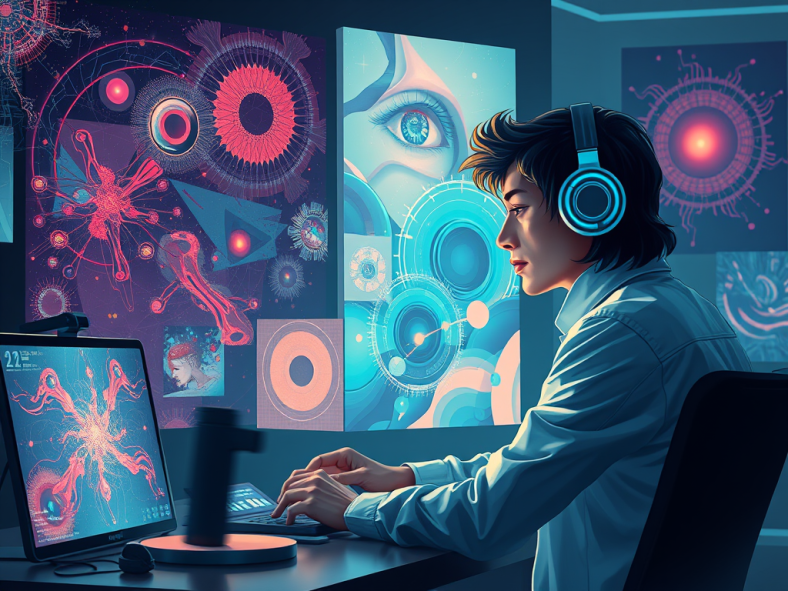
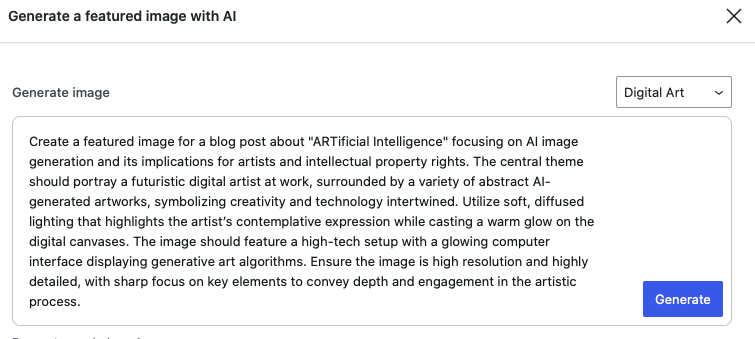
Whilst writing this post, I noticed the WordPress AI Assistant. It created the image at the top of this post after generating the following prompt based on the contents.

I’ll finish with Alan Turing’s warning which he gave in a lecture in 1951:

” Once the machine thinking method had started, it would not take long to outstrip our feeble powers. At some stage, therefore, we should have to expect the machines to take control.”

If You See It, Just Buy It.

This post has been sitting in draft for a while now. I’m not sure why I’ve been delaying in publishing it – maybe a reticence to commit in case something better comes along. Rather like the way I shop: I like to browse in every single shop to see all the available options, and for the most part end up going back to the first shop, several hours later. My husband, on the other hand, sets out with a list and buys the first item which fits the bill – his advice to me is that if I see it, I should just buy it, and save myself the aggravation. So what if I do have a better idea further down the line? That’s part of the process isn’t it? To reflect, adapt and recognise the need for a change of direction.

I’ve been giving further thought to what I would like to explore over the next couple of years. I’m afraid it’s not a laugh a minute, but it’s something that’s been on my mind for a while.

Not to be egocentric about it, but it’s ME! Then again that’s not a surprise as everything I make, even within the constraints of my art class, is subconsciously about me in one way or another: how I see the world; what matters to me; what interests me; about me; my experiences.

I remember sitting in the back of the family car as a child, probably on one of those Sunday afternoon drives in the Black Forest my parents used to like, with my brother on the back seat playing my dad’s favourite Elvis Presley and James Last songs on his double deck cassette player and thinking to myself: Who am I? This is me. Here. Right now. I almost tried to climb inside myself which messed with my head a bit. I must have been about 7 years old.

Who am I, as a person, as an artist? Hopefully by the end of the next two years I might have a better idea.

I’m particularly interested in my identity in the sense of nature and nurture: who is the authentic me – the one that drew its first breath? As Z recently mused on her blog ‘we will never be as unmarked as when we were born’. How has that version of me been influenced by my life experience, in particular, the roles I have had in my life?

This line of thought was prompted by the death of my mother in 2023. As my father had passed away in 2013, she was my lone parent. It struck me that my role as a daughter was coming to an end. Arguably it had gone on hiatus sometime earlier when I started to care for her following her cancer diagnosis, whereupon my role became that of carer. Some roles in life are mutually exclusive and in my case this was more or less true of my roles as daughter and carer – maybe it was a coping mechanism. As a result, I have issues in processing that brief, but cataclysmic, period of my life.

My mother’s death also made me consider my role as a sibling and the subsequent sense of estrangement I feel from my brother and, conversely, the closeness I have with my sister as a result of our shared experience of caring: sometimes only someone who has gone through the same experience can truly understand how it feels.

What effect does the ending of a role have on identity? What if I feel that I have failed in some roles? What if others think that I have failed? What if my roles conflict or were not mine by choice?

In being a mother I reflected on my experiences as a daughter to try and be the best mother I could be, and so the cycle will continue, perhaps. I’ve been a career woman, a homemaker and, still am a wife. At some stage I have lost the sense of the real me, if there is one: some roles allowed others to prosper whilst I took a back seat. Words which particularly resonate with me are from Deborah Levy’s The Cost of Living :

“It requires skill, time, dedication and empathy to create a home that everyone enjoys and that functions well. Above all else, it is an act of immense generosity to be the architect of everyone else’s well-being.”

In my head I’ve been Norman Foster.